
Peter Hitchens's Blog, page 164
May 20, 2016
An interview of PH by an Irish website
Some readers may want to read this interview of me on an Irish website
https://irishenergyblog.blogspot.co.uk/2016/05/an-interview-with-peter-hitchens.html
Some may not


May 17, 2016
Is this About Helping the Tatars - or Just Another Pretext for Attacking Russia?
I am always amused when the wider world catches up with things I���ve known for decades. The inexcusable and savage deportation of Crimean Tatars by Stalin is one of the many bloodstained blots on that appalling man. Now, thanks to the Eurovision Song Contests���s award of first prize to a song on the subject by ���Jamala���, the world has discovered it.
I first became broadly conscious of it in the late 1980s when Mikhail Gorbachev���s reformed Soviet state began to allow the descendants of the deportees to return to their former homes. This was long after the Soviet state had officially admitted (in 1967) that the deportations had been wrong. As this was the USSR, this act was not accompanied by any great state generosity or efficiency, and I suspect it was often quite unpopular among Russians (and Ukrainians) in the Crimea who had to cope with the arrival of the returnees, never a simple matter even if the arrivals are positively saintly. Even so, it happened and there are now, I believe, more Tatars living in Crimea than before the deportations.
Soon afterwards the USSR fell to pieces and these events (like the plight of the Tatars, too little known) described here http://hitchensblog.mailonsunday.co.uk/2015/02/a-not-so-brief-history-of-crimea.html
led to Crimea being forcibly prevented, in 1992, from leaving Ukraine, as many of its people wanted to do, having signed a petition in large numbers seeking a referendum, and been made, by threats of force, to abandon this plan. There is a an interesting contrast between Ukraine���s menacing refusal to allow Crimea to decide its future, and Moscow���s complete willingness to allow Ukraine to decide *its* future. I am surprised so few people know about this or allow it to influence the general view of Ukraine as some sort of unimpeachable Saint Among Nations.
I have been able to find *nothing* anywhere, suggesting that the treatment of the Crimea Tatars by the Kiev government (corrupt, broke and inefficient) was in any way more generous, more kind, more anything, than it had been under the final years of the USSR. I would be grateful for any information on this. What is certain is that there is neither continuity nor comparison between Stalin���s Tatar policies and those of the Putin State. So what exactly is the current fuss about the Tatars intended to achieve or suggest?
There has certainly been some friction between the new Russian authorities and the Tatar leadership, since Russia seized Crimea in 2014, but this is the direct consequence of the decision of the Tatar leadership to attack the annexation. They are of course entitled to do so, though I���m not quite sure what their grounds are, They should be free to do so, but I must confess that I unsurprised that this has led to poor relations between the Tatar leadership and Moscow. But I can���t help feeling that the Tatar cause is being used by Ukraine ( and perhaps others) to make easy trouble for Russia. Moscow���s post-2014 treatment of the Tatars may well be at fault, and there is certainly nasty evidence of repressive government in Crimea, but do those who laud ���Jamala��� actually care about the Tatars? Are they for the Tatars? Or are they just against Russia?
Much of EU Europe has problems of one kind or another with poorly assimilated Muslim or non-Christian minorities. The Sinti and Roma in Slovakia and Hungary are, I believe, not always well-treated. Much of Western Europe, notably France and Germany, plus Sweden, is struggling to cope with the recent influx of Muslims from Asia, the Middle East or Africa, and will; struggle more in years to come, I suspect. Let us see how they get on. It would plainly be wrong to judge them on the basis that their predecessor governments, long ago, did unforgiveably dreadful things to some minorities. Wouldn���t it?
And then there is now. China, whose President we so recently entertained at Buckingham Palace, and on whose behalf our police barged into and arrested peaceful protestors in London, is not behaving in an exemplary fashion towards the Turkic Uighur Muslims of Sinkiang (Chinese Turkestan, as it was once more informatively known), and indeed is more or less reducing them to a minority in their own land while demolishing historic evidence of their culture (let us not even mention Tibet). You may read about this here http://www.dailymail.co.uk/news/article-1233439/Special-Investigation-PETER-HITCHENS--Blood-fear-Happiness-Street-China-threatens-obliterate-ancient-culture.html
Yet I never notice anyone making much fuss about this , or about the horrible fact that an entirely peaceful dissenter against these policies, Professor Ilham Tohti, has been flung into prison *for life* in China after a parody of a trial:
while his wife and two young sons were left destitute by the state seizure of his savings - with remarkably little protest from the righteous brigades who have so much to say about the wrongs of Russia.
Are those who chose to make the Tatars This Week���s Good Cause concerned about opposing injustice in general, or actually concerned about attacking Russia in particular? Let���s see if anyone writes a song about Professor Tohti and his poor penniless family, and it wins the Eurovision Song Contest.
,
More Interesting Material on the 'Addiction' Fiction
Don���t take my word for it that ���addiction��� is a fiction. Please read this
May 15, 2016
A Debate on the Death Penalty
Here those who wish to may watch the opening segment of a debate on the death penalty in which I recently took part, at Stationers' Crown Woods Academy, a school on the South-Eastern fringes of London
https://www.youtube.com/watch?v=6fsjo4jry9Y
Gluttons for capital or other punishment may watch the whole thing here
Link to playlist- http://www.youtube.com/playlist?list=PLY4JQ3kcsI_sB-umwmgJDEsBlO62Yvig-
Link to video 1/4- http://youtu.be/6fsjo4jry9Y
Link to video 2/4- http://youtu.be/pj081BXdEvo
Link to video 3/4- http://youtu.be/prKOhySyY1I
Link to video 4/4- http://youtu.be/5pT8cOHgSqk
An Exchange with a Sympathiser of Billionaire Big Dope
The following exchange, with a Mr Falconer, appears in the comment thread beneath 'More notes on marijuana legalisation...'
I thought it deserved a wider audience. Mr Falconer is of course free to reply at length, the word limit will be waived for him. My responses are bracketed with asterisks.
Mr Hitchens
I happen to know a great deal about drugs and drug policy, having followed the debate for nigh on three decades. (***PH remarks: 'Jolly good!"***) I also know your arguments backwards (**PH asks : Does he really? It seems from much of the below that he has paid little attention to them so far, backwards or forwards****), and they are disingenuous at very least.
**PH remarks: I think this means that he disagrees with me. Well and good, many people do. But, as a fact, the information that he disagrees with me is, by itself, unpersuasive.***
Firstly, your accusation of "Big Money" buying up the California referendum is absurd to say the least. Do you seriously expect that any major political campaign can be funded for nothing, and frankly why should it, when its opponents have access to plenty of cash, whose putting up the money for the prohibitionist SAM organisation I wonder.
***PH responds. I am well aware of the costly nature of American campaigning. I note that Bernie Sanders, a contender for the Democratic Party's Presidential nomination, has funded his campaign entirely without billionaire backing, amassing the necessary cash through many small individual contributions. One also has to differentiate between donations to a cause which would open major commercial possibilities, and to one which would block them.****
Secondly, you keep on saying, oh why should anyone bother wanting legalisation, it's as good as legal now, there is no prohibition. Mr Hitchens, you know well enough that a thing is either legal or it is not. Cannabis is illegal, therefore the entire market is gifted to organised crime.
***PH: On the contrary, the British and US governments have (in my view deliberately) achieved a position where the substance is officially illegal(to satisfy international treaties) but in practice legal, so it can indeed be both at the same time.
***PH further notes: The product itself is damaging to those who buy it, whatever its legal status. I really don't see why it would be better for it to be in the hands of cynical businessmen than in the hands of organised crime. The cynical and greedy supply (for profit) of a dangerous poison to consumers who will be damaged by it is wicked whether legal or illegal. The principal difference between legality and illegality is the number of victims, which will be far greater if the drug is legalised.
Also, he mistakes or misrepresents my point. My point is a) that the claim of harsh prohibition, a principal argument of the legalisers, is based on a falsehood; that the step from decriminalisation to legalisation would not greatly alter the ability of those who want to buy and use marijuana to do so. It would therefore have only one major effect - on the sellers and suppliers : it would allow the open sale and advertising of the drug, the taxation of it by the state, and the involvement of major investors and banks in financing its production, promotion and distribution.*
I wonder if you are aware that cannabis, or marijuana,as the Americans call it, is the main commodity for the cartels.
***PH: I am aware of it.***
They earn more money from cannabis than any other banned substance, and legalisation hits them very hard. The fact that the state chooses not to enforce its laws against possession of cannabis does not amount to a legal market, and that is what people are campaigning for,
***PH: Quite so***
as they are tired of people like you demonising what is in fact a mainstream recreational intoxicant with dangers no worse than alcohol.
*** PH asks: What objective, testable calculus has he used to reach this conclusion? Has he even taken into account the fact that marijuana, not being legal, is used far less in our society than alcohol?***
***PH further comments: He means, they are frustrated by the continuing insistence by people such as me that marijuana is not a safe drug, which is not 'demonising', but a statement of plain fact given the growing correlation between cannabis use and mental illness (Swedish Army Study, Dunedin Study, many works by Professor Sir Robin Murray etc). It use is at the least restrained by it not being advertised, promoted or on commercial sale via shops or the Internet.
It is also observable (in the case of tobacco) that governments, which receive large tax revenues from an unhealthy or dangerous product, are reluctant and slow to do too much to suppress or discourage use of that product. Were it to be legalised, it is highly likely that its use would increase. Its bad consequences would then increase as well (driving while under the influence of marijuana is already a growing problem and public danger in the UK, and I have many times highlighted here the instances of violent criminals being under the influence of marijuana at the time of their crimes).
So it is at least arguable that its widespread use would be at least as disastrous as the widespread use of alcohol -which nobody would now make legal, if it were illegal, in the knowledge of its effects which we now possess. But as we also know, products which have been legal and in mass use for any significant period cannot realistically be made illegal again. Legalisation is an irreversible step, and it would be an act of extraordinary rashness to legalise marijuana just as we begin to discover its dangers.**
Your pointing up of the few cases of damage done by cannabis....
***PH comments: This, too , is a misunderstanding. I repeat, for the umpteenth time, that the cases about which I write are chosen because they are from a small sub-set of high-profile crimes where in-depth reporting has uncovered the use of cannabis. In this sub-set, the correlation between marijuana use and violence is close to 100%. We simply do not know how pervasive its use is among less-prominent criminals, because nobody has even asked. It would be unwise to be too sure about the far greater number of uninvestigated crimes. This is why I call for an inquiry into this very thing. Once again, to move towards legalisation *before* such an inquiry has reported is highly irresponsible.***
.... are insignificant when compared to the overall numbers of people using the drug.
***PH responds: See above, but until the correlation between violent crime as a whole and cannabis use is established, he cannot actually yet say that with any confidence. There is a lot of violent crime in our society which has been growing since cannabis was decriminalised. In any case, as he well knows, the violent crime issue merely *highlights* the basic problem - the damage the drug apparently does to the mental health of its users.This can take many forms, some homicidally violent, others merely tragic and miserable.***
It is equivalent to someone pointing to skid row alcoholics and demanding alcohol be banned; a call which would rightly be seen as ridiculous.
***PH: Not really. Most alcohol abuse does not lead to skid row, but just to unhappy and often desperate families in ruined homes, unseen by outsiders, ending in physical ill-health, unemployment, poverty and early death. That does not mean that it is illegitimate to point to the dreadful violence done by some users, as a reason for restricting its sale. And anyone with any knowledge of its effects would probably wish that alcohol had never *been* legal in the first place. The problem, for the third time is that it has been legal and in mass use for many centuries. Attempts to rescind this permission have failed wherever they have been tried.
We do not (with alcohol) possess the great piece of good fortune we have in the case of marijuana. Marijuana has never been both legal and in mass use. We can still prevent it ever reaching the same levels of use that alcohol has attained, as long as people such as Mr Falconer are ignored****
I am very sorry for those who suffer ill-effects from using cannabis, but the truth is that if the market were legal, it would [a] be easier for people to get help as it would no longer be a furtive illicit vice which must be denied by the user
***PH: This is twaddle. As we have demonstrated here repeatedly, the marijuana user has precisely nothing to fear from the law. I am not sure what 'help' he suggests they might seek, but the best help would never to take it at all.****
...and also [b] the quality of the cannabis used would be far higher than in the illegal market of today, where high THC skunk is the product most often used: the cannabis equivalent of the bathtub gin of the 1920's.
***PH: Once again twaddle. Legal alcohol is sold in increasingly high strengths, because it is what consumers want. The same would be true of legal marijuana. A poison is a poison is a poison. 'Quality' does not make it less so.****
You also probably know but fail to mention, in the majority of cases of cannabis psychosis it is a temporary condition which resolves when the person suffering it ceases using cannabis, rather than a lifetime mental derangement as you claim.
***PH notes: I would be interested to know of his evidence for this. My concern is in any case not 'cannabis psychosis', a term whose meaning seems to me to be vague and hard to define, but the long-term effects of the drug on the human brain, a complaint which so far has no name, but (as I explain in my book 'The War We Never Fought') mental illness is notoriously hard to define or diagnose in any objective, testable way. Yet it undoubtedly exists, in the form of irrational and often self-destructive behaviour in the sufferer, normally following some sort of physical or chemical damage to brain tissue. This is seldom if ever reparable. ****
You also state in regard to crime figures that the reduction in crime is due solely to reclassification of offences, which comes pretty close to the truly bottom of the barrel prohibitionist argument that "why don't we just legalise murder and theft and then we won't have any crime problem at all", conveniently ignoring the prescient fact that cannabis use, unlike theft and murder is a victimless 'crime',
***PH notes: My arguments about crime figures can be examined exhaustively elsewhere E.g.
As for the 'victimless crime' claim, on the contrary (as I have many times said here ( and as he would know if , as he claims above, he 'knows my arguments backwards') the principal victims of the marijuana abuser are his family.**
...unlike theft and murder which have very real victims who demand and should receive justice. Cannabis is only became a crime because right-wing, authoritarian racist bigots legislated prohibition statutes to make it so, a pattern that has been repeated ever since, especially by Richard Nixon, whose adviser John Ehrlichman later admitted the War on Drugs was fabricated in order to allow a police attack on the counter-culture and the civil rights movements.
***PH notes: this is just assertion and rhetoric. The laws against marijuana originate (via the League of Nations) in the terrible problems experienced in Egypt following widespread use of the drug, and first resisted by 'Russell Pasha'. This is described in my book, 'The War We Never Fought' .I believe Mr Erhrlichman has a bit of a grudge against his former employer, and I can easily understand why that might be. I am not sure we can take his testimony as gospel. ***
Finally, your claim that cannabis legalisation will inevitably be followed by marketing, advertising and internet sales. How is it then, that the government is able to regulate tobacco successfully, disallowing advertising and marketing etc of that substance,
***PH: It has taken governments more than half a century to impose anything remotely resembling control on tobacco, all of these restrictions fought inch by inch by Big Tobacco, during which time millions have died needlessly. To this day, these measures still fail to prevent millions of people from smoking, and from taking up smoking. Big Tobacco was driven backwards partly because people like Mr Falconer by and large viewed it with contempt, and government felt more confident in taking it on. But Billionaire Big Dope, by contrast has the sympathy and support of such people, and will therefore be far better able to resist attempts to control it. Also all modern western governments are desperate for tax revenue, and will not want to diminish it*
....but somehow will not be able to do the same with cannabis, which of course it will be able to do, as you well know.
***PH: No, they won't, no 'somehow' about it. See above.****
I quite expect that in keeping with your usual pattern, you will not allow this reply to your claims to appear on your blog, as you seem to have a tendency to want the last word.
*** PH his claim is proved untrue by its appearance here. He should withdraw it.****
No matter, the facts remain the facts, and on drug policy I repeat, you are quite simply wrong.
***PH adds: In his opinion, which is not, as he seems to think, a fact . Rather far from it, in fact***.
Lefties are spot on, their precious BBC IS at risk... it may have to lose its bias
This is Peter Hitchens's Mail on Sunday column
 As I have actually been to North Korea, and lived in Russia, I feel qualified to comment on some stupid remarks by a Leftist BBC favourite, Peter Kosminsky.
Mr Kosminsky, a much-garlanded film-maker, absurdly compared government plans to reform the BBC with the control of the airwaves in North Korea and Russia.
Here���s the thing I noticed about North Korea, and which was true of all the communist states in their pomp (which I saw). Those ridiculous slogans you see everywhere, urging praise for the Great Leader, or acclaiming the Party���s wise rule, have a hard purpose.
What they say to the people is: ���You are powerless. We can put this insulting, arrogant rubbish on the wall in 8ft letters, and you can do absolutely nothing about it.���
It is a deliberate humiliation of all thinking people.
And the only thing comparable to this in modern Britain is the BBC. Here, it ceaselessly transmits material which many of us believe to be false, propagandist or contentious. Mr Kosminsky said the BBC���s main job is to speak truth to power. But the BBC is power. Who can speak truth to it?
We are compelled to pay for it under the threat of imprisonment, it decides which opinions are approved and which are not. It can and does utterly ignore the views of about half the population.
On many occasions I have spotted clear instances of bias, complained in calm, well-marshalled detail about them, taken them through stage after stage and at the end been told ��� by the BBC themselves ��� that they have done nothing wrong.
Many of you will have had similar feelings of powerless fury as you have listened to the Corporation���s presenters, and its dramas and soap operas, despising your morals and tastes, ignoring things you know to be true and important, and treating things as uncontested fact which, let us say, have not been proven.
If you doubt this bias, then listen to the words of several prominent BBC people. Mark Thompson, the then director- general, said in 2010 that the BBC had suffered a ���massive bias to the Left���.
The distinguished presenter Andrew Marr said the Corporation was ���a publicly funded urban organisation with an abnormally large proportion of younger people, of people in ethnic minorities and almost certainly of gay people, compared with the population at large���.
All this, he said, ���creates an innate liberal bias inside the BBC���. The equally distinguished John Humphrys has also said: ���The BBC has tended over the years to be broadly liberal as opposed to broadly conservative.���
There���s no real dispute about it, and it is quite unjust and wrong. But last week���s White Paper on the BBC offers a tiny spark of hope. The BBC is soon to lose the power to be judge and jury in its own cause. If you pursue your complaint hard enough, it will go to Ofcom, an outside regulator.
I urge you to do as I shall do, and ��� as soon as it is in place ��� use this new freedom to the full. My only fear is that Ofcom itself is infected by the same establishment Leftism as the BBC. It will have to prove me wrong. But such small changes can sometimes bring about revolutions.
As much as I mistrust all optimism, I am entitled to hope. Let us all speak truth to BBC power.
A clear message from Moscow
The Prime Minister���s daft claim that a British exit from the EU could lead to war is not just panic-mongering, but wrong.
The real fault-line in Europe lies between Germany and Russia. It���s amazing how many call the EU ���Europe��� when it excludes Russia, the biggest country in Europe. In fact, the EU is the continuation of Germany by other means, swelling and spreading eastwards, abolishing frontiers and gobbling up territory as it has so many times before.
Russia, meanwhile, has begun to make it plain ��� by increasingly spectacular celebrations of its 1945 triumph over Hitler, including a Victory Day parade in Red Square last week ��� that it will not take much more of this.
After decades of putting up with Western expansionism, and the scandalous transformation of Nato from a defensive alliance into an aggressive one, Moscow���s had enough. If there is a new war in Europe, the EU will be the cause of it, and all its members will be dragged into it.
Contrary to what Mr Cameron said, Britain was far safer when it stayed aloof from these continental quarrels. All our present misfortunes began when we foolishly took sides in the great Russo-German war of 1914.
****
Should senior police officers grizzle to the Queen about how a state visit was ���quite a testing time for me���? Is Her Majesty much interested? She is the Head of State, not some counsellor or grievance expert.
Do members of the Armed Forces likewise inform her that combat was ���quite a testing time for me���? I do hope not.
I was more shocked by ���Gold Commander��� Lucy D���Orsi���s apparent belief that the Chinese state visit was all about her, than by the Monarch���s obvious distaste for the way the Government had made her suck up to the appalling waxworks of the Chinese Politburo.
However ���testing��� Ms D���Orsi found her dealings with the despotic Chinese goon squad, her Metropolitan Police colleagues seem to have found a way of working happily and willingly with them. Some of us will not forget the shocking way they arrested peaceful protesters and searched their homes, while allowing fake pro-Peking crowds to drown out dissent and block it from view. If this was a test, they failed it.
*****
By the way, I am not a ���Brit��� ��� a dismissive term used by Irish- Americans, and am surprised to see David Cameron using the word in a serious speech.
If you want to comment on Peter Hitchens, click on Comments and scroll down
May 13, 2016
Bach among the Ruins, and the Death of the Purple Witch
As I roam through the newspapers this week, two things have struck me as especially interesting. Then first is from a thoughtful New York Times writer���s account of a Moscow-organised propaganda-trip to Syria for foreign correspondents culminating with the astonishing Bach violin solo which began the Russian concert in the ruins of Palmyra which was (in my view quite wrongly) sneered at by our Foreign Secretary, whose name escapes me.
I think those who dismiss Russia as nothing more than a corrupt despotism should at least consider the possibility that it is also (despite these faults and perhaps, paradoxically because of them) a great civilisation, the embattled borderland of Europe which fringes both the Muslim world and the Chinese sphere, and has had to put up with more invasions than most of us. I was reminded by this event( in the most perfectly beautiful location and celebrating the victory of civilisation and culture over leaden zealotry, of the famous Leningrad (Petrograd, as I prefer to call it) premiere of Shostakovich���s symphony No. 7 played by starving musicians (some of whom keeled over and died during rehearsals) in the midst of a cruel and murderous 29-month German siege in which more than a million citizens died, many of starvation. I cannot help thinking that this may have been in the mind of Vladimir Putin, a native of Petrograd, when he authorised the Palmyra concert, in the midst of the glorious ruins which Islamic fanatics had begun to destroy and where they had horribly murdered the brave curator who tried to save them. It���s a good report because it is so completely fair, pointing out Russian faults as well as good Russian qualities.
The second also concerns the former communist world. It is a first-rate obituary ( I should like to know who wrote it, as it seems to me to betray that rare thing in British journalism, a real interest in Germany combined with a real knowledge of it) of Frau Margot Honecker, known in the old German Democratic Republic as ��� Der Lila Drache��� , literally ���the Purple Dragon���, or more loosely, ���The Purple Witch��� .
http://www.telegraph.co.uk/obituaries/2016/05/09/margot-honecker-communist--obituary/
The name came about partly because of Frau Honecker���s adventurous experiments with hair colour, and partly because of her immense cruelty in stealing the children of dissenters from their parents. She was a steel-spined, rather beautiful old-fashioned Communist, the child of Communists and utterly devoted to the cause. Her life was one of fanatical egalitarianism combined with personal privilege as a high official (she was the GDR���s Education Minister and lived in the special fenced-off luxury compound at Wandlitz north of Berlin where the leadership, driven to and fro in imported Volvos, enjoyed a Western lifestyle in the midst of their country���s grey-brown deprivations and cardboard motor cars). It was also one of sexual liberation. Her marriage to Erich Honecker, another Communist warhorse from the 1930s, was notoriously unfaithful on both sides. Communist (and indeed left-wing) morality, though highly puritan in matters of what others should do or be made to do by the state, has tended to be lax to the point of non-existence in those areas where religious morality is strongest. This is not an accident. Communism instinctively recognises the family, with its privacy and individualism, as an enemy, and undermines it, and the parent-child relationship, at every point, except in those periods where it needs cannon-fodder, when it goes into rapid reverse to ensure the breeding of sufficient soldiers.
The practical scorn for the family and for private life which she represented so well has become (for me) the defining characteristic of the Bolshevik strand of thought. This, far more than state control of the economy, reveals the heart of the project for what it was and is, and it has also been inherited by the new left which has prospered so greatly in the West since the fall of formal Communism in East Germany and elsewhere.
The fascinating obituary also mentions her involvement in a strange affair at the Carl von Ossietzky Erweiterte Oberschule (extended upper school, the nearest comprehensive East Germany came to a selective secondary school and generally reserved for the children of this in the regime���s favour). I always think schools give a key to the real nature of the societies they serve, so please forgive this digression.
The school, an astonishingly grandiose building from the German imperial era,, had been through a number of name-changes in its life, opening as the Richard Wagner Lyzeum (grammar school) in 1909, then being named after Anna Magdalene, wife Of Johann Sebastian Bach, and ending up, under the new Communist regime, as the Carl von Ossietzky extended upper school. It was (and is) situated in the suburb of Pankow, just north of central East Berlin and the seat of many ministries, and was largely reserved for the children of the Communist elite, favoured with high-quality teaching and near-guaranteed access to higher education, much less available to those who attended the more usual Gesamtschule, (comprehensive schools) Though the school is now once again a grammar school, it has rightly kept Ossietzky���s name, as he was not himself a Communist but a rather noble figure of the non-sectarian left, murdered (in slow motion) by National Socialist brutality and ill-treatment over several years (largely in revenge for having won the Nobel Peace Prize).
In 1988, eight students at the school were subjected to show trials by fellow pupils (apparently encouraged by Margot Honecker) for having mistaken their privileged education for real liberty of thought, and put up wall-posters sympathising with the liberalisation then going on in other parts of the Soviet empire. All those involved would have had their lives systematically ruined by an unforgiving Communist Party had Communism continued much longer. Fortunately for them, the regime fell the next year and they were able to escape this injustice. It is easy to imagine the terror in the pits of their stomachs when they realised that their gesture had brought upon them the wrath of the Purple Witch.
Speaking on the Side of Doom
I am proposing the rather gloomy motion that 'Christianity has no future in Britain' in a debate with Tim Stanley, organised by 'The conservative woman' website, and taking place in London on Tuesday 24th May. It is due to start at 6.00 p.m. at the Institute of Economic Affairs, 55 Tufton Street, London SW1.
This is not a capacious address, so if anyone wants to come, and be sure of getting in, he or she is strongly advised to RSVP to the TCW team at info@conservativewoman.co.uk
May 12, 2016
At last - a small victory in the rehabilitation of George Bell
Here is a picture of the portrait of Bishop George Bell, now restored to its rightful place in the elegant old Council House (town hall) at Chichester, where he was Bishop for many distinguished and courageous years.
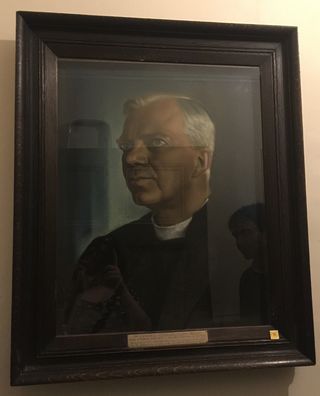 This follows the wise decision of the Town Council to put it up again, and is the first small victory in the campaign to resist the Stalinist unpersoning of Bishop Bell, which followed unproven, uncorroborated charges being laid against him by a solitary and anonymous complainant, long after the alleged offences and long after his death - and wrongly treated as proven by the Church of England.
His name has already been removed from a school named after him in Eastbourne (to which he travelled, in his last dying weeks, to show his appreciation of the tribute); from a ���house��� in a Church secondary school in Chichester itself, and from George Bell House, a guest house in the grounds of the Cathedral, named after him in a ceremony conducted by the then Archbishop of Canterbury, Rowan Williams(there is a detail of this removal which is especially shocking, which I hope to reveal very soon) .
A Chichester art gallery has placed another portrait of the Bishop in temporary ���storage���. His main memorial, in Chichester cathedral (where his ashes are buried) was until recently marred by a nasty notice about ���safeguarding, and it is whispered that it may eventually be altered or removed. Anglican churches have largely ceased to sing the hymn he wrote ���Christ is the King���, though I was happy to hear it sung in Oxford���s Christ Church Cathedral, where Bell���s memory is still revered and he has a fine memorial, last Sunday. There are suggestions that hjs name may be removed from the Church���s calendar.
The Cathedral itself, whose illustrated guide book contains about a dozen mentions of George Bell, struggles now to avoid mentioning his name. the Bell-Arundel Screen, rebuilt in the early 1960s as a memorial to him, is now known as the Arundel Screen.
This behaviour has always reminded me of the Stalinist habit of removing the images of disgraced ex-comrades from actual photographs, and of erasing monuments to them if they fell out of fashion. Trotsky was famously wiped from pictures in which he appeared alongside Lenin, the GPU chief Yezhov was wiped from pictures where he stood alongside Stalin. In more modern times, a plaque to Leonid Brezhnev was removed from the fa��ade of the block of flats where he (and later I ) lived in Moscow. It is a sort of official lie. It says ���This piece of history never happened���.
If you find this sort of thing objectionable in an English institution, please find it in your heart to sign the petition here
Many more signatures are need to make it effective. Yours is one of them.
May 10, 2016
A few notes on David Cameron's Big EU Speech
So many events now taking place (e.g. the Trump phenomenon, the repeated resort to stupid wars, the relentless fall in educational standards and the equally relentless assault on liberty of speech and thought) persuade me that we in the ���West��� are now witnessing the death of politics as we have known it, and quite possibly the final decades of universal suffrage democracy, which can no longer provide stable or intelligent government.
The Prime Minister���s ridiculous speech, which you may read here, https://www.gov.uk/government/speeches/pm-speech-on-the-uks-strength-and-security-in-the-eu-9-may-2016
���must count as one of the most absurd ever delivered. And yet he and all his aides do not seem to have realised this. Together they planned, wrote, rehearsed and publicised it, and ensured that it was delivered. And it may well succeed in its objective, of frightening ignorant people into voting for the status quo. I have to fear for the future of any country where the level of debate has sunk so low. A proper dismissal of it would take days to write, and hours to read. But the few thoughts below may be helpful to some readers:
One bit of it I quite liked ; ���And I understand and respect the views of those who think we should leave, even if I believe they are wrong and that leaving would inflict real damage on our country, its economy and its power in the world.��� I too believe that leaving might lead to all these things, and worse, but still favour it. The ���Remain��� side have been absolutely right to point out that people such as me, who believe in national independence as a principle, recognise that it may come at a price.
I wish more people on the ���Leave��� side would make it clear that this is what they think. If it isn���t, I really don���t know why they *do* want to leave.
Our economy, of course, is not doing well, but wallowing in unpayable debt and deficit, from which the only escape will be very serious inflation. This is currently being targeted mainly at savers, whose funds are being stealthily drained by the policy of paying no interest at all, but must soon expand into other parts of the economy. The supposed ���rise��� in house prices is in fact a true measure of inflation, since housing property is a market limited by the existence of land, and must rise as the true value of sterling falls, especially while savers are diverting funds from savings into housing investment. Something similar is happening to the dwindling number of fully-trained professionals and skilled artisans in this country, whose wages cannot be depressed by mass immigration, and who can charge very heavily for their services.
I do wish people would stop claiming that the economy is doing especially well simply because it is outside the Euro and so under the chancy stewardship of Mr Osborne. It just has a different sort of crisis, as all the indicators are now starting to show. I also think that it is very hard to maintain that a British exit from the EU would bring any short-term economic benefits at all. It wouldn���t automatically bring any long-term benefits either. That would depend on the governments we then chose.
In the same spirit I think claims that we would be at more risk from the (greatly exaggerated) terrorist bogey, if we stayed in *or* if we stayed out, are moonshine. We don���t control these things. ���Security��� services are a state-sponsored confidence trick, whose power to influence events is hugely over-rated. The European Arrest warrant is an unacceptable threat to Habeas Corpus, a liberty too vital to be trifled with, and makes no difference to our ability to ���fight terror���, since those affected by it are arrested and under suspicion anyway, and are therefore of no use in the surprise attacks in which terrorists specialise.
But this is the passage from the speech which I wish to deride most thoroughly:
My comments are interleaved with it, marked ***
���Our history teaches us: the stronger we are in our neighbourhood, the stronger we are in the world.���***PH: This is a platitude. But national strength cannot be equated with our membership of supranational bodies, that is, not alliances between nations but bodies set up above the level of nation states, which claimed to have power over our law and government.. Indeed, we belonged to no such bodies after Henry VIII���s 1534 break with Rome, which removed the supranational Church���s power to interfere in our internal affairs.***
���For 2,000 years, our affairs have been intertwined with the affairs of Europe. ���
***PH notes Of course they have. That is where we are, geographically. But this would only matter to someone who is a child in political matters, and cannot distinguish between differing applications of the same word. The British Isles, like Muscovy, are in the continent of Europe. But geographical Europe is not synonymous with the political construct now known as the EU, which governs, in such places as Martinique, territories which are not in Europe at all, and which permanently and deliberately excludes from membership the largest country in Europe, Russia.****
���For good or ill, we have written Europe���s history just as Europe has helped to write ours.
From Caesar���s legions to the wars of the Spanish Succession, from the Napoleonic Wars to the fall of the Berlin Wall.���
***PH notes: Britain did not exist in Roman times, or for many centuries afterwards. Nor did England. Our independent history began much later. The War of the Spanish Succession was an opportunist intervention designed to limit French power and allow us to get on with expanding our global trade and colonies. Likewise the Napoleonic Wars, which allowed us to turn our backs on the continent for a happy and prosperous century of successful isolation (with the daft exception of the Crimean war, ultimately a failure). As for the fall of the Berlin Wall, Margaret Thatcher, not unreasonably, strove vainly to prevent German reunification when that still seemed possible, and as far as I can tell British policy would have been perfectly happy for the Cold War to continue indefinitely, freezing continental diplomacy where it had been in 1945 . It���s an odd collection of examples. In no case between 1534 and 1972 did any British government seek to be governed by a continental supranational power. Indeed, much of its diplomacy and warlike activity were directed specifically to avoid this outcome. ****
���Proud as we are of our global reach and our global connections, Britain has always been a European power, and we always will be.���
***PH notes: No, it hasn���t. Britain has been a global power, and now, largely thanks to failed and costly continental entanglements in the 20th century, isn���t. It never attempted to become a European continental power until this century, and the results were not happy (bankruptcy and an inconclusive outcome dictated by others, which was so unenforceable that it had to be fought all over again 21 years later). Before 1916, Britain never raised an army on a continental scale, and fought its wars on the Continent through cynical, ad-hoc coalitions based on the old principle of my enemy���s enemy is my friend, or simply paid to fight with London gold. Our main armed force was the Navy, which secured the Channel against invasion and which enabled us to hold on to our imperial possessions . It was a British *naval* defeat on the far side of the Atlantic, the 1781 Battle of the Chesapeake, which led to the military defeat at Yorktown and Britain���s greatest setback in history, the loss of the American colonies. Likewise it was the overpowering of British *naval* force in the Pacific by the Japanese in 1941-2 which led to the catastrophic defeat at Singapore and the subsequent loss of the British Empire as a whole. It was British *naval* power ( which always served the dual purpose of keeping the home islands safe while projecting imperial power around the world) which ultimately made a German invasion of this country impossible, and which enabled us to survive to the 1940-44 period without being starved to death. I have discussed elsewhere the role of British armed forces against the main body of the (German) enemy on the continent of Europe between 1939 and 1945, but it is an astonishing fact that from Dunkirk to D-Day our army was not in direct contact with the main body of the enemy. That is how unEuropean our power was. ****
���We know that to be a global power and to be a European power are not mutually exclusive.���
***PH: Do we? The height of our power as a nation, from 1815 to 1914, was spent mainly in isolation from European matters. Our attempt to become a European power costs us our global power***
���And the moments of which we are rightly most proud in our national story include pivotal moments in European history.
Blenheim. Trafalgar. Waterloo.���
***PH: each of these is quite distinct. Blenheim is discussed above, in the War of the Spanish Succession. Trafalgar made us safe from invasion, but had no real effect on the Continental struggle, which Bonaparte continued to win for years afterwards. He was fundamentally defeated by Russia, which destroyed his original Grand Army on the retreat from Moscow, and then at the Battle of the Nations at Leipzig, in which we played no direct part (if he hadn���t been defeated in this period, there���d have been no Waterloo) . Waterloo likewise gave us permission to do what we wanted to do and leave the Continent to its own devices for a century. ***
������. Our country���s heroism in the Great War. And most of all our lone stand in 1940, when Britain stood as a bulwark against a new dark age of tyranny and oppression. When I sit in the Cabinet Room, I never forget the decisions that were taken in that room in those darkest of times. When I fly to European summits in Brussels from RAF Northolt, I pass a Spitfire just outside the airfield, a vital base for brave RAF and Polish pilots during the Battle of Britain. I think of the Few who saved this country in its hour of mortal danger, and who made it possible for us to go on and help liberate Europe. Like any Brit, my heart swells with pride at the sight of that aircraft, or whenever I hear the tell-tale roar of those Merlin engines over our skies in the summer.���
***PH: This is all very sentimental, though I am dismayed by the Eton and BNC premier���s use of the coarse word ���Brit��� in a supposedly uplifting speech. I doubt he has much of a grasp of the diplomatic and political reality of that period, or ever has cause to wonder at the contrast between the bravery of the Polish pilots and our abandonment of their country to half a century of foreign tyranny, having promised them our support. Churchill���s resolve was indeed a great thing. But why do we so seldom question the incompetent continental diplomacy which so nearly imperilled the freedom of this country in that period? Sentimentalising over Spitfires 76 years ago is all very well, but what is the state of our current armed forces, and the industries which sustain them, under Mr Cameron���s premiership? ****
���Defiant, brave, indefatigable.
But it wasn���t through choice that Britain was alone. Churchill never wanted that. Indeed he spent the months before the Battle of Britain trying to keep our French allies in the war, and then after France fell, he spent the next 18 months persuading the United States to come to our aid.
And in the post-war period he argued passionately for Western Europe to come together, to promote free trade, and to build institutions which would endure so that our continent would never again see such bloodshed.���
***PH: I do think he should be careful about suggesting that Churchill ever favoured supranationalism. He was very much in favour of Franco-German unity, and of a strong Council of Europe, which was not a supranational body and still isn���t - but not of Britain losing its independence in a supranational body. ****
���Isolationism has never served this country well. Whenever we turn our back on Europe, sooner or later we come to regret it.���
***PH asks: Is this in fact true? I don���t think it is, and I would be interested to know what other readers think. ***
As for the claim that the EU has prevented war, I think we have discussed this many times here. There���s no doubt that it has made war between France and Germany very difficult, but there has really been no great reason for such a war in the post-1945 period. The fundamental conflict of our continent, between Germany and Russia, remains alive as I believe has been proved in both the Balkans and Ukraine (I would also attribute the foolish war in Georgia to this tension) . The EU, either as itself or in the form of its dominant member state, has not in my view been a force for peace in these areas.
As for ���Either we influence Europe, or it influences us.���, I should have thought that if we remained independent of the EU, it would be true that each would *influence* the other. But since the EU now has actual *power* over our borders, our laws, our trade and our foreign policy, and since we lack any effective veto in any council of the EU, it is q
wrong to speak of influence. The EU has power over us. We have no power over the EU. Only by leaving could we return to an era when the two influenced each other.
Peter Hitchens's Blog

- Peter Hitchens's profile
- 299 followers

