
Peter Hitchens's Blog, page 162
June 7, 2016
The 'Leave ' Campaign may well be winning.
Some of you will have noticed that I have tried to stay away from the EU referendum debate for most of the past few weeks. Firstly, I think the campaign is far too long. Secondly, I mistrust the main spokesmen for exit. Thirdly, I did not desire a referendum, which I think is unconstitutional, politically dangerous and open to manipulation and emotional spasms. So I have not really been involved, heart and soul, in what many might expect to be ���my side���.
I have done a little light debating since the campaign began ��� once at meeting (supposed to be non-contentious) at the House of Commons organised by Cambridge University, once at a bookshop squabble with Dennis MacShane and last week at Buckingham in a debate organised by the Speaker, John Bercow.
This took place at the Royal Latin School, a marvellous, thriving state grammar school in an ancient country town in the handsome but unpretty heart of England ��� a place whose very existence makes my heart ache for the lost land of acres, dark, quiet pubs, hedgerows and the certainty of liberty, whose final years I watched all unaware that it was about to disappear forever. I noticed as I sat in the hall before the debate that it had once been called St John���s Royal Latin School, and I wondered how and when that had gone, and what might be next. . It reaches back to before the Reformation and is one of those astonishing quiet survivals, like the ancient school and almshouses at Ewelme, which connect us so completely within our forebears that anyone who stops to think about them, that pondering on it makes it difficult to breathe.
I was constrained in the Buckingham debate, as I am now, by my dislike of the referendum and my growing fear that it will create a dangerous constitutional crisis, the worst since the Abdication 80 years ago, and actually probably deeper than that over David Lloyd George���s ���People���s Budget��� of 1909, which led to a huge change in the way we were governed - the hobbling of the House of Lords. This crisis may well do a great deal of damage without achieving the result the voters desire.
I suspect that the next step *may* have to be an early general election, in which both the existing large English Parties may face severe realignments or even splits. The alternative, in which the ���Leave��� campaign splits into diehards and compromisers, and a new ���negotiation��� is proposed ( and possibly another plebiscite), will of course appeal far more to the political class. That is why it is more likely. Michael Gove and Alexander ���Boris��� Johnson never let their supposedly urgent desire for British independence show before a few weeks ago. Nor did Lord (Michael) Howard. Maybe they will be able to suppress it again in future, if conditions require.
This interesting story on the BBC website ���..
http://www.bbc.co.uk/news/uk-politics-eu-referendum-36457120
���.illustrates some of the possible problems of a vote to leave, in a country whose parliament, civil service, judiciary , academy and broadcast media are largely in favour of remaining.
I suspect the whole thing has gone utterly wrong, an unsurprising result of what was in any case a wholly irresponsible promise made by one of the most unprincipled and inexperienced people ever to hold the post of head of government.
Mr Cameron promised a referendum out of utter cynicism. To head off UKIP (which foolishly accepted s referendum as desirable, which, as is now clear, it wasn���t). The circumstantial evidence that he didn���t want or expect a parliamentary majority (a manifesto full of rash and unredeemable pledges, his own genuine fear that he would lose outright, George Osborne���s incredulity (I���ll French-kiss you if we win!��� when told by Lynton Crosby that a majority was what they were going to get) is overwhelming. His affronted attitude towards the idea of a British exit is further evidence. If he thinks it is so dangerous for us to depart, then why did he create an opportunity for us to do so?
Several straws in the wind suggest to me that the vote is now swinging towards exit . One reason is that the fear campaign has blown up in the faces of those who designed it. It was so overdone that it became a national joke. It involved too many foreign potentates and officials telling us what we should do. And it has no answer at all to the immigration question, which is the only other big issue in the vote. As it happens, the leave campaign don���t really agree among themselves or know what to do about this either, but nobody���s interested in that just now.
One conversation, with a bus-driver from a very ordinary middle-England town who told me that everyone in his depot (except him) is planning to vote out, persuaded me that the old working-class Labour vote will go heavily for exit, which may well be enough to get the Leave campaign across the line. In elections, Labour tribal loyalty keeps such voters from having anything to do with any anti-immigration party. A referendum breaks that barrier.


June 5, 2016
PETER HITCHENS: This barmy 'blitz on toffs' will make us ALL poorer
This is Peter Hitchens' Mail On Sunday column
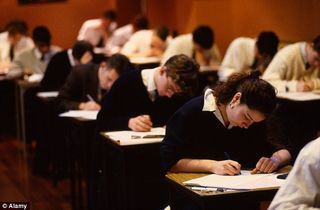 I still struggle to persuade many Tory loyalists that their party has now actually become a rather Left-wing version of New Labour. If only they���d listen, it might help them come round to recognising one of the most important facts about modern Britain.
Here���s some evidence. The Cabinet Office Minister, Matthew Hancock, has announced plans to grill job applicants to find out if they have been to independent schools.
He explains this inquisition by saying: ���Social justice is at the heart of everything this one nation Government is trying to achieve.
'Our goal is simple: to make sure everyone has the opportunity to succeed and make the most of their talents, whatever the circumstances of their birth.���
Social justice? This is, of course, top-grade tripe. What Mr Hancock wants is to destroy quality, in the name of equality.
There is a simple and proven way to make the best use of the nation���s talents: restore the 1,000 fine state grammar schools in England and Wales madly destroyed in an idiotic frenzy between 1965 and 1990, and their equivalents in Scotland.
Then build more of them. And reopen the best independent schools to the children of poor homes by reintroducing the direct grant system, which gave a free, first-class education to thousands of talented children from state primaries, the late Alan Rickman being a good example.
Every time I hear politicians drivelling that the independent schools should do more to help the state sector, I long to shout in their ears: ���But they did! And it worked! And you abolished it in 1975, and are so pig-ignorant you don���t even know about it!���
Even now those supposed towers of snobbish privilege which are the independent schools do what they can (often through the generosity of parents already paying stiff fees) to take in as many boys and girls from less well-off homes as they possibly can, free of charge.
Meanwhile, huge numbers of children at these alleged Snob Academies come from families where the fees are a giant strain on the family budget, willingly accepted. Many have tried the supposedly improved state education system and found it gravely wanting. They just think education is more important than holidays or new cars or restaurant meals.
They tend not to be rich enough to live in the catchment areas of the exclusive fake comprehensives where wealthy Leftists send their young, pretending to be apostles of equality when to all intents and purposes they have paid for their children to be privileged.
Mr Hancock���s scheme would waft these pampered Leftists into the best jobs, as they are already wafted into the top universities, which are ceaselessly pestered to make them discriminate against independent schools. And it would slam the door of opportunity in the faces of many who would make the most of it. Crazily, it would do this in the name of progress.
How insane this all is. None of these people knows what he is doing. The Left has not only taken over all the parties, but now proceeds to spit on the very people ��� the poor ��� it claims to be helping.
I will quote here what that great teacher, headmaster and university Vice Chancellor, Lord James of Rusholme, told the House of Lords in 1976 as he protested against the destruction of all these schools: ���If I were a High Tory instead of a Fabian Socialist ��� a Tory of a type that now scarcely exists even in cartoons, one who really believes in privilege and keeping the lower orders down ��� one of the first things I should do would be to get rid of grammar schools and, above all, I should applaud what we are doing this afternoon, getting rid of the direct grant schools.���
I would like to point this out to Mr Matthew Parris, former Tory MP, BBC favourite and frequent apologist for David Cameron, who wrote last week: ���The present public mood of sneering at public school toffs is healthy.
'The brand must be trashed. People must be made to feel sheepish about going to Eton or Harrow. It was welcome news yesterday that the Cabinet Office Minister, Matt Hancock, is drawing up a list of questions that employers may ask job applicants about their socio-economic background.���
He added that he meant this to sound aggressive. Well, I mean my response to sound rude. Mr Parris and Mr Hancock have adopted opinions which are stupid, ill-informed and utterly wrong.
Finally...the great housewife myth is turning to dust
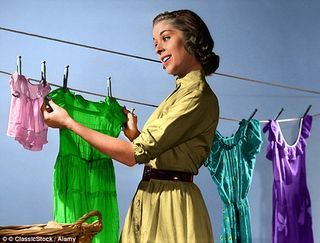 The nastiest and most dishonest slogan of the ultra-feminists was that women who stayed at home to raise their children were ���chained to the kitchen sink���.
This unpleasant expression scared many women away from doing the most important and responsible (and rewarding) task which most of us will ever have ��� raising the next generation to be worthy inheritors of a great free country, hand-reared individuals rather than battery children, the conformist products of TV and mass culture.
And it gulled them into undergoing a real enslavement: wage-slavery. How many really wanted to do this, and how many were cajoled and propagandised into it?
Well, last week Professor Maggie Andrews, of the University of Worcester, told the Hay Festival that the old assumption was that feminism was about escaping the domestic, getting out of the home, getting a job and being financially independent.
But ���people are more sceptical about that now - they see a much more complex picture. They see the domestic space as one area of women���s power.
Certain elements of the domestic have become much sexier, much more popular, an escape from the horrors of society���.
Well, that���s one way of putting it. I just think many women have discovered that wage-slavery was a false liberation, and that, if there are any chains in their lives, they are the chains of money that keep them from their children.
A sorry war with nothing but baddies
News from the supposed liberal democratic paradise of Ukraine, so much nicer than Mr Putin���s nasty Russia.
According to the United Nations, Ukrainian forces are rounding up and torturing suspected rebel sympathisers.
One victim had his hand smashed with a hammer and was waterboarded while being kicked and punched in the genitals.
The UN had to abandon an anti-torture inspection after being denied access to five secret detention centres. The Russian rebels are just as bad, but you knew that. So sorry, but there are no good guys in this conflict.
If the true culprits of the Birmingham pub bombings were arrested, tried and convicted, how long would it be before they were released in the cause of the ���peace process���? My guess is two years maximum ��� less than you can get for some driving offences.
If you want to comment on Peter Hitchens, click on Comments and scroll down
June 3, 2016
A Few Reflections on Mr Donald Trump
Soon after I arrived in Washington DC in the autumn of 1993, I found myself in a dinner-table argument with one of the many deeply liberal Washingtonians who populated the diplomatic and media circuits of that strange, lovely, melancholy city, which increasingly strikes me, when I now visit it, as a beautiful cemetery of vast, imposing sepulchres in which various deceased ideas lie at rest among lakes and woods.
He obviously despised my social conservatism, was shocked that I dared articulate it inn such a place, and addressed me more or less as you speak to something you had found stuck to the underside of a caf�� table.
I said that he should show me more consideration. I was, I pointed out, civilised, polite, a believer in freedom of speech and the rule of law, tolerant of opponents and inclined to listen to them. I was literate, informed, reasonably cultured. I felt very strongly that he and his faction were wrong to push their programme so hard ��� especially sexual revolution and mass immigration. I thought it was wrong anyway. I also thought that it would in the end infuriate so many people that it would endanger free society.
They should listen to people like me while there was still time, or they might find they had other, less loveable opponents top contend with.
Out of the blue, I found myself saying ���This life and state of affairs, which we enjoy here, and which you seem to think will go on for ever the way you want it to, could turn out to be the Weimar Republic.���
He turned away contemptuously and did not speak to me again that evening. I cannot now even recall precisely who he was or exactly where it was, I remember one of those large DC houses, or perhaps it was over the line in Maryland, or Northern Virginia, surrounded by wooded slopes in which the cicadas shirred and chirruped in the warm darkness.
The thing about Weimar, as far as one can see, is not that it ended precisely with the Nazis. That will never happen again. It was that nobody who lived in it really had any clue that it would finish so abruptly, or what was coming next, until, the very end. Nor did they grasp how much their own liberalism was resented and how swiftly and absolutely most of it would be undone in the reckoning that followed.
Despite the myth of ultra-liberated 1920s Berlin, Weimar was in many ways a much more staid and conservative society than the ones we inhabit in post-Cold War Britain and the USA.
The social experiments of our time are far bolder, the abandonment of old rules far more complete and comprehensive. There isn���t a corner of our society which has not felt it, and TV brings it swiftly into every home.
But what about the economics? The refloating of Germany after money died, much of it done by that fishy wizard Hjalmar Schacht, was a confidence trick based iobn kabnd vaklues (and later off-the-books loans) not all that much more wobbly than the confidence trick by which our own wildly indebted economy (and that of the USA) totters onwards on the tightrope, into the mist, unable to tell when or even if it will reach solid ground again.
We have actually had a great crash in 2008, but managed to paper it over. Nobody really knows when it will return, but many fear it will.
And now along comes Donald Trump. I am amazed to find some conservatives enthusing about this person, who until quite recently was a keen defender of abortion, a donor to Hillary Clinton���s senatorial campaigns and to the Clinton Foundation (Mrs Clinton attended Mr Trump���s Palm Beach wedding, in 2005, to his current wife, Melania, and ex-President Bill came to the reception).
Likewise, Mr Trump���s personal life, though of course his own business in the modern world, does not exactly conform to the Christian ideal which most American conservatives espouse.
So, whoever may delight in Mr Trump���s advance, I shouldn���t have thought any principled conservative could do so.
I am also troubled by his extravagant promises ��� to build a wall along the Mexican border, to bar Muslims from entering the USA (how?) ; and by the crudity of his slogans. I don���t get the impression Mr Trump is an especially cultured or historically-informed person, but I am pretty sure he is a cunning and astute one (these two sets of qualities rarely coincide in any human being) , and knows perfectly well that such things are, shall we say, going to be very hard to fulfil in practice. Likewise his enthusiasms for protecting America���s many dying industries. I���m a protectionist myself, unbeguiled by the siren song of free trade, but even I can see that these pledges may be a bit hard to fulfil in practice in two terms, let alone one.
In any normal time, his success would have been headed off, as was Ross Perot���s similar (but less outrageous) campaign back in 1992. In fact, Perot was far more realistic. The North American Free Trade Agreement was still unsigned when Perot campaigned against it, and US domestic industry was a lot healthier and more protectable then that it is now.
Meanwhile, though the Mexican border was terribly porous (as I saw for myself at the El Paso- Juarez frontier) , the full effect of mass migration had yet to be felt, and the USA���s conservatives were still divided on whether to support or oppose it.
Both those policies, plus the sexual revolution and the de facto decriminalisation of marijuana, were continued and amplified during the next 20 years, and the idiotic, bellicose, repressive response to September 11th discredited and divided what was left of conservative America, leaving nothing to define them but war abroad and the free market at home.
Even the abortion and death penalty issues, which allow American Republican politicians to pose as social conservatives without actually having to *do* anything, have worn pretty thin as vote-getters.
And so now here is Mr Trump, bellowing the cracker-barrel wisdom of ten thousand bar-bores over a national megaphone.
And the vast ignored heart of America, pushed to the margins and infuriated by decades of bilingualism, 'meduical marijuana' , same-sex marriage, political correctness and shrinking wages, falls for it.
While the Democrats, who have likewise run out of useful things to say and are in many cases reduced to nostalgic votes for that 1930s figure, Bernie Sanders, have no reply except the Clinton name, which is not that good a name in the end.
Is this how the great experiment in universal suffrage democracy ends?
For the last few weeks, thanks to a minor back injury which (by keeping me off my bicycle) has completely re-arranged all my days, I have been rather prone to a sort of melancholy foreboding, which is, as I well know, subjective and irrational. What I cannot now reliably do is to separate this from the equally melancholy foreboding, objective and rational, I now feel about the US general election, and our own increasingly banal and thought-free referendum, in which both sides are drawing very heavily on the Bank of Trust which (just as in the USA) is very nearly empty anyway. This is playing with fire. Can any of these people even begin to deliver what they promise, or prevent the things they rail against?
If not, what happens when the voters find this out?
May 31, 2016
Arguing Lessons - How to Have More Fun, and Learn More, In Debate. You can do this at home
Uninterested as I am in the referendum, for reasons explained here���
And here http://hitchensblog.mailonsunday.co.uk/2016/02/why-i-wont-be-voting-on-referendum-day.html
���. I am still interested in the slow absorption of this country into the great python that is the EU. The other day the subject of English law came up ��� the absolute reason, for me, why Britain should not be in the EU, since our law is not compatible with Continental law and any convergence is bound to mean the disappearance of our traditions.
Bert the Pretentious refuses to believe that the EU has any influence over events in this country at all (he is *still* , after several years, searching for an explanation of the revolution in rubbish collection which does not involve its actual cause, the EU Landfill Directive) . He responded to this point by commenting (in response to contributions by others)
@young Aussie John, Alan Hill and David Taylor, No, you continue to be wrong. Young John - any evidence for your assertion that there is a 'clear drive to uniformity in law'? Specific evidence, I mean, not just vague stuff about how the EU wants to turn everything into greater Germany, or similar.
I replied***PH writes: the origin of this drive is generally understood to be the Tampere EU conference, held in that Finnish town on October (apologies for originally wrongly dating this in December 1999.PH) 15th and 16th 1999 'on the creation of an area of freedom, security and justice in the European Union.' http://www.europarl.europa.eu/summits... gives details. The European Arrest Warrant, which overrides Magna Carta protections, is one product of this agenda. The justiciability of the European Charter of Fundamental Rights (not to be confused with the ECHR) at the European Court of Justice in Strasbourg (&&NB This was a stupid error on my part. I know perfectly well that the ECJ is in Luxembourg and is unconnected with the ECHR in Strasbourg. It just goes to show how the mind and the fingers may not always be fully linked&&) is a principal means by which law can be brought into line.
This creates by stages a European area of justice and convergence in civil law. There have also been discussions on creating an EU 'Corpus Juris' a European Legal Area, a European Public Prosecutor and a European Criminal Code. These are in fact logical developments of the Single Market. Perhaps coincidentally, English criminal law has been growing to resemble continental systems. On-the-spot penalties, or 'restorative justice' under which resort to the courts is discouraged, have replaced many magistrates court proceedings (in contravention of the Bill of Rights 1689 and the principle of the presumption of innocence). A huge number of, perhaps most, criminal cases never go to court but are tried bureaucratically by the Crown Prosecution Service, functioning as an examining magistracy on the Continental Model. The absolute right to Jury trial is ceaselessly whittled away, and juries themselves are eviscerated by majority verdicts and the inclusion of the wholly uneducated and inexperienced on jury panels. Once again, Bert demonstrates his profound knowledge of the non-existent alternative world (where, for example, the EU Landfill Directive has no bearing on rubbish collection) and his ignorance of the real world, where the EU increasingly takes over our lives. I hope he has an enjoyable evening trying to rake the Moon out of the nearest pond. ****
I sent the same reply (minus the sarcastic remark about moonraking) to Mr ���Bunker���, who had written from his Teutonic fastness:
���John, Alan and Thucydides - this intrigued me so I tried to find evidence of an EU drive to get rid of British common law. All I could find on the subject was a 2014 article by Brenda Hale, Deputy President of the Supreme Court of the UK in which she stated, inter alia: "After more than a decade of concentrating on European instruments as the source of rights, remedies and obligations, there is emerging a renewed emphasis on the common law and distinctively UK constitutional principles as a source of legal inspiration," She also said that there was a "growing awareness of the extent to which the UK's constitutional principles should be at the forefront of the court's analysis". Has anything happened in the meantime to change that? Or is all this just more anti-EU scaremongering?���
Bert, as is usual when he is challenged and rebutted, fell into a profound silence which has lasted ever since. He is not given to responding when it doesn���t suit him, but will pop up again soon with a completely different contradiction, prompted by his difficulty, a desire to oppose anything I say under any circumstances.
Mr ���Bunker���, by contrast, favoured me with a reply. He wrote : ���I'm very grateful to Mr Hitchens for his interesting information. But I still have one or two questions: - The 1999 Tampere Conference - was the UK not represented at it? - The European Arrest Warrant - did the UK have no say in its establishment? - The European Charter of Fundamental Rights - was the UK not represented when it was drawn up? - The European Court of Justice in Strasbourg - does the UK have no participation in this body? - The proposed creation of "an EU 'Corpus Juris' a European Legal Area, a European Public Prosecutor and a European Criminal Code" - has the UK no opportunity to use its influence (veto) here?���
I responded : ���***PH notes: A. Blair, Jack Straw and Robin Cook were all at Tampere, if he finds that reassuring. The Lisbon Treaty , signed by Gordon Brown in 2009, made the ECFR binding in EU law. Britain was represented on the 1999-2000 European Convention, which drew up the ECFR, by Timothy Kirkhope , a Tory MEP., Lord Bowness, a Tory peer with a background in local government, and the Attorney General, Lord Goldsmith of Baghdad (joke). The UK has no substantive veto in most EU decisions, having accepted 'qualified majority voting' in almost all areas of decision making, a system which gives the UK no special power to oppose the majority, which is of course already wedded to civil code, jury-free justice.
���I believe that QMV is the agreed system in 'security and justice' and judicial co-operation' since the signing of the Lisbon Treaty. I believe the UK has lost most of the QMV votes on which it has sought to challenge the Commission on any subject. The EAW is an interesting case, as, thanks to a quirk of Lisbon, the UK was allowed (uniquely as normally the 'acquis communautaire' of past EU law cannot be reversed), to opt out of it. But last year the Cameron government ,as mentioned on this site, voluntarily decided to opt back in though it was free not to. The abolition of English justice has plenty of supporters in the English elite, as the Auld Report of 2002 shows. (See my 'Abolition of Liberty') . The European Court of Justice has 28 judges of whom I believe two are currently from the UK. But like all EU functionaries, they are required to observe and enforce the laws of the EU, not act as representatives of the country or rather member state' from which they come.***
Mr Bunker had continued: ���In other words, if - as is claimed - common law is in danger of being superseded by European law - is this being done by a scheming pack of unelected, unaccountable foreigners in Brussels and Strasbourg, as some contributors intimate, or is it being done with the full compliance and collaboration of the UK? -- Or is it not really in danger at all?���
I replied ��� ***PH asks: Who has referred to 'a scheming pack of unelected, unaccountable foreigners in Brussels and Strasbourg,'? (Strasbourg is the seat of the European Court of Human Rights, unconnected with the EU and part of the Council of Europe, a separate and distinct body). This looks like a pack of straw men to me. What has taken place is all perfectly normal EU procedure, the endless drive towards ever-closer union, accepted by us in 1972, which goes on 24 hours of every day and occasionally comes to light in a conference or a treaty. As for ' the full compliance and collaboration of the UK', one would have to ask whether, given the alarming and comically confident ignorance of these matters in the cases of Mr 'Bunker' and of Bert, one can really describe this process in that way. It has never been put to the British people as such, or debated fully in Parliament, and is rarely covered in the media. The compliance of the British state is not the same thing as the compliance of the British people. ***
Mr Bunker then replied again: ���Again I must thank Mr Hitchens for those interesting facts, many of which were indeed unknown to me. I'm no expert on EU law and have never claimed to be. So I gladly take note of the fact that the UK doesn't always have a right to veto but - if I understand correctly - the UK quite freely relinquished this right, fully aware of its consequences. So I see no EU "drive" there And quite apart from that, why should the UK have "special power to oppose the majority"? If Britain's in the EU, it should abide by the rules and not seek special powers. OK, I know Mr Hitchens didn't say it should, but nor did I say that the EU was "ruled by a scheming pack of unelected, unaccountable foreigners in Brussels and Strasbourg", I said that is merely the tenor of quite a lot of contributors to this blog. That's all. I'm surprised to hear that the "abolition of English justice has plenty of supporters in the English elite". I wonder why! But I'm not surprised to hear that the British judges in the European Court of Justice "are required to observe and enforce the laws of the EU, not act as representatives" of the UK. That principle, I imagine, applies to all the judges and I believe it is right. Does anyone think differently? Strasbourg - it was Mr Hitchens, not me, that introduced Strasbourg into the discussion, so I reject any charge of "strawmen" here.���
I responded ��� ***PH writes: Mr Bunker is correct. I was trying so hard to say 'Luxembourg', where the ECJ is in fact based, that I did the opposite of what I intended and wrote 'Strasbourg' . My apologies, both for the error and for blaming Mr 'Bunker' for it. But I am baffled by his general drift. No opponent of the EU in Britain is under any illusions about the support of many members of his own country's elite for British absorption in the superstate. And Mr B will have to read Booker and North's 'Great Deception' for the details, but the abolition of the veto (which Mr Bunker himself still seemed to think existed) was of course done in quid pro quo negotiations, in which there was little realistic hope of escape from QMV short of walking out altogether. Either the veto was an important argument or it wasn't. But Mr Bunker raised it as it was - and now, having learned it is dead and gone, he pretends that he never thought it mattered In the first place. Personally I think its abolition very significant, and I doubt if the 1975 referendum would have gone the way it did if voters had known the veto would ultimately be abolished***
Mr Bunker had continued :���The "endless drive towards ever-closer union", Mr Hitchens tells us, was actually accepted (!) by the UK back in 1972, so I see no reason to blame the EU. True, the British people may not be in agreement with the idea of the EU, but if they aren't they should blame their own representatives (MPs) whom they elected to act in their interests, and not the EU.���
I replied :��� ***PH writes: On this we agree. I have never blamed anyone else but our own rulers���***
Mr Bunker had continued :���I'll ignore the charge of comical ignorance and explain that I speak from direct personal experience of almost half a century of life in the EU and having a passable interest in its workings. And as for Common Law, which is what this discussion was originally about, I have seen no particular advantage in it over the legal system of the European Union. But I'm always willing to learn. As I have done from Mr Hitchens' kind interventions.
****
AS far as I know this is the end of MR Bunker���s responses. While his reaction ( as always in his case good-natured and personally generous) is infinitely preferable to Bert���s unresponsive silence, I note that he hasn���t really allowed himself to be influenced by the facts and arguments presented to him.
The original question was ���is there a convergence���? And then ���is it driven by the EU?���. Well, I think the very existence of the Tampere conference (whose aims came as something of a surprise to many attendees, as far as I can find out) is evidence that it is. Opponents of the EU have never claimed that their fellow-countrymen have been guiltless in entangling us in this thing. Rather the contrary. Some secessionists ( not I) even claim to have been misled about the nature of the project, thinking it to have been a free trade area. I don���t think this stands up. Several opponents of the original Common Market, including Hugh Gaitskell from the mainstream, pointed out from the beginning that it was a political project. Anyone who didn���t know that by 1975 hadn���t been paying attention and wasn���t qualified to vote.
But rather than accept that he was ill-informed, and the EU is indeed seeking a convergence of legal forms, Mr Bunker swam off into a bog of irrelevance, making up stuff about ���a scheming pack of unelected, unaccountable foreigners��� so as to caricature, rather than consider, my case. He then kept asking whether British representatives had any role in these changes. Well, of course they di, thiough you will struggle to find much coverage of the event in British media, or discussion of it in Parliament for ��� like much of the EU ��� it is poorly understood and poorly reported here. The main purpose of political journalists in EU meetings is to write stories claiming that the British premier of the day has ���;triumphed��� in some way or other, whether he has (seldom) or has not (usually).
As in interestingly explored in Professor Robert Tombs���s recent book reviewed here http://www.nytimes.com/2016/01/03/books/review/the-english-and-their-history-by-robert-tombs.html?_r=0
by me, the rejection of Roman Law was important in the development of English liberty, as (this is my interpretation) Roman Law tends to side with authority, whereas Common Law tends to insist on the law being above all. Which is often very inconvenient for authority.
Mr Bunker, leading his blameless life untroubled by authority, will never have had cause to discover the difference, and so no doubt he sees no great advantage in the English system over the continental one. Well, the difference between a safe car and an unsafe one only becomes evident in a collision or a storm. But one is still safer than the other, even if neither ever encounters a collision or a storm.
But I would be obliged if he ( and Bert) would have the generosity and civility to concede that they were ill-informed, and that the EU does indeed have an active policy of bringing about convergence in matters of law and justice.
.
.
A Challenge to Matthew Parris - drop the inverted snobbery, back the return of grammar schools
I think this would be more of a controversy if it weren���t for the political Verdun that is the EU debate. This column by Matthew Parris (here seen in ���The Australian���) is about Britain
(I suppose it has some relevance in the antipodes, as Australia and New Zealand both have plentiful private schools, modelled on the British original).
Two passages are especially striking
���Class advantage in Britain is a disgrace, and that isn���t just a social thing, it���s a life-chances thing. Private education is key to its maintenance. Because we���ve become inured to the disgrace does not lessen the unfairness or the waste of talent. We should step back and recognise it.
Look, I know these stats are forever being trotted out, but don���t be numbed, be angry. Taking into account that only 7 per cent ��� one in 14 ��� of our population is privately educated, get this: according to the Sutton Trust, almost three-quarters of top military officers, three-quarters of senior judges, half of leading print journalists, three-fifths of the top ranks of the medical profession, four-fifths of leading newspaper editors, two-fifths of BAFTA winners, a fifth of British music awards winners, nearly a third of MPs and half the cabinet were educated at independent schools. Even Jeremy Corbyn���s Labour shadow cabinet has twice as big a proportion as the population as a whole.
���National ability and potential cannot possibly be so concentrated in the ranks of the privately educated.���
And then:
So what to do?��� Here���s the good news. State schools have improved a lot under both parties, and are still improving. From Kenneth Baker in the 1990s to Andrew Adonis to Michael Gove, politicians have led a real rise in standards. Across much of Britain the academic (as opposed to the social) case for choosing an independent school has never been weaker. The state now puts up stiff competition.���
The first ( apart from the claim that private education, rather than disastrous comprehensive state schooling, is the key to maintaining the class gap) is a simple statement of fact. The second is top-quality, fresh-from-the-cow, four-letter tripe. The alleged improvement in the state schools is, if it exists at all, from such a low level that in most cases they do not begin to approach the standards of the private schools or of the remaining academically selective grammar schools. Where they do,it is because they are selective in other ways, through tiny catchment areas mostly restricted to the wealthy, or by religious selection which cannot prevent people from faking their faith. Often there is a combination of the two.
The suggestion, of flooding the private schools with ���hundreds of thousands��� of assisted places is thoughtless idiocy. They aren���t big enough, and wouldn���t be so good if they were. These schools currently educate 517,000 pupils in 1,200 schools (an average of about 430 per school) . They could not physically survive an influx of pupils on such scale.
The conclusion, that it���s OK to sneer at public school products, is cheap and rather nasty playing to the gallery. Plenty of public school boys and girls may well be recipients of unappreciated privilege, though this is less so than ever at the good ones, which have long selected by examination, though obviously mostly from among those who can pay. Thousands of others benefit from bursaries which in some cases pay all their fees, financed by contributions from richer parents. But this is obviously limited. What else are they supposed to do?
Until 1975, when (without noticeable Tory opposition) Labour���s Fred Mulley abolished the Direct Grant, scores of first-rate private day schools took in huge numbers of state-school pupils thanks to a wise government subsidy. It was done entirely on merit. They had generally passed the eleven- plus at a high level. Their pupils stormed Oxford and Cambridge, elbowing aside the public school hoorays. But the4 scheme relied on the continued existence of state grammar schools and of academic selection as a whole. And by 1975, Tony Crosland and Margaret Thatcher together, ably succeeded by Mr Mulley and soon afterwards to be succeeded by Shirley Williams, were well on the way to destroying the grammar schools.
It is that destruction which has led to the class advantages which Mr Parris mentions, which also apply (though he does not mention it ) to the elite state comprehensives which select by wealth, and which a New Labour Tory, Matthew Hancock, now proposes to challenge by encouraging employers to probe the class backgrounds of job applicants.
This measure, trumpeted on the BBC but little-noticed by print media, will no doubt please Alan Milburn, the former(?) revolutionary who now runs an egalitarian quango for the government (and won���t say where his own children went to school, as I know because I have asked him) . Lord (William) Waldegrave and Charles Moore http://www.telegraph.co.uk/news/2016/05/29/young-matt-hancock-the-privately-educated-minister-fighting-a-ch/ do not like it.
Mr Parris, perhaps, does.
Well, I think it odd that Classism of this kind should be encouraged when all other imaginable forms of discrimination are so frowned on. I am reminded of the behaviour of the new ���People���s Democracies��� such as Communist Czechoslovakia, which actively discriminated against the middle class in their early years, for reasons I think it is pretty easy to work out.
Once, I suppose, it would have been worth pointing out that this is the policy of a nominally Conservative government. But do I have any readers left who do not understand that the Tory party is now New Labour in arms, wholly dedicated to the Blairite Eurocommunist agenda ��� equality of outcome for everyone except the political and business elite?
Of course a serious conservative, and a responsible democratic socialist alike, would agree that the best way to tackle this problem would be the immediate re-establishment of academic selection, grammar schools and the Direct Grant. But such people are rare in politics.
Matthew Parris should know a lot better. Does he really think that ���The present public mood of sneering at public-school toffs is healthy. The brand must be trashed.���? Is he genuinely unaware of a far better ,more effective alternative ��� the restoration of academic selection in state schools, and of the Direct Grant? Perhaps he is. I hope he now considers it. His voice, on the side of this much-needed reform, would be very valuable.
May 29, 2016
PETER HITCHENS: Nutrition 'experts' are stuffing us full of low-cal baloney
This is Peter Hitchens��� Mail on Sunday column
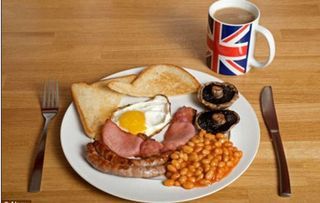 Whenever I see a ���low-fat muffin��� in a coffee shop, I have to control an urge to pick it up, jump on it and shout rude words. I am myself an expert in getting fat, and know that this evil blob of sugar and starch is a rapid route to a bigger waistband.
Fat doesn���t make you fat. Butter is good for you. So is cream. Skimmed milk is a futile punitive measure, not a foodstuff, a way of making ourselves needlessly miserable which has taken over the world on the basis of an illusion.
This is because almost everything most people think about food, and almost everything shops tell them, is completely wrong. In an unending struggle to get this across, the National Obesity Forum last week made a renewed attack on these mistaken attitudes.
Sugar, not fat, is the menace to our lives. And this has been known since 1972 when a brave scientist, John Yudkin, wrote a book ��� Pure, White And Deadly ��� showing it was so.
He and his unfashionable message were buried in abuse. It may be that some in the sugar industry might have been involved. These days he would have been called a ���fat-threat denier���, or something of the kind. He died in 1995, too soon to see his ideas rescued and taken seriously again.
Even now, people are getting needlessly fat and dying of horrible diseases because the anti-fat (and pro-sugar) lobby still hasn���t been completely routed. It will be, but these things take time. I mention this not just because it���s true, but because it���s an example of how thoughtless worship of scientists gets us repeatedly into trouble. Doubters like me are told not to dare criticise the sacred men in white coats.
But scientists disagree among themselves and are often wrong. In fact, science progresses by exploding dud theories of the past. And laymen are perfectly entitled to apply facts and logic to what these people say. The obvious argument against the skimmed-milk fanatics is that decades of this policy have left us with more fat people than ever. But we should not have had to wait so long.
There is powerful evidence against many other things now accepted as true, and often very weak evidence for them. I���d name ���antidepressant��� pills, ���dyslexia���, ���ADHD��� and ���man-made climate change���.
Those who criticise these things are angrily hushed, with righteous cries of ���How dare you!���, and if they won���t shut up, they are punished ��� as was John Yudkin. Yet I believe in all these cases the critics will be proved right, as Professor Yudkin was. The miserable thing is that so much damage will be done while we wait for the truth to get the upper hand.
Be less trusting of all fashionable ideas, is my advice.
Gullibility and conformism never advanced civilisation by a single step.
Jailed... for a very odd non-crime
In the same way that we have to allow free speech to those we despise, we must be most careful to ensure justice for those who are different from us, and with whom we can���t easily sympathise.
So a nasty shiver ran up and down my spine when I saw that Lorna Moore, a convert to Islam who married a Muslim, has been locked up for a very odd offence.
In fact, I know of no other offence like it in English law. This young mother has been imprisoned for not informing on her husband. I���ve yet to see any conclusive proof that she actually knew he was planning to join a terror group. Somehow or other, a return ticket to Majorca was taken as evidence that she was planning to run away to Syria with a husband she loathes.
And my English heart revolts at the idea of a wife being forced by law to inform on her husband. This is sinister, totalitarian stuff, alien to everything we stand for.
Those who drafted the 2000 Terrorism Act should be ashamed of enacting it. Can they have meant to lock up this person, so undangerous that she was allowed to be out on bail for three months between conviction and sentence?
Will it be children next, snatched into custody for not sneaking to the police about their parents��� conversations? This reminds me of the nauseating cult of Pavlik Morozov, whom Soviet children were taught to revere because he reported his father to the secret police.
There used to be a statue of this little monster (who was promptly and understandably murdered by his grandfather) in the middle of Moscow.
But while even Vladimir Putin doesn���t encourage such things nowadays, we in Britain are moving towards the all-powerful state, on the excuse of combating terror.
As it happens, Lorna Moore had every reason to do her husband harm if she had wanted to. She went into the witness box (a dangerous thing for a guilty person to do) to say convincingly that she hates her husband, who was given to shoving her head down the lavatory.
To make the matter even more odd, the husband involved hasn���t actually been convicted of doing the thing his wife didn���t tell the police about.
Indeed, he has sent an email to British media saying he isn���t actually in Syria, but in Turkey. Are the rest of us truly free when people can be locked up for such things? I don���t feel so.
One more lie in the drugs 'war'
The trumpeted ���ban on legal highs��� is a fiction, like the rest of our drug laws. The new Act imposes no penalties at all for possessing these dangerous poisons ��� except for people who are already in jail.
This is an amazing giveaway of the Government���s real drugs policy, which is to look the other way while pretending to be ���tough���.
In fact, simple possession of cannabis, heroin or cocaine is now hardly punished at all, even though it is illegal.
Claims that this ���frees up��� the police to pursue ���evil dealers��� are not backed up by the figures. Prosecutions for these offences stay about the same each year.
It makes no sense. The thing that makes the dealers, importers and growers evil is the damage that the drugs actually do to their users and their families.
The final, crucial link in this wicked chain is the purchase of the drug by the user. Yet this is the one thing we don���t punish.
Users are let off, or treated as if they are the victims of an irresistible disease.
One of the reasons why too few people criticise the feebleness of the modern police is that they know they will then be bombarded with spiteful and abusive letters and tweets from workers in this arrogant and unresponsive nationalised industry.
If the police responded to calls for help from the public as quickly, persistently and numerously as they react to justified criticism, they���d be a lot more use.
If you want to comment on Peter Hitchens, click on Comments and scroll down
May 28, 2016
And another interview
Another interview
which some readers may find interesting. You need to scroll down a bit to find it.
May 27, 2016
'Why I Changed My Mind' now available on iplayer
The BBC Radio 4 interview with PH ���Why I changed my mind��� is now on iplayer here
Has Finland Proved that Comprehensive Schools Work?
In the endless debate about how comprehensive education has failed (which it certainly has in Britain) I am often told about the supposed success of that sort of schooling in the rich (high GDP per capita) and tiny city state which is Finland.
Well, one point is precisely that. Finland is not blighted by the industrial and agrarian revolution which gave Britain so many harshly-divided big cities, nor by recent mass immigration on an unprecedented scale, Finland does not (I believe) have a snobbish class system comparable to ours. It would never have wasted so many of its bright children in the first place. A fully comprehensive school system (if such a thing can exist) would not be half as damaging there as it is here.
But leaving all that aside, the Economist (which I often deride for its bumptious liberal certainties on foreign and domestic policy) has done one of the things that it *is* good at, namely dispassionate coverage of a country which is barely reported in the British press.
A brief registration process will allow you to read the article to which I refer
Which shows that the great Finnish comprehensive triumph is not quite so triumphant after all. The PISA study( dubious but all we have) suggests declining results and a widening gap between rich and poor .
And, wouldn���t you know ���well-off parents are renting flats near good schools and entering pupils for competitive music classes to game the system.���
You mean that, despite being so brilliantly comprehensive, Finland has ���good schools��� and not-so-good ones? Well, I never. I wonder if they could possibly be found in areas where better-off people live?
May 26, 2016
Reminder: PH interviewed on BBC Radio 4 tonight at 8.45
A reminder that I will be interviewed by Dominic Lawson on BBC Radio 4 at 8.45 this evening on ���Why I changed my mind���
Details here
http://www.bbc.co.uk/programmes/b07c2t62
Gillian Reynolds writes in today's 'Daily Telegraph' radio preview
MediaMogul
'Why I Changed My Mind RADIO 4, 8.45PM : Dominic Lawson's final guest in this too-short series is journalist Peter Hitchens, tracing how he changed his political opinions from radical left to radical right. The "radical" is important as he conforms to no accepted model but always argues a clear and logical case with which you may not agree but usually admire because of its beautiful construction and his passion as an advocate. He used to have a show of his own on Talk Radio but, because he doesn't conform to any right-wing stereotype, it didn't last. Pity. He's a grand match for Lawson.'
Peter Hitchens's Blog

- Peter Hitchens's profile
- 299 followers

