Foster Dickson's Blog, page 76
August 4, 2016
The Passive Activist #10
We Americans are living with an unprecedented absence of leadership. In the Deep South, we have lived with this void for most of our history, so we’re a little more used to it than the rest of the nation— but that doesn’t make it OK. In the face of Congressional deadlock, soaring national debt, secular/religious strife, rogue policy actions by state legislatures, mistrust of the police, declines in public education funding, exorbitant college costs, internet predators and trolls, crumbling labor unions, global warming, and the open availability of assault rifles, the Passive Activist series offers ideas for how ordinary people can create and implement positive change in our own lives. Movements are made up of people.
10. Read an awarding-winning book.
For music, the Grammys are televised. As are the Oscars for film, the Emmys for TV, and the Golden Globes for film and TV. And so are the CMAs, the BET Awards, the Radio Disney Awards . . .
But the ceremonies for two most important annual awards in American literature – The Pulitzer Prize and the National Book Award – are not. (This goes back to my long-standing resentment about how literary professionals have totally failed to employ the most effectively mass communication tool in human history: TV.) So most Americans know even less about the best literature published any given year than they do about which saggy-pants clones and underdressed divas were honored for their . . . “music.”
In case you didn’t know, this year’s Pulitzer Prize for Fiction went to Viet Thanh Nguyen for his novel The Sympathizer, and the prize for Poetry went to Ozone Journal by Peter Balakian. (Of course, there are more Pulitzer Prizes for literature, in Drama, History, Biography, General Nonfiction, and Music.) You can read the whole list here.
The most recent National Book Awards, awarded in 2015, have a plethora of offerings too, including Ta-Nehisi Coates’ Between the World and Me and Hanya Yanagihara’s A Little Life.
The process for choosing great books may not be flawless, and certainly, every reader won’t like every book, but both of these prizes have a long tradition of recognizing some of the best books ever written. Given the fact that print book sales and time spent reading have declined in recent years, too many people are missing out on these great books.
Consider giving one of them a read.
Filed under: Literature, Reading



August 2, 2016
The Southern Movie of the Month, a recap
At the beginning of each month, I write a post about a movie that offers a portrayal of the American South, whether it is set in the South, features Southern characters, or both. This month, rather than featuring a movie, I wanted to encourage readers to go back and take a look at one of the posts from past months. Just click on the red title to read:
“tick . . . tick . . . tick . . .” (1970)
“Intruder in the Dust” (1949)
“Black Snake Moan” (2006)
“The Black Klansman” (1966)
“Cat on a Hot Tin Roof” (1958)
“Way Down South” (1939)
“The Waterboy” (1998)
“Greased Lightning” (1977)
“Green Pastures” (1936)
“The Southerner” (1945)
“Down by Law” (1986)
“In the Heat of the Night” (1967)
“The Phenix City Story” (1955)
“The Children’s Hour” (1961)
“Lemora: A Child’s Tale of the Supernatural” (1973)
“Norma Rae” (1979)
“Walking Tall” (1973)
Filed under: Film/Movies, The Deep South, The South



July 31, 2016
A writer-editor-teacher’s quote of the week #130
You cannot mend the chromosome, quell the earthquake, or stanch the flood. You cannot atone for dead tyrants’ murders, and you alone cannot stop living tyrants.
As Martin Buber saw it – writing at his best near the turn of the last century – the world of ordinary days “affords” us that precise association with God that redeems both us and our speck of the world. God entrusts and allots to everyone an area to redeem: this creased and feeble life, “the world in which you live, just as it is and not otherwise.” A farmer can unfetter souls and free divine sparks in “his beasts and his houses, his garden and his meadow, his tools and his food.” Here and now, presumably, an ordinary person would approach with a holy and compassionate intention the bank and the post office, the car pool, the God-help-us television, the retirement account, the car, the desk, phone, and keys. “Insofar as he cultivates and enjoys them in holiness, eats and speaks in holiness, in holiness performs the appointed ablutions, and in holiness reflects upon his business, through him the sparks which have fallen will be uplifted, and the worlds which have fallen will be delivered and renewed.”
“It is given to men to lift up the fallen and to free the imprisoned. Not merely to wait, not merely to look on! Man is able to work for the redemption of the world.”
This work is not yours to finish, Rabbi Tarfon said, but neither are you free to take no part in it.
– from chapter seven in For the Time Being by Annie Dillard
Filed under: Civil Rights, Critical Thinking, Education, Literature, Reading, Social Justice, Teaching, Writing and Editing



July 28, 2016
“Hating Obama”
Twice in 2008, I stood in the long lines at the Alabama State University polling place to vote for Barack Obama. First in the primary, then again in November. ASU is a historically black university, and many of the neighborhoods surrounding it are majority-black. I had never seen so many people show up to vote— nor have I seen so many since.
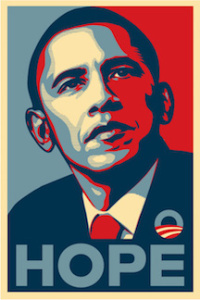 I was on board with Barack Obama’s message from the first time that I saw him on “Meet the Press” with Tim Russert, when he explained why he was the best candidate to lead the country. The world has changed, he said, we are no longer operating within the Cold War politics that form the Baby Boomers’ worldview, and as such, the nation needs a younger leader with a vision for our times. I agreed, I was ready for a president from my generation, and Barack Obama had my vote, especially in the general election, when John McCain’s bland, backward-looking conservatism was the other option.
The next year, after Barack Obama had become our nation’s first black president, Alabama stood on its own historic precipice, when a black US Congressman named Artur Davis was running strong as Democratic candidate for governor. The Democrats had controlled state government since the end of Reconstruction, and winning that primary usually meant winning in November. However, Artur Davis lost in the primaries to then-Agriculture Commissioner Ron Sparks – who then lost in the general election to Republican Robert Bentley – but it looked for a moment like stolid old Alabama’s worst nightmare might come true: a black president and a black governor.
Though Artur Davis’ defeat in the 2009 election cycle is attributed to many factors, I wondered then, and still do now, whether Barack Obama’s victory mobilized scared white voters into action. It is entirely possible that notorious Deep Southern racism caused many voters to say, Oh Lord, this could really happen! (Studies have shown the election of a black president increased membership among hate groups.) No matter whether anti-Obama fervor led voters or not, here’s what we got: the Republican Wave of 2010— the elections that gave us the utterly failed leadership we have now.
The contempt among white conservatives in Alabama for Barack Obama has been swift, immediate, and unrelenting. For eight years, Alabama’s leadership has sold an image of our president as the boogeyman, the barbarian at the gate, and the devil under every rock, all rolled into one. And that unceasing barrage of rhetoric has worked. One Friday night last fall, at my nephew’s football game, I was talking to a childhood friend on the sidelines when suddenly the conversation turned and he said casually but with emphasis, “I think Obama is a piece of shit, I hope you agree.” I told him that I didn’t, and he looked genuinely surprised. Sadly, the venom in Alabama that has been spent on Barack Obama has never been aimed at the state-level politicians whose removal seems more appropriate.
It was phenomena like these that prompted me to watch the 2014 documentary “Hating Obama”, which carries the viewer through about an hour of mish-mash opinion and populist commentary on this controversial president. While the film did a good job of presenting well-rounded perspectives on the 44th president, it failed to do something I wanted it to do: take a stand! “Hating Obama” begins with a question – Is President Obama hated for his policies or because he’s black? – and after we watch a multitude of testimonials from media personalities, from beauty-shop customers, from white people, from black, it ends with the same question . . .
Since we probably won’t get a real show of hands on who hates Barack Obama because he’s black, it makes more sense to see if he could be hated for his policies.
On job growth, President Obama has done reasonably well, according to the Washington Post’s assessment last January, and who could be mad at a president whose administration has steady job creation? According to a graphic in that Post article, of the last six presidents, three have done better than Obama – Carter, Reagan, and Clinton – and two have done (much) worse: both Bushes. Considering that George W. Bush’s administration basically destroyed the American economy and mired us deep into two expensive wars, Barack Obama’s administration has had a hard uphill climb.
How about another issue that affects everybody in one way or another: poverty. During Barack Obama’s administration, one NPR report from August 2015 shows, the poverty rate started at 14.3%, had risen at first, but then began falling; it was back down to 14.5% in 2013. (During George W. Bush’s administration, it rose three full percentage points.) Basically, President Obama stopped the bleeding. That NPR report is titled “Is It Obama’s Fault That Poverty Has Grown?” and the answer seems to be: sort of. It could be his fault— if we choose to totally ignore the roles of Congress, corporations, investors, business owners, and banks in the American economy.
Alright, another one that affects everyone: the deficit. Yes, President Obama’s administration has added massively to the national debt. It was around $10 trillion when he took office, and it now stands around $18 trillion. That’s $18,000,000,000,000.00— a dizzying number of zeros. Yet, it’s not as simple as saying that Obama “overspent” that much. Again, look what he inherited from George W. Bush: two wars and a shrunken tax base. This 2015 Washington Post story breaks it down reasonably well: yes, the debt has soared, but no, President Obama did not just whimsically decide to overspend. Again, this could be Obama’s fault if we ignore the roles played by everyone else.
Finally, let’s address the huge fear that has fueled anti-Obama sentiment in the Deep South: the dreaded “Obama is coming to take our guns.” Well, has he done that? In the seven-and-a-half years that Barack Obama has been president, he has not “taken away” people’s guns, even though many Americans still believe that he wants to. Here is an idea that is much more rational, from the Washington Post last January:
Confiscation is a much more radical gun-control policy than the bill to expand an existing background-check program for people who want to buy guns, which failed in Congress in 2013 due to opposition from gun-rights advocates. Even if Congress did support it, confiscation would be unconstitutional. The Supreme Court has ruled that Americans have a right to keep handguns at home.
However,
Guns are a way that those who fear Obama and his policies can feel like they have a measure of control over their own situation. Advocates for gun rights often claim that weapons will be needed so that citizens can fight back against the federal government, and sales of guns have skyrocketed since Obama took office.
That’s the Deep South that I know. I’ve heard more times than I can count that the guns will allow people to stand up against the tyranny of the federal government.
Certainly, there are other political issues – abortion, immigration, and student loan debt, which haven’t changed much during Obama’s presidency; or LGBT rights, which has changed dramatically – but those four are pretty broad in their relevance: jobs, poverty, the deficit, and guns. What it looks like to me, regarding the first three, is: President Obama stopped the crash that George W. Bush’s laissez faire policies caused, but he couldn’t single-handedly save the day. Unlike many Obama-haters, my memory actually extends back before 2008, so I recognize how W’s wars and anti-regulation economic policies have cost the country, even after he left office. About that fourth one, equating common-sense control on new gun purchases with a totalitarian confiscation scheme— that just smacks of paranoia, especially at this late date on his second term.
Earlier this month, NPR’s Steve Inskeep did a story on “The Obama Years,” and what he found tells a pretty convincing story about a good president. Unemployment was at 7.8% when Obama took office, and has fallen to 4.7%, while underemployment declined from 14.2% to 9.7%. Hourly wages have risen, but only slightly. Regarding health insurance, the uninsured rate “dropped by 5 percentage points between 2008 to 2014.” And though renewable energy still makes up only 13% of total US energy used, all forms have increased since 2007. Conservatives will be pleased to learn that rates of deporting illegal immigrants have been very high during the Obama administration. The issue of same-sex marriage was fully resolved during his presidency, and now there are no more questions about its legality (much to Roy Moore’s chagrin). A full third of the American people, including half of African Americans, say that Obama has improved race relations, while one-quarter say that he has made it worse; another 28% say that he has “tried but failed” to resolve racial problems in the country. (To those who blame Barack Obama for current racial tensions, thus ignoring the roles of every other person in America, I point you to Frank Bruni’s expertly stated rebuttal from mid-July.)
Whether you think Barack Obama’s election affected the chances of other black politicians, like Artur Davis, or not, to show just how much Alabama voters disdain Barack Obama and everything associated with him, e.g. Hillary Clinton, the state has swelled with support for Donald Trump. (In the state’s Republican primaries, Trump won every county race.) No candidate for president could be less Obama-like: where our current president is a slim, athletic man with a gracious smile, smooth baritone voice, and eloquent open-mindedness, Trump is a weasel-eyed name-caller with a spray tan and a ludicrous quaff, who slouches when he sits, meanders when he walks, and bears his teeth when he rants. But, in today’s political climate, he can be a bully, a thug, a Yankee, a scoundrel, a flip-flopper, whatever . . . because he’s male and white. (Well, sort of, he’s actually kind of yellowish-orange.)
While I recognize that everyone doesn’t have the affinity for Barack Obama that I do, I would say to his detractors: just thank your lucky stars that McCain or Romney wasn’t in the White House during these last years. Had George W. Bush handed the ball off to another Republican, I don’t know where we would be right now. I also think about how the last six years in Alabama could have been different if we had elected Artur Davis (or Ron Sparks) rather than Robert Bentley, who is now undergoing a laughable impeachment process. If we had had a Democratic governor to counterbalance that Republican super-majority . . . who knows?
Last night, Barack Obama’s speech at the Democratic Convention reminded me why I voted for him three times, twice in 2008 and again in 2012. Notwithstanding his wit, grace, or skill in oratory, he reminded listeners of two things to keep in mind always: first, that we – all of us – are integral part of American democracy, and second, that the process of democracy can be very difficult because it requires compromise— something that way too many people don’t want to do. Completely disregarding Barack Obama’s race, I truly believe that that’s why so many of his detractors hate him.
Filed under: Alabama, Civil Rights, Race, The Deep South, Voting



July 26, 2016
“Old South” and “New South” in the JeffCo Courthouse
The Change.org petition to remove two Depression-era murals in the Jefferson County Courthouse, in Birmingham, Alabama begins with this statement:
A courthouse should be a place of equality and justice before the law.
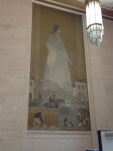 The controversial murals, which were done in the early 1930s by artist John Warner Norton, depict gigantic white people – a woman in the “Old South” mural and a man in the other, titled “New South” – standing tall over groups of much smaller blacks who are laboring, at the bottom of the scene, to bring the white vision into reality. And some in Birmingham want them gone.
Back in May, I read about the efforts to remove or cover the murals, when the AP covered the story:
The Jefferson County Commission on Thursday endorsed a recommendation from a special committee to put retractable shades over murals in the Birmingham courthouse that depict black people picking cotton and doing other manual labor against a backdrop of white people in more prominent positions.
The commission didn’t take a formal vote, however. It’s not yet clear when that will happen.
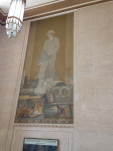 However, questions remained about being faithful to history. Though slavery and Jim Crow are regrettable, some said, removing evidence that they happened is not necessarily a good idea:
Amid those developments, Birmingham Museum of Art director Gail Andrews asked, “What do we save? What do we keep? What do we try to understand better about the forming of our nation and our county?”
“These are not murals that we take pride in today,” she said. “I appreciate that, but they are our history and we need to understand them.”
Since I hadn’t seen any more news about what would happen with the murals, I stopped by the Jefferson County Courthouse in late July to see if they were still there. And they were. Frankly, despite their size and their demeaning imagery, they were being largely ignored by the few people languishing in small lobby where the murals are located. (It was nearly 100 degrees that day, and I think they were just glad to get out of the heat.) One young man who stopped me in the lobby, asking me sign his petitions to get the Green and Libertarian candidates on the November ballot, had no idea what I was talking about when I told them I was only there to look at the murals.
Despite my own heat-induced languor that day, I had to agree about the deep irony of being flanked by two massive glorifications of injustice right as one enters a public building whose purpose is to house justice. However, I would think that most people today enter that courthouse with their own business on their minds, and many probably don’t even notice the murals, especially since the “Old South” mural, which contains the slavery images, looms right over a security station’s metal detector.
The discussion here is really over symbolism, not practicality. Just as a Confederate flag has never jumped down off of a pole and attacked anyone, it is what the flag stands for that makes it difficult: how can we glorify the Confederate South without also glorifying its most recognizable feature: slavery? Some defenders try to make the argument that we can value one without the other, but few of us buy it these days. Likewise, with these murals. What do we do with public art that testifies to, and even celebrates, the severity of past inequality? Again, it’s a hard sell to leave it there, as is . . . even though it may be even more dangerous, long term, to sanitize our understanding of history by removing or covering images that remind us how many errs in judgment have led us to where we are now.
Filed under: Alabama, Arts, Civil Rights, Race, Social Justice, The Deep South



July 24, 2016
A writer-editor-teacher’s quote of the week #129
If sometimes racism is called a social problem, other times a disease (often, a “cancer” on the South), and still other times a “poison,” most often it has been described by those writers who have examined it in very personal terms as, simply, “sin” or “evil.” Those writers’ penchant for giving voice to a litany of their own racial sins and thoughtless acts of cruelty might be seen as evidence that they subscribed, in some measure, to that old Puritan conviction that the greatest sinner was also the best candidate for salvation.
– from the “Introduction” to But Now I See: The White Southern Racial Conversion Narrative by Fred Hobson
Filed under: Bible Belt, Civil Rights, Critical Thinking, Literature, Race, Social Justice, Teaching, The Deep South, Writing and Editing



July 21, 2016
Recycling in Montgomery: The Latest Chapter
This week, the City of Montgomery took action that would give our local leaders ownership of the IREP recycling facility here. I’ve been following this story for several years – from the announcement three years ago to the return of curbside recycling service in 2014, followed by a much-lauded operation that shut down abruptly in late 2015 – and I’m among those who want to see this effort succeed.
The City’s press release from July 19 explains that IREP, the company that built and had been operating the facility, would be filing for Chapter 11 bankruptcy, which would allow the City to take it over and find a new way to operate it “with the goal of finding a forward-thinking and environmentally-conscious solution to Montgomery’s recycling needs.”
The Montgomery Advertiser reported that the City’s Director of Finance Barry Crabb “said discussions have already been held with five potential companies and more meetings are planned. One potential hiccup in the negotiating process is that the city hopes to provide no more capital than the multi-million dollar facility it will acquire if the bankruptcy is approved.”
Earlier this year, there had been reports that the City was working to take over the IREP facility. Though I’m sorry that the IREP couldn’t carry out their plans long-term, I’m glad to see that City leaders have stuck with it!
Filed under: Alabama, Local Issues, The Environment



July 19, 2016
Women, Wages, Work, and Wisdom
Back in April, al.com’s Kelly Poe reported on a story of national interest, as it pertained to our illustrious Heart of Dixie: “Alabama’s pay gap among largest in nation, study finds.” Where, on the national average, women earn 79 cents for every dollar a man earns, in Alabama the female worker is getting just 73 cents. According to the report from the National Partnership for Women & Families, Alabama ranks an unfortunate sixth in the nation in this dubious category, though we don’t have to look far to see the first-place “winner,” our Deep Southern neighbor: Louisiana.
The Deep South’s unsavory history with being shortsighted on women’s issues is well-documented. Alabama didn’t accept the fact of the 19th amendment, which guarantees women the right to vote, until 1953, but that was fairly progressive in Deep Southern terms. The amendment was ratified in August 1920, but South Carolina, Georgia, Louisiana and North Carolina were even later than Alabama, accepting it in the late 1960s and early 1970s. Mississippi officially got on board in 1984!
Also in April, al.com’s Charles Dean reported on better news in this area: “Women-owned businesses in Alabama and America growing fast.” Reading these articles side by side, I was thinking, Heck, if you’re a woman in Alabama, you might do better to quit being an employee and start your own business. Looking at Dean’s reportage of the facts, female-owned businesses are growing in Alabama at an astounding rate, and despite Alabama’s usual placement near the bottom of national rankings, the state is 15th in the nation in this category— doing pretty well.
However, as with everything, there is a downside.
In May, the Birmingham Business Journal reported on a WalletHub study, which showed that Alabama is the second worst state for working moms:
The site compared statistics across 13 metrics, including child care quality and costs, the gender pay gap, female unemployment rates and parental leave policies, among others. These metrics combined for an overall state score of 35.94 out of 100. Alabama was second only to Nevada, which had an overall average score of 34.63.
Sadly, Alabama is also 49th in the nation in the number of single-mother families living in poverty. (The Business Wire also reported on this aspect of the study.) These numbers tell a story of too many women living in poverty, receiving low pay, and raising children by themselves. That is magnified by the simple fact that 51.6% of Alabama’s 4.85 million people are female. What that means for our state is simple enough: we have tens of thousands of households where a woman is raising is struggling to raise children by herself, all too often with inadequate wages, and our public policy, e.g. refusing to raise the minimum wage, does little to assist them.
When North Carolina’s News-Courier reported on the same study, they shared this very interesting correlation with Deep Southern political leanings:
Overall, women in blue states (those states that predominantly vote or support the Democratic Party) faired better than those in red states (those states that predominantly vote or support the Republican Party).
Interestingly, while the electoral map of the South has been almost solid red since days of Ronald Reagan, other statistical maps of the US also show our region as solid red, like this one from the US Census report “America’s Families and Living Arrangements, 2012”:
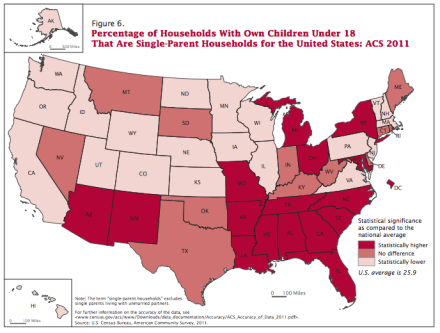
Here, the color red indicates not the Republican Party, not the Alabama Crimson Tide, but “Statistically higher” rates of single-parent households.
I share this map and these facts not to degrade single-parent families – I spent my teenage years in a single-mother household, and we struggled, too – but to point out how these disparate facts coalesce:
women earning lower wages
public policies aligned against working people
workplace policies that are unfriendly to working mothers
higher rates of households led by single women
Add all that up, and the resulting inequality is obvious. Our culture, economy, and public policy make life more difficult for women, especially for women with children, most especially for single women with children.
Back in April and May, these reports about the earning gap between men and women were the flavor of the moment in the twenty-four-hour news cycle. Yet, even though the news reporters moved on – first to Trump, then to Orlando, now to Dallas – these realities haven’t changed for the women living them. There are thousands of women across the Deep South who are trying to support themselves and children on about $300 a week before taxes, which is what a full-time job at the federal minimum-wage pays. Anyone with children knows that, once that mom pays for childcare so she can actually go to work, she has almost nothing left, even for basic needs: housing, food, utilities, and clothes.
Just as other aspects of Alabama’s culture, created in the early statehood/antebellum days, can still be easily seen – racial apartheid, disdain for the federal government, violence as a response to perceived disrespect – attitudes toward women’s issues have been equally slow to change. As the culture of the Deep South emerged from a colonial/frontier period in the early 1800s, the political and social systems were set up by men to be dominated by men. In the first section of Alabama: History of a Deep South State, historian Leah Rawls Atkins tells us:
Despite the proverbial pedestal, white women in Alabama suffered under some of the same legal restrictions as free blacks and slaves. They, too, had no primary rights of citizenship and could neither vote nor serve on juries. Following the English common law, a married woman’s possessions, including her personal clothes, were owned by her husband. Any real estate a married woman might inherit could be controlled by her husband, and he could sell it without her consent and appropriate the money for his own purposes. The editors of the reformist-free thought publication Free Enquirer, which was based in New York, noted in 1829 that “a married woman belong[ed] to her matrimonial master, as in the case of any other slave.”
Rawls noted also that an early “ladies bill,” proposed in 1828 to remedy those property-rights policies, failed because, as its detractors put it, the bill “questioned the wisdom of altering human and divine laws.” That male-dominated property-ownership system was later reformed in the 1840s, but subsequent legislative acts quickly dialed back the reforms, lessening their effects. In nineteenth-century Alabama, the bottom line was that women were expected to be “pious, modest, compassionate, quiet, and dainty, and by nature self-denying and soft-spoken,” i.e. the Southern belle— demure, pretty, easily controlled, and easily ignored.
But we don’t live in those days anymore. That old way broke down forty or more years ago, when both the divorce rate and teen pregnancies rate skyrocketed, yet public policy and workplace standards haven’t kept up with the changes. In my 2011 book, Children of the Changing South, one of the issues addressed in both the introduction and the memoirs within is how Southerners handled the changes brought by the women’s movement. In my introduction, I referred to Numan V. Bartley’s The New South, 1945 – 1980, which explains that the gender protections in the Civil Rights Act of 1964 and the increasing number of women in the workplace changed the South’s traditionally male-dominated fabric. Later in the anthology, for example, Leslie Haynsworth’s “Women’s Work and Working Women” addresses those subjects directly. Once again, the world changed, but the South wouldn’t change with it.
The traditionally conservative and resistant-to-change Deep South has a long way to go to remedy the inconsistencies between our social, political, and economic systems and the realities on the ground. (That’s true of many areas, not just women’s issues.) Back when we lived in a society where (typically) men worked and women stayed home with children, there was less of a need for something like the Family Medical Leave Act. But now there is a great need for policies within the public and private sectors to match up our way of doing business with our way of life, like expanding Medicaid to help those single-parent families living in poverty. Today, a lot of women in Alabama and across the Deep South work and raise children, and many do both alone, with no help. It’s high time we pass some new “ladies bills” that give them the supports they need.
Filed under: Alabama, Civil Rights, Multiculturalism, Social Justice, The Deep South



July 17, 2016
A writer-editor-teacher’s quote of the week #128
“There was something of the conscience of the South in the theme and the characters in the book,” she said. “All of us seek a time and way to communicate something of the sense of loneliness and solitude that is in us – the human heart is a lonely hunter – but the search of us Southerners is more anguished. There is a special guilt in us, a seeking for something had— communicable. Southerners are the more lonely and spiritually estranged, I think, because we have lived so long in an artificial system that we insisted was natural and right and just— when all along we knew it wasn’t.”
“The fact we bolstered it with laws and developed a secular liturgy and sacraments for it is evidence of how little we believed our own deceits.”
Carson was, of course, quite right.
– from the chapter, “The Conscience of the South,” in The South and the Southerner by Ralph McGill. (McGill was writing here about meeting and talking with Carson McCullers, author of The Heart Is A Lonely Hunter.)
Filed under: Literature, Race, Teaching, The South, Writing and Editing



July 14, 2016
A little nod to the “Sweet Sunny South”
Throughout the month of June, Sierra Nevada Brewing in Chico, California, had their summertime Beer Camp festivals across the nation. Though the nearest one to the Deep South was in Tampa, Florida – a seven-and-a-half hour drive of nearly 500 miles from where I live – I did get to enjoy a “Sweet Sunny South” from their “one-time-only variety pack.”
Although “Sweet Sunny South” was flavored with tea, peaches, and grits, it tasted a kind of like a grapefruit shandy, and was even a little bit pink coming out of the bottle and into the glass. The label says that it was concocted with Austin Beerworks in Texas, Bayou Teche in Lousiana, Creature Comforts in Georgia, Funky Buddha in Florida, and Wicked Weed in North Carolina. (I don’t what was so wrong with the Alabama breweries, but I guess folks have their reasons.) With an ABV just under 5%, they called this one a “Southern Table Beer.” I’m just enough of a redneck not to know what that means: my beer stays in the cooler until I drink it.
Filed under: Food, The South