
Regina Scott's Blog, page 10
March 15, 2022
Free to Fly, Free to Read
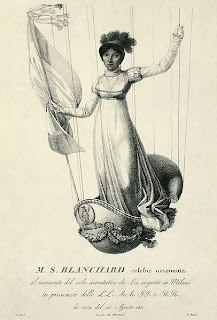 Nearly 10 years ago (how time flies, like this nineteenth century heroine!), I introduced you to Marie Madeleine-Sophie Blanchard, Napoleon’s Chief Air Minister. Sophie’s story refused to leave me alone, so I’ve continued to research her and her accomplishments. They have only made her more fascinating!
 Sophie was a nervous little thing—afraid of loud noises, afraid of riding in carriages. But she found her strength in an unlikely place—taking death-defying rides in hydrogen balloons! She was the only female balloonist at the time to take solo flights. She was one of the only aeronauts to toss out fireworks from her balloon to the thrill of the crowds. She went higher and farther than many male balloonists. Her one failure?
She could not give Napoleon what he most wanted—a balloon invasion of England.
England ruled the waves at the time. Crossing the Channel by ships filled with the vast French forces Napoleon needed to invade would have seen many if not all of the vessels, and their occupants, sinking below the water. But if balloons could be launched, Napoleon reasoned, they might be set down on the very shores of England, if not the Prince Regent’s front lawn!
Sophie knew better. The prevailing winds ran up the Channel, not across it. Only a few, her famous husband, Jean-Pierre Blanchard among them, had crossed the Channel by balloon, and always from England to France. The state of ballooning at the time, with little way to maneuver the craft aside from rising or falling to catch the wind, meant there was no way to fight the air currents. Jean-Pierre’s Channel crossing craft had had wings on the sides, allegedly to pilot the craft. Sophie knew they had been for show only. Her husband had been a visionary, but few of his devices ever worked.
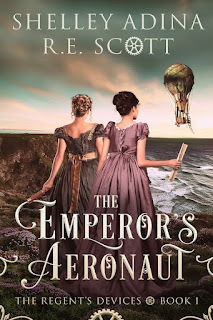 Until their daughter made them work. Yes, I am delighted to report that my research into Sophie Blanchard is about the bear fruit. Look for Celeste Blanchard to star alongside intrepid British inventor Loveday Penhale in May’s The Emperor’s Aeronaut!
 Napoleon is determined to conquer the world with his steam-powered weapons. Nothing in England can stop him … except two young lady inventors.
In 1819, France is surrounded by armies. With Russia in the north, the Karlsruhe Confederacy in the east, and a pirate kingdom in the south, Napoleon cannot break out, nor can the English Navy seem to break in. Europe teeters on the edge of a sword. Whichever side rules the air will win.
Celeste Blanchard, daughter of the Emperor’s disgraced Air Minister, is running out of time to develop an air ship that can carry his armies to England and restore her mother to glory. But on a daring and desperate test flight, she is blown off course … and washes up, half drowned, on the shores of Cornwall, in the heart of enemy territory.
Loveday Penhale, cosseted daughter of gentry, has her own inventions to build, even as pressure mounts to behave like a proper young lady and seek a husband instead of a design for a high-pressure steam engine. But when Arthur Trevelyan, heir to the neighboring estate, Gwynn Place, asks for her help in rescuing an unconscious young woman on the beach, Loveday discovers an aeronaut and an inventor as skilled as she is. Between them, a friendship blossoms, and Loveday wonders if they might even pull off the impossible and invent an air ship that will catch the eye of the Tinkering Prince Regent, who has offered a prize to anyone who can help England break the impasse. Celeste’s loyalties are torn in two. If she is caught working secretly for France, she will lose her friend, the love of an honorable man—and her life. But if Napoleon learns she has betrayed him, she will be executed on sight.
Can friendship prevail in the face of war? Or is there a third solution—one where everything hinges on the bravery and daring of a Cornish debutante and the Emperor’s aeronaut?
Available for preorder at
 In the meantime, I am also delighted to report that The Matchmaker’s Rogue is free from now through March 22 at fine online retailers.
 The admired hostess of the spa in the little village of Grace-by-the-Sea, Jesslyn Chance plays matchmaker to those who come to take the waters, promenade through the shops, and dance at the assembly. But when a rogue returns from her past, Jess finds herself suddenly at sea. Larkin Denby is back on a mission: to identify the mysterious Lord of the Smugglers who takes England’s secrets to France. As Jess works with Lark to uncover the fellow, the matchmaker may find that the best match for her is the rogue who stole her heart years ago.
Feel free to fly!


March 8, 2022
The Soup That Never Was
This post was inspired by a social media post I recently ran across that I found fascinating, and had to share with you. It’s about a soup that never was.
Yes, that’s right: a historical soup that never seems to have existed in real life.
Brown Windsor Soup appears in all sorts of modern cookbooks as an historical recipe, a Victorian staple, and even as Queen Victoria’s favorite soup. In my copy of Jane Garmey’s Great British Cooking*, it’s called a “hearty beef soup, once extremely fashionable…. For many years, a particularly unappetizing version was continually served by British Railways in their dining cars, which may explain its present demise.” It appears in the Unofficial Downton Abbey Cookbook and several other modern volumes of Victorian cookery.
 There’s only one problem: were you to go back in time to the Victorian era and, say, try to order it in a restaurant, they wouldn’t know what you’re talking about. Brown Windsor Soup didn’t actually exist, according to food scholar Glyn Hughes, author of
The Lost Foods of England
(which is totally on my to-buy list!)
There’s only one problem: were you to go back in time to the Victorian era and, say, try to order it in a restaurant, they wouldn’t know what you’re talking about. Brown Windsor Soup didn’t actually exist, according to food scholar Glyn Hughes, author of
The Lost Foods of England
(which is totally on my to-buy list!) When Hughes was beginning research on his book documenting English gastronomy, Brown Windsor Soup seemed like an easy topic to start with; everyone knew what it was, and even had memories of the dreadful version served on trains (see Jane Garmey’s comment above.) But when he started consulting Victorian cookbooks, he could find no mention of it—anywhere. Intrigued, he pored through the British Newspaper Archive and even paid researchers to comb through the records of the National Railway Museum. There was nary a single mention of it in Victoria’s reign. Certainly recipes for hearty beef soups existed, but not under this name. Not until the 1920s did it begin to appear in cafeterias and cafes (and likely railway stations dining rooms) as a filling, if dubious and dreary, menu item.
So where did the legend of Brown Windsor Soup as a Victorian staple come from?
Hughes points to a few things, among them toiletries and radio.
It seems that there was a Windsor Soup, or potage à la Windsor, on her majesty’s menus. It was the creation of Charles Francatelli, one of the queen’s chefs whom we’ve met before. But Francatelli’s Windsor Soup was a creamy white soup made with rice, not brown and beefy...and while it’s not known to have been a particular favorite of her majesty, Francatelli’s cookbook was a staple in Victorian households for decades. Other Victorian cooks created their own Windsor soups, but again, most borrowed heavily from Francatelli’s recipe, and were decidedly white.
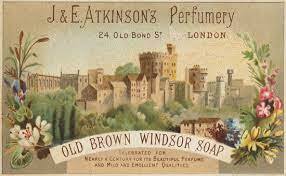
But there was Brown Windsor Soap—a toiletry that was well known as a favorite of Queen Victoria (and Napoleon!), complete with a picture of Windsor Castle on its packaging (and still available today.)
And then there was The Goon Show. This popular (and very goofy) radio show of the 1950s (featuring Peter Sellars in his pre-Inspector Clouseau/Pink Panther days—if you ever have a chance to hear them, do!) latched onto “Brown Windsor Soup” as a recurring comedic gag, a stand-in for all stodgy English cuisine (and, by extension, stodgy Britishness.)
Might all of these—a real Windsor soup, a very popular product with a similar name, and the hilarity of radio—have mixed themselves up with a twentieth century invention into a sort of cultural pseudo-memory? Hughes thinks so—and is astonished by the resistance to his research by people who are convinced to this day that they used to eat Brown Windsor soup on trains.
* * * * *
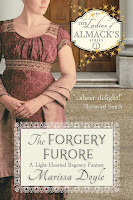
Not imaginary or Victorian is that there is currently a giveaway for The Forgery Furore, the first installment in my new Regency fantasy series The Ladies of Almack’s, on Goodreads. You can enter it here; entries are open till March 20.Good luck!
*Amazon affiliate links are used in this post.
March 1, 2022
A Count Worth Courting
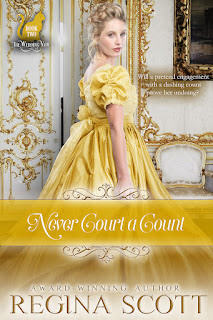 February 21 saw the launch of Never Court a Count, the second book in my Fortune’s Brides: The Wedding Vow series. I’ve had several readers and reviewers ask about how I developed Callie’s character: shy, quiet, unsure in Society. She’s an introvert, like me. But she has secret weapon I wish I’d thought of as a benefit growing up.
 Lady Calantha, middle daughter of the Duke of Wey, has the unique ability to turn invisible in company. Well, not entirely invisible, or the eligible Frederick, Count Montalban, wouldn’t have noticed her at all. But Callie’s shy nature and plain features tend to make people overlook her. And they say the most outrageous things around her as a result, which is why she accidentally overhears strangers plotting to harm the count and his royal brother and father. What can a lady do but warn him?
Fritz, Count Montalban, is determined to keep his family safe. But he can’t drag Callie all over London to identify those plotting against them unless she has a reason to be alone with him. Pretending an engagement sounds like the perfect plan. After all, his dashing demeanor hides a wounded soul that demands he hold a true fiancée at a distance. But there’s something about Callie that pulls him closer.
As the danger grows along with their attraction, Fritz and Callie must work together to protect both their families, and Fritz finds his heart cracking open. Can he prove to the sweet Callie that she will never be invisible, to him?
Available in ebook and paperback at fine online retailers and bookstores near you, such as
Amazon (affiliate link)
An Independent Bookstore Near You: https://www.indiebound.org/book/9798985340914or https://bookshop.org/books/never-court-a-count/9798985340914
February 22, 2022
With Apologies to Mr. Ackermann…a Little
I’ve been collecting early 19th century fashion prints for a long time now. They the perfect thing to collect: they don’t take up a whole lot of room; they don’t break the bank to acquire; they’re a tangible piece of history; and they’re soooooo pretty! I’ve enjoyed sharing them with you and using them as a way to explore the fashions of the era.
And now, I’ve found another use for them: silly memes!
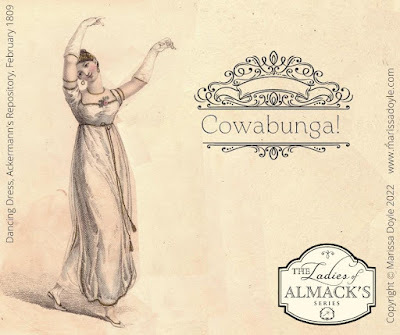
Inspired in part by graphic artist Anne Taintor’s work and in part by my upcoming Regency series, The Ladies of Almack’s, coming out next month, these have been huge fun to create. Like, waaaayyy too much fun.
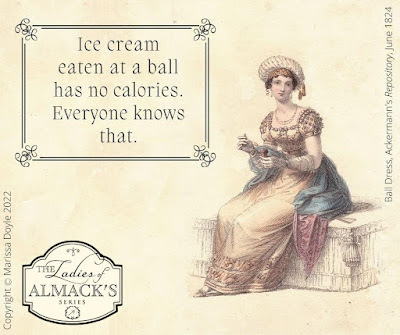
The combination and/or juxtaposition of old images and modern sensibilities has proven irresistible and…er…I’ve made rather a lot of them.
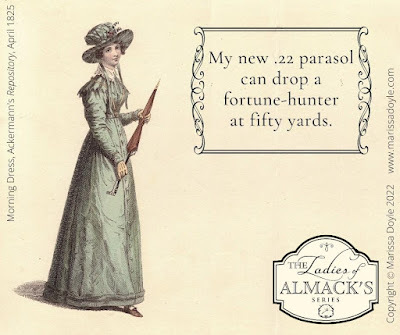
If you like them, keep a look out for them on my social media outlets: Facebook, Twitter, Instagram, and Pinterest (and follow me, if you don’t want to miss any.)
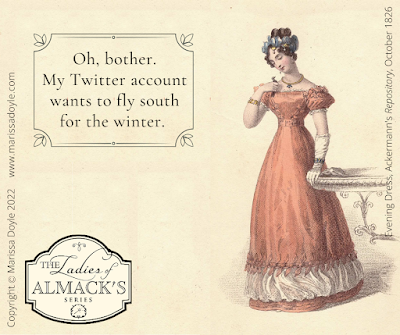
I might even compile them into a downloadable screen-saver for my newsletter subscribersat some point...what do you think? Should I?
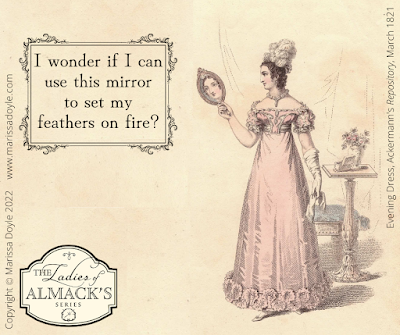
Anyway, I’ll be having a lot of fun with these…and I hope you will too. To paraphrase Jane Austen, “For what do Ackermann prints exist, but to make sport for our neighbors, and laugh at them in our turn?” 😁
February 15, 2022
Spend a Moment in the Salon?
 Once upon a time, those who loved stories set in the nineteenth century had to enjoy their books in relative solitude. Oh, they might extoll the virtues to friends and family, some of whom had their eyes glaze over, alas. And they might find a book club willing to read with them on occasion. But then came Facebook Groups, where they could talk, and talk, and talk with like-minded lovers of Regency romances. 😊Allow me to introduce you to three of my favorite groups.
 I am one of the founding authors for Regency Kisses: Lady Catherine’s Salon. The group is for those who love low-heat Regency romances. We occasionally throw in a Victorian. Each week, a different author hosts, offering insights into the time period and their writing life. They also offer fun activities. We’ve had lessons in trimming your own bonnet, setting up a dinner party, and taking a trip by carriage. I hosted a week on the history of the genre. We’ve even had games like a Where’s Waldo in the Regency and online puzzles of period paintings. Readers post reviews on the weekends along with other information about the books they love.
We also hold parties from time to time around a theme like a ball or a dinner. We’re celebrating Valentine’s Day all this week with first kiss scenes. You can join in the fun here.
The second group I’d like to draw your attention to is Inspirational Regency Readers. Run by authors Erica Vetsch and Julie Klassen (link), this group has fun activities, wonderful pictures, and tantalizing tidbits about the period we all love and the books set in them. Readers are very active in this group. You can join them here.
Finally, there’s Alissa’s Regency Companions, run by author Alissa Baxter. She finds the most amazing photographs of country houses (exteriors and interiors), ladies in Regency garb, and Regency items I’ve ever seen. She also posts about Regency books on sale or free. Again, lots of interactions among the other members. You can join here.
Hope to see you at a salon soon!
February 8, 2022
A Pelisse, Please!
Oh, La Belle Assemblée. You got me right between the eyes with this one!
May I present, for your viewing delectation, a Walking Dress for March 1812.
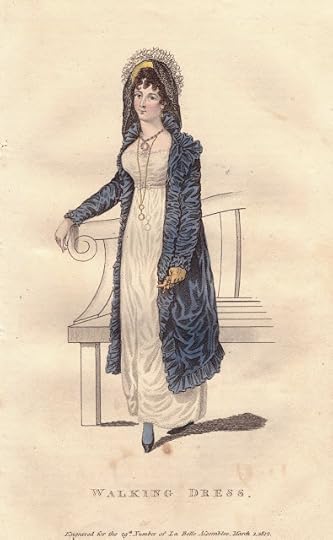
The description reads
No. 2.—Dress for the Fashionable Promenades.
A purple velvet pelisse, with a full standing-up collar, worn carelessly open over a round white dress of fine French cambric; the pelisse trimmed with a broad bordering of braided ribbon, the same colour as the velvet. A Minerva bonnet of amber coloured sarsnet, with a long white ostrich feather across the front; the feather made round, and very full; long black lace veil, a-la religieuse; a chain necklace, composed of pearls with a gold ornament depending in front, representing the Apollo Lyre, set round with a circle of pearls; a gold Lisbon chain with an eye glass hanging below the waist. Plain gold oval-ring pendants. Purple half-boots, and York tan gloves.
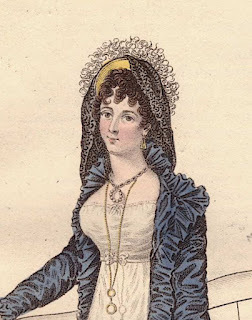 Lots to unpack here. I’m struck by the “carelessly” style suggestion, which has appeared in other fashion prints. It’s fascinating how at times being absolutely neat and buttoned-up and pulled together is the desirable mode, while at others a dash of wind-blown untidiness is all the rage. “Fine French cambric.” Hello, we’re smack in the middle of the Napoleonic wars at this time! I don’t know if its use here means it was actually imported from France (which I really can’t see, considering the embargo.) It might be worth doing some digging around to find out if “French cambric” meant a particular weave or finish…or if describing some article of fashion as “French” was just to give it a little extra desirability. Lots of description of jewelry in this particular plate, which is unusual.
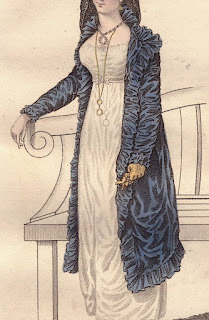 Now, that amazing pelisse! I’m reminded of coats from the high heyday of evening wear in the 1950s and 1960s, aren’t you? The high collar, the rumpled, gathered look of the fabric (which seems slightly at odds with the description of the trim)—it’s scrumptious. I'm trying to tell if it’s self-lined or not—it rather looks that way, but trying to put on and take off a velvet-lined pelisse...hmm.
The dress is pretty enough, but honestly, who’s looking at the dress? 😁 The hat confuses me, however; wouldn’t wearing the lace veil over it (as shown in the image) hide the ostrich feather?
On reflection, I don’t care. I’m too in love with the pelisse.
What do you think?
February 1, 2022
Can You See Anything? Not in the Women’s Gallery in the House of Commons
I suppose I take for granted the ability to watch our democracy in action. The internet and cable television bring our legislators up front and personal, and the news media provides summaries of actions taken in the House of Representatives and the Senate. Before the pandemic, I might have gone to sit in the gallery of my state legislature and watch proposed laws being debated. So, I was surprised to learn just how hard it was for a young lady to view activities in the House of Commons during the early part of the nineteenth century.
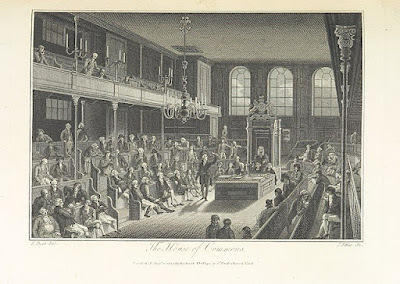
Until 1834, when the House of Commons was destroyed by fire, the building was a rambling, four-story structure along the Thames. The Members of the House met in a lofty chamber with galleries around three sides, but these spaces were for men only. Two galleries flanking each other were for Members who did not intend to take part in the debate. Overflow was necessary, because the main floor could only accommodate a little over half of the Members at a time. The third gallery was for “Strangers,” or visitors. Of the 120 seats, 40 were reserved for reporters.
If a lady wanted to observe the goings on, she must watch from the Women’s Gallery. It was located in the attic, directly above the debate chamber. There was room for only fourteen occupants, and their view consisted of a grating in the floor that gave onto the chamber below. As near as I can tell, you can see the grating in the ceiling at the upper left of the picture above.
According to one attendee, all that could be seen were the feet of the Speaker of the House sitting in his chair, part of the table at which the clerks recorded the proceedings, and one or two of the dignitaries seated nearby. The Women’s Gallery was dark, with only a single candle in a tin lantern, and hot, with the chamber below ventilating into it. (I will restrain myself from making a joke about all that hot air rising from the pontificators.)
Such was the scene when Lady Calantha, heroine of February’s Never Court a Count, attempted to identify a Member of the House by the sound of his voice. She promised Fritz, Count Montalban and brother to the Crown Prince of Batavaria, that she can find the man she overheard threatening his family. But she never expected identifying him would be so difficult, or Fritz so hard to forget. Here’s a little about the story.
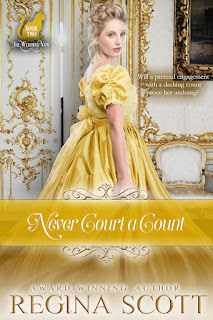 Lady Calantha, middle daughter of the Duke of Wey, has the unique ability to turn invisible in company. Well, not entirely invisible, or the eligible Frederick, Count Montalban, wouldn’t have noticed her at all. But Callie’s shy nature and plain features tend to make people overlook her. And they say the most outrageous things around her as a result, which is why she accidentally overhears strangers plotting to harm the count and his royal brother and father. What can a lady do but warn him?
 Fritz, Count Montalban, is determined to keep his family safe. But he can’t drag Callie all over London to identify those plotting against them unless she has a reason to be alone with him. Pretending an engagement sounds like the perfect plan. After all, his dashing demeanor hides a wounded soul that demands he hold a true fiancée at a distance. But there’s something about Callie that pulls him closer.
As the danger grows along with their attraction, Fritz and Callie must work together to protect both their families, and Fritz finds his heart cracking open. Can he prove to the sweet Callie that she will never be invisible, to him?
Preorder now at
Amazon (affiliate link)
January 25, 2022
Regency Fabrics, Part 34
Here���s another post in our ongoing series on Regency fabrics.
As I have in previous posts, I���ll be examining actual fabric samples glued into several earlier editions of Ackermann���s Repository, samples supplied by the manufacturers and published by Ackermann in order to boost the British cloth-making industry at a time when exporting British goods to Europe was almost impossible because of the Napoleonic war. I'll give you a close-up scan of each sample, the published description if available, and my own observations of the color, weight, condition, and similarity to present-day materials, to give you as close a picture as possible of what these fabrics are like.
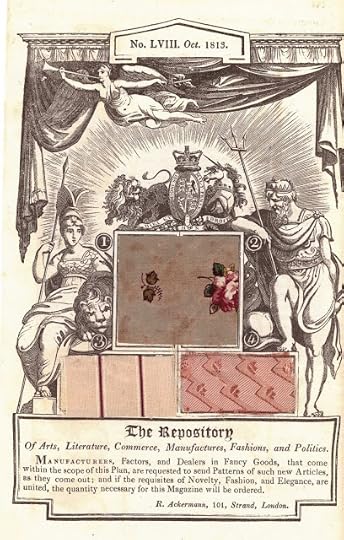
Today���s three samples are from the October 1813 issue of Ackermann���s Repository. The overall condition of my copy is excellent, though (like our last fabric print) a little closely trimmed on the outside edge; the page itself is free of foxing and is only slightly toned on the edges. The samples themselves are in very good condition, with perhaps a bit of discoloration from the glue used to affix it to the page in the top sample.
Here we go!
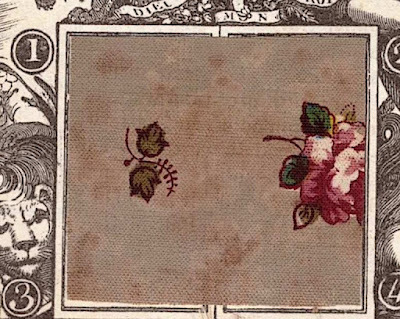
No. 1 and 2 is an olive chintz for furniture, designed by Mr. Allen expressly for her Grace the Duchess of Bedford, and is to ornament several of the rooms in the cottage now building in Devonshire. The linings best adapted to this lively and elegant article, are, blue, pea-green, and rose colour, with variegated fringes to correspond. We offer this pattern as a sample of those numerous and beautiful articles for furniture, which are exhibited at the splendid gallery of Mr. Allen, of Pall-Mall; where purchasers may meet with the most fashionable variety, and at the most reasonable prices.
My comments: It���s a little hard to see the original olive color here because of the brown foxing, but it was a clear, light-ish shade complemented by the various pinks of the flowers. It���s also possible to see, if you hold the sample about two inches from your nose, that the green of the printed leaves in the floral cluster was created by printing in blue and then yellow (or the reverse���it���s difficult to say) rather than with green dye, which, as we have seen in other posts, was not an easy color to obtain before the advent of artificial dyes. The weave is fairly even and tight (as is usual with chintz), and the glazing is not too heavy but has a nice sheen to it.
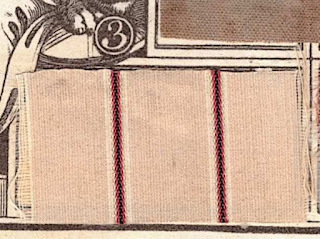
No. 3 is a new Manchester manufacture for gentlemen���s waistcoats. The lively contrast of the stripe and ground, will sufficiently recommend this article for autumnal wear. It is sold by Kestevens and Co. York-street, Covent-Garden.
My comments: I like this very well indeed. It���s a sturdy fabric: the warp threads are three-ply while the weft is single. The wider, pale apricot stripes of the ground fabric are about a half-inch wide, and the red and blue stripes are set off by a few threads of white that add some dimensionality to them. It would indeed make a handsome waistcoat; a hundred or so years later, I could see this as a shirtwaist dress worn by a Bright Young Thing for a luncheon party.
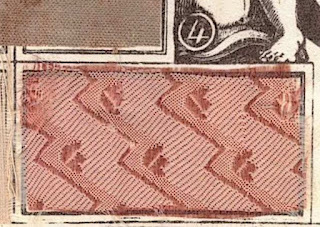
No.4 is a rich lilac-shot figured sarsnet, calculated for spencers, pelisses, mantles, and bodices. It admits trimmings of silk of the same shade, thread lace, white net, and white beads; which judgment and taste will appropriate to the article, composed so as to produce a becoming and consistent effect. It is sold by Mr. King, silk-mercer, Pall-Mall.
My comments: Oh, this is lovely fabric! Not so much the color���I still haven���t decided if ���lilac��� was the term used for this dusty shade of pink that we���ve seen in other fabric samples, or if the pigment in the dyes has aged and changed from something more purplish to this. But the silk is exquisite: rich and buttery, heavy enough to drape beautifully but light enough, I would imagine, to float and flutter when made into a pelisse (though a lining would tame that tendency.
What do you think of this month���s fabrics? Fancy a dress in one?
January 18, 2022
The Looooong Regency
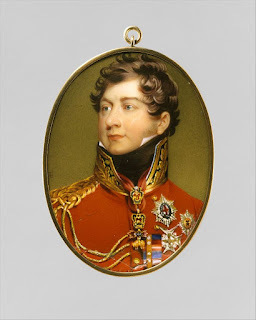 Every so often, I have a reader ask me when the Regency period was. When I tell them February 5, 1811, to January 29, 1820, I frequently get wide eyes and the response, “That’s it?”
 Yes, technically, the Regency period encompasses the time when Prince George was Regent for his father, King George III. He was made Regency by an Act of Parliament in 1811, and he ascended to the throne on his father’s death in 1820 (although he would not be crowned until a year and a half later). It is one of the most popular periods for setting historical romances and historical mysteries. But the same aspects of the beloved Regency lasted longer than that short 9-year period.
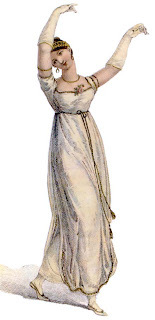
The high-waisted women’s fashions and dapper men’s fashions that typify the Regency came into style around 1794, following the French Revolution, and women’s waistlines didn’t start to fall until the 1820s and then only gradually. The Gothic Revival movement in architecture started in the 1740s. The ideas of freedom for all from tyranny flourished from the 1750s onward.
Regency Fiction Writers, the professional organization for those who write books set in the Regency period, recognizes the years 1780 to 1840 as the extended Regency period. The organization celebrates the publication of new works set during those years through its monthly Regency Reader newsletter. If you love the Regency, you can subscribe here.
Because who doesn’t want a little more Regency?
January 11, 2022
Baby, It's Cold Outside
After a very mild autumn, my neck of the woods is finally getting a sharp dose of winter today, with temperatures hovering in single digits (which is why I did anything that needed doing outdoors yesterday.) Of course, in today’s world we have central heating and insulated homes and amazing fabrics that keep us warm…and while winter temperatures in England aren’t generally as severe as those in the more northerly parts of North America, the world was still in the grip of the Little Ice Age and the Thames still occasionally froze over. So what did a Regency miss do when winter dogged her heels and nipped at her nose?
I’ve one word in answer to that question: fur.
Since down jackets and Gore-tex had yet to be invented, the warmest thing in outerwear that one could wear was fur…and our hypothetical Regency lady took full advantage of it. She might wear fur-lined pelisses and cloaks like some of these:
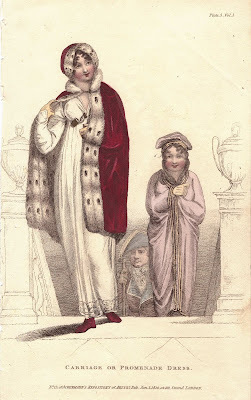 Carriage or Promenade Dress, Ackermann’s Repository, January 1810. Incidentally, this print and the next are among the only illustrations I’ve seen of fur used in millinery in Ackermann’s Repository; the other is a print from La Belle Assemblee that we looked at in detail a few years ago.
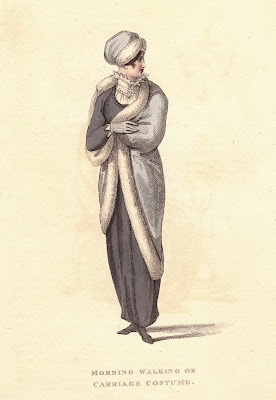 Morning Walking or Carriage Costume, Ackermann’s Repository, December 1810
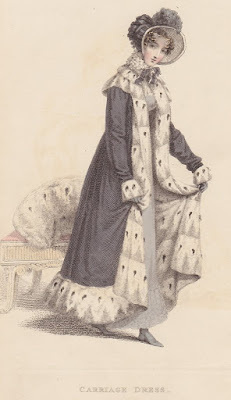
Carriage Dress, Ackermann’s Repository, February 1820
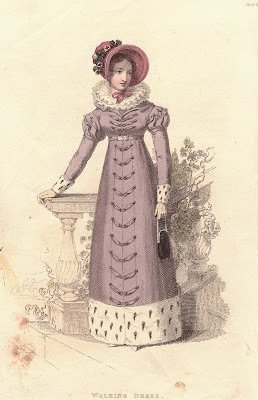 Or maybe just settle for fur trim, as in this Walking Dress from the March 1822 Ackermann’s Repository.
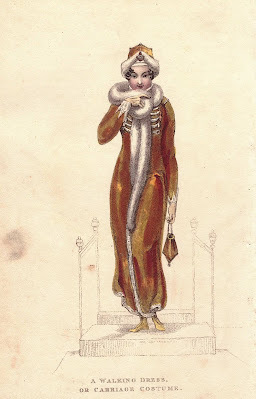 She might cuddle up in a fur tippet (or what we call a boa) to keep her neck warm. (A Walking Dress, or Carriage Costume, Ackermann’s Repository, February 1811.)
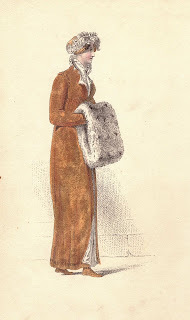 And of course, there were those enormous, eye-catching muffs that were popular for decades...and no wonder: gloves were worn year round, but when glovemakers boasted of the fineness of the kidskin they used, something more would definitely be wanted in winter to keep the hands and forearms warm. (Promenade Dress, Ackermann’s Repository, January 1814)
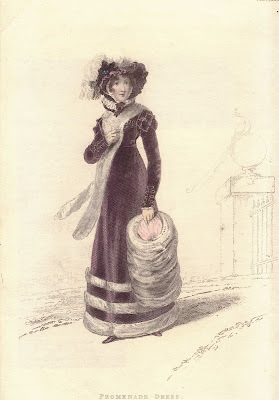 Promenade Dress, Ackermann’s Repository, December 1822.
So what kind of fur was worn?
Looking over years of Ackermann’s Repository images gives the impression that a lot of ermine (white fur decorated with the tufts of black tail fur) was worn. But actually reading the text accompanying the images tells a different tale (ahem): for example, the fur-lined mantle above from January 1810 is made with (are you ready?) “spotted American squirrel skin”! A coat from January 1811 (not shown here) was trimmed with blue fox fur. The February 1811 Walking Dress with the tippet and fur trim uses “astracan” (more commonly spelled astrakhan), or lamb. Other plates mention red fox, mole, leopard, sable, and chinchilla in addition to ermine.
While these prints are fascinating to look at, I have to say that I’m very grateful that we don’t have to follow their example any more. Now if you’ll excuse me, I think I’ll go have some quality time with my Primaloft quilt...


