
Regina Scott's Blog, page 13
July 27, 2021
A Bittersweet Conference
 This past weekend Regina and I were both happy and sad to attend Regency Fiction Writers’ 2021 Virtual Conference. We’re sad because it has now been two very long years since we were able to have our annual “girls’ week” together at a conference, the one time in the year where we get to see each other in person. But happy because it was an amazing learning experience!
To backtrack: you may remember Regina’s post last fall about the opening of a brand-new organization for writers of fiction set in the Regency period. Regency Fiction Writers grew out of the now-closed The Beau Monde chapter of Romance Writers of America. And rather than being limited to Regency romance fiction, RFW is open to writers of all fiction set in the “Long Regency”, a period of time from 1780-1840 that saw enormous changes in the world as a whole, not just in Britain. Writers of mysteries, thrillers, fantasies, science fiction (there’s some very cool Regency steampunk out there!) and general fiction set during those years are welcome in the organization.
The workshops reflected that broader mission. Nile Green presented a workshop entitled “Mr. D’Arcy’s Persians: Exploring Regency England through the Eyes of Six Muslim Students”, based on research from his book The Love of Strangers(which I’ve already ordered!) C.S. Harris, author of the Regency-set Sebastian St. Cyr mystery series, was a keynote speaker. And author Tracee Garner gave a wonderful, informative workshop in “Happily Ever After for All: Inclusivity in Your Writing."
Of course, there were more traditionally Regency topics discussed as well. One of my favorite workshops was by Jayne Davis and past NineteenTeen guest Gail Eastwood on Regency Language, and I was attacked by a plot bunny the size of Harvey during Susan de Guardiola’s workshop on Masquerades and Fancy Dress Balls.
There were several other workshops, all excellent, and even a Regency dance party, the Soiree, that included video clips of Regency dancing to replace the dancing that usually takes place at in-person conferences…which will (hopefully) be able to resume next year. But I think RFW will try to continue to present a virtual conference alongside a live one. If you have the least interest in writing about the Regency era, I highly recommend it.
Even though I didn’t get to see Regina. *sigh*


July 20, 2021
Launching the Captain
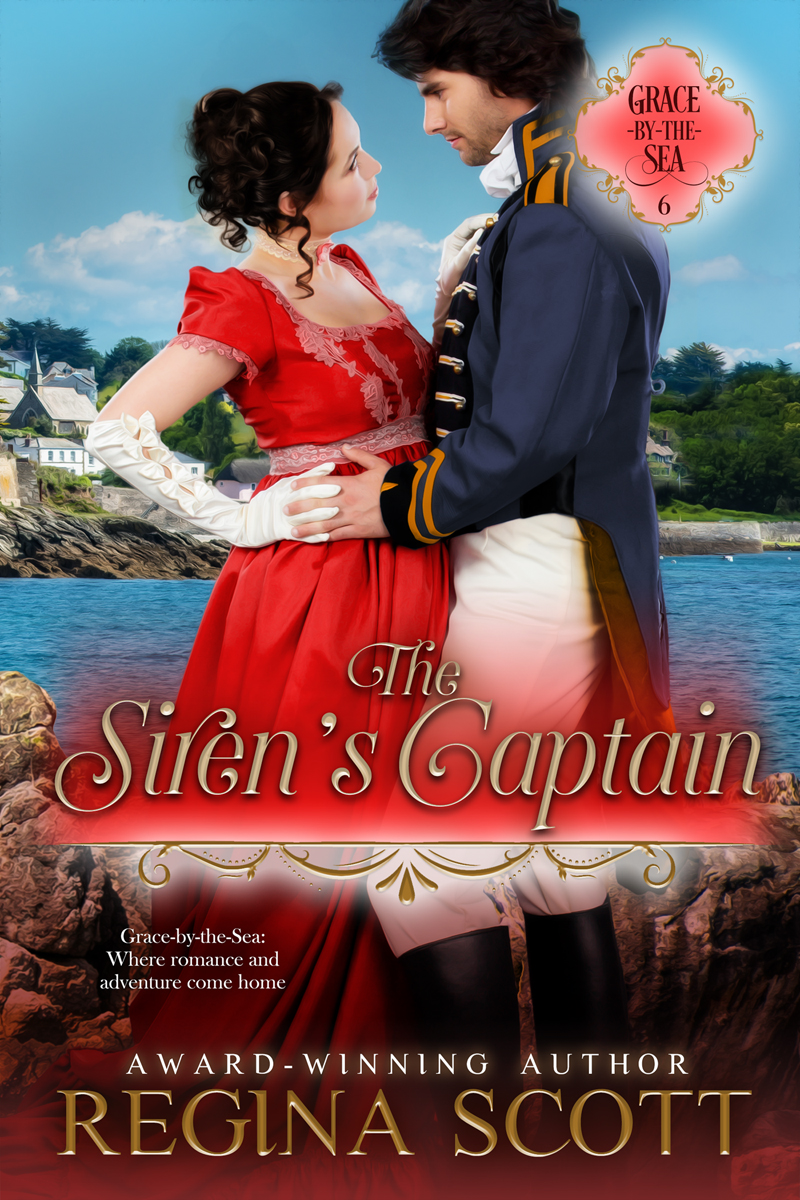 Captain Quillan St. Claire, that is. He is the Lord of the Smugglers in 1804 Dorset, England. Okay, so I have a soft spot in my heart for witty, dashing, slightly dangerous heroes, particularly when they're humbled by the love of a strong-willed woman. That’s one of the reasons I’ve been eagerly waiting to write the sixth, and final-for-now, story in my Grace-by-the-Sea series. The Siren’s Captain officially released July 19 and has been getting lovely reviews.
 “FIVE STARS! A fantastic conclusion to the series! Long have I waited to read Quill’s story and I am in no way disappointed. It was definitely worth the wait.” – Huntress Reviews
“Regina Scott is a dab hand at a Regency tale, and these stories are super good. Well done!” – Simply Susan Review Blog
Here’s the story in a nutshell:
French singer and spy Marie-Louise Fortier has spent her life protecting idealistic men like her father, who died trying to wrest France back from Napoleon. So when the British War Office asks her to safeguard a former naval captain in the little spa village of Grace-by-the-Sea from the emperor’s threats, she doesn’t hesitate, even if it means pretending to be engaged to the legendary Captain St. Claire to remain at his side.
Quillan St. Claire has been taking care of himself since he was a foundling. He’s fought Napoleon in battle and now smuggles the tyrant’s secrets from France to aid England’s cause. He’s certainly not willing to trust the pretty soprano with his life, yet her siren’s voice seems to call to him. As danger draws closer, these two must work together to protect the friendly little village that welcomed them, only to discover that protecting each other may mean risking their hearts for a real chance at love.
Those of you who have been following the series may also enjoy the courtship of another resident of Grace-by-the-Sea, Maudie Tully. I couldn’t resist giving our whimsical wise woman a happily ever after.
You can find The Siren’s Captain at fine online retailers in ebook format and print on Amazon:
Amazon (Affiliate Link)
Set your sails for Grace-by-the-Sea today.
June 29, 2021
Guest Blogger Brenda W. Clough: Cemetery Decor
Memorial Day may have already happened, but in Victorian England, every day was Memorial Day. My friend and fellow Book View Cafe author Brenda W. Clough explains why.
The 19thcentury was prime time for cemeteries and monuments. Partly this was a status thing. If you were important, you wanted a big fancy tomb so that everyone for the next thousand years or so would appreciate your status. Also partly this was just the look of the time. For Victorians, more was more – another pattern, some more marble fretwork, always good. Photo by DAVID ILIFF. License: CC BY-SA 3.0
The Albert Memorial, erected by Queen Victoria in memory of her husband Prince Albert, carries this just about as far as it can go. It cost millions of pounds and is adorned with lots of friezes and allegorical statue groups. The ornate Gothic spire, 176 feet tall, shelters a statue of the Prince plated in gold. The Queen wanted to be sure that everybody, for all time, could see at a glance how important and wonderful her Prince was.
But there’s also the issue of personalization. You don’t want your tomb to look just like everyone else’s, do you? Sure, you could just have a statue of yourself, but everybody famous does that. When you look at that gold statue of Prince Albert, do you get any sense of why he was interesting? No.
 Photo by Nicholas Jackson
This one is a great example of how it should be done. George Wombwell ran a famous traveling menagerie in the mid-1800s in England. His favorite lion Nero went with him everywhere. Now a statue of Nero lies mourning on Wombwell’s grave in London, making the lion tamer’s last resting place instantly recognizable and one of the favorite sights of Highgate Cemetery.
 Mortsafe, Greyfriars Kirkyard; photo by Kim Traynor

Brenda W. Clough is the first female Asian-American SF writer, first appearing in print in 1984. Her novella ‘May Be Some Time’ was a finalist for both the Hugo and the Nebula awards and became the novel Revise the World. Her latest time travel trilogy is Edge to Center, available at Book View Café. In 2021 she began publishing Marian Halcombe, a series of eleven neo-Victorian thrillers. Marian will tell you herself that she is a proper Victorian lady, because this keeps people happy--and unsuspecting. But those who know her will tell you that she's the most dangerous woman in Europe. Her adventures are appearing one a month at BVC, and the first volume is free! Get it here: Marian Halcombe | Book View Cafe. Brenda's complete bibliography is up on her web page, brendaclough.net
June 22, 2021
Blast from the Past: Getting Down and Dirty in the Garden
For various reasons, I was over two weeks late in getting my garden planted this year...but as of this past weekend, the tomatoes and peppers and zucchini and cucumbers were finally in, and the bush bean seeds I did manage to plant last weekend are popping up like crazy. In honor of (or perhaps relief at) the occasion, here’s a walk down memory lane into 1917 via 2014...and down the garden path.
* * * * *
With the clarion call to American women to save food at home so that the starving of Europe and the troops fighting the Kaiser could be fed, 1917 could be called the year of the canning jar...sort of.
 It started in the spring. American women were exhorted to plant gardens and preserve their crops, and by July, the women’s magazines blossomed with advice: July’s McCall’s article “Uncle Sam’s Kitchen Brigade” gave a detailed list of how each type of garden bounty could be canned, both fruit (apricots, plums, berries, and cherries) and vegetables (bean, peppers, asparagus, cabbage spinach, cauliflower, carrots, and beets).
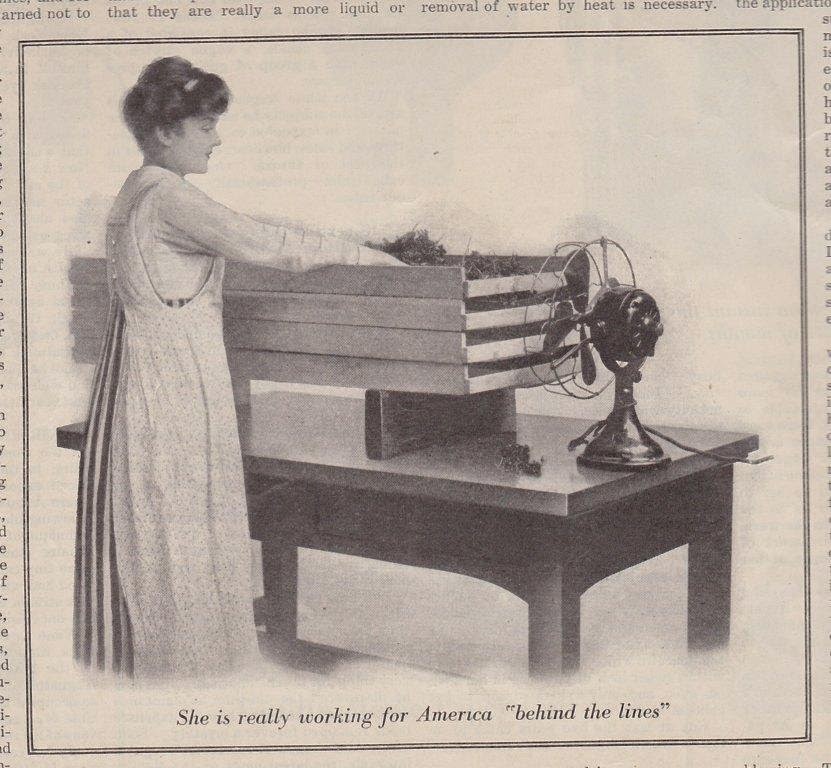
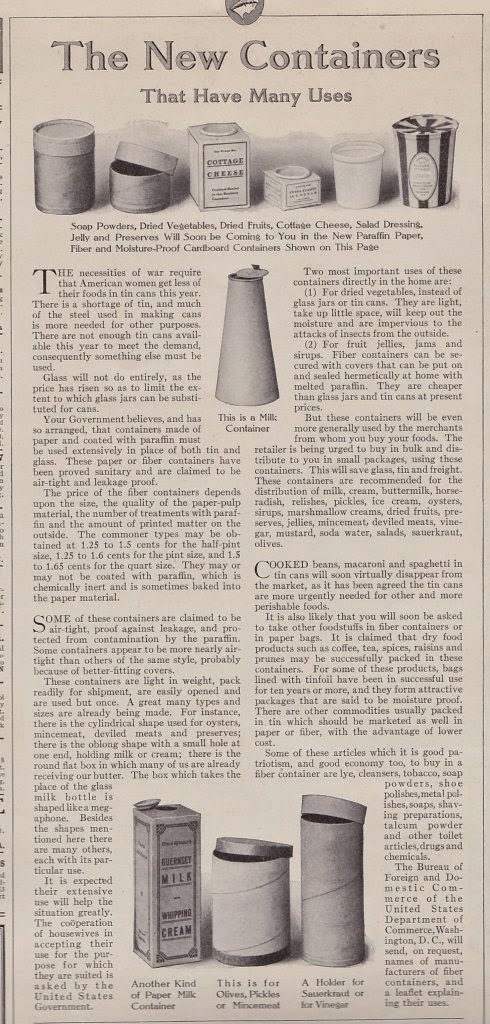 The Independent featured an article on dehydrating foods in June as did The Ladies’ World Magazine in August which suggested dehydrating foods--including leafy greens like spinach-- to preserve them (as the lady above is doing, with wire mesh trays and a house fan!) for a very practical reason: because of the success of the canning campaign, there was a national shortage of canning jars! The Ladies’ Home Journal included an article about “the new containers”, primarily different types of coated paper--the forerunner of our paper milk and juice cartons today.
 In addition to all the encouragement to can, preserve, and dry, American women were also encouraged to change the way their families ate. Based on the number of articles and recipes published about salads this summer (in Women’s World and The Modern Priscilla in particular), I have to wonder if anyone actually ate them before 1917. The salad was a somewhat different creature from today’s greens and chopped veggies: it tended more to be a collection of foods mixed together and served cold, thereby saving cooking fuel and using up not only the garden’s bounty but also anything else that happened to be lurking in the icebox. How can you resist a tasty Baked Bean salad, presented by such a fetching young lady?
June 18, 2021
Read This If You Get the Nineteen Teen by E-mail
 Special service announcement, my dears! Effectively July 1, the app used to send posts from Nineteen Teen via e-mail will be deactivated by its creator, and there doesn’t appear to be an alternative. The RSS feed will still function. The blog will post online as usual.
Here’s what you can do. If you prefer to get your information via e-mail, sign up for our newsletters.
You’ll be first to hear about sales and new releases, plus we both offer free content like short stories and novellas to our subscribers. Win-win.
(Image by Rocapurpura from Pixabay)
We now return you to your regularly scheduled programming.
June 15, 2021
Nineteenth Century Heroines: Taking Command
 I recently read The Great Clippers by Jane D. Lyon, who mentions a young wife who took command of a sailing ship as it rounded the Horn in a storm. Of course, I had to learn more! I give you Mary Patten, a true nineteenth century heroine!
 Born in Chelsea, Massachusetts in 1837, Mary Ann Brown married at the tender age of 15 to a dashing sailing ship captain named Joshua Patten who was nine years her senior. He was a rising star among captains, so it wasn’t surprising for him to be offered command of an extreme clipper, a more than 1,600-ton sailing ship with massive amounts of canvas, within two years of their marriage. Neptune’s Car was built by Page and Allen of Portsmouth, Virginia, for the line of Foster and Nickerson in New York. Under Patten’s command, she had broke records for the time from Boston around the Horn to San Francisco.
And Mary came along. In her first 17-month journey, she saw the coasts of South America, San Francisco, China, England, and New York. But she was no idle passenger. She used the time to learn navigation and the role of a captain aboard a sailing ship.
 In 1856, they started out on another long voyage to San Francisco, racing several other clipper ships. Mary was 19 years old and pregnant with her first child. The trip began much like the previous, with more than some $300,000 of cargo in the hold and a valiant crew, but things began to worsen fairly quickly. For one thing, the first mate proved inept, sleeping through his watches and failing to let down the sails to catch the wind. There was some speculation he had bet on one of the other ships reaching California first. After attempting to reason with him, Joshua relived him of duty and clapped him in irons, then took on the duties of the first mate himself.
 Tragedy struck just as they reached Cape Horn. Joshua came down with brain fever and was insensible. (Some accounts say it was tuberculosis.) With the first mate unreliable and the second mate unable to navigate, Mary Patten assumed command. She is credited with being the first female captain of a sailing ship.
It couldn’t have been easy. The Horn is notorious for its gales. Besides ordering the work of the crew, Mary had to devote herself to caring for her sick husband. She studied the medical books aboard to gain ideas of how to ease his suffering. When the first mate tried to instigate a mutiny, she stood up to the crew and rallied them to her cause. They reached San Francisco ahead of all but one of their competitors, and Mary herself piloted the ship into port.
She and Joshua returned home to Boston via another ship, a steamer, but her beloved husband never recovered. It’s likely he didn’t know Mary had given birth, to a son she named Joshua. Having heard of her heroism, the New York Daily Tribune tried to interview her, but she was too humble. The reporter said she was “of medium height, with black hair, large, dark, lustrous eyes, and very pleasing features.”
Sadly, Mary caught consumption and died four years later. She was 23. She has been the inspiration for a novel, and the U.S. Merchant Marine academy named its hospital after her.
One of the most touching things I learned about Mary, however, was the stone she put on Joshua’s grave. It reads, “Are there seas in heaven, Joshua? And is there such a vessel as our Neptune’s Car? If there is, wait for me. And we shall explore the vast and boundless reaches of eternity.”
Now, there’s a nineteenth century heroine.
 And I will be so bold as to draw your attention to another nineteenth century heroine, this one fictional. The Unflappable Miss Fairchild, the first book in my Uncommon Courtships series, is available for free through June 16. The ever-practical Anne Fairchild knows the proper way to seek a husband. So why is it one moment in the presence of the dashing Chas Prestwick, and she’s ready to throw propriety to the wind? Chas excels at shocking Society with his wild wagers and reckless carriage racing. But his bravado masks a bruised and lonely heart. Can the sweet-natured Anne convince him to take the greatest risk of all—on love?
 You can find her at fine online retailers such as
June 8, 2021
Shawl We Dance?**
Another stunner from La Belle Assemblée! This one is dated May 1810, so was likely published in April of that year.
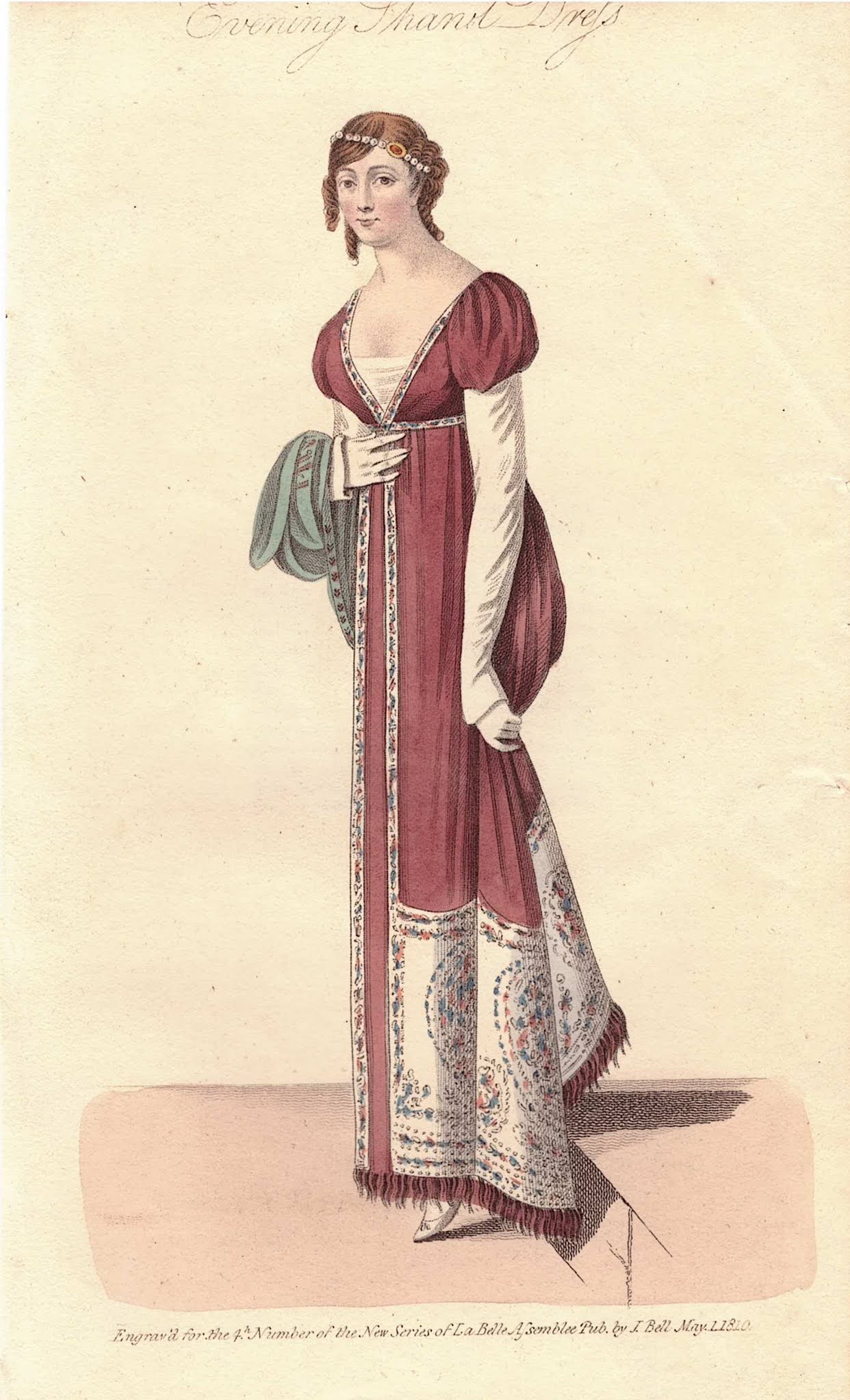
The text reads:
ENGLISH COSTUME.
No. 1.—Evening Shawl Dress.
A rich Paris-brown French silk shawl robe, with short full sleeves, made to sit very much off the shoulders; worn over a white satin body with long sleeves. The hair divided on the crown of the head, curled in ringlets in the neck behind, and on the right side of the face, with a small bunch of curls on the left side of the head; a band of diamonds, or coloured stones (with a cornelian clasp or brooch), is worn round the head; diamond earrings; Persian scarf of green silk; white satin shoes; and white kid gloves.
Aside from general bemusement at the description of an “English costume” made up of Paris-brown French silk, what do we have here?
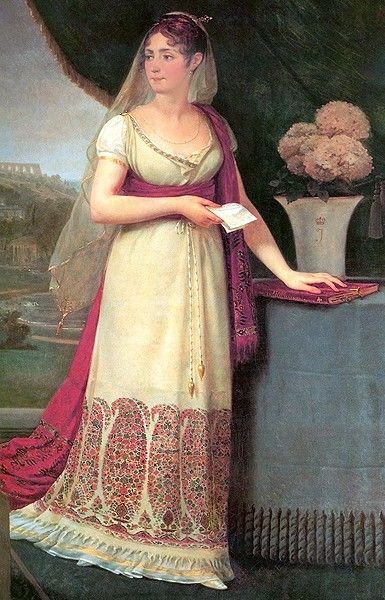
In the early nineteenth century (well, before then too), shawls woven or silk and/or kashmir wool in India and elsewhere in Asia and imported to Europe were prized indeed by fashionable women. The plates in the French Journal des Dames et des Modes in particular contain many depictions of beautiful shawls. So prized, indeed, were these shawls that it became a bit of a “thing” to make dresses out of them (and later, from fabric that had been made to look like a shawl.) They tended to be quite large, so this was not as silly as it initially sounds; with the slim profile of Regency-era dresses, it was quite doable, as can be seen here at right in this portrait of Empress Joséphine by Baron Antoine-Jean Gros, ca. 1808, from the Musée d’Art et d’Histoire at Palais Massena, Nice, France.
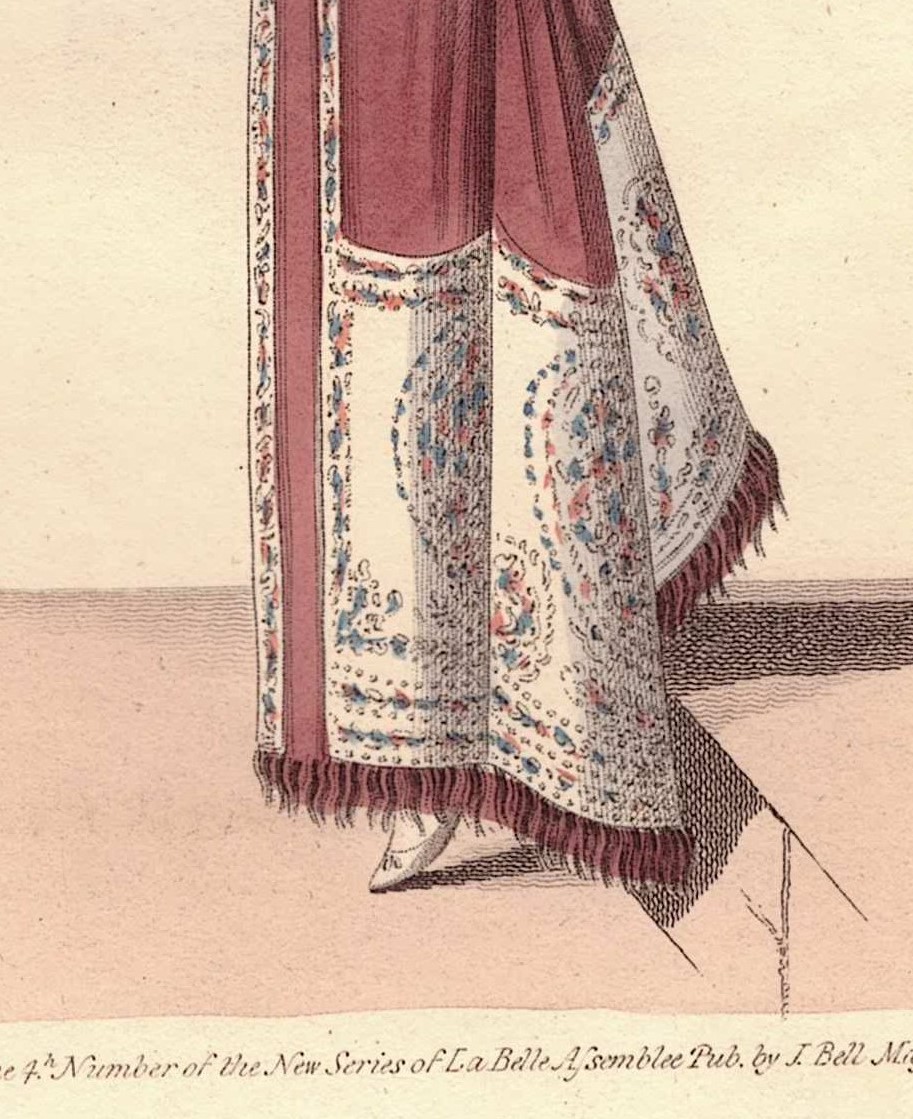 So what about our Belle Assemblée example? It’s a fairly straightforward design: the ends of the shawl, with its deep paisleys, are used to decorate the lower edge of the skirt. I like that the fringe edge was utilized, as you can see around the very bottom of the hem. I’m guessing that the shawl’s selvages form the trim up the front and around the bodice. As this dress is made to be worn over a bodice (white satin, in this case), less fabric has to be used.
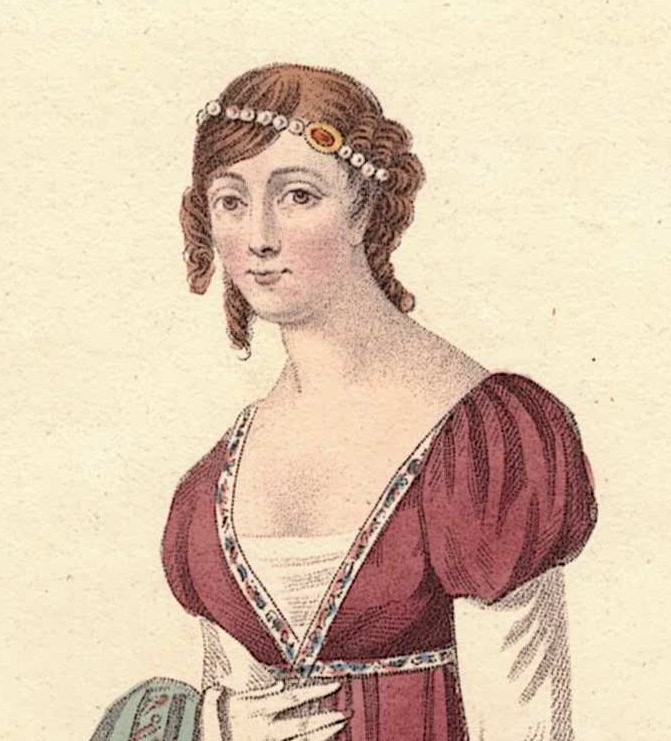
And may I just say that her hairstyle may be one of the prettiest I’ve seen in any fashion plate? Simple and charming, though using a diamond necklace as a headband may be anything but “simple!”
What do you think of today’s confection?
 Oh...speaking of “prized” indeed, I’m happy to announce that Evergreen is a finalist in the Young Adult category of First Coast Romance Writers’ National Excellence in Romance Fiction Award contest.
**This is, of course, not a ball dress or at all suitable for dancing. But I couldn’t resist the pun. 😊
June 1, 2021
Temple of the Muses: Your Ultimate Regency Bookstore

We’ve talked about where the fashionable bluestocking shopped, but I recently came across what must have been the BEST bookstore in London: the Lackington Temple of the Muses.
It’s a rather grand name, isn’t it. But the bookstore lived up to it in several ways. First, its founder, James Lackington, started poor and illiterate, but he taught himself to read and fell in love with books. Legend has it when he and his wife were down to their last cent at one point, and he had a choice of buying food or a book, he bought a book. I’m sure we can relate. 😊
Second, his Temple of the Muses was easily the largest bookstore of its day, boasting nearly a million volumes at one point. Located at Number 32 Finsbury Place South, at the southeast corner of Finsbury Square in London (east of fashionable Mayfair by a good clip in what appears to be the Spitalfields area), the warehouse featured multiple stories and bookshelves towering to the high ceilings. This print gives you a good idea of the breadth and depth.

Third, he managed to sell his books at a reasonable price. He billed the Temple of the Muses as the “cheapest bookseller in the world.” To make good on that claim, he purchased remaindered stock from publishers for much less than a typical bookseller would pay, and he extended no credit. Purchases at the Temple were purely cash.
Books were listed in an annual catalog, and shoppers came to the central desk to request their preferences. It was said that young gentlemen newly acquired of lands and houses would come shop for entire libraries! You could also request the color of the bindings. Hard to imagine a library where every book spine is the same color!
Lackington also ventured into publishing. Though he retired in 1798, leaving the management of his businesses to his cousin George, his company published Mary Shelley’s Frankenstein.
Tragically, the Temple of the Muses burned down in 1841. You can find more details about this wonderful establishment courtesy of author Maria Grace at her blog.
May 25, 2021
No Slang Like Old Slang, Unless It's New...Part Five!
 We haven’t played this game in awhile, so let’s have another round of
No Slang Like Old Slang…Unless it’s New
, the Nineteenteen game show where you have to identify whether a word or turn of phrase was used in the 19th century, or has a later (20th century) origin. I’ll post the answers in the comment column...in the meanwhile, happy guessing!!
We haven’t played this game in awhile, so let’s have another round of
No Slang Like Old Slang…Unless it’s New
, the Nineteenteen game show where you have to identify whether a word or turn of phrase was used in the 19th century, or has a later (20th century) origin. I’ll post the answers in the comment column...in the meanwhile, happy guessing!! 1. Elbow room (Sufficient space to act in): My clumsy cousin Fred avoids our town’s assembly rooms, saying that he never feels he has enough elbow room there…for which the rest of our town is quietly grateful.
2. Down in the Dumps (low-spirited, melancholy): Amelia has been down in the dumps ever since Captain Toploft failed to show up for the dance he made her promise to save for him.
3. Look down one’s nose (to regard with a feeling of superiority): As he is known to look down his nose at any girl who isn’t at least a viscount’s daughter, she should probably not be surprised.
4. Tight (drunk): But my brother said that the captain has an unfortunate tendency to get tight before most assemblies, so she likely had a lucky escape.
5. In clink or in the clink(in prison): As it turns out, Captain Toploft and three other friends spent the night of the assembly in clink for public drunkenness.
6. Blot one’s copybook(disgrace one’s self): Papa said that if he continues to blot his copybook in such a fashion, he’ll have to resign his commission.
7. Shortchange (to cheat someone by giving them incorrect change or treat unfairly by withholding something of value): That dreadful Mrs. Pinche at the sweet shop shortchanged my little brother when he went there to spend his birthday money.
8. Conniption (a fit of rage or hysterics): As he had a conniption right in front of her shop just as the mayor was walking past, I doubt she’ll do it again.
May 18, 2021
My Father's Mountain
He was born in the Appalachians, in a sleepy little town now called Whitehall, whose claim to fame is that it was the birthplace of the U.S. Navy in the Revolutionary War. A silk mill employed many in town for some years. The oldest of ten children, he wanted more than anything to get out and see the world. As soon as he could, he enrolled in the Air Force. His dream was to go into radar.
After some training, he ended up at what is now Joint Base Lewis-McChord. He arrived in the winter and endured weeks of unrelenting rain and snow. The first sunny day, he looked out in surprise, then asked his fellow airmen, “Who put that big pile of snow at the end of the runway?”
That big pile of snow was Mt. Rainier. From a certain angle, it does indeed look as if it rises from the end of the main runway.
[image error] Even before he married my mother, he was spending his free time up on the slopes, hiking, taking pictures, soaking up the beauty. The tallest mountain he’d seen before then had been less than one-quarter the size. He and Mom went there often. When I was a few months old, he was given the chance to go to Greenland and learn about radar. Instead, he mustered out. His dream was less important than spending time with his family.I don’t recall a time growing up when we didn’t spend a good chunk of the summer on the mountain. My father liked to brag that I had made the long and steep climb to the Ice Caves (now gone) above Paradise when I was only six. One of the pictures of the climb shows me up on his shoulders, so I’m pretty sure I didn’t walk the entire way!
We hiked, and we camped. He always wanted to summit, but life got in the way. When we moved north for five years, he found other mountains to love in the North Cascades, but Rainier was ever his favorite.
She is mine as well. Happy birthday, Papa. Now, at least, you get to look down at her instead of up.


![[image error]](https://1.bp.blogspot.com/-AvvqMxD6xMg/YKKO532OU_I/AAAAAAAAFxU/jIjaiuCHtWgyvrxF0v9fqnICadgvtLcUQCNcBGAsYHQ/s640/640px-Mount_Rainier_and_lake_reflection-free.jpg)
![[image error]](https://1.bp.blogspot.com/-I7exJ4IyGjs/YKKPEc9jUBI/AAAAAAAAFxY/rCTceDh6y-MUGP7phafEOjCdRV_6QdhEgCNcBGAsYHQ/s723/z-d-snow.jpg)