
Elizabeth Jarrett Andrew's Blog, page 20
January 8, 2014
Red Hot and Holy
 Red Hot and Holy by Sera Beak
Now here's an unexpected memoir! Sera Beak is a theologically educated woman with experience in New Age traditions who has dedicated her life to the Red Lady--her name for the goddess Kali. Two aspects of Beak's story made this a worthwhile read for me. First, she's achingly (and sometimes gruelingly) honest about the difficulties of serving this demanding, wild, rule-breaking and sensual divinity. Staying true to her path required long spells of despair and painful reordering of priorities and lots of social rule-breaking. I appreciate anyone who doesn't sugar-coat the spiritual life, no matter what form it takes. Second, I found Beak's depiction of the Red Lady a nice challenge to my feminist Christianity. She explores aspects of divinity that Christianity steers clear of--the holiness in seduction, in sexual touch, in wild dancing, in a fierce, destructive, feminine force. I like having my God-box broken open.
This book's strength--it's scholarly foundation--is also its weakness. I wished for more ordinary, embodied stories. I wanted less of the abstract, internal struggles of faith and more of the lived consequences. I also had to remind myself that Beak was evoking only one aspect of the goddess. The mother in me longs for a similar, serious memoir about the mother goddess, grounded in the earth, profoundly relational, and generous beyond imagining. But that's a different story.


November 29, 2013
Pastrix
I'm not one to be impressed by a tattoo-sporting, cussing, former comedian Lutheran pastor. There's too many real contradictions in the life of faith to think these external ones carry much weight. PATRIX flaunts these and more--Bolz-Weber seems (although never directly claims to be) queer identified, she's a recovering addict, she's hip, and she plays these cards a bit too self-consciously for my taste.
Nevertheless, she tells a damn good story, and her theology is excellent. I thoroughly enjoyed this memoir because of these solid foundations. It's a quick and enjoyable read, but I also come away with some refreshing perspectives on faith. Take some of these comments on identity:
Maybe demons are defined as anything other than God that tries to tell us who we are. And maybe, just moments after Jesus’ baptism, when the devil says to him, “If you are the Son of God…” he does so because he knows that Jesus is vulnerable to temptation precisely to the degree that he is insecure about his identity and mistrusts his relationship with God.
So if God’s first move is to give us our identity, then the devil’s first move is to throw that identity into question.
--Nadia Bolz-Weber, Pastrix, 139-142
Leave it to a member of an identity-conscious generation to unearth this understanding of God's intimacy. I find it refreshing. Thanks, Nadia!Pastrix: The Cranky, Beautiful Faith of a Sinner & Saint
Nevertheless, she tells a damn good story, and her theology is excellent. I thoroughly enjoyed this memoir because of these solid foundations. It's a quick and enjoyable read, but I also come away with some refreshing perspectives on faith. Take some of these comments on identity:
Maybe demons are defined as anything other than God that tries to tell us who we are. And maybe, just moments after Jesus’ baptism, when the devil says to him, “If you are the Son of God…” he does so because he knows that Jesus is vulnerable to temptation precisely to the degree that he is insecure about his identity and mistrusts his relationship with God.
So if God’s first move is to give us our identity, then the devil’s first move is to throw that identity into question.
--Nadia Bolz-Weber, Pastrix, 139-142
Leave it to a member of an identity-conscious generation to unearth this understanding of God's intimacy. I find it refreshing. Thanks, Nadia!Pastrix: The Cranky, Beautiful Faith of a Sinner & Saint
November 1, 2013
Writing to Wake the Soul
 Writing to Wake the Soul: Opening the Sacred Conversation Within by Karen Hering
My rating: 5 of 5 stars
A Fresh Look at Writing as a Spiritual Practice
Karen Hering’s new book, Writing to Wake the Soul: Opening the Sacred Conversation Within, hits the bookstores next week, and I want to encourage everyone interested in writing as a spiritual practice to get a copy. In her role as literary minister at a Unitarian Universalist congregation, Hering developed what she calls Contemplative Correspondence, a practice of writing from prompts around theological themes like faith, prayer, sin, grace, and redemption. If this sounds heady or dull or too religious, hold your horses. This book is far more than what you might expect.
Karen’s reflections and prompts are meant to exercise our metaphor muscles—our capacity to make connections between disparate images or ideas, and therefore our ability to communicate across differences, resolve paradoxical problems, and relate to mystery. Her choice of tough theological terms is deliberate. We need to reclaim the language of mystery; we need to remember language’s capacity to connect humans to our sacred source. So we take hard words that have been used to drive wedges between people and soften them.
How? By listening deeply; by exploring memory; by writing stories. “What makes some writing a spiritual practice and not others,” Karen writes, “is less a matter of form than it is an orientation and intention. Writing becomes a spiritual practice when it serves as a personal correspondence with “the still, small voice within,” a way of listening to one’s inner voice and truth, and to the sacred source of that truth.” Karen’s exercises help us connect the dots of our experience to see what Thomas Merton calls “a hidden wholeness.” She chooses big words because our small stories are windows onto universal truths, and she wants us to remember this.
“But the practice does not stop there. It also insists that our story is only powerful and meaningful to the degree that we are willing and able to engage it in conversation with larger, open‐ended narratives. It calls upon us to listen for the stories and the presence of others.” What I most love about Karen’s book is its insistence on our connectedness. Rather than framing the spiritual practice of writing as simply a private conversation with the holy, she pushes us outward, into dialogue with others, with voices present in religious teachings, and with the emergent, collective narrative of our culture. She understands the Sacred as both personal and corporate, in and through history, within and beyond language, and still emerging in our life experiences.
I am infinitely grateful for this book.
View all my reviews
June 10, 2013
Are You My Mother?
 Are You My Mother? by Alison Bechdel
My rating: 5 of 5 stars
From the author of the comic strip, DYKES TO WATCH OUT FOR, ARE YOU MY MOTHER is a refreshingly frank take on the deeply psychological work of writing a memoir. The majority of scenes in this book take place in a therapist's office--a prospect that usually makes me cringe. But Bechdel uses the story of her therapy not only to explore the nuances of her relationship with her mother but also as a forum for learning about human psychology. I loved how she used the "voice over" or the narrator to analyze the works of Winnicott, Freud, Jung, Adrienne Rich, and Virginia Woolf while her frames shows scenes in real time. At every point in this narrative multiple ideas and events are unfolding. So the seeming self-absorption of the main character never becomes burdensome to the reader, or at least to this reader.
Bechdel also lays bare the memoir writing process, which will be fun for new memoir writers to read. "This is one of my difficulties now..." she writes, "...my fear that mom will find this memoir about her "angry." Another difficulty is the fact that the story of my mother and me is unfolding even as I write it." In the frame below these words, Bechdel's mother says, "Did you see Daniel Mendelsohn's article on memoir in The New Yorker?" "Uh, no," says Bechdel. "It's good. Isn't he the one who beat you for that prize?" "Uh... Yeah," Alison responds.
Don't let the drawings deceive you: This is a dark book. But it's also terrifically smart and fast-paced. Well worth reading.
View all my reviews

May 24, 2013
May 17, 2013
Mystery & Manners, Flannery O'Connor
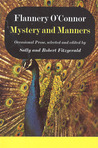 Mystery and Manners: Occasional Prose by Flannery O'Connor
My rating: 5 of 5 stars
I'm kicking myself for not reading MYSTERY AND MANNERS years ago. Flannery O'Connor is a fiction writer, I told myself; what could she teach me about spiritual memoir writing? And yet some of these are the best essays I've ever read about addressing the spiritual life in prose.
If a writer is any good, what he makes will have its source in a realm much larger than that which his conscious mind can encompass and will always be a greater surprise to him than it can ever be to his reader.
--Flannery O’Connor, Mystery & Manners, 83.
The point O'Connor emphasizes repeatedly is that only a writer's adherence to reality, in its sensory, concrete details, can make the supernatural apparent. The universal is in the particular; the supernatural is in the natural. I knew this. But where she challenges me is when she discusses the skepticism of modern readers, and how a writer of faith must at times exaggerate to make his or her point:
The novelist with Christian concerns will find in modern life distortions which are repugnant to him, and his problem will be to make these appear as distortions to an audience which is used to seeing them as natural. … When you can assume that your audience holds the same beliefs you do, you can relax a little and use more normal means of talking to it; when you have to assume that it does not, then you have to make your vision apparent by shock—to the hard of hearing you shout, and for the almost-blind you draw large and startling figures.
--Flannery O’Connor, Mystery & Manners, 33.
How do we do this in memoir, or essays? I'm curious to explore this.
I also love O'Connor's perspective that her faith, rather than diminish the terrain of her content or the breadth of her perspective, actually demands more of her craft. Good writing addresses the farthest reaches of mystery, O'Connor says, and faith requires us to live in relationship with this mystery in every moment--or, more to her point, with every mundane detail of our days. In a literary world so often devoid of believers, O'Connor is a must-read.
View all my reviews
March 11, 2013
Wolf Hall
 Wolf Hall by Hilary Mantel
My rating: 5 of 5 stars
I'm infatuated. Well, that's a strange word to use for WOLF HALL and Hilary Mantel, one of the sharpest, most thorough historical fiction writers I've ever encountered. But I AM infatuated--with her prose, which is absolutely the most brilliant writing I've read in years. I love the sentences in this book. And when every sentence you flow through is sheer delight, that adds up to a delightful book. Not to mention the faster-than-lighting pacing of dialogue and story, the complicated character which is Thomas Cromwell, the quirky, close third-person point of view which allows you into a stunning mind, the tension of knowing just enough about Henry VIII to anticipate disaster but not enough to know exactly how disaster unfolded...in other words, add to those gorgeous sentences a thrilling plot, and I can't put the book down.
If that's not enough, Mantel also explores the theological tensions of the day: The heresy of Martin Luther, the waning of the pope's influence in England, the Bible's translation into English, and the beginnings of the Church of England. The church's corruption becomes reason for the king to occupy church property. At first, Mantel makes these conflicts deeply personal; we see Cromwell as a faithful but smart, questioning reformer who acts from his faith. As he gets closer to the crown, Mantel neglects this aspect of his being. But this is my only criticism of an otherwise exceptional novel.
I could pull a paragraph from anywhere in the book and you'd be wowed. Here's one from the end, referring to the heresies of Thomas More:
They hurry in; the wind bangs a door behind them. Rafe takes his arm. He says, this silence of Moore's, it was never really silence, was it? It was loud with his treason; it was quibbling as far as quibbles would serve him, it was demurs and cavils, suave ambiguities. It was fear of plain words, or the assertion that plain words pervert themselves; More's dictionary, against our dictionary. You can have a silence full of words. A lute retains, in its bowl, the notes it has played. The viol, in its strings, holds a concord. A shriveled petal can hold its scent, a prayer can rattle with curses; an empty house, when the owners have gone out, can still be loud with ghosts.
AHHH.....
View all my reviews
Wolf Hall
January 25, 2013
Safekeeping by Abigail Thomas
What a gorgeous book! As someone who perpetually gripes about memoirists not doing thorough, emotional research, I have to give three cheers to Abigail Thomas. She has taken the mundane stuff of motherhood and marriage and a woman floundering through life and made an object of striking beauty. Her short pieces are tiny windows onto tiny moments that nonetheless illuminate human brokenness and the terrific force of love. I delight in trusting a narrator so completely. I'm also thrilled to now know a woman writer who is masterfully representing a mother's experience without complaint or sentimentality. Her form is refreshing and fun--I read this book in about two hours--but in no way self-consciously artsy, as many lyrical memoirs are. I'm wowed. On to THREE DOG LIFE...

November 28, 2012
Wild
 Wild: From Lost to Found on the Pacific Crest Trail by Cheryl Strayed
My rating: 3 of 5 stars
I didn't like WILD. Call me a curmudgeon, accuse me of deliberately resisting the latest fads in publishing, even think me a prude. I expect more self-awareness from authors.
Cheryl Strayed's story is great: Flattened by the death of her mother, she walks the Pacific Crest Trail as a way to move through her grief. She's 26 and completely unprepared for the hike, so her adventures along the way are gripping. So I can see why this book is popular now; it's a page-turner. Strayed reminds me a lot of Mary Karr in her hip voice and extraordinary narrative skills. Her opening pages describe one of her boots falling off a cliff mid-hike--what a brilliant beginning! (And also very much like Karr's opening to THE LIAR'S CLUB.)
So Strayed has a great plot, but books get their life-force from the connection between outer and inner events, and I found her inner story lacking. Yes, the death of a mother is wrenching, but most of people who lose mothers don't obsessively cheat on their spouse, spiral into addiction, and persevere on a sadistic and dangerous hike. What else made this loss so profound? How exactly did the hardships she encountered on the trail transform her grief? The links between the outer events and her inner transformation were never clear to me.
In part this is because Strayed highlights other titillating elements of the story (sex, drugs, alcohol) above her grief. The book's climax is a two-day sexual encounter with a stranger in Ashland, on break from hiking. These scenes get far more attention than Strayed's grief but they only illustrate how little she's been changed by her trials. Sure, they're a great read. But they don't work to support the character's central journey.
I also wished for more narrative distance throughout. Strayed 26-year-old-self has no perspective on her grief. I imagine the author does, now, or at least I hope so, and I want that insight to give me compassion for this young woman. As it reads, I just felt annoyed at her.
Okay, so I want emotional awareness from my authors and I don't want titillating material to obscure a book's heart. Hurrumph. Now go enjoy this book.
View all my reviews

November 7, 2012
A Testament of Devotion
 A Testament of Devotion by Thomas R. Kelly
My rating: 4 of 5 stars
Friends recommended this book when they heard my 2012 New Year's resolution was to not be overwhelmed by life. A good dose of Quakerism is a nice antidote. I can't say Thomas Kelly led me to calm and simplicity, but he did offer me understanding: "For, except for spells of sickness in the family and when the children are small, when terrific pressure comes upon us, we find time for what we really want to do." With a small child, yes, living a focused life of service can be hard.
While his language and theology are old fashioned, Kelly's faith nonetheless inspires me:
I am persuaded that religious people do not with sufficient seriousness count on God as an active factor in the affairs of the world. “Behold, I stand at the door and knock,” but too many well-intentioned people are so preoccupied with the clatter of effort to do something for God that they don’t hear Him asking that He might do something through them.
…For the Eternal is urgently, actively breaking into time, working through those who are willing to be laid hold upon, to surrender self-confidence and self-centered effort, that is, self-originated effort, and let the Eternal be the dynamic guide in recreating, through us, our time-world. 71-74.
I want to pray unceasingly, as Kelly describes. The joy of spiritual community he portrays seems impossible to me, but I want it nonetheless. Most of all, I want to face this complex world with profound trust. I'm grateful for the guides that help me on this journey.
View all my reviews


