Jacob Morgan's Blog, page 35
January 23, 2014
How Can Organizations Stay Adaptable and Nimble While Focusing on Growth?
There’s an interesting paradox that organizations are faced with. On the one hand they realize that the rate of change around the world of work (and the world in general) is increasing and on the other hand they are focusing on growth. In order to remain competitive organizations must be nimble, adaptable, and agile yet by focusing on growth they make themselves more complex and slower; so therein lies the problem. Why are organizations focusing on things they know will make them slower and more complex when they know they need to be more nimble and adaptable? The analogy I like to use is trying to lose weight by eating more calories a day; an impossible task.
I see three scenarios which can play out:
Too profitable to fail
Organizations get so profitable, have so many assets and customers, and have so much money that nothing short of a world apocalypse can bring them down. This is certainly possible for some companies.
Smaller organizations replace larger ones
We have seen amazing disruption from smaller but rapidly rising organizations. Look at Box, Netflix, Uber, Square, and many others which are challenging established organizations and industries. This trend will continue until larger organizations keep getting displaced or they attempt to acquire their smaller counterparts.
Larger organizations split into more manageable pieces
How big can an organization realistically get and how scalable and manageable can that growth be? One option is for organizations to start breaking off into smaller pieces instead of putting more pieces together to form a giant mass.
I discuss all of these ideas and more in the video below.
So what is the future going to look like? That’s a good question and it’s certainly not easy to predict the answer but we do know what’s right in front of us. Change is happening faster and the larger the organization (in most cases) the longer it takes and the harder it becomes to adapt to change.
What’s your take?
 Send to Kindle




January 21, 2014
Why We Don’t Need Offices
Looking back a decade or so ago it was absolutely essential to have an office, or more likely, a cubicle. That’s where we had meetings, saw our coworkers, and just got work done. But today do we really need corporate offices? New technologies allow us to “connect to work,” meaning that all we need to get work done is an internet connection. Employees are working from co-working spots, cafes, and home offices all over the world without ever having to step foot into a corporate office. In fact the 2013 Regus Global Economic Indicator of 26,000 business managers across 90 countries, revealed that 48% of them are now working remotely for at least half of their work-week.
There are 8 reasons why our reliance on corporate offices is dwindling.
Collaborative technologies
New technologies are allowing employees to “connect to work,” meaning that the only thing we need to get our jobs done is an internet connection. From there we can access all the people and information we need to do our jobs. We can have virtual meetings, create assets (documents, presentations, or anything else), get updates from our team, and stay connected to our global workforce without daily face to face interaction. Additionally collaborative technologies allow us to work while we are on the go from our mobile devices.
New generation of workers
Millenialls are projected to be the majority of the U.S. workforce by 2020–just a few years away. This is a generation that is used to being connected. Millenialls grew up with social platforms such as Facebook Twitter, and Google and they are comfortable sharing and engaging with people and information; it’s a part of our daily life. This is a generation that doesn’t know what it’s like to get 200 emails a day while sitting in a cubicle. Organizations need to adapt to this employee.
A more attractive workplace
Chances are that if you were to ask someone if they would rather work from an office or from their home, they would say their home (or co-working spot). In a recent report released by my company Chess Media Group we found that 90% of workers believe that an organization offering flexible work environments is more attractive than an organization that does not. For organizations that want to attract and retain top talent it almost seems essential that employees not be required to work full-time from an office.
Companies save money
Companies spend a massive amount of money on real estate space to house their employees. TELUS, a telecommunications company based in Canada has a global goal of making a majority of their workforce work remotely either full-time or part time. They want to get rid of some of their massive buildings that they are spending a large amount of money on. Companies also have to spend money on office equipment, internet, amenities, and a host of other things. Depending on the size of the company the potential cost savings here is in the millions per year for a single company.
Employees save time
Commuting is a big issue for many employees around the world. According to a report from the United States Census Bureau 600,000 employees in the U.S. travel 90 minutes and 50 miles to work (each way) and 10.8 million employees travel an hour each way. Can you imagine spending 10-15 hours in your car each week just driving? That’s almost a part-time job in your car. You can play around with various scenarios here to figure out how much money is being wasted each year on commuting but the number can easily reach the billions especially when considering other costs such as gas.
Employees are more productive
There are numerous reports which cite the fact that employees who work from home are actually more productive then those who work from an office. Global Workplace Analytics has perhaps the most comprehensive set of data around this with numbers ranging from 600 billion dollars which are wasted each year on workplace distractions to figures showing that national productivity would increase by $334 billion to $467 billion a year through telecommuting.
Improved quality of life for employees
A few years ago researchers at Umea University in Sweden found that “couples in which one partner commutes for longer than 45 minutes are 40 percent likelier to divorce.” Work is already one of the leading causes of stress for employees and on top of that we throw on the stress that comes from commuting. Employees could spend that time working or being with family members or loved ones instead of sitting in a car.
New workplaces
As mentioned above, any location is now a potential workplace; this includes a home office, a coffee shop, or any other location where you can get an internet connection. Over the past few years we have also seen the rapid emergence of co-working spaces where employees from different companies can rent desks or offices near where they live (or where it is convenient for them). These co-working spaces are equipment with conference rooms, kitchens, and oftentimes more amenities then a traditional corporate office. In addition, some companies are renting out their excess offices to employees of other companies.
In conclusion
We don’t need to look farther than our personal lives to see why working from an office isn’t always the best approach. Of course many argue that offices are great for fostering communication and collaboration and some offices are gorgeous with fantastic amenities ranging from on-site laundry and massages to childcare and grocery shopping! However, the reality is that even a small distance impacts employee communication and collaboration. Once employees are 200 feet away (or more) from each other, the chances of them talking to one another is virtually zero; you might as well have employees be hundreds of miles away.
The point here isn’t to say that face-to-face communication is dead, because it isn’t, and we certainly don’t want to get rid of human contact (at least most of us). Instead organizations need to implement more flexible work environments for employees to allow them to decide how they want to work. For example, some organizations are implementing “pop-up work spaces,” which means that when meetings need to happen they can be arranged at mutually convenient co-working locations where a conference room can be rented for as much time as needed. This isn’t about removing face-to-face communication it’s about not relying on that as the only option.
I’m sure you can add to the list above as well, but the overall trend is that we no longer need to rely on corporate offices as the only place where we can get work done.
Send to Kindle


January 15, 2014
Challenge Everything You Know About Work
I recently put this video up on Forbes but wanted to share it hear as well. It’s about the importance of challenging our common ideas and assumptions of work. This is crucial if organizations are to thrive and remain competitive in the new world of work.
Send to Kindle


January 9, 2014
Should Managers and Leaders be Separated?
I decided that in 2014 I want to do more videos. I have a Youtube channel but I haven’t really been using it. I’m hoping to a do a lot more videos talking about the future of work and collaboration starting with this one on managers and leaders. For some reason there’s a common assumption and a lot of talk around the separation of managers and leaders, however when it comes to the future of work, managers MUST be leaders.
Subscribe to my Youtube channel where I’ll try to do at least one video a week, hopefully more!
Send to Kindle


January 2, 2014
Creating a Boundaryless Organization
 The first and most important truth any leader must understand is that the human beings who work inside every kind of organization possess unlimited potential. They have the ability to solve any problem and the adaptability to respond to unforeseen circumstances. It may be the most overworked truism in the business world, but employees are indeed the most valuable resource and asset that any company has.
The problem: most organizations today are unable to tap into that limitless human potential because of a series of self-imposed boundaries. Unlocking this potential means challenging the many assumptions that we have about work today: the incontestability of hierarchy, the importance of putting in time in the office, semi-annual employee reviews, valuing the voice of the customer but not of the employee, and the restriction of vital information to preserve rank.
Organizations and their leaders must strive to break three common boundaries in order to unleash all of the talent and contribution lying in wait. The first is role-based: communication and collaboration is restricted by seniority level. How could a lowly entry-level employee possibly engage with a senior manager or worse… an executive! The second type of boundary is around departments and function. Marketing folks stick with their peers in marketing, sales with sales, product development with product development and information and potential opportunities for innovation remain stuck within silos. The third most common type of boundary is geographic—employees in one office or location simply don’t “see” their peers in another.
Escaping these persistent and pernicious boundaries to communication, contribution and collaboration requires three key shifts:
From management to leadership
Lifting boundaries isn’t a matter of executive direction. It’s about re-thinking management and shifting perspective from telling people what to do to getting them excited to want to do it. We don’t need more managers, we need more leaders. Today, any employee can become that leader. Yet the norm in most organizations is to bring in more and more managers to oversee people and then more managers to look after those managers. The goal of all of this, of course, is to get a tighter grip on the organization, to enforce control. The original goal of management was simply to make sure that employees showed up to work on time to do their tasks, to not ask questions, to not cause problems, and then to leave and do that over and over again. Management wasn’t focused on innovation, the voice of the employee, engagement, or creativity. That was the case 100 years ago—and it’s still the case in too many organizations today. This is why it’s so crucial to create leadership capacity in every aspect of the business.
The leader challenges common assumptions around management and mentors employees to help them become successful. The leader has followers not because he commands them, but because he has earned them.
From “need-to-know” to collaborative technologies
The range of collaborative technologies emerging today allows employees to connect with each other and information, any time, anywhere, and on any device. While many leaders look at the onslaught of devices and apps and new technologies as a problem to be solved, the most effective leaders today aggressively support any tools that enable employees to connect, contribute, choose, and create. It needs to be easy for an employee in California to find a co-worker in Beijing. It needs to be easy for an entry-level employee to start a dialogue with an executive, even though they may have never met face to face.
Collaborative technologies are also crucial in developing leaders. In the new world of work, leaders create themselves. They share their ideas, content, and feedback in a public way, which attracts followers within the organization. Anyone can become a thought leader or subject matter expert.
From controlling management to boundary-breaking work
At every turn, leaders must ask themselves, “How does this support our vision of breaking down boundaries?” How can employee onboarding be changed? What about talent management? Perhaps when employees are brought on board they are taken through a collaboration scavenger hunt where they must find and connect with colleagues around the world; something telecommunications company TELUS does for new recruits. What if instead of semi-annual reviews, you go with a system of real-time feedback on a collaborative platform? Why not create a company leaderboard around health and wellness so that different geographic regions can see how they compare to one another. What if employees “narrated” their work in a public way so that everyone and anyone can see what they are working on? Every built-in management process is an opportunity for unleashing more human potential. The job of leaders and managers is to fundamentally rethink and re-design that core.
Unlocking human potential is the new competitive advantage. But it’s not as simple as expressing good intentions at the top. And it’s not enough to proclaim, “our people are our most important assets.” Every leader must do the hard work of breaking down boundaries and rethinking the most deeply held assumptions about work. It’s the difference between winning and losing in the future.
What are you or your organization doing to break down the boundaries that constrain human potential? Share your stories and ideas in the Unlimited Human Potential Challenge.
Send to Kindle


December 18, 2013
The Employee-Employer Contract Has Changed
I recently had a conversation with Thomas Friel who is the former CEO of Heidrick & Struggles, a global executive search firm, they are the ones who got Eric Schmidt his job as the CEO of Google in 2004 and were at one point ranked by the WSJ as the top executive search firm in the world. We had a long conversation about how the world of work is changing.
Years ago when employees would work at an organization there was an implicit contract between the employee and the employer. The employee would be loyal to the company and provide their labor and attention. In turn the company would take care of the employees for life. Employees used to work at companies for decades and then collect their pensions. They were loyal to the companies they worked for.
Today this employee-employer contract has changed. We don’t see many life-long employees anymore and employees have moved away from committing and being loyal to companies to committing to managers, teams, products, and people. Today employees are willing to provide some labor and attention but if things start going for them they leave and go somewhere else. Employees will also leave if they feel like their talents aren’t being taken advantage of or if they aren’t interested in and challenged by the work that they are doing.
In a few decades we went from lifelong employees and company loyalty to a much more dynamic workforce which has new loyalties, new priorities, and new timelines for how long they are willing to and want to stay with a company. What is your organization doing to adapt to this?
Send to Kindle


December 12, 2013
Working at a Big Company Doesn’t Give You the Job Security You Think it Does
The assumption of working for a large established company has always been that there would job security. ”You should always take a job at a big strong company because at least you know will be there for a while,” is what people used to say. In fact, many people today still believe this. While it may have been true years ago it’s anything but true today.
Working for a large company no longer means job security, it just means you work for a large company.
Merck recently announced they are laying off 8,500 workers, Alitalia (the national airline of Italy) is proposing to lay off 2,000 workers, Blackberry is cutting around 5,000, Safeway is laying off around 6,000 (through their Dominick’s chain), Kelloggs is cutting over 2,000, Thomson Reuters is cutting 4,500, and Cisco is cutting around 4,000, EADS (the aerospace company) is cutting up to 6,000, and Qantas is cutting 1,000. The list goes on and on and I haven’t even included companies like Blockbuster that have completely gone out of business. Oh, and did I mentioned that these are just numbers from the past few weeks? These cuts are made by people in the finance department who are looking at balance sheets and data, not at people; in fact many call this “trimming the fat.” Where’s the job security at these companies? I think many of the companies today are actually in danger of a disappearing altogether, but that’s a topic for another post.
Still not convinced?
What about the fact that the average life expectancy of a company on the S&P 500 used to be 75 years. Today that number is just barely 15 years. Research shows that by the year 2027, 75% of the companies on the S&P 500 will be replaced. Take a look at the chart below from Innosight to see the trend.
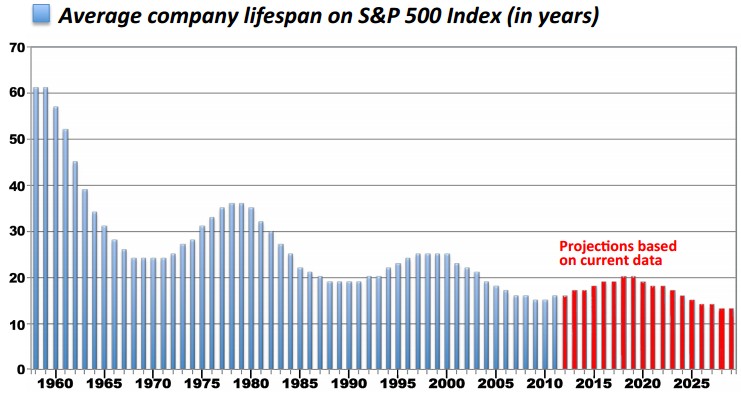
This trend doesn’t show signs of slowing down.
Previous generations primarily valued working at larger organizations because it meant more money and longer term employment. That’s really the only things that mattered. Along with this job security facade we also see that the future workforce is prioritizing other things above salary. This includes things such as flexible work environments and doing meaningful work. It’s no longer just about a paycheck. This means that one of the huge advantages that large organizations have is gone.
In fact, I’d argue that many people may have more job security working for a smaller or mid-size company instead of for massive global organizations. Large organizations can make sweeping cuts to thousands of employees and it’s just a drop in the bucket for them. The trend I have seen is that smaller organizations find reasons to keep employees and not reasons to let them go.
The size of some of these behemoth’s is also mind-boggling. Some of the companies have tens of thousands or hundreds of thousands of employees around the world, it makes you wonder if companies were ever meant to get that big and how much bigger they can possibly get. One would assume that after a certain point, once the companies go up, they must come down.
Pick a job that you care about, that offers you the opportunity to pursue your passions, and gives you freedom not the one that just has a higher dollar sign.
Send to Kindle


December 6, 2013
The 5 Must-Have Qualities of the Modern Employee, Manager, and Company
Over the past few months I’ve written some articles for Forbes which have received a lot of attention, far more than I could have ever expected. All three articles were about the future of work and explored what the future employee, manager, and company are going to look like from a high level. I wanted to share some of that here and encourage you to take a look at the full articles over on Forbes.
The Future Employee
We are seeing dramatic changes in the way we work are being fueled by new behaviors and new technologies. Along with a set of new expectations and views around work the future employee is going to have to possess five qualities.
Ability to embrace change
Having a voice within the company
Being autonomous
Sharing and helping others
Filtering and focusing
You can read the full post on the 5 Must-Have Qualities of the Modern Employee on Forbes
The Future Manager
As the world of work continues to change so do the qualities and characteristics of the managers who are going to be leading our companies. This means that just because managers were successful in the past doesn’t mean they will be successful in the future. When it comes to evolving the way we work managers need to possess five qualities to help their organizations evolve and succeed in the future of work.
Follow from the front
Understand technology
Lead by example
Embrace vulnerability
Belief in sharing
You can read the full post on the 5 Must-Have Qualities of the Modern Manager on Forbes
The Future Organization
Companies themselves need to evolve and change so that they can not only attract and retain top talent, but so that they can continue to exist and thrive in the future. Here are my 5 must have qualities of the modern company.
Supports flexible work
Operates like a small company
Prioritizes “want” vs “need”
Focused on the voice of the employee
Adapts to change faster
You can read the full post on the 5 Must-Have Qualities of the Modern Company on Forbes
Send to Kindle


December 2, 2013
Telling Your Company Story to Employees, Not Customers
 I’m in the process of reading the Brick by Brick: How LEGO Rewrote the Rules of Innovation and Conquered the Global Toy Industry, which thus far has been a very interesting read. While reading it I was struck by something interesting. New LEGO employees are told a story when they start working there about the history of LEGO and how it got to where it is today. In fact, these new employees actually visit the original factory where Ole Kirk Christiansen, the founder of LEGO first set up shop (it burned down and Ole had to rebuild it and start from scratch). While the story of LEGO is indeed fascinating and interesting it is but one story.
Organizations today spend a lot of time talking about and telling stories to their customers to help them make a purchase a decision. But, what about telling stories to our employees? How many organizations out there actually take the time to help employees understand what their organization stands for, how it was created, why it was created, and how it got to where it is today?
When it comes to the future of work and being able to attract and retain top talent, story-telling is going to be a huge factor. Not every potential employee is going to resonate with your story and that’s ok. That just means the employee is not a good fit for your organization. But, those employees who do appreciate and relate with your company story are going to be able to do amazing things. The only way to find out though is by actually telling and sharing that story with employees.
As Simon Sinek has said many times, people don’t buy from you because of what you do or what you sell, the because of WHY you do what you do. I strongly believe this applies to employees as well. Organizations of the future want to create a place where employees work there because they want to not because they need to. To do this goes beyond workplace flexibility, salary, and benefits packages. It’s also about helping employees understand WHY your company does what it does. If your employees understand and can get behind the WHY, then they will help you figure out the how.
The future of work is about telling your story to employees, not just customers.
 Send to Kindle


November 18, 2013
Workplace Flexibility as a Competitive Advantage
Some people still look at workplace flexibility (the ability to work anywhere, anytime, and hopefully be measured by outputs not inputs) as a perk or a bonus whereas the future employee looks at workplace flexibility as a standard way to get work done. The reality is that offering workplace flexibility is quite simply a competitive advantage. Assume that you have employees interviewing at your company (which I’m sure many of you do, every day). New, young, bright, and talented people who have a lot of promise to make valuable contributions. These future employees are becoming pickier with where they want to work and if it comes down to working at a company with flexibility or one without it (even if the pay is a bit higher), most will chose the company that supports flexibility. This means that your organization will have a hard time recruiting top talent. Not only that but you can also expect to see many of your existing employees gravitating to competitive companies that offer flexibility, so not only will you have a hard to recruiting new top talent, you will also be shedding your existing talent.
Thanks to today’s collaboration technologies workplace flexibility has never been easier to deploy and make a reality. I work and speak with companies all over the world who are quickly realizing the value of making this change and the absurdity of not making this change.
Still think workplace flexibility is just a nice perk?
Send to Kindle