Jacob Morgan's Blog, page 43
April 4, 2013
The Future Employee Must Posses the Skill and Will to Learn
Thomas Friedman recently wrote an article for the NYT titled, “Need a Job? Invent It” which addresses how our educational institutions are not teaching students the skills that value most. He goes on to point out that in today’s economy there is no such thing as a high-wage, middle-skilled job. Things are changing quickly and by time most students graduate from college the things they studied have evolved. What’s more common is that the jobs people are going to school for haven’t really been invented yet.
I went to school at UCSC and graduated with a double major in business management economics and psychology. When I was in school social media, enterprise social software, emergent collaboration, and anything related to the future of work was not taught. Facebook was just getting started, Twitter didn’t exist and neither did many of the enterprise collaboration platforms such as Jive, Yammer, Chatter, and dozens of others.
Experience used to the the hot commodity to get a good job. When I graduated from UCSC even the entry level jobs I was applying for were asking for 2-3 years of experience and these were basic jobs. I was always candid during my interviews and told the people interviewing me that even though I may not know how to do something that I’m sure I could figure it out. Experience, experience, experience, that’s all I would ever hear.
Today experience is no longer the primary commodity. Things are changing and evolving so quickly that experience is becoming less and less relevant. New jobs are emerging that didn’t exist a few years ago and so experience for them is irrelevant. Instead what is more valuable today is the ability to learn new things and then apply them in order to solve problems. Anyone with an internet connection has access to limitless information to help them learn about anything and everything they want. However as Friedman points out in his article, we spend too much time getting people to be college ready instead of innovation ready.
According to Thomas Wagner (who was featured in the article), author of “Creating Innovators” and Harvard education specialist:
“Today because knowledge is available on every Internet-connected device, what you know matters far less than what you can do with what you know. The capacity to innovate — the ability to solve problems creatively or bring new possibilities to life — and skills like critical thinking, communication and collaboration are far more important than academic knowledge. As one executive told me, ‘We can teach new hires the content, and we will have to because it continues to change, but we can’t teach them how to think — to ask the right questions — and to take initiative.”
The future employee must have the skill and will to learn.





April 2, 2013
The Evolution of the Networked Enterprise: New McKinsey Research
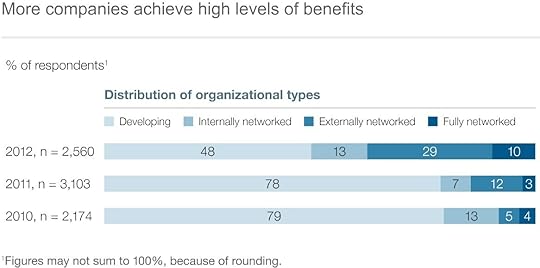
McKinsey just released some more research on the use of social and collaborative technologies within the enterprise. Not surprisingly they found that adoption levels are continuing to climb and are almost double what they were in 2009. The more important finding from the research they conducted was that organizations are moving beyond the experimentation phase with many of these tools and into more mainstream applications and deployments.
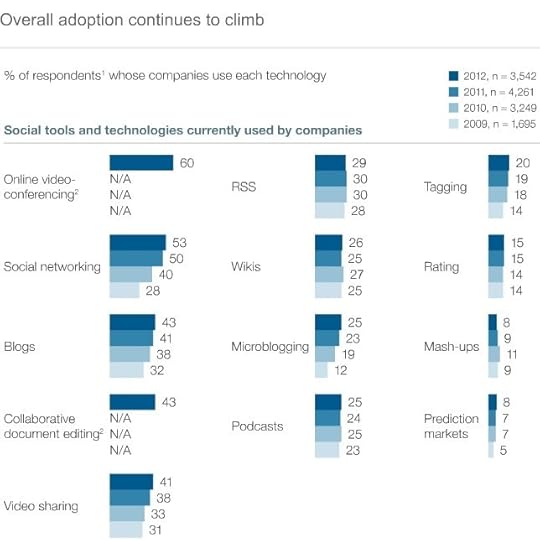
Although most of the executive respondents reported seeing benefits from deploying these tools, the research shows that these benefits have achieved a plateau. According to McKinsey:
Executives are optimistic but sober about the next leg of the social-technology pathway: they expect increases in employee productivity but also recognize the significant organizational barriers that prevent their companies from capturing the full potential of social tools. They also acknowledge the new open environment’s risks, including possible leaks of confidential information and intellectual property—yet 60 percent of respondents still say the potential benefits outweigh the risks.
This is very much aligned with what I am seeing with the companies we work with and speak with. Business leaders are really starting to realize that technology can only do so much; change is required. Now organizations are starting to explore what these changes are that need to happen and how they need to happen since they fundamentally impact the core of the company.
Many organizations are continuing to focus on empowering their remote and mobile workers by allowing them to connect to the organization through a mobile device aka “connect to work.” I’m finding that there are some security concerns around mobile but companies are finding ways to deal with them (for example losing a phone which has an app that allows someone to get access to a companies’ internal environment). Allowing employees to work and connect from mobile devices appears to be a big priority from what I’m hearing. Again, according to McKinsey:
Remarkably, 65 percent say their companies have adopted at least one technology that’s used on a mobile device and that 48 percent of their companies’ employees have mobile access.
This is certainly supporting research which employees can take back to their organizations to help build support and the case for evolving how they work. The fact is that the way we work is changing and the smart organizations are adapting to that change. In just 3 years the number of companies adopting social technologies in their organizations has almost doubled and I fully expect this growth to continue at an even more rapid pace during 2013 and 2014. Organizations are clearly seeing the value in deploying these social and collaborative technologies and are going to have to move the technology focus.
Organizations looking to succeed with these initiatives should read, the 12 principles of collaboration.


April 1, 2013
The First Step to Recovery Is Admitting You Have a Problem
There are many reasons for why organizations invest in social and collaborative tools and strategies (or for that matter anything else). However, for successful organizations change doesn’t typically happen unless there is either a problem that needs to be solved or an opportunity that needs to be pursued. There are some organizations that have invested in social and collaborative technologies without understanding why they were doing it, they didn’t perceive a problem and they didn’t see an opportunity. These organizations never mapped their collaboration use cases to platform requirements. They made the investment because other people were doing it and ran into heavy obstacles along the way because neither of the above two reasons existed. These companies purchased expensive hammers looking for things to bash into the wall.
As the title of the post suggests, the first step to recovery is admitting that your organization has a problem (or an opportunity). If your organizations doesn’t accept and understand that it’s time to change and that their are better and more effective ways of working then there is no point in allocating resources into these initiatives. The future of work cannot exist in an environment where business leaders don’t understand where the future of work is heading.


March 27, 2013
Mozilla Launches Open Badges; Creates an Educational and Skill Currency
Mozilla recently unveiled a project that they have been working on for over a year and a half called Open Badges. The concept is built around people being able to gain recognition for skills that they earn on the web, anywhere on the web. Ideally an individual will be able to acquire virtually any skill on any site. Right now we see the concept of badges being deployed on social media sites such as Foursquare or on enterprise social software applications such as Yammer but Mozilla is looking to take this one step further.
I always use my brother as an example. He’s turning 21 this year and although he’s going to school for business he was able to build a career for himself as a videographer and photographer for free by watching Youtube videos, joining discussions, and getting access to other relevant resources through social media and the web. Now, he has no formal training or degree in these areas yet is very good at what he does and has recently amassed the equivalent of a little studio including top-notch cameras, green-screens, and lights. Open Badges from Mozilla seeks to take these type of skills and assign badges around them to signify a legitimate form of expertise. They are taking the concept beyond the common of idea of badges as fun or rewarding incentives and putting some structure around it. The goal is ultimately to have a single place (what Mozilla calls your “Backpack”) where you can display your badges, which again, you can earn from anywhere on the web.
The Providence After School Alliance has already taken this as far as issuing badges to students who complete a semester, these badges are then going to be visible on college transcripts.
The reason this is so relevant today is because we have access to a virtually unlimited database of information and people which means we can learn just about anything and acquire skills in just about anything. Today however, there is no way for us to recognized for these skills that we acquire. Think about new college graduates that are going to apply for jobs. They are judged on a resume which shows what they studied in school even though their arsenal of skills may be much broader. Open course ware is becoming a recent phenomenon and some of the world’s top educational institutions are making their course material available for free and even offering certificates of completion for some of them. One of the interesting things about Open Badges is that it not only allows you to showcase your digital badges but also badges you might earn in the real-world. You have the option to manually upload a “badge” to your “backpack” to showcase your skills.
Open Badges is still very much in the early stages of development but the direction they are going in is quite interesting and you can expect integration with collaborative platforms such as Jive, Yammer, Chatter, and others in the future. This is very interesting as far as “the future of work” is concerned and impacts several areas:
How employers view and hire employees, moving beyond the resume and looking at other skills which may have previously been non-credentialed (yet still very real and applicable)
Evolves badges from oftentimes being thought of as more fun and whimsical to having more serious business value
Encouraging learning at all ages of anyone and everyone that has a web-connection
Challenges the value, necessity, and cost of a traditional educational institution
Creates a new type of educational and skill currency
Merges personal and professional skills by allowing you to bring in your badges into your existing work environment (or it will in the future)
Here are a few examples taken from the KQED write-up of this announcement.
NASA is working on launching badges in robotics and in the STEM fields to be earned through working with NASA content and used to identify candidates for internships and jobs.
The Manufacturing Institute is developing a badge to be earned by current workers and students to demonstrate skills necessary to succeed in an advanced manufacturing job or internship.
The Intel Society for Science and the Public is developing badges to affirm and evaluate scientific research and tie it to professional and academic skills.
Carnegie Mellon is developing badges that will eventually be issued on a curricular path that terminates in certifications recognized by computer science and STEM industries.
Badges for Vets is creating a series of badges that will help offer civilian-applicable credentials for professional skills learned through military training.
It’s still very early in development with the first version jut launching a few weeks ago but it has a lot of potential, especially when considering the platform that Mozilla has. I’m very much looking forward to see where this is going to go in the next few years.