Jacob Morgan's Blog, page 42
May 14, 2013
Aligning on Purpose
One of the things we can’t neglect when thinking about the future of work is for organizations to align on a sense of purpose. Many organizations who are investing in enterprise collaboration tools and strategies to a good job of messaging and conveying value but where many fall short is on being able to align the organization as a whole on a sense of purpose. Atos Origin does a good example of this but publicly conveying their goal of becoming a zero email company by the end of 2014. Another company that does a great job of this is TELUS which set out an aggressive goal to have 30% of their almost 40,000 workers work full-time from home by 2015. These are organizations who are truly planning and seeking to impact the future of work.
So how does an organization go about aligning on a sense of purpose?
At a very high level there are a few things that need to be done:
Set out an ambitious goal that is going to significantly impact what it means to work at your company. This goal needs to be something that all employees can relate to and easily understand.
Convey this goal (or sense of purpose) to the company at large, and if possible communicate this with the general public as well.
Make sure this goal is consistently being reinforced within the organization
Create public updates and announcements on the progress of the organization as it moves towards this goal, Atos does this quite well with their “zero-email” blog along with public appearances, interviews, and events that they host. This makes sure that everyone inside and outside of the company knows what the big picture is.
These four things should be the foundation of helping your organization align on a sense of purpose around the future of work. The investments that are made in enterprise collaboration tools and strategies are all being driven by this sense of purpose that everyone at the organization shares. It’s the driving force behind change at your company.
Before doing anything else, make sure your entire organization can align on a sense of purpose around the future of work.





May 9, 2013
Enterprise Collaboration Technology Deployment Scenarios
I’m seeing a few trends around how organizations are deploying enterprise collaboration platforms. Typically one of four paths are taken which are: a unified solution, multiple solutions (not connected), an aggregator solution, or multiple solutions which are integrated together. These are explained in more detail in the table below.
What is itProsConsWhen it occurs
Unified solutionSingle platform across the entepriseIn most companies this is the ideal scenario. All of the employees will wok across a single platform which acts as the single source of truth for information. All employees have access to this central "collaborative operating system for the enterprise."Not all of the business units or departments are going to derive the same value from a single platform. Oftentimes a specific unit will know of another platform that better fits their needs or will want some customization that is not available, this can hurt adoption. The larger the company the harder it is to get everyone using a single collaboration platform. It's challenging for the organization as a whole to keep everyone happy and with such a low barrier to entry any business unit can beak off and deploy something else without needing the backing from corporate.When commitment exists across the enterprise and the necessary resources are in place for customization and integration. Integration of employee feedback and ideas as well as feature updates may be required regularly. The organization needs to have a plan in place for how to deal with rogue/side deployments that may arise. Somewhat frequent occurrence.
Multiple solutions (not connected)Multiple platforms acoss the enterpriseThis approach gives every department or business unit the ability to deploy something that best meets their needs. Each department essentially owns their own deployment and make the changes and customizations that are most relevant to them.With multiple platforms deployed across the enterprise larger silos can be created. Information and activity doesn't pass from one system to the other so complete organizational collaboration is still not possible. Oftentimes employees will work in one platform but may need access to someone or something in another platform that they can't get into.Typically this is seen when corporate level support is minimal or takes too long. In this situation business unit leaders take things into their own hands and deploy solutions which make sense for their respective business units. Seen frequently but is not something I would recommend.
Aggregator solutionsMultiple platforms acoss the enterprise, with a central aggregator platformThe ability to use multiple platforms is still an option but now the activity can be aggregated into a central environment that anyone and everyone can access. This approach is a bit of a combination of having a unified and multiple solution. Everyone can use what makes the most sense for them.These types of solutions don't really exist. Platforms do allow for integration into other systems but oftentimes this integration results in information being duplicated in mutliple places. Integration and aggregation is not the same thing and while many vendors can integrate well there is still a big gap around being able to bring together multiple collaboration environments (or several instances of the same platform) into one area. Organizations seeking to go down this path become a bit of a product company as they need to develop customized solutions to allow this to happen.If an organization has already been using multiple systems but wants to get the organization on the same page then this method can be used. The business units still use their own independent platforms but the activity and data is aggregated into a central platform that everyone can access. I haven't seen this happen much but am aware of some organizations who are attempting this.
Integration solutions (multiple solutions, connected)Multiple platforms across the enterprise that are integrated together but there is no aggregator.The ability to use multiple platforms is still an option but now the platforms can "speak" to each other and pull/push information from one to the other. There isn't a central platform which aggregates information.This approach typically doesn't work (or is difficult to make wok) in situations where an organization is using multiple instances of the same platorm in addition to other plaforms. The same content may also be present in more than one place as oftentimes the platforms simply "sync" together. Upgrades also become a challenge as complex integration's can make things difficult.This is perhaps the most common scenario and happens in many organizations where multiple platforms are being used and those platforms needs to "speak" to each other. I see this more often in larger enterprises. Oftentimes there isn't a central platform, instead each business unit uses what they want but the multiple platforms allow for communication and collaboration across them.
There is no perfect approach and as I mentioned I’ve seen all of these methods attempted. The reality today is these deployments are not perfect and organizations do need to make some tough choices around how they want to approach these technology deployments. This goes hand in hand with understanding the four types of enterprise collaboration deployments. The best solution for your organization depends on where you see this initiative going in the long run and the kind of support you are willing to give it.
Hopefully this will provide some guidance or at least start some discussions around what your organization should be doing.


May 7, 2013
The Gap Between the Consumer Web and the Enterprise
Much of what we are seeing in the enterprise is being fueled by the consumer web. For example if there would have been no Wikipedia, Twitter, Facebook, or Linkedin, chances are there would be no Jive, Yammer, Chatter, or any other enterprise collaboration platform. The behaviors we exhibit on social media channels are also making their way into the enterprise. For example we can easily use social media to: create communities, easily find people or information, share our ideas and insights, ask for help or get advice, create and share content, and get access to people and information anytime, anywhere, and on an device (among other things). The same cannot be said for many enterprises around the world. In fact there is a large gap between the consumer web and the enterprise (which is trying to catch up!).
The image below looks at some of the different characteristics of the consumer web and the enterprise and the gap that exists between the two.
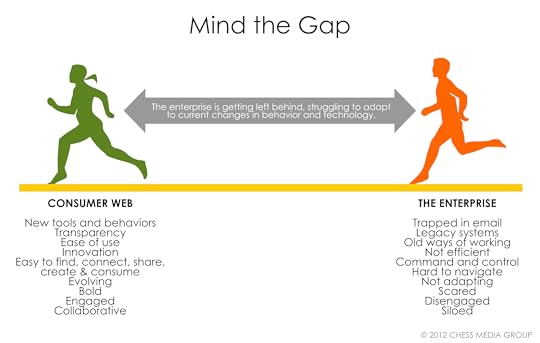
The next couple years are going to be very interesting as organizations start to invest more resources into enterprise collaboration and future of work initiatives. It’s clear that business leaders around the world are understanding that the way we work is evolving and that they need to adapt. It’s still early in the game and we still have a long way to go in the innovation adoption life-cycle but we are moving in the right direction.
The gap above isn’t one that can’t be bridged nor does it need to be 100% on par with what is happening in the consumer web but our organizations can’t be THAT far behind (and thankfully some aren’t). What I’m finding is that the first step is always the hardest, in other words committing to change and moving forward with that commitment. As I always say, you can’t learn how to swim by watching Youtube videos, eventually you are going to have to get in the pool and when you do, you will find that you learn and adapt much quicker.
Here’s to closing the gap and learning how to swim.


May 3, 2013
The Future of Work is NOT About Replacing Sharepoint and Email
Some still believe that the whole point of investing in enterprise collaboration tools and strategies is simply to replace existing systems that organizations are currently using such as Sharepoint and/or email. Let me be clear that it is about far more than that. At the core; we are talking about the future of work. Technology is inevitably a part of that but it’s just the tip of the iceberg.
For as long as organizations have existed there has been a set of unwritten conventions that we have all followed. Some of them are that employees came into the office at 9 and worked until 5, managers made all the decisions and those who brought in the most money got promoted, work was done on a company assigned computer, the communication was handled through email or some legacy intranet system, fear or getting a paycheck was the primary motivator to work, employees stuck to their own departments, and a sense of palpable hierarchy misted through the office. In short, work was not pleasant. As I’ve repeated many times, some of the dictionary synonyms for “employee” are: slave, cog, servant. Synonyms for “work” include drudgery and daily grind. And synonyms for “manager” include: slave-driver and zookeeper.
Replacing Sharepoint and email is not going to change the fact that our organizations were built from the ground up with these types of stereotypes firmly in place.
What we are talking about is an evolution of work, or perhaps a revolution of work. We are challenging the very ideas of what it means to “work” and this goes far beyond technology. We are questioning and challenging what it means to be an employee or a manager and what it means to work at company and have a “job.” Fixed career paths are being replaced by customized work; managers who got promoted just by bringing in revenue are being supplanted by those who can collaborate with others and build an engaged workforce; a strict hierarchy is being replaced by a more horizontal, open, and transparent culture; the wisdom of a few is being replaced by the knowledge of many; the notion of working 9-5 from an office is being replaced by the idea of being able to “connect to work;” an employee feeling like a cog is being replaced by the voice of the engaged employee; email and intranets are being replaced by networked and connected systems; yearly reviews are being replaced by real-time feedback; working in silos is being replaced by cross-boundary collaboration, and the traditional idea of what it means to be an organization is being replaced by evolving to a collaborative organization.
No, the future of work is not about replacing Sharepoint and email, it’s about re-defining what work means, why we work, and how we work. Pass this along to anyone who thinks otherwise.


May 1, 2013
Free Ebook on The Collaborative Organization
Before The Collaborative Organization came out I actually wrote a small ebook to capture the ideas and concepts that then became the full 314 page book. I wanted to share this ebook with all of you as a bit of thank you for your support and encouragement over the past few years. I think the message of creating a collaborative organization and investing in the future of work is a powerful one and you will see some big changes around those areas coming to this site soon, but more on that later. I think we are living in very exciting times where the traditional definitions of what it means to work, to be an employee, and to be a manager are all changing radically.
We are still learning a lot about what this change is going to look and where we are going to end up but a few things are now certain:
the way we work is being forever altered with social and collaborative tools and strategies in the enterprise
employees now have a voice within their organizations
leaders don’t have to be managers and managers aren’t always leaders
mangers who manage by fear have no place within organizations
the theme for the future is “connect to work”
for the first time in the history of business organizations are able to invest in strategies and technologies that not only positively impact the lives of employees at work but also outside of work
Several other things are discussed in the ebook below and for those of you looking for a much deeper time into how to create a collaborative organization, please check out The Collaborative Organization on Amazon.
I uploaded the ebook to slideshare so you can view it below, you can also view the ebook directly on slideshare here.


April 29, 2013
Announcing The Future of Work Survey; Take it and Share it!
Today Chess Media Group is launching a new survey; The Future of Work: Collaboration and Flexible Work Solutions for Today and Tomorrow. The goal of the survey to is to uncover a few things around:
the usage of social and collaborative tools within the enterprise
the state of flexible work arrangements
BYOD policies and approaches
motivations for employees to leverage new ways of working
The way we work is changing rapidly. New tools and strategies are entering the enterprise and there isn’t enough guidance around what employees and business leaders need to do to adapt to the coming changes. The goal of the survey is to allow us to produce a free report which will help guide organizations around how to plan for the future of work and build a more collaborative organization. We conducted another report in 2011 around the State of Enterprise 2.0 Collaboration which received responses from hundreds of people around the world and was read by many thousands. Our goal is to get even more responses and attention for this one.
A lot has changed since 2011 and we want to explore other topics around the future of work which are mentioned above. The survey should take no more than 10 minutes to fill out and we will not be sharing your contact information or answers with others. We would love your support in both taking and sharing the survey to anyone or any company that is currently using social and collaborative tools internally (for employees). We plan to complete and release the report in a few months time and it will be free for anyone to download. I personally hope that the finished product will become a valuable resource for employees and business leaders on the future of work. We hope to continue other such reports in the future.
This project would not be possible without four vendors who are underwriting the report. I encourage you to check out the products they offer and connect with them on Twitter. If you would like a personal introduction to any of these companies just let me know.
Central Desktop created a cloud product called SocialBridge which has features such as document and project management, mobile apps, workspaces, integration with third party apps, and much more. Customers include companies such as the American Red Cross, Career Builder, and WD-40. Connect with them on Twitter.
Citrix offers a variety of products in the enterprise collaboration space and you may recall that they acquired Podio not too long ago which offers everything from CRM to lead management to meeting planning to social collaboration. Citrix is probably most known for their GoToMeeting and GoToWebinar products. Connect with them on Twitter.
Moxie Software actually made headlines recently when they announced they were giving their product away for free. Their positioning is specifically geared around allowing employees to leverage the collective intelligence of employees to help customers. Moxie has the ability to create both internal and external communities. Connect with them on Twitter.
Atlassian is most known for their Jira product for project and issue tracking, and their confluence product which is designed for employee collaboration. Confluence features everything from a robust wiki editor to task management to mobile access and a robust ecosystem for third party apps. Connect with them on Twitter.
Click here to take the survey, and thanks in advance!


April 26, 2013
Investing in Enterprise Collaboration Can Help You Attract and Retain Top Talent
According to a Forbes article by Jeanne Meister:
“The average worker today stays at each of his or her jobs for 4.4 years, according to the most recent available data from the Bureau of Labor Statistics, but the expected tenure of the workforce’s youngest employees is about half that. Ninety-one percent of Millennials (born between 1977-1997) expect to stay in a job for less than three years…”
This is obviously a concern for many companies around the world because they invest a lot of time and resources into making sure they can attract and then retain top talent. One of the many benefits of investing in enterprise collaboration is being able to do both of these things. Before I explore a few of the reasons why this is the case, ask yourself; would you rather work for a company that invested in collaborative tools and strategies or one that didn’t?
Giving employees a voice
Traditionally most employees never have their voices heard in their organization. The platforms and the culture to accomplish this are just not in place. Oftentimes this results in employees resenting their managers and their jobs because they feel like they have valuable ideas and feedback to contribute and nobody cares to hear it. Enterprise collaboration platforms change that by allowing employees to be heard and recognized in a public way by their peers and managers.
Becoming a leader
Leaders used to be associated with managers or executives. That is no longer the case. Any employee within an organization has the ability to become a leader regardless of their level of seniority. Collaborative platforms make this possible in much the same way that social media allows this to happen in our personal lives. Employees can share their ideas, build a following, and get recognized as subject matter experts in their areas of interest. This was not possible in the traditional construct of an organization.
Greater sense of purpose
Enterprise collaboration platforms allow employees to see how their contributions and feedback are affecting a broader part of the organization (whether it’s a specific team or the organization as a whole). They can see how their work is being used what happens to something that they create or contribute to. Again, in the past this wasn’t possible; the old model is you complete your portion of something, hand it over to your manager, and move onto the next task at hand.
Flexible work environments
One of the most attractive benefits to employees is the ability to work flexible hours and from various locations (such as from home). However, the concern for management has usually been around productivity, employees getting access to information and people, and work getting done in general. Most organizations today that investing in collaborative tools and strategies are more aggressively adopting flexible work environments. That is because new platforms allow employees to get access to the people and the information they need to get their jobs done anywhere, anytime, and on any device. In today’s organization you don’t have to go into an office to work, you simply need to “connect to work.”
Customized career paths
Unfortunately the traditional model of work has usually been such that if you get hired in a particular department you are typically going to stay in that department or at best can move to another related area. The problem with this is that our passions and interests can change and organizations are not flexible enough to cater to these changes. Enterprise collaboration platforms allow for the discoverability of passions and interests. Managers now have the ability to see and pay attention to what their employees care about and can offer suitable opportunities in those area. Business unit leaders can collaborate with each other to help fill roles for new openings which may be eyed by existing employees wanting to take on new challenges. This is exactly what happened in a client engagement where an employee wanted to switch departments to something she was more passionate about. Through their collaboration environment business unit leaders where able to find her a more suitable role and were thus able to keep her employed. As another example, you might be in the marketing department at your organization yet have extensive knowledge about IT related issues. After contributing to IT related discussions and groups in your collaborative environment you build thought leadership in that area and are recruited to work on the IT team. Employees are rarely interested in one specific thing and one of the reasons why employees switch jobs is because they want a career change. Organizations no longer need to lose these employees; they can offer career changes in the current company.
The list goes on with things such as:
improved work-life balance
reduced stress at work
better relationships with managers and co-workers
improved overall happiness
and others
The point is the organizations who invest the time and money into building a collaborative organization will not only be able to retain current employees but will become more attractive to new employees.
What kind of a company would you rather work for? One that made these investments or one that didn’t?


April 16, 2013
Three Reasons Why Your Department Shouldn’t Wait for Corporate to Invest in Collaboration
In an ideal scenario the corporate management team at your organization will make the necessary technology and strategy investments around collaboration and the future of work across the enterprise. However, what if you’re a part of a larger organization and corporate is just moving too slow? Oftentimes departments make these investments independent of what corporate is doing. This is actually the case with some of our clients right now, one of them is a 500,000 person global company. In these types of scenarios the business leaders of specific regions or departments shouldn’t feel the need to wait. There are several reasons for why departments shouldn’t wait for corporate:
Corporate can learn from you
There have been several situations where corporate finds out of regional or department deployments and then piggy-backs on top of those for an enterprise wide deployment. Your department can be the pioneering group for the whole enterprise and can help educate and show others what the business value is and how to make it work. This approach can also help dramatically speed up an enterprise wide deployment backed by the necessary resources from your corporate management team.
Don’t sacrifice opportunity
There is no reason for why you should be sacrificing the potential opportunity and business value of investing in collaboration just because corporate isn’t. Your department or region can still benefit from creating an engaged and connect workforce. Don’t wait just because other people want to. That’s their problem. This evolution of how we work needs to start somewhere, it might as well start with you.
Timing
I know of several initiatives being led by departments within larger enterprises that have been ongoing for at least the last two years. Meanwhile corporate management in many of these organizations is still trying to make decisions around what to do. The best thing you can do is communicate with corporate around what your plans are, your successes, and challenges. But sitting around idly and waiting is useless.
The reality is that in many larger organizations there are already several collaboration initiatives being led by employees that management just isn’t aware of. I can pretty much guarantee that in large organizations there are already some Yammer deployments, perhaps a few instances of Confluence, Jive, MangoApps, or some other platform. When employees see an opportunity to improve the way they work they typically go after it. Consider that setting up any of these cloud-based platforms just takes a few minutes and only requires a credit-card. The barrier of going through IT or getting the blessing from corporate is completely removed. This is why management needs to really pay attention to what is happening in the enterprise. Smart management will leverage these pockets of collaboration as a springboard for a much broader initiative.
If you’re running a department or a region within a larger company and corporate isn’t making the investments in collaboration that you want to make, then make them yourself, corporate will eventually follow.


April 11, 2013
The Five-Step Maturity Model for Building a Collaborative Organization
In my book, The Collaborative Organization, I featured a maturity model that Chess Media Group created based on our client experience and research. The purpose of the maturity model is to help organizations where they are today, where they should go in the future and the value of doing so, and how to get there. Organizations typically fall into one of five types of categories when it comes to collaboration in the enterprise. These are:
The unaware organization
The exploratory organization
The defined organization
The adoptive organization
The adaptive organization
Here is a simplified version of the maturity model:
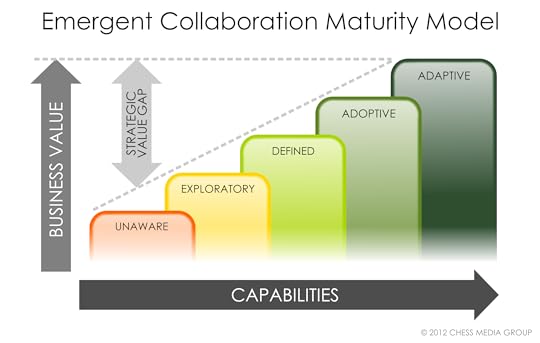
When the collaborative capabilities of an organization increase, so does the business value that the organization will realize. Let’s take a look at these 5 types of organizations in more details (much more comprehensive information and a grid is available in the book).
The Unaware Organization
Not surprisingly, unaware organizations are just that…unaware. Meaning, they are not really up to speed on what is happening around collaboration and the future of work; they just don’t know what they don’t know. Manager resistance is going to be strongest at this stage as value and business cases have not yet been established. There is also a high degree of uncertainty and fear as the organization tries to understand how emergent (or social) collaboration applies to the way it works. The opportunity and the upside for emergent collaboration here are great.
The Value
The value here is quite low, but the potential is the greatest.
The Exploratory Organization
At this stage organizations are spending more time researching and understanding what emergent collaboration is and how it can affect the business. In fact, organizations here may start defining what this means and what it can look like. Typically, organizations here start to see the possibilities of what can be done and begin to understand how emergent collaboration can solve business problems. We also start to see the formations of teams that are going to help drive this initiative within the organization. This is also where organizations will see most of their IT (and some manager) resistance. To move to the defined stage, there needs to be a very solid understanding of what emergent collaboration means to the organization and a strategic direction and vision has to start forming. Depending on the size of the organization, it can remain in this stage from one month to over three months.
The Value
The organization clearly sees where collaboration can benefit the enterprise. The strategic value gap begins closing as the capabilities for emergent collaboration start to increase. Teams begin forming that will be tackling this evolution of the organization. The key value here lies in knowing that things can be improved. The organization starts to get excited, and innovative ideas for collaboration begin flowing. The organization is now educated on emergent collaboration.
The Defined Organization
Here the organization needs to have a clearly defined strategy and direction for the emergent collaboration efforts. At this stage, the organization is getting ready to communicate and share the direction and vision and teams and roles are clearly defined. We also see use cases developed, measures of success defined, and potential technology solutions selected. To progress to the adoptive stage, organizations have to communicate their vision and direction for emergent collaboration and start implementing everything that was outlined and put together in the defined stage. The process of defining emergent collaboration for the organization can usually be completed in one to three months.
The Value
The organization is one step closer to realizing the business value of emergent collaboration. The strategic framework to make this happen is complete, and the organization is ready to begin implementing.
The Adoptive Organization
At this stage the organization is in the process of full implementation. Everything has been explored, teams have been established, the vision has been communicated, measures of success have been established, risks have been evaluated, and the road map and strategy have been developed. Organizations here can typically implement in one of four types of enterprise collaboration deployments. This is the stage of greatest learning for the organization as progress is evaluated and bench-marked and feedback is continuously collected. This stage can last from one to three years, depending on the size of the organization and how quickly things can get done. Employee resistance here is greatest as they try to embrace new strategies and technologies at work. The remainder of the emergent collaboration life cycle is spent in the adaptive stage.
The Value
Employees share anecdotal and data-driven information about the benefits of emergent collaboration. Information starts to be easier to find and share. Teams are more easily formed, and employees start to open up and trust one another. Company morale begins to improve as employees begin to understand their roles and the roles of their colleagues better. Senior-level leaders gain much greater insight into the way the organization operates. The organization now sees opportunities to engage and inspire employees and to retain and attract new talent by being perceived as innovative and cutting edge.
The Adaptive Organization
This adaptive stage isn’t an end state; it’s a continuous cycle of improvement and evolution. The adaptive organization has a very solid understanding of what works and what doesn’t and is capable of making the right decisions. Organizations can easily regress into previous stages if, for example, they stop listening to and incorporating employee feedback into their efforts, which in turn can cause employees to abandon platforms. If employees don’t feel supported and listened to, then chances are that adoption rates will never rise. The important thing here is that there are always going to be improvements, updates, changes to technologies, new best practices, new team members, new leaders, and evolved strategies. An adaptive organization is one that learns what works and what doesn’t and is able to improve.
The Value
This is where the organization sees the greatest business value from emergent collaboration as problems are solved and successes are repeated. Inefficiencies begin to be eliminated. The organization is now able to adapt to new changes, behaviors, or feedback from employees. Company morale increases as employees see that they have a voice and their feedback is being implemented. All necessary components for emergent collaboration are integrated, and sharing, finding, and collaborating on information are at their peak. As new use cases emerge, the organization is quickly able to create solutions. Productivity increases, and opportunities are identified and implemented regularly and efficiently that result in cost-saving or revenue-generating
opportunities.
Here is a more detailed version of the maturity mode (click to expand):
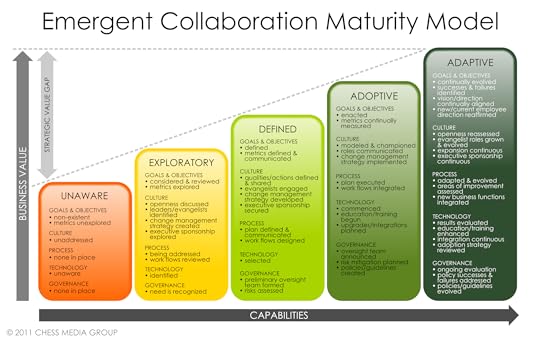
For more detail on this model and strategic advice on everything from employee adoption, to vendor evaluation, to strategy development; check out my book, The Collaborative Organization, on Amazon.


April 8, 2013
When is the Best Time to Get Started With Collaboration?
Getting started with your future of work and collaboration initiative is typically the biggest step that an organization has to make. It’s that commitment to changing and evolving the way you are going to work from here forward. However, some of the organizations I have been speaking with recently are wondering, “when is the best time to get started?” I understand the skepticism and the temptation to put things off but in all honesty the best time is now.
Every organization typically has multiple initiatives going on that are keeping people busy. In these situations management wonders if it’s worth waiting a few months before making the investment so that people can have more time to work on this project. Have you ever heard of that saying, “life gets in the way?” Well the business version of that is “business gets in the way.” Putting off these initiatives will get you nowhere because there is always going to be something that comes up. The reality is that your organization and every other organization out there needs to get started somewhere and at sometime, and now is that time.
I had one organization get in touch with me around 9 months ago wanting to get started on something but then postponed because of “timing,” we still talk all the time and they still haven’t done anything but if they would have gotten started 9 months ago they would be much farther ahead today. If you commit to changing the way your organization is going to work then you need to commit to no excuses.
You don’t need to make giant steps on day one. Realize that this an ongoing and evolving journey that realistically doesn’t have a finite end. You can’t learn to swim unless you actually get in the water. Here are a four things you can do to get you moving in the right direction now:
Figure out who is going to be leading your collaboration initiative and empower that person to make decisions related to this project.
Get together a few collaboration use cases around how employees will use new tools and how their behaviors will change
Explore some of the collaboration technologies that exist today (for bonus points read this post on the eight variables to evaluate collaboration vendors and this one on how to actually select a collaboration vendor
Read this post on getting started with collaboration in the workplace
As I’ve said many times, there is no such thing as a future of work initiative in an organization that doesn’t invest see where the future of work is headed. Get your head in the game and get moving.