Rosa Say's Blog: Managing with Aloha, page 27
November 25, 2012
The First Time and the Insider’s Advantage
Preface: This is a freshened-up reprint of a short article I had initially published for Lifehack.org back in May of 2006. I have just returned from a trip, and a couple of my travel experiences brought it back to mind for me; one was at Café Rio, and another at The Boiling Crab. Its subject matter connects to three of our MWA Key Concepts for me; see if we agree after your reading, and before you see my category choices in the post footer.
After you get over your initial surprise that these people actually do exist still, there is something very cool about watching someone who has never been in a Starbucks before, come in to one for the very first time.
It is easy to pick them out, for they are the only ones who walk in front of the overhead menu board, step back a few paces to take the whole thing in, and actually begin to read it.
Everyone else who is already in line waiting, or who might be seated at a nearby table, looks at them and smiles to themselves knowingly. It’s that smile of understanding, of recognition, and in remembrance of their own first time.
Next, this insider’s smugness slowly but surely replaces those looks of understanding and recognition on the faces of all the bystanders. They love the thought that they are now veterans and in the know, and that their own rite of passage is over. They feel they’ve paid their dues and have arrived, and it’s a feeling they like way more than that first-timer’s memory.
It is very rare to see anyone help the newcomer with a suggestion. On the contrary, sometimes you see ranks close, and the line gets tighter, so the newcomer can be left with no doubt where that line begins and ends. People actually start to anticipate that funny moment the newcomer will approach the barista and order, saying they want “the medium size I guess” instead of the grande. If their learning curve is sluggish or steep, impatience sets in; if others help now, there is an uncomfortable edge to it.
Starbucks is but one example. If you are a road warrior, think about those airlines you now frequent and those you don’t, and how class distinction is taken to a whole new level with premier lines and those for “everyone else.” There’s a whole slew of businesses where being the veteran with the insider’s advantage is definitely part of the reason you continue to patronize them. In fact, to not be part of a frequent-something club is considered to be downright foolhardy consumer behavior.
However, if you are a business owner, leader, or manager, what I propose to you is this:
Not capitalizing on making the first-timer’s experience your competitive advantage, because that experience is as good as it can possibly be, is where you might be missing the boat for both kinds of business potential: First-timer and Insider.
Every business person will tell you how critical first impressions are, yet they don’t concentrate on fostering those impressions, relentlessly addressing them in their training and service standards. In restaurants, we’ve all been asked, “Have you been here before?” but most times we get the feeling our server wants to know of our answer for their ease rather than ours: They aren’t being Mea Ho‘okipa, they’re cutting to the chase.
To continue with the Starbucks example, imagine if the barista doing their turn at wiping down tables were focused on those newcomers first, and the dirty tables second…
Imagine if they walked up to that newcomer and asked if they needed some help making a choice, and offered to explain some of the coffee lingo…
Imagine how the bystanders would now feel, seeing that newcomer get a level of service they don’t recall they’d received their first time…
Imagine everyone craning their necks to hear about offerings they’ve never tried because they had on veteran’s blinders, and they now realize that there’s a lot of things offered at Starbucks that they’ve never bothered to try because they’ve just been too comfortable, and they’ve been too accepting of the level of service they no longer get now that they have been trained so well by the coffeehouse’s so-called “insider’s advantage.”
Interesting to imagine all that, isn’t it?
Now think of your own place of business, and how Sense of Place is created there, and felt there. How can you make it better for everyone, customer and workplace partner alike?
Mea Ho‘okipa as service providerI have been taught that if you were called Mea Ho‘okipa in old Hawai‘i, it was a compliment of the highest possible order. It meant that the person who accorded you that recognition felt that you embodied a nature of absolute unselfishness. With the compliment they were also saying “Mahalo” (thank you), appreciative of the hospitality you extended to them with complete and unconditional Aloha (the outpouring of your spirit). In acknowledging you as Mea Ho‘okipa they were actually saying, “Your arms of Aloha have embraced me; I accept your graciousness, and I am exceptionally thankful for the outpouring of your generous spirit.” Fewer words said, much more meaning expressed.
The Mea Ho‘okipa were those who always seemed to radiate well-being, with an inner peace and joy that came from the total satisfaction they received from their acts of giving. They were those who truly gave of themselves freely, and gave often, never trading favors or silently hoping for anything in return. Their own pleasure and satisfaction came from the act of giving itself. Giving was their inner source of joy and contentment.
Now wouldn’t that be a compliment you’d like to receive from someone, especially from your customer? Isn’t that a feeling you’d want to experience? I wrote down this quote from a Successories poster I had seen once, for I’d immediately thought to myself, they’re referring to Ho‘okipa;
“Never underestimate the power of giving.
It shines like a beacon throughout humanity.
It cuts through the oceans that divide us and brightens the lives of all it touches.
One of life’s greatest laws is that you cannot hold a torch to light another’s path without brightening your own as well.”This “brightening of your own [path] as well” is the abundance of Aloha we’ve already talked about. It is the Aloha we want to give.
— From Managing with Aloha, Chapter 6. Do you have a copy of your own yet?
Archive Aloha with related reading:
Tear Down Your Walls
What can a Humble Wave do for you?
The Visibility Guarantee: Your Values
Start with two words: “with Aloha”
Managing: Be a Big Fan of the Small Win
For more reading paths, go to New Here? or click on the tags found in the footer.




November 22, 2012
Thanksgiving Blessings and Aloha
Happy Thanksgiving my friends,
I have always loved November, for it is a beautiful month of thoughtfulness and reflection. This day in particular, Thanksgiving Day, is one that shines brightly with the brilliance of our inner human light. We nourish each other today, and we relish the gift of each others company.
Three values come to mind for me most of all:
NĀNĀ I KE KUMU; this is a month which seems to exist just so we can be reminded to look to our sources of well being, sources rooted in the basic simple goodness of our Aloha Spirit.
MAHALO; November encourages our intentional practices of appreciation, gratitude, and thankfulness so we can become content in the understanding of just how rich our lives are.
‘OHANA; We commune today, pulling each other close with unconditional acceptance, with the eager arms of friendship, and with overflowing love.
With this trio of goodness, we strip away the confusion and clutter we may be carrying through our days, and we reach who we are at our core. Our ALOHA. That is the way November is a gift to our humanity, I think, for it keeps us more human and less contrived.
This is my mana‘o: I know these things to be true because of the evidence in my own life.
For as if ALOHA wasn’t abundant enough, November became the month I would publish Managing with Aloha eight years ago, and my blessings would multiply by magnificent number.
MWA would ‘talk’ in its own language of intention, and it would give me an astounding gift; I would live with MAHALO, the Hawaiian value of thankfulness, connected to my work, and to my life every single day.
Managing with Aloha has done much for the success of my business as the teachable philosophy it is, but it grows more joyously with the people it has brought into my life. Blessings counted in smiling, caring faces are the very best kind.
To everyone who reads these words, thank you for being part of our Ho‘ohana Community, and part of my life. I write knowing you are there, and that we are in some way connected.
Be thankful knowing how your Aloha Spirit will always thrive and grow in the most elemental ways, grounding you in pure goodness.
I wish you the contentment of gratitude.
I wish you the clarity of simplicity and serenity.
I wish you the pleasure of wonder and joy.
And I wish you the brilliant light of the company you keep, honoring their Aloha Spirit as well.
Me ke aloha e Thanksgiving maika‘i nui,
~ Rosa Say
A journal entry from 2007: This feeling gets stronger and stronger for me with each passing year:
We human beings are such a marvel; we come in such a perfect package upon our birth, with so much potential to be groomed and polished as time goes by. We really don’t need that much more than what we start with; it is that simplicity I am so grateful I came to better appreciate this year. My paring down to a few focused essentials has helped me realize how very little I need to live a blessed life.
I have my family, I have my friends, I have our community, I have my aloha spirit and my life’s work; everything else falls in place. In good place, and I feel wealthy.


November 18, 2012
Our Thanksgiving Week Mahalo
If you were part of the Ho‘ohana Community involved in Talking Story, the Managing with Aloha Coaching project, or Say “Alaka‘i” (and Ho‘ohana ‘Ōlelo — remember that?) today’s posting will look familiar, and with very good reason. Good things are worth repeating! If not, hurray for being here now!
Let’s practice the magnificent gifting of MAHALO.
My Mana‘o (what I deeply believe):
I believe that great leadership creates positive energy, and that great management channels that energy into the best possible results, delivering healthy, meaningful and fulfilling work to people in the process.
I believe we need more management and leadership, and not less, so we can optimize those energies: One of my reasons for constantly writing articles to newly publish (or repeat like this one),� is that I want to help you learn more about the rewards both managing and leading deliver to you, rippling positive for everyone you associate with.
So let’s make this entire holiday week about YOU, and about the people who are YOUR rewards.
What do you appreciate within your working practice? Who are you grateful for as your partners?
If someone else considers you to be their boss, leader, or manager in any way, this is a week to ask yourself if your delivery of “healthy, meaningful and fulfilling work”� is being made in matters large and small; with baby steps and big shifts alike.
No workplace is perfect, but this week, focus on understanding what works. Reflect on anything and everything which is going right and not what might be going wrong — we’ll deal with that another time. This is the week to “Catch people doing something right” and to push yourself toward doing those right things too!
Catch it, and relish it: What is good and right, and why?
Think about what you are grateful for (those cool results), and then think about the people who help you make work happen in tangibly wonderful ways. Think about WHO you are grateful for, for simply doing what they do.
It could be they show up with complete dependability.
It could be they are responsibility-driven, meticulous and thorough.
It could be they listen well, intently even, asking terrific questions.
It could be they smile constantly, and laugh easily; they infect the place with joy.
It could be they volunteer their ideas, and quite courageously.
It could be they are resilient and patient, and don’t get discouraged easily.
It could be they are tenacious, and try harder when a mistake trips them up the first time.
It could be they are insatiably curious, seeking to learn and improve continually.
It could be they are great ambassadors, speaking well of everyone in your company, and everything about it.
It could be they have no entitlement mentality whatsoever; frankly, they earn their keep.
It could be they respect the customer and consistently treat them like royalty.
It could be they believe in you, and trust you. They put their faith in you.
I could add dozens more “it could be”� possibilities to my list, but what is on yours? Your work is probably different than mine in significant ways: What are the characteristics of good work done in great ways that you genuinely are thankful for?

I’ve got your back.
Fill in the blank:
Who is really important to you, and
you don’t ever want to take them for granted?
________________________________________________
Then, ask yourself this question:
“When did I last say a “Thank you”� of MAHALO to those who do even one of these things for me, where they knew the words weren’t just automatic or polite (like saying “Bless you” when somebody sneezes), but that I really meant it? Did I truly convey what their actions meant to me?”�
We managers need to sincerely say “thank you”� often. Speak of your appreciation and it will soften the tone of your voice, giving it richness, yet humility and integrity. It will open you up, so others can step in.
People need to hear it from you: Say, “Mahalo nui loa,”� and add why you are saying it. What happened? What did you notice? What blew you away with how fantastic it was, how creative it turned out to be, or how perfectly timed?
Thanksgiving is the perfect time for Management Mahalo Week.
When you are a manager, you get your best work done through other people; it’s as simple as that. Great management is about optimizing resources, and there may be no truer statement than that “our people are our greatest asset.”� Any gratuitous lip service that statement ever gets is horribly unfortunate. It IS true as humanity-guaranteed potential; the ALAKA‘I managers who matter in a workplace make it a true statement in everyday occurrence.
Providence seems to conspire with us now: People more readily believe we have thought about our appreciation with more introspection, and that our words are genuine and sincere.
They remember that MAHALO is infused with belief and conviction, and the thought warms them completely: Beyond a beautifully compact word for “thank you,”� Mahalo is the value of appreciation, of gratitude, and of thankfulness.
Mahalo means “thank you”� and as a value Mahalo is appreciation and gratitude as a way of living. We live in thankfulness for the richness that makes life so precious at work and at home. Mahalo is the opposite of indifference and apathy, for it is the life perspective of giving thanks for what you have by using your gifts — and all of your gifts — in the best possible way.
Living Mahalo is a life of living within awareness of our gifts. We relish those gifts. We celebrate them joyously. MAHALO is the value that gives us an attitude of gratitude, and the pleasure of awe and wonder.
So this is your week to experience how this works. Ask yourself just how true a statement “our people are our greatest asset”� is in the way people feel about working together. Are they thankful they are able to work with you? Are they thankful for your company? Do they enjoy a sense of gratitude for each other while in your workplace? Do they feel their work is valued and appreciated?
Let’s fill up these comment boxes this week!
Okay, enough of my questions for you. Time to make our MAHALO statements.
There are a lot of great relationships out there in our Hawai‘i nei, and beyond to wherever the internet helps us reach our global brothers and sisters in ALOHA: There are thousands of working relationships where managers are immensely grateful for those who work with them, and where people are just as grateful for the person they are able to call their coach, manager, boss and leader.
Are you in one of those working relationships? Will you let us know about it?
All this week, let’s use the comment boxes here� to publicly, and joyously say Mahalo to each other: How great would that be if your manager’s name shows up here, or if yours does!
Who are you thanking, and why do you appreciate what they do for you, or with you? Write them a note and let them know.
Now remember: Please don’t just go through the motions. People feel we mean it when they feel they have earned it. They did something good; something worth your noticing; something they understand to be valuable to you. You didn’t say “Mahalo”� or “Thank you”� just to say it, or because they had a turn come up, or to make yourself look like the bigger person; they caused your gratitude to happen.
Gratitude never disappoints. Gratitude graces; it can change everything.
From the archives:
Evoke and elicit MAHALO.MAHALO teaches us to weave more thankfulness, appreciation, and gratitude into our days. To evoke it, is to bring MAHALO to your conscious mind. To elicit it, is to bring MAHALO to your responses for others.
You can practice this in your self-coaching with the simplest MAHALO exercise there is: Gratitude journaling… The ‘But’s Which Work to Favor


November 15, 2012
Your In-house Training: Do it!
When it comes to workplace programs, I have 3 favorites to recommend to managers who wish to cultivate more Managing with Aloha “real work” practices in their culture:
The Daily 5 Minutes, mandated for constant conversational inputs and partnership agreements
A Value of the Month program, as mentioned last time, and
The Monthly In-House Training program.
All 3 are about ‘Ike loa, the Value of Learning
Simply said, we strive to keep learning so we grow well intentionally, and not just as the result of our physical aging.
I see these 3 programs as learning initiatives. They are;
Learning to listen better, and learning to receive well (whatever you hear)
Learning to use values as the very practical tools they are in our human toolkit: We use them personally, organizationally, and in our community living
Learning about the assets of our workplace team, so we can discover how to connect with those assets as our accessible resources
Let’s talk about that 3rd one today: Monthly in-house training programs. It’s actually the easiest one for you to do right now, regardless of your business discipline, because you do it with the assets you already have, and need not know a single thing about Managing with Aloha at all.
You know what I’m talking about: You have a class each and every month. The subject matter differs each month, because the presenter gets to choose it; they’ll share, teach, and coach the class in some area of their expertise, whether talent, skill, strength or knowledge. The result is often some pleasing combination; it’s their personal and professional story of all four — and of their HO‘OHANA; their daily intentions with purposeful and important work.
‘In-House’ means that this is not a program of visiting professors. No paid consultants or trainers — not even me! This is done by you and your people, and not just by managers, but by anyone willing to do so.
Sometimes you won’t even need a classroom: Some of the best in-house trainings are done out in the field — your field — or as a community-based field trip that connects the dots of what you’d describe as your Sense of Place, tapping into its wealth.
All of us are in workplaces infused with talent, skill, strength and knowledge as our accessible resources, that much is fact. The only question is, are you tapping into those resources as much as you could be?
Are you a manager?
If you are, I want to finish this posting with some encouragement for you: Be one of these trainers. You don’t even need a company-wide program to sanction it, and you can stretch it to a quarterly event if better for you to start… once you’re rolling with it though, and invite others on your team to take the podium and do the next one, I guarantee you, the months won’t come fast enough for you to schedule everything you want to!
Remember reading about ShopTalk in Managing with Aloha, and how it evolved to our Vendor Partnership Program for Hualalai? Here is a snippet from Chapter 11 on ‘Ike loa, the value of learning:
We started a weekly forum called ShopTalk. For one hour each week, every retail clerk on the resort —which included a modest warehouse staff —would participate in this forum of retail learning. Product knowledge was a staple on the agenda, and my vendors were asked to help me teach it —they were the ones who knew most about their own products (think back to Kuleana and delegation strategy). My shop managers were asked to facilitate forums on store operations, and our warehouse staff covered that operation.
For my part, I normally taught and explained our retail business plan, investing more in our relationship as business partners. As retail manager I was also buyer, and I’d attend the instructional seminars given at trade shows as student so I could replenish my own arsenal as teacher: My crew came to think of my post-travel ShopTalks as the trend discussions they could look forward to, linking our local operation with the retail industry as a whole. Soon we found that our ShopTalk students became the teachers too: As Mea Ho‘okipa, they were the best qualified to mentor all of us about delivering better service, and maintaining our ever-constant focus on the customer. ShopTalk became both a forum for learning and a celebration of the immense wealth of talent we had and could share with each other.
You can read the complete chapter, by taking the Book Excerpt link over in the right column under Resource Pages. That chapter includes a description of The Daily Five Minutes as well.
Your people are hoping you will make something like this happen. Believe me, they expect you to be teacher, trainer, and coach for them, even if they don’t come right out and say so. Their school of the future germinates in the workplace, in the place they will connect their learning to their earning.
My own encouragement for you, has to do with how good it will make you feel.
Conducting a training workshop, where the class is small enough for me to look everyone in the eye, and where I am able to sense their presence and connection with whatever we’re talking about (usually about 50 people at most) is my favorite thing to do. I’ve had quite a bit of practice at it, but I truly don’t believe I’m any better at it than you can be: I don’t love it because of my own performance. I love it because of the energy: I love what happens in the room when learning is engaging for people. I love seeing the heads shake or nod; I love seeing questions on faces and lights in eyes. I love doubt as much as I love the aha! moment, for doubt means we have to talk about this, and probably should… it will probably open a door that had been closed before.
Doubt and questions create those golden opportunities for me, when I momentarily go off agenda (sometimes abandoning it totally) because the people in the room didn’t need my agenda per se; they just needed the prompting it gave them. Those will usually be my best classes of all, because people didn’t just sit and passively listen. They engaged and got involved; they made the class theirs, and not just mine.
And you know what? You have a better chance of having that kind of success happen in your in-house training than I’ll ever have. You know your stuff — and it’s locational experience, and expertise which is highly relevant to people in your working world. In comparison, I always start with Managing with Aloha being something extra for a group, or something totally new. And you know your people — you are aware of connections in the room, and you sense their unasked questions better than I can ever do.
Please don’t deny yourself the goodness: If you don’t have an In-House Training program now, be the person who starts one, and who becomes its champion. You will be honoring and championing all the resources of the company you keep, and you will relish your own growth as it happens, a win-win for everyone involved.
“Whatever it is you want to do, find the person who does it best. Then see if they will teach you.”
— When the Student is Ready, the Teacher Will Appear



November 13, 2012
Would you write “Walk my talk” on your calendar?
It’s no secret that I’m a huge fan of Value of the Month programs in the workplace. Case in point: Value Your Month to Value Your Life.
I like them because of their dipping effect: They dip workplaces into a constant swirl of value immersion, where anything and everything can be looked at with values-colored glasses, allowed into our front-and-center attentions to beg us for more alignment — “Let’s walk the talk, shall we?”
When we have a Value of the Month program, we examine the values we claim, and we savor our convictions to those values in sensible, real-work context.
What we bank on in a Value of the Month program, is that we’ll dip in, and we won’t get back out. These programs keep values fresh, relevant, and in play: We rotate our value attentions (this month may be about MAHALO appreciations, and next month might be about the NĀNĀ I KE KUMU recharging, a terrific choice for December) but we stay all-in. We get completely drenched in what we say we stand for, wallowing in the value immersion of our choosing.
What I sometimes hear, however, is a battle of the calendar, where we allow scheduling to trump common sense and better responsiveness: If you need to have a KULEANA conversation right now, about the work at hand, or an ‘OHANA conversation in tomorrow’s meeting (you read the agenda), by all means, have those conversations!
Working in alignment with your values is a constant. You either do it, or you don’t. And if you don’t, you can’t say you are an Alaka‘i Manager learning to practice Managing with Aloha.
A Value of the Month program should be thought of as a cool-and-sexy extra that actually gets the stars in Providence to align for you — it’s like that power boost you opt for in that healthy smoothie you order from Jamba Juice. However the fact of the matter is that value alignment — simply defined as walking the talk of the values you stand for — is a constant, everyday matter: It is simply what you do as an Alaka‘i Manager.
It’s not dictated by “when time allows” on your calendar. If you want it there, write it in on every day of the year, and in every time slot.
Footnote:
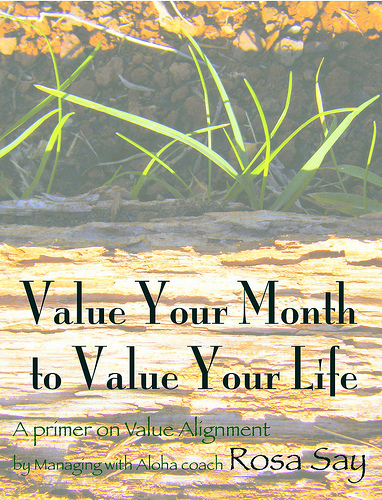 Value Alignment (site category) is the subject of my third book, Value Your Month to Value Your Life: I wrote it to guide Alaka‘i Managers through the what, how, and why of Value of the Month programs conducted in the workplace. In my view, these programs are pure gold as a Managing with Aloha jumpstart, for you choose your own values and begin your culture-building in a personalized way as you learn more about the MWA philosophy as a whole.
From the book’s synopsis: “Value mapping is a way that good begets good, beginning with the good which already resides within you in the form of your personal values. To illustrate, we’ll cover two workplace how-to’s: The Value of the Month program, and Value Steering for Projects, both which help foster healthy business cultures.” You can buy VYLVYM on Kindle and on Smashwords.
See the Table of Contents here.


November 8, 2012
Our Values and our DNA
I took this picture while at Ulu La‘au — Waimea Nature Park:
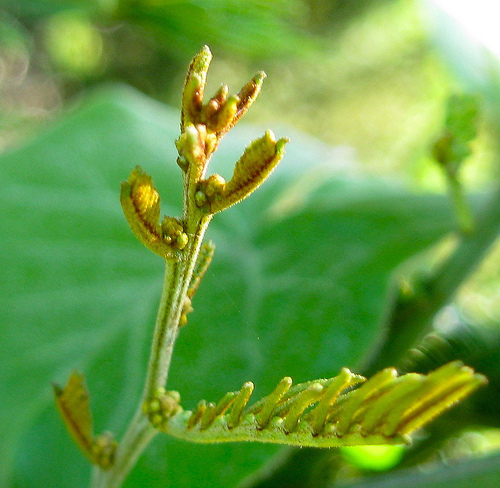
I honestly have no idea what it is, other than knowing it’s a very young tree of some kind.
I’m very sure it will look quite different when it grows a bit more, for it’s clear that it’s starting with rich DNA that simply will not be denied. Majesty sleeps within those young shoots, getting ready to reveal itself more fully.
It caused me to think anew about the values I’ve urged you to adopt this past week within the practice of our democracy — whatever values you choose — simply because I know that at their core (in their DNA within you), your values are good.
They’ll serve you well when you choose to grow them too.
It looks a bit awkward now, but I bet this will grow to be a very beautiful tree.
Nature is very good at embracing these awkward stages, and correcting her mistakes as she does so.
Just like values do.
Here is a description of DNA from Wikipedia:
Deoxyribonucleic acid, or DNA, is a nucleic acid that contains the genetic instructions used in the development and functioning of all known living organisms (with the exception of RNA viruses). The main role of DNA molecules is the long-term storage of information. DNA is often compared to a set of blueprints, like a recipe or a code, since it contains the instructions needed to construct other components of cells, such as proteins and RNA molecules. The DNA segments that carry this genetic information are called genes, but other DNA sequences have structural purposes, or are involved in regulating the use of this genetic information.
Compare it to this description of VALUES from Managing with Aloha, beginning on page 19:
… not only are values universal, they are highly personalized. They come alive with one’s personal mana’o (one’s thoughts and beliefs) and they are strengthened and continually reinforced with the nuances of their own experiences —a value can have kaona (hidden meaning) for someone in a way that is very uniquely meaningful for them. There is a self-awareness that is uncovered for you. When coupled with your mission and with Ho‘ohana (working with intent and purpose) the result is powerful self-motivation.
Our values drive our beliefs, and often they give our thoughts clarity. When we are true to our beliefs, the decisions and choices we make come to us naturally and easily, especially when we have a goal or objective in mind. It is easier to act on that which you believe.
I am a strong advocate for the writing of mission statements, as you will discover when we reach the chapter on ‘Imi ola (to seek life). Our mission defines our goals, and our goals drive our actions. And actions taken, true to clear beliefs that have been borne from good values, give us our integrity. Acting with integrity makes things right for us; it feeds our hunger to be intelligent, ethical and morally just.
KA LĀ HIKI OLA: Take a deep breath. It is the dawning of a new day.

Postscript: Does this look, or sound familiar?
I had previously published another version of this post on Talking Story in the context of KA LĀ HIKI OLA work we were doing in the early weeks of New Year’s 2011 with this result. It came back to mind for me as I grabbed time for some Election Day hangover reading yesterday, particularly in regard to a couple of writers speculating on how President Obama will now shape his legacy; second-term presidents do feel more freedom when another election for that office no longer clouds their future. There is more clarity in their thinking, and visions extend to longer-term potential. [This, at The New Yorker, was actually written by Ryan Lizza back in June: The Second Term.]
President Obama is now a leader with a far better chance to excel. Let’s all support and encourage him, so he rises to that expectation.


November 4, 2012
Valuing the Vote: What is it we really feel?
If we accept the judgement of the political pundits, Tuesday’s election of the President of the United States is a toss-up; too close to call. Dip into the news or polls, and it’s clear that even our expectations are quite polarized; we are believing what we want to believe and throwing our more objective sensibilities out the window. I write this today to ask you: Please cast your vote. Let’s get the clarity we need, and achieve a meaningful result.
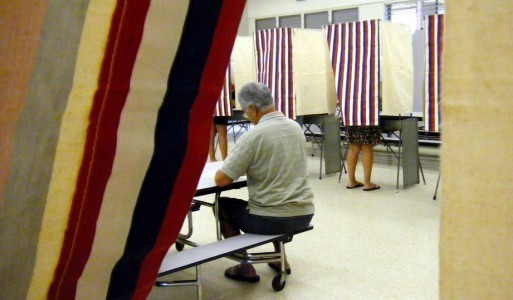
Appreciate your opportunity, and have your voice be heard. When you cast your ballot, it’s all you — no one goes into that voting booth with you, and thus, it’s the closest we get to an accurate assessment of how most in our country really feel. As we know from our Managing with Aloha learning, it’s our 4-year check of what our collective values are as a country of United States citizens — or if there is much of a collective currently in play.
When I say, “cast your vote [so we] achieve a meaningful result” I am hoping for the result of clearly seeing and understanding what we must do to then go forward with our healing. Our vote will quantify the full accounting of the work to be done, and help us define its gravity.
When the election is over, you can be sure the man who lost will ask his supporters to stand behind the president, and say something like, “It is time we come together.” Yet it won’t be easy; we will need our ALOHA, and as strongly as we can muster it; tolerance is not enough. So let’s at least start from a place of solid reckoning and full awareness. Let’s clearly see each other as we must, so we can understand our differences more clearly, and then rally behind a common vision for our next four years together. United we stand.
There are certain times our values speak to us in groundswell voices. Election years are one of those times, so let’s listen.
Ever since I was eighteen, and first walked into a voting booth for myself, I’ve had this same election year consciousness, of being part of a point-in-time temperature taking, where we measure the temperature of our entire country. True that it only measures those choosing to participate, but I have always sensed that those who vote represent the vocal and energetic masses. They are those who are more involved than most, willing to be part of change, or alternately, of our collective stubbornness and tenacity with going the course. In the way our elections work, when we vote for someone, or for what they stand for, we also vote against something else. We effectively say, “Good job; keep it going” to an incumbent, or “Okay, let’s see what you will do instead” to a fresh face emoting ALAKA‘I energies.
Our values at that point in time of choosing, become more clear, and we reckon with honestly knowing what we really feel. Specific issues illustrate why we feel that way, and how important our views are to us. We all possess several values, and at these times their hierarchy of importance and relevance can shift.
Our values can, and will change over time: We can, and do choose them. They illustrate our core beliefs, and they serve us.
Let’s Define Values and The 19 Values of Aloha
Ethos: Be True to Your Values
Trusting your Intuition and Intuition x9Read more in our MWA Key 3. Value Alignment index.
Election years like this one are very unsettling because we appear to be so dramatically (and passionately) divided. 2008 was quite different, when Barack Obama won a decisive victory over John McCain in both the electoral and popular votes, but it was mostly different because of its historical significance. As noted in Wikipedia, “This was the first U.S. presidential election in which an African American was elected, having also been the first in which an African American won the nomination of either major party.”
Barack Obama still had to be everyone’s president, and he tried to be, yet it’s quite clear he has lost some ground, and this year’s results will not be as conclusive. Whatever way it goes, there will be many more people who will be unhappy, and feel their guy has lost.
“As the two rivals hurtle toward the finish, in many ways, Obama is rallying a coalition of transformation and Romney a coalition of restoration. For the third time in the past four presidential elections, these divergent coalitions might prove almost identical in size. That means the outcome will likely alienate almost exactly half of us.”
— Ronald Brownstein, National Journal Group. Brownstein is a two-time finalist for the Pulitzer Prize for his coverage of presidential campaigns.
We have a tough time ahead of us, where we must work to come together as a more unified country. The task ahead is not solely the job of our president, though we certainly will draw our own energies from his leadership. It is undeniable that come together we must, and that starts with a willingness to understand and include those who differ with our own views. In our MWA ‘Language of We,’ it calls for the values of LŌKAHI (cooperation and unity), KĀKOU (inclusiveness and togetherness), MĀLAMA na ‘OHANA (stewardship of our communities and our country), and HO‘OHANOHANO (respect and dignity), conducting ourselves with honor and distinction — and always, with the unconditional acceptance of ALOHA.
All of that work will start with your vote.
Cast it and be heard so your values are counted.
It will be your first act in helping us heal as we will need to.


November 2, 2012
Managerial Batching: 1, 2, 5 and 7
Several years ago, when blogging was relatively new, I was a weekly contributor to a very popular blog called Lifehack.org. The word ‘lifehack’ was new to our vocabulary then too, and we were defining it quite broadly and on-the fly, simply offering our ideas on how to make things easier and better in a rapidly changing world where all-things-digital kept rearing its head, clamoring for our attention. As a Lifehack.org columnist, my task was to focus our readers on savvy management and thoughtful leadership.
Swept up in the mood of the time, I began to think of lifehacking as a kind of distillation in productivity: Distillation is a process where you purify a liquid to its essence, by vaporizing whatever excess you really don’t need, so you can work with the resulting condensation. As managers, we condense as a survival skill; we seek to make everything more concrete, tangible and concise so we know exactly what we’re dealing with. We pursue relevancy, so every effort can be well-connected, and if we’re lucky, well contained.
This is rarely a solitary job for us. Others are, and should be involved. But when, exactly, and how?
Managing by the Numbers
To answer that question, one of the management/leadership ‘things’ I began to hack away at within my own workplace productivity was numerology — the ways I would get numbers to work for me. The distillation I wanted to achieve, was understanding what managerial batching was best for my Ho‘ohana, the cultural work of Managing with Aloha.
This turned out to be quite a playful experiment and meaningful set of experiences. Numbers began to mean a few specifics for me; they began to tell me what to do on my own terms, i.e. what approach to take in certain situations, just as I’ve learned to do with value-mapping.
My workplace of choice morphs quite a bit these days, yet I still think of myself as a working manager. To be smartly productive, this is the way I have hacked my managerial batching in MWA culture-building:
1 by 1 — 2 by 2 — Just 5 — 7 Strong
Let’s go through each batch, and define their usefulness.
1 by 1
Job 1 for the Alaka‘i Manager is healthy, with-ALOHA culture-building in the workplace, and they are fully cognizant of the fact that real people are their building blocks. They understand that people are driven by their personal values first, and a culture’s organizational values second — hopefully! That’s always the goal! This process of value alignment, where an individual’s Ho‘ohana [work of intention] finds its rightful and most fulfilling place in a workplace culture, guided and coached well by an Alaka‘i Manager, is, and must be done one person at a time. It honors that person completely, and it truly is the most practical approach to take as well. We don’t manage by the book; we manage by the person.
2 by 2
Partner is our word of choice in the MWA verbiage; that’s what we call each other instead of employees, and we think of ourselves as fully vested business partners. The number 2 is about all other workplace relationships extended in partnership, evoking the feeling that “It takes 2 to tango.” Where the 1 by 1 batch defines the working relationship between an individual and their manager, the 2 by 2 batch defines an individual’s personal relationship and professional partnership with everyone else they’ll interact with in a workplace culture — co-workers, other authority figures and divisional liaisons, vendors and suppliers, customers, etc. A team of two engaged in their best-possible collaboration is the essence of every relationship; there is a symbiosis there to be optimized and to be fully enjoyed.
Just 5
In MWA culture-building, ‘Just 5’ carries two meanings.
Just 5 minutes each day for The Daily 5 Minutes. We say, “If you aren’t doing the D5M you aren’t managing with Aloha” and we mean it, for conversation reigns supreme in our daily practice. (Find our newest reference page for D5M here, and learn about its history in this book excerpt.)
Just 5 is our list bucket. We “Take 5″ to contain any and all list-making within 5 items max, feeling that more is likely to be unreasonable. We feel that “Less absolutely IS More” and having to stop at 5 helps us focus on what is most important and deserving of our attentions. (It’s a condensation.)
7 Strong
‘7 Strong’ is the group batching we have adopted for larger teams within the MWA workplace. This batching has been developed through the years in my first-hand experience, where a group of no larger than 7 people has consistently proved to be the best possible size of a team assembled for project work. We think of “7 Strong!” as the mantra for any and all focus groups, task force teams and pilot projects, and the coaching here is that collective strengths are in play: Each person is expected to, and challenged to bring their specific strengths into the work at hand as their tangible contribution. The bonus in this approach, is that when a project pilot is over, team members value each other with added significance — they have learned more about each others talents, and they connect a teammate’s personality and character to their values and strengths going forward.
In the workplaces managed with ALOHA we manage strengths, not standards. Feeling good must include feeling strong:
See Key 7 on Strengths Management within our 9 Key Concepts
MWA Site Category for more articles on Key 7Are you fully aware of the strengths your partners possess, and can potentially share with you?
Reckon with your numbers
Managerial batching has been my way to appreciate numerology more fully than before, seizing the practical nature of numbers on my terms, and within my values. When I started my career, I was that manager who only equated numbers with finance — and the thought made me groan, for back then, finance meant budget (i.e. Ironclad Rule) more than it meant strategic opportunity (i.e. Parameter for Reinvention) as it does now.
So I encourage you to do your own reckoning with ‘the numbers’ and to do it quicker than the time it took me: Gain your batching advantage, and grab onto it now. Numerology and batching are beautiful things once you make them useful to you. If you work within a peer group of other managers and supervisors, taking a unified approach to managerial batching will help you perform consistently.

Other numbers we have claimed in our MWA Language of Intention:
9: The 9 Key Concepts — Why these 9?
12: Twelve Aloha Virtues
19: The 19 Values of Aloha
21: Core 21: About the Book


October 30, 2012
What can you Stop, and, what Must you Continue?
What can we learn from the events of the day, making our lessons more personal, and more personally fulfilling? File this one under worthwhile work: Here are thoughts on how three different values can help us reflect: Kuleana, Mālama, and ‘Ohana.
Juggling Irrelevancy
A manager who constantly juggles balls in the air, will never create a better ball. Her juggling performance will simply drone on — until the inevitable moment she simply stops of pure exhaustion, dropping each and every ball.
— Give Managers their Chance to Excel
Mindlessly and needlessly handling irrelevancy is something we all do, and if you’re a manager, it seems to come with the territory: You must learn to sort and curate to the point of being ruthless about it.
A weekend like we’ve just had — earthquake off the coast of west Canada, tsunami threat in Hawai‘i, Superstorm Sandy ravishing the eastern part of the USA — can really put things in perspective for us, can’t it. It can also give you a golden opportunity to do some self-assessment of the work you regularly do, or don’t do, revealing all stripes of automatic pilot, both good and not so good.
And then there’s the stuff which is neither good nor bad exactly… it’s more accurately described as disconnected from what really matters. Work of all kinds will simply come to a grinding halt during these episodes of emergency, giving you the chance to ‘get real’ about them. When the clouds clear and the dust settles, and they will, do you really want to pick up the reins of irrelevant work again? (And if the answer is “Yes, I kinda do!” are you aware of why you feel that way?)
When work resumes, what can you stop, and what must you continue?
And if you are a manager, primarily responsible for the stewardship of healthy workplace culture, take note: The second part of the question is not what can you continue, but must.
For example, I’ve been quite pleased with the freeze Sandy’s weather system put on a lot of campaigning and electioneering… it is good to see our governing officials get back to the work we expect and prefer them to do!
Kuleana and Mālama are what’s Relevant
This is a time the value of KULEANA serves us well, for it rephrases the question a bit, giving it a filter of responsibility: What, of vital importance, are you responsible for, and conversely, what have you been assuming personal responsibility for that really isn’t necessary, or can, and perhaps should, be done by someone else, or even by no one at all?
The value of MĀLAMA offers more filtering to the responsibilities we assume, filters of caring and stewardship, helping us be less selfish about our answers. There are times we absolutely need to be self-absorbed, setting our own good example for others to follow, but our responsibilities can be tough to sort out at times, and MĀLAMA has a way of clearing up the cloudiness caused by the workplace interdependency we get in organizational culture.
Add ‘Ohana to your Replacement Opportunity
We have a productivity mantra in Managing with Aloha work cultures that goes like this: “Don’t add; Replace.” It helps us be reasonable in the work we willingly shoulder, so we are human dynamos of HO‘OHANA energies, and not just beasts of burden. When you want to seize a new initiative or tackle an opportunity of some kind, don’t carelessly add it to the work you already handle; have it replace something instead.
Another way to say it; Make room for the new by allowing and encouraging the old to expire. If this becomes your habit, you’ll be constantly sorting and curating, and all automatic pilot of the bad or needless sort, will become a thing of the past.
Weather emergencies like we are experiencing, have no favorites: They affect whatever and whoever are in their path. You can take very good precautions, like choosing not to live or work in a flood inundation zone in the first place, but some of those same precautions may cramp your lifestyle way too much; so we humans take risks that will give us fuller lives. Because we do, and because we always will, our emergencies can happen, and they often have ripple effects in our communities.
“Now more than ever, our neighbors need our help.”
— Al Gore On Hurricane Sandy
This is a time these effects are illustrated so clearly for us, and the value of ‘OHANA will ask you: Do you have the time, and the means, to be a contributor to community need, and participate in whatever healing is needed?
If you can make that time — if you make that choice right now, you may find it is a replacement opportunity you want to keep, holding it close and never letting it go again. It’s about businesses being less incestuous and self-absorbed, and giving back to the community which helps you succeed in the first place.

Archive Aloha with related reading:
The Workplace Mixology of ‘Ohana
Beauty in the Work: “Things Occur to You.”
Humility tames the Indispensable Beast. Here’s how.
Ethos: Be true to your Values
Like it? Might love it? Run with it.
For more reading paths, go to New Here? or click on the tags found in the footer.


October 1, 2012
Accept your Small Wisdoms with Grace
I had an interesting conversation with a young manager: She was quick to beat herself up for her youth and inexperience, feeling she hadn’t paid her dues yet, and could claim any lessons learned. Hers was not a case of extreme humility, but one of disbelief and cynicism: Surely more time and more work was needed no matter what she had already achieved.
Rubbish.
I can think of no more fatal mistake, than a manager who resists believing in herself.
Young managers will have a lot of Don’t!(s) and Not Yet(s) thrown in their path as unfortunate obstacles. One of the greatest character strengths anyone can have, is self-efficacy, where Do!(s) and Now!(s) flow from within them courageously because they believe in their own abilities and ever-growing capacity.
Lessons learned happen daily. When we get in the flow of our HO‘OHANA and energies and ‘IKE LOA intentions, they’ll happen hourly and from minute to minute. Learn to recognize them as the small wisdoms they are, and accept them with grace. Collect, and keep them close with gratitude. Use the value of MAHALO to see them in a more elemental way — keep them simple and uncluttered, for there is such a thing as being overdone. There is such a thing as having too much experience, as threat to your open-mindedness, natural curiosity, and sense of adventure.
I say “with grace” as courteous goodwill, whether you give it to others or to yourself.
I think of grace as a very attractive demeanor of unconditional acceptance, blending three of our ALOHA values: MAHALO, HA‘AHA‘A and HO‘OHANOHANO.
Grace is one of our Twelve Aloha Virtues:
“I once heard grace called ‘unmerited favor’ and I love that. I want to be gracious, always.”
Please: Stop and think about this right now. What did you learn yesterday, and how are you keeping that learning as the small wisdom you’ll add to? What did you learn in the hours or minutes before you stopped to read this? What are you learning right now?
Your age is irrelevant. Your ALOHA attitude and HO‘OHANOHANO demeanor can deliver everything you will need to succeed in your efforts with managing and with leading.

Here is some additional reading on self-efficacy:
A Manager’s Calling: The critical beliefs we start with in Managing with Aloha.
Ethos: Be true to your Values
Trusting Your Intuition and Beauty in the Work: “Things Occur to You.”
Ka lā hiki ola and the ‘Can do’ attitude of Ho‘ohiki
When the Student is Ready, the Teacher will Appear