
Chris Abouzeid's Blog, page 30
October 28, 2013
“It’s More Important Than Ever That Writers Have Community”: A Conversation With Sonya Larson, Program Director at Grub Street

By Becky Tuch
Begun in 1997, Grub Street is one of the nation’s premier writing centers. A quick scan through the testimonials from students include comments like, ”Excellent instructors, brilliant participants, an inspiring experience;” and “I LOVED this workshop…I learned a lot more than I thought possible.” It’s not uncommon to hear someone describe a Grub Street workshop as “first-rate,” “wonderful,” or, very often, “life-changing.”
Recently, I chatted with Sonya Larson, Grub Street’s Program Director about what it’s like to work in such a trailblazing writing center, how she manages to organize a terrific writing conference each year, and what it really means to be grubby.
What is an average day like for you at Grub Street?
 I work from 10am to 6 or 6:30pm. When I get in, my colleagues are often already rushing from meeting to meeting, answering ringing phones, and talking with visitors. Writers mingle in the hallways and brew mug after mug of coffee. I open my laptop to email: I like to pretend I’m playing tennis and must hit back every “conversational ball” in a timely fashion. Now you know (one of) the dorkiest things about me.
It’s my job to ensure that Grub’s programming is of the highest quality, operates with the highest efficiency, and is innovative and relevant to the modern writer. So that means a lot of meetings– typically about 4 a day, which may be with other staff or with outside organizations like The Moth, Discover Roxbury, or the Isabella Stewart Gardner Museum.
And throughout these meetings we’re deciding what new classes Grub will offer, what ways to improve existing programs, and what new people to involve in our community: techies, publishing innovators, literary organizations, and more.
Throughout all this, workshops are happening down the hall, writers are visiting the office, the staff is watching funny YouTube videos and eating cookies people bring us, and Eve Bridburg’s dog might be chasing people across the floor. It’s a lively, loud, and hilarious office. Not a day goes by that I don’t hurt from laughter.
You’ve been working at Grub Street for eight years. What are the two most exciting changes you’ve seen during your time there?
Crazy growth, for one. When I first arrived, Grub was offering about 80 classes a year, and now we offer over 600. The Muse conference attracted 200 people; in 2014 we expect 900. We’re now offering such a breadth and depth of programming that we need a whole new database to keep track of it. And all of this began as a single workshop in the living room of Eve Bridburg, our founder and Executive Director. The community has grown like wildfire and it’s been thrilling to help it along.
And I loved moving to our spanking-new space in 2012. It’s twice as big, has gigantic windows, and all-new furniture and fixings. Writers can truly relax and feel at home here without the worries of our old space, like getting trapped in the elevator or having dirty rainwater drip onto your manuscript during class.
Do you and other staff members talk about writing craft issues throughout the day? What’s an example of a discussion that might arise related to craft?
Absolutely! To teach writing well, we must be exacting in our own understanding of the craft and how we want to teach it. Christopher Castellani, our Artistic Director, and Chip Cheek, our Head Instructor, are especially skilled at setting this tone.
As an independent center, Grub is uniquely positioned to keep our instruction fresh, evolving, and responsive to modern readers and writers. Lately we’ve been discussing precisely what writers need to learn when writing a novel, as opposed to writing short fiction. Oftentimes MFA programs assume that short stories are somehow “training wheels” for the novel, but we believe that they’re quite different beasts. Novels have unique goals, entail a different experience for the reader and writer, and involve uncharted artistic decisions for the short fiction writer. That’s why we created the Novel Incubator program, and continue to innovate novel-specific classes every term.
And just last week we hosted a “What is ‘Ethnic’ Writing?” panel, in which writers discussed the potential enmeshment of a writer’s artistic choices with her personal identity, or perceived identity. For writers of– and/or writing about– a minority culture, these issues can be inescapable. For example, one African-American writer at the panel reported that some of her readers felt it important to know–only after learning that she was was black– if the characters in her stories were also black. How might she address this issue in her work? Should she? Who is her reading audience, and how might publishers attempt to “use” or not use her identity in marketing her work? Grub is by no means the authority on this topic, but we’re looking for ways to open and deepen this ever-important conversation.
Who is the ideal Grub Street student?
The ideal Grub student is one who takes his work seriously but not himself seriously. He/She is devoted to improving his skills, reading widely, and revising over and over until his manuscripts are as strong as possible. At the same time, he is generous to his fellow writers and cheers them on in their endeavors too. He’s no diva and no snob. He enjoys beer. He’s fun.
We welcome any human being who wants to write–it doesn’t matter your age, background, income, or experience level. We have something for everyone, and support writers at every stage of their development, and every stage of their projects.
If I tell you that I believe Grub Street is magical place, what can you tell me about that?
I will try! Many people speak about the magic of Grub, and I suspect that they’re referring to a rare combination of feeling welcomed, challenged, energized, and respected as a writer once they walk through our doors. We do a lot to create a culture of both warmth and rigor.
There are many great communities of writers out there, but sometimes people complain of them being too exclusive, too navel-gazing, too snobbish, or unhealthily competitive. All of which I think is ridiculous, especially as the publishing world as we know it is quickly collapsing, and writers are even more unmoored from the money, community, and security needed to support their art.
At Grub Street, we see no reason why writers should fight over the same piece of pie. Instead, we should all be working to make the pie bigger.
You oversee the organization of the annual Muse & The Marketplace conference. To many people, this makes you a god among mortals. What is this conference, in your own words?
The Muse, as we affectionately call it, is a literary conference that takes place the first weekend in May, and it so fun that I often think of it as Second Christmas.
It’s our largest event of the year and attracts writers, guest authors, literary agents, editors, and publishing innovators from all over the country. They come for 3 days of sessions on the craft of writing, on navigating the publishing world, on practical skills for writers (like giving a great reading), and on innovative new publishing ventures. And food. And great parties. It’s the best.
We expect about 900 people to attend in 2014, and while we like to grow it a little bit each year, we work hard to ensure that The Muse feels intimate and “grubby.”
What makes The Muse different from other literary conferences throughout the country?
Several things, but one is that it places equal emphasis on the craft of writing (the “Muse”) and the business of it (the “Marketplace”). Many writers’ conferences focus on just one of these areas, but at Grub we believe writers ought to learn about both, especially at this particular point in history, when the top-heavy publishing world is collapsing and new ventures are sprouting up in their debris. It’s an exciting time, and we believe that writers should feel empowered– not scared– by educating themselves about these changes.
We also hear from the writers, agents, and editors who attend that the “grubby” spirit truly prevails at the Muse– there’s far less needless competition and “careerism” among attendees than at some other conferences. Which is ironic, because many attendees are there precisely for their careers. But we work hard to set a tone of interaction that minimizes that anxiety, and we educate writers year-round so that such jockeying for attention is less important. The result is a conference that’s fun, stimulating, and doesn’t make you feel gross.
The conference also features the very popular Manuscript Mart, in which writers can arrange to meet with an agent or editor who has read 20 pages of their work in advance. It’s an excellent chance to get direct feedback from industry professionals, and every year writers meet their future agents and editors there. No other comparable opportunity for writers exists in this country.
Every year, the conference expands and improves. What will be new in 2014?
So many things! There will be new kick-off event the night before the conference begins. There will be a special “Marketplace Clinic” for authors readying to launch a book. There will be new publishing ventures coming to discuss their services. There will be citywide literary events leading up to the conference. And there may be massages– maybe.
Who is the ideal Grub Street instructor?
Someone who loves teaching, is high-energy, generous, rigorous, supportive, and inspiring. Unlike many academic programs, our top criterion in hiring instructors is that they be excellent teachers; NOT that they have a zillion publications or prestigious degrees, though many do.
We want Grub students to get an excellent education; therefore we hire great teachers. We also work with them over time to improve their teaching skills, classroom management, and to develop new classes.
I’ve noticed that the Grub staff does not take lunch breaks. Can you explain this?
It is the sad truth that most of us do eat lunch at our desks. Ours is a face-paced office where we all bust our butts, and we’ve never developed a habit of eating-meals-in-a-proper-meal-setting.
But we do take plenty of breaks to walk in the Boston Common, crack jokes, watch movie trailers, and practice our breakdancing moves. That last one is not a joke.
Hypothetical situation: I’m new to Boston, I don’t know anyone. I want to get involved in the literary community. What should I do?
Sign up for the Grub newsletter, The Rag, which will share every Monday the best approaching literary events in Boston and at Grub Street. Whitney Scharer, our Development and Communications Director, does a phenomenal job writing it. You are lucky to be in Boston– there are so many literary events happening every night that you’ll have to turn down 85% of them.
I highly recommend signing up for Grub membership too; you’ll get invitations to writerly gatherings like parties, beer potlucks, readings, write-in’s, and visits to art museums and theaters.
Hypothetical situation: I don’t live in Boston. I am not enrolled in an MFA program. I want to meet other writers in my town and get involved in the literary world at large. What should I do?
Go where writers are bound to lurk: at bookstores, libraries, cafes, readings, literary magazine offices, and online meetup groups. Be bold. Be friendly. It can be tricky at first. But in order to find a community of writers, you have to help form it too. And you have to turn up your extroverted side. Remember that Grub Street began as a single workshop of 5 people!
Every time I have an interaction with someone who works at Grub Street, I feel happy. Can you explain this?
That sentence makes me very happy. I do think that one of Grub’s greatest attributes is that we hire well. In addition to performing the job exceptionally well, a Grub staffer must embody the many “grubby” qualities of being warm, fun, innovative, quick, and friendly to all. And it’s important that the staffer is naturally inclined in these ways. Grub exists partly to create literary community, and a staffer who is grumpy or doesn’t have time for you runs totally counter to that mission.
What does it mean to be “grubby”?
To be “grubby,” as many have come to say, is to embody all the characteristics I’ve already mentioned– of being supportive but rigorous, hard-working, fun, and generous to all.
We didn’t begin with the concept in mind, but it has proven to be the guiding principle in all our decisions. We ask ourselves, “Is this grubby?” when deciding what classes to offer, who to hire, where to sit in the office, and even what color to paint our walls.
Publishing is changing, and it’s more important than ever that writers have community. One would think that in such a time of upheaval that writers might retreat into our respective hovels, become more guarded and territorial in our desperation to stay alive. But we at Grub believe that now is precisely the time to share our fear and our experiences, to experiment and innovate, and together create new forms of writerly support.



Online Etiquette (Or The Case Against Literary Spam)


Before my second novel came out, I received a Facebook request from a woman I’d never heard of or met. We had several mutual friends and she looked like an interesting, likeminded person. I had no idea how she’d found me or why, but I clicked “confirm.”
The following day I was carpet-bombed with messages, posts to my wall, links and invitations. She wanted me to like her author page, buy her book, give her five stars on Amazon (oh, and Goodreads, too, if I wouldn’t mind), attend her reading 40 miles from my home and share her glorious NYT review.
Here’s the truth: She’s probably a spectacular writer I might like to know. The review, which I skimmed, was glowing. But I was so turned off by her methods, I defriended her immediately and never read her book.
Add to this the well-known writer who “reached out” to me because we had a hometown in common then assigned me a series of marketing tasks. The midlist writer who asked me to blurb her book and sent me a three-sentence outline of exactly what to say. The journalist I sent a friend request—because I admired her work—only to have her write back and say she would accept IF I would like her husband’s author page and buy his book.
By the time my novel came out I was sick of the writing chatter and jaded, which definitely showed. I had a Facebook page, a Twitter presence and blog but I used each inconsistently, more afraid of offending than I was of low sales. The results were pretty much what you’d expect.
I wished there were a way to market effectively online without being solipsistic. Then I started reading David Abrams and discovered there is.

Lisa Wareham Photography
~~~
Abrams started his blog The Quivering Pen in 2010, two years before his novel Fobbit came out.
“In the beginning, this was my way of being there online in hopes that one day my novel would be published,” he says. “I was making a home on the Internet. But the other reason I started it rose out of my love for books and writing.”
When Fobbit appeared in ‘12 to critical acclaim, Abrams had to decide how to weave his own good publishing, award and review news into what had been, for two years, a blog mostly about other people’s books.
Abrams spoke to me from his home in Butte, Montana, where in addition to working on a new novel and hosting The Quivering Pen, he is a public affairs specialist with the Bureau of Land Management. Here’s what he said:
You strike such balance on The Quivering Pen. It feels more like valuable content than personal marketing. How do you achieve that?
Thanks. I do struggle with wondering sometimes if I’m shouting into a void. A lot of the people I know on Facebook, for instance, are old friends from high school or people from Butte, so I don’t throw out too many insider-y publishing industry terms. I try to use plain language. And even the vast majority of my audience who are writers and editors, I figure they’re tired of being bombarded by news from a particular author. I think we’ve all been on the receiving end of what I call “literary spam.” Like you, I get really turned off by that.
What are your rules or guidelines?
I wouldn’t say I have rules but lately I’ve become a lot more selective about who I become Facebook friends with. When I get a request from someone who writes paranormal teen romances—and frankly a lot of these are self-published, which is something I don’t write about—I’m wary of accepting that. I want the people in my community to be likeminded about books and respectful of each other.
So I suppose that’s one rule: generally, I don’t feature self-published books. I try to post an average of five times a week, no more than once per day. And I’ve tried to stay really consistent, even when things got hectic. I’ve never gone more than two weeks without blogging.
Do you support other writers on principle, no matter what you think of their work?
Absolutely not. Sometimes I’m a cheerleader for books I haven’t read but I’ve read enough of to know I would really get behind them. I think you run a risk if every single book that your friends publish you really rally behind on social media. I don’t do that.
Here’s an example: a friend of mine, Craig Lancaster, sent me his second novel and I didn’t love it. So I wrote about it and I found some faults in it. It’s not all pom-poms and fight songs on The Quivering Pen. That’s how you know you can trust what I say.
How do you handle news about your own book?
When Fobbit first came out I posted quite a lot of things about it. But I also tried to highlight the bookstores I was visiting on my tour. And as soon as there wasn’t major news about my book, I tried to squelch talk about it. I’m a proponent that you should share good news or send an email asking another writer for a favor, that’s fine. But do it just one time, even if you don’t get a response.
If I sell foreign rights, I’ll probably go out online and say that I did because there are people who are interested in the success of my book. But I’ll say it once and then I’ll go back to writing about other people’s work.
How critical is it that writers market online?
I think your book is going to do what it’s going to do no matter how many Facebook posts and tweets you post about it. Ask yourself every time you sit down to write one: Is this going to irritate or offend people who are tired of hearing about your book? If so, is it worth it to sell…what, one or two copies?
Look at Ben Fountain, the author of Billy Lynn’s Halftime Walk. So far as I know, Ben’s not on social media at all. I don’t know if it’s a question of his not having the time or the interest. But look at the success of his novel! That’s a book that grew out of word of mouth, so it’s very possible to have success without being all over social media.
What’s your best advice to debut writers online?
Be humble. Be considerate of people’s time, patience and interest. Never send more than one email or make more than one post on a topic related to your book. Tweets are different; those you can send out a few times.
Let’s face it, there’s a lot of noise out there and we have to make our voices heard above the latest fries at Burger King or Paris Hilton’s new perfume. I think you should speak loudly but carry a soft stick. Don’t beat people over their heads. Say: This is my book, I worked really hard on it, and here it is for your consideration. Not: Here’s my book, go buy it.
David Abrams is the author of Fobbit (Grove/Atlantic, 2012), a comedy about the Iraq War which Publishers Weekly called “an instant classic” and named a Top 10 Pick for Literary Fiction in Fall 2012. It was also a New York Times Notable Book of 2012, an Indie Next pick, a Barnes & Noble Discover Great New Writers selection, a Montana Honor Book, and a finalist for the L.A. Times’ Art Seidenbaum Award for First Fiction.
October 24, 2013
Friday Faves: Dept of Lost, Found & Broken
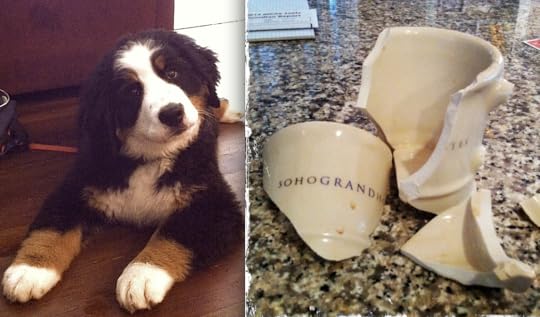
In honor of my broken writing talisman superstitious crutch 20 year old mug, which was destroyed by my puppy and miraculously replaced by the original hotel, I’m theming this week’s Friday Faves the “Department of Lost & Found.”
Things lost and broken, found and given:
LOST:
Amazon raised free shipping minimum from $25 to $35. The $10 bump affects the company’s Super Saver Shipping, which for years offered free shipping on any orders that cost $25 or more. The move comes just days before the Seattle company releases its third-quarter earnings results.
Paulo Santos, a trader and analyst at financial site Seeking Alpha, said free shipping “has long been a cornerstone” of the company’s strategy.
“Moving this threshold is a borderline desperate measure,” Santos wrote in a Tuesday blog post. “A measure which would only be taken if Amazon.com internally was looking at some seriously ugly numbers.”
Parental faith & teen parties:
Where’s the fail when your high-school senior promises a booze-free party, and you trust him, and put all the requsisite securite measures in place?
The thing that’s lost in the process. In the NYT blog, Motherlode:
http://parenting.blogs.nytimes.com/2013/06/09/trying-and-failing-to-host-an-alcohol-free-teen-party/
Are these the books you would choose to represent each state? Or are there others you’d wish were chosen? (Cough cough, CROSSING TO SAFETY for Vermont, cough cough.) Check out the map of books that are said to be the most popular for each state.
FOUND
Free books!
World book night announces its lineup of books to be given away next spring by avid readers excited to spread the word. Pick your favorite read, and convince passers-by to give it a whirl.
Not much is free in this world. Especially in a time where not much advice comes free without consultants. Which makes this post doubly valuable….. Your book is in the chute: What kind of marketing support should you be looking for?
http://writerunboxed.com/2013/10/16/ask-and-you-shall-receive-or-at-least-ask-and-you-shall-know/
Your teen looking for a good read? Just announced by the ALA, the Teen Top Ten: http://bit.ly/17dXopc
Inspiration:
What happens when you loosen the strings on your mind’s expectations? Wonderful stuff: The art of “creative sleep” – Stephen King on writing and wakeful dreaming.
Shoes to match the bookish dress:
You know the brand Toms? Ever think you could find a pair to complement your built-in shelves?
http://bookriot.com/2013/10/24/book-fetish-volume-xcii/
‘Til next Friday,
Beyond the Margins
October 23, 2013
Help! My On-Line Presence Is Killing Me!

When I published my first book (okay, okay—my only book) a few years ago, my editor mentioned—as a brief sidebar to our conversation about publicity and promotion—that it might be helpful to develop an on-line presence, maybe even start a blog. I responded with something like “Can we also beat my fingers with a bag of frozen anchovies every morning?” and that was the end of the conversation.
Fast forward six years. Creating an on-line presence is no longer the subject of polite sidebar discussions or even optional. Agents, editors, publishers, fellow authors, any person at all who has your literary interests at heart—even your mother!—will nag you to insanity until you roll out your blog, post your book trailer, tweet your brilliance and get your book cover pinned on as many Pinterest boards as you can.
So now I have two blogs, two Twitter handles, three Facebook pages (one for me, one for my book, one for Beyond The Margins), and a YouTube account. I don’t have the least interest in pirating images to create colorful representations of my diverse interests, but yes, I joined Pinterest, too, and am completely open to getting pinned over and over again. (Nothing says “future giant of American literature” like a “Pin me!” badge.)
 Has all this digital chatter boosted sales of my book? Not really. I may have sold a dozen more copies than I would have otherwise. I’ve met a lot of nice writers, though. And there are days when my tweeps are the only things that keep me going.
But, I’m sorry to say, there are also many days when being on-line makes me feel like crap. Not dog or horse crap. Planeria crap. Remember planeria—the microscopic flatworms you can split in half and they’ll grow two heads? That’s the level of craptitude I’m talking about.
So I thought I should send out a warning to all the new authors being barraged with advice on their on-line presence: Beware! The social networks are dangerous. They can shred your self-esteem faster than a cat can shred your favorite sweater. Why? Because there are no big fish in little ponds anymore. There is only one pond, the size of an ocean, and ninety-nine percent of us are not big fish. In fact, we aren’t even brine shrimp (aka sea monkeys).
Don’t believe me? Observe:
Intelligence – You think you’re a pretty smart person. You’ve read all those books on chaos theory and fuzzy logic. You totally predicted string theory would need at least ten dimensions to create enough quantum foam to soak up all the dark matter spilled by the God particle in the last Big Splash. Then you get on Twitter and behold—there are THOUSANDS of people smarter than you. Not just smarter, but so totally hip and social and funny you don’t even get the joy of dismissing them as nerdy douchebags. If Twitter were TV, they would be the loveable stars of Big Bang Theory, and you would be just another one of Penny’s moronic boyfriends.
Creativity – You’re a fantasy author. You make up entire societies and ecosystems before you even get to plot or character. No wait—you’re a mystery writer. You create mazes of crime and clues so complex, they make quantum physics look like a Sudoku puzzle. Or maybe you’re a so-called literary writer, plumbing the depths of human nature with a box full of artisanal metaphors and handcrafted sentences. Well guess what? On Twitter, Goodreads, Facebook, Tumblr, etc., there are a million mystery writers. There are a bajillion fantasy writers. And literary authors—oh please. It’s easier to count all the termites in Africa. The worst part is, even their tweets will make you look like a Readers’ Digest drop-out.
Humor – You’ve been told your writing is hilarious—maybe by your spouse, maybe by your friends, worst case scenario, by a couple of obsequious barristas at your local coffee shop. Too bad. After five minutes on Facebook, Twitter and YouTube, you’ll realize humor has nothing to do with the written word anymore. All the truly, madly, deeply brilliant humorists—John Green, Stephen Colbert, Ron Charles, etc.—are on video. If you can’t crank out a 30 – 60 second video with brilliant acting, sound effects, subtitles and uproariously funny credits and post it to YouTube BEFORE the event you’re parodying has even ended, don’t bother trying to make a joke. Seriously. You’ll only embarrass yourself.
Looks – Okay, so you’re probably thinking this is a pretty shallow thing to worry about. I mean, it’s not like you expect people to vote you Sexiest Blogger of the Year or call you a TWILF (Tweeps I’d Like to …). And it’s not like you posted your profile pic thinking it would make all the other avis quiver with desire. But still, when you’re hit with wave after wave of gorgeous creatures—male and female—flashing across the screen, smiling, vogueing, posing in hot blue evening dresses and understated, hip jackets, and then you realize they’re not movie stars or models or porn spammers but writers—writers, just like you!—you’ll want to crawl back into your Twitter egg-atar and never come out again.
Social Impact – This is the biggy. With a lot of therapy you might be able to deal with millions of people being smarter, funnier, better looking and more creative than you. But when it comes to being one of those people who bring good into the world, you always hoped you would be near the top. Not MLK or Ghandi or Mother Theresa top, not even Eleanor Roosevelt top, but you know, Internet top. Like if there was a Google+ circle for social do-gooders, yours would be the one everyone would want to get into. If there was a Facebook page for champions of peace, you’d be the administrator. Well, sorry—the social networks are infested with do-gooders. Even writers give parts of their proceeds to charities. (Writers. Since when do they even have proceeds?) So give it up, dear noob. Unless you have eradicated malaria or found a free source of energy, you are just another Girl Scout selling cookies in the suburbs.
Okay, maybe I’m exaggerating a little here. The truth is, I’ve met some of the most incredible people through Twitter and Facebook—not just writers, but editors, agents, reviewers, teachers, doctors, lawyers, librarians, programmers, even a drummer. And I could have gone to a dozen conferences every year and not met as many talented, funny, supportive and, yes, darn good-looking writers as I’ve met in one year on Twitter. So I’d have to say the good outweighs the bad—most of the time. But others may feel differently. What do you say, my social networking friends? Are you mostly feeling the love in your on-line presence or mostly feeling insecure? Do you bounce back and forth?
(This post first appeared on Beyond The Margins on February 23, 2012.)
October 22, 2013
Judging a Book By Its Title

Guest post by Charles Garabedian
After browsing dozens and dozens of recipes for my upcoming cookout, I ended up choosing Crazy Nut Coleslaw, Brazen Fudge Brownies, and Chickie’s Barbecue Chicken. Each caught my eye right away, and looking back at it now as I prepare this post, I can understand why. Not only do the recipes have catchy titles, each has a distinctive rhythm when read out loud. Alliteration places stress on the first syllable of every other word and gives the title a galloping beat.
A few weeks after the cookout, I happened to be perusing books in a bookstore when I overheard a teenage girl next to me say, “This one seems cool.”
I looked over and saw her pointing to the paperback: Tall, Dark, and Vampire, by Sara Humphreys.
“Yeah, I read it already,” the other girl said.
Paranormal romance, one of the hottest genres in the publishing market today, lured yet another teen to its title. I have to admit that I, too, am drawn to a provocative title. It’s especially true when I’ve heard the title spoken and haven’t had the chance to see the jacket cover, to skim an excerpt, or to read the first line. It reminds me of when I listen to NPR or other radio stations broadcasting a book review. Since the jacket cover isn’t visible nor any page from the novel, I tend to form a first impression after hearing the title. The way the title sounds may be the single most important factor as to whether I search for the book on websites or in local libraries and bookstores.
Hearing the title of a novel is one thing, remembering the name is another. Ever find yourself rushing through the Sunday newspaper book reviews not to be late for church or because you need to drive the kids to their sports practices on time? In these situations, remembering a title with lots of nouns may be more difficult than a title with active verbs. Similarly, a title that is short, easy to pronounce, and flaunts a catchy phrase, may be simpler to keep in mind than one that’s too wordy.
But does a shorter title necessarily mean better sales and a wider readership? Not so in the case of these bestsellers: The Man Who Mistook His Wife For A Hat: And Other Clinical Tales, Fried Green Tomatoes at the Whistle Stop Cafe, and The Curious Incident of the Dog in the Night-Time.
Whether a title is long or short, other considerations come to play when an author chooses a name for his/her novel. Some titles offer clues to the theme and give the reader a hint of what the story is about: Misery, Atonement, and Terms of Endearment. Other titles suggest the main event: Sophie’s Choice, Gone Girl, and Interview With The Vampire. There are titles involving proper names, typically the main character or a character crucial to the plot: Mrs. Dalloway, Olive Kitteridge, and Jane Eyre.
Titles can also be taken from a line in the novel: We Were The Mulvaneys, can be borrowed from other literary sources such as the Bible: The Sun Also Rises, can use common idioms: A Day Late And A Dollar Short, can indicate a place: Mystic River, Middlesex, and Tara Road, and depict an object: The Black Box and The Notebook.
In the end, no matter what title an author feels is best, a publishing house may have other ideas and suggestions. And so the final version appearing on the jacket cover may not be what the author intended. Working titles of The Great Gatsby included Trimalchio, The High-bouncing Lover, Gold-hatted Gatsby, and On the Road to West Egg. Of Mice and Men was originally titled Something That Happened. And Margaret Mitchell’s Gone With The Wind was initially, A Manuscript of the Old South.
Thinking back on my own novel, I remember considering several titles including House of Lost Souls and Longing for Ivy before choosing Ivy House. Ivy House is the name of the four-story brick dwelling in the North End of Boston where nearly all of the action takes place. I treated Ivy House as a main character, central to the plot spanning from the 1920’s to present day. Its former elegance collapsing into decay, followed by a rebirth and renovation, mirror the arcs of the main characters.
According to author Randy Susan Meyers, “My original title for The Murderer’s Daughters was Adopting Adults, which I was told sounded like a self-help book. (Oh, they were right on the money there.) My editor chose the final title, tacking on ‘a novel’ when I insisted people would think it was a mystery.” (1)
I recently had a conversation with New York Times best selling author, Jenna Blum, who said, “When Those Who Save Us was in the editing stage at Harcourt, the publisher feared the title might not be memorable enough. Too vowel-y; lacked a proper noun for readers to remember. So my editor asked me to come up with an alternate title…I asked my friends who’d read the manuscript to help me. I sent out an email saying, ‘If you can come up with a title for my novel, I’ll give you $20 and a bottle of Scotch.’”
Jenna Blum’s request ended up as a spoof contest and she received these possible titles:
1. “Someone’s In The Kitchen With Anna”
2. “The Bread Also Rises”
3. “Nazi Whore”
4. “Gone With The Reich”
Jenna sent these titles to her editor, who said, “We’ll just keep the title the way it is, darling child.”
Choosing a title may be one of the most difficult decisions facing an author. Some authors define a title from the start and use it as a building block to develop plot and theme. Others come up with a title after the novel is written.
Though titles vary in length and content, the intent of many authors and editors is to create one that piques a reader’s interest. And from the reader’s prospective, a title that’s uncomplicated, hints at genre, and begs the questions of what, why, who, and where, may draw further attention, a closer look, and eventually a purchase.
What were your working titles, and what ended up on the jacket cover?
1. Beyond the Margins, January 24, 2012

Charles Garabedian
Charles Garabedian is a fiction writer represented by agent Carolyn Jenks at the Carolyn Jenks Agency. He has been a member of the Grub Street Writers’ Center in Boston for many years. His debut novel, Ivy House, was conceived during the center’s Master novel workshop mentored by New York Times bestselling author, Jenna Blum. Charles lives in Boston and enjoys playing tennis, kayaking, and spending time with family. Since 1993, he has been a pediatrician in Concord, Massachusetts.
October 21, 2013
A Reflection on the Boston Book Festival: Taming That Self-Criticism
I had a fabulous time at the Boston Book Festival this weekend. I was with three other authors on a historical fiction panel and by chance met two of the other panelists beforehand at the author party. They were lovely. As debut authors often do, we commiserated about tours and sales and the difficulties of writing book two. And when our panel came to pass, the hall overflowed, literally, into the lobby, we had a great conversation, and the audience laughed at all my jokes.
But when I walked away, I thought, whoops, I missed the boat there. I had taken the summer off from promotion and forgotten how to promote my book. Instead of laughing and having a good time, I should have been hitting a list of essential items to pique interest in my book. Instead of talking about how I started the book in 1989 and danced around it for decades, I should have proclaimed that The Third Son is the first American novel to cover the previously censored modern history of Taiwan. I should have waxed eloquent about the parallels between the trajectory of the country’s history and the novel’s central story. If I had, every single member of that huge audience would have lined up and bought my book, making it a Boston Globe—nay, a New York Times bestseller. Instead, because of my laxity, my book and I were heading for the remainder bin and eternal obscurity.
Self-critical much? Well, of course. If I weren’t, I would not have ever started writing at all. The source of all my characters is my own observation, self-examination, and self-recrimination. My ear for dialogue has been honed by a lifetime of mulling over conversations I wished I had conducted otherwise, or that I wish I had conducted, or not conducted, at all.
That said, when I first started writing my book, decades ago, I was happily naive and thought it was terrific. Don’t we all, at the start? Why else would we persist and send our work into the world? But, as with any endeavor I have ever undertaken, the more I learned, the more I realized I needed to learn. A large part of my journey as a writer has been learning to judge which parts of my work can be improved, and which are awful and should be deleted without a second thought.
The process of publishing my book has been one of increasingly pointed criticism—the agent chose the book because she loved it, but thought it needed some shaping. I agreed, and took my revisions several steps further than she suggested. The editor loved the story, but suggested changing some scenes. Again, I enthusiastically revised more than what was asked. The copyeditor took issue with a couple of my dates and my Taiwanese transliteration. Fine, I took it all. I was happy to hear any criticism, because it gave me an opportunity to make my book the best it could be.
The tricky part, I’m coming to realize, is now, when the book is done, published, printed, unchangeable. My self criticism, innate, eager, and now finely honed, is now on the loose. And it no longer has a manuscript to polish. Instead, it has other things to focus on—my public speaking style, my self promotional skills, my ability to get my book noticed, and my first draft of book two. And there’s a problem with all of that: My book sales, unlike my manuscript, are not under my control. There is no proof that if I hit certain notes in my speech or tour in a certain town that my book will sell through the roof. No one knows if any of the self promotion we’re all told to do really helps at all.
And most importantly, my nascent inklings of book two cannot bear all that criticism. To persist with this book, I do need to think it is terrific. It is just too paralyzing to think while I write that I will be throwing out ninety-eight percent of what I am producing. I need to recapture that excitement of thinking that what I’m writing matters, that it will make people both cry and rise up in arms, that it’s worth the time and effort for me to write it and for others to read it.
And so I am going to try, very, very hard, to take a step back. I’m going to try my best to shut down that self critical voice, the one that makes me feel inadequate as both a book promoter and a sophomore novelist. It’s time to recapture some of that naïveté of years past, enjoy myself, and get back to work.
Slow(ly) Writing
 You’ve probably seen the phrase “slow writing” before, although it’s less common than I thought it might be when it popped into my head earlier this year. There are a few essays about it, one site devoted to it by the marvelous Julia Alvarez (but there aren’t many entries…oh well, it is “slow writing,” after all), and a few discussions here and there. However, even if there were a plethora of pieces on “slow writing” around, I still think what I have to say about it might be a bit different.
Perhaps that’s because what I am really talking about is not the act of writing slowly, or even slowing down the amount I write each day (although that has certainly happened during a year in which we’ve moved house!). I’m talking about slowing down my approach to my novel in progress, about not writing “X number of words” per day, about taking time to truly tune in and think on what it is I want to say.
Everyone works differently. We know that. What we don’t know, until we start working, is what works best for us as individuals. A brief digression: Back when I had my first child, I told a friend that what was most unsettling to me as a new parent was that the schedule constantly changed. I’d been used to a life as a graduate student, in which the major decision was how much of the day to spend reading versus how much to spend writing. Juggling a growing person’s development along with a teaching job was much, much different–any parent reading this will know what I mean. For a few weeks, you might think you had a great daily plan and then, all of a sudden, the little one gave up her morning nap…her afternoon nap…wanted dinner at a different hour…and so forth.
So it is with my “growing” novel. (No wonder so many authors talk about being “book pregnant!”) The schedule keeps changing. For the first few months, words came in great spurts. It was all I could do not to write for hours at a time–there was no need for “bum glue” or dedication to a daily two hours. I was smitten (again, kind of the way you are with a new baby). Then things changed. The words came more slowly, or if and when they came quickly, needed to be considered along with paragraphs and scenes and chapters I’d already written. It was a new stage of development.
A few months ago, I hit another stage, which seemed more like a plateau. I wasn’t writing very much, and while most of us could devote lots of time and journal space to being “blocked,” I put it down to moving and didn’t think (read: worry) much about it at all.
Imagine my surprise, when I came back to a regular routine this month, to find that not only did I have new energy for my “baby”–I had new purpose. I had finally discerned the deeper theme behind what I’ve been nurturing all this time, the idea that I knew I needed all along, but couldn’t have forced, any more than you can predict when a child will start to crawl. This is something I couldn’t have forced, couldn’t have planned for, and couldn’t have been more overjoyed to discover.
It was entirely worth the “wait” to get to this stage, and that’s given me a new perspective on times when we think we’re “blocked:” Perhaps, we aren’t really stuck–we’re just at a new stage of growth, one not easily seen from the outside.
October 18, 2013
Friday Faves – Boston Book Festival and More

Hi all, welcome to Friday, where we often slow down and take a look at all the literary happenings around the web, beyond our margins (oh, the puns).
Big doings in Boston this weekend as the Boston Book Festival hits its fifth year with a lineup so big, so wide, so deep, that it had to start last night. Highlights of this now three-day shindig include:
Keynote by Salman Rushdie, tonight at 7:30 at the Old South Sanctuary, 645 Boylston Street.
A discussion of this year’s One City One Story, Karma, by Rishi Reddi. Read the story and then hear a chat about it with the author. Nice. Saturday at 11:00 am, Boston Common Hancock, 40 Trinity Place
Secrets and Lies, featuring Beyond the Margins’ very own (yes, we take full responsibility) Randy Susan Meyers reading from her second novel, The Comfort of Lies. Also on deck are Andrew Goldstein reads from The Bookie’s Son and Douglas Kennedy reading from Five Days. Saturday at 11:00 am, Trinity Forum, Copley Square.
Heroes and Antiheroes: A discussion with Harvard professor Gregory Nagy, and authors Chuck Klosterman and Claire Messud. Saturday at 1:15 pm, Old South Sanctuary, 645 Boylston Street.
And so much more.
In other news…Are you a writer? An introvert? Am I being redundant? Over at Grub Street Daily, Ethan Gilsdorf gives some tips to writers on how to schmooze. “Mingling. Working the room. Working the Internet. Hitting people up (but not being an idiot). Networking. Schmoozing: It’s the dirty secret that makes the writing world go ’round.”
Do you like free stuff? Yes, you do. Are you looking for a powerful way to organize your notes, your thoughts, your ramblings, the outlines for your next novel? Then try ConnectedText, a personal wiki. It is designed for storing, locating and navigating your information. Yes, now you can create your own wikipedia. And name it after your cat: ChesterPedia. Or your dog: WikiFido.
This week the Man Booker announced their annual prize winner, and it’s Eleanor Catton, the youngest recipient of the prize (she’s 28) for the longest book to win, The Luminaries, clocking in at 832 pages. This leaves Nicholas Lezard at The Guardian to ponder winning such a prize so early in one’s writing career: “Failure is good for the soul – one should avoid peaking too early. At least that’s what I tell myself as I contemplate the successful young.”
Are you a book cover junky? There’s a website just for you: Cover Browser. View scans of thousands of books and comic books. Categories include: Bestsellers 2007, Classic Children’s Books, Penguin Books, Dell Books (no relation), Crest Books, and Philip K. Dick.
And who can resist an article titled As author Lisa Gabriele explains: “For the women in my family, sex was shameful. But when I wrote a book celebrating it, Grandma’s name was perfect.” Go on…
That’s all for now.
October 16, 2013
Official Permission Slip for Your Trip to Joyful Insanity

“Don’t even bother looking at the Amazon rankings. It’s a waste of time. They mean nothing.”
“Just work on your next book.”
“Stay off all those social reading sites. You can’t please everyone, and you’ll just get depressed.”
“You can’t tell anything from B&N’s online numbers.”
“Don’t make yourself crazy. Just wait until your royalty statement comes in; it’s the only thing that matters.”
“Oh, yeah, nothing ever comes from the things you see on your website statistics. Don’t waste your time.”
“Oh my God, are you still looking at Amazon?”
“Don’t even think about calling the Ingram stock line. It doesn’t mean anything.”
“You just can’t worry about all of it.”
“Don’t read reviews…trust me.”
“Get out of the house. Take a walk. Stop obsessing.”
“GET OFF AMAZON!”
Oh, all such good advice, so well meaning. Sometimes it comes from a fellow debut author, but most often it comes from someone with a few books under their belt, someone who knows, someone who’s been through it.
And here’s what I–someone who has a few books under her belt, someone who’s been through it–have to say to them: “Shut up! Seriously, just shut up.”
Look, the fact is, they have already done this. They’ve already gone through the obsessions, the rapid fire clicking on Amazon, Barnes and Noble, Goodreads, LibraryThing, Google (even though you’ve set up Google Alerts for your name in quotes, your title in quotes, your title in quotes plus your name without quotes), Twitter search, Facebook Book Shelf.
Or, even worse, the people who are so assuredly giving this advice have ten books under their belt, and they never even had to contend with the sheer amount of information–accurate or not–out there on their first book, because their first book came out in 1989, or ’92, or even ’98.
But of course they know they wouldn’t have wasted their time, of course they wouldn’t have.
And I got all this advice. And, oh, I listened, eagerly, asking for more.
Tell me more, tell me what to do with all this anxiety, all this energy, all this jittery fear that has nowhere to go. Please, tell me what to do.
But of course nobody could babysit me, Barbara Kingsolver didn’t volunteer to be my minder on this psychedelic debut trip, keeping me from hitting refresh, watching my numbers on Catching Genius go down and down, and so there’s nobody there to stop me from doing any of the things everyone is telling me, sternly, to, by all means, NOT do.
And the more advice I’m getting to not do them, the more I’m doing them, and, the very worst part of it all is that I am so ashamed of myself. I’m so guilty, and I’m lying about how often I check for new reviews on reading sites, about the fact that my Amazon pages stay open constantly on my computer screen, that I’m calling the Ingram stock line a minimum of three times a day, Googling the business ISPs that show up on StatCounter, squealing when The New York Times or another known quantity pops up, keeping my new manuscript open on my computer, over top of the multiple pages all bearing the Catching Genius cover.
I feel as though I’ve been caught doing something so untoward, so absurdly nasty, as if the entire publishing industry has caught me masturbating with one of my own novels. I am miserable with shame and embarrassment, sick to my stomach at the fact that I can’t seem to let this all go as breezily as everyone else swears they have, and I wonder at their fortitude, wonder if I am not cut out for this business.
By the time Matters of Faith comes out, a little over a year later, I’ve calmed down, though I’m still keeping tabs, and I give myself the advice this time. I gear myself up for its release with stern internal lectures (keep your hands off it, that’s dirty!), as well as reading over all the same old advice everyone is giving debut authors to NOT look at any of it, to not take it seriously, to not waste their time.
And when it came out, I went through it all again. Maybe without the same intensity, and perhaps I was far enough along in my career to know that I really wanted to get cracking on the next book, but…still…the siren song of the mouse called, the lure of Amazon, the speediest speed dial of Ingram.
And, again, the shame and embarrassment, and the wonder at my peers who never, gosh no, never looked at any of it, or seemed to worry about a thing, so blasé about it all, making me, by comparison, a privately quivering neurotic mess.
But about a month after Matters of Faith‘s release I…got tired of it. I was exhausted with the shame, and I could no longer quite figure out why everyone thought that all this concentrated energy was so wrong, why it was shameful, and why everyone seemed to take such satisfaction in telling me how little it all mattered.
Shame and excitement are pretty damn close cousins, and I realized that in buying into the idea that all of the natural enthusiasm for as much information as I could find about the books that I had slaved over for years was somehow wrong, and weak, and shameful, had robbed me of a good amount of the fun, healthy excitement of it all. I spent more time beating myself up for checking my Amazon rankings than I spent enjoying the fact that I had Amazon rankings to check to begin with!
Here’s the thing: You’re going to do it anyway. Yes, you are. And all those people telling you that they don’t do it? They’re liars. Okay, maybe not all of them. Maybe Joyce Carol Oates doesn’t start her day by hitting the “Open All In Tabs” link to tile all her various Amazon, B&N, and GoodReads pages open (that would crash the hardiest computer anyway), but yes, I still do.
Granted, I don’t spend much time on them. A quick check, and then I don’t even look at them again until the next day, and of course the Ingram stock line doesn’t even exist anymore, so there’s that little obsession solved. But I still do it. And I’m not going to apologize for that, or hide it, or be embarrassed because some other author enjoys the feeling of superiority of having a much tighter rein on their neuroses than I apparently do.
How sad.
How dry.
How joyless.
I’ve earned the right to obsess about my books. That concentrated, jittery energy is excitement, and I’m not going to dampen that in order to impress anyone. And nobody gets to take it away from me, either.
So when I get questions from debut authors about Amazon rankings and all the various other venues in which they can fritter their time away, I tell them that there are other, more important factors, and that no, they don’t really matter much, but that of course they’re going to check, and to go enjoy it. Let that feeling in your belly be excitement, joy, happiness, not shame and embarrassment.
Shame and embarrassment aren’t words I’m willing to associate with my life’s work anymore.
So, go, obsess, and enjoy it, you earned that, you deserve it, and when someone rolls their eyes at your joy and enthusiasm for all the hundreds of inconsequential little pieces of this business, tell them that Kristy Kiernan says, “Cram it, joysucker.”
Unless it’s Barbara Kingsolver.
Then, you know, give her my e-mail address…I could use a blurb.
(re-run from 2010)
Do This! Don’t Do That! To Outline or Not: That Is The Question

Advice to writers is a funny thing (I’ve had my share of taking and giving) and when I have the opportunity (hubris?) to offer my opinions, I try to remember to preface my words with “this is what works for me.”
Oppositional advice can spin one’s head around. It often all sounds good, something that struck me as I caught up with recent (paper) issues of The Writer, reading first, in the November issue, the thoughts (on writing a novel) of Andre Dubus III, New York Times bestselling author:
“Dream, dream, dream it though. Write more with your body and less with your head. Don’t think a story through, don’t think it out. The danger of thinking it through is that most of us are not smart enough to do it that way. We have to go one moment at a time.”
Later in the article, he included in his ‘advice to new writers,’ “Do not outline stories and do not think about stories. Find one true sentence at a time, one detail at a time.”
Dubus teaches writing; he frowns on writer’s groups. (Oh no, am I diluting my work?) He ‘drifts into dream-like silence,’ and has low-tech habits to become more intimate with his characters.
Also in November’s issue, we have Amor Towles, author of NYT Bestselling Rules of Civility, in an interview, referencing a novel that was a ‘dud’:
. . .because he had not carefully out outlined in advance, Towles knew his unpublished novel set in Russia had little chance of success. He approached his next book with a fresh strategy, allotting himself 52 weeks to write a 26-chapter novel.
On not waiting for inspiration and perseverance, Towles says:
“ . . . eventually you can get lost in the process and creative function takes over.”
October’s issue of The Writer offers “6 reasons a workshop jolts your writing.” (Ah, sweet relief, I can remain with my much-loved writing group.)
Also in the October issue is Bram Stoker award winner Jonathan Maberry, who stresses the need to “stop mythologizing the life of a writer. Don’t wait for the must to whisper in your ear . . . A writer is no different that a plumber, a landscaper or a dental hygienist.”
I believe in the power of advice. (My “Homemade MFA” was based on reading shelves of book on writing.) But, though there are some absolutes (always end a sentence with some form of punctuation would seem a good rule) one must find the balance between advice that bewilders or makes one feel less senseless and that which leaves us enriched. Perhaps this is also the danger of taking writing courses with a teacher who expounds on a one-way-to-paradise approach. Imitation is not always the wisest course. Truman Capote, Patricia Highsmith, and Marcel Proust, according to Daily Rituals: How Great Minds Make Time, Find Inspiration, and Get to Work: How Artists Work by Mason Currey, “all wrote worked in bed, surrounded by a cocoon of food, alcohol and cigarettes.”
However, those habits were not the fount of their success.
Stephen King, often used as gold standard for the not-outlining group, says he plots in advance “as infrequently as possible. I distrust plot for two reasons: first, because our lives are largely plotless, even when you add in all our reasonable precautions and careful planning; and second, because I believe plotting and the spontaneity of real creation aren’t compatible.”
Aaron Hamburger began a January 2013 essay in the New York Times online “Opinionater” with the words, “In my experience, one of the surest ways to kill the creative energy of a work of fiction at its inception is with an outline.” (He believes in reverse outlining.)
Had I read that when as I settled into my first published novel I might still be floundering. (Although I do reverse outline—but I also do it in forward.) For me an outline (and everyone has a different idea of what constitutes an outline—mine is formulating one third of a book at a time) provides the freedom to be as creative as I want. If I go ‘off-outline,’ that’s okay, but I have my security blanket.
Justin Cronin says “There’s an outline for each of the books that I adhere to pretty closely, but I’m not averse to taking it in a new direction, as long as I can get it back to where I need it to go.”
Khaled Hosseini states “I don’t outline at all; I don’t find it useful, and I don’t like the way it boxes me in. I like the element of surprise and spontaneity, of letting the story find its own way.”
R. L. Stine swears “If you do enough planning before you start to write, there’s no way you can have writer’s block. I do a complete chapter by chapter outline.”
Jeffrey Deaver is pro-outline: “The outline is 95 percent of the book. Then I sit down and write, and that’s the easy part.”
Diane Galbadon is not: “I don’t plot the books out ahead of time, I don’t plan them. I don’t begin at the beginning and end at the end. I don’t work with an outline and I don’t work in a straight line.”
The head spins, but my guess is that few writers truly fit into a rigid guideline:
I always have a basic plot outline, but I like to leave some things to be decided while I write. J. K. Rowling
Perhaps the ‘outlining debate’ was best answered by Joseph Finder, who wrote:
“Outline or not?
This is the question I get most of all, whether by e-mail or at conferences: Do you outline or not?
It’s a good and important question, and here’s the thing: There’s no Right Answer. All of us writers make up our own rules as we go along. There’s no one way to do it.’
Except perhaps for the recent advice from Between The Margins own Juliette Fay, who wrested me from a book stymie by advising something that will always live with me:
So get your whiny hiney in that chair and produce some verbiage, you big baby.
The only magic rule to which we must all adhere.
Chris Abouzeid's Blog

- Chris Abouzeid's profile
- 21 followers

