
Justine Musk's Blog, page 20
September 9, 2012
write what you don’t know you know
“Write What You Know is meaningless bullshit. Write what is mysterious, what is treacherous, what gets a spear thrown through your face.” — by @thebookslut (Jessa Crispin)

Write what you don’t know you know
Write to find out what you know
Write what you thought all these years that you had to keep secret
Write what whispers in your room when there’s no one around, puts an invisible hand on your shoulder, makes sure the eyes in the portrait are following you
Write what other people know but can’t say, or don’t want to say, or don’t know they know
Write what gets lost to silence
Write what had to happen when you went through to the other side
Write what’s dangerous
Write what made you out for your own blood
Write what you would write if you got tired of being nice
Write what moves through you like lightning, looking for a place to touch down
Write what you saw when you unlocked the door that he told you not to
Write what the truth would write if the truth was writing you
Write what you saw when you saw love (and it’s not what we thought)
Write what’s burning down the house
Write what scares you
Write what made you want revenge and this is how you’ll get it
Write what pulls you in the wrong direction
Write what’s written on her body and only you can see
…feel free to add your own in the comments below…
photo credit: Helga Weber via photo pin cc





September 7, 2012
marilyn monroe was a badass

“Persons of genius with mysterious gifts: in many cases a wound has been inflicted early in life, which impels the person to strive harder or makes him or her extra-sensitive. The talent, the genius, is the scab on the wound, there to protect a weak place, an opening to death. Men and women who come successfully out of misfortune, they have strength that is extraordinary.”
— Elia Kazan
1
I was standing in Barnes + Noble checking out Lois Banner’s biography of Marilyn Monroe when I came across this line:
“….she exudes sexuality and transcends it; poses for the male gaze and confronts it.”
That sentence intrigued me enough to buy the book. It reminded me of this post I wrote over a year ago, in which I reference the painting OLYMPIA. A naked courtesan reclines on the bed and stares shamelessly out at the viewer. The painting created a scandal, not because of the nudity (nude women being rather a popular subject in Western art) but because of that stare. Because she wasn’t looking away.
Neither did Marilyn.
2
Marilyn started out as Norma Jeane Baker, and Norma Jeane didn’t start out with much.
She grew up in a series of foster homes and an orphanage. Her mother was mentally ill. Her father was gone (she used to fantasize that Cary Grant was her father). She was dyslexic. She stuttered. She was sexually abused and could – as traumatized children learn to do — dissociate from reality. She was bipolar.
What she did have, starting from the time she first put on a too-small sweater and noticed the influx of male attention, was her ability to “exude sensuality”. Whenever her name came up in class, the boys would say “mmmm”. Norma Jeane even signed off in her yearbook as “the mmmm girl” (ostensibly referring to the way she stuttered over the ‘m’ sound, but c’mon).
What strikes me is how her sexuality and her tragedy are linked. We live in a culture where girls are taught to be hot like Marilyn — and valued accordingly– but Marilyn’s ability to ‘exude sensuality’ isn’t just because she had the body.
When you’re a kid, you unconsciously develop strategies — based on how the adults in your life react to you — for getting the attention you need to survive. You carry those strategies into adulthood. Attention = love = life. When that attention happens to be sexualized, the child-brain lays down deep neural pathways that conflate sexual attention with love, and the child starts developing the ability to attract that attention.
By the time Norma Jeane hit her teenage years, she was already practicing how to be ‘special’.
3
Norma Jeane actively constructed and perfected her ‘sex goddess’ persona over years. As Banner put it, she
“exhibited a rare genius.
Publicists marveled at her ability to generate publicity; makeup artists saluted her skin at their craft; photographers rated her one of the greatest models of their age She studied with top acting, singing and movement teachers to create her era’s greatest dumb-blonde clown….[she] exemplified 1950s femininity. Yet she mocked it with her wiggling walk, jiggling breasts, and puckered mouth. She could tone her blonde bombshell image down, project sadness in her eyes, and, like all great clowns, play her figure on the edge between comedy and tragedy.”
She didn’t start out playing the ‘blonde bombshell’; Norma Jeane Baker was the lush and lovely girl next door. She had some success with cheesecake, ‘glamour’ modeling, building her initial fanbase among the military men stationed abroad. (This would eventually force a reluctant Hollywood studio head to put her in films because she was a “moneymaker”.) But she had to fight to become an actress. She was hired by the studios – and fired — and hired — and fired.
Turned out the ‘girl next door’ slot was taken.
But there was an opening for the next Jean Harlow, who
“electrified the nation in 1929 by wearing no underwear, flaunting her body, and bleaching her hair white blonde, a color that indicated perverse desire.”
Marilyn also did these things, and more. Banner points to the ways that Marilyn deliberately
“mixed elements from high culture and low, from the legitimate stage…as well as from burlesque and striptease.”
Banner also admits to being impressed by Marilyn’s
“deep historical imagination. She knew the history of Hollywood, and it fascinated her…When she came to create herself as Marilyn Monroe, those images were in her mind.”
But Marilyn’s ultimate goal was to be a dramatic actress. At the height of her career she surprised people by uprooting from LA and moving to New York, where she started her own production company and studied under the greatest acting teachers of the day. One of them stated that she was the
“most constantly exciting actress I had ever worked with, and that excitement was not related to her celebrity but her humanness, to the way she saw life around her.”
When criticized for this stance, the teacher replied that the problem wasn’t Marilyn, but rather that most people don’t think beautiful women have any brains.
You can be the smart one. Or the pretty one.
‘Both’ is not so much regarded as an option.
4
Marilyn’s story exposes the ugly underside of Hollywood, the boys’ club mentality, its misogynistic and dismissive attitudes toward women. This group intersected with Jack and Bobby Kennedy who, Banner says,
“…sometimes acted like randy boys…chased women and openly groped them. The Kennedy women didn’t make a fuss; they’d been schooled in their family to find women for their brothers. As powerful men, they claimed the spoils of success, including women.”
This was not a world where women had much of a voice. Mia Farrow describes them as “appendages” who sat, smiled, listened, laughed when necessary, and said little to nothing.
Marilyn — who, Banner points out, was not subservient but would often turn herself into what her companion wanted her to be — was among them. From the beginning of her career, she was an “easy mark”:
“…she was regarded as sexually awakened and eager for sex, and she couldn’t claim that she was saving her virginity for a husband – a common goal for young unmarried women in the 1950s. The sexual abuse she had endured as a child had programmed her to please men. And she didn’t have an assertive mother to protect her, or an upper-class background or Broadway acting experience to impress studio executives [that would keep] her off the ‘casting couch’.”
Up until her death, despite her iconic status, the Hollywood powers-that-be never regarded Marilyn as anything more than a “slut they could use with impunity.”
They “passed her around”.
5
In her book LIVING DOLLS, British writer Natasha Walter points out that the young women who go into “glamour modeling” – cheesecake modeling, tits-and-ass modeling – do it of their own free will. It’s their choice. She also points out how that sense of choice is limited: these are mostly working-class women who “may have few other routes in front of them which they feel will lead to any equivalent success”.
These “so-called choices are often fueled more by desperation than liberation”.
She describes a conversation with Dave Read, head of a talent agency who has been in the business for over fifteen years:
“…there are so many girls coming through….You don’t even have to pay those girls. They come down to London on the strength of one shoot, with stars in their eyes, and they end up to their ears in debt, pulling pints, lap dancing, prostitution, you name it.”
And yet glamour modeling and soft porn have gone mainstream. A very, very few of these girls become stars. What was born of desperation then gets held up as a celebrated model of female sexuality:
“…many young women now seem to believe that….sexual confidence can only be gained if a young woman is ready to conform to the soft-porn image of a tanned, waxed young girl with large breasts ready to strip and pole-dance.”
In other words, women who do have choices are encouraged to model themselves after women who cater to a specific kind of heterosexual male fantasy because they don’t have that same range of choice. Going into academia or politics or business isn’t really an option for them.
After reading Banner’s book, I see Marilyn as one of those women, exceptional for her “rare genius” at using the only thing she really had – the male gaze – to propel her out of limited circumstances. She “transcended” her sexuality in that she created an astonishing career and a multi-dimensional life rich with friendships; she achieved financial independence; she stood up to the studios when they tried to bully or discard her, and won; she developed her mind and talent as well as her appearance.
At the same time, she couldn’t escape being what one friend described as “the quintessential victim of the male”.
She was beautiful, sexy, mysterious, complex and famous – and regarded as a disposable plaything by many of the powerful men in her life.
And when we think about her now, it’s usually in terms of her sex appeal, that compelling mix of innocence and sensuality. But this turns out to have been one of the least interesting things about her character — edged with the darkness of exploitation and abuse.
“Many of us,” points out Lisa Bloom, an attorney and writer,
spend more time looking in the mirror than looking out at our planet…because there can be a bigger payoff for being sexy than brainy. Young women have little motivation to think because the rewards for being hot are so powerful.”
But you only have to consider a story like Marilyn’s – she who was the hottest of them all – to wonder at the cost, and if it’s worth it.
(Love you, Norma Jeane. You were badass.)




September 5, 2012
how to put the awe into awesome

“TGIF — Thank God I’m Fabulous”
– unknown
“Whenever you find yourself on the side of the majority, it’s time to pause and reflect.” – Mark Twain
All over the web, it seems, there is a call to Be Awesome.
(One of the most recent is Johnny Truant’s new free ebook HOW TO BE LEGENDARY — perhaps using the word ‘legendary’ because ‘awesome’ has been pummeled to death — and it’s good. You should read it.)
What does it actually mean, to be awesome?
To inspire awe.
And my favorite definition of ‘awe’ is Jane McGonigal’s, from REALITY IS BROKEN:
“Awe is what we feel when we recognize that we’re in the presence of something bigger than ourselves. It’s closely linked with feelings of spirituality, love, and gratitude – and more importantly, a desire to serve.”
When we talk about being awesome – at least online – we talk in terms of kicking ass and dominating the world. What we’re often missing is this whole other dimension that McGonigal is referring to – ‘the presence of something bigger than ourselves’.
She’s talking about meaning.
Meaning is about making a difference, about doing something that actually matters, that has resonance in the world beyond our own little lives.
Meaning is about connecting our daily actions to “something bigger than ourselves”.
Our culture doesn’t really encourage this: everything starts and ends with the power of the individual to buy something. But the self, as Martin Seligman points out, “is a very poor site for meaning.” What actually makes us feel fulfilled isn’t shopping for another pair of boots (although that has its place) but those moments when we can get over our own damn selves, and hook into something so major that it humbles us in the best possible way.
“Our ability to feel awe,” writes McGonigal,
in the form of chills, goose bumps or choking up serves as a kind of emotional radar for detecting meaningful activity. Whenever we feel awe, we know we’ve found a potential source of meaning. We’ve discovered a real opportunity to be of service, to band together, to contribute to a larger cause.”
In the book GREAT BY CHOICE, Jim Collins refers to “level 5 ambition”. While analyzing the characters of some of the most awesome leaders in business – called 10xers because they’ve achieved 10 times the results as their competitors — Collins and his team discovered them to be, as he politely puts it, “somewhat extreme”. Despite the image we have of the swashbuckling charismatic entrepreneur – Richard Branson, for example – these 10xers emerged as
“paranoid, contrarian, independent, obsessed, monomaniacal, exhausting, and so forth….We labeled them PNFs, short for ‘paranoid neurotic freaks.’”
And yet, if this was all they were – weird, selfish, antisocial, etc. – they probably could not have built such impressive organizations. So Collins asks the very reasonable question: Why do people follow them? And then he answers:
“Because of a deeply attractive form of ambition: [they] channel their ego and intensity into something larger and more enduring than themselves. They’re ambitious, to be sure, but for a purpose beyond themselves, be it building a great company, changing the world, or achieving some great object that’s ultimately not about them.”
We hunger for purpose and meaning. We follow those who can hook us up. This also might explain why cause marketing is on the rise. The consumer doesn’t just buy a chocolate bar or a pair of shoes, but becomes part of a larger story in which she is helping the physical and social environment or enabling children in a third-world country to go to school.
It’s story that takes a bunch of facts and makes meaning out of them. In the case of cause marketing, story creates a context around the product that imbues it, and the action of buying it, with a sense of significance.
When we get it, we like to spread it around. Awe is contagious. A study at the University of Pennsylvania attempted to decode word-of-mouth by investigating what motivates readers of the New York Times to email articles to friends. Through an examination of the articles that were emailed the most, the primary finding was this:
people pass on the stories that inspire in the reader a feeling of awe.
In this case, awe gets defined as the “emotion of self-transcendence, a feeling of admiration and elevation in the face of something greater than the self.” Stories that trigger it have two important dimensions: 1) their scale is epic, and 2) they require “mental accommodation”, meaning they force the reader to somehow alter their view of the world.
Awe broadens your perspective.
It shifts your personal paradigm.
In her book GENERATION ME, Jean M Twenge argues that the youngest generations today are “more miserable than ever before” because of our culture’s heavy emphasis on self-esteem and self-fulfillment. We try to make ourselves happy alone. But true happiness – as psychologists, philosophers and spiritual leaders have demonstrated through the ages – comes from making and fulfilling commitments to others. We want to be recognized for the impact we have. The legacy we leave. We want to know that our lives actually meant something.
The ability to be awesome, then, isn’t about – or just about — kicking ass or being a badass – but the ability to unlock meaning and connect to something bigger.
What awesome forces are at play in your own life?
How are you awesome?
photo credit: lighthack via photo pin cc




September 4, 2012
life lessons from a 40th birthday

My soul is from elsewhere, I’m sure of that, and I intend to end up there. — Rumi
1
I could say that turning 40 felt like any other birthday, but that would be a lie. And it wasn’t just because my wondrous boyfriend organized a surprise birthday celebration (plotting alongside my best friend, who hosted the dinner at the Sunset Marquis).
As I contemplated what to wear, I found myself thinking: Is that age appropriate?
And then I thought, Fuck it, and put on the minidress.
2
One of the strange things about getting older – you’ll hear people of all ages say this – is that you keep waking up the same person. It’s not like the Maturation Fairy visits you in the night and touches you with her wand and says, Presto! You’re a grown-up!
When you imagine yourself being older – if you allow yourself to imagine it at all – it’s with the sense that Future You is not really you, with your wants and needs and habits, but perhaps a different person entirely.
In her book THE WILLPOWER INSTINCT, Kelly McGonigal puts it like this:
“Brain-imaging studies show that we…use different regions of the brain to think about our present selves and our future selves. When people imagine enjoying a future experience, the brain areas associated with thinking about oneself are surprisingly unengaged….It’s as if we are observing a person from the outside to decide what is true about them, rather than looking within to decide what is true of ourselves.”
She also adds:
“Studies show that the less active your brain’s self-reflection system is when you contemplate your future self, the more likely you are to say “screw you” to future you, and “yes” to immediate gratification.”
It’s human nature to care more about our own well-being than a stranger’s. So it’s easy to put the wants of our present self ahead of the needs of our future self. The stranger-self.
But time has a way of passing – shocking, I know – and suddenly we become that future self. Did that earlier, more immature self screw us over, or not? Did she care for our health, relationships, work, finances? The self is like a car that the younger version gets to drive around first. What kind of shape is it in when she finally hands it over?
There’s an epithet that appears on many old gravestones:
As you are now, so once was I. As I am now, so you must be.
But who really, truly believes that?
3
The toughest part of my life was the death of my baby son and what followed. Now that I’m through the other side, it’s all sacred to me. It’s part of who I am. It’s in my blood and bones, my eyes, my worldview.
It transformed me.
And I’m a novelist, so I know: the meaning of the story lies in the transformation of the character. I can lovingly carry my son’s death inside me because of the meaning I fought to make of it, how I chose to weave it though the narrative of my life.
(Trauma is what you leave outside that narrative, until it grows a dark narrative of its own.)
I don’t think human beings are wired for happiness so much as challenge and meaning. (If we’re lucky, happiness arrives as an indirect benefit of the pursuit of other things, including health, accomplishment, service and love).
Meaning so often comes from the tough stuff, the dark nights of the soul, the raw and difficult material from which we must fashion some altered version of ourselves: wounded, yes, but stronger for the broken places.
4
I’m grateful for my kids, my family.
I’m grateful for my man.
I’m grateful for my friends.
Here’s the thing about friends: at one time or another, in one way or another, they save your goddamn life.
(Thank you for saving me.)
I’m grateful for my vigilant use of sunscreen and the fact that I spent a lot of time indoors. I’m grateful that I quit smoking. I’m grateful that I saw an Oprah Winfrey episode in my mid-twenties about the benefits of weight-training. I’m grateful for the exercise regimen that saw me through three pregnancies, fifteen years, I’m the same weight now I was in high school. I’m grateful that I never abandoned my writing, even if I misplaced it at times. I’m grateful that I stayed in touch, however shifting, with the life goals I listed as a teenager: Raise kids. Write books. Travel world.
I’m grateful for the events that got me into therapy so I could address my freaking issues (ongoing, of course, but going well. Knock wood).
There were some wild years, and no matter how ill-advised some of those nights may have been, I’m grateful for them (because they were awesome). I’m also grateful I got through them unscathed.
I have some stretch marks and battle scars and I’m grateful for those. Fall down seven times, get up eight. I’m grateful for that eighth time, that next day, that new chance. Not everybody gets one. They don’t last forever.
I’m grateful for what’s behind me, and for what lies ahead.
5
There is a point to this. Because what I want to say is:
Everything matters.
‘Everything’ has a way of breaking down into small things: small tasks, small choices. Small things have a way of adding up, and when we come into our future self, we come into a reckoning.
If we chose the cake or the apple, the walk or the television rerun, to pick up or put down the cigarette. If we shopped more than we earned. If we showed up in our relationships or neglected them for the more immediate thrill of whatever. If we showed up for anything at all. If we fought – fought hard – to build momentum. If we succumbed to the bullshit or figured out how, in our own way, to stand up to it. If we had the courage to admit our mistakes and tear down what we needed to tear down, in order to build something new, whole and right. If we chose the right person to be with. If we chose the right people to be around, to influence our views and habits.
If we chose to add value to others – and ourselves – or to subtract.
6
McGonigal refers to something called “future-self continuity”.
It is “the degree to which you see your future self as essentially the same person as your current self.”
If you think of your present self and your future self as two individual circles, do those circles overlap, or not? The more close and connected you feel to your future self – the more the circles overlap – the higher your sense of “future-self continuity” – the better off you’ll be.
You will make choices with your future self in mind. You build, brick by brick and day by day, a better future for that self to enjoy. McGonigal writes:
“High future-self continuity seems to propel people to be the best version of themselves now.”
Which probably explains why self-help literature and success gurus place such emphasis on developing a vision for your life, on figuring out what you want, on clarity, clarity, clarity. Imagining the future kicks the brain in gear so that it pays more attention to the actions you take now. The more concrete and vivid the future feels, the more your brain pulls that future to you by making the necessary choices now.
It’s as if the decisions you make today are messages sent to your future self. When you’re on the receiving end of those messages — as you one day must be -– will you regret them, or not?
6
Barbara Sher writes about how, at 40, a woman’s life starts to belong to herself.
The first 20 years of adulthood are busy with nature’s dictates, wrestling with them or responding to them: finding a mate, building the nest, having the kids, raising the kids. Not always in that order.
You spend your twenties figuring out who you are; you spend your thirties putting together the pieces of your life; you juggle like mad.
In your 40s, a lot of those decisions fall behind you. Certain tasks are complete or far enough along to release you to other things. The parts of your life grow together. And as you come to a richer understanding of the life that you have, you can reach – in ever more powerful ways – for the life you still want.
“Studies have shown that careers that begin at a later age can have the same trajectory of excellence as those started in young adulthood – the peak of achievement is just reached later in life.”
Men, she adds, tend not to sustain the same level of productivity as in their earlier years. They start to decline in mid-life – when many women are “freed enough from family responsibilities” to put the pedal to the metal and really get going in their careers.
Austin writes:
“The challenge is for women at this stage not to have already typecast themselves as second-tier achievers, nor to become discouraged or feel left behind. The challenge is to re-find the excitement of achievement they experienced in young adulthood.
Given the reality of most women’s lives, if women are to succeed fully we must extend our expectation of the age when that achievement will occur and actively nurture the development of our intellect to allow that to happen.”
As George Eliot once said: It’s never too late to be what you might have been.
7
When you live in a culture as youth-oriented as ours, you tend to think that life ends at 30 – and then at 40 – and you can’t imagine yourself past that edge, or what could lie beyond. There’s a certain self-importance to youth; no matter how crappy your life is, you tend to be smug about being young, and feel sorry for people who aren’t.
But what I’m reveling in right now, what I’m holding close to my heart, is a sense of time. Whatever time I have left, I still have it, and — dammit — I will make the most of it.
My gift to my future self is a life of no regrets.
(Mistakes, of course — they can be very interesting — but no regrets.)
And somewhere in the distance – hopefully in the far, far, far-off distance, the light-years away kind of distance – my future self stands on a balcony looking out at the view, hair twisted in a chignon and a gin-and-tonic in one hand as I celebrate my latest book, or my newest grandchild, or an awesome yoga session or an old friendship or a new friendship or the richness of my current marriage or the adventure of life as a single woman or the start of an exciting project or something.
What you hunt for, you find, and so there will always be something to celebrate.
That is my promise to my future self.
She’s looking at me now, she’s tossing a scarf across her shoulder, she’s speaking down through a corridor of time: You go, woman. Flaunt it. Enjoy it. Give ‘em hell.




how to love up your future self: life lessons from a 40th birthday
My soul is from elsewhere, I’m sure of that, and I intend to end up there. — Rumi
1
I could say that turning 40 felt like any other birthday, but that would be a lie. And it wasn’t just because my wondrous boyfriend organized a surprise birthday celebration (plotting alongside my best friend, who hosted the dinner at the Sunset Marquis).
As I contemplated what to wear, I found myself thinking: Is that age appropriate?
And then I thought, Fuck it, and put on the minidress.
2
One of the strange things about getting older – you’ll hear people of all ages say this – is that you keep waking up the same person. It’s not like the Maturation Fairy visits you in the night and touches you with her wand and says, Presto! You’re a grown-up!
When you imagine yourself being older – if you allow yourself to imagine it at all – it’s with the sense that Future You is not really you, with your wants and needs and habits, but perhaps a different person entirely.
In her book THE WILLPOWER INSTINCT, Kelly McGonigal puts it like this:
“Brain-imaging studies show that we…use different regions of the brain to think about our present selves and our future selves. When people imagine enjoying a future experience, the brain areas associated with thinking about oneself are surprisingly unengaged….It’s as if we are observing a person from the outside to decide what is true about them, rather than looking within to decide what is true of ourselves.”
She also adds:
“Studies show that the less active your brain’s self-reflection system is when you contemplate your future self, the more likely you are to say “screw you” to future you, and “yes” to immediate gratification.”
It’s human nature to care more about our own well-being than a stranger’s. So it’s easy to put the wants of our present self ahead of the needs of our future self. The stranger-self.
But time has a way of passing – shocking, I know – and suddenly we become that future self. Did that earlier, more immature self screw us over, or not? Did she care for our health, relationships, work, finances? The self is like a car that the younger version gets to drive around first. What kind of shape is it in when she finally hands it over?
There’s an epithet that appears on many old gravestones:
As you are now, so once was I. As I am now, so you must be.
But who really, truly believes that?
3
The toughest part of my life was the death of my baby son and what followed. Now that I’m through the other side, it’s all sacred to me. It’s part of who I am. It’s in my blood and bones, my eyes, my worldview.
It transformed me.
And I’m a novelist, so I know: the meaning of the story lies in the transformation of the character. I can lovingly carry my son’s death inside me because of the meaning I fought to make of it, how I chose to weave it though the narrative of my life.
(Trauma is what you leave outside that narrative, until it grows a dark narrative of its own.)
I don’t think human beings are wired for happiness so much as challenge and meaning. (If we’re lucky, happiness arrives as an indirect benefit of the pursuit of other things, including health, accomplishment, service and love).
Meaning so often comes from the tough stuff, the dark nights of the soul, the raw and difficult material from which we must fashion some altered version of ourselves: wounded, yes, but stronger for the broken places.
4
I’m grateful for my kids, my family.
I’m grateful for my man.
I’m grateful for my friends.
Here’s the thing about friends: at one time or another, in one way or another, they save your goddamn life.
(Thank you for saving me.)
I’m grateful for my vigilant use of sunscreen and the fact that I spent a lot of time indoors. I’m grateful that I quit smoking. I’m grateful that I saw an Oprah Winfrey episode in my mid-twenties about the benefits of weight-training. I’m grateful for the exercise regimen that saw me through three pregnancies, fifteen years, I’m the same weight now I was in high school. I’m grateful that I never abandoned my writing, even if I misplaced it at times. I’m grateful that I stayed in touch, however shifting, with the life goals I listed as a teenager: Raise kids. Write books. Travel world.
I’m grateful for the events that got me into therapy so I could address my freaking issues (ongoing, of course, but going well. Knock wood).
There were some wild years, and no matter how ill-advised some of those nights may have (technically) been, I’m grateful for them (because they were awesome). I’m also grateful I got through them unscathed.
I have some stretch marks and battle scars and I’m grateful for those. Fall down seven times, get up eight. I’m grateful for that eighth time, that next day, that new chance. Not everybody gets one. They don’t last forever.
I’m grateful for what’s behind me, and for what lies ahead.
5
There is a point to this. Because what I want to say is:
Everything matters.
‘Everything’ has a way of breaking down into small things: small tasks, small choices. Small things have a way of adding up, and when we come into our future self, we come into a reckoning.
If we chose the cake or the apple, the walk or the television rerun, to pick up or put down the cigarette. If we shopped more than we earned. If we showed up in our relationships or neglected them for the more immediate thrill of whatever. If we showed up for anything at all. If we fought – fought hard – to build momentum. If we succumbed to the bullshit or figured out how, in our own way, to stand up to it. If we had the courage to admit our mistakes and tear down what we needed to tear down, in order to build something new, whole and right. If we chose the right person to be with. If we chose the right people to be around, to influence our views and habits.
If we chose to add value to others – and ourselves – or to subtract.
6
McGonigal refers to something called “future-self continuity”.
It is “the degree to which you see your future self as essentially the same person as your current self.”
If you think of your present self and your future self as two individual circles, do those circles overlap, or not? The more close and connected you feel to your future self – the more the circles overlap – the higher your sense of “future-self continuity” – the better off you’ll be.
You will make choices with your future self in mind. You build, brick by brick and day by day, a better future for that self to enjoy. McGonigal writes:
“High future-self continuity seems to propel people to be the best version of themselves now.”
Which probably explains why self-help literature and success gurus place such emphasis on developing a vision for your life, on figuring out what you want, on clarity, clarity, clarity. Imagining the future kicks the brain in gear so that it pays more attention to the actions you take now. The more concrete and vivid the future feels, the more your brain pulls that future to you by making the necessary choices now.
It’s as if the decisions you make today are messages sent to your future self. When you’re on the receiving end of those messages — as you one day must be -– will you regret them, or not?
6
Barbara Sher writes about how, at 40, a woman’s life starts to belong to herself.
The first 20 years of adulthood are busy with nature’s dictates, wrestling with them or responding to them: finding a mate, building the nest, having the kids, raising the kids. Not always in that order.
You spend your twenties figuring out who you are; you spend your thirties putting together the pieces of your life; you juggle like mad.
In your 40s, a lot of those decisions fall behind you. Certain tasks are complete or far enough along to release you to other things. The parts of your life grow together. And as you come to a richer understanding of the life that you have, you can reach – in ever more powerful ways – for the life you still want.
“Studies have shown that careers that begin at a later age can have the same trajectory of excellence as those started in young adulthood – the peak of achievement is just reached later in life.”
Men, she adds, tend not to sustain the same level of productivity as in their earlier years. They start to decline in mid-life – when many women are “freed enough from family responsibilities” to put the pedal to the metal and really get going in their careers.
Austin writes:
“The challenge is for women at this stage not to have already typecast themselves as second-tier achievers, nor to become discouraged or feel left behind. The challenge is to re-find the excitement of achievement they experienced in young adulthood.
Given the reality of most women’s lives, if women are to succeed fully we must extend our expectation of the age when that achievement will occur and actively nurture the development of our intellect to allow that to happen.”
As George Eliot once said: It’s never too late to be what you might have been.
7
When you live in a culture as youth-oriented as ours, you tend to think that life ends at 30 – and then at 40 – and you can’t imagine yourself past that edge, or what could lie beyond. There’s a certain self-importance to youth; no matter how crappy your life is, you tend to be smug about being young, and feel sorry for people who aren’t.
But what I’m reveling in right now, what I’m holding close to my heart, is a sense of time. Whatever time I have left, I still have it, and — dammit — I will make the most of it.
My gift to my future self is a life of no regrets.
(Mistakes, of course — they can be very interesting — but no regrets.)
And somewhere in the distance – hopefully in the far, far, far-off distance, the light-years away kind of distance – my future self stands on a balcony looking out at the view, hair twisted in a chignon and a gin-and-tonic in one hand as I celebrate my latest book, or my newest grandchild, or an awesome yoga session or an old friendship or a new friendship or the richness of my current marriage or the adventure of life as a single woman or the start of an exciting project or something.
What you hunt for, you find, and so there will always be something to celebrate.
That is my promise to my future self.
She’s looking at me now, she’s tossing a scarf across her shoulder, she’s speaking down through a corridor of time: You go, woman. Flaunt it. Enjoy it. Give ‘em hell.
August 29, 2012
the shocking truth about the wolf in sheep’s clothing

So there’s this wolf, right, and he finds this perfect sheepskin just lying on the ground, and he’s, like, Score!
He puts the thing on and it fits him like a Herve Leger dress.
The wolf saunters, all casual-like, into a nearby flock and seeks out some tasty young morsels.
The sheep barely notice what’s going on, because of the disguise, and because they are stupid.
Meanwhile the shepherd is roaming through the flock, he’s got his strut on, and he sees the sheep that’s really a wolf, except he thinks it’s really a sheep – and he slaughters him.
Did you know the fable ends like that?
It often gets confused with an idiom from the King James Bible: “Beware of the false prophets, who come to you in sheep’s clothing, but inwardly are ravenous wolves.”
Many people think, as I did, that the fable ends with the cross-species-dressing wolf eating some innocent (and confused) little lambs, with the moral about appearances being deceiving: so beware the dangerous person who pretends to be who she is not! (or meets you for coffee at Starbucks wearing nothing but a sheepskin!).
But according to Jonah Sachs, who wrote the excellent WINNING THE STORY WARS, the fable is actually a warning to wolves:
…don’t try too hard to fit in. You’re better off being yourself.




August 25, 2012
“it would cause the slow withering death of my soul” + 75 other ways to say No

1. I’ll be out of town.
2. I’ll be out of the country.
3. I’ll be frolicking through strawberry fields. Frolicking, I tell you!
4. I know I’m not the best person for that, you should ask ______.
5. I can’t do that.
6. I could do that, but then I’d have to kill you.
7. You don’t want to do that.
8. It’s not my thing. Now, figure skating is my thing…
9. I’m already overextended, and I wouldn’t want to do a mediocre job.
10. The idea is bad and you must be punished.
11. It’s not a priority for me at this time.
12. Have to jet, but thanks for asking.
13. I’ll call you.
14. Seriously, I’ll call you.
15. I’ve done it before and I didn’t enjoy it.
16. I’d rather stick needles in my eyes.
17. Or your eyes.
18. Let me check my schedule.
19. My schedule is up in the air right now. See it wafting gently down the corridor.
20. My schedule appears to have been devoured by wild dogs.
21. I don’t love it, which means I’m not the right person for it.
22. I have problems with commitment.
23. Commitment has problems with me.
24. I would prefer to do something else.
25. I would prefer another option.
26. I would prefer a night with Keanu Reeves, but that’s just me. Never mind.
27. I’ll have to check with Dude.
28. Dude would smack me upside the head, strap me down and force me to listen to Mariah Carey.
29. Let me consult with the fam. Which, as you know, is short for ‘family’.
30. I need more information on this.
31. I don’t want to hold you up/slow you down, so go ahead and try someone else.
32. I love it, but I know in my gut I’m not the person to execute.
33. I would be the absolute worst person to execute, are you on crack?
34. This is a joke. Right?
35. Life is too short to do things you don’t love.
36. Life is too short to do things that bleed your eyes out.
37. I no longer do things that make me want to kill myself.
38. I’ll do it for a gajillion dollars.
39. I’ll be taking salsa lessons with my evil twin.
40. Talk to my lawyer.
41. Talk to my business manager.
42. Talk to my dog. His name is Sparky.
43. Talk to me again in six months.
44. I can’t do it now, but maybe later.
45. You should do this yourself, you would be awesome sauce.
46. My ladyballs are not that big.
47. I am not The One that you’ve been searching for.
48. You should speak to this other dude. Let me hook you up.
49. I have a date. Yes. Stop laughing.
50. You want someone who enjoys this kind of thing, and that’s not me.
51. I need to focus on my career right now.
52. I need to focus on my personal life right now.
53. I need to focus on my origami right now.
54. I need coffee.
55. I need to be free…with the wind in my hair….
56. I need to focus on one project at a time.
57. I would love to say yes to everything, but that would be stupid.
58. I’m not comfortable with that.
59. I would like to go in a different direction.
60. I am disturbed by your excessive use of smiley faces.
61. Some things have come up that need my attention.
62. Fuck no.
63. My instincts tell me I’m just not suitable for this.
64. There’s an appropriate person for this kind of thing – and then there’s me.
65. I’m not taking on any new responsibilities right now.
66. I am taking on new responsibilities, just not this one.
67. There is a person who totally kicks ass at this. I am not that person.
68. Perhaps we should eat.
69. Perhaps we should have the wild monkey sex. I didn’t mean to say that out loud.
70. It would cause the slow withering death of my soul.
71. I’m too distracted by that zit in the center of your forehead. It’s like a unicorn horn!!!
72. No.
73. Please no.
74. My eyes!!! My eyes!!!
75. Shoot me now.
76. I didn’t mean literally shoot me, you moron.




76 ways to say ‘no’
1. I’ll be out of town.
2. I’ll be out of the country.
3. I’ll be frolicking through strawberry fields. Frolicking, I tell you!
4. I know I’m not the best person for that, you should ask ______.
5. I can’t do that.
6. I could do that, but then I’d have to kill you.
7. You don’t want to do that.
8. It’s not my thing. Now, figure skating is my thing…
9. I’m already overextended, and I wouldn’t want to do a mediocre job.
10. The idea is bad and you must be punished.
11. It’s not a priority for me at this time.
12. Have to jet, but thanks for asking.
13. I’ll call you.
14. Seriously, I’ll call you.
15. I’ve done it before and I didn’t enjoy it.
16. I’d rather stick needles in my eyes.
17. Or your eyes.
18. Let me check my schedule.
19. My schedule is up in the air right now. See it wafting gently down the corridor.
20. My schedule appears to have been devoured by wild dogs.
21. I don’t love it, which means I’m not the right person for it.
22. I have problems with commitment.
23. Commitment has problems with me.
24. I would prefer to do something else.
25. I would prefer another option.
26. I would prefer a night with Keanu Reeves, but that’s just me. Never mind.
27. I’ll have to check with Dude.
28. Dude would smack me upside the head, strap me down and force me to listen to Mariah Carey.
29. Let me consult with the fam. Which, as you know, is short for ‘family’.
30. I need more information on this.
31. I don’t want to hold you up/slow you down, so go ahead and try someone else.
32. I love it, but I know in my gut I’m not the person to execute.
33. I would be the absolute worst person to execute, are you on crack?
34. This is a joke. Right?
35. Life is too short to do things you don’t love.
36. Life is too short to do things that bleed your eyes out.
37. I no longer do things that make me want to kill myself.
38. I’ll do it for a gajillion dollars.
39. I’ll be taking salsa lessons with my evil twin.
40. Talk to my lawyer.
41. Talk to my business manager.
42. Talk to my dog. His name is Sparky.
43. Talk to me again in six months.
44. I can’t do it now, but maybe later.
45. You should do this yourself, you would be awesome sauce.
46. My ladyballs are not that big.
47. I am not The One that you’ve been searching for.
48. You should speak to this other dude. Let me hook you up.
49. I have a date. Yes. Stop laughing.
50. You want someone who enjoys this kind of thing, and that’s not me.
51. I need to focus on my career right now.
52. I need to focus on my personal life right now.
53. I need to focus on my origami right now.
54. I need coffee.
55. I need to be free…with the wind in my hair….
56. I need to focus on one project at a time.
57. I would love to say yes to everything, but that would be stupid.
58. I’m not comfortable with that.
59. I would like to try something else.
60. I am disturbed by your excessive use of smiley faces.
61. Some things have come up that need my attention.
62. Fuck no.
63. My instincts tell me I’m just not suitable for this.
64. There’s an appropriate person for this kind of thing – and then there’s me.
65. I’m not taking on any new responsibilities right now.
66. I am taking on new responsibilities, just not this one.
67. There is a person who totally kicks ass at this. I am not that person.
68. Perhaps we should eat.
69. Perhaps we should have the wild monkey sex. I didn’t mean to say that out loud.
70. It would cause the slow withering death of my soul.
71. I’m too distracted by that zit in the center of your forehead. It’s like a unicorn horn!!!
72. No.
73. Please no.
74. My eyes!!! My eyes!!!
75. Shoot me now.
76. I didn’t mean literally shoot me, you moron.
August 24, 2012
how not to be a ‘legitimate’ rape victim
“I’d always make sure it was real cold in the room, cold enough so that when we started watching the movie I’d say something about being chilly, and grab a big fleece blanket for the both of us.
We’d get kind of close, and then maybe ignore the movie for some kissing.
After a while, we’d talk some more, and I’d start edging my hands around the under strap of the bra, or maybe a bit into her pants, just kind of playing on the edge to gauge her response.
Some girls would stiffen up a little, and that’s when you knew they didn’t like what was going on.
We were in my studio apartment, so the bed served as the couch, and it was easy to start sliding down throughout the movie so we’d be laying down. It was then that I could turn around and get on top of her. The girls usually didn’t know how to respond. Some of them were into it, and those nights were usually consensual and boring sex, sometimes followed up by a few more nightly visits before getting the boot. However, the great nights were the ones who squirmed, ones who didn’t want to give in. I’d have to shush them down, and try to work on them slowly enough so they didn’t know what was going on until it was pretty much already happening. I’m a muscular guy, over 6′ around 200 lbs. and most of these girls may have been 125-130, really tiny and easy to pin down. To be honest, even remembering it now, the squirming always made it better, they didn’t want it to happen, but they couldn’t do anything about it. Most girls don’t say no either. They think you’re a good guy, and should pick up on the hints, they don’t want to have to say “no” and admit to themselves what’s happening.”
— excerpted from real life rapists explain why they rape on reddit
1
When I was in eighth grade, a classmate – let’s call her Anna — said that she’d been raped. She told me during lunch at our desks, tipping her chair until it seemed she might fall over. It happened on a rocky lakeshore. The man came off a boat that was anchored nearby and she could hear voices yelling to him in the darkness. She was freezing. When it was over, he threw her jeans in the water and said, “I hope you get pregnant.”
I mentioned some of this to another girl I knew, trying to work out what I felt I should do. I was the new kid in school. I didn’t know anyone. This girl, who I thought might be a friend, shook her head at me and laughed.
“Anna’s trash and a liar,” she said. “She’s just looking for attention. I wouldn’t worry about it.”
Anna left school and didn’t come back.
The rocks, the cold, the voices from the boat, that final gesture of contempt when he tossed her jeans in the lake. I hope you get pregnant. Her voice when she told me was matter-of-fact, her eyes dull. She wore stonewashed jeans and tight t-shirts and smoked cigarettes and skipped class and dyed her hair red. She had skin even paler than mine and outlined her eyes in dark kohl. The homeroom teacher warned me — the new girl — to stay away from her crowd.
There was a listless quality to Anna. Some mix of people, poverty and events shocked-and-awed her into the belief that nothing she did could change anything, affect anything, or matter in any way. Now, I can recognize that state of mind as ‘learned helplessness’; at the time, I found it repellent.
2
When Todd Akin and his ilk distinguish between what they call “forcible rape” and what they imply to be “illegitimate” rape, I suspect they’re not talking about different kinds of rape so much as different kinds of victims.
Your class, your age, your race, your level of income, your personal history, your reputation, your choice of dress, your sexuality, your reason for being there in the first place, your relationship (if there is one) to your attacker, the identity of the attacker (including his race and class), the drama of your physical injuries: all these things have to intersect in an acceptable way to make you a “legitimate” candidate for rape.
With Anna, poor and trashy, they did not.
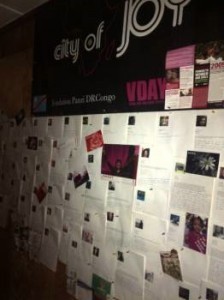
I just came back from the Congo. I was visiting City of Joy, a community to rehabilitate and educate female survivors of extreme sexual violence. The women receive daily lessons in everything from reading and writing to math to leadership to animal husbandry to entrepreneurialism. “In America,” the playwright and founder of V-Day: A Global Movement to End Violence Against Women + Girls, Eve Ensler, told me, “it takes a person thirty years of therapy to get over a trauma. These women have six months.” Then they get cell phones and go back to their villages to be leaders, expected to share what they have learned, connected to a network that spreads more deeply throughout the countryside of the Congo with every graduating class.
When Eve and her colleague Christine set about building the City of Joy – tailoring their plans to what the survivors said they wanted (a safe place, a woman’s place, where they could learn and acquire skillsets for a better life) – people of course told them they were crazy. Crazy. Things don’t intersect for Congolese girls and women to be very ‘legitimate’ either, and it’s not because we doubt their stories. It’s because they don’t rank high enough as a priority for much of the world to do more than shake its collective head and mutter about how hopeless and despairing and fucked-up the situation is and you can’t do anything to change it, why try?
When women first enter this community, torn and often mutilated, possibly pregnant, orphaned, widowed, dragged into the woods and raped daily for months, possibly insane, they need to be convinced that they have value as human beings. They learn their rights (they’re amazed to discover that they have rights). I sat in on a sex ed class taught by Dr Mukwege of Panzi Hospital, and afterwards Eve stood up and reminded the women about their right to say no. No matter what people might tell them, she said, having sex against your will is a big deal. What happened to them is a big deal. It mattered. She had them chorus, their voices blending together, My vagina is mine. The room exploded in shouts and whoops and smiles, women clapping and stomping and flashing the V sign.
The healing power – and it is healing — of validation.
You matter. You have rights. What happened to you is horrible and wrong and completely unacceptable. Your body is your own.
I believe you.
3
As human beings, we are social animals, wired into each other; we mirror each other to understand what the other is feeling, which affects how we are feeling, which affects how others are feeling; we know ourselves by how the people in our lives reflect us through what they say and how they treat us.
We unconsciously strive to adapt to our group and live up to, or down to, expectations.
In the book THE WILLPOWER INSTINCT, Kelly McGonigal writes about how “we include other people in our sense of self”:
“….when we think about people we love, respect and feel similar to, our brains treat them more like us than like not-us. You can see it in a brain scanner, watching adults first think about themselves, then about their mothers. The brain regions activated by self and mom are almost identical, showing that who we think we are includes the people we care about. Our sense of self depends on our relationships with others, and in many ways, we only know who we are by thinking about other people.”
We’re so influenced by the tribe that our brains will start to actively believe something it knows isn’t true (this stick is longer than the other sticks) if enough people around us keep insisting. We’ll start to doubt our feelings, our knowing, our own perceptions of the evidence. We’ll start to wonder if we’re crazy.
The defining characteristic of any abusive relationship is one partner’s constant attempt to control the other, including her experience of her own subjective reality. The abuser dictates how she’s feeling (“Get off it, you’re not so sick, I had the same cold a few days ago and I was fine”) or what she’s thinking (“You don’t actually like those people, do you?”) and manages to imply, to make her believe, that she is the problem. If she would only get it together and start behaving like an adult, things would be great. The abused partner on some level knows that something is off, something is wrong, that she’s possibly even being destroyed, but she contorts her mind to believe what the abuser tells her. She disconnects her own instincts. He’s also telling her that he loves her, and if she starts paying attention to what her body truly knows – that she’s in pain, her partner is full of it – then her whole life comes crashing apart.
As a culture – not necessarily as individuals – I believe that we emotionally abuse survivors of rape, often without realizing. We dictate their reality. We deny or negate or overwrite their experience. We tell them that what happened to them didn’t actually happen. We imply or say straight out that they’re lying, or at least exaggerating, they’re after money or attention or maybe they’re just crazy or maybe it did happen but it’s not that big a deal. It wasn’t ‘forcible’. And they need to move on and get over it because we’re uncomfortable talking about it or maybe we’re bored or it’s all so expensive and inconvenient or maybe we know the guy she’s accusing and he’s a good guy, a family guy, he would never ever. (Even if he did.)
We say, “He’s innocent until proven guilty” as if we were talking about real innocence and real guilt instead of legal concepts meant to establish burden of proof; as if a truly guilty man was innocent before proven guilty, or is made innocent because they can’t prove him guilty. We act as if the man has every right to assert his innocence but the woman does not have the right to assert her own rape, especially if it might damage his career or community standing (never mind how she’s been damaged).
The message that comes through, over and over again, is that certain people are more important than other people, and some people are not important at all. It was still less than a hundred years ago – in a time span of over twenty centuries – that women weren’t trusted enough to be ‘given’ the vote. To be recognized as legal individuals in their own right (when a woman married, her identity was absorbed into her husband, so that she had no legal existence outside of his). After all, they would only vote however their father or husband told them, right? They were childish and childlike, easily swayed, unable to understand the bigger picture. They were creatures of the flesh, given to impulse and irrationality. Thinking hurt their brains. They were innocent lambs too sweet and pure for the real world. Or they were cunning, deceptive femme fatales, a threat to the domestic order, who would use every power they had to exploit some luckless chap.
We may have the vote, but we’re still haunted by the virgin/whore dichotomy that puts us in the dirt or on the pedestal (and defines us not by our brains or moral character but whether or not we’ve had sex, and how often). Seen from that angle, we’re not fully human. We’re untouchables, too low or too high to be eye to eye. And if we can’t be ‘touched’, then we can’t be ‘legitimately’ raped, which means our story is suspect, we are suspect. We’re Adam’s Eve all over again, careless with the snake and dooming the entire human race to exile, pain and suffering.
(Eve no doubt had her own version of what went down, but no one seemed interested.)
We’re human beings. We’re made of stories. We run on stories. And the story we tell about men and women, women and rape, needs revision.
4
When I was in eighth grade, and a classmate told me she’d been raped, I didn’t know what to do. I didn’t know her well and wasn’t sure why she’d confided in me of all people. My knowledge of rape came from YA novels like Richard Peck’s ARE YOU IN THE HOUSE ALONE? and the soap opera SANTA BARBARA, where it seemed every female character was at some point dramatically ravished. I knew that I believed Anna, but my friend’s callous reaction confused me, and I was struggling through some learned helplessness of my own. It was easier just to let Anna slip from my life.
If I could go back.
If I could handle it differently.
I would know that all Anna wanted from me – what she was so quietly asking for – was the gift of validation. I wasn’t supposed to ‘fix’ anything, and she didn’t need me to tell her what she should have done differently or what to do now.
I needed to listen to her.
Just listen.
Maybe ask gentle questions about her experience, not to imply criticism but to let her know that I was right there in the moment with her, that I cared enough to provide full and focused attention.
It’s odd, how I can remember the things she told me – He threw my jeans in the water and said, I hope you get pregnant – but can’t remember anything I said in response.
You matter. You have rights. What happened to you is horrible and wrong and completely unacceptable. Your body is your own.
I believe you.
Did I have the presence of mind, the instincts, to convey any of that?
Over fifteen years later, I would like to think so.
I would like to hope so.
I would like to think there’s hope.


August 21, 2012
the problem with ‘nice’ girls ( + why you don’t want to be one)
When one is pretending, the entire body revolts. — Anais Nin
Nice is not the same as kind. Kindness is freely given.
‘Nice’ is when you think you have no choice, otherwise you’ll be unloved/cast out/confronted/selfish.
A woman can be strong, or she can be nice.
(Oprah Winfrey isn’t nice.)
Being ‘nice’ makes you feel wrong inside. Dishonest. Diminished.
‘Nice’ is the fog that keeps you from knowing what you really feel + who you really are.
‘Nice’ is emotionally, physically and sexually abused.
‘Nice’ puts the other’s needs ahead of her own, always + forever.
‘Nice’ isn’t even sure she has a right to put her own needs first.
‘Nice’ is not about morals. ‘Nice’ is about a lack of boundaries.
‘Nice’ is more concerned with what others think of her than what she thinks of herself.
‘Nice’ would rather give people the benefit of the doubt than trust her own perceptions.
‘Nice’ does what she is told, because it’s usually easier that way.
‘Nice’ is passive.
‘Nice’ is manipulated and controlled.
‘Nice’ says one thing and then turns around and says something else, because she wants to please all of the people all of the time.
‘Nice’ pretends to like you when she doesn’t. She pretends to want to be somewhere when she would rather be somewhere else.
‘Nice’ believes she’s on the high road.
‘Nice’ doesn’t take enough care with herself, her feelings, or her safety.
‘Nice’ does not get respect. She gets taken for granted.
‘Nice’ often learns she has to be ‘nice’ to get a man, except the kind of man that she gets is usually not worth it.
‘Nice’ is afraid of her own anger. So she represses it.
‘Nice’ is so determined to look at both sides of a situation that she loses her sense of the truth.
‘Nice’ needs to learn that sometimes it’s good to be ‘bad’. Otherwise you might pull people into your life to act out that badness for you — and against you.
With thanks to THE NICE GIRL SYNDROME by Beverly Engel
photo credit: arartplatform via photo pin


