Radhanath Swami's Blog, page 28
May 14, 2015
Video & Transcript of Radhanath Swami’s Talk at Oxford Union
On December 3rd, 2014 Radhanath Swami was invited to participate in a historic discussion by the Oxford Union, one of the world’s most prestigious debating societies. The other speakers were Dr. Cornel West, a provocative American academic, activist and author, and Dr. Angela Davis a prominent political activist, author, and educator. The discussion was attended by 400 students and held in honor of the revolutionary campaigner of civil rights Malcolm X who himself had come to the Union 50 years ago. The topic was whether extremism in the defense of liberty is a vice, a revisitation of the topic debated by Malcolm X a half-century ago.
The topic ignited an evening of passionate exposition and engaging discussion.You can see a video of Radhanath Swami’s talk above, and read a transcript of it below.
Transcript of Radhanath Swamis Talk the Oxford Union, December 3rd, 2014
It is a profound honor to be with all of you this evening at the Oxford Union.
My special gratitude to Dr. Cornell West for his eloquent, heart-felt presentation and for Angela Davis, one of the great heroes of my generation, and to all of you.
Whatever side you put me on, I’m a Swami and I’m going to speak my heart.
The concept of extremism can be interpreted in numerous ways according to a person’s or a societies’ experiences and mindsets. For example, there were people at one time, in political power, who considered Mahatma Gandhi and Martin Luther King dangerous extremists. They gathered large followings to boycott the economic norms, to violate the existing laws, and to subject their own followers to brutality in the name of defending justice. Yet many people may consider that the forceful military action to free the surviving prisoners of nazi concentration camps to not be extremism.
I would like to address the subject of extremism from a spiritual perspective. In this room, fifty years ago, Malcolm X stated, “I think the only way one can really determine whether extremism in the defense of liberty is justified, is not to approach it as an American or a European or an African or an Asian, but as a human being.” Ralph Waldo Emerson said “The reason why the world lacks unity, and lies broken and in heaps, is because man is disunited with himself.”
I argue today that hatred and egoistic obsession to prove ourselves superior to others through ideologies, neglect, or oppression is an extremist vice to the very soul of humanity. We must stand up to injustice with courage, with humility, with compassion, and with a love for truth. Otherwise, in time, even the oppressed become oppressors. Darkness cannot dispel darkness. Only love can dispel hate. Along with our efforts to make social change it would be wise to address the underlying core problem – a lack of respect for the sacredness of life.
Jesus cited the first and great commandment to love the Lord, your God, with all your heart, all your soul, all your strength and all your mind, and to love your neighbor as yourself. My brothers and sisters, everyone is our neighbor.
Lord Krishna, in the sacred scripture of the Bhagavad-gita, teaches that the foundation of true knowledge is to see and appreciate the equality in all living beings.
We are divine souls occupying our changing bodies. My guru Srila Prabhupada, he taught me that real love is when we see the sufferings of others to be our own sufferings and to see the happiness of others to be our own happiness.
What does it mean to see the equality in all living beings. It means whether we are a Hindu, a Muslim. a Christian, a Jew, a Buddhist, a Jain, a Zoroastrian, a Sikh, an agnostic, or an atheist; whether we are in a body which is black, or white, or red, or yellow, or brown, or man or woman; whether we are in a species of human being, or a dog, or a cow – life is sacred. Humanity, in its fullest evolvement, is to appreciate the sacredness of life.
Love is expressed in compassion. It is a disconnection from our own hearts that perpetuates racism, sexism, sectarianism, greed and even hate in the name of a loving God.
It is a betrayal to the very heart of humanity when we are deaf to the cries of children, women and men suffering from poverty, abuse, disease or oppression. It is a disconnect from our own hearts when we ignore the cries of life-loving animals suffering and dying in slaughter houses. It is a disconnect from the sacred principle of life that impels people to plunder and pollute the environment that we all share and depend on. It is the ecology of our hearts that will determine what is our society and the state of the world around us.
We are all one family. The eternal self of all beings is of the same origin. And each life has infinite value. I repeat, each life has infinite value. In the light of our unity we can appreciate and celebrate diversity.
I would like to conclude by sharing a simple lesson that deeply impacted my own life. A few years ago I was walking through a redwood forest in Northern California. The Sequoia, or Redwood tree is the largest and tallest tree on Earth. Many of them live for thousands of years. They grow in loose, mountainous soil and over the centuries have endured devastating earthquakes, blazing forest fires, and brutal storms. Yet they keep growing higher and higher. How – how do they do that? I will explain to you the underground secret of the Redwood tree. The roots of the redwood tree reach out to the roots of other trees. When the unite they embrace, intertwine and form a permanent bond between each other. In this way, every tree in the whole Redwood Forest is directly or indirectly connected to every other tree. The tender and the weak get all the strength from the stronger trees. Unity is the strength that empowers them to grow, even in the hardest of all times.
Let us discover our own roots and reach out to each other to defend our shared God-given right to life, true liberty and the pursuit of happiness.
Thank you very much.
Following Radhanath Swami’s talk the Oxford Union invited the other respected speakers to share their insights on this historic occasion. Firstly, Dr Cornel West, aroused the crowd with a rapturous speech and subsequently Professor Angela Davis shared her extensive experience and wisdom on this important topic. As is custom, the evening was also interwoven with contributions from students at Oxford University. The speeches from Dr Cornel West and Professor Angela Davis can be found upon the links below:
Dr. Cornel West: https://www.youtube.com/watch?v=4ZcPLNzkoZU
Professor Angela Davis: https://www.youtube.com/watch?v=zlzZSYloJ3M


May 13, 2015
What it Means to be Detached
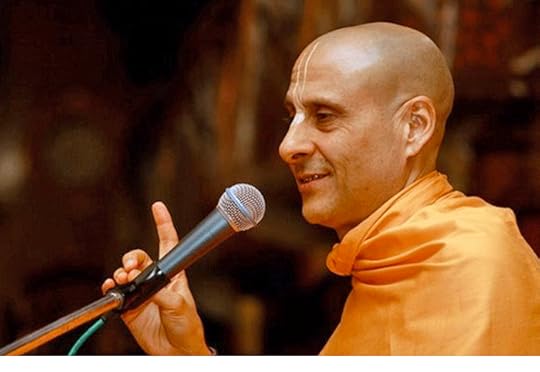 Question: I am married and have a family with certain responsibilities. Recently I took up the spiritual practice of Bhakti-yoga and heard about ‘detachment’ as one of the principles. With so many responsibilities how can I practice this principle?
Radhanath Swami: We have to understand from Bhagavad-Gita, what it means to be detached. To be detached means that you are attached to the service but you are detached from the results of the service for your personal enjoyment. Arjuna was a warrior and his duty was to fight. Lord Krishna told him, “You must fight. You must fight better than anyone else. You must fight with care, with conviction, and with all your intelligence, strength and energy; but fight for me. Do not fight according to your own will, but according to my directions. This is the responsibility that I am giving you.” It is detachment that Krishna is herein teaching Arjuna.
For instance, if you have a child, that means God is giving you that child. You are the secondary father but God is the primary father and he has the ultimate proprietorship. You are only a father on his behalf but he is the father. Therefore, you have a great responsibility to be a father on behalf of God and to raise that child according to His will and not according to your whims. If you neglect your duty and your responsibility, you are not on the path of God consciousness.
May 8, 2015
Radhanath Swami Speaks to Leading Industrialists on Simple Living
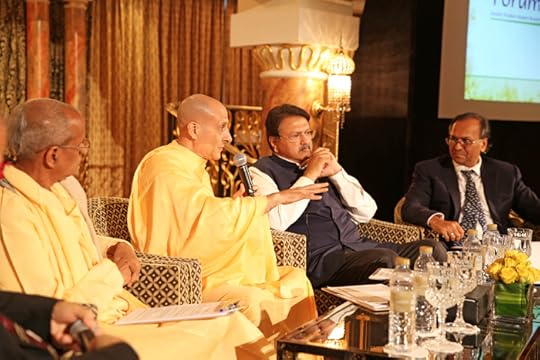
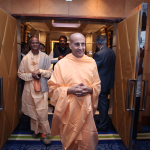
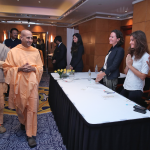
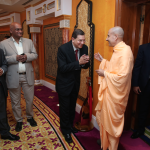
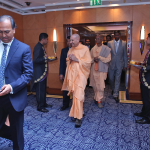
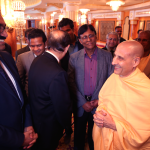
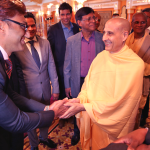
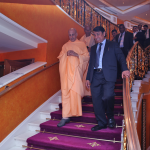
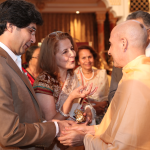
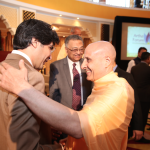
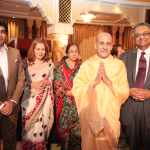
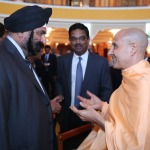
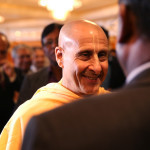
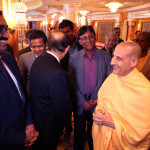
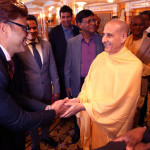
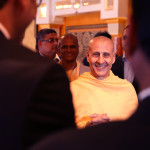
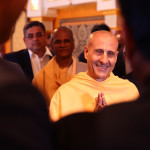
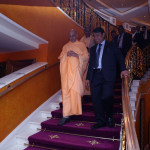
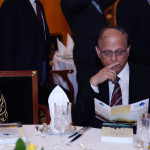
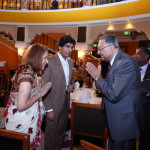
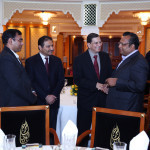
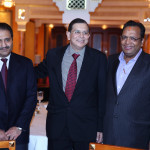
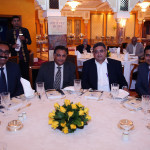
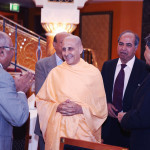
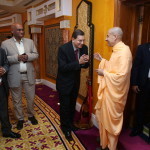
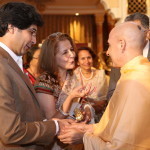
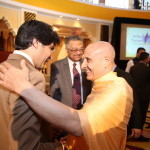
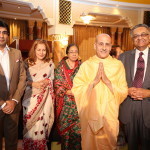
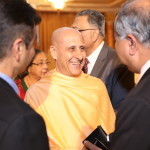
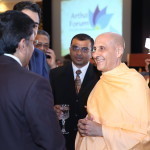
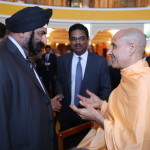
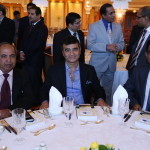
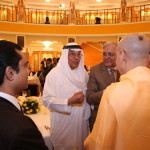
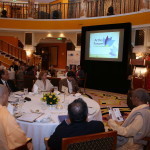
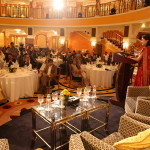
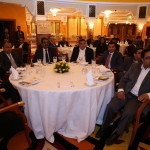
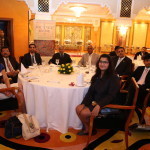
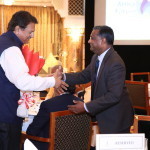
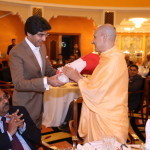
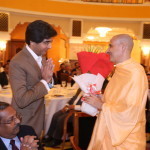
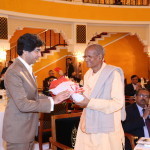
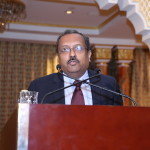
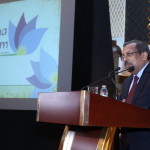
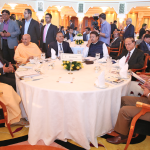
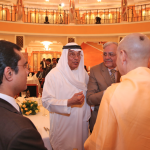
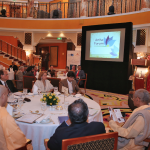
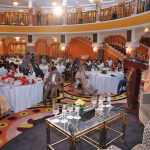
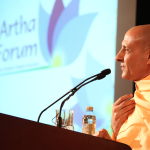
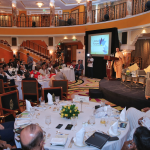
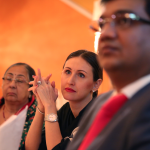
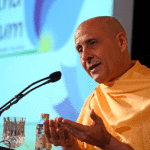
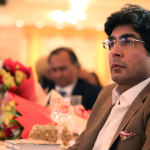
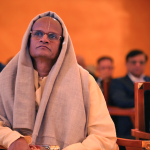
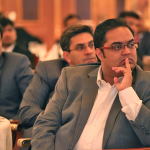
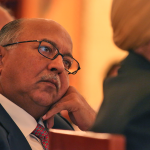
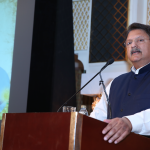
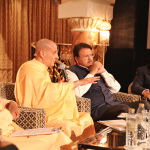
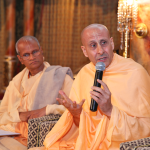
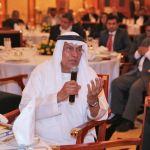
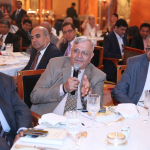
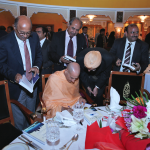
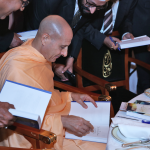
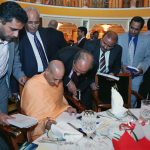
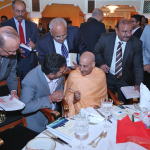
On April 15, 2015, over 100 industrialists, investors and corporate leaders converged at the Burj Al Arab Hotel in Dubai for a conference organized by Artha Forum Dubai Chapter, a community dedicated to providing healthy work-life balance and holistic world view to entrepreneurs, and business and thought leaders.
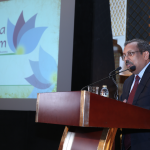
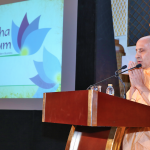
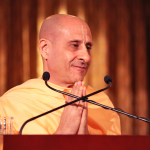
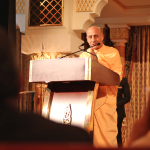
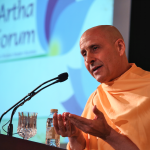
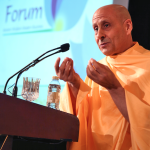
Held in the Al Falak Ball Room, the event was entitled “Simple Living High Thinking”. It was attended by the Indian Ambassador to The United Arab Emirates His Excellency T. P. Seetharam who spoke of how the building, seminar room and the lifestyle are the antithesis to the concept of simple living, and he was looking forward to hear from the swamis. This was followed by a keynote address by His Holiness Radhanath Swami and Mr. Ajay Piramal, leader of The Piramal Group.
Radhanath Swami explained how the idea of Simple Living High Thinking is actually a state of consciousness. “When I was looking around I was thinking ‘what am I supposed to say here’. But actually, simple living is a state of consciousness, and one can apply this principle by living without duplicity and with the values of compassion rather than values of selfishness, arrogance and greed” he said.
He further elucidated how economics deal with a basic problem – the world has limited resources but people have greed that needs unlimited resources. He quoted Mahatma Gandhi, saying that, “The world has enough for everyone’s need, but not enough for everyone’s greed”.
Radhanath Swami said that it is imperative in business to earn with integrity and spend with compassion. He stressed the importance of having a strong internal foundation based on good values and principles. “This is the essence of simple living and high thinking. Establishing priorities that are sacred, and living by those priorities with values. Saintly and pure life is possible even living in the topmost room of this hotel. It’s a matter of values. It’s a matter of our foundation” he said.
Sharing his business experience, Mr. Ajay Piramal said that practicing spiritual principles in one’s business not only helps build strong entrepreneurial spirit, but actually creates long term economic value. He cited his own company’s example where what seemed to be an impossible challenge paved ways to new opportunities. “What kept me going was remembering that we are mere instruments in the hands of a superior power,” he added, noting that the spiritual teachings of Radhanath Swami helped him remain cool and composed, while staring at rock bottom situations.
The event was attended by many important industrialists and business leaders of UAE including Mohan Jashanmal – Jashanmal Group, Dr. N. D. Desai -Chairman Apar Group, Hrishikesh Mafatlal -Chairman,Mafatlal Group, Jacky Panjabi -Chairman Jacky’s Group, Surender Kandhari – Chairman Al Dobowi Group, Mohan Valrani – Vice Chariman Al Shirawi Group, Veral Pancholia – Chairman M. P. Pancholia Group, Arun Pancharia – Consul General of Liberia, Ajay Rajendran – Vice Chairman Sobha Developers, Seema Shetty – CEO – NMC Group, Sudhir Shetty – CEO UAE Exchange.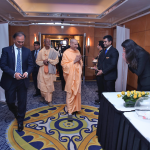





















May 5, 2015
Srimad Bhagavatam Class at ISKCON Alachua Temple
HH Radhanath Swami will deliver a Srimad Bhagavatam lecture at ISKCON Alachua (Florida) Temple.
Date: May 19, 2015
Time: 8:00AM – 9:00AM
Venue: ISKCON Alachua 17306 NW 112th Blvd, Alachua, FL 32615
April 28, 2015
Lessons From the Sand
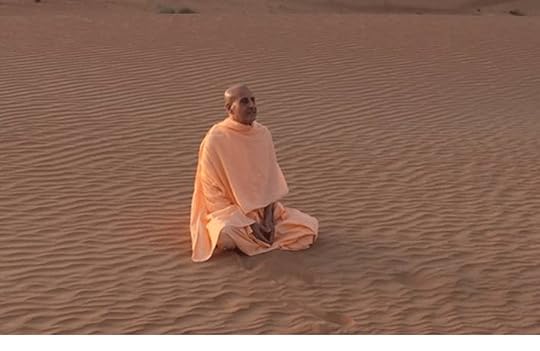 “I was sitting on the sand, thinking this sand was so cool and it’s giving me such shelter. Then I was analyzing the nature of sand. That the same sand that’s now so cool and so comfortable to sit, earlier in the day, it was burning hot, I couldn’t tolerate it. And then in another place the same kind of sand, was sucking me down to suffocate me and kill me. How sand is so influenced by it’s surroundings….and isn’t that like human nature, according to the company we keep, according to the experiences we have and the circumstances we have in our lives, how it can make us envious or proud of somebody. How it can make us angry or forgiving. Mean or kind. Just due to circumstances, like the sand.” – Radhanath Swami
April 27, 2015
Developing a Very Positive Attitude
 If we objectively look at the world today – study the newspapers, the magazines, the statistics – there is really a lot be depressed about: the pollution, the way people treat each other with so much rudeness, so much selfishness, and so much egotism. There is lot of evil in this world. There is a lot of darkness and cruelty in this world. There is terrorism. There is crime. There are so many terrible diseases. There is so much poverty. There are earthquakes. There are droughts. There are floods. There are massive forest fires. There is a lot to be depressed about if you really look at the world as it is.
Now, how does an ostrich deal with crises? When the lion comes to eat the ostrich the ostrich runs, and when he sees the lion coming up behind him he digs a hole in the ground and puts his head in the ground. He thinks, “Now I am safe.” And the rabbit; when the fox is coming to eat the rabbit he closes his eyes and he just forgets the fox is there. But the fact is the lion is about to eat the ostrich and the fox is about to eat the rabbit. Closing your eyes or putting your head in a hole in the ground is not going to change situations. So people in the world today, either they just do not want to hear about the problems of the world, or they just dig their hole in the ground in the form of television or some sports event. ‘Whatever… just forget it all.’ Television is very popular. Sporting events are very popular. Usually, people take those things so seriously because they just want to forget the perplexities, the complexities and the frustrations of life. It is a way of sticking your head in the ground or closing your eyes.
Arjuna, when he was faced with a severe perplexity, he could not close his eyes or stick his head in the ground. He had to face the reality as it was, and he became severely depressed. If a clinical psychologist were to read Bhagavad-Gita, and read the symptoms of Arjuna, he would say, “This man really needs some medications.” Arjuna was shaking. His bow fell from his hand and his dark complexion turned white. His mouth was dried up and tears were brimming in his eyes. He was in a hopeless state. He was depressed. Then he decided, “Krishna, I am not going to stay on this battlefield. I am not going to face this crisis. I am going to the mountains. Better I just renounce everything and negate the problems altogether. Then I will be at peace.” But negation of the negative is not the best solution. What does Krishna teach Arjuna in Bhagavad-Gita? He taught him bhakti.
What is bhakti? Bhakti encompasses the elements of jnana (knowledge) and vairagya (detachment). Krishna told Arjuna, “Do not be depressed. Do not just artificially close your eyes and escape the problems of life. Do not run away and negate them. See the positive opportunity that you have in this situation and work accordingly.” That is the teachings of Bhagavad-Gita. Do your work for the welfare of others in a spirit of compassion to others with consciousness of your relationship with God. That is what Bhagavad-Gita is all about: developing a very positive attitude, not on the basis of just physical and emotional – but physical, emotional and spiritual. – Radhanath Swami
April 26, 2015
Hong Kong Students Learn About Sanatana Dharma
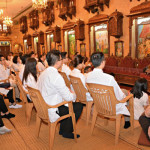
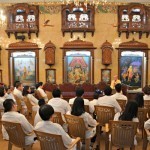
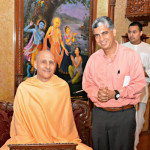
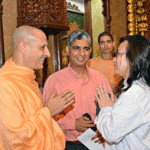
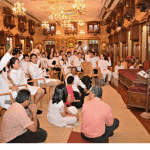
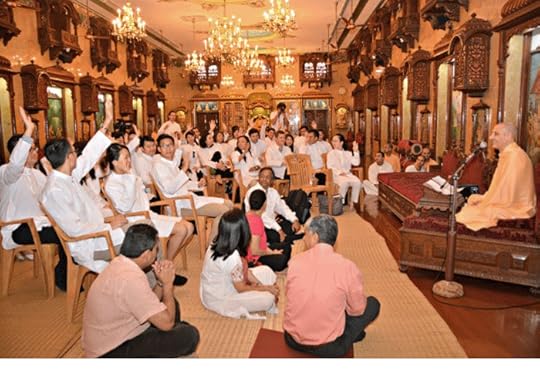 On April 8th, 2015, forty management students from the Hong Kong University of Science and Technology (HKUST) Business School, who are on a study tour in India, visited Radhanath Swami at Radha Gopinath Temple, Mumbai.
HKUST is an international research university with strong ties to global thought leaders and wide-ranging connections with Mainland China. It promotes interdisciplinary studies, dedicated to educating well-rounded students to acquire a strong entrepreneurial spirit and innovative thinking. Within the short span of two decades, HKUST has rapidly risen in the global academic arena and has become one of Asia’s top ranked Universities.
The group was led by Mr. S. K Mitra, Prof. Mitya and Michelle TO, Assistant Manager of Global Initiatives, MBA Programs.
In his address to the students Radhanath Swami said, “Why do so many millions of people from all parts of the world come to India for spiritual enlightenment? Because many are looking for universal principles of spirituality, and the heritage of India has a deep legacy in that spirit. Various religions flourished in this land because of the foundational universal principles of spirituality of this nation. It is called Sanatana Dharma, spiritual principles that help us to understand who we truly are, our true relationship with each other, with the environment, with God and with the world. These universal principles when understood deeply include all other true religions.” The talk was followed by thoughtful question and answer session.

April 24, 2015
The Power of Inquiry
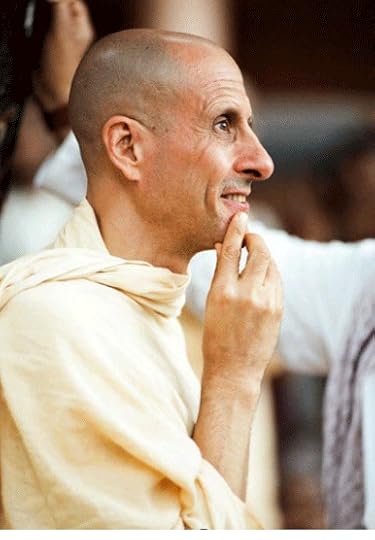 A great saintly person once remarked that everyone spends their lives within a series of questions and answers. When a bird rises in the morning it begins asking questions and searching for answers. When it comes back to the nest at night it is still asking questions and trying to find answers. In human society the businessmen, politicians, lawyers, artists, farmers, etc., all are seeking answers to their questions.
Life is a series of questions and answers:
How to solve our problems?
How to find happiness?
How to avoid suffering?
How to make friends?
How to gain power and prestige?
All the television shows, cinemas, newspapers, magazines, are about these questions and answers.
The Vedic scriptures explain that, now that you are a human being, inquire about who you are. The questions about eating, sleeping, mating and defending, and all of their various sub-divisions exhibit the basic trend of human intelligence in today’s world, but these are unimportant questions.
Who am I?
Why am I suffering?
Where am I coming from?
Where am I going?
Who is God?
What is the nature of this universe?
What is my relationship with God within this universe?
When a human being comes to the elevated platform of making serious inquiry on these subjects, then human life has real spiritual value.
If we really want to digest food, we have to have hunger. If we have no hunger, we have very weak digestion. Hunger is a very important part of life because it gives power to digest and that principle holds true for spiritual knowledge as well. When we feel the urgency and the hunger to solve the real problems of life and we inquire from people who act truly and who reveal the word of God in an unadulterated way, then our human life really begins. –Radhanath Swami
April 23, 2015
Programs at Alachua
Title: Programs at Alachua
Location: Florida
Description: Radhanath Swami will be at Alachua, Florida.
Start Date: 2015-05-18
End Date: 2015-05-21
April 22, 2015
Honoring Mother Earth
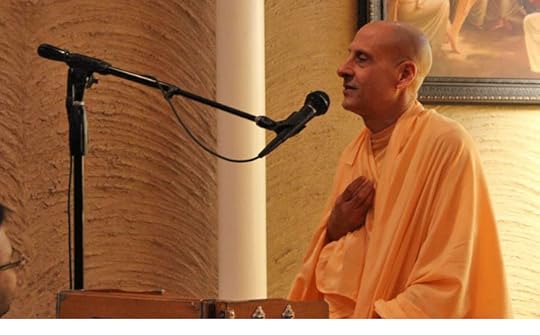
On July 1st, 2014, Radhanath Swami spoke at the Bhakti Center in New York City about the Govardhan Eco Village, a project he initiated on the outskirts of Mumbai, India. An excerpt of the talk is below. The entire talk may be downloaded here .
In the early 1970’s I heard a story about my beloved gurudev, Srila Prabhupada. He was in Mayapur, a very holy place in India where Lord Chaitanya appeared in this world. For many, many years, saintly people have gone there.
So Srila Prabhupada, after much struggle and challenge was able to purchase a plot of land in a kind of isolated place there. It was mainly rice paddies in the area, and he wanted to build a place of pilgrimage where people could come from all over India and from all around the world to a place of spiritual rejuvenation.
He hardly had any funds whatsoever. In fact, when he first started living there he lived within these rice paddies in a little hut made of straw. When monsoons came, cobras would make their residence in the roof of the hut to avoid the high waters. It was kind of like living in New York City with unpredictable neighbors (laughter).
One day Srila Prabhupada took some of the leaders of the project for a walk around the land, and he was discussing what he would like to be done with the land in different places. He became very excited and he pointed his cane towards one field and said, “Don’t you see?” and everyone was looking. They just saw the field and so didn’t say anything. But he again repeated, “Don’t you see?” They again looked at the field and at each other, thinking that maybe Srila Prabhupada was seeing Krishna there. Finally someone spoke up and asked what they were supposed to see. Srila Prabhupada walked into the field where there was a water faucet that was leaking and he turned it off and walked back. He said, Krishna consciousness means to honor what God has given us and not to waste anything.
This was an interesting story that had a tremendous impact on me. I never forgot that story. I only heard it once but it stayed with me – that respecting Mother Nature and utilizing her resources with compassion is an integral part of being God conscious. We know that radha-krishna-pranaya-vikritir hladini-shaktir asmad, that the Absolute Truth is one. He has many names and comes in many times and places to establish many religions. So there is one God.
In each manifestation of sanatana dharma he is ultimately teaching us prema pumartho mahan – that the highest goal is to love God. What does it mean to love God? This one Absolute Truth has a feminine power, Sri Radha. The two together are the one God – Radha Krsna. In the Vedic literatures we find that Sri Radha is the embodiment of all compassion and forgiveness and the source of grace. That grace is the most powerful source in all existence. It is this grace alone that can make our hearts blossom and awaken the love that is within us. Love of God cannot be attained no matter how many lifetimes we fast, or how little sleep we get, or how much we chant names or meditate. Ultimately all these spiritual activities are to connect us with that grace, and it is that grace that opens our hearts and reveals that love that has been forgotten.
Sri Radha is the source of that grace, and when she manifests Herself in material creation she is Bhumi, or Mother Earth, and also Durga, the mother of material nature. Through the grace of Bhumi – Sri Radha’s expansion, God’s expansion – Mother Earth is providing everything to us. We are completely dependent upon her.
In many parts of the world we refer to “Mother Earth.” The Vedas have a very deep concept about how she is the actual eternal mother of our souls, who is coming into this world to be the mother of every aspect of our lives, through the sunshine, rain, foodgrains, soil, the air we breathe. Whether we are simple villagers or multi-millionaires, whether we are illiterate or have multi PhD’s, whoever we are, we are all like infant babies totally dependent upon her. We are like little babies. A two-day-old baby can’t say, “Forget you, I can take care of myself.” (laughter) They don’t even know how to talk. They are completely dependent on their mother. And actually, no matter who we are, we are always even more dependent upon Mother Earth.
So in bhakti, the concepts of being respectful and honoring the gifts of Mother Earth are inseparable with our nature of devotion for God, Krishna. So this idea of environmentalism and eco-friendly lifestyle is a very essential part of the devotional path, because we receive grace to the degree that we are grateful and willing to reciprocate with it. Otherwise, we can’t recognize it. This chanting of the holy names, these sacred mantras, they take us into this grace. And as we are chanting these beautiful names of God, if we live a spirit of seva, or service, then it has a very, very powerful effect of bringing total peace and love to our lives.
Every drop of water is like a diamond. It is so precious. We should be so eager to save it. It is like diamonds falling from the sky and we are just letting it go into the ground. So the idea of really recognizing Krishna is being grateful for what is given, and utilizing it with compassion. And in this same spirit, we understand that every living being is a child of Mother Earth and the Supreme. Ahaḿ bīja-pradaḥ pitā, Krishna says: “I am the father and mother of all beings.”
When Srila Prabhupada turned off that water faucet, just one little activity like that, it was performed with such deep spiritual realization and compassion and love for God. When we had the concept of starting this eco-village that little story was my inspiration. That was the seed.
Srila Prabhupada explained the concept of simple living and high thinking – that we don’t need a lot of things to be happy. What will make us happy are our values and ultimately our understanding that we are eternal souls and that we have an eternal relationship with God, with Krishna. And in that relationship we have a relationship with all the resources of Krishna. Sarva loka mahesvaram. Everything in creation is God’s property. So as we see everything connected to Him, we respect it and honor it.
When I heard the story of Srila Prabhupada turning off that faucet I thought, “Yes, this is not just theory; it is something extremely practical. So let us get some land and try to make a model for the world to show how, when we have bhakti, devotion to Krishna, we will naturally have respect, compassion and love for everything connected with Krishna.” If we are compassionate to humans, it is contradictory if we do not treat the animals, trees, rivers, air and mountains nicely as well. Because everything is interdependent. That is the way creation is made.
— Radhanath Swami