Radhanath Swami's Blog, page 31
March 12, 2015


March 11, 2015
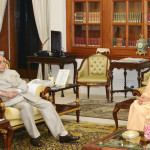
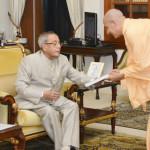
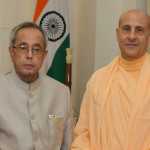
Radhanath Swami Meets with the President of India, Shri Pranab Mukherjee
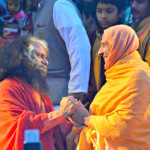
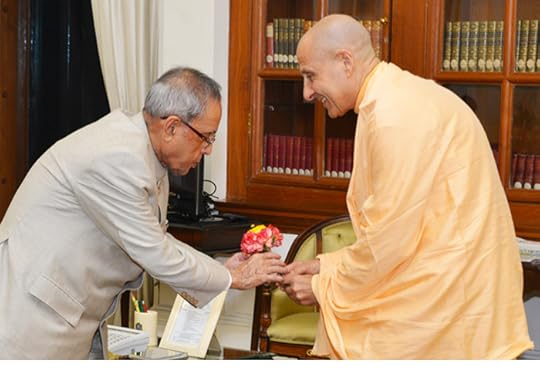 On February 28th, 2015 Radhanath Swami was invited by the President of India, Shri Pranab Mukherjee at Rashtrapati Bhavan, New Delhi.
They had a very pleasant meeting and the two of them discussed about the Govardhan Ecovillage, the Prayag project and the various projects connected to it. The President was happy to go through the booklet about Govardhan Ecovillage with great interest. He noted the work done by ISKCON in reviving the economic prosperity of farmers, preserving the eco system, organic farming, etc.
The President glorified the unique contribution of Srila Prabhupada and the great service he did to humanity by spreading the message of Bhagavad Gita and the teachings of Lord Caitanya. The President also recollected his visit to Mayapur, Pune and Kolkata Rath Yatra festival.

March 10, 2015
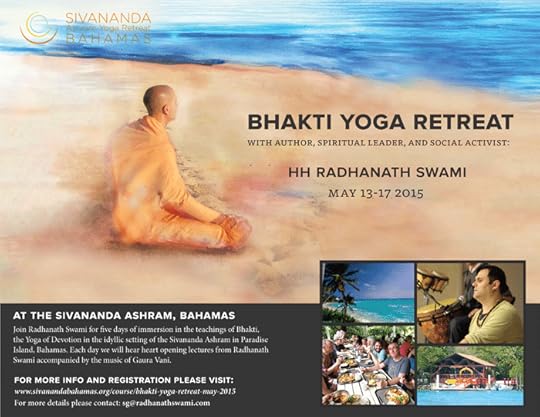
Radhanath Swami Joins International Yoga Festival, Rishikesh
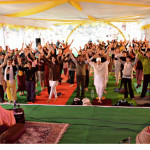
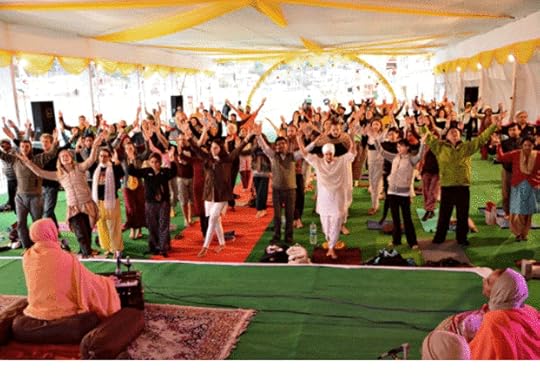 For the fourth consecutive year Radhanath Swami took part in the annual International Yoga Festival in Rishikesh, this year from the 1st through the 3rd March. The week-long event attracted more than 1000 students from 55 countries. It was organized by Paramarth Niketan Ashram, the largest ashram in Rishikesh and one of the largest spiritual institutions in India. Pujya Swami Chidananda Saraswati is the president of the ashram.
An international group of forty-seven teachers participated including yoga teachers Gurumukh Kaur Khalsa, Laura Plumb, Jules Febre, spiritual teacher Mooji, bestselling author Janet Attwood, environmentalist Dr. Vandana Shiva and nutritionist Rujuta Diwekar.
A special highlight of this year’s festival was the Spiritual Discourses Series held on the bank of the Ganges at 11 a.m. each morning. Director of festival Sadhvi Bhagavati Saraswati explained, “These spiritual discourses make this festival unique, special and precious. Here we get to hear from revered and enlightened masters. No other event runs parallel to this event, to ensure everyone gets to participate in these discourses. Throughout the day we learn different aspects of yoga, but here we learn of the highest aspect.” Radhanath Swami was twice featured in the Spiritual Discourses Series and spoke on the topics ‘Equanimity Amidst Turbulence’ and ‘Yoga of Love’. He gave a third talk on ‘Qualities of a True Yogi’ on one of the evenings. At the end of the discourse he led the participants in the kirtan of the holy names, as everyone danced in ecstasy.






February 26, 2015
The Nature of the Mind
 It is the not the nature of the mind to pursue selfishness and egoism and thus experience frustration and depression in due course of time. It is the nature of the mind to pursue the needs of the soul and thus find peace, compassion, happiness and ecstatic enlightenment. It is the actual nature of the mind to always be filled with transcendental pleasure. This happens when it is connected to the will of the atma, the eternal soul. But it is the nature of the mind to be implicated in material bondage and suffering when we forget our real nature and pursue the desires of the false ego under the misconception that “I am this mind, I am this body, I am the controller, the proprietor and the enjoyer”.
If we want to free our mind, the easiest way is to chant mantra. The word mantra means to deliver the mind from its artificial conditions and to bring it back to its original, natural, pure state. It is for this reason that the greatest welfare work is to teach people how to purify and cleanse their heart through chanting God’s names. – Radhanath Swami
February 25, 2015
Radhanath Swami at the Journey Home Book Club Meet
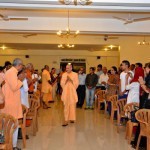
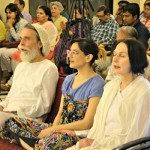
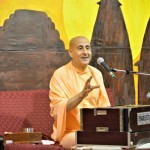
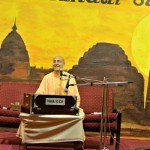
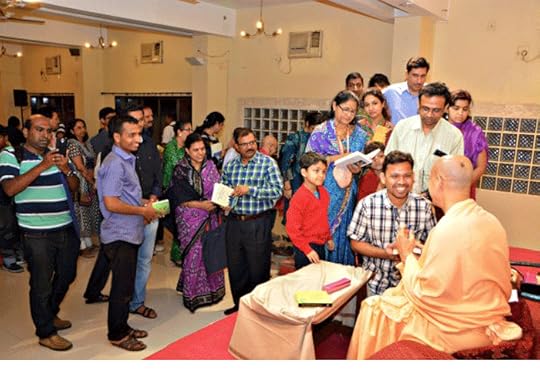 On the evening of February 20th 2015, Radhanath Swami met over 200 members of the Journey Home Book Club at Patidar Samaj Hall, Opera House, Mumbai. The club facilitates the spiritual quest of those inspired by The Journey Home.
In his address Radhanath Swami said, “In every true religion of the world, throughout history and in all different countries, it is the one God and his representatives coming to remind us what we have forgotten. When my Guru Srila Prabhupada came to New York City, he was asked, ‘Swamiji, we already have our own religion in this country. Why have you come?’ Srila Prabhupada replied, ‘I have not come to convert. I have come to enlighten. I have come to simply remind you of what you have forgotten.’ We have forgotten our real need, our true propensity – to serve with compassion. The journey home for everyone is to find that truth, that realization, within ourselves.’
A new book authored by Radhanath Swami Life with Lemon Drops was released on the occasion. The book contains a collection of special quotes which, as the name suggests, work like drops of lemon squeezed over various aspects of life, adding extra value, flavour and dynamism to our existence.
The gurus and founders of the Jivamukti Yoga, Sharon Gannon and David Life, were present as special. Also in attendance was film producer Sachin Khanolkar, who won the National Film Award for his Marathi film ‘Mee Sindhutai Sapkal’; the film is based on the life of Sindhutai Sapkal, the legendary woman who single handedly fought abuse and injustice to be a ray of hope for thousands of destitute children.


February 24, 2015
Living Superficial Lives Can Never Bring Us Real Fulfillment
 According to statistics provided by the World Health Organization, incidents of serious depression have increased by 50% in the last 10 years. We have better telephones, better televisions, more efficient motor cars, better highways systems, better airplanes and air traffic control and the computers are getting smaller and more efficient. But despite so much material progress, why have the number of cases of suicides, depression, alcoholism and drug addiction drastically increased in society? This is a simple question that thoughtful people should ask. The answer, according to the Bhagavad-gita, is that living superficial lives that are not in harmony with our real nature can never bring us real fulfillment. The more we strive for happiness through materialistic ways, the more our heart becomes frustrated. – Radhanath Swami
February 23, 2015
Every Living Being is a Part of God
 The Gita teaches that every living being is a part of God, just as every ray emanating from the Sun is part of the Sun. When we discover the love of God that is within our own hearts, we see an inseparable part of God in the heart of every living being — male or female; black, white, red, yellow or brown; Hindu, Muslim, Christian, Jew, Parsee, Jain, or Sikh; Pakistani, Indian, Israeli, or Palestinian. These are all temporary bodily designations that are ever changing. They are like clothes on the body. When we actually understand our own soul and our relationship with God, we can identify the soul in every living being and see its relationship with God. Then, instead of hatred there is love, there is compassion. And that love is the fundamental greatest need in the world. – Radhanath Swami
February 22, 2015
This Material Existence is Not Our Natural Place
 Question: We see that everything gets destroyed in due course of time in this world. Why did God have to make the world this way?
Radhanath Swami: You cannot figure that out, nor can I, but the Creator Himself has revealed that to us through the scriptures.
This material existence is not our natural place. It is not the place where the love and happiness that the soul is longing for can be experienced. If the resources and facilities of this material world were everlasting, then we may never make the right decision in life — to enter again into our constitutional, blissful nature.
The spirit soul is sac-cid-ananda: it is eternal, it is full of knowledge, and it is full of bliss. That is real life. In that state there is real hope and real ecstasy. And the soul is looking for that ecstasy. Though there may be some temporary pleasure in this world, there is no ecstasy. So we must lose our faith in the hope of happiness in this world in order to actually turn to where real happiness is — in the eternal soul’s relationship with God. Therefore, to facilitate our loss of hope in the material world, everything is designed to be temporary.
However, we shouldn’t neglect the body, nor should we neglect the wonderful gifts of God within this world. At the same time we should understand their temporary nature, understand our eternal nature, and understand the purpose of life — to re-establish our relationship with God. And we should utilize the gifts of the world to serve that purpose.
February 21, 2015
Understanding the Conclusion of the Bhagavad-gita
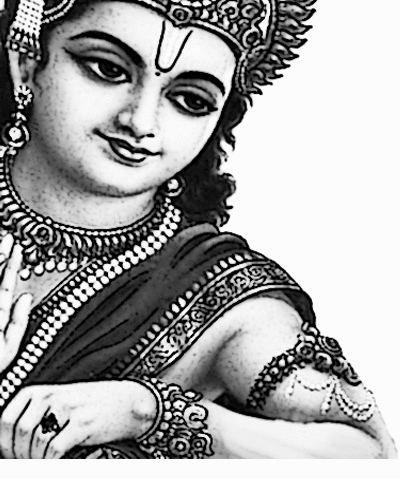 Question: Lord Krishna speaks of different paths of yoga in the Bhagavad Gita. It is confusing. Where does he intend to lead us to?
Radhanath Swami: Lord Krishna has given different types of yoga systems to bring us all to the stage of perfection.
In the Bhagavad-gita, we find the process of Karma-yoga. Krishna explains the perfection of karma-yoga in the Ninth Chapter of the Bhagavad-gita: “Whatever you do, whatever you eat, whatever you offer or give away, and whatever austerities you perform — do that, O son of Kunti, as an offering to Me.” (Bhagavad-gita 9.27)
So the ultimate conclusion of Karma-yoga is do everything as an offering to the Lord.
The Jnana-yoga system presented in the Bhagavad-gita is meant to give one the knowledge of who Krishna is, what the soul is, how the pure soul comes under the influence of material nature, how the time element functions driving one towards death at every moment, how the laws of karma are acting, etc. The perfection of achieving this jnana is explained in the Seventh Chapter of the Bhagavad-gita: “After many births and deaths, he who is actually in knowledge surrenders unto Me, knowing Me to be the cause of all causes and all that is. Such a great soul is very rare.” (Bhagavad-gita 7.19) Thus, Jnana-yoga in its perfectional state brings one to surrender unto Krishna.
The Bhagavad-gita concludes with Lord Krishna’s demand that we surrender unto Him: “Abandon all varieties of religion and just surrender unto Me. I shall deliver you from all sinful reactions. Do not fear.” (Bhagavad-gita 18.66)
The Bhagavad Gita teaches the harmony of all the other yoga systems with the ultimate goal – surrender to Krishna, known as Bhakti-yoga. Anyone who understands the Bhagavad-gita as it is can see how the other processes of yoga are simply parts and parcels of Bhakti and how they lead the practitioner towards the same. Those who do not understand the Bhagavad-gita as it is, however, have a less developed comprehension of its philosophy. They separate the different yoga systems thinking that each is in of itself sufficient to lead one to the same goal. Therefore their philosophy is yato mata tato patha – one can choose the path of his choice. However, Krishna presents the different yoga systems to convince Arjuna to surrender unto Him, remember Him, and do everything for Him.
In the Tenth Chapter of the Bhagavad-gita, Lord Krishna explains: “I am the source of all spiritual and material worlds. Everything emanates from Me. The wise who perfectly know this engage in My devotional service and worship Me with all their hearts.” (Bhagavad-gita 10.8) This principle is the continuous thread of the Gita and all other teachings are like pearls strung around this thread. It is just like arithmetic and calculus are different divisions of the same subject – mathematics. A young child studying in primary school may see arithmetic and calculus as separate but a Ph.D. in the subject will see that they are intertwined and developed for the single purpose of acquiring a degree in mathematics. Basic arithmetic is meant to bring the student to higher and higher aspects of mathematics but they are all parts of the same system. Similarly, those who have a clear understanding of the Bhagavad-gita can see the whole picture of the Gita, whereas a person whose understanding is less developed will see each part isolated from the rest.
Every syllable, word and verse of the Bhagavad-gita was meant to bring Arjuna, and is meant to bring one and all, to the point of complete love, devotion and surrender. This understanding can only be had by a person who understands the Bhagavad Gita as it is. Who is he/she? Lord Krishna explains the qualification to comprehend the essence of the Bhagavad-gita: “That very ancient science of the relationship with the Supreme is today told by Me to you because you are My devotee as well as My friend and can therefore understand the transcendental mystery of this science.” (Bhagavad-gita 4.3)