Radhanath Swami's Blog, page 33
January 26, 2015
International Yoga Festival
Title: International Yoga Festival
Location: Rishikesh, India
Description: Radhanath Swami will participate and speak at the International Yoga Festival – details at http://www.internationalyogafestival....
Start Date: 2015-03-01
End Date: 2015-03-04


Gaura Purnima Festival
Title: Gaura Purnima Festival
Location: Chowpatty, Mumbai
Description: Radhanath Swami will participate, speak and lead kirtan at the Gaura Purnima Festival at Radha Gopinath Temple, Chowpatty, Mumbai
Date: 2015-03-05
What Comes First, Love or Trust?
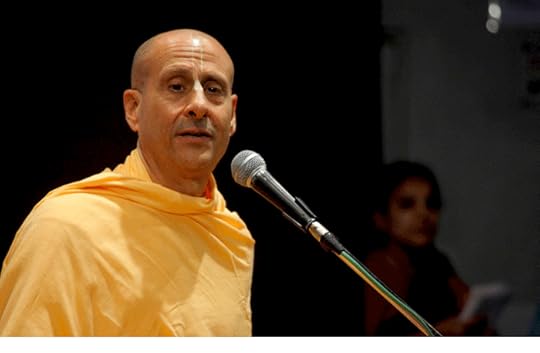
Question: Swamiji, what comes first, love or trust?
Radhanath Swami: That’s a beautiful question. They are like a coin with the head side and the tail side. If you have heads and tails on the coin, it’s the same coin. They are inseparable. The depths of real love and real trust are inseparable to each other. But generally, when there is some trust or faith in dharma, in the values of dharma, in the people who are teaching dharma, then that trust gives us the strength and the determination to put these beautiful principles in our life and from that love is awakened. But as love is awakened there is deeper and deeper awakening of trust and as the trust gets deeper there is awakening of love.
But some trust is preliminary: “That love exists within me. And there is a way that I can reconnect to that.”
January 22, 2015
How to Cultivate Enthusiasm and Determination in Bhakti
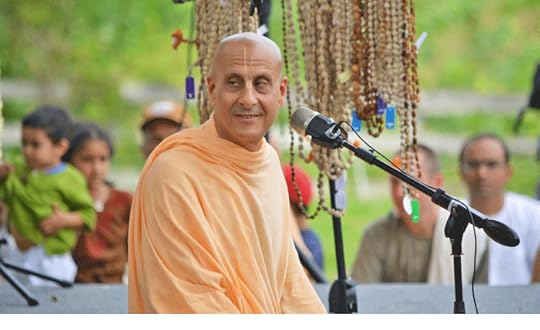 Question: I am very much interested in Bhakti Yoga. But how do I cultivate enthusiasm and determination to remain steady on this path?
Radhanath Swami: How do you cultivate a plant? You have to protect it and you have to water it. If you’re growing a flower in your garden you must protect it from being ripped out, from being trampled on, from being choked by weeds, and you also have to put water on it. So that is how enthusiasm and determination are also developed. If you engage in sense gratification, it’s like choking whatever little enthusiasm and determination you have with the weed of sense enjoyment.
Sense gratification very much deters the growth of our enthusiasm and determination. And offenses to others are like an elephant, trampling on that little seed of determination and enthusiasm. So we must protect it by guarding against sense gratification and guarding against offenses to others and we must water. We must water by whatever determination we have; we cultivate that by acting with determination. You already have determination; it’s just a matter of using it.
A human being has determination. You simply have to choose to use it and choose to cultivate it by chanting God’s names, by reading Srimad Bhagavatam and Bhagavad-gita, by associating with devotees, and by endeavoring with great efforts. If you endeavor, your determination and your enthusiasm will grow.
Krishna tells in the Bhagavad-gita, “For those who are too much attached to material opulence and sense enjoyment, the resolute determination for devotional service does not take place.” Austerities cultivate determination. Good association and good sadhana cultivate determination.
January 21, 2015
Investing in the Ecology of the Heart
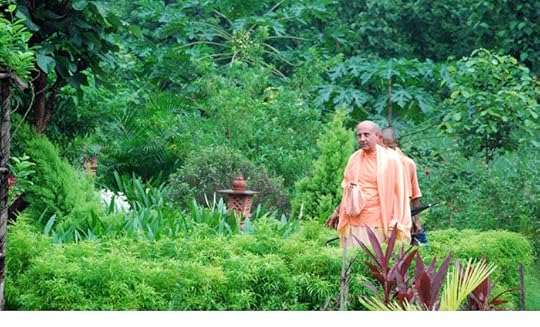 A crippled economy and a polluted environment plague our social body. Both largely stem from the same core disease — pollution of hearts. Blinded by distractions one can forget how to invest in what awards a meaningful, fulfilling life.
Parallel to our vast strides in technology, there is a dangerous rise in unemployment, foreclosures and degrading education. Millions of people are stricken with hopelessness and strife. Sadly, in the name of progress we have polluted the air, water, soil and the food we eat. What can we do? The following is a story about an encounter I had with someone who cared. It was winter in New Delhi when the days are mild and the nights are biting cold. New Delhi’s wide roads are lined with massive government buildings, the older ones built by the British perhaps a century back with stone pillars, ornate statues and vast lawns. Others built after independence in 1947 are adorned with Indian style arches and domes. I rode toward the airport. Monkeys appeared everywhere, scampering along the boundary walls.
At the crossroads on the way to the airport we passed circular islands of grass and trees surrounding memorials for the country’s freedom fighters. The streets were congested with cars, trucks and motorcycle rickshaws spewing out trails of exhaust fumes. Overhead a murky cloud of smog hung in the sky and reduced the sun to a gray lifeless ball. The fumes were thick, the smells toxic, and they sat on our tongues like sour lozenges. On the roadside an elderly man squatted cross-legged with back erect performing pranayama, a yogic breathing exercise. He vigorously inhaled and exhaled. I wondered if it did him more harm than good.
We crossed a bridge over the Yamuna River. I looked down and remembered 30 years before, when I had first come to India, that under the same bridge the Yamuna flowed in her full glory. Now, she looked plundered and crippled. What was once a pristine river had now become a thick blackish liquid, foaming bubbles, and a current so lame she barely flowed.
When I reached the airport and was waiting at the gate for my flight, a lady informed me that sitting close by was the Union Minister for Environment and Forests. She wanted to talk to me. I obliged.
The minister stood up and greeted me, “Namaste Swamiji.” After a pleasant exchange she suddenly challenged me with a passion.
“What are you spiritual leaders doing about the ecology?” She was very serious.
“Every second the air is being saturated with cancerous smog,” she said. “Tons of raw sewage and toxic waste are dumped hourly into rivers where millions of people bathe and drink. The earth is being stripped of its forest and has become a dumping ground for deadly waste. The world is on the brink of ecological disaster while all of you spiritualists are praying, meditating or chanting. What is all your devotion doing to save the ecology?”
Her concern was real and impassioned. It was exciting to see that depth of concern from a powerful leader over an issue that affects us all.
“Yes, the environment is everyone’s responsibility,” I responded, “and I sincerely admire your tireless commitment. The spiritual leaders I know believe that along with passing laws and doing the cleaning work we need to address the root cause of the problem. If a person is covered with boils, the symptoms must be treated, but unless the cause of the problem is addressed, the boils will recur. In the case of boils, the cause may be a disease in the blood. The root of cause of pollution in the world is pollution in the heart.
“Toxic greed has contaminated the minds of human society. The environment is simply an external manifestation of the ecology of the mind. Greed is an obsession, an addiction. It can never be quenched. The more it gets, the more it needs. Greed hardens the heart and fools us into rationalizing cruelty and justifying crime. Greed induces envy, divides families, provokes wars and blinds us to our real self-interest. Greed for money, power, fame, sex — the world is ravaged by greed. It is practically an exercise in futility to attempt to clean the environment when politicians are corrupted by bribes, industrialists pollute rivers to maximize profits and scientists put aside their ethics for funding.
“The Bhagavad-gita states that greed is a symptom of avidya or ignorance that covers the natural virtues of the true self within us. I’m sure you would agree with me that most people are not bad spirited, but due to a lack of awareness they may be destroying the environment, not understanding that what may seem convenient, like dumping industrial waste into a river, is actually killing fish, animals and people. So along with the pollution of our rivers, we must give attention to the pollution in our hearts. If you successfully clean the air, the sky, every river and every ocean, it is for certain that people will pollute them again unless they reform the ecology of their hearts.
“Spiritual life is the science of cleansing the heart and tasting the joy of living in harmony with God, each other and nature. It begins with cultivating good character, the willingness to make personal sacrifices for a higher cause, to make the right choices even in the face of temptation and fear, and put concern for the well being of others as a priority.
“How to do that? All of these virtues can spring from Bhakti or spiritual love. The Bible teaches that ‘the first and great commandment is to love God with all one’s heart, mind and soul.’ And the natural result of that is, ‘to love your neighbor as yourself.’ Nature is also our neighbor, she is alive with rights like everyone else, but too many people don’t see nature that way. The Vedic scriptures tell that the most simple and powerful method of cleansing the ecology of the heart and awakening this dormant love within us is to chant God’s names. In my tradition we chant the names of Krishna.”
“God has empowered all of us in different ways and if we agree on what the real problem is, then we can all contribute our part of the solution. The well being of Mother Earth is everyone’s problem. It is crucial for leaders in all fields to serve cooperatively.”
At that point the minister was called to board her flight. She thought for a moment, then stood up and smiled saying, “Yes Swamiji, What you say is true. We all need to work together.”
She was right to take me to task. Religious and spiritual leaders should be held accountable for environmental activism, not only because they have access to large communities and can influence votes but because service is integral to religious and spiritual life. Reducing carbon emissions is important, but it is shortsighted if not coupled with reducing the toxic emissions from our heart; and that is something spiritual leaders are supposed to teach and something all thinking people, regardless of their beliefs, should practice.
We should honor Mother Earth with gratitude; otherwise our spirituality may become hypocritical. The earth nourishes us with every necessity for a prosperous life. When, on a massive worldwide scale we plunder her oil, destroy her forests, pollute her resources, torture and kill her animals, soak her with the blood of her children, exploit one another and trample her with immorality, there will naturally be devastating consequences.
We should honor our mother and respect all of her children as our brothers and sisters. Otherwise, we may force her to react. Humanity has reached a critical crossroads. We have made monumental progress in technology, medicine, science, academics and globalization but if we do not use them with compassion what will be our fate? The dire need is at hand to take responsibility as caretakers of the helpless and live as dedicated instruments of God’s love. – Radhanath Swami
January 19, 2015
Confluence of Vedic Wisdom and Modern Business at Govardhan Eco Village
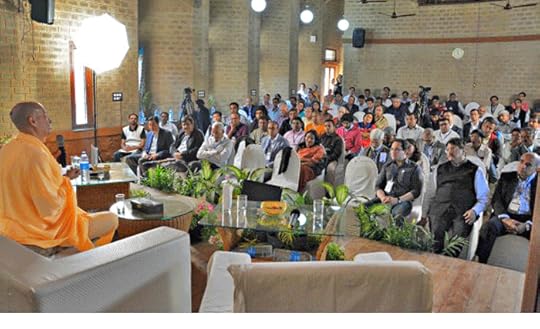 On the 10th and 11th January 2015, 130 industrialists and corporate leaders from around the world converged at Govardhan Eco Village to participate in talks and panel discussions that concerned the ‘Confluence of Vedic Wisdom and Modern Business’. The conference was organized by Artha Forum, an online community dedicated to raising awareness amoung professionals and business leaders of the relevance of ancient wisdom and literature in modern business. Radhanath Swami guides the forum’s activities.
Compassion was the keynote of most of the proceedings. During the panel discussion entitled ‘Art of Real Giving’, founder of Kalinga Institute of Social Sciences (KISS) Dr. Achyut Samant expressed, “Spirituality is the best means of inspiring people to do good to society. Radhanath Swami should introduce spirituality to the privileged, to inspire them to share with the needy.” KISS is the largest residential institute for tribal children in India that provides education to 22,500 extremely underprivileged children – from their kindergarten to post graduation.
Radhanath Swami and Dr. Ajay Piramal delivered keynote addresses. Dr. Piramal is the chairman of the Piramal Group, a leading business conglomerate. Forbes magazine recognized Pirmal as one of India’s leading philanthropists of 2014. Ascertaining the positive influence of spirituality for businesses, Radhanath Swami cited examples from the scriptures, while Dr. Piramal cited examples from his corporate experiences. “Thanks to the spiritual contact with Radhanath Swami, I try to imbibe Bhagavad-gita,” Dr Piramal said. “Radhanath Swami talks about how we are mere caretakers of wealth. That’s a powerful message of compassion. If we can do something for the world, that’s a good thought.”
The CEO of Bombay Stock Exchange (BSE) Mr. Ashish Chauhan participated in the panel discussion ‘Spirituality – a Compass for Business?” BSE is among Asia’s leading stock exchanges, and the world leader in terms of number of listed members. Mr. Chauhan took the opportunity to launch a new project of the BSE that will facilitate the not-for-profit organizations in finding prospective corporate donors.
Banker turned environmentalist Dr. M.B. Nirmal, who is reputed as ‘a crusader who can change India’, lauded the achievements of Govardhan Eco Village in environmentalism, during the panel discussion entitiled ‘Financial services – beyond greed and speed’. Deputy Governor of the Reserve Bank of India Mr. R. Gandhi and the Indian head of HSBC Bank Mr. Sunil Shanghai were the other participants in the discussion.
Other participants in the discussions included spiritual leader Bhakti Rasamrita Swami, Patrika Group national head Dr. Shipra Mathur, renowned journalist Mr. Rahul Dev, R K Swamy BBDO chairman Mr. Srinivasan Swamy, Repute Public Affairs founder and CEO Ms. Madhulika Gupta, Prabhat Khabar chief editor Mr. Harivamsh, and Rajshri Media MD and CEO Rajjat Barjatya. Participants also toured Govardhan Eco Village, and for many that was a highlight of ‘The Confluence’.












January 10, 2015
Chariot Festival
Title: Chariot Festival
Location: Juhu, Mumbai
Date: 2015-01-23
January 7, 2015
Bhakti Yoga Retreat
Title: Bhakti Yoga Retreat
Location: Bahamas
Start Date: 2015-05-13
End Date: 2015-05-17
India
Title: India
Location: India
Description: Radhanath Swami will be spending time in India – more details will be posted soon.
Start Date: 2015-01-06
End Date: 2015-04-13
Italy
Title: Italy
Location: Italy
Description: Radhanath Swami will be spending time in Italy – more details will be posted soon.
Start Date: 2014-04-18
End Date: 2014-04-24