Radhanath Swami's Blog, page 24
July 30, 2015
Two Principles of Marriage
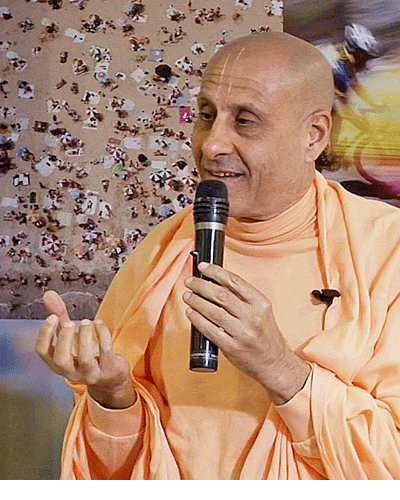 Across all religions there is a universal concept that when a man and woman marry with proper attitude they become one body. After marriage they start living for a common purpose – to serve God together.
The first principle they follow is – “I will do anything to protect you and you will do anything to protect me. We are there for each other and whatever the difficulties we may face we will be faithful to each other, till death separates us.”
This devotion to each other is the common principle of marriage. Secondly – “For raising children we will tolerate any differences between us for the sake of giving the children the best possible upbringing. Whether it’s a fight or cold war, children can feel the vibrations and its ruins them within. So in a marriage we have to give up our egos and our preferences because we share one principle – the welfare of our children. And all these activities become transcendental when it is done in the service of God. Because the children are God’s children and our bodies are God’s bodies we should not misuse them. Marriage is a divine relationship because we are responsible to God on behalf of each other; this is oneness in a marriage”. – Radhanath Swami


July 29, 2015
We Can Not Change Everything, But We Can Change Ourselves
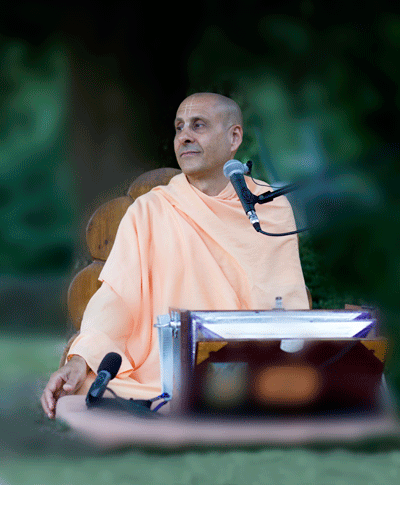 Question: How should we deal with people who clearly are out to cheat the world, and clearly are more inclined towards evil than good? What should be our attitude towards them?
Radhanath Swami: To a certain extent we have the power to change our environment, but ultimately it’s very limited. We may not be able to change the whole world or how people think or how people act or why people do what they do. Of course we can try our best to help, but there is one thing that we can always change and that’s ourselves.
If we live by the power, if we live with that potential of devotion, if we carry God’s grace in our lives and express it through what we do, that’s the greatest way in which we can influence others, and there will be many people you do seriously influence. And of course there will be other people you may not be able to influence so much. But you can be transcendental to that. We cannot always change everything in this world but we can change ourselves and that gives us this great strength to be an instrument of change in others.
So how to deal with people like that? There are certain universal laws of spirituality. It is said that we should hate the disease but not the diseased. In Bhagvad-gita Krishna tells ahaḿ bīja-pradaḥ pitā, that he is the father and mother of every living being. So that means everyone is our brother and sister, everyone is inherently divine. Everyone is part of God, but due to disease of the ahankar, the ego, one becomes incriminated in ever increasing bondage of lust, envy, anger, pride and greed, and one becomes a servant of these things.
If our mother is sick we hate the disease but we love our mother. So when our brothers and sisters, in the form of whoever they may be in this world, when they are acting in such a cruel, evil or selfish way, it’s the symptom of terrible disease. If we see it that way, instead of hating them we will actually feel compassion for them. To feel hate for a diseased person, that hate burns our heart; it doesn’t heal our heart.
July 27, 2015
Radhanath Swami Speaks to Biology Students from California State University
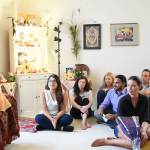
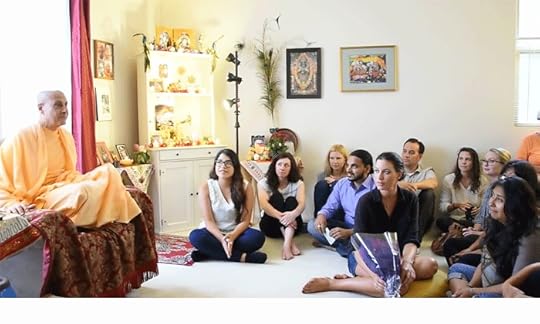 HH Radhanath Swami was invited to a special home program on June 30, 2015 in Camarillo, California. This city houses California State University, Channel Islands, one of the 23 campuses in the CSU system, the biggest public university structure in California, where Nandini Radha devi dasi (aka Dr. Nitika Parmar), a disciple of Radhanath Swami works as a Biology professor.
In January of 2014 and 2015, Dr. Parmar took a group of 14 students from the university for a trip to India, to explore various facets of biotechnology. This trip served as the culmination activity of a study abroad course that she teaches. The core textbook for this course was “The Journey Home” and students were required to write a summary on this book and were also given quiz assignments on the same. As a result of reading the book beforehand, the students were very eager to meet with the author, which they did in India.
A visit to the Govardhan Ecovillage in Maharashtra was built into the itinerary as the environmental biotechnology component. The students had the most amazing time at GEV and got to meet with Radhanath Swami both at the Ecovillage as well as ISKCON Chowpatty, where the spiritual leader spent several hours conversing with them. Upon returning back to USA all students expressed an interest in meeting with Radhanath Swami again when they were told about his summer tour to USA. This led to the June 30 gathering at Dr. Parmar’s home.
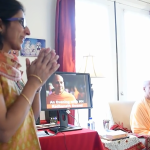
Overall, the audience of almost 45 guests made for a packed gathering at the venue. Radhanath Swami arrived promptly on time and was greeted loudly by the students with the chant “Haribol!” which they learnt at GEV. An introductory video of the Journey Home was played in the first few minutes while the speaker was being introduced.
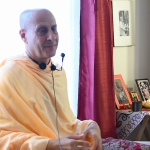
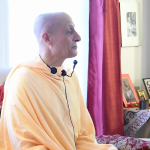
After a seven minute introduction, Radhanath Swami gave a discourse on “The Ecology of the Heart” a subject which focused on the development of human values in conjunction with concern for the environment. The speaker spoke about the need to connect with the Divine and our dependence on the higher powers at every stage in life. He also spoke briefly about his quest to know the truth and how this curiosity led him to travel to the other side of the globe while he was a teenager.
One main area that was discussed was the need to better ourselves in three “S” areas- sanga (association), sadhana (devotional practice) and sadachara (character). The speaker quoted- “If one loses money, nothing is lost. If one loses health, something is lost but if one loses character, everything is lost.”
The topic of hatred and religious intolerance rampant in the world today was also touched upon and the speaker enunciated beautifully how greed is leading to proprietorship of things that don’t belong to us in the first place. He specifically talked about the ‘simple living, high thinking’ model which is much needed in today’s society. Focusing on students, he encouraged them to think deeper since they would be the leaders of the future and to follow a path based on compassion and care was of prime necessity.
The audience listened attentively, digesting each word. Following the discourse there was a question and answer session and several questions were fielded. This Q and A could have lasted longer but since it was getting late and the guests were looking forward to dinner, a sumptuous vegetarian feast was served. The Journey Home book was also available for purchase and several books were bought by the guests. Radhanath Swami signed the books and spoke with the guests personally, tending to them with his characteristic care and attention. This program was very well received as evidenced from the feedback received (feedback forms were provided to the guests). Some of the feedback received was:
I have been reflecting a lot about the message the Swami shared. My apologies to referring to him simply as the Swami. I can’t recall his name. His message really speaks to me in where I am at in my life in discovering my spiritual path and seeking enlightenment. I am very interested in learning more. It was a great event.
Admittedly I thought your guest was going to be someone in the science field but I was pleasantly surprised! He was very insightful and his words resonated in me. Thank you so much!
Radhanath Swami was a very inspiring and interesting speaker I feel privileged and lucky to have had the opportunity to hear him speak in such an intimate setting. I will definitely be reading his book in the near future. I just wanted to let you know how much I enjoyed the speaker.
Thank you for a wonderful evening last night. We really enjoyed the talk. I purchased his book. I am looking forward to reading it.
Thank you again for having us over to your home for dinner with the swami. Both my friend Cecily and I really enjoyed the talk and found it invigorating and enlightening.
Thank you for such a very lovely dinner and what a surprise, to meet the most fascinating person I have ever met! I purchased his book and am enjoying it so much. I remember when the HARE KRISHNA movement was starting here in L.A. when I first became aware of it. I attended the temple in Malibu for a wedding sometime in the 70’s, it was very beautiful and here some 40yrs later to meet such an important man, to say I was very impressed does not even come close to how I felt.
I really enjoyed Swami and his message. It would be great to go to another event in the future.
The program ended with the students eager to visit GEV again in the future and several mentioned how they would make changes in their own lives which will make them more conscious of values which are meaningful rather than pursue hollow dreams.
Article writen by Nandini Radha devi dasi






July 25, 2015
Confusion is a Blessing If We Respond Accordingly.
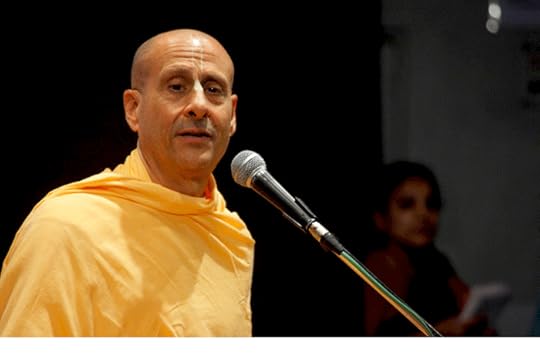 Question: Swamiji, I guess we are all made for a purpose. But if we are at a confused state of life, how would we really know what our purpose in life is?
Radhanath Swami: Confusion is a blessing. Because when we are confused, it shakes us from our complacency, and we start asking the questions that you are asking today.
This is the basis of the Bhagavad Gita. Arjuna was in total illusion. Then he became extremely confused. He thought his illusion was truth. The Bhagvad Gita begins were Arjuna is telling Krishna why he will not fight and he cannot fight. He had such good logic, such good scientific philosophical and social reasons. But ultimately all of his reasoning couldn’t really save him from distress because the nature of the world is that things happen that we just don’t want to happen, but they happen anyway. It’s the nature of this place.
Then Arjuna was confused and in his confusion he turned to God. kārpaṇya-doṣopahata-svabhāvaḥ pṛcchāmi tvāḿ dharma-sammūḍha-cetāḥ. “Now I am bewildered, I am confused, I don’t know what is to be done and what is not to be done. Please instruct me.” Confusion can shake us from our complacent comfort zone and that’s often times what we need to grow. And in that confusion we seek answers. And when we seek it in satsang — in the association of saintly people, in spiritual literatures, in the names of God — then we can find the real faith, the real conviction, the real realization that forever frees us from this confusion. So confusion is a blessing, if we respond accordingly.
July 24, 2015
Why Do We Worship God?
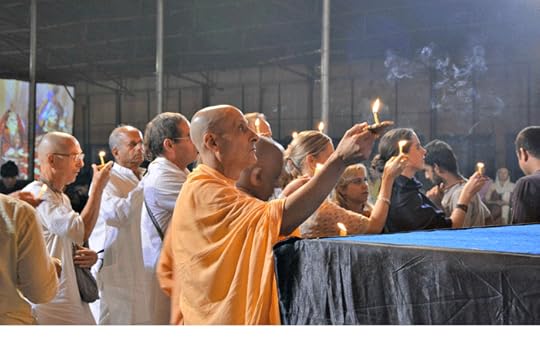 Question: Why do we worship God?
Radhanath Swami: This is a very important question. Unless we ask this essential ‘why’, we will never have the conviction and faith to do it with the proper spirit.
Everyone is looking for happiness. For example, when a mosquito bites you, he doesn’t do it to give you malaria; he just wants to drink your blood, because that gives him happiness. Similarly, all the amazing things that people do in society today, it is all in pursuance of happiness. But what is real happiness? Before we can understand what is real pleasure we have to understand who’s trying to enjoy.
The person trying to enjoy is different from this body. If the body is compared to a vehicle, the person who’s trying to enjoy, the soul, can be compared to the driver in the vehicle. The vehicle requires certain maintenance; it requires food in the form of petrol, it requires certain types of maintenance in the form of oil. But the driver in the automobile has a different need. Drinking petrol and that oil will not give him pleasure; rather it will ruin his health. Similarly, this body and this mind have certain needs: food, sleep, shelter, and various other facilities.
But what are the needs of the soul? Human society today has practically forgotten the needs of the soul. Therefore, however much you get you can’t be happy; it ultimately brings about frustration.
The soul is spiritual. The soul is part of God. The nature of the soul is to serve God and to love God through all actions, words and thoughts. That gives real pleasure and real nourishment for the soul. So if you want your happiness based on truth, you must worship God in every act of life. We worship God because it is the truth, it is our essence, it is our nature, and forgetfulness of that nature is the root cause of all the problems in this world.
July 21, 2015
We Cannot Love God & Not Love Every Living Entity
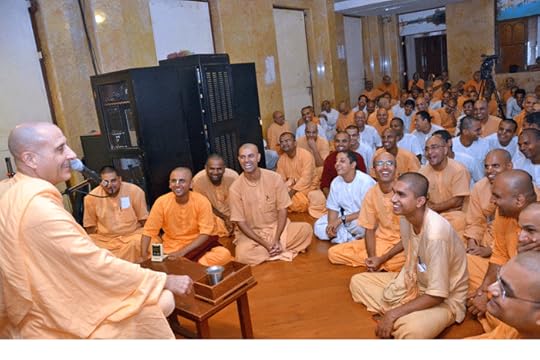 Question: I heard somewhere that without loving all the living beings we cannot love God. So I just wanted to know, what is the best possible way in which I can love and serve all the living beings?
Radhanath Swami: By loving God. When you water the root of the tree, every part of the tree is nourished by that water. So when we learn how to love God, naturally our love extends to every part of God, which is every living being.
The example is also given that if we want to feed the various limbs and organs of the body, we must give food to the stomach. When we give the proper food to the stomach it is naturally distributed to the hands, the eyes, the brain, the feet, and every tissue of the body. When we learn how to love Radha and Krishna, naturally our love will extend to all living beings without discrimination of sex, sect, caste, religion, nationality or even species – panditah sama darshina.
We cannot love God and not love every living entity. The testimony of the authenticity of our love for God is how it extends to everyone. When we love God, we see a part of God in every heart beyond the superficial differences we saw earlier. But also, in order to achieve that love of God—through the chanting of God’s names and the practice of bhakti— it is an elementary practice of bhakti to be amanina mana-dena — to honor and respect others and feel oneself the servant of all beings.
July 16, 2015
On Religion & Spirituality
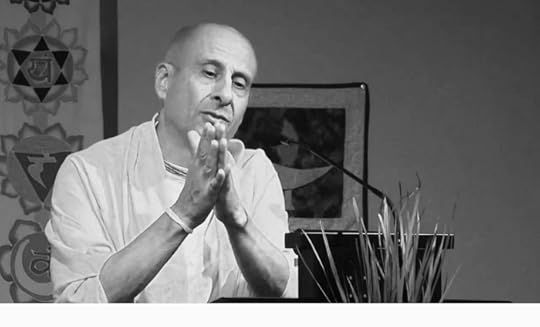 Question: How would you define the difference between a religion and spirituality?
Radhanath Swami: If we try to understand the true meaning of religion, we will find that there is no difference. But if we view the way religion is often followed in the world today, there is a big difference.
The word religion comes from the Greek word religio, which means ‘to bind back’ or ‘to reconnect’— to reconnect our hearts, our consciousness, with God. The word yoga means exactly the same—to reunite the atma with the Paramatma, to reconnect our consciousness with the Supreme, and to reconnect our consciousness with each other through our connection with God.
Religion is the path of purification. We understand that love of God is dormant within the heart of everyone. The mind is like a mirror. When you look in a clean mirror, you see yourself. But if the mirror is covered with dirt, dust, pollution, and all sorts of other coverings, all you see in the mirror is the dust, the dirt and the pollution—and you think “that’s me”. Similarly, when the mind is clean, we see Krishna, the all beautiful all loving object of our love, and we see our own eternal soul as the lover of Krishna. But when the mind is covered by arrogance, greed, envy and passion, we think that’s me.
What is religion? My gurudev Srila Prabhupad would say that real religion is not about being a Hindu or a Muslim or a Christian or a Jew or a Jain or a Sikh or a Parsi or anything else. Real religion is about awakening love of God. And the first commandment of the Bible is to love God with all our heart, mind and soul. And if you love God with all your heart, mind and soul, what comes next? Naturally, spontaneously, we love our neighbor as ourselves — and every living being happens to be our neighbor. Every living being is our neighbor because every living being is a part of God.
Krishna tells in the Bhaghavad Gita:
sarva-dharmān parityajya
mām ekaḿ śaraṇaḿ vraja
ahaḿ tvāḿ sarva-pāpebhyo
mokṣayiṣyāmi mā śucaḥ
He says, “Abandon all varieties of dharma, (sometimes dharma is translated as religion) and just surrender to me.” What is ‘surrender to me’? It doesn’t mean surrendering in defeat. The mother surrenders to the baby, doesn’t she? In the middle of the night when the mother is sleeping and the baby goes “aaahh…” the mother surrenders to the baby. She gets up to take care of the child. That’s not surrender of defeat, that’s the surrender of love. Unselfish love is to surrender in love to God and be an instrument of God’s love in this world; that is religion. That is the spirit, that is the essence of religion, and that is the essence of spirituality.
As far as the various rituals are concerned, when we become attached to those things and forget what it is for, it becomes what we today know as religion, where there are so many differences. What are we doing puja for? Do we really know what it is? It’s meant to tune us into the grace of God. It’s meant to help us focus on the divine power of God’s love. And why do we study scriptures? I have seen people who have studied scriptures and have memorized thousands and thousands of slokas, but their ego and their envy and their greed is as much as anybody else’s. The purpose of studying scripture , the purpose of puja, mantra, yantra, tantra, mudra, – the purpose of all these things is to clean the mirror of the mind and reconnect us to the divine grace.
Becoming religious is about becoming saragrahi. Saragrahi means one who seeks the essence; that is real religion. When we seek the essence of all religions, then we see what is in common. In my book The Journey Home, I give one analogy. When I was living in Patna, I was 20 years old. I stayed with Ramasevak Swami who was about 85 years old, and there was another man who was over 85; his name was Narayan Prasad. Everyday about 11 ‘o-clock in the morning he took me to his best friend. His best friend lived at the Magadha X-ray Clinic and his name was Mohammad. Interestingly, Narayan Prasad would speak to him about Bhagvad Gita, Mohammad would speak to him about the Quran, and I would speak about all the different stuff that I knew. One day I asked Narayan Prasad, “How is it that in a place like India, where there is so much conflict between Hindus and Muslims that you and Mohammad are best friends and you are sharing each other’s scriptures like this?” He said, “If a dog has a master, the dog will recognize the master in whatever way the master dresses. Sometimes he may be in a suit and tie, sometimes he may be in t-shirt and jeans, sometimes he may be wearing a dhoti or a lungi, sometimes he may not be wearing anything, but the dog will recognize. If we cannot recognize our beloved Lord when he comes in different times, in different dresses, with different names, then we have much to learn from the dog.”
Saragrahi means to seek the essence. Even though there may be differences, if we seek the essence, we will understand what we really have in common, and then there is no difference between spirituality and religion.