Radhanath Swami's Blog, page 16
May 24, 2016
Radhanath Swami Returns to Sacred Sounds at Rutgers University
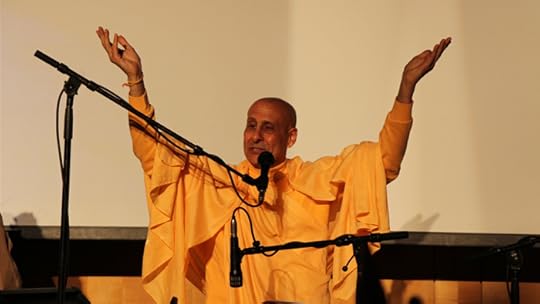

Radhanath Swami visited Rutgers University on April 28th, 2016 to participate in the award winning event Sacred Sounds, a dynamic program of kirtan and talks on bhakti-yoga. Since it’s inception in 2009 Sacred Sounds has been a movement bringing together a group of students working towards the goal of producing an unforgettable evening of spiritual energy. This year’s event was another grand success as Radhanath Swami, along with the kirtan group The Juggernauts, moved a group of four hundred students to dance ecstatically with their arms raised in the air, crying out the sweet names of the divine.
The students are attracted to Sacred Sounds for a variety of reasons including the delicious vegan meal, the dancing, the talk, and the melodious bhajans and songs. Some have experienced kirtan in their asana practice in yoga studios, or have enjoyed kirtan at the Rutgers Bhakti Club’s weekly meetings. Sacred Sounds gives them a taste of Bhakti on a large scale that they’ve never experienced before.
Radhanath Swami captured the hearts of the students seeking for a higher taste and purpose in their lives. His talk touched on the topics of fearlessness, forgiveness, and love. As he spoke, animating his talk with gestures, sounds and humorous anecdotes, so many of the students’ hearts were enraptured by his presence and his message.
By the end of the talk and kirtan, Rutgers yoga practitioners, faculty and students from all walks of life wanted to know more about Radhanath Swami, his message of bhakti and his formula for peace. To address this, the Bhakti Club featured a “Meet the Monk” table where students were able to ask him personal questions and spiritual enquiries. For hundreds of Rutgers students, it was an evening that they will never forget.






May 19, 2016
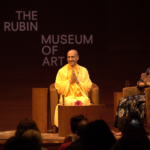
Radhanath Swami Speaks at New York’s Rubin Museum of Art
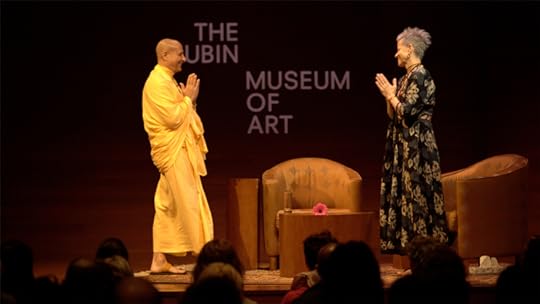
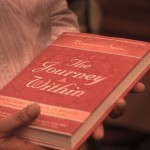
On Saturday, May 7, Radhanath Swami spoke before a capacity crowd at The Rubin Museum of Art in New York City. The Rubin Museum is dedicated to the preservation of the art and cultures of the Himalayas, India and neighboring regions. On the eve of the release of his upcoming book The Journey Within, Radhanath Swami was interviewed by yoga teacher and social activist, Dana Flynn on the topic of how to live spiritually through yoga in an increasingly materialistic and impersonal world.
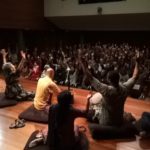
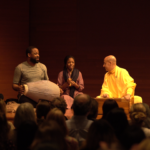
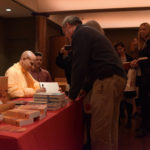
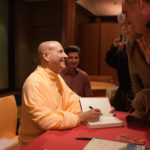
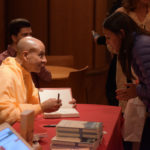
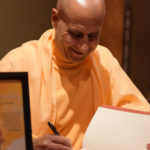
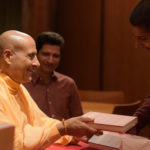
Following the discussion Radhanath Swami took questions from the audience and then the speakers were joined onstage by Ananta Govinda Das, Acyuta Gopi and Govinda Jones, engaging the audience in an uplifting kirtan to conclude the event. One pleasant surprise was that an early shipment of copies of The Journey Within arrived and quickly sold out at the museum’s gift shop. After the talk Radhanath Swami met guests and signed books. Below are excerpts from the evening’s talk.
On Renunciation
I would like to give a little analogy which is from an ancient story.
There is the crane, which is a bird that stands on one leg in a stream of water and watches so many little fish that are swimming by. The crane continues to patiently stand there watching until finally a big fish swims by – and then he snaps it up. Now what does this mean?
If we want that higher, bigger thing in life we can’t be distracted by all the little things in life that will inevitable come. Dr. Cornel West, when I was sitting on the stage with him, used a beautiful example of how in this world we are constantly being bombarded with weapons of mass distraction.
And what is renunciation? Its not about getting proud and arrogant that “I can eat less than you”, or “I can sleep less than you”, or “I can be more celibate than you”. Real renunciation is becoming humble and giving up one’s false ego. And to not be distracted by all these little things can come into our life. Because most of the things we fuss over, crave for, and are in a state of disturbance and anxiety about are little things that are not really worth our time and energy. But when we are not focused on something bigger then inevitably the little distractions consume us.
So when we really focus on the higher meanings and purpose, the higher truths in life, and when we have good people there to help us to remain focused, we can live with integrity even despite the storms of temptations and fears. We can live with character. And we can live in a spirit of service to Krishna, to God and to each other and not be distracted by all these things.
And the Gita explains the way to protect ourselves from being distracted by all little things and thinking they are big things is to act on whats really important in our life, on our self realization. And we adjust all the little things and focus on the bigger issues. And that can be applied on so many levels. As a parent, a spiritual seeker, in our work place, to unite on the sacred issues that are always there.
I will give an example of a seed that later grew into a spiritual understanding. When I was about 8 years old I was sitting alone with my mother and she told me “Everyone loves your father and everyone loves your mother, but we don’t love each other. We are going to separate.” I was so hurt and ran off and hid somewhere. When my father came home my mother and father went to their bedroom and talked about what happened. And they said, “for the sake of our children we are going to make this work. We have so many little disturbances and problems but for a higher reason we are going to make this work.” And they did, and it wasn’t easy. I saw over the years, because they had a higher principle they were willing to adjust the little details. Afterwards they were so loyal and loving to each other, on such a wonderful level, that when my mother passed away they had just celebrated their 58th wedding anniversary.
From a spiritual prospective, when I came to Vrindavan and I learned about Krishna and I met my guru and found my spiritual path, I understood that to apply all of this on all levels of life is so important. Because whats really important and meaningful and purposeful and spiritual is what is going to eventually give us the deepest satisfaction.
On Practicing Spiritual Life in a Modern Urban Setting
Question: For one who can’t leave their corporate job or urban life or study in India, what do you think is the best practical advice is for someone to follow the spiritual path?
Answer: The spiritual path is not about changing our occupation or our dress or the location where we reside, its about changing our heart and through changing our heart, changing our prospective of the world.
Some principles in our tradition are very effective:
Satsang – to associate with people who help us to remain focused on these higher principles and who inspire us. Who help us to keep the compass of the choices we make in a direction in which we come closer to God and grow.
Sadhana – to put some time aside everyday, some very quality time to connect with our own being, our soul, with God and the peace and love that is within us. We chant God’s names through meditation, prayer, puja or some devotional activity. In the bhakti tradition, asana and pranayama, if they are focused in our consciousness as offerings of body, mind and soul to the Supreme, then they become bhakti too. So in that way, we tune into that grace within ourselves. Through that enlivening company, through that time with spiritual practice, then the wealth we receive there we apply to our life by living with character, morality and integrity by living in the spirit of service. And I have seen some of the most saintly people, who are CEO’s of corporations and I have seen saintly people who are monks too.
My guru Srila Prabhupada was living in New York City in 1966 and he was 70 years old then and his students were mainly teenagers in the beginning. One of his students took him for a walk and they came to a part of New York City where there was trash all over the streets and rats fighting over the trash. It really was pathetic scene. They were really ashamed and apologized. But he replied, “Don’t you see? New York City is the spiritual world, you just don’t have the eyes to see it.” Even when we see these difficulties, when we see how I can make a difference to these peoples lives, how I can have compassion, then we are seeing the spiritual world. And New York City has a lot of opportunities on so many levels. So if we have that mood of service and inner connection then whatever our profession and wherever we may be we can see the opportunity to express our love and that is where real happiness is, in the heart.
On Gurus
Question: I feel in todays world the concept of guru has vanished. Where have all the guru’s gone? There is the spiritual concept of a spiritual seeker finding a guru but I feel those shoes are empty. Who do we look to today to fill that void?
Answer: Ultimately God is the supreme guru and the guru’s of this world are humble messengers of that supreme guru. In the bhakti tradition the guru does not claim to be God but to be the representative who is helping to bring us to God by repeating God’s message especially through their example and words. In our tradition the concept of lineage is very important. And there is a simple saying that by the mercy of Krishna, or by the mercy of God, one gets a guru and by the mercy of guru one gets God. If we are sincere the Lord is within our hearts, then a divine power beyond ourselves makes a connection. Any time in world history God can make that connection.
Question: Sometimes it feels like there is a spiritual casualty that you are not really getting what you are seeking. Everyone is ready to take this journey within and willing to do the work but we can only go so far on our own and want someone to shine our light on our path.
Answer: I can speak from my own experience. I was seeking that light in so many ways and at a certain time in my spiritual evolution I understood how important it was to have a teacher and a path that I could really put my heart into. And when I met my guru Srila Prabhupada it was natural. I could feel his love for God and I could feel he could open my heart to receive God’s love. And the philosophy he spoke of was so inclusive and made so much sense. I wanted to follow and I wanted to assist. And that was my calling in life.
When we really have a connection, when we find teachers, when we find a community, when we find a path that we are confident will not make us a sectarian person but will actually open my heart to God’s love – when we experience that then we start to see the teachings of Krishna or God and our guru in so many people and so many incidents that happen. The Bible says, seek and ye shall find. Knock and the door will open. Whats really important is that we are sincerely seeking and then our beloved within our hearts will reveal that to us.
And in the Vedic context there are three principles, guru, sadhu and sastra. Guru means one who just is not a charismatic person, but a person who’s teachings are and behavior are exemplifying the conclusions of the sacred text as it has been understood and practiced by enlightened people throughout history. And those three are inseparable – the teachers, the holy text and the line of great people throughout history. When we find that harmony we can invest our faith and our trust.
On the Disheartening State of the World
Question: Growing closer to God and becoming more humble is imaginable to me, but when I look around us as a human race I have a question are we able to collectively do this and move forward?
Answer: From a spiritual prospective I would like to address your question and your genuine concern. There was a great saint, his name was Bhaktivinode Thakur, who lived in the latter part of the 19th century in Bengal. At the time that India was under British rule. He was a magistrate, a judge in the courtroom, and he had ten children. His wife was saintly just like him. Thousands of villagers, monks, British scholars, came for spiritual guidance from him because he was saintly and he cared so much. He was such a compassionate person. If he sentenced a person to prison, usually that person would thank him. “If you are telling me to do this then it must be the best thing.” That was what a caring and enlightened person he was.
He wrote something very important – that where there is the greatest need there is the greatest opportunity to serve.
So there is a lot of need in the world and humanity is fractured on most every level. In the name of a loving God there is so much hatred. In the name of service to the nation there is so much unnecessary political fighting and the people are the ones who are suffering. In the name of humanity a few people are getting richer, and more and more people are suffering poverty. Every living being is equally dependent on the gifts of Mother Earth and whenever one of us pollute her it is violence towards all living beings. So there are a lot of ecological problems and problems on every level. But as one famous person said, “Be the change you want to see in this world”. That is something you have the power to do. We may not have the power immediately to change the whole world, but we can change ourselves. If we can change ourselves and transform arrogance into humility, greed into generosity, indifference into compassion – if we can work in what little way we can, we can make a difference in the world. If we can inspire one person towards that spiritual awareness, its glorious! We should never be discouraged. And each one of us can begin with ourselves to try to do what we can genuinely. Then we are really part of make a beautiful difference in the world.
Photos by Maksim Brenner, Ananta Cuffee and Kaustubha Das



May 5, 2016
Radhanath Swami speaks at Northwestern University, Illinois
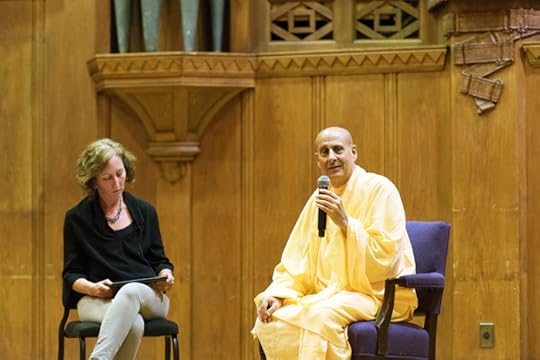

On the evening of April 14, 2016, Radhanath Swami spoke at Northwestern University’s Evanston Campus at an event entitled “Worlds at War / Minds at Peace – Intersection of Leadership and Mental Health.” More than 100 people attended the talk, hosted by six student groups and held in Lutkin Hall. Organizers chose Radhanath Swami, a Hindu monk, to provide an outsider’s perspective on the stress of college life.
Special Guests included the Mayor of Evanston, Ms. Elizabeth Tisdahl who spoke on the need of cultivating leadership qualities and simultaneously balancing mental health and Professor Galya Ruffer, Director, International Studies, Department of Political Science who moderated the questions & answers session. Professor John Dunkle, Executive Director of Counseling and Psychological services at the Northwestern also supported and participated in the event.
The event was hosted by the seven primary student groups on campus – AIESEC, Global Brigades, UNICEF, Supplies for Dreams, School of Education and Social Policy, Fight for Freedom, MENtal Health.
The article below was published on the website The Daily Northwestern. The photos below are courtesy of Robert Chesrow.
Spiritual Leader Talks Mental Health, Compassion
Sam Krevlin, Reporter
April 15, 2016
Radhanath Swami, a spiritual leader, author and social activist, discussed the intersection between mental health and expressing compassion at an event Thursday evening.
More than 100 people attended the talk, hosted by six student groups and held in Lutkin Hall.
Organizers picked Radhanath Swami, a Hindu monk, to provide an outsider’s perspective on the stresses of college life. The swami said helping others can benefit one’s mental health.
“When the mind is connected to the heart, then the heart is satisfied,” he said. “If you have pain in your body but a peaceful mind, you can still be happy. But if you are suffering mental anguish, even if your body is in perfect health, you can only suffer.”
Material goods are nothing compared to the love one shares with others, Radhanath Swami said. He said in a past conversation with Mother Teresa, she told him greed — which she likened to hunger — is the world’s biggest problem.
“Not the hunger of the belly — some food can satisfy that — but hunger of the heart,” he said. “Only love can satisfy the hunger of the heart.”
The swami said his worldview comes from his childhood growing up in Chicago during the Civil Rights Movement and his internal struggles that led him to search for God. He ultimately ended up in India, where he met his guru and became a monk under the Hindu branch of Vaishnava, according to his website.
Shivangi Agarwal and Shivani Agarwal, postdoctoral fellows of the Department of Cell and Molecular Biology at the Feinberg School of Medicine who are twins, led the way in bringing the swami to Northwestern. Shivangi Agarwal, who has known Radhanath Swami since 2012, said the swami has influenced her life through his service work and selflessness in her home country of India.
“His message has touched my heart,” Shivangi Agarwal said. “He holds a lot of value in my life. How he is inspiring youth and talking to universities inspires me. I see how people are being touched by his talks, and I feel like he has an incredible potential of making us transform.”
Sandeep Bharadwaj, a third-year McCormick student graduating after this quarter, is the former president of Global Brigades, which helped organize the event. He said he hopes the swami’s speech will help students cope with future stress.
“We are pulled in several different directions with things we have to take care of, being academics, family and extracurriculars,” Bharadwaj said. “In order to reason out these worlds of wars that are pulling you out in different directions, you have to be able to have your own mind.”
Photographs below courtesy of Robert Chesrow.
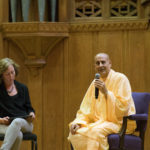
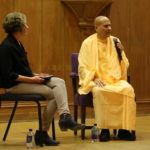
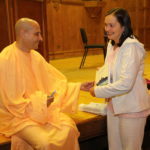
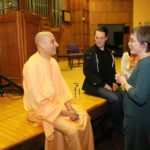
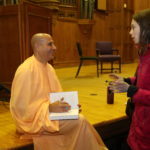
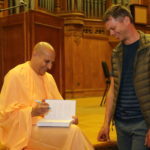
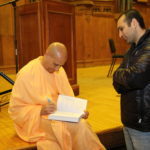
Radhanath Swami speaks at Northwestern University, Illinois.
On the evening of April 14, 2016, Radhanath Swami spoke at Northwestern University’s Evanston Campus at an event entitled “Worlds at War / Minds at Peace – Intersection of Leadership and Mental Health.” More than 100 people attended the talk, hosted by six student groups and held in Lutkin Hall. Organizers chose Radhanath Swami, a Hindu monk, to provide an outsider’s perspective on the stress of college life. Also of note is that before his talk, the Mayor of Highland Park, Nancy Rotering gave Radhanath Swami a key to Highland Park, the town he grew up in as a boy.
Special Guests included the Mayor of Evanston, Ms. Elizabeth Tisdahl who spoke on the need of cultivating leadership qualities and simultaneously balancing mental health and Professor Galya Ruffer, Director, International Studies, Department of Political Science who moderated the questions & answers session. Professor John Dunkle, Executive Director of Counseling and Psychological services at the Northwestern also supported and participated in the event.
The twins Shivangi Agarwal and Shivani Agarwal, both postdoctoral fellows of the Department of Cell and Molecular Biology at the Feinberg School of Medicine, led the way in bringing the swami to Northwestern. Shivangi Agarwal said Radhanath Swami has influenced her life through his selfless service in her home country of India.
“His message has touched my heart,” Shivangi Agarwal said. “He holds a lot of value in my life. How he is inspiring youth and talking to universities inspires me. I see how people are being touched by his talks, and I feel like he has an incredible potential for helping us transform.”
Sandeep Bharadwaj, a third-year McCormick student said he hopes that the swami’s speech will help students cope with future stress.
“We are pulled in several different directions with things we have to take care of – being academics, family and extracurriculars,” Bharadwaj said. “In order to reason out these worlds of wars that are pulling you out in different directions you have to be able to have your own mind.”
The event was hosted by the seven primary student groups on campus – AIESEC, Global Brigades, UNICEF, Supplies for Dreams, School of Education and Social Policy, Fight for Freedom, MENtal Health.
The article below was published on the website North by Northwestern, Northwestern University’s leading independent online publication. The photos below are courtesy of Robert Chesrow.
Radhanath Swami Discusses Effective Leadership
In the middle of midterm season and the summer internship search, Radhanath Swami, a world-renowned speaker, social activist, spiritual teacher and author, preached a message that Northwestern students need to hear: “People will not love you because of what you achieve … People love people because of their values, because of their compassion, because of their love.”
Radhanath Swami, who is originally from Highland Park, said love and connection to others are key to effective leadership in his lecture “The Power to Lead” in Harris 107.
He gave an example of redwood trees that have lasted through earthquakes and terrible storms, even though their roots are not deep. The secret to their stability is that the roots grow outward rather than down into the ground, intertwining and forming “inseparable bonds.”
“Unity is their strength,” Radhanath said. “They have an innate natural quality to really care to help each other.”
He also said leadership is setting an example for others. He said it is important that leaders choose to nourish the goodness in other people.
“Within each heart, there is a good dog and a bad dog,” he said. “These two dogs are always fighting with each other … Which dog is going to prevail? The one that we choose to feed.”
A question and answer session followed the lecture. One student asked how to remain optimistic when he was surrounded by negativity in the world.
“Despite the news of terrorism, and murder, and exploitation, and racism, the goodness and the potential of loving people is always there in this world,” he responded.
Mayor Elizabeth Tisdahl spoke briefly on the importance of listening when leading a diverse community.
“Evanston values diversity – it’s always been the best thing about us,” she said.
Before the lecture, Mayor of Highland Park Nancy Rotering gave Radhanath a key to Highland Park. Professor Jody Kretzmann, who teaches community building at Northwestern, introduced Radhanath.
Weinberg freshman Sharon Tam enjoyed hearing Radhanath’s message of unity and working together. She said she could apply his message to her own life.
“I’m pre-med,” she said. “My main job now is to work hard academically and so that I can reach that level … and have a greater impact as a doctor.”
Tam also appreciated Radhanath’s local roots.
“The fact that he’s from around here, that he could be any one of us – it’s more personal,” she said.
When asked about the event some of the students replied:
“It really rejuvenated my sense of purpose and I loved the idea that whatever we tune into our how we will experience life, I thought it was really beautiful. I would like to go to more such talks”-Colette Ghumin
“His talk really melted my heart, the words were so deep and just penetrated my heart, we need more people like him on the planet who can inspire and bring a positive change in the world”-Kristen Kloostra
“His stories touched my heart specially the monkey story and the practical lessons he took from the whole experience was very enlivening”-Emilla Parr
article By Rachel Fobar
Photographs below courtesy of Robert Chesrow.
April 26, 2016
Radhanath Swami Speaks at United Nations Interfaith Climate Change Ceremony
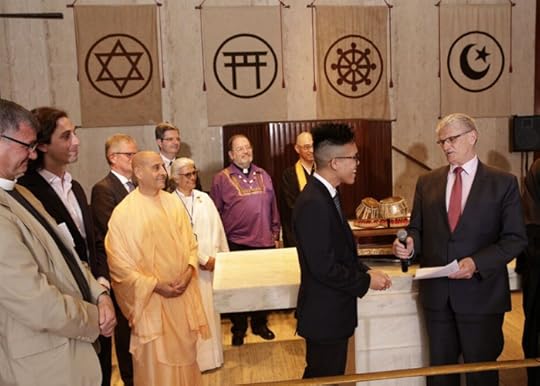

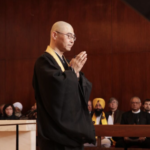
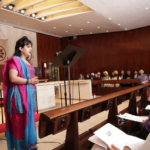
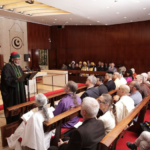
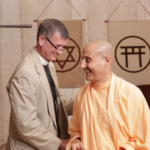
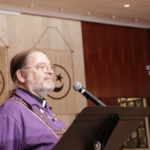
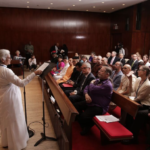
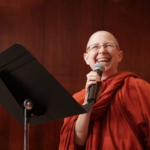
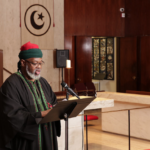
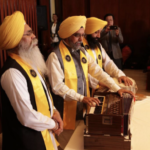
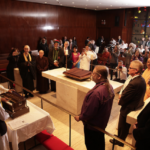
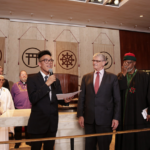
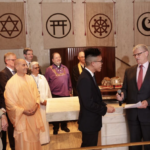
On April 22nd, 2016 Radhanath Swami joined faith leaders from around the world at Church Center of The United Nations in New York City to encourage world leaders to sign the Paris agreement on climate change. The event (The Interfaith Climate Change Statement To World Leaders Handover Program) was mainly organized by GreenFaith, in partnership with a number of faith based organizations.
Although a climate change agreement was made in Paris, each individual country that signed on still needs to approve it through their respective parliaments and legislative bodies. The Interfaith Climate Change Statement presents the positive judgement of the Paris Agreement from 250 global faith leaders, and urges its prompt signature and ratification by governments so that it can come into force as soon as possible. It also calls for action relating to emission reductions and a swift phase out of fossil fuel subsidies. The statement serves to renew the strong commitment of the faith community to remain active in defining the moral responsibility to care for the Earth,
The ceremony included short talks by faith leaders and representatives of the UN. It concluded with the presentation of The Interfaith Climate Change Statement to H.E. Mogens Lykketoft, the President of the UN General Assembly and was followed by a press conference.
Radhanath Swami shared the following message with the assembly.
“It is a great honor to be here in such a distinguished assembly.”
“From a spiritual prospective the condition of todays environment is to a large extent due to a crisis of the human spirit. The ecology of the world is a reflection of the ecology of the human heart.”
“The universal principle of religion or dharma, is to learn the science of harmonizing the body, the mind and the true self to live in harmony with God, each other and with nature. To transform greed into the joy of giving, arrogance into humility and gratitude, indifference into compassion, and prejudice into love.“
“In the Bhagavad-gita, there is a verse spoken by Lord Krishna:
bhoktāraḿ yajña-tapasāḿ / sarva-loka-maheśvaram
suhṛdaḿ sarva-bhūtānāḿ / jñātvā māḿ śāntim ṛcchat
That the Supreme Divine source of everything, or God, is the proprietor of all that exists –the mother, father and the most intimate friend of all living beings. And true peace is possible when we learn to recognize that we are not proprietors, but that rather we are caretakers of sacred property and caretakers of each other.”
“The Hindu Declaration on Climate Change states that all life is divine and interconnected. This current crisis is a real opportunity to put aside our differences and unite with one heart and one voice to appeal to world leaders and genuinely put forth policies and action to honor the sacredness of life itself.”
Other speakers included the following.
Rev’d Fletcher Harper, Executive Director, GreenFaith
Kiran Bali MBE JP, Global Chairperson, United Religions Initiative
Imam Talib Abdur- Rashid, President, Islamic Leadership Council of Metropolitan New York
The Rt. Rev. Mark MacDonald, Bishop for Indigenous Peoples, Anglican Church of Canada
Sister Gayatri, Representative to the UN in New York of the, Brahma Kumaris
Permanent Representative of France to the United Nations in New York: His Excellency Mr. François Delattre
Director for Strategy, Secretariat of the UN Framework Convention on Climate Change, Mr. Halldór Thorgeirsson
The President of the UN General Assembly, His Excellency Mr. Mogens Lykketoft




April 13, 2016
Bhakti Immersion at Govardhan Eco-Village
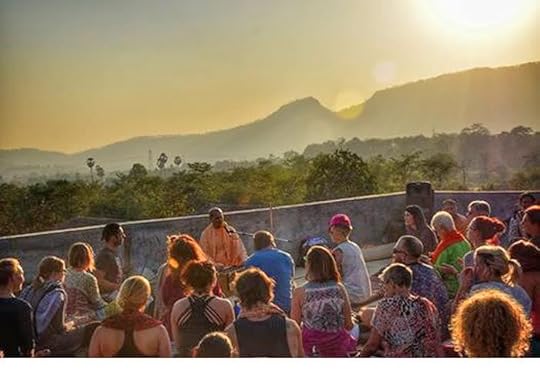 Over one hundred participants from five yoga and kirtan groups joined for the Bhakti Immersion Retreat held at Govardhan Eco Village (GEV) from January 25 to January 29, 2016. In the words of Vishvambhar Sheth, who headed one of the groups, the retreat consisted of “Bhakti teachings, yoga asana classes, Ayurveda and of course dancing and chanting!”
Another group leader John Smritic shared on social media a picture of Radhanath Swami addressing the participants of the retreat (John included) and texted his experience, “360° mountain surround, golden setting sun, warm Indian countryside air… A talk on the very essence of Bhakti Yoga and Bhakti philosophy. The satsang gave way to ecstatic kirtan as day turned dusk turned the most transcendental starlight sky I have ever seen. Humbled, honored and grateful beyond words.” Yoga teacher Gopi Kinnicut posted a similar picture on the internet and added, “What a heart filled evening!”
After three days at the retreat, Vishvambhar posted on Facebook, “We’ve only been at the Govardhan Eco Village for less than 3 days, but we feel completely at home…our eternal home, GolokaVrindavan, planet of cows. The spiritual vibrations of this place is beyond this world in all aspects.”
At the end of the retreat, Gaura Vani, leader of the kirtan group Hanumen, said “We gathered this year – 108 enthusiastic friends – at the Govardhan Eco Village. We brought our students, guests, pilgrims and even our families and children. We studied yoga, Mantra Music, sacred stories, ayurveda. We ate together, sang and danced, served with local villagers. It was a beautiful home-coming. Like friends and relatives who didn’t know each other were being introduced for the first time. Under the guidance of the beautiful and dedicated devotees at GEV a home is being created for all of us. For the animals. For the environment. For the monks and villagers. A place where sincere spiritual seekers can go to find their inner holy land. Their inner Vrindavan. That’s why we all return each year to this village deep in the drought-stricken Maharastrian countryside. To learn how to harvest the rain and fill our thirsty heart-wells with sweet sacred water.”

April 5, 2016
Artha Forum Presents the Event “Earn With Integrity & Spend With Compassion” in Singapore
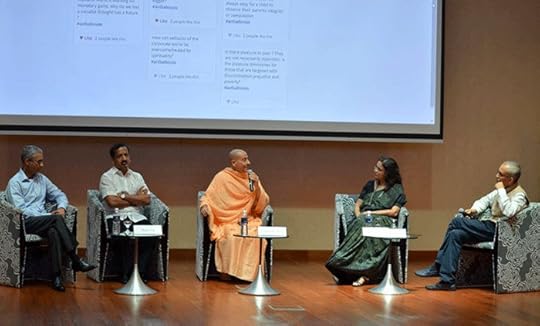
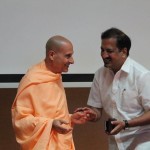
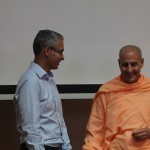
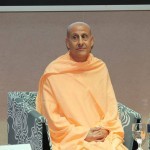
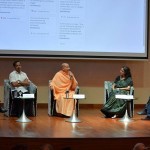
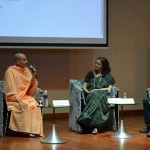
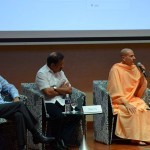
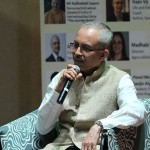
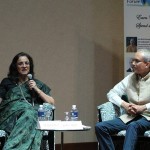
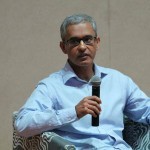
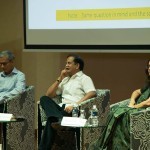
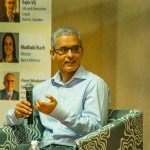
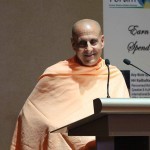
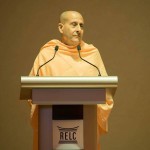
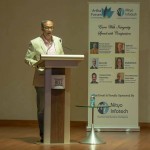
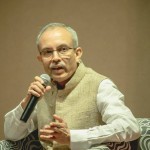
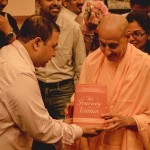
On March 19th, 2016 Artha Forum (a not for profit initiative dedicated to bringing the relevance of ancient wisdom to modern business) organized its 6th and largest ever event, in Singapore at RELC International Hotel. The event entitled “Earn With Integrity, Spend With Compassion” was attended by over 400 entrepreneurs, industrialists, corporate leaders and professionals. The event a joint effort with TiE Singapore and IIMPACT. World renowned spiritual teacher and author Radhanath Swami was invited to be the keynote speaker. Esteemed panelists shared the dais, including Rajiv Vij – Life and Executive Coach, Author and Speaker; Srinivasan Venkita Padmanabhan – President & Global Head of Finance at Olam Group, Madhabi Buch – Director at Agora Advisory, and Sanjiv Aiyar – President of PAN IIM Alumni and a longtime supporter of Artha Forum.
The panel discussion brought out very practical and important points. Answering the question of how to define “Earning with Integrity”, Venkita Padmanabhan said that earning goes beyond just earning money. It includes the relationships that we build, the lives we meaningfully change and the long term impact that we create. Rajiv Vij brought out the important point that compassion is a very high order need and does not just mean empathy. “Compassion” he said, “is not just the empathy in seeing the suffering and difficulty of someone else, but what it brings within us. What arises out of it? The deep desire to do something about it.”
Madhabi Buch gave her practical perspective on giving charity, saying “At different stages of our life we are in different gears and we have different bandwidth in terms of money and emotion that we are willing and able to allocate to different roles that we perform. And while it will be really wonderful if the underpinning principle of all that is compassion, but if on day to day basis – if it’s hard or difficult, I personally see very little harm in saying that, at this stage of my life, that part of compassion finds its manifestation in just writing a check for charity.“
Radhanath Swami began his talk by mentioning a famous quote “If you want to feel rich, just count the things you have that money can’t buy.” Reflecting on the current state of the society, he said that in the past, people used to love people and use things to express that love. But now people are loving things and using people to get them and keep them. He said, “Things can give some flickering pleasure to the body, senses and mind, but things can never give fulfillment to the heart.” He recalled his discussion with Mother Teresa where she mentioned that the true hunger of today’s world is not the hunger of stomach but it’s the hunger of heart.
Quoting Bhagvad-gita text 5.18, which states that true wisdom is to see all living beings with equal vision, Radhanath Swami said “Once we understand the sacredness of our own life, we can appreciate the sacredness of the life of everyone, everywhere. And we must understand the sacredness of the environment, which is a divine gift that we are all responsible to share with one another.”
Illustrating that true happiness and success stem from service rather than prestige Radhanath Swami cited the example of New York Yankees baseball Manager Joe Torre who lead one of the worlds most successful baseball teams and went on to become a top five manager in the history of the sport. Having gone through a very difficult childhood filled of abuse and violence, when he retired he began working with ghetto schools to give counseling, guidance and therapy to the children from abusive families. He found that true happiness was not from the awards, money and fame that he had earned, but rather from the smile which he sees in the faces of these children.
The event ended with thoughtful and intriguing lineup of questions which were posted in real-time during the sessions via a newly launched mobile site. Both Radhanath Swami and the other panelists fielded the questions with very practical responses on how to take back the topic of the event into one’s day to day life.















March 29, 2016
Radhanath Swami Addresses the Confederation of Indian Industry
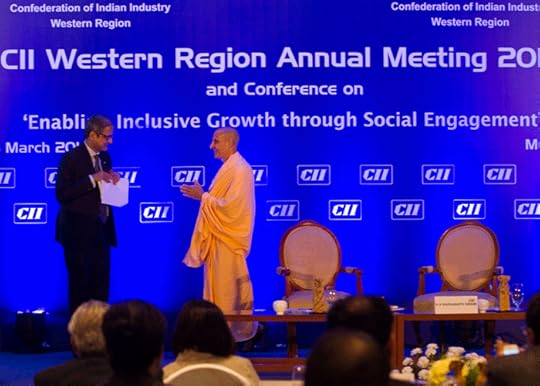

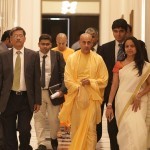
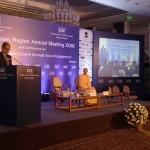
On March 16th, 2016, Radhanath Swami was invited by Mr. Sanjay Kirloskar, Chairman and Managing Director of Kirloskar Group and Western Region Director of Confederation of Indian Industry (CII), to deliver the closing Key Note Address at CII’s conference on ‘Enabling Inclusive Growth Through Social Engagement’ at the Hotel Taj Palace in Mumbai. Over 300 industry leaders attended. Founded in 1895, CII is one of the largest industry bodies of India with over 200,000 companies directly or indirectly part of its membership.
As per the Corporate Social Responsibility (CSR) – Indian Companies Act of 2013, every organization above certain turnover is expected to reinvest at least 2% of its average net profit for the immediately preceding 3 financial years back into the society on CSR activities. The purpose of the event was two-fold – one to discuss and deliberate on groundbreaking leadership attributes and to channelize social impact. The Nobel laureate Mr. Kailash Satyarthi was invited to share his experience on social impact while Radhanath Swami was given the task to enlighten the leaders on conscious entrepreneurship and the importance of corporate ethics to support positive growth which is need of the hour around the globe.
Radhanath Swami began by highlighting the importance of compassion, sharing his experience of speaking with one of the multi-millionaire businessman in the United States. He asked him to list down things which money cannot buy. It was unbelievable for the gentlemen as he was able to come up with a long list of things which money cannot buy. The essence of the conversation was one must earn with integrity and spend with compassion.
Radhanath Swami also quoted Mahatma Gandhi’s words “Be the change you want to see in this world”. There are usually two options leaders in the industry have during their journey – win at all costs versus win where it matters. When it comes to winning it’s very easy to compromise one’s values. Radhanath Swami ended his talk by highlighting the importance of satsang, sadhana and sadachar which are ingredients for leaders who want to be victorious by winning where it matters. Satsang involves associating with the right people, Sadhana involves engaging oneself in some kind of spiritual practice, meditation, etc. while sadachar is about building ones character. If one’s succeeds in a life which is not based on sound spiritual values then it could be like winning the battle but losing the war.
Other eminent speakers at the event included Mr. Chandrajit Banerjee Director General Confederation of Indian Industry and member of the World Economic Forum (WEF), Mr. Sumit Mazumder Chairman and Managing Director TIL Limited, Mr. Sudhir Mehta Chairman and Managing Director Pinnacle Industries Ltd., Tejal Patil General Counsel GE South Asia, Dr Mukund Rajan Member Group Executive Council Tata Sons Ltd., Mr. Ninad Karpe Managing Director and CEO Aptech Limited.
Below you will find feedback from few attendees of the conference.
“Spiritual leader’s discourse was phenomenal – I must appreciate CII for thinking of this ‘different’ method of delivering a standard message.”
Ravindra Bhide, Client Partner, Global Industrial Markets, Korn Ferry
“I was very happy listening to some very good talks by the eminent speakers called today.”
Tarun Grover Managing Director Tracers India
“It was a wonderful event and I enjoyed it.”
Jinesh Shah, Managing Director, Omnivore Partners
“It was the most divine experience listening to Radhanath Swami.”
Aliya Hasal, CEO, Drum Cafe