Radhanath Swami's Blog, page 15
August 16, 2016
The Journey Within Comes to Unity Church in Houston
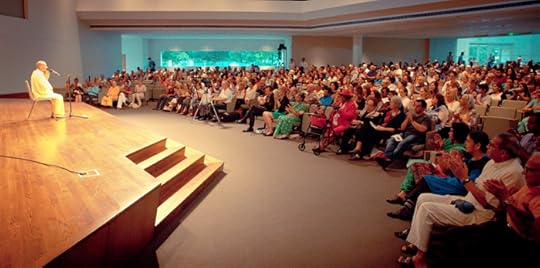
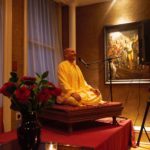
 On the evening of Saturday, May 21, 2016 Radhanath Swami was invited to speak on his new book The Journey Within at an event co-sponsored by ISKCON, the Call and Response Foundation, and other local yoga and faith based organizations in Houston. The event was held at Unity of Houston.
The Master of Ceremony, Emmy Award winning news person Ms. Patricia Gras, introduced specials guests Dr Helen Rose Ebaugh (Religious Studies at the University of Houston), Rev. Greg Han (Houston Interfaith Ministries), Giriraj Swami (ISKCON), Mr Vijay Pallod (Hindus of Greater Houston) and Ms. Amy Hertz the editor who initially encouraged Radhanath Swami to write The Journey Within. Over 700 people attended.
Vishvambar & Vrinda Devi Sheth (from the Mayapuris), along with long Houston based artists Anish and Bhagavan Pillai, inspired and entertained the audience with kirtan, music and dance.
Dr Ebaugh started with an introduction of Radhanath Swami that touched on his first book The Journey Home. A short film on Radhanath Swami’s life and works followed. Radhanath Swami then spoke on the encouragement and inspiration he received to write The Journey Within and shared with the audience some insights on the topics within the book.
Amy Hertz and Giriraj Swami addressed the audience after Radhanath Swami’s talk, sharing personal stories of their experiences in encouraging and helping Radhanath Swami write The Journey Within. This was followed by another kirtan which got the audience up and dancing. The Honorable Reverend Greg Han closed the evening with an inspiring note of thanks to Radhanath Swami for visiting Houston and encouraged the audience to continue on the path of interfaith dialog and finding common ground.
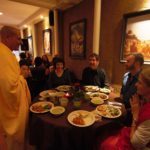
“It was truly a coming together of a Houston community inspired by common purpose”, said Nisha Vanodia one of the event organizers. Following the event a free vegetarian dinner was served, compliments of ISKCON’s new restaurant in Houston, Govinda’s.


















August 15, 2016
Radhanath Swami Speaks to Leaders & Staff at Hewlett Packard
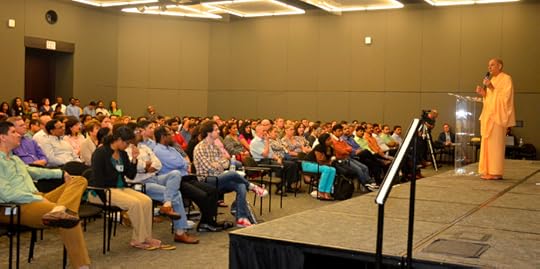 On the 18th of May, 2016 Radhanath Swami was invited to speak at the Hewlett Packard (HP) Campus in Houston, Texas on the subject “The Power of Positive Attitude”. The event was hosted by Venkatesh Yarraguntla, the director of Hewlett Packard Conscious Living Club and was supported by Toastmasters Club, IndusHP (HP Indian association), HP Chinese association, HP’s Black Employee Network and HP’s Young Employee Network. Aproximately 350 people attended the talk including Chris Parsons (Vice President of Americas Supply Chain), and Kent Biggs (a distinguished technologist and the evenings emcee).
After Chris Parsons began the evening by explaining about HP’s vision, Radhanath Swami expressed his gratitude to be with all the employees. In his talk, Radhanath Swami quoted Winston Churchill’s definition of success, which is to go through failure after failure after failure and not to give up enthusiasm. He cited example of Thomas Edison and how he failed several hundred times in his experiments. When asked if he was getting discouraged he replied “No, No, every time I fail, I become more encouraged, because I know one more way my experiment doesn’t work, and that means I am closer to understand how it does work!”
Radhanath Swami emphasized that if we are looking for reasons to complain and be disturbed, we will find limitless ways to do so, and if we are looking for how we can improve in all situations, we can find them too, because they are always there.
He then quoted Bhagavad Gita dehino smin yaha dehe, kaumaram yauvanam jara – our body and mind are always changing whereas we, the soul doesn’t. “Happiness cannot be circumstantial, it is a state of mind”. He emphasized importance of maintaining a strong spiritual foundation in our lives just as the redwood trees in California support each other during storms with strong intertwined roots. “Challenges will come in our life, but we all have capacity to rise above them and grow.”
After the talk, Radhanath Swami signed his copies of his new book The Journey Within and Venkatesh Yarraguntla presented a gift to Radhanath Swami as token of appreciation for accepting the invitation.

July 22, 2016
On Seeing Reversals as Blessings
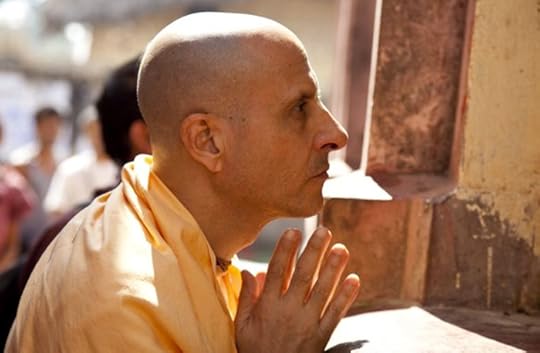
Reversals, even of the most difficult kind, have the potential to be the greatest opportunities in our life. The nature of material existence, even when we come to spiritual path, is that we are conditioned that things should go our own way. Material existence is a consciousness by which I am the controller, I am the enjoyer, I am the proprietor. And therefore we very much are accustomed to expect things to go our way. And if things don’t go our way, depending on our nature, we may become angry, may become vengeful, we may fight, we may give up, become depressed, commit suicide, withdraw from society, these are among the different ways the conditioned soul deals with they emotional crisis that “things are not going my way”. When we come to spiritual life we still have our same conditionings. It is not that as soon as we come to the path of bhakti we are pure.
When we go to the hospital it doesn’t mean that when you walk in the door you are free from disease. Usually after you walk into the hospital there is more pain than before we walked in. I walked into a hospital last week. I was feeling quite good when I walked in. But soon I was on an operating table, they were cutting organs out of me and they were sawing me up and soon I was lying there and they were asking me how many painkillers I want. A lot of pain, so many restrictions, so many problems. So when you go into a hospital as a patient, you can expect that things are going to get worst before they are going to get better, because that is the process of taking out the disease. Restrictions of diet, restrictions of movements. And then you are not even allowed out until they discharge you. Very difficult. So similarly spiritual life is like coming into a hospital for the heart. And there are going to be a lot of difficulties that we wouldn’t have to deal with if we just remained in the diseased condition without trying to solve.
One of our diseases that we come into spiritual life with is that we expect things to go our way. We also apply this to our spiritual life. I am serving Krsna and this is the way Krsna should deal with me. I have done these many pujas, these many sacrifices. He should make my children scholars, he should make them obedient to me. He should give me good health and in fact he should give all my family members good health. And my business, of course, because it is for him, it should flourish, it should prosper, without any impediments. And as far as my relationships, people should give me the honor and respect I am due, for being such a sincere and saintly person. More or less we all expect like this. But the problem is if Krsna gave you what you wanted, you probably you wouldn’t grow much at all.
Because bhakti is not about getting, bhakti is about seeking shelter. You only get Krsna when you seek shelter, you only get Krsna when you give up hope of anything else. If you want other things, that is the karma kanda mentality. You can get other things but you will not get the goal. So reversals come. And one of the problems is that the reversals are not the ones we like. It is our tendency to think that “I know reversals will come and I know if I take shelter of Krsna I will make advancement, but I will give my list of which reversals are acceptable.” But the problem is that Krsna has His own list. You made your list, but what you have on your list won’t work. Definitely the difficulties that Kuntidevi got were not on her list. But she thanked Krishna. Because she understood it was perfect. What appears to be a curse is a blessing if we simply appreciate the inner essence of the possibility of how to connect to God in that situation.
Therefore one of Srila Prabhupada’s most common and favorite of all verses is from the Tenth Canto of Srimad Bhagavatam spoken by Lord Brahma.
tat te ‘nukampäà su-samékñamäëo
bhuïjäna evätma-kåtaà vipäkam
håd-väg-vapurbhir vidadhan namas te
jéveta yo mukti-pade sa däya-bhäk
One who seeks the compassion of the Lord with folded palms, even in the phase of the most difficult possible adversity, seeking the compassion of the Lord, and bows down thinking “I deserve much worse, Krishna is just giving me this much, just to help me to turn to Him”, and if we do this with a grateful heart, däya-bhäk, that means it is our natural inheritance to go back home to the spiritual world, to attain the perfection of liberation. We have to see deeper than what appears. – Radhanath Swami
July 21, 2016
Understanding the Need to Go Deeper
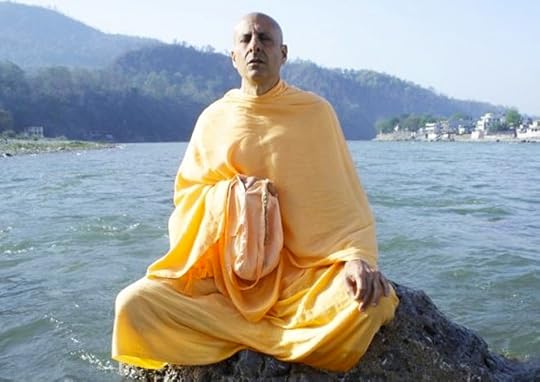
On the surface of the river are so many waves, and these waves are constantly changing. Some are swirling, some are foaming, some are crashing against each other. And no wave lasts for more than a few seconds. It’s the same water. The same water turns in to another form of wave, and another form of wave – waves are always in a turbulent situation. But if you go deeper, there is a constant current below the waves that is steady and peaceful.
Similarly, situations come to us in the different phases of our life. Everything is just like the waves of our lifetime. Sometimes we are young and healthy, sometimes we are old and diseased, sometimes we have cancer, sometimes we are winning athletic events, sometimes people love us and sometimes people hate us. It is all just superficial, on the surface – waves of time.
But if we go deeper we can understand, “I am the eternal soul, I am part of God” and we can make that connection between our own consciousness and the soul, we make the connection between the soul and God. That is constant.
For the soul there is no birth, no death. All of these superficial changes that happen on the surface of life have nothing to do with the soul, a current of truth. But very few people want to go deeper than the superficial appearance of existence.
On the superficial surface level of the waves sometimes things are really flowing as you like, but other times there is so much disruption. The purpose of that disruption is to break us from the complacency of being satisfied on the surface; to give us the sense of the real need to dive deeper into the constant current of truth. – Radhanath Swami
June 28, 2016
Finding Perfect Joy – A Lessons from St. Francis
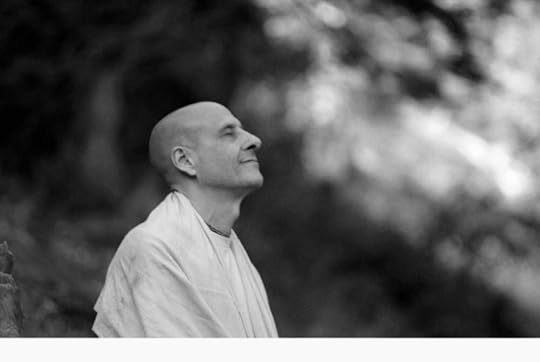
In Italy, near the city of Perugia, is the place called Assisi, the birth place of a very popular saint named Francis. He was the son of a wealthy merchant, but he took up the life of renunciation. Committed to a life of self-imposed poverty, humility, and devotion, he attracted many to follow.
“One day he was walking with one brother Leo from Perugia to a very famous temple, St. Maria of the Angel. He was walking for miles and miles, and it was freezing cold. It was raining and snowing. He asked his brother Leo, “I want you to write down whatever I say.” They were walking and it was already night time. He said, “What is perfect joy? If our brothers give excellent sermons glorifying our God, I do not consider that perfect joy. If our brothers give sight to the blind, they give ability to the lame to walk and to run, they give ability to the dumb to speak and deaf to hear, and even if they raise a dead man back to life, I do not consider that is perfect joy. Even if our brothers are so deeply learned that they know all philosophy and they know all the science and they have memorized expertly all the holy scriptures, I do not consider that perfect joy. Even if our brothers can prophesize what’s going to happen and tell the future and understand astrology and understand the intelligence and the mentality of all species of life and reciprocate with all species in that way, I do not consider that perfect joy.”
Brother Leo was surprised and asked, “Then what is perfect joy?” Saint Francis said, “If we can preach the message of God and convert every human being in the entire world to our faith, I do not consider that perfect joy.” So finally brother Leo said, “Francis, please tell me what then is perfect joy?” He said, “When we get to our destination St. Maria of the Angel and it is freezing cold in the middle of the night, we are covered with mud, and it’s raining on us, and we are starving of hunger and thirst, and then we desperately knock on the door. Then our brother answers the door and he asks, ‘Who are you?’ We say, ‘We are your brothers, this is Leo and I am Francis. We have come to be with you, to have communion with you. Please give us shelter.’ Then he looks up with scorn in his eyes, and says, ‘You are not my brothers. You are liars. You are despicable, low grade thieves pretending to be saints. You are exploiting and torturing poor people. You deserve to be punished. Get out from here.’ And then he slams the door in our in our face. I consider that if we bear that and thank God and forgive that man — that is perfect joy.”
“Then outside we are suffering so badly and we are freezing, we are starving, we are dying and we are desperately knocking on the door again and he comes to the door and he says, ‘Oh, you are back.’ We say, ‘My brother, we are your brothers. Please show mercy to us, show kindness to us, we are starving, we are freezing, and we are dying.’ Then that man becomes so angry, he picks up a big heavy stick, comes out and screams at us, and grabs us by the neck and repeatedly hits us until we are laying in the snow in bloody mess and he just leaves us there freezing, beaten, and blasphemed. In that state, if we could remember our Lord and think, ‘My Lord I have tolerated all of this and forgiven this man as an offering of my love to You’ — brother Leo, that is perfect joy. To expect and bear whatever may come into our life and remember the Lord, forgive and love our brother under all circumstances as an offering to the Lord, that is perfect joy.”
This quality of forgiveness is more illuminating than the light of the sun. Those who“justice or setback to us has to be seen as God’s arrangement. Not a blade of grass moves without the sanction of the Lord. To tolerate and to maintain the consciousness of forgiveness and compassion means, to pray as a well-wisher of everyone — our friends, our family members, and even our competitors and our persecutors. And thus see every situation as an opportunity to sincerely take shelter of the Lord. – Radhanath Swami
June 26, 2016
Radhanath Swami Interview with Examiner.com
 In May of 2016 Radhanath Swami was interviewed for the American news website Examiner.com by their Spirituality Examiner Bridgette Jackson-Buckley. She asked him about his new book The Journey Within, as well as other topics, in a charming and informative dialog. You can read the entire article and interview below.
The Journey Within with an American Swami
By Bridgette Jackson-Buckley
May 21, 2016
So I have to admit, I was a bit apprehensive to conduct an interview with a Swami. Prior to this, I had not had a direct encounter with someone who holds this religious title. I wasn’t sure if there was a particular way to address him, or a particular manner in which I should speak with him.
Now before I go any further some of you may ask, “What exactly is a swami?” Well, to continue along the lines of the uncertainty I experienced, I didn’t know either. I had to look up the definition.
The word swami means master. The name Swami is a monastic name given to one who has “set aside all of the limited, worldly pursuits, so as to devote full time effort to the direct experience of the highest spiritual realization, and to the service of others along those lines.”
Now that I was clear that there would be a master on the other side of the call, I finished reading his latest book, planned my questions for the telephone interview and began to wonder, “What have I got myself into? I am not spiritually prepared to talk with a master.”
Despite my initial concerns, the interview with Radhanath Swami turned out to be one of the most endearing and accessible interviews I’ve done.
Flowing like a conversation between two familiar acquaintances with undertones of kindness, patience, presence and sincerity, Radhanath Swami went on to explain that his most recent work, The Journey Within, is “meant to highlight the opportunity we all have to find deeper, more meaningful forms of happiness and being an instrument to give others that happiness.”
Here’s what Radhanath Swami had to say:
BJB: Could you talk about the difference between your memoir The Journey Home and your most recent book, The Journey Within?
RS: Actually, I never wanted to write either one. When I was 19 years-old I left my home in the Chicago area on a spiritual quest.
I decided to hitch hike from London through Europe, from Greece to Turkey, Iran, Afghanistan, Pakistan, to India and to the Himalayas. Through the journey I visited monasteries, cathedrals, holy people and synagogues. I studied Christianity, Judaism, and Islam. Eventually I came to India and studied various forms of Buddhism, Hinduism and yoga. I saw something beautiful and common at the essence of all these traditions. I believed in that essence and wanted to give my heart and my life to connecting with that essence.
I came to a very holy forest in India named Vrindavan where people consider it their holy place who are devoted to the one God, who appeared with the name and the form of Krishna. There I felt this was my home.
While there I met my guru, Bhaktivedanta Swami Prabhupada. I saw that he was representing a very ancient lineage of great enlightened beings. I was so influenced by his compassion that I wanted to assist him.
Over the years, since 1970 when I made that journey, people have asked me to write a book about it.
I had a consistent answer, “No.” I just would not consider it. One, I’ve never wrote a book before, so I’m not a writer. Two, if I told the truth about what happened to me I really didn’t think people would believe me because it was quite different. And third was, if I just write a book about me where the words “me” and “mine” are on every page, isn’t that an act of arrogance? I’m trying to go beyond arrogance.
So I was firm until one of my dearest friends, Bhakti Tirtha Swami, was dying of cancer. His doctor told him he had three days to live. He asked me to come visit him.
I drove about six hours and spent a day with him. The next day when I was about to leave he said to me, “I want to die in your arms. Please stay with me.” I thought he had two days, but he stayed for another eight weeks.
The most profound experiences of human relationships I’ve ever had in my life were during those eight weeks sitting by his bedside. We just shared our hearts to help each other connect with God, who we call Krishna.
Toward the end he told me I should write a book about my travels. He said, “It would be an act of arrogance” if I did not write the book. “If your story will inspire other people, then it’s your service to them to share it.”
I still didn’t want to do it, but I made the promise. He squeezed my hand, smiled and said, “You cannot tell a lie to a man on his death bed.”
A few days later he left us and I wrote the book, The Journey Home: Autobiography of an American Swami.
On one level The Journey Home is about travelling through some incredible and mysterious places, but it’s really about an internal journey of how I was being transformed by these situations in the good and bad times.
After The Journey Home was published, another publisher who had read it convinced me that I should I write a book about the universal teachings that I discovered on this path, using analogies and stories that would make these teachings easy to understand. This book is The Journey Within and in a sense is a sequel to The Journey Home.
BJB: In the introduction you write The Journey Within “…is a call to an adventure to reach beyond monotony and pursue your hearts deepest calling.” For those who have identified what they want to pursue and are taking action towards the calling, but still experience monotony and frustration. What is the deeper purpose of monotony? Is it a call to do more or be more?
RS: So much of how we are either diminished or we grow in the fulfillment, the happiness, the purpose of our life is according to how we perceive everyday events. Two people could see the same thing. One could be depressed by it and one could humble oneself before God in that process.
A knife is knife. A thief will see the knife as an instrument to kill somebody, and a surgeon will see the knife as an instrument to save a person’s life. According to the consciousness of what our purpose in life is, is very much how we’re going to perceive the same things.
The monotony, the fears and the challenges of this world come to everybody. It’s according to our consciousness how we’re going to respond to those challenges.
If we associate with people who inspire us and help us to connect within ourselves, read literature and expose ourselves to forms of entertainment that gives us a philosophical way of seeing the world, have a spiritual practice to develop that inner strength and inner vision then we see the world in a different way. The storms of life are then re-interpreted in a way that we can grow.
BJB: On page 19 you write, “The Supreme Being has appeared on earth many times in different places to teach us how to revive our awareness of our original nature.” If we have experienced several occurrences to relay the same message, why is the progress toward self-realization so slow?
RS: We all have free will. We all have our present state of consciousness and the past, which has very much influenced our present state of consciousness.
So for a person who has been smoking cigarettes for 20 years, it takes some time to feel happy without them. A person who has never smoked a cigarette in their life doesn’t need any time to feel happy without them. I’m sorry it’s such a crude example, but we’re very much habituated to certain mindsets and inclinations according to the decisions we’ve made in the past.
In that sense what might be very easy for some person to overcome on the spiritual path, or to be attracted to on the spiritual path, is very difficult for others.
Whether it’s difficult or easy, we all have the potential within us and the opportunity. In the Bhagavad Gita Krishna says, “If we’re sincere, then God helps us.” If we really try our best, sincerely, that’s all we have to do.The sincerity of our efforts is the true success of our endeavor.
BJB: What is the role of religion to remind us of our awareness of our original nature?
RS: In my search, I’ve met very enlightened Christians, Jews, Muslims, Buddhists and different types of Yogis from different schools of Hinduism. Within each religion there are people who are seeking the essence and who can appreciate that essence in others’ path.
And there’s also those who are perhaps quite insecure and therefore as a way of expressing that they become arrogant and sectarian and “my way is the only way.”
When you’re brought up to hear “my way is the only way,” then you really can believe it because there can be so many scriptural references to prove that. But in my life I saw that in every spiritual path there were people who were saying, “My way is the only way,” and they all had equally powerful spiritual references. It’s a contradiction.
Krishna speaks the Bhagavad Gita explaining that through our history, the one supreme God, the Father and Mother of all living beings is one source that has appeared in many ways, places and forms to present the same essential spiritual message; which is how to know Him, love Him and experience true spiritual happiness and be an instrument of that happiness beyond birth and death.
Religions are for that purpose of understanding what is truly the deepest meaning of life, the highest purpose that we’re here for and how we can discover the love that we’re searching for.
It’s not an impossibility, it’s not a fantasy, it’s the highest reality and it’s within us, but it’s forgotten.
BJB: What has been the most surprising and unexpected part of the spiritual journey for you?
RS: I think the wonderful opportunity to see how every moment unfolds and how every moment is a unique opportunity to surrender our hearts to our beloved.
BJB: Having relayed and experienced so much information over the past few decades, what questions do you have?
RS: When we develop faith in God as the origin of everything that exists, faith in God’s inherent goodness toward everyone despite the inconceivable changes of this temporary world, and faith in God’s name when we chant, we make that connection to God and open up our world view to see that deeper perspective of things even in the most ordinary of situations.
In that way the most essential questions of, who am I and who is God? What is my relationship with God? What is my relationship with this world around me to be a caretaker and respect the sacred property of the environment? What is my relationship with all my brothers and sisters in all different forms of life?
These answers I’ve come to understand by the grace of my guru and the saints, and by the wonderful spiritual practices I’ve been given.
What I’m striving to go in the direction of is:
How can I best serve in a particular situation?
How can I best help somebody?
How can I best overcome this problem myself?
How can I best make the right choices in life when there are so many uncertainties?
How to apply these eternal teachings to an ever-changing world according to the circumstances?
There are limitless unanswered questions. We have to humble ourselves and prepare ourselves to make the right choices.
BJB: Is there anything you would like for readers to know about The Journey Within that we have not covered?
RS: The book is a very sincere offer of service to whoever is kind and gracious enough to read it, and to help us in whatever spiritual path, or whatever path we may be on in life, to understand that there is a beautiful higher dimension of reality that is within us.
It can transform the way we see the world and the way we interact with each other.
Everyone is looking for happiness and The Journey Within, in its teachings and stories, are meant to highlight the opportunity we all have to find deeper, more meaningful forms of happiness and being an instrument to give others that happiness.
“In spite of his constant global travels over many years, Radhanath Swami established his spiritual headquarters at Radha Gopinath Ashram in Chowpatty, Mumbai. For the past twenty years he has guided the community development and has initiated a number of acclaimed social action programs including Midday Meal, which feeds more than 260,000 plates of vegetarian food to indigent children daily; missionary hospitals and eye camps; eco-friendly farms, schools and ashrams; and a number of emergency relief programs throughout India.”
Flowing with the same ease as our conversation, The Journey Within is spiritually and emotionally accessible. Presenting timeless teachings through simple metaphors, the Journey is a beautiful reminder that “life leads us on many journeys, and all are ultimately meant to lead us to the love that lies within us.”
June 25, 2016
Nourishing Our Higher Tendencies
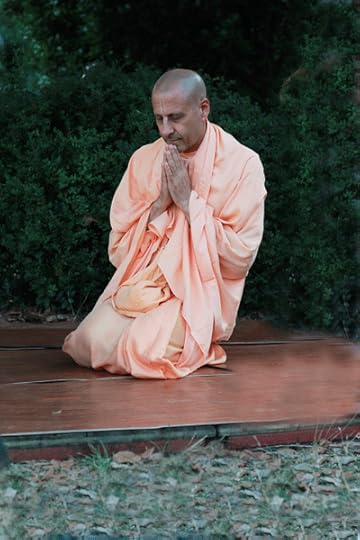 A Native American wisdom story tells of two dogs that live in every human heart: a bad dog and a good dog. The bad dog represents the lower tendencies of envy, anger, lust, greed, arrogance and illusion. The good dog represents the higher tendencies of compassion, integrity, generosity, humility and wisdom. These two dogs battle one another. Which dog will win? The one we chose to feed!
We “feed” the dogs through the choices we make. Using the intelligence for spiritual pursuits, to express compassion, and to love with integrity nourishes the good dog and keeps the bad dog at bay. Sometimes that’s easier said than done. For many of us, the bad dog has become so entrenched in us that it’s deafening howls drive our actions. Meanwhile, the good dog, weak and undernourished, is only a whimper in the corner of our conscience.
Practicing yoga strengthens the intelligence and empowers us to neglect our bad-dog qualities, however loudly they may howl. Then we’re free to feed the good dog, or our own divine nature. At each moment, life hands us the choice to be cruel or kind, duplicitous or honest, arrogant or humble, greedy or charitable, vengeful or forgiving. We can choose between selfish passion and selfless devotion. There are many things in the world that are beyond our control, but how we choose to act isn’t one of them. So we’re free to elevate our consciousness – feed the good dog – or degrade it. excerpt from Radhanath Swami’s The Journey Within
June 23, 2016
Radhanath Swami Speaks at the Byham Theater, Pittsburgh
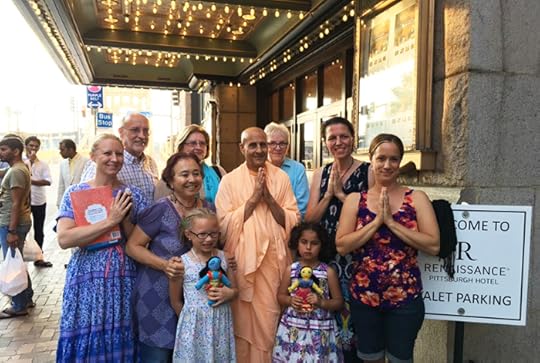
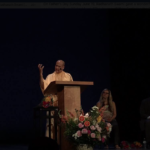
On Father’s Day Sunday June 19, Radhanath Swami gave a wonderful talk on his recently published book “The Journey Within: Exploring the Path of Bhakti ” at the Byham Theater in Pittsburgh. The book was very well-received and over 700 people attended the event. Radhanath Swami presented a wonderfully engaging talk focusing on the main themes presented in the Journey Within Book.






June 17, 2016
Ground Breaking Ceremony with UK Prime Minister David Cameron

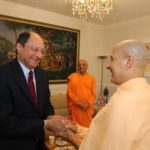
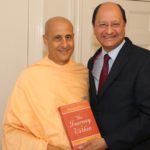
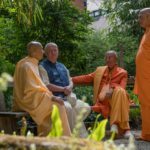
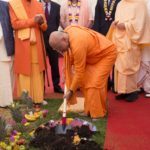
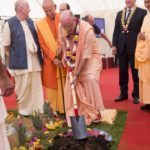
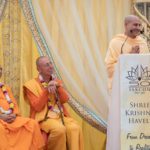
On Friday, June 10th, 2016 Radhanath Swami was in England to attend the groundbreaking ceremony for the Bhaktivedanta Manor’s long awaited Haveli building. The event was attended by UK Prime Minister David Cameron, who was hosted by Radhanath Swami along with Sivarama Swami, Indradyumna Swami, Bhakti Caru Swami, Pragosh Das and other ISKCON leaders from the Manor. The ceremony formed part of the Manor’s offerings to celebrate the 50th anniversary of ISKCON. Mr. Cameron congratulated ISKCON on by praising Srila Prabhupada for his creation of a “global mission”.
A reception of over 300 people, including Parliamentary Secretary Under State Shailesh Vara, devotees and patrons, was held in a marquee over the spot where the new Shree Krishna Haveli will be built.
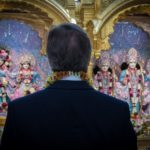
After being shown the Temple Room and deities of Shree Shree Radha Gokulananda, the Prime Minister went on to garland the deity of Srila Prabhupada, stating “if only he had lived to see what the Manor has become; a mock Tudor country house donated by a Beatle, serving as a hub of worship, celebration and selflessness.” (The Bhaktivedanta Manor was donated to ISKCON by George Harrison, of the Beatles.)
The Prime Minister also congratulated ISKCON on its 50th anniversary, joking that he too will celebrate his 50th birthday this year. He went on to say: “I look at what you have done in the past fifty years and I think how much you can achieve in the next fifty. In fact, the next half century begins right now as we begin building the new Krishna Haveli, and I’m delighted to be putting the first tool in the ground.”
Srutidharma Das, President of Bhaktivedanta Manor thanked the Prime Minister for attending, and spoke of the important role of the Haveli and the need to promote the spiritual values of tolerance and kindness. “We at Bhaktivedanta Manor aim to embody these principles at large.”








































May 27, 2016
Living Your Calling in an Age of Confusion
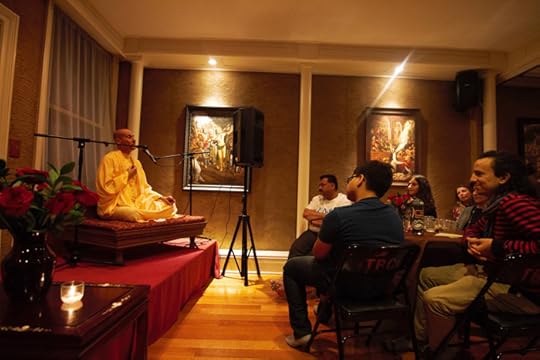
On the evening of Friday, May 6th, New York’s Bhakti Center partnered with Upbuild to hold a dinner event featuring a talk by Radhanath Swami on the topic “Living Your Calling in an Age of Confusion”.
Upbuild is an educational social enterprise created by Rasanath Das and Hari Prasad, who both used to live and serve at The Bhakti Center as monks. Upon graduation from the monastic order they went on to launch Upbuild which aims at maximizing the human potential by creating environments that inspire genuine purpose and authentic connection. Among the dinner’s 100 guests were many leaders in business, journalism and other creative fields.
Below are excerpts from Radhanath Swami’s talk on how true wealth and happiness are found through finding and sharing the divine love that lies within the soul.
Living Your Calling in an Age of Confusion
Times like we are facing these days are periods in human history that could potentially bring a rise in enlightenment, or just the opposite. Times of difficult, individually and collectively, are crossroads where we have to really question our lives.
What gives a thing value to a person’s heart is not the monetary price of it, or how it may stimulate the eyes or the mind. What gives value to anything is the exchange of love.
What is valuable? Things can give some degree of pleasure to the senses and the mind but things can never give fulfillment to the heart. Only love can do that. The nature of the heart is to love and be loved. The heart is starving for love. If it is not nourished, no matter what we get, we can never be satisfied and we can never be an instrument to give true satisfaction.
When we realize that love within us, and make it our life’s service to be an instrument of that love, which is expressed through compassion for the body, mind and souls of others, then our life is truly meaningful and fulfilling. With that integrity we can work harder than anyone, if that is required, but it is not motivated by greed, envy or arrogance – it’s motivated by love. By really caring and wanting to make a difference.
The greatest thing that we can pass down through our legacy is compassion, love and care based on moral values – principles of spiritual integrity. There is a saying, that if you lose your wealth you lose nothing, if you lose health you lose something, and if you lose your character you lose everything. Of course we need wealth and we see that when the economy is struggling it can really bring out the worst in people. But where there is compassion, where we see humanity and life itself as a family, then we will make our policies with the mindset that we are caretakers of each other, whether we are in investment bankers, farmers or even swami’s.
My guru, Srila Prabhupada, would often cite a verse wherein there is a simple phrase, para dukha dukhi. What is a evolved enlightened consciousness? This is how we can evaluate how we are progressing. When another person’s suffering is my suffering and when another’s persons happiness is my happiness – para dukha dukhi. It is not just a poetic idea. It is life’s deepest reality – that in giving we do receive. In loving we can access love.
When our mind and consciousness become clouded by selfishness, greed, arrogance, illusion, anger and envy, then we identify with those things and it becomes our calling to satisfy them by any means. But there is no substance there. It is vey shallow and it cannot last.
Yes, there are times of confusion, but what is that confusion? Its like a boat in the middle of the ocean and doesn’t have a compass it doesn’t know where it is going. Its pretty confusing. But if we know where we want to go and how to get there then life is no longer confusing.
Yes, there are so many difficulties and challenges, but challenges are inevitable in this world. But if we know what our calling really is, the calling of the heart – the soul, then we can pass through those challenges and only grow and find deeper realizations and experiences.
We only become inwardly wealthier through the trials and tribulations as well as the joys and celebrations of life. But when we lose that connection with our true self, then life is really confusing. One race, one religion, one nation is saying we are better than you. One person says I have rights to exploit you. For me to get richer is just part of the business, and to achieve my goals I can squash you and crush you. There is no substance to such a life. And when society starts to glorify and honor those things it is really confused.
Spiritual values, integrity, love and compassion is real wealth. And whether we are millionaires or swamis we can all make a difference in the world. We can all serve together.
The social body is like the human body. A healthy body is when all the organs and different bodily parts are working in harmony for a common purpose. Within the bodies we have our hearts, kidneys and pancreas and they all have different sizes, shapes and colors and very very different functions. They eyes can’t do what the feet can do but its not like the stomach is telling every part of the body, if I don’t give you food you die. The stomach is serving every part of the body and when every body has a common higher purpose the body is healthy but if different body parts are disunited from each other then the body gets diseased.
So similarly there are different occupations such as mothers, teachers, politicians, engineers and farmers and little swami and we all have our role to play as one social body with a common interest. And if we can’t realize and appreciate each other. then we can’t make a positive difference in this world. Its not sustainable, not very deep. Thats why people throughout the ages who have been activists, to truth, spiritual and social activists, they have tried to teach us what the Bhagavad-gita says, that real wisdom is when we see everyone with an equal vision and to really care. Thats love and thats compassion. Thats true humanity.
In the Bible it is said the first and great commandment is to love God with all your heart, mind and soul and that the testimony and expression of that love is that we will love our neighbor as ourself. And everyone is our neighbor. Wherever there is life, life is sacred. Compassion is very very integral. A confused society is when we lose touch with ourself, then we lose touch with each other, and we lose contact with God, and then naturally greed and envy, selfishness and anger perpetuate. But each and everyone of us have an opportunity and the sacred responsibility to make that journey within.
There are three principles that are universally very effective in helping us in that journey. In Sanskrit, satsanga, sadhana and sadachara.
1. Satsanga means to be in the company of people who elevate our consciousness, who inspire us, who deepen our faith in these true values. To be with enlightened people, or like minded people, who are on that journey to enlightenment. It gives us courage, strength and direction.
2. Sadhana means putting some time aside each day to really make that inner connection, to gain that inner strength, to cultivate that love. Like a gardner to water that seed of devotion that is within us of truth and joy.
3. Sadachara means to actually live with principles because its those principles that make our life truly meaningful. And its those principles that give us a chance to be an example that could really help other people’s lives. The world needs examples. We don’t have to be big or little examples, each and everyone of us could change the world by the sincerity of our own example.
Question: Would you say that people who have had loving parents in their lives can experience the feeling of surrender spiritually better than people who have not?
Answer: Its a wonderful opportunity. I write about this in my book The Journey Within. We all have our free will.
If we have loving parents it can give a deep deep samskara or impression in our hearts, and if we are grateful for that then we will deepen that to a greater spiritual connection and share that with the world. Thats how we can really show our gratitude.
But even if we didn’t have that, we can understand what it feels like not to have it and feel compassion for people. So in every situation we should try to be the change we want to see in this world.
The Bible says seek and ye shall find. Knock and the door will open. If we are seeking to grow, seeking to love and seeking God, in a true way, then even the hard times only helps the goodness of our own hearts to grow. And thats why keeping company who remind us of that, who help us to keep our compass of aspirations and values in life in the right direction, is very sacred and important.
Question: Earlier you were talking about how we are working together with a higher goal in mind. Is there a way to know in your own heart that you are doing the thing that is most helpful towards that?
Answer: The details are not always what’s important. Its the value and principles that motivate us. And there are universal principles. If we are sincere it’s quite easy to understand.
Are we seeking to be an instrument of God’s love? Are we seeking to exemplify values of humility rather than ignorance, generosity rather than greed, compassion rather than indifference, being a well wisher instead of being envious.
Is this our wealth? To serve and find happiness in whats really meaningful and good in God. Not in a sectarian way, but as a true well wisher. Is this the way we are doing our investment, or being a father or mother? Is this the way are being a student or running our business?
In this world we have to be competitive to survive, but that competition doesn’t mean we have to be evil or selfish. We have mentors, guru’s, and enlightened scriptures and books that give these essential values that we should live for. And if we are sincere, then we are doing the right thing. If you have the higher purpose in mind of being the caretaker of others, then you are doing the right thing. The purpose of this little place, The Bhakti Center, is for people to come together who share these values and try to give strength to those values that we have within ourselves and each other.
Photos by Dennis Fialkovsky