Radhanath Swami's Blog, page 17
March 24, 2016
The Flower Festival 2016
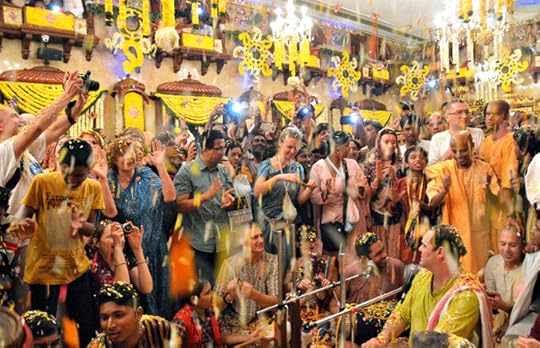

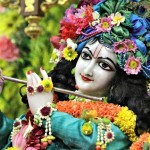
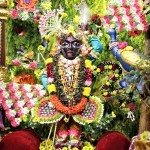
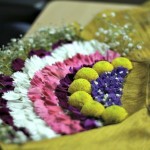
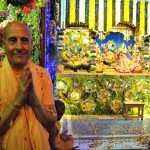
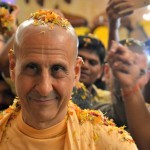
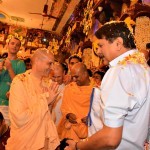
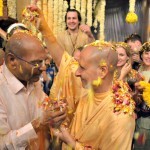
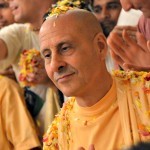
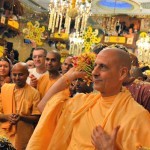
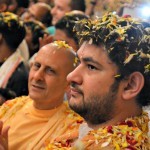
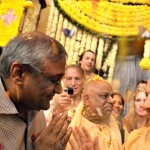
The Radha Gopinath Temple in Mumbai, India celebrated their annual Flower Festival on January 30th, 2016. Over two hundred western yoga teachers and students joined thousands of members of the Radha Gopinath Temple congregation for the event. Participants of the Bhakti Immersion Retreat held at Govardhan Eco Village rushed to Mumbai for the celebrations. Gaur Vani, of the music band The Hanumen, posted on the internet, “After seeing the new developments at Radhanath Swami’s Govardhan Eco Village (including life-size replicas of the holy sites of Vrindavan), tons of hugging cows, serving with villagers, and loads of kirtans and music and yoga classes we’ve come back to Mumbai for the world-famous Flower Festival….” Sixty students of Jiva Mukti Yoga’s Yoga Teachers Training also joined in.
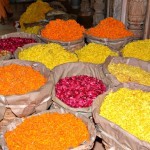
At 7:00 a.m. on the day of the festival a team of hundreds of volunteers began plucking petals from 2300 pounds of flowers – white and yellow chamomile, orange and coppery marigold, yellow and white chrysanthemum, pink and red roses, jasminum molle and jasmine. This seva continued for several hours as Radhanath Swami gave a talk describing the history and teachings of the path of devotion. Then in the evening those plucked petals were showered upon temple deities Sri Sri Radha and Krishna as Gaur Vani, Vishvambhar and his wife Vrinda lead the thousands of devotees in Kirtan. Finally the same petals were showered upon the devotees.
Gaur Vani posted on Facebook the next day, “At one point while chanting the entire harmonium gets covered in petals. I’m just poking at this flower covered, wheezing box hoping to hit something that sounds halfway decent. Flowers in every pocket, gap, opening, fold, and crevice. Still pulling petals out of cameras and backpacks the next day .
Just prior to the flower showers Radhanath Swami spoke of how bhakti unites us for the common purpose of serving Sri Krishna: “Here are people from Mexico and United States, from Canada and Sweden, from Switzerland and Australia, from Russia and Ukraine, from England and Italy, and a lot of people from India. And this morning everyone was sitting around the same little baskets of flowers, plucking petals, irrespective of what status, caste, sex or economic bracket we came from. Despite our incredibly amazing differences we are one in our love for God, in our compassion for each other, and in our appreciation for each other.”


















March 9, 2016
March 7, 2016
Launching Bengali Translation of The Journey Home
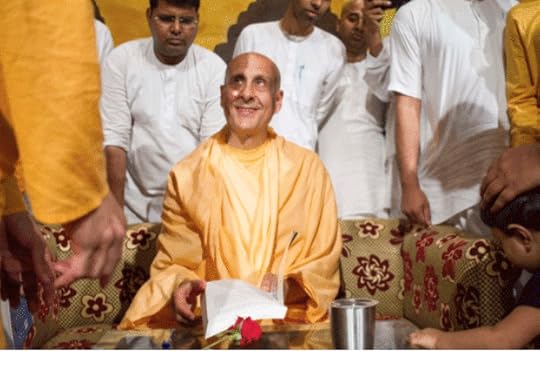
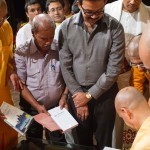
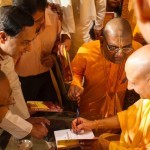
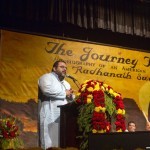
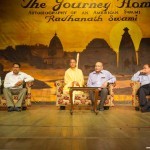
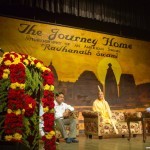
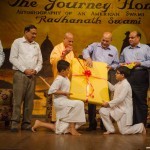
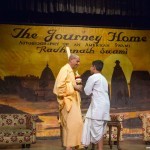
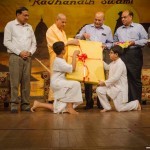
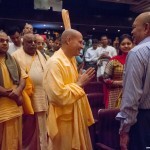
On the evening of February 19th, 2016 Grihe Pratyabartan, the Bengali translation of The Journey Home, was launched in G. D. Birla Auditorium, Kolkata, India.
Addressing a gathering of 700 guests, Radhanath Swami said, “Never have I felt in any book release so humbled, so grateful, and so happy, as I am feeling tonight.
Of all the religions, spiritual and yogic paths that I studied, and of all the teachers that I met – and there were many – in Srila Prabhupada I found the essence of everything I was looking for. And what was that essence? The spiritual culture of Bengal as taught by Sri Chaitanya. The lineage that Prabhupada connected me to, the Gaudiya Vaishnava Sampradaya, is based on the Bengali language, the scriptures that guided the passion of my soul – Chaitanya Charitamrita, Chaitanya Mangal and Chaitanya Bhagavat – are all in the Bengali language.
And today this tiny offering of mine, The Journey Home, its Bengali translation is launched. This is a special moment in my life.”
Former Mayor of the London borough of Harrow, Mrinal Chowdry, director of Adhunik Group Ghanshyam Das Agarwal, managing director of Techno India Group Satyam Roy Chowdry, Director General of Police and Commander General of Police Home Guard of West Bengal State Durga Prasad Tarenia and movie producer Dipankar Jojo Chaki were the special guests present for the occasion.
The event concluded with Radhanath Swami leading an ecstatic kirtan. The audience rose from their seats, raised their arms as they chanted responsively; some even danced in the aisles.






March 5, 2016
Visit to Goa
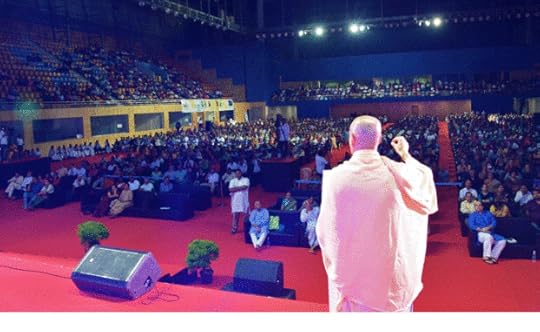
From 12th to 14th of February 2016 Radhanath Swami was at Goa, India. He addressed 9000 Goans at a two day event called Maha Jagruti, ‘the great spiritual awakening’, celebrating ISKCON’s Golden Jubilee. The festival was held at Dr Shyam Prasad Mukherjee Indoor Stadium.
The chief secretary of the Goan Government R. K. Srivastava, chairman of Dempo group Srinivas Dempo, chairman of NRB group Narayan Bandekar, and chief editor of magazine Viva Goa were present for Maha Jagruti.
At a program in Kranti Yoga Village Radhanath Swami reminisced about his Goan visit of 1971, details of which are found in his book The Journey Home. Kranti is a popular yoga school located amid tranquil coconut groves and luscious palm trees of southern Goa. 60 western yoga students attended the talk; 45 purchased The Journey Home. The Founder and Director of Kranti Yoga, Tarun Agarwal, was also present.
At another event, the inauguration of an ISKCON temple in Goa, Radhanath Swami said, “People from all over the world come to Goa in search of happiness, and so we have the chance to share with them the secrets of spiritual happiness as taught by Sri Chaitanya and Srila Prabhupada.”
February 29, 2016
Udupi: Paryaya Festival
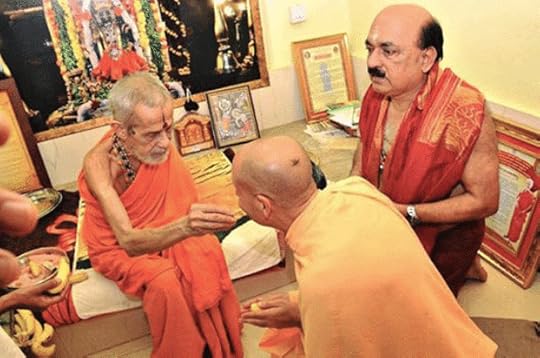
On the 17th and 18th of January 2016 Radhanath Swami visited the holy town of Udupi in South India to attend the biennial Paryaya Festival. He was personally invited by His Holiness Vishwesh Teertha Swami, the senior most pontiff of the Udupi Sri Krishna Temple.
There are eight pontiffs, each a life long swami, at Sri Krishna Temple, and they conduct worship on a rotating basis: each takes charge for two years, then passes the privilege to another pontiff, and awaits his next term that will come after 14 years. The festival marking the beginning of a new term of worship is called Paryaya. In this year’s festival the 85 year old Vishwesh Teerth Swami took charge for the fifth time. This was historic, as since the establishment of the temple no pontiff has received the privilege more than four times. Hours before the main ceremony began Vishwesh Teerth Swami had a private meeting with Radhanath Swami and some of Radhanath Swami’s students.
During the months leading to the festival, the media was abuzz discussing the life and teachings of Vishwesh Teertha Swami, and when the festival date arrived many prominent political leaders from across the country converged in Udupi including former deputy prime minister of India Lal Krishna Advani, union minister Uma Bharathi and chief minister of the state of Andhra Pradesh Dr. Chandrababu Nidu, among others.
Sri Krishna Temple was established 800 years ago by Madhvacharya, who also founded Madhva Sampradaya, a lineage of spiritual teachers. 500 years ago the mystic avatar Lord Chaitanya took initiation in the same lineage. And Srila Prabhupada, the founder of International Society for Krishna Consiousness, belongs to the same lineage.
February 16, 2016
What is Yajna?
 Question: I want to understand the concept of yajna (sacrifice) which Krishna talks about. Yajna, in relevance to modern times; can it be related to in modern times?
Radhanath Swami: Yes, it is a timeless principle. How to apply spiritual truths, according to time place and circumstance, takes wisdom – wisdom of the scriptures, wisdom of saints and wisdom of own intuition. So yajna has many meanings. In one sense, yajna means the ‘homa’, the performing of oblations to a sacred fire. And in another sense, yajna means sacrificing something selfish for something divine. Neglecting the bad dog to feed the good dog is also a form of yajna. Yajna also means whatever particular spiritual practice we perform – it may be puja, it may be bandana (prayer), or may be mantra japa.
This age of Kali is a time, or let us say a season, predominated by the tendency for quarrel and hypocrisy. Cornel West once, when we were having a conversation together in Princeton University, he said something that really inspired me. Because he is a very religious man himself as a Christian, he said, “In this world people are constantly being bombarded by weapons of mass distraction.” So our spiritual practices are meant to help us to focus our energies in such a way that we are making progress towards our spiritual goals in whatever we do. So to make those choices are a form of yajna. But in this age, where the tendency is strong towards quarrel and hypocrisy, where there are so many distractions, the simplest most powerful and accessible of all forms of yajna is the chanting of God’s names.
Lord Chaitanya wrote a prayer – namnam akari bahuda nija sarva shakes – “My dear Lord, you have many names that you have revealed in many religions over the ages. And you are personally present with all of your powers, with all of your grace, with all of your love in your names. And there are no hard and fast rules for chanting these names.” Even a child can chant. It doesn’t matter what material designation or role in our society may be; it’s so accessible. Whether you are in the bathroom, or whether you are on the altar of a temple, you can chant God’s names and we can invoke that grace and be purified by that grace. Lord Chaitanya himself personally chanted this mantra, Hare Krishna Hare Krishna, Krishna Krishna Hare Hare, Hare Rama Hare Rama, Rama Rama Hare Hare. He proclaimed, according to the Kali Santaran Upanishad, that it is Maha-Mantra, special medicine of a yajna to clean our hearts, to awaken that love within us in this age of Kali.
February 6, 2016
Radhanath Swami Gives Keynote Address at Event for Helping Vulnerable Women
“I wish I knew about Sharan when I first left home” were the words of Shaheen, a sixteen year old girl living in the UK who was being beaten, abused and disowned by her family. Shaheen used to live with her three sisters and parents until one day she was accused of speaking with a boy from her college by a male member of her family. Fearing that their family name would be dishonored, her parents stopped her from leaving her house, took away her phone and laptop as well as her self-esteem. Shaheen was often locked in her room and told not to speak with anyone, while her parents planned to force her into an arranged marriage. The one time she spoke out against it she was beaten and had her life threatened by her own family members. Thankfully, she managed to escape. Shaheen was since referred to The Sharan Project by a friend and is now a university student. She has a safe place to live and is more confident knowing that she is not alone.The Sharan Project, a charity that supports South Asian women, has helped hundreds of women in similar situations.
This year the founder of the Sharan Project, Polly Harrar invited Radhanath Swami to be the keynote speaker at their annual fundraiser at the Asia House, London. The event was introduced by Lady Gilda Levy the head of the Women’s Interfaith Committee in the UK.Radhanath Swami’s presentation took the form of an interview conducted by Sunny Grewal from BBC Radio London.
Radhanath Swami spoke of Sindhutai Sakpal, an Indian social activist who has overcome her own extreme hardships to dedicated her life to nurturing thousands of orphans. Preity Mohyal, a HSBC employee, who also volunteers for the Sharan Project appreciated Sindhutai’s story saying, “A woman who was torn to pieces by her own husband and shunned by her community, but still managed to give love and compassion to others is remarkable. She managed to give others a voice, and gave hope that you deserve to have freedom from abuse and a loving life.”
Asked to speak on the mistreatment of young women Radhanath Swami shared, “Tradition is meant to uphold that which is sacred. But unfortunately, when things go corrupt, then tradition is used to preserve that corruption, and this is what we are facing.… The laws of karma are especially relevant to our own family members. In God’s eyes, it’s not that anyone is “my wife” or “my daughter” or “my husband” – these are all God’s children, and we are caretakers. Wherever we have responsibilities for other human beings we are caretakers of God’s beloved children. And God loves all his children. That’s our spirituality, that’s our morality, that’s our ethics, that’s our humanness. Our daughters, our daughters-in-law are God’s beloved children.”
After the talk Polly Harrar exclaimed, “It was inspiring to hear the Swami explore how some of the most marginalized and isolated members of our society need our support and compassion. They need a voice.”
Sunny Grewal said, “It was brilliant, because I didn’t have to do anything. I just had to ask a couple of questions to Swamiji. See, it’s funny because it’s all about finding yourself and looking for the truth within. Swamji is on that journey himself and with a smile on his face, he’s sharing that journey with others”.
Other key guests included Guilda Navidi Walker from the World Wide Fund for Nature and Shefali Solanki from the Asian Media Group who expressed great appreciation for the event.
January 18, 2016
What makes us act selfishly?
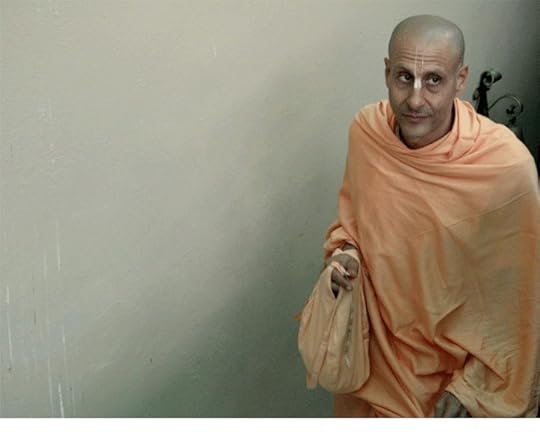 Question: The caring attitude is pleasing to everyone, but generally the default attitude in this world is one always thinks selfishly. So is it an inbuilt script of the mind that makes one think selfishly?
Radhanath Swami: The false ego misconceives: “I am this body, I am this mind, I am the controller, I am the proprietor, and I am the selfish enjoyer.” This is foundational to all material complications. It impels us to put ourselves above others and act selfishly. And when we continue to act in that way it becomes a habit. According to how we habituate ourselves, by making those wrong choices, we become more and more engrained in that way of thinking.
That is the way any habit works. For example, if you smoke a lot of cigarettes you become addicted, and the more you smoke the more you become addicted. The habit becomes a craving, and then it is very difficult to do anything without feeding your habit. When you are in the middle of it, you cannot really understand the effect of what you are doing because you are so much a slave of the habit. So that is exactly the way the ego works. Our selfishness, our arrogance, our greed, our selfish passions, our anger, and our envy – as we make choices to feed these habits, they become stronger and stronger and stronger.
But when we associate with saintly people we began to understand what we really want in life and what our condition is. And then we will take the medicine and the way of life by which we can become liberated from these habits of egotism. Chanting of the Holy Names is the simple medicine that will cure one from all the symptoms of ego, ignorance and selfishness.
January 14, 2016
Radhanath Swami Speaks to Concerned Doctors at GFESH Summit
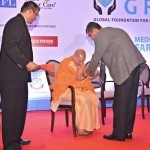
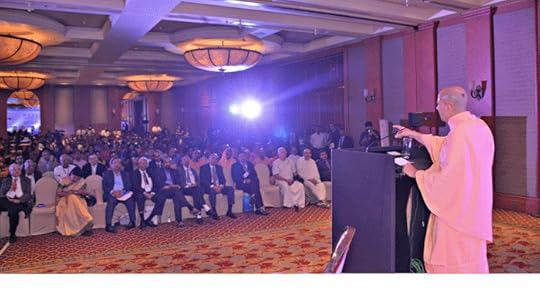 On January 3rd, 2016 Radhanath Swami gave the keynote address at the medical conference Medical Profession – Welfare Not Warfare held at Mumbai. The event was organized by the Global Foundation for Ethical and Spiritual Health (GFESH), a global initiative patronized by Radhanath Swami that aims to blend traditional spiritual science of healing with modern medical science. The event was supported by Indian Medical Association, Association of Medical Consultants, Association of Hospitals, and Mumbai Medical Society. Over 500 doctors attended.
The title of the event refers to a recent trend in India where, due to feelings of having been neglected or cheated, patients have attacked doctors and medical institutions both legally as well as through acts of violence. Radhanath Swami mentioned that the group of doctors gathered for the event, if they join together, can make an impact in reversing the trend and that although these doctors are exemplary, still they could see this as a wake up call to improve the level of care that they provide. Radhanath Swami said, “A true doctor treats each and every patient as he would like himself to be treated when he is a patient. We must see the presence of God in our patients.”
Participants in the discussions were experts from various fields, and mainly from medical care:. They included Director of Asian Institute of Oncology Dr. Ramakant Deshpande, who received one of the top civilian awards Padmashree in 2014, Dean of G.S. Medical College & K.E.M Hospital Dr. Avinash Supe, Director of Nursing at Hinduja Hospital Mrs. Phalakshi Manjrekar, and Joint Commissioner of Police Mr. V. V. Laxminarayan.







Preparing Ourselves Spiritually
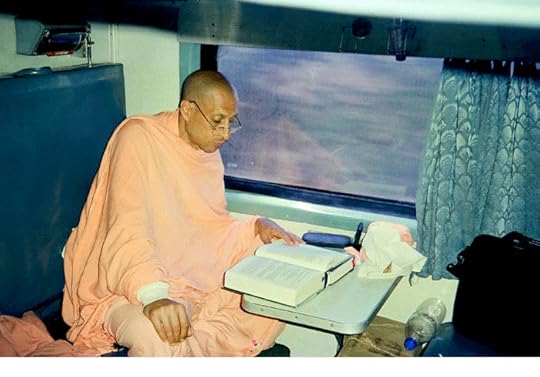 Question: How can an aspiring spiritual practitioner prepare for something disastrous that can happen at any moment, and how can he or she tackle the situation of uncertainty?
Radhanath Swami: Our whole life should be prepared for each moment. If we have a strong foundation, when a storm comes you will have strength. If we have the wisdom and intelligence that is coming from hearing the great scriptures like Bhagavad Gita, Srimad Bhagavatam, and Chaitanya Charitamrita, if we are properly nourished with philosophy and if we are chanting the holy names properly and not committing offense to others, we get spiritual strength and intelligence, and then when these moments come we will be prepared.
If we are not prepared when the moment comes it is just like….when I was in Vrindavan, India, in 1971, there was a war between Pakistan and India. At night everyone was told to stay inside; they would cut out all electricity for the whole of Vrindavan, and if you had a candle or something you had to put a black covering over your window. The idea is that when the enemy planes come over and when they see light they will bomb. There was preparation. If you know that you are going to be attacked then you have to prepare yourself to be safe. It is not that just do anything you want and it does not matter.
So we know that maya (illusion) is going to attack. Definitely, she will attack you every day in so many ways from within and without. So we should prepare ourselves. We prepare ourselves by chanting attentively, hearing Srimad Bhagavatam, avoiding offenses to others, sincerity of our prayers of feeling helpless and crying out for Krishna’s mercy. Then when the storms come and the attacks come, we have some preparation.