Radhanath Swami's Blog, page 12
March 23, 2017
Radhanath Swami Speaks at Kirtan London
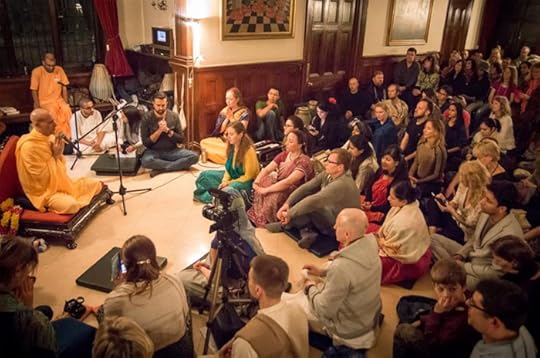

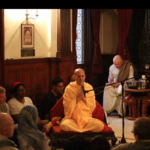
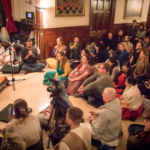
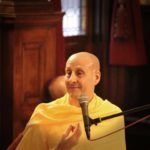
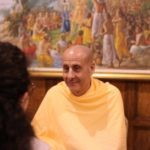
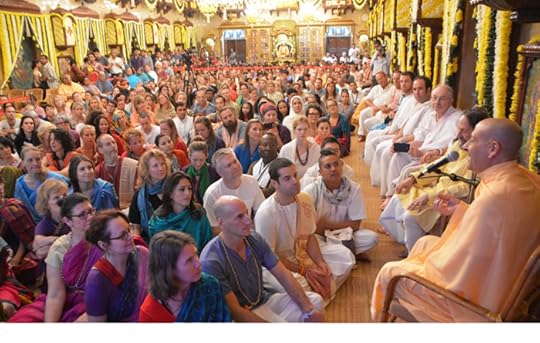
On 18th March 2017, Radhanath Swami spoke to the metropolitan crowd of 140 people at the breath-taking Kirtan London day retreat at Bhaktivedanta Manor.
Started five years ago by a small team and launched with Russell Brand and Radhanath Swami himself, Kirtan London has grown into an attractive movement to spread mantra, music and meditation. Jahnavi Harrison, one of the founders of the project, said “the aim of the initiative is to take kirtan to everyone! We want to take kirtan to people who typically wouldn’t come across it.” Since then it has grown into a variety of projects:
– Six Hour Kirtan – an extended celebration of kirtan that occurs every season.
– Mantra Lounge – a bimonthly session of evening kirtan in the bustling heart of London, Covent Garden.
– Barefoot in The Park – a summer festival of singing and meditation under the shelter of the bandstand in Hyde Park.
– Bhakti Sangha – a discussion of philosophy and wisdom related to the practice of kirtan.
– Retreats – residential and single day retreats to dive deeper into the meaning and practice of kirtan.
On this particular day retreat, pilgrims were gifted with sessions of yoga, kirtan and even milking the cows on the local farm. The retreat’s finale was Radhanath Swami addressing the audience on overcoming negative habits. “Time is precious. Although we measure it in units such as seconds or minutes, in the Vedic literature time is described as a force which no amount of wealth can buy back” started Radhanath Swami. “Yet we are creatures of habit. Our actions set deep impressions as a mindset within us. Every time we do something spiritual we become happier, but if crave for prestige and worldly things then we get habituated. It is positive association that can help us change habits.” The talk was concluded by speaking of the mind being like a monkey and the only way to control it is by yoga: “Bhakti yoga is to experience the inner pleasure of connecting with our true inner self and real nature. We are not dependent on external things for our happiness. To connect with inner love and live with compassion is the higher taste we need to give up our binding habits.”
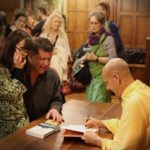
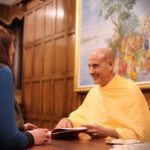
After the speech, Radhanath Swami signed copies of his bestselling book, ‘The Journey Within’ and took questions.
It was comments galore on social media after the event. “His talk was very amusing” said Lucy Munday, a yoga teacher and therapist from London. “I was so blessed to meet him. He asked me my favourite part of his book and gave me prasada!”
Craig Thomas, a student at Cass Business School, echoed the same sentiments. “A truly magical moment last night conversing with Radhanath Swami. Having spent hours listening to this man on YouTube and on his app, RISE, I picked up the courage to introduce myself, on this rare occasion he is in London, to let him know how grateful I am for what he has done for me. You don’t need to be spiritual or religious to connect with the ancient wisdom he imparts. I promise you that you will be taken aback by his majesty, gravity and humility.”
Special thanks to Kanhaiya das, Radha Govinda das, Radhika Ranjana das, Balaram Nityananda and the rest of the team from Kirtan London who oversaw and managed the event and continue to inspire the diverse crowd that Bhaktivedanta Manor for spiritual upliftment.
Written by Vinay Raniga









February 28, 2017
From Illusion to Reality
 The difference between material and spiritual life is our perception. How we see the reality around us. According to our conditionings, the species of life we are in, the various designations we have identified with, our desires and our ego, everything is being filtered and creates a perception.
A simple analogy. If you wear rose colored glasses everything looks rosy. So we, the soul, are perceiving life through the ego, then the intelligence, then the mind and the five senses. So what is real? Spiritual life is not about interpreting reality according to our different conceptions and conditionings. Real spiritual life is about waking up to the internal underlying substance of truth that is within everything.
So how to go from illusion to reality? Be quite convinced of our present condition and the inaccuracies of what the world is so strongly generating today. When the blind lead the blind they both fall into the ditch. Therefore, the realizations from other conditioned souls are based upon an ascending form trying to figure things out. But ahoksaja means revealed knowledge, evidence that is revealed from God, descending down.
When you buy a complicated piece of machinery there is an owner’s manual from the manufacturer, as they know how it works and what it is for. The manuals for this world are called the Vedas or holy scriptures that have been revealed throughout the ages in different places at different times according to the capacity of people to digest. But the truth is the same.
Therefore, if you want to look for real substance, meaning and truth in life, then you have to come out from amongst men and be separate as the scriptures say. So anyone who sincerely and honestly questions their existence and leaves behind all their preconceived indoctrinations could easily understand I am not this body but the consciousness, the life force within this body seeing through the eyes, tasting through the tongue and loving through the heart.
This world is a place to cultivate life’s perfection rather than forget it. Our eternal nature is to serve God and in that nature we realize God’s love which is the essential aspiration of every living being – to find the pleasure of perfect love. Its why people murder, steal, drink and get intoxicated with drugs, gamble, watch TV and go to the movies, give charity to others, get married and have children or look into religion. If you examine every motivation that every human being has, its for the desire for pleasure or the reaction to the frustration of not getting pleasure. Yet there is only one pleasure that can truly satisfy the heart and that is pleasure of love. If you have everything else but you don’t have people who love you and you don’t have people you love, your life is miserable and lonely and empty.
So this is reality and why do we all have that in common? Because our nature is to love God and are seeking that love in everything and anything at all times and that love is within our own hearts. So reality is on the spiritual platform – to see everything in relationship to the truth in relation to God. This realization can be easily understood and realized through the same process we have been conditioned to forget the truth – by our association.
So we need to transform our conditioned habits to spiritual habits and the most powerful way is to chant the names of God. The names can reveal our true identity and uncover the blissful life that is buried within our hearts. So go deep into the contemplation of what you really want in life. Don’t be exploited by the jargon and propaganda of the illusions of this world. Search for light, truth and and real love. – Radhanath Swami
February 26, 2017
The Nature of Difficulties
 Question: Even if we look in the right direction and do the right things, why some difficulties still come?
Radhanath Swami: If you are in the ocean, even if you swim correctly, do you still get wet? Yes, because you are in water. So, the nature of this world is there will be difficulties. No matter what right or wrong we do there will be difficulties. If we are going in the wrong direction, the difficulties will be perpetuated, complicated and worsened for the future. If we’re going in the right direction, by passing through those difficulties, we will be liberated. Wrong direction leads to further bondage.
What is the Purpose of Temples?
Question: What is the purpose of temples?
Radhanath Swami: A temple is a place where people are in a selfless spirit of compassion and love, and are truly worshipping God and surrendering their hearts to him. A temple is a place that transforms your life, by illuminating you and bringing you to higher states of consciousness and higher states of living.
Temples are not just places where you give donations, see the deities and say a prayer. It’s pious to go to a temple and give a donation and walk away. That’s nice, but you will not get enlightened by that. Temples have always been established by acaryas as spiritual, educational institutions.
We have so many educational institutions. My Guru Maharaj, Srila Prabhupada, went to MIT, Massachusetts Institute of Technology, in Boston. He said, “You have thousands of courses in your syllabus but there’s not a single course in this whole college that’s teaching people who they are and what the ultimate aim of life is. In all of these great tools that they are learning in MIT, they are only really as valuable as the ideals and intentions of a person’s utilization of them.” The most dangerous people in the world are not the uneducated peasants, but the people with big educations but filthy, dirty hearts filled with envy, pride and hatred.They are the greatest dangers to the world. Academic knowledge are facilities, they are tools. The more powerful the tool, the more they could either do benefit or harm depending on whose hand it’s in.
So the purpose of religious buildings is to educate people to be first-class human beings, people who can actually be examples of integrity and spiritual principle. When you go to that type of temple, church or mosque or gurdwara, if we go to that place, where we are actually getting that higher consciousness, then our life becomes very deep and substantial.
What is the Purpose of Temples?
Question: What is the pur...
What is the Purpose of Temples?
Question: What is the purpose of temples?
Radhanath Swami: A temple is a place where people are in a selfless spirit of compassion and love, and are truly worshipping God and surrendering their hearts to him. A temple is a place that transforms your life, by illuminating you and bringing you to higher states of consciousness and higher states of living.
Temples are not just places where you give donations, see the deities and say a prayer. It’s pious to go to a temple and give a donation and walk away. That’s nice, but you will not get enlightened by that. Temples have always been established by acaryas as spiritual, educational institutions.
We have so many educational institutions. My Guru Maharaj, Srila Prabhupada, went to MIT, Massachusetts Institute of Technology, in Boston. He said, “You have thousands of courses in your syllabus but there’s not a single course in this whole college that’s teaching people who they are and what the ultimate aim of life is. In all of these great tools that they are learning in MIT, they are only really as valuable as the ideals and intentions of a person’s utilization of them.” The most dangerous people in the world are not the uneducated peasants, but the people with big educations but filthy, dirty hearts filled with envy, pride and hatred.They are the greatest dangers to the world. Academic knowledge are facilities, they are tools. The more powerful the tool, the more they could either do benefit or harm depending on whose hand it’s in.
So the purpose of religious buildings is to educate people to be first-class human beings, people who can actually be examples of integrity and spiritual principle. When you go to that type of temple, church or mosque or gurdwara, if we go to that place, where we are actually getting that higher consciousness, then our life becomes very deep and substantial.
February 24, 2017
Tuning Into Grace
 Lord Caitanya and Lord Nityananda descended into this world to teach us that the power of illusion is inconceivable, but by the grace of the Lord we can overcome all obstacles. The three modes are impossible to cross over but one who takes shelter of Krishna can easily cross beyond it. How is that? When we take shelter of the Lord we attract the grace of the Lord. The path of Bhakti is to access that grace. By our desire to serve and please the Lord, our humility and devotion, and by living a very moral and proper life, living with integrity, dignity, humility and with devotion we cleanse our heart through the path of bhakti.
In this world there are so many frequencies that affect our consciousness. Television these days may have a 100 channels. According to what you tune into will you access that particular frequency. Thats the way the world works. We are just like antennas. Everything you say, feel and do is emitting a certain energy and frequency. When we tune into lust its going to access us and its going to fill us. You just focus on something thats creating that lust and that energy is going to go right into your consciousness.
Spiritual life is about tuning into transcendental frequencies. Some tune into mystical powers or liberation. But bhakti means to tune into grace – to Krishna’s grace which is all pervading. When we do so it cleanses our heart of all of this lust, envy, greed, anger and illusion. There is nothing else but grace that can awaken the dormant love of God that is within our hearts.
There is no amount of tapasya or learning or charity that can gain devotional service. It only comes by grace. Srila Prabhupada said, if one chants the names of the Lord in a sincerely, without any ulterior motives, and practices bhakti in that spirit, we can tune into that grace. Kirtan is the collective of all of us tuning in together to the all powerful love of Krishna by chanting the Maha-mantra and invoking that grace. – Radhanath Swami
January 21, 2017
Govardhan Eco Village Receives UNWTO Award For Innovation
The UN World Tourism Organization (UNWTO) is the United Nations agency responsible for the promotion of responsible, sustainable and universally accessible tourism. The organization is committed to promoting tourism as an instrument in achieving the Sustainable Development Goals, geared towards reducing poverty and fostering sustainable development worldwide.
The Govardhan Eco Village is a a 70-acre sustainable farming community and retreat center on the foothills of the Sahyadhri Mountains, 108km north of Mumbai, India, dedicated to living in harmony with the environment and developing a ‘spiritual ecology’ that can bring about tangible, positive changes “within ourselves – and how we interact with the planet”.
Srila Prabhupada, the Founder-Acharya of the International Society for Krishna Consciousness, frequently encouraged his disciples to adhere to the principle of “simple living and high thinking” by developing farm communities for healthful and ecological living. To serve this vision, his disciple Radhanatha Swami, the spiritual mentor for GEV, envisioned a sustainable farm community in India and inspired his followers to create GEV.
Despite its humble beginnings in 2003, GEV is now an award-winning eco community where the technology of modern science combines with Vedic wisdom. It provides a sustainable solution to the ecological crises we are now facing throughout the world.
December 24, 2016
Los Angeles Times Interviews Radhanath Swami on How to Cultivate Compassion in the Workplace
 On December 14th The Los Angeles Times published a short interview with Radhanath Swami conducted by Kavita Daswani. The Article was
entitled “How to Cultivate Compassion in the Workplace”. The contents of that interview are below. The original articla can be viewed at lattimes.com.
On December 14th The Los Angeles Times published a short interview with Radhanath Swami conducted by Kavita Daswani. The Article was
entitled “How to Cultivate Compassion in the Workplace”. The contents of that interview are below. The original articla can be viewed at lattimes.com.
The irony is not lost on Radhanath Swami that he speaks to international financiers but hasn’t had a bank account in 40 years.
“I last signed a check in 1969,” said the author and spiritual figure. “And here are these business people asking me to teach them. I guess we all have our purpose.”
We caught up with the Mumbai-based activist and lecturer as part of a speaking tour for his latest book, “The Journey Within: Exploring the Path of Bhakti.” Radhanath Swami was born Richard Slavin to a Jewish family in Chicago but left the U.S. at age 19 and ultimately ended up in India, living in caves in the Himalayas and studying yoga.
At age 31, he became a Hindu monk. He has been invited to speak at companies like Google, Apple and Starbucks on subjects including compassion in the workplace.
What’s the main message you share with business leaders?
It begins with what we value as real success. There’s a saying that you know how rich you are by what you have that money cannot buy. Material things can give pleasure to the mind and senses, but it is fleeting. Those things cannot give fulfillment to the heart.
If things aren’t going well at work, what can people do?
Everyone needs a practice that helps them to respond to stresses at work in a positive way. It can be meditation, chanting or prayer. When frustrations come, we’re not disturbed by them. When we go home, we’re not bringing the baggage of anger with us.
In your lectures, how do you address issues like inequality and discrimination in the workforce?
Greed, selfishness, arrogance are rooted in the human heart. If we remind ourselves of the sacredness of our humanity, that can change. There are people who truly share their wealth with their employees, who see fairness as their responsibility. I knew of a large textile manufacturer who lost almost everything. Many employees stayed with him even though he could no longer pay them because he had always been good to them.
Are company heads responsive to your message?
People are looking for something deeper than the superficiality of life. Integrity is the most important thing when seeking a fulfilling experience in every aspect of life, including work. If we have a foundation of inner fulfillment, storms will come, but that purpose will keep us focused.
Do people think that being more compassionate at work means they lose their edge?
It’s a common misconception. I have met many wealthy and powerful people who are humble and respectful and every bit as effective, dynamic and competitive as others. Whether you are a villager or a billionaire, everyone is entrusted with a divine purpose in their lives, and that’s why we work. It’s not a sectarian concept. We want to be instruments of compassion in the world and toward our greater family of humanity. Otherwise, we just become prisoners of our own success.
December 16, 2016
The New App Rise by Radhanath Swami

Rise brings its users short bursts of wake-up wisdom from the comfort of their phones. It has simple, uncomplicated spiritual tools specific for everyone’s needs. If you’re stressed, search through the videos on stress. If you’re looking for advice on relationships, search through the videos on relationships. And if you’re looking to realize your inner self, the app may even have something for that too. It’s a practical, accessible approach to spirituality created for the modern world, which is why it all fits into everyone’s mobile.
Rise was inspired by Radhanath Swami, a lifelong monk in the bhakti tradition and author of the New York Times bestseller, The Journey Within – Exploring the Path of Bhakti. With a wealth of experience on mindfulness meditation, relationships, happiness and wellbeing, his daily doses of inspiration are just what many people need to start the day right. Users can tailor content based on topic, save their favorites for easy navigation and read the video summaries for a quick insight.
But that’s not all. In the next update, users will be able to learn from full-feature courses on motivation, leadership, kirtan and a host of other topics – created by Radhanath Swami and friends – all to help people demystify spirituality.
An integral part of Rise by Radhanath Swami is the philosophy. The app is completely free of charge. No in-app purchases or hidden costs; all their content is free. They simply run off the donations of the users. In fact, running costs aside, any profit made goes towards charitable projects founded by Radhanath Swami or those close to his heart. (The following article by Bala Nimai Das first appeared on the website http://iskconnews.org.)
Not just on your phone – for those using an iPad or tablet, download the new App free for daily inspiration wherever you go.
Download Apple here
Download Android here
Video of app on phone
Video of app on ipad