Radhanath Swami's Blog, page 8
February 7, 2018
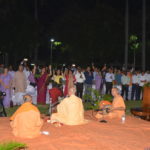
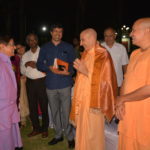
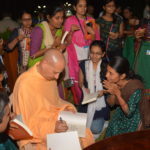
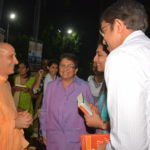
Radhanath Swami Speaks at Governor’s Bungalow, Pondicherry
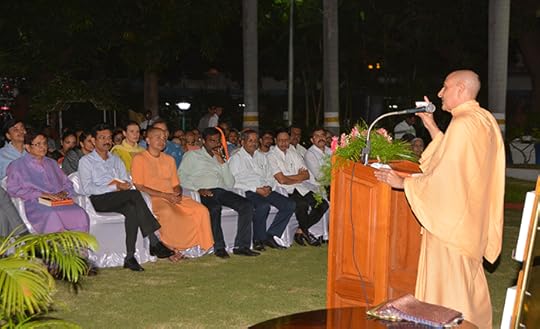
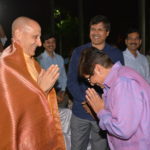
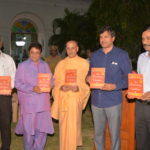
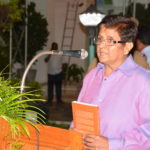
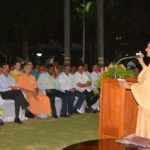
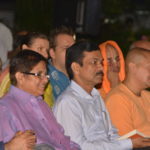
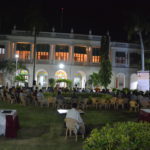
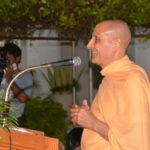
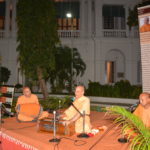
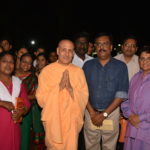
Radhanath Swami was invited by the Honorable Lieutenant Governor of Pondicherry Mrs. Kiran Bedi to speak at her official residence Raj Nivas on 23rd December 2017. He spoke from his book The Journey Home, and the talk culminated with the launch of his second book The Journey Within. Radhanath Swami’s talk was part of Raj Nivas Lecture Series, an initiative by the Governor “to engage citizens of Pondicherry on thought leadership through a series of interactive sessions by eminent speakers from the fields of history, art, leadership, literature, management, science, culture, health, spiritually and more.”
The talk was attended by Lieutenant Governor Mrs. Bedi, a retired police officer who, while in the police service won the Ramon Magsaysay Award as well as worldwide acclaim for her reforms in Tihar Jail in India. She was the first woman to join the Indian Police Service and the first woman to be appointed the United Nations civilian police adviser. “We can’t thank enough Radhanath Swami for accepting our invitation to come to Pondicherry. I have never seen an audience so rapt in attention as the audience were during his talk today,” said the Lieutenant Governor. “Radhanath Swami is a remarkable gift of divine grace to India. To come across living legends and saints like him is very rare. It will be my dream come true if I see The Journey Home made into a movie during my lifetime,” she said.


January 22, 2018
Radhanath Swami’s Pilgrimage to Mayapur 2017
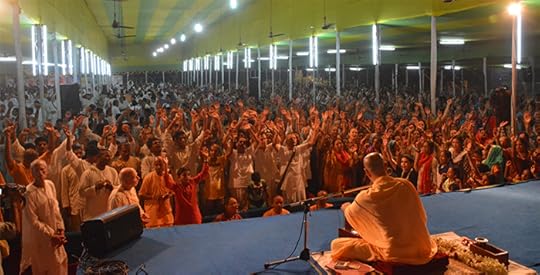
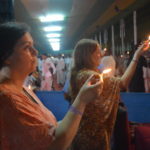
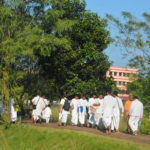
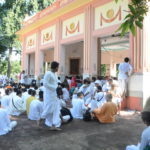
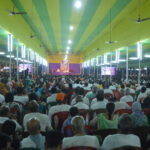
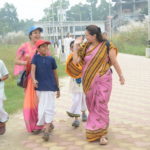
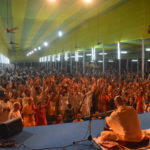
Over 6000 devotees from 34 countries joined Radhanath Swami on a pilgrimage to Mayapur, birthplace of the mystic avatar Sri Chaitanya, from 19th to 27th October.
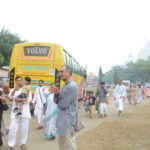
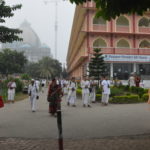
Everyday thousands of pilgrims would rise early to take a delicious breakfast, and then divide into eight groups to visit various holy places. The parties traveled, some by boat through the Ganges, some by foot to close by places, and others by buses. It was beautiful seeing thousands of people singing together on fleets of simple traditional Indian boats, eager to see, eager to experience the sacred places they were destined to visit for the day. When each group arrived at their particular location, there was education by inspiring lectures and discussions, as well as sweet kirtans and devotional ceremonies. “Visiting the very locations where the Lord performed his pastimes was a divine experience,” recalls Craig Thomas, one of the pilgrims who hails from London.
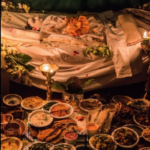
In the afternoon the eight groups returned from their destinations to enjoy a nine course lunch feast.
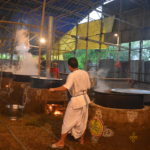
While the number of pilgrims joining Radhanath Swami for the annual pilgrimage has been steadily increasing over the years, the volunteers running the kitchen have been upgrading their technology, and more so their commitment; this time they had set up the kitchen in a vacant field to prepare meals for the 6000 pilgrims. The magnitude of the kitchen’s operations has even attracted media attention. The kitchen was featured on National Geographic channel last year under the series “India’s Mega Kitchens”.
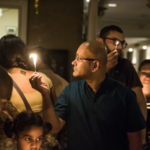
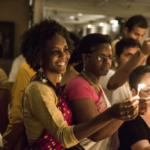
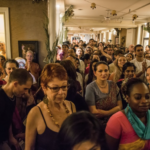
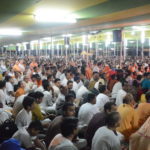
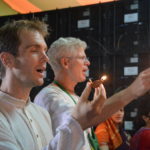
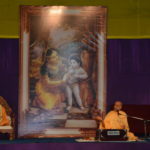
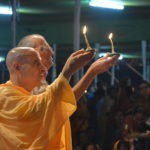
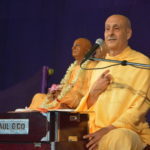
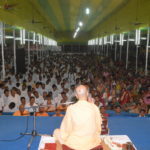
Every evening by 5 p.m., everyone came together for the evening discourse. Even local devotees from Mayapur joined, and the total attendance would go well beyond 7000. Radhanath Swami would speak for several hours – stories, histories and teachings – from such classic literatures as the Chaitanya Bhagavat and Chaitanya Charitamrita, the two biographies of Lord Chaitanya. The lectures were translated into Chinese, Russian, Persian, Hindi, Marathi and Telugu, and transmitted live on FM radio for the benefit of pilgrims who didn’t understand English. The evening programs concluded with Radhanath Swami leading the pilgrims in kirtan, offering of lamps and prayers.
“I come for the yatra (pilgrimage) especially to get Radhanath Swami’s association. It’s like coming to the spiritual world where everyone is united in love for God. It’s a joy to see Americans and Iranians, Russians and Ukrainians joining hands and dancing together as Radhanath Swami sings kirtan,” says Nitin Sawant who is from a small village in Maharashtra, India. “The memories I gather here charge up my spiritual batteries for an entire year.”









January 17, 2018
Radhanath Swami Speaks on Gita Jayanti, at the Bhakti Center, New York City
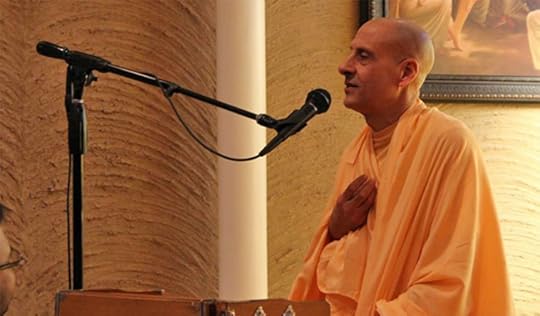
On November 29, 2017, Radhanath Swami spoke at Bhakti Center, New York City, about the wisdom of the Bhagavad-gita on the day of Gita Jayanti. Below are exerts from his talk.
Today is Gita Jayanti, the day the Bhagavad-gita was spoken which is about 700 verses within a great literature called the Mahabharata which is approximately 100,000 verses. Bhagavad-gita is the very essence of the Mahabharata and is in fact the very essence of all the great Vedic literatures.
It is spoken in such a way that it is especially not just for people who are renunciants, yogi’s, scholars, but was actually spoken for everyone. The setting in which it is spoken is very much pertinent to the world today and for that matter the world as it has always been. It was spoken in an inconceivable environment of conflict in a time when things became so difficult that the person who was hearing Bhagavad-gita, Arjuna, he felt powerless and didn’t know what he could do. This situation of conflict not only represents conflict that is within the world but the conflict that is within each of our hearts and minds.
The basic story of the Bhagavad-gita is Arjuna wanted to renounce performing his duty and the Bhagavad-gita was spoken to activate him to live in this world but not of this world. To actually see everything as divine property and according to our positions, whether we are in business, finance, education, mothers, fathers, students, swami’s, whatever are role is what’s important is not what the role is but what is the spirit in which we function within that role. What is the least likely person to talk to about peace and love? A warrior on a battlefield. Krishna spoke to the whole world through Arjuna to teach us these basic priniciples that true peace, love and happiness is realized in the eternal self and its relationship with the supreme self and through that to understand our relationship with nature and all living beings.
Recently I was speaking at the Cambridge Union and the discussion was,’have we lost faith in faith’, because so many people had lost faith in religion due to seeing so much hatred, divisions, violence, arrogance in the name of religion and God and therefore rejected. Bhagavad-gita says when we identify the spiritual path by these material aspects of it it can make us more pious maybe but it is not really the purpose. Krishna is telling you must go to the essence and understand who truly am I am, who is God, what is this world and what is our relationship with them.
Everyone was looking at me at what I was going to say and I agreed with them, I also lost faith in faith as these dyanamics were tearing the world apart in so many ways. Yet it is really based on the ego, its not just religion. People do it in the name of politics and race. Its due to the insidious ego in where we have to feel ourself superior to others.
Srila Prabhupada, explained that true religion is not to be a Hindu, Muslim, Christian, Jew, but true spirituality is to awaken the innate love for the Supreme within our hearts and to live in the spirit of service to others. That is Krishna’s message in the Bhagavad-gita.
Krishna tells in the Bhagavad-gita, there are two types of knowledge, jnana and vijana. Jnana means to theoretically know and vijnana means to realize, to have direct experience, to be enlightened and that comes when we just apply to our life these essential teachings of the Bhagavad-gita. We can be empowered scholars and obtain perfection or we could be illiterate and obtain the same perfection if we apply the principles of the Bhagavad-gita to our lives. What is that principle? True peace and love comes when we value the spirit of seva or service. Whatever we see we see it in its truth. A student once asked Srila Prabhupada what do you see when you see a tree? He said, I see the tree and I see that there is a soul that is giving life to this tree and I see how that soul is a part of Krishna and the tree is part of Krishna’s creation and so when I see the tree I remember Krishna and feel great love for Krishna and in that love for Krishna I feel great love for the tree and all trees and everyone else. That is teachings of the Bhagavad-gita.
Chanting God’s names in this spirit that the Bhagavad-gita gives, it gives us that potential of happiness of eternal love that is within our hearts. This Bhagavad-gita is dynamic and universal and beyond any sectarian conceptions and helps us to live in this world, even when there is so much conflict all around us, and like a lotus flower that grows in a muddy place, it lives very pure, the Bhagavad-gita teaches us to live in a spiritual state and actually make a real difference in this world.
January 16, 2018
Radhanath Swami Keynote Speaker at Clifford Chance LLP, London
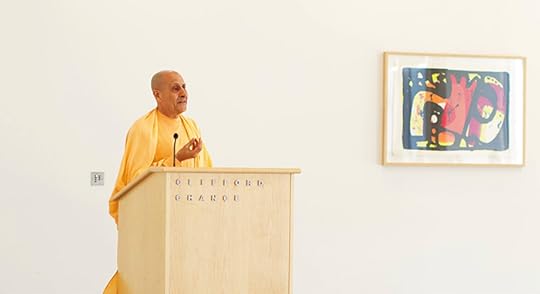
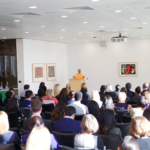
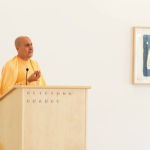
On 6th November 2017, Radhanath Swami gave a keynote address on the topic of unity in diversity at Clifford Chance LLP, an international law firm and a member of the ‘Magic Circle’ of leading British law firms.
The law firm’s second year of Diwali celebrations took place on the 30th floor of their Canary Wharf offices, a hub of the United Kingdom’s major financial institutions. Radhanath Swami was introduced by Monica Sah, a senior partner in the International Financial Markets Group. She spoke of the Swami’s accolades from the Govardhana Eco-Village to the Midday Meals project, as well as his New York Times bestselling book The Journey Within.
Radhanath Swami started his speech with an explanation of the significance of Diwali. “Diwali happens to be celebrated on the new moon, which is the darkest night of the month. It is a day where people come together from all varieties of life with lamps and candles. Whether we have our candle in a golden receptacle or a clay receptacle or no receptacle at all, it’s the light that is important. That is unity in diversity.”
Being a global firm, Clifford Chance play a key role in numerous communities around the world as part of their corporate social responsibility. Cathy Jones, head of community outreach, celebrated the holistic nature of Radhanath Swami’s talk saying he “emanated good vibes and spoke sensibly for all faiths.” This highlighted that Diwali is not just for those of the Hindu faith, but for everyone, from whatever background. Director of Human Resources, Claire Howe, echoed the same gratitude stating how Radhanath Swami’s talk was “just right – interesting and a pleasure to listen to”.
As Radhanath Swami spoke, he intertwined lessons from ancient literatures and stories from his life. From partners to associates to legal secretaries – a mix of people from different backgrounds, there was acclaim for the Swami’s speech. A tax partner at the firm, said “What a lovely man. His aura was amazing and he emanated such calmness. I want to hear more from him!” He also said that he also took advice from a Tibetan monk and was intrigued to do the same from Radhanath Swami through his books and events.
The event also consisted of a traditional Indian kathak dance by BBC Young Dancer of the Year Finalist, Shyam Dattani and lunch for all the guests. As the event drew to a close, one of the legal secretaries, exclaimed, “What a lovely speech from the keynote speaker His Holiness Radhanath Swami! I told my colleagues and they wished they had registered themselves! Looking forward to the next event with him.”
Radhanath Swami was grateful to the organisers, Ashika Patel and Chirag Ghelani and looks forward to being back at Clifford Chance in the future.
December 19, 2017
Radhanath Swami Keynote Speaker at Accenture, London
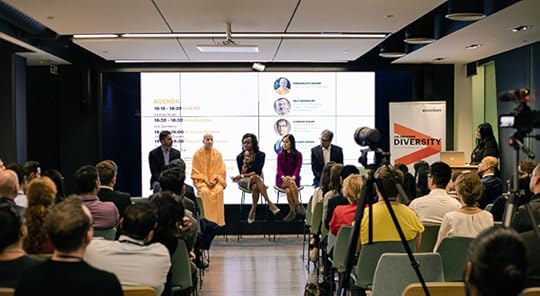
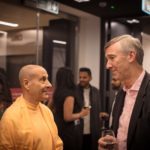
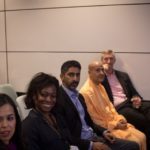
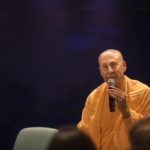
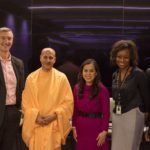
On November 5, 2017, Radhanath Swami was in London, serving as the keynote speaker for the fiscal year’s first South Asian Networking Meeting at Accenture, addressing over a hundred employees on the topic “Be the Leader You Wish You Had”.
Accenture is a management consultancy firm that provides services in strategy, consulting, digital technology and operations. They partner with more than three-quarter of the Fortune Global 500. More specific to the event, the South Asian Network is an inclusion and diversity network that brings together people from or interested in eight different South Asian countries. They hold events to help employees at Accenture understand the history and culture of the region, and to help those from that ethnicity understand that they can be as successful as anyone else at the firm.
Oliver (Olly) Benzecry, the managing director of Accenture’s business in the United Kingdom and Ireland, also attended the event as a speaker. He inaugurated the event by sharing a few words about the topic at hand – leadership. “As an organisation we flourish when people want to be here and people can be themselves in the workplace.” He went on to speak on four traits he felt a good leader had: a sense of shared purpose with their team, affinity and affection, they talk openly to the members of their team and they care. This underpins Accenture’s focus on being ‘Truly Human’, to not only work incredibly hard as a team, but care for each other deeply as individuals.
Olly’s leadership was also the focus of Radhanath Swami’s keynote address. The Swami mentioned a simple incident involving himself and Olly that had happened just before the event began. “I was so thrilled to hear the words of Olly” he began. “In the Bhagavad Gita, there is a very significant verse: a true leader is one who sets a direction for people by his or her exemplary actions. When I first arrived just a few minutes ago, I met Olly. We were taking for a few minutes until I requested if someone can show me to the restroom. He said, “I’ll take you.” But I insisted that someone else take me. Yet he insisted on taking me, although he didn’t even know the way! As I entered the restroom, I told him I’ll meet you back in the room of the event, but he again insisted to wait. And wait he did! Here is the Managing Director of Accenture for the whole of the U.K. and Ireland, waiting for a small Swami who hasn’t had a bank account since 1969 to use the bathroom. A good leader is one who cares for others, regardless of their position. It really moved my heart. That is leadership!”
After the keynote address, Radhanath Swami sat on a panel discussion with a handful of the Managing Directors from the firm. They shared their thoughts on inspiration and answered questions from the audience. Sevasti Wong, the Global Talent and Organisation Consulting Lead, shared that authenticity, being yourself and not being scared by failure, were important qualities of a leader. She also mentioned, “I loved the keynote speaker and what he spoke about, especially his position on expressing love and kindness in the workplace and our personal lives. His analogy of being a gardener was my take-home message.” Radhanath Swami shared a story earlier in the event, “The secret of a good garden is in one who personally loves his or her flowers and plants. Because when you take care of them with love, they release the energy of love. If you put together all the right fertilizers and scientific botanical method, you will see something beautiful, but you will not experience something great. When flowers are nourished with both expertise and love, they give out a vibration, that when you enter into that garden, something incredible leaves your heart. Leadership means we must pour love into people to unlock their gift to the world.”
Nnenna Ilomechina, the UKI Lead for Communications, Media and Tech, shared something similar to Sevasti. “Leaders should be authentic. This means they understand themselves and are comfortable with what value they bring to the party.” On Radhanath Swami she mentioned, “He was incredibly calming and took me into a zen calm place. I think that is very important in leadership. He put everyone in such a calm and relaxed place that it’s easy to follow that sort of personality.”
Another Managing Director, Kamran Ikram, who leads the UKI Executive Infrastructure Services, and who sponsored the event for the night, said, “Radhanath Swami very eloquently described how important it is to care about your team. True leaders are not just in it for themselves, but are in it for the whole team. His way of speaking and style of getting messages across is different to your typical corporate speaker. He talked about humility, about love and about being a servant. Those messages were valid, no matter if you’re a large private organisation, a government organisation or tiny independent self employed business!”
As the night went on, a range of employees from the firm bought Radhanath Swami’s The Journey Within and The Journey Home and had them signed. One of them was Helen Anderson, part of the legal team at Accenture. She mentioned, “I had an opportunity to meet the Swami at the end. We only managed to exchange short words about what I do and his event in my home town of Oxford, but the presence he has and the way he carries himself makes even the shortest interaction very meaningful.” This was echoed by Barry Elbashir, a Senior Manager, who spent a lot of time in Mumbai without knowing of Radhanath Swami’s work there. He told us that the Swami was…“extremely inspiring. His humility and rich experience going back through the civil rights movements. Being able to share those lessons and articulating so well what the meaning of life is was incredible. I found him really helpful and I had the pleasure of sitting for a few minutes with him which I found even more inspiring that the actual keynote address!”








December 11, 2017
Radhanath Swami Speaks at Church College, University of Oxford.
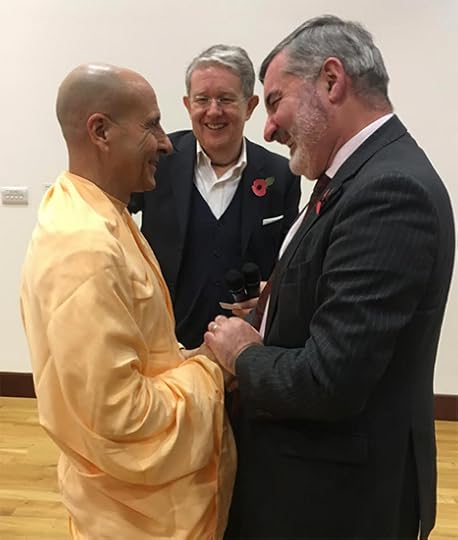
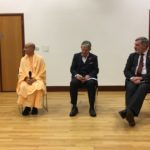
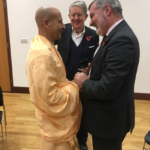
In early November 2017, Radhanath Swami was in discussion with former leader of the Alliance party of Northern-Ireland, Lord John Alderdice on the topic of ‘Bridging the Divide in a Fractured World’ at Christ Church College, University of Oxford.
Christ Church College is one of the largest colleges of Oxford University and is home to over 400 undergraduates and 175 graduates.
Christ Church is famous for its connection with two fictional figures: Alice in Wonderland, the creation of the 19th-century mathematics tutor Charles Lutwidge Dodgson (Lewis Carroll), and Harry Potter (the film version of Hogwarts was partly based on Christ Church Hall). But there have been many real-life alumni of historical importance: among them the philosopher and Father of Liberalism, John Locke; William Penn, who founded the Province of Pennsylvania; W.E.Gladstone, four times Prime Minister of UK; the poet W.H.Auden; Frederick Lindemann, scientific adviser to Churchill; and many others. Alfred Einstein too was briefly given hospitality and membership of the college, when he fled to England from Nazi persecution.
Radhanath Swami spoke with Lord Alderdice, who is famous for his part in the peace negotiations between Northern Ireland and the Republic of Ireland in the 1980s. He was also Speaker of the Northern Ireland Assembly between 1998-2004, but currently he sits as a Liberal Democrat in the House of Lords. The discussion was moderated by Shaunaka Rishi das, Director of the Oxford Centre for Hindu Studies who also sits on the International Advisory Council of the Auroville Foundation by appointment of the Indian government.
An audience of eighty students gathered in the Sir Micheal Dummett Lecture theatre to listen to the discussion. They both spoke about community, compassion, values and ethics that are needed in today’s society.
Lord Alderdice spoke warmly of Radhanath Swami at the end of the event and was eager to remain in contact with the Swami. He had never spoken alongside a leader of the Hindu community and told the Swami that he enjoyed their discussion and looked forward to more in the future. Radhanath Swami presented him with a gift of both his books: The Journey Home and The Journey Within which he was happy to receive.
Other students from the University commented how they were inspired by the event. Sushini, a DPhil student in Social Policy and African Studies, said “I really liked the questions from the Shaunaka das and the event was evenly balanced to allow enough questions from the audience.” On Radhanath Swami she expressed, “I think the way he answered questions was wonderful. As a teen and then as an adult, sharing his life-stories made it real for us because it’s easy to feel distance from someone that wise. So he felt more human in that way.”
Radhanath Swami was happy to speak at Oxford University and looks forward sharing ancient wisdom within its historic landscape in the near future.







November 30, 2017
November 29, 2017
Radhanath Swami Debates at the Cambridge Union
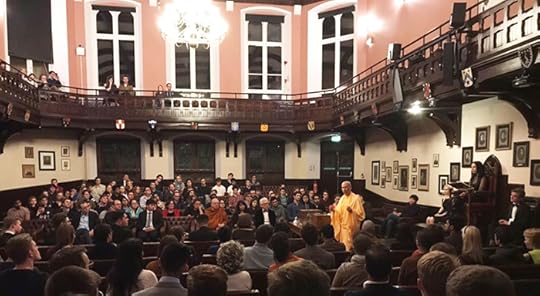 In November 2017, Radhanath Swami was invited to debate at the worlds oldest, and arguably most prestigious debating society, the Cambridge Union. The topic was “Have we lost faith in faith? Does it have meaning in the modern world? Can we justify faith in line with the rest of the world’s atrocities?”
The Cambridge Union was founded as a small debating society in 1815, but today is the largest student society in Cambridge and has over 70,000 life members worldwide. It established a forum in which the art of public debate was defended and the free exchange of ideas was encouraged. The Union hosts many of the most famous speakers in the world including politicians, olympians, businesspeople and journalists, so that its members can meet them, question them, and challenge their views. In the past the Society has hosted important world figures such as Winston Churchill, Theodore Roosevelt and the current Dalai Lama. Recent guests have included Germaine Greer, the Rev. Jesse Jackson, Robert Downey Jr, Vivienne Westwood, Buzz Aldrin, Russell Brand and Julian Assange, to name but a few.
The Union also serves to encourage younger generations in public speaking, providing free debating workshops to local schools, and thrice-weekly workshops for all student members in Cambridge, at every level of ability, to train themselves in public speaking and learn how to competitively debate. It is this training that produced the top two debaters at the World University Debating Championships in 2015.
Over 200 people gathered in the chamber of the Union for the debate on faith. On the side proposing the motion, was Ken Follet, a Welsh Author who has sold more than 150 million copies of his works, and is a staunch atheist. Ajhan Brahm, a British Theravada Buddhist monk and the Abbot of Bodhinyana in Serpentine, Western Australia and Sadia Hameed, spokesperson for the Council of ex-Muslims of Britain, also joined him.
Opposing the motion was His Holiness Radhanath Swami, alongside Virginia Moffat, religious editor for Peace News and Asad Dhunna, board member of Imaan, Europe’s biggest charity supporting LGBTQI Muslims.
Before the debate started, the Cambridge Union created a poll on their Facebook page to ask attendees to vote whether the motion stands firm. That is, have we lost faith in faith? Fifty-eight percent voted that we had, leave 42% defending that we had not. This meant the debate was on the side of the Ken Follet and his peers.
The debate started with Ken Follet defining the word faith and sharing his thought on why faith had no place in our society. Radhanath Swami spoke in opposition first, arguing that giving up artificial faith makes us eligible to find genuine faith. As the debate proceeded, it swung to become a debate on religion versus science, but a member of the audience, Jonathan, who studied Philosophy and Religion at Cambridge University brought it back. He mentioned that we must have faith in something. We can have faith in empirical science, but that is still faith. Therefore, we can never lose our inherent faith by definition. The debate was closed by Ajhan Brahma for the motion and Asad Dhunna who was against the motion.
The evening came to an end with a book signing of both Mr Follet’s and Radhanath Swami’s books, with students intrigued to know the outcome. The Swami presented his memoir The Journey Home and New York Times Bestseller The Journey Within to all speakers and the President of the Cambridge Union, Page Nyame-Satterthwaite who mentioned, “It was a pleasure to speak to the Swami. It’s rare to have a speaker with such gravitas at the Union. We were very grateful he could attend.” Jonathan, the student who criticised both sides earlier, also met Radhanath Swami at the end. He said, “It was an honour to meet him and I enjoyed listening to his point of view.”
The result of the debate was confirmed at the end of the evening and the opposition claimed victory by receiving 54% of the vote to the propositions 27% of the vote. The rest of the audience abstained. This meant that arguments that Radhanath Swami and his peers put forward had swung the Cambridge audience to vote against the motion that we had lost faith in faith.










November 13, 2017
Three Basic Views of the World
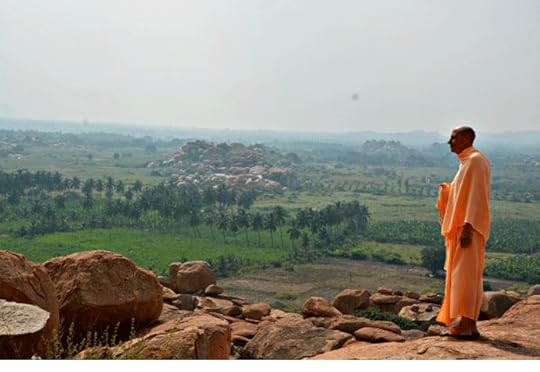 There are three basic views of the world we live in. One is the very materialistic view wherein people see this world as the only real reality. Another is that world is an entirely an illusion, and the third is the best of view, that the world is the sacred property of God. It is real but it is temporary in its manifestations.
Now the conception that the world is the only true reality leaves one with the consciousness that it really doesn’t matter what we do as long as we get what we want. If we hurt people, if we trample on moral values, ethical principles, if we get money, fame, power, sensual and emotional pleasures, its all justified because as that saying goes, “eat drink and be merry because tomorrow may never come”. When we believe that this world is the only reality then even our so called moral principles are built on a very weak foundation because when temptation and fear come, why not break our moral and ethical values if I can get something better. Then we become victimized by greed, envy, lust, anger, arrogance and illusion. We see it so prevalent in the world today. This conception that if it feels good now it doesn’t really matter what else. What matters is me. So much is based upon what makes me happy, what can I acquire what I can call “mine”. In other words, its a world that is so much conquered by this tendency of selfishness and egoism, and so much of that is born from the conception that the world is the only reality.
Another conception is that the whole world is nothing but an illusion. It doesn’t actually even exist. The truth is real but the whole world is an illusion. For those who are thinking like this it is a good impetus for liberation after death because if the world is an illusion it doesn’t matter if we live or die, what matters is that somehow or other we get out of it as soon as possible. Now the environmental and ecological conditions of the world today is extremely precarious. This philosophy that this world is an illusion, if we see all these environmental issues happening, who cares. It doesn’t exist. Let everyone pollute the rivers and air because this world is an illusion. Our impetus is to just get out of this crazy contaminated condemned world and what we really leave behind doesn’t really matter because this world is an illusion. Where is the call for action within the world we live. The call of action is only to get out.
But then we have the Vaisnava philosopy of Srimad Bhagavatam and Bhagavad-gita, that Sri Chaitanya Mahaprabhu, Vallabhacarya, Ramanujacarya, Madhvacharya, all these great souls taught. They taught om purnam adah purnam idam according to Sri Isopanisad. The Absolute Truth is the source of everything that exists. It is perfect and compete and everything eminating from the Absolute Truth is all perfect and complete. The material world and the spiritual world – everything is coming from Krishna. Sarvaloka mahesvaram, Krishna says in Bhagavad-gita, this whole world is God’s property. If we see it in this way we are free from that greed, envy, lust and anger because we understand I am not the proprietor, I am the caretaker. If we see someone else doing well we celebrate their good fortune because we understand we are all brothers and sisters, we are all spirit souls, children of God. We are not envious. Exploitation is the symptom of the disease of the selfish egoistic heart. Compassion is the symptom of a person who has actually found inner fulfillment within their hearts.
So this is so important for the world to understand today – that we must build our lives and relationships with other living beings, humans and other species of life, with Mother Earth and the environment on the principle that everything is sacred.
Maya means the energy of God and maya is categorized in two ways: mahamaya and yogamaya. It’s the same energy. This whole material world is God’s energy. All the manifestations within this energy are under the influence of time and therefore are temporary and under the three modes of goodness, passion and ignorance. The spiritual energy is sat-cit-ananda, eternal, full of knowledge and full of bliss. But what is the difference between these energies? It really is under the basis of our perception. If we see this world as God’s energy, as Krishna’s property then we are seeing it in its true spiritual nature. But if we don’t see it in relationship to God then we see it as” this is mine, this is yours”. This results in so much conflict. But true religion is meant to unite people not divide people. These religions are all manifestations of God’s grace on humanity to come to this earth to give us an understanding how we are all children of God. Wherever there is life there is a sacred child of God. Everything is the property of God and we are meant to be a family to utilize it properly.
This conception understands that everything in this world is meant to be used for the purpose of seva, or unselfish service. It is our sacred duty to God to honor and respect everything in this world as his sacred property and to use it in a spirit of service. If you own a business, own a house, have a family, have wealth, property, it’s all the property of God and used in harmony with God’s will which is to keep it all very very pure as far as possible. So in order to engineer a better world it has to begin by engineering a proper preceptive and realization of the world. Engineering our own inner consciousness to the degree we actually understand the beauty and the love and the greatness of Krishna, to that degree we will actually love Krishna and we will see everything in this world as a beautiful opportunity to serve Krishna and to elevate people’s lives and consciousness. – Radhanath Swami
November 1, 2017
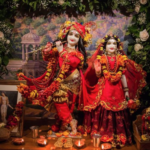
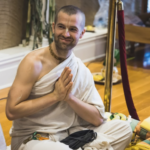
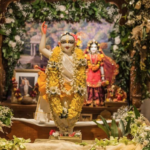
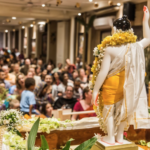
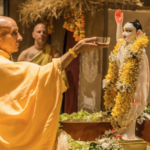
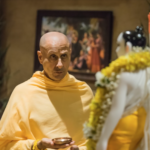
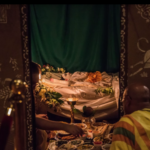
Installation of Sri Gaurachandra at the Bhakti Center in New York
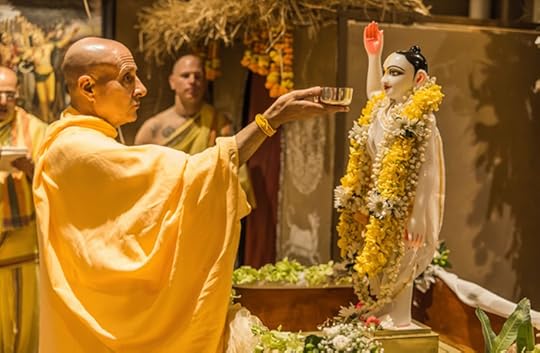
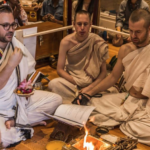
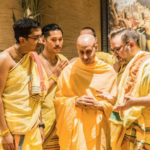
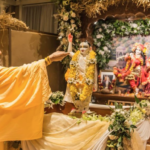
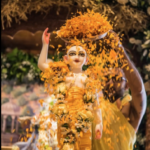
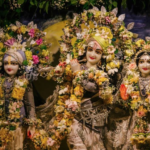
On October 3-5, 2017 Radhanath Swami participated in a three day festival of the Installation of Sri Gaurachandra at the Bhakti Center in New York City. For over twenty years the Bhakti Center has been the home of the beautiful Temple of Sri Sri Radha Muralidhara (Radha & Krishna). October’s festival engaged the center’s community in the timeless Vedic tradition of calling the presence of the Divine to reside on the temple altar, this time in the compassionate form of Sri Chaitanya called Sri Gaurachandra (The Golden Moon). The festival was filled with unforgettable moments that we will treasured by all who attended.
The first day of the festival served as a fundraising drive to cover new outfits and paraphernalia for Sri Gaurachandra’s seva, festival expenses and the remaining building improvements and repairs at the Bhakti Center.
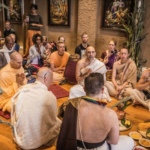
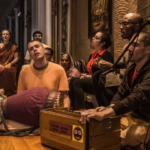
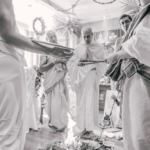
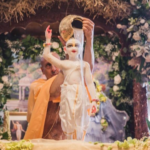
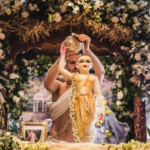
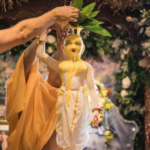
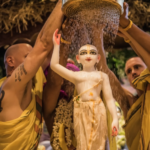
On day two, accompanied by a chorus of voices chanting Vedic mantras and jubilant kirtan, brahmins began the ceremony on installation by establishing the intention in the minds of the community, honoring and seeking the blessings of the seniors present and commencing the rites with the traditional Vedic fire ceremony.
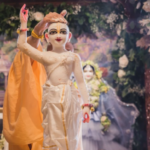
In the evening the eyes of Sri Gaurachandra were opened, auspicious items were shown to him, and the gathered community had their first chance to see His beautiful form.
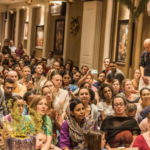
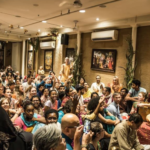
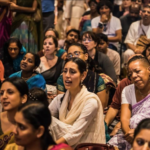
On the third day the rites concluded during the day, and in the evening everyone celebrated with a grand festival. Radhanath Swami spoke,guests had their first vision of Sri Gaurachandra residing alongside Sri Sri Radha Muralidhara, full dressed and decorated, and kirtan as held late into the night.
The installation of Sri Caitanya at the Bhakti Center was a desire in the heart of Radhanath Swami and the community at the Bhakti Center for some years. The form of Sri Gaurachandra had been carved and the center had been waiting for the right time to take up this service and perform the ceremony of His Installation. The time was finally right on a practical level, as the center, along with ISKCON’s Deity Worship Ministry, felt the staff at the center were ready to take the step of increased service as, over the course of time, the had improved the standard of seva to Sri Sri Radha Muralidhara and expand their team of pujaris and servants.. On a spiritual level the community felt that perhaps Sri Chaitanya has chosen to appear now to bless their efforts of expanding their service of bringing Bhakti to an ever increasing family in New York City.