Radhanath Swami's Blog, page 5
September 26, 2018
The Only Enemy a Person Can Have is His or Her Own Uncontrolled Mind
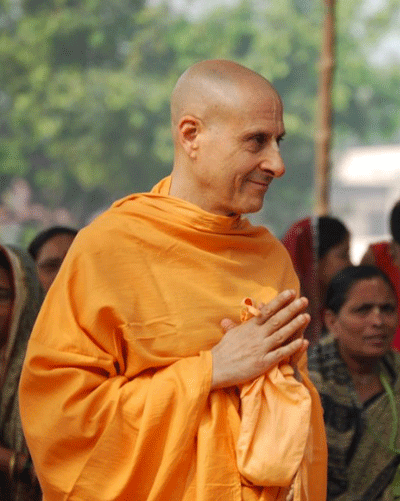 Yoga is often misunderstood as merely breath control, asanas or exercises; for some it is about practising some rules and regulations based on morality and for others it is cultivation of scriputral knowledge. But the real purpose of Yoga is to fix our mind on the Supreme.
According to Bhagavad-gita, yoga can not be practiced unless we practice mind control. An uncontrolled mind restricts the soul from reaching its natural blissful state, which a practioner is trying to acheive through yoga.
Our mind works like a television set. A television set is just some plastic, metal, and glass fitted with circuits inside. This box can tune into waves of energy transmitted by a satellite to produce images and sounds.
The pleasure that we are looking for in this world is compared to the energy emitted by the satellite. Satellites can transmit energy that can be received through millions of televison sets, but not every television is tuned into same channel. For human beings, the senses are just like an antenna, receiving whatever station the tuning device chooses. The tuning device is the mind. We tune into what our mind focuses on, and what we are tuned into is what affects us and our life.
People are affected by watching advertisements. They tune into the product, get attracted to it and then buy it. Similalry, we will be affected by whatever we tune into. This is the law of nature – “We become like whatever we associate with”. For example, if we put an iron rod in fire, it becomes red hot like fire. If we put that same iron rod in ice, due to its association with ice, it becomes as cold as ice. So, yoga simply means tuning our mind into a spiritual channel.
In Bhagavad-gita [BG 2.62], it is mentioned that while contemplating the objects of the senses, one developes attachment. Contemplation is the mind’s way of tuning in. Our whole direction in life is based on what we contemplate, or what station or channel we choose to tune our mind into. The mind contemplates and then activates the senses. The most beautiful sense object may be kept right next to us, but if our mind is absorbed somewhere else and we don’t even look at it, we will not be affected. Therefore Bhagvad-gita states, “For one who controls the mind, the mind is the best of the friends, but for one who is unable to control the mind, the mind is the worst enemy.” The only enemy a person can have is his or her own uncontrolled mind. If our mind is controlled, there are no enemies outside.
We should try to avoid tuning in to negative forces because everytime we do, our receptivity to positive forces reduces. If we avoid all these other stations, and we tune into the channel of Supreme power then our receptivity for spirituality becomes much deeper.


September 25, 2018
September 20, 2018
Radhanath Swami Speaks at Sustainability Conference at New York’s Bhakti Center
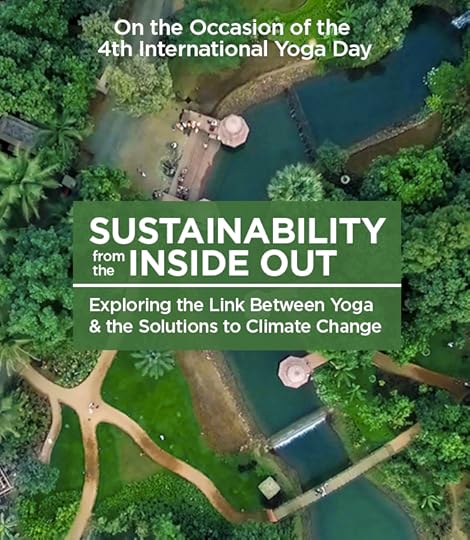

On Sunday, June 10th, 2018, on the occasion of the 4th International Yoga Day,
Radhanath Swami was a featured speaker at the conference “Sustainability From the Inside Out”, hosted by The Bhakti Center, on New York City’s Lower East Side.
The conference was a unique opportunity to hear from a group of leading voices, and about important projects, that are leading the way in exploring the profound connection between spirituality and the practice of yoga, and the sustainability of the Earth and its resources.
The premise of the conference was that the central tenets of yoga, when applied to communities and societies, can serve as a catalyst for change, and as the evidence of climate change continues to draw focus to the urgent need for action, voices from both the worlds of Yoga and Environmental Science can draw attention to the important role that personal transformation through Yoga can play in the solution.
The event was hosted by Vineet Chander, the Director of Hindu Life and the Hindu Chaplain at Princeton University. Vineet also serves as a member of the Sacred Ecology Forum, one the Bhakti Center’s social initiatives. He shared his appreciation for the growing phenomena of the uniting of science, spirituality and activism in the face of the growing ecological threats.
“To have thought leaders and scholars like the ones assembled here today is a remarkable thing. The conventional model was one of everyone staying in their own place— academics stayed within academic silos (and even there, within their own departments), scientists relegated to the world of lab work and cold data, activists kept company with other activists, and religious practitioners couldn’t dare to look beyond their houses of worship. Thankfully, that model is giving way to a new paradigm of collaboration, intersectionality, and cross-pollination. Now, we understand that a fuller picture emerges when the scholar and the practitioner and the scientist and the activist are in conversation with one another. Today we recognize not just that religion and ecology can be approached together, but that to some extent—they must be approached together.”
Speakers included the following.
• Mr. Sandeep Chakravorty, the Consul General of India in New York, who has worked with civil society organizations dealing with natural resources and environmental issues. For Mr. Chakravorty, the intersection of international relations and the environment remains a key passion. He spoke about the yogic vision of need vs. greed.
• Dr. Mary Evelyn Tucker & Dr. John Grim, the Co-Directors of the Forum on Religion and Ecology at Yale University. Widely recognized as the pioneers of the discipline of Religion and Ecology, they are the co-founders and co-directors of the Forum on Religion and Ecology at Yale, and co-created the Emmy Award winning “Journey of the Universe”, a film and multi-media project that aired on PBS to wide acclaim. Together, they spoke about the intersection of religion and ecology, and the dangers of being disconnected from nature.
• Dr. David Haberman, a Professor in the Department of Religious Studies at Indiana University and one of the world’s foremost scholars of Braj, the sacred land of Sri Krishna. Dr. Haberman sits on the Advisory Board of the Forum on Religion and Ecology, and is particularly interested in examining how traditional Hindu theologies, and Bhakti theology in particular, are being employed by Indian environmental activists to resist environmental degradation. Dr. Haberman spoke about the sacred Govardhan Hill, Nature Worship, and the vision of personalism in the natural world.
• Ms. Anita Katial, who serves as Counselor for the US Department of Agriculture’s Foreign Agricultural Service, as part of the American Embassy in Costa Rica. The Foreign Agricultural Service (FAS) links U.S. agriculture to the world, to enhance export opportunities and global food security. Ms. Katial’s work is instrumental as part of the FAS’s effort to help developing countries improve their agricultural systems and build their trade capacity. Ms. Katial spoke on food justice issues and complexity of sustainability.
• Dr. Peter Whitehouse, the President of Intergenerational Schools International. Dr. Whitehouse spoke about intergenerational bonding as a model of sustainability.
• Gauranga Das, the Director of the Govardhan Eco Village (GEV) who has been recognized as a leader in the world of sustainability and eco-tourism, and received numerous awards on behalf of the Govardhan Eco Village such as the Platinum Award, the Best of India Award, and the Renaissance Award for Water Conservation in the 34th SKOCH Summit. Gauranga Das, who was largely responsible for organizing the event, spoke of how the conference came together.
The event also featured a musical performance by the Bhakti Center’s Jahnavi Harrison, and Youssef Benibrahim, who sang their rendition of the Yamunastakam, an 8-stanza poem composed by Rupa Goswami in praise of the sacred Yamuna River.
Vineet Chander and Gopal Lila Das also spoke briefly about the Bhakti Center’s Sacred Ecology Forum and creating an eco-Bhakti saga (community) in New York City.
Radhanath Swami was a natural fit for the conference. As Founder of Govardhan Eco Village, he has often expressed his conviction that devotees of Krishna—and lovers of the Divine by whatever name they may know Him—must honor the Earth. “Love of God manifests in this world as compassion,” he is fond of saying, “compassion is for all living beings, and for the Earth herself. Wherever there is life, it is sacred.”
He spoke of how Govardhan Eco Village was inspired by the teachings and example that Srila Prabhupada set, including how he saw nature in connection to God in small, simple ways. “Sometimes little things give usthe largest messages.” Included were anecdotes of Srila Prabhupada’s displeasure with the unnecessary cutting down of tress, his insistence on conserving water, and his compassion for all living beings – tying the theme of ecology to the purpose of life as it is explained in the yoga tradition.
“Every living being is sacred. Yoga is learning to understand the sacredness of our own life. And to the degree that we do, we are able to understand our greatest potential, our truest nature, which is to be connected to the Supreme. The Supreme has one quality in which all other qualities are contained – infinite, eternal love for all beings. The word Krishna means ‘all attractive’, ‘the supreme object of love’, and ‘the supreme bestower of love’. As we connect to that infinite love of God, that is all pervading, everywhere – within our own hearts, then there becomes only one purpose of life, which is integrated in every aspect of our lives – and that is to reciprocate with that love, to be an instrument of that love. That, according to the Bhakti tradition, is the definition of religion. That is the essence of yoga. That is the only true purpose of life. And there is nothing else that can bring fulfillment to the heart.”
He further spoke about Srila Prabhupada’s instruction of how we have to learn to live naturally. “Simple living and high thinking, he said, where we are not exploiting the resources of Mother Nature for unnecessary purposes, because it’s unsustainable. Govardhan Ecovillage is one of many communities that were developed on these simple principles. When we see the gifts of nature as the gifts of God, the energy of the Supreme, non-different from the Supreme, we naturally understand it’s value.”
Radhanath Swami went on to describe some of the work the Govardhan Eco Village does in its surrounding villages in terms of water conservation, farming, women’s empowerment and the development of natural handicrafts.
“If people see something that works they believe it. We were going around to the villages for years telling them things, but they didn’t believe it. If we can show them it works they believe it, and they allow us to help. Gandhi said that if you give charity to a poor person you make them feel like a beggar and they have no human dignity. But if you show them the art of how to do it themselves then they will have happiness with dignity. And all of these principles at Govardhan Eco Village are just a way of trying to share an expression of the idea of yoga – that when we are living with harmony with our own soul, through our spiritual practices and association, we naturally learn to live in harmony with each other. And we can’t really live in harmony with each other unless we include Mother Earth and all of her gifts.”
September 3, 2018
The Real Spirit of Janmashtami
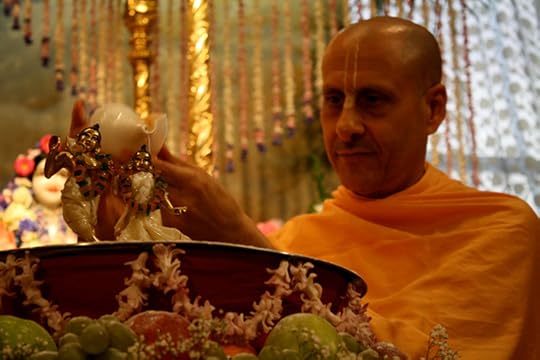
Janmashtami is the festival commemorating the appearance of Krishna in this world. He is believed to have appeared 5,000 years ago in a prison cell in Mathura. Janmashtami represents the appearance of hope in the dark night of hopelessness, of virtue in the fortress of vices, through the appearance of the Absolute Truth, Krishna.
The sun rises in the East each day. Not that it is born that time, but it comes to our relative vision and with each setting, it no longer appears to our vision. My spiritual master, Srila Prabhupada said that Krishna is within everyone’s heart and with the sincerity of our devotion, can appear to us every day. He reciprocates to us according to our desires.
Everyone is looking for pleasure. The question arises that if our ultimate aim is pleasure and if the world is designed to frustrate our attempts to attain pleasure, then what is the hope? Therefore, the Supreme personally descends into this world simply to reveal the way by which we can not only attain true happiness and peace but also perfect our life and go ahead to the eternal spiritual world.
The Bhagwad Gita teaches the process by which we can achieve the highest joy of Bhakti Yoga and also share it with others. When we celebrate Janmashtami, it should be a time when we commit and dedicate ourselves to live by the will of Krishna. This is real celebration.
When Krishna appears in this world, he gives us a glimpse into the joyful exchanges of love in the spiritual world. Krishna’s pastimes in Vrindavan are an advertisement for the suffering, living entities to relinquish stubborn, selfish desires and join the eternal party of selfless service and love.
Today, in the name of religion, people are so caught up in rituals, conventions and obligations that they are deluded from the real purpose of religion – transformation of consciousness. Transformation of greed to generosity, egoism to humility, vengeance to forgiveness, agitation to peace and hate to love, all happens when we revive our eternal relationship with the absolute truth, God.
When Krishna appeared, he appeared in a way to attract us to his sweetness and love rather than his power and grandeur. He appeared as a simple cowherd boy in Vrindavan, just to attract our love. The Gita says that we are infatuated by beautiful people and beautiful things, but the beauty of this world is an infinitesimal spark of the supreme splendour of God.
Today, in the name of God, there is so much division and disunity. To help us rise above all externality, ego, selfishness and greed and understand that the real pleasure we’re seeking is unmotivated, unconditional love, is the purpose of religious practices. Each time we invoke Krishna’s names with sincere feeling and devotion, he appears, and it is Janmashtami. Krishna is manifesting and appearing within our hearts and our lives.
Across the world, people make elaborate offerings and decorations and organise grand events to celebrate Krishna’s birthday. With no monetary gains in return, they make time from their daily routine, to serve – to share our love for Krishna through service is the real spirit of Janmashtami. – Radhanath Swami
August 30, 2018
What Matters is Our Consciousness
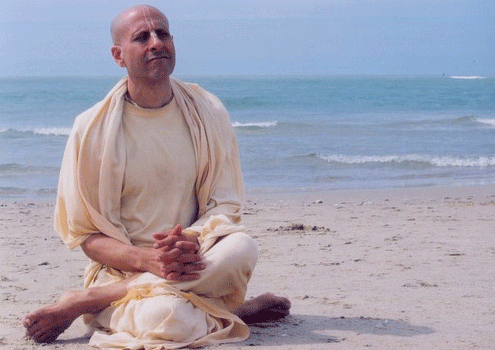 The famous writer Paulo Coelho once said, “There is always a gap between our intention and action.” This holds true in our lives. How we present things or in what ways we present is definitely important and critical, but if we deeply analyze the matter, it’s the intention or consciousness behind it that matters.
In Vedic scriptures the nature of the God is defined as bhava-grahi, i.e. he is interested in the consciousness that we have invested in the service rather than the externals of exactly how it is done. Because of today’s lifestyle that focuses more on external facade, we have lost the essence of giving importance to the motive behind our deeds; rather we focus on the glamorous and peripheral presentation of it.
My spiritual master Srila Prabhupada used to say, “Giving importance to details is a sign of love.” He taught us that if we are striving to serve God and humanity, the best possible way is to get absorbed in our services. Whatever we are doing, we should do with our full heart, with our full consciousness because it is in the service of God and Humanity.
God is the ultimate creator, maintainer, enjoyer, and proprietor of this entire cosmos and everything is emanating from him. So what exactly can we give him? Everything already belongs to him; we are just the caretakers, that too just for time being. So, he will be pleased with our love, and our consciousness; he doesn’t care for other things. It is just like a child who buys a beautiful birthday gift for his father from his father’s money, still the father can feel and appreciate the love and affection of his son through that gift, which he can easily afford himself.
Similar is our relationship with our supreme father and in that relationship it’s not the things that matter but what matters is our consciousness and our attitude. – Radhanath Swami
August 26, 2018
God is Revealed Through Devotion
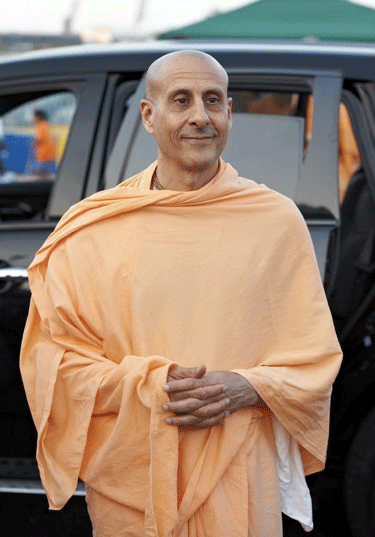 Spiritual practice involves distinguishing between that which is temporary and that which is eternal. Through the sacred texts, such as the Bhagavad-gita, we can understand what this material energy is. It is God’s energy. The energy itself is eternal, but its manifestations are temporary. These manifestations are always in the state of transformation. They change by the will of God under the influence of three modes of material nature—Goodness, Passion, and Ignorance, and by the power of the element of time.
Thus, everything in this universe is constantly changing. Everything is constantly being created, maintained for sometime, and ultimately destroyed. Every cell is like a universe in itself, going through these processes of creation, maintenance, and destruction. We may look at Himalayan Mountains covered with ice, and they may seem permanent, but even they are made up of molecules and atoms which are always changing. Because of our ignorance it appears that it’s the same mountain, but it too is always changing. Our body is also undergoing changes every moment. And the ultimate change where everything culminates, which we sometimes refer as death, is the end of all the change. Therefore, material nature is endlessly mutable. It’s always changing.
Similarly, all the worldly knowledge that we have accumulated will come to an end at the time of death. Thus, we should get knowledge by studying the sacred texts along with the guidance of true saints. This knowledge is eternal and has a specific purpose—to help us understand God and show us how to surrender to God. It is not our merely our mind, senses or intelligence that will help us understand God. They are all temporary themselves and can not reach the eternal. The sacred texts of Bhakti give information about God. And ultimately we can know God only through deep faith in the process of Bhakti – through devotion. Otherwise God will always remain beyond our perception.
advaitam acyutam anadim ananta-rupam
adyam purana-purusam nava-yauvanam ca
vedesu durlabham adurlabham atma-bhaktau
govindam adi-purusam tam aham bhajami
I worship Govinda (Krishna), the primeval Lord, who is inaccessible to the Vedas, but obtainable by pure unalloyed devotion of the soul, who is without a second, who is not subject to decay, is without a beginning, whose form is endless, who is the beginning, and the eternal purusa; yet He is a person possessing the beauty of blooming youth. – Sri Brahma Samhita 5.33
August 20, 2018
On Peace vs. Love
In the year 1971, as a young spiritual seeker, I attended a yoga peace conference where the different speakers fought to grab the microphone. As the yogis rambled aggressively like politicians, I was disappointed and shocked. A kind hearted saintly person who had maintained grace and dignity throughout the chaos consoled me, explaining how all are struggling at their respective level of progress. He revealed to me that instead of fighting for peace, we have to find peace within ourselves first. Later, I discovered a sacred teaching from my guru, Srila Prabhupada, who revealed that the soul’s real need and perfection is to go beyond the neutral condition of peace. “We do not care for peace – we want love”.
Love means the willingness to sacrifice oneself for the beloved. It is like a mother in her relationship with her child. When a woman has a little baby, there is practically no peace in the house. The baby is crying all night long and responding to nature indiscriminately wherever it goes. Now a mother can easily just give the baby to somebody else, ‘You take care; I do not want anything to do with this.’ But the mother is running here and there, caring for the child. That is love.
This love, when channeled to God is higher than peace, because in that love is eternal peace—not the peace of the mind, but the peace of soul. Even in an ordinary relationship we can see that if a couple says they are peaceful, it simply means they are not fighting. But if there is love, there is a dynamic exchange of emotions; Love is not static. Peace is negation of misery; love is a positive expression of the heart. Love means sacrifice—sacrificing even our own peace for the pleasure of the beloved.
When this love is directed towards God, we become internally connected to God and this deep anchor helps us relate to the other living entities, the other children of God also with love. Our love expands and grows in all fronts, and we experience a more fulfilling relationship in this state of love than in mere peaceful coexistence. – Radhanath Swami
August 13, 2018
How can I know if God Exists?
Radhanath Swami answers the question: “How can I know if God Exists? “
July 14, 2018
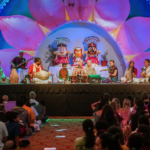
Radhanath Swami Attends Sadhu Sanga Festival 2018
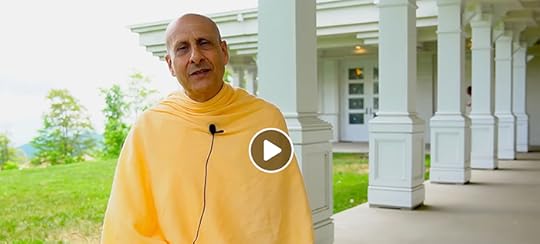
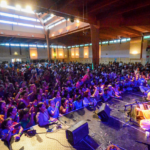
The Sadhu Sanga Kirtan Retreat is a yearly offering begun by His Holiness Indradyumna Swami in 2012. This year’s retreat, in Boone, North Carolina, ran from May 25-28th and was a grand success. Over 2,000 devotees from around the world attended and there were 150,000 views of the livestream videos. The organization, facilities, prasadam, decorations, and sound system were all arranged beautifully.
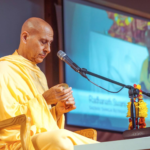
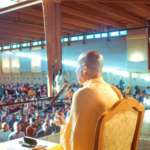
Radhanath Swami attended, led kirtan and spoke on Srimad Bhagavatam. An excerpt of his Bhagavatam class is below.
“Srila Prabhupada took the message of Lord Chaitanya as his very life and soul – to bring the chanting of the holy names of Sri Krishna to the whole world. Whenever devotees come together to chant in a sincere spirit of devotion, Krishna manifests Himself. In this age of Kali, it is described there is one benediction,
kaler dosa-nidhe rajann
asti hy eko mahan gunah
kirtanad eva krsnasya
mukta-sangah param vrajet
(SB 12.3.51)
We are living in the Age of Kali, and we see the effects of conflict, envy, arrogance, pollution and wars. But within this is the blessing of the chanting of the Holy Names. Simply by chanting Krishna’s names we can attain the supreme perfection of liberation.
This festival, the Sadhu Sanga Retreat, is a wonderful opportunity for devotees to come together, from all different parts of America and the world, to re-inspire each other in this great mission of compassion.
To me, the Sadhu Sanga Retreat is one of the greatest blessings to the world. For such sincere devotees to be chanting with the motive of awakening pure love of Krishna and spreading the spirit of pure love of Krishna to others throughout the world, I am forever indebted with gratitude to His Holiness Indradyumna Swami Maharaja. With great efforts, he has expressed his love for Srila Prabhupada by bringing us all together. We are all very grateful to him.”
Radhanth Swami’s Srimad Bhagavatam Class