Radhanath Swami's Blog, page 7
May 29, 2018
Need for a Strong Foundation
 Everyone seeks happiness. True happiness is a product of inner fulfillment. Through the ages, sincere people have turned to spirituality to find a higher quality of life. The tendency in today’s world is to be trapped in a life obsessed with quantitative rather than qualitative values. This tendency can imprison the mind in endless superficialities. Today, stress and anxiety are often daily realities, and even those who excel are often prisoners of their own success. The more we have, the more work it takes to sustain it, and the more people try to take it away from us. It’s like battling to swim upstream in the river of competition.
Real wisdom is to build our life on a strong foundation. This world is a place of dualities and no one, whatever their position may be, can escape from these dualities. There is success and failure, honor and dishonor, pleasure and pain, happiness and distress, victory and defeat. If we build a strong internal foundation in life, then whatever comes in our life—the ups, the downs, the rewards, the trials—we can grow from, we can gain experience from. We can deepen our love through any situation that comes upon us. We see the world according to our unique state of consciousness. A really successful person is one who sees a positive opportunity in every situation in life. Even in the darkest tragedies and traumas, there must be something to learn, some wisdom, some growth, some opportunity.
A diamond is nothing but an ordinary piece of coal, which with the help of nature’s wisdom, has transformed into a precious jewel under extreme pressure. Pressure can make us, pressure can break us. Tragedies can make us or they can break us. And even success, honor and glorification can make us or break us. To make a positive transformation takes a strong foundation. We should perform our duties with full power and determination and enthusiasm, and not be attached to the results of our duties. A happy, clear-thinking and fulfilling life requires that we learn the art of controlling the mind rather than being controlled by it.
What greater need is there than the leaders of society, from all levels, to be exemplary in transforming greed into generosity, transforming envy into appreciation of others, transforming arrogance into humility, transforming our selfish passions into selfless love, service and compassion towards others, transforming despair into hope and seeing opportunities in whatever comes before us in life?
— Radhanath Swami


April 30, 2018
Inauguration Festival at ISKCON Farmington Hills
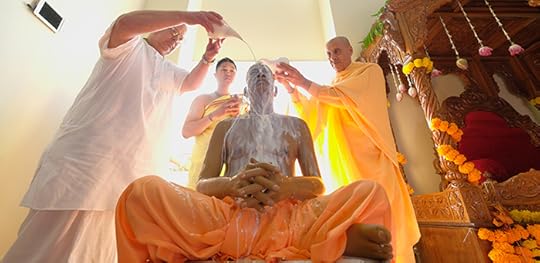
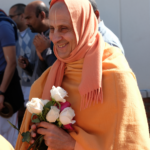
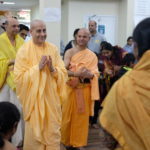
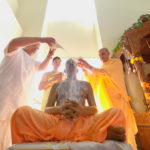
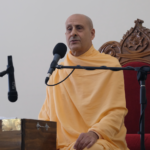
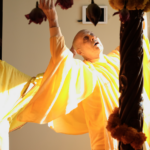
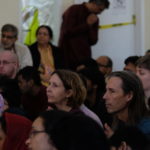
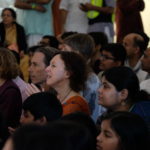
On the weekend of April 20th, 2018, Radhanath Swami joined the devotees of ISKCON Farmington Hills, Michigan, and other guests, as together they inaugurated their new temple and installed the beautiful deity forms of Radha and Krishna (Sri Sri Radha Gopijan Vallab). The festival was filled with unforgettable moments that will treasured by all who attended.
On Friday, Radhanath Swami participated in the installation of Srila Prabhupada’s murti with other god brothers and sisters and attended the first arati as Virabadra Ram Das, visiting Executive Director of New York’s Bhakti Center, led a rousing Guru Puja kirtan. Later, Radhanath Swami presided over the netronmelan (eye opening) ceremony of Sri Radha Gopijan Vallab. Auspicious items were shown to Radha and Krishna as the gathered community had their first chance to see Their beautiful forms.
The next day Radhanath Swami took part in Pran Pratishta ceremony wherein Radha and Krishna are invited to reside in the temple. Then he spoke at length on the significance of the rituals of temple worship. Later, he witnessed the abhishek ceremony of the deities.
Local congress woman Christine Greig and Farmington Hills Mayor Ken Massey of were present for the occasion.
In the evening Radhanath Swami did the first Maha arati to the deities and then took a guided tour of the newly renovated temple building and met with many of the local devotees. On Sunday morning he gave Srimad Bhagavatam class which Christine Greig also attended.
Approximately 12,000 guests and devotees visited the temple and attended the festival.





April 28, 2018
Three Planes of Consciousness
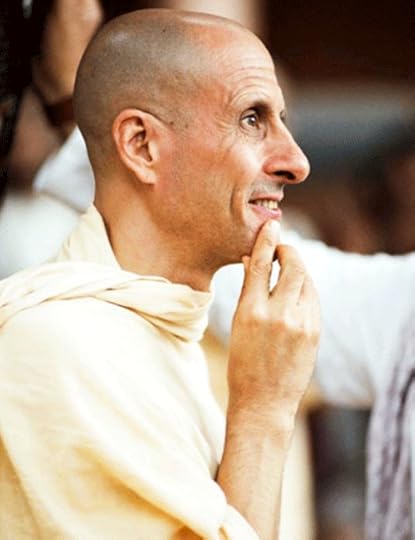 Essentially there are three planes of consciousness: enjoyment, renunciation, and devotion.
1. Enjoyment
In order to survive, the environment is geared towards exploitation. Why? Because of selfishness. We put ourselves in the center and this results in conflict as everyone has a different center.
2. Renunciation
It is taught that there can be no peace in this material existence because everything is temporary and there is so much conflict. To renounce everything and have a deep dreamless sleep – no more pain and suffering, everything is just peaceful! Yet death is not the end, so the problem is that you are going to be reborn according to your karma.
3. Devotion
This path recognizes that the highest of all solutions is to understand who we are, and who is our origin, and to live in harmony with that. We are meant to serve and to be selfless, to put God in the center and eternally be connected to Him. Harmony is there because we have a common interest.
The path of devotion transforms the material world to the spiritual world through consciousness. We need to find the spiritual world within ourselves – to find the love, peace, compassion within ourselves and to be instruments of that within the world. —Radhanath Swami
April 26, 2018
What Is Real Wealth?
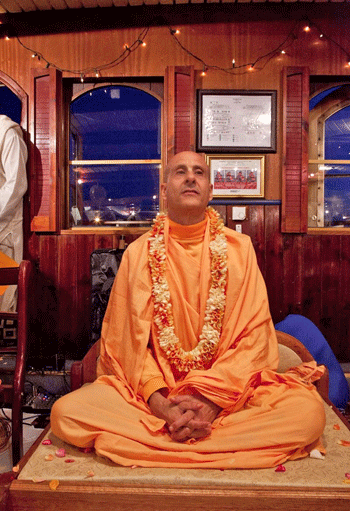 Srimad Bhagavatam tells that even if one conquers the entire universe one cannot be satisfied or free from anxiety unless one controls one’s own mind and senses. So this is real wealth. True wealth from a realistic spiritual prospective is not what we accumulate – fame, power, wealth, skills, longevity of physical life. All of these things we strive for thinking they will give us happiness.
Real wealth is happiness that is not subjected to the ever changing conditions of this world. Because whoever we are, whatever position we may hold, this world is full of uncertainties – honor, dishonor, pleasure, pain, happiness, distress, health, disease, fame and infamy, the birth and death of love ones. Often times these dualities are out of our control.
So real happiness is transcendental to all of the changes in this world and we must deal with the things of this world from the prospective of service, rather than from the prospective of being the enjoyer because of the lack of fulfillment inside. – Radhanath Swami
March 31, 2018
Memorial For HG Shyam Vallabha Das
On February 27 Shyam Vallabha Das (Dr. Sanjay Pisharodi), a disciple of Radhanath Swami and a highly respected and sought after Ayurvedic doctor, passed away at the Govardhan Eco Village outside of Mumbai. Dr. Sham Vallabha was loved and trusted not only amongst the devotee community in Mumbai, where he was from, but by so many others around the world who benefited from his service.
On March 12th, 2018 a memorial ceremony was held at the Radha Gopinath Temple in Mumbai. In the video above Radhanath Swami shares his appreciation for his dear disciple.
March 30, 2018
Wearing the Talisman of Humility & Tolerance
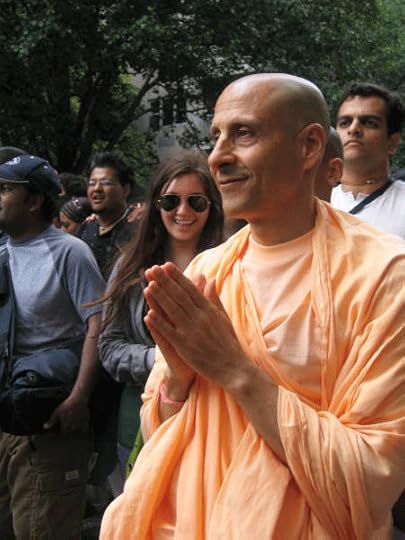 Just as we protect ourselves from unseasonal rains and earthquakes by building good, strong shelters, similarly we need to systematically cultivate the divine qualities that give us protection during the storms of strife and doubts. We build a safe haven before the storm; we cultivate humility and tolerance to face the negative stimulants. Srila Prabhupada often said, “One’s greatness is estimated by one’s ability to tolerate provoking situations.”
In an age when relationships are strained over minor misunderstandings and we dispute over trifles, how can we cultivate tolerance? While in the midst of a misunderstanding, instead of investigating who’s actually guilty, and trying to get to the bottom of issues, we need to remember that a forest fire isn’t started by anyone. When the wind blows and the bamboos rub against each other the friction causes fire. We can’t blame anyone for that. Likewise the nature of this forest-like material world is individual egos clash and for no reason, even without any ill motives and prejudices, there will be misunderstandings.
At such times we need to remember a classic verse from the sacred text, Sri Chaitanya Charitamrita – “One who thinks himself lower than a blade of grass, who is more tolerant than a tree, and who does not expect personal honour but is always prepared to give all respect to others can very easily and always chant the holy name of the Lord.” (Chaitanya Charitamrita, Antya, 20.21). A tree silently faces bitter winters and cruel summers, and offers its life for the benefit of others without ever retaliating. When life treats us unjustly, we should accept it as mercy of God, and respond with compassion, love and respect.
As soon as a propensity to judge, criticize or quarrel arises in our minds, we could try to remember this verse. The scripture further recommends us to thread this verse on the string of the holy name of God and wear this verse around our neck always. In India it is common to see people wearing a talisman on their necks or arms. Some put on precious gems, or astrological stones on their bodies, hoping it will offer magical protection against evil spells or disease. But the real amulet for all quarrels and dissensions is the jewel of humility and tolerance. – Radhanath Swami
March 26, 2018
On Desire
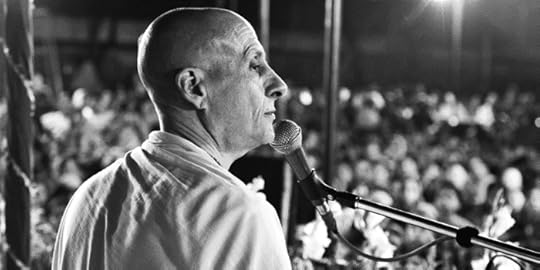
The whole reason why there is suffering in this world is selfishness. We are so much concerned with ‘me’ or ‘mine.’ It is the anchor that keeps us in this world birth after birth. Even if we are chanting the holy name and reading the Bhagavatam we may still have materialistic desires. Why? Does the process work?
Srila Bhaktisiddhanta Maharaja was asked the same question. He told the story of the marriage party. A newly married couple had to take an overnight boat ride and it was already dark. The boatman started to row and he rowed the boat all night, but when the couple woke up in the morning they were still in the same place. Everyone was confused how this could be, and then they noticed the boatman had forgotten to pull up the anchor. He was rowing all night long, but he didn’t get anywhere. Srila Bhaktisiddhanta Maharaja described how our desire to enjoy this world is the anchor. Our multitude of attachments to materialistic life is our anchor. If we don’t change our desire and make a conscious decision to change our attachments, then we can chant the maha mantra all life long and we hardly get anywhere.
People may do so much service, but still may criticize others and be selfish. What does that mean? That they really haven’t pulled up the anchor. You can chant the holy names and make some advancement. But you are not going to make real advancement until you change your desire. This is because Krishna is in His name and will reciprocate accordingly to our desire.
What is the use of all philosophy without good character? These things are all based upon desire. We hear from great saints what is their desire. They are praying to the Lord, “Don’t fulfill my lust; but rather free me from lust, pride, illusion, greed, anger and envy. I just want to be your servant, my dear Lord.” If we have that desire then very rapidly we can proceed. We must pull up the anchor. —Radhanath Swami
March 22, 2018
Understanding Meditation
There are different forms of meditation in every religious tradition and practically in every denomination of each religious tradition. In order for any of them to be effective, what is most important is our sincerity and the willingness to really absorb ourselves in that particular process. Some meditate on a silent mantra, some on a particular form, some on a particular prayer, some on a virtue, some on the breath, some on the different sensations of the body and some on the name of God, which is considered very divine and holy.
All these meditations are meant to purify our heart and bring our mind to its natural condition. Our consciousness is inherently pure, eternal, full of knowledge and bliss. But somehow or other it has been covered by and adulterated by so many misconceptions, so many desires, so many longings, so many anxieties about what we want and what we don’t want “I am a man, I am a woman; I am American, I am South American, I am Indian, I am Pakistani, I am Russian, I am African”— all of these are bodily conceptions. We are so much consumed by these things and it is all mixed into our consciousness. If we filter our mind through meditation or any genuine spiritual practice, it brings our consciousness back to its original state, which is pure.
Another example is a mirror. When you look into a mirror, you see yourself. But what if that mirror has been neglected for hundreds of years? There are layers and layers of debris, dust, dirt and filth. And when you look into that mirror, all you see is the dust and the dirt that is accumulated, and all that you think is “This is me!” But when you clean the mirror, little by little you start seeing the image of yourself. And when the mirror is actually clean, you see who you are. Meditation is for that purpose; prayers are for that purpose; spirituality is for that purpose: to cleanse our heart, to cleanse our life-style so that we can actually directly experience our own essence, which is eternal, full of knowledge and full of love.
— Radhanath Swami
February 22, 2018
Radhanath Swami Speaks at Techfest, Mumbai
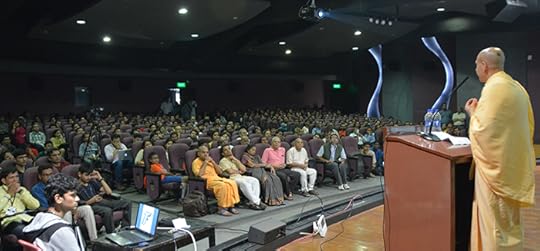

On December 31st, 2017 Radhanath Swami spoke on ‘A scientific Case Study of Spiritual and Religious Faith’ at Techfest, the annual science and technology festival hosted by the Indian Institute of Technology (IIT) Bombay. Techfest is Asia’s largest tech festival with an attendance of approximately 160,000. Over 3000 colleges from around the world participate.
Radhanath Swami emphasized the need of spirituality to engineer our inner selves. “When people neglect this inner cultivation, there is every danger of destructive use of science and technology,” he said.
“He left the packed audience completely inspired and touched with his presentation. It was absolutely grounded in his personal experiences and his profound journey of self-discovery,” said Professor Ganesh Ramakrishnan of the Department of Computer Science and Engineering, IIT Bombay. “He inspired me to start thinking on a level deeper than I usually do,” remarked Varun Nagandla, who is doing his bachelors degree at the Premier Institute.
Other speakers at the event included prominent names from the fields of science, technology, industry and politics, such as Randy Schekman, Nobel Prize recipient in physiology; Marlene Kanga, president of WFEO, UNESCO; Manohar Parrikar, chief minister of Goa; Tanmay Bhakshi, youngest IBM Watson developer; and Sophia, the humanoid robot.




February 16, 2018
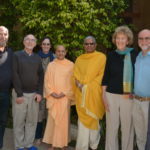
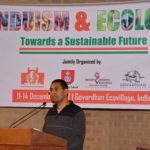
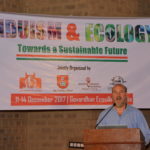
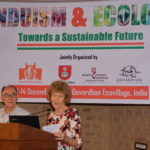
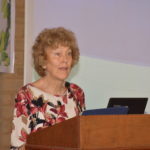
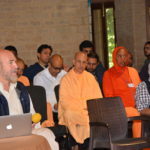
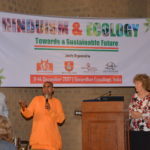
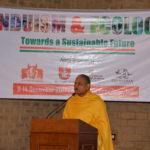
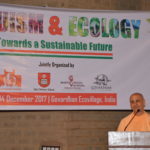
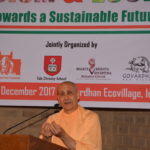
Radhanath Swami Keynote Speaker at Hindu & Ecology Conference, Govardhan Ecovillage, India
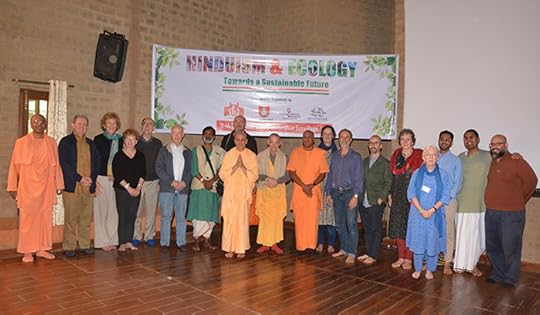
Govardhan Ecovillage hosted a 4-day conference, Hinduism and Ecology: Towards a Sustainable Future, from 11th to 14th of December 2017. The conference was jointly organized by Yale University, Govardhan Eco Village, Bhaktivedanta Vidyapith, and Maharashtra Tourism, and brought together leading faculty from prominent American universities and Hindu leaders from around the world, who extensively explored Vedic solutions to the ecological crisis.
Over thirty academic scholars participated, including Harry Blair, John Grim and Mary Evelyn Tucker from Yale University, David Haberman from Indiana University, Srivatsa Goswami, leading academic scholar from Radha Raman Temple in Vrindavan, Ravi Gupta from Utah State University, Christopher Chapple from Loyola Marymount University, Devamrita Swami, Krishna Kshetra Swami, and Bhaktirasamrita Swami.
The participants invited Radhanath Swami to give the keynote address on the first day of the conference, and the closing remarks on the last day. Addressing the delegates, Radhanath Swami said, “The problems of ego and greed are the foundation of all our environmental problems. Problems of this magnitude can discourage us, but big things start from small seeds. I feel conferences and gatherings such as these are a seed. We as a family gathered today can make a significant difference for the wellness of all beings within our creation.”