
Aaron E. Carroll's Blog, page 119
November 7, 2017
The Bad Food Bible – Now Available in Stores!
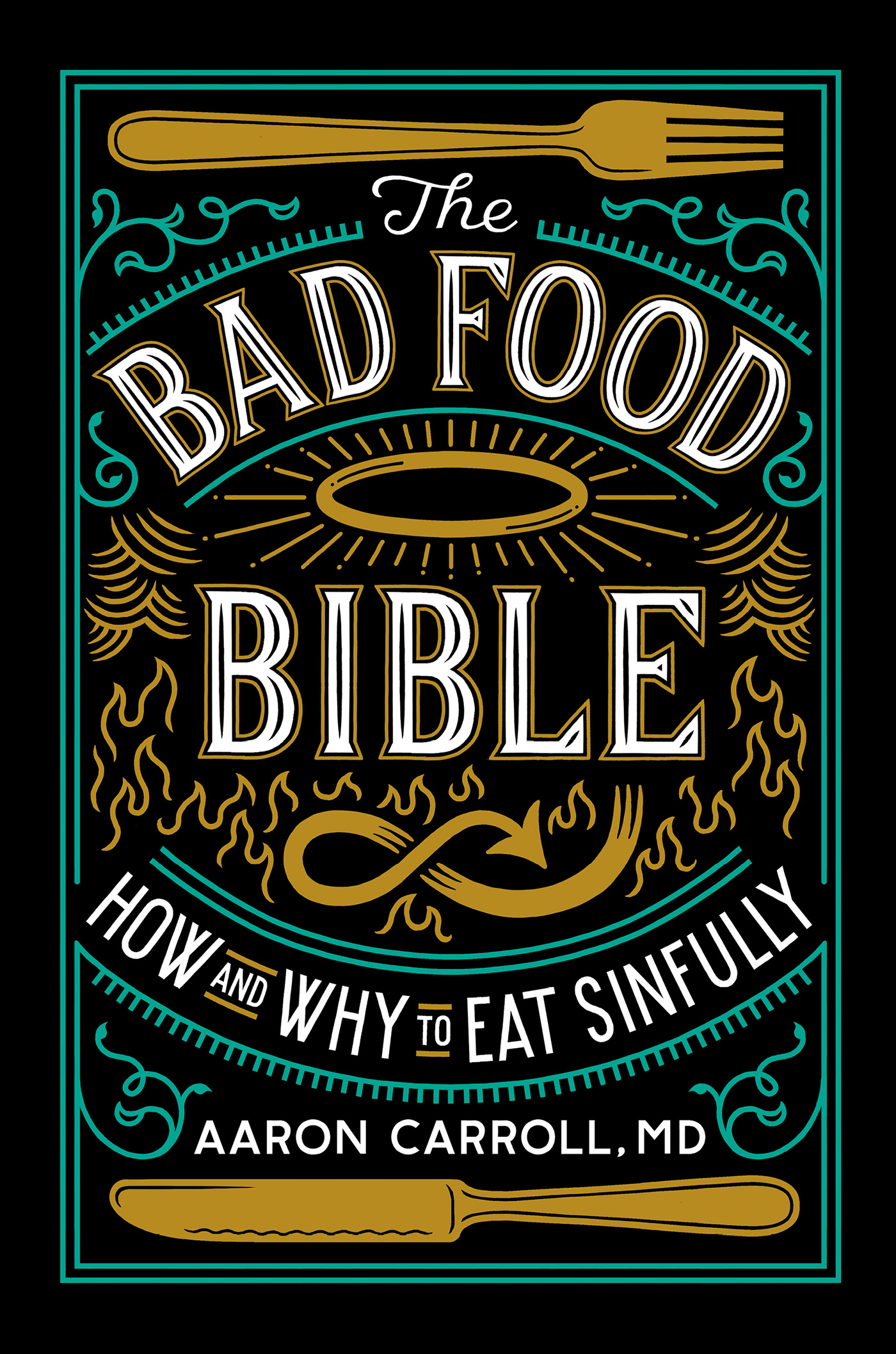 It’s finally here! If you enjoyed my Sunday NYT column on food fear, you’re going to love my book. The Bad Food Bible: How and Why to Eat Sinfully is now available wherever you buy books. I’d really appreciate your picking up a copy! Here are some links to help:
Amazon
Barnes & Noble
Indiebound
iBooks
Kobo
Any local bookstore you might frequent. You can ask for the book by name or ISBN 978-0544952560
Thanks!


November 3, 2017
Why Advertising Is a Poor Choice to Tackle the Opioid Crisis
The following originally appeared on The Upshot (copyright 2017, The New York Times Company) and is jointly authored by Austin Frakt and Keith Humphreys. Keith is the Esther Ting Memorial Professor at Stanford University School of Medicine. He has advised several government bodies, including the White House Commission on Drug Free Communities. This also appeared on page A11 of the November 2, 2017 print edition.
In declaring the opioid epidemic a public health emergency last week, President Trump promised that the federal government would start “a massive advertising campaign to get people, especially children, not to want to take drugs in the first place.” But past efforts to prevent substance abuse through advertising have often been ineffective or even harmful.
Perhaps the most famous American antidrug advertisement featured a sizzling egg in a frying pan to the sound of ominous music and a stern voice-over warning, “This is your brain on drugs.” A sequel to this ad featured smashing an egg and the better part of a kitchen to dramatize the impact of heroin.
Many other ads denouncing drugs and emphasizing their destructive effects — as in the “Just Say No” campaign — appeared regularly on television and in print beginning in the 1980s. Most of them were funded by the White House Office of National Drug Control Policy, which received hundreds of millions of dollars a year from Congress for such campaigns.
Visually dramatic though the ads were, evaluations of them were deeply discouraging. The billions spent from the late 1980s through the mid-2000s at best had no effect on drug use, research shows. At worst, exposure to the campaign might have actually increased the likelihood of adolescent marijuana use. A study of over 20,000 youths 9 to 18 found that those who had been exposed to more antidrug ads expressed weaker intentions to avoid marijuana and more doubts that marijuana was harmful.
Why was the original campaign such a failure? In part it suffered from perverse incentives. Congress provided substantial money for the ads and was intensely interested in them at the height of the so-called war on drugs, creating internal pressure to make the ads appealing to members of Congress. But while ads that lectured or scared people about drugs might have seemed compelling to the modal member of Congress (a 60-year-old white male), they did not necessarily dissuade drug use by adolescents. In some cases, this kind of approach may make drugs more attractive as a sign of rebellion.
Other reasons that campaigns backfire is that they make adolescents aware of a drug that they might not have heard of, sparking curiosity in some to try it. Campaigns against drugs can also create a false sense that drug use is more common than it is, making those who don’t use drugs feel socially abnormal.
After the failure of the government’s initial antidrug media campaign, which was highlighted in the press and congressional hearings, it was significantly redesigned. The new approach, named Above the Influence, moved more toward the message that not using drugs exemplified and maximized youth freedom.
The retooled campaign had stronger results, with one study of over 4,000 adolescents showing that it reduced teenage marijuana use.
In switching tack, antidrug campaigns were taking a page from antismoking campaigns like the “truth.”This campaign, which research has estimated has deterred hundreds of thousands of adolescents from beginning to smoke, turns youthful rebellion to its advantage. Refraining from smoking was not about pleasing a parental authority figure; the “truth” pointed out to adolescents that people their parents’ age ran the tobacco companies and took them for saps (not cool). To be free thus meant to snub their seduction (cool).
Still, the positive results for Above the Influence and the “truth” are not the norm. A recent Cochrane review of rigorous studies collectively examining over 180,000 people reported that the average effect of mass media campaigns on drug use in randomized studies was essentially zero. Why is it so hard for media to change young people’s drug use?
By the time they reach adulthood, Americans are typically exposed to tens of thousands of advertisements promoting substance use, be it beer, cigarettes or more recently cannabis in some locations. Although opioids are not directly advertised to the public, seeking relief through pills certainly is (“Ask your doctor about …”).
Given this environment, it is not surprising that the comparatively small number of ads promoting the opposite message do not make much difference. In fact, it would probably be more consequential as a media strategy to stop the promotion of addictive products, but American courts are almost alone in the developed world in treating commercial speech comparably to the protection given free speech.
Media campaigns against drug use by young people thus can at most make a modest contribution to turning around the opioid epidemic, with some risk of making it worse if the lessons of past failed antidrug campaigns are not heeded. But the safest bet is that the results will be between those two end points: zero. To fight the opioid crisis, public money is probably best spent elsewhere.
November 1, 2017
Help me learn new skills in 2017 – Cooking!
This post is part of a series in which I’m dedicating two months to learning six new skills this year. The full schedule can be found here. This is month nine/ten. (tl;dr at the bottom of this post)
In terms of developing skills I might use over a lifetime, these might have been my two most successful months. Unfortunately, they reinforced the truth that there really are a limited number of hours in the day, and any time I spend on one skill means no time for another. I still haven’t finished the socks for Aimee I want to knit. I had no time to meditate. I spent no time on Hebrew.
I did, however, cook. I had a crazy amount of travel in in September and October, and it kept me from the kitchen. It was also tennis season for the kids, and shuttling them around kept us from many family meals. Nevertheless, I got a lot done.
I bought four books. Let’s get the lesser two out of the way first. I bought and read Modernist Cuisine at Home, which is the smaller $110 version of the $500 monstrosity Nathan Myhrvold released some years ago. It’s gorgeous. It also reads as the most scientific and precise of any cookbook you could imagine. Recipes are times to the microsecond. Temperatures are exact. Weights are to the nanoparticle. But the methodology also requires a NASA-like kitchen. You need scales, torches, and a great sous-vide machine. That’s not going to happen at this point in my life. Someday, when Aimee and I have nothing else to do, I might consider going this route. For now, though, I need to cook in the real world.
I also read On Food and Cooking: The Science and Lore of the Kitchen. It was good, but it didn’t inspire me. Nice science background. Not grounded enough in the real world.
The book that made these two months work, and the one you must buy is Salt, Fat, Acid, Heat by Samin Nosrat. My goal in this month was to learn the theory of cooking, not to follow recipes. I can do that already. I wanted to know how you made the recipe. How do you know what should be in a dish? How do you adjust it to make it better? The key is adjusting – you guessed it – the salt, fat, acid, and heat.
There are big chapters on each. Nosrat starts with salt. No surprise to me, salt is the key to everything. I’ve got a chapter on it in my book, too. Salt is the key to preparing meat ahead of time. It’s the key to boiling/steaming/anything with water. It’s the key to every sauce. When something is missing, it’s almost always salt.
I learned to add what felt like a crazy amount of salt to most of what I was making. And lest you all start lecturing me, since I was cooking and not eating processed food, I bet my sodium consumption was lower than usual. Salt makes all the difference. Nosrat uses Caesar salad dressing as a fantastic example for salt since it contains a ridiculous number of salt-adding ingredients that must be balanced.
Key #2 is fat. Oil, especially olive oil, is your friend. It’s in everything. The key exercise in this chapter was making mayonnaise, which is just egg yolks and oil. Maybe some lemon juice. It’s much harder than you think.
The third factor is acid. You need to balance all salt and fat with acid. This can come from citrus, from vinegar, etc. The example here is an “avocado matrix”, where you can make a crazy amount of salads from just a few ingredients, as long as you learn to balance the salt, fat, and acid.
Heat gets into cooking techniques. For vegetables, I blanched, I boiled, I slow-cooked, I sauteed, I steamed, I lost track. But I learned what techniques go with different vegetables and why. That will serve me well in the long run. I learned to roast, to grill, to saute, to pan fry, to braise.
I made mayonnaise from scratch to turn into Caesar salad dressing and creme fraiche into blue cheese dressing. I blanched and sauteed bok choi. I slow cooked broccoli rabe. I sauteed green beans, and snap peas, and more.
I braised a pork shoulder all day one Sunday. I make Kufte more than once, and whipped up three sauces each time (Harissa – which required making pepper paste first, Charmoula, and an herbed yogurt). I slow roasted salmon three different ways. I marinated chicken to make “Buttermilk chicken”, a Persian chicken, and five-spice chicken. I spent hours on a ragu. I made a kick-ass cacio de peppe. I made a variety of salads, which I learned to mix with my hands. I took a whole weekend to make beef stock from bones and then turn it into pho. But it was amazing.
By the end of the months, I wasn’t measuring things out so much as eyeballing them. I was trying more to do things on instinct. I tasted, and I tasted, and I tasted – adjusting the ingredients accordingly. I think I got much better. Towards the end of the month, I was opening other cookbooks to look at recipes, and I could see what people were doing. I made a Thai steak salad out of Christopher Kimball’s new cookbook (I’m a regular contributor to his program and he sent me a copy). Today, I’m making kebobs and hummus from Michael Solomonov’s Zahav cookbook (that restaurant is a family favorite).
But here’s the hard part – cooking takes a lot of time. You can find cookbooks that swear you can do things faster, but I swear to you, it makes a difference when you do things right. Making harissa from scratch took almost two hours. Every meat must, and I mean must, be at least salted for at least 24 hours. Marinades are even better.
Grinding spices (and toasting them no less) makes a big difference, but it sure is time-consuming. Having fresh herbs on hand and dicing them ain’t fast. Soaking beans ahead of time requires planning, but they’re so much better in terms of texture and taste.
Even cooking veggies right isn’t “efficient”, especially when you’re trying to balance the creation of a salad and a main course simultaneously. I tweeted out a few weeks ago that I’m starting to understand why good restaurants need to charge a lot for good food. Sourcing ain’t cheap. Nor is the time it takes to do this right. Let me give you an example: I’m planning to make Michael Solomonov’s hummus later today. I’m going to need chickpeas, so I had to remember to start soaking them last night. Then, I need to make his tahini sauce, which requires picking up some ingredients that I don’t have in the house. While I’m making the tahini sauce, I’ll simmer the chickpeas – which will take at least an hour. This is just for hummus. I’m also planning a salad, kebobs, and perhaps a vegetable. I also made two sauces for the kebobs last night while kids were trick or treating. This served a dual purpose since needed the harissa – one of the sauces – for marinating the chicken tonight for the meal I’m planning tomorrow.
This takes time. Everything takes time.
Having said that, it’s totally worth it. I’m getting better at this. I like it. The food tastes better. We look forward to eating together. Sometimes the kids help. I rely less and less on the cookbooks as I progress.
Before I forget, let me mention the fourth book. The Flavor Bible is more of a reference than anything else, but it’s really useful. You can look up any one ingredient, and it tells you what other ingredients go with it. So if you had a bunch of herbs in the house and wanted to know what goes with “dill” this would tell you. Or, if you wanted to know what works well with lamb – boom, you can see. It’s not for everyone, but I like having it around. Nosrat has a much simpler version of this in illustrated form in her book, but I like the detail.
tl;dr: Cooking well takes time, but it’s worth it. The best book by far is Salt, Fat, Acid, Heat. You may find The Flavor Bible helpful as a reference. And buy my book!
How Medicare Premium Support Could Affect You
The following originally appeared on The Upshot (copyright 2017, The New York Times Company). It also appeared on page A11 of the print edition on October 30, 2017.
Last month, as Republican leaders were preoccupied with another unsuccessful attempt to replace Obamacare, a senior Trump administration official issued a warning about a different major medical program, Medicare.
The official, Seema Verma, administrator of the Centers for Medicare and Medicaid Services, wrote in The Wall Street Journalthat Medicare was facing a fiscal crisis. She announced that she was asking the agency’s innovation center for ideas to address it, and that part of the answer was to give consumers “incentives to be cost-conscious.” This has some Democrats worried that she’s trying to move Medicare toward something called premium support, which would be a huge change for consumers.
Before we get into the pros and cons, what’s the fiscal crisis? According to projections from this year’s Medicare Trustees’ report, the fund that pays for Medicare-financed hospital care will be depleted in 12 years, and care for other services will consume an ever-larger share of the economy and federal revenue. Citing trends like those, Republicans included the outlines of a Medicare premium support plan in the House of Representatives’ fiscal year 2018 budget resolution, as they did in several prior ones.
In broad terms, “premium support” means the government pays a contribution toward premiums, and beneficiaries pay the rest. In a sense, today’s Medicare program already has such a structure. For either the traditional program or a private Medicare Advantage plan, the government pays a preset premium stipend (alternatively called a subsidy, credit or voucher) that varies across these two parts of the program. In all cases, stipends grow at the rate of health care costs.
If Medicare already has a form of a premium support model, what’s all the fuss about?
The important difference is in how stipend levels are set. Today’s stipends are not driven by the market, but are set according to legislatively established formulas. But the type of premium support Medicare reformers usually advocate — what people generally mean when they use this term — would use market signals to set stipend levels.
“Premium support could result in increased efficiency in the Medicare program,” said Bryan Dowd, a health economist at the University of Minnesota, and co-author of a book that analyzed various premium support options. That efficiency could push the hospital trust fund depletion date further into the future and reduce “the financial burden on future generations.”
Premium support models take many forms, but there are two crucial variables. One is how stipend levels are set, which determines how much of beneficiaries’ own money they need to contribute. The other key feature of premium support is how much the stipend grows over time. Both aspects are hotly debated.
In some versions of premium support, the stipend level would grow more slowly than health care costs, forcing people to pay more out of pocket over time to purchase coverage. In other versions, the stipend level would grow at the same rate as health care costs, so beneficiaries would continue to pay about the same share of their own money for health insurance.
Most premium support approaches would retain traditional Medicare, though its fate would be uncertain, a source of controversy. “A lot rides on how the government’s support level differentially impacts the cost to beneficiaries of private plans versus traditional Medicare,” said Timothy McBride, a health economist with Washington University in St. Louis. Geography also plays a role. “If traditional Medicare is disadvantaged, that would hit rural beneficiaries harder, because a larger share of rural America relies on the traditional program than do urban Americans.”
As a report this month from the Congressional Budget Office reveals, how much premium support could save the government varies considerably depending on how stipend levels are established. Across the variations the C.B.O. examined, Medicare spending could fall by as much as 9 percent or as little as about 0.5 percent. But premiums could rise, including the premium for traditional Medicare. Under one projection, the C.B.O. estimates, traditional Medicare’s premium could double.
In all the scenarios the C.B.O. analyzed, stipend levels would be based on bids from Medicare Advantage plans and traditional Medicare that reflect the cost to cover a person for standard Medicare services. Stipend levels would keep pace with overall health care costs, but they could still be lower than what many Medicare beneficiaries receive today.
For example, tying the stipend to the second-lowest bid and requiring all Medicare beneficiaries to be subject to that new, lower level would save $419 billion over 2022-2026, the C.B.O. estimated.
Tying it to the average bid or requiring only new beneficiaries to be subject to the new stipend would save less. In either case, people would have access to plans that don’t cost more than today’s. But those who opted for more expensive plans because they offer more benefits, or the traditional program because it covers any doctor willing to accept Medicare patients, would pay more out of pocket. Consequently, more people would opt for cheaper, private plans — and fewer would choose traditional Medicare.
This worries some health policy experts. “Traditional Medicare has been the leader in reforming the health care payment and delivery system to improve efficiency,” said Paul Van de Water, senior fellow with the Center on Budget and Policy Priorities. “It has outperformed private insurance in holding down the growth of health costs, but its ability to continue to do that would shrink significantly if premium support caused its enrollment to dwindle.”
Exactly how much more people would pay depends not only on the plans they select, but also on where they live. In some markets, many plans, including the traditional program, might charge premiums close to the second-lowest bid. In others, plans that many beneficiaries may want might cost a lot more.
In the premium support debate, there’s a fundamental lesson: It’s conceptually simple to reduce federal spending on health care, but it’s very hard to do so in a way that doesn’t increase costs for at least some consumers. To actually reduce total (not just federal) health care spending for everyone, one has to overhaul how care is delivered, not just how it is paid for. That’s much harder.
October 31, 2017
It’s only a week until my book comes out. Preorder a copy now!
I’m trying to keep the number of posts I write about this to a minimum, but the publication date for my new book is a week away. The Bad Food Bible: How and Why to Eat Sinfully will be released on November 7. It grew out of some of my columns over at the Upshot about food (which also happen to be some of my most popular).
Preorders matter because they all count towards first week sales, and I’m told that’s important. So if you’re considering picking up a copy (and why wouldn’t you?), please consider buying one now from any of these sellers:
Amazon
Barnes & Noble
Indiebound
iBooks
Kobo
Any local bookstore you might frequent. You can ask for the book by name or ISBN 978-0544952560
Thanks!
October 30, 2017
Healthcare Triage: Cars are the enemy on Halloween, not tainted candy
This one is evergreen. Enjoy.
You should also go read Christopher Ingraham, who is stamping out myths about the panic-du-jour, marijuana-laced candy.
Healthcare Triage: The Death of a Sibling Takes Emotional and Physical Tolls
The death of a child is almost too awful to complicate. The emotional toll on those who remain is high, but the death of a sibling can also have long-term health consequences, including increased mortality.
This episode was adapted from a column I wrote for the Upshot. Links to further reading and sources can be found there.
Trump and the Essential Health Benefits
On Friday, HHS released a proposed rule that would make a number of adjustments to the rules governing insurance exchanges for 2019. The rule is long and detailed; there’s a lot to digest. Among the most noteworthy changes, however, are those relating to the essential health benefits. They’re significant, and I’m not convinced they’re legal.
By way of background, the ACA requires all health plans in the individual and small-group markets to cover a baseline roster of services, including services falling into ten broad categories (e.g., maternity care, prescription drugs, mental health services). Taken as a whole, the essential health benefits must be “equal to the scope of benefits provided under a typical employer plan, as determined by the Secretary.”
The ACA’s drafters anticipated that HHS would establish a national, uniform slate of essential health benefits. Instead, the Obama administration opted to allow the states to select a “benchmark plan” from among existing plans in the small group market (or from plans for state employees). The benefits covered under the benchmark were then considered “essential” within the state.
At the time, Helen Levy and I concluded that HHS’s approach brushed up against the limits of what the law allowed. We noted, among other things, that the ACA tells HHS to establish the essential health benefits—not the states. And it’s black-letter administrative law that an agency can’t subdelegate its powers to outside entities, states included.
At the end of the day, however, Helen and I concluded that the Obama-era regulation passed muster. Our rationale bears repeating:
Although a federal agency cannot delegate its powers to the states, it “may turn to an outside entity for advice and policy recommendations, provided the agency makes the final decisions itself.” Here, the secretary gave the states a constrained set of options (e.g., choose a benchmark plan from among the three largest small-group plans in the state) and retained the authority to select a benchmark for any state that either does not pick a benchmark or chooses an inappropriate one. As such, the secretary remains firmly in control. Nothing in the ACA prevents her from deferring to states that select benchmark plans from among the few options she has provided. That choice to defer is itself an exercise of her delegated powers.
The Trump administration’s proposed rule would vastly enlarge this Obama-era subdelegation. For starters, the rule would allow a state to adopt another state’s benchmark, or part of a state’s benchmark, as its own. Michigan, for example, could borrow Alabama’s benchmark plan wholesale, or it could incorporate Alabama’s benchmark for mental health and substance use disorder treatment. More significantly, the rule would allow a state to “selec[t] a set of benefits that would become the State’s EHB-benchmark plan.”
You read that right: if the rule is adopted, each state can pick whatever essential health benefits it likes. No longer will it be choosing from a preselected menu; it’ll be picking the essential benefits out of a hat. In so doing, the proposed rule looks like it would unlawfully cede to the states the power to establish the essential benefits.
This extraordinary subdelegation of regulatory authority is subject only to the loosest of constraints: benefits can’t be “unduly weighted” toward any one benefit category or another, and the benchmark must “[p]rovide benefits for diverse segments of the population, including women, children, persons with disabilities, and other groups.” The selected benefits also can’t be more generous than the state’s 2017 benchmark (or any of the plans the state could have selected as its benchmark), but that’s a ceiling, not a floor, so states have lots of room to pare back.
The only meaningful constraint is that the benefits covered by the state’s benchmark must be “equal to the scope of benefits provided under a typical employer plan.” But another portion of the proposed rule would hollow out that requirement:
[W]e propose to define a typical employer plan as an employer plan within a product (as these terms are defined in §144.103 of this subchapter) with substantial enrollment in the product of at least 5,000 enrollees sold in the small group or large group market, in one or more States, or a self-insured group health plan with substantial enrollment of at least 5,000 enrollees in one or more States.
In other words, HHS is saying it will treat as “typical” any employer plan, in any state, that covers more than 5,000 people.
This looks like an innocuous change. It’s not. If the rule is adopted, it means that a single outlier plan can now count as typical, even if it’s way stingier than any other plan in the market. It also makes me wonder if HHS already has in mind some large employer with an unusually narrow health plan—maybe some hospital-based “administrative services only” plan, as Dave Anderson speculates. If so, voilá, the states can all ratchet down their essential benefits to that plan’s level.
I don’t think that’s legal. To know if a slate of health benefits is typical, you have to know something about how many health plans cover those benefits and how many don’t. The proposed rule eschews that comparative inquiry, and instead defines typicality with reference to the number of people who are covered by a single plan. Some random self-insured plan that excludes appendectomies could be treated as typical, even if it’s the only plan in the nation that does so.
In other words, HHS wants to define a “typical employer plan” to include atypical plans—which the agency emphatically cannot do. Yes, plans that enroll 5,000+ people are less likely to be outliers than smaller ones. But in a country as big and complicated as ours, there are bound to be some idiosyncratic quirks even in large plans. Those quirks would all be considered typical under HHS’s rule.
This definitional change, combined with the choose-your-own-adventure option to devise a benchmark, means that states will have wide authority to water down the essential health benefits requirement. Whether that’s good or bad depends is hard to say. Requiring plans to cover lots of services assures comprehensive coverage, but it also raises the cost of insurance. Because there’s no single “best” way to strike the balance, I think there’s a lot to be said for giving states the freedom to choose for themselves.
Wise or not, however, I’m skeptical that the Trump administration’s effort to hollow out the rule governing essential health benefits is legal. If HHS presses ahead with the rule, it could face tough sledding in the courts.
October 26, 2017
Come work with me (job posting 2)
Colleagues and I are advertising for policy analysts. If that’s you, this is an opportunity to work with us at the Partnered Evidence-based Policy Resource Center (PEPReC).Though PEPReC is a center in the Veterans Health Administration, the position will be filled through Boston University.
Apply here. (We are also looking for research data analysts.)
October 25, 2017
Healthcare Triage News: A Bipartisan Fix for Obamacare? Who F***ing Knows?
There’s been talk in Washington DC in recent weeks that Senators Patty Murray and Lamar Alexander has come to some kind of bipartisan agreement to fix the problems with the Affordable Care Act exchanges. Well, details are scant, the president keeps changing his mind about it, and as a result, nobody knows what’s going to happen. It drives a host to curse.
Aaron E. Carroll's Blog

- Aaron E. Carroll's profile
- 42 followers

