
Andrew Huang's Blog, page 3
February 28, 2025
Solution, Name that Ware January 2025
The ware for January 2025 is the Gavilan SC laptop motherboard. The Gavilan laptop is one of the first portable computer designs, announced in 1983, at a 2024-equivalent price of $12,400. However, the company only survived for one year, per Wikipedia:
Owing to a rigorous overhaul of the design of the laptop, the company missed its initial shipment deadline of December 1983, with the first several dozen units shipping instead in April 1984. Early units were fraught with technical issues, prompting more tweaks. Mass production and sales did not commence until June 1984. By this point, a major distributor of the Gavilan computer had filed for bankruptcy and was forced to pulled out of their deal with Gavilan. In late 1984, Gavilan Computer Corporation themselves declared Chapter 11 bankruptcy with cash flow problems. The company ceased operations in 1985, having only shipped a few thousand units of the Gavilan SC.
The number of blue wires on the main board is pretty consistent with “fraught with technical issues, prompting more tweaks”, and the history of the company reads like a botched Kickstarter from 2010, except it happened in 1984.
I was a little surprised at how difficult it was to guess the nature of the ware. I think contestants were reasonably thrown off by the inclusion of the modem. That would be a pretty forward-thinking feature to be designed into a laptop mainboard back in 1984. It’s also puzzling why one would preferentially integrate the modem over say, the RAM/ROM on the mainboard: generally there is some bare minimum memory required for a system to even function, whereas a modem might benefit from modularity for e.g. SKU diversity and/or future-proofing against improvements in modem hardware.
That being said, the company didn’t survive. Perhaps it is due in part to poor integration decisions from the get-go, yet contestants were viewing the ware through the lens of good decision making. Personally, I have found some of the hardest wares to guess to be poorly designed wares, as the final form is a bad fit for the function.
After reading through the comment thread a couple of times, I find it too hard to assign any one person a clear winner. A shout-out to FETguy for the explanation of the crinkly solder mask: I think the SMOBC vs HASL answer is correct – turns out I probably knew the answer to this once upon a time, but I had forgotten it with old age. Unfortunately, there wasn’t a tie to break in the competition – I think none of the guesses got close enough for me to declare a winner, despite all the thoughtful commentary. Thanks to everyone who participated!


January 30, 2025
Name that Ware, January 2025
The ware for January 2025 is shown below.
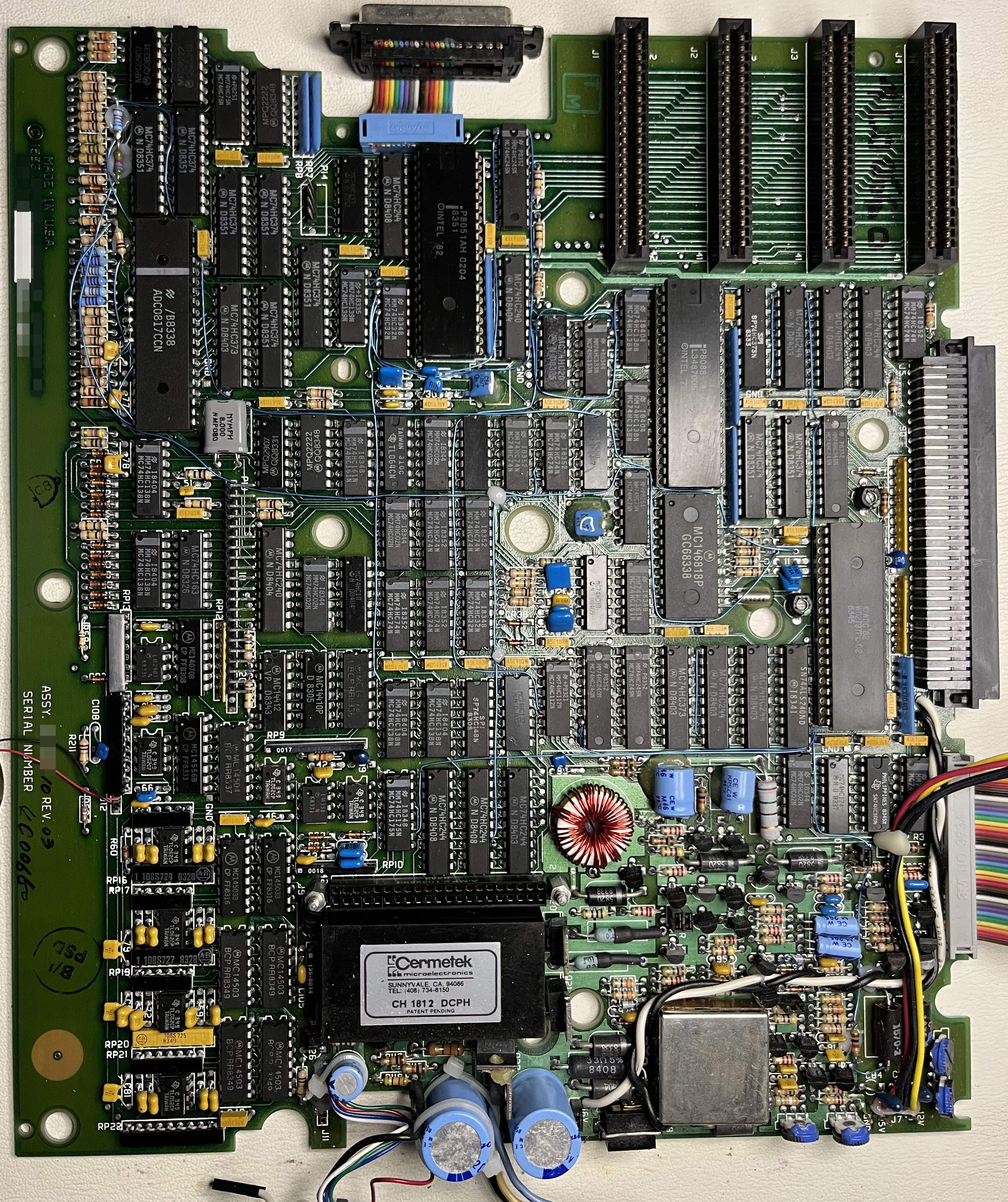
Thanks to brimdavis for contributing this ware! …back in the day when you would get wares that had “blue wires” in them…
One thing I wonder about this ware is…where are the ROMs? Perhaps I’ll find out soon!
Happy year of the snake!
Winner, Name that Ware December 2024
The ware for December 2024 is a 2mm pitch, 64×64 LED panel purchased from Evershine Opto Limited. Their sales part number is ES-P2-I, but the silkscreen says DCHY-P2-6464-1515-VP. The seller is just the name slapped on the box; like most commodity wares, there’s likely multiple channels offering the exact same make and model. So, I’ll accept any generic that more or less matches the spec as the winner.
As a matter of the “spirit” of the competition, my goal is to encourage thoughtful analysis, rather than “first to post”, so I will tend to award more insightful or accurate answers over quick answers. It’s a balance between rewarding “open discussion” versus “first to post”: I don’t want things to devolve into either a situation where nobody shares ideas out of fear that someone might riff off of their thoughts and win the prize; but I also don’t want a situation where folks are just throwing partial guesses at the wall to claim priority.
That being said, I had observed this would be an easy ware, which indicates priority to more insightful answers, not the first correct answer. To that end while “h” got the quickie out, Joe did produce a link to an exact match on the ware (which, significantly, is not what I get when I do an image search for the ware, although perhaps the results are geolocated). Meanwhile, Ian commented on some actual design features – an insight you wouldn’t get out of a rote image search.
In my mind, all three could be eligible for the prize in this case. I think if “h” had looped back and commented on some other design feature of the ware (doesn’t have to be lengthy – similar to Ian’s is sufficient), it would have been straightforward to give the prize to “h”. But because the ware was so easy to guess, the prize goes to Joe for producing an exact link (the part number, pixelated in the contest image, is an exact match!), as that took a little bit more research. Congrats, email me for your prize!
Tough one to judge, though; I suppose I asked for that by posting a relatively easy ware.
December 31, 2024
Name that Ware, December 2024
The ware for December 2024 is shown below.
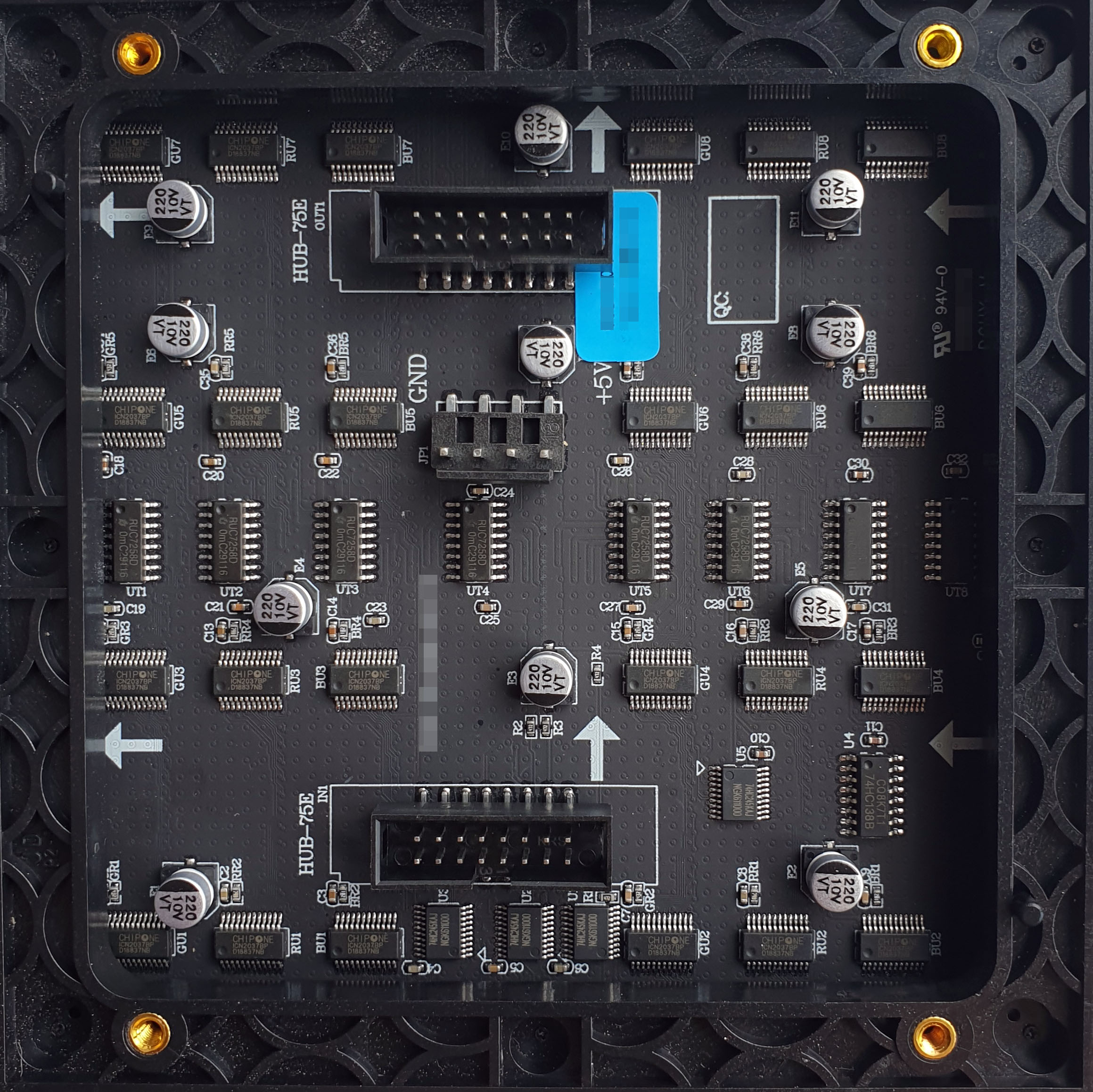
This one should be a cakewalk, and I’m mostly sharing it because I had trouble searching for a recent example at an image quality sufficient to make out most of the part numbers. Maybe this can help someone else in a similar fix!
Warm wishes for a safe and happy new year to all!
Winner, Name that Ware, November 2024
The Ware for November 2024 is the NLP-16A by cherry-takuan. It’s a bespoke 16-bit CPU made entirely from 74HC00 NAND gates.
Even the D-flip flops are made from NAND gates:

Lots and lots of NAND gates…
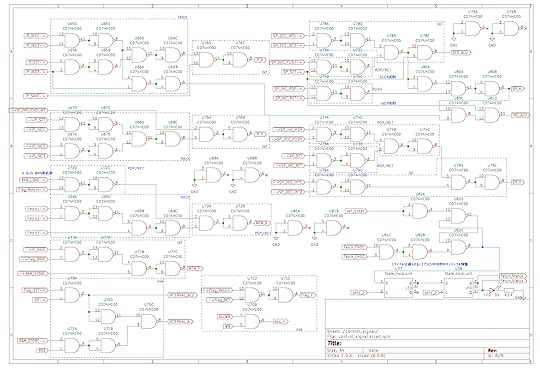
I got to meet the maker, who goes by Cherry Takuan, at the Chiba Institute of Technology‘s 75th annual student festival. The NLP-16A was on display in a corner of the Denken electronics club (there’s also a rival club at the event, CITera). I was a little in disbelief at first, but after a bit of hemming and hawing I convinced myself this was in fact a full 16-bit CPU made out of nothing but NAND gates (the I/O card and RAM/ROM are separate). It’s double-cool in that the whole thing is up on github (here’s the schematics) and all the tooling (assembler, demo applications, etc.) are there as well. This was apparently a high school project that grew out of control and he’s now on his 6th year working on it. I wonder if he’d be interested in making a version in SKY130 with eFabless or TinyTapeout. Could stick with the “entirely NAND gate” theme, even in silicon, because why not?
I love this kind of stuff, and it’s heartening to know there’s still engineering students who have a hankering to build stuff out of nothing but NAND gates and solder — and will take the time to do it, instead of chasing the latest AI-crazed startup idea. In retrospect, I could grow into who I am today only because I cut my teeth on gritty projects like this (although not nearly as ambitious!), back when I was his age.
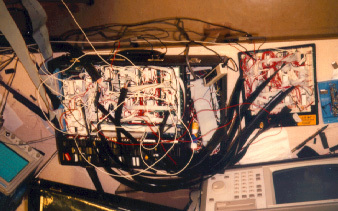
For example, above is a 48-bit wide VLIW audio DSP I made for a “6.111” lab project when I was an undergraduate at MIT…I “cheated” (compared to cherry-takuan’s all-7400 flex) and used some PLA devices, ROMs, and SRAMs to improve density. Unfortunately it was all breadboards so it was ripped up shortly after the class ended. This potato-quality photo is all I have left of it, but this was all pre-Internet, and about as good as we could do back then to preserve a design for sharing if you were a cash-strapped undergraduate with nothing but disposable film camera (remember those?).
Congrats to Alastair for nailing this one. Email me for your prize!
November 30, 2024
Name that Ware, November 2024
The Ware for November 2024 is shown below. Click on any image for a larger version.


I have a policy of never using one of my own projects for name that ware. But, sometimes I see another person’s project in the wild and it is just too cool not to share! I came across this ware recently and fell in love with it instantly. It’s the sort of thing I’ve always dreamed of doing, but didn’t have the resources to do it when I had the time, and when I finally had the resources, I no longer had the time.
The images for this month are somewhat redacted to make it a little more challenging, but … you might get an idea of what’s going on, and yah, it’s exactly that. How cool! I’ll share more details next month. My gut tells me one of my subscribers is going to have seen this thing somewhere already on the Internet, so I’m betting there will be an ID on it shortly in the comments, despite the redactions.
Winner, Name that Ware October 2024
Last month’s ware were boards from a Sony HCD-T1. Thanks again to spida for contributing the ware, and congratulations to marcan for nailing it. Ping me if you want a prize!
October 29, 2024
Name that Ware, October 2024
The Ware for October 2024 is shown below.
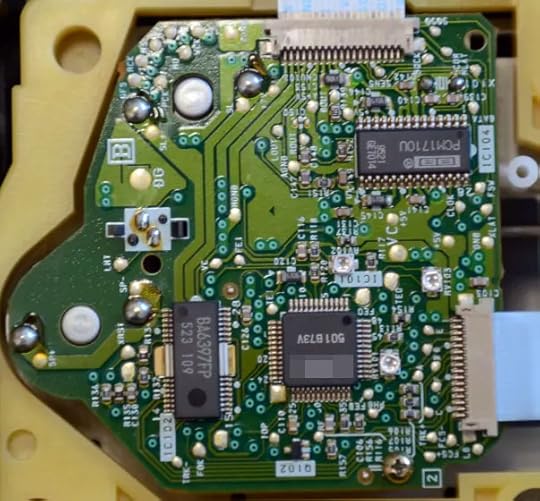
This one should be a smidge easier to guess than last month’s ware. The main reason I liked this ware is actually the board shown below with the prominent star-routing. It’s such traditional hand-routing work, I love craftsmanship like this.
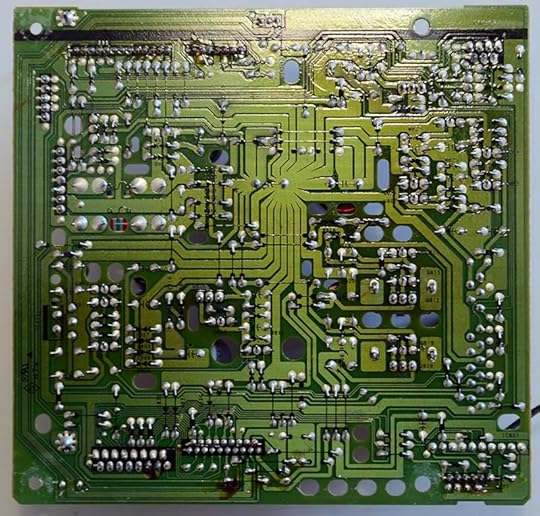
For completeness, this is the top side of the board shown above:
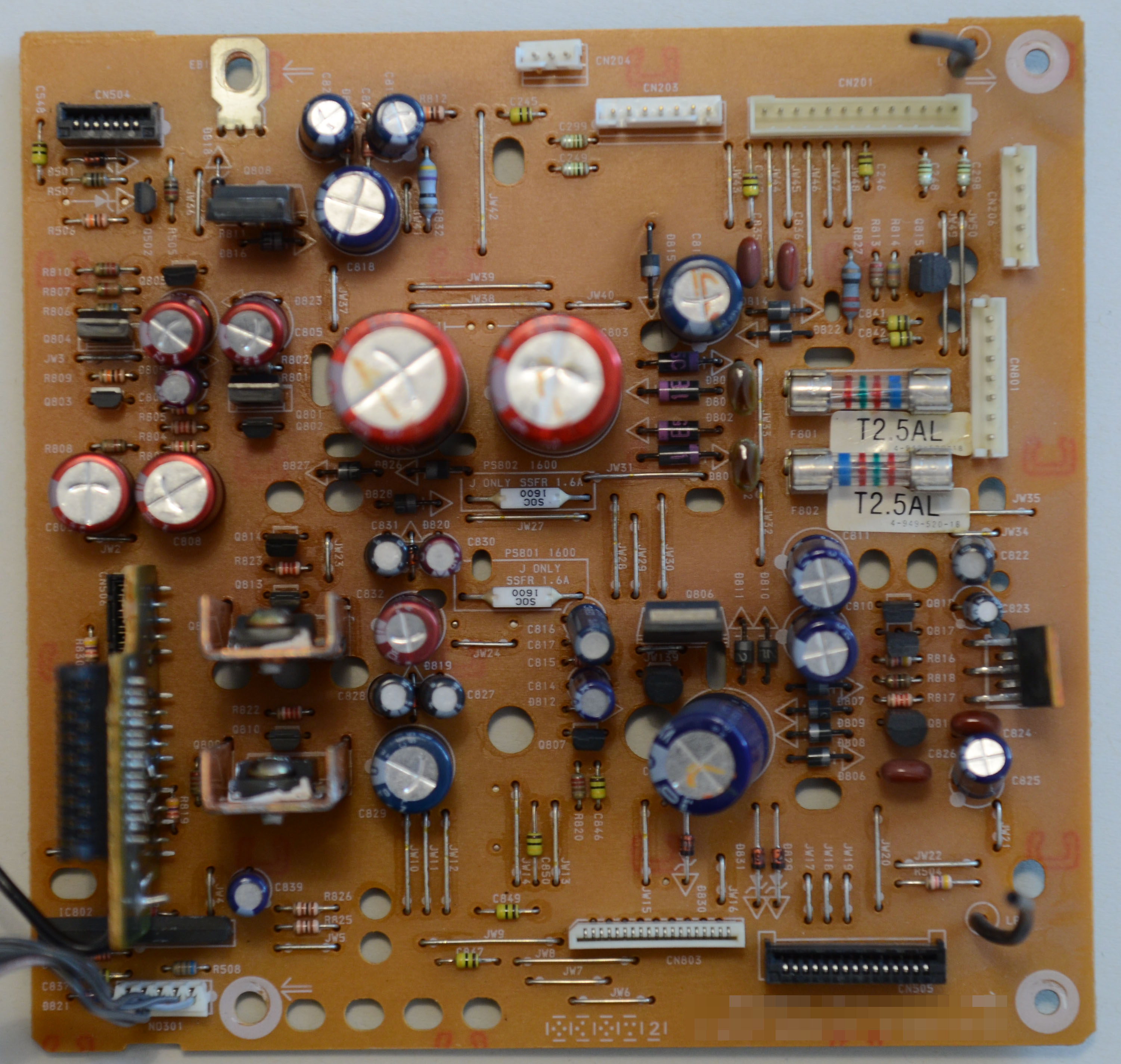
Thanks to spida for sharing this ware!
Also, just in time for Halloween, this spooky ware made its way to my desk:

This is the “fuse box” that was connecting my flat to the power mains. I live in one of the oldest buildings in Singapore; I’m pretty sure this is part of the original wiring, which makes it over 50 years old. I guess at some point, someone decided to replace the fuse with a…wire.
OK, sure.
That’s spooky enough as it is … but also not so spooky, given that downstream of it are two very modern circuit breaker boxes with GFIs. So, I think its sole purpose was to give the power company a “switch” to disconnect the power meter from the mains, if they had to service the meter.
However, the fuse cartridge probably also played some role in pushing the copper fingers into the receptacle, so without the fuse in place, the fingers were not pushing firmly against the terminal block. Over time, one of the fingers turned into a miniature electron milling experiment.
The air quality sensor in my place had ticked up slightly a couple days ago, and I thought maybe it was the haze coming back; but then last night I smelled an acrid smell I know all too well, and when I poked my head out I heard the slight crackling of electricity arcing coming from the mains panel, and knew I had to drop everything and look for the source of trouble.
So, the servers were down for a bit yesterday, but at least I have power now and only a slightly charred mounting board at the power entry point of the unit, instead no electricity and an entirely charred unit. My place is now slightly less cursed, but if I were to be honest, this is probably not the most cursed circuit on the premises…my lab is a veritable crypt of cursed circuitry!
Winner, Name that Ware September 2024
Last month’s Ware was a Cue COVID test reader. It uses LAMP (loop-mediated isothermal amplification) to perform a fast and sensitive detection of nucleic acid sequences. Thanks again to Curtis Galloway for contributing this ware for me to take apart and photograph!
Nobody had guessed the ware exactly, but “microfluidic lab on a chip” is a pretty fair generic description of a LAMP reader, so I’ll give the prize to Jimmy. Congrats and email me for your prize!
I had perhaps gotten a bit overzealous with the image redaction, but here is the connector on the PCB that I had blurred out previously. I figured this connector would have been a dead ringer for the mating Cue cartridge.


One other interesting facet – the miniature optical interrupters I highlighted previously are used to detect when the assembly shown above is no longer flush to the circuit board. It’s basically a set of very strong magnets on a flexible polymer membrane.
I’m not quite sure how it works as I’ve never used the test myself, but I seem to recall the test cartridge having a slug of metal in it that would mate with this magnet. Probably, the magnets help to hold the test in place and make firm contact with the connector while giving positive feedback to the user it’s been inserted correctly, and the interrupters allow the circuitry to know when the cartridge is all the way in. The entire thing is constructed to resist some amount of accidental liquid exposure, so this perhaps explains the need for a mechanism to detect cartridge insertion via a sealed, flexible polymer membrane.
September 30, 2024
Name that Ware, September 2024
The Ware for September 2024 is shown below:
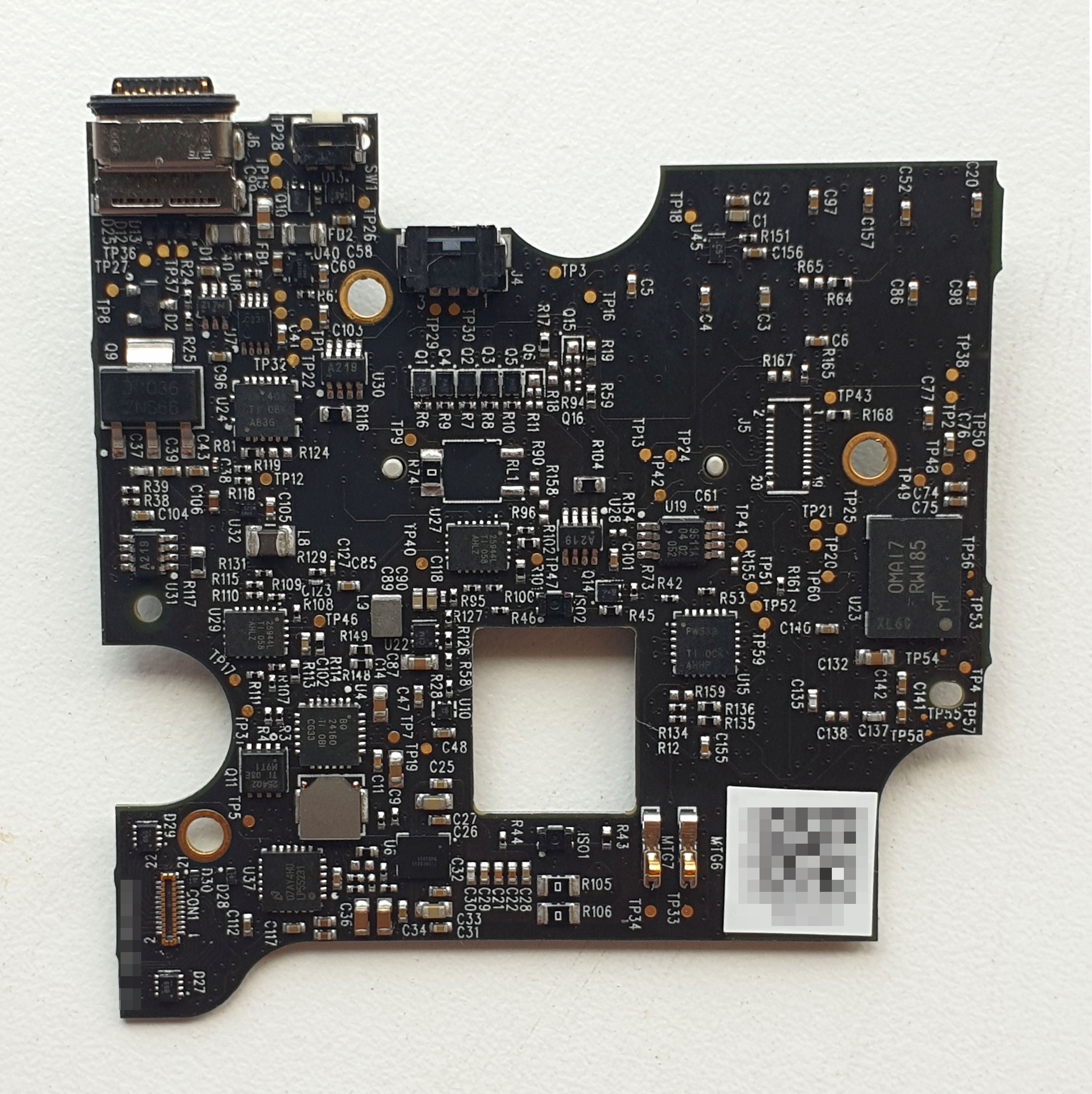
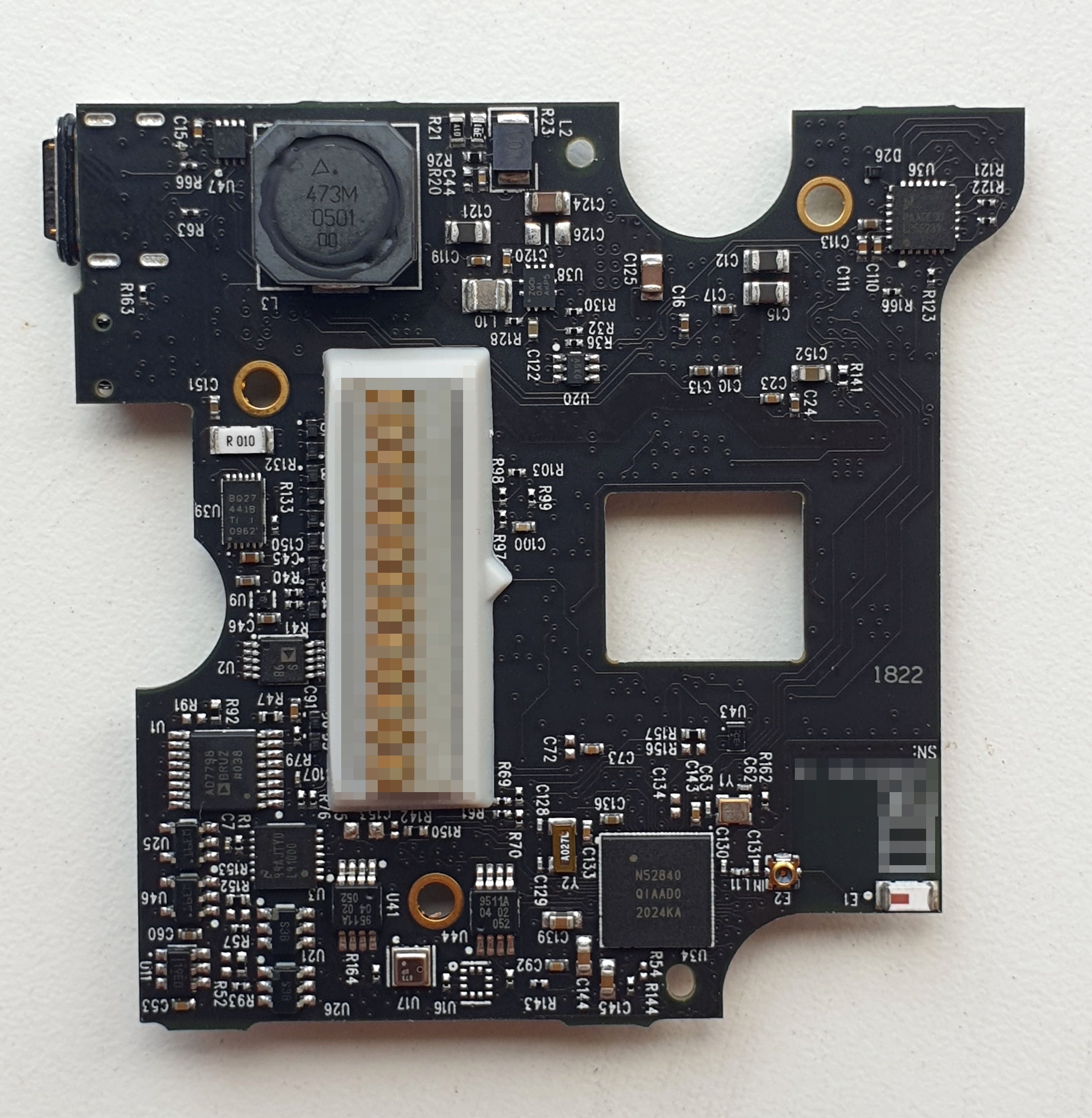
This ware was a gift, but I won’t credit the donor until the solution is revealed, because the credit itself might give a clue about the ware.
My first reaction to seeing this board is: “this thing has a high BOM cost”. My second thought is the engineers who put it together (hopefully) got a lot of free lunches and design advice from US-based FAEs (been there, done that!). My third reaction is, huh, this is a thing (link goes to a Digikey listing for the tiniest photointerrupter that I have ever seen – 2.26 x 1.4 x 1.6mm – it’s ISO1 and ISO2 in the first image of the board; they are flanking the top and bottom of the rectangular cut-out in the board. Could come in handy someday, especially with the compact electromechanics of IRIS…).
Andrew Huang's Blog

- Andrew Huang's profile
- 32 followers

