Could not find Kindle Notes & Highlights for that user.
Peter M. Ball's Blog, page 32
June 25, 2019
Angela Slatter on What It’s Like To Finish a Trilogy

Angela Slatter has written a post about writing the third book in a trilogy and figuring out structures for the Always Trust In Books blog.
It amuses me because a friend of mine recently commented that I do not seem to like geeky things, citing the fact that I rarely seem to talk about Star Wars or Star Trek or Doctor Who.
Meanwhile, I suspect that I am the person referenced who banged on about story structure and Star Wars in Angela’s presence a little too often, because it’s spent a lot of time as my go-to for structure examples (back in the days before I banged on about story structure and Die Hard instead…)
For the record: I’m a fan of Star Wars, fan of Doctor Who. Usually irritated by Star Trek, outside of Discovery and Deep Space Nine, because it never fits what I want from the narrative and the abstract level in which their space battles never feels like it has much tension. I was a big fan of Babylon 5, courtesy of Sean Cunningham insisting we stop a late-night D&D game in order to watch episodes of the second series during its original run (Babylon 5 is aided by encountering it when once the continuity is in full swing–I suspect, if I’d watched Season 1 first, I would have been a lot less forgiving).
So…yes, I’m a fan of many things. Often quietly, because I learned to keep my mouth shut about such things over the years–the conversations I want to have about them usually don’t fit the things people think of as fan-like, and frequently involve the kind of analysis that is not-fun for folks who just want to enjoy things.
I am, for the record, a fan of Angela Slatter.
Restoration is out in mass market paperback on July 9, should you need it to finish off your collection.
#
My partner has discovered TikTok recently, which means she’ll occasionally show me fascinating 15-second clips of real people moving and emoting like anime characters. Every now and then I start pondering the creative possibilities of the platform, thinking about how writers can use it to do interesting thing.
Then I come to my senses and try to think about other things, for I am old and grumpy and far too easily distracted by rapid bursts of movement in the corner of my vision.
I suspect that this is one of those tools I’m content to let other people explore, and report back with interesting treasures.
Right now, I’m reducing my cognitive load and eliminating online inputs that have gone from useful-things-I-enjoy-thinking-about-and-understanding-the-theory-of to online-distractions-that-get-into-my-head-and-distract-me. Generally, this means cutting out the podcast listening in the car and online communities focused on indie publishing, replacing them with the comparatively old-school approach of listening to music and actually writing things.
Partially, this has been done by picking up Freedom and setting “business hours” where I’m blocked from accessing various websites. Freedom have lured me away from RescueTime, which blends similar blocking functions with online tracking, through the simple expedient of offering one-and-done payment for the premium model instead of going for a subscription model.
Partially this has been done by going analogue and diving into notebooks, focusing my attention down to a single page and filling it with squiggly ink.


Wordcount Escalation Woes
Elizabeth Bear wrote a fantastic newsletter about creativity and bad habits last week. You can read it online, if you’re not a subscriber, but subscriptions are a magical thing.
The really useful take-away, meditating on the internet and productivity and the psychology of creativity:
Measuring one’s self against the internet rarely turns out well. Unless you’re reading dub one-star reviews of your favorite book to make yourself feel better about the dumb one-star reviews of your own book, because obviously some people failed reading comprehension and don’t know it. (This works until you start getting angry on behalf of Watership Down, because it deserves so much better than “There are no boating accidents in this novel, if I could give it zero stars I would.**)
The thing is, a thousand good words a day is a pretty good rate. But it’s hard to remember that when everybody around you is engaged in wordcount escalation, or the deadlines and the sewer bill are looming. And the worse we feel about our work, the more likely we are to avoid it. Or to throw ourselves into it in long, compulsive bursts that don’t actually increase your productivity: they just exhaust us and don’t leave room for recovery.
I’ve been watching the trend towards word-count escalation among writers for a few years now. I put it on the program of one of the early GenreCons, because I thought it was important: Rachael Aaron’s post about going from 2k a day to 10k had just gone viral, and self-publishing was just starting to pick up on the write-a-lot-and-publish-often business model which has metastasised into release-dozens-of-books-per-year-and-rapid-release-everything business model that dominates the conversation right now.
The problem with these conversations is, on one level, they make so much sense. When your product is the written word, doing more words means you’ve got more to sell. In an industry that’s predicated on uncertainty, and where work is frequently undervalued, writing more feels like a source of control over things.
Sometimes, that plays out the way people hope. Sometimes, trying to rapidly escalate their word count pulls them further and further away from what drew them to writing in the first place.
Obviously, I have no problem with trying to write all the things and write them fast. I did, after all, sign up to attempt a 600k year of NaNoWriMos once upon a time. At the same time, tellingly, I failed at that attempt, coming in at 380,000 or so, very little of which is ready for prime time and still needs work before it’s publishable.
These days, I’m content to be slower, even if the occasional daily log suggests I’m doing an awful lot. That’s a function of a PhD scholarship that affords me more time to think, and tinker, and focus, not any particular speed on my part when it comes to producing words.
Next year, when my scholarship runs out and I’m fitting writing around a dayjob once more, I fully expect to find myself edging forward a handful of words at a time.
June 24, 2019
Short Stories That Are No Longer Short Stories & Load Bearing Ambitions
Yesterday was a weird writing day.
I’m working on a short story at the moment, scribbling a couple of pages in a notebook every day, locking down the details as I go. Yesterday the rough draft hit forty-odd pages, rolling through the first major gear change in the plot, and my momentum ground to a halt in the space of a page. For the first time since I started, I’d written less than a page.
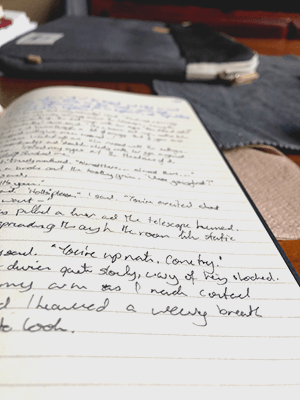
Now, yesterday was a not-terribly-good day, but other writing still got done on other projects. I did the usual self-recrimination and doubt that comes when you stall out on a project–the inner monologue of lo, it has finally been revealed, I am rubbish and the ideas are gone and I will never do good work again–and then put my writing away at 6:00 PM and went out to eat tea and watch Netflix.
This morning I’m pondering the issue with a clearer head. Less angst, more analysis. Thinking through what it is that’s got me stuck, looking back at what’s come before to see what I’ve set up that I’m now ignoring, or what tangent have I started that’s a departure that does not fit and now need to include set-up if I want to keep it? The problem with the third act is invariably in the first, as movie writers are fond of saying, and some days you just need to apply the Kress protocol and get on with it.
I’ve done that a few times in this story, when I’ve followed an idea in the wrong direction. Usually I’ll pull myself up after four or five paragraphs, recognise that I’ve made a wrong turn and go back and make a different (usually harder) choice.
The problem this time went all the way back to the beginning, because the story had simply grown too long. 40 pages of handwritten story is approximately 8,000 to 10,000 words on average, which means I’m moving beyond the realms of a short story and into the realms of a novelette, and the little idea about telescopes and alternate worlds that could sustain a 4,000 word story feels too slight for anything that long.
The events of the story, and the pacing of them, was more-or-less occurring at the pace they should be. But a short story is about one thing, more or less. You take an idea or a point of conflict, and you play it out in a condensed punch of fiction. As you get longer, you start developing layers, otherwise you risk that feeling that the story is too long to read and offering not enough in return. And with that in mind, I’m sensing the ambition of the story–how it’s told, where the tension in placed, what’s drawing the reader through the story–wasn’t up to carrying the weight.
Back when my former flatmate and I did the Trashy Tuesday Movie watching, ambition was one of those things that separated a really good bad movie from a really tedious one. A flawed work that strives and fails is inevitably more interesting than a competent work that stays within the lines and plays it safe.
Some films have lode-bearing ambition that will shore up their failings. Short stories and novels have the same, and I believe we respond to those ambitions in ways we can’t quite pinpoint.
Having realised that, I could start seeing the ways in which the story could be shored up. Where the load-bearing ambition of the story could change, where I could create contrasts and tensions that would carry the reader along for longer (Also how I could make the story shorter, more concise–but having thought of the more ambitious approach, it’s harder to go back and do less).
June 22, 2019
The Sunday Circle: What Are You Working On This Week?

The Sunday Circle is the weekly check-in where I ask the creative-types who follow this blog to weigh in about their goals, inspirations, and challenges for the coming week. The logic behind it can be found here. Want to be involved? It’s easy – just answer three questions in the comments or on your own blog (with a link in the comments here, so that everyone can find them).
After that, throw some thoughts around about other people’s projects, ask questions if you’re so inclined. Be supportive above all.
Then show up again next Sunday when the circle updates next, letting us know how you did on your weekly project and what you’ve got coming down the pipe in the coming week (if you’d like to part of the circle, without subscribing to the rest of the blog, you can sign-up for reminders via email here).
MY CHECK-IN
What am I working on this week?
I finished my marking on Wednesday night last week, and immediately settled into a few days of rebuilding routines and re-establishing my areas of focus.
Right now, I seem to have settled on four seperate projects that I’m trying to advance every day, with the bulk of the work taking place in notebook rather than on the computer (a tactic that kept me writing when the bulk of my marking needed the PC). This week, the to list looks like this:
Progressing past the first act of Project Rad after doing a brain-dump of the project revealed a whole bunch of places where the original first act was going astray on me (Keith, the working-class monster slayer, got to fly instead of drive–the moment the book switched back to driving while he boss did the easy stuff, everything fell into place).
Moving into the second act of the Exile redraft, after redrafting a bunch of scenes in the first act. I’m tossing up whether this is a point to stop writing new stuff this week and type up what I’ve already done to lock it down–swapping back-and-forth between versions makes it tricky to keep in mind what I’ve setup.
Trying to finish a short story–let’s dub this one Project Long View–which has slowly become a project after playing with a writing prompt.
Writing approximately 1,000 new words on my thesis, pulling together all the bits I’ve previously written for the current chapter and adding in the connective tissue as it becomes a unified whole.
What’s inspiring me this week?
Going by the sheer number of notes taken and potential story ideas scribbled into the BuJo while reading, Joe and Casey Landsdale’s Terror is Our Business: Dana Roberts Casebook of Horrors is the clear winner this week.
It’s also a book that I want to press into the hands of a very specific subset of friends–the kind of folks who enjoy Lovecraft and the Carnacki the Ghost Hunter stories and the Quartermass serials. It’s very much the territory Dana Roberts occupies–the first few stories in the book are all “club stories,” with a gentleman’s club inviting a famed ghost hunter to regale them with tales of her adventures studying the supernatural and applying scientific method and skepticism to the process. It’s got that great blend of horror and sci-fi, without tripping over into overt science fiction.
These stories are great in and of themselves, but the series morphs halfway through when Casey Lansdale–Joe Lansdale’s daughter–creates her own character in the Dana Roberts universe and the pair start co-writing Watson-and-Holmes style investigations of the occult. Joe Lansdale does buddy stories very well, as evidenced by his long-running Hap and Leonard series, but the addition of his daughter’s voice really elevates this partnership and gives him someone with a different experience of the world to bounce off.
What action do I need to take?
I’m stalling on this one this week. Not because there’s nothing that needs to be done, but because there’s a long list of projects that need to be picked up and moved forward, but I’m wary of trying to add anything more to my to-do list.
What should probably go here, given that I’m nearing the end of my Bullet Journal, is going through and transferring all the story ideas, research notes, and brainstorming for current projects to a new home. Then set up a new journal for July, thinking through the techniques worth keeping from the current one and which are’t working as well as they should.
June 19, 2019
?
My website seems to have spontaneously created this particular post, throwing up the headline with no particular content to share, and broadcasting it to the usual channels.
I originally came in to delete the post and take it down, then figured, what the hell? It’s actually a pretty good metaphor for today: I’ve just finished ten days straight of grading assignments, making comments on first chapters for forty-two different novels, and my brain is feeling rather scraped out and devoid of things worth saying.
The thing about marking creative work, as opposed to essays, is that it gets horribly repetitive. You don’t have time to explain everything that’s going wrong across three or four thousand words, which means you focus in on the stuff that will help the manuscript get to the next level. Inevitably, when dealing with new writers, this comes down to the same conversations about scene structure and developing beats and figuring out what your characters want, talking about the mechanics of good description and thinking about patterns of action and reaction when you start generating dialogue.
And the really hard part is trying to ensure your not treating every problem in a manuscript like it’s a nail and you’ve got a hammer, having to pause and ask yourself if it’s really a structural issue thats the biggest problem right now, or just some clunk dialogue that isn’t quite working as it should.
So you second-guess, and you fret, and you suck it up and go with your gut.
And you celebrate those little moments when someone hands in something where your focus shifts towards the upper end of the feedback hierarchy, and your attention moves to buffing out the dents rather than talking about ways to repair the engine or overhauling the engine entirely.
June 15, 2019
The Sunday Circle: What Are You Working On This Week?
The Sunday Circle is the weekly check-in where I ask the creative-types who follow this blog to weigh in about their goals, inspirations, and challenges for the coming week. The logic behind it can be found here. Want to be involved? It’s easy – just answer three questions in the comments or on your own blog (with a link in the comments here, so that everyone can find them).
After that, throw some thoughts around about other people’s projects, ask questions if you’re so inclined. Be supportive above all.
Then show up again next Sunday when the circle updates next, letting us know how you did on your weekly project and what you’ve got coming down the pipe in the coming week (if you’d like to part of the circle, without subscribing to the rest of the blog, you can sign-up for reminders via email here).
MY CHECK-IN
What am I working on this week?
I’m part-way through marking at the moment, which means the bulk of this week will be spent grading and critiquing about 72,000 words of student fiction before a Thursday deadline. I’m averaging about 12,000 words of marking a day at the moment, so I’m more-or-less on target.
I’m usually grabbing an hour or so for other work over coffee, which are being spent working on Project Rad and the Exile rewrite. Mostly, at this stage, working by hand, brain dumping everything I know about both projects and what the stories are actually about, figuring out when scenes I’ve written need to be resequenced or shifted, and generally having fun with things.
What’s inspiring me this week?
I picked up Amistead Maupin’s Tales of the City after watching a few episodes of the Netflix miniseries. I’m fascinated by the structure of the novel, which features self-contained vignettes that gradually weave together but still have the potential to stand alone. The structure is a legacy of the books origins as a newspaper serial, getting printed as a regular column on the back page of the San Francisco Chronicle.
I wish I’d read this a little earlier in my life. I remember being curious what fiction-using-webcomic models might look like ten or fifteen years ago, and even did a short-lived project where I explored the idea, but couldn’t quite wrap my head around it. Now, I’m pretty sure it would look something Maupin’s work, which is basically a prose comic strip that builds up narratives through daily repetition of themes/characters.
What action do I need to take?
I’ve stopped doing my daily plan and heartbeat log on Instagram because the one-two punch of guinea pigs in surgery and long days of marking made for a heavily disrupted week. Really need to get back to both on Monday–I’m feeling the lack focus starting to get to me and things like checking email or doing exercises to combat back pain are slipping through the cracks.
June 12, 2019
A Confluence of Time/Money/Success Posts
There are days when the internet feeds you an interesting series of posts, comments, and articles that all seem to weave together in interesting ways. For example, this quartet of things have all showed up on my radar within a twenty-four hour period:
Charlotte Nash’a comments about the limits of time on Tuesday’s post about bad systems and newsletters, which I read a few hours before…Kameron Hurley’s Locus essay about burnout, the expectation of productivity, and the reluctance to say “do less” in our culture at the moment.This post by Daphne Huff about writing a novel when you have zero time due to running a family, a full-time job, and a podcast (which seems like madness when read alongside everything else, but the final section about focusing on one aspect of craft/publishing at a time in the final section orients it with in this list). And this highly interesting twitter rant by @GravisLizard about the way we react to the phrase $100 shoes as if it’s a Gold Plated Toilet, rather than a sign that our understanding of money, value, and cost is fucked up and set to the standards of an 1980s economy, and the implications of that in terms of fixing larger problems.
I’m intrigued by this because the indie publishing world is hyperfocused on hustle at the moment, with a lot of people getting very vocal about the success they’ve had through producing fast and launching content regularly.
It’s undeniably a useful tactic–I’ve seen my own modest gains when Brain Jar releases things on a month-by-month basis, even if they’re just short stories–but I’m also conscious of the skewed landscape I’m working within. One in which definitions of success either sync with default capitalism (I have hustled and come out the end with $$$$) or are predicated on publishing expectations set by the industry as it was several decades ago.
On occasion, when you feel guilty about charging money for your art, possibly even definitions of success predicated on the industry as it was centuries ago, before capitalism had a name and the internet made everything more complex.
Sometimes it pays to take a breath and re-align your expectations with the world and capacities you’ve got right now.
The Archive Impulse
The first blog I truly followed belonged to Neil Gaiman, when he added the American Gods dairy to his website back in 2001. It was quickly followed by Caitlin Kiernan’s Low Red Moon journal, which quickly metamorphosed into her Livejournal (and has stayed there, even now, after Livejournal has become an archaic thing occupied by Russians and die-hards refusing to walk away).
I’m not sure when, exactly, I started my own web presence. The first site I owned was coded by my friend Sean and set up on a friend’s server, a place to flag gaming things. It was quickly followed by a Livejournal, where I didn’t need to know HTML or ask friends for help to make an update.
This blog, which turned ten in November last year, was a grudging concession to the idea that I needed a site I controlled more than I needed Livejournal’s friend’s feature.
When I was young, you’d occasionally find books full of writer’s letters or notebooks. Compilations of things they’d written that offered a glimpse behind the curtain.
These days, you can trace a writers history by going to their site and scrolling back. Those first posts I followed are still out there, archived on Gaiman’s site, a glimpse into a younger writer and the beginning of an ongoing chronicle that evolves with Gaiman’s career. Kiernan’s Low Red Moon Journal is still live, waiting for those interested in her history as a writer to find their way there. Every now and then I’ll go back and read the archives of writers I love, tracking the way projects evolved as they talked about them, picking up the little details that only seem significant in hindsight.
One of the things that makes me sad about the shift to social media is the way these archives get lost, or at least transformed into something it’s a huge pain in the arse to try and find.
June 10, 2019
Bad Systems & The Republic of Newsletters
Criag Mod recently did a six-week walk across Japan during which he purposefully removed himself from the phone as a tool of social media.
Of course, such things aren’t new these days. 2019 seems to be the year everyone stopped and looked at social networks with a critical eye, evaluating the space they occupy in our lives. This is particular true of freelance artists and writers, for whom the promise of connection the internet offers is of great interest indeed if the cost-to-benefit ratio can be managed.
What separates Mod out is his background as an essayist, and in particular an essayist who frequently meditates on the intersection of technology and publishing. This mean he’s got a capacity to turn a lovely phrase when noting particular ironies:
I consider “bad” to be design patterns that subvert impulse control. Anything that obviates agency over one’s attention. Bad is being manipulated by an algorithm in favor of the company over the human.
Bad is being stuck in a “tiny loop” of the mind and body — a senseless series of actions that span minutes, hours, days, consume years, and add up to nothing or almost nothing, and that benefit (ideally: tranquility, growth, curiosity) no one but the company (in reality: engagement, ad views) who owns the container in which the loop takes place.
To be a bit reductive, for example: Bad is Tinder getting you addicted to the pseudo-pornography of hundreds or thousands of potential mates, the high of a “match,” as opposed to helping you find, and sustain, a meaningful relationship. There’s a business model in helping you find true love, but it doesn’t have the same growth curve as making you think you can hump half of Manhattan.
Roden Explorers — 027 — June, 9, 2019, Craig Mod
It also means that when he sits down and thinks about his engagement, there’s a solid theoretical underpinning behind the decisions. He’s not rejecting technology outright, but looking at it with a calculating eye and figuring out what keeps it working as a useful tool. The internet is, at its heart, just a series of publishing engines, repurposed to deliver slightly different effects than reading a book or newspaper.
One of the insights that fascinates me, given my retreat from social media and more focus on both blogging and email newsletters, is his desire for seperate production and consumption systems.
Both the SMS and podcast publishing systems are “open” systems, with no single controlling entity like a Facebook or Twitter. And they are “quiet” systems, in that production and consumption spaces are separated. You don’t have to enter a timeline of consumption in order to produce.
THE GLORIOUS, ALMOST-DISCONNECTED BOREDOM OF MY WALK IN JAPAN, Craig Mod in Wired
Every now and then, I talk to writers who perplexed by the idea of a weekly newsletter: what do you write about every week? How do you produce something that doesn’t irritate people?
The answer, of course, is that I do irritate people and have the unsubscribes to prove it, but the content is almost never a problem. I post about the same things people post about to Facebook and Twitter. I gather thoughts and links and news, shepherd them together into a miniature zine that goes out every week (more or less), talking to the people who have elected to receive it.
It may be a less efficient distribution of information than sites like Facebook and Twitter, but that only matters when you think about reach. The newsletters’ role as a quiet system matters to me, as does the deeper engagement it offers. But it’s not just that, and again I can link to Mod being smart:
Ownership is the critical point here. Ownership in email in the same way we own a paperback: We recognize that we (largely) control the email subscriber lists, they are portable, they are not governed by unknowable algorithmic timelines. And this isn’t ownership yoked to a company or piece of software operating on quarterly horizon, or even multi-year horizon, but rather to a half-century horizon. Email is a (the only?) networked publishing technology with both widespread, near universal adoption, and history. It is, as they say, proven
Oh God, It’s Raining Newsletters, Craig Mod
Increasingly, I subscribe to newsletters instead of following people on Social Media. I’m starting to prefer the idea of reading what people really want me to read, rather than trusting in the algorithms to deliver what I’m looking for.
June 9, 2019
The Brain Jar’s Heartbeat
I’ve been reading ReWork and It Doesn’t Have To Be Crazy At Work over the weekend, processing the business advice of the 37 Signals/Basecamp founders who have rejected the notion of building a growth-at-all-costs business. The former is very philosophy focused, while the latter is a ore process-oriented approach which implements that philosophy.
One of the ideas that intrigued me in It Doesn’t Have to Be Crazy At Work is the discussion of heartbeats–a way of overcoming communication challenges in a decentralised workspace without devolving into meetings and reports. There’s a more detailed discussion of it over on their blog (and another discussion here), but at it’s core its a system of automated check-ins where folks list what they’ve worked on with their day, coupled with a system for discussion and requests for updates.
It’s a really intriguing idea, but not terribly useful in a company of one (which, essentially, most writers are regardless of whether they self-publish or not).
With that in mind, I did what I often do when encountering group-based management systems that seem like useful ideas: I figured out a way to deploy it online. The last time I did this it launched the Sunday Circle, which has been rolling on for a bout three years now and continues to be useful to me. This time around, I’ve been doing analog heartbeat updates on pen and paper then posting them up on Instagram.
The first one turned out a little rough:
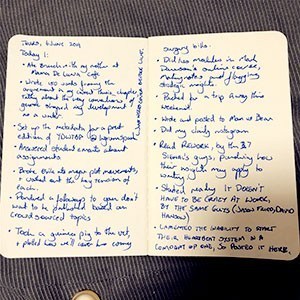 Posted June 6
But I got a lot happier with the idea once I realised that block caps and the occasional nice background helped frame the content:
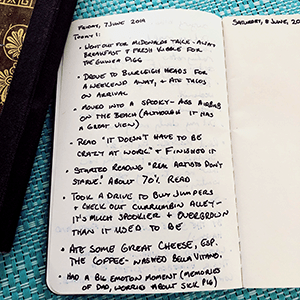 Posted June 7
Of course, starting this process right as you go on holidays for the weekend tends to skew the content a little.
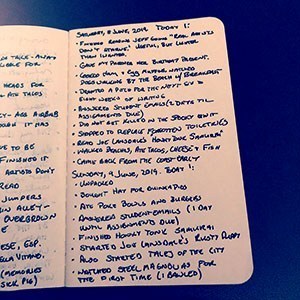 Posted June 10
I’m interested in this logging process because it’s easy to get locked into a mindset with writing that word count=progress. Admittedly, this mindset is frequently useful, because you cannot finish anything unless it’s actually written, but getting the book done and out (whether submitted to a traditional publishing venue or starting the process of self-publishing) is where the work actually starts earning money. Sometimes it’s useful to step back and look at what else is involved in the process.
I don’t have to manage a team of people with Brian Jar, but writers have stakeholders who have a vested interest in what’s going on. We just call them readers, and have spent the last twenty years being slightly bewildered by the level of access the internet has given us to them, instead of leaving it to be mediated by publishers and periodicles.
But I digress.
ReWork and It Doesn’t Have To Be Crazy At Work. Both are really good reads, both as someone who has worked a dayjobs with not terribly functional management structures and as someone involved in indie publishing where the bulk of the conversations are predicated on a bulk inventory, growth-at-all-costs mindset. The ideology of working calm and limiting growth to focus on what really drives you strikes me as a useful one, if only because it’s easy to slip into oh-god, do-more-do-more when you’re in charge of your own schedule.