Peter M. Ball's Blog, page 28
August 24, 2019
The Sunday Circle: What Are You Working On This Week?

The Sunday Circle is the weekly check-in where I ask the creative-types who follow this blog to weigh in about their goals, inspirations, and challenges for the coming week. The logic behind it can be found here. Want to be involved? It’s easy – just answer three questions in the comments or on your own blog (with a link in the comments here, so that everyone can find them).
After that, throw some thoughts around about other people’s projects, ask questions if you’re so inclined. Be supportive above all.
Then show up again next Sunday when the circle updates next, letting us know how you did on your weekly project and what you’ve got coming down the pipe in the coming week (if you’d like to part of the circle, without subscribing to the rest of the blog, you can sign-up for reminders via email here).
MY CHECK-IN
What am I working on this week?
Right now I’m in the phase of Project Stairwell where I need to a) tell a really good ghost story within the context of the story, and then b) deliver on said ghost story when I send characters in to figure out what’s really going on.
What’s inspiring me this week?
Do Anything Vol 1: Jack Kirby Ripped My Flesh, a collection of Warren Ellis’ columns about the history of the comic book field, filtered through Jack Kirby as a nexus point and the conceit that Ellis has Jack Kirby’s Robot Head on his desk and…look, this is one of those books that’s impossible to explain. Ellis is one of those writers who gets interested in forms, and what happens when you break them down and rebuild them again.
It’s the kind of work that makes me want t dig out my copy of A Thousand Plateau’s and start talking about the difference between single-root and rhizome narratives and how Ellis applies that idea to non-fiction and history. Also the kind of work that makes you want to take the advice of the title–the recognition that nobody is really asking you to fill a comic book or a novel or a web-column, they’re just asking you to fill a container–and within that, you can do anything. Ergo, it becomes a book that fills my head with possibilities.
I am incredibly sad that there is no volume 2.
What action do I need to take?
I revamped my website this week, giving it a long-overdue fresh coat of paint and setting up some back-end tools that I’ve needed for a while (specifically, the ability to create proper landing pages without the other website distractions floating about).
Naturally, this now means there’s a veritable army of small jobs that need to be done: updated links in the back-matter of books, standardising some of the language and approach; re-uploading books into the new library set-up; actually going over to BrainJarPress.com and transforming it into a fully operational Death Star before the company hits its second birthday.
The latter has been on my list forever, and part of the revamp was getting to a point where it uses the same toolkit as my personal site to avoid duplication of work and encourages duplication of content. It still, alas, needs me to do the work of transferring information over and revamping the design there…


August 23, 2019
Status Post: 24 August, 2019
Another week draws to a close and the next week is being planned, which means it’s time to break out another Status Post as I survey the state of things here in Brain Jar Headquarters.
BIG THINGS ACHIEVED THIS WEEK: Some weeks the achievements are the big list of things you did above-and-beyond the list of things you set out to do. Some weeks the achievements are the things you kept on track despite the drawbacks. This week is one of the latter, with my fiction writer suffering but my PhD word count and a lot of goals on the non-writing side of writing were all met.
And I did sneak in shiny new website redesign during the week, when it was clear creative work wasn’t going to stay on track. That lets me tick a task of the “one day’ list, and opens up a bunch of opportunities that weren’t there under the old layout.
Also, there was this:
YES! This is what I've been saying for years, and why I was so disappointed with what was done to my script for #Sharknado 4. @petermball hits the nail squarely on the head.
— Thunder Levin (@ThunderLevin) August 22, 2019
Sharkandos, Zombie Tidal Waves, and Verisimilitude https://t.co/pZgKMrXFF2 via
CHALLENGES, MET & UNMET: I’ve had a pretty good run of getting stuff done of late, but got caught in a someone-is-wrong-on-the-internet discussion earlier this week that derailed me midweek. I also ran into the dark side of productivity–the part were anxiety sinks its teeth in and starts coaxing me into trying to do even more, which is usually a sign that it might be a good idea to scale back and do slightly less.
CURRENT EARWORM: Fuck knows where it came from, as I’m not a fan of the band, but I’ve spent the morning singing the same four lines from the Doors Touch Me that my brain has managed to dredge up from somewhere.
Brains are fucking weird, man.
CURRENT READING: Shades of Milk and Honey, the first book in Mary Robinette Kowal’s Glamourist Histories. I gave my partner a copy of Kowal’s The Calculating Stars as a birthday gift, and the level of enthusiasm as she read through was a good reminder that i’ve been reading to read Milk and Honey for years.
BEST SCREEN MEDIA OF THE WEEK: Wu Assassins stole our hearts this week, and likely will retain its hold until we run out of episodes and scroll through Netflix in a forlorn daze wishing we could find something just as good. some really nice action scenes, great use of cinematography and colour, and just really nice attention to detail in every part.
INBOX STATUS: 8 Emails awaiting my attention, but I just glanced over and at least half of that is either newsletters that will be quickly processed or random emails about cars that are probably meant for a different Peter M. Ball who lives in the UK.
WHAT I’M LOOKING FORWARD TO RIGHT NOW: I saw the Mandalorian Trailer and instantly found myself wanting to see by a project that I was dimly aware of, but not that interested in. I mean, look at this thing:
So, yeah. Bring on November, even if I have to subscribe to a new streaming service to get it. I’m fucking sold.
August 22, 2019
Vintage Links 004: Heroine’s Journey, Mortal Kombat, Re-Setting After A Bad Day, & Professional Discomfort
The Vintage Links series is an attempt to clear 600+ bookmarked links I compiled over a period of six years, mostly coinciding with the period in which I worked for Queensland Writers Centre. It involves a lot of stuff I flagged because it would be useful at work, in my own process, or just plain useful.
Every week I gather together four of the best links I came across while clearing out the bookmarks folder on my browser, presenting a grab-bag of interesting stuff. I’m going full Marie Kondo on those fuckers: everything is checked, thanked, and either deleted or properly filed so I don’t have to deal with it again. If you want to see more, you can see the prior instalments using the Vintage Links tag
An Oral Hisotry of the Mortal Combat Movie (Aaron Couch for Hollywood Reporter, 2015)
I have a soft spot for video game adaptations. They’re very rarely great works of cenema, but will often be servicable and entertaining (Tekken, DOA, Resident Evil), bizarre to the point of abserdity (Double Dragon, Super Mario Brothers), or a cinematic car crash of ubelievable proportions (Streetfighter). Back in 2014, Aaron Couch did a bunch of interviews with folks involved in one of the first adaptations to reach that servicable and entertaining milestone—Paul Anderson’s Mortal Combat adaptation from 1995.
This breakdown of the film’s production process is a fascinating look behind the scenes, casitng light on the challenges that impact on the final product of a film and the decisions being made in the moment. It also gives you a glimpse of an alternate universe where Cameron Diaz played Sonja Blade in the film, and a whole new world of appreciation for the work ethic and glory that is Robin Shou:
Anderson: Robin would rate the fights. They would be a one, a two or a three. That would refer to how many ribs he bruised when he did the fight. The Reptile fight was a three-rib fight, so he really felt like he’d delivered for me.
The Heroines Journey: Learning to Work (Theodora Goss, 2015)
Read it over at TheodoraGoss.com
I’m a huge fan of Theodora Goss as a fiction writer. The Rapid Advance of Sorrow is one of those short-stories I come back to again and again, trying to plumb the depths of how it works and figure out all the little things that elevate it into something special.
Her blog is just as good as her fiction: often engrossing and open about process, full of deep thought about the topics she chooses to tackle. Back in 2015 she did a run where she looked at archetypal female stories,, and the ways the heroes journey as envisioned by Joseph Campbell makes for a poor fit when applied to female protagonists.
I’d flagged this post as a reminder ot read the entire series, but it’s also a remarkably useful examoination of a particular sotry beat.
How to Recover From An Unproductive Day Like It Never Happened (LifeHacker, 2015)
Possibly one of the most useful articles I’ve ever come across on Lifehacker, and the kind of content that keeps it on my RSS feed when the firehouse of data they send my way starts to feel overwhelming.
I’m generally pretty good with managing my day when the idea of managing and being on top of things is something that I’m focusing in. I’ve got a productivity system that works for me, and when it’s running hot I get a shitton of things done on a daily basis. But I also have a tendency towards anxiety and fixed-mindset thinking, which means a bad day can quickly blossom into a bad week once I lock onto the idea that everything’s going a bit shit right now.
This article was the first place that suggested setting up a series of post-bad-day habits designed to get you back into a productive mindset, and that’s an incredibly useful idea.
Kelly Sue DeConnick on Discomfort (Vimeo, 2015)
One of the joys of clearing my Vintage Links file is occasionally finding something I’ve filed away and forgotten about that’s absolutely startling and great. This video, from comic book writer Kelly Sue DeConnick, absolutely belongs in that category.
It’s a speech about writing, and in particular about writing things that make people uncomfortable (whether that person is yourself or your audience). It’s also a speech about being read, as evidenced by this particular bit of insight.
…it is a weird thing to have something that you have had a hand in creating become a tattoo phenomenon, but my ego stays in check because as proud as I am of this book, and as much as it means to me, I know that what Dan Curtis Johnson said is right. You don’t get that tattoo to celebrate something in the book, you get that tattoo because the book celebrates something in you…
If you pay close attention there’s little bits of practical craft advice in there, among the broader talk about intent and goals, and the entire thing is well worth 20 minutes of your time.
August 21, 2019
New Writing Kit: Logitech MK850 & Field Notes
Yesterday I hit a milestone: for the first time in nearly four years, I’m a week ahead on writing blogs. Which means the temporality of these posts gets a little weird, because “Yesterday” can now mean a week-in-the-past-when-I’m-actually-writing-things, or one-day-back, when-I-was-posting-about-a-thing.
Getting ahead has largely been a function of the first major change I made when setting up my new workspace: adding in a whiteboard that sits in front of the “goofing off” computer, tracking my weekly to-do list. Thus far, it’s kept me on track with writing, with reading, with blogging, with newsletter creation, and with a bunch of little things I need to do throughout the week.
It’s not a bad result for something that cost me $20, in terms of the value it delivers. I get quite gushy about it, when talking to folks about getting shit done.
The other pieces of new kit i’ve added to my workspace is this: a Logitech MK850 wireless Keyboard and Mouse combo and a set of Field Notes notebooks.
The keyboard was a change requested by my partner, especially since the new desk set-up makes it easier for me to work over weekends. See, I have a habit of typing incredibly fucking fast when I’m in first draft mode, and I’ve always worked on old, cheap banger keyboards that make an incredible racket when I’m really flying.
Typing a thousand words typically sounded like a hailstorm rattling against a corrugated iron roof, and while that was satisfying to me on a personal level, it’s not the best thing to unleash in a tiny flat when your partner is sleeping in the next room.
“It’s time for a quieter keyboard and mouse,” my partner suggested, and I had a little spare cash for such things, so I went out to fix the problem.
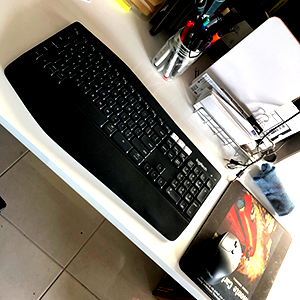
The MK850 wasn’t the keyboard I set out to buy, but it’s the one that was in stock when I hit my local Office Orcs–a wireless keyboard and mouse combo, considerably quieter than my old banger, with an added bonus that eked it ahead of the others they had available.
Because the MK850 is set-up to switch between multiple devices with the touch of a button, and it automatically adjusts which keys do what when switching between Mac and PC devices. Given my tendency to switch between a MacBook (writing and layouts), a desktop pc (socials and gaming), and a Samsung tablet (random stuff in the background) throughout the day, the MK850 actually replaces two mouse/keyboard combinations in one fell swoop.
It’s still not quite as much fun as making a racket on my old banger, but it means I can work without disrupting my partner and that’s a big shift. Also, that PC/mac adjustment is huge–mapping the Macs Command key onto the Alt key on most PC Keyboard seems like a simple thing, but I’ve spent a year working on keyboards that insist it should be on a spare key four or five spots away.
Not having to think about where the keys are for your keyboard shortcuts actually keeps them keyboard shortcuts, you know?
Couple that with the fact that my noise level has dropped considerably, and it’s been a pretty neat purchase. The only real test left is getting into a marathon game of Civ IV, which is heavy on the mouse clicks and gets referred to by my partner as “that clicky game,” to test how much less grating the new mouse is.
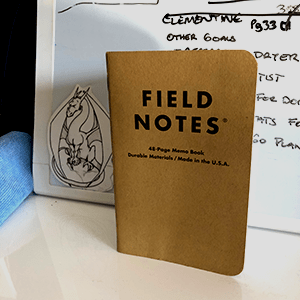
I got crazy excited when the Field Note brand of notebooks started appearing on Amazon Australia. This is partially because I’m a bit of a notebook nerd, and really like the Field Notes design (particularly the special editions), and partially because they were so damned hard to track down at a reasonable price in Australia. Even when they’d list local stockists on their website, I’d go check ’em out and discover they hadn’t actually kept any in stock for months.
In practical terms, they’re roughly the equivalent of the slim pocket Moleskinses–same size, same page count, same cardstock cover. I may even lean towards the Moleskine’s paper a little harder, since it’s a nice comforting cream rather than the stark white of the baseline Field Note. Here’s a shot of two in-progress notebooks from both brands, if you’re interested in a comparison:
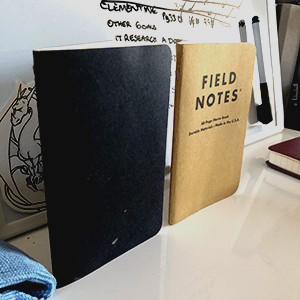
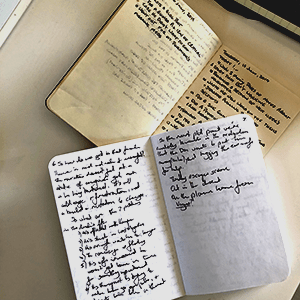
But lets be honest: you don’t pick up a notebook like this if you’re thinking in purely practical terms. You pick it up because you’re entranced by the design and the little decisions that set it apart, for the spark of joy you get when you discover the five-inch ruler on interior back cover (which, to my surprise, actually comes in handy), or the pre-printed section for logging start and end dates, or the little details like this:
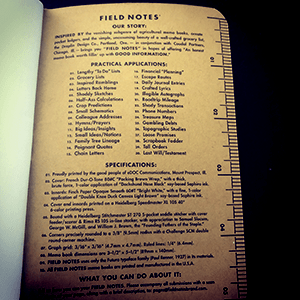
Mostly, you pick it up because those little details let you pretend you’re a steampunk explorer for a half-second, and because the price difference between it and the Moleskine isn’t large enough to stop you.
And its great for that. Opening the Field Note makes me a little bit happy every time I go to write down some notes, and that matters enough to be worth the white page.
Right now, one of my markers of success with Brain Jar and writing–a completely frivolous and meaningless marker, but a personal one–is hitting a point where I can pay for a yearly subscription to the Field Note special editions without fretting about the money I’m spending. The idea of having packs of pretty, fun to write in notebooks delivered to me on a quarterly basis appeals, particularly given how nice some of the special editions look.
August 20, 2019
Sharkandos, Zombie Tidal Waves, and Verisimilitude
Last week, my partner showed me the trailer for the next film from Ian Ziering and the guys who did all those Sharknado films, a little flick they’ve dubbed ZOMBIE TIDAL WAVE. For those who haven’t seen it yet, I encourage you to take a look:
As fans of large chunks of the Sharknado franchise, we’re naturally excited about this film. It looks decidedly B-Grade and terrible, but at least 50% of the time this combination of actor and director have taken a terrible concept and made it into something far more interesting. They pushed the ambition of the film and played things straight, delivered above and beyond what was expected of them.
The other 50% of the time–I’m looking at you, Sharknado 4–they blew it by playing things for laugh.
I did a write up of what made a really good Sharknado films in my newsletter after we rewatched the series last year. It ran a little something like this:
I am known, among my friends, for complaining loudly about the fact that Sharknado 4 is the worst of the franchise because it finally gets silly. Peter, they tell me, it’s a series about shark-infested tornado, it’s already quite silly.
It is. That’s part of what people love about the series: it’s terribly silly, terribly goofy, and altogether unrealistic. It’s also why I point people towards Sharknado one through four in order to study how silly concepts can be made to work as a narrative (and, weirdly, become a cultural phenomenon).
The key thing to look for, in the first few instalments of the franchise, are the way they handle internal consistence and establish the rules of the milieu. Once you accept that sharkando’s are possible, everything in the films make sense: people are killed by flying sharks and they are grieved; sharkando’s get worse in silly ways, but they are treated as threats with dire consequences; madcap, absurd solutions are offered, but they are merely a natural escalation of things that have worked before. More importantly, those solutions make sense in the broader genre of the monster movie and natural disaster movies, playing with tropes we already know and love.
This means, as a reviewer, you can suspend your disbelief while acknowledging the absurdity. Things are silly, but because the characters in the film respond to sharknado’s like they’re a serious thing, there is an internal chain of cause and effect that makes sense and escalates the sense of threat.
Sharknado 4 is the part of the franchise where they lose that, leaning harder on pastiche. Characters die, but they are not grieved and thus their deaths hold no emotional weight. The internal consistency of the film is broken in order to make way for parodies of other films, which means the characters are increasingly aware of the fact they’re in a fictional construct, even if they don’t acknowledge it as such.
The character’s no longer feel the threat because they are fictional constructs, which means the threat is no longer means something. \You can get away with incredibly silly concepts, so long as they’re taken seriously by the characters. It’s largely how I write fiction about killer mimes that float about on balloons, or cities laid waste by kaiju only half the world can see. The line between slapstick, absurd, and horror is largely one of internal integrity and the way character’s respond to what’s happening in the narrative.
Notes from the Brain Jar, 13 July 2018
I think about this kind of thing a lot because starting a goofy-but-serious horror franchise is on my bucket list of things to do with Brain Jar Press. It’s one of those projects that’s a long way out of my comfort zone as a writer, but the idea of taking an absolutely moronic idea and playing it as straight as I can appeals to me on all kinds of levels.
Of course, figuring out the kind of goofball combinations that result in title like Sharknado or Zombie Tidal Wave is an art all of its own.
August 19, 2019
The Difference Between Busy & Working
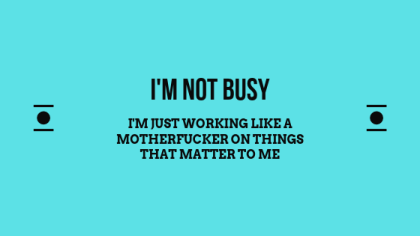
Back in 2013, I made the decision to stop using the phrase I’m Busy and it’s associated attempt to shut down conversations or engender pity/respect from people who asked I was going.
I did pretty good with it for a while, but words like busy creep back into your vocabulary if you don’t monitor for it. Certainly, this year, it’s back with a vengeance in my conversations, because the alternative often involves uncomfortable conversations about death.
So I went back to I’m busy. I told myself it was because I didn’t want to make other people uncomfortable, or deal with their emotional response as they realised they’d tripped over a livewire. However, after reading Jory Mackay’s recent post over at Fast Company, I suspect there was also a large part of me that needed the validation when other things weren’t going right.
Mackay’s writing on behalf of RescueTime (admittedly, a service I use and adore), so there’s a certain amount of vested interest in getting people to think about their relationship with busyness. It doesn’t, however, mean that he’s wrong, especially when he starts framing the problems of staying busy versus doing your best work.
There’s a paradox when it comes to busyness that goes like this:
Anyone with professional ambition strives to do great work and be recognized for their talent and therefore is in high demand (i.e. busy). However, the more in demand you are (i.e. busy), the harder it is to provide the same quality of work or creative thinking that got you there in the first place.
If being in demand is proof you’re doing a good job, it’s easy to mistake busyness for validation.
This is why you’re addicted to being busy, Fast Company
So, yeah, it’s an article worth reading, particularly once Mackay starts digging into what the opposite of busy really looks like and the psychological benefits of tunnelling (which aren’t really benefits at all).
When we’re busy running around, answering emails, putting out fires, and racing to back-to-back meetings, time becomes much more scarce. To deal with that scarcity, our brains effectively put on blinders.
Suddenly, we’re not able to look at the big picture and instead can only concentrate on the most immediate (often low-value) tasks in front of us. (Research has even found that we lose 13 IQ points when we’re in a tunneling state!)
However, when we pop our heads above water at the end of the day, we realize that we’ve spent barely any time on the work that really matters.
This is why you’re addicted to being busy, Fast Company
It’s not a huge surprise that I’ve recognised that feeling lately.
Nor is it a surprise that it’s started to recede now that I’ve set up the big picture whiteboard to guide my weeks, actually thinking through what needs to be done and making decisions long before a scarcity of time and resources kicks in.
August 18, 2019
RECENT READING: Do Not Say That We Have Nothing, Madeleine Thien

It took me an incredibly long time to read Madeleine Thien’s Do Not Say That We Have Nothing, but that’s not a reflection of quality. It’s an intense kind of book, dealing with an extended family of musicians during the Cultural Revolution in China, and the fall-out on their children’s lives afterwards. I frequently hit the end of a chapter and took a short break, coming back after a bit of a breather.
It’s intense and complex and beautiful and heartfelt, and if you’re any kind of creative artist who occasionally looks towards politics and wonders how bad things can get, it’s going to be an intense read.
But it should–really, really should–be read.
Back in 1916, a Russian named Victor Shklovsky wrote an essay about the nature of art. In it, he argued that our perception has a tendency to become automated, and the role of art is to disrupt that automation and force us to look at things anew:
“After we see an object several times, we begin to recognize it. The object is in front of it and we know about it, but we do not see it – hence we cannot say anything significant about it. Art removes objects from the automatism of perception…”
Art of as Technique, Victor Shklovsky,
It’s as good a guideline for recognising great art as I’ve ever seen, and the sheer amount of disruption that Thein achieves over the course of her novel is impressive. It ranges from small, graceful moments when she charts the differences between Cultures, like this:

Then ranges all the way up to narrative sequences that forced me to re-examine my relationship with art and practice and it’s importance, and what might happen if the ability to produce it went away.
DO NOT SAY THAT WE HAVE NOTHING, Madeleine Thien: Amazon (AUS | UK | USA) | KOBO
August 17, 2019
The Sunday Circle: What Are You Working On This Week?

The Sunday Circle is the weekly check-in where I ask the creative-types who follow this blog to weigh in about their goals, inspirations, and challenges for the coming week. The logic behind it can be found here. Want to be involved? It’s easy – just answer three questions in the comments or on your own blog (with a link in the comments here, so that everyone can find them).
After that, throw some thoughts around about other people’s projects, ask questions if you’re so inclined. Be supportive above all.
Then show up again next Sunday when the circle updates next, letting us know how you did on your weekly project and what you’ve got coming down the pipe in the coming week (if you’d like to part of the circle, without subscribing to the rest of the blog, you can sign-up for reminders via email here).
MY CHECK-IN
What am I working on this week?
I’m deep in the draft for Project Stair, which started off as a Short Fiction Lab project but may just edge into longer territory by the time I’m done. It’s a YA-quest-fantasy set around an underground ocean, filtered through the kind of Lovecraftian logic of a Guillermo del Toro horror film.
I spent the bulk of last week getting the shape of the thing, and realising that I couldn’t achieve the effect I wanted without really fleshing the details out on the various sub-quest narratives. This week I’m hoping to finalise two of the three side-quests, one of which revolves around a haunted battlefield and the other of which involves a boiling patch of ocean and whatever thing I end up hiding there.
What’s inspiring me this week?
I’ve been re-reading Damon Suede’s Verbalize and Jim Butcher’s 2006 post about writing sequel scenes this week, trying to wrap my head around developing my ideas for stories a lot more before I write them.
I turned to the former towards the start of the week, when I found myself stalling out on the Project Stair draft and could figure what happened after all the initial set-up. A half-day spent working out character’s inner voids, long-term strategies, and tactical voids suddenly opened up a whole suite of story options, and got me working at a fair clip.
But when I stalled again, towards the end of the week, I found myself going back to Butcher and really pondering how the way character’s process information changes the tone of a story. What felt like an out-of-place whiz-bang action scene started taking on very different overtones when I started lingering on the anticipation instead, and I’ve started to really notice the way other writers are using the same.
What action do I need to take?
I kicked goals on most of my writing tasks this week, doing more than I’d actually scheduled in my drafting, thesis, admin, blogging, and newsletter columns on my whiteboard.
That said, there are two columns on my board that were barely touched: the ones devoted to redrafting tasks for novels and developing new story ideas before I sit down to write.
I think this is because neither had specific actions to turn to, which made it really easy to disregard them or treat them as less important, so my challenge for the coming week is breaking them down into clearer, trackable daily actions.
August 16, 2019
Saturday Status Post: 17 August 2019
It appears I had a bunch of good ideas back in February, many of which were derailed by life rolls and complications far beyond my control. One of these was the regular STATUS POST as a lead-in to the Sunday Circle, and I’m going to try and back into the groove of such things.
HAPPIEST MOMENTS OF THIS WEEK: I finished the redraft for Short Fiction Lab #4, handed it off to Brain Jar’s resident beta reader, and put it up for preorder at the usual suspects.
View this post on InstagramA post shared by Peter M Ball (@petermball) on Aug 8, 2019 at 4:52am PDT
BIG THINGS ACHIEVED THIS WEEK: After rocking the whiteboard as an organisational tool earlier this week, I’ve actually succeeded in getting a bunch of things on-track. Aside from the aforementioned development work on Brain Jar’s next release:
I hit my writing quota for the thesis for the first time since June, and actually started buying down the word-debt I owe that project.I progressed a fiction project every day this week–not quite back to the 1,666 words a day i think of as “cruising speed” as a writer, but close enough to make me happy.I’ve written a bunch of blog posts ahead of time, because I’ve missed the routine fo regular blogging and would like to get back to it. I got my reading mojo back, devouring three books in the space of seven days.Consolidated everything I need to do into a single work space, instead of shifting around the house.
It doesn’t quite tick everything off my list from last week, but I’m starting to see the shape of my routines again and that gives me the space to start hacking them to add new things.
CURRENT EARWORM: Emile Autumns It’s Time for Tea, particularly the line ‘Revenge is a dish best served…now.’

CURRENT READING: The Penguin Book of Hell, compiled by Scott. G. Bruce.
I don’t actually remember picking this book up at any stage, although it definitely looks like the kind of thing i’d grab because it’s likely to be useful. Bruce compiles a bunch of writing about hell and its denizens, starting with ancient greek writing about Hades and progressing all the way through to some 20th century authors.
It’s fascinating to trace the literary origins of some particular beliefs and tropes about hell that we naturally assume to be biblical, but actually come from secondary sources.
BEST SCREEN MEDIA OF THE WEEK: I raved about this in my newsletter on Wednesday, but the Stallone/Schwarzenegger team-up film, Escape Plan, caught me by surprise with its ambition and storytelling. It was a film custom-built to coast on nostalgia and the promise of seeing Sly and Arnie team up for the first time, and it didn’t.
INBOX STATUS: Two emails remaining at time of writing, although I haven’t checked in this morning.
WHAT AM I LOOKING FORWARD TO RIGHT NOW? Next week!
Partially because I’m feeling on top of things for the first time in forever, and I’m excited to see how I can adjust what I’m doing and start building upon it.
Partially because my partner got some news about a health issue that’s been frustrating her for a while, and I remember what it was like when I went from having-sleep-apnea-and-nobody-really-knowing-about-t to having-sleep-apnea-and-treating-it.
And partially because my friend Nic is running Call of C’thulhu next weekend, and it’s always a good weekend to poke your nose at things that man is not meant to know and go mad as a result.

August 15, 2019
Vintage Links 003: Phish, Insane Clown Posse, Design, Clouds, and Habits
Back in March, before my dad passed away, I’d started the Vintage Links project in order to put some structure around clearing my overstocked “To Read” folder. At time of writing, there are about 600 of them remaining, and I’m going full Marie Kondo on those fuckers: everything is checked, thanks, and either deleted or filed away so I don’t have to deal with it again.
I got through two instalments before life went all kinds of chaotic, and I think it’s time to resume now that the year is settling down. This week I’m clearing a grab bag of useful links for writers and one particularly pretty short film that’s well worth giving ten minutes of your time (and if you want to see more, you can see the prior instalments using the Vintage Links tag).
9 Lessons from Phish and The Insane Clown Posse For Deep Fan Engagement (Fast Company, 2013)
Read the post over at Fast Company
Back in 2013, journalist and pop culture commentator Nathan Rabin wrote an entire book about deep fan communities that had built up around acts like Phish and The Insane Clown Posse. This post is a fantastic distillation of what these sorts of acts do to engage such fervent adoration from their fans, and in particular how they’ve built a loyal following that follows them from project to project (I mean, seriously, the Insane Clown Posse built their own wrestling federation from their fanbase, it’s…well, insane).
It’s an incredible list of ideas if you’re working in a niche (which, frankly, many emerging writers are), and I’m vaguely disappointed that the book is still only available in print.
The Ten Basic Elements of Design (Creative Market, 2017)
Check it out over at the Creative Market website (and there’s an infographic to go with it)
I got interested in design about fifteen years ago, when I first started looking at RPG book covers and trying to figure out what made them work beyond the great cover art (which, as an emerging RPG publisher, was well beyond my price range). By the time I started working for the writers centre eight year slater, we were starting to have those conversations with writers who were venturing into the world of indie publishing as the kindle took off.
I’d tagged this one because it was an incredibly useful primer for people starting to look at cover design and start thinking about the elements that made something work.
Four Common Myths About Habits, Debunked (Lifehacker, 2015)
Read the post over at LifeHacker
There’s a lot of bad advice out there with regards to building habits, and the worst of them (also the first debunked in this article) is the idea that it takes 21 days to bed a new habit in.
Teaching people habits (and hacking habits) is frequently a huge part of teaching people to write, so posts like this are always a handy reference point. The real useful thing to do is probably reading Charles Duhig’s book on habits and their formation, which I recommend to writers and other artists at every available opportunity, but stuff like this is always a useful reminder.
The OceanMaker (Vimeo, 2015)
Watch it over on Vimeo (or click the embedded video below)
A short, ten-minute animated film about a post-apocalyptic world where pilots compete to harvest water from the last remaining source of moisture–the clouds. It’s incredible what the film gets out of a simple concept and some really nice design–particularly when you consider it’s the result of a seven-week project done on a laptop.
The OceanMaker from Mighty Coconut on Vimeo.