Nancy Lawrence's Blog, page 8
October 13, 2018
The Children of Pride and Prejudice
Today I’m posting on the Austen Authors blog about the art of Kate Greenaway and children’s clothing in Jane Austen’s time. I hope you’ll join me by clicking on the icon below.
See you at Austen Authors!


October 2, 2018
Halloween and Hyde Park
It’s October! That means it’s time for me to buy bags of Halloween candy and pick out all the Almond Joy bars so I can hide them to eat later in private.
October also means getting ready to dress up in costumes, tour haunted houses, and choose the foggiest night of the month to whistle through a graveyard.
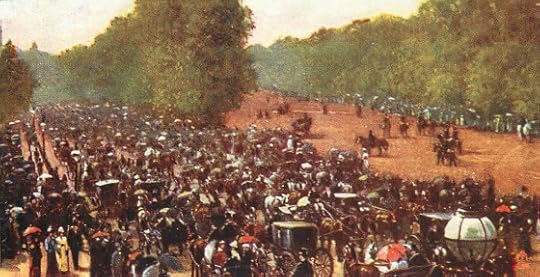
A crush of fashionable Victorians at Hyde Park.
In reality, I’m not spooked by graveyards. In fact, there’s a graveyard in the heart of London that has always intrigued me.
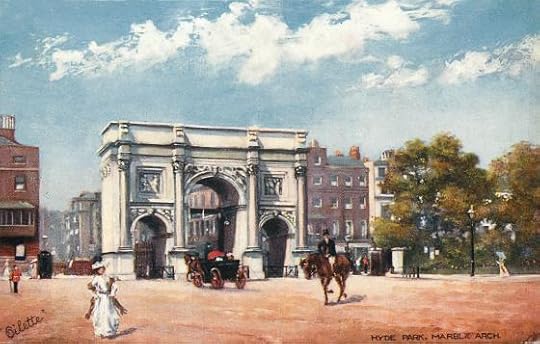
Marble Arch, Hyde Park, near the pet cemetery.
It’s a graveyard that was created specifically for pets. It dates back to the 1880s, with grave markers that span three centuries.
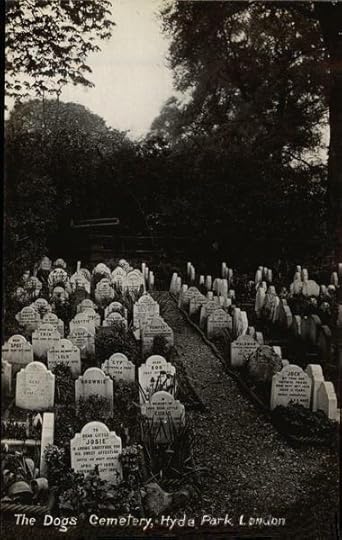
Hyde Park Pet Cemetery, photographed early 19th Century.
Since I’m an animal lover who has all too often suffered the loss of a beloved pet, I find myself drawn to the Hyde Park cemetery. If I ever doubted that I had anything in common with the Victorians, all I have to do is look at the grave markers to feel a kinship with them and the devotion they had for their furry (or feathered) friends.
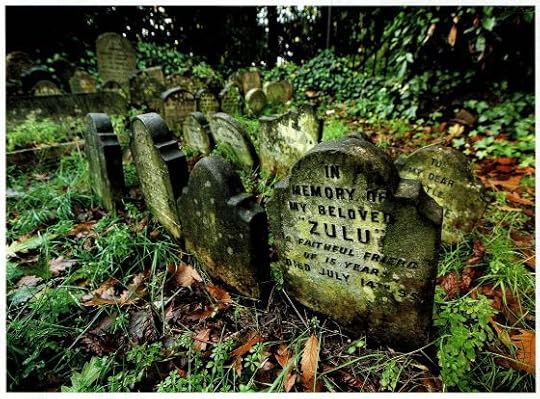
A grave marker for Zulu, at Hyde Park pet cemetery.
The cemetery has hundreds of markers, all loving tributes to Brownie, Jack, Spot and Josie.
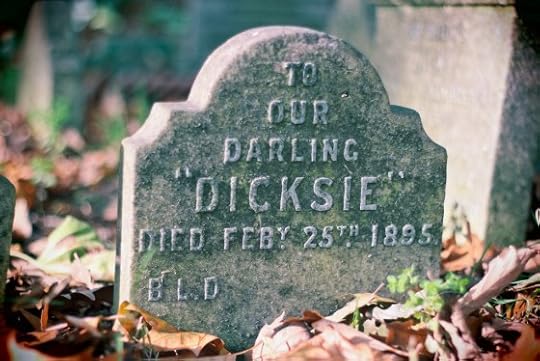
Some epitaphs are simple and heart felt, like one for Josie that reads: “In loving gratitude for his sweet affection.”
And for Pompey, who was “loyaler than any of my husbands.”
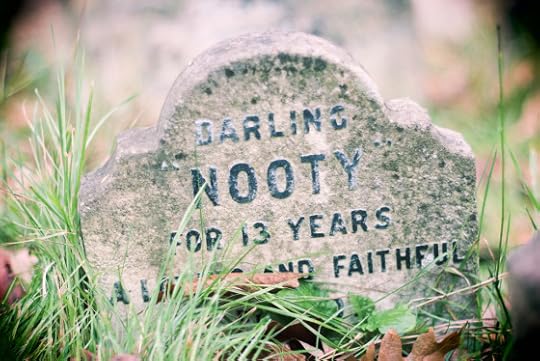
But my favorite is a tall headstone for a dog named Prince, who served in the military: “Marine Commando of Anisor. He asked for so little and gave so much.”
There are hundreds of pet cemeteries around the world; but for me, there’s something special about this pet cemetery tucked away near a corner of Hyde Park. It’s a well-cared-for, loving tribute to generations of mankind’s beloved animal companions. And there’s nothing spooky about that.
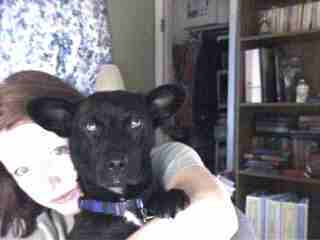
My little Byron. R.I.P.
September 15, 2018
Bad Jane?
I’m on Austen Authors today, talking about “Bad Jane” variations of Austen’s Pride and Prejudice. Please join me and have your share in the conversation!
August 28, 2018
On My Bookshelf: Beau Brocade
I own several copies of each of Jane Austen’s novels, but my favorite edition is a compilation of Austen’s novels that include wonderful illustrations by C. E. Brock and Hugh Thomson.
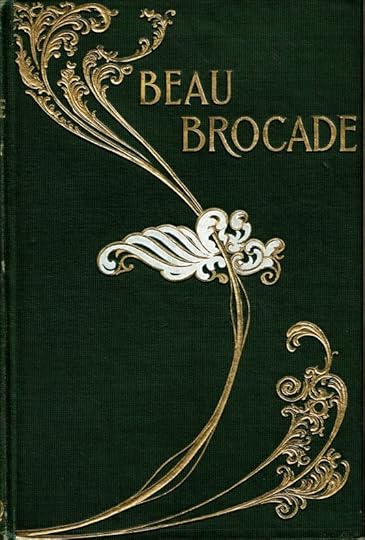
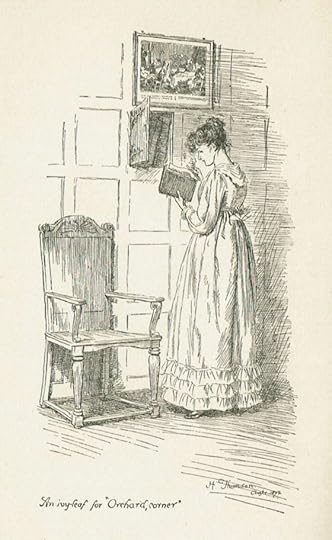
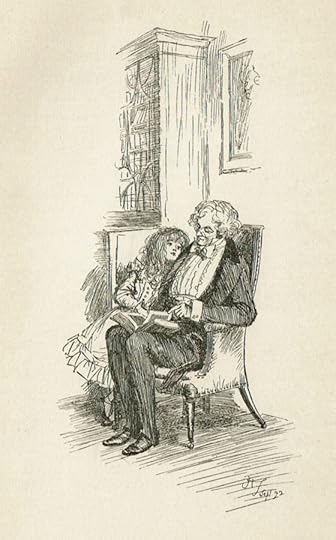
Hugh Thomson created the illustrations for another book I own: The Ballad of Beau Brocade by Austin Dobson.
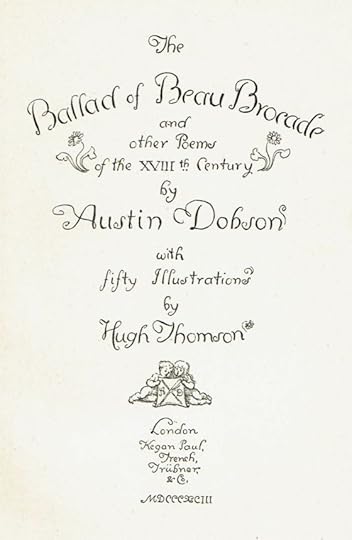
Beau Brocade was published in 1893. It’s a light-hearted collection of poems about imaginary characters of the Georgian era. Here’s the title page, designed by Hugh Thomson:
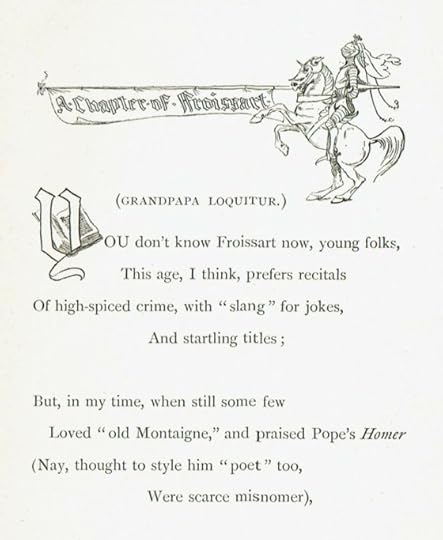
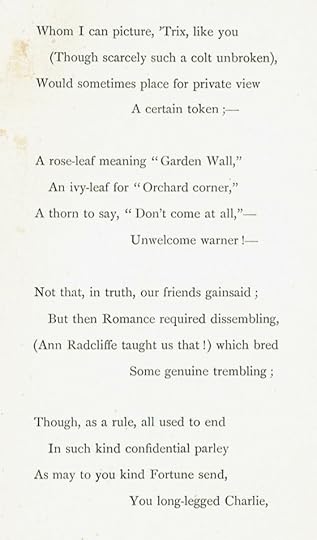
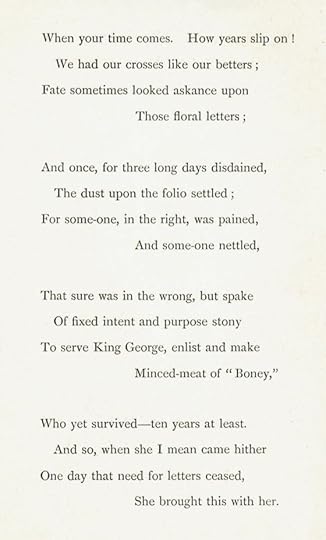
One of the poems is titled “A Chapter of Froissart.” Hugh Thomson’s whimsical illustrations grace the first page:
.
.
.
.
.
.
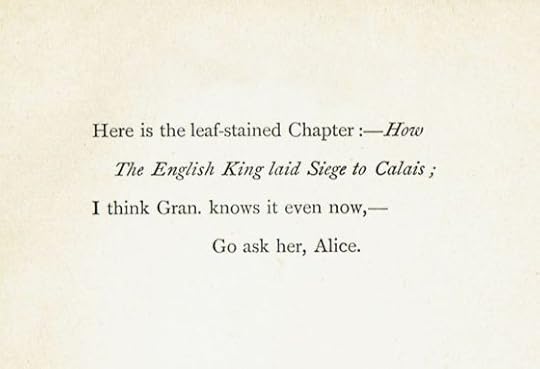
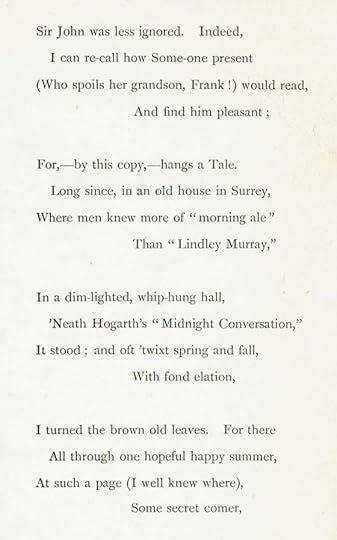
The language of this poem is a sometimes difficult to follow, but I love all the sly little references to Hogarth, Murray, Bonaparte, and Ann Radcliffe.
Although I’ve had the book for many years, it was very well read by the time I gave it a home. The pages are yellowed and loose, and there’s some foxing here and there; but this slim little book is definitely one of my favorites. I hope you enjoyed reading an excerpt.
How about you? Have you seen Hugh Thomson’s illustrations in other books? Did you enjoy this poem?
August 18, 2018
Jane Austen’s Social Media
A happy Saturday to you!
 I’m posting on the Austen Authors blog today, talking about social media in Jane Austen’s time. Please join me!
July 21, 2018
Walking with Lizzy Bennet
I’m on the Austen Authors blog today, talking about walks in the Kent countryside with Lizzy Bennet.
Please join me there by clicking on the Austen Authors icon below!
July 11, 2018
Did Your Ancestor Serve in a Royal Household?
Ever wonder if your ancestor worked at Buckingham Palace? Or maybe at Windsor Castle?

Windsor Castle
Perhaps one of your forebears held the title of Yeoman of the Mouth; or Laundress of the Body Linen, both of which were real titles of positions in royal households.
There’s a way you can find out. A few years ago the Royal Archives teamed up with genealogy website Find My Past to make the Royal Household Staff Lists available to the public.
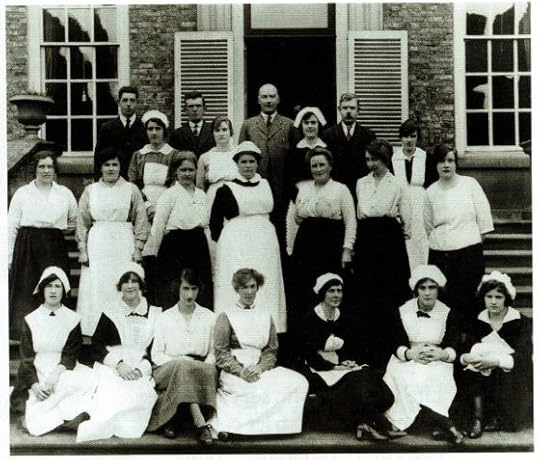
Edwardian Era household servants.
The site lists over 50,000 staff records dating from 1660 to 1924.
And the best part is, you can search the records for free! Click on the Find My Past icon to be taken to their United Kingdom site:

There’s no charge for viewing the search results—I found names of my Cornell ancestors on the list—but if you want to see scanned images of the original records, you’ll have to subscribe to the site or use their Pay-as-You-Go feature.
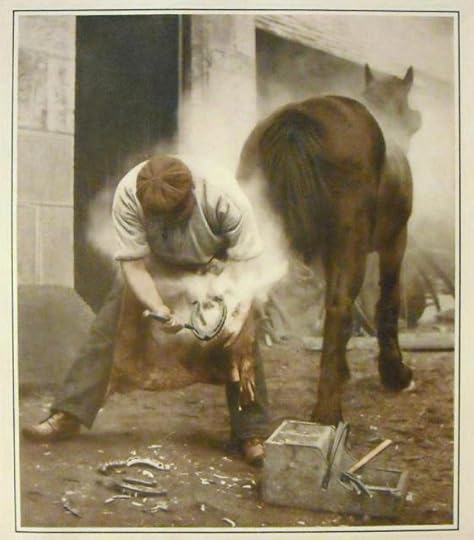
Not all staff worked in the house itself. Some of my Cornell relations worked in the Royal mews.
Still, it’s a fun way to find out if you have a connection through your ancestors to a royal palace or country home.
Happy hunting!
June 26, 2018
Let’s Meet at the Meet
My current work-in-progress has a minor sub-plot involving a race meet in a county town.

Scenes on the Road, or A Trip to Epsom and Back, showing Kennington Turnpike-gate, by James Pollard
Since I’m a visual person, I went searching for images of race meets held during the Regency era. Specifically, I wanted to see if I could get a sense of the logistics of the meet. Did they use a starting line or an actual starting gate? How did they mark the course? Did spectators line the course or did they watch from a safe distance?

The Meet with Lord Derby’s Stag Hounds
I thought I’d share with you a few of the images I collected, so you can see for yourself what inspired me to write my own descriptions of a race meet.

The Betting Post at Epsom Races, by James Pollard
When you look at the style of clothing depicted in these images, you can tell they were painted in the 1830s, well after the end of the Regency era. Despite that, I think they’re relevant for my purpose.

Epsom Races: Preparing to Start, by James Pollard
Another question I hoped to answer through these art pieces: Did ladies attend race meets? In the first image above there is a woman in the foreground of the picture, but I think she’s merely watching the men, on horseback and in carriages, as they pass through the gate on their way to the meet.
However, I do see some feminine-looking figures seated in the viewing tower on the far left in the image below. That’s a good thing; if social conventions of the time didn’t prohibit women from attending race meets, I have more flexibility in writing my story and keeping my female characters where the action is.

Epsom Races: The Race Over, by James Pollard
Even if women were allowed to watch races, I know they would have been banned from setting foot on the premises of Tattersall’s. Tattersall’s was a famous bastion of masculinity where horses were bought and sold. I’ve searched the image below several times, and can confirm there isn’t even a hint of a bonnet or skirt. (Apparently, cats were allowed at Tattersall’s, but women weren’t.)

Epsom Races: Settling Day at Tattersalls, by James Pollard
These images did help me visualize what county race meets must have been like. Judging from these images, meets were popular events that caused large crowds of men to descend upon a town—and if that isn’t an inspiring premise for a fiction writer, I don’t know what is!
I hope you enjoyed viewing these images. You can click on each one to open a larger version.
June 10, 2018
Reader Reviews and Bits of Fluff
My novel Mary and the Captain was published last year. The story is a continuation of Jane Austen’s Pride and Prejudice. In the book publishing world, Mary and the Captain fits very neatly into the Regency Romance sub-genre of Jane Austen Fan Fiction (JAFF).
Like many people who read, enjoy, and admire Jane Austen’s greatest work, I always wanted to know what happened to her characters after the close of her original novel. So I knew, when I took up my figurative pen to write my continuation of the classic story, my book had to be as perfect as possible.
I don’t mean perfect in its physical form relating to layout and formatting and proofreading (although those elements are certainly important).
By “perfect” I mean that my book had to hit the right tone in its characters and plot so the overall story was true to Austen’s original.
Why was that so important? Because JAFF readers know their stuff. They can spot an Austen error from a mile away.
Dedicated Readers
JAFF readers are dedicated to the genre. They typically read at least one JAFF novel a month.
It’s a tribute to Jane Austen that 200 years after her death, her novels—particularly Pride and Prejudice—are more popular and more loved than ever before. Readers identify with her characters and want to continue to read about them long after Austen’s original story comes to an end.
That’s why the number of JAFF writers and readers grows daily.
Want proof? Austenesque Reviews recently published a list of Jane Austen inspired novels and stories released in May 2018. Click here to see their list of 48 new titles for the month of May alone.
And for every new JAFF book, there’s a new JAFF reader who can’t get enough of Darcy and Lizzy, Anne and Wentworth, or Emma and Knightley.
Dedicated Reviewers
JAFF readers know what they like when it comes to variations of Jane Austen works, and they show their appreciation for a good story (or criticism of a poorly written story) by leaving reviews of JAFF books on book retailer websites.
Their reviews are thoughtful and well-crafted. It’s rare to see a JAFF reader leave a review that simply says, “Loved it!” or “Hated it!”
Bits of Fluff
I’ve been fortunate to have received several reviews for Mary and the Captain, and I’ve read every one—the good reviews, the bad reviews, and those in between. When readers take the time to tell me the particular reasons they liked or disliked my story, I pay attention.
Here’s an example of what I mean:
On Amazon.UK a reader named Chriss wrote a very thoughtful and complimentary review of Mary and the Captain. She ended by saying:
Overall this rates as probably the most entertaining Pride and Prejudice continuation story I’ve read and I’d highly recommend it to others.
By this time, I’m beaming; and I’m grateful that Chriss in the UK enjoyed my book so much. Chriss goes on to say:
I believe the author is American; however the sense of England and use of English terms is almost flawless, with the notable exception of the word ‘lint’ – if English characters must pick bits off of each other, let it be ‘fluff’ or ‘dust’ – but otherwise very well done indeed!
Chriss found me out. I am, indeed, American; and as an American, I know I have to say lift instead of elevator, trousers instead of pants, jumper instead of sweater, and queue instead of line.
I also should be spelling certain words that contain the letter “o” with “ou” or substitute the letter “z” with “s” and “e” with “ae” if I want my British settings and characters to be believable.
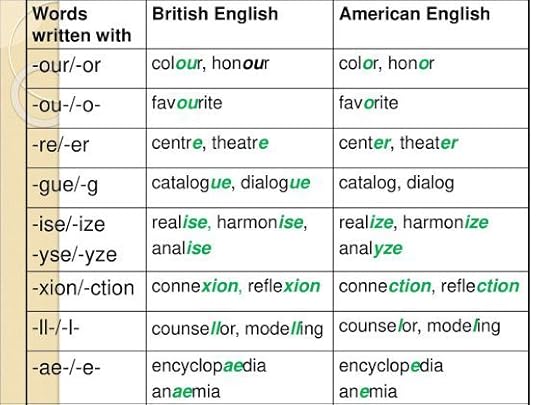
But the truth is, the word “fluff” never crossed my mind; but now, thanks to Chriss, I will never forget the lesson.
And while I’m at it, this video reminds me there are a few more English words I should keep in mind if I want the books I write to correctly reflect the English Regency period:
When Delicious Isn’t
Cathy G on Amazon.com also had nice things to say about Mary and the Captain. She began with:
This is hands down my favorite P&P sequel focused on Mary.
Of course, Cathy G gained my complete and worshipful attention with an opening line like that. She goes on to compliment the story, and then writes:
The only things [sic] I was a teensy-weensy disappointed in is the fact that, on occasion, Ms. Lawrence uses language that is a little out of Austen’s writing style (specifically the use of “delicious” in contexts unrelated to food/eating)
As soon as I read her comment, I could feel the heat in my face. I was embarrassed. I didn’t specifically recall using the word “delicious” in the book, but in my personal life, I do have a habit of saying things like:
Lady Susan is so deliciously evil.
or
His manners were so deliciously charming, I couldn’t help but say yes to whatever he suggested.
(Disclaimer: Those are just examples; I don’t really agree with a guy on everything just because he’s charming . . . although I’m clearly tempted to. I’ll work on that.)
When I reviewed my manuscript, I realized I had used the word “delicious” only twice (as in “the delicious feeling of his hand in hers” and “a long, delicious kiss”).
Still, it was two times too many if it meant Cathy G or any other reader was jarred out of the context of my story by the use of a word that was out of place in the Regency era. And if Cathy G noticed my misuse of the word, how many other readers noticed it, too?
Based on Chriss’ and Cathy G’s comments, I clearly have some things to work on as I write my next Jane Austen inspired book.
Therefore, I resolve that I:
Will not use the word “delicious” unless I use it in the context of food. (Easy. I can do this.)
Will not use Americanisms when I’m writing a story about an English family in the early nineteenth century. (This one is harder, so I went searching for some help.)
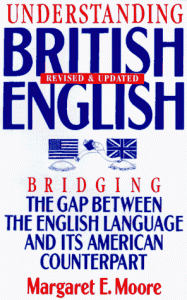
For assistance, I now keep a copy of Understanding British English on my desk top beside my dictionary and thesaurus.
And I subscribed to Tom’s YouTube Channel, “Eat Sleep Dream English.” Tom’s videos don’t specifically address how to write or speak the language of Regency England, but they’re pretty entertaining and they keep me mindful of how very different American English can be from British English. Here’s an example:
I’m grateful to Chriss and Cathy G and all the other readers who took the time to leave a review of my book. Their thoughtful and generous comments are very encouraging to me, and they give me plenty of inspiration as I write my next book.
They also taught me a lesson that I’m keeping in the forefront of my mind as I work to make my next JAFF novel better than ever and devoid of all traces of delicious lint.
June 2, 2018
GDPR E-I-E-I-O
You may have heard the term GDPR floating around social media in the last few weeks. You may have received several emails from different authors, asking you to re-subscribe to their mailing lists or blog updates so they will be compliant with GDPR. Those authors may even have sent you their updated privacy policies, asking you to read them.
You can thank GDPR for all of that.

GDPR is short-hand for the General Data Protection Regulation that went into effect on May 25, 2018 in the European Union. The regulation requires businesses of all kinds to protect the personal data and privacy of EU citizens. Non-compliance could result in hefty penalties.
I live in the United States and my website, NancyLawrenceRegency.com is domesticated in the USA. As such, it might be tempting to ignore the new GDPR requirements by saying they don’t apply to me or my website.
But that assumption would be wrong.
Readers in the European Union buy my books.
Readers in the EU visit my blog and leave comments.
Readers in the EU deserve my assurance that I value their privacy and intend to fully comply with the laws and regulations that ensure their safe online experience.

After I read the GDPR language and stopped to think about it, I realized the GDPR offers EU consumers the very same protections I would like to have for my own personal information.
So I now have a new “Privacy Policy” page on my website that complies with GDPR requirements.
The policy explains in every-day terms my policies for collecting personal information from visitors to my site. It also explains how that information is stored and used.

I hope you will take a few minutes to read the entire policy so you understand it and will always feel comfortable visiting my website.
To begin reading, just click here or on the tab marked “Privacy Policy” in the menu at the top of this page.