Nancy Lawrence's Blog, page 4
December 7, 2019
Listen Up! There’s a Jane Austen Podcast for You
I’m on the Austen Authors blog today talking about Jane Austen-themed podcasts.
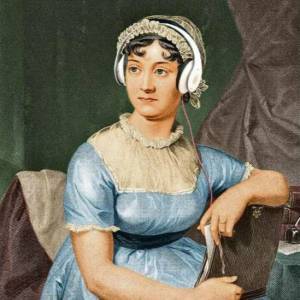
From fun to informative (and a few that are both), there’s a Jane Austen podcast to suit your mood.
Click on the image below to join me. See you at Austen Authors!



December 4, 2019
The Village People
I always love finding images that help me visualize life during the Regency Era.
Recently I came across some of those kinds of images, and I thought I’d share them with you.
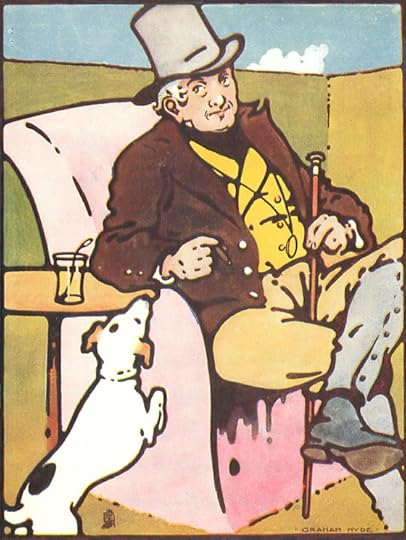
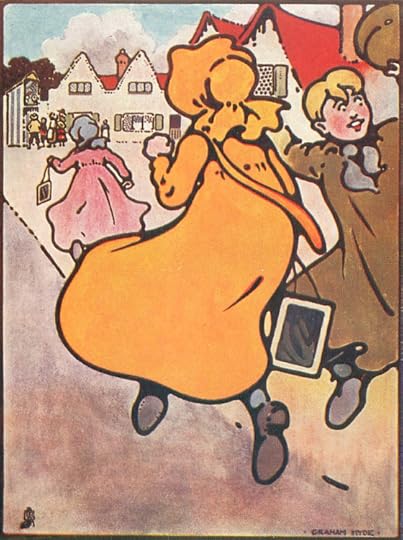
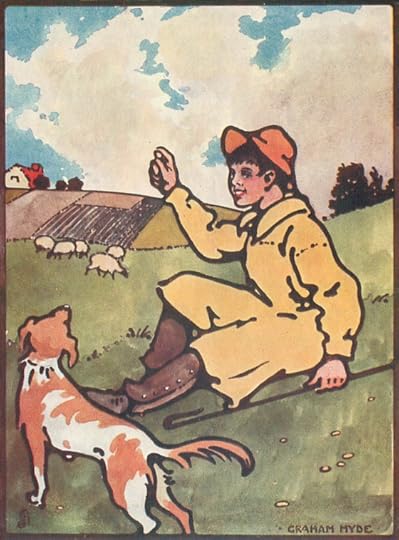
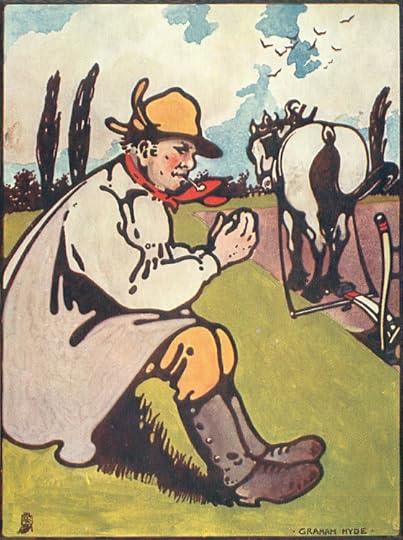
The artist is Graham Hyde, who was popular around 1900 to 1910 for his cartoonish illustrations.
In 1902 he produced a series of illustrations for Tuck & Sons that featured village people going about their daily lives during the late Regency/early Victorian time period.
One my favorites is this one, featuring a squire and his dog:
This one depicts children running to the town square, perhaps to see a Punch-and-Judy-style show.
Other village people illustrations include the local shepherd boy …
… and a farm worker taking a break from ploughing a field.
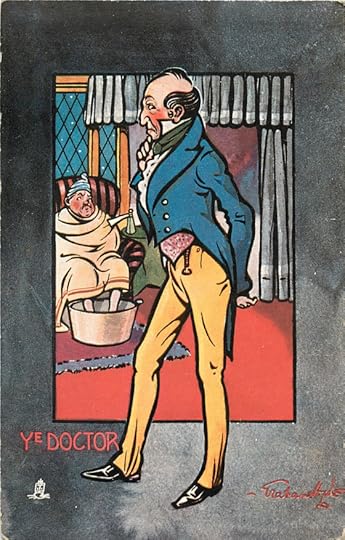
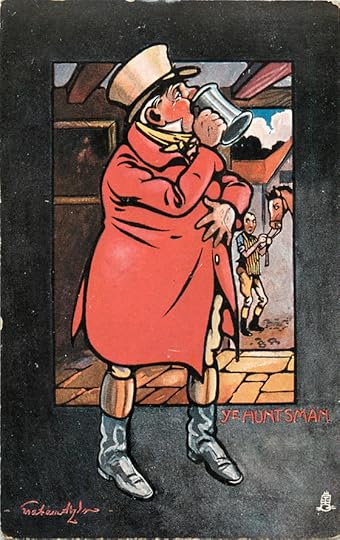
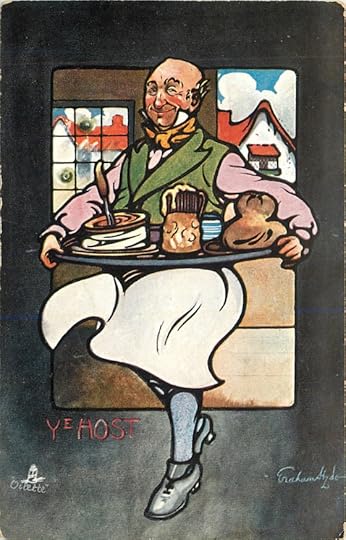
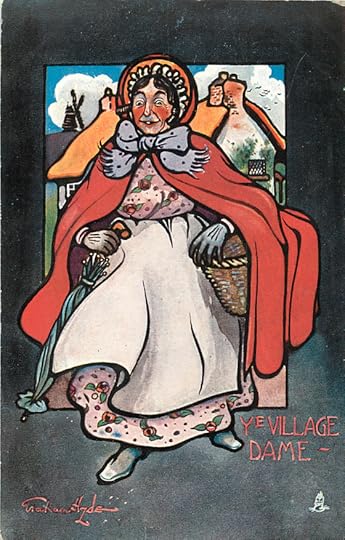
In 1908 Graham Hyde produced another set of illustrations along the same theme of characters you might find living in a village.
This set is more stylized and leans a little more toward Mr. Hyde’s cartoon-ish side.
This one is titled “Ye Doctor.”
Then there’s this one titled, “Ye Huntsman.”
Here’s “Ye Host,” which instantly makes me think of a landlord at a country posting inn:
And finally, here’s my favorite of the set, “Ye Village Dame.” It reminds me of Mrs. Philips running to tell Mrs. Bennet the gossip concerning Wickham’s iniquities:
What do you think of these illustrations? Do any of them remind you of characters you’ve read in classic literature?
November 9, 2019
How Many is Too Many?
Happy Saturday to you!
Do you have multiple copies of Pride and Prejudice on your bookshelf? Me, too!
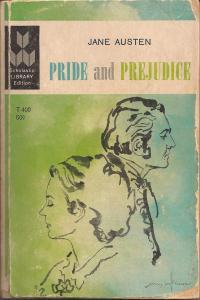
My tattered, well-worn copy of P&P.
I’m on the Austen Authors blog today explaining why each copy is special and I really can’t get rid of any of them. Really, I can’t.
Click on the image below to join me at Austen Authors.
November 5, 2019
More on Beau Brummell and a Short Story
One of my favorite places to shop is my neighborhood antique mall and in Denver we have several. On Broadway, just south of the downtown area, is Antique Row, where antique stores of different varieties pack a seven block stretch. There you’ll find an amazing collection of other people’s trash and treasures, just waiting to be taken home and given a new life. It’s a bargain hunter’s dream.
A few weeks ago, I made my annual pilgrimage to Antique Row. While I was browsing through some neatly arranged baskets filled with ephemera, I came across a magazine dated 1901, and in that magazine was a story about Beau Brummel, the arbiter of Regency fashion and champion of sport during the period when George IV was still Prince of Wales.
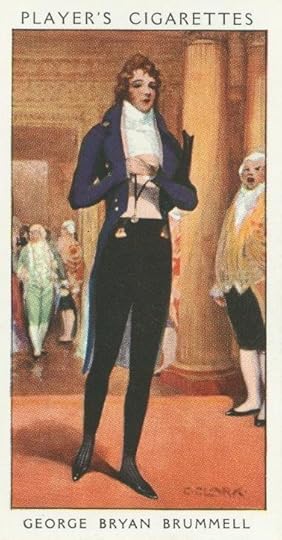
Beau Brummell immortalized on a 1930s cigarette card.
The story, written by Stephen F. Whitman, is titled “Brummell: An Enigma” and it included some beautiful black and white illustrations.
There are some characters of Regency England that really intrigue me: Lady Jersey, The Golden Ball, and Caroline of Brunswick, to name a few. So when I saw this story about Brummell (also a favorite), I started reading it right there in the store, and decided (as if I really needed to make a decision!) to take the magazine home with me and read the rest.
I wasn’t disappointed. Although the story is written in a style popular a century ago, I thought it ticked all the boxes that are part of Beau Brummell’s lore:
His immaculate appearance
His three-hour dressing sessions before going out
His legendary falling out with the Prince of Wales
I enjoyed the story, and thought I’d share it with you. So here, for your reading pleasure, is “Brummell: An Enigma,” along with the original black-and-white magazine illustrations.
I hope you enjoy it!

Introduction
In those days when gentlemen both rose and retired by daylight, and felt themselves but poorly occupied unless engaged in cultivating the vices of the period, society placed a greater tax upon health and morality than now.
George, Prince of Wales, who detested the government that restricted his wild extravagances, was sliding down the dizzy descent of his own choosing, and after him, with as close an imitation of the royal mode as possible, slid the court. Wales was a good leader, and the speed never slackened on his account, although to a person of an anticipatory nature, it would be evident that all this must end somewhere and sometime, with a crash a little above the ordinary.
The future, however, seldom bothered the prince. It was the present that he lived in—the crimson nights of drinking and gaming and prize fighting and love making and, unpleasant but necessary adjuncts, the gray mornings of ever increasing lethargy and stupor.
Royal of line, and of conduct most unroyal, he was a strange prince. And his court, with their exquisite garb and speckled souls, their perfect manners and love of blood and brutality—complex beings steeped in affectation—were the strangest birds that ever picked a quarrel and arranged a duel with smiles and gentle words, or passed eagerly from a lady’s perfumed boudoir to the reek of the prize ring.

One fine January afternoon, they were beginning to straggle into Watier’s Club for a bit of breakfast, just as they always did, these small-waisted, square-shouldered gentlemen of pale, emotionless faces and superb carriage.
The great foyer, with its glistening chandeliers and many little glass laden tables, was presenting each moment a scene of greater animation. White wigged lackeys slipped among the chairs, their swift movements contrasting peculiarly with the languid action of the courtiers they were serving.
They were nearly all there now, fresh from their three hour ordeal with hair dresser and valet—spotless, immaculately clothed. The broad oak doors would swing shut after the last of them by half past two. No, not the last of them, after all.
At twenty minutes of three, a gentleman, remarkable for the tightness of his pantaloons, the splendor of his ruffles, and the cock of his Corinthian beaver, alighted from his covered chair, fastidiously picked his way across the muddy gutter, and ascended the broad steps with a manner that was a work of art.
A passing carter pulled up his horses with a jerk, and peered after the erect, perfectly groomed figure, while a chandler and a bakery boy gaped, wide eyed, into the great doorway, until the sudden and unexpected descent of a very large footman put them to flight.
In the foyer, at this particular moment, a man in a rather startling canary waistcoat and glistening Hessians was turning the crackling leaves of the great betting book, and reading the recent wagers in a drawling undertone, for his own amusement evidently, as the succession of absurd bets caused absolutely no change in the immobile faces of the group about him. Wagers at Watier’s, even the most reckless and silly sort, were of too common occurrence to excite even passing interest.
“Mr. Moore wagers Mr. Haddon thirty guineas,” he read softly; “thirty guineas that Mr. Moore will drink thirty cases of Burgundy in a week.” He paused and raised his eyebrows a trifle. “If the bet is to be really decided,” he commented in the same tone, “I shall bet that he will, too.” He turned to the next entry. “Mr. Brummell wagers Mr. Raikes fifty guineas that ruffles will go out within the year.”
Two or three men turned slowly in their chairs and regarded him inquiringly. The subject of dress seemed to have partially awakened them from the general apathy.
The gentleman of the canary waistcoat reread the last entry, and pushed the book back among the glasses and bottles on the table with just a shade of annoyance.
“You might almost call that absurd,” he remarked, frowning. “Are hats and shoes going out, pray? Then, why ruffles? I hold that to a gentleman they are entirely necessary—it would be folly to dispute it for a moment. And how, I would like to know, shall they be put out?”
“The way it will be done, my dear Bully, will be by my ceasing to wear them.”
The voice came from the door, and involuntarily every head turned in that direction.
On the threshold stood the gentleman who had but a moment before attracted the admiration of the carter, the chandler, and the baker’s boy. He glanced about him slowly, tapping his snuff box with his fingers, and wearing on his pale face an expression half indifferent, half inscrutable, that clothed it like a mask.
At his entrance, an outsider’s opinion of all the rest would have changed swiftly and readjusted itself. The other men, with their airs and style and mannerisms, had suddenly become but imitations of an original. And this man was the original.
He moved across the room deliberately and quietly, bowing slightly now and then, swinging his cane and flicking his snowy ruffles with an air that was perfection.
When he finally chose a seat at a table, the men about it made room for him with a readiness that had almost a hint of alacrity. Brummell, the arbiter, the beau, who had the prince’s highest favor, was not the person to confer the honor of his company indiscriminately, even among the elect of Watier’s.
When the lackey had brought him his tiny glass of maraschino, he made no offer to engage in the conversation, which finally took on life again to some extent, and wandered through the themes of horses, women, prize fighters, and tailors, but never beyond.
In a pause, it was noticed that Brummell’s gaze, which had been traveling languidly about the foyer, was fixed upon two card players as near to annoyance and disgust as that gentleman ever permitted himself.
“Who is that person?” he asked, nodding his short auburn curls. “That person in the buff coat. Who, in Heaven’s name, is he?”
Two or three men turned and looked.
“It’s Jack Payne and some Lincolnshire friend of his,” said one. “Why?”
Brummell closed his eyes gently.
“Why?” he repeated, in a tone that made the other flush uncomfortably. “Good God! Look at his coat. Can’t you see at this distance that it was made for a hansom driver or a bailiff? And I suppose that hat on the chair is his? Look at it. I ask you, gentlemen, if this is Watier’s or a diving cellar? How in Heaven did a man with such a hat and coat get in here?”
Everyone turned now and regarded the offender. “He’s from Lincolnshire, Brummell,” repeated the man who had spoken before, “and a friend of Payne’s. What is a person to do?”
Brummell nodded to a waiter.
“Turn my chair around,” he said. “The other way. There. And another maraschino. A friend of Payne, then? I shall never forgive Payne for bringing him here in that coat! I feel quite ill, upon my word.”
He sipped his cordial delicately, wrinkling his brow from time to time. The others were silent and rather uncomfortable. The Lincolnshire person, however, continued to play cards, unconscious of offense.
A young man with a flushed cheek and hollow eyes threaded his way among the tables, and tapped the Beau on the shoulder.
“Morning, Brummell,” he said in a low voice. “The prince has just driven up and gone into one of the private rooms. He wants to see you.”
Brummell frowned slightly for a moment, and played with his glass. Then he looked up.
“‘Our Ben’ is up early today,” he said, with a little smile. “It must be important business that brings him out at three.”
He finished his glass without the slightest haste. Finally he rose.
“We’ll go to him,” said he. “Keep on this side of me, Lee, that’s a good fellow. I wouldn’t look at that coat again for worlds. Come on.”
They passed out through one of the side doors, Brummell swinging his slender cane and humming an air from the opera. In the corridor he paused and regarded the other for a moment by the dim light.
“Jack,” he drawled, “I’ve had a sort of foolish desire to see you get on in the world, but you seem determined to drag yourself back. I’ve done all I could for you. Last week I gave you my arm from the club to St. James’ in the height of the afternoon, but I really can’t do it again. My boy, your clothes look as if you were your own tailor. Let me see that hat.”
He took it gingerly between his thumb and forefinger, and regarded it, shaking his head.
“Out of date,” he said sadly; “out of date by three months. Look at that clouded cane—I don’t have to tell you that it’s archaic. Now, take a word of advice from Beau Brummell. You have the income to dress; you have the figure to put clothes on. Brace up. You may be possible some day, really. Good bye, good bye.” He sauntered down the corridor, humming lightly to himself.
Finally he came to a door which a footman in the royal livery opened. He passed in, and laid his hat down on a table garnished by a number of bottles, although there was but one occupant of the room—a heavy man, with a round, red face, half concealed for the moment by an elevated glass. Brummell shut the door and sank into a chair. The prince put down the glass.
“Morning, George,” he said discontentedly, frowning at the bottles. His hands, resting on the edge of the table, were twitching now and then involuntarily. Brummell noted it carelessly from where he sat. The effects of inherited ills developed by extreme dissipation were a source of interest to him, although no one would have suspected him of being interested in anything.
“Morning, George,” replied Brummell, opening his snuff box and passing it over. The prince waved it aside, and poured himself another glass.
“You’re out early today,” said the Beau, with a little yawn. The prince twisted uneasily in his chair.
“’Od’s bones, man,” he said, “I know it. It’s no pleasure for me to lose my sleep. The fight wasn’t over till four this morning. I suppose you know that the black won? He had the Smasher a sheet of blood from his hair to his waist before he put him under.”
Brummell frowned. “Very careless of the Smasher,” he murmured, flicking his ruffles.
“I’ve lost a hundred guineas on the ass, whom, you may be sure, I won’t dignify by my money again.”
Brummell picked up an uncorked decanter and held it to his nose.
“Canelle!” he said, with a faint grimace. “Wales, when will you learn to leave that alone? I abhor the stuff. You will be wearing ear muffs and pitching coppers next, I imagine.”
The prince growled unintelligibly, and dived into his snuff box. Brummell hummed softly to himself, and noted that the other appeared to be suffering somewhat from embarrassment.
“I suppose,” he said, after a moment, “that you didn’t send for me to drink that stuff under my nose? If you did, I must send for some gentleman’s mixture, out of self protection. Just ring the bell, will you, George, and order a bottle of maraschino?”
Wales’ red face turned a bit ruddier, and he glared covertly at the other. There were some who said that someday Brummell would go a step too far. Perhaps Brummell liked to play with fire, but if it once got beyond his control—The Beau might be arbiter, but Wales was the prince.
“We’ll let that wait,” growled the latter. “I’ve got something to say to you. They say you cross the Channel tomorrow?”
Brummell nodded languidly. “I’ve got to run over to Lyons to decide on some waistcoat patterns I’m having made. It’s a devil of a bother, but a man must wear clothes. Why?”
The prince fidgeted uncomfortably for a moment.
“Because,” he said, “I’ve important papers that ought to go to Paris—papers I can’t trust to everyone—and as you’re going to Lyons, I thought—”
“Exactly,” said Brummell. There was an awkward pause. “I suppose,” remarked the Beau, “it’s those foreign loans again?”
“Precisely,” replied the prince very eagerly. “That is it, precisely. You’re one of the few that know the particulars, you see. And then,” he added peevishly, “I can never tell when a letter gets to its place without being opened. You know,” he leaned forward cautiously, “you know the last ruling of Parliament on it. They know I must get money somewhere. Today I thought I saw a man—” he stopped. His hands were twitching again. Brummell watched him with half shut eyes. It was a half formed delusion with Wales that spies of Parliament dogged him constantly. His father had had delusions, too; and—everyone knows the rest.
“It wouldn’t inconvenience you much, would it?” asked the prince at length.
Brummell looked at the ceiling. He was thinking of the old king with the wrecked mind, and the old king’s son had to repeat his question.
“The mail from Lyons to Paris,” said Brummell, wrinkling his forehead, “is atrocious, and the people one has to travel with are perfectly unmentionable. However, I should be going to Paris soon, and it may as well be now as later. Have you got the letters with you?”
The prince began to fumble in his pocket hurriedly.
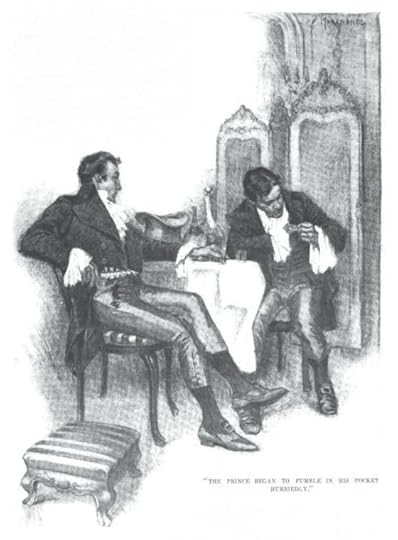
The prince began to fumble in his pocket hurriedly.
“Here it is,” he said quickly; “only one letter, to be given to a Vicomte de Vigny, who’ll wait in the foyer of the opera from seven on, Friday and Saturday nights. I’m sure it’s very good of you—”
Brummell rose and took the letter. “Don’t mention it, George,” he drawled, “don’t mention it. I wouldn’t do it for everyone, however. I’m off on the mail at seven o’clock tonight.” He paused and regarded the prince, with his head on one side. “Who is your tailor now?” he asked suddenly. Wales, who had also risen, hesitated and looked down at his clothes anxiously.
“Bennet,” he said; “the same, you know. Don’t you like my coat?”
The Beau looked at the garment from three positions, with very much the manner of a person contemplating a rare curiosity.
“Do you call that a coat?” he asked softly. “Just as you say, of course. Well, allons—au revoir.”
Outside the door, he paused and addressed the footman.
“His highness wants a bottle of maraschino,” he said, and passed on. And at seven that night he took the mail for Dover.

The tempo of conversation alone would have hinted to an observer that it was a Gallic, and not a Saxon, assembly, and the appearance of the women would have decided the suggestion.
It is remarkable that a narrow channel alone separates two countries whose women are so strikingly dissimilar.
The men—but the difference here was most noticeable in the covered lip, and the quick movements of the hands when conversation became lively. Over there in London, it was all smooth, calm faces above white ruffles and the deliberate tapping of snuff boxes. Here in Paris, it was fierce little mustaches, and much shrugging of shoulders, changing of pose, flashing of eyes.
The scene was pleasantly animated. The opera foyer was crowded with the bright toilettes of the women and the light coats and gold spattered uniforms of the men, that blazed and sparkled under the immense glistening candelabra. Through the open doors on one hand, the strains of the orchestra, playing the entr’acte, drifted in and mingled with the laughter and murmur of voices, while through the tapestry swathed windows on the other came the faint rattle of the Rue Richelieu.
Presently, after the crowd had moved back again, with bows and smiles, to the boxes, the second act of “Héro et Léandre” began.
It was while Mlle. Armand was singing her celebrated aria that Brummell passed through the arched main entrance and into the opera foyer, swinging that slender cane of his, and glancing about lazily through a ribboned quizzing glass, which he held daintily to one imperturbable eye.
A man moved from beside the auditorium entrance, and came towards him quickly. Before he had taken a dozen steps, the Beau’s gaze, which seemed to rest on him with the utmost indifference, had taken in every detail of his appearance—a dark, rather hard face, evening clothes with which Brummell could find no glaring fault, a diamond or two that sparkled from finger and ruffle, excellent legs, and a certain air.
“Monsieur is from London direct?” asked he stranger courteously. The Beau executed one of the bows for which he was famed.
“If monsieur is the Vicomte de Vigny,” said he, “I have the extreme pleasure of transferring to him a letter from—” He paused and appeared to be intently studying the top of his snuff box. The pause lengethened out.
The Frenchman regarded him curiously, and then shrugged his shoulders, dived into his pocket and drew out a slip of paper, which he held out towards Brummell. The Englishman looked at it through his glass, without offering to take it, however. Across it was scrawled one words, “Wales.” Brummell bowed again, and, taking from his coat the prince’s letter, handed it to the other.
De Vigny broke the seal and began to read. Brummell sauntered a little distance away, and helped himself to a pinch of snuff, after which he inspected his surroundings with vague interest. In the auditorium the aria was over, and Léandre, somewhat throaty, was singing to an appreciative chorus.
Finally, the Frenchman came over to the Beau, holding the open letter in his hand.
“Do you intend, monsieur,” he said, with a frown of perplexity, “that the lady shall accompany you?”
Brummell stared at him for a moment. “The lady?” he asked finally.
De Vigny’s shoulders went up. “Yes,” he said, “certainly, the lady. Why not?”
Brummell laid three fingers gently upon the sleeve of his coat, and motioned towards the door.
“Monsieur le vicomte,” he remarked, “I think that we may consider this in a private room, with discretion.”
They went out together into the night, and down the Rue Richelieu a bit they came to a brilliantly lighted wine house, beside the Library.
When they had passed in and made their way between the crowded tables of the salle, they were shown to a private room. Waiters lit candles, brought wine and cards, and left them.
Outside of the door was a hall, beyond was the salle. On the other side, a window looked out on a little clump of poplars and a flower bed. Beyond that was a wall and the housetops, pale in the moonlight.
Brummell seated himself, and regarded the other attentively for a minute.
“You were speaking over there, monsieur le vicomte,” said he suavely, “of a lady. I should be delighted now to hear more on the same subject.”
De Vigny drank wine and smiled.
“You seem to be somewhat in the dark,” he said, “and I can hardly understand it. When I was told to meet a gentleman at the opera down there, I thought it was I who should take the orders; but it seems the wind blows the other way. The lady, naturally, is the lady in the case—Mademoiselle Vassey, the debutante at the opera this year. You know the fancy his highness has taken to her, and that it is his wish to introduce her at the court. Mademoiselle, on the other hand, does not exhibit that appreciation which might be expected, perhaps because she is so young—altogether an ingénue, and does not know enough of the world to appreciate the prince’s philanthropy. Therefore, she is to be persuaded by other means.” He broke off, and unrolled the letter again.
“By other means,” he repeated lightly. “His highness, you see, has just written that she is to be conveyed to London. You understand. What hesitation mademoiselle’s unwillingness might cause us will easily be overcome by the prince’s power and resources. Therefore, I asked you if you were going to accompany the lady, and you will perceive that we have again arrived at that question.”
There was a little pause, in which Brummell poured himself a glass of wine with the utmost deliberation. His rather pale face bore a peculiar pallor, which was unusual. People who knew him as intimately as he ever permitted knew that mark. Buck Ainsley had known it at Tunbridge Wells. But that is ancient history.
He sat forward now, and began to speak. With his first word, de Vigny looked up in surprise. It was as though it was another man’s voice, and the face caused him still greater astonishment; for once, that mask of languid apathy and indifference was off. Perhaps, for a moment, the Frenchman thought that another being looked at him out of the gleaming eyes opposite, and that another voice spoke through the thin lips.
“You have just told me some very interesting things, monsieur,” said the Beau, “and I owe you some tale in return. Had I known the contents of that letter you hold in your hand when the Prince of Wales asked me to bring it here as a favor, by God, sir, I would have torn it up and cast it in his teeth. Furthermore, while you did not know my name, you did very delicately honor my appearance by considering me equal to assisting you in a most despicable crime—I shall call it nothing else, sir. Let me assure you that George Brummell is not in the habit of acting as a kidnapper, even for a royal maniac, or of sitting in the same room, sir, with one of his servants; and, while I believe you are no more a vicomte than I am the Pope of Rome, I take great pleasure in telling you that it is extremely doubtful that you ever pass out of this room other than feet first.”
He rose quickly from his seat, picked up the prince’s letter, which had fallen between the bottles, and lit it in the flame of the candelabra. When it was blazing well, he tossed it on the floor, and rang the bell. A servant appeared at once.
“Go into the main salle,” he said, “and pick out two officers sitting together—any two. Bring them here at once.”
He turned and regarded de Vigny, who had risen and, with a black face, was pouring out a continuous stream of assorted oaths and blasphemy of a personal trend. The Beau smiled slightly. Now, strangely enough, the mask was slipped back. He was almost the Brummell of Watier’s again.
“Very diverting.” he remarked. “If you will pardon me for a moment—”
He sat again at the table, and, drawing out his tablets, scribbled:
“Mademoiselle:
The desire of a certain Personage to present you at a Court across the Water has tonight placed you in a Danger which I, although not having the extreme Pleasure of your Acquaintance, am Happily able to Dissipate. Hereafter, I should advise you to surround yourself with Safeguards of the Strongest Sort.”
He hesitated a moment, and then folded it unsigned. On the outside he wrote:
“Mlle. Vassey, l’Opera, Rue Richelieu.”
Then he tore off another sheet, and wrote:
Just a Line to correct a Mistake. I am neither your Servant nor your Intriguer, and I Marvel at your Presumption in confiding such an Office to any Person above the caste of a Bailiff.
I regret that you must Procure a New Vicomte, as this one is about to join his Illustrious Ancestors.
It would appear that you might have skimmed Drury Lane for a more sure and less Particular Messenger than
. . . .George Brummell.
This he folded, and on the cover he wrote:
“George, Prince of Wales. Burlington House, London.”
So, once again, the, arbiter was playing with fire, and the little flame within the letter was to run many miles ere long, and kindle a blaze of no small proportions. Perhaps he foresaw something of it as he sealed the papers and put them in his pocket, but his movements were as slowly decisive as ever, and now his face was immobile again. His pride had been outraged, and that Corinthian honor of his had been belittled. Because of that, there could be no two ways of procedure. He was Brummell.
Whatever his reflections were, they were soon ended. He glanced up, and regarded the Frenchman, who was looking out of the window at the moonlight, his face swollen with passion and his mouth muttering lurid curses.
Brummell yawned behind his slim white hand.
“You are a very unfortunate vicomte,” he said, with a little smile, “but you are having a considerable honor done you at the last.”
De Vigny wheeled fiercely, and stretched out a shaking hand towards the other.
“At the last!” he cried hoarsely. “Ha! In five minutes you will be sticking on my sword point, you white cheeked, thin waisted English dandy!” He said more besides. He was not afraid anymore—he had only been startled during that little while that Brummell’s face had been somewhat different.
The English dandy took a pinch of snuff, and raised his eyebrows. Then the door opened and two officers entered. They bowed, and came forward quickly. The Beau waved his hand gracefully towards de Vigny.
“This gentleman and I,” said he, “have differed. I regret the necessity of taking you from your table, but I am sure that you will be witnesses of a very short settlement. If I might make the suggestion, I would recommend monsieur, who, I perceive, is of the Royal Horse, to my vis-a-vis.”
The soldier nodded, and pronounced his name and that of his companion.
“Colonel Mouilly. The Vicomte de Renanie. The servants, you know, are curious. These little affairs are noised about very quickly. If anything is to be done, it must be at once.”
The Beau picked up his cane, and twirled it lightly. “My name is Brummell,” he said.
Colonel Mouilly stared. “George Brummell of Watier’s?” he cried, finding the English names difficult. “Name of God! I knew I had seen you somewhere! De Renanie, look! When I was in London last year, it was this gentleman who fought a prize fighter in that punching ring of these English—fought him with his bare hands for an hour, on a wager. Monsieur Brummell, I know you. You are the man who is bloodied by a prize fighter, and yet who will wash in nothing but silver. Ah, you English!”
He smiled, probably at the recollection. Then he recovered himself, and locked the door quietly. De Renanie was moving back the table and chairs with a despatch which proclaimed no ignorance of the impending pastime. Brummell had carefully removed his coat, and was engaged in turning back his sleeve ruffles with the most scrupulous attention.
“I am delighted to have a real vicomte with us at last; the air has already cleared it little.” He spoke softly, as though to himself. While he was loosening his waistcoat de Renanie came across to him.
“Monsieur Brummell,” said he, “you across the water have stopped carrying swords. Will you take mine?”
The Beau picked up his cane again with a glimmer of acknowledgment about his mouth.
“A sword is a handy thing,” he said, “is it not?”
Then he twisted the stick between his hands, and from its interior drew out a long, slim blade.
“I have often thought, monsieur le vicomte,” he remarked reflectively, bending it against the table, “that this cane of mine is an example of how the exterior may deceive. It applies—” He looked up absently towards the ceiling. “Yes, I may say that it applies admirably to . . . some men.”
De Vigny, stripped to his shirt, was beating his sword savagely against his thigh. He sneered angrily, and reached for a glass of wine.
Brummell tightened his waistband deliberately, and then sauntered forward into the middle of the room. Where the ruffles of his sword arm were turned back, the muscles swelled like twisted strands of rope.
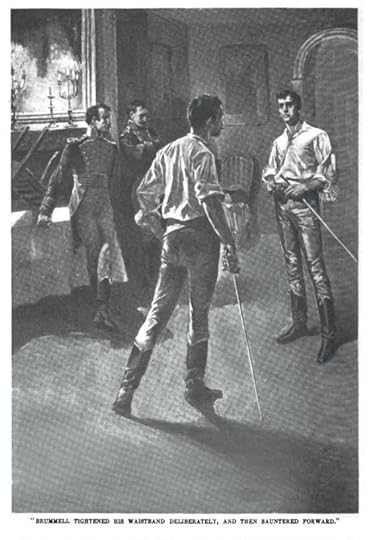
Brummell tightened his waistband deliberately, and then sauntered forward.
“It is chilly here, gentlemen,” he drawled; “shall we get to work?”
The officers bowed, arranged the lights, and stepped back. Instantly, the two blades crossed and ground together, clashed and ground again.
Outside, in the little hallway, a waiter leaned against the bolted door, and listened to the faint metallic clashes and thud of feet. Once there was a moment’s pause, and then it began again. Inside of two breathless minutes, there was a muffled cough, an exclamation, and a fall. Shortly, the bolt was drawn.
In a little while there issued forth two French military men and a gentleman faultlessly attired, and English by his dress. They sauntered towards the salle, talking together lightly.
“You are quite right,” the Englishman was saying, as he swung his cane, “the lunge you speak of is the surer move in that case; but I think you will agree with me that the other is a very pretty play.”
At the entrance to the salle they stopped.
“You go back to England at once, monsieur?” asked the colonel.
Brummell’s eyes turned indifferently towards the closed door of the little room they had left.
“I shall be leaving Paris,” said he, “but not for England yet. You have been to Avignon, messieurs?” The two soldiers nodded. “I sometimes think,” said Brummell softly, “that it is the fairest spot there is. It is not the place so much, perhaps, as the—associations. The cool remembrance of a week spent there will carry a man through the furnace of the London season.”
He paused and regarded them curiously. “You have the honor, messieurs,” he said, smiling, “to have heard me speak in a most unusual vein. What odds? This is Paris, not London.” He bowed low to them, and, passing between the tables, went out into the moonlit street.
The fresh, pale green of spring was rustling above the Mall. From the trees and lawns came the songs of birds, and from farther off the dull rumble of the London streets. The afternoon crowds were filling the broad walk, and it was all sunshine, bright gowns, and faultless coats under the moving branches.
Three men had paused to speak to an old gentleman sitting on one of the benches.
“Take my word for it, boys,” he was saying, his wrinkled face twisted with a wry smile. “Take old Captain Grownow’s word for it, he’s off at some game that will set you all staring when he comes back. Four months? Ha! What’s that to a young man? He went in a hurry, but George Brummell’s not the boy to do old things. He’s up to something, I know. I was a bit of a Mohawk myself once, before you young bucks began to ruffle it.”
“He went without a word,” said one of the others, “and, egad, there’s been not a hint of him since. Even the prince—” He stopped, and looked around him.
Old Grownow looked up curiously. “They tell me it’s not all straight between George and Wales now,” said he. The others nodded.
“Worcester has spread it that Wales will not hear his name now,” said one. “But that came up some time after George had gone.”
The crowd was thick in the walk now. A man resplendent in a blue coat and Hessians made his way towards the little group about the bench, with a near approach to haste.
“Bully, Payne, he said at once, “who do you think is coming up the Mall?”
The four turned, and perceived, at some distance, a well known erect figure, walking slowly and bowing from side to side with an elegant grace. He had come back.
In a few moments he reached them and smiled. People along the walk moved as slowly as they could without stopping altogether. The whole Mall seemed to know at once that Brummell was back again.
“Heigho,” he yawned, in his old way. “It’s good to be back in town again.”
His eye fell on Raikes, and he raised his hand gently to a quilted cloth he wore folded about his neck.
“They’re not going to wear ruffles anymore, my boy,” he said seriously. “You notice I’ve stopped it. I believe—” He looked up at the trees for a moment. “Yes, I believe we had a little wager on it, didn’t we?”
There were a dozen young bloods in the group now, cocking their hats and fingering their snuff boxes. The old captain laughed from his bench.
“London is itself again,” he chuckled. “We were lost without an arbiter, George.”
The Beau turned. “Impossible, captain,” he said, with one of his rare tones of sincerity and deference remarkable in him. “While you are here, London does not lack an arbiter. In your youth, sir, you were a great man, and your fame still lives on. You were the only man of your day who knew and appreciated the niceties of dress.”
Another figure hurried up, and, catching Brummel by the arm, pulled him aside. It was young Jack Lee. His face was agitated.
“My God,” he whispered, “why did you come back now? The prince has been against you for months. Someone has told him that you are here, and he swore that he would cut you in the Mall. You know what that means, George. Go away—go away at once, before it is too late.”
Brummell’s eyes narrowed. “Where is he?” he asked, turning quickly.
The other made a covert gesture with his hands. “He’s coming down the walk,” he groaned. “But you have time, George; you have time.”
The Beau laid his hand gently on the other’s shoulder. “You’re a good boy, Jack,” he said. “He will cut me to break me, then? Indeed, he seems to forget that I am George Brummell.” He turned to the others. “Gentlemen—” He looked around the little circle— “the prince is coming. Let us go and meet him.”
They set out along the middle of the walk under the great trees, Brummell a little in advance. Jack Lee was pale, and from time to time glanced ahead fearfully. Perhaps Brummell was a little paler than usual, too; but it was the pallor that had come on him in the Paris wine house.
Word of the impending meeting and the prince’s threat must have flown on wings, for the grass was crowded with ladies and beaux alongside that part of the path where the two parties must meet. They were nearing each other now, and the crowd of onlookers grew hushed.
It was quite evident to the dullest that if Wales intended to keep his word and cut the Beau, it would mean ruin to Brummell. It flashed through the minds of the intimates of both principals in the scene that the arbiter had perhaps played with the prince once too often, in some way.
There was hope yet, though, if Brummell would bend. Everyone felt that there was hope yet.
Wales was ten feet away now. The only sounds were the crunch of gravel and the voice of the prince, who was engrossed in talking to Lord Worcester. When the presence of so many people in so deathly a silence forced itself on his mind, he looked about him in astonishment.
As he saw the Beau, his stout face darkened and stiffened. The memory of that letter burned his brain like fire, and fire seemed to smolder in those bloodshot eyes. Brummell’s little following, hardly wishing to be identified in the probable disaster, had fallen back. Jack Lee walked on beside the Beau.
Now the prince and the arbiter were almost abreast. They looked into each other’s eyes.
Silence.
Then Brummell turned to Lee, and his voice cut the still air with a distinctness that was startling.
“Jack,” said he, with just a shade of interest and amusement in his voice, “I wonder who Worcester’s fat friend can be? I’m a little surprised at his lordship for bringing him to the Mall in such a coat.”
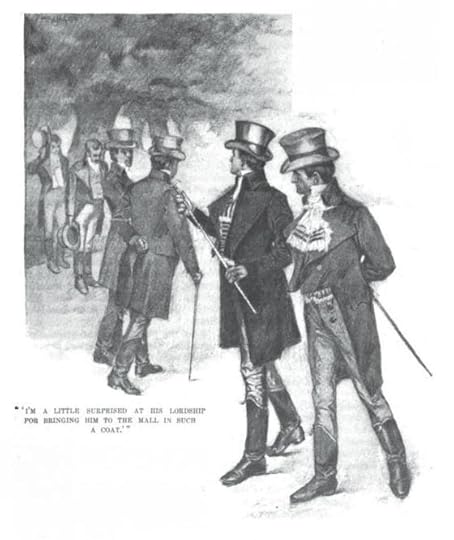
“I’m a little surprised at his lordship for bringing him to the mall in such a coat.”
A gasp went up along the Mall, and Jack Lee clenched his fists.
And the prince—the prince grew almost pale, as pale as was possible for him; opened his mouth, shut it, and passed on.
Then Brummell, with the same slow step that he had neither slackened nor hastened, passed on between the frozen lines of people—cold, graceful, perfect, with a far-away, abstracted look in his eyes, and a face that held the vestige of no emotion under the sun.
The story ends a bit abruptly and at a place where I’d love to know more, especially in regard to what Brummell did next; but overall, I enjoyed this story. I also liked the insights the author imagined in regard to Brummell’s personality. He made him the consummate Corinthian—cool, urbane, witty, and powerful. That’s a characterization Georgette Heyer and other Regency romance authors perpetuated for decades.
I hope you enjoyed the story, too. Please let me know what you thought of it!
October 30, 2019
Beau Brummell at Bonwit Teller
I’ve been working on a story that includes a secondary character who is an unabashed Regency Dandy. In his mind, appearance is everything.
In writing the character, I wanted to make certain I accurately described his attire, so I turned to my research files on the king of all dandies: Beau Brummell.
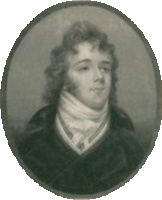
Beau Brummell, engraved from a miniature by John Cook.
When I skimmed through my files and the books I have about Beau Brummell, I realized they focused more on the events of his life and his sense of style, but really didn’t contain any actual descriptions of his clothing.
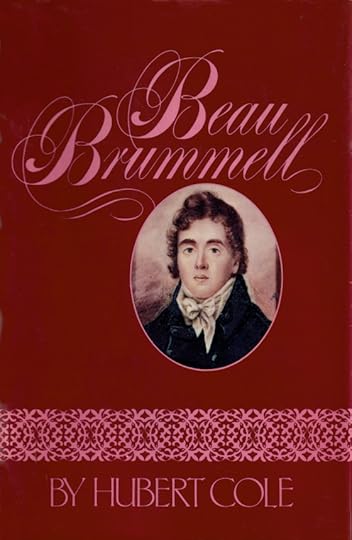
Beau Brummell, by Hubert Cole, from my library of Regency research books.
Also surprising: there’s precious little when it comes to detailed descriptions of Beau Brummell’s clothing on the Internet, either.
But in my online searches I did find something interesting. On The New School’s website, tucked into their online archives, were several photos of Brummell-inspired fashion from the 1950s.
Why were people in the 1950’s so interested in Beau Brummell? Because in 1954 MGM released a movie that was supposed to be about Beau Brummell’s life. The film starred Stewart Granger as The Beau, Peter Ustinov as the Prince of Wales, and Rosemary Harris (mother of Jennifer Ehle, my favorite Lizzy Bennet) as Mrs. Fitzherbert.
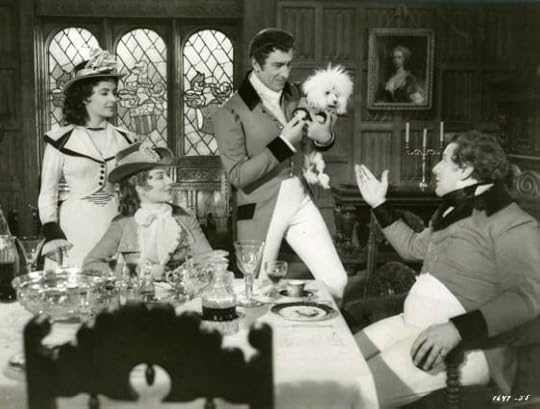
A black and white still from a scene in “Beau Brummell” starring (left to right) Elizabeth Taylor, Rosemary Harris, Stewart Granger, and Peter Ustinov.
Also in the film: Elizabeth Taylor as Lady Patricia, a totally fictional character who served only to showcase Elizabeth Taylor’s beauty and give Stewart Granger a heterosexual love interest in the midst of all the ruffles and tight breeches. (That’s the kind of thing they did in the fifties. Don’t ask me why.)
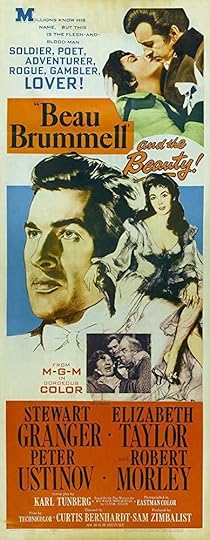
Poster for the 1954 movie, “Beau Brummell.”
The great New York department store Bonwit Teller caught a little of the Beau Brummell bug. They came up with an advertising tie-in to the movie and devoted several of their coveted 5th Avenue window displays to women’s fashion “inspired by” Beau Brummell’s dandyism.
Here’s a photo taken at the time of one of the window displays in 1954 (courtesy of The New School archives):
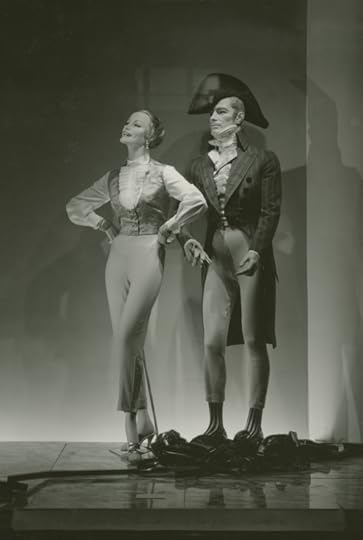
The female mannequin is dressed in 1950’s style high-waist pants, ruffled shirt, and a waistcoat that mimic the male’s attire. On the floor at their feet is an unraveled reel of film.
The male mannequin is wearing one of the actual costumes from the Beau Brummel movie. Here’s how that costume looked when Stewart Granger wore it in the film:
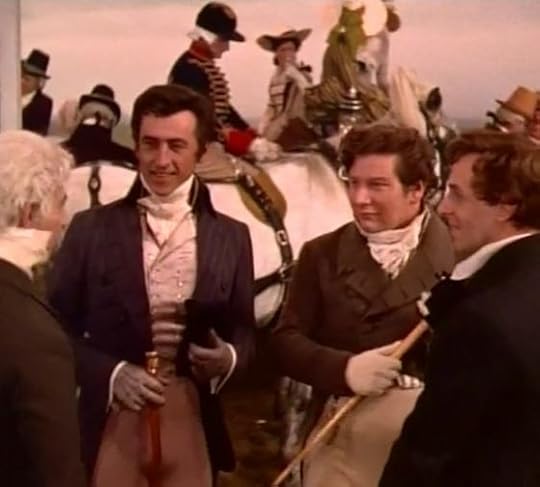
If you look closely, you can see his round hat tucked under his left arm.
Here’s another of the Bonwit Teller window displays from 1954. In this display the female mannequin is again wearing high-waist pants with a seam detail that mimics the brocade on the male mannequin’s military jacket.
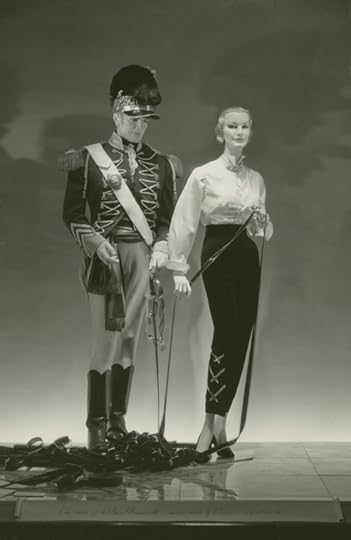
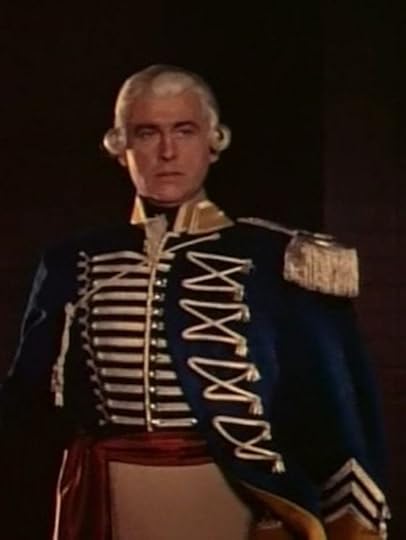
He is is dressed in another costume from the movie. Here’s what Stewart Granger looked like in that same military uniform in the film:
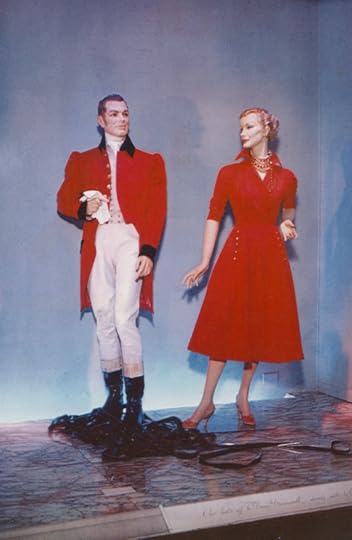
There’s a scene mid-way through the movie when Beau Brummell joins the Prince of Wales on a hunt. Bonwit teller depicted the scene, matching their idea of a modern, 1950s woman in a red dress and heeled shoes with a gentleman’s hunting pink, which consisted of a long red coat, white shirt and pants, and black boots.
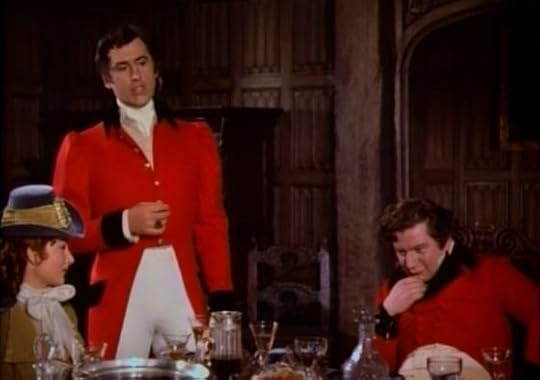
Here’s the same costume worn by Stewart Granger in the movie. With him in the scene is Rosemary Harris as Mrs. Fitzherbert and Peter Ustinov as the prince.
I was so glad to find these images, because they helped me realize Beau Brummell was not all about black tailcoats and understated fawn pantaloons.
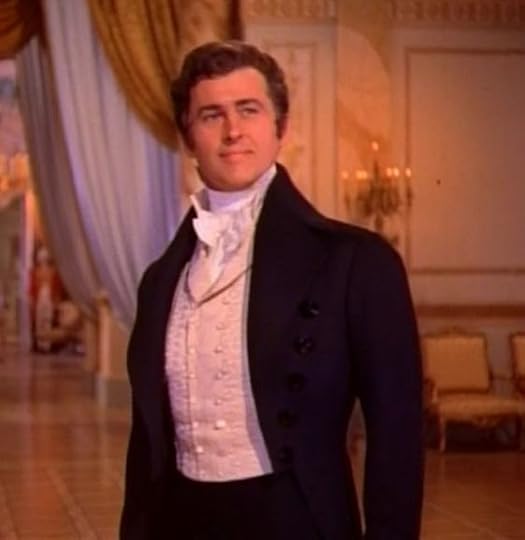
Stewart Granger as Beau Brummel in the 1954 movie of the same name.
Those articles of clothing have been the mainstays of any Regency romance hero’s wardrobe since Georgette Heyer first described them in Devil’s Cub in 1932. But the movie costumes convinced me I can introduce color, stripes and pattern to my character’s attire and still hold true to the Dandy’s dress code.
With these costumes as a guide, I was able to write some descriptions of ensembles I think my Regency character will enjoy wearing. I even thought up an article of clothing he’ll wear that will end up playing a major role in the story.
I’m looking forward to sharing all of it with you soon!
In the meantime, if you’d like to see more photos of the Bonwit Teller window displays featuring costumes from the movie, click here to be taken to The New School Archive and Special Collections website.
October 12, 2019
Beware the Urge to Quote Jane Austen!
Good morning, and a happy Saturday to you!
Today I have a post on the Austen Authors blog about the dangers of quoting Jane Austen. I hope you’ll join me there.
Just click on the image below to begin reading.
October 8, 2019
A Gentleman’s Sporting Life
In a Regency era story I’ve been working on, my hero is a sporting man. Whatever the sport, he loves it: Fencing, boxing, fishing, shooting—they’re all on my hero’s list of favorite things to do.
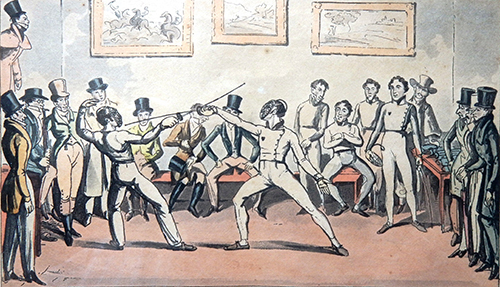
Fencing at O’Saunessy’s Rooms in St James Street in 1820, by Cruickshank.
While researching different sports that were popular at the time, I came across a reference to the sport of hare-coursing.
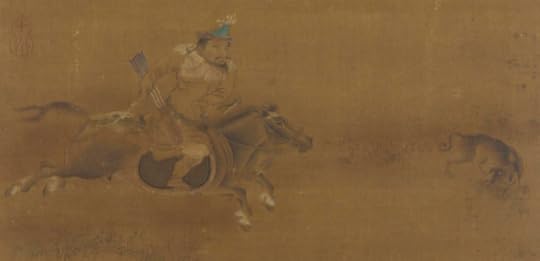
A portion of a 17th Century painting on silk of a hunter and his dog hare-coursing.
Hare-coursing is a violent sport in which dogs are turned loose to hunt down hares by sight.
That’s all the description I’ll provide, because I find the concept of the sport too upsetting. I’m an animal lover through and through, so I’m glad to know the sport is banned in most places today.
Still, it was a normal gentleman’s pastime during the Regency, and while I’d never write about it in a story (except to condemn the practice), I was intrigued to discover there was a specific style of dress men wore for the sport.
I did a previous post (which you can read here) that featured gentlemen dressed for shooting pheasant or other game birds.
Likewise, when I stumbled upon a description of hare-coursing, I also found this image of a coat a gentleman would have worn that was specially designed for the “sport.”
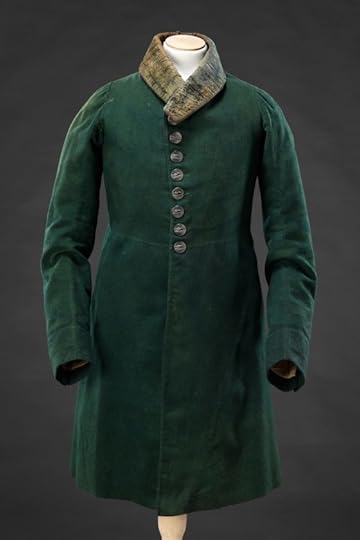
From the John Bright Collection
The coat itself is made of wool, trimmed with velvet, which leads me to think hare-coursing was a popular pastime during the colder months of the year.
The coat has two deep pockets on either side of the back skirt. The size of the pockets indicates they may have been used to carry the dead hares.
But what I found most interesting was the buttons on the coat. They were cast with images of a running hare, which makes me think the garment belonged to a wealthy man who could indulge in a custom coat to wear just for engaging in hare-coursing.
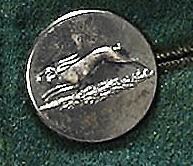
I’d never glorify hare-coursing by including it in a story, but this image does inspire me to rethink my hero’s wealth. Is he the kind of man possessed of such an extensive wardrobe that he’d naturally have a custom coat made up to wear only one or two times a year?
Or would that be too vain of him?
Maybe I’ll have my hero be a little more altruistic—the kind of man who would rather put his wealth to better use.
Hmmm, the possibilities are endless!
October 1, 2019
Downton Abbey and Simpson’s-in-the-Strand
Last week I saw the movie, Downton Abbey. It was wonderful and perfect and all I hoped it would be. In fact, I smiled like an idiot through the entire 122 minutes of the film (and, yes, I sat through the credits at the end.).
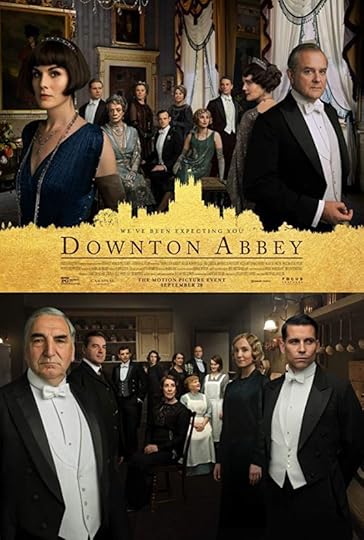
One reason I love the series, and the movie, is the visual feast they provide in both costumes and settings. To me, every shoe or gown, every setting or detail seems so authentic to the time.
For example, during the series, Downton’s characters frequented a London restaurant that was never named in the show, but I recognized it as Simpson’s-in-the-Strand.
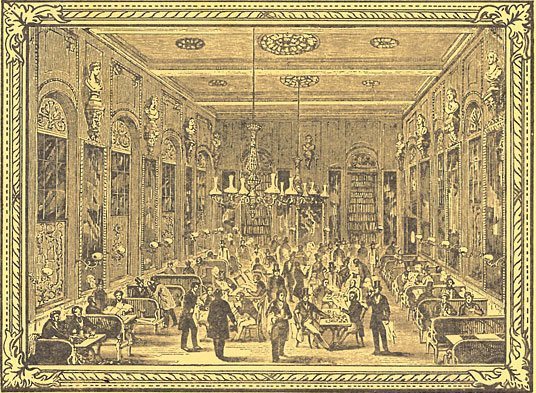
Simpson’s Chess Hall, about 1830.
Simpson’s began as a chess club/coffee house in 1828. In 1848 it expanded into the restaurant business. The owners instituted silver-domed carving trolleys, from which they discreetly carved large joints of roast beef table-side so as not to disturb the chess players.
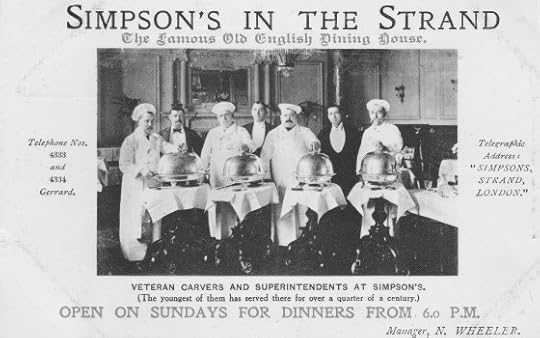
A tradecard for Simpson’s-in-the-Strand from about 1910.
By 1898, when its name was formally changed to Simpson’s-in-the-Strand, the restaurant became a favorite haunt of Benjamin Disraeli, George Bernard Shaw, and William Gladstone.
Simpson’s was so famous, it earned a mention in the fictional world, when Sherlock Holmes suggested “a meal at Simpson’s” to celebrate the successful resolution of one of his challenging cases.
With its grand Edwardian interior, it’s no wonder it was chosen as the perfect location for filming a London restaurant scene for Downton Abbey.
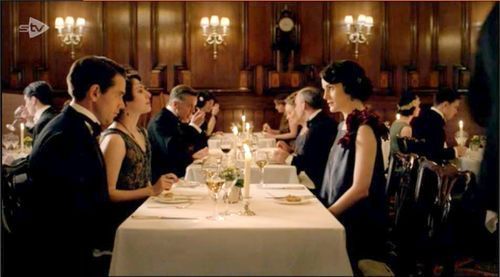
In Season 5 of the series, Lady Mary Crawley met Lord Gillingham and Mabel Lane Fox for dinner at Simpson’s:
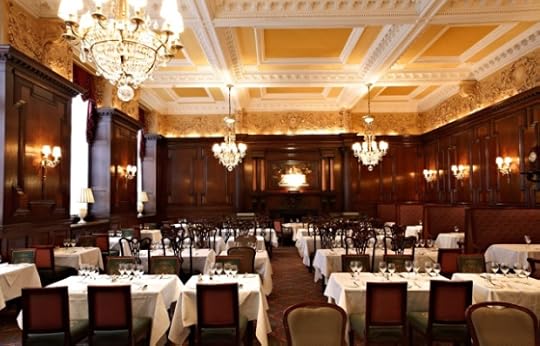
Here’s a broader view of the grand dining room, to give you an idea of the size of the room:
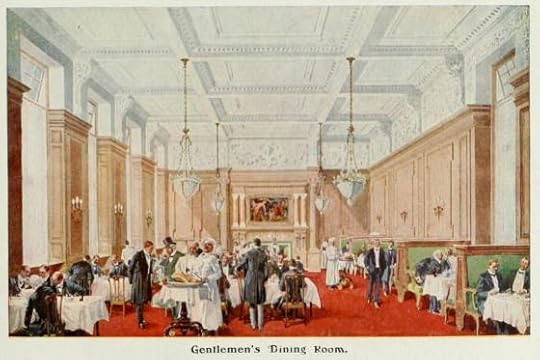
With its dark paneling, it was once known as the gentlemen’s dining room. This 1907 illustration lightens things up a bit so you can see some of the details of the room:
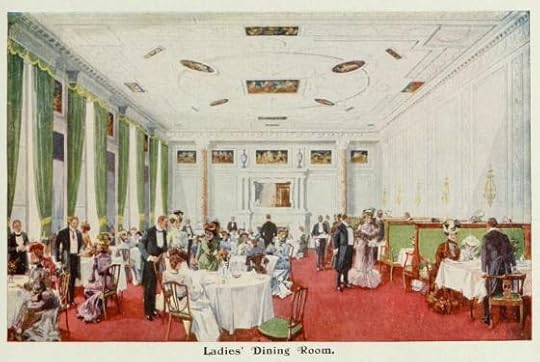
There was also a separate ladies dining room, where women could take luncheon or tea, as depicted in this 1907 illustration:
Downton Abbey wasn’t the only production to make use of Simpson’s beautiful interiors. In the 1992 production of Howards End, Margaret Schlegel (played by Emma Thompson) met Henry Wilcox (played by Anthony Hopkins) in Simpson’s ladies dining room.
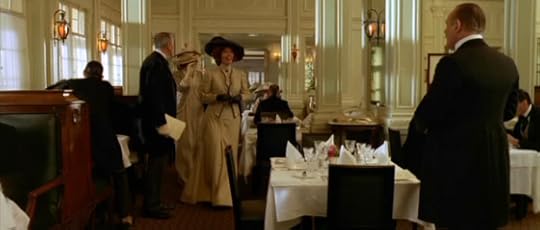
In 2017 Simpson’s-in-the-Strand closed for several months for renovations, and work was done to restore the ceilings and chandeliers. But you can bet that when the restaurant reopened, the silver-domed trolley carts once again rolled between tables, and skilled carvers served Simpson’s signature beef-on-the-bone on fine china dinner plates, just as they did for Lady Mary Crawley in the Downton Abbey series.
Want to know about another restaurant that was featured in Downton Abbey? Click here to read my post about Lady Edith Crawley dining at Rules of London.
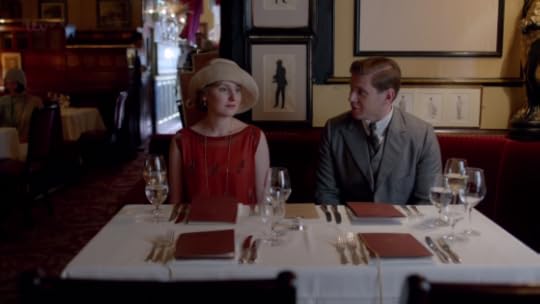
A scene from Downton Abbey, shot at Rules.
August 22, 2019
Guys Who Read
In this post I’m going way to take a break from my usual Regency/Jane Austen topics, and linger a while in our modern world.
If you’ve been following me on this blog or on social media, you already know I love to read.
I always seem to have a book in my hand, or in my purse, or in my car, so I can make ready use of any free moment to get “just one more chapter” in.

About a week ago I realized something odd: When I think of avid readers, my mind naturally goes toward women. When I want to talk about a book, I talk about it with my girlfriends.
When I think of book clubs, I gravitate toward book clubs made up of women.
But the truth is, men read a lot, too.

Want proof? There’s an Instagram account titled “Hot Dudes Reading” you need to visit.
The account is aptly named. I didn’t have to scroll far to find plenty of examples of attractive men with books in their hands.
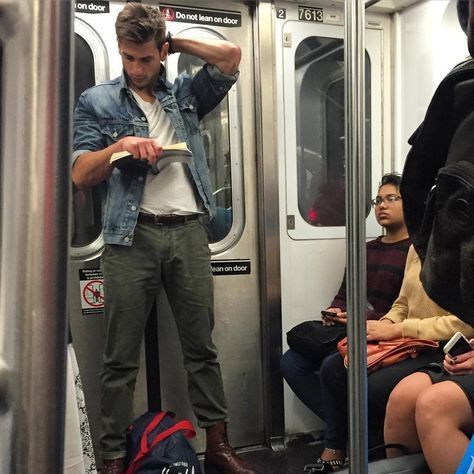
There are photos of military guys reading . . .

And guys reading in libraries.
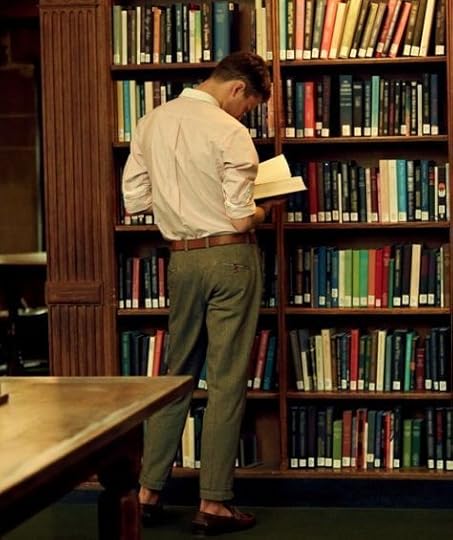
There are photos of dudes reading while listening to music …

… and others who read while lowering their carbon footprint.

Some of my favorite photos are of guys who clearly get into the books they’re reading. They show it by biting their nails . . .
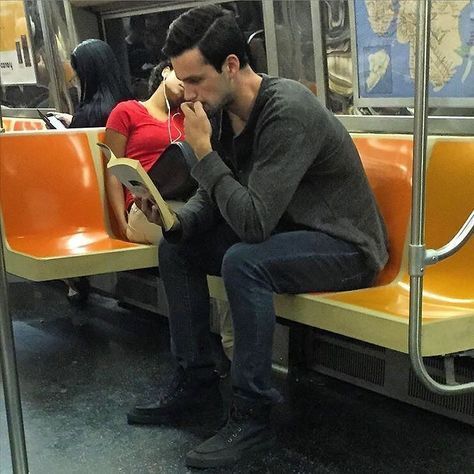
. . . secretly wiping away a tear . . .
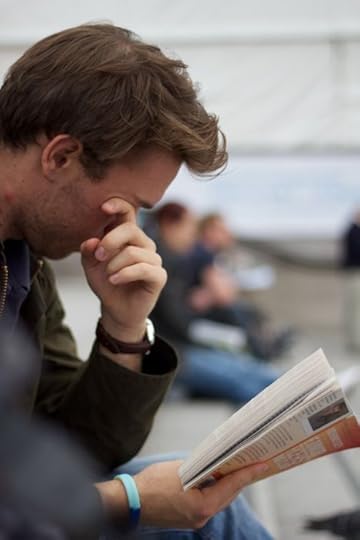
. . . and holding the book a little closer as the story gets tense.
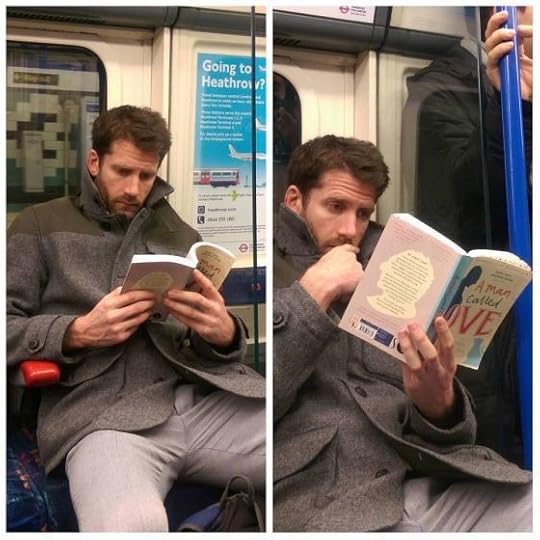
And then there’s this dude:

What could be sexier than a handsome guy reading a book while taking flowers to someone he loves?
The answer is this guy:

Oh, my heart! Yes, he is definitely a “hot dude reading,” and I’m a little bit in love with his pup, too.
I’d like to point out that viewing the photos on this Instagram account expanded my thinking considerably. I’m now much more aware of the fact that women don’t hold a monopoly on reading good books; and the next time there’s an opening in my book club, I’m going to suggest a guy fill it.
If you’d like to expand your horizons, too, and see more photos of Hot Dudes Reading, click on the link below:
August 17, 2019
Jane Austen’s Bread Crumbs
I have a post on the Austen Authors blog today, talking about Pride and Prejudice, and Jane Austen’s story building skills.
Please join me! Just click on the image below to read the post!