Nancy Lawrence's Blog, page 12
April 3, 2017
Take Two Pigeons and Call Me in the Morning
Inaccurate—and sometimes preposterous—news stories have been circulating since mankind first began stringing words together in a sentence. History shows that even reputable publications sometimes pick up questionable stories and run with them.
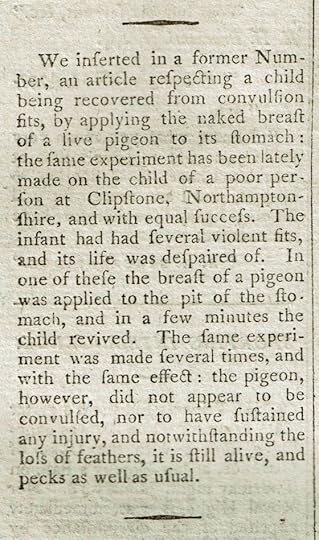
 To illustrate the point, here’s a news item I found in a 1798 issue of Sporting Magazine about a revolutionary medical treatment:
We inserted in a former Number, an article respecting a child being recovered from convulsion fits, by applying the naked breast of a live pigeon to its stomach: the same experiment has been lately made on the child of a poor person at Clipstone, Northamptonshire, and with equal success. The infant had had several violent fits, and its life was despaired of. In one of these the breast of a pigeon was applied to the pit of the stomach, and in a few minutes the child revived. The same experiment was made several times, and with the same effect: the pigeon, however, did not appear to be convulsed, nor to have sustained any injury, and notwithstanding the loss of feathers, it is still alive, and pecks as well as usual.
This may read like nothing more than a bit of Regency-era quackery, but at least the story had a happy ending: both patient and pigeon survived.
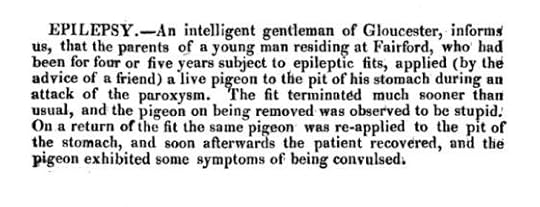
The pigeon was not so lucky in the following account of a similar encounter, which I found in The Monthly Gazette of Health, Vol. IV for the Year 1819 by Richard Reece, M.D. of London:
Epilepsy.—An intelligent gentleman of Gloucester, informs us, that the parents of a young man residing at Fairford, who had been for four or five years subject to epileptic fits, applied (by the advice of a friend) a live pigeon to the pit of his stomach during an attack of the paroxysm. The fit terminated much sooner than usual, and the pigeon on being removed was observed to be stupid. On a return of the fit the same pigeon was re-applied to the pit of the stomach, and soon afterwards the patient recovered, and the pigeon exhibited some symptoms of being convulsed.
These two stories aren’t necessarily representative of the state of early nineteenth century medicine, but they do make an important point: In Regency-era England, physician-prescribed medical treatments (like blood-letting, laxative-induced purging, and applying leeches) often did more harm than good. It was natural, then, for people to search for alternatives, like folk remedies, to cure what ailed them.

After all, pigeons were plentiful; and with stories like these fueling people’s imaginations, desperate families (and a few untrained members in the medical profession) had nothing to lose by turning to pigeons to ease the symptoms of a loved one’s illness.
Medical anthropologist and author Kyra Kramer recently did a guest post about Regency medicine on Maria Grace’s blog, . It’s an interesting read with nary a mention of pigeons. I hope you .
Filed under: Regency Life Tagged: Apothecary, Doctor, Georgian, Medical Cures, Medicine, Physician, Pigeon, Quackery, Regency


March 6, 2017
My Garage Sale Find
It’s true what they say about one man’s trash.
I should know. I’ve found a few treasures of my own while browsing through jumbles of used items other people have for sale. I never know what I’m going to find in a booth at my local swap meet or on a table of items at a neighborhood garage sale.
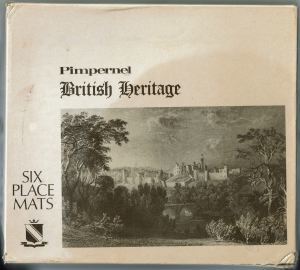
Just last week I found a set of Pimpernel British Heritage place mats at a garage sale. Each cork-backed mat in the set of six measures about 8″ x 8-1/2″ in size; and though the original box is a little beat up, the place mats themselves are in great condition.
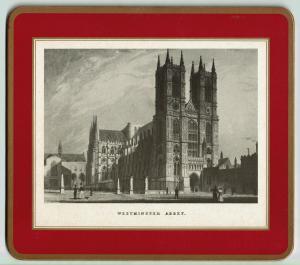
But I didn’t spend $2 of my hard-earned money to take them home and put hot plates on them; I bought them solely because of the images they depict of old London landmarks. And when I scanned each image and cropped off the red and gold borders on my digital copies, they were nice images, indeed.
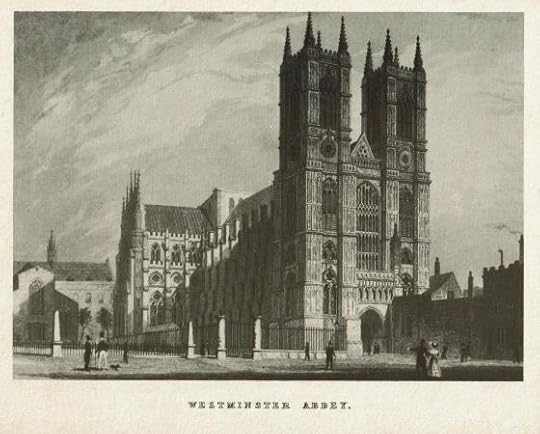
Unfortunately, there’s nothing on the box to indicate where the original images came from.
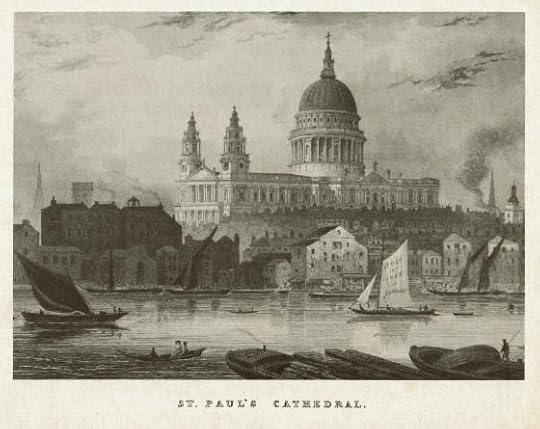
Nor do they name an artist (although the box did assure me these mats would add “interest and elegance” to my table).
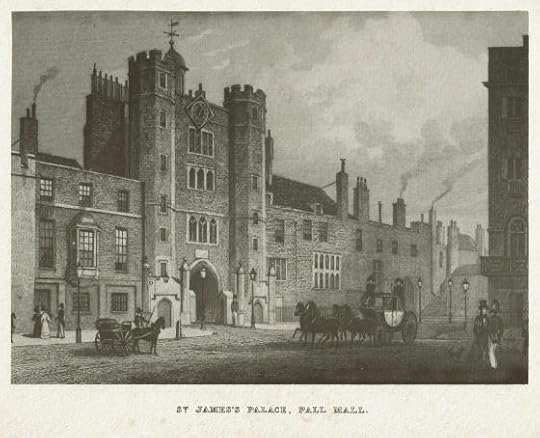
So I turned to Google Image Search and found a couple of matches, but I couldn’t be certain how reliable the background info was that I found.
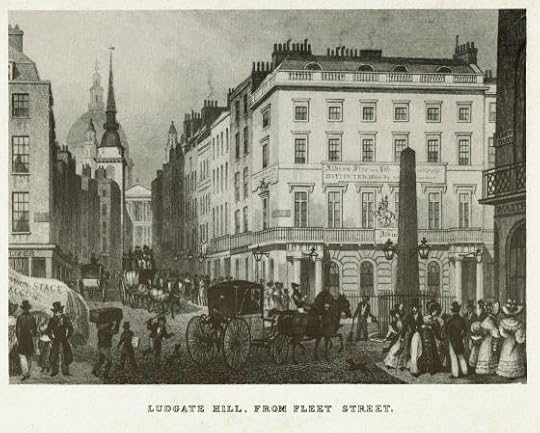
The above image of Ludgate Hill viewed from Fleet Street returned several matches, one of which indicated the original was by Jones & Co. from 1830.
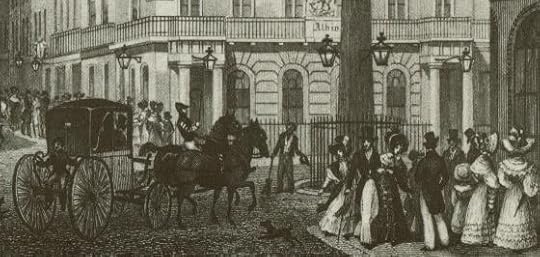
Detail of the Ludgate Hill mat
Based on the style of dress of the people depicted in each scene, I’d agree the setting for each image is about 1830.
The other nice thing about these illustrations is the amount of detail they contain. Take the Ludgate Hill image, for instance. In the shadowed corner of the building on the far right of the illustration you can see the marker for Fleet Street.
And on the face of the four-story white building you can just make out the name “Albion Fire and Life,” an insurance company founded in 1805.
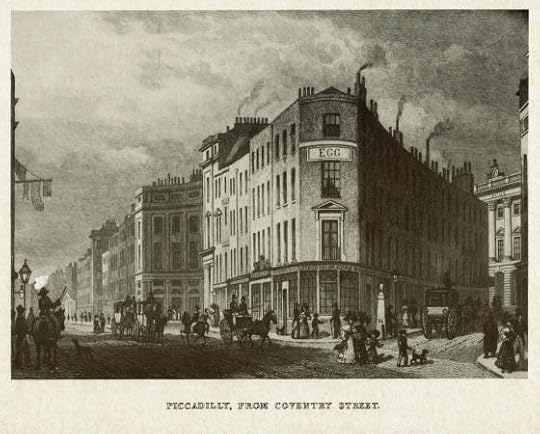
The illustration of the intersection of Piccadilly and Coventry has similar details, from the business names on the buildings to the style of coach and dress at the time:
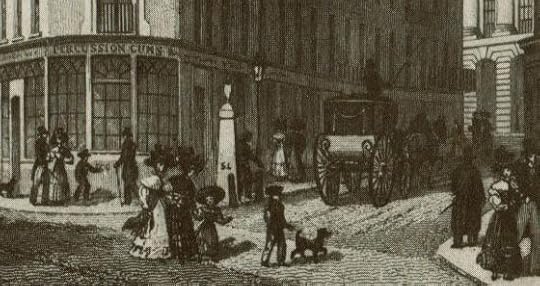
The other thing I like is the scale each image provides, showing the monumental size of the buildings and landmarks.
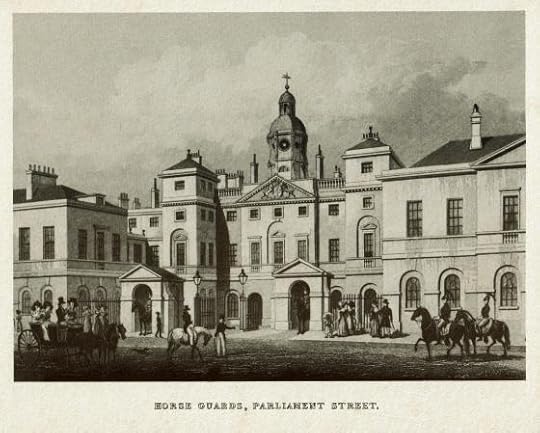
So these place mats, once planned for a purely utilitarian purpose, will now be added to my collection of items related to the Regency era. The next time I’m writing about the era and find myself stumped describing a London landmark, I’ll have these images to refer to. All in all, I think this set is one of my better $2 investments.
Filed under: Regency Life, Regency Locations Tagged: Albion Fire and Life, Coventry Street, Fleet Street, Horse Guards, Landmarks, London, Ludgate, Parliament Street, Piccadilly, Pimpernel, St. James Palace, St. Paul's Cathedral, Westminster Abbey

February 8, 2017
Hold on to Your Hats! It’s a Helter Skelter
I love to ride roller coasters. The hair-raising speed, the sudden drops you feel in the pit of your stomach, the hair-pin turns—they all combine to make for one thrilling ride.
If roller coasters are a little too intense for your taste, you might want to give a Helter Skelter a try.
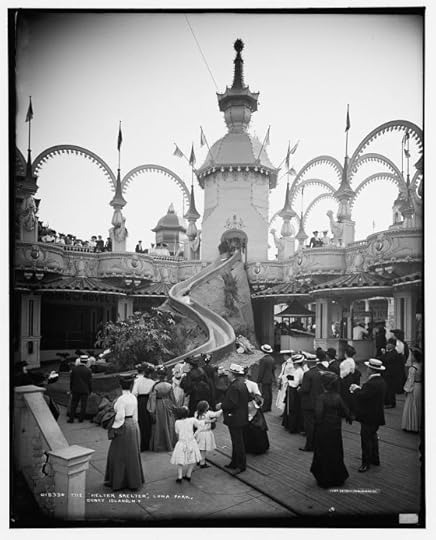
The Helter Skelter at Coney Island, New York in 1905
Helter Skelters are slides built around a central structure. Instead of modern mechanical gears and pulley systems, they rely on gravity to give riders a smooth, twisting-turning trip to the ground. Inside their central structure is a staircase; riders climb the stairs to their highest point where they emerge from the structure at the top of the slide; then they sit down on a mat, or take a seat on a sled, and ride the slide to the ground.
Helter Skelters aren’t exclusive to America. The photograph below, found at I Love the British Royals, shows the future King George VI riding a Helter Skelter at Wembley Exhibition in London, 1925.
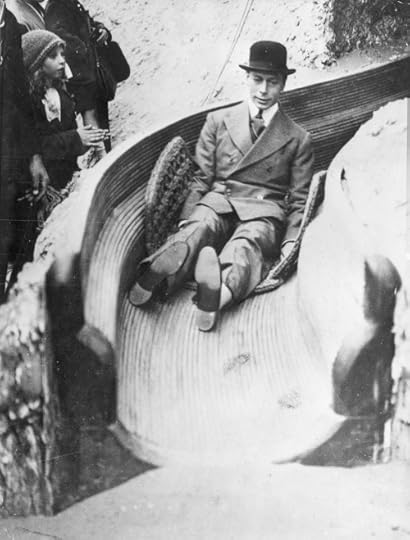
The future King George VI on a Helter Skelter at Wembley Exhibition, London, 1925.
Nor are Helter Skelters a 20th century invention. In fact, there are records of Helter Skelters as far back as the Regency era.
The image below from 1817 shows a man with two masked revelers at the base of a Helter Skelter slide, with twin tower structures in the background.
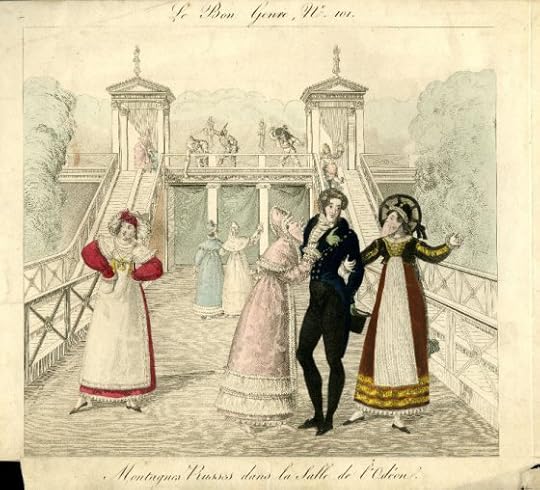
A gentleman and two masked revelers at a Helter Skelter slide; 1817.
And the following 1816 image depicts two ladies and a gentleman watching riders descend a Helter Skelter.
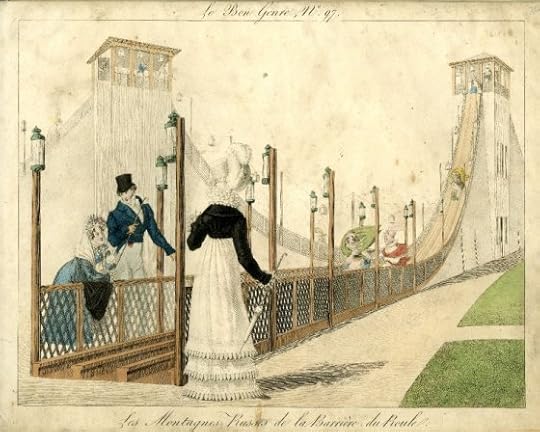
A Helter Skelter slide; 1816.
In this undated image, one man collects his wife and daughter as a second man collects his wife after they’ve gone down a Helter Skelter:
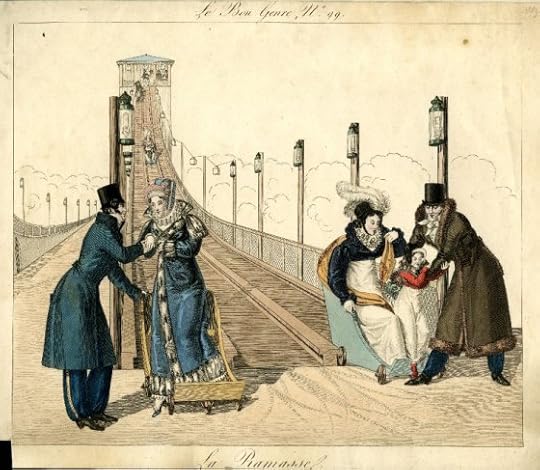
Riders completing a turn on a Helter Skelter slide.
Some Helter Skelters were rather elaborate. The 1816 image below shows a Helter Skelter with dual slides that take deep turns—certain to thrill the era’s most adventurous riders. And with a starting point four stories high, riders probably reached some impressive speeds on their way down.
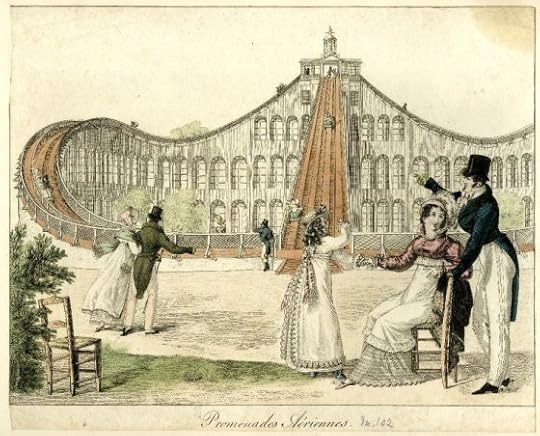
An elaborate Helter Skelter, four stories high; 1816. The image shows riders descending on wheeled sleds that follow a track.
Given my love for roller coasters named Goliath and Intimidator, I feel a special kinship with the Regency era ladies and gentlemen who dared to take a turn on a Helter Skelter. It looks like the kind of fun I like!
Filed under: Regency Life, Regency Pastimes Tagged: Coney Island, Helter Skelter, King George VI, Roller Coaster, Sled, Slide, Tower

January 17, 2017
And the Chutzpah Award Goes to …
In my collection of old books and documents I have several copies of The Sporting Magazine from the years 1797 and 1798. The Sporting Magazine was a monthly publication for gentlemen. Most of the articles chronicled racing events and reports on stag and fox hunting; but they also contain some excellent feature articles, too.
The features cover diverse topics. I’ve read articles on the history of boxing, the proper equipment for anglers, some poetry, and even reviews of new plays being performed at London theaters at the time.
But my favorite elements of the magazine are the little news items that the editors fit in between the larger articles. Here’s a sample:
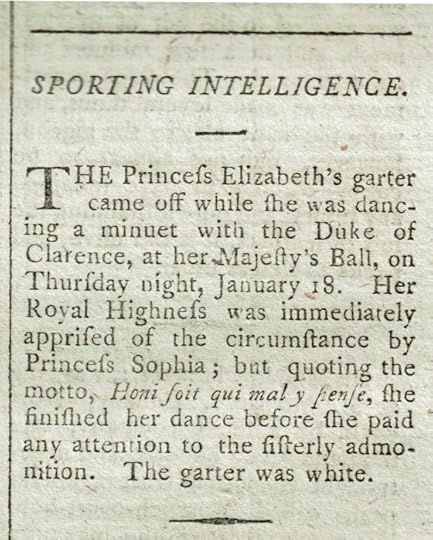
From the January 1798 edition of The Sporting Magazine
The motto “Honi foit qui mal y pense” is the motto of the Most Noble Order of the Garter and translates as “Shame on him who thinks evil of it.”

Princess Elizabeth (center) with her sisters Princess Augusta Sophia (left) and Charlotte Augusta Matilda, Princess Royal (seated); by Arthur N. Sanders, published by Henry Graves, after Thomas Gainsborough (1784)
NPG D15000
© National Portrait Gallery, London
This story really tickled me—first because it’s just plain funny; and, second, in an era of strict etiquette and court manners, Princess Elizabeth sounds like she would have been a very interesting young woman to know.
Filed under: Regency Life Tagged: Duke of Clarence, Garter, Minuet, Princess Elizabeth, Princess Sophia

December 26, 2016
A Visit from Book Santa
I woke up on Christmas morning to find that Book Santa had visited my house!
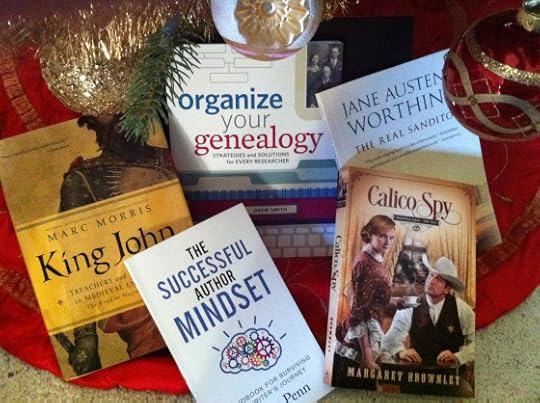
I’ve had visits from Book Santa in the past, so I knew to expect two things:
His reading tastes are varied; he enjoys giving fiction titles just as much as non-fiction titles
His reading tastes are a lot like my own (a happy co-ink-ee-dink, right?)
So you can imagine how excited I was to unwrap these titles on Christmas morning:
 Jane Austen’s Worthing by Antony Edmonds.
I thought I owned just about every Jane Austen-related book there was until Book Santa dropped this one under my Christmas tree. It’s an account of the seaside resort town that inspired Austen’s Sanditon, one of my favorite (if unfinished) Austen novels.
.
 King John: Treachery and Tyranny in Medieval England by Marc Morris
I have a very personal interest in learning all I can about King John of England; through my Cornell ancestors I’m a direct descendant of that notorious king who was ultimately forced to sign the Magna Carta. Every time I open the pages of a new book about King John, I hope to read about some redeeming quality in the man (he is family, after all). Could this be the book that finally shows King John to have some humanity? Here’s hoping …
.
 Organize Your Genealogy by Drew Smith
After years of gathering family histories, photographs, and documents, I have paper coming out of my ears. Book Santa must have known I needed a book like this to help me safely and sensibly share and store each precious item I’ve collected. Check in with me in a couple of months to see if I’ve put this book’s suggestions to good use.
.
 Calico Spy by Margaret Brownley
Everybody knows Book Santa has a great sense of humor, which is why he knew I’d enjoy Calico Spy. It’s book three in Ms. Brownley’s Undercover Ladies series of old west mysteries featuring female detectives. Ever have a hankerin’ for a good laugh, memorable characters, and an intriguing who-done-it mystery? Yup, me, too. I think I just talked myself into making this the first of my new books to read.
.
 The Successful Author Mindset by Joanna Penn
I’ve been a Joanna Penn fan for years. I read her fiction, follow her blog, listen to her podcasts, and look to her for inspiration when I need an indie-author-pick-me-up. She never fails to deliver. I rather suspect Book Santa gave me this Joanna Penn offering because he knows I could do a better job of managing my writing career (and he’d be right!). But, God bless him, Book Santa never judges; he just gives the right book at the right time to give us all the kick in the pants we need. And speaking of time, I’m currently in the process of setting my writing goals for 2017; and I suspect The Successful Author Mindset will be a big help in the process.
So there you have it … Book Santa’s Christmas delivery to my house was generous and well-planned, and his selections showed his usual flair for variety.
I hope Book Santa visited your house, too. What did he bring you?
Filed under: Holidays, Movies, Theater and TV Tagged: #amreading, #Austen, #BookSanta, #JaneAusten