Diane Lockward's Blog, page 34
February 21, 2012
Good News Department

Temptation by Water has received not one but two new reviews. I'm delighted with and grateful for both of them. The first, by Emma Bolden, appears in the Alabama Register. Bolden begins, "In her fourth collection of poetry, Temptation by Water, Diane
Lockward offers a series of meditations on the nature of human desire
and how nature itself goes against the fulfillment of our desires.
Lockward's poems are at turns wry and wicked, sensual and satisfied,
mournful and obsessed with making meaning out of 'the wreckage of
absence' which so often makes up our lives." Read the rest of the review HERE.
The second review, by Michael Meyerhofer, appears in Midwest Book Review. Meyerhofer begins, "'Save your water and green vegetation,' Lockward writes in 'The Temptation of Mirage': 'What I want is the desert.' But how can we argue with her when she presents the reader with the 'eternity of sand' like 'an open-air coffin,' not to mention the cereus with 'its creamy petals like white silk,' the fruit 'red as a splash of blood'? And that's the beauty of Temptation by Water. Beyond the subtly brilliant way in which these poems are ordered, the poems themselves shine with a crisp lyricism eclipsed only by their humanity and honest lack of pretension." Read the rest of the review HERE.
How lovely to be wicked and brilliant. Suddenly, I'm in love with adjectives.
Chef and author, John Ross, has begun two of his recent columns in the Long Island Wine Press by quoting from my poems, both found in my second book, What Feeds Us. The first article, "Your own pasta is well worth the effort," begins with a quotation from "Linguini." The second, "Tropical taste in the shape of a pear," quotes from my poem, "Organic Fruit." That's a concrete poem in the shape of an avocado, a feature of the poem that's lost in the article but can be seen if you follow the link to the poem.
Both articles contain recipes that sound incredibly delicious. Check them out.
Given all this food talk, I've decided to share with you a recipe I recently made that was fantastic—if I do say so myself. Oddly, I wasn't at all sure I wanted to make this dish as the ingredients struck me as odd—sour cream, catsup, peaches? But it was one of the best dishes I've ever made. And it was pretty, too. I don't think "casserole" is the best name for this dish but can't come up with a better one. Perhaps you can?
CHICKEN-ALMOND CASSEROLE WITH PEACHES
6 chicken breasts split and boned
3/4 cup flour
2 teaspoons salt
1½ teaspoons paprika
½ cup butter
½ cup slivered almonds
1 ¼ cups water
1 can condensed beef consomme
2 T catsup
1 C sour cream
6 small individual cans of diced peaches, drained
1 C parmesan cheese
Preheat oven to 350
Dredge chicken breasts with mixture of salt, pepper, paprika and flour. Reserve remaining flour mixture.
Brown chicken on all sides in hot butter. Remove to a 3-quart casserole.
Lightly brown almonds in drippings left in skillet.
Stir in remaining flour. Gradually stir in water and consomme. Add catsup, cook and stir until thickened.
Remove from heat and stir in sour cream. Pour over chicken and bake, uncovered, for about 1 hour.
Arrange peaches on chicken.
Sprinkle with cheese and return to oven for 10 minutes.


February 14, 2012
Nance Van Winckel and the Art of the Photoem
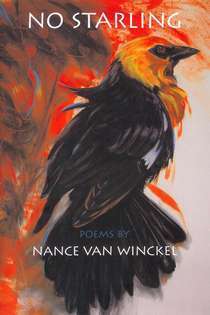
Click Cover for Amazon
I recently used a poem by Nance Van Winckel as a prompt in my Poetry Newsletter. When I requested permission, Nance told me about a new project of hers called Photoems. I checked out the Photoems website she sent me to and immediately was intrigued by this new art form. I then asked Nance to do a Q & A with me so that I could learn more about her project and spread the word about it.
Nance lives in Spokane, Washington. She is married to the visual artist, Rik Nelson. She is the author of 5 books of poetry, most recently No Starling (U of Washington P), and three books of short stories. She is also the recipient of two NEAs, a Pushcart, and several other prizes. She has taught poetry at colleges, festivals, and writing conferences, and has served as poet-in-residence at various universities. She also served as editor for the journal Willow Springs. She currently teaches in the MFA in Writing programs at Eastern Washington University and Vermont College of Fine Arts.
According to Nance's website, "She melds photography (her own) with small poems she 'graffities' onto the photographic surface." Let's take a look first at two samples of this cross-discipline art.

Kid You Not Was How We Loved You Best
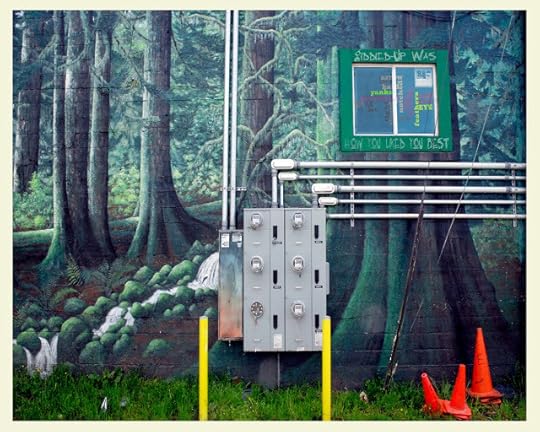
Giddied-Up Was How You Liked You Best
DL: Many people consider graffiti defacement of public or private property. But at your Pho-toems page, you say, "And as with poetry, graffiti tackles the big emotions of love and grief and, perhaps most of all, of sheer being, unequivocal presence." How did you come to regard graffiti as an art form?
NVW: The path by which I came to graffiti and the one by which I came to photography are themselves entwined. My husband is a visual artist and he has always loved looking at graffiti when we travel. Since I'm usually the one carrying the camera, he'll often turn to me and say, "Shoot that wall, would you, honey?" And later, after I'd get these pictures on my computer, I'd find myself admiring the graffiti too: its color, its passion, often a wild abandonment, and a crisscrossing of conversations taking place on an edifice as people tagged back to one other.
Over the past seven years, I've been experimenting with digitally adding my own little textual responses to the walls I liked. A wall speaks to me. To stand and look at such a wall is to recognize that there are others who aren't like me and/or don't like me. From early times of wall-writing, people have had that basic urge of "graffiari," to scratch, to say, I am here too. I live among you. Read this and remember me.
I do, however, try to keep gang insignia out of my work. If some appears in a photo I've shot, I often bury it under some other graphic image. I don't want messages of violence in my work.
Interestingly, the graffer is often staking claim to boarded-up buildings he or she perceives as wastelands. Unclaimed walls as unclaimed spaces. In other words, I'm thinking about the graffer as a kind of urban pioneer. Of what's unoccupied and/or abandoned in the urban landscape as frontier. Open to its next use. A reuse. My musings have to do with the American impulse to go out and take that which seems to be available. It's how many of us came to be here, and it may be deeper down in our psyches than we can know.
The French writer and poet, Michel Butor, talks about a too-rigid division between visual and literary art. "Painting," he says, "is also something we read… literature is also something we look at. The [physical] presence of words ruins…the retaining wall our teaching constructs in between literature and the arts."
DL: Tell us how you got into this new form. Has being married to a visual artist played a role in your work? How did you move from poetry to photography and at what point and why did you decide to fuse them together?
NVW: I'm sure I wouldn't have made much progress with this photo-collage work without my husband's feedback. He has been a full-time working artist for the last 20 years. He occasionally offers some responses to my pieces. Sometimes he'll say simply, "Next, please." You may think this is harsh, but I am keen (with poetry and stories too!) on just letting go of probable failures as soon as possible. Move on. And especially since I am still relatively new to visual composition, I know I have much to learn and am grateful for help in pointing me toward what holds potential. Most of all, Rik has helped me figure out what skills I need to acquire. These have been many and studying them should take me right up to the time of my demise. I'm talking about basic elements of graphic design, visual composition, photographic lighting, lenses, exposures, and on and on! I'm talking about freakin' perspective!
What I have brought to the table are a few Photoshop skills. I confess I am old enough to have learned Photoshop before it was Photoshop. When I worked as a literary magazine editor (Willow Springs), I used a desktop publishing program called Adobe PageMaker. When this evolved into Photoshop, I followed it along. Finding cover art for the magazine and laying out pages were parts of the editing work I especially loved.
DL: Describe for us the process of creating a pho-toem. Is it similar to the way you compose a poem? Does revision play a role?
NVW: Roo N Boom Love More Than You was graffiti I found on a crumbling tavern wall. Those words seemed to me, as I clicked the shutter, an absolutely lovely poem. Later when I saw the photograph on my monitor, I decided I could not improve upon the piece with additional language. So I chose to augment that facade with faces from a Victorian photograph album; the page in the album had itself been a collage. So there was a collage within my collage. I'm quite aware that the work I'm doing is, at heart, collage. Often as I work on a photograph, I will think of some text for it, or sometimes when I'm working on a regular poem, a line or a small phrase will hit me as right for a particular photoem in progress. I generally work on about 4-6 photoems at the same time. I move around between them. I may take off a text layer from one wall and try it on another. I aim to see what a wall needs and what might live upon the wall naturally. I like how digital layers are easy to delete and move and alter in seemingly endless ways.
Like any collage artist, I have drawers (computer files really) of parts. Many parts! I am in love with the public domain. Much of the graphic material I use on walls comes from open-use sites (like WikiCommons). I have files of old ads, of etchings and line drawings from old books (some of which I've hand-colored), of old photographs (my family and friends' families), of ex libris bookplates and postcards. Then, of course, I have the photographs that I've taken of the walls themselves (and several trains too!). I've done a whole series set in Butte, Montana, of the tumble-down but still hauntingly beautiful early 1900's buildings. I spend much of my time interacting with the photograph itself—as a visual composition—before I begin to add text and other elements. I want the text to be one element, not necessarily the focal point.
DL: You've said, "I have not left poetry. I'm just putting it on walls." Are you still writing regular poems, that is, poems that appear on a piece of 8" x 10" paper? And where do the short stories fit in? How do you manage your creative time? Can you juggle several forms at the same time or do you go back and forth among the various forms in which you work?
NVW: I'll have a new book of "regular" poems, called Pacific Walkers, out next year. I certainly have not left poetry! But I am interested in other ways of getting it out into the world. Yes, I still like the page, but reading—and writing on!—walls has a certain stealthy excitement about it. I like how succinct the wall makes me be. I like the idea of text as physical thing, having paint chips and plaster flecks, having bird shit mixed in with the ink.
It's been helpful to me to teach workshops lately in this field, a class called "Text Off the Page." I teach in the MFA program at Vermont College of Fine Arts, and I have some wonderful faculty friends there who have wise and intriguing ideas on this subject and are moving in their own off-the-page directions: Jody Gladding with her ecological emphasis (language among rocks and trees!), Mary Ruefle with her erasure books and much else, and Jen Bervin who integrates text and textiles. But we all learn so much too as we work with our students and the various aesthetic issues that surface. For instance, does someone viewing a certain piece in a gallery really want to stand in front of it and read a 100-word poem within it? A question I often pose to students: what does the text you're putting on that shoe (as an example) have to do with its shoe-ness? (I put a link to a video of some of my students' work on my website too.)
As for creative time, I confess most of my day is devoted to making. I work on poems in the mornings, then lunch, a walk, and then I spend most of the afternoons on the visual art. Stories are an altogether different beast. Stories mean clearing the deck. I wait until I feel I have several of the story's dramatic pieces (again with the "parts"!), then I start writing: generally a scene a day. I keep a notepad for scenes to get to . . . eventually. I don't worry initially about the scenes' order. I'm just trying to stay with the people and what is going on dramatically. But when I'm working on that first draft, everything else in my life comes to a halt. I've always loved that poems can weave so much more easily in and out of my day. I am lucky to not have a full-time job, no children, and a very small abode to keep clean.
DL: How are you getting this new work out into the world? Is there a commercial aspect to your new work? Are the pieces for sale?
NVW: I have only just begun to tiptoe a bit into the art gallery (and juried shows) world, and I have had some beginners' luck. My first solo show is up right now! (There's a link to a video of that on the website.) As with beginning to venture into literary publishing, it's been helpful to me with the visual art to begin to get some reactions and feedback now from gallery owners and show curators.
I have just this past month collected some of my work for this new Photoems website, and it is possible for a person to purchase work there. I'm also going for a little cross-over with literary journals, which comes mainly in the form of the "altered ads" I'm creating. These are ads (now in the public domain) which I partially rewrite. A few of these have been published, and others are about to be.
Mostly, I have just appreciated having this site as a way to share my work with friends and especially with others who are also working in the visual-verbal realm.
***************
Readers, I encourage you to visit Nance's personal website where you'll find a good deal of additional information about her work as well as a gallery of Photoems. Then also be sure to visit the online gallery where her Photoems are displayed and available for purchase.

February 9, 2012
Poetry Only, Please

Although I subscribe to several journals that include poetry and prose, I often find myself skipping over the prose pieces to get to the poems. So it occurred to me that perhaps I ought to subscribe to a few more poetry-only journals. Poetry with perhaps some reviews of poetry books, interviews with poets, and / or a poetics essay. A bit of art would be nice, too. I then set about gathering a list of such journals. Perhaps you might also be looking for a few ideas for new subscriptions, so I'll share the list with you. Those with a single asterisk are ones I just subscribed to. Those with two asterisks are ones I am already subscribed to. Looks like I have a good year of reading to look forward to.
Beloit Poetry Journal
A saddle-stapled journal that has been around a long time. Four issues per year.
*Cave Wall
Combines poetry and art. Two issues per year.
Cider Press Review
Poetry and reviews. One issue per year.
Court Green
Each issue includes a themed section. One issue per year.
Field
Poetry and poetics, reviews by editors. Two issues per year.
Mudfish
Poetry and art. One issue per year. They make it difficult to subscribe as there is no online subscription option. Instead, you are asked to make a phone call to their NYC number.
Naugatuck River Review
Poetry only, focus on narrative poetry. Two issues per year. One is a contest issue.
**Poet Lore
Poetry and Reviews, occasional essay. Two issues per year.
**Rattle
Poetry and interviews. Each issue has a section of poems solicited from a particular group, e.g., nurses, attorneys. Reviews are online. Two issues per year.
*Southern Poetry Review
Pure poetry. Two issues per year.
Spoon River Poetry Review
Poetry and one very long review essay. Two issues per year.
*Sugar House Review
Poetry and reviews. All reviews are also archived online. Two issues per year. A very beautiful journal, perfect bound, glossy paper inside, pretty end pages. Very reasonable at $12 per year. Can download a pdf for your e-reader.
*32 Poems
All poetry. Saddle stapled. Two issues per year.

February 5, 2012
Invitation to a Reading

Wednesday, February 8
Diane Lockward
Poets Wednesday Series
Barron Arts Center
582 Rahway Ave.
Woodbridge, NJ
8:00 PM
There will be a workshop at 7:00 PM, led by host Deborah LaVeglia.
An Open Mic will follow the reading.
Snacks will be served!
Directions
As you can see from the photo, this is a charming venue. Some nice stained glass and the reading room always has art on display. Please come if you're free.

January 30, 2012
Prunis Persica: The Movie
Here's a new movie I recently made of "
Prunis Persica
," a poem from my book, Temptation by Water. Poet Julie Moore read the poem a few months ago for a radio program called "Conrad's Corner." Unfortunately, the station does not archive the poems, but Julie sent me the mp3. I liked her reading so much that I wanted to make a video and use her recording as the soundtrack.
First, I gathered a bunch of photos of peaches, all from Photoxpress. Some of them had white backgrounds and I wanted black, so I used instant alpha in Keynote to get rid of the background color. That took several days. I decided to make this entire video using Keynote, something I hadn't done before. There are many more options for transitions than in iMovie. You can also add a soundtrack to an individual slide and / or to the entire show. You can't, however, add a second full-length soundtrack unless you record it there. But if you want to do that, you could just download your finished product, add it to iMovie, and then add another track.
I had to do some tweaking with timing when I wanted to convert the video to Quick Time. That should be easier and faster next time. So take a look. I hope this makes you hungry for a peach.

First, I gathered a bunch of photos of peaches, all from Photoxpress. Some of them had white backgrounds and I wanted black, so I used instant alpha in Keynote to get rid of the background color. That took several days. I decided to make this entire video using Keynote, something I hadn't done before. There are many more options for transitions than in iMovie. You can also add a soundtrack to an individual slide and / or to the entire show. You can't, however, add a second full-length soundtrack unless you record it there. But if you want to do that, you could just download your finished product, add it to iMovie, and then add another track.
I had to do some tweaking with timing when I wanted to convert the video to Quick Time. That should be easier and faster next time. So take a look. I hope this makes you hungry for a peach.
January 24, 2012
When You Have No Ideas of Your Own

I keep hearing my poet friends say that they need to generate new work but can't seem to get started. They've probably heard me saying the same thing. Does this have something to do with the time of year? Is there a big creativity sag after the holidays? Is that sag weighted down by the prospect of the winter months still ahead? Whatever the cause, it does seem that some of us need a kick in the pants, also known as inspiration. When we don't have any fresh ideas, it's time to turn to the people who do. Here's a handful of sites where you'll find poetry prompts.
1. Adele Kenny's The Music in It. Adele posts a new prompt each Saturday. Each prompt is preceded by an image and links to relevant model poems. Then comes the prompt along with possible variations. Good instruction here.
2. Donna Vorreyer's Tow Truck. Donna has recently abandoned her weekly prompts here, but she's going to maintain her archive from the past year, so you have lots to choose from there.
3. Donna Vorreyer's Poetry Mix Tape. This is a new feature. Once a week Donna will post a favorite poem with some discussion of why she likes it as well as some discussion of the craft in the poem. The poem will be followed by a writing suggestion. As this project has just launched, the archive is empty, but it will soon be filling.
4. Anjie Kokan's Prompts for Writers. A new prompt appears approximately every 5 days. Prompts often cross genres. Occasionally features a Guest Prompter.
5. Robert Lee Brewer's Poetic Asides. This is the site Robert keeps for Writer's Digest, and it's 's a veritable feast of prompts.
6. Margo Roby's Wordgathering. Her Friday Freeforall offers an amazing gathering of other sites where you can find all kinds of prompts. A regular treasure chest here.
7. Ken Ronkowitz's Poets Online. Ken offers one prompt per month. This site invites its users to submit the poems they write for posting in the following month. An archive is maintained. Since Ken has been maintaining this site for quite a few years, the archive is loaded.
8. Finally, if you're not already subscribed to my monthly Poetry Newsletter, consider joining. It's free. Each issue contains a model poem and a prompt based on the model. Sign-up form in the right sidebar.

January 19, 2012
What Time Is the Right Time?

Recently I received an email from a young woman who took a workshop I gave a few years ago at a Writers Conference. She later reappeared in another workshop I led at my local library. Since then she's popped up at other events. I'm always happy to see her. She's a wonderful poet.
In her email this woman asked, How do you know if a poem is ready for submission? I read one of your interviews and noted your advice against sending out work too early. Is there a way to tell when it's done and ready to be submitted?
Here, with some additions, is what I replied:
That's a hard question and I don't think there's a definitive answer. If there is, I don't have it. Of course, one has to let go at a certain point and say Done—or at least Done for now.
Before sending out, I make sure I've applied all my revision checks—have I polished the diction? Gone line by line looking for words that could be jazzed up? Have I maximized sounds? Have I weeded out dead syllables? Does the format of the poem feel right? Does it look right? Do I feel like Yes, this is just the right form for this poem?
In order to answer these questions, I do a line by line interrogation. Here's where the poem can't be rushed. In the first flush of excitement, when you know you've written something worth writing, when you feel that you've said something you haven't said before, it's easy to decide to send that poem right off to the journal you've been dying to get in. I stopped doing that years ago because I found that I was always sorry. Invariably, a week or several weeks later, I found something I'd missed, something that needed to be fixed. Sometimes that something was pretty obvious and I had to wonder how I'd missed it. I'd missed it because I'd submitted in haste.
After I've taken a poem through multiple drafts, I read the most recent draft silently to myself and then I read it aloud. I record myself and play back, listening for spots that sag. If I find myself daydreaming during the playback, I can be sure that's just what the reader will do too. Sometimes this feels self-indulgent, almost egomaniacal—sitting there listening to the sound of my own voice over and over. And yet it's one of the most useful revision strategies I have. Is the poem a comfortable read? If not, is something wrong with the rhythm? or the line breaks? I would never send out a poem that I hadn't yet spoken aloud and heard multiple times.
If I get to the point where I begin to suspect that I'm leeching the life out of the poem, then it may be time to stop and let go. If I begin to suspect that I'm just putting off moving onto new work, then it's time to let go. Am I revising or stalling?
After I've submitted the poem numerous times and gotten nothing but rejection, I may take another look at the poem. But rejection is not always a reliable indicator. I've had poems rejected many times that eventually were published in good journals and received lots of praise.
I always put what I think is a Done poem into my folder for several weeks. I never send out a poem that's just hot off the printer. I let it sit. I want to forget about the poem. Get uninvolved with it. Eventually I dig it out and read it again. Does it still surprise and delight me? Am I still excited about the poem? Does it still touch me? If it's a sad poem, do I have to wrestle a bit with tears? Do I even sort of wonder, Gee, did I really write this? Not bad, not bad at all. But Uh oh, is that a bad verb in there? A missing comma? Yes, yes. I fix the little devils and then send the poem on its way.

January 14, 2012
Filling a Void with Fire on Her Tongue
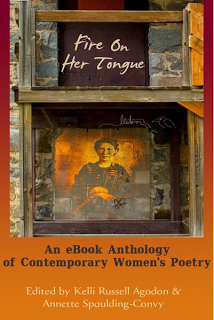
Click Cover for Amazon
Those of you who already own kindle readers and use them to buy and read books have perhaps noticed the paucity of available poetry ebooks. Fire on Her Tongue: An eBook Anthology of Contemporary Women's Poetry takes a giant step towards remedying that situation. Published by Two Sylvias Press, a press created by the editors, this collection is, as far as I know, the first ebook of its kind. The collection begins with an Introduction by the two editors. They begin by explaining what led them to undertake this project:
This project began innocently, with the purchase of a Nook and an iPad, with both of us browsing through the thousands and thousands of eBooks, asking ourselves, "Where is the poetry?" We noticed that while we could purchase our favorite prose works in eBook format, we could not find many contemporary poetry collections. While technology has moved ahead, bringing with it the novelists, memoirists, and nonfiction writers, it has seemingly left behind the poets. We began to wonder, "What if we contacted our favorite women poets and asked them to be in an eBook anthology? Could we successfully tackle the formatting issues unique to poetry, which have dissuaded so many strong poets from publishing their work on an electronic platform? Could we, editors of a print journal, publish the first eBook of contemporary women's poetry?"
The answer to their question is: Yes! Kudos to editors Kelli Russell Agodon and Annette Spaulding-Convey for braving uncharted territory and doing it so well.
Undoubtedly the dearth of poetry ebooks is the result of the difficulty that has existed in formatting poems properly for ebooks. Previous efforts resulted in collections with poems that were double spaced and had dreadful line breaks. Fortunately, the technology has now advanced so that a pair of industrious and determined editors, both poets themselves, could accomplish their mission and present the poems as they ought to be presented. They've even mastered the challenge of justified margins for the prose poems. Readers will see the poems just as they appear in print.
This 460-page anthology includes over 70 women poets. Each poet is represented by 2-5 poems. Each poet's poems are preceded by a brief bio and a link to the poet's website. Acknowledgments follow each poet's poems. Given the way an ebook works, this arrangement makes good sense as it eliminates the need to scroll to the end of the book to find this information.
As might be expected, there is an enormous variety of poetry—formal, free verse, prose poems. The poets cover the US landscape from East Coast to West Coast. One characteristic the poets have in common is that they are all still living.
The poets are democratically arranged in alphabetical order as follows:
Kim Addonizio, Deborah Ager, Ivy Alvarez, Nin Andrews, Elizabeth Aoki, Elizabeth Austen, Lana Hechtman Ayers, Dorothy Barresi, Judith Barrington, Mary Biddinger, Elizabeth Bradfield, Ronda Broatch, Gloria Burgess, Jill Crammond, Barbara Crooker, Rachel Dacus, Madeline DeFrees, Susan Elbe, Patricia Fargnoli, Annie Finch, Kathleen Flenniken, Rachel Contreni Flynn, Rebecca Foust, Suzanne Frischkorn, Jeannine Hall Gailey, Maya Ganesan, Arielle Greenberg, Kate Greenstreet, Lola Haskins, Eloise Klein Healy, Jane Hirshfield, Erin Coughlin Hollowell, Anna Maria Hong, Holly Hughes, Ann Batchelor Hursey, Luisa A. Igloria, Jill McCabe Johnson, Tina Kelley, Janet Norman Knox, Keetje Kuipers, Dorianne Laux, Jenifer Browne Lawrence, Kate Lebo, Carol Levin, Rebecca Loudon, Erin Malone, Marjorie Manwaring, Frances McCue, Aimee Nezhukumatathil, January Gill O'Neil, Alicia Ostriker, Nancy Pagh, Alison Pelegrin, Susan Rich, Rachel Rose, Natasha Sajé, Peggy Shumaker, Martha Silano, Judith Skillman, Patricia Smith, Ann Spiers, A.E. Stallings, Joannie Kervran Stangeland, Marilyn L. Taylor, Molly Tenenbaum, Ann Tweedy, Nance Van Winckel, Katrina Vandenberg, Sarah Vap, Kary Wayson, Katharine Whitcomb, Wendy Wisner, Rachel Zucker
This book is ideal for curling up in a comfortable chair but also makes a terrific traveling companion. In print such an anthology would most likely be priced around $30. But this ebook is available for a mere $7.99!

January 5, 2012
Ingrid Wendt on Salvaging Lines
Ingrid Wendt provided the craft tip in the January issue of my monthly Poetry Newsletter. I am happy that she has agreed to be guest blogger here so that I can now offer my blog readers her tip with the addition of a sample poem and a prompt based on her tip.
Ingrid Wendt is the author of five full-length books of poems, one chapbook, two anthologies, a book-length teaching guide, and numerous articles and reviews. A Poetry Consultant with the National Council of Teachers of English, she is a popular keynote speaker as well as a poet and teacher of poetry for more than 30 years. Her honors include the Oregon Book Award, the 2004 Editions Prize from WordTech Editions, the 2003 Yellowglen Award from Word Press, the Carolyn Kizer Award, several Pushcart nominations, an Oregon Literary Arts Fellowship, and the D.H. Lawrence Award. Visit "The Writer's Almanac" to hear Garrison Keillor read two of her poems.
Saving the Savory
"Letting go" is not, and never has been, something I do easily. Downsizing, three years ago, from a 1900 square foot house to just over 1000 sq. ft., nearly did me in. When it comes to poetry, though, I've somehow managed to accept—most of the time—the fact that crafting a diamond out of the rough draft of a poem often means leaving out certain gorgeous lines, or wonderful words, or stunning metaphors, or brilliant images, that do (sigh) overburden the poem and so must be cut. Cut. Cut. Cut. Isn't that what we always hear from writing instructors, ourselves (sometimes) included?
But need these words be wasted? Thrown out, never to be seen again? Good news, all you who hate to toss: you can "re-purpose" at least some of these words. And, oh happiness, some day you might use them again; they might even get you out of a jam.
Here's my system. Outmoded though it may be, in today's digital age, the old-fashioned loose-leaf binder still serves as a place to keep those gems of words / lines / images / ideas I've reluctantly tossed out. Prominent among the spines of books shelved next to the thesaurus, rhyming dictionary, and other reference books I keep above my desk, this special binder's front pages (ahead of entire first drafts of poems "to return to some day") bear the headings "lines saved," "lines for future poems," "favorite words," "good rhymes," "images I like." Etc.
What good can this do? Here are two examples.
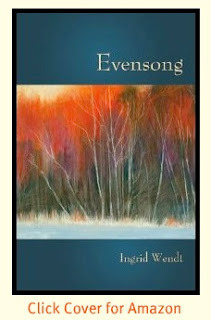
1) More than half-way through a rough draft of "On the Nature of Touch," which appears in my newest book, Evensong, I got stuck. Drew a total blank. Went to the notebook, leafed through it for a bit, and found an image–hair dye stains on the downstairs hall carpet like stones Hansel tossed to find the way home–which had come to me during a workshop on metaphor I'd taught several years before. Whoopie! That worked! I was off and writing again.
2) Another poem from Evensong, "Silence," is a Cento: technically, a poem made entirely of lines cut from other poems. In my case, "Silence" is made of lines from several different notebook pages, not even close to each other, which I didn't realize resonated with each other and belonged together till I looked at them again in a moment of stress: feeling totally dry and unable to complete the assignment I'd just given students at a retreat. Was this cheating? I did feel a bit guilty, at first. But still, the words were mine, and putting them together anew made a poem I could be happy with.
Silence
After a painting by Odilon Redon, 1911
Caught at last in this brown caution,
this wake of sound beyond the known
alphabet, where is our refuge?
Frame of forgetting.
Frame of remembering.
Floor of a faith forever gone.
Steps we've taken, those footprints
are in us forever. Listen.
All those words we never will say, echoing.
These lists don't, of course, consist entirely of lines cut out of other poems. Sometimes I'll be doing the dishes or talking or listening to music, and I'll hear myself thinking a line that needs to be in a poem. Sometimes I think a poet is someone who doesn't think such terribly different thoughts from everyone else; it's just that we poets catch ourselves thinking them, and recognize their potential. So, if and when I can find some paper, I write them down.
Just to get the hang of it, try a Cento of your own, with someone else's words (at first). Pull out one of your favorite books of poems. Make a list of some of your favorite lines from some of your favorite poems in this book. Or make a similar list of favorite lines by this and other favorite poets. The words need not even be complete lines: just a phrase or word cluster will do. After amassing 10-15 or more of these lines, choose six or eight lines or groups of words that somehow could go together. Your word processor is terrific for moving them around on the screen. Or print the page and take a scissors to the list. Move the many smaller pieces of paper around, stick in a few connective words, if you must, or more than a few. Now take look at some of your own discarded rough drafts of poems (if you, like I, have kept them somewhere, maybe in the garage). Dust them off, pick out the grains of wheat from the chaff. See what happens when you give them even a little bit of water and earth and sun!

Ingrid Wendt is the author of five full-length books of poems, one chapbook, two anthologies, a book-length teaching guide, and numerous articles and reviews. A Poetry Consultant with the National Council of Teachers of English, she is a popular keynote speaker as well as a poet and teacher of poetry for more than 30 years. Her honors include the Oregon Book Award, the 2004 Editions Prize from WordTech Editions, the 2003 Yellowglen Award from Word Press, the Carolyn Kizer Award, several Pushcart nominations, an Oregon Literary Arts Fellowship, and the D.H. Lawrence Award. Visit "The Writer's Almanac" to hear Garrison Keillor read two of her poems.
Saving the Savory
"Letting go" is not, and never has been, something I do easily. Downsizing, three years ago, from a 1900 square foot house to just over 1000 sq. ft., nearly did me in. When it comes to poetry, though, I've somehow managed to accept—most of the time—the fact that crafting a diamond out of the rough draft of a poem often means leaving out certain gorgeous lines, or wonderful words, or stunning metaphors, or brilliant images, that do (sigh) overburden the poem and so must be cut. Cut. Cut. Cut. Isn't that what we always hear from writing instructors, ourselves (sometimes) included?
But need these words be wasted? Thrown out, never to be seen again? Good news, all you who hate to toss: you can "re-purpose" at least some of these words. And, oh happiness, some day you might use them again; they might even get you out of a jam.
Here's my system. Outmoded though it may be, in today's digital age, the old-fashioned loose-leaf binder still serves as a place to keep those gems of words / lines / images / ideas I've reluctantly tossed out. Prominent among the spines of books shelved next to the thesaurus, rhyming dictionary, and other reference books I keep above my desk, this special binder's front pages (ahead of entire first drafts of poems "to return to some day") bear the headings "lines saved," "lines for future poems," "favorite words," "good rhymes," "images I like." Etc.
What good can this do? Here are two examples.
1) More than half-way through a rough draft of "On the Nature of Touch," which appears in my newest book, Evensong, I got stuck. Drew a total blank. Went to the notebook, leafed through it for a bit, and found an image–hair dye stains on the downstairs hall carpet like stones Hansel tossed to find the way home–which had come to me during a workshop on metaphor I'd taught several years before. Whoopie! That worked! I was off and writing again.
2) Another poem from Evensong, "Silence," is a Cento: technically, a poem made entirely of lines cut from other poems. In my case, "Silence" is made of lines from several different notebook pages, not even close to each other, which I didn't realize resonated with each other and belonged together till I looked at them again in a moment of stress: feeling totally dry and unable to complete the assignment I'd just given students at a retreat. Was this cheating? I did feel a bit guilty, at first. But still, the words were mine, and putting them together anew made a poem I could be happy with.
Silence
After a painting by Odilon Redon, 1911
Caught at last in this brown caution,
this wake of sound beyond the known
alphabet, where is our refuge?
Frame of forgetting.
Frame of remembering.
Floor of a faith forever gone.
Steps we've taken, those footprints
are in us forever. Listen.
All those words we never will say, echoing.
These lists don't, of course, consist entirely of lines cut out of other poems. Sometimes I'll be doing the dishes or talking or listening to music, and I'll hear myself thinking a line that needs to be in a poem. Sometimes I think a poet is someone who doesn't think such terribly different thoughts from everyone else; it's just that we poets catch ourselves thinking them, and recognize their potential. So, if and when I can find some paper, I write them down.
Just to get the hang of it, try a Cento of your own, with someone else's words (at first). Pull out one of your favorite books of poems. Make a list of some of your favorite lines from some of your favorite poems in this book. Or make a similar list of favorite lines by this and other favorite poets. The words need not even be complete lines: just a phrase or word cluster will do. After amassing 10-15 or more of these lines, choose six or eight lines or groups of words that somehow could go together. Your word processor is terrific for moving them around on the screen. Or print the page and take a scissors to the list. Move the many smaller pieces of paper around, stick in a few connective words, if you must, or more than a few. Now take look at some of your own discarded rough drafts of poems (if you, like I, have kept them somewhere, maybe in the garage). Dust them off, pick out the grains of wheat from the chaff. See what happens when you give them even a little bit of water and earth and sun!
January 3, 2012
I Account for Myself

Following Lisa Romeo's lead, instead of compiling a list of goals for 2012, I'm reflecting on the accomplishments of 2011. My reflections are limited to my poetry life.
Taking care of my own work:
For the past two years I gave myself the goal of spending time writing three mornings a week. I never seemed to meet that goal and thus had the feeling of being a non-productive slug. Some months ago I lowered my standard to two mornings a week. I'm happy to say that I've not only met my goal of two sessions per week, I've exceeded it. Perhaps lowering the goal took the pressure off and gave me more freedom? Anyhow, my productivity has increased. As I add new poems to my desktop folder, I can see that the list is getting plump. And I only add the ones I'm interested in sending out. The losers and the undones stay in the Ramblings folder. That, of course, is the thicker folder.
I didn't send out submissions as routinely this past year as I used to—post-book drag, I think, and the need to generate new work—but several weeks ago, probably because the folder was getting fuller, I went on a submission rampage and now have a number of submissions out. That feels good. I like the possibility each day of getting interesting mail.
I've done a number of readings, including one that took me to New Hampshire for two days. I've cut back on doing poetry-in-the-schools as I found it was really draining my energy. Just doing freelance visits so I can stipulate no more than 3 classes per day. Protecting my energy level.
Supporting other poets:
I have continued buying as many books by other poets as I can afford. If someone reviews my book, I buy that person's book. I usually try to write an Amazon review or in some way return the kindness of a review. If someone buys my book and lets me know about it, I try to return the favor when that person has a new book.
I have continued to use my blog and my Poetry Newsletter to spread the word about poetry and poets. I deeply believe in the poetry community and our mutual need to support and assist each other. I have featured a number of poets at my blog and always do a book recommendation in the newsletter and invite a poet to offer a craft tip. These poets seem to get some book sales and new fans as a result. I am really proud of the Newsletter and how it has taken off. Each month I pick up a bunch of new subscribers. They come from all over the world. Both activities are stimulating and fun, don't require new clothes and don't make me report to an office.
I organized two poetry events last year—"Girl Talk" for the third year and "Poetry Festival: A Celebration of Literary Journals" for the eighth year. Both events are scheduled again for this year. I also hosted two readings at my husband's restaurant—one for the journal Adanna and the other for the journal Tiferet.
I served as Guest Editor for the inaugural issue of Adanna, judged a chapbook contest for Wisconsin poets, and was again a reader for a book contest.
At the same time I am putting down my foot about supporting people who haven't supported my work. Don't ask me to buy, blurb, or review your book if you haven't at least bought and read my latest book. I mean, really, it's just a matter of fairness, isn't it? And please, if you haven't supported my work, don't ask me to pre-order and pay for your forthcoming book or chapbook so you can get a good print run. I mean, really. I'm somewhat low-key about pushing my books, but fair is fair. This is me protecting my time and energy (and my wallet). Crabby, yes, but necessary.
Taking it outside of the poetry community:
One of my favorite things to do is to bring poetry to an audience that doesn't typically attend readings. I recently read for the University Women of West Essex at their fall luncheon. I talked and read about how poetry reflects the lives of women. It was one of my favorite readings. They fed me, bought books, and paid me which was really cool as I'd thought I was doing the reading pro bono; thus, I felt like a generous soul and fattened my wallet at the same time.
I have another such reading scheduled for a group of seniors, also not a poetry group, and am looking forward to that.
Looking forward:
I desperately need a day of poetry with a group of like-minded poets. I want the stimulation of us giving each other prompts all day, one after the other. I should make this happen.