
Diane Lockward's Blog, page 36
November 13, 2011
Invitation to a Reading

Tuesday, November 15, 2011
Diane Lockward and Ed Romond
Carriage House Poetry Series
Kuran Arts Center
Watson Rd.
Fanwood, NJ
8:00 PM
Open Mic
Do you need reasons to come? Okay, then for one thing, I'll be reading with Ed Romond who is just terrific. For another, this is a really nifty venue—an authentic restored carriage house. And just because it would be lovely to see you.
Directions
Scroll to the bottom of the page.
If using a GPS, use 75 N. Martine Avenue as your address.


November 11, 2011
My Poem Goes to Portugal
Several months ago I was contacted by Francisco Craveiro, a mathematics professor from the University of Coimbra in Portugal. It turned out that in addition to things mathematical he also enjoys poetry and translation. He especially likes poems with math-related subject matter. From time to time he gathers such poems together, translates, and compiles them in a chapbook which he reproduces and distributes. He had come across my poem, "The Mathematics of Your Leaving," from my first book, Eve's Red Dress. I don't know where he found the poem, but it first appeared in Rattle. Now while Rattle is a print journal the editor had also posted the poem on the journal's website, so perhaps that's where Francisco found it.
A few days ago I received a copy of the chapbook. Eight poets are included. There I am right after Charles Simic! I have no knowledge whatsoever of Portuguese, but it's a kick to have my poem translated into that language. I love how poems make their way around the world and end up in unexpected places.
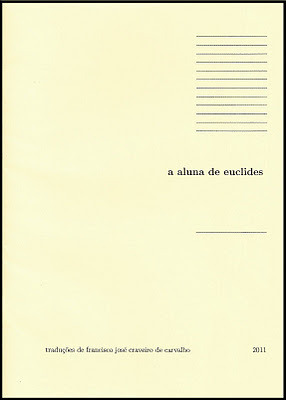
Here's the cover of the chapbook
And here's the original poem in English:
THE MATHEMATICS OF YOUR LEAVING
Today I remembered my algebra book
flying across the room,
my father shouting I was stupid,
a dumb girl, because I couldn't do math–
and all because you are leaving,
I'm calculating numbers,
totaling years, even
working out equations:
If x + 1 = 2, what is the value of x alone?
All day I've been thinking about
word problems: If a train travels west
at the speed of 60 miles per hour
against a thirty mile per hour wind, how fast
will you be gone?
Today I've added and subtracted,
multiplied and divided. I've mastered
fractions. Even that theorem
I could never understand–plus 1
plus minus 1 equals zero–is perfectly clear.
Then just when I think I've finally
caught on, a whiz kid now, a regular
Einstein, suddenly the numbers
betray me. No matter how many times
I count the beads on the abacus, work it out
on the calculator, everything comes
to nothing.
Mute and fractured, a dumb girl again,
I sit alone at my desk, staring
out the window, homework
incomplete. A square root unrooted,
I contemplate infinity.
–from Rattle #11, Summer 1999
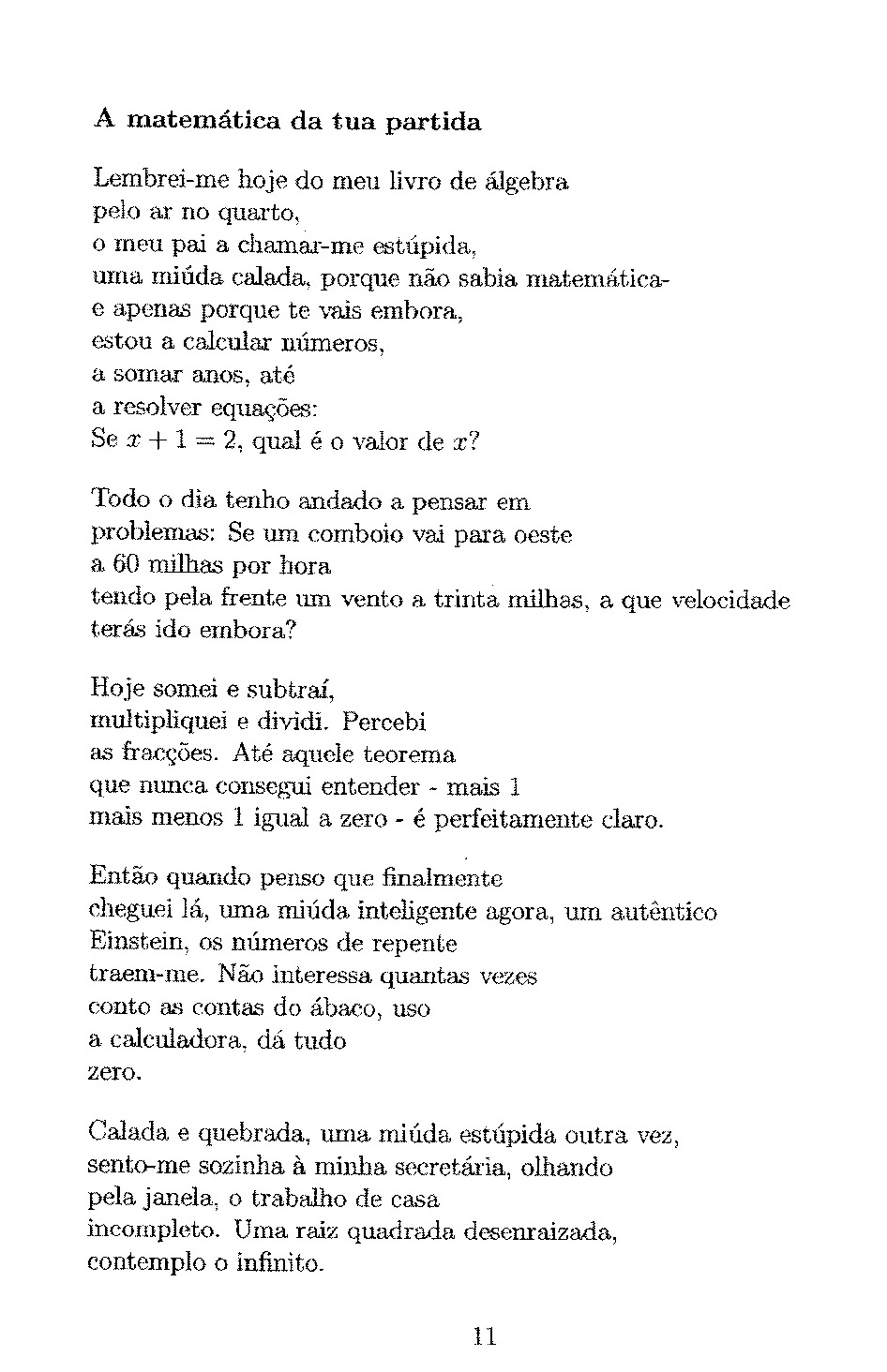
And now here it is in translation:
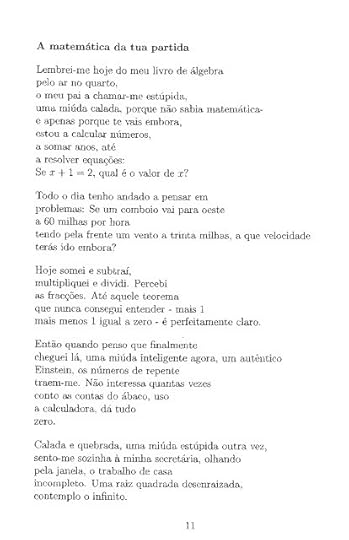

A few days ago I received a copy of the chapbook. Eight poets are included. There I am right after Charles Simic! I have no knowledge whatsoever of Portuguese, but it's a kick to have my poem translated into that language. I love how poems make their way around the world and end up in unexpected places.

Here's the cover of the chapbook
And here's the original poem in English:
THE MATHEMATICS OF YOUR LEAVING
Today I remembered my algebra book
flying across the room,
my father shouting I was stupid,
a dumb girl, because I couldn't do math–
and all because you are leaving,
I'm calculating numbers,
totaling years, even
working out equations:
If x + 1 = 2, what is the value of x alone?
All day I've been thinking about
word problems: If a train travels west
at the speed of 60 miles per hour
against a thirty mile per hour wind, how fast
will you be gone?
Today I've added and subtracted,
multiplied and divided. I've mastered
fractions. Even that theorem
I could never understand–plus 1
plus minus 1 equals zero–is perfectly clear.
Then just when I think I've finally
caught on, a whiz kid now, a regular
Einstein, suddenly the numbers
betray me. No matter how many times
I count the beads on the abacus, work it out
on the calculator, everything comes
to nothing.
Mute and fractured, a dumb girl again,
I sit alone at my desk, staring
out the window, homework
incomplete. A square root unrooted,
I contemplate infinity.
–from Rattle #11, Summer 1999
And now here it is in translation:
November 4, 2011
The Poet on the Poem: Patricia Fargnoli
I first met Patricia Fargnoli online at the Wompo listserve. Later, I met her in person when she was resident faculty at The Frost Place. She is a wonderful poet and teacher of poetry. Poet Laureate of New Hampshire from 2006-2009, she is the author of six collections of poetry, including two chapbooks. Her first book, Necessary Light (Utah State University Press, 1999) was awarded the 1999 May Swenson Poetry Award judged by Mary Oliver. Her most recent book is Then, Something (Tupelo Press, 2009).
I found today's poem in the current issue of Poet Lore, one of my favorite journals. I was reading the journal recently in New Hampshire to give a reading. When I came across Pat's poem, I knew I wanted to invite her to discuss it here. Then as Fate would have, who should show up at my reading later that day? Pat! So I immediately lassoed her. By the way, Pat is the kind of poet who shows up at other poets' readings. She is truly a model of how we should support each other.

Click Cover for Amazon
Will the Cows Come Home?
When the river freezes over and the pot boils
When the cat leaves the corner, when the tulips leave the bed
After absence has made your heart grow fonder
After the apples have fallen far from the tree
Where the village is sleeping, the cows will come to the barn
Swishing their long tails, nodding their heads
If you have been waiting too long, the cows will come for you
If you believe in cows, they will come to your hand
If you hold out sweet grass in late afternoon's last hour
From the greener pastures, they will surely come to you
When you say the right sounds, they will hear you
When your house is made of glass and stones, they will see you
When what has gone around must come around,
They will come home
Be careful what you wish for; if something can go wrong it will
But where there's a will there's a way
After the eat's nine lives are through and the dog's bone is buried
After the wishbone's been broken and the turkey's been eaten
Go with the flow of the river. The cows will come home
After your actions have spoken louder than words
Before all good things have come to an end
Before all the bridges have burned
The cows will come home
If the rolling stone has gathered its moss and is still
If the salt has been thrown over the barn's shoulder
All things come to those who wait
Cometh the hour, cometh the cows
Better late than never, everything in its own good time
The cows will come home
To your barn shaking their bells
They will come home to you.
DL: What led you to choose cows as a topic for a poem? As the poem progresses, they seem to become more than merely cows. Was that your intention?
PF: I had just been to buy raw milk from a local dairy farm (as I often do), where I'd stood at the fence talking to the Holsteins and loving their broad innocent faces. So I thought why not write another cow poem (I've written a few). And the phrase "when will the cows come home" came into my head. But I haven't a clue where the idea came from to answer the question by playing with sayings. The muse was on the job that day, I guess. But the next thing I did was, with the help of Google, make a long list of popular sayings. Then (and when I had the rhythm) the poem almost wrote itself. Which, I might say, is much different than my usual "struggle over months or years" process.
And yes, of course, the "cows" become more than merely cows…though I don't know that I realized that at first. They are, perhaps, whatever we wait for. Though I don't know if that's it exactly either. One of the early lessons I learned when I was learning to write was this: If one writes exactly enough about a specific thing/object/image/event, sometimes it gathers a deeper meaning (or another level of meaning) beyond that exact description. I think that is true in this case.
DL: You violate one of the first rules taught to novice poets: Avoid clichés. Instead, you embrace them—and to great advantage. What made you decide to take this risk and what do you think makes it work?
PF: I wasn't thinking of these as "clichés" exactly but mostly as sayings: aphorisms, platitudes, proverbs that have been around for a long time and which have been used as "lessons" for humans about life. What's changed here, of course, is that I've made them apply to cows—a shift in perspective. Anyway, I love breaking "rules" in poems and getting away with it (the latter part of that sentence, the important part). An early poetry teacher, Brendan Galvin, taught me that "what works" is the only final rule.
DL: Your use of anaphora adds music, structure, and meaning. How hard did you work on that technique? Also, the refrain, "The cows will come home," or a slight variation, adds such power to the poem. How conscious was this?
PF: It was very conscious. I read somewhere that Stanley Kunitz once said that when he had the rhythm of a beginning poem in his head, the poem could be written. Well, I may be remembering that wrong, but he said something like that and it struck me as being true.
And the refrain and anaphora keep the poem focused and glued together. The repetition builds power as it goes, I think.
DL: In the third to last stanza, you say, "Cometh the hour; cometh the cows." That change in diction immediately grabbed my attention. But why "cometh"?
PF: The saying I was playing with and paralleling here is "Cometh the hour; cometh the man." This is my favorite line, precisely because of the surprise of the change in diction—and because of its rhythm.
DL: a) Tell us why there's no punctuation at line ends.
PF: There's no end punctuation at all except for the final period. That just seemed intuitively right to keep the flow going. I let capital letters and line and stanza breaks substitute for punctuation.
DL: b) Tell us why each line begins with the formality of a capital letter.
PF: Because I felt that each line was almost an end-stopped sentence—or at least a sentence fragment and I wanted them to be read that way. Again, this was intuitive and seemed right.
Bonus: Visit Pat's poems on The Writer's Almanac, read by Garrison Keillor.


I found today's poem in the current issue of Poet Lore, one of my favorite journals. I was reading the journal recently in New Hampshire to give a reading. When I came across Pat's poem, I knew I wanted to invite her to discuss it here. Then as Fate would have, who should show up at my reading later that day? Pat! So I immediately lassoed her. By the way, Pat is the kind of poet who shows up at other poets' readings. She is truly a model of how we should support each other.
Click Cover for Amazon
Will the Cows Come Home?
When the river freezes over and the pot boils
When the cat leaves the corner, when the tulips leave the bed
After absence has made your heart grow fonder
After the apples have fallen far from the tree
Where the village is sleeping, the cows will come to the barn
Swishing their long tails, nodding their heads
If you have been waiting too long, the cows will come for you
If you believe in cows, they will come to your hand
If you hold out sweet grass in late afternoon's last hour
From the greener pastures, they will surely come to you
When you say the right sounds, they will hear you
When your house is made of glass and stones, they will see you
When what has gone around must come around,
They will come home
Be careful what you wish for; if something can go wrong it will
But where there's a will there's a way
After the eat's nine lives are through and the dog's bone is buried
After the wishbone's been broken and the turkey's been eaten
Go with the flow of the river. The cows will come home
After your actions have spoken louder than words
Before all good things have come to an end
Before all the bridges have burned
The cows will come home
If the rolling stone has gathered its moss and is still
If the salt has been thrown over the barn's shoulder
All things come to those who wait
Cometh the hour, cometh the cows
Better late than never, everything in its own good time
The cows will come home
To your barn shaking their bells
They will come home to you.
DL: What led you to choose cows as a topic for a poem? As the poem progresses, they seem to become more than merely cows. Was that your intention?
PF: I had just been to buy raw milk from a local dairy farm (as I often do), where I'd stood at the fence talking to the Holsteins and loving their broad innocent faces. So I thought why not write another cow poem (I've written a few). And the phrase "when will the cows come home" came into my head. But I haven't a clue where the idea came from to answer the question by playing with sayings. The muse was on the job that day, I guess. But the next thing I did was, with the help of Google, make a long list of popular sayings. Then (and when I had the rhythm) the poem almost wrote itself. Which, I might say, is much different than my usual "struggle over months or years" process.
And yes, of course, the "cows" become more than merely cows…though I don't know that I realized that at first. They are, perhaps, whatever we wait for. Though I don't know if that's it exactly either. One of the early lessons I learned when I was learning to write was this: If one writes exactly enough about a specific thing/object/image/event, sometimes it gathers a deeper meaning (or another level of meaning) beyond that exact description. I think that is true in this case.
DL: You violate one of the first rules taught to novice poets: Avoid clichés. Instead, you embrace them—and to great advantage. What made you decide to take this risk and what do you think makes it work?
PF: I wasn't thinking of these as "clichés" exactly but mostly as sayings: aphorisms, platitudes, proverbs that have been around for a long time and which have been used as "lessons" for humans about life. What's changed here, of course, is that I've made them apply to cows—a shift in perspective. Anyway, I love breaking "rules" in poems and getting away with it (the latter part of that sentence, the important part). An early poetry teacher, Brendan Galvin, taught me that "what works" is the only final rule.
DL: Your use of anaphora adds music, structure, and meaning. How hard did you work on that technique? Also, the refrain, "The cows will come home," or a slight variation, adds such power to the poem. How conscious was this?
PF: It was very conscious. I read somewhere that Stanley Kunitz once said that when he had the rhythm of a beginning poem in his head, the poem could be written. Well, I may be remembering that wrong, but he said something like that and it struck me as being true.
And the refrain and anaphora keep the poem focused and glued together. The repetition builds power as it goes, I think.
DL: In the third to last stanza, you say, "Cometh the hour; cometh the cows." That change in diction immediately grabbed my attention. But why "cometh"?
PF: The saying I was playing with and paralleling here is "Cometh the hour; cometh the man." This is my favorite line, precisely because of the surprise of the change in diction—and because of its rhythm.
DL: a) Tell us why there's no punctuation at line ends.
PF: There's no end punctuation at all except for the final period. That just seemed intuitively right to keep the flow going. I let capital letters and line and stanza breaks substitute for punctuation.
DL: b) Tell us why each line begins with the formality of a capital letter.
PF: Because I felt that each line was almost an end-stopped sentence—or at least a sentence fragment and I wanted them to be read that way. Again, this was intuitive and seemed right.
Bonus: Visit Pat's poems on The Writer's Almanac, read by Garrison Keillor.
October 28, 2011
Good News Department
For publication news, I recently had an interview and four poems published in Connotation Press. I like that this journal frequently interviews the poets about their poems. Nice to have a bit of chatter along with the poems. I initially submitted to Connotation because they'd carried a review of Temptation by Water in a previous issue. Therefore, I liked them!
I also have three poems in IthacaLit, a new online journal. This one came from a solicitation to submit by the guest editor who is also poetry editor of another journal where I'd recently had some work accepted. It's so nice to be wanted, isn't it? And don't you hate it when someone solicits your work and then rejects it? Bummer. But the news was all good here. This journal plans to include a limited number of poets in each issue—this one has twelve. There's also a featured poet with an interview. And some very nice artwork as headers. The plan is to each year produce a print issue with some of the poetry and artwork.
Then I recently had two really nice readings. The first was at DelRossi's Trattoria in Dublin, New Hampshire. I'd read there once before, back in 2005. That reading was preceded by eight days of torrential rain. The highway I was on to get up there—I think it was 91—opened up with a sinkhole. I was in the same spot for 4 hours! The whole drive which should have taken little more than 4 hours took more than 10. Once in NH I hit roads I could not traverse due to flooding and found myself on alternate dark, dark roads with no idea where I was going. But I made it. And the next day went to the reading, only to learn that the other poet, who lived in New Hampshire, hadn't been able to make it. There was a decent audience but certainly diminished by weather. So I was delighted to be asked back. Then it turned out that there were all kinds of festivals and other readings the same weekend. I expected to read for an empty room. Not so! Happily, we had a nice turnout of jolly people. I spent two nights in a hotel, enjoyed the fall foliage, indulged in room service, and did a bit of writing.
The second reading was last week for the University Women of West Essex, a local group. This was their fall luncheon meeting so I had a free lunch. Then I read—my presentation was "Poetry and the Lives of Women," a combination of poems and talk about subject and process. Lovely turnout and as these women were all local we had lots of connections. I'm happy to say that both readings resulted in some joy-inducing book sales.
One more piece of news. Remember the chapbook I wrote about almost a year ago? For the Greatest Hits series. It's a long story, but I had long ago concluded that it just wasn't going to happen. It had completely stalled out although I'd sent in my manuscript. Yesterday I learned that the woman who has bought the series is now going to take over the publication of my chapbook at a different press. That's exactly what I wanted to happen.
Perhaps I should have known that luck was on my side when I recently won a Mail Chimp t shirt. Mail Chimp is the email service I use for my Poetry Newsletter (sign up in right sidebar). Every once in a while they have a big giveaway. The day they recently had one I sat in front of the computer for an hour watching the countdown. Then as soon as the giveaway link was posted, I was there. And lucked out!
[image error]

I also have three poems in IthacaLit, a new online journal. This one came from a solicitation to submit by the guest editor who is also poetry editor of another journal where I'd recently had some work accepted. It's so nice to be wanted, isn't it? And don't you hate it when someone solicits your work and then rejects it? Bummer. But the news was all good here. This journal plans to include a limited number of poets in each issue—this one has twelve. There's also a featured poet with an interview. And some very nice artwork as headers. The plan is to each year produce a print issue with some of the poetry and artwork.
Then I recently had two really nice readings. The first was at DelRossi's Trattoria in Dublin, New Hampshire. I'd read there once before, back in 2005. That reading was preceded by eight days of torrential rain. The highway I was on to get up there—I think it was 91—opened up with a sinkhole. I was in the same spot for 4 hours! The whole drive which should have taken little more than 4 hours took more than 10. Once in NH I hit roads I could not traverse due to flooding and found myself on alternate dark, dark roads with no idea where I was going. But I made it. And the next day went to the reading, only to learn that the other poet, who lived in New Hampshire, hadn't been able to make it. There was a decent audience but certainly diminished by weather. So I was delighted to be asked back. Then it turned out that there were all kinds of festivals and other readings the same weekend. I expected to read for an empty room. Not so! Happily, we had a nice turnout of jolly people. I spent two nights in a hotel, enjoyed the fall foliage, indulged in room service, and did a bit of writing.
The second reading was last week for the University Women of West Essex, a local group. This was their fall luncheon meeting so I had a free lunch. Then I read—my presentation was "Poetry and the Lives of Women," a combination of poems and talk about subject and process. Lovely turnout and as these women were all local we had lots of connections. I'm happy to say that both readings resulted in some joy-inducing book sales.
One more piece of news. Remember the chapbook I wrote about almost a year ago? For the Greatest Hits series. It's a long story, but I had long ago concluded that it just wasn't going to happen. It had completely stalled out although I'd sent in my manuscript. Yesterday I learned that the woman who has bought the series is now going to take over the publication of my chapbook at a different press. That's exactly what I wanted to happen.
Perhaps I should have known that luck was on my side when I recently won a Mail Chimp t shirt. Mail Chimp is the email service I use for my Poetry Newsletter (sign up in right sidebar). Every once in a while they have a big giveaway. The day they recently had one I sat in front of the computer for an hour watching the countdown. Then as soon as the giveaway link was posted, I was there. And lucked out!
[image error]
October 24, 2011
My Book Goes Kindle

If you'd told me a year ago that I'd be excited about having my book available in a Kindle edition, I would have said you were wrong. But here I am, a year later, excited to tell you that my latest poetry book, Temptation by Water, is now available in a Kindle Edition.
Why the change of heart? It recently occurred to me, and not a minute too soon, that this new way of publishing books and reading them is here to stay. And has several advantages. For one thing, for the author it's a great way to supplement the print edition of a book. My book has been out for a year now. Perhaps it will gain some new readers in its new form. As a reader of books, I'm also realizing how convenient it is to store and carry books in a Kindle. No more packing and carrying a heavy bag of books for a trip. They can all go onto the Kindle reader. Another nice perk is that there is no shipping fee with a Kindle book.
When poetry books were first appearing in Kindle editions, I read a lot of complaints about the results. For example, there were problems with line spacing and stanza breaks. Those problems have now been worked out. The Kindle version looks very much like the print one. Then there have been advances in the readers themselves. My ears perked up when I read the first ads and articles about Amazon's new Kindle Fire. Not only is it very reasonably priced at $199, but also it is wireless and can take you to the internet and to your email, thereby serving nicely as a substitute for the laptop.
Then right about the time the Kindle Fire announced itself, my publisher emailed and asked if I'd be interested in having a Kindle Edition. I'd asked him about that months ago, just out of curiosity. He'd recently done a prose book for Kindle and was ready to do his first poetry book. I said, Yes, let's do it. He got to work and in just a few days sent me the proof for the Kindle version. But I have no Kindle Reader. How, then, to read and proofread? A quick Google search took me back to Amazon where I discovered that they offer free downloadable Kindle Readers for computers, iPads, iPhones, BlackBerries, and Androids. So I downloaded one for my Mac and within minutes was reading and proofing my book.
In less than a week my Kindle book was officially listed at Amazon and Barnes & Noble (for Nook).
I immediately ordered the Kindle Fire, but it won't ship until mid-November. Of course, I was anxious to see how the book would look in its final form. So I ordered a copy. Bingo! There it was immediately on the Kindle app on my desktop. I am very pleased with the appearance. The Table of Contents appears in blue and all titles are underlined, making them look like active links, but they're not. Poems are single spaced and stanza breaks are correct. This Kindle App saves all orders in its library. Once my real Kindle Fire arrives, I can move any titles to that.
One note—at Amazon you can read some sample pages with the Search Inside feature. If your print book has this, your Kindle book will automatically have it. Sometimes spacing issues appear. However, if you have the free sample emailed to your Kindle app, those issues will disappear and you'll see exactly how the real thing will look. You'll find that delivery option on the right side of the Amazon page.
By no means am I'm done with print books, mine or yours, but I can see this Kindle Fire becoming a significant part of my reading.

October 18, 2011
Poetry Salon: Adele Kenny
It's my pleasure to host a salon to celebrate the publication of What Matters, the newest poetry collection by Adele Kenny. Adele lives a life fully immersed in poetry. She has for years run a workshop at her home. Many New Jersey poets can trace their published poems back to Adele's living room. She also has for years run the Carriage House Reading Series in Fanwood, NJ, and has hosted many poets there. I've heard Adele read several times, have read her books, and am now happy to hear what she has to say about her new book. Please join us.
Diane: Tell us how you went about writing these poems and assembling them into a collection.
Adele: My muse is fickle – she takes three-martini lunches, and heads to the south of France for months at a time – which means that I don't write as often as I'd like. The forty-seven poems in this collection were written over the past ten years.
For me, poems almost always begin as single images. This was especially true of the poems in this collection. A very few of the poems also appeared in Chosen Ghosts but were extensively revised for What Matters; I included them because they are part of a "story" that overlaps from one book to the other, just as life experiences sometimes overlap. My goal was to create a collection of poems that would be intimate rather than private, a collection that would touch the universal part of readers' hearts, as well as the personal.
Diane: Tell us the story behind your cover.
Adele: My good friend and fellow poet Edwin Romond wrote of the cover, "I don't think I know of any cover of a poetry collection that better captures the soul of the contents than yours. Absolutely perfect." I was grateful for that note from Ed because the cover painting (Beata Beatrix by Dante Gabriel Rossetti – poet, painter, and Christina Rossetti's brother) was the first picture that came to mind when my publisher asked if I had any ideas for the cover illustration. I'd written an ekphrastic poem based on the painting ("In Memory Of," in section three of the book), and the painting image admittedly haunts me.
A long-time fan of the Pre-Raphaelites, I feel close to Beata, which, I believe, "speaks" the meaning of What Matters: loss, grief, coming to terms, healing, survival – all things I suspect were present for Rossetti when he made the painting, although his particular circumstances were quite different. In addition, Rossetti explained in a letter that he portrayed the woman in Beata (his wife Lizzie) in a state of "spiritual transformation" – a fundamental theme of What Matters.
I considered other possibilities for the cover but always came back to Beata. My publisher (John Weber at Welcome Rain Publishers) generously purchased the rights to use the image, which is housed in London's Tate Gallery.
Diane: How did you select the title for your book?
Adele: Strangely enough, What Matters had a title several years before it became a book. Like many images in the poems, the title came to me late one night. It literally "popped into my mind" before I'd even begun to think of the poems in terms of a collection. I woke up the next morning knowing that What Matters would be the title of my next book. That day I took a long look at my newer poems (revised, written, and in process) and began to see them arranged in sections relative to the experiences that drove them. The title powered the long process of writing, editing, tweaking, and selecting.
Diane: What do you hope readers will take away from your book?
Adele: What Matters is a book about survival, specifically my own experience with breast cancer (the three sections of the book – before, during, and after), but it's more than just a collection of poems about an illness. In fact, few of the poems focus exclusively on that. Interestingly, though, as it worked out, the official publication month of the book is October, and October is National Breast Cancer Awareness Month. I like to think that What Matters offers meaning and hope to readers who have dealt with the illness themselves or through family members and friends.
Most importantly, What Matters affirms that we're all survivors of one thing or another (grief, fear, illness, losses of loved ones); individual experiences differ, but we're all survivors. What Matters looks at life as it is and celebrates the moments in which healing begins, the ways in which the human spirit survives, and the ways in which we remember how to live. I've come to believe that one of the things poetry does best is to tell readers that they're not alone. I hope the poems in What Matters do that.
Diane: Please choose a poem for us and, if you like, tell us why you chose this one.
Adele: The poem I've chosen is "Like I Said" because it's one of the lighter
poems in the collection and shows that sometimes it's good to take stock
of things and to "laugh at life" (it's also a "goof" on grammar and pop
culture) – the point being that, despite whatever else, "what matters"
is the peace we make within ourselves.
Like I Said
Okay, so it's Sunday. I didn't
go to church. I'm an Irish Catholic,
I know about sin, but I was tired and
just didn't feel like getting dressed.
On Thursday night, I fell and broke
a slat from the garden fence. My
hip still hurts – the bruise is as big
as my Yorkie's head.
That would have been enough, but
this morning the vacuum coughed up
a hairball and quit. The only food in
the fridge is a bearded yogurt.
The washing machine refuses to spin.
There's no clean underwear left, so
I'm not wearing any. Like I said,
I was tired; I didn't feel like getting
dressed, so I didn't go to church and
abdicated rights to all that grace.
I put on a pair of dirty jeans, a dirty
shirt, and sat outdoors all morning.
I did nothing but talk to my dogs,
watch squirrels, and wonder what it
might be like to nibble Prozac from
Johnny Depp's lower lip.
Let's all gather round while Adele reads her poem for us:

Now it's time to enjoy the snacks that Adele has requested. First, her favorite beverages, Korbel Natural Champagne and Yoo-Hoo. Then something sweet: dark-chocolate cupcakes with dark chocolate frosting and something savory: Cornish Pasties (small D-shaped pies filled with meats and veggies). These snacks might very well serve as a metaphor for the collection.
Overheard at the party: "In Adele Kenny's finely wrought meditations
on grief and loss, she never forgets that she's a maker of poems; in other
words, that the poem in its entirety is more important than any one of its
utterances, phrasings, or laments. What Matters
straddles two of the exigencies of the human condition: diminishment and
endurance. It abounds with poems that skillfully earn their sentiments." (Stephen
Dunn)
Before you leave, be sure to pick up a copy of What Matters. Feel free to add comments in the Comments section.
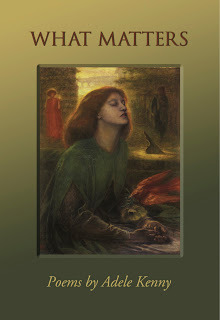
Click Here for Amazon
For another poem from the book, check out Survivor which was featured on October 1 at Your Daily Poem, in honor of Breast Cancer Awareness Month.
Video: Adele reads selections from What Matters
Visit Adele's blog, The Music in It, for weekly prompts.

October 15, 2011
Reading at DelRossi's Trattoria
Come for the leaves, the poems, and the food!
[image error]
Sunday, October 16, 2011
Diane Lockward and Sylva Haddad-Boyadjian
Del Rossi's Trattoria
Rt. 137
Dublin, New Hampshire
3:00 PM

October 8, 2011
Print Journals That Accept Online Submissions

Time to once again update the list of print journals that accept online submissions. The list has grown this time by a baker's dozen. Clearly, more and more print journals are moving to online submission managers. I sort of miss those trips to the post office. But am happy to save paper, envelopes, and stamps. Thank you, Journals!
The Baltimore Review has been removed as it has become an online journal.
Journals new to the list (not necessarily new journals) are indicated with a double asterisk.
The number of issues per year appears after the journal's name.
The reading period for each journal appears at the end of each entry.
Unless noted otherwise, the journal accepts simultaneous submissions.
As always, please let me know if you find any errors here. And good luck.
**Adanna: a journal about women, for women—1x
Jan 31 - April 30
Agni—2x
Sept 1 - May 31
The American Poetry Journal—2x
September 1 - April 30
Barn Owl Review—1x
June 1 - November 1
Bat City Review—1x
June 1 - November 15
Bateau—2x
all year
Bellevue Literary Review—2x
all year
**Bellingham Review—1x
Sept 15-Dec 15
**Beloit Poetry Journal—4x
all year
no sim
**Black Warrior Review—2x
all year
Boston Review—6x
Sept 15 - May 15
**Boulevard—3x
November 1-April 30
Caesura—2x
August 5 - Oct. 5
Caketrain—1x
all year
Cider Press Review—1x
April 1 - Aug. 31
Columbia—2x
September 1 - May 1
Copper Nickel—2x
all year
Crazyhorse—2x
all year
Cream City Review—2x
August 1 to 1 November
December 1 to April 1
CutBank—1-2x
October 1 thru February 15
**Edison Literary Review—1x
all year
Feast—4x
print and online journal
all year
FIELD—2x
all year
no sim
Fifth Wednesday—2x
no Jan, Feb, June, or July
**The Florida Review—2x
August thru May
Gargoyle—1x
most recent reading period was June 1, 2011-August 1, 2011
Greatcoat—1 or 2x
November - May
Grist—1x
August 15 - April 15
**Harpur Palate—2x
deadlines: Winter issue: November 15
Summer issue: April 15
Harvard Review—2x
Sept 1 - May 31
Hawk and Handsaw—2x
Aug 1 - Oct 1
Hayden's Ferry—2x
All year
pays
The Hollins Critic—5x
Sept 1 - Dec. 15
Hunger Mountain—1x
all year
Iron Horse Literary Review—6x
rolling for 3-4 weeks at a time
check website for dates
Jubilat—2x
September 1 - May 1
Kenyon Review—4x
September 15 - January 15
no sim
The Literary Review—4x
All year
The Los Angeles Review—1x
Submit to Poetry Editor: lareview.poetry@gmail.com
Sept 1 - Dec 1
Lumina—1x
Sept 1 - Nov 15
The MacGuffin—3x
all year
The Massachusetts Review—4x
October 1 - April 30
**Measure—2x
no sim
all year
**The Mom Egg—1x
July 15 - Sept. 30
Meridian—2x ($2 fee)
all year
Mid-American Review—2x
all year
The Minnesota Review—2x
all year
The Missouri Review–4x
all year
Naugatuck River Review—2x
for the Summer issue January 1 through March 1
for the Winter issue July 1 through September 1 (contest only)
New England Review—4x
no sim
Sept 1-May 31
New Madrid—2x
August 15 - November 1
New Ohio Review—2x
Sept-May (summer okay for subscribers)
New Orleans Review—2x
Aug 15 - May 1
**New South—2x
all year
The New Yorker
weekly magazine
all year
Ninth Letter—2x
September 1 - April 30
Parthenon West Review—1x
Jan 1- May 1
Ploughshares—3x
June 1 - Jan. 15
Poetry—11x
year round
no sim
Poetry Northwest—2x
September 15 - April 15
Post Road Magazine—2x
check website for submission dates
Potomac Review—2x
Sept 1-May 1
Puerto del Sol—2x
September 15-March 31
The Raintown Review—2x
all year
considers previously published
The Raleigh Review—1x
All year
Rattle—2x
year round
Redactions—1x
year round
Redivider—2x
all year
Red Rock Review—2x
No June, July, August, or December
no sim
Rhino—1x
April 1 - Oct 1
roger—1x
Aug 1 - Jan 1
Rosebud—3x
All year
Sakura Review—2x
year round
Salt Hill—2x
August 1 - April 1
San Pedro River Review—2x
Jan 1 - Feb 1 / July 1-Aug 1
Slice Magazine—2x
Feb. 1 - April 1
Smartish Pace—2x
All year
Sonora Review—2x
All year
The Southeast Review—2x
All year
Southwest Review—4x
No June, July, August
$2 fee
Sou'wester—2x
August 15 - May 15
Spinning Jenny—1x
Sept 15 - May 15
No Sim
**The Stillwater Review—1x
deadline Nov. 15
poetrycenter@sussex.edu
Sugar House Review—2x
All year
Tampa Review—2x
Sept 1 - Dec. 31
no sim
Tar River Poetry—2x
via email
Sept 15 - Nov. 1
no sim
Third Coast Review—2x
Sept 15 - April 30
Tiferet—1x
Sept 1 - December
Tinhouse Magazine—2x
September 1 - May 31
Tygerburning Literary Journal—1x
October 15-December 15
Upstreet—1x
Sept 1 - March 1
Versal—1x
Sept 15 - Jan 15
Verse Wisconsin—4x
All year
Washington Square Review—2x
August 1 - Oct 15
Dec 15 – Feb 1
Weave Magazine—2x
April 15 - July 31
West Branch—2x
Aug 15 - April 15
Willow Springs—2x
all year
<!--
/* Font Definitions */
@font-face
{font-family:Arial;
panose-1:2 11 6 4 2 2 2 2 2 4;
mso-font-charset:0;
mso-generic-font-family:auto;
mso-font-pitch:variable;
mso-font-signature:3 0 0 0 1 0;}
@font-face
{font-family:Times;
panose-1:2 0 5 0 0 0 0 0 0 0;
mso-font-charset:0;
mso-generic-font-family:auto;
mso-font-pitch:variable;
mso-font-signature:3 0 0 0 1 0;}
@font-face
{font-family:Verdana;
panose-1:2 11 6 4 3 5 4 4 2 4;
mso-font-charset:0;
mso-generic-font-family:auto;
mso-font-pitch:variable;
mso-font-signature:3 0 0 0 1 0;}
@font-face
{font-family:Cambria;
panose-1:2 4 5 3 5 4 6 3 2 4;
mso-font-charset:0;
mso-generic-font-family:auto;
mso-font-pitch:variable;
mso-font-signature:3 0 0 0 1 0;}
/* Style Definitions */
p.MsoNormal, li.MsoNormal, div.MsoNormal
{mso-style-parent:"";
margin:0in;
margin-bottom:.0001pt;
mso-pagination:widow-orphan;
font-size:12.0pt;
font-family:"Times New Roman";
mso-ascii-font-family:Arial;
mso-fareast-font-family:Cambria;
mso-fareast-theme-font:minor-latin;
mso-hansi-font-family:Arial;
mso-bidi-font-family:"Times New Roman";
mso-bidi-theme-font:minor-bidi;}
a:link, span.MsoHyperlink
{mso-style-noshow:yes;
color:blue;
text-decoration:underline;
text-underline:single;}
a:visited, span.MsoHyperlinkFollowed
{mso-style-noshow:yes;
color:purple;
text-decoration:underline;
text-underline:single;}
@page Section1
{size:8.5in 11.0in;
margin:1.0in .75in 1.0in .75in;
mso-header-margin:.5in;
mso-footer-margin:.5in;
mso-paper-source:0;}
div.Section1
{page:Secti
</style>
</div>
<div style="font-family: inherit;">
<span style="font-size: small;">**<a href="http://www.vivacepress.com/waq"&... Arts Quarterly Journal</a>—4x
</span></div>
<div class="MsoNormal" style="font-family: inherit;">
<span style="font-size: small;">all year</span></div>
<div style="font-family: inherit;">
<span style="font-size: small;"><br /></span></div>
<span style="font-size: small;"><br /></span><div class="blogger-post-footer"><img width='1' height='1' src='https://blogger.googleusercontent.com...' alt='' /></div>
October 2, 2011
Ellen Bass on Metaphors

Click Cover for Amazon
I recently invited poet Ellen Bass to provide the Craft Tip for my September Poetry Newsletter (sign-up form in the right sidebar). She kindly accepted and sent me a wonderful piece about metaphors. I wanted the piece to get a wider audience so invited Ellen to also be a guest blogger here. Here's the full-length version of her tip. I know you'll find it useful.
METAPHOR: WHAT IS IT LIKE?
Poetry is rooted in metaphor, in which things which are superficially different are revealed as being in some essential way, similar. We say, this is like that. And when it's true, when it's accurate, barriers collapse and we get a glimpse into the oneness of the world. But of course it's necessary for the metaphor to be vital enough, original enough, to actually do its work.
One of the main functions of metaphor is to heighten emotion. But the more sophisticated we get about language, the less we are moved by its conventional expression. Because of this, we constantly seek ways to make emotion fresh.
In Best Words, Best Order, Stephen Dobyns writes, "If the poet can get us to believe about a small thing, we will be more likely to believe the poet about a big thing. One of the quickest ways to establish the reader's trust is through precise description of physical setting. More difficult are precise descriptions of emotional and spiritual conditions. All three mean giving us a combination of the familiar and unfamiliar, what we know with what we do not know. These three types of description are best communicated with the help of metaphor. And it is probably through the quality of metaphor that the poet most quickly achieves or loses the trust of the reader."
So how do we discover the metaphors that will allow us to say the unsayable, to join intimately with the reader? Whether you're writing a first draft or working to revise, here are some practical ideas for opening up the world of metaphor in your poems:
Look in unfamiliar places:
Many of us operate in metaphoric ruts. Thus we wind up with an overabundance of similar, overused, images. I call this "the green vine school of poetry." I struggled with this myself for awhile, winding up with a glut of garden imagery. So if you seem always to be comparing things within some overly familiar territory, look elsewhere. Look under the hood of your car, in your elementary school, in a shoe factory, in a hospital, in the grocery store.
Also, vary the scale. Look small, under the microscope, one thread in a bolt of cloth or even one fiber of the thread. Look big, out into space, back in time to when the stars were born. Getting away from the middle ground can open up a wealth of unexpected images.
It's good to look in your imagination, but you can also look literally. If you're trying to think of a metaphor for what it's like to touch your lover's skin, or the pain of cancer, or your dog's exuberance, take that unsolved metaphor with you and look for possibilities throughout your day. As you drive around town, brush your teeth, fold laundry, pay bills, count out change for a customer, look for what your lover's skin might be like. With everything you see or touch or smell, ask yourself, is it like this?
Make lists:
It can be useful to make lists of metaphors Write twenty or thirty possible metaphors for what it feels like when your child has a fever or the way dirt clings to a carrot when you pull one out of the ground. It's easier to brainstorm a whole page of ideas that don't have to be good, than it is to have to write one perfect metaphor. So, if you make a list of all the images (and some can be terrible) you can think of, you'll loosen up your mind and you may, in the process, stumble upon one that's accurate.
Imitate the holiday ham:
If you can think in metaphor, from the start that's best, of course. A poem that doesn't have some muscular language working right from the beginning is going to be harder to bring to fruition than one that does. But sometimes we don't have the ability or the good fortune to get those necessary metaphors in the first draft. In that case, it's often possible to go back and add them in. I think of this as the holiday ham method. When you bake a ham, you make little cuts in it and then you stick cloves into the little cuts. Well, that's what you do with the metaphors—you look for places in the poem where you can insert them. For example, you may have a line that says, "She walked toward me." So you can make a little slit right there and ask yourself, How did she walk toward me? She walked toward me like…
Court strangeness:
Don't be afraid of the strange. Galway Kinnell said, "It's okay to have something strange in your poem. In fact, it's preferable." Strangeness is often where the most interesting images live. Be willing to be wild, to go out on a limb, to risk making a fool of yourself. If you always stay safe with your metaphors, you'll miss out on too much. You'll be censoring your metaphors before you even generate them. Often metaphors which may seem too odd when you write them, turn out to be the most resonant.
Ultimately, the metaphors need to deepen the impact of your poem or they'll detract from it. Beautiful or interesting or wonderfully strange as they might be, every metaphor must be in service to the poem. And anything that doesn't enhance the poem, diminishes it. But it's easier to take out a metaphor that's not needed than to write a brilliant metaphor. So while you're in the generative mode, don't be overly critical. You may put a dozen metaphors in your poem and only wind up using one, but if it's the right one, that's all you need.

September 27, 2011
Symmetry and Poetry

Back in July I recommended the book, Poetry in Person: Twenty-five Years of Conversation with America's Poets, edited by Alexander Neubauer. One of the conversations that particularly interested me was Edward Hirsch's. He spoke about the writing of his poem, "Wild Gratitude." I paused over his comment about stanza form. I'll include the question that was directed to him and his response.
STUDENT: In the several drafts that we read of "Wild Gratitude" it remained a block. No stanza breaks until the final version [broken into six stanzas]. I was wondering, at what point do you make that decision? In your poetry you very often have four-line stanzas or six-line stanzas that you really stay with. Do you feel pressed to maintain six lines when it wants to break on the fifth line?
HIRSCH: Yes. I think that a form, though, which is what you're talking about to some extent, is a series of expectations. It's a contract that you set up, as a musical form, a series of patterns and expectations and fulfillments and thwartings and movement, and your task is to work through the form so that the reader can follow. Many poets do something that drives me up the wall. They'll do five lines, five lines, five lines, five lines, four lines, five lines, six lines, five lines. Formally, it doesn't make any sense to me. I believe it has to make sense.
Given Hirsch's comment I was surprised to find that "Wild Gratitude" appears in stanzas of 8, 7, 8, 8, 10, and 5 lines. I expected a more formal pattern. Then I went onto his next paragraph:
HIRSCH: I always begin with a stanzaic idea. That is, I try to write by the line
as a unit of meaning and by the stanza as a unit of meaning. Sometimes
that's regular and sometimes that's irregular. I follow it through.
Sometimes when it's operating well, it fulfills itself; other times it's
not fulfilling itself, so you have to change it. Or something feels
radically wrong to you—as it began to feel with "Wild Gratitude" as a
big block. So I had to fool with it. Each poem is different, but what I
would say about it overall is that I have a stanzaic idea to get me
going. If the poem is not alive, if something is not happening, then I
change it. And I decide the way Marianne Moore decided her stanzas. She
wrote one, and if that seemed attractive, she kept going and kept
patterning it like that.
Okay, now I get it. He begins with a stanzaic plan but does not feel married to it though he is committed to logical breaks. I returned to the poem to see if I could discern the logic behind the stanza breaks. The breaks are not at sentence ends—the first stanza breaks with a comma, the second with a period, third with a comma, fourth with no punctuation (separates subject and verb), fifth with a period. So what guided the breaks? My sense is that as Hirsch read the poem aloud there seemed to be a logical moment of pause right where he made his stanza breaks. That feels right to me.
This interested me as it's something that always concerns me as I go through multiple drafts. There's something in me that wants the stanzas to be orderly in appearance—line lengths approximately equal, number of lines per stanza equal. Certainly, not all of my poems cooperate in this desire and I thank them for their defiance. Wouldn't it be tedious to have that much order? But I wrestle with form and it causes me some tension. That tension is probably a good thing.
I still find it hard to live with a pattern like this: 4, 4, 4, 3, 4. Seems like a line is missing in that second to last stanza. I can comfortably accept, however, 4, 4, 3, 4, 4. Then the stanza with 3 lines feels like a balancing point. I'm also comfortable with 4, 4, 4, 4, 3.
Likewise, I can't bear it if in the middle of a poem one line is significantly longer than the others. But it's okay with me if the last line is.
I should have lived in the Renaissance.




![[image error]](http://1.bp.blogspot.com/-wa2dszl6R9E/TqmscGwaC9I/AAAAAAAACMg/Yxg9PcuaOQM/s1600/shirt.png)
![[image error]](http://1.bp.blogspot.com/-YqGB0Fs8xVI/Tl6_c1mrGuI/AAAAAAAACKQ/v0sBwVAJuZY/s1600/233.jpg)