Peter K Fallon's Blog
December 14, 2022
Propaganda 2.1 on WGN-TV
In my first television interview in 21 years, I spoke this morning with Larry Potash and Robin Baumgarten, hosts of the WGN-TV Morning News in Chicago, about my new book, Propaganda 2.1: Understanding Propaganda in the Digital Age.
In all fairness to the hosts and producers of the show, they assumed what most people assume when they hear the title of the book: "Oh, this guy is going to show us how to identify fake news that comes to us via social media." That's kind of the zeitgeist right now, isn't it? That's exactly what seven years of mainstream mass media, propaganda 2.0 coverage has done to us. We've been massaged (sometimes brutally) to doubt everything that comes to us through our "new media" digital information environment and to trust only the information we receive through the older, non-digital mass media.
Unfortunately (or fortunately) that kind of thinking -- so typical of our society at the moment -- is proving itself to be less than productive. Reliance on the mass media for our information brought us Donald J. Trump in the first place, and made Bernie Sanders' candidacy for the Presidency a dead issue. (With the help, of course, of a rigged primary system, a thoroughly corrupt Democratic Party establishment, and an indolent and acquiescent mass media establishment.)
This book has been a real learning experience for me -- from ten years of reading and writing, a year in the editing/publication process, to three months of promotion. My mind has changed on a lot of issues in ten years, and the entire thrust of the book changed with. It actually started out (which is to say that I actually started out) as exactly the kind of "Don't trust the Internet" book that everyone seems to be expecting.
It's not. I hope you'll read it. Who knows? It may turn out to be a learning experience for you as well.


October 5, 2022
Neil Postman died nineteen years ago today. The sadness ...

Neil Postman died nineteen years ago today. The sadness I feel still is hard to describe.
In the e-mail that brought me news of his death from lung cancer at the age of 72, Lance Strate described Neil, very accurately, as "the mentor of hundreds, in fact thousands of graduate students, and so the loss is personal as well as professional. We will miss him as a friend, colleague, teacher, and father."
I have to say right off the bat that I was not one of those people to whom Lance refers. I cannot claim Neil Postman as a mentor. A teacher and an inspiration? Yes. But not a mentor. Frankly, he frightened and intimidated me (not deliberately, of course; the insecurities were all mine) and reminded me of my own self-perceived intellectual inadequacies. (In fairness to the topic, if anyone deserves credit – or perhaps I should say blame – for mentoring me, it would be Neil’s NYU colleague Christine Nystrom, who was able to encourage and coax from me my best thinking and writing.) Yet Neil supported and helped me in so many ways--academically, professionally, personally—and, as it turns out, influenced my thinking far more deeply than I understood at the time, that the shock of his passing has barely abated after all this time. How I’d love to sit and talk with him now about our shared media ecology.
I first heard of Neil Postman while working on my Master’s Degree in Communication at New York Institute of Technology around 1976. A couple of serendipitous events occurred. One, I took a course with a professor named Irving Weingarten who, during my time at NYIT, defended his dissertation and received his Doctorate in Media Ecology from New York University and introduced me to Neil’s work. Two, I took a course with Philip Miele – “Vocabulary of the Media Critic” – whose core text was Harold Innis’s “The Bias of Communication.” I had, of course, read Marshall McLuhan’s “Understanding Media” as an undergraduate – depending on your point of view, either essential reading or de rigueur at the time – and was of course fascinated by him and his aphoristic probes. But I had an uneasy feeling that one could make of much of McLuhan’s wisdom just about anything one wanted. A Nostradamus for the electronic age. There was great vision and imagination – even poetry – in McLuhan’s probes but not a whole lot of specificity.
Innis, on the other hand, supplied the structure and method that I felt lacking in McLuhan’s work. Innis told me, in different words, that the medium is the message. But he also supplied me with historical examples that provided a foundation upon which I could build an understanding of exactly what that phrase meant. And Irv Weingarten turned me on to Neil’s writing and the concept of a “media ecology,” so similar to what I was reading in McLuhan but so much more grounded in common sense and reason. My first encounter with Neil’s work was “Crazy Talk, Stupid Talk” (1977), followed almost immediately by “Teaching as a Subversive Activity” (1969). By the time I was awarded my Master’s degree in 1980, I knew I had to get into that “Media Ecology” program at NYU. Money, work, life being what they are, it took me six more years.
Neil was a humble, funny, gregarious person who, at the same time, was a towering, imposing figure. He was also, at the time of my arrival, the author of a new book that everyone seemed to be talking about, “Amusing Ourselves to Death: Public Discourse in an Age of Show Business.” At the risk of repeating myself, I had enormous difficulty finding the same comfort level with Neil as so many others in the program so easily managed to do. At first, my end of our infrequent exchanges were limited pretty much to a stumbling “Yes, sir” and “No, sir” and “I’m not sure, sir.” Oh, I answered questions and gave my opinion when called upon to do so, but I’m pretty sure my mouth dried and my tongue tied every time I had to speak with him. At the end of the first semester, in our “Seminar in Media Ecology: Analysis,” my colleagues and I in the class of ‘90 cohort had to write and submit a brief (mine was 35 pages) history of a medium, after which we defended it orally in front of Neil and Chris Nystrom. I’ll never forget the feeling of horror and humiliation as I sat across from the two of them and watched Neil hold my paper between his thumb and forefinger, dangling it to his side as though it were a soiled tissue picked up from the floor, while he leaned back in his chair, took a deep drag on his cigarette, paused, and said only this: “Peter…your writing is so…florid…Why is that?” Chris rescued me, even remarking that she enjoyed my writing, but if I could have melted into the woodwork at that moment, I surely would have. I must also say (with considerable pride but also immeasurable relief) that in time Neil came to appreciate and perhaps even respect both my writing and my thinking.
Over the years, I learned so much from Neil, as well as from Chris, Terry Moran, Henry Perkinson, John Mayher, and others. It was impossible not to learn in this program. I learned about and read the works of John Dewey, George Herbert Mead, Alfred Korzybski, I.A. Richards; of Alfred North Whitehead and Suzanne Langer; of Lewis Mumford and Jacques Ellul; of Marx, Engels, and Freud; of Aristotle, Augustine, and Aquinas; and of course, of Marshall McLuhan. For Neil, there was no educational replacement for the information technology of the Gutenberg era, the printed book. As he explained to Jay Rosen with typical understatement, “We’re just trying to give people a good liberal arts education,” and that good liberal arts education was the education of literacy, the education of the Enlightenment. I got to know Neil Postman as an eminently reasonable – and rational – man; but a man for whom reason was simply one piece of the human intellect, incomplete without its complementary counterpart, imagination. And the imagination, seat of the emotional life, was the foundation of empathy.
“From the beginning,” Neil said in the keynote address at the inaugural convention of the Media Ecology Association, “we were a group of moralists.” This appealed to me, because I am something of a media moralist myself. It was what attracted me to the program in the first place. I could see this moralism subtly in Innis, more overtly in Ellul. But it was absent in McLuhan. McLuhan had once said “A moral point of view too often substitutes for understanding in technological matters” (I have an imaginary discussion of this point with McLuhan here). I couldn’t understand why, in the act of understanding media, one would not be moved to improve the situation of the people that those media serve. And so my affinity for Neil’s thinking grew. “It was our idea,” Neil continued in his 2000 keynote, “to have an academic department that would focus its attention on the media environment, with a particular interest in understanding how and if our media ecology was making us better or worse. Not everyone thought that this was a good idea—Marshall McLuhan, for one. Although McLuhan had suggested that we start such a department at NYU, he did not have in mind that we ought to interest ourselves in whether or not new media, especially electronic media, would make us better or worse. He reminded me several times of the lines in Stephen Vincent Benét’s long poem John Brown’s Body. At the end of the poem, Benét makes reference to the Industrial Revolution and finishes with these lines:
“Say neither, it is blessed nor cursed.
“Say only ‘It is here.’
“No room for moralists there. McLuhan claimed that we ought to take the same point of view in thinking about modern media: that they are neither blessed nor cursed, only that they are here. He thought that this moral neutrality would give the best opportunity to learn exactly how new media do their stuff. If one spent too much time on the question of whether or not that stuff was good, one would be distracted from truly understanding media. As a consequence, although I believe McLuhan liked me, I feel sure he would not have much liked my books, which he would have thought too moralistic, rabbinical or, if not that, certainly too judgmental.”
Neil Postman was a true heir to the legacy of the Enlightenment: a proponent of propositional language and thought who wrote clear, concise, rational prose; a man of imagination and transcendence who knew that humans were more than the sum of their material parts. Far from being the Luddite he is generally accused of being, Neil rejected the idea that all technological change constituted “progress” and refused to be controlled by technology – or the people who market them – but enthusiastically embraced those technologies – and only those – that measurably improved the quality of human life. And he did not apologize for that.
He did not hesitate to point a finger at the mendacity of marketers who sell newness for its own sake or to ridicule the baseless and unsupported claims of the acolytes of our new digital religion. “Through the computer, the heralds say, we will make education better, religion better, politics better, our minds better — best of all, ourselves better. This is, of course, nonsense, and only the young or the ignorant or the foolish could believe it.”
But throughout human history, Neil also acknowledged, it was technologies that shaped the information, psychic, and spiritual environments that allowed people to make things better. In true humanist fashion, Neil left us some questions to think about when trying to make judgments about which value system would be served by a given technology: “The first question is this: To what extent does a medium contribute to the uses and development of rational thought? Here is a second question: To what extent does a medium contribute to the development of democratic processes? A third question—related to the previous two—is: To what extent do new media give greater access to meaningful information? Here is a final question: To what extent do new media enhance or diminish our moral sense, our capacity for goodness?” Neil would never reject any technology that provided suitable answers to those questions.
Nineteen years after his death, one of my fondest memories of Neil is sitting in the courtyard of Fordham's Lincoln Center campus at lunchtime during the first MEA conference. My Mom had just died, and I was nursing my Dad through his final (two year) illness. Much of my personal life, at that moment, was a shambles. Neil came and sat with me and we just talked about life--its difficulty, its tragedy, and its beauty. I was impressed not so much by what he said – what does one say, after all, to someone who believes his life is falling apart? – but by the sheer humanity of the gesture. I really don’t remember the specifics of our conversation, but I’ll never forget the moment. One of the reasons that Neil was the teacher, thinker, and writer that we know him to be is that he was – for all the criticisms of his "Luddite" work – wholly alive and in love with life and the phenomenon of human intelligence. He had a profound faith in ALL of us. Those moments with Neil – no longer the “towering figure” I stammered before but the compassionate friend who listened to me – are burned into my memory forever.
Nineteen years ago this semester I began a new phase in my career and my life out here on the prairie, and I was unable to attend the various memorials and social events in Neil's honor. I was unable to be in NY for his funeral, although I would dearly have loved to pay my respects in person to all who knew Neil. My sympathies remain with all of you who continue to mourn Neil's passing, just as my joy will always be with those of you who celebrate his life and carry on his work. I am proud to count myself among your ranks. I honestly believe it is time for a “Neil Postman Renaissance.” We need a corrective to the orgy of technophilia that has surrounded this false information “revolution” for the last two decades. We need a direction and while Neil Postman is not that direction – and would blanch at any suggestion to the contrary – his work may provide with clues to that direction.
At the end of his 2000 MEA keynote, Neil (who was snarky before snarky was cool) made it clear that he, if no one else, envisioned Media Ecology as a logical extension of Enlightenment and Renaissance humanism, in which no answers are given, but methods for questioning are constantly improved and the end of this intellectual activity is the improvement of the human condition. He concluded “by saying that as I understand the whole point of media ecology, it exists to further our insights into how we stand as human beings, how we are doing morally in the journey we are taking. There may be some of you who think of yourselves as media ecologists who disagree with what I have just said. If that is the case, you are wrong.”
Neil Postman Bibliography
Author
•Building a Bridge to the Eighteenth Century: Ideas from the Past that Can Improve Our Future. New York: Knopf, 1999.
•The End of Education: Redefining the Value of School. New York, Knopf, 1995
•The Disappearance of Childhood: Redefining the Value of School. New York: Vintage Books, 1994, c.1982.
•Technopoly: The Surrender of Culture to Technology. New York: Vintage Books, 1993
•Conscientious Objection: Stirring Up Trouble About Language, Technology and Education. New York: Vintage Books, 1992, c.1988.
•Amusing Ourselves to Death: Public Discourse in the Age of Show Business. New York: Penguin, 1985
•Teaching as a Conserving Activity. New York: Delacorte Press, 1979.
•Crazy Talk, Stupid Talk: How We Defeat Ourselves by the Way We Talk and What to Do About It. New York: Delacorte Press, 1976.
•Teaching as a Subversive Activity. New York: Delta Book Publishing, 1971, c.1969.
•Languages of Discovery. New York: Holt, Reinhart and Winston, 1967.
•The Uses of Language. New York: Holt, Reinhart and Winston, 1967.
•Exploring Your Language. New York: Holt, Reinhart and Winston, 1966.
•Linguistics: A Revolution in Teaching. New York: Delta Book Publishing, 1966.
•The New English: A Forward Look. New York: Holt, Reinhart and Winston, 1965.
•Discovering Your Language. New York: Holt, Reinhart and Winston, 1963.
•Television and the Teaching of English. New York: Appleton Centruy Croft, 1961.
Co-author
•with Donald N. Wood. Post-Intellectualism and the Decline of Democracy: The Failure of Reason and Responsibility in the Twentieth Century. Westport, Conn.: Greenwood, 1996.
•with Steve Powers. How to Watch TV News. New York: Penguin, 1992.
•et al. Myths, Men and Beer: an Analysis of Beer Commercials on Broadcast Television. Church Falls, VA.: Foundation for Traffic Safety, 1987.
•with Charles Weingartner. The School Book: for People Who Want to Know What all the Hollering Is About. New York: Delacorte Press, 1973.
•with Charles Weingartner. How to Recognize a Good School. Bloomington: Phi Delta Kappa Educational Foundation, 1973.
•with Charles Weingartner. The Soft Revolution: A Student Handbook for Turning Schools Around. New York: Delacorte Press, 1971.
•with Charles Weingartner. Teaching as a Subversive Activity. New York: Delacorte Press, 1979, c. 1969.
•with Charles Weingartner. Linguistics: A Revolution in Teaching. New York: Delacorte Press, 1966.
•with Howard C. Damon. The Language of Discovery. New York: Delacotre Press, 1965.
•with Howard C. Damon. Language and System. New York: Holt, Reinhart and Winston, 1965.
•et al. Television and the Teaching of English. New York: Appleton Century Crofts, 1961.
Editor
•Language in America: A Report on Our Deteriorating Semantic Environment. New York: Pegasus, 1969.
•The Roots of Fanaticism. Ed. with Howard C. Damon. New York: Holt Reinhart and Winston, 1965.
Articles
•“Science and the Story that We Need. First Things. No. 69 (1997), 29-32.
•“Making a Living, Making a Life: Technology Reconsidered.” College Board Review. No. 176-177 (1995), 8-13.
•“Virtual Students, Digital Classroom.” The Nation. No. 261 ign (1995), 377-378ff.
•“The American Experiment” Education Week, Vol. 15 (1995), 56.
•“Error of Our Ways.” Teacher Magazine. Vol. 6 (1995), 32-37.
•“Technology as Dazzling Distraction.” The Education Digest. Vol. 59 (1994), 25-28.
•“Deus Machina” Technos. Vol. 1 (1992), 16-18.
•with Camille Paglia. “She Wants Her TV! He Wants His Book!” Harper’s Vol. 282 (1991), 44-51, 54-55.
•“What is a Conservative? (And Why Reagan Is Not One).” Utne Reader (Mar/Ap, 1989), 75.
•“Learning by Story.” The Atlantic. No. 264 (1989) 119-124.
•“The Educationist as Painkiller.” English Education. (1988), 7-17.
•“The Blurring of Childhood and the Media.” Religious Education, Vol. 82 (1987) 293-295.
•“The Limits of Language.” Etc. Vol. 43 (1986), 227-235.
•“TV News as Vaudeville.” The Quill. Vol. 74 (1986), 18-23.
•“Media and Technology as Educators.” Yearbook of the National Society for the Study of Education. (1985), 183-200.
•“Social Science as Theology.” Etc. Vol. 41 (1984), 22-32.
•“The Day Our Children Disappear: Predictions of a Media Ecologist.” Phi Delta Kappa. Vol. 62 (1981), 382-386.
•“Fine Tuning the Balance Between Education and Media Culture.” Teacher. Vol. 98 (1980), 28-30.
•“Language Education in a Knowledge Context.” Etc. Vol. 37 (1980), 25-37.
•“Landmarks in the Literature: the Limits of Language.” New York University Education Quarterly. Vol. 11 (1979), 29-32.
•“The Ascent of Humanity: a Coherent Curriculum.” Educational Leadership. Vol. 37 (1980), 300-303
•“Order in the Classroom!” Atlantic. Vol. 244 (1979) 35-38.
•“The First Curriculum.” Phi Delta Kappa. Vol. 61 (1979), 163-168.
•“The Information Environment.” Etc. Vol. 36 (1979), 234-245.
•“Landmarks in Literature: Where Have All the Critics Gone?” New York University Education Quarterly. Vol. 9 (1977), 28-31.
•“What an Educator Means When He Says…” Journal of the International Association of Pupil Personnel Workers. Vol. 20 (1976), 153-156.
•“Whatever I Call It, It Is.” Etc. Vol. 31 (1974), 37-44.
•with Charles Weingartner. “Two Tests to Take - to Find Out if Yours Is a Great School.” American School Board Journal. Vol. 161 (1974), 23-26.
•“Media Ecology: A Growing Perspective.” Media Ecology Review. Vol. 3 (1973), 10-11.
•“Illich, Pro and Con.” Social Policy. Vol. 2 (1971), 33-42.
•“The New Literacy” Grade Teacher. Vol. 88 (1971), 2-52.
•“The Politics of Reading.” Harvard Educational Review. Vol. 40 (1970), 244-252.
September 24, 2022
Propaganda 2.1: Understanding Propaganda in the Digital Age
 I'm happy to announce the publication of my fourth book, Propaganda 2.1: Understanding Propaganda in the Digital Age. (Cascade Books, Eugene OR, September 8, 2022)
Here's a blurb:
Since the US presidential election of 2016 the words propaganda and fake news have been prominent in American political and cultural discourse. Yet very few people can provide a coherent explanation of what they mean, precisely, when using them. On the two sides of the political spectrum ("red" and "blue"), each points out messages from the other side that they think are untrue--or that they simply don't like. Unlike our dangerously biased political system, however, reality has more than only two sides. For decades, Americans sat by while their mediated world was carved into a single "red reality" focused in necessary opposition to a single "blue reality." We've been given "red media outlets" and "blue media outlets" to stoke our collective rage, each against the other's lies. But the first two decades of the twenty-first century have presented us with a new information environment, one of unregulated and seemingly uncontrollable information. Like the young boy in a popular folktale, we can now see--if only we can resist the pressures of social conformity--that both emperors, red and blue, strut proudly before us, naked. Propaganda 2.1 is a handbook for seeing reality clearly--and coping with it.
And here are some early reviews:
Writing in the tradition of media-ecology scholars such as Jacques Ellul and Neil Postman, Peter Fallon takes on the subject of propaganda with intelligence, insight, and moral clarity. Coupling historical context with contemporary analysis, Propaganda 2.1 is essential reading for anyone concerned about the contemporary media environment and where we may be headed in the years to come. —Lance Strate, Fordham University
Propaganda 2.1 is a timely contribution to digital-literacy education. After a thoughtful rereading of Ellul’s classic work, the book offers in a lucid exposition a wealth of original research and insights into the changing nature of propaganda in the twenty-first century. No student of media or reader who wants to better understand and defend themselves from the new generation of propaganda in the digital age can afford to ignore this extremely resourceful book.—Casey Man Kong Lum, William Paterson University
Propaganda 2.1 is a brilliant contribution to our fragile planet and civilization. . . . The picture is bleak, but Fallon shows how the emergence of the World Wide Web and various internet technologies can open up new possibilities—not just QAnon and Alex Jones, but WikiLeaks, Occupy Wall Street, and Black Lives Matter. Individuals and smaller movements can have a voice. Resistance, truth, justice, freedom, and community may not be likely—but they are possible with Propaganda 2.1.—David W. Gill, International Jacques Ellul Society
The book is available on Amazon, Barnes & Noble, Books-a-Million, the website of Wipf & Stock Publishers, and at select bookstores. You can also support your local independent bookstore by finding Propaganda 2.1 on IndieBound and buying it there.
A limited preview can be found on Google Books.
April 6, 2021
I'm in Facebook Jail!
Last weekend, on the 53rd anniversary of the Rev. Dr. Martin Luther King's last speech ("I've been to the mountaintop!"), I posted a video of that speech on Facebook. I was immediately banned from posting on Facebook, and my account deactivated, for thirty days for violations of "community standards."
This is not a rare piece of video. I have posted it a half-dozen or more times in the last decade or so, and I've seen it posted elsewhere on social media. Facebook said it was in violation of copyright law, and I responded that, being an educator, I was claiming fair use as a rationale for posting it. That didn't seem to matter, and I now have 28 days to sit quietly in the corner.
In fact, I believe it was my commentary on the video that got me in (good) trouble. The post is gone now so I can't remember precisely what I said, but it was something very much like this:
53 years ago today, the Rev. Dr. Martin Luther King, Jr. gave his last speech to striking sanitation workers in Memphis, Tennessee. He told them that he had "been to the mountaintop" and had seen "the promised land," and he promised them that they would too.
The next day he was murdered.
Here is that video.
So maybe, just maybe, if you're reading this post and watching this video you'll feel like reposting it to one of your social media sites, like Twitter -- or Facebook. And then please tell the nice folks at Facebook how sorry I am for violating their "community standards."
I'm Returning...
After several years of sporadic posting -- and wasted time on social media outlets like Facebook -- I've decided to slowly get back into blogging. I mean, now that blogging is, for all intents and purposes, passe (if not obsolete), it seems like an entirely appropriate time for me to return to it.
Over the years this blog has logged more than 90,000 hits and garnered hundreds of thoughtful responses (with a few crackpots and nasties trolling for trouble). I appreciate those thoughtful responses, and I have even appreciated the moments that the crackpots and trolls chose to have serious discussions about whichever of my thoughts and words offended them. As a teacher, you're expected to change everyone's thinking. But as a good teacher, you know that this is impossible, and it's not even particularly desirable, from a societal point of view. The goal of education is not (or certainly ought not to be) to get everyone to march in lock-step. The goal of education is to get people to think critically, and in order to do that you have to do two things: 1] propose ideas that not everyone will like, and 2] to be willing to discuss those ideas.
I used to think social media outlets were the more appropriate venue for these two activities. In recent years I believe this has not been the case (although I still believe that it can be, under the right circumstances). When I look back on the seventeen years I've had this blog, I have to admit that I had more success in having frank discussions about our world here than on social media.
So I'm trying again.
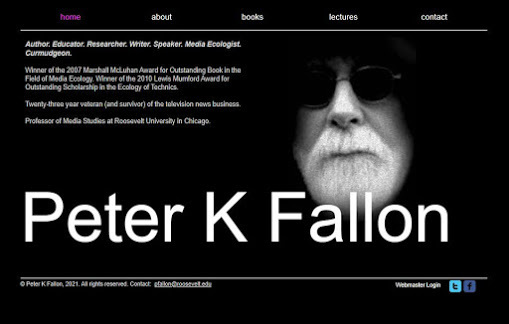
I've also gone public with my own personal website, pictured (and linked) above. In the coming weeks I intend to link this blog to my website so that whoever happens upon it can hop over to the blog to see whatever happens to be my peeve of the day.
I hope to see you soon, and even better, to hear from you.
October 5, 2019
Neil Postman Sixteen Years On
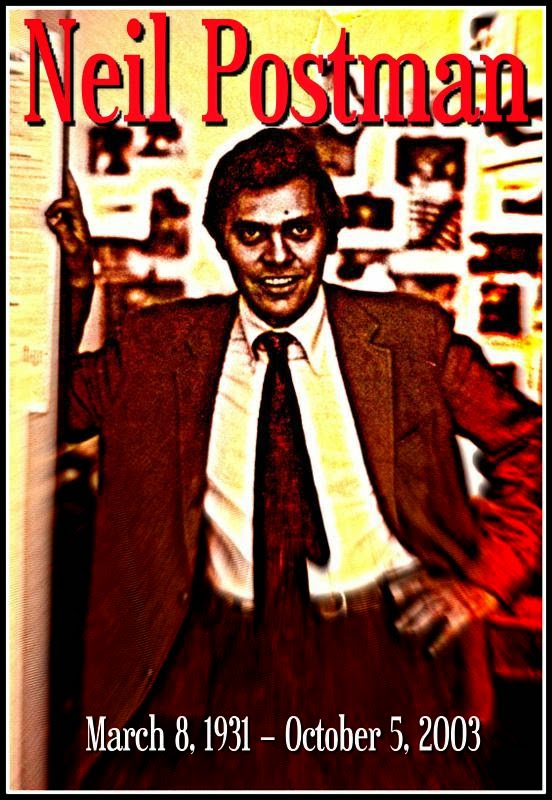
Neil Postman died sixteen years ago today. The sadness I feel still is hard to describe.
In the e-mail that brought me news of his death from lung cancer at the age of 72, Lance Strate described Neil, very accurately, as "the mentor of hundreds, in fact thousands of graduate students, and so the loss is personal as well as professional. We will miss him as a friend, colleague, teacher, and father."
I have to say right off the bat that I was not one of those people to whom Lance refers. I cannot claim Neil Postman as a mentor. A teacher and an inspiration? Yes. But not a mentor. Frankly, he frightened and intimidated me (not deliberately, of course; the insecurities were all mine) and reminded me of my own self-perceived intellectual inadequacies. (In fairness to the topic, if anyone deserves credit – or perhaps I should say blame – for mentoring me, it would be Neil’s NYU colleague Christine Nystrom, who was able to encourage and coax from me my best thinking and writing.) Yet Neil supported and helped me in so many ways--academically, professionally, personally—and, as it turns out, influenced my thinking far more deeply than I understood at the time, that the shock of his passing has barely abated in ten years. How I’d love to sit and talk with him now about our shared media ecology.
I first heard of Neil Postman while working on my Master’s Degree in Communication at New York Institute of Technology around 1976. A couple of serendipitous events occurred. One, I took a course with a professor named Irving Weingarten who, during my time at NYIT, defended his dissertation and received his Doctorate in Media Ecology from New York University and introduced me to Neil’s work. Two, I took a course with Philip Miele – “Vocabulary of the Media Critic” – whose core text was Harold Innis’s “The Bias of Communication.” I had, of course, read Marshall McLuhan’s “Understanding Media” as an undergraduate – depending on your point of view, either essential reading or de rigueur at the time – and was of course fascinated by him and his aphoristic probes. But I had an uneasy feeling that one could make of much of McLuhan’s wisdom just about anything one wanted. A Nostrodamus for the electronic age. There was great vision and imagination – even poetry – in McLuhan’s probes but not a whole lot of specificity.
Innis, on the other hand, supplied the structure and method that I felt lacking in McLuhan’s work. Innis told me, in different words, that the medium is the message. But he also supplied me with historical examples that provided a foundation upon which I could build an understanding of exactly what that phrase meant. And Irv Weingarten turned me on to Neil’s writing and the concept of a “media ecology,” so similar to what I was reading in McLuhan but so much more grounded in common sense and reason. My first encounter with Neil’s work was “Crazy Talk, Stupid Talk” (1977), followed almost immediately by “Teaching as a Subversive Activity” (1969). By the time I was awarded my Master’s degree in 1980, I knew I had to get into that “Media Ecology” program at NYU. Money, work, life being what they are, it took me six more years.
Neil was a humble, funny, gregarious person who, at the same time, was a towering, imposing figure. He was also, at the time of my arrival, the author of a new book that everyone seemed to be talking about, “Amusing Ourselves to Death: Public Discourse in an Age of Show Business.” At the risk of repeating myself, I had enormous difficulty finding the same comfort level with Neil as so many others in the program so easily managed to do. At first, my end of our infrequent exchanges were limited pretty much to a stumbling “Yes, sir” and “No, sir” and “I’m not sure, sir.” Oh, I answered questions and gave my opinion when called upon to do so, but I’m pretty sure my mouth dried and my tongue tied every time I had to speak with him. At the end of the first semester, in our “Seminar in Media Ecology: Analysis,” my colleagues and I in the class of ‘90 cohort had to write and submit a brief (mine was 35 pages) history of a medium, after which we defended it orally in front of Neil and Chris Nystrom. I’ll never forget the feeling of horror and humiliation as I sat across from the two of them and watched Neil hold my paper between his thumb and forefinger, dangling it to his side as though it were a soiled tissue picked up from the floor, while he leaned back in his chair, took a deep drag on his cigarette, paused, and said only this: “Peter…your writing is so…florid…” Chris rescued me, even remarking that she enjoyed my writing, but if I could have melted into the woodwork at that moment, I surely would have. I must also say (with considerable pride but also immeasurable relief) that in time Neil came to appreciate and perhaps even respect both my writing and my thinking.
Over the years, I learned so much from Neil, as well as from Chris, Terry Moran, Henry Perkinson, John Mayher, and others. It was impossible not to learn in this program. I learned about and read the works of John Dewey, George Herbert Mead, Alfred Korzybski, I.A. Richards; of Alfred North Whitehead and Suzanne Langer; of Lewis Mumford and Jacques Ellul; of Marx, Engels, and Freud; of Aristotle, Augustine, and Aquinas; and of course, of Marshall McLuhan. For Neil, there was no educational replacement for the information technology of the Gutenberg era, the printed book. As he explained to Jay Rosen with typical understatement, “We’re just trying to give people a good liberal arts education,” and that good liberal arts education was the education of literacy, the education of the Enlightenment. I got to know Neil Postman as an eminently reasonable – and rational – man; but a man for whom reason was simply one piece of the human intellect, incomplete without its complementary counterpart, imagination. And the imagination, seat of the emotional life, was the foundation of empathy.
“From the beginning,” Neil said in the keynote address at the inaugural convention of the Media Ecology Association, “we were a group of moralists.” This appealed to me, because I am something of a media moralist myself. It was what attracted me to the program in the first place. I could see this moralism subtly in Innis, more overtly in Ellul. But it was absent in McLuhan. McLuhan had once said “A moral point of view too often substitutes for understanding in technological matters” (I have an imaginary discussion of this point with McLuhan here). I couldn’t understand why, in the act of understanding media, one would not be moved to improve the situation of the people that those media serve. And so my affinity for Neil’s thinking grew. “It was our idea,” Neil continued in his 2000 keynote, “to have an academic department that would focus its attention on the media environment, with a particular interest in understanding how and if our media ecology was making us better or worse. Not everyone thought that this was a good idea—Marshall McLuhan, for one. Although McLuhan had suggested that we start such a department at NYU, he did not have in mind that we ought to interest ourselves in whether or not new media, especially electronic media, would make us better or worse. He reminded me several times of the lines in Stephen Vincent Benét’s long poem John Brown’s Body. At the end of the poem, Benét makes reference to the Industrial Revolution and finishes with these lines:
“Say neither, it is blessed nor cursed.
“Say only ‘It is here.’
“No room for moralists there. McLuhan claimed that we ought to take the same point of view in thinking about modern media: that they are neither blessed nor cursed, only that they are here. He thought that this moral neutrality would give the best opportunity to learn exactly how new media do their stuff. If one spent too much time on the question of whether or not that stuff was good, one would be distracted from truly understanding media. As a consequence, although I believe McLuhan liked me, I feel sure he would not have much liked my books, which he would have thought too moralistic, rabbinical or, if not that, certainly too judgmental.”
Neil Postman was a true heir to the legacy of the Enlightenment: a proponent of propositional language and thought who wrote clear, concise, rational prose; a man of imagination and transcendence who knew that humans were more than the sum of their material parts. Far from being the Luddite he is generally accused of being, Neil rejected the idea that all technological change constituted “progress” and refused to be controlled by technology – or the people who market them – but enthusiastically embraced those technologies – and only those – that measurably improved the quality of human life. And he did not apologize for that.
He did not hesitate to point a finger at the mendacity of marketers who sell newness for its own sake or to ridicule the baseless and unsupported claims of the acolytes of our new digital religion. “Through the computer, the heralds say, we will make education better, religion better, politics better, our minds better — best of all, ourselves better. This is, of course, nonsense, and only the young or the ignorant or the foolish could believe it.”
But throughout human history, Neil also acknowledged, it was technologies that shaped the information, psychic, and spiritual environments that allowed people to make things better. In true humanist fashion, Neil left us some questions to think about when trying to make judgments about which value system would be served by a given technology: “The first question is this: To what extent does a medium contribute to the uses and development of rational thought? Here is a second question: To what extent does a medium contribute to the development of democratic processes? A third question—related to the previous two—is: To what extent do new media give greater access to meaningful information? Here is a final question: To what extent do new media enhance or diminish our moral sense, our capacity for goodness?” Neil would never rejectaAny technology that provided suitable answers to those questions.
Ten brief years after his death, one of my fondest memories of Neil is sitting in the courtyard of Fordham's Lincoln Center campus at lunchtime during the first MEA conference. My Mom had just died, and I was nursing my Dad through his final (three year) illness. Much of my personal life, at that moment, was a shambles. Neil came and sat with me and we just talked about life--its difficulty, its tragedy, and its beauty. I was impressed not so much by what he said – what does one say, after all, to someone who believes his life is falling apart? – but by the sheer humanity of the gesture. I really don’t remember the specifics of our conversation, but I’ll never forget the moment. One of the reasons that Neil was the teacher, thinker, and writer that we know him to be is that he was – for all the criticisms of his "Luddite" work – wholly alive and in love with life and the phenomenon of human intelligence. He had a profound faith in ALL of us. Those moments with Neil – no longer the “towering figure” I stammered before but the compassionate friend who listened to me – are burned into my memory forever.
Ten years ago this semester I began a new phase in my career and my life out here on the prairie, and I was unable to attend the various memorials and social events in Neil's honor. I was unable to be in NY for his funeral, although I would dearly have loved to pay my respects in person to all who knew Neil. My sympathies remain with all of you who continue to mourn Neil's passing, just as my joy will always be with those of you who celebrate his life and carry on his work. I am proud to count myself among your ranks. I honestly believe it is time for a “Neil Postman Renaissance.” We need a corrective to the orgy of technophilia that has surrounded this false information “revolution” for the last two decades. We need a direction and while Neil Postman is not that direction – and would blanch at any suggestion to the contrary – his work may provide with clues to that direction.
At the end of his 2000 MEA keynote, Neil (who was snarky before snarky was cool) made it clear that he, if no one else, envisioned Media Ecology as a logical extension of Enlightenment and Renaissance humanism, in which no answers are given, but methods for questioning are constantly improved and the end of this intellectual activity is the improvement of the human condition. He concluded “by saying that as I understand the whole point of media ecology, it exists to further our insights into how we stand as human beings, how we are doing morally in the journey we are taking. There may be some of you who think of yourselves as media ecologists who disagree with what I have just said. If that is the case, you are wrong.”
Neil Postman Bibliography
Author
•Building a Bridge to the Eighteenth Century: Ideas from the Past that Can Improve Our Future. New York: Knopf, 1999.
•The End of Education: Redefining the Value of School. New York, Knopf, 1995
•The Disappearance of Childhood: Redefining the Value of School. New York: Vintage Books, 1994, c.1982.
•Technopoly: The Surrender of Culture to Technology. New York: Vintage Books, 1993
•Conscientious Objection: Stirring Up Trouble About Language, Technology and Education. New York: Vintage Books, 1992, c.1988.
•Amusing Ourselves to Death: Public Discourse in the Age of Show Business. New York: Penguin, 1985
•Teaching as a Conserving Activity. New York: Delacorte Press, 1979.
•Crazy Talk, Stupid Talk: How We Defeat Ourselves by the Way We Talk and What to Do About It. New York: Delacorte Press, 1976.
•Teaching as a Subversive Activity. New York: Delta Book Publishing, 1971, c.1969.
•Languages of Discovery. New York: Holt, Reinhart and Winston, 1967.
•The Uses of Language. New York: Holt, Reinhart and Winston, 1967.
•Exploring Your Language. New York: Holt, Reinhart and Winston, 1966.
•Linguistics: A Revolution in Teaching. New York: Delta Book Publishing, 1966.
•The New English: A Forward Look. New York: Holt, Reinhart and Winston, 1965.
•Discovering Your Language. New York: Holt, Reinhart and Winston, 1963.
•Television and the Teaching of English. New York: Appleton Centruy Croft, 1961.
Co-author
•with Donald N. Wood. Post-Intellectualism and the Decline of Democracy: The Failure of Reason and Responsibility in the Twentieth Century. Westport, Conn.: Greenwood, 1996.
•with Steve Powers. How to Watch TV News. New York: Penguin, 1992.
•et al. Myths, Men and Beer: an Analysis of Beer Commercials on Broadcast Television. Church Falls, VA.: Foundation for Traffic Safety, 1987.
•with Charles Weingartner. The School Book: for People Who Want to Know What all the Hollering Is About. New York: Delacorte Press, 1973.
•with Charles Weingartner. How to Recognize a Good School. Bloomington: Phi Delta Kappa Educational Foundation, 1973.
•with Charles Weingartner. The Soft Revolution: A Student Handbook for Turning Schools Around. New York: Delacorte Press, 1971.
•with Charles Weingartner. Teaching as a Subversive Activity. New York: Delacorte Press, 1979, c. 1969.
•with Charles Weingartner. Linguistics: A Revolution in Teaching. New York: Delacorte Press, 1966.
•with Howard C. Damon. The Language of Discovery. New York: Delacotre Press, 1965.
•with Howard C. Damon. Language and System. New York: Holt, Reinhart and Winston, 1965.
•et al. Television and the Teaching of English. New York: Appleton Century Crofts, 1961.
Editor
•Language in America: A Report on Our Deteriorating Semantic Environment. New York: Pegasus, 1969.
•The Roots of Fanaticism. Ed. with Howard C. Damon. New York: Holt Reinhart and Winston, 1965.
Articles
•“Science and the Story that We Need. First Things. No. 69 (1997), 29-32.
•“Making a Living, Making a Life: Technology Reconsidered.” College Board Review. No. 176-177 (1995), 8-13.
•“Virtual Students, Digital Classroom.” The Nation. No. 261 ign (1995), 377-378ff.
•“The American Experiment” Education Week, Vol. 15 (1995), 56.
•“Error of Our Ways.” Teacher Magazine. Vol. 6 (1995), 32-37.
•“Technology as Dazzling Distraction.” The Education Digest. Vol. 59 (1994), 25-28.
•“Deus Machina” Technos. Vol. 1 (1992), 16-18.
•with Camille Paglia. “She Wants Her TV! He Wants His Book!” Harper’s Vol. 282 (1991), 44-51, 54-55.
•“What is a Conservative? (And Why Reagan Is Not One).” Utne Reader (Mar/Ap, 1989), 75.
•“Learning by Story.” The Atlantic. No. 264 (1989) 119-124.
•“The Educationist as Painkiller.” English Education. (1988), 7-17.
•“The Blurring of Childhood and the Media.” Religious Education, Vol. 82 (1987) 293-295.
•“The Limits of Language.” Etc. Vol. 43 (1986), 227-235.
•“TV News as Vaudeville.” The Quill. Vol. 74 (1986), 18-23.
•“Media and Technology as Educators.” Yearbook of the National Society for the Study of Education. (1985), 183-200.
•“Social Science as Theology.” Etc. Vol. 41 (1984), 22-32.
•“The Day Our Children Disappear: Predictions of a Media Ecologist.” Phi Delta Kappa. Vol. 62 (1981), 382-386.
•“Fine Tuning the Balance Between Education and Media Culture.” Teacher. Vol. 98 (1980), 28-30.
•“Language Education in a Knowledge Context.” Etc. Vol. 37 (1980), 25-37.
•“Landmarks in the Literature: the Limits of Language.” New York University Education Quarterly. Vol. 11 (1979), 29-32.
•“The Ascent of Humanity: a Coherent Curriculum.” Educational Leadership. Vol. 37 (1980), 300-303
•“Order in the Classroom!” Atlantic. Vol. 244 (1979) 35-38.
•“The First Curriculum.” Phi Delta Kappa. Vol. 61 (1979), 163-168.
•“The Information Environment.” Etc. Vol. 36 (1979), 234-245.
•“Landmarks in Literature: Where Have All the Critics Gone?” New York University Education Quarterly. Vol. 9 (1977), 28-31.
•“What an Educator Means When He Says…” Journal of the International Association of Pupil Personnel Workers. Vol. 20 (1976), 153-156.
•“Whatever I Call It, It Is.” Etc. Vol. 31 (1974), 37-44.
•with Charles Weingartner. “Two Tests to Take - to Find Out if Yours Is a Great School.” American School Board Journal. Vol. 161 (1974), 23-26.
•“Media Ecology: A Growing Perspective.” Media Ecology Review. Vol. 3 (1973), 10-11.
•“Illich, Pro and Con.” Social Policy. Vol. 2 (1971), 33-42.
•“The New Literacy” Grade Teacher. Vol. 88 (1971), 2-52.
•“The Politics of Reading.” Harvard Educational Review. Vol. 40 (1970), 244-252.
December 21, 2015
Christmas 2015
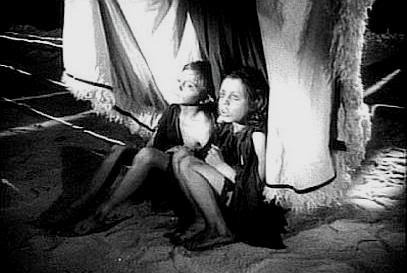
This boy is Ignorance. This girl is Want. Beware them both, and all of their degree, but most of all beware this boy, for on his brow I see that written which is Doom, unless the writing be erased. Deny it.' cried the Spirit, stretching out its hand towards the city. 'Slander those who tell it ye. Admit it for your factious purposes, and make it worse. And abide the end.'
'Have they no refuge or resource?' cried Scrooge.
'Are there no prisons?' said the Spirit, turning on him for the last time with his own words. 'Are there no workhouses?'"
This Christmas, as always, my fervent wish is that we use our wealth and our might to lift people out of poverty, to share the blessings that God has given us with the billions in the world who, through no fault of their own, have been left behind. But my most fervent wish is that we take back control of our media from the hands of multinational corporations, and bring real journalism back to America. Otherwise, we will remain ignorant of the crushing poverty and pain that others suffer, and we'll continue to live IN THE DARK.
- A Christmas Carol, Stave 3: The Second of the Three Spirits
Merry Christmas.
September 1, 2015
Propaganda as Psychic Violence
“We need a revolution,” Ellul concludes, “in a world in which it has become impossible,”The revolutionary spirit – the will to fight the violence of technique – demands that we acknowledge the fact that violence is a natural and normal part of society, that it dwells in what Ellul calls “the realm of necessity” “imposed on governors and governed, on rich and poor. If this realism scandalizes Christians, it is because they make the great mistake of thinking what is natural is good and what is necessaryis legitimate.”In considering violence to be part of the human condition dwelling in the realm of necessity, and acknowledging that fact, it might become possible to cease our attempts to avoid it. For in our avoidance, it seems, we often do nothing more than replace one form of violence with another, move the realm of necessity from the world of nature to the world of technique. With great and constant and unavoidably violent force, our technological culture promises to protect us from violence and consistently delivers on that promise. All we have to do in return is to allow ourselves to be constrained, limited, shaped, and guided by values that aren’t our own; to give up everything that makes us most authentically human – our curiosity and creativity, our empathy and reason, our organic connections to nature and to each other. True human freedom is found in that brief, too-frequently comfortable interval between the stimulus and the response, between the offer and the acceptance, and in the realization that freedom is that perpetual struggle against necessity implicit in our conscious free will.
Ibid., p. 118. Ibid. Ellul (1969), op. cit., p. 127.
June 5, 2015
Why We Fight: Resisting the Incursion of Free-Market Technique in US Higher Education (An Educator's Manifesto)
(This is a brief excerpt of a paper I'll be delivering in July in France at a colloquium on "Resistance in the work of Jacques Ellul")
We are now being told that a transformation is under way in American Higher Education. This transformation is commonly explained by two major factors: 1] cuts in state support for higher education, and 2] increased competition from non-traditional educational institutions (e.g., on-line “universities” such as the University of Phoenix, Argosy University, and Capella University). Universities have become dependent on tuition due to decreased external (usually state) funding; in fact, nearly half (47%) of the national average institutional cost of educating a student is paid for by tuition,Unprecedented problems confront our campuses. Institutions ignore a changing environment at their peril. Like dinosaurs, they risk becoming exhibits in a kind of cultural Jurassic Park: places of great interest and curiosity, increasingly irrelevant in a world that has passed them by.Many governing boards, faculty members, and chief executives believe that internal governance arrangements have become so cumbersome that timely decisions are difficult to make, and small factions often are able to impede the decision-making process.In response to these systemic economic problems, university administrators across the country have introduced with surprising consistency – to the dismay of faculty and of many staff but with the encouragement of governing boards – sets of policies that, while no two universities may have exactly the same response, still contain a number of curiously similar items: the elimination of tenure, diminution of faculty’s role in shared governance, the remediation of “curricular stagnation,” an increase in (faculty) productivity, the control of costs, etc.
Notwithstanding the sacrifices that have been borne – almost exclusively – by faculty and staff around the US in the last several years (faculty salaries have essentially flat-lined in the last few years and in many cases have not kept up with inflationI believe that US higher education is on the verge of adopting a “free-market” model of higher education, a top-down structure of bosses and workers, a commoditization of information that mirrors the technological society, that focuses not on the needs of students as citizens and people, but on the culturally-derived desires of students as consumers and future functionaries of the free market.
Woodhouse, Kellie. Public Colleges' Revenue Shift, Inside Higher Education, April 13, 2015. Accessed April 15, 2015 from: https://www.insidehighered.com/news/2015/04/13/report-shows-public-higher-educations-reliance-tuitionBidwell, Allie. Colleges Get More State Funds, but Rely on Tuition. US News & World Report, April 21, 2014. Accessed April 16, 2015 from: http://www.usnews.com/news/articles/2014/04/21/states-increase-higher-education-spending-rely-on-tuition-in-economic-recoveryThe Institute for College Access and Success. Quick Facts About Student Debt, March 2014. Accessed April 16, 2015 from: http://ticas.org/sites/default/files/pub_files/Debt_Facts_and_Sources.pdfIbid. Kellogg Commission on the Future of State and Land-Grant Universities. Taking charge of change: Renewing the promise of state and land-grant universities. (Washington, DC: National Association of State Universities and Land-Grant Colleges, 1996), p. 1.Board of Directors, Association of Governing Boards of Universities and Colleges. AGB Statement on Institutional Governance. (Washington, DC: Association of Governing Boards of Universities and Colleges, 1998), p. 3.Curtis, John, and Thornton, Sarenna. Losing Focus: The Annual Report on the State of the Profession, 2013-14. Academe (Washington, DC: American Association of University Professors, March-April 2014), p. 5.Jaschik, Scott. The Disappearing Tenure-Track Job. Inside Higher Education, May 12, 2009. Accessed May 12, 2015 from: https://www.insidehighered.com/news/2009/05/12/workforce Jacobs, Ken; Perry, Ian; and MacGillvary, Jenifer. The High Public Cost of Low Wages. The University of California at Berkeley Center for Labor Research and Education, April 2015. Accessed June 2, 2015 from: http://laborcenter.berkeley.edu/pdf/2015/the-high-public-cost-of-low-wages.pdf
February 20, 2014
W. H. Auden's "The Unknown Citizen" -- a Critical Analysis
.jpg) The Unknown CitizenThis Marble Monument
The Unknown CitizenThis Marble MonumentIs Erected by the State)
[
[
The bureaucrat brings the poem around full circle. The “unknown citizen’s” life is planned, measured, and evaluated in real time. Judgments are made not on the basis of achievements, but on the ability to adhere to the plan – on both the individual basis but also on the basis of the plan’s effects on the level of the mass. Notations are made only of deviations from the expected norm of the mass, not on the basis of objective achievements of the individual. So the fact that we (the bureaucratic class) are not aware of any “problems” (deviations from the mass norm) is all the sign we need to make the final judgment: not whether the “unknown citizen” was either free or happy (words which have no meaning in this technological context), but whether he was in conformity with the expectations of social planners. A perverse sort of utopia if ever there was one.