Peter K Fallon's Blog, page 4
December 2, 2011
It's Official...

Donald Trump is moderating a Republican debate in Iowa on December 27. The twice-bankrupt real estate developer, birther, and reality television star with the docile badger on his head will moderate "The Newsmax Ion Television 2012 Presidential Debate," which I'm sure was deliberately misnamed to sound far more important than history will prove it to be (it is, to be accurate, a Republican Presidential primary debate).
Pity the poor Republican. This primary season has already had the atmosphere of a circus; in lieu of ideas or palatable policies, candidates have tried to "come off" as various things, to project various images. There's Newt the intellectual (!), Newt the historian (!), Michelle the historian (!!), Rick P. the tough-talkin' Texan, Rick the only-real-Republican, Ron the hard-headed realist, and most entertaining of all, Herman the Herminator. ( Just how many clowns can you fit in that little car? ) The most memorable catch-phrases of the primary season thus far have included:
Apples and Oranges (Cain)
Nein, nein, nein!!! (Cain)
Now, I don't have the facts to back this up... (Cain)
Ummmm...ummm...uh... (Perry)
Obama put us in Lybia. Now he's going to put us in Africa. (Bachmann)
Let him die! (Paul)
Hey, remember me? (Santorum)
Why am I even here? (Huntsman)
Perhaps after December 27, we'll have one more phrase to remember, courtesy of the Donald: You're Fired!!!


November 21, 2011
On This Date in 1511...
On November 21, 1511, Antonio de Montesinos, a Dominican Friar from Spain, attempting to free the Indians from the slavery to which the Spanish -- both military and clerical -- had reduced them, preached an incendiary sermon which incurred the wrath of many Spanish Catholics -- incendiary in the sense that his soul was on fire, ignited by truth. For his efforts he became an object of Spanish persecution.
I am the voice of one crying in the wilderness. In order to make your sins known
to you I have mounted this pulpit, I who am the voice of Christ crying in the
wilderness of this island; and therefore it behooves you to listen to me, not
with indifference but with all your heart and senses; for this voice will be the
strangest, the harshest and hardest, the most terrifying that you ever heard or
expected to hear…This voice declares that you are in mortal sin, and live and
die therein by reason of the cruelty and tyranny that you practice on these
innocent people. Tell me, by what right or justice do you hold these Indians in
such cruel and horrible slavery? By what right do you wage such detestable wars
on these people who lived mildly and peacefully in their own lands, where you
have consumed infinite numbers of them with unheard of murders and desolations?
Why do you so greatly oppress and fatigue them, not giving them enough to eat or
caring for them when they fall ill from excessive labors, so that they die or
rather are slain by you, so that you may extract and acquire gold every day? And
what care do you take that they receive religious instruction and come to know
their God and creator, or that they be baptized, hear mass, or observe holidays
and Sundays? Are they not men? Do they not have rational souls? Are you not
bound to love them as you love yourselves? How can you lie in such profound and
lethargic slumber? Be sure that in your present state you can no more be saved
than the Moors or Turks who do not have and do not want the faith of Jesus
Christ.
His sermon provoked great resentment among the Spanish Conquistadors, much as the anti-war, anti-corporate rhetoric of the Christian "left" and the Occupy Movement incites resentment among the modern, global Conquistador class. Montesinos was accused of preaching heresy by a church hierarchy tainted by Spanish gold. Yes, the church and the elite of society, who controlled the wealth and profited from the exploitation of the weak, called Montesino's sermon, which called for justice based on the inherent equality of the immortal soul, "heretical." The more things change, the more they stay the same.
However, after hearing Montesinos preach, a Spanish priest by the name of Bartolomeo de Las Casas had a conversion experience. He saw the truth in Montesinos's words. In 1514, he became a Dominican Friar, freed his Indian slaves, and began a quest to ban slavery and bring justice to the Americas. He condemned the use of torture and coercion in the evangelization of the people of the new world. Las Casas helped to draft laws which banned slavery. Until the end of his life, Las Casas continued to speak out but he had few supporters. I'm not surprised. Do not expect people to rally around you when you are speaking the truth about their -- and your -- common human imperfections. No one wants to hear they're doing the wrong thing. No one wants to think that God is NOT on their side.
Montesinos and Las Casas were prophets, as Martin Luther King, Jr. was a prophet, and Oscar Romero was a prophet. And prophets don't live long. To paraphrase Leo Rosten, conservatives make heroes out of prophets only after they've martyred them. Today is the anniversary of a simple man's simple message of justice. Montesinos was a prophet belonging to a preaching order with a history of fighting heresies.Today's heresies include inequality, injustice, exploitation and the ascendancy of an omnipotent self-interest over the common good.
Wanna fight?

October 8, 2011
Cantor: Occupy Movement is a "Mob"
Thursday at the "Values Voters Summit" in Washington, House Majority Whip Eric Cantor (R-VA) said he was becoming "increasingly concerned" about the "mobs" who were occupying Wall Street and other cities across the country.
The mainstream media narrative of the occupy movement is that it is leaderless (as though that's a bad thing) and without defined goals. Right-wing bloggers consider the movement to be populated by "socialists, communists, and delinquents."
I thought I'd go downtown (Chicago) on Friday and see how dangerous this "mob" of communists is. It turns out, I think, that Eric Cantor is right to be concerned -- but not for the reasons he insinuates.

August 8, 2011
A Wish on the Feast Day of St. Dominic
St. Dominic de Guzman
His sermon provoked great resentment among the Spanish Conquistadors, much as the anti-war, anti-corporate rhetoric of the Christian "left" incites resentment among the modern, global Conquistador class. Montesinos was accused of preaching heresy by a church hierarchy tainted by Spanish gold. Yes, the church and the elite of society, who controlled the wealth and profited from the exploitation of the weak, called Montesino's sermon, which called for justice based on the inherent equality of the immortal soul, "heretical."
I am the voice of one crying in the wilderness. In order to make your sins known to you I have mounted this pulpit, I who am the voice of Christ crying in the wilderness of this island; and therefore it behooves you to listen to me, not with indifference but with all your heart and senses; for this voice will be the strangest, the harshest and hardest, the most terrifying that you ever heard or expected to hear…This voice declares that you are in mortal sin, and live and die therein by reason of the cruelty and tyranny that you practice on these innocent people. Tell me, by what right or justice do you hold these Indians in such cruel and horrible slavery? By what right do you wage such detestable wars on these people who lived mildly and peacefully in their own lands, where you have consumed infinite numbers of them with unheard of murders and desolations? Why do you so greatly oppress and fatigue them, not giving them enough to eat or caring for them when they fall ill from excessive labors, so that they die or rather are slain by you, so that you may extract and acquire gold every day? And what care do you take that they receive religious instruction and come to know their God and creator, or that they be baptized, hear mass, or observe holidays and Sundays? Are they not men? Do they not have rational souls? Are you not bound to love them as you love yourselves? How can you lie in such profound and lethargic slumber? Be sure that in your present state you can no more be saved than the Moors or Turks who do not have and do not want the faith of Jesus Christ.
The more things change, the more they stay the same.
However, after hearing Montesinos preach, a Spanish priest by the name of Bartolomeo de Las Casas had a conversion experience. He saw the truth in Montesinos's words. In 1514, he became a Dominican Friar, freed his Indian slaves, and began a quest to ban slavery and bring justice to the Americas. He condemned the use of torture and coercion in the evangelization of the people of the new world. Las Casas helped to draft laws which banned slavery. Until the end of his life, Las Casas continued to speak out but he had few supporters.
I'm not surprised. Do not expect people to rally around you when you are speaking the truth about their -- and your -- common human imperfections. No one wants to hear they're doing the wrong thing. No one wants to think that God is NOT on their side. Montesinos and Las Casas were prophets, as Martin Luther King, Jr. was a prophet, and Oscar Romero was a prophet. And prophets don't live long. To paraphrase Leo Rosten, conservatives make heroes out of prophets only after they've martyred them.
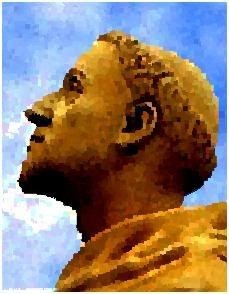
Today is the feastday of Dominic de Guzman, the founder of this preaching order with a history of fighting heresies.Today's heresies include inequality, injustice, exploitation and the ascendancy of an omnipotent self-interest over the common good.
Wanna fight?


April 21, 2011
Survey: Plurality of Americans Believe Capitalism at Odds with Christian Values
Nearly 6 in 10 Americans (58%) see the Federal budget as a moral document that reflects our national priorities. A full 60% believe that this recession is something other than a "natural" downturn, and 30% blame greedy businesses making risky market speculations, while another 52% blame government failure to regulate business activity.
66% of Americans think it is fair to ask wealthier Americans and corporations to bear a greater tax burden than the poor and middle class and 62% believe that the concentration of wealth in the hands of a small minority is a serious problem. 44% believe that Capitalism is fundamentally at odds with Christian values.
The findings seem to hold true across political and demographic lines, except for the Tea Party, a majority of whom seem to believe that capitalism (like America) was ordained by God. To them I offer the following:
Exodus 22:25-27 "If you lend money to My people, to the poor among you, you are not to act as a creditor to him; you shall not charge him interest. If you ever take your neighbor's cloak as a pledge, you are to return it to him before the sun sets, for that is his only covering; it is his cloak for his body. What else shall he sleep in? And it shall come about that when he cries out to Me, I will hear him, for I am gracious."
Psalm 15:1-5 "O LORD, who may abide in Your tent? Who may dwell on Your holy hill? He who walks with integrity, and works righteousness, and speaks truth in his heart. He does not slander with his tongue, Nor does evil to his neighbor, Nor takes up a reproach against his friend; In whose eyes a reprobate is despised, But who honors those who fear the LORD; He swears to his own hurt and does not change; He does not put out his money at interest, Nor does he take a bribe against the innocent. He who does these things will never be shaken."
Deuteronomy 15:7-8 "If there is a poor man with you, one of your brothers, in any of your towns in your land which the LORD your God is giving you, you shall not harden your heart, nor close your hand from your poor brother; but you shall freely open your hand to him, and shall generously lend him sufficient for his need in whatever he lacks."
Deuteronomy 15:10-11 "You shall generously give to him, and your heart shall not be grieved when you give to him, because for this thing the LORD your God will bless you in all your work and in all your undertakings. For the poor will never cease to be in the land; therefore I command you, saying, 'You shall freely open your hand to your brother, to your needy and poor in your land.'"
Deuteronomy 24:14 "You shall not oppress a hired servant who is poor and needy, whether he is one of your countrymen or one of your aliens who is in your land in your towns."
Leviticus 25:35-38: "'Now in case a countryman of yours becomes poor and his means with regard to you falter, then you are to sustain him, like a stranger or a sojourner, that he may live with you. Do not take usurious interest from him, but revere your God, that your countryman may live with you. You shall not give him your silver at interest, nor your food for gain. I am the LORD your God, who brought you out of the land of Egypt to give you the land of Canaan and to be your God.'"
Matthew 19:21-24 "Jesus said to [the wealthy young man], 'If you wish to be complete, go and sell your possessions and give to the poor, and you will have treasure in heaven; and come, follow Me.' But when the young man heard this statement, he went away grieving; for he was one who owned much property. And Jesus said to His disciples, 'Truly I say to you, it is hard for a rich man to enter the kingdom of heaven. Again I say to you, it is easier for a camel to go through the eye of a needle, than for a rich man to enter the kingdom of God.'"
Mark 10:21-25 "Looking at [the wealthy young man], Jesus felt a love for him and said to him, 'One thing you lack: go and sell all you possess and give to the poor, and you will have treasure in heaven; and come, follow Me.' But at these words he was saddened, and he went away grieving, for he was one who owned much property. And Jesus, looking around, said to His disciples, 'How hard it will be for those who are wealthy to enter the kingdom of God!' The disciples were amazed at His words. But Jesus answered again and said to them, 'Children, how hard it is to enter the kingdom of God! It is easier for a camel to go through the eye of a needle than for a rich man to enter the kingdom of God.'"

March 23, 2011
TIPS FOR PEACEFUL TOTALITARIAN RULE
What developing nations seek today is not democracy – for they see no evidence of its usefulness anywhere in the world – but stability. It is stability that is necessary to create the fertile ground for investment, technological development, and global trade. It is to this end that I offer ten tips to achieve this stability, and peace:
1] Celebrate materialism and eliminate idealism. Happiness comes from the consumption of material goods. Utilize the vast resources of mass media to reinforce this message on a minute-by-minute basis. Transcendent ideas – whether "God," or "liberty," or "sovereignty," or "truth" – can never be allowed to subvert the primacy of money and material goods.
2] Extol the virtues of a "free-marketplace of ideas." Flood your media networks with entertainment, diversions, amusements, and trivia. Remind the people repeatedly that they have an absolute right to choose whatever "information" suits them.
3] Make truth subjective. There can be no absolutes. Truth arbitrarily limits human behavior to the moral. Moral absolutes have no place in a pluralistic society. Everyone should have the right to his or her own opinion, no matter how preposterous, or self-serving, or manipulative it is.
4] Redefine "objectivity" in journalism to mean "neutrality." Journalism must be "fair" and "balanced," not truthful. Neutrality implies openness to all points of view, even those that are objectively false. Objectivity implies openly acknowledging truth and falsehood among arguments. This is dangerous.
5] Make the people understand that education is about a skilled workforce, not about an informed electorate. The Enlightenment is over. History ended with the fall of Communism. It's all about jobs now. Focus on skills, not critical thinking. Focus on technology, not ethics.
6] Encourage reductionism in public discourse. Nuance demands careful, critical thought (see number five). Seeing gray areas in a situation only invites ethical analysis. Presenting problems as "us vs. them" or "good vs. evil," and referring to "enemies" is more effective in engendering and supporting group cohesion. Use stereotypes at every opportunity. Any problem that can't be explained in a 20 second sound bite should be left to "experts" to solve.
7] Nurture "individualism," but discourage individuality. People should labor under the illusion that they are true individuals rather than mere constituents of a mass. The isolation of mass society encourages group identity and consensus building. Constant connection to the group via mass-mediated diversions ensures no real, meaningful critical thought will ever occur.
8] Make a fetish of personal responsibility; ignore social responsibility. Emphasize constantly the notion that people are responsible for their own actions; ignore any possibility that they may be responsible to one another. As long as one's behaviors are consistent with those of one's group, no good can come of dwelling on the consequences of those actions for others outside the group.
9] Don't persecute dissidents – ignore them. Americans still know the name Aleksandr Solzhenitsyn and can identify him as a dissident of the former Soviet Union. The same is true of Chinese dissident Liu Xiaobo who enjoys a prominent place in the US media. But Noam Chomsky or Howard Zinn or Daniel Berrigan? Who are they? American media simply ignore them. Prison is unnecessary when no one knows you exist.
10] Keep 'em smiling. ☺

March 8, 2011
Happy 80th Birthday, Neil Postman

"Children are the living messages we send to a time we will not see." -- Neil Postman (The Disappearance of Childhood, 1982) A note from Lance Strate: Friends, today is the 80th anniversary of Neil Postman's birth, and by way of honoring his memory, I want to ask you, and especially those of you who have blogs and websites and/or are on Twitter, Facebook, YouTube, and the like, to help in an effort to correct an injustice that exists online. Neil's most memorable quote is, "Children are the living messages we send to a time we will not see." But if you Google that quote, you'll find that more often than not, it is attributed to someone else, specifically John W. Whitehead (the rightwing lawyer who represented Paula Jones against Bill Clinton). Naturally, this is upsetting for many of us, and it is pretty much impossible to get websites to change their listings, but we can drive themdown in the Google rankings by posting in searchable sites that Neil Postman wrote "Children are the living messages we send to a time we will not see." So, we have a begun a campaign on this day to spread the word, and set the online record straight, at least as much as possible. Glad to help, Lance. And anyone reading this who'd like to set the record straight, feel free to post this great quote from one of America's great thinkers of the last century.

February 27, 2011
The Cheddar Revolution: How Many People Attended the Rally in Chicago?
Was I wrong in my estimate? Sure. I'm no expert in this stuff. Was I that wrong? I don't think so. So I did some thinking and some poking around to try to figure out where I got the idea that several thousand protesters – not several hundred – filled the plaza at Chicago's Thompson Center yesterday.
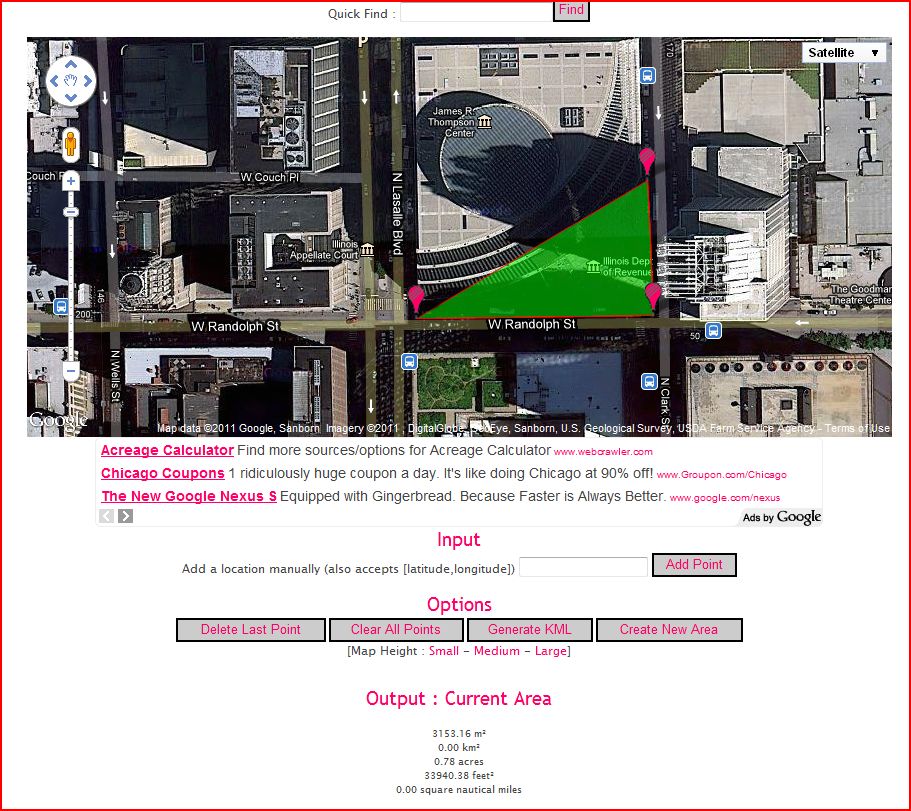 I figured I needed to find out the area of that plaza before I could figure out how many people could fit into it. So I got the latitude and longitude coordinates of the roughly triangular plaza of the Thompson Center using Google Earth. I then calculated the area of the plaza at the Thompson Center using the Google Maps Area Calculator Tool. The highlighted area (click on the map to see it full size) where the rally took place constitutes 33,940.38 feet². Let's be conservative (so to speak) and round it off to 30,000 square feet.
According to the Poynter Institute, working to improve American journalism since the 1970s, crowd estimates are difficult, but not impossible:
So by this rule of thumb, in 30,000 square feet of space a loose crowd would consist of about 3,000 people. A more tightly-packed crowd would contain more than 6,000 people, and a truly dense crowd, jam-packed into 30,000 square feet, could easily be close to 12,000 people.A loose crowd, one where each person is an arm's length from the body of his or her nearest neighbors, needs 10 square feet per person. A more tightly packed crowd fills 4.5 square feet per person. A truly scary mob of mosh-pit density would get about 2.5 square feet per person.
The trick, then, is to accurately measure the square feet in the total area occupied by the crowd and divide it by the appropriate figure, depending on assessment of crowd density.
Now this was a pretty tightly-packed crowd at yesterday's rally, but it wasn't 12,000 people. But I think my initial estimate of between 5,000 and 6,000 people is pretty close.
So why are the local media reporting that "several hundred people" showed up?

February 26, 2011
The Cheddar Revolution
A Rally in Support of Wisconsin's Public Workers from Dr Fallon on Vimeo.
Chicago went all Cairo today on Wisconsin Governor Scott ("I've got a baseball bat in my office") Walker as thousands of residents of the Windy City showed up at the State of Illinois Building (The Thompson Center) to protest Walker's cheesy, sleazy attempt to take away collective bargaining rights from state workers (translation: to break unions ).I'm not really very good at such things and I claim no true expertise, but I have had a little experience looking at crowds and figuring out how big they are, and I can tell you this: this was a BIG crowd.
The video gives only a flavor of the rally; I was too far from the podium to either see or hear the speakers very well (although I was glad to see my Senator, Dick Durbin, showing solidarity with the crowd) so don't look for speeches. But I spoke to several people to ask them why they were there. None of them were paid by wealthy ideologues to attend. They wanted to be there. Take a look and a listen.

October 3, 2010
My (Imaginary) Conversation with Marshall McLuhan
 I had heard of Marshall McLuhan's Understanding Media as a freshman in high school in 1968, but didn't read it until four years later when I got to college. It was only the second book I had read about the power of media to shape societies (oddly enough for an eighteen-year-old, my baptism into the field of media studies was provided by Harold Innis's The Bias of Communication, but I had to read that one several times before I really, truly even began to comprehend it), and it so captured my attention and fired my curiosity that I was compelled to spend the rest of my life studying the interactions of technology and culture. So I was thrilled and proud when my first book, Printing, Literacy and Education in Eighteenth Century Ireland: Why the Irish Speak English, won the Media Ecology Association's Marshall McLuhan Award for Outstanding Book in the Field of Media Ecology in 2007.
Yet, since almost the very beginning I've been bothered by McLuhan. I was looking for answers and McLuhan kept posing me riddles. Alternately dazzlingly clear and maddeningly cryptic, so much of what he had to say left many people feeling uncomfortable and skeptical; others, wildly enthusiastic and hopeful. For me – and many others who were moved to dedicate their lives to understanding media – McLuhan's words were intriguing and enticing, inviting questions and urging deeper consideration. They made my head hurt, but they showed me for the first time that questions are, after all, far more important than answers.
I have, I believe, come to terms with McLuhan in the intervening thirty-eight years. Or I have almost come to terms with him. I'm at the very least minimally comfortable with his method; the "probe," oracular aphorisms, heuristic in nature, not particularly suited to empiric measurement, a kind of "intellectual Rorschach test" that everyone can read something into and get something out of.
What I am not comfortable with is a single phrase: "A moral point of view is a poor substitute for understanding in technical matters." So I decided to sit and talk with him about it.
What follows is a (totally imaginary) conversation I had recently with the "the oracle of the electric age." Many of McLuhan's responses are direct quotes from his works, many more are close paraphrases altered only for the sake of the literary integrity (such as there may or may not be) of this essay. I have, by necessity, invented some of McLuhan's responses to my questions posed here, but only then on the basis of what I honestly believe might have been his actual response. Needless to say, this essay very possibly says more about me and my understanding of McLuhan than it does about McLuhan himself. But I'd be willing to argue that point:
Peter K. Fallon: "A moral point of view is a poor substitute for understanding in technical matters." Why? It seems to me that understanding technical matters absent a moral point of view is not "understanding" at all.
Marshall McLuhan: Well, first of all let me just mention that I don't always agree with everything I say. The point is not to say something and stand by it; the point is to push the limits of human perceptions and assumptions and see what we can find beyond them. If you don't like that idea, let's try something else.
PKF: Well, it seems to me that you're abdicating moral responsibility for questioning the role of media in social change. It seems to me that you're presenting as a given certain, almost pre-determined, consequences of technology and positing that this vague concept of "understanding" is all human beings can do in the face of rapid and radical technological change.
MM: Does that bother you?
PKF: Yes, it bothers me. It bothers me something awful. I have spent years defending you – from many who I don't believe really understand what you're saying – against the charges of "technological determinism," yet in far too many cases you sound as though you're saying that the best we can hope for is to understand the changes that technology brings us, not manage them.
MM: What does it matter if some call me a "technological determinist" or a "guru" or, for that matter, a "Charlatan"? There is absolutely no determinism in my work, because I urge a willingness to contemplate what is happening. I need no defense, Peter, from such charges. My job, as I see it, is to alert people to the changes going on around them. That in itself is a moral imperative, and no abdication of responsibility. Everybody experiences far more than he understands. Yet it is experience, rather than understanding, that influences behavior. I've just tried to bring more understanding into the picture. The electronic age has presented us with a dilemma: we are awash in electronic and digital information, and the swirl of this maelstrom of information tosses us about like corks on a stormy sea. But if we keep our cool during our "descent into the maelstrom," and study the process as it happens, like Poe's sailor we can save ourselves.
PKF: Yes. That's another thing. It's always bothered me that the "old sailor" – who was, of course, not old at all but aged prematurely by his ordeal – did not or could not save his brothers. One brother is flung outright from the boat, another goes mad at the sight of the enormous whirlpool and dies in its vortex. But the "old sailor" "keeps his cool" as you say and studies the patterns of the maelstrom. He notices – in a way that presages Einstein and relativity – that in the midst of the maelstrom's power, with its force propelling the boat in circles within its cone, he appears to be sitting still, and the opposite side of the whirlpool remains stationary in relation to him.
MM: Moving along within the maelstrom, at its speed, in its direction, there is a certain curious peace, and the sailor has time to study its patterns and make inferences about its behavior.
PKF: Yes, and he saves himself with the knowledge he gains within the chaos. But his brothers die.
MM: Well, yes. But, Peter, it's only a story. No one actually died in its telling by Edgar Poe.
PKF: But it's a story that describes your views on understanding media, that you have stated serves as a metaphor for your approach to studying media and their effects. And so we're back to my original difficulty: the idea of understanding anything absent a moral point of view. Why didn't he try to save his brothers?
MM: Because he would have died, it's as simple as that. Why is what you call "a moral point of view" so important to you, Peter? Is a "moral point of view," by its nature, any better or worse than an immoral point of view, or an amoral point of view, or a secular point of view, or a humanist point of view? Point of view, whatever its orientation, is imaginary. It is part and parcel of the typographic mindset, the cordoning off of the individual from the group, the artificial separation of one from the other. We don't live in that world anymore, but in a world of electric simultaneity that brings people together in a tribal village that is a rich and creative mix, where there is actually more room for creative diversity than within the homogenized mass urban society of Western man. In such a world a point of view – any point of view – reveals itself to be a dangerous luxury, an intellectual self-indulgence, especially when substituted for insight and understanding.
PKF: A world of chaos and – to use Harry Frankfurt's term – bullshit, if you ask me. A world with no point of view and no real knowledge. "Understanding media" today means the opposite of what you probably intended – or perhaps not…? "Understanding media" means knowing how to work them, knowing how to use them. Literacy has given way to "media literacy" and "information literacy" and "visual literacy" and point of view has given way to pointlessness and objectivity has given way to a truly egoistic subjectivity…I see no "rich and creative mix" – although people tell me I'm constantly surrounded by it – any more than I see understanding. And I don't see understanding any more than I see a moral point of view. We're left with nothing except a sort of psychic "I got mine, fuck you" environment that empowers us (if that is at all the appropriate word) to focus on ourselves to the detriment of the rest of the world. It seems to me that in a world like this, a point of view – if it is a positive point of view – is a Godsend. But what is worse, any point of view – even an entirely stupid one – strikes many who have none of their own, and are entirely unable to identify one, as a Godsend.
MM: Peter, you may be over-reacting. This age we live in of infinite connections and the liberation of consciousness from the body – the age of "discarnate man" – is barely half a century old. Innumerable confusions and a feeling of despair such as those you appear to feel invariably emerge in periods of great technological and cultural transition. Your assumptions about alphabetic man, if you'll allow me to say to you critically, may have outlived their uselessness. It was alphabetic man himself who was disposed to desacralize his mode of being, not we. In this electronic age we see ourselves being translated more and more into the form of information, moving toward the technological extension of consciousness, a seamless web of experience. This is not the individualist, trivial (in all senses of the word) consciousness of alphabetic man, but a consciousness that begins in the senses, is rooted in perception, and is derailed by concepts or ideas.
PKF: I know you're referring now, however obliquely, to your Christian faith, and specifically to your adopted faith of Catholicism.
MM: As you say.
PKF: And here again I have a hard time coming to terms with your ideas, which to my ears sound so sanguine. I know that your work was profoundly influenced by that of Pierre Teilhard de Chardin.
MM: I am not in the slightest influenced by Fr. Teilhard's works, even though we may share areas of common interest.
PKF: As you say. But Teilhard famously anticipated many of your ideas and even your tone. And I am a great admirer of Teilhard's work, as I am of yours…
MM: (~~feigns satisfaction with an irrelevant opinion~~)
PKF: …and I hope – no, I pray – that Teilhard is correct about many of his ideas, but I fear he is wrong. Because in the final analysis I do in fact see a determinism in your work, but it is not a technological determinism. It is a determinism of faith and salvation. Teilhard's "noosphere" is merely an anticipation of your "global central nervous system." And Teilhard's conception of the "Omega point" – the parousia – sounds very much like your idea that "Psychic communal integration, made possible at last by the electronic media, could create the universality of consciousness foreseen by Dante when he predicted that men would continue as no more than broken fragments until they were unified into an inclusive consciousness. In a Christian sense, this is merely a new interpretation of the mystical body of Christ; and Christ, after all, is the ultimate extension of man." You appear to have adopted an eschatological approach to your pursuit of understanding media – very, very similar to Teilhard's – that you don't ever explicitly identify.
MM: Is that so?
PKF: Well, I certainly believe it is so. It seems to me that you've put your faith entirely in acceptance of Christ – medium and message – without ever considering the human agency involved in salvation. As a Catholic, and in the knowledge of your devout Catholicism, I'm confounded by what sounds to me like the Protestant principle of sola gratia – salvation by God's grace alone – ignoring the quintessential Catholic principle of salvation by grace and good works. Your "evangelism" – it seems to me – is more of the Lutheran or Reformation variety than of a fully- (and rightly-) formed Catholic one.
Understanding media alone will not bring about a better world (the Kingdom of God?), but ought to be the foundation of good works that may bring it about: constructing an environment of truly free-flowing and uninhibited information, to be sure, but also reaffirming and supporting the structures of thought that allow us to identify error and falsehood, and empowering us to label bullshit as bullshit, as Harry Frankfurt suggests. The global village, with its "rich and creative mix" full of "creative diversity" can be the perfect venue to put bullshit on an equal footing with truth. I see nothing in this situation that is either constructive or Catholic.
MM: That is your point of view.
PKF: (~~sigh~~) Yes, it is. I'll stand by it.
MM: In my defense, I'll say only this: The revealed and divinely constituted fact of religion has nothing to do with human opinion or human adherence. In Jesus Christ, there is no separation or distance between the medium and the message; it is the one case where we can say that the medium and the message are fully one and the same. To know Christ – to truly know him – is to accept Him. And there is no greater moral action – no greater "good work" – than understanding media.
At any rate, that's how I imagine the conversation going...