
Larry Gottlieb's Blog: The Insights Blog, page 2
June 8, 2023
On the Spirituality of Physics: Three
In my last post, I made the following claim: quantum physics shows us that the world we experience is fully dependent on our observation of it and that the independent reality of the world (i.e. independent of us) is an illusion. It follows that our strategies for living are rendered obsolete by this understanding. This begs the question, “What does this mean for human beings?”
One of our culture’s profound illusions is that there is a world which exists independently from any and all observation of it. Ruediger Schack, in the online publication The Conversation, has pointed out that “The starting point for most philosophers of physics is that quantum mechanics must somehow provide a description of the world as it is independently of us, the users of the theory.”
Quantum physics, I believe, flatly denies this interpretation. Instead, it shows that the world exists as a field of weighted possibilities (i.e. probabilities) for the results of any experiment that will be performed on the world. It further shows that any attempt to measure or observe any part of the world causes that field to collapse into the one possibility that is actually observed.
There have been many attempts to interpret this finding, none of which is truly definitive. For a century, physicists have argued about how observation of a system can cause one possibility to emerge from a field of possibilities when the laws of quantum physics contain no mechanism for this emergence.
Since we always start from the assumption that the world exists independently of us, once we encounter quantum theory as probable outcomes of experiment, we assume that these probabilities are somehow inherent in the physical system we’re observing. Yet, a century and more of theorizing has yet to provide a mechanism that yields these probabilities.
I believe that the most plausible resolution of this quandary lies in the recognition that the world we experience is actually a picture formed in our brains by interpretation of sensory data. That is, what we think of as the external world is in reality an interpretation, and all such interpretations are conditioned by past experience, trauma, memory, and many other subjective factors. We could interpret that sensory data in many ways, the most probable of which is in accord with what our culture has taught us, what “everybody knows.”
When we look at the world as an interpretation of something that is in itself essentially unknowable, optimizing our experience is no longer about solving problems or trying to change conditions. Instead, it is about crafting our interpretations to optimize the quality of our experience.
Another of our culture’s profound illusions is that the resources required for our physical and emotional wellbeing are limited. That would be true if the world were “real” in the scientific sense. The definition of “real” in physics is that “objects have definite properties independent of observation.” The 2022 Nobel Prize in physics was in part awarded for the demonstration that this is not the case, that the objects composing the world do not have definite properties when they are not being observed. We are interpreting signals that represent something, but that something is not the objective reality we think it is.
Here is the key idea: The world we experience is the product of interpretation of something which is itself unknowable. Scarcity, the limits we believe apply to the available supply of physical stuff, is part of this interpretation. The field of possibilities we are interpreting is not limited; that field is infinite. In other words, interpretation as a phenomenon is not limited unless belief places a limitation upon it. If I free myself from a belief in limitation, I am free to interpret the field of possibililties however I choose.
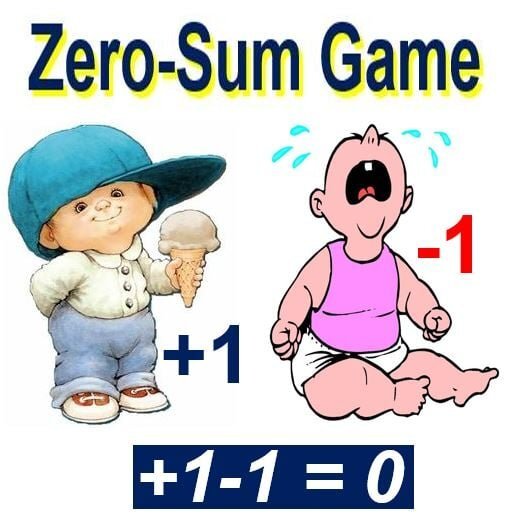
This argument shows, I believe, that so-called zero-sum games are artificial. Zero-sum games are systems in which what one gains another must lose. Again, that would be true if the world were “real,” if the stuff of the world were limited.
Believing in the finiteness of resources is required for zero-sum games. And this belief is the source of most, if not all, of our human misery. Ultimately, we fight over scarce resources: territory, wealth, and ideas which are themselves based on scarcity, such as markets, political and other arguments,


June 4, 2023
A Big-Picture Story

While traveling in Guatemala last year, my wife and I had the opportunity to attend a Mayan cacao ceremony. There were about 25 of us, arranged in a circle on the floor. We were easily twice as old as the rest of our fellow attendees.
After some prayers and readings and drinking more unsweetened cacao than I ever imagined consuming, the leader of the ceremony told us a story about this time in human evolution. To the best of my recollection, this is what she said.
“During the period we refer to as the Second World War, those on the other side became concerned that this human experiment might entirely self-destruct. Some older souls chose to answer the call… to come forth into human form and hold the possibility of love and light on Earth.”
She particularly emphasized the dropping of the two atomic bombs, the first on Hiroshima on August 6, 1945, and the second on Nagasaki on August 9. She looked around the room and her eyes gazed into mine.
She said, “You appear to be the eldest of the group. When were you born?”
I answered, “I was born four days after Nagasaki.”
She said, “You were part of the first wave. You, and others after you, came forth to hold that space of possibility through some relatively dark times.”
That conversation had a profound impact on me. Those of you reading these words can, if you choose, consider yourselves part of the first few waves of souls who are here on Earth to lift us all up, to participate in what has been called the Ascension.
This lifting up requires the exploration and ultimately the discarding of our culture’s profound illusions. Observing recent as well as current events, I am compelled to conclude that such exploration requires seeing our illusions and their consequences “up close and personal.”
A list of those profound illusions would include, but not be limited to:
There are good guys and bad guys, good countries and bad countries
The resources required to live a good life are finite, limited, and therefore we must participate in zero-sum games
The universe is “local” - objects can only be influenced by their surroundings and such influence can’t travel faster than light
The universe is “real” - objects have definite properties independent of observation
Lifting one another up… what does that look like? A traditional way of looking at that phrase would imply speaking, or more technically, languaging, which can show up as speaking, writing, creating programs, and so on. It looks like somebody influencing another through words and actions.
Languaging, in turn, nearly always conjures putting something out into your surroundings. This idea rests on top of our belief that the universe is “local” - that we can only influence another by being part of their surroundings, and this influence must obey the realities of time and space.
But wait - I listed locality above as one of our culture’s profound illusions. What’s my justification for doing that?
Well, it’s the basis of the 2022 Nobel Prize in physics! That prize was given to three physicists for experiments that demonstrated the reality of quantum entanglement. Quantum entanglement shows that the idea that we can only influence objects, i.e. other people, through their physical surroundings is an illusion.
I propose that there is a profound implication inherent in this finding. The implication is that we can influence other people in ways that do not require obeying the usual rules of time and space, physical languaging, and so on.
I further propose that we live in a sea of illusions which obscure our true nature as creators. Any one of us who carries the knowledge of this condition, and who chooses to regard the world as our mutual creation, uplifts the entire world. That’s what the first few waves of souls emerging in and after 1945 are here to do. We are here to serve as guard rails, keeping the entire human experiment from going entirely off the rails.
It’s a profound responsibility we carry, to fulfill the purpose for which we’re here. It’s also a path of fulfillment and joy.
March 16, 2023
On the Spirituality of Physics: Two
Twentieth century physics represents a profound turning point in the history of science. It marks the time when we as a culture had to leave behind the comfortable world of common sense, where physics agreed with and supported what “we all know” about the world.
Three major ideas birthed during the early part of the century illustrate this profound new conception of the world. These ideas are:
Einstein
Special Relativity
General Relativity
Quantum Physics
Special relativity, credited to Albert Einstein, shows us that time and space are not just abstract ideas… they are entities with their own dynamics. That is, they expand and contract according to the relative motion of the observer and the observed.
General relativity, Einstein again, shows us that gravity is not a force. It is rather the interaction between a mass, or massive body, and a field we call the gravitational field. Einstein predicted that this field would support waves, a prediction that was borne out early in this century.
Bohr
Quantum physics, due to Bohr and many others, shows us that the world is not at all as we conceptualize it, and that the externality and persistence of the world we humans perceive is an illusion.
To get at what I call the spirituality of physics, we will consider the story that is called quantum theory.Quantum theory is a probablistic explanation of the subatomic realm, allowing us to predict with unequaled accuracy the probable results of any experiment to be performed in the future involving the behavior of the physical world at its smallest scale, the scale of atoms and subatomic particles.
Quantum theory does not describe the “external” physical world. It describes the likely result of any experiment performed on the world at this small scale. It is vital to realize that these two things are not the same! Quantum theory explicitly invokes the observer, the one conducting the experiment… and that’s you and me!
Once quantum theory was established as a reliable theory, it was noticed that certain quantum systems remain correlated even when their components are then separated by a great distance. These systems, even when separated by enormous distances, behave as one system. A measurement of one part of that system instantly measures that same aspect of the other, distant part. This phenomenon is called entanglement. Let’s see why quantum entanglement leads us to the spirituality of physics.
One of the foundational principles of modern physics is that the speed of light is the ultimate speed limit in the physical universe. This speed limit applies to objects in relation to an observer, and it applies to the transmission of information between observers. However, at first glance it appears as if this speed limit is violated by entanglement. If an observation of one part of an entangled system instantly determines the results of a measurements of the other, distant part, that would seem to allow information to flow between those two parts at a speed which is essentially infinite.
Either the speed of light is not the ultimate speed limit in the universe, or the idea that those systems are separated in space is somehow untenable.
Quantum entanglement implies that the universe is not “locally real” and its demonstration was the basis of the 2022 Nobel Prize in physics. “Real” means that objects have definite properties independent of observation. And “Local” means objects can only be influenced by their surroundings and such influence can’t travel faster than light. This is the principle of non-locality.
What does this tell us?We think objects have definite properties independent of observation. This is an illusion.
We think that objects are separated by distance. This is an illusion.
I suggest that the primary lesson we can draw from all this is that our conception of the world we live in is, as a whole, an illusion.This is why quantum physics is a profoundly spiritual discipline. It demonstrates that the world we experience is dependent on our observation of it and that its independent reality is an illusion. Realizing this truth renders almost all of our strategies for living obsolete. It calls for a whole new approach to the search for who each one of us really is.
More on that next time…
March 13, 2023
On the Spirituality of Physics: One

Love language
For some, it’s cooking. For me, one of them is playing music.
I believe the Universe has a multitude of these love languages, enough so that each of us can hear at least one and be drawn back by love to the Source of all that is. The one I first heard, many decades ago, was physics. I know it sounds odd, but bear with me…
Iin my several decades of inquiry, I have come to see spirituality as the name given to the search for what does lie behind the physical world… and for the possibility of seeing beyond the materialist view. For me, spirituality is neither a religion nor a set of beliefs. It is rather a path, in particular a pathway to a deeper understanding of life that can free us from the pain and sadness we feel when we confront the world in its current state.
How could physics contribute to that?
Let’s start by “listening” to the language of physics. At the beginning of the 20th century, there were four basic threads or principles that were woven through that worldview. They are:
Determinism
Reductionism
Materialism
Zero-sum-ism (I made that one up…)
Determinism means that everything that happens is determined by the state of the universe immediately before it happens. This applies to all the atoms in the universe… including the ones that make up our brains!
Reductionism means that to find out what something really is, you reduce it to its smallest indivisible components.
Materialism means that matter is the fundamental stuff of the universe, and everything is made of it… including consciousness!
Zero-sum-ism means that the “stuff” of the world is what’s real, it’s finite, and whatever is gained somewhere is lost everywhere else.

Woven threads
These four threads constituted physics at the beginning of the last century. That’s relatively easy to see. Harder to see is that they are woven through our collective worldview, our understanding of the world, to this day.
Back in 1974, I had a powerful, personal experience that ultimately cured me of my belief in those threads. You can read about it in either of my two books, The Seer’s Explanation or Hoodwinked: Exploring Our Culture’s Profound Illusions. Bottom line is, I had a direct and personal experience that while the laws of the physical universe are rigidly enforced, they can be suspended temporarily if the Universe wants to make a point. In addition, I had a direct and personal experience that while we perceive that consciousness resides within a body, it need not, and can be recognized to simply Be, unembodied.
I had to surrender determinism as a principle when I realized that what happened to me could not have been caused by anything that was in the world before that experience.
I had to release reductionism when I investigated quantum physics and understood that there are no smallest indivisible components to anything; there are just vibrations in various fields.
I had to give up materialism when I experienced that consciousness exists apart from matter.
Zero-sum-ism vaporized for me when I came to understand that what we think of as the external world isn’t external at all.
Now, I realize that last one is a bold (if not ridiculous) statement to make. It’s completely counter-intuitive, but the idea is really very simple. I’m inviting you to participate in a thought experiment. To get started, identify an object in your field of view.
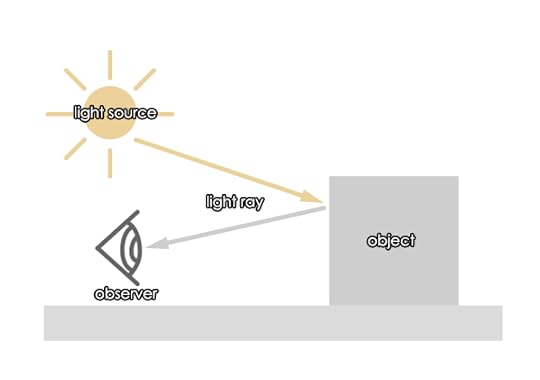
The story we’re told about vision is that light from a source, be it a star or a lightbulb, is reflected off that object and enters your eye. The light is focused on your retina, which contains rods and cones that transform the light energy into electrical impulses. These vibrations are conducted by the optic nerve to the brain.
Our brains then make three-dimensional pictures out of these impulses, much like televisions create pictures out of the electrical signals in the cable. These pictures (and sounds, etc.) constitute an interpretation of sensory input. They become a three-dimensional view, our view of the world.
Here’s my ask: that you seriously consider the possibility that what you’re looking at right now is a picture in your brain.
That picture is not “out there,” whereever out there might be. It’s within you, in your brain!
We humans mistake our pictures for the “real” world. What is the real world? We don’t know! We have no access to it, because our pictures of it, our interpretations of our sensory input, always stand in between. We walk around in this interpretation, inside these pictures we mistake for a real, external world.
We assume that our interpretations represent something that exists out there, independent of us. But there is no way to demonstrate that. And because you can’t demonstrate the independent existence of the world, the idea that it exists as we “know” it is a belief, a conceptualization.
When you see the world you know as a conceptualization, you have to release the independent reality of those four fundamental threads I spoke of earlier: determinism, reductionism, materialism, and zero-sumism. They become part of the concept, the belief system, the picture of the world. And when that happens, you find that you are creating the entirety of the world you experience!
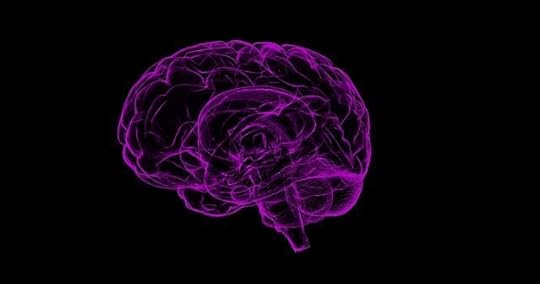
Oh, and here’s the kicker. The brain that creates a picture of the world out of sensory input? It’s part of the picture! It doesn’t exist independent of you any more than the rest of the world does. Brains don’t create consciousness. They exist as part of a picture created within consciousness as an explanation of what’s really going on.
Chew on that for a while. It will transform the quality of your life if you let it.
January 10, 2023
My Invented Self is Struggling
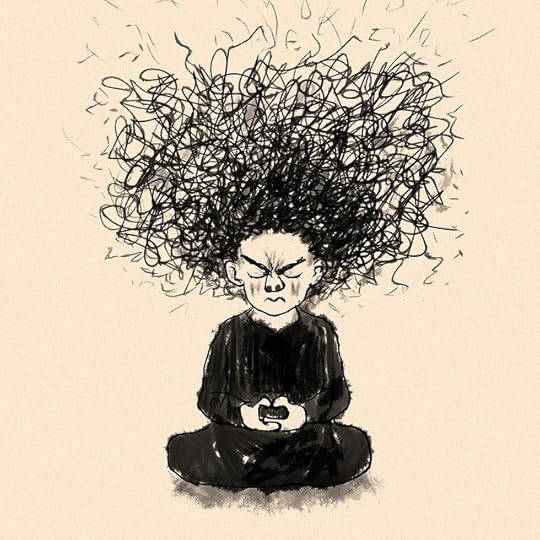
I feel the struggle in my chest. There’s a deep sadness in my heart, a longing to be free of the struggle, to soar.
When I think about my early years, I don’t remember any mistreatment per se… certainly not from my parents. But I don’t remember much joyful play either. Just kind of learning how to keep my parents pleased with me and avoid my dad’s anger.
My dad used to try to shape or direct me with that anger… I guess it was the only way he knew how. Meanwhile, I was engaged in building a persona I could use to both deflect the anger and cover up the feeling that I was its victim. I felt diminished in Dad’s presence, both in terms of his height advantage and what I believed to be my inability to make him proud of me. I know he wanted me to succeed, but I was never sure whether his desire was for my benefit or to make himself feel better as a father.
That persona I was building back then became an “invented self.” I shaped it in order to find ways to feel safe and valued and, well, significant. Constructing that invented self required virtually all my time and energy, and there wasn’t much of it left to remember my true Self.
Here’s what I wrote in my second book, Hoodwinked: Exploring Our Culture’s Profound Illusions:
“Each of us has a self-image to which we cling mightily. My self-image is that I am a kind and gentle person, warm and caring and considerate of all the people I encounter in my daily life. I like that self-image, and I’m happy to project it to everyone, old friends and new. The only problem is that it’s a contrivance. It’s part of who I learned to be to ensure that people would like me and include me so that I wouldn’t be alone. I think that, by far, the most difficult thing any human being could possibly do is to allow that self-image to crumble so that the real Being can emerge. It’s a terrifying prospect, giving up the mask that one has worn for so long and that we have fervently believed to be who we are. Who might we turn out to be?”
I’m feeling that difficulty now in my chest. My identification with that self-image, that invented self, is strong. I spent more than 70 years grooming it, hoping it would be resilient enough to cover up my true feelings.
These days, that invented self is struggling. It is increasingly being undermined by my true Being, my growing awareness of who I truly am. It’s being forced to tell the truth about what it’s been up to. It wants to continue to lie, to appear to have all the answers, and to hide its failures. For much of my life, it got away with all that because I identified my true Being with it. One day a number of years ago however, it made a critical mistake and I suddenly saw it as an imposter. Turns out, that was a one-way door. I couldn’t un-see it. And now, I find that I’m progressively withdrawing my support.
Without that support, the invented self teeters, like buildings on an unstable California coastline during one of these latest storms. It struggles to survive, to remain upright, and that’s what I feel in my chest. Perhaps it’s afraid, fearful of being found out, of being revealed as a fraud. Fortunately, my sense of the true Self within me rises to take its place. My invented self will never go away, not while I’m still here on Earth. It will remain, but it is increasingly confined to the back seat. Hands off the wheel, self-image! Your days are numbered, after all…
January 5, 2023
On Being a Guardrail
I’m old enough to remember the so-called Doomsday Clock. “Maintained since 1947, the clock is a metaphor for threats to humanity from unchecked scientific and technological advances. The clock's original setting in 1947 was seven minutes to midnight. It has since been set backward eight times and forward 16 times for a total of 24, the farthest from midnight being 17 minutes in 1991, and the nearest being 100 seconds, from 2020 to the present.” — Wikipedia
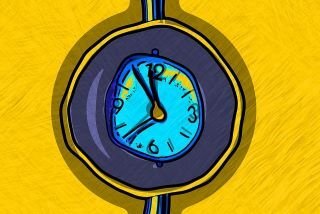
The Doomsday Clock
The Doomsday Clock is a metaphorical representation of how close the members of The Bulletin of the Atomic Scientists (a non-profit organization) believe we are to a man-made global catastrophe. In this metaphor, midnight represents that catastrophe.
In January 2020, the clock was moved forward to 100 seconds before midnight. The original setting, seven minutes to midnight, was undoubtedly the result of the atomic bombs dropped on Japan. The first, of course, destroyed Hiroshima on August 6, 1945, and the second obliterated Nagasaki on August 9. I was born on August 13 of that year.
Let me share a story relating to my birthdate. Last year, my wife and I attended a Mayan Cacao Ceremony in San Marcos La Laguna, Guatemala. As a prelude to the festivities, our Mayan shaman host referenced that particular time period. She related how those on the other side of the veil, having observed those terrible events in Japan, decided to send volunteers to incarnate on Earth to act as counterbalance to the prevailing forces at work on the planet.
According to the shaman, those of us who came forth immediately after the end of World War II were termed the “first wave.” When I heard that story, something clicked into place, though it has taken about nine months for the idea to take sufficient form that I could talk about it.
How does one act as a counterbalance to prevailing forces? What are those prevailing forces, and how do they shape actual events?
One of the principles spoken about in spiritual circles is that “thoughts become things.” This principle means that the world we perceive is formed as a result of our patterns of thought. From a materialist perspective about what is real in the world, this idea seems odd if not naive.
However, I have written extensively in this blog about an alternative to the materialist perspective, one in which materialism is understood to be an illusion originating in our acquisition of language. In order to participate in the world with others, each of us has to learn the components of which the world consists, and language is the delivery system of that understanding.
In terms of this alternative perspective, what we think of as the world is an interpretation of sensory information. We don’t experience the world directly, because the interpretation or description of the world stands in between. As a result, the world itself is and always will be an unfathomable mystery to us. All we have is our description, and we all mistake that for what we believe is the external world. Our description of the world lives in our thoughts and beliefs, and this is how thoughts become things.
From this point of view, that we create the world we experience with our thoughts, what are the prevailing forces on the planet that determine actual events?
Because we all became members of our culture by learning the elements of the worldview we share, that worldview has its own momentum from generation to generation. It also has its own agenda, which is to survive. I call this worldview the Global Ego or the Egoic Field. Just like a fish in water, we are immersed in this field. Just as in the case of our immersion in the gravitational field, we have no choice but to collaborate with its agenda because it shapes what we experience. The Global Ego has defined for us the possibilities, opportunities, and choices we have in how to conduct our lives.
It’s clear to me that sober reflection on the history of our world during our lifetimes, since World War II in mine, presents clear evidence that the Ego’s agenda does not take into account the needs and desires of human beings, other creatures, or the planet itself.
So, how did the “first wave” act as a counterbalance to the Global Ego? Now bear with me…
In addition to “thoughts become things,” another of the principles discussed in spiritual circles is that of The Law of Attraction. This law has been stated by Abraham-Hicks.com as “that which is like unto itself is drawn.” It implies that it is the thoughts of human beings that shape the world we experience.
It is my belief that all of us desire a better, more peaceful world. Why don’t we have one? According to the Law of Attraction, it is because that universal desire is filtered and limited by the Ego’s agenda. Remember, the Ego’s agenda is to survive by staying in control. The Ego doesn’t thrive when things are peaceful. It thrives by placing all of us in conflict with one another so that we turn to It for answers… which, of course, it doesn’t have.
Those of us in the “first wave,” of course, were born into the Global Ego as well. But some of us carry within ourselves enough awareness of what we all desire to reach for that awareness in spite of the nearly overwhelming force of the Ego. We are aware that our true desire is peace, collaboration, and the highest good of all, and not the sham gratifications of conflict, competition, and “every man for himself.”
Law of Attraction responds to all desires. That desire for peace and the highest good of all is authentic and thus more powerful than the desires for immediate gratification that the Ego demands.

And that is how we act as counterbalance to the Ego’s forcible hijacking of our power to create according to our hearts’ desires. We recover our own power by using that power in service to the betterment of the human experience. This is how the Doomsday Clock is kept from finally approaching midnight. This should serve as comfort to all of us who fervently wish for the end of all those aspects of our world which are inconsistent with a thriving humanity, other creatures, and the planet itself. This is how we serve as guardrails, keeping the “traffic” of our societies from going entirely off the road while we wait for all to awaken to our true nature as deliberate creators.
What is a deliberate creator? Stay tuned…
December 22, 2022
My Covid Silver Lining

So, today is day ten, and I’m feeling much better. I’ve never experienced a sore throat like I did last week. Ever. The scope of my life experience narrowed to my own head and neck for several days. Everything else came to a screeching halt.
On the plus side, I’ve had the opportunity to contemplate the nature of struggle, in this case the effort to avoid something as natural and commonplace as swallowing. I know a little bit more now about why some people pray, and why some will try almost anything to deal with pain.
I feel more compassion now for all those who suffer… which is all of us, according to the Buddhists.Over the past several decades, I have come to believe that the lessons of this human life of ours are purposeful and that purpose is for us to learn to be deliberate creators of our own experience. I have urged others to consider that idea as the context for their struggles. From the perspective of that belief, my heart goes out to all of us for the courageous choice to come here for the experience of being human.
However, I have begun to understand that in urging others to remember who they really are, whole and complete beings who come forth for experience, I have been neglecting our shared humanity. In sharing my suffering with others, I realized that I want to know that I am heard, wherever I happen to be in my process of awakening. Each of us is simply where we are on that journey, and we want only to feel our shared humanity. We need to know that we are not alone.
During my experience with the virus, I came to see how I expend a lot of time and energy judging other people, and myself, for almost everything about this pandemic encounter with the virus. I’ve made people wrong for wearing masks (such as alone in their cars) and for not wearing them (such as at large sporting and other events). I’ve judged people for isolating (outside, with masks) and for not isolating (“look at all those people standing together at that party"!”). I was judging others for conducting themselves in such a way as to come in contact with the virus. And now, the joke is on me.
Of course, I also recognize that this impulse of mine to judge isn’t confined to masks, our struggles with isolating versus gathering, or anything else for that matter. It’s the “water I swim in.” It shows me once again how pervasive and insidious this arguably most profound of all our culture’s illusions really is: our tenacious belief in separation.
We don’t think about or ponder our belief that we are separate entities. This belief places us in inevitable competition with each other and makes us feel obligated to judge others and ourselves. We think “from” that premise as if it is part of an ultimate reality, whatever that might be.
We are certain that we know who and what we are, even though science has, I believe, shown us otherwise.
We believe that the world is made of things, whether they be fundamental particles, objects, or people. And yet physics has shown us for over a century that this is an illusion. The world is not made of things, and we are not things either. Both we and the world are much more subtle and much more abstract, and finally ultimately unknowable in any direct sense. We make pictures in our minds as we interpret what our senses tell us, and those pictures become more refined as we go along. But we never see the world as it really is.
Separateness requires objects. If we are not objects or entities, then what is it that is, or could be, separate?Separateness is an illusion. It is a conceptual construction created in our minds as we compartmentalize the world so that we can attempt to understand it. Without separateness, judgement and competition fade away as relics of a previous interpretation. Perhaps that will turn out to be the ultimate point of the virus, if indeed there is one.
For many of us, an unexpected silver lining of the virus will have been to bring to the surface of our consciousness that we are all in this together. It is not a better understanding, but rather the experience of our shared humanity, that eases the burden of our suffering. As a little-known philosopher once said, “Understanding is the booby prize.”
I Finally Got Covid!
So, today is day ten, and I’m feeling much better. I’ve never experienced a sore throat like I did last week. Ever. The scope of my life experience narrowed to my own head and neck for several days. Everything else came to a screeching halt.
On the plus side, I’ve had the opportunity to contemplate the nature of struggle, in this case the effort to avoid something as natural and commonplace as swallowing. I know a little bit more now about why some people pray, and why some will try almost anything to deal with pain.
I feel more compassion now for all those who suffer… which is all of us, according to the Buddhists.Over the past several decades, I have come to believe that the lessons of this human life of ours are purposeful and that purpose is for us to learn to be deliberate creators of our own experience. I have urged others to consider that idea as the context for their struggles. From the perspective of that belief, my heart goes out to all of us for the courageous choice to come here for the experience of being human.
However, I have begun to understand that in urging others to remember who they really are, whole and complete beings who come forth for experience, I have been neglecting our shared humanity. In sharing my suffering with others, I realized that I want to know that I am heard, wherever I happen to be in my process of awakening. Each of us is simply where we are on that journey, and we want only to feel our shared humanity. We need to know that we are not alone.
During my experience with the virus, I came to see how I expend a lot of time and energy judging other people, and myself, for almost everything about this pandemic encounter with the virus. I’ve made people wrong for wearing masks (such as alone in their cars) and for not wearing them (such as at large sporting and other events). I’ve judged people for isolating (outside, with masks) and for not isolating (“look at all those people standing together at that party"!”). I was judging others for conducting themselves in such a way as to come in contact with the virus. And now, the joke is on me.
Of course, I also recognize that this impulse of mine to judge isn’t confined to masks, our struggles with isolating versus gathering, or anything else for that matter. It’s the “water I swim in.” It shows me once again how pervasive and insidious this arguably most profound of all our culture’s illusions really is: our tenacious belief in separation.
We don’t think about or ponder our belief that we are separate entities. This belief places us in inevitable competition with each other and makes us feel obligated to judge others and ourselves. We think “from” that premise as if it is part of an ultimate reality, whatever that might be.
We are certain that we know who and what we are, even though science has, I believe, shown us otherwise.
We believe that the world is made of things, whether they be fundamental particles, objects, or people. And yet physics has shown us for over a century that this is an illusion. The world is not made of things, and we are not things either. Both we and the world are much more subtle and much more abstract, and finally ultimately unknowable in any direct sense. We make pictures in our minds as we interpret what our senses tell us, and those pictures become more refined as we go along. But we never see the world as it really is.
Separateness requires objects. If we are not objects or entities, then what is it that is, or could be, separate?Separateness is an illusion. It is a conceptual construction created in our minds as we compartmentalize the world so that we can attempt to understand it. Without separateness, judgement and competition fade away as relics of a previous interpretation. Perhaps that will turn out to be the ultimate point of the virus, if indeed there is one.
For many of us, an unexpected silver lining of the virus will have been to bring to the surface of our consciousness that we are all in this together. It is not a better understanding, but rather the experience of our shared humanity, that eases the burden of our suffering. As a little-known philosopher once said, “Understanding is the booby prize.”
November 17, 2022
Quantum Physics and Spirituality
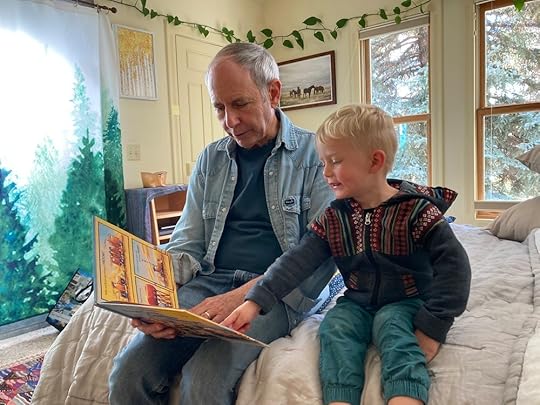
As children, we are taught to recognize and name objects. Over time, we build a description of the world, and this description ultimately becomes our reality. In the process, we become a member of our tribe or community, complete with its beliefs and stories about that reality. For myself, and I believe for a growing number of us, there comes a time when this description of the world, what we’ve been taught about life and about our presence here on Earth, is no longer satisfying.
Materialism is the name I use to point to an important part of this default explanation. It says that the physical world is what is ultimately real and that we can experience the world directly. It says that the world is permanent in human terms, and that we are the ones who come and go.
Because materialism is the way we’ve all been taught to look at the world, we try to explain our own being and consciousness in those terms. That attempt becomes very cumbersome, like trying to explain how neurons working together can produce consciousness. Again, it’s ultimately unsatisfying.
Spirituality is the name given to the search for what lies behind the physical world, for the possibility of seeing beyond the materialistic view. Spirituality is neither a religion nor a set of beliefs. It is rather a path to a deeper understanding of life that can free us from the sadness we feel when we confront the world in its current state. When we recognize that it’s possible to release materialism as the framework in which we consider everything, we can become aware that what we think of as the external world isn’t external at all.
We can dig deeper in order to make sense of this in our daily lives.First, consider the standard description of how vision works. Light that enters our eyes is converted to electrical impulses by the rods and cones in our retinas. These impulses are transmitted to our brains by the optic nerve. And our brains then make three-dimensional pictures out of these impulses, much like televisions create pictures out of the signals in the cable. These pictures, and sounds and so on, constitute an interpretation of sensory input. They become a three-dimensional view, our view of the world.
It is perfectly natural to assume that this view is a more-or-less accurate picture of what’s actually “out there.” After all, we rely on these pictures of the physical world we have in our minds for all the strategies we use for getting along in life. In that context, it’s useful to keep in mind that our interpretation of physical sensory data is conditioned by our experience of the past, by our habits of thought, by our beliefs, and by what we were told when we were young. All we have is our interpretation of what we see, and we all mistake that interpretation for what is actually there.
Let’s do a simple but immensely consequential thought experiment.This thought experiment goes as follows. Suppose that there is no external world to which the pictures in our brains correspond. Suppose that instead of walking around in the world out there, our bodies are part of the description or interpretation our brains create from electrical impulses. In those terms, we are simply manipulating elements of our interpretation when we walk around. That would be like having an avatar in a virtual reality headset that moves around in a virtual world. Is it possible that what you think of as “you” is such an avatar?
In terms of the relationship between our description of the world and the world itself, there are two possibilities. One is that the picture in your brain is a representation of a real external world. In this possibility, the world exists roughly as it appears to you, and when you die the world will remain.
In terms of the second possibility for the relationship between our description of the world and the world itself, there is no external world. Your beliefs (and the thoughts they control) shape the world you perceive, and when you die that world ceases to be for you.
I suggest that there is no way for us, equipped with only our five senses, to determine which of those two possibilities is real. To do so, we would have to step outside of the pictures in our brains and see the world directly. If that were possible, we could then compare our interpretations, our pictures, to the “real” world. But with what apparatus could we “see” the world without using our sense of vision as I described it above?
If you perform this thought experiment honestly, you’ll discover two things. First, you have to question everything you’ve ever been taught about how to get along in life. And second, you’ll find yourself in possession of the power to determine the quality of your own life.
Now, what does quantum mechanics have to do with this thought experiment?Quantum physics is a very spiritual discipline. It has shown us that the world isn’t what we thought it was.
First, a bit of context. We used to think of material objects as made of atoms, which were thought to be fundamental and indivisible. Later, we learned that they are composed of smaller, indivisible objects called protons, neutrons, and electrons. Later still, we learned that protons and neutrons are composed of still smaller objects called quarks, of which there are two kinds. This left us with three particles that used to be considered the fundamental building blocks of nature: the electron and the two quarks. (These days, this description has expanded to include six quarks and the electron, as well as a whole bunch of other stuff like neutrinos and photons, but that’s a minor point in this discussion.)
To reiterate, mainstream scientific world-views have always assumed that matter is what the universe is made of. This view, materialism, tells us that every observed phenomenon can be explained by more fully understanding the nature of matter. Since consciousness is one of these observed phenomena, it must be appropriate to explain it in the same way. In this physics model, neurons must somehow work together to generate consciousness.
Materialism is a comforting picture, but it’s a superficial way to think about the world. These days, the best theories we have refer to those fundamental particles that make up matter as ripples in conceptual, abstract entities called fields.
Most of us are familiar with two of these fields: the gravitational field and the electromagnetic field. The former binds us to the earth, the earth to the solar system, and so on. The latter sustains vibrations we call light. These fields are usually thought of as fluid-like substances that fill all of space, quivering and vibrating in ways that can be mathematically defined. The fields that vibrate as what we call particles behave in the same way, and they are just as hard to visualize.
However, there are lessons we can draw from understanding that matter is just our visualization of a (very) complex ripple in a fluid-like field.The first lesson we can draw from this shift from particles to fields is that the world doesn’t exist as an external reality but rather as a way of visualizing something that is itself entirely abstract.
The second and more valuable lesson is that because we are the ones doing the visualizing, we can become conscious of the process by which we do that. We are actually picturing the world in accordance with our beliefs. Since we can adjust our beliefs, we can even alter our visualizations, the ones we call reality, to improve our experience of being alive.
This is deliberate creation, and it is our birthright as human beings. Accepting the lessons of quantum physics allows us to move beyond materialism, beyond the framework in which we consider the world as being senior to ourselves. This is one way to inform our spirituality, the longing we feel to move beyond the dualistic, oppressive world we believe we live in. The shift from believing we are navigating an external world to understanding we are creating our own interpretation of the world frees us to express those deep desires we all have to feel joyful, free, and whole.
October 12, 2022
A Toddler’s Ego?
 Someone asked me a great question just now: Does a toddler have an ego?
It’s a potentially very useful question. Let’s start by noticing that our usual conception of the ego is as something that we have. In the popular culture, it’s traditionally been spoken of as an impediment to getting along with others, an aspect of ourselves that gets in the way of authentic conversation and behavior.
Technically of course, the ego is part of Sigmund Freud’s model of psychic structure, consisting of the id, the ego, and the super-ego. According to Freud, the ego “attempts to exact a balance between the impractical hedonism of the id and the equally impractical moralism of the super-ego.”
Both of these uses of the word ego imply an object, albeit an entirely conceptual one, and thus consistent with the idea that the ego is something that you and I have.
In that context, it is admittedly difficult to see the ego as something that a toddler would have acquired or created at such an early stage of life.
Throughout this website and blog, I have proposed that the Ego is not an object at all but is rather an environment or ocean into which one is born. It is created and maintained by all living persons as a function of our collective belief systems. It is held in place and spread far and wide by what I call languaging, the way we think and speak about the world and our selves.
When a child is born, and even before birth, its parents begin to talk to it, describing the world into which it has emerged, telling it of their feelings and intentions for it, and so on. These descriptions constitute aspects of the parents’ worldview and are always consistent with that view. Over time, the child absorbs this view as it attempts to learn the language or languages its parents use. This is the acculturation process, and for most of us it is required for successful participation in our own particular culture.
As someone who has studied and thought about physics for most of my life, I have come to think of this cultural environment, which permeates the world of our experience, as a “field.” We can think of fields as dynamic fluid-like substances that fill all of space, quivering and vibrating in ways that can be mathematically described.
Unlike other fields with which we are familiar, such as the electromagnetic and gravitational fields, this one, which I like to call the Egoic field, exhibits several characteristics that we ordinarily ascribe to individuals. It exhibits agency, the state of being in action or of exerting power. It seems to have, as it were, a mind of its own. It also displays its own survival mechanism, which shows up as mimicking the human’s voice in internal conversation. It pretends to be the voice of the human whose head it seems to inhabit, and it denies its own separate existence when that existence is noticed. All of these characteristics can be observed within one’s awareness if we pay attention to its behavior.
It is rarely noticed that in addition to promising the child a successful lifetime of participation in our culture, the acculturation process serves to ensure the perpetuation of the culture itself. And if the culture’s world view contains misunderstandings, confusion, and even superstitions, those will be perpetuated as well.
In my recent book, Hoodwinked, I wrote about a definitive experience many years ago during which I was suddenly aware of the Ego as it operated within me. It was clear to me on that occasion that It was attempting to hide, to deny Its own existence and Its own agency. That moment was as a one-way door, impossible to forget or deny, and it has shaped my life experience ever since.
It is because I recognize agency in the Egoic field that I tend to capitalize both the word Ego and the pronoun, It, which refers to it.
Recently, I had the opportunity to be with a toddler, to observe him as he reacted to his parents’ requests. It was abundantly clear to me that something was driving him to deliberately behave in certain ways so as to establish his own agency, his own power to either do what his parents asked or, in several cases, the exact opposite. I could see the Ego enticing him to apply his will to its suggestions.
In that sense, this toddler doesn’t have an ego; It has him. Said differently, the Ego acts as if it coopts us, coaxing us to further Its own aims and intentions instead of ours, whatever those might be. I say that because I have observed within myself that until we make that distinction between the Ego’s being and our own, we don’t actually know what our intentions are! We are accustomed to the assumption that Its intentions are our own. After all, Its voice sounds exactly like ours, and we are used to hearing Its voice as expressing our own thoughts and feelings about our being in the world.
I invite you to consider this idea of the relationship between a person and the Ego. I believe it eliminates the need to try to get rid of one’s ego or to fix or improve it in some way. We need only recognize that the voice in our heads is other than ourselves, a foreign entity, to strip It of Its apparent power. This is the real meaning of taking back one’s power, not from someone else but from a misunderstanding of what that voice really is.
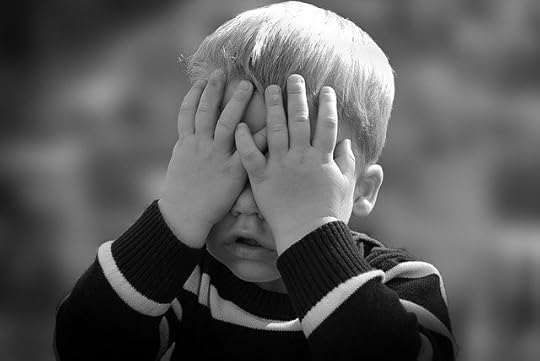
Do you feel like this sometimes?
The toddler doesn’t have an ego. The Ego is the environment in which he or she learns to operate in the world. It has us all, It uses all of us, and in that way It’s the same for all of us. It’s just that the toddler hasn’t yet learned that some of the Ego’s aims and methods aren’t acceptable to some around him and so should be either hidden from others or apologized for. And he hasn’t yet felt the shame and guilt he will likely feel later on for acting as It dictates. And maybe, down the line, he will also discover that the Ego is not himself, and that its urgings can be safely ignored. In that discovery, he will create for himself the possibility of living a truly authentic life.
The Insights Blog

Those superstitions are responsible for Albert Einstein’s declaration that “you can’t solve problems with the same thinking that created them in the first place.” ...more
- Larry Gottlieb's profile
- 122 followers

