
David Tallerman's Blog, page 18
October 17, 2018
My Fantasycon 2018 Schedule
Is it really Fantasycon time already? I guess it must be, since I keep getting e-mails about panels and stuff I'm supposed to be attending. Here's everywhere I'll be that's not the bar:
FRIDAY
FRIDAY
Dungeons & Disorderly Module B2: The Sheep on the Borderlands - Friday 9pm (Panel Room 1)
Dave Moore (Moderator), Nate Crowley (Moderator), Eliza Chan, Anna Smith Spark, Helen Armfield, Phil Lunt, David Tallerman, Ed Fortune
Dungeons and Disorderly is back! Join another troupe of hapless adventurers in a rambling, incoherent mess of a pseudo-roleplaying game. The Terrifying Sorcerer of Terrifying Evil is finally slain, but our heroes have no time to rest on their laurels! At the edges of the Empire, in the wilderness beyond civilisation, hushed rumours speak of a new threat: a sheep of vast size and power, consuming all in its path…
[I don't entirely know what this is. I think I volunteered for it while drunk. Or possibly while sober, which come to think of it is when I make most of my worst decisions. After last year's misadventures at the hands of Lee Harris, it would seem that my new Fantasycon tradition is to publicly humiliate myself in the company of Anna Smith Spark.]SATURDAY
Saturday Noon - Fantasy Readings (3)
David Tallerman, R J Barker, Joel Cornah
[At which I guess I'll be reading from the soon-to-be-released third Black River book, since I can't very well pass The Bad Neighbour off as fantasy.
Or ... can I?
No, I can't.]
- Saturday 5 PM - NewCon Press Book Launch
Ian Whates and Co
Launching:
Best British Horror 2018 - Various
The Scent of Tears - Adrian Tchaikovsky & Friends
Assassins' Endgame - Ian Watson & Andy West
Novella Set 4 or The Land of Somewhere Safe - Hal Duncan
[I'm one of the "& Friends", with my Shadows of the Apt short story The Promise of a Threat, which I'll no doubt be talking about more here sometime soon, because, hey, I wrote a story set in my favourite fantasy universe and now it's canon!]
- Saturday 9pm (Panel Room 1) - Up, Up and Away! Superheroes in Genre Fiction
Eric Ian Steele (Moderator), Allanah Hunt, Ginger Lee Thomason, Mike Chinn, David Tallerman
Once solely the preserve of the comic book stand, superhero fiction now dominates our cinemas, permeates our television screens and commands a sizable computer gaming fan base. With the franchise dominance of the DC and Marvel universes, in these mediums, is there room for new heroes to emerge? Has the superhero novel lagged behind, and if so, why? Our panel explore the place of superheroes in genre fiction and examines the possibilities for new takes, new stories and new ideas in new mediums.
[Well, look, there was a panel that I really wanted to be on to discuss the new Black River book, and then I thought that just in case I got turned down for that, I might as well volunteer for this one, since I have a superhero novel all written and ready to send out, even if no-one but me has actually read it. Anyway, here we are!]SUNDAY
Sunday 1.30pm (Panel Room 2) - Griminal Criminals!
David Tallerman (Moderator), Tom Johnstone, Kit Power, Rob Boffard
There are villains and villains. Some of the worst self serving ruffians are pretty endearing in their way. These rogues have a strange charm to them. Maybe they can be redeemed, maybe they can’t. Join our panel to discuss the best down and dirty characters who breathe new life into their stories.
[Yeah, I'm moderating this one, which is awkward since I really don't know what the question is. I mean, that's more of a series of statements, right? But I'm sure it'll be fine, I've got me some awesome panelists, and in any case, anyone who's anyone will be at the banquet, so we'll probably just end up playing Cards Against Humanity or something.]And there we have it! My Fantasycon 2018 schedule. Man, I really did want to be on that panel about when magic goes horribly wrong, since that's literally the entire plot of Black River 3. Maybe I could be that guy who sits on the front row, asking questions that are really just lengthy, rambling statements and annoying the hell out of everyone? Anyway, I really ought to be prepping Griminal Criminals. It'll be great, I promise! Come watch us, eating is overrated and potentially fatal.


September 28, 2018
Film Ramble: Drowning in Nineties Anime, Pt. 41
I keep swearing off these themed posts, only to get sucked in, as I realise that nineties anime is inimically suited to this approach. After all, why spend so much time grumbling about how similar certain titles are when I can make the same point by just bunching them together? And let's face it, if there's one thing we keep stumbling over here, it's those really short releases that look a bit embarrassed when lumped in with proper films and OVAs.
So, unified by the fact that not one of them runs to more than an hour, we have: Queen Emeraldas, Samurai: Hunt For the Sword, Black Lion, and Maze...
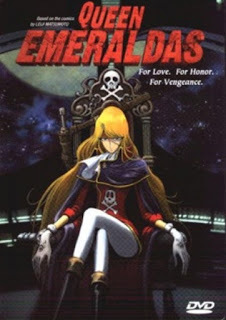 Queen Emeraldas, 1998, dir: Yûji Asada
Above all else, the word I'd pick to describe Queen Emeraldas is romantic. And not in the lovey-dovey sense, though I suppose it is that a bit, but in the sense of dashing adventures full of sword fights and chivalry, along with lashings of outrageous idealism and preposterous bravery. All of this, as I understand it, is very much in keeping with the works of Leiji Matsumoto, a creator I've only encountered with his science-fiction hat on once up until now, via the - rather disappointing, it has to be said! - classic Galaxy Express 999.
But Queen Emeraldas didn't disappoint one bit, despite being heavily set up by distributor ADV to do so. I've been frustrated at many an OVA that was never allowed to finish, but this is that bit worse, in that there are a concluding two parts that the company decided not to pick up, meaning that what they sold as Queen Emeraldas is but half of the real thing. In any other corner of the industry that would probably have been regarded as somewhat criminal, and it should be agonisingly frustrating, so it's a good job that the two parts we did get wrap up in such satisfying fashion. Other than the clear implication that our heroes will go on to further adventures, there really are no obvious threads left hanging - and thank goodness for that.
None of which explains what exactly Queen Emeraldas is, so let's backtrack to that opening paragraph: what we have here is space opera of a particular lavish, rather silly, and, yes, romantic sort, in which women with hair down to their ankles fly around in giant blimps with sailing ships hanging from their undersides and angry young men hitchhike on gigantic galactic vessels in search of adventure. And those two - Emeraldas herself (the Queen Emeraldas is her wildly impractical ship) and young Hiroshi, whose fate becomes entwined with hers - happen to be our protagonists. Hiroshi is fine, as young male leads with massive chips on their shoulders go; he has lessons to learn about not being a jerk to everyone around him, but he learns them fast enough to not be too annoying. Emeraldas, however, who drifts in and out of his plot, usually to do something outstandingly cool, is a delight in every second she spends on-screen: a creation of utter style, from her design to her ridiculous laser cutlass to her Bond-esque theme tune, which adorably points out that "My name comes from a green jewel / But the path I travel is red / The red of burning blood."
All of this is presented with some terrific animation, in which unusually heavy line weights give one of the more convincing impressions of Manga in motion that I've come across, ginned up with some intelligently used (and, in fairness, occasionally terrible) CG. Director Asada has a whopping sense of style that seems to have been exploited nowhere else in his career; he managed to land on precisely the right tone for this material, and to keep it from straying into the silliness that always hovers around the edges. I mean, blimps in space! Honestly, it is silly - of course it is! - but it's also delightful and thrilling and satisfying. And while it's a heck of a shame ADV decided to screw international audiences over the way they did, we can still be glad for the two episodes we have.
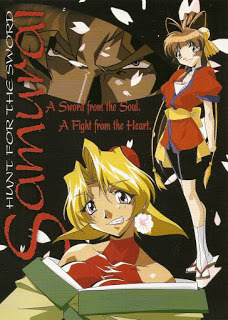 Samurai: Hunt For the Sword, 1999, dir: Masahiro Sekino
The question I keep coming back to with Samurai: Hunt For the Sword is, what is it? I mean, I know what it is: a two episode OVA in which, at some point in history that I didn't bother to make precise note of, young hero Shinjuro finds himself both stuck with running his dad's sword-fighting school and embroiled in some murky business surrounding the quest to steal a magical sword and so ultimately topple the shogunate. More than that, it's easy to identify the elements on display here: likable teen protagonists, some bubbly comedy that largely revolves around the relative sizes of breasts, a couple of surprisingly deft action sequences that are at least in the ballpark of what actual sword fights of the time might have been like, and a bright, appealing art style that's weathered surprisingly well.
So really, when there's nothing at all shocking or puzzling or significantly out of place here, I guess that it's more the why of Samurai: Hunt For the Sword that's throwing me. Why this story, told in less than an hour? Why, given that limitation, go to so much effort to introduce so large a cast, devoting meaningful time to characters that serve no function whatsoever when, midway through the second episode, the conflict that's been bubbling along in the background finally shifts to centre stage? Why end in a manner that wraps absolutely everything up and yet feels more like the beginning of some other story? I mean, what actually was the goal here?
Ultimately, I suppose that what I'm asking for is the bigger picture, which the internet - strangely silent on an inconsequential anime OVA from nearly two decades ago - fails to provide. I suspect a clue might lie in the show's alternate title of Kaitouranma, but...
Well, this is awkward. Two and a bit paragraphs into this review and I've answered my own question! It's not Kaitouranma, it's Kaitou Ranma, as in Kaitou Ranma Miyabi, a game for the original PlayStation long forgotten to history. And really, that does solve the whole damn puzzle: the sense of a prologue that's also an intact story, the obsession with introducing characters that serve no discernible purpose, the striking but unmemorable designs, the way that most of the female characters talk about nothing but their breasts. Wait, perhaps not that last one.
Anyway, I'm glad we got that figured out! Unfortunately, it still leaves Samurai: Hunt For the Sword as nothing more than a mildly pleasing diversion that manages to be a teeny bit boring despite its brief running time. Oh well. I imagine the game was quite fun.
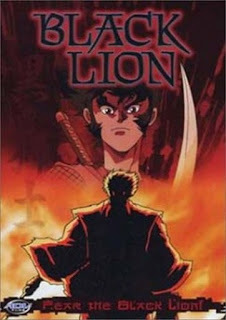 Black Lion, 1992, dir: Takashi Watanabe
Poor Oda Nobunaga! It's one thing to get constant flack for being evil and having a sinister mustache, but you'd at least expect to be acknowledged for being a bit of a talented military strategist, what with that whole "unifying Japan" business. But no, not if anime is to be believed; cleverness had not a thing to do with it. Clearly Nobunaga just had an unfair advantage, whether it be demon hordes or magical powers or, in the case of the short OVA Black Lion, hugely advanced technology stolen from the future.
Now, while I feel like Nobunaga probably deserves more credit than he tends to get, I admit that I'm down with that notion. And there's something fairly compelling about the opening scenes, in which a bunch of ninja find themselves ludicrously outclassed by minigun-toting samurai, among other high-tech horrors. It's a preposterous setup, but it's fun - and woe on Black Lion for squandering that fun as badly as it does. All the really interesting material gets bundled away in the first third, presumably to be developed in further episodes that would never come to pass, and for the most part what we get is a remake of The Terminator in 16th century Japan, as all the ninjas who aren't dead go up against Nobunaga's seemingly immortal ninja-killer Ginnai Doma.
And still I'd not complain about forty-five minutes of historical ninja versus cyborg action, except that it just isn't terribly good. The animation is resolutely half-arsed, the protagonist is a brat, the direction is lifeless, and the story amounts to scene after scene of "ninjas think they've killed Ginnai Doma and then realise to their cost that they haven't." There's some truly unpleasant gore, but the lazy art can't sell it, so that all it evokes is the odd "Ew!" And that's a shame, because a touch of genuine horror would do much to lift the material. I'm reminded here of the similar Ninja Resurrection, which, while far from great, at least managed to mine some impact from comparable material.
The result is frustrating more than it's anything else. There's a far better version of this, so close that at times you feel like you could reach out and grab it, and that Watanabe so reliably dodges it is disappointing; while far from a top tier director, he was provably capable of better work.* Black Lion isn't terrible, and I certainly wasn't bored by it, because you can only go so badly wrong with a premise like this one. Ginnai Doma is a solid baddie, the action scenes are interesting on paper, even if they could have been done a good deal better than they are, and it's not like it looks terrible or anything. But honestly, how you make something so resolutely mediocre from that concept is beyond me! Shame on you, Black Lion, not to mention a definite thumbs down.
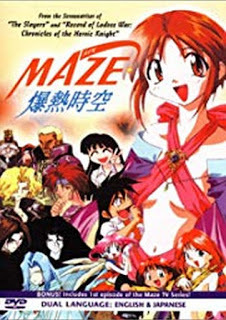 Maze, 1996, dir: Iku Suzuki
If you're going to steal, steal from the best. And if that fails then steal from everyone, because you're bound to get something good, right? Or so the creators of Maze appear to have decided: if ever a show was a compendium of just about every property that was being remotely successful in its vicinity, it's this one. If you've wondered what Slayers would have been like with the gender-swapping of Ranma 1/2 and the lecherous protagonist of Urusei Yatsura (but also the tough but sweet-natured female protagonist of oh so many other shows) and also some mecha action and a fair bit of bloodshed because why not? then here's your answer.
If Maze pushes any boundary at all, it's in the level of raunchiness - which, okay, mostly just means lots of bare breasts, but there's a generally high level of gags that are in some way to do with sex, too. Which I suppose isn't surprising when your female lead transforms into a perverted male character by night, though curiously this is something the show bothers with nary at all. And thank goodness for that, because the gender-swapping thing really isn't funny, but the rest of Maze is. Whether it's being crude or silly or merely surreal, there are some really good gags tucked away. So it's a shame that the show is so bent on self-sabotage: the requirement to see every female character topless at least once grinds the action to a halt, and the couple of occasions when we meet male Maze are plain painful. Actually, Maze-the-character's entire plot is pretty unsatisfactory, and it's what goes on elsewhere that provides all the laughs and drama. The creators make the wise call to start heavily in media res, dumping back story via an adorable intro (complete with puppet show) narrated by the show's other main character, Princess Mill, and so we get a nice, self-contained dungeon crawl of a tale with a big old boss fight at the end, which is just right for a couple of OVA episodes.
The thing is, Maze gets a lot wrong, but when it's not doing, it's a heck of a lot of fun. A couple of gags are genuinely brilliant, and even when it's not operating at that level - excepting male Maze, anyway - it's entirely daft and pleasurable. It's the sort of thing I could happily have watched a lot more of, and I was grateful that Central Park Media chucked in the first episode of the series (though having it before the OVA set midway through the story would have made a damn sight more sense.) I guess that makes for another vague recommendation, of the "If you like this sort of thing and you happen to see it cheap" variety? Unless you have a scholarly interest towards the subject of where anime was at in the latter half of the nineties, that is, in which case its achievement of maximum possible derivativeness makes it pretty much indispensable.
-oOo-
I guess the fact that it's woefully hard to justify recommending these obscure, super-short releases means that the fact that I seriously do recommend hunting for Queen Emeraldas mean a little bit more than it otherwise might? It's certainly turned me on to Leiji Matsumoto in a way that Galaxy Express 9999 didn't manage to do. As for the rest, I think it's safe to say that Maze is the only title that might cling onto a spot in my DVD collection; looking back, Black Lion and Samurai: Hunt For the Sword weren't much cop at all, and I sincerely apologize if I gave the impression otherwise. I mean, I don't think I did, but I can't be bothered to go back and check.
[Other posts in this series: Part 1, Part 2, Part 3, Part 4, Part 5, Part 6, Part 7, Part 8, Part 9, Part 10, Part 11, Part 12, Part 13, Part 14, Part 15, Part 16, Part 17, Part 18, Part 19, Part 20, Part 21, Part 22, Part 23, Part 24, Part 25, Part 26, Part 27, Part 28, Part 29, Part 30, Part 31, Part 32, Part 33, Part 34, Part 35, Part 36, Part 37, Part 38, Part 39, Part 40]
* Even if that better work was only Battle Skipper.
So, unified by the fact that not one of them runs to more than an hour, we have: Queen Emeraldas, Samurai: Hunt For the Sword, Black Lion, and Maze...
 Queen Emeraldas, 1998, dir: Yûji Asada
Above all else, the word I'd pick to describe Queen Emeraldas is romantic. And not in the lovey-dovey sense, though I suppose it is that a bit, but in the sense of dashing adventures full of sword fights and chivalry, along with lashings of outrageous idealism and preposterous bravery. All of this, as I understand it, is very much in keeping with the works of Leiji Matsumoto, a creator I've only encountered with his science-fiction hat on once up until now, via the - rather disappointing, it has to be said! - classic Galaxy Express 999.
But Queen Emeraldas didn't disappoint one bit, despite being heavily set up by distributor ADV to do so. I've been frustrated at many an OVA that was never allowed to finish, but this is that bit worse, in that there are a concluding two parts that the company decided not to pick up, meaning that what they sold as Queen Emeraldas is but half of the real thing. In any other corner of the industry that would probably have been regarded as somewhat criminal, and it should be agonisingly frustrating, so it's a good job that the two parts we did get wrap up in such satisfying fashion. Other than the clear implication that our heroes will go on to further adventures, there really are no obvious threads left hanging - and thank goodness for that.
None of which explains what exactly Queen Emeraldas is, so let's backtrack to that opening paragraph: what we have here is space opera of a particular lavish, rather silly, and, yes, romantic sort, in which women with hair down to their ankles fly around in giant blimps with sailing ships hanging from their undersides and angry young men hitchhike on gigantic galactic vessels in search of adventure. And those two - Emeraldas herself (the Queen Emeraldas is her wildly impractical ship) and young Hiroshi, whose fate becomes entwined with hers - happen to be our protagonists. Hiroshi is fine, as young male leads with massive chips on their shoulders go; he has lessons to learn about not being a jerk to everyone around him, but he learns them fast enough to not be too annoying. Emeraldas, however, who drifts in and out of his plot, usually to do something outstandingly cool, is a delight in every second she spends on-screen: a creation of utter style, from her design to her ridiculous laser cutlass to her Bond-esque theme tune, which adorably points out that "My name comes from a green jewel / But the path I travel is red / The red of burning blood."
All of this is presented with some terrific animation, in which unusually heavy line weights give one of the more convincing impressions of Manga in motion that I've come across, ginned up with some intelligently used (and, in fairness, occasionally terrible) CG. Director Asada has a whopping sense of style that seems to have been exploited nowhere else in his career; he managed to land on precisely the right tone for this material, and to keep it from straying into the silliness that always hovers around the edges. I mean, blimps in space! Honestly, it is silly - of course it is! - but it's also delightful and thrilling and satisfying. And while it's a heck of a shame ADV decided to screw international audiences over the way they did, we can still be glad for the two episodes we have.
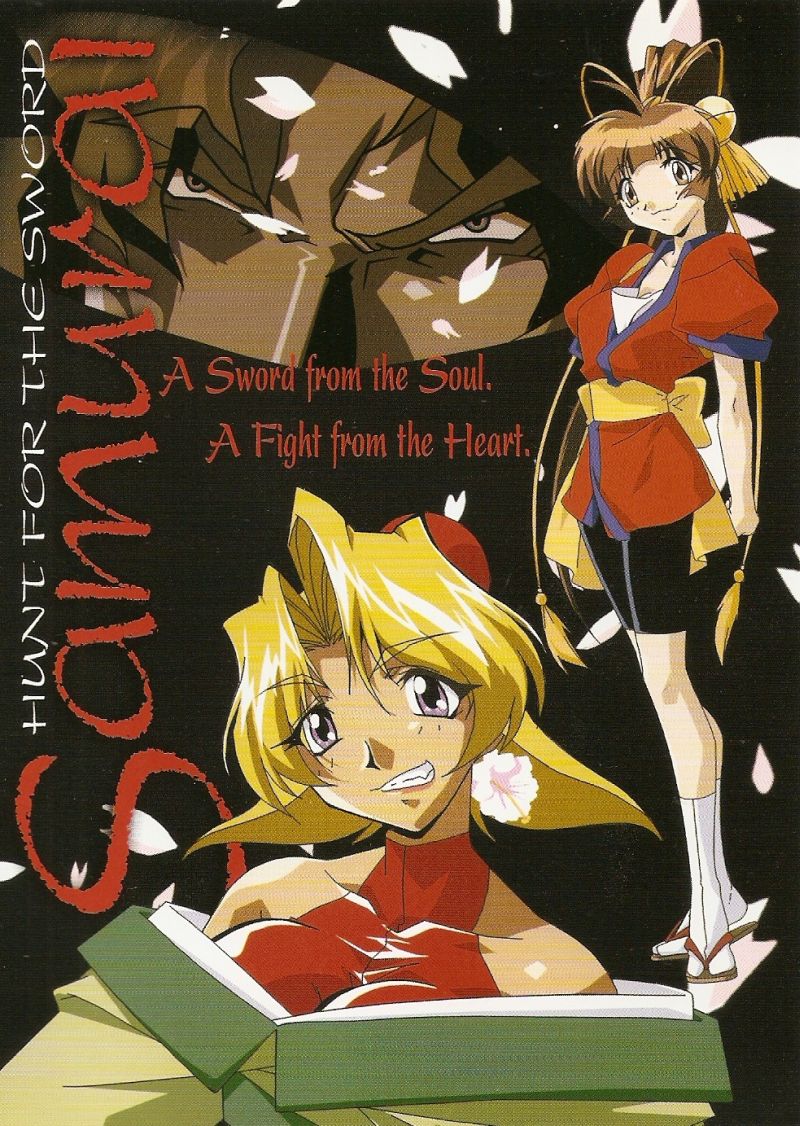 Samurai: Hunt For the Sword, 1999, dir: Masahiro Sekino
The question I keep coming back to with Samurai: Hunt For the Sword is, what is it? I mean, I know what it is: a two episode OVA in which, at some point in history that I didn't bother to make precise note of, young hero Shinjuro finds himself both stuck with running his dad's sword-fighting school and embroiled in some murky business surrounding the quest to steal a magical sword and so ultimately topple the shogunate. More than that, it's easy to identify the elements on display here: likable teen protagonists, some bubbly comedy that largely revolves around the relative sizes of breasts, a couple of surprisingly deft action sequences that are at least in the ballpark of what actual sword fights of the time might have been like, and a bright, appealing art style that's weathered surprisingly well.
So really, when there's nothing at all shocking or puzzling or significantly out of place here, I guess that it's more the why of Samurai: Hunt For the Sword that's throwing me. Why this story, told in less than an hour? Why, given that limitation, go to so much effort to introduce so large a cast, devoting meaningful time to characters that serve no function whatsoever when, midway through the second episode, the conflict that's been bubbling along in the background finally shifts to centre stage? Why end in a manner that wraps absolutely everything up and yet feels more like the beginning of some other story? I mean, what actually was the goal here?
Ultimately, I suppose that what I'm asking for is the bigger picture, which the internet - strangely silent on an inconsequential anime OVA from nearly two decades ago - fails to provide. I suspect a clue might lie in the show's alternate title of Kaitouranma, but...
Well, this is awkward. Two and a bit paragraphs into this review and I've answered my own question! It's not Kaitouranma, it's Kaitou Ranma, as in Kaitou Ranma Miyabi, a game for the original PlayStation long forgotten to history. And really, that does solve the whole damn puzzle: the sense of a prologue that's also an intact story, the obsession with introducing characters that serve no discernible purpose, the striking but unmemorable designs, the way that most of the female characters talk about nothing but their breasts. Wait, perhaps not that last one.
Anyway, I'm glad we got that figured out! Unfortunately, it still leaves Samurai: Hunt For the Sword as nothing more than a mildly pleasing diversion that manages to be a teeny bit boring despite its brief running time. Oh well. I imagine the game was quite fun.
 Black Lion, 1992, dir: Takashi Watanabe
Poor Oda Nobunaga! It's one thing to get constant flack for being evil and having a sinister mustache, but you'd at least expect to be acknowledged for being a bit of a talented military strategist, what with that whole "unifying Japan" business. But no, not if anime is to be believed; cleverness had not a thing to do with it. Clearly Nobunaga just had an unfair advantage, whether it be demon hordes or magical powers or, in the case of the short OVA Black Lion, hugely advanced technology stolen from the future.
Now, while I feel like Nobunaga probably deserves more credit than he tends to get, I admit that I'm down with that notion. And there's something fairly compelling about the opening scenes, in which a bunch of ninja find themselves ludicrously outclassed by minigun-toting samurai, among other high-tech horrors. It's a preposterous setup, but it's fun - and woe on Black Lion for squandering that fun as badly as it does. All the really interesting material gets bundled away in the first third, presumably to be developed in further episodes that would never come to pass, and for the most part what we get is a remake of The Terminator in 16th century Japan, as all the ninjas who aren't dead go up against Nobunaga's seemingly immortal ninja-killer Ginnai Doma.
And still I'd not complain about forty-five minutes of historical ninja versus cyborg action, except that it just isn't terribly good. The animation is resolutely half-arsed, the protagonist is a brat, the direction is lifeless, and the story amounts to scene after scene of "ninjas think they've killed Ginnai Doma and then realise to their cost that they haven't." There's some truly unpleasant gore, but the lazy art can't sell it, so that all it evokes is the odd "Ew!" And that's a shame, because a touch of genuine horror would do much to lift the material. I'm reminded here of the similar Ninja Resurrection, which, while far from great, at least managed to mine some impact from comparable material.
The result is frustrating more than it's anything else. There's a far better version of this, so close that at times you feel like you could reach out and grab it, and that Watanabe so reliably dodges it is disappointing; while far from a top tier director, he was provably capable of better work.* Black Lion isn't terrible, and I certainly wasn't bored by it, because you can only go so badly wrong with a premise like this one. Ginnai Doma is a solid baddie, the action scenes are interesting on paper, even if they could have been done a good deal better than they are, and it's not like it looks terrible or anything. But honestly, how you make something so resolutely mediocre from that concept is beyond me! Shame on you, Black Lion, not to mention a definite thumbs down.
 Maze, 1996, dir: Iku Suzuki
If you're going to steal, steal from the best. And if that fails then steal from everyone, because you're bound to get something good, right? Or so the creators of Maze appear to have decided: if ever a show was a compendium of just about every property that was being remotely successful in its vicinity, it's this one. If you've wondered what Slayers would have been like with the gender-swapping of Ranma 1/2 and the lecherous protagonist of Urusei Yatsura (but also the tough but sweet-natured female protagonist of oh so many other shows) and also some mecha action and a fair bit of bloodshed because why not? then here's your answer.
If Maze pushes any boundary at all, it's in the level of raunchiness - which, okay, mostly just means lots of bare breasts, but there's a generally high level of gags that are in some way to do with sex, too. Which I suppose isn't surprising when your female lead transforms into a perverted male character by night, though curiously this is something the show bothers with nary at all. And thank goodness for that, because the gender-swapping thing really isn't funny, but the rest of Maze is. Whether it's being crude or silly or merely surreal, there are some really good gags tucked away. So it's a shame that the show is so bent on self-sabotage: the requirement to see every female character topless at least once grinds the action to a halt, and the couple of occasions when we meet male Maze are plain painful. Actually, Maze-the-character's entire plot is pretty unsatisfactory, and it's what goes on elsewhere that provides all the laughs and drama. The creators make the wise call to start heavily in media res, dumping back story via an adorable intro (complete with puppet show) narrated by the show's other main character, Princess Mill, and so we get a nice, self-contained dungeon crawl of a tale with a big old boss fight at the end, which is just right for a couple of OVA episodes.
The thing is, Maze gets a lot wrong, but when it's not doing, it's a heck of a lot of fun. A couple of gags are genuinely brilliant, and even when it's not operating at that level - excepting male Maze, anyway - it's entirely daft and pleasurable. It's the sort of thing I could happily have watched a lot more of, and I was grateful that Central Park Media chucked in the first episode of the series (though having it before the OVA set midway through the story would have made a damn sight more sense.) I guess that makes for another vague recommendation, of the "If you like this sort of thing and you happen to see it cheap" variety? Unless you have a scholarly interest towards the subject of where anime was at in the latter half of the nineties, that is, in which case its achievement of maximum possible derivativeness makes it pretty much indispensable.
-oOo-
I guess the fact that it's woefully hard to justify recommending these obscure, super-short releases means that the fact that I seriously do recommend hunting for Queen Emeraldas mean a little bit more than it otherwise might? It's certainly turned me on to Leiji Matsumoto in a way that Galaxy Express 9999 didn't manage to do. As for the rest, I think it's safe to say that Maze is the only title that might cling onto a spot in my DVD collection; looking back, Black Lion and Samurai: Hunt For the Sword weren't much cop at all, and I sincerely apologize if I gave the impression otherwise. I mean, I don't think I did, but I can't be bothered to go back and check.
[Other posts in this series: Part 1, Part 2, Part 3, Part 4, Part 5, Part 6, Part 7, Part 8, Part 9, Part 10, Part 11, Part 12, Part 13, Part 14, Part 15, Part 16, Part 17, Part 18, Part 19, Part 20, Part 21, Part 22, Part 23, Part 24, Part 25, Part 26, Part 27, Part 28, Part 29, Part 30, Part 31, Part 32, Part 33, Part 34, Part 35, Part 36, Part 37, Part 38, Part 39, Part 40]
* Even if that better work was only Battle Skipper.
September 19, 2018
Gods Is (Really) Dead
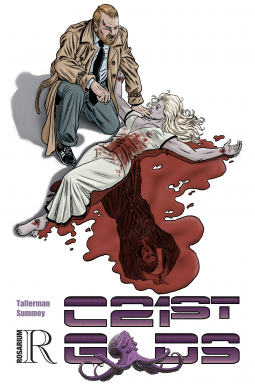 It's possible that if you have a really good memory you'll recall my comic book miniseries C21st Gods, which debuted at the back end of 2016 from Rosarium Publishing. But probably you won't, since it sold all of about a dozen copies and the subsequent issues never materialized. At any rate, if you're one of that handful of people who splashed out for the first issue, and have been desperately hanging on, waiting to find out what happens next, then - well, sorry about that, factors outside of my control and all that, and it would honestly have been pretty cool. But I'm afraid that neither of us will ever get to read the remaining two parts, so you'll just have to take my word for it.
Not being a total idiot, I'd suspected for a while that the book's artist, Anthony Summey, wasn't intending to stick with the project; the many months of silence were a definite clue. But I eventually figured I'd better raise the question, and sure enough, C21st Gods is now without an artist and so effectively defunct. This, by the way, is the second artist the book has lost, and if you want a truly gruesome, grueling horror story then click on the "C21st Gods" label down there at the bottom of the post and read from start to finish the whole damn odyssey of how I've tried and failed and failed and failed and briefly succeeded and failed to make this goddamn project happen. Trust me, it'll turn your hair white!
I guess that if I learned one lesson as a writer from the whole experience, it's that you can't save your best material. There was some really interesting stuff coming up in the remaining two issues, and especially in the closing third, including one particular scene that's been lodged in my head for years now and which I'd really have liked to see on the page. That said, the truth is that I wrote the script for C21st Gods as a graphic novel, the decision to publish it as individual issues wasn't mine, and it would have been impossible to restructure it as a miniseries by that point. The reviews for the first issue weren't great, and I think they were generally fair in their not-greatness, but it was immensely frustrating when I knew that most of the criticisms would have been addressed by the remainder of the story. Which is all the more gutting now that the first issue is all the story there'll be.
Actually, that's a bit defeatist, isn't it? And I try not to be that, especially when I have a shiny new novel out and should really be feeling quite chipper. So I think what I'll do, if I can find a minute somewhere, is slap the entire script up on my website. That way, if anyone wants to know what they missed, they can find out. And hey, at least that first issue is a thing, one I'm still kind of proud of. While I'm not exactly thrilled with Anthony for walking off the book a third of the way in without feeling the need to tell me, there's no getting around the fact that he did some seriously nice work in bringing C21st Gods to life, and if you're one of the approximately seven and a half billion people who haven't read it, it's worth a look purely for the artwork. If you'd care to grab a copy, you can do so from Amazon and Comixology. And if you'd rather just read the script then keep checking back, I'll get it up there eventually!
September 6, 2018
The Bad Neighbour is Out Today
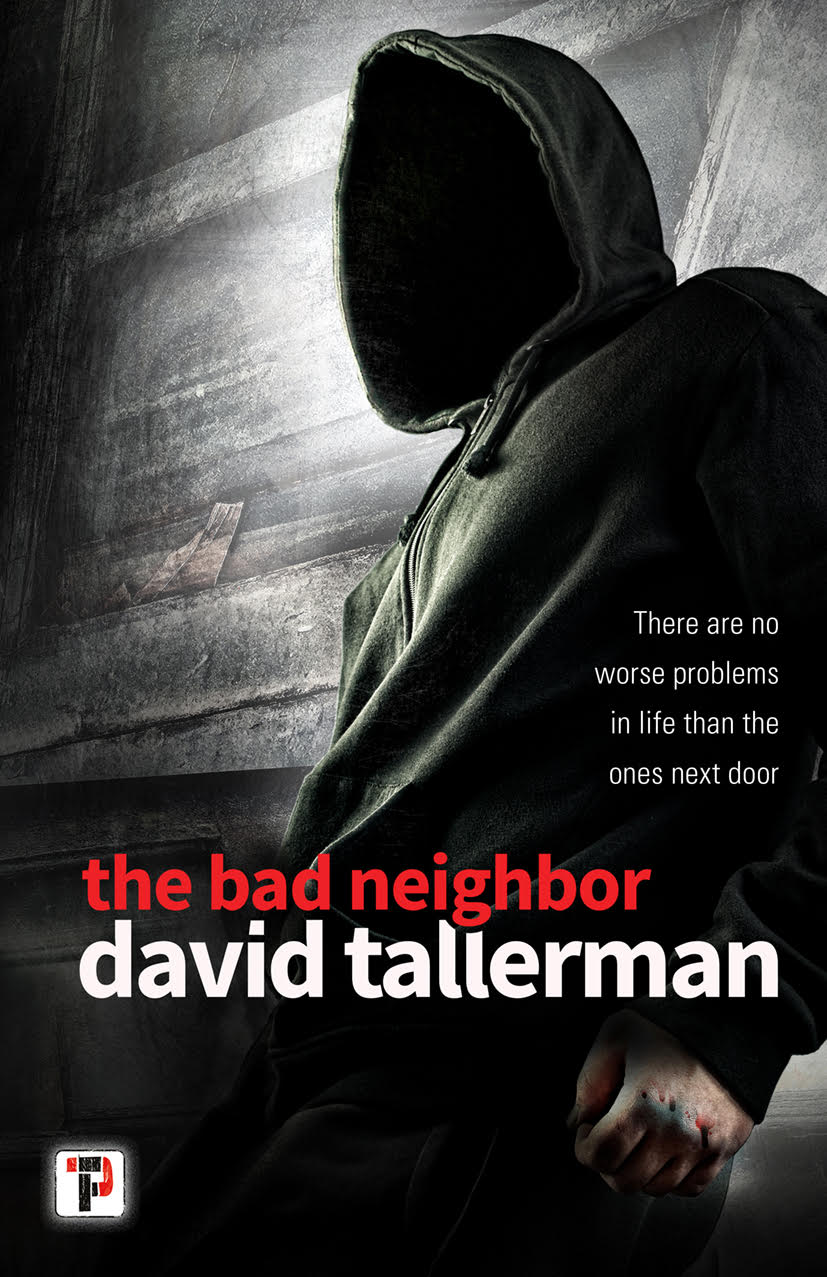 Today sees the release of my sixth novel, The Bad Neighbour - also known as The Bad Neighbor, since I was fool enough to come up with a title that wouldn't work on both sides of the Atlantic! It represents a lot of firsts for me, and a huge departure from everything that's come before. My first standalone novel. My first novel to get a hardback release. My first serious stab at writing a thriller, and my first significant dabbling with writing crime. My first book to be set wholly in the real world, and my first to draw significantly on aspects of my own life. In fact, The Bad Neighbour is a good deal more personal than anything I've put my name to before now. One of the early reviewers found it a little implausible that somebody would spend all of their money on buying a run-down house in an unfamiliar, impoverished area, as my protagonist Ollie Clay does, but that's exactly what I did seven or so years ago, and the reason I had a base from which to write this very book. Of course, it worked out a hell of a lot better for me than it did for Ollie. My neighbours haven't always been brilliant, but I've never had to deal with anyone like Chas Walker, the right wing thug who makes Ollie's existence a living hell, and I've certainly never gone quite so far off the deep end as Ollie ends up doing.
Which reminds me of another first: I don't know that anything else I've written has addressed current affairs quite so directly. I wrote The Bad Neighbour in what seems, now, to be a very different and rather more innocent time. When I conceived the book, and when I decided to write in a small way about some of the toxicity I saw bubbling away beneath the nation's surface, Brexit wasn't even a rumour, and I'd no way to guess how much of that bile would soon be gushing forth. Less than a year after finishing the final draft, I came home from holiday to find out that my local MP, Jo Cox, had been murdered in the street by a far-right domestic terrorist, and suddenly what I'd written didn't seem half so dramatic or implausible. Ollie's story has become, for the most part, shockingly likely, though I dearly wish it wasn't.
On a far happier note, one last first: this is also my debut with a new publisher. Indeed, a new publisher in both senses: today marks the true birth of extremely exciting upstart Flame Tree Press, who also happen to have five other books out today, the first wave of what's set to be a truly astonishing catalogue. So you might want to grab a copy of Tim Waggoner's The Mouth of the Dark, J. D. Moyer's The Sky Woman, Hunter Shea's Creature, Jonathan Janz's The Siren and the Spectre, or the legendary Ramsey Campbell's latest, Thirteen Days by Sunset Beach, while you're shopping for The Bad Neighbour.
Which is totally a thing you should do! You can pick it up from Amazon UK and Amazon US in paperback, hardback, e-book and audio formats, and Waterstones have it here. And as ever, early sales are especially crucial, so if you fancy it, don't wait!
September 2, 2018
Film Ramble: Drowning in Nineties Anime, Pt. 40
This will be the last of these themed posts, I promise, at least until I inadvertently stumble over a reason to come up with another one. And really, the topic is more tenuous than ever, to the point where I hardly know how to sum it up. Oddities would be one word, and "nineties anime that aren't really what you'd think of when you talk about nineties anime" would be, er, one sentence. The thing is, the lines get awfully blurry sometimes, especially when you take into account that anime, from a Japanese perspective, is a blanket term covering all animated films made anywhere in the world. Which is good news for those of us hunting an excuse to review whatever they like in their nineties anime blog posts, but bad news for anyone who'd get annoyed by, say, a Tsui Hark-produced movie or a Christopher Columbus-written film from 1989 popping up here.
If that's you then prepare for annoyance, I guess! And brace yourself for reviews of Pokémon: The First Movie - Mewtwo Strikes Back, A Chinese Ghost Story, Little Nemo: Adventures in Slumberland, and Colorful.
 Pokémon: The First Movie - Mewtwo Strikes Back, 1998, dir:
Pokémon: The First Movie was, I believe, the first anime I ever saw in a cinema. I mention this not so that we can all chuckle over my poor life choices, but to emphasise what a huge damn deal the film was way back in 1998. Anime simply didn't get wide releases in the UK back in those days, certainly not from major studios such as Warner Bros., and absolutely definitely they didn't go on to make astronomical amounts of money that put the likes of My Neighbour Totoro and Ghost in the Shell to shame.
With all of that in mind, it beggars belief what a cheap, scrappy, inconsequential bit of fluff the first Pokémon movie is. I mean, it's not even feature length; they only managed to pad it out by inserting the execrable Pikachu's Vacation before it, a delirious nothing of a twenty minutes that must have left many a parent in sweaty-palmed dread of what they were in for. And yet Warner Bros. behaved as though this was the biggest damn thing, and for many a kid (and, er, twenty-something with too much time on their hands) it really was. Heck, I even remember responding to it quite positively, without being ignorant of the fact that it was essentially shoddy and trivial.
With the benefit of both hindsight and research, this didn't altogether have to be the case. It turns out Warner got a bit nervy over the Japanese original, which made antagonist Mewtwo an ambiguous character with meaningful motivations. None of that for US children, oh no! And so international audiences lost an opening chunk of plot, and were treated to some truly unfathomable changes in emphasis. It's for this reason, incidentally, that a show about literally nothing other than fighting thinks to pause leadenly for every cast member to discover that fighting is just dreadful and we should all really stop it. Though, given how hysterically weird the moment is, perhaps we Westerners got the better end of that one after all. The same can't be said for the vomitous pop songs that stink up the soundtrack, surely from artists that Warner were eager to push before their unearned fifteen minutes of fame expired.
And yet, there's something here. When the soundtrack isn't being stinky American pop, it's rather grand and portentous, and the animation, while aggressively subpar by what we'd generally accept as feature standards, is at least solid, with some well-integrated CG to set it apart from the TV show. Mostly, though, it's the fact that Pokémon was a thoroughly likable franchise back in those days, and that the film takes that and shoves it into some unexpectedly dark places retains its impact to this day. We get a major character death, and even if it's reversed basically immediately, it's still startling in a franchise where stuff like that just doesn't happen. More, we get the scene that's indelibly burned into my subconscious, in which the Pokémon have to fight their clones, ending in a sequence where Ash's Pikachu turns the other cheek to a pummeling from its counterpart. In slow motion. While the other Pikachu weeps in anguish. I swear, it makes Sophie's Choice look like a light-hearted romp, and if the film doesn't remotely earn it, nevertheless it'll haunt me to my deathbed.
Note that none of this should be considered a reason to go back and watch Pokémon: The First Movie, which is mostly a bit rubbish.
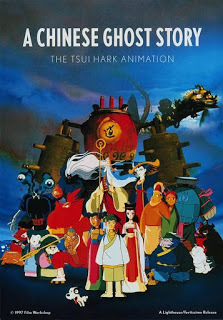 A Chinese Ghost Story, 1997, dir: Andrew Chan
A Chinese Ghost Story - and here I'm talking about the live-action 1987 original - is a basically perfect film for what it is. Imagine Evil Dead 2 as a martial arts rom-com and you'll get about halfway to envisioning what it has to offer. So it's sort of comprehensible that, some years after, producer Tsui Hark would decide to bring about an animated semi-remake, despite the fact that the Chinese animation scene was in a somewhat woeful state at the time.
(And here let us briefly divert to point at the elephant in the room: I thought when I bought A Chinese Ghost Story that it was conceived in Hong Kong but made by Japanese animators, and in this I was almost entirely wrong. So it's only anime in the sense that all animated films are anime. All of which is to say, it's my blog and I can write about what I like!)
So: at some point between 1987 and 1997 (I'm going off a brief interview on the DVD here) Hark would decide to lavishly adapt his live-action success into the animated medium. More than that, he was determined to do so by utilising all that then-current technologies had to offer, and that meant dabbling with CGI. After much wrangling with his animators and others, who insisted that computer animation just wasn't there yet, Hark settled on a mix of 3D-rendered backgrounds and mostly 2D hand-animated characters, a notion that would become at least somewhat standard in following years, if not to the extent that Hark embraced it, but at the time was crazier than cat juggling.
Now, I have immense respect for Tsui Hark, I truly do, and if you're remotely familiar with the golden age of Hong Kong film-making then probably you have too. But in this he was horrifyingly wrong. The hand-drawn animation in A Chinese Ghost Story is, but for the odd slip-up from a team that like as not had never attempted anything remotely so ambitious, flat-out lovely: not perhaps up to the standards of Disney in 1997 but certainly on a par with what they'd been producing a mere few years earlier. And the character designs are as fun as anything anywhere in the Disney canon, or anything in anime for that matter. But, oh good god, that CGI! The maddening thing is that it's not that bad: I mean, for 1997 it's not. But by 2018 standards it looks like crap. And it's surely the single reason that the movie, which otherwise is witty and goofy and charming and just thoroughly lovely, isn't remembered with immense fondness two decades later.
I'll say this: you do get used to it after a while. And the compositing between 2D and 3D is surprisingly respectable, though of course far from perfect. But my goodness, to think about A Chinese Ghost Story with backgrounds to match those delightful characters ... it breaks the heart a little. I mean, I loved it with the constant distraction of sets and props that look like they've wandered in from a mid-budget late-nineties video game; imagine how giddy I'd be getting without them. And who knows, maybe the film is getting a free pass on some other weaknesses that I didn't notice because I was obsessing over the glaringly obvious one? It's a little frantic, I guess, and the DVD - from Viz Films - is pretty much garbage, with an overly soft print and the sort of offensively bad subtitling that graced many an imported martial arts movie. But, much like its live-action progenitor, A Chinese Ghost Story does a brilliant job of marrying comedy, horror, action, romance and music into one weird, intoxicating whole. It's worth tracking down if you like Eastern animation of any flavour, and if you have an interest in the Hong Kong film scene that Hark was (and still is) such an integral part of. But if, like me, you fit into both groups then find a copy right this minute. You'll thank me, I swear.
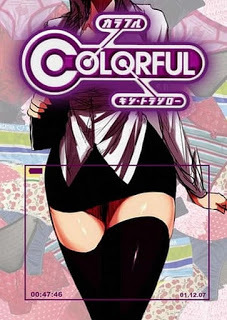 Colorful, 1999, dir: Ryûtarô Nakamura
I promised unclassifiable oddities, and unclassifiable oddities you get! Honestly, it's hard to even know where to begin with Colorful, but trying to establish what it is would probably be a sensible starting point. The DVD release consists of sixteen short films, which, aside from a couple of partial exceptions, all follow an identical formula: a man or men purposefully or accidentally catch glimpses of women's underwear, are uncontrollably aroused, and suffer some mishap as a result of their distraction. These episodes are delivered in five-minute bursts, interspersed with credits and clips of apparently random footage, some of which is thematically related (i.e. mildly pornographic) and some of which hasn't a damn thing to do with anything (i.e exploding cars.) Altogether, the shorts come to a little under two hours, though a good chunk of that consists of the intro and other repeated footage. With judicious skipping, you can get that running time down to about an hour and a half.
It's still a hell of a long hour and a half. Really, one of these shorts would have done me. Sixteen in a row is a merciless slog into a very peculiar sort of hell. There are no remotely likable characters in Colorful; the men are hideous lechers utterly at the mercy of their libidos and the women are basically sexy furniture, however much the creators seem to think they're presenting them sympathetically. (And this is definitely the intent: while the male characters are frequently exaggerated and reduced to monstrous caricatures, the female characters are uniformly realistic, or at worst idealised.) For most of the running time, there's one joke, which repeats ad nauseum: man glimpses underwear, man loses it and seeks to see more of said underwear, man suffers misfortune. It should be no surprise that the shorts that differ from this formula are far and away the most interesting. Even if they both end in more or less the same place, the tales of a high school girl the size of Godzilla and a TV documentary about a creepy psychic boy manage to wring a bit of humour from their material, and are that bit funnier for being surrounded by so much leaden anti-humour.
If anything redeems Colorful (and it doesn't, and couldn't) then it would be the production, which has a certain heady vitality and vague surrealism that are appealing in and of themselves - or they were to me, anyway, as an animation nerd and as someone who appreciates a bit of high-energy weirdness. I found myself reminded of the video game Jet Set Radio Future, which played around with bursts of music, sound, and animation in a similarly aggressive manner, and more distantly of Satoshi Kon's masterpiece Paranoia Agent, which surely has to be the pinnacle for this sort of thing. Colorful is less successful for the simple reason that its sound and fury ultimately signify bugger all, but still, credit where it's due.
I'm willing to accept that the creators of Colorful believed they were making some sort of meaningful social comment, if only because Ryûtarô Nakamura has some infinitely better work on his CV. Conceivably, in the distant, more (less?) innocent age of 1999 that was even sort of true. Though if would be a great deal truer without the punchlines that basically amount to: man thinks he's looking at sexy young girl and in fact is looking at an older / transgender woman, to his horror and disgust. Colorful certainly finds male lecherousness absurd; however it's still wholeheartedly committed to the notion that female youth and beauty are to be idolised, which leads inevitably to the assumption that women without one or the other are effectively without worth. With that in mind, perhaps the only surviving value here is as a handy learning tool for those left behind by the #metoo age: if you should stumble upon someone who genuinely doesn't believe that male gaze is a thing, or that, for many women, harassment isn't the exception but the norm, sit them down in front of Colorful for a couple of hours. It might not change their perspective, but it will sure as hell leave them feeling wretched.
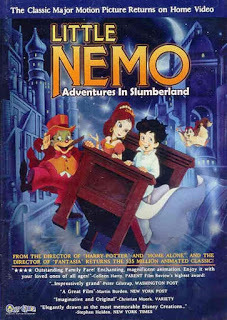 Little Nemo: Adventures in Slumberland, 1989, dir's: Masami Hata, William T. Hurtz
Imagine for a moment that you're producer Yutaka Fujioka, and for years you've been harbouring a dream of transforming Windsor McCay's decades-old comic strip about a child's phantasmagorical nighttime adventures into an animated motion picture. Who do you turn to in the hope of making your vision real? Do you start with the animation masters of your own country, the likes of Hayao Miyazaki, Isao Takahata, and Osamu Dezaki? Do you look to America, since that's where the material you're set on adapting came from? You might approach animators like Brad Bird and Chuck Jones, or a live-action director with relevant experience like George Lucas, or a writer of fantasy like Ray Bradbury, or a script-writer with more direct experience of writing kids' movies like Chris "The Goonies" Columbus? Or just maybe America seems too much of a stretch and you turn to Europe instead, and try, say, Jean Giraud, also known as the legendary Moebius?
The correct answer, if you haven't guessed, is that what Fujioka did was approach all of those luminaries over a period of years, and many of them left their fingerprints on what would end up being Little Nemo: Adventures in Slumberland, one of the most lavish - and troubled! - animated films created up to that point. Were art created by osmosis, that would surely make it the greatest masterpiece the human race has ever concocted. Sadly, it doesn't quite work that way, especially when not everyone involved was altogether positive about the project: Lucas bemoaned a lack of character development, as did Takahata, while Miyazaki had issues with the "everything's a dream" concept that was so essential to the source material.
And from this one might argue that Fujioka should have drawn two clear conclusions: firstly that when people like George Lucas and Hayao Miyazaki give you advice, you should listen, and secondly that too many cooks really do spoil the broth, especially when the ingredients are dubious to begin with. Little Nemo: Adventures in Slumberland was a colossal flop, and deservedly so. It simply doesn't work. Part of the problem is that it's too saccharine and empty for adults, too weird and scary for kids. Part of the problem is Miyazaki's point that the material feels empty and inconsequential due to its very nature, and part of the problem was probably co-director Hurtz, since much of the direction is flat and lifeless regardless of how extraordinary what's occurring on screen is.* But the heart of the problem is Nemo himself, who manages to be both deliriously boring and an annoying, amoral little shit at one and the same time.
The story goes like this: utter nobody Nemo - see what McCay did there! - whose talents stretch to a knack for duplicity and a tendency toward exceptionally vivid dreams, is made heir to the throne of Slumberland by its king Morpheus, who, judging by the available evidence, is severely senile and really shouldn't be allowed near decisions of such magnitude. His sole injunction is that Nemo not open a certain door, with the definite implication that something severely unpleasant lies on the other side. Nemo, under the influence of the obviously ill-intentioned clown Flip, duly opens said door, unleashing all manner of horrors. Nemo then spends the remainder of the film trying to make right his mistake, a task that mostly gets done by others but for which he inevitably takes all the credit.
It's an awful plot with an awful protagonist, and it's at its most awful in the first half, which mostly just introduces us to Slumberland and the characters and goes to great efforts to lower our expectations of Nemo, so that when he gets to his most atrocious act we at least won't be surprised. It's material that could never have worked, and one gets the strong impression that the project finally shunting into life had less to do with anyone feeling the script was ready and more because Fujioka eventually threw his hands up and said "Sod it." And honestly, I wouldn't be wasting a tenth as many words were it not for the one detail I've dodged until now: Fujioka's company was TMS Entertainment, who around the same time were working on a little something called Akira, and in general experimenting with what feature length animation could look like if you threw astounding amounts of money at it. And as Akira looks extraordinary, so too does Little Nemo: Adventures in Slumberland; this is some of the smoothest, most lavish animation you'll ever encounter, and for all the directorial failings, and despite some largely bland character designs, it's never less than mind-blowing. It's up there with prime Disney, from the early days when Walt was still convinced that the medium could be made to appeal to children and adults alike. It's up there with Akira, or damn near. And its failure ensured that TMS Entertainment would never again try anything a fraction as ambitious, thus arguably setting anime film-making back an entire decade.
Taking all of that into account, I have no qualms about devoting so much time to Little Nemo: Adventures in Slumberland. But really, the crucial points I wanted to make are that a) the film is pretty much a mess and b) if you have even a shred of interest in animation as a medium then you absolutely have to see it, and will certainly enjoy it at least a little despite every one of its flaws. You should see it preferably in the blu-ray edition, and in Japanese, since the American voices are just one of the many problems, especially that of the ever-punchable Nemo. Heck, if it erases the dismal, cloying Sherman Brothers' songs then it might even shove the film over the line into being quite good. But truly, it doesn't matter, because what you'll be watching for is the absolutely astonishing craftsmanship, and that alone makes all of Fujioka's efforts worthwhile.
-oOo-
Okay, so ultimately this post was a bit of a cheat. I just wanted an excuse to review A Chinese Ghost Story and Little Nemo, neither of which can honestly, comfortably be described as anime. Heck, A Chinese Ghost Story really isn't anime in any way, shape or form, and I've probably gravely insulted the entire Hong Kong animated film industry. So, er, sorry about that. But perhaps I made up for it in some small way by being probably the only person on the planet currently excited about the movie? Let's hope so, eh.
Elsewhere, the Pokémon film was a weird old trip down memory lane, and I suspect I actually downplayed what a miserable, merciless slog Colorful was. But the biggest trauma here is that I know damn well that one day I'm going to have to pay good money for Little Nemo on blu-ray because, despite its many failings, it's still an utter masterpiece of the animator's art.
Next time around ... we all knew I was lying when I said no more themed posts, right?
[Other posts in this series: Part 1, Part 2, Part 3, Part 4, Part 5, Part 6, Part 7, Part 8, Part 9, Part 10, Part 11, Part 12, Part 13, Part 14, Part 15, Part 16, Part 17, Part 18, Part 19, Part 20, Part 21, Part 22, Part 23, Part 24, Part 25, Part 26, Part 27, Part 28, Part 29, Part 30, Part 31, Part 32, Part 33, Part 34, Part 35, Part 36, Part 37, Part 38, Part 39]
* I'm inclined to blame Hurtz over Hata because his entire prior CV was pretty much garbage and he'd never work in animation again, and because almost all the directorial failings feel like someone trying to badly ape Disney, whereas its successes seem like someone successfully making late-eighties anime.
If that's you then prepare for annoyance, I guess! And brace yourself for reviews of Pokémon: The First Movie - Mewtwo Strikes Back, A Chinese Ghost Story, Little Nemo: Adventures in Slumberland, and Colorful.
 Pokémon: The First Movie - Mewtwo Strikes Back, 1998, dir:
Pokémon: The First Movie was, I believe, the first anime I ever saw in a cinema. I mention this not so that we can all chuckle over my poor life choices, but to emphasise what a huge damn deal the film was way back in 1998. Anime simply didn't get wide releases in the UK back in those days, certainly not from major studios such as Warner Bros., and absolutely definitely they didn't go on to make astronomical amounts of money that put the likes of My Neighbour Totoro and Ghost in the Shell to shame.
With all of that in mind, it beggars belief what a cheap, scrappy, inconsequential bit of fluff the first Pokémon movie is. I mean, it's not even feature length; they only managed to pad it out by inserting the execrable Pikachu's Vacation before it, a delirious nothing of a twenty minutes that must have left many a parent in sweaty-palmed dread of what they were in for. And yet Warner Bros. behaved as though this was the biggest damn thing, and for many a kid (and, er, twenty-something with too much time on their hands) it really was. Heck, I even remember responding to it quite positively, without being ignorant of the fact that it was essentially shoddy and trivial.
With the benefit of both hindsight and research, this didn't altogether have to be the case. It turns out Warner got a bit nervy over the Japanese original, which made antagonist Mewtwo an ambiguous character with meaningful motivations. None of that for US children, oh no! And so international audiences lost an opening chunk of plot, and were treated to some truly unfathomable changes in emphasis. It's for this reason, incidentally, that a show about literally nothing other than fighting thinks to pause leadenly for every cast member to discover that fighting is just dreadful and we should all really stop it. Though, given how hysterically weird the moment is, perhaps we Westerners got the better end of that one after all. The same can't be said for the vomitous pop songs that stink up the soundtrack, surely from artists that Warner were eager to push before their unearned fifteen minutes of fame expired.
And yet, there's something here. When the soundtrack isn't being stinky American pop, it's rather grand and portentous, and the animation, while aggressively subpar by what we'd generally accept as feature standards, is at least solid, with some well-integrated CG to set it apart from the TV show. Mostly, though, it's the fact that Pokémon was a thoroughly likable franchise back in those days, and that the film takes that and shoves it into some unexpectedly dark places retains its impact to this day. We get a major character death, and even if it's reversed basically immediately, it's still startling in a franchise where stuff like that just doesn't happen. More, we get the scene that's indelibly burned into my subconscious, in which the Pokémon have to fight their clones, ending in a sequence where Ash's Pikachu turns the other cheek to a pummeling from its counterpart. In slow motion. While the other Pikachu weeps in anguish. I swear, it makes Sophie's Choice look like a light-hearted romp, and if the film doesn't remotely earn it, nevertheless it'll haunt me to my deathbed.
Note that none of this should be considered a reason to go back and watch Pokémon: The First Movie, which is mostly a bit rubbish.
 A Chinese Ghost Story, 1997, dir: Andrew Chan
A Chinese Ghost Story - and here I'm talking about the live-action 1987 original - is a basically perfect film for what it is. Imagine Evil Dead 2 as a martial arts rom-com and you'll get about halfway to envisioning what it has to offer. So it's sort of comprehensible that, some years after, producer Tsui Hark would decide to bring about an animated semi-remake, despite the fact that the Chinese animation scene was in a somewhat woeful state at the time.
(And here let us briefly divert to point at the elephant in the room: I thought when I bought A Chinese Ghost Story that it was conceived in Hong Kong but made by Japanese animators, and in this I was almost entirely wrong. So it's only anime in the sense that all animated films are anime. All of which is to say, it's my blog and I can write about what I like!)
So: at some point between 1987 and 1997 (I'm going off a brief interview on the DVD here) Hark would decide to lavishly adapt his live-action success into the animated medium. More than that, he was determined to do so by utilising all that then-current technologies had to offer, and that meant dabbling with CGI. After much wrangling with his animators and others, who insisted that computer animation just wasn't there yet, Hark settled on a mix of 3D-rendered backgrounds and mostly 2D hand-animated characters, a notion that would become at least somewhat standard in following years, if not to the extent that Hark embraced it, but at the time was crazier than cat juggling.
Now, I have immense respect for Tsui Hark, I truly do, and if you're remotely familiar with the golden age of Hong Kong film-making then probably you have too. But in this he was horrifyingly wrong. The hand-drawn animation in A Chinese Ghost Story is, but for the odd slip-up from a team that like as not had never attempted anything remotely so ambitious, flat-out lovely: not perhaps up to the standards of Disney in 1997 but certainly on a par with what they'd been producing a mere few years earlier. And the character designs are as fun as anything anywhere in the Disney canon, or anything in anime for that matter. But, oh good god, that CGI! The maddening thing is that it's not that bad: I mean, for 1997 it's not. But by 2018 standards it looks like crap. And it's surely the single reason that the movie, which otherwise is witty and goofy and charming and just thoroughly lovely, isn't remembered with immense fondness two decades later.
I'll say this: you do get used to it after a while. And the compositing between 2D and 3D is surprisingly respectable, though of course far from perfect. But my goodness, to think about A Chinese Ghost Story with backgrounds to match those delightful characters ... it breaks the heart a little. I mean, I loved it with the constant distraction of sets and props that look like they've wandered in from a mid-budget late-nineties video game; imagine how giddy I'd be getting without them. And who knows, maybe the film is getting a free pass on some other weaknesses that I didn't notice because I was obsessing over the glaringly obvious one? It's a little frantic, I guess, and the DVD - from Viz Films - is pretty much garbage, with an overly soft print and the sort of offensively bad subtitling that graced many an imported martial arts movie. But, much like its live-action progenitor, A Chinese Ghost Story does a brilliant job of marrying comedy, horror, action, romance and music into one weird, intoxicating whole. It's worth tracking down if you like Eastern animation of any flavour, and if you have an interest in the Hong Kong film scene that Hark was (and still is) such an integral part of. But if, like me, you fit into both groups then find a copy right this minute. You'll thank me, I swear.
 Colorful, 1999, dir: Ryûtarô Nakamura
I promised unclassifiable oddities, and unclassifiable oddities you get! Honestly, it's hard to even know where to begin with Colorful, but trying to establish what it is would probably be a sensible starting point. The DVD release consists of sixteen short films, which, aside from a couple of partial exceptions, all follow an identical formula: a man or men purposefully or accidentally catch glimpses of women's underwear, are uncontrollably aroused, and suffer some mishap as a result of their distraction. These episodes are delivered in five-minute bursts, interspersed with credits and clips of apparently random footage, some of which is thematically related (i.e. mildly pornographic) and some of which hasn't a damn thing to do with anything (i.e exploding cars.) Altogether, the shorts come to a little under two hours, though a good chunk of that consists of the intro and other repeated footage. With judicious skipping, you can get that running time down to about an hour and a half.
It's still a hell of a long hour and a half. Really, one of these shorts would have done me. Sixteen in a row is a merciless slog into a very peculiar sort of hell. There are no remotely likable characters in Colorful; the men are hideous lechers utterly at the mercy of their libidos and the women are basically sexy furniture, however much the creators seem to think they're presenting them sympathetically. (And this is definitely the intent: while the male characters are frequently exaggerated and reduced to monstrous caricatures, the female characters are uniformly realistic, or at worst idealised.) For most of the running time, there's one joke, which repeats ad nauseum: man glimpses underwear, man loses it and seeks to see more of said underwear, man suffers misfortune. It should be no surprise that the shorts that differ from this formula are far and away the most interesting. Even if they both end in more or less the same place, the tales of a high school girl the size of Godzilla and a TV documentary about a creepy psychic boy manage to wring a bit of humour from their material, and are that bit funnier for being surrounded by so much leaden anti-humour.
If anything redeems Colorful (and it doesn't, and couldn't) then it would be the production, which has a certain heady vitality and vague surrealism that are appealing in and of themselves - or they were to me, anyway, as an animation nerd and as someone who appreciates a bit of high-energy weirdness. I found myself reminded of the video game Jet Set Radio Future, which played around with bursts of music, sound, and animation in a similarly aggressive manner, and more distantly of Satoshi Kon's masterpiece Paranoia Agent, which surely has to be the pinnacle for this sort of thing. Colorful is less successful for the simple reason that its sound and fury ultimately signify bugger all, but still, credit where it's due.
I'm willing to accept that the creators of Colorful believed they were making some sort of meaningful social comment, if only because Ryûtarô Nakamura has some infinitely better work on his CV. Conceivably, in the distant, more (less?) innocent age of 1999 that was even sort of true. Though if would be a great deal truer without the punchlines that basically amount to: man thinks he's looking at sexy young girl and in fact is looking at an older / transgender woman, to his horror and disgust. Colorful certainly finds male lecherousness absurd; however it's still wholeheartedly committed to the notion that female youth and beauty are to be idolised, which leads inevitably to the assumption that women without one or the other are effectively without worth. With that in mind, perhaps the only surviving value here is as a handy learning tool for those left behind by the #metoo age: if you should stumble upon someone who genuinely doesn't believe that male gaze is a thing, or that, for many women, harassment isn't the exception but the norm, sit them down in front of Colorful for a couple of hours. It might not change their perspective, but it will sure as hell leave them feeling wretched.
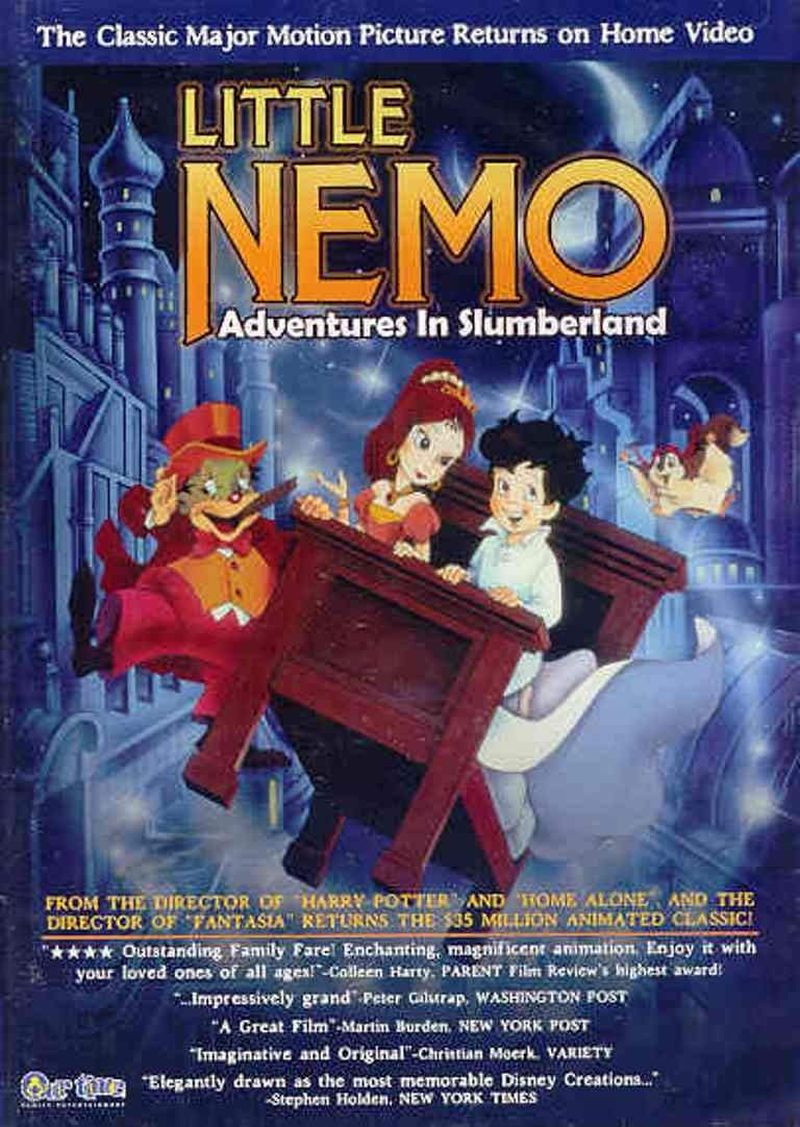 Little Nemo: Adventures in Slumberland, 1989, dir's: Masami Hata, William T. Hurtz
Imagine for a moment that you're producer Yutaka Fujioka, and for years you've been harbouring a dream of transforming Windsor McCay's decades-old comic strip about a child's phantasmagorical nighttime adventures into an animated motion picture. Who do you turn to in the hope of making your vision real? Do you start with the animation masters of your own country, the likes of Hayao Miyazaki, Isao Takahata, and Osamu Dezaki? Do you look to America, since that's where the material you're set on adapting came from? You might approach animators like Brad Bird and Chuck Jones, or a live-action director with relevant experience like George Lucas, or a writer of fantasy like Ray Bradbury, or a script-writer with more direct experience of writing kids' movies like Chris "The Goonies" Columbus? Or just maybe America seems too much of a stretch and you turn to Europe instead, and try, say, Jean Giraud, also known as the legendary Moebius?
The correct answer, if you haven't guessed, is that what Fujioka did was approach all of those luminaries over a period of years, and many of them left their fingerprints on what would end up being Little Nemo: Adventures in Slumberland, one of the most lavish - and troubled! - animated films created up to that point. Were art created by osmosis, that would surely make it the greatest masterpiece the human race has ever concocted. Sadly, it doesn't quite work that way, especially when not everyone involved was altogether positive about the project: Lucas bemoaned a lack of character development, as did Takahata, while Miyazaki had issues with the "everything's a dream" concept that was so essential to the source material.
And from this one might argue that Fujioka should have drawn two clear conclusions: firstly that when people like George Lucas and Hayao Miyazaki give you advice, you should listen, and secondly that too many cooks really do spoil the broth, especially when the ingredients are dubious to begin with. Little Nemo: Adventures in Slumberland was a colossal flop, and deservedly so. It simply doesn't work. Part of the problem is that it's too saccharine and empty for adults, too weird and scary for kids. Part of the problem is Miyazaki's point that the material feels empty and inconsequential due to its very nature, and part of the problem was probably co-director Hurtz, since much of the direction is flat and lifeless regardless of how extraordinary what's occurring on screen is.* But the heart of the problem is Nemo himself, who manages to be both deliriously boring and an annoying, amoral little shit at one and the same time.
The story goes like this: utter nobody Nemo - see what McCay did there! - whose talents stretch to a knack for duplicity and a tendency toward exceptionally vivid dreams, is made heir to the throne of Slumberland by its king Morpheus, who, judging by the available evidence, is severely senile and really shouldn't be allowed near decisions of such magnitude. His sole injunction is that Nemo not open a certain door, with the definite implication that something severely unpleasant lies on the other side. Nemo, under the influence of the obviously ill-intentioned clown Flip, duly opens said door, unleashing all manner of horrors. Nemo then spends the remainder of the film trying to make right his mistake, a task that mostly gets done by others but for which he inevitably takes all the credit.
It's an awful plot with an awful protagonist, and it's at its most awful in the first half, which mostly just introduces us to Slumberland and the characters and goes to great efforts to lower our expectations of Nemo, so that when he gets to his most atrocious act we at least won't be surprised. It's material that could never have worked, and one gets the strong impression that the project finally shunting into life had less to do with anyone feeling the script was ready and more because Fujioka eventually threw his hands up and said "Sod it." And honestly, I wouldn't be wasting a tenth as many words were it not for the one detail I've dodged until now: Fujioka's company was TMS Entertainment, who around the same time were working on a little something called Akira, and in general experimenting with what feature length animation could look like if you threw astounding amounts of money at it. And as Akira looks extraordinary, so too does Little Nemo: Adventures in Slumberland; this is some of the smoothest, most lavish animation you'll ever encounter, and for all the directorial failings, and despite some largely bland character designs, it's never less than mind-blowing. It's up there with prime Disney, from the early days when Walt was still convinced that the medium could be made to appeal to children and adults alike. It's up there with Akira, or damn near. And its failure ensured that TMS Entertainment would never again try anything a fraction as ambitious, thus arguably setting anime film-making back an entire decade.
Taking all of that into account, I have no qualms about devoting so much time to Little Nemo: Adventures in Slumberland. But really, the crucial points I wanted to make are that a) the film is pretty much a mess and b) if you have even a shred of interest in animation as a medium then you absolutely have to see it, and will certainly enjoy it at least a little despite every one of its flaws. You should see it preferably in the blu-ray edition, and in Japanese, since the American voices are just one of the many problems, especially that of the ever-punchable Nemo. Heck, if it erases the dismal, cloying Sherman Brothers' songs then it might even shove the film over the line into being quite good. But truly, it doesn't matter, because what you'll be watching for is the absolutely astonishing craftsmanship, and that alone makes all of Fujioka's efforts worthwhile.
-oOo-
Okay, so ultimately this post was a bit of a cheat. I just wanted an excuse to review A Chinese Ghost Story and Little Nemo, neither of which can honestly, comfortably be described as anime. Heck, A Chinese Ghost Story really isn't anime in any way, shape or form, and I've probably gravely insulted the entire Hong Kong animated film industry. So, er, sorry about that. But perhaps I made up for it in some small way by being probably the only person on the planet currently excited about the movie? Let's hope so, eh.
Elsewhere, the Pokémon film was a weird old trip down memory lane, and I suspect I actually downplayed what a miserable, merciless slog Colorful was. But the biggest trauma here is that I know damn well that one day I'm going to have to pay good money for Little Nemo on blu-ray because, despite its many failings, it's still an utter masterpiece of the animator's art.
Next time around ... we all knew I was lying when I said no more themed posts, right?
[Other posts in this series: Part 1, Part 2, Part 3, Part 4, Part 5, Part 6, Part 7, Part 8, Part 9, Part 10, Part 11, Part 12, Part 13, Part 14, Part 15, Part 16, Part 17, Part 18, Part 19, Part 20, Part 21, Part 22, Part 23, Part 24, Part 25, Part 26, Part 27, Part 28, Part 29, Part 30, Part 31, Part 32, Part 33, Part 34, Part 35, Part 36, Part 37, Part 38, Part 39]
* I'm inclined to blame Hurtz over Hata because his entire prior CV was pretty much garbage and he'd never work in animation again, and because almost all the directorial failings feel like someone trying to badly ape Disney, whereas its successes seem like someone successfully making late-eighties anime.
August 27, 2018
My First Blog Tour
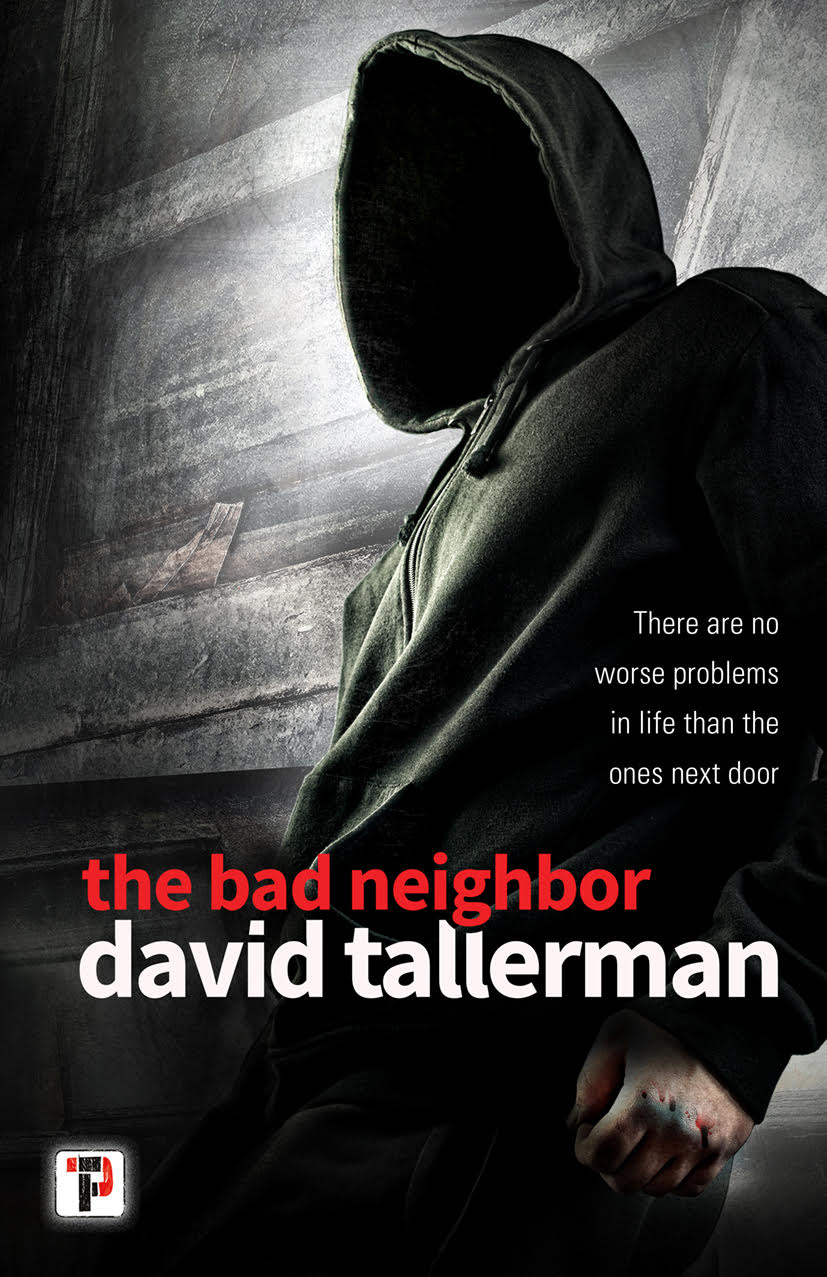 For a long time indeed, blog tours have been something that those cool author kids did, and I gazed from the sidelines, vaguely puzzled by the use of the word "tour" to describe something that didn't involve any movement in physical space. Well, no more! In your collective faces, cool author kids! I have a blog tour of my own, for my imminent crime debut The Bad Neighbour - and unbeknown to the bloggers, I've even been camping out outside of their respective houses on the relevant days out of a misplaced sense of literalism. Fortunately, two of the posts are effectively by me, which meant I got to stay home and get a bit of work done on those days. Still, it's been pretty hectic all told, and frankly, while I'm grateful for all the excitement, it's nice to have everything back to normal.
So here's where I've been, both spiritually and physically, over the last week:
Monday 20th August: Audio Killed the Bookmark (Review)Tuesday 21st August: Ebookwyrm's Blog Cave (Review)Wednesday 22nd August: Don Jimmy Reviews (Review)Thursday 23rd August: CBailey31 Books and Blogs (Review)Friday 24th August: Blog of Lucy V Hay (Interview)Saturday 25th August: Loving Life Everday (Review)Sunday 26th August: Random Through My Letterbox (Eight books that influenced me.)
A huge thank you to everyone who was involved, and especially to Maria Tissot at Flame Tree for getting the ball rolling, and especially especially to Anne Cater, who seems to have been the guiding force behind the whole business. Joking aside, it's been really cool to have a whole week of people talking about my book. The Bad Neighbour (or The Bad Neighbor if you're of a more American persuasion) is out in paperback and hardback on the ninth of September.
Lastly, it should be noted that this is only one chunk of a much bigger Flame Tree Press tour, which also takes in Hunter Shea, Tim Waggoner and Jonathan Janz, and which you can read about here. Oh, and here's all of that information above, except in a cool banner thing:

August 19, 2018
Film Ramble: Drowning in Nineties Anime, Pt. 39
Well, this one's a right old hotchpotch! My nineties anime viewing has been distinctly unruly lately, as I finally got sick of how much room this stuff was occupying on my "to watch" shelf and started plugging away in earnest. I'm also writing these posts in an incredibly disorderly fashion, which makes them confusing to come back to; I suspect this particular batch were reviewed over the course of about two months. On the plus side, there's no hint of a theme this time around! Well, except for the fact that two of the titles are about ninjas.
Extra prize points* for guessing what those two ninja titles are out of: City Hunter: Secret Service, Wrath of the Ninja: The Yotoden Movie, The Cockpit and The Dagger of Kamui...
 City Hunter: Secret Service, 1996, dir: Kenji Kodama
I'm not quite lazy enough to suggest that if you want to know my thoughts on City Hunter: Secret Service, it would save us both time if you simply went back and read my review of City Hunter: .357 Magnum and assumed they were in every meaningful way identical. Yet by not doing so, I leave myself at an impasse, because I've nothing to add: everything that was wrong there is wrong here, and in more or less the same ways and even the same places, because the two films are structurally largely identical, down as far as the construction of certain scenes and the majority of the humour. City Hunter: Secret Service feels more like a remake then a fresh project, and a remake of a story that barely warranted telling the first time.
And that feels harsh to say, because City Hunter: Secret Service is fine, in a certain way. View it as what it is, a TV special, and lump it into the same category as all those other TV specials that littered the entertainment landscape in those days, and it probably does more or less what you'd expect, bringing familiar characters back for another lap in the most formulaic way possible. So maybe the problem is just that I don't much like the formula. With the best will in the world, Ryô Saeba, letch, stalker, underwear thief, and manipulator of vulnerable women, has not aged well as a protagonist, and the fact that he inevitably gets punished in "comic" fashion by his long-suffering assistant doesn't make the laughs come any more readily. This kind of stuff can be amusing - see Urusei Yatsura at its best - but it can also be awfully painful, and Secret Service spends far too much of its time at that end of the spectrum.
This one, at least, gets a solid action sequence midway through, one with a dash of imagination and a modicum of ambition. Elsewhere, the animation is resolutely so-so, with the briefest splashes of flair, but a ghastly colour scheme makes the film look much worse than it is: there's one hotel corridor in particular that's actively unpleasant to look at, and which gets shown a lot. Kodama directs with little elegance, and I'm at a loss to say why he was let loose on so many of these things, let alone the proper City Hunter motion picture that would follow a year later.
Ultimately, and depending on how bothered you are by the protagonist's atrocious behaviour, Secret Service is a title that trundles along in largely tolerable fashion: one suspects that the reason it's so formulaic is that by this point the creators felt they'd discovered a formula that worked, and there's a kernel of truth to that. I can honestly say that I was never bored, or even that incensed. Generally when I was close to the point of wishing Ryô would just sod off and die, he'd suffer some appropriately violent retribution, or flip into cool action guy mode, or just occasionally show a little actual decency. But ultimately, that amounts only to saying that City Hunter: Secret Service is fitfully amusing, with bearable stretches in between, so I'm sure as hell not recommending it.**
 Wrath of the Ninja: The Yotoden Movie, 1989, dir's: Toshiyuki Sakurai, Osamu Yamasaki
I'm no expert on Japanese history by any means, but I've watched enough anime that I feel I have a fair grasp of the facts surrounding Oda Nobunaga, the sixteenth century feudal lord regarded as one of the crucial figures in the unification of Japan. The essential details seem undebatable: he was colossally evil, he had a correspondingly evil mustache, he had an army of monsters and freaky, super-powered generals, and he was (or very much wanted to be) a demon. It's only on the trivia that things get murkier: was he defeated by ninjas, samurai, or a combination of the two? Did he drink out of a human skull? How much maniacal cackling did he really get up to?
At any rate, Wrath of the Ninja is content to stick to the absolute historical certainties: as such, it follows a trio of ninja, all of whom possess magical weapons they're not quite sure what to do with, as they struggle against Nobunaga's sneakiness and lack of fair play and then, ever so slowly and with no end of setbacks, begin to maneuverer into a position where a final strike might be only mostly suicidal.
At this point, it's perhaps useful to mention that Wrath of the Ninja is a cut-down version of a three part OVA, which in turn was an adaptation of a fantasy novel that I assume, with no evidence whatsoever, to be the originator of all this "Nobunaga was a demon with an army of monsters" hokum. The crucial point for our purposes is that what we have here is a chunk of a bigger story, spliced together without a great deal of grace and with animation more appropriate to TV than film. As such, first impressions are far from brilliant: it's easy enough to tell what's going on, but certain fairly significant points and characters are dealt with hastily or barely at all. Around what I take for the end of the first episode, for example, there's a supposedly major death that has zero impact because we've barely had time to learn the name of the character in question, let alone care about them, and I spent literally half the film wondering whether the other characters realised that the protagonist was female or not, since it had the air of a badly kept secret.
But Wrath of the Ninja gets better, and then gets a lot better, until by the end it's become very good indeed. To some extent that's to do with the scale of a story that achieves a certain gravitas simply by letting us watch the characters we're growing acquainted with be ground down by defeat after defeat and horror after horror. To some extent it's because those horrors are actually rather creepy and imaginative, and never more so than with Nobunaga's seven generals, who offer up a series of weird and exciting boss fights. And to some extent it's because the storytelling focuses in as it goes along, and so begins to feel less like a mercilessly chopped OVA and more like an actual movie. Put it all together and the result is rather satisfying. In many ways, Wrath of the Ninja does Ninja Scroll well before Ninja Scroll did, and while the resolutely not-great animation holds it back, not helped by the usual murky U.S. Manga Corps print, it's nevertheless a better-than-average entry into its genre. Very much in the "one to track down if you like this sort of thing" basket, then, but a title better suited to the higher end of that list than the lower.
 The Cockpit, 1994, dir's: Takashi Imanishi, Yoshiaki Kawajiri, Ryôsuke Takahashi
Anyone who's been reading from the start may remember lots of noble talk about finding lost classics, and how quickly that degenerated into merely hunting for stuff that was at least genuinely good - and since then, of course, standards have slipped all the way to "Look, you could do worse than watch Voogie's Angel, all right?" Which is to say that grand aspirations don't hold up for long in the face of just how cheap, derivative, and silly a great deal of nineties anime truly was. And also that I vastly overrated Voogie's Angel.
Yet here we are, post number thirty-nine, and The Cockpit is a masterpiece if ever I saw one. It's great art made with great artistry, telling stories of a sort that have rarely been told in a manner and a medium that makes them all the more unique. No wonder it was a catastrophic flop when it was released in the US, eh? And that it's now all but impossible to find? It's almost as though a movie consisting of three vignettes about how World World Two wasn't actually a whole lot of fun for everyone on the losing side doesn't fit terribly well in the narrative we've built around that most horrific of conflicts. What do you mean, a German pilot might have second thoughts about escorting an appalling new test weapon in the last days of the war? What do you mean, Japanese troops might feel uncomfortable with the notion of escorting a young kamikaze pilot to his final, one-way flight? What do you mean, the enemy were people?
But let's back up and dig a little further into what The Cockpit is. When he wasn't writing deeply romantic space operas featuring the likes of Captain Harlock and Queen Emeraldas, Leiji Matsumoto was crafting a World War Two series called Battlefield, and the movie in hand was a bid to turn that series into an anthology film of the type that pops up occasionally in the world of anime: three directors tell three stories with three different animation teams and no real connection between them. Of those directors, Yoshiaki (Ninja Scroll) Kawajiri is certainly the biggest name today, though one of the remarkable aspects of The Cockpit is how consistently superb it is. Kawajiri's piece - that one about the German pilot - is the opener, Slipstream, and feels most familiar from what I've seen of Matsumoto's work: in fact, the characters are very familiar looking indeed. At any rate, it's fine work, and sets such a high bar that it's astonishing how effortlessly Sonic Boom Squadron - the kamikazi pilot section - vaults over it. A desperately sad little tale of a great many people sacrificing themselves so that one man can throw away his life in a war that's already lost, its greatest triumphs are perhaps that it manages to transcend being mere misery porn and that it finds an ending that's both honest and transcendent. Which leaves Knight of the Iron Dragon in a tough position, and if it subsequently feels like the weakest section then that's no criticism. That it ups the humanity and focuses even harder on a tiny microcosm of the war is absolutely the right note to end on, and brilliant work remains brilliant work even when it's not quite as brilliant as what came before.
While everyone seems to basically agree that it's a classic, I've seen various criticisms thrown at The Cockpit: that it's patriotic, that it doesn't address the horrors the Axis powers committed, and that the cartoony character designs that begin to pop up in part two and take over almost entirely in three are at odds with the seriousness of the material. The first two are plain idiotic; if there's one message it's impossible to ignore here, it's that war is an act of madness committed by people who'd be better off devoting their energies to absolutely anything else, and if the notion of a Japanese film not presenting the Japanese solely as villains offends you then, sorry, but you're a racist. The last one is trickier, though probably only if you're unwilling to meet the film on its own terms: those rubber-faced characters serve particular purposes, their presence is clearly a creative decision, and much can be gleaned from which characters are drawn realistically and which aren't. For my part, all I can complain about is that The Cockpit has all but vanished from the Earth: I consider myself lucky indeed to have landed a cheap DVD copy (also including the risible Digital Devil!) but even then, there's no escaping the fact that the print doesn't do the material a shred of justice. In a saner world, this thing would be available on blu-ray by this time. And maybe someone would actually buy it, instead of sulking over the shocking revelation that war sucks whichever side you're on.
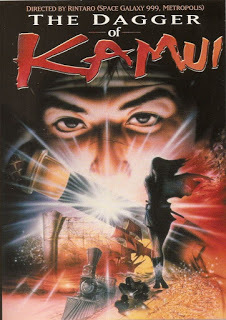 The Dagger of Kamui, 1985, dir: Rintaro
Say what you like about director Rintaro, he's consistent in both his virtues and his vices. Want an overly long film full of imaginative, gorgeously animated scenes that never quite coheres into a logical, satisfying whole? Then Rintaro is absolutely your man. It's true of his best work - probably X and Metropolis, based on what I've seen - and it's true of his more middling efforts. Of which, sad to say, The Dagger of Kamui is certainly one.
But goodness knows, it's not for a lack of trying! The Dagger of Kamui is epic in every sense of the word, a work of outrageous ambition that tells a whopping narrative spanning years, continents, and a considerable cast of characters, all brought to life with animation that must have looked mighty fine in 1985 and looks pretty decent today, though I sorely regret picking up the muddy, too-soft AnimEigo release over the newer Eastern Star edition.*** But either way, the problems certainly don't lie in the appearance of the thing, which is a perfect example of what for me counts as Rintaro's greatest talent, to craft each and every scene with the same high levels of energy and visual flair. It's a little exhausting, to be sure, but there are so many ideas here, and so many sequences that are thrilling purely on the level of how the language of animation is manipulated to evoke mood or heighten action. The Dagger of Kamui is not a film that you could ever get bored looking at, not if you have any enthusiasm at all for animation or design.
Which is a good thing, because the plot is hellaciously easy to get bored by, or at the very least to get befuddled and annoyed by. Our hero is young Jirô, who's accused of murdering his adoptive mother and sister in the opening sequence (a crime, of course, really committed by evil ninjas, because this is an anime about historical Japan!) only to soon after be manipulated into offing his actual father, at the behest of evil priest Tenkai. In fact, Jirô will be manipulated a great deal by Tenkai over the next couple of hours, as it becomes apparent that what the villain is after is a treasure that Jirô's father was seeking and which he believes Jirô is thus best suited to chase after.
Now, to explain why that makes no sense would take a blog post in itself, but suffice to say that there was never a moment where I was persuaded either by Tenkai's baffling, generations-spanning scheme or by Jirô's willingness to go along with it. There's literally no reason, other then perhaps idle curiosity, for him to do so; it's not even as if he wants the treasure for himself. And the rest of the cast have motivations just as woolly, making for an extremely long story in which people mostly do things because the plot needs them to be doing that thing at that moment.
And this is a shame. Partly because it was absolutely fixable - give Jirô one single reason to go treasure hunting and you've already solved half the script's issues - and partly because it's surrounded by something so basically interesting. The superstructure of The Dagger of Kamui, which eventually opens out into historical drama on a grand scale, is fairly splendid stuff, and Jirô's globe-trotting trip is thrilling if for no other reason than that it steps outside of Japan's borders in a way that very little historical anime ever does. Want to see a ninja go up against a gunfighter in a dusty Wild West town? Then you've come to the right place. And this being Rintaro, Kamui is laden with such scenes, that work perfectly in and of themselves. It's the connective tissue he's terrible at, and rarely more so than here. As such, The Dagger of Kamui is both impossible to dismiss and hard to unreservedly recommend: another worthwhile, flawed, visually thrilling work from a director who seemingly did his best to corner that particularly market.
-oOo-
So a random old mess, certainly, but at least we got a new classic out of it. Sadly, you're unlikely indeed to ever see The Cockpit in a remotely legal fashion, and I'm unlikely to ever see it in a print that doesn't look like it was left in a swamp for a week, so maybe that's not altogether a reason to break out the party poppers. Especially since, that aside, we're left with Wrath of the Ninja as a high point, and ... well, it is, I guess? Editing up my review certainly made me want to watch it again.
Next time I think maybe we're going to be getting the "oddities" post I've been cobbling together for goodness knows how long. And yes, that's oddities that are odder than the baseline oddness of nineties anime, and that's surely a reason to be excited. Or scared. Wait, no, definitely that second one.
[Other posts in this series: Part 1, Part 2, Part 3, Part 4, Part 5, Part 6, Part 7, Part 8, Part 9, Part 10, Part 11, Part 12, Part 13, Part 14, Part 15, Part 16, Part 17, Part 18, Part 19, Part 20, Part 21, Part 22, Part 23, Part 24, Part 25, Part 26, Part 27, Part 28, Part 29, Part 30, Part 31, Part 32, Part 33, Part 34, Part 35, Part 36, Part 37, Part 38]
* Needless to say, the prize will be more damn nineties anime reviews.
** Also, I've watched two of these things now, and City Hunter still hasn't caught a single city. If that's not false advertising then I don't know what is.
*** On the plus side, the enclosed liner notes are fantastic, and who else but AnimEigo ever felt the need to provide a print-out of translated song lyrics?
Extra prize points* for guessing what those two ninja titles are out of: City Hunter: Secret Service, Wrath of the Ninja: The Yotoden Movie, The Cockpit and The Dagger of Kamui...
 City Hunter: Secret Service, 1996, dir: Kenji Kodama
I'm not quite lazy enough to suggest that if you want to know my thoughts on City Hunter: Secret Service, it would save us both time if you simply went back and read my review of City Hunter: .357 Magnum and assumed they were in every meaningful way identical. Yet by not doing so, I leave myself at an impasse, because I've nothing to add: everything that was wrong there is wrong here, and in more or less the same ways and even the same places, because the two films are structurally largely identical, down as far as the construction of certain scenes and the majority of the humour. City Hunter: Secret Service feels more like a remake then a fresh project, and a remake of a story that barely warranted telling the first time.
And that feels harsh to say, because City Hunter: Secret Service is fine, in a certain way. View it as what it is, a TV special, and lump it into the same category as all those other TV specials that littered the entertainment landscape in those days, and it probably does more or less what you'd expect, bringing familiar characters back for another lap in the most formulaic way possible. So maybe the problem is just that I don't much like the formula. With the best will in the world, Ryô Saeba, letch, stalker, underwear thief, and manipulator of vulnerable women, has not aged well as a protagonist, and the fact that he inevitably gets punished in "comic" fashion by his long-suffering assistant doesn't make the laughs come any more readily. This kind of stuff can be amusing - see Urusei Yatsura at its best - but it can also be awfully painful, and Secret Service spends far too much of its time at that end of the spectrum.
This one, at least, gets a solid action sequence midway through, one with a dash of imagination and a modicum of ambition. Elsewhere, the animation is resolutely so-so, with the briefest splashes of flair, but a ghastly colour scheme makes the film look much worse than it is: there's one hotel corridor in particular that's actively unpleasant to look at, and which gets shown a lot. Kodama directs with little elegance, and I'm at a loss to say why he was let loose on so many of these things, let alone the proper City Hunter motion picture that would follow a year later.
Ultimately, and depending on how bothered you are by the protagonist's atrocious behaviour, Secret Service is a title that trundles along in largely tolerable fashion: one suspects that the reason it's so formulaic is that by this point the creators felt they'd discovered a formula that worked, and there's a kernel of truth to that. I can honestly say that I was never bored, or even that incensed. Generally when I was close to the point of wishing Ryô would just sod off and die, he'd suffer some appropriately violent retribution, or flip into cool action guy mode, or just occasionally show a little actual decency. But ultimately, that amounts only to saying that City Hunter: Secret Service is fitfully amusing, with bearable stretches in between, so I'm sure as hell not recommending it.**
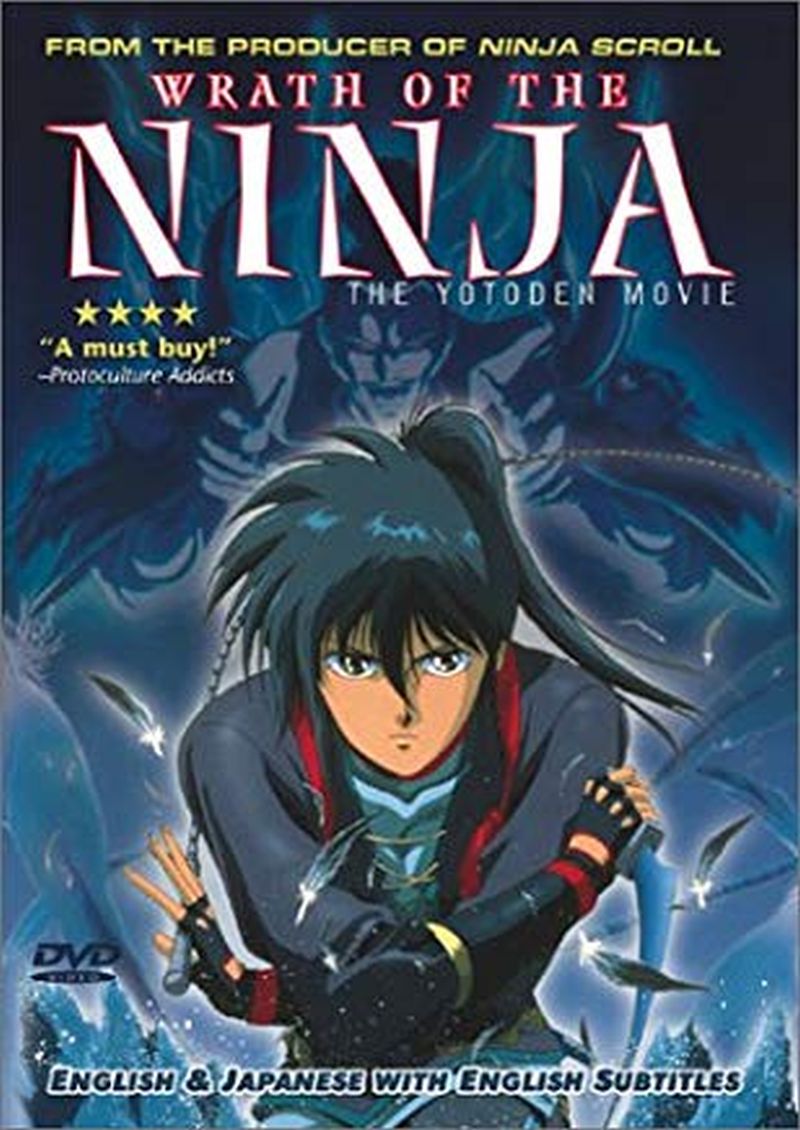 Wrath of the Ninja: The Yotoden Movie, 1989, dir's: Toshiyuki Sakurai, Osamu Yamasaki
I'm no expert on Japanese history by any means, but I've watched enough anime that I feel I have a fair grasp of the facts surrounding Oda Nobunaga, the sixteenth century feudal lord regarded as one of the crucial figures in the unification of Japan. The essential details seem undebatable: he was colossally evil, he had a correspondingly evil mustache, he had an army of monsters and freaky, super-powered generals, and he was (or very much wanted to be) a demon. It's only on the trivia that things get murkier: was he defeated by ninjas, samurai, or a combination of the two? Did he drink out of a human skull? How much maniacal cackling did he really get up to?
At any rate, Wrath of the Ninja is content to stick to the absolute historical certainties: as such, it follows a trio of ninja, all of whom possess magical weapons they're not quite sure what to do with, as they struggle against Nobunaga's sneakiness and lack of fair play and then, ever so slowly and with no end of setbacks, begin to maneuverer into a position where a final strike might be only mostly suicidal.
At this point, it's perhaps useful to mention that Wrath of the Ninja is a cut-down version of a three part OVA, which in turn was an adaptation of a fantasy novel that I assume, with no evidence whatsoever, to be the originator of all this "Nobunaga was a demon with an army of monsters" hokum. The crucial point for our purposes is that what we have here is a chunk of a bigger story, spliced together without a great deal of grace and with animation more appropriate to TV than film. As such, first impressions are far from brilliant: it's easy enough to tell what's going on, but certain fairly significant points and characters are dealt with hastily or barely at all. Around what I take for the end of the first episode, for example, there's a supposedly major death that has zero impact because we've barely had time to learn the name of the character in question, let alone care about them, and I spent literally half the film wondering whether the other characters realised that the protagonist was female or not, since it had the air of a badly kept secret.
But Wrath of the Ninja gets better, and then gets a lot better, until by the end it's become very good indeed. To some extent that's to do with the scale of a story that achieves a certain gravitas simply by letting us watch the characters we're growing acquainted with be ground down by defeat after defeat and horror after horror. To some extent it's because those horrors are actually rather creepy and imaginative, and never more so than with Nobunaga's seven generals, who offer up a series of weird and exciting boss fights. And to some extent it's because the storytelling focuses in as it goes along, and so begins to feel less like a mercilessly chopped OVA and more like an actual movie. Put it all together and the result is rather satisfying. In many ways, Wrath of the Ninja does Ninja Scroll well before Ninja Scroll did, and while the resolutely not-great animation holds it back, not helped by the usual murky U.S. Manga Corps print, it's nevertheless a better-than-average entry into its genre. Very much in the "one to track down if you like this sort of thing" basket, then, but a title better suited to the higher end of that list than the lower.
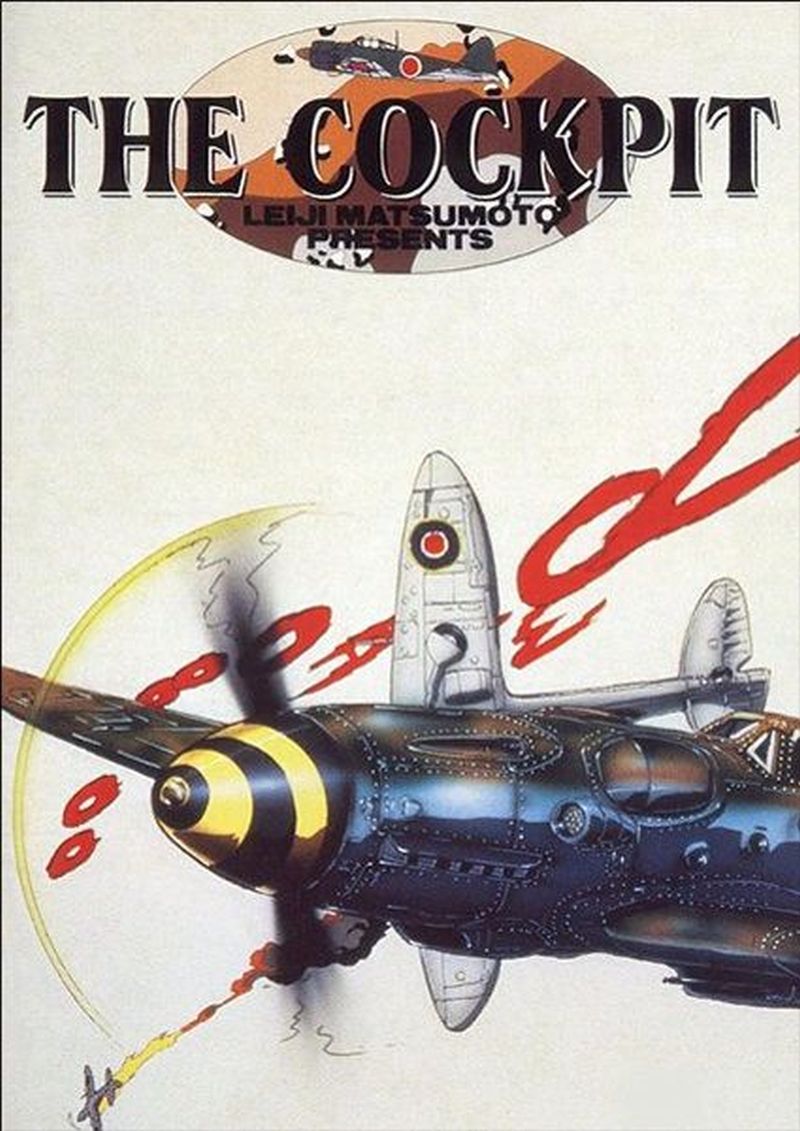 The Cockpit, 1994, dir's: Takashi Imanishi, Yoshiaki Kawajiri, Ryôsuke Takahashi
Anyone who's been reading from the start may remember lots of noble talk about finding lost classics, and how quickly that degenerated into merely hunting for stuff that was at least genuinely good - and since then, of course, standards have slipped all the way to "Look, you could do worse than watch Voogie's Angel, all right?" Which is to say that grand aspirations don't hold up for long in the face of just how cheap, derivative, and silly a great deal of nineties anime truly was. And also that I vastly overrated Voogie's Angel.
Yet here we are, post number thirty-nine, and The Cockpit is a masterpiece if ever I saw one. It's great art made with great artistry, telling stories of a sort that have rarely been told in a manner and a medium that makes them all the more unique. No wonder it was a catastrophic flop when it was released in the US, eh? And that it's now all but impossible to find? It's almost as though a movie consisting of three vignettes about how World World Two wasn't actually a whole lot of fun for everyone on the losing side doesn't fit terribly well in the narrative we've built around that most horrific of conflicts. What do you mean, a German pilot might have second thoughts about escorting an appalling new test weapon in the last days of the war? What do you mean, Japanese troops might feel uncomfortable with the notion of escorting a young kamikaze pilot to his final, one-way flight? What do you mean, the enemy were people?
But let's back up and dig a little further into what The Cockpit is. When he wasn't writing deeply romantic space operas featuring the likes of Captain Harlock and Queen Emeraldas, Leiji Matsumoto was crafting a World War Two series called Battlefield, and the movie in hand was a bid to turn that series into an anthology film of the type that pops up occasionally in the world of anime: three directors tell three stories with three different animation teams and no real connection between them. Of those directors, Yoshiaki (Ninja Scroll) Kawajiri is certainly the biggest name today, though one of the remarkable aspects of The Cockpit is how consistently superb it is. Kawajiri's piece - that one about the German pilot - is the opener, Slipstream, and feels most familiar from what I've seen of Matsumoto's work: in fact, the characters are very familiar looking indeed. At any rate, it's fine work, and sets such a high bar that it's astonishing how effortlessly Sonic Boom Squadron - the kamikazi pilot section - vaults over it. A desperately sad little tale of a great many people sacrificing themselves so that one man can throw away his life in a war that's already lost, its greatest triumphs are perhaps that it manages to transcend being mere misery porn and that it finds an ending that's both honest and transcendent. Which leaves Knight of the Iron Dragon in a tough position, and if it subsequently feels like the weakest section then that's no criticism. That it ups the humanity and focuses even harder on a tiny microcosm of the war is absolutely the right note to end on, and brilliant work remains brilliant work even when it's not quite as brilliant as what came before.
While everyone seems to basically agree that it's a classic, I've seen various criticisms thrown at The Cockpit: that it's patriotic, that it doesn't address the horrors the Axis powers committed, and that the cartoony character designs that begin to pop up in part two and take over almost entirely in three are at odds with the seriousness of the material. The first two are plain idiotic; if there's one message it's impossible to ignore here, it's that war is an act of madness committed by people who'd be better off devoting their energies to absolutely anything else, and if the notion of a Japanese film not presenting the Japanese solely as villains offends you then, sorry, but you're a racist. The last one is trickier, though probably only if you're unwilling to meet the film on its own terms: those rubber-faced characters serve particular purposes, their presence is clearly a creative decision, and much can be gleaned from which characters are drawn realistically and which aren't. For my part, all I can complain about is that The Cockpit has all but vanished from the Earth: I consider myself lucky indeed to have landed a cheap DVD copy (also including the risible Digital Devil!) but even then, there's no escaping the fact that the print doesn't do the material a shred of justice. In a saner world, this thing would be available on blu-ray by this time. And maybe someone would actually buy it, instead of sulking over the shocking revelation that war sucks whichever side you're on.
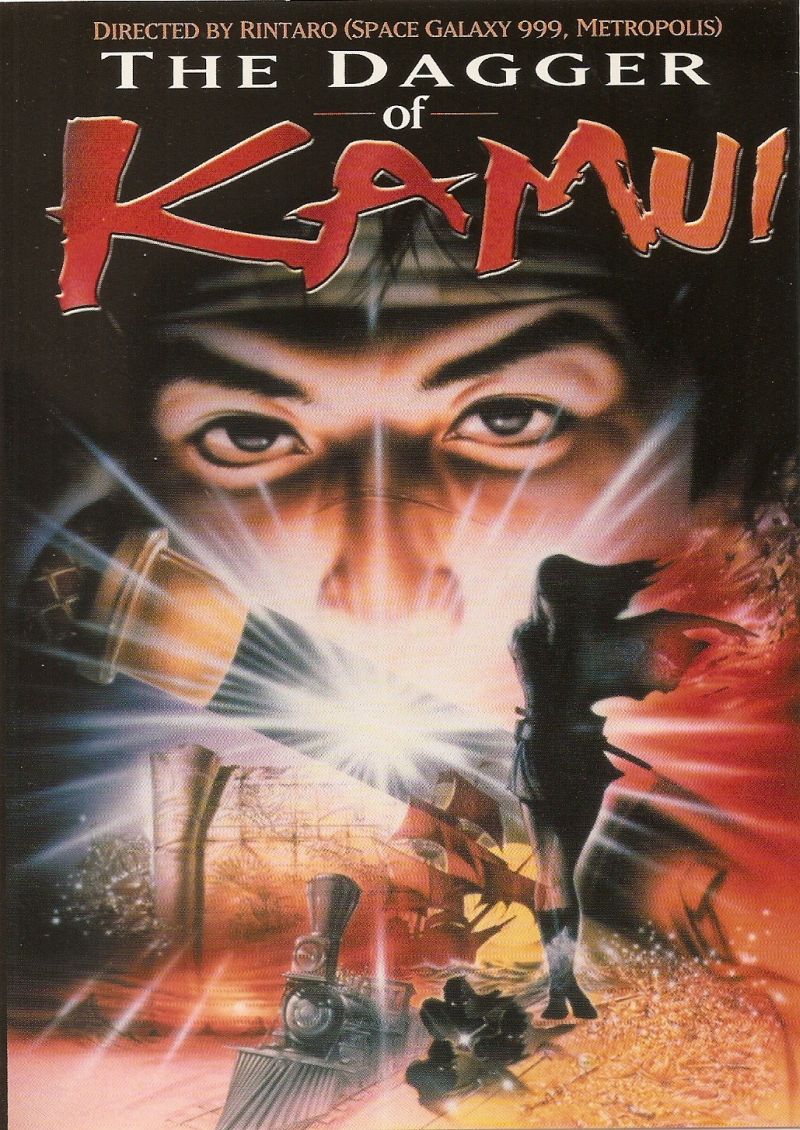 The Dagger of Kamui, 1985, dir: Rintaro
Say what you like about director Rintaro, he's consistent in both his virtues and his vices. Want an overly long film full of imaginative, gorgeously animated scenes that never quite coheres into a logical, satisfying whole? Then Rintaro is absolutely your man. It's true of his best work - probably X and Metropolis, based on what I've seen - and it's true of his more middling efforts. Of which, sad to say, The Dagger of Kamui is certainly one.
But goodness knows, it's not for a lack of trying! The Dagger of Kamui is epic in every sense of the word, a work of outrageous ambition that tells a whopping narrative spanning years, continents, and a considerable cast of characters, all brought to life with animation that must have looked mighty fine in 1985 and looks pretty decent today, though I sorely regret picking up the muddy, too-soft AnimEigo release over the newer Eastern Star edition.*** But either way, the problems certainly don't lie in the appearance of the thing, which is a perfect example of what for me counts as Rintaro's greatest talent, to craft each and every scene with the same high levels of energy and visual flair. It's a little exhausting, to be sure, but there are so many ideas here, and so many sequences that are thrilling purely on the level of how the language of animation is manipulated to evoke mood or heighten action. The Dagger of Kamui is not a film that you could ever get bored looking at, not if you have any enthusiasm at all for animation or design.
Which is a good thing, because the plot is hellaciously easy to get bored by, or at the very least to get befuddled and annoyed by. Our hero is young Jirô, who's accused of murdering his adoptive mother and sister in the opening sequence (a crime, of course, really committed by evil ninjas, because this is an anime about historical Japan!) only to soon after be manipulated into offing his actual father, at the behest of evil priest Tenkai. In fact, Jirô will be manipulated a great deal by Tenkai over the next couple of hours, as it becomes apparent that what the villain is after is a treasure that Jirô's father was seeking and which he believes Jirô is thus best suited to chase after.
Now, to explain why that makes no sense would take a blog post in itself, but suffice to say that there was never a moment where I was persuaded either by Tenkai's baffling, generations-spanning scheme or by Jirô's willingness to go along with it. There's literally no reason, other then perhaps idle curiosity, for him to do so; it's not even as if he wants the treasure for himself. And the rest of the cast have motivations just as woolly, making for an extremely long story in which people mostly do things because the plot needs them to be doing that thing at that moment.
And this is a shame. Partly because it was absolutely fixable - give Jirô one single reason to go treasure hunting and you've already solved half the script's issues - and partly because it's surrounded by something so basically interesting. The superstructure of The Dagger of Kamui, which eventually opens out into historical drama on a grand scale, is fairly splendid stuff, and Jirô's globe-trotting trip is thrilling if for no other reason than that it steps outside of Japan's borders in a way that very little historical anime ever does. Want to see a ninja go up against a gunfighter in a dusty Wild West town? Then you've come to the right place. And this being Rintaro, Kamui is laden with such scenes, that work perfectly in and of themselves. It's the connective tissue he's terrible at, and rarely more so than here. As such, The Dagger of Kamui is both impossible to dismiss and hard to unreservedly recommend: another worthwhile, flawed, visually thrilling work from a director who seemingly did his best to corner that particularly market.
-oOo-
So a random old mess, certainly, but at least we got a new classic out of it. Sadly, you're unlikely indeed to ever see The Cockpit in a remotely legal fashion, and I'm unlikely to ever see it in a print that doesn't look like it was left in a swamp for a week, so maybe that's not altogether a reason to break out the party poppers. Especially since, that aside, we're left with Wrath of the Ninja as a high point, and ... well, it is, I guess? Editing up my review certainly made me want to watch it again.
Next time I think maybe we're going to be getting the "oddities" post I've been cobbling together for goodness knows how long. And yes, that's oddities that are odder than the baseline oddness of nineties anime, and that's surely a reason to be excited. Or scared. Wait, no, definitely that second one.
[Other posts in this series: Part 1, Part 2, Part 3, Part 4, Part 5, Part 6, Part 7, Part 8, Part 9, Part 10, Part 11, Part 12, Part 13, Part 14, Part 15, Part 16, Part 17, Part 18, Part 19, Part 20, Part 21, Part 22, Part 23, Part 24, Part 25, Part 26, Part 27, Part 28, Part 29, Part 30, Part 31, Part 32, Part 33, Part 34, Part 35, Part 36, Part 37, Part 38]
* Needless to say, the prize will be more damn nineties anime reviews.
** Also, I've watched two of these things now, and City Hunter still hasn't caught a single city. If that's not false advertising then I don't know what is.
*** On the plus side, the enclosed liner notes are fantastic, and who else but AnimEigo ever felt the need to provide a print-out of translated song lyrics?
August 9, 2018
The Voices in the Moonlight
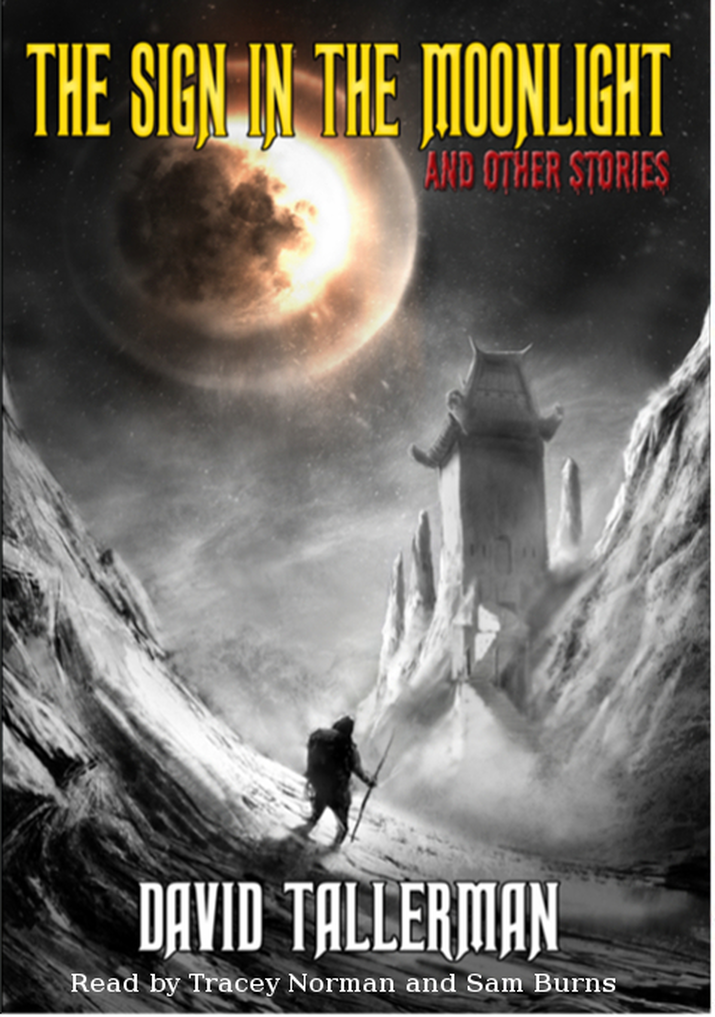 This year is proving crazily busy, and that's the sole excuse I can offer for not having listened to the audiobook adaptation of my own short story collection until now. It certainly wasn't through a lack of wanting to! But what I needed was the perfect opportunity, and an immensely long drive down the length of the country for a weekend of kayaking in the gorgeous Wye valley provided just that: what better way to make four hours in a car on a boiling hot day more bearable than listening to your own short stories being read to you?
Okay, not to everyone's tastes maybe, but for me it turned what could have been an afternoon of horror into - well, still an afternoon of horror, but in a good way rather than a bad way. The point is that I now know for certain what I'd only been assuming based on the odds and ends I'd heard: that Circle of Spears did a stunning job in adapting The Sign in the Moonlight and Other Stories into an audiobook. Or more specifically, Sam Burns and Tracey Norman, who handled the male and female narrators respectively, did a stunning job.
It feels a bit mean, not to mention a bit silly, to have picked favourites from the audiobook adaptation of my own short story collection. But I did it anyway, and here they are...
The War of the Rats
What could be better suited to the audio treatment than an epistolary narrative? Really, the fact that so many of these tales involve the narrators speaking directly to the reader in one form or another is the main reason I had my heart set on making an audiobook of the collection happen. But nowhere does that work better than here, and nowhere is Sam's voice a more perfect fit: the story's protagonist is, after all, an amateur playwright, and though I don't think it's ever mentioned, he was always also an actor in my head. So it's absolutely right that he should deliver his tale with a little drama and bombast, and Sam nails both, without missing the sadness and tragedy at its heart.Caretaker in the Garden of Dreams
I don't know that I really took this into account when I first started considering Circle of Spears for the Sign in the Moonlight audiobook, but there's a big difference between actors and narrators, and if you can get people who can do a terrific job of both then you ought to consider yourself properly lucky. Caretaker in the Garden of Dreams was one of the stories that brought that home to me, in that there's a point in the second half that requires a bit of genuine acting and Sam completely runs away with it. In fact, it was disconcerting to hear a character I'd always thought of as pretty much a plot device suddenly coming to life. Now I almost wish I'd treated them better!A Study in Red and White
By the same measure, it never struck me until I listened to the audiobook quite how creepy and weird the dialogue I'd given to A Study in Red and White's monster was. So I got a shiver down my spine when I heard how Sam had given voice to the antediluvian nightmare that is the Santa Thing. The words "Happy Christmas" have never sounded so sick and wrong!My Friend Fishfinger, by Daisy Aged 7
With no disrespect to Sam's brilliant efforts, this one is my favourite of the lot. Tracey absolutely nails the balance between humour and horror, while all the while pulling off what, to my ears, is a perfect impression of a seven-year-old American girl. The result is so much better than the story has ever sounded in my head, sweet and charming until it's suddenly all dark and horrible. It's a piece that relies entirely on the dissonance between what the character knows and what the reader suspects, and that works even better when we're listening instead - but only because Tracey sells it so completely.
July 19, 2018
Film Ramble: Drowning in Nineties Anime, Pt. 38
If these posts could be likened to wandering in a desert with nothing but a belligerent camel for company and nary a landmark in sight, it's reassuring to know that at least it's still possible to stumble over the occasional oasis out here upon the blazing sands. Which is to say that, perhaps astonishingly given the degree of barrel-scraping we're reduced to these days, I've managed to find a couple of real pleasures this time around - along with a couple of titles that, if a long way from any sensible definition of classic, were a thoroughly acceptable waste of ninety minutes.
That surprising desert watering hole, then, looks a lot like a combination of: Voogie's Angel, Legend of Crystania: The Motion Picture, Magic User's Club! and Battle Skipper...
 Voogie's Angel, 1997, dir's: Masami Ōbari, Aoi Takeuchi
What an odd creature Voogie's Angel* is! A three episode OVA that's obviously telling one chunk of a bigger story, it's wildly all over the place in terms of tone, and really in everything else as well. A brief prologue promises us a bleak tale of Earth's last defenders fighting a losing battle against the alien Space Emigrants, but that impression is rapidly dispelled when we meet Voogie and her all-female cyborg crew, and the bulk of the first episode is occupied with goofy comedy that conveys not much besides how lightly the four of them take their responsibilities as defenders of the human race.
Then part two comes along, and gets very grim indeed - a late-game character death is particularly ghastly - and by the third part we're well into nightmarishly despondent territory, as we learn the back story behind these characters we've been hanging around with and never really got to know. It's odd is what it is, and effective only in spurts. The script is crummy, despite the best efforts of the leads to inject a bit of life, and the characterisation is so not there that I literally didn't know what two of the main characters were meant to be about. Only Voogie herself and the trigger-happy Rebecca come to much, and some angsty stuff about whether the gang are truly human falls hopelessly flat.
None of this is especially good, but lest I be too harsh towards a title that's actually pretty innocuous, I should add that none of it's ruinous either. The plot and characters are boilerplate, but it's a fun boilerplate, and the production values are solid enough to keep things ticking along. There's a peppy opening theme that I can't stop listening to and some derivate but effective incidental music, and on the visual side - well, Masami Ōbari was never a great director, but his work feels more enthusiastic here than elsewhere, and a few sequences, particularly in the second part, are genuinely thrilling. (He also manages to tone down his usually hideous designs, thank goodness!) Writer Aoi Takeuchi, who I can find no details about anywhere, takes over for the third episode, and does better work all round, leaving things on a stronger note than the show quite deserves. He even manages to retrospectively hammer out the character arcs that Ōbari left flapping, and to make some sense of the uneven tone. As such, I'm probably remembering Voogie's Angel as being a little better than it was. But what the heck! It was a fun enough ninety minutes, and there's a decent chance I'll watch it again one of these days, so I'm giving it a pass.
 Legend of Crystania: The Motion Picture, 1995, dir: Ryûtarô Nakamura
For me anyway, good, original high fantasy films are a bit of a treat. I mean, can you list more than a dozen Western fantasy movies with half-decent budgets, which aren't adaptations of door-stop novels, usually by a certain Mr. Tolkien, and which don't suck at least a little bit? The point being, I consider the huge influence of D&D-inspired fantasy upon the world of nineties anime to be basically a good thing - and then I tend to get my hopes up far too highly for what generally ends up being derivate, by-the-numbers crap.
Legend of Crystania is derivative and by the numbers: it's a spin-off of the popular Record of Lodoss War series, which I've never seen but looks very much like someone writing their role-playing campaign (which, indeed, is precisely what it was.) Legend of Crystania is also pretty great. And perhaps that comes down to the difference between a creator slathering their plot in clichés and one who knows the tropes of the genre and wields them with precision, effectively making of them a nifty shorthand to keep his narrative moving at breakneck pace.
At under 80 minutes including credits, the film tears by swiftly enough to give you whiplash, building a dense world and a huge cast with enviable economy. It helps that the beats are almost all familiar, but it helps more than the voice cast (at least in the original Japanese) do sterling work to pluck out enough notes of originality that such utter stereotypes as the scholarly wizard and the hot-headed young warrior and the grizzled, morally grey veteran actually feel distinctive. But it helps most that the animation is lovely. Not expensive, mind you, and the frame rate is distinctly choppy, not to mention a stripped-down art style that's rather a shock at first. But get used to all that and you'll notice some real craftsmanship. Generally, cheaper anime tends to stint on character details in favour of a few big, showy sequences, but Legend of Crystania goes almost entirely the other way: the thought that's gone into capturing human motion, and in making those motions expressive and distinctive, and using them to gift the viewer with insights into who these people are, is a joy to behold. And this, I think, we can put down to director Nakamura, who'd later give us another work that did wonders on a restrictive budget, the bonkers cult classic Serial Experiments Lain.
Also, in fairness, it has to be said that Legend of Crystania isn't half so hackneyed as I've made out. If many of the ingredients are recognisable, enough aren't, or are presented differently enough to feel fresh. Crystania itself, an enclosed world of battling gods and warring, shape-shifting tribes, is a particularly fun and novel setting. And there are legitimately interesting themes too, rotating around knotty questions of responsibility and leadership; in general, this is that rare breed of fantasy that's actually paused to consider what living in its world might be like, regardless of whether you're a lord or a were-tiger or a hired thug or some bloke propping up the bar.
With all of that - and with a rather lovely orchestral score, and some solid action sequences, drawn by people who actually appreciate that swords are pretty damn heavy, and a couple of moments with real emotional heft, including a late-game death that left me thoroughly gutted - I suppose that we're ultimately still talking about a cheesy, mid-budget piece of D&D-pastiching fantasy anime here. Like I said, personally I happen to like cheesy, mid-budget D&D-pastiching fantasy anime when it's done exceptionally well, as it almost never is. As such, I really did enjoy the hell out of Legend of Crystania, and I'm at a loss to explain its rather lowly reputation.
 Magic User's Club!, 1996, dir: Junichi Sato
I grumble enough about familiar ingredients here, but sometimes it's nice to be reminded of the things you love. And though my mind went to numerous other works while I was watching the six episodes of Magic User's Club!, it was always in the show's favour.
The initial point of reference was the marvelous Little Witch Academia, and not just for the obvious reasons, though obviously there's a fair bit of overlap here: both have very literal titles, after all! But actually it was more to do with the character designs, which have a similar certain something that sets them apart from a million other big-eyed, outlandishly dressed designs; it's to do, I think, with some rather more humanly shaped faces than we're used to. And in both cases, those designs are brought to life with superlative animation, though that's perhaps a bit more impressive in Magic User's Club!'s case, what with the intervening two decades and all. It's a fine-looking show, and worth a watch for that reason alone.
But lo, there's more. Because, although there's a definite ongoing plot, Magic User's Club! spends the majority of its time in the sort of light-hearted, slightly raunchy romantic comedy territory that so much anime occupies. And there too it's not content just to tick the usual boxes. In that sense, it reminded me of my exemplar for this sort of thing, the mighty Toradora! Like Toradora!, it finds meaningful depths in characters that appear rote at first glance, then uses that to inject a bit of real emotion and humanity amid the jokes. There's an extraordinary scene, for example, where the heroine's best friend Nanaka declares her love to the club's vice-president, Ayanojyo, even though she's pretty certain he's gay, that doesn't remotely go the way you'd expect if you were judging by the usual nineties anime standards. I mean, in part because having a sympathetic, openly gay male character has already kicked most of those standards out the window, but also because it's just really well handled. And if that's a stand-out moment, it's not an atypical one.
Which would all be well and good, but the last show I was reminded of was the clincher - because this isn't just a cute, goofy rom-com about teenagers getting up to high jinks with magic, it's all of that crammed together with a bit of high-concept sci-fi. And it does that well too! That overarching plot I mentioned revolves around the gang clumsily trying to defend the earth from a very unusual alien invasion: a year ago, a single, gigantic craft appeared and eradicated every weapon turned against it, but the massive object - named the Bell - has done little since, to the point where the robot drones it sends out even politely obey traffic signals. And because those drones get some brilliant and deeply weird designs and animation, my last point of reference was the seminal Neon Genesis Evangelion.
So, yes, Magic User's Club is like some weird hybrid of Little Witch Academia, Toradora, and Neon Genesis Evangelion. But it's also very much it's own thing, and rife with it's own charms, right from the joyously boppy opening theme to the ending that actually wraps its core drama up to an extent I wasn't remotely expecting. It's immensely fun, its missteps are few - really, not much more than some crummy CG that was probably pretty fine in 1996 - and I liked it enough that I'd decided to order the subsequent series before the last episode was done with. Highly recommended.
 Battle Skipper, 1995, dir: Takashi Watanabe
So imagine the scenario: you've been assigned to create a three-episode OVA to promote a new toy. And not just any new toy, but a startlingly crummy one, so crappy in every aspect that there's not a cat in hell's chance of it proving a success. Heck, the toy company have even produced a few anime snippets of their own for the adverts, which are just about the worst thing ever. Do you a) accept the poisoned chalice you've been handed and make some generic piece of garbage that hopefully will vanish immediately and without trace, or do you b) jump on the opportunity to produce something thoroughly silly and nonsensical, that throws a bunch of bonkers, incompatible ideas in a blender, ignores any groundwork already laid by that dreadful trailer, and sidelines those stupid toys as much as possible?
In fairness, there's probably no right answer here, since Battle Skipper appears to be fairly widely despised, despite opting firmly for option b) and despite being an immense amount of fun as a result. And it's possible, I suppose, that writer Hidemi Kamata and director Takashi Watanabe were earnestly trying to craft a product that producers Tomy would be happy with, but it really does seem more likely that they were having a bit of a laugh at their expense, and at mecha and magic girl shows while they were at it. I mean, just look at Saori's impossible hair, while is like Sailor Moon's dialed up to eleven, or observe how little screen time the stupifyingly ugly titular robot vehicle thingies get. For that matter, consider a plot in which rival clubs at a posh catholic girls' school either plot feminist world domination or battle crime, in a manner that the show barely even tries to make sense of.
To accuse this frivolous nonsense of being derivative is, I think, to miss the point: it is, but it knows it is, and refuses to take that or anything else too seriously. The result is utterly daft and bubbly, even when things are happening that might theoretically be a bit serious. And I suppose it helps that I like the clichés it's indulging; I like canned magic girl transformation sequences and high-school students who can figure out who to pilot advanced military hardware in a matter of minutes and silly robots that combine into even sillier robots and gravity-defying hair styles. This is the raw stuff of nineties anime, and if Battle Skipper wants to have jokey fun with it then who am I to argue? Wrap all that up with some solid production values, and add in some surprisingly decent DVD extras from the usual hopeless U. S. Manga Corps and you're left with - well, a daft bit of fluff that kept me entirely happy for an hour and a half. It's not good in any of the traditional senses of the word, but it's a new favourite nevertheless, and perhaps more so because of than in spite of its flaws.
-oOo-
Hold up, was that really a nineties anime post where I basically recommended everything? All right, I hedged my bets heavily on Voogie's Angel - and rightly so! - but still, there's an awful lot of positivism in this post, such as we haven't seen around these parts in a good long while. What can I say? I stumbled over some excellent stuff. The Legend of Crystania movie and Magic User's Club! both immediately shot into my favourites, and so did Battle Skipper, sort of, despite probably being not altogether deserving.
Well, I have no idea of where we go from here. If only because I've got, like, eight of these posts on the go right now at various stages of completion.
[Other posts in this series: Part 1, Part 2, Part 3, Part 4, Part 5, Part 6, Part 7, Part 8, Part 9, Part 10, Part 11, Part 12, Part 13, Part 14, Part 15, Part 16, Part 17, Part 18, Part 19, Part 20, Part 21, Part 22, Part 23, Part 24, Part 25, Part 26, Part 27, Part 28, Part 29, Part 30, Part 31, Part 32, Part 33, Part 34, Part 35, Part 36, Part 37]
* And why exactly is it Voogie's Angel, not Voogie's Angels, eh? If you're going to rip off a title, surely you might as well go all the way and at least make sense.
That surprising desert watering hole, then, looks a lot like a combination of: Voogie's Angel, Legend of Crystania: The Motion Picture, Magic User's Club! and Battle Skipper...
 Voogie's Angel, 1997, dir's: Masami Ōbari, Aoi Takeuchi
What an odd creature Voogie's Angel* is! A three episode OVA that's obviously telling one chunk of a bigger story, it's wildly all over the place in terms of tone, and really in everything else as well. A brief prologue promises us a bleak tale of Earth's last defenders fighting a losing battle against the alien Space Emigrants, but that impression is rapidly dispelled when we meet Voogie and her all-female cyborg crew, and the bulk of the first episode is occupied with goofy comedy that conveys not much besides how lightly the four of them take their responsibilities as defenders of the human race.
Then part two comes along, and gets very grim indeed - a late-game character death is particularly ghastly - and by the third part we're well into nightmarishly despondent territory, as we learn the back story behind these characters we've been hanging around with and never really got to know. It's odd is what it is, and effective only in spurts. The script is crummy, despite the best efforts of the leads to inject a bit of life, and the characterisation is so not there that I literally didn't know what two of the main characters were meant to be about. Only Voogie herself and the trigger-happy Rebecca come to much, and some angsty stuff about whether the gang are truly human falls hopelessly flat.
None of this is especially good, but lest I be too harsh towards a title that's actually pretty innocuous, I should add that none of it's ruinous either. The plot and characters are boilerplate, but it's a fun boilerplate, and the production values are solid enough to keep things ticking along. There's a peppy opening theme that I can't stop listening to and some derivate but effective incidental music, and on the visual side - well, Masami Ōbari was never a great director, but his work feels more enthusiastic here than elsewhere, and a few sequences, particularly in the second part, are genuinely thrilling. (He also manages to tone down his usually hideous designs, thank goodness!) Writer Aoi Takeuchi, who I can find no details about anywhere, takes over for the third episode, and does better work all round, leaving things on a stronger note than the show quite deserves. He even manages to retrospectively hammer out the character arcs that Ōbari left flapping, and to make some sense of the uneven tone. As such, I'm probably remembering Voogie's Angel as being a little better than it was. But what the heck! It was a fun enough ninety minutes, and there's a decent chance I'll watch it again one of these days, so I'm giving it a pass.
 Legend of Crystania: The Motion Picture, 1995, dir: Ryûtarô Nakamura
For me anyway, good, original high fantasy films are a bit of a treat. I mean, can you list more than a dozen Western fantasy movies with half-decent budgets, which aren't adaptations of door-stop novels, usually by a certain Mr. Tolkien, and which don't suck at least a little bit? The point being, I consider the huge influence of D&D-inspired fantasy upon the world of nineties anime to be basically a good thing - and then I tend to get my hopes up far too highly for what generally ends up being derivate, by-the-numbers crap.
Legend of Crystania is derivative and by the numbers: it's a spin-off of the popular Record of Lodoss War series, which I've never seen but looks very much like someone writing their role-playing campaign (which, indeed, is precisely what it was.) Legend of Crystania is also pretty great. And perhaps that comes down to the difference between a creator slathering their plot in clichés and one who knows the tropes of the genre and wields them with precision, effectively making of them a nifty shorthand to keep his narrative moving at breakneck pace.
At under 80 minutes including credits, the film tears by swiftly enough to give you whiplash, building a dense world and a huge cast with enviable economy. It helps that the beats are almost all familiar, but it helps more than the voice cast (at least in the original Japanese) do sterling work to pluck out enough notes of originality that such utter stereotypes as the scholarly wizard and the hot-headed young warrior and the grizzled, morally grey veteran actually feel distinctive. But it helps most that the animation is lovely. Not expensive, mind you, and the frame rate is distinctly choppy, not to mention a stripped-down art style that's rather a shock at first. But get used to all that and you'll notice some real craftsmanship. Generally, cheaper anime tends to stint on character details in favour of a few big, showy sequences, but Legend of Crystania goes almost entirely the other way: the thought that's gone into capturing human motion, and in making those motions expressive and distinctive, and using them to gift the viewer with insights into who these people are, is a joy to behold. And this, I think, we can put down to director Nakamura, who'd later give us another work that did wonders on a restrictive budget, the bonkers cult classic Serial Experiments Lain.
Also, in fairness, it has to be said that Legend of Crystania isn't half so hackneyed as I've made out. If many of the ingredients are recognisable, enough aren't, or are presented differently enough to feel fresh. Crystania itself, an enclosed world of battling gods and warring, shape-shifting tribes, is a particularly fun and novel setting. And there are legitimately interesting themes too, rotating around knotty questions of responsibility and leadership; in general, this is that rare breed of fantasy that's actually paused to consider what living in its world might be like, regardless of whether you're a lord or a were-tiger or a hired thug or some bloke propping up the bar.
With all of that - and with a rather lovely orchestral score, and some solid action sequences, drawn by people who actually appreciate that swords are pretty damn heavy, and a couple of moments with real emotional heft, including a late-game death that left me thoroughly gutted - I suppose that we're ultimately still talking about a cheesy, mid-budget piece of D&D-pastiching fantasy anime here. Like I said, personally I happen to like cheesy, mid-budget D&D-pastiching fantasy anime when it's done exceptionally well, as it almost never is. As such, I really did enjoy the hell out of Legend of Crystania, and I'm at a loss to explain its rather lowly reputation.
 Magic User's Club!, 1996, dir: Junichi Sato
I grumble enough about familiar ingredients here, but sometimes it's nice to be reminded of the things you love. And though my mind went to numerous other works while I was watching the six episodes of Magic User's Club!, it was always in the show's favour.
The initial point of reference was the marvelous Little Witch Academia, and not just for the obvious reasons, though obviously there's a fair bit of overlap here: both have very literal titles, after all! But actually it was more to do with the character designs, which have a similar certain something that sets them apart from a million other big-eyed, outlandishly dressed designs; it's to do, I think, with some rather more humanly shaped faces than we're used to. And in both cases, those designs are brought to life with superlative animation, though that's perhaps a bit more impressive in Magic User's Club!'s case, what with the intervening two decades and all. It's a fine-looking show, and worth a watch for that reason alone.
But lo, there's more. Because, although there's a definite ongoing plot, Magic User's Club! spends the majority of its time in the sort of light-hearted, slightly raunchy romantic comedy territory that so much anime occupies. And there too it's not content just to tick the usual boxes. In that sense, it reminded me of my exemplar for this sort of thing, the mighty Toradora! Like Toradora!, it finds meaningful depths in characters that appear rote at first glance, then uses that to inject a bit of real emotion and humanity amid the jokes. There's an extraordinary scene, for example, where the heroine's best friend Nanaka declares her love to the club's vice-president, Ayanojyo, even though she's pretty certain he's gay, that doesn't remotely go the way you'd expect if you were judging by the usual nineties anime standards. I mean, in part because having a sympathetic, openly gay male character has already kicked most of those standards out the window, but also because it's just really well handled. And if that's a stand-out moment, it's not an atypical one.
Which would all be well and good, but the last show I was reminded of was the clincher - because this isn't just a cute, goofy rom-com about teenagers getting up to high jinks with magic, it's all of that crammed together with a bit of high-concept sci-fi. And it does that well too! That overarching plot I mentioned revolves around the gang clumsily trying to defend the earth from a very unusual alien invasion: a year ago, a single, gigantic craft appeared and eradicated every weapon turned against it, but the massive object - named the Bell - has done little since, to the point where the robot drones it sends out even politely obey traffic signals. And because those drones get some brilliant and deeply weird designs and animation, my last point of reference was the seminal Neon Genesis Evangelion.
So, yes, Magic User's Club is like some weird hybrid of Little Witch Academia, Toradora, and Neon Genesis Evangelion. But it's also very much it's own thing, and rife with it's own charms, right from the joyously boppy opening theme to the ending that actually wraps its core drama up to an extent I wasn't remotely expecting. It's immensely fun, its missteps are few - really, not much more than some crummy CG that was probably pretty fine in 1996 - and I liked it enough that I'd decided to order the subsequent series before the last episode was done with. Highly recommended.
 Battle Skipper, 1995, dir: Takashi Watanabe
So imagine the scenario: you've been assigned to create a three-episode OVA to promote a new toy. And not just any new toy, but a startlingly crummy one, so crappy in every aspect that there's not a cat in hell's chance of it proving a success. Heck, the toy company have even produced a few anime snippets of their own for the adverts, which are just about the worst thing ever. Do you a) accept the poisoned chalice you've been handed and make some generic piece of garbage that hopefully will vanish immediately and without trace, or do you b) jump on the opportunity to produce something thoroughly silly and nonsensical, that throws a bunch of bonkers, incompatible ideas in a blender, ignores any groundwork already laid by that dreadful trailer, and sidelines those stupid toys as much as possible?
In fairness, there's probably no right answer here, since Battle Skipper appears to be fairly widely despised, despite opting firmly for option b) and despite being an immense amount of fun as a result. And it's possible, I suppose, that writer Hidemi Kamata and director Takashi Watanabe were earnestly trying to craft a product that producers Tomy would be happy with, but it really does seem more likely that they were having a bit of a laugh at their expense, and at mecha and magic girl shows while they were at it. I mean, just look at Saori's impossible hair, while is like Sailor Moon's dialed up to eleven, or observe how little screen time the stupifyingly ugly titular robot vehicle thingies get. For that matter, consider a plot in which rival clubs at a posh catholic girls' school either plot feminist world domination or battle crime, in a manner that the show barely even tries to make sense of.
To accuse this frivolous nonsense of being derivative is, I think, to miss the point: it is, but it knows it is, and refuses to take that or anything else too seriously. The result is utterly daft and bubbly, even when things are happening that might theoretically be a bit serious. And I suppose it helps that I like the clichés it's indulging; I like canned magic girl transformation sequences and high-school students who can figure out who to pilot advanced military hardware in a matter of minutes and silly robots that combine into even sillier robots and gravity-defying hair styles. This is the raw stuff of nineties anime, and if Battle Skipper wants to have jokey fun with it then who am I to argue? Wrap all that up with some solid production values, and add in some surprisingly decent DVD extras from the usual hopeless U. S. Manga Corps and you're left with - well, a daft bit of fluff that kept me entirely happy for an hour and a half. It's not good in any of the traditional senses of the word, but it's a new favourite nevertheless, and perhaps more so because of than in spite of its flaws.
-oOo-
Hold up, was that really a nineties anime post where I basically recommended everything? All right, I hedged my bets heavily on Voogie's Angel - and rightly so! - but still, there's an awful lot of positivism in this post, such as we haven't seen around these parts in a good long while. What can I say? I stumbled over some excellent stuff. The Legend of Crystania movie and Magic User's Club! both immediately shot into my favourites, and so did Battle Skipper, sort of, despite probably being not altogether deserving.
Well, I have no idea of where we go from here. If only because I've got, like, eight of these posts on the go right now at various stages of completion.
[Other posts in this series: Part 1, Part 2, Part 3, Part 4, Part 5, Part 6, Part 7, Part 8, Part 9, Part 10, Part 11, Part 12, Part 13, Part 14, Part 15, Part 16, Part 17, Part 18, Part 19, Part 20, Part 21, Part 22, Part 23, Part 24, Part 25, Part 26, Part 27, Part 28, Part 29, Part 30, Part 31, Part 32, Part 33, Part 34, Part 35, Part 36, Part 37]
* And why exactly is it Voogie's Angel, not Voogie's Angels, eh? If you're going to rip off a title, surely you might as well go all the way and at least make sense.
July 5, 2018
The Black River Chronicles and the War For Female Superhero Supremacy
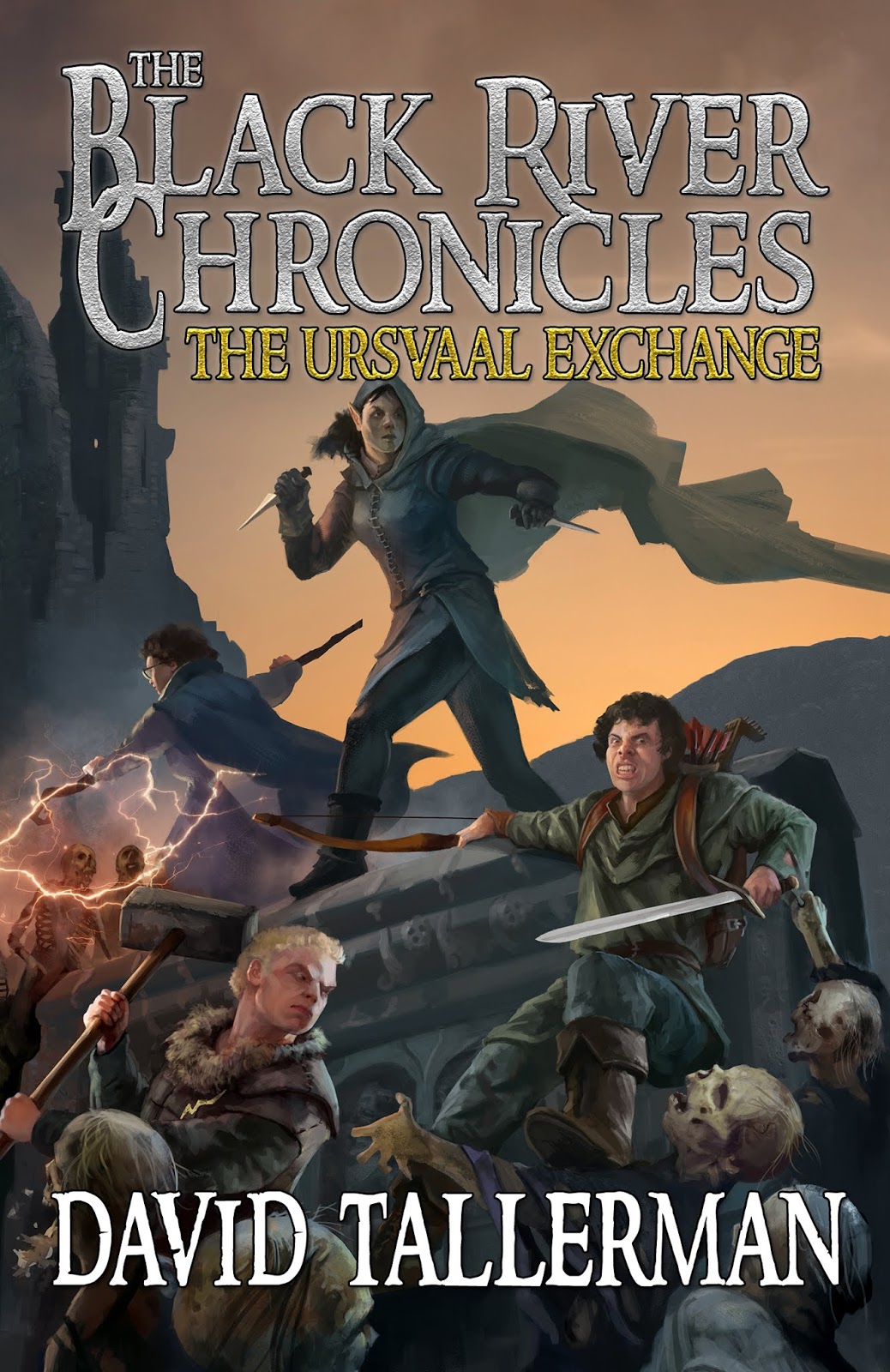 Not a superhero book.I wouldn't normally comment on a review, let alone on an Amazon review, let alone on a one star Amazon review, but recently one came along that was just too good (or too bad?) to let go. It was from our perennial friend "Kindle Customer" and it read as follows:
Misleads readers, supports "girl super hero storyline"
This is a "girl super hero book". It's written in the harry potter style but lacks the quality of character development common with them. It uses subtle narratives to bring the reader to the realization that females are, quicker, smarter, brighter, more heroic than males. If you like a "girl super hero book" you will like it. If you dislike veiled references to female supremacy in the guise of a fantasy novel, then you wont like the book.Well, you saw right through me, Kindle Customer - if that really is your name! - but now that my plotting is out in the open, let's fight the man. Even though I am one! In fact, I'm literally punching myself as I left-handedly type this. In your face, the patriarchy!
...is what I'd have liked to reply. But instead, I'm writing this blog post. And sarcasm aside, I don't want to dig into why I try hard to write capable, convincing female characters, because frankly I find the whole question idiotic beyond words. Suffice to say that when we talk about female representation, we're discussing half the human beings who've ever walked the Earth, and who, despite generally wretched treatment by their male counterparts, have proved endlessly and beyond reasonable doubt that they can be in every way as able, as strong, as intelligent, and as every other damn thing you care to come up with. If you're genuinely horrified by the notion that a female character might be quicker or smarter or more heroic than a male character then I'm willing to concede that you might not get on with my work, Kindle Customer - and that's okay. I reckon I can get by without you.
No, actually, only one thing about that review bothered me as a critique of Level One, and that's that it simply isn't true. To claim that the female characters, or any of the characters, are superhumanly able misinterprets something that was at the core of what I've tried to accomplish with the Black River Chronicles. Though different characters have their moments in the spotlight, these aren't Tia or Arein's books, any more than they're Durren's or Hule's. And not one of these characters could accomplish alone what they manage together. Tia may be essentially a ninja and always nine steps ahead of everyone else in the room, but put her in a situation that requires proper cooperation or good social skills and she's a lot less effective. Arein is great at the academic side of things, but when you're a wizard who's actively afraid of casting spells, that's never going to be enough. They're not perfect, because no-one is. But they are a good deal better at a lot of things that Durren or Hule, because of course they are, they've been studying those subjects and honing those skills for years.
 Actually a female superhero.The long and the short of it is, while I wasn't offended by that review as a writer - heck, I suspect I even sold a few copies off the back of it! - it did make me sad that anyone could get the wrong end of the stick quite so badly. And that's not because the Black River Chronicles aren't actually a codified manifesto for female supremacy, it's that their very heart is the notion that nobody's supreme. These kids need each other. They rely on each other. Without any one of them, they'd none of them have survived to midway through the first book. And really, that's as close to a moral as there is: it's okay for people to be better at things than you, whoever and however they are, and it's okay to rely on others when you're already pulling your weight in other ways.
So there we go. I've no issue with the notion that I might write a "girl super hero storyline" one of these days; heck, I'd be honoured to give it a go, and if Marvel are looking for someone to pick up Ironheart, my favourite new comics character of recent years, then I'd take that job in a millisecond. But that ain't the Black River Chronicles. Though Tia and Arein are absolutely, unquestionably heroes, they don't have a single superpower between them - and like no end of women throughout the history of the world, they don't let that hold them back for a second.


