Gio Lodi's Blog, page 5
March 21, 2024
Some Work Keeps You Employed. Other Gets You Promoted.
Knowledge workers perform a rich variety of work tasks. Research, development, communication, time sheet, coordination, and sifting through emails and Slack messages.
If you go at the essence of each of those types of work, however, you’ll see that there are only two kinds of work. There’s the work that keeps you employed. And there’s the work that gets you promoted.
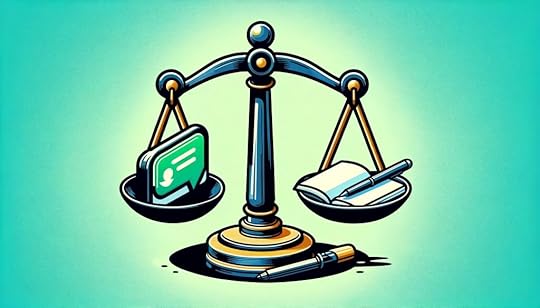 Some work pulls more weight than other.
Busy work keeps you employed. Deep work gets you promoted.
Staying on top of your Slack notifications keeps you employed. Delivering your projects on time and on budget gets you promoted.
Let’s call work that keeps you employed maintenance work, and work that gets you promoted advancement work.
If you are interested in a promotion (or a raise, if climbing the ladder is not your thing) then you should pay attention to how you distribute your effort between maintenance and advancement work. This is easier said than done, however.
While some activities are clearly maintenance or advancement, most are in between. Is writing a memo about the project you just shipped advancement or maintenance? On one hand, it would be more impactful to move onto a new project, on the other, you need to let people know about your contributions if you want that promotion.
An additional challenge is that maintenance work is usually more attractive for our brains than advancement work. Checking Slack is easier than sorting through the user feedback in search for patterns. Commenting on the internal project boards leaves a visible trace. Writing the report might take days and people might wonder where you’ve been.
Maximizing the time you spend on advancement work comes down to discipline. The discipline to choose hard work with delayed gratification. The discipline to placate that internal voice that says “it looks like I’m not doing anything” whenever you have not made yourself visible on Slack for a couple of hours.
In order to keep the balance between maintenance and advancement work in check, it helps to establish a scaffold around your work day. Here’s a proposal made of three components: Plan, measure, and reflect.
Plan your days, or the portion of your days that is under your control and free from pre-scheduled meetings or activities. Having a plan mitigates our brains tendency to choose the path of least resistance and gravitate towards the less energy demanding and emotionally satisfying maintenance work.
Planning also helps making the most of your natural attentional rhythm. Allocate advancement work for those slots when you are more likely to be energized. Schedule maintenance work in between, as a way to flush the attention residue.
Keep in mind that plans don’t have to be written in stone. Things change all the time, and as such daily plans should be malleable. The point of a daily plan is to exercise intentionality over your time.
Measure the value of the work you get done. As you complete tasks in your plan, ask yourself how valuable each and the project it belongs to was. Was it towards the maintenance or advancement end of the spectrum?
Reflect and course correct. Once you accumulated a couple of weeks worth of measurements, you’ll be able to gauge how much time and energy you direct towards the different kinds of work. If the distribution doesn’t seem appropriate, use the data to have a conversation with your manager about it.
Over longer periods of time, this practice can give you insight on your ability to estimate the value of your work. As I mentioned above, knowledge work is ambiguous and sometimes it’s hard to say whether a project falls more into the maintenance or advancement category. But the more you practice assigning a value and checking back once the project is done, the better your confidence range will become.
Knowledge work is highly self-directed. This is a great opportunity for personal fulfillment. We know from research that autonomy is among the key psychological nutrients humans need.
Freedom in knowledge work is a double edged sword. Left to its own devices, our brain can all to easily default to the least energy demanding and most immediately gratifying work. More often than not, that’s the kind of work that might keep you employed, but it won’t get you promoted.
President Eisenhower once said that “freedom is an opportunity for self-discipline“. If you see work as more than a means to pay the bills, if you want to spend that large portion of your day growing and accomplishing something of value, develop the discipline to consistently direct your time and effort towards the right kind of work.
This is what productivity in the knowledge world is all about. Not doing more, but doing better.


March 14, 2024
The Willy Wonka Scam Has Nothing To Do With AI
Scammers will scam. Doomers will doom.

The families who stepped into Glasgow’s Box Hub Warehouse on February 24th and 25th were promised “extraordinary props, oversized lollipops, and a paradise of sweet treats.”
What they found was a handful of candy canes and a lonely Oompa Loompa who, to her credit, tried her best to entertain the disappointed children.
The Willy’s Chocolate Experience that fans of Roald Dahl’s classic were looking forward to turned out to be a text-book scam. Misleading, overhyped advertising, a no refund policy, and a cheap experience on the other end.
What made this particular scam go viral and generate much buzz online was not the poor quality of the experience or the reaction of the upset Glaswegians. What set it apart was that the scammers used AI generated copy and images for their advertisement.
AI skeptics immediately latched onto this implementation detail. Yahoo! News proclaimed that “the Willy Wonka shambles shows how dangerous AI can be,” and Chris Alsikkan concluded his thread on the incident with “just remember, generative AI advertising is ass.”
I’m here to tell you: AI is not to blame for the Glasgow scam.
AI is no more to blame for enabling the Glasgow fiasco than social networks are for providing a channel to advertise it, or online payment systems for allowing the scammers to collect the payment.
Technology doesn’t create scams. Scammers create the scam.
The causation arrow goes in one direction only.
Scammers may leverage technology for their nefarious plots, but technology does not create scams nor scammers.
Scammers existed before AI. Think of the infamous Fyre Festival, where attendees were promised a luxurious experience by their favorite social media influencers but only found packaged sandwiches and disaster relief tents.
Scammers existed before social media and the internet. Think of Charles Ponzi. Or Clark Stanley, the OG snake oil seller.
Scammers existed when there was little technology to enable them. In the middle ages, scammers like Edward Kelley sold hoax manuscripts and relics. The ancients had their fair share of scammers and people gaming the system, such as the Roman coin clippers and insurance-fraudster Hegestratos.
Wherever you look in history, you’ll find scammers.
Don’t blame AI. Blame human nature.
For every bad actor using AI to generate the images and text for their scam, there are many thousands of people who benefit from generative AI.
Complaining about AI “enabling” scammers is pointless. What we need to do is help folks develop AI literacy and create new technology to fight the bad actors.
We are in the transition period. Hopefully, incidents like the Willy’s Chocolate Experience scam will help people sharpen their BS filter.
Soon enough, most people will hear warning bells when visiting a site filled with AI generated images and copy, in the same way that most people immediately discard the email from the lawyer representing the lost uncle who left them an inheritance in Bitcoin.
The Willy’s Chocolate Experience scam has little to teach about AI. What it shows is that human nature never changes—and that you should do some research before buying stuff off the internet.
March 5, 2024
Gloria Mark on the Ezra Klein Show
On the intersection between attention and well-being.
 Credits: Gloria Mark and C D-X.
Earlier in 2024, UC Irvine professor Gloria Mark appeared on The Ezra Klein Show to talk about attention and how to nurture it.
As a fan of Gloria’s work, I was pleased to see her on such a big platform, and her ideas further spread.
The interview is a treat, even for those already familiar with her research or who read her book Attention Span.
Here are some highlights from the conversation.
Interruptions can be productive, when you deploy them intentionally. For example when you step away from the desk to incubate a hard problem, or when you reach a valley in your attentional flow (more on that later) and take an exercise break.
We are conditioned to interruptions. Gloria’s field research shows how our brains easily get addicted to interruptions. Even when external interruptions are removed, such as by blocking emails, her test subjects experienced internal interruptions. The study participants’ brains (and, I’m afraid, ours, too) were so used to interruptions that, when none came from the outside, they conjured interruptions from within.
Keep your goals front of mind. At the start of the day, we might have a clear vision on the most important things we can do for our long term success. But as the day progresses and life gets in the way, those goals tend to fall into the background. Don’t let it happen. The main thing is to keep the main thing the main thing, Stephen Covey famously wrote. Tip: Planning your day on paper helps with this, because you can write your goals prominently and keep referring to them.
Practice forethought. Imagine how your actions right now are going to influence your future self. Gloria uses the example of checking the news online, which we all know can easily degenerate into doomscrolling and emotional overload. When that thought arises, imagine yourself at the end of the day. Will you be unwinding on the couch with a glass of wine, or will you be tired and frustrated, still working to meet your deadline and asking yourself “where did time go?!”
Understand your attentional rhythm. It will come at no surprise to hear that we are all different. Some of us, for example, are early birds, while others are night owls. Likewise, each of us has times during the day when focusing comes easy and times when it’s difficult. Track how you feel, how hard it is to focus, and what activities you have been doing for a couple of weeks and you should see a pattern emerge. You’ll discover your attention has its own semi-predictable rhythm throughout the day. Armed with that knowledge, try to design your schedule to take advantage of your attentional peaks and valleys to the extent that’s possible. This, by the way, is one of the best perks of an async first distributed workplace: letting people design their days in order to fit work in the most effective times.
The interview concludes with Gloria remarking how we need to be intentional in the way we interface with technology so that we can preserve our attention.
So I’d like us to think about how we can be more intelligent about how we use tech so that we’re not getting burned out, and we need to think about preserving our well-being.
And ultimately, I believe we’re a lot more fulfilled by the relationships we have off-screen.
And you know, let’s not ignore those.
Well said.
Nurture your attention as part of living an healthy life.
Train your attention so you can direct it to the things and people that matter.
February 27, 2024
If Something Sucks, Do It As A Career
Want to create value? Do the jobs no one else wants to do.
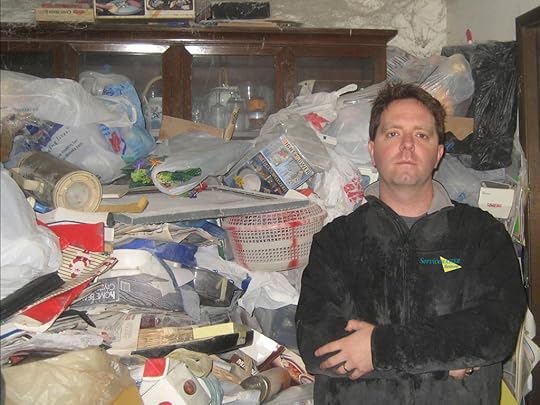 Hoarding expert Matt Paxton. Source.
“If something sucks,” grandpa Paxton used to say, “do it as a career ’cause people will pay you to do it, ’cause they don’t wanna do it.”
Today, Matt Paxton is a “downsizing and cleaning expert”, speaker, author, and host on the Legacy List with Matt Paxton TV show. But, as Paxton recalls in an Art of Manliness interview, it all started with him embodying that advice.
I honestly just… I didn’t hate it [cleaning], so that’s why I kept doing it, and then when I cleared out those four houses, I still didn’t know what I wanted to do, so I just kept cleaning [for] little old ladies at church. I’d clean their attics and their basements, and then I started helping them move out, and then I realized these hoarding houses, nobody wanted to touch them. And so, I could charge more.
Paxton took on cleaning the houses nobody wanted to clean, the hoarders’ houses. And in doing so, he got to set his price.
As Derek Sivers succinctly put it, money is a neutral indicator of value.
The fact that people were willing to pay Paxton for cleaning, and in fact paying him extra for the hoarding houses, means the job was intrinsically valuable.
Grandpa Paxton’s advice is as applicable to messy houses as to the world of ideas.
In every job, in every company, in every team, there are tasks and projects that need doing but no one wants to do. They are great opportunities for ambitious people who want to make themselves valuable and become linchpins.
More often than not, those jobs are also ripe for innovative solutions, new workflows, and automation. The SaaS world is filled with products that spun up from agencies noticing multiple clients having the same problem.
Problem solving leads to satisfaction. It doesn’t matter if the job is not sexy. Whether it’s cleaning houses or automating the dreaded weekly report, by doing what nobody else wants to do, and doing it well, you will become valuable in the marketplace.
What’s a job nobody wants to do in your team? What would happen if you picked it up and made it your mission to get it done?
February 20, 2024
What I’ve been reading in January 2024
Stoic discipline, American tycoons, rugged flexibility, and more.
I decided to change the name of the monthly books post.
I called them Bunch of Books before because I thought the alliteration was clever. But there’s something off with the word “bunch”. I don’t know—I feel books deserve better than being in bunches.
This title iteration is a nod to Jason Crawford’s What I’ve been reading posts, which are always a source of inspiration for me.
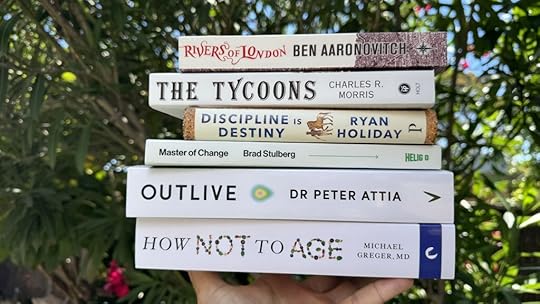 Discipline is Destiny by Ryan Holiday
Ryan’s The Obstacle is the Way and Ego is the Enemy are two of my favorite books, and were my introduction to Stoic philosophy.
In Discipline is Destiny, Ryan continues to explore Stoicism and how to apply it in the modern world. This time, via the concept of temperance, one of the four cardinal virtues of Stoic and other philosophies.
I wrote in the past about the value of discipline. What a better way to start the year than by reading a book all about it?
Ryan weaves together the stories of Lou Gehrig, Queen Elizabeth, Antoniuns Pius, George Washington, and other characters, using them as examples of discipline in the body, mind, and in relationships.
[Lou Gehrig] knew that getting comfortable was the enemy, and that success is an endless series of invitations to get comfortable.
It’s a good read from an author who has already proven to be a master of his genre. But I didn’t find it as fresh and eye-opening as Obstacle or Ego were. I don’t know if it’s because I was already familiar with some of the stories and ideas, or because I’ve been reading Ryan’s work for a while. Still, definitely worth your time.
Here’s one more quote from a passage on being disciplined as a core tenant of productivity:
The Tycoons by Charles MorrisDiscipline isn’t just endurance and strength. It’s also finding the best, most economical way of doing something. It’s the commitment to evolving and improving so that the tasks get more efficient as you go. A true master isn’t just dominating their profession, they’re also doing it with ease . . . while everyone else is still huffing and puffing.
The book’s subtitle is How Andrew Carnegie, John D. Rockefeller, Jay Gould, and J. P. Morgan Invented the American Supereconomy but really, it is more a book about the American economic explosion than it is a biography of four of its protagonists.
It’s a fascinating and inspiring account of how American economy took off starting in the mid nineteenth century thanks to a coming together of mindset, territory, technological development, and dedication.
America was the only country where “worker” was a job description rather than a badge of class.
Most Americans seem to have truly believed, just as Lincoln said they should, that their lives would get better, that there was no limit to the vistas to be opened by hard work and imagination.
Perhaps most important was a style of problem solving.
The fact that Americans typically thought of machine solutions as a first recourse, an integral part of almost any production process, was a major factor in the seemingly effortless move up to manufacturing scales previously undreamed of.
The book is worth reading just to get to the final chapter, titled “The Wrong Lesson”. In there, you’ll find an account of how bad ideas such as scientific management and the disconnect between what was taught in business schools and the reality of technology-enabled and technology-producing businesses slowly resulted in American manufacturing loosing its edge and facing a “sweep-the-board triumph of Japanese companies in nearly every important mass-production industry.”
Master of Change by Brad StulbergMaster of Change explores how to thrive in a world that does not and will not stop changing. What’s refreshing about it is that instead of suggesting hacks or branded frameworks, Brad shows how it’s all about learning to know yourself and appreciating the complexity of the reality around you.
One step in this journey is to engage in non-dual thinking.
Non-dual thinking recognizes that the world is complex, that much is nuanced, and that truth is often found in paradox: not this or that, but this and that.
One non-dual concept at the core of the book is that to become masters of change, we need to be both rugged and flexible. As Brad puts it:
The goal is not to be so rugged that you never change. The goal is not to be so flexible that you passively surrender to the whims of life. The goal is to marry these qualities—to develop a mindset and practice called rugged flexibility.
If you already read Brad’s previous book, The Practice of Groundedness, and you are in a rush, you might want to skip this one. They overlap quite a bit. Then again, the book is short and flows well. You could read it to reiterate useful concepts on resilience and growth.
Special Mention: Outlive by Peter Attia and How Not To Age by Dr. Michael GregerI browsed these two tomes, dipping in and out to find inspiration and guidance on how nutrition and exercise intersect to improve life span and health span. The latter being a relatively new concept representing the length of time that the person is healthy — not just alive.
The two books share a focus on prevention over intervention. We have medicine and technologies that can treat many diseases. But, as the old saying goes, an ounce of prevention is worth a pound of cure.
Something I like about Outlive is that Attia doesn’t try to sell you a fully fledged framework — or, worse, a put you in a funnel for his exercise program — but rather brings to the table a number of concepts and tools everyone can use to develop a personalized plan.
As for How Not to Age, in the style of his nutritionfacts.org articles, Dr. Greger translates the latest research on nutrition in an understandable format.
“Longevity” has become quite trendy recently. I can’t help being skeptical, even when it comes to honest books like these two. After all, the only way to know if those recommendation work for you is to adopt them and live your life.
The only way to know if the advice in Outlive and How Not to Die works for a 30-something like myself, is to implement it… and check back in 70 years or so.
Then again, as Dr. Greger put it, we don’t need randomized control trials to show jumping off a plane with a parachute is safer than without one.
We might not have solid data collected over decades, but you can’t go wrong eating healthy and exercising.
FictionI enjoyed Rivers of London by Ben Aaronovitch in particular the structured approach to magic he devised. The protagonist finds a mentor and has to practice basic formae, which he can then learn to combine into more powerful spells.
The books is the first in a series. I’m curious to see how it continues, but not enough to have started the next title yet.
KidsWe’ve been enjoying reading The Baby Sitters Little Sister graphic novels. The colorful drawings and cartoonish expressions are great to hold the four-year-old attention for longer than the original chapter book version would.
During school holiday, we attended a play adaptation of one of the books in my son’s beloved Treehouse Series. It was great fun and a nice way to introduce kids to live performances.
February 9, 2024
Productivity Systems Are For Using, Not Tweaking
Your job is chopping trees, not sharpening axes.
“Every July and December I look at my workflows,” writes Evernote expert Jon Tormans, “and look to see if using different apps will help me work a little better.”
Systems and tools are paramount for being an effective knowledge worker.
But they can also become a distraction.
After experiencing the difference in quality from working in an organized way, you’ll naturally want to keep improving your systems. But once you have a decent setup in place, the improvements will mostly be marginal.
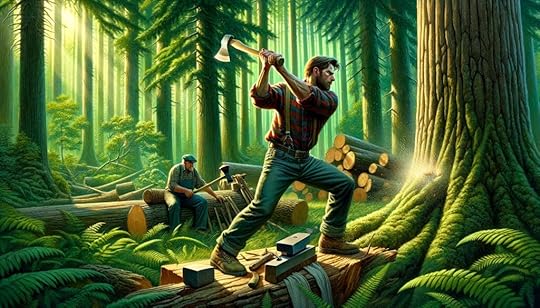
There’s a quote often misattributed to Abraham Lincoln about working smart, not hard. “Give me six hours to chop down a tree and I will spend the first four sharpening the axe.”
Fine tuning the productivity setup is a way of sharpening the proverbial axe. But where the apocryphal lumberjack-Lincoln had only one tree to chop down, knowledge workers have entire forests to deal with. We need to ensure the time we spend with the whetstone doesn’t get in the way of the actual chopping.
Tinkering with our productivity system is an easy trap to fall into. It feels like work. It’s more fun than work. But, more often than not, it’s actually a way to avoid engaging with the cognitive demanding activities that prompted us to establish a system in the first place.
We must not let the allure of tweaking the setup distract us from showing up and doing the work. Because it’s only through our work, our hard thinking, that we create value.
At the same time, our work and life are in constant flux. A configuration that is optimal today might become wasteful the next quarter. And every now and then, a new tool comes around that can truly make a difference in your efficiency
Which is why I like Jon’s approach. Twice a year, Jon revisits his setup to see if it’s serving him well for his current needs. At the same time, he runs experiments with possible changes, like moving from Evernote to Todoist.
A scheduled periodic review of your productivity system prevents your brain from using tinkering as an excuse to dodge hard work.
You can think of it in terms of explore-exploit. Spend some time, even better timebox, exploring different workflow and tools configuration to find one that suits your needs. Then, exploit it to get the work done.
A good setup should be frictionless. It should be easy to retrieve and modify items. Ideally, it should integrate with your calendar or at least have a reminders functionality so that you can outsource worries to it.
During the exploitation period, track ideas for tweaks to the system in a safe place, ready to be reviewed when the next scheduled exploration session comes up.
A productivity system is an axe that needs to be kept sharp. Sharpening it can be fun and invigorating. But at some point, sooner rather than later, you need to bear your finely sharped axe against a tree trunk.
Working smart might beat working hard—but you still gotta work.
January 26, 2024
Good Goals Take You On A Journey
When chasing a goal, be mindful of the path to get there.
 Credits Jake Melara
In a recent Farewell podcast episode Brad Stulberg shared a useful mental model for choosing and pursuing goals.
Brad suggests to “think of goals akin to the peaks of mountains.”
Choosing a goal is like climbing a mountain. You will spend most of the time on the climb not on the peak. The view from the peak matters, but so do the various landscapes you’ll see along the way.
So when choosing a goal, ask yourself whether the journey there is one you are willing to embark on.
Will the journey be enriching? Will you grow along the way?
Also, will you have fun? Because if the journey is not fun, then you’re setting yourself up for misery and, potentially, failure.
But here’s the good news. I might be stretching the analogy a bit, but I’d say that like there are various paths one can take to the top of a mountain, there are also various paths one can take to achieve a goal.
For example, an individual contributor who wants to level up her career has various options at hand. She could take the leadership track or double down on a technical part of the job. She might find a new and complementary skill to use in synergy or take on board some freelance work on the side. Each option translates into a different journey; it’s a matter of choosing the one that seems more interesting and fun.
If pursuing a goal is a journey, then the best goals are those whose journey is worth embarking on regardless of whether you’ll ever get to the end.
The goals-as-mountain-peaks is also a good analogy to run a reality check. Are the things you do during the day steps in the path for your peak, or are they leading you in the wrong direction?
January 18, 2024
Simple Not Easy
Why understanding how to be productive is simple, but actually being productive is hard.
 Credits Pablo Arroyo.
The productivity we write about here is getting the right stuff done well without wasting time. Or, as Jocko puts it, write what you need to do, wake up early, and do it.
This kind of productivity is simple, not easy. After all, who in their right mind would want to work on things that don’t matter, do a lousy job, and waste their time? Yet, we often end up doing that. Evidently, this concept is simple to grasp but hard to implement.
I can think of at least three factors that make being productive hard:
Our schedules are mostly out of our handsWe don’t always know what the best thing isKnowing what’s the best thing makes doing it only marginally easierSystems and frameworks can go a long way toward gaining control over one’s schedule and developing clarity of action. Time-block planning helps visualize the portion of the schedule you have control over and allocate tasks strategically. The focusing question is an excellent tool to identify the most promising item to focus on. You can think in terms of little bets to explore different options before committing to one.
But once you have your carefully crafted plan written down, the hurdle of actually doing the work remains.
I know exercise is good for me. And I know I’ll enjoy doing it. But getting started remains hard.
“Being productive” is as much a matter of knowing the tools and techniques as it is about being disciplined in consistently deploying them. Discipline, after all, is doing what needs doing even when you don’t feel like doing it. And that, unfortunately, doesn’t get any easier.
January 3, 2024
The Ingredients Of A Good Day
Here’s a question to begin the new year: What are the ingredients of a good day?
Not a great day. Just a good day. What needs to happen on an average weekday for you to go to bed content?
For me, a good day includes:
Time with my family.Reading and writing. That is, engaging with ideas in a stimulating way.Making concrete progress on something.Time outdoors.Exercise.A good day doesn’t require remarkable events, only a dose of those things that matter to you. As a matter of fact, my good day looks pretty boring. Part of it is that I am a boring man, but it’s also a way to keep myself focused on what truly matters to me in the long run: family, health, mastery.
Once you know the ingredients of a good day, you can experiment with your schedule and commitments to ensure you get most of them day after day.
If dinner with the family is a key ingredient, make a point of clocking off work in time for it. If hitting the gym in the morning is guaranteed to make your day good, but you have a fixed start to the workday, consider waking up earlier to make time for it.
I hope this year will be our best yet, and I’m going to work hard to increase the chance of it being so. But I would settle for a year where most days have been good days.
What are your ingredients for a good day? Leave a comment below or get in touch on X.
December 13, 2023
Will It Bounce Or Will It Break?
A filter to decide what to drop and what to keep.

The harsh reality of our work lives is that there are more things to do than we have resources for. There aren’t enough hours in the day to stay on top of all emails, bug reports, and customer feedback.
This is a good problem to have—the alternative would be a stagnating business that cannot move forward—but it does force us to make choices.
There comes a point when you end up juggling too many balls, and the only way forward is to drop some. When that happens, ask yourself, “Will it bounce or will it break?”
If a task, meeting, or project will break if dropped, you have to keep juggling it or at least find a way to set it aside gently. But if it will bounce back, either in someone else’s lap or on the floor, ready to be picked up later, it’s safe to let it go.
If you find yourself overwhelmed juggling too many balls, look for those that won’t break when dropped and give yourself permission to let them go. They’ll bounce back to you sooner or later if they are truly important.
Credit for this idea goes to Steph Viccari and Chris Toomey, the hosts of what was the best iteration of The Bike Shed Podcast. Unfortunately, I didn’t note down the episode where they discussed it. If you are a keen researcher and want to look into it, the note I have about this idea dates 2021/11/22.
Below is an alternative AI-generated cover for this post, made with DALL-E. I find the many fingers hilarious. A good reminder that generative AIs are giant average machines and that we have more pressing problems to worry about these days than them developing consciousness and taking over the world.