Gio Lodi's Blog, page 4
March 5, 2025
Memento Mori. Tempus Edax Rerum.
Two mantras on mortality from Ancient Rome that pair well together.
The first is Memento Mori, literary “remember to die,” but more commonly translated as “remember you must die.” It’s a recurring theme in Stoic philosophy, a filter function to prioritize and a way to ground oneself.
The second is Tempus Edax Rerum. It comes from the poet Ovid from the Metamorphoses book 15, verse 234 and can be translated to “time devours everything.”1
Both call to attention how ephemeral our existence is.
It might be tempting to interpret them as an excuse to slack. An invitation to nihilism. If nothing last, what’s the point in even trying?
On the contrary, they are a call to action. Time devours everything, so keep things into perspective, let go of the petty, and don’t think too grandly of yourself. Remember you must die, so don’t waste the precious little time you have.
You can hold them in your mind and look at them in both directions. Time devours everything, so remember that you, too, will die. Remember you must die; time, after all, devours everything.
Few things are as powerful as contemplating your own upcoming death to keep you present and focused.
Sooner or later, time will devour all the people and things you care about. Better make the most of them while you have the chance.
1 – For a richer version of the Ovid quote, in context, see Henry T. Riley’s translation, conserved by Project Gutenberg.


February 28, 2025
How To Never Be Bored
To never be bored, always have something to think deeply about.
To always have something to think deeply about, always be learning something new.
This is how author Louis L’Amour lived his life, particularly during his teens and twenties as he wandered around the world and educated himself by reading in the order of a 100 books a year.
As he wrote in Education of a Wandering Man:
The beauty of educating oneself as I was doing, or as anyone can do, is that there are no limits to what can be learned. All that is learned demands contemplation, and so one is never at a loss for something to do.
This is a cheap and effective antidote to boredom. One that will also strengthen the ability to focus so important to live an intentional life and to thrive in the knowledge economy.
September 30, 2024
The Ambitious Student Reading List
Conquer college and set yourself up for a productive career.
For a couple of years, I’ve had the pleasure of collaborating with LeadTheFuture Mentorship and having great conversations with Italian students.
One topic that often comes up is how to stay on top of the university lessons and assignments while having enough free time to explore other interests, work on side projects (the best way of boosting your CV!), or, you know, have a life.
My recommendation is always the same: read Cal Newport.
Cal is a computer science professor who explores the intersection of technology and culture. His recent work includes multiple New York Times best-selling books and a regular column on The New Yorker, but he started out writing student advice almost two decades ago.
Here is the Cal Newport reading list I wish I had access to when I was at uni.
Start with How to Become a Straight-A Student for the most practical advice to become more productive and thrive as a student.
If you want more student-specific advice, follow up with How to Win at College: 75 short chapters with rules and principles, such as “Study in Fifty-Minute Chunks” and “Befriend a Professor.”
Follow up with Deep Work to learn how to make the most of your focus time and fend off distractions. I can’t state how impactful this book has been in how I work and organize my day as a remote software engineer and wannabe writer.
If the “Quit Social Media” chapter from Deep Work struck a chord, take a detour and read Digital Minimalism for a vision of technology deployed with intention.
With the books above, you’ll have built a strong foundation to foster and deploy your focus. Read So Good They Can’t Ignore You to put it into practice. This book is perfect for ambitious students getting ready to enter the real world. It challenges the popular “follow your passion,” arguing instead that a fulfilling career is built on mastery and intentionality.
His most recent books, A World Without Email and Slow Productivity, are geared toward people who are already in the knowledge work sector. You’ll still get value from reading them, but I would save them for last.
And if those books are not enough, check Subtract, Getting Things Done, Rest, Range, and Clear Thinking for various ideas at the intersection of productivity and living with intention. Finally, I would be remiss if I didn’t mention the best book I ever read: The Beginning of Infinity by David Deutsch. You won’t find much productivity advice there, but I guarantee it will upgrade your thinking.
Once you are done reading, listen to Cal’s podcast: Deep Questions for a weekly refresher on his ideas.
I hope you’ll find this list useful. Looking back at my uni days, I wish I had access to that information. Most hadn’t been published yet, but neither was I switched on enough to google “time management advice for students,”—go figure…
I only managed to stay on track (barely) because I got lucky and made a group of friends to study and build with. We kept each other motivated, shared notes, and complemented each others’ study and execution strengths. I got my first (and second) real job thanks to them and I learned more in one hackathon weekend together than in one semester of lessons.
To this day, we keep sharing advice and banter even though we are spread across many time zones.
And that is my one piece of “original” advice:
Build genuine friendships with your fellow students.
The grades and the assignments will fade away the moment you leave the campus, but the friendships you’ll make have the opportunity to last forever.
September 17, 2024
More modesty. Less ideology.
An invitation by Karl Popper, from his lecture Epistemology and the Problem of Peace delivered in Zurich, August 1985, and published in All Life Is Problem Solving.
Intellectuals, who mostly have the best of intentions, must first be persuaded to be a little more modest and not to try to play a leading role. No new ideologies, no new religion. Instead: ‘A little more intellectual modesty.’
We intellectuals know nothing. We grope our way along. Those of us who are scientists ought to be a little more modest and, above all, less dogmatic. Otherwise science will fall by the wayside – science, which is one of man’s greatest and most promising creations.
Intellectuals know nothing. And their lack of modesty, their pre-sumptuousness, is perhaps the greatest obstacle to peace on earth. The greatest hope is that, although they are arrogant, they may not be too stupid to realize it.
When he says “Intellectuals know nothing,” he refers to the fact that “In our infinite ignorance we are all equal“.
September 15, 2024
In our infinite ignorance we are all equal
Here is a humbling quote from Karl Popper’s lecture On the Sources of Knowledge and of Ignorance, emphasis mine:
I believe that it would be worth trying to learn something about the world even if in trying to do so we should merely learn that we do not know much. This state of learned ignorance might be a help in many of our troubles. It might be well for all of us to remember that, while differing widely in the various little bits we know, in our infinite ignorance we are all equal.
April 19, 2024
You Can’t Fake Focus
But you can train it.

Every athlete knows it: You can’t fake speed.
When race day comes, you can have the best gear, the best mindset, the best nutrition and sleep, but without speed, you’re never going to win.
There is only one way to gain speed: By training.
Hard. Purposeful. Consistent training.
It’s the same with focus. You can’t fake focus.
Focus is not an operative mode you can switch on and maintain on command. It requires training and a commitment to use and maintain it.
If you don’t exercise your focus in your work and personal life, your ability to focus will inevitably deteriorate. Like a runner who stops exercising, your capacity to sustain focus will slowly but surely diminish.
Everyone should care about focus. It’s not only the primary mode of earning for knowledge workers but also the instrument through which we experience our lives.
If you can’t focus, you will struggle at work and miss out on precious time with the people you love.
Focus can be trained.
Here’s a three-step proposal.
ReadReading recruits multiple brain regions and makes them coordinate to operate at different levels of abstraction. See The Reader’s Brain for an in-depth discussion.
Reading daily, no matter the content, is an excellent way to keep your brain nimble and able to focus.
DisconnectConstant access to information and entertainment is one of the primary forces eroding our focus.
Checking the news while waiting in line at the supermarket might seem harmless, but it reinforces our brain’s need for external stimuli. The result is that when the time comes to sit down and give your full attention to writing that report due tomorrow, your brain will keep wanting distractions, and your performance will suffer.
To compensate for modern life and work necessities eroding your focus, make sure every day has periods where you are disconnected. A walk without podcasts in the background. A tea on the couch without scrolling. Journalling with pen and paper instead of an app.
Focus TimeReading and disconnecting are like maintenance exercises for focus. But to improve it, you need to push yourself. This means actually focusing on cognitively demanding problems for increasing intervals and, of course, without distractions.
The next time you pick up a deep-work-worthy task, set a timer and see how long you can stay focused on it. That will be your focus time baseline.
Once you have your focus time baseline, aim to increase it over time. Let’s say by 5 to 10 minutes every week. That is, every week, challenge yourself to work with intense focus on a cognitively demanding task for an interval 5 to 10 minutes longer than the previous one.
Ninety minutes seems the gold standard to aim for intense, sustained focus. Longer than that, the brain fatigue will catch up on performance. I haven’t been able to find solid research to back that claim, but I can say anecdotally that ninety minutes, two hours max, is my upper limit before needing a break.
I’ll admit my suggestions are not “scientific.” They are not backed by a randomized controlled trial to show their effectiveness. Or even a comprehensive theory on how the mind works and why those exercises foster focus. But I can vouch for the regimen’s effect on my focus, and I’d love to hear how that works for you.
Regardless of how you improve or maintain it, the fact remains: You can’t fake focus.
Given how critical this skill is for our personal and professional lives, we ought to go to great lengths to protect and nourish it.
April 15, 2024
Reflecting on 150 posts and 2+ years of writing
Last month marked the second anniversary of my transition from writing about (mostly) software testing on mokacoding.com to (mostly) productivity on giolodi.com.
On top of that, I realized I passed the 100 posts milestone a while back. As a matter of fact, I published 125 posts on giolodi.com, plus 15 Monday Dispatches, and 10 Patreon-supporter posts, for a total of 150 posts.
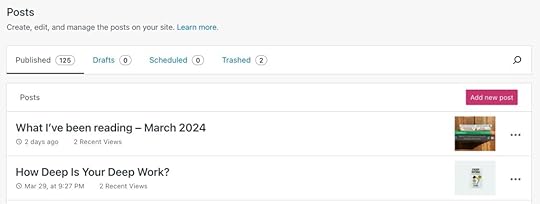 125 posts on giolodi.com, plus 25 more between Substack and Patreon.
This seems like a good time to look back and share some highlights and reflections.
The setupA few details on my peculiar setup.
giolodi.com is the official site, but I use Substack as the vehicle to email posts and offer paid content. The idea was that Substack’s social layer would help with discovery, which it does, but only a little. More on that later.
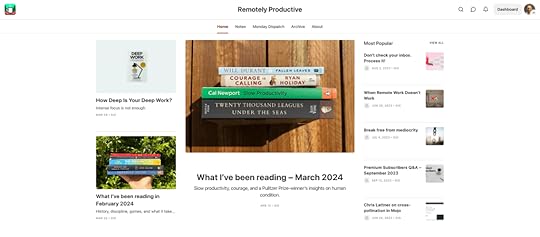 The homepage of the mirror publication on Substack.
I also cross-post on Medium because it takes a couple of clicks, and, with less diligence, on LinkedIn.
giolodi.com is hosted on WordPress.com. That’s a way to dog-food one of the products I help build at Automattic.
Some NumbersEach article gets an average of 1.3k views on Substack but only a handful on giolodi.com.
The figure comes from me eyeballing the posts list as I couldn’t find that figure in Substack’s stats. Substack optimizes for sending new emails and converting paid subscribers, any data about other areas is quite sparse.
Most viewed posts on SubstackDon’t let your intrinsic motivation become a liability Being productive won’t get you more free timeWrite down what you need to do, wake up early, and do it Develop empathy for your future self Be your harshest criticThose posts received 1.45k to 1.6k views each. They match with the most emails opened. That suggests most reads come from you, my dear subscribers, and not other sources like social or searches.
Most viewed posts on giolodi.comThe numbers on the blog itself are one order of magnitude lower, between 350 and 150 views. This reinforces my conjecture on where and how people read my work.
What does it mean to be a productive software developer? Swift did not disrupt the iOS job market, and neither will AI Turn Your iPhone Into An Inspiration Machine When should you fix software bugs? Software developers should readI find it interesting that the top posts on giolodi.com are different from Substack’s. I haven’t dug into it, but I suppose those views come from a mix of sharing on social media and organic searches.
Notable mentionsThese are the 5 posts that Substack’s algorithm currently ranks as “top”:
Don’t check your inbox. Process it! When Remote Work Doesn’t Work Break free from mediocrity Premium Subscribers Q&A – September 2023Chris Lattner on cross-pollination in MojoI’m surprised that none of the top posts are from the most viewed group. Nor are they the ones with the most likes. Clearly, Substack’s alg must take additional factors into account.
The piece There’s more to caring than working long hours deserves a special mention, too. It got syndicated on Medium’s Better Programming publication where it got quite a few eyeballs.
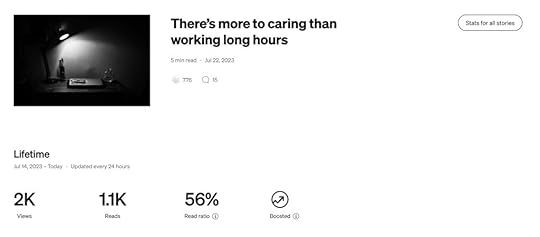 Stats for the post that got feature on Medium’s Better ProgrammingObservation
I’m skeptical of analyzing the posts data without at least exporting them into a spreadsheet. But I cannot find such an option on Substack. Besides, given my volume, I doubt there’d be anything statistically relevant.
So, here are some observations.
ThemesThe posts that most resonated, using views as a proxy metric, are down-to-earth, actionable productivity advice. One might say they have a contrarian flavor. The titles are phrased as critical or have negative verbs. “Don’t let this,” “That won’t,” “That other doesn’t,” “There’s more to this than,” etc.
None of the best posts are about AI, the future of work or the other tech-related topics I opine about from time to time. I don’t have the discipline or the attention span to write on a single topic over and over, but this observation will help me decide how much effort to put into those tangential topics.
Speaking of AI, none of the top posts has AI-generated images.
DistributionCross-posting and syndicating have been basically useless in gathering new subscribers. The piece syndicated on Better Programming that I mentioned above got more views than any of my posts on Substack, yet Medium accounts for only nine all-time views and one free subscription.
When viewed from that angle, I should stop doing it.
But I’d like to think my writing is helpful in some way. Sure, I’d love for folks to subscribe and for this endeavor to eventually become economically viable. But I’m also doing it with the romantic ambition of being part of the ladder of progress. From that angle, sharing and cross-posting are good ways to spread ideas and meet people where they are. I can see myself keep doing it on those channels that have low friction.
SEOAs I’ve mentioned above, from the data I can gather between Substack and my WordPress instance, little of my traffic is organic.
I debate whether to invest in SEO. On the one hand, it seems like a no-brainer. Why spend all that time writing if people only see your posts once?
On the other hand, I’d rather use the little time I have on writing.
I may be delusional, but I think there’s a tipping point in scale that, once reached, will outsize the return from any SEO effort. Better to work on my craft and sharpen my ideas by iterating on post after post than playing SEO games.
Lessons LearnedA classic theme for this kind of retrospective post is “how to grow your newsletter like I did.” Alas, I can’t advise you on how to grow an audience or succeed at Substack because mine is not a success story. My subs number is low and churning, and the growth curve is relatively flat.
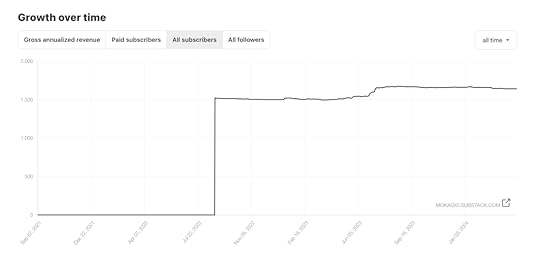 Subscribers graph on Substack. The jump in Aug 2022 is the initial import.
What I can share, however, is how I managed to stick with this for two years, publish a healthy number of articles, and get value out of the process regardless of extrinsic metrics being unremarkable and stagnant.
What works for meI’ll summarize it in a step-by-step framework. But keep in mind that reality is often more complex. Take this as a guideline.
1. Find something you are interested in and care about. Ideally, it should be a “scratch your own hitch” kind of thing. I care about productivity because I want to be the best version of myself and support and provide for my family. All the online writers I admire write from a place of curiosity.
2. Read about it. Read about your area of interest as widely as you can. Watching videos and listening to podcasts also counts as gathering ideas. After all, ideas come in all different forms and instantiation. But I can’t help feeling that if writing is your goal, reading should be the primary acquisition medium.
That means being in touch with the prominent voices in the field at present, as well as understanding the “canon” and background of the field. In addition, read widely, for example, by reviewing the bibliographies of the books that resonated with you or by finding out who your favorite authors read.
3. Think. Then, think some more. I came across a prominent author’s comic strip illustration of their writing process. Unfortunately, I didn’t note it down at the time, but I remember it showing a stick-figure-like version of the author’s head growing in size in each frame until it was massive. That’s when the writing began.
Writing is thinking.
I’ve heard from various authors in interviews that they have several ideas in incubation at a time. They’ll go out for a walk and ponder about them. Or collect notes in draft articles. At some point, all the thinking coalesces, and they’re ready to start writing.
That’s been my amateur experience as well. I’ve missed my self-imposed weekly deadline many times because I started to write a post that wasn’t thought through enough and couldn’t get anything worth sharing in time.
4. Write. That sounds easy enough, but anyone who tried it knows it isn’t.
But if you’ve thought through your ideas long enough, writing about them gets less hard.
I follow a rather standard process.
Write down the core idea. That’s the elevator pitch for the post, the one-liner kernel at the center of it.Develop an outline. Try to think about storytelling, too. Beginning, middle, end. Setup, conflict, resolution.First draft.Edit.Bounce between writing and editing until satisfied. Or till you realize you’re going round in circles and it’s time to ship the damned thing.Copy edit. I’ve been using Grammarly for a while. Recently, I’ve also been feeding the final version into ChatGPT. It picks things every now and then that Grammarly missed.5. Publish, then move on. It’s easy to get emotionally attached to a post. You came up with a new idea or a fresh angle to an old one. You’ve put your heart and soul into it.
Then you publish and… it’s out of your hands.
Sometimes, it resonates. Once in a while, it goes really well.
More often than not, it falls flat.
That’s why I try to ignore my posts’ stats and think forward.
John McPhee pointed out that: “It doesn’t matter that something you’ve done before worked out well. Your last piece is never going to write your next one for you.”
Something your last piece can do, however, is reveal further avenues for research and thinking.
Something your last piece can do, however, is reveal further avenues for research and thinking. At that point, you’re ready to start again from the top.
I find the process I just described thoroughly enjoyable. From the turning of pages in the books I read to the loud clicking of the Cherry MX Blue in my Ergodox EZ mechanical keyboard. From diving into rabbit holes to ruminating on ideas while out walking.
I get something out of it every time, regardless of the measurable outcomes. If all the reads and like went away, I’d still be writing in one way or another.
That’s the not so secret secret of my consistency. If found something I care about and built an enjoyable process around it. It’s a climb where the landscape I see along the way is intrinsically rewarding, regardless of how far the peak is.
AccountabilityAnother benefit of writing about the topics I cover is that every post holds me accountable.
Since writing about developing empathy for the future self, I found it harder to make short-term focused choices. Publishing posts about workflows and ways to work is a way for me to put them into practice. I can’t be consistently disorganized when I pour so much ink into praising organization and discipline.
If writing is thinking, then publishing is accountability.
If you want to embark on a self-improvement journey, consider writing about it in public.
The raw metrics for my writing are far from impressive, but there’s more to this work than optimizing for views or shares.
It might sound lofty, but I find myself aligned with what philosopher Karl Popper wrote in Conjecture and Refutations: “It so happens that I am not only deeply interested in certain philosophical problems (I do not much care whether they are ‘rightly’ called ‘philosophical problems’), but inspired by the hope that I may contribute—if only a little, and only by hard work—to their solution.”
So, here’s to the next 150 posts.
And here’s to you for sharing the journey with me.
Thanks!
April 11, 2024
What I’ve been reading – March 2024
Slow productivity, courage, and a Pulitzer Prize-winner’s insights on human condition.
Just a note before getting started. I posted a poll to learn what kind of writing you want to see more of in the latest Monday Dispatch. It will remain open for a few more days. Thank you for casting your vote. Your input is very much appreciated.
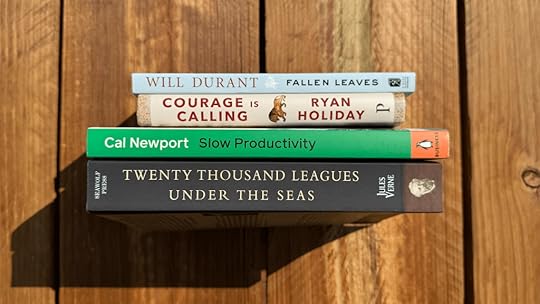 Slow Productivity by Cal Newport
Long-time readers know how influential Cal Newport’s work is on my thinking, so it should be no surprise that I pre-ordered and dove straight into his latest book on release day. Inspired by the ethos behind the Slow Food movement, Cal proposes a vision of productivity that is sustainable and rewarding without compromising on results. The model revolves around three tenets: do fewer things, work at a natural pace, and obsess over quality.
A reality of personal productivity is that humans are not great at estimating the time required for cognitive endeavors. We’re wired to understand the demands of tangible efforts, like crafting a hand ax, or gathering edible plants. When it comes to planning pursuits for which we lack physical intuition, however, we’re guessing more than we realize, leading us to gravitate toward best-case scenarios for how long things might take.
Slow productivity requires that you free yourself from the constraints of the small so that you can invest more meaningfully in the big. This is a messy, detail-oriented conflict, largely fought on the battleground of old-fashioned productivity tactics and systems. But it’s a battle that must be fought if you hope to, as Benjamin Franklin lauded, become the master of your own time.
Read it to obtain a strong argument for slowing down to push against the drive—external but most often internal—for busyness.
Read it with Subtract by Leidy Klotz to dive deeper into the “do fewer things” theme.
Courage Is Calling by Ryan HolidayRyan Holiday doing what Ryan Holiday does best: weaving together various stories from across the ages to teach and inspire. This is the first book in his series on the four cardinal virtues: courage, discipline, wisdom, and justice. Courage is the first because it is “the backbone of all the rest,” or, as C.S. Lewis put it, “the form of every virtue at the testing point,” the one we all need when the rubber meets the road.
“To each,” Winston Churchill would say, “there comes in their lifetime a special moment when they are figuratively tapped on the shoulder and offered the chance to do a very special thing, unique to them and fitted to their talents. What a tragedy if that moment finds them unprepared or unqualified for that which could have been their finest hour.”
It’s more accurate to say that life has many of these moments, many such taps on the shoulder.
For more than two thousand years, military leaders have had some version of the same maxim: The only inexcusable offense for an officer is to be surprised. To say, I didn’t think that would happen.
[…]
Douglas MacArthur summed up all failures of war and life in two words: “Too late.”
Too late in preparing, too late in grasping the enemy’s intentions, too late in securing allies, too late for leaders to be exchanging contact info, too late in rushing to the aid of those in need.
Too late in nothing getting specific, in not counting as Grant learned, or in not preparing for the appearance of the enemy as Napoleon said.
Read it to unlock the drive to do what you know needs to be done but are scared of doing.
Read it with The Obstacle is The Way, which, in my partial opinion, remains the best and most effective book on Stoicism Ryan published so far.
Fallen Leaves, by Will DurantSomeone recommended dipping your toes in Durant’s work, beginning with the short and approachable The Lessons of History (see February books) and Fallen Leaves. Where Lessons is a high-level overview of the patterns Durant and his wife Ariel noticed during their five decades spent researching “the philosophies, religions, arts, sciences, and civilizations of the world” and tries to be as objective as possible, Leaves is a look into the Durants’ (although written mostly from Will’s perspective) opinions and how their work shaped them. What a privilege to be able to peer inside two minds like theirs.
Health lies in action, and so it graces youth. To be busy is the secret of grace, and half the secret of content. Let us ask the gods not for possessions, but for things to do; happiness is in making things rather than in consuming them.
Nothing learned from a book is worth anything until it is used and verified in life; only then does it begin to affect behavior and desire. It is Life that educates.
Read it to inspect a thoughtful worldview rooted in a particular time of history, see how it clashes with yours, and what remains afterward.
Read it with… I’m sure there are other retrospectives from great thinkers at the end of their careers, but the only ones I can’t think of pale in comparison, so I’ll go with the obvious choice and recommend The Lessons of History once again.
FictionGrowing up, there was an Italian translation of Jules Verne’s Twenty Thousand Leagues under the Sea in our bookshelf that I picked up many times, but never read. The size of it was too daunting at the time. I heard the book mentioned somewhere recently and thought I’d give it a shot. When you think Verne wrote it in 1869-70, it’s really a remarkable story for its technology and scenery. The character of Captain Nemo and the mystery surrounding him were captivating, but I wouldn’t put it into my list of top sci-fi books.
KidsMy son stumbled upon a hand-me-down copy of Max Brallier’s The Last Kids on Earth and was hooked. The site pitches it as “Diary of a Wimpy Kid meets The Walking Dead in this very funny post-apocalyptic graphic novel. I can vouch for the funny part—I could hear him read out loud while reading it.
March 29, 2024
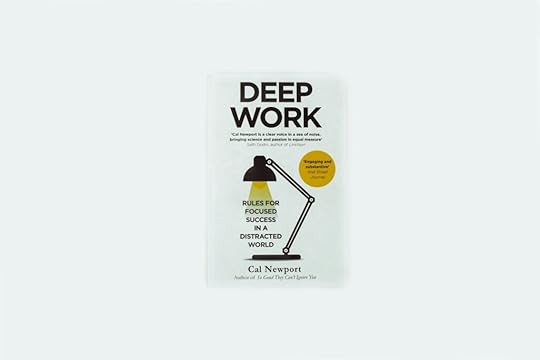
How Deep Is Your Deep Work?
Intense focus is not enough.
 Credits Saurav Thapa Shrestha
You probably heard of deep work.
You might have even read Cal Newport’s 2016 book that introduced the idea—or my advice to get started.
But are you actually practicing deep work?
Sorry to break it to you, but you might not be doing as much deep work as you actually think.
Deep work is more than a badge you put on Slack to signal you’re working on something important. Deep work is more than working with noise cancelling headphones while sipping your caffeinated drink of choice.
To better understand the nuances of deep work, let’s look at the original definition from the book.
Deep Work: Professional activities performed in a state of distraction-free concentration that push your cognitive capabilities to their limit. These efforts create new value, improve your skill, and are hard to replicate.
As you can see, there’s a lot that goes into deep work:
A state of distraction-free concentrationCognitively demandingCreating value and/or improving skillsHard to replicateIntense focus is necessary for deep work, but not enough. You can process email without getting distracted, but that is not deep work.
Likewise, a hard problem is necessary for deep work, but not enough. Implementing a new feature for a software product is hard, but if you do it while attending a remote meeting, it doesn’t count as deep work.
Deep work requires both material and execution. It’s a combination of how you work and what you work on.
Deep work is focused, uninterrupted attention directed to solving hard, specialized problems.
The strictness of this criterion is why true deep work is hard to come by. Being aware of these constraints is the first step in identifying truly valuable work, the kind of work that gets you promoted.
Keep these strict criteria in mind at your next team planning session and as you schedule your day. What hard problems are you most suited to tackle? How can you allocate time at the peak of your attentional rhythm and keep it free from distractions to make progress on them?
March 24, 2024
What I’ve been reading in February 2024
History, discipline, games, and what it takes to innovate.
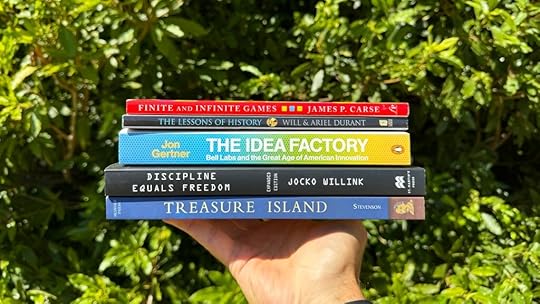
Still playing with the naming and format of these posts. This time, each book comes with a three-sentence comment, two quotes, one reason to read it, and one book to pair it with.
Also, February is not a mistake in the title. I am simply embarrassingly late with this post. These are the February books indeed.
As always, let me know how I could improve the format.
Finite and Infinite Games by James P. CarseA book about mindset and worldview. Being able to see life as an infinite game, a game where the only aim is to keep playing, makes every experience into an opportunity for growth and exploration. This is the kind of book guaranteed to give new insights on every reread.
Finite players play within boundaries; infinite players play with boundaries.
An infinite player does not begin working for the purpose of filling up a period of time with work, but for the purpose of filling work with time.
Work is not an infinite player’s way of passing time, but of engendering possibility. Work is not a way of arriving at a desired present and securing it against an unpredictable future, but of moving toward a future which itself has a future.
Read it to reframe how you approach work and relationships.
Pair it with The Beginning of Infinity to see the infinite game mindset applied to the growth of knowledge.
The Lessons of History by Will and Ariel DurantWill and Ariel Durant are among the most celebrated and prolific historians of the twentieth century. After spending decades writing their The Story of Civilizations series, they compiled “a survey of human experience” based on their probing through the centuries. These short but thought provoking essays peer deep into humanity and the mistakes that we keep repeating.
If progress is real despite our whining, it is not because we are born any healthier, better, or wiser than infants were in the past, but because we are born to a richer heritage, born on a higher level of that pedestal which the accumulation of knowledge and art raises as the ground and support of our being. The heritage rises, and man rises in proportion as he receives it. History is, above all else, the creation and recording of that heritage; progress is its increasing abundance, preservation, transmission, and use.
History repeats itself, but only in outline and in the large. […] History repeats itself in the large because human nature changes with geological leisureliness, and man is equipped to respond in stereotyped ways to frequently occurring situations and stimuli like hunger, danger, and sex. But in a developed and complex civilization individuals are more differentiated and unique than in a primitive society, and many situations contain novel circumstances requiring modifications of instinctive response; custom recedes, reasoning spreads; the results are less predictable. There is no certainty that the future will repeat the past. Every year is an adventure.
Read it to gain a lens to apply to current events.
Pair it with Meditations by Marcus Aurelius for a concrete example of how human nature has not changed in the past millennia.
Discipline Equals Freedom by Jocko WillinkDecorated navy SEAL Jocko Willink makes the case for discipline as an instrument for self-improvement and freedom. The only issue: it’s printed white on black. The paperback pages had so much ink on them that my fingertips became black.
That is what I want you to be afraid of: Waking up in six days or six weeks or six years or SIXTY YEARS and being no closer to your goal … You have made NO PROGRESS. That is the horror. That is the nightmare. That is what you really need to be afraid of: Being stagnant.
But my glory, it doesn’t happen in front of a crowd. It doesn’t happen in a stadium or on a stage. There are no medals handed out. It happens in the darkness of the early morning. In solitude. Where I try. And I try. And I try again. With everything I have, to be the best that I can possibly be. Better than I was yesterday. Better than people thought I could be.
Read it to get motivated to get off your ass.
Pair it with Discipline is Destiny by Ryan Holiday (see What I’ve been reading in January 2024) for inspiring stories of discipline in action.
The Idea Factory: Bell Labs and the Great Age of American Innovation by Jon GertnerA history of Bell Labs, AT&T’s legendary research and development division, told through the contributions of its most impactful managers and luminaries. This is a chronicle of technological development as well as a reflection of what it takes to innovate. As with many other biographies and historical books, I came away from it inspired and energized, but also with a touch of melancholy for a time and place the like of which we might never see again.
The men could see there were enormous, but surmountable, engineering challenges […] But there were also profound challenges of science. “The crux of the problem,” [Frank Baldwin] Jewett wrote […], “was a satisfactory telephone repeater or amplifier. Did we know how to develop such a repeater? No. Why not? Science hadn’t yet shown us the way. Did we have any reason to think that she would? Yes. In time? Possibly. What must we do to make “possibly” into “probably” in two years?”
A drive for understanding separated the great scientists and engineers of the twentieth century from their predecessors. And it separated their inventions and business successes, too. [Mervin] Kelly could see that they were only going to get ahead by understanding what they were doing.
Read it to learn about the story beyond the technologies that power our daily lives.
Pair it with How Innovation Works by Matt Ridley if you want to better understand some of the processes that made Bell Labs so successful.
FictionI re-read Treasure Island by Robert Louis Stevenson, for the first time in English. What can I say… there’s a reason it’s a classic. It has all the ingredients from the best adventures: travels to far away places, mystery, plot twists, betrayals, and a young protagonist who finds an inner strength he didn’t know was there.
KidsMy son has been devouring the Diary of a Minecraft Zombie and Diary of a Minecraft Creeper books from his school library. It’s bizarre because he doesn’t play Minecraft, or any other video games. The books have the right level of nonsense to keep him engaged and clearly don’t require extensive Minecraft knowledge to be enjoyed.
My daughter and I continued reading The Baby Sitter Little Sister graphic novels on repeat, with some old school Disney fairy tales in between.