Renee Robinson's Blog, page 22
July 14, 2013
Some people gopher feet. I never had that fetish.

Minnesota mother, son accused of stealing frozen gopher feet
Jun 19, 2013
PRESTON, Minn. (UPI) — A mother and son face theft charges after a southeastern Minnesota trapper reported thousands of gopher feet missing from his freezer, a court complaint said.Tina Marie Garrison, 37, and her son, Junior Lee Dillon, 18, of Preston were charged with felony and misdemeanor theft counts after a trapper in Granger reported nearly $5,000 in gopher feet, used as bounty to claim government rewards to help reduce the gopher population, missing, Rochester’s Post-Bulletin reported Wednesday.
The payment rate is $3 per pair of feet submitted, the newspaper noted.
Garrison pleaded not guilty and is awaiting trial. Dillon awaits a July 29 hearing.
Dillon turned in $1,014 worth of feet in November and Garrison $3,780 in December, figures the Harmony Township clerk said was unusually high. Garrison claimed at the time she and her son had been saving the feet for three years.
Copyright 2013 by United Press International
Read more at http://www.arcamax.com/entertainment/weirdnews/s-1344379-853721#qxRaBgEACRSphMt5.99
Filed under: humor, Nae's Nest, nature, photography, Reblogged articles, musing, photos etc, Short Stories, wildlife Tagged: felony, gopher, ground hog, misdemeanor, Preston Minn








July 13, 2013
11 Empowering Ways to Strengthen Your Brain By Paige Greenfield
 1. Volunteer
Stimulates: The prefrontal cortex, which analyzes, plans, and problem-solves
Why: A Johns Hopkins study found that older women who tutored kids for six months developed sharper cognitive skills. The social and mental activity required for teaching sends blood rushing to this part of the brain.2. Work out
Stimulates: The hippocampus, which forms memories
Why: Arthur Kramer, PhD, a researcher at the University of Illinois, used MRIs to show that exercise actually makes your hippocampus bigger. Physical activity may increase the number of capillaries in the region, which in turn helps new cells grow. Kramer prescribes one-hour sweat sessions three times a week.3. Learn a skill
Stimulates: The intraparietal sulcus, which directs hand-eye coordination
Why: At Oxford University, researchers taught 24 people to juggle and found that after six weeks this region had a higher density of white matter (the fibers that let neurons communicate). Any novel activity that is practiced intently, such as tennis or guitar playing, will likely have this effect, says study author Heidi Johansen-Berg.
4. Keep the weight off
As the number on the scale creeps upward, it’s hard to imagine that anything’s getting smaller, but extra pounds can actually shrink your brain. In a 2009 study, brain scans of older adults revealed that overweight individuals had an average of 4 percent less brain tissue than normal-weight folks. And in obese people the loss of tissue was so significant that their brains appeared 16 years older than those of thinner people.”By eating more calories, you’re also consuming more fat,” says study author Paul Thompson, PhD, a neurology professor at UCLA School of Medicine. “The fat clogs arteries that feed the brain, which in turn causes brain cells to wither.” That loss can impair memory, mood, movement, speech, and more.Though the first priority is getting down to a healthier weight, you can also focus on strengthening the brain cells you’ve got. Aerobic activity will not only help you shed pounds but increase the amount of blood, oxygen, and nutrients flowing north to your neurons. And more nourishment means a faster processor.5. Wiggle your eyes
Can’t remember where you stashed your glasses? Try looking from side to side. Rapid horizontal eye movements cause the brain’s two hemispheres to interact with each other more efficiently, explains memory researcher Andrew Parker, PhD. In moments of temporary amnesia, that action may help you pull up information.
6. Take a snooze
In a University of California, Berkeley, study, participants improved their scores on a memory test by 10 percent when they repeated the test after catching some z’s. (Nonnappers saw a 10 percent decline in their scores the second time they took the quiz.) Here’s why: New facts enter your brain like e-mails arriving in your in-box. And as your in-box can overflow over the course of a day, so can your brain. During sleep, your brain shuffles recently received data into storage, creating space for fresh info.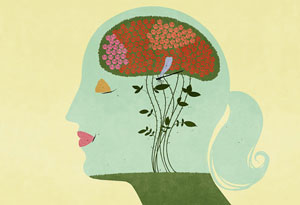
7. Eat brain foods—rich in B12, antioxidants, or essential fatty acid
Bananas (Get the recipe for Banana Cinnamon Smoothies)
Kale (Get the recipe for Spicy Parmesan Green Beans and Kale)
Tomatoes (Get the recipe for Grilled Pizza with Goat Cheese, Tomatoes and Thyme)
Blueberries (Get 8 blueberry recipes)
Swiss cheese (Get the recipe for a classic Muffuletta sandwich)
Chocolate (Get the recipe for double chocolate loaf and more decadent retro desserts)
Salmon (Get the recipe for healthy Lemon Salmon with Garlic Spinach)
Brussels sprouts (Get the recipe for Balsamic Glazed Brussels Sprouts with Bacon and Bread Crumbs)
Apples (Get the recipe for Maine Crab, Green Apple and Avocado Salad with Parmesan Tuiles)
Olive oil (Get the recipe for Olive Oil Vinaigrette)
Coffee beans (Get 8 caffeine infused coffee recipes)
Oranges (Get 8 citrus recipes, from entrées to dessert)
How to avoid health problems that can hurt your brain.
8. Thief: Chronic Stress
The Damage: Prolonged exposure to the fight-or-flight hormone cortisol and other brain chemicals can actually kill neurons by exciting them to death.
The Fix: Stay connected. A six-year Harvard University study of 16,638 people found that those with the largest social networks had the slowest rate of memory decline. Family and friends can mute the intensity of stress—and the brain’s chemical response.9. Thief: Cholesterol
The Damage: If plaque gets lodged inside one of the tiny blood vessels in your brain, it can cause a “silent” stroke (the kind you don’t even know you’ve had). The harm this can do to your brain tissue could slow the speed at which you absorb new information.
The Fix: In addition to eating a healthy diet and getting plenty of exercise, go nuts for nuts. Eating about 2.4 ounces a day can lower bad cholesterol by ten points. The type of nut doesn’t seem to matter, though raw nuts are healthiest.10. Thief: Sleep Apnea
The Damage: In this disorder (marked by loud snoring and exhaustion upon waking), your airway spontaneously closes or becomes blocked for several seconds at a time. The result—a dip in the oxygen level in your blood, which can cause brain cells to starve.
The Fix: Studies show that losing 10 percent of your body weight is enough to improve symptoms. And your doctor may recommend using a CPAP (continuous positive airway pressure) machine while you sleep. It fits over your nose and mouth and generates a steady flow of air to keep the airway open.11. Thief: Hypothyroidism
The Damage: An underactive thyroid slows metabolism, which leads to fatigue, which leads to a foggy brain. One of the symptoms of this disorder, affecting about 17 percent of women 60 and over, is difficulty committing new info to long-term memory.
The Fix: A common cause of the problem is insufficient levels of iodine, which the body needs in order to produce thyroid hormones, so seek out lots of iodine-rich foods, such as seafood and dairy products.

This article is part of Oprah.com’s 2011 Feel Good Challenge. Join now—and move closer to the life you want!
Related Resources
Dr. Oz’s 5 ways to keep your brain sharp
Why your memory might be slipping
4 tips to remember what you’ve learned
Read more: http://www.oprah.com/health/The-Science-Behind-Brain-Activity-Enhancing-Brainpower/3#ixzz2Tb6ILXbm
Read more: http://www.oprah.com/health/The-Science-Behind-Brain-Activity-Enhancing-Brainpower/4#ixzz2Tb6pHgQF
Filed under: Nae's Nest, nature, Reblogged articles, musing, photos etc, Renee Robinson, Spirituality/Reigion Tagged: Arthur Kramer, hand-eye coordination, hippocampus, Johns Hopkins, Oprah, PHD







Angel on The Moon

She speaks to me
The voice of the moon
She is truly an angel
Who dwells on the moon
She delivers prayers
To the Master’s room
The Sandman is sent
To come and get them
Delivers to the angel
Who then submits them
These are special prayers
Filled with tears and need
All asking for miracles
For God to receive
Some will be granted
Others will not
God has His plans
We understand not. We have no choice
Whatever He decides. Is for our best
We must find strength. To follow the path
Set down before us. And have no wrath.
But a heart full of joy
For blessings of the past
When we didn’t even ask. What a wonderful life
Bestowed upon us
Enveloped in love
Enriched with goodness
Sending a prayer. Special delivery. Sandman comes
To pick-up for me
Delivers to the angel. Who lives on the moon
And sends up to God
To be read soon
I ask for nothing
Thank you I send
For the life I have lived
Full of family and friends
Renee Robinson
Filed under: Art, by Renee Robinson,






July 12, 2013
Our Last Embrace

http://images2.layoutsparks.com
With each breath
I draw you in
Your scent I’ll carry along
On streets of gold
I shall walk upon
My time here, isn’t long
I take your hand to draw you close
Will this be our last embrace?
In your arms, I want to stay
Soon to awake, in a new place
Weaker I grow with each day
I listen to your spirit
I can hear your inner voice
I hear sorrow in your heart
If only I had a choice
I hear a flood coming in tears
Our time together, a few years
He can see inside of me
Places no one has ever seen
Feeling fragile and transparent
As though I will crack
My fight has been very long
Too much burden to carry on
You draw me in for a kiss
A sweetness deep within
Holding out for a miracle
Refusing to give in
You lift me up and carry me
Taking the burden away
Helping me and feeding me
Praying for me to stay
With each breath
You draw me in
My cancer cannot stay
Her time here
Lord, expand upon
Please hear me as I pray
Renee Robinson
Filed under: Art, birds, by Renee Robinson,






Bear & Moose Fun

http://moose-r-us.com/pics/TakingCareofBusiness.jpg
Author Unknown
Like any hiker that spends a lot of time in bear country, I have a healthy respect for bears. But the only animal that’s tried to straight-out kill me in the wilderness was a moose, so I’ve had to learn how to stay on a moose’s good side, too.
Case in point: A few years ago I went climbing with a friend. The crag was about a half-mile hike from the highway. Our skinny footpath was the only trail through an overgrown crush of spiny, head-high devil’s club and the occasional tree, all funneling between two rock faces.
A cow moose must have had her baby in the middle of that trail sometime after we first passed by. On the way back down a few hours later, the undergrowth started vibrating violently in front of me as we reached a blind turn around the trail. I had just enough time to think Please don’t be a bear! Don’t be a bear! before the cow moose materialized from the bushes in full-on stomp mode.
We did the right thing, or at least my friend did: She dived right into the thicket of devil’s club and looked for a tree to hide behind, whereas I turned and ran back up the footpath. Moose are faster than humans, of course, but that didn’t really matter because I only got a few steps in before I slipped on a rock.
I tripped and fell flat on my face, right in front of the moose. Everything after that happened in slow motion: I spent a long time falling. I twisted around to see the moose looming over me. That’s a big moose, I thought. And then I froze, because it was the only option I had left.
And the moose went back to whatever was around the corner — her calf, we assume — without laying a hoof on me.
We gave the moose about half an hour to calm down and move off before we tried the trail again, but when we peeked around the blind corner she was still there — ears laid back, ruff raised, clearly ready to attack again.
Our only other option for getting back to the car was crawling through the devil’s club, spines and all, with frequent pauses to peer above the vegetation for any sign of mama moose, then below it for any trace of the baby we assumed she was guarding. I’m sure I could have handled just the first, run-or-die part of the encounter on my own, but it was during that nerve-racking descent back to the road that I was truly grateful to be hiking with a trusted friend.
If you live in bear country, you’ve probably had one key rule of bear safety drilled into your head: Don’t run. Don’t run. Don’t run.
Well, guess what: That rule is completely different for moosesafety. Running from a charging moose won’t trigger predatory instincts, and once you’re outside a moose’s “personal space” — which varies from animal to animal — it’s probably going to leave you alone. It’s not like it could eat you, even if it wanted to.
Moose have a top of speed of 30+ mph, so you’re not going to win a footrace with them. If a moose charges you, run for solid cover like a tree you can duck behind. Climbing the tree is a viable option if there’s time.
If a moose does charge you and knock you down, curl into a ball and stay still, protecting your head with your hands as best you can. A backpack can offer some protection for your spine. The moose might kick you and stomp you before it decides you’re no longer a threat and moves away. Don’t get up until the moose leaves you alone and moves off; if it remains close by and agitated, it might interpret your movement as a renewed threat.
Moose Etiquette
If the moose hasn’t charged you, you can probably go about your business as long as you observe the proper moose etiquette. Give the moose plenty of space (the Alaska Department of Transportationrecommends at least 50 feet; I say give it more if you can). Never, ever get between a mother moose and her calves, so if you suspect there might be little ones around, take the time to figure out where they are before you make your move. If you suspect the presence of little ones but can’t spot them, your options are:
Go back
Wait a while and see if the situation changes
Cross your fingers and give momma moose the absolute widest berth you can
Warning Signs
Like most animals, moose have their own vocabulary to let you know they’re feeling uncomfortable. Look out for raised hackles along the moose’s shoulders, earns pinned back (like a dog’s or horse’s), or a lowered head. A moose moving toward you isn’t a good sign; move away from it and seek cover if you can.
Reasons Moose Might Charge
Moose typically don’t want anything to do with you, but they’re also notoriously temperamental and unpredictable. Here are are some of the most common reasons a moose might charge you:
It’s stressed. Hunger and inclement conditions, like deep snow, can stress moose and make them more irritable than usual. Give a stressed moose as much space as you can, and be on the lookout for warning signs that it’s zeroed in on you as a threat (or a scapegoat).
It’s cornered. If a moose feels cornered, it’s more likely to charge.
It’s been harassed. If a moose has been harassed — by people, dogs, or other wild animals — it’s more likely to see you as a threat (or take its irritation out on you).
Dogs bother it. This warrants a special mention because if your off-leash dog goes after a moose, it may well get kicked in reply, or run back to you with the moose in hot pursuit. (Moose can kick out to the side, front, and back.) Many experts warn that moose see dogs as wolves — which prey on moose — and may go out of their way to kick a dog, even if it’s tied or leashed.
Mating season. Bulls are particularly aggressive during the September and October mating season.
Calving season. Cows are especially aggressive when protecting calves, which are born in late spring. While a mother with ambulatory calves will usually move away if given the opportunity, they’ll stay put to defend calves that can’t walk yet, and I’ve heard that they’ll stay with stillborn calves for quite some time as well. (I suspect that may have been what happened with the “Moose of Doom.”)
Ways to Keep Safe
Practicing moose safety is as simple as eliminating potential reasons for a charge. Give moose plenty of space (at least 50 feet, preferably more) and take care never to force them into a corner. If you have dogs, keep them on-leash and under control. Be especially wary if the moose seems irritable or if calves are around.
And above all, stay aware of your surroundings. Making some noise lets the moose know you’re coming and gives them a chance to avoid conflict in the first place; but you should also be paying close attention with your eyes and ears so you can see or hear them coming, too. If it comes down it a moose is a lot bigger and more dangerous than you are, so let it have the right of way on the trail.
Hikers need to reconcile two contradictory ideas before hiking in bear country: The odds of being injured by bears are quite remote. But you also can’t ignore the potential for bear attacks. The stakes are simply too high, so it’s essential to follow bear safety tips.
The Greater Yellowstone Coalition puts the chances of being injured by a grizzly bear in Yellowstone National Park at one in 1.9 million.
But in July 2011, the park experienced its first bear-related fatality since 1986 when a grizzly sow defending her cubs attacked two hikers on the Wapiti Lake Trail. And not long after,Yellowstone wildlife officials had to kill a different grizzly bear when it acted aggressively toward park visitors during several different incidents.
The potential for bear encounters is also increasing. More people are out on trails and development along the wildland-urban interface has infringed on bear habitat.
And changing patterns in bear behavior are bringing the animals closer to populated areas than ever before. A New York Times article described how climate change has forced grizzlies to forage more widely because of the decline of whitebark pines, which produce pine nuts that the bears depend on in their diet.
Add it all up and it’s definitely a good idea to familiarize yourself with bear safety tips before heading out on a hike. There’s no need to be overly fearful. Just prepared.
North America is home to three species of bears. But because most of us aren’t likely to head out for a day hike in the Arctic, I’ll skip polar bears and focus instead on grizzlies (also known as brown bears) and black bears.
• Grizzly Bears
Range: Grizzlies have been eliminated from 98 percent of their native range in the American West and the Great Plains, according to the environmental organization Defenders of Wildlife. They’re now found from Alaska (the population there is 30,000) through western Canada, and down through parts of Washington and into the Northern Rockies. About 600 grizzlies live in the Greater Yellowstone Ecosystem, which includes Yellowstone and Grand Teton national parks.
Size: Grizzlies are bigger than black bears, although some male black bears can actually be larger than female grizzlies. Grizzlies can weigh more than 850 pounds and stand nearly seven feet tall. Kodiak bears, an Alaskan subspecies of grizzlies, can weigh well over 1,000 pounds and stand ten feet tall.
Color: Although there’s considerable variation in color, grizzlies tend to be browner and redder than black bears.
Distinguishing Traits: Grizzlies have a prominent hump on their back. Their ears are small and rounded.
• Black Bears
Range: With an estimated population of 300,000 animals in the U.S. across 40 states, black bears are much more numerous and widely distributed than grizzlies.
Size: Larger males can weigh more than 500 pounds but most average between 150-300 pounds.
Color: Despite their name, black bears have great color variation. Cinnamon-colored black bears are not unusual and many also have prominent white chest patches.
Distinguishing Traits: Light-colored chest patches. Prominent ears and more of a direct line from forehead to the tip of the nose than grizzlies. Grizzlies have a much more defined brow.
• Avoiding Bear Attacks
Be bear aware. Bears frequently use hiking trails, so pay attention and look for signs of recent activity: clean pawprints, scat, and trees with fresh claw marks. Avoid any carcasses you may come upon because bears will defend their kills.
Hike at safe times. Chances of bear encounters are more likely around dawn and dusk. Yellowstone National Park recommends against hiking after dark.
Make your presence known. Try not to surprise bears. Bear country is one place where you need to break the rules of trail etiquette. Wear bear bells, blow a whistle, sing, and clap your hands as you hike down the trail.
Hike in a group. When Banff National Park imposed strict seasonal rules for hiking in bear country, it required visitors to stay in tight groups of at least four people. Be sure to keep children close to you at all times.
Be cautious in areas of dense vegetation. Use extra care (and make extra noise) in trail sections with limited visibility and hearing. Dense thickets, especially areas with a heavy concentration of berries, are prime bear habitat. There’s also a chance that you may surprise a bear as you round a bend. And when bears are feeding along streams, the noise of rushing water may make it harder for them to hear you.
Leave the dog at home (or keep it on a leash). Your dog may try to protect you and will confront a bear farther up on the trail. If there’s a chase, your dog can easily lead the bear right back to your group.
Carry bear spray. According to the Denali National Park and Preserve website, pepper spray effectively deters grizzly attacks 90 percent of the time. But it’s a last resort defense and no substitute for following basic bear safety guidelines. Be sure to also familiarize yourself with how the spray canister works before you head out.
• Bear Encounters
Stay calm. If the bear hasn’t noticed you, try to leave the area. Speak quietly and don’t make threatening gestures or do anything else that may provoke the bear. Never approach a bear for a closer look or a photograph.
Back away. Keep your eyes on the bear but avoid direct eye contact. Bears may consider that aggressive behavior. Waving your arms is okay.
Never feed bears. Bears are omnivorous eating machines and are constantly searching for food. If you put out food so you can observe bears, they may begin to associate humans with feeding. That can mean serious problems for other people and for the bear too. As the saying goes, “A fed bear is a dead bear” because wildlife officials often kill bears that get into the habit of approaching humans for food.
Watch out for cubs. The most dangerous bear encounter is with a mother defending her cubs.
Don’t run. Bears can reach speeds of 35 mph. That’s more than 500 feet in 10 seconds. Usain Bolt couldn’t outrun a charging bear, so neither can you.
Look for warning signs. Stomping of feet, swaying, woofing, clacking of jaws, ears flattened against the head, and a steady glare are all possible precursors of an attack. But a bear rearing up on its hind legs is more a sign of curiosity than a hint of imminent aggression.
• How to Survive an Attack
Don’t panic. Both grizzlies and black bears often try to intimidate with bluff charges. And they can certainly be quite intimidating. Bears will run at full speed then peel off or come to a halt—sometimes within 10 feet of you. Some experts suggest throwing an object to the ground to distract a charging bear. But keep your daypack on because it might provide a bit of protection if the bear does attack.
Play dead with grizzly bears. Curl up in a ball or lie face down and clasp your hands tightly against your neck and the back of your head. Try to remain as still and silent as you possibly can. Not easy.
Fight back against black bears. Use your hands, camera, rocks, or anything else you can reach to defend yourself against black bears. The strategy is similar to how you would handle a mountain lion attack because black bears are much more easily scared off than grizzlies.
http://viewallpapers.com
Filed under: humor, Nae's Nest, nature, photography, Reblogged articles, musing, photos etc, Renee Robinson, wildlife Tagged: bear, devil, Devil's club, hiking, moose, mountain climbing







July 11, 2013
Ancient carving found in garbage pit
An 1,800-year-old stone carving of what may be the head of a Roman god was recently found in an ancient garbage dump, British archaeologists announced today (July 3).
An undergraduate student at Durham University discovered the largely intact head during an archaeological dig at the Binchester Roman Fort, a major Roman Empire fort built around A.D. 100 in northeastern England’s County Durham.
Archaeologists involved in the dig believe that somebody probably tossed the 8-inch-long (20 centimeters) statue in the garbage when the building was abandoned in the fourth century, during the fall of the Roman Empire. [See Photos of the Stone Head & Dig Site]

https://encrypted-tbn0.gstatic.com
Article:
Ancient Carving of Roman God Found in Garbage Pit
Laura Poppick, LiveScience Staff Writer
The team is still not certain who the carved head is meant to represent, though they have noted its resemblance to a similar stone head discovered in 1862 inscribed with the name “Antenociticus” — a Celtic deity associated with military prayers in that particular region.
A shrine sits nearby the garbage dump, further suggesting the stone head was involved in prayer and represents a deity.
“It is probably the head of a Roman god — we can’t be sure of his name, but it does have similarities to head of Antenociticus,” David Petts, a Durham University archaeologist who was involved in the dig, said in a statement. “We may never know the true identity of this new head, but we are continuing to explore the building from which it came to help us improve our understanding of late Roman life at Binchester and [the] Roman Empire’s northern frontier in Northern England.”
The team is particularly interested in the unique local aesthetic of the head, which combines classical Roman art and regional Romano-British art. Some of the facial features also appear to be African, though this remains speculative.
“This is something we need to consider deeply,” Petts said in a statement. “If it is an image of an African, it could be extremely important, although this identification is not certain.”
The dig was conducted in collaboration with Stanford University in an effort to unearth evidence from the era leading up to the fall of the Roman Empire. The team has yet to publish a report on their recent findings in a peer-reviewed scientific journal.
Follow Laura Poppick on Twitter. Follow us @livescience, Facebook & Google+. Original article onLiveScience.com.
Filed under: Art, Nae's Nest, Reblogged articles, musing, photos etc, Renee Robinson Tagged: ancient history, Durham University, Roman Empire, Roman God carving, Stanford University







My Final Year

Feel my need, my fear, my pain
Look into my heart and relieve the strain
See who I am and what I need to be
Dear Lord, I beg, Please heal me
A year and a half is not very long
It is all I have to heal and to grow strong
I need a miracle to proceed
I will follow wherever He leads
I am your child, I am in need
May your words touch and heal me
Oh please Lord
I am on bended knee
Oh please Lord
Hear my plea
Oh please Lord
Help me
Rock me in your arms
A soothing song, sing to me
Help me that I may understand
Show me visions of the promised land
Ease my pain, take my fear
Please be with me, my final year
Asking for a healing
Is this your plan?
Or is it my time to leave this land?
Renee Robinson
Filed under: birds, by Renee Robinson,






July 8, 2013
A excerpt of my soon to be released novel “Dancing With Cancer”
http://www.booksie.com/non-fiction/book/arizonaflame/dancing-with-cancer-coming-soon
[contact-form]
http://www.booksie.com/poetry/poetry/arizonaflame/raindrops-on-my-pillow
I would truly love to hear what you think. I want my journal to be a success. The top link will take you to the excerpt of my novel, “Dancing With Cancer”. Please, leave comments. Does anything need added or taken away? Does it make sense, does it need changed at all?
xxox
Renee
Filed under: by Renee Robinson,






July 6, 2013
No End in Sight

 The mathematical symbol that represents infinity.
CREDIT: Boykung | Shutterstock
View full size image
No End in Sight
Denise Chow, LiveScience Staff Writer
NEW YORK — Despite being in existence for more than 2,000 years, the concept of infinity has endured as an enigmatic, and oftentimes challenging, idea for mathematicians, physicists and philosophers. Does infinity really exist, or is it just part of the fabric of our imaginations?
A panel of scientists and mathematicians gathered to discuss some of the profound questions and controversies surrounding the concept of infinity here Friday (May 31), as part of the World Science Festival, an annual celebration and exploration of science.
Part of the difficulty in trying to solve some of the abstract questions related to infinity is that these problems fall beyond the more established mathematical theories, said William Hugh Woodin, a mathematician at the University of California, Berkeley. [Watch: World Science Festival Highlights]
“It’s kind of like mathematics lives on a stable island — we’ve built them a solid foundation,” Woodin said. “Then, there’s the wild land out there. That’s infinity.”
Where it all began
A philosopher named Zeno of Elea, who lived from 490 B.C. to 430 B.C, is credited with introducing the idea of infinity.
The concept was studied by ancient philosophers, including Aristotle, who questioned whether infinites could exist in a seemingly finite physical world, said Philip Clayton, dean of the Claremont School of Theology at Claremont Lincoln University in Claremont, Calif. Theologians, including Thomas Aquinas, used the infinite to explain the relationship between humans, God and the natural world.
In the 1870s, a German mathematician named Georg Cantor pioneered work in a field that became known as set theory. According to set theory, integers, which are numbers without a fraction or decimal component (such as 1, 5, -4), make up an infinite set that is countable. On the other hand, real numbers, which include integers, fractions and so-called irrational numbers, such as the square root of 2, are part of an infinite set that is uncountable.
This led Cantor to wonder about different types of infinity.
“If there are now two kinds of infinity — the countable kind and this continuous kind, which is bigger — are there other infinities? Is there some infinity that’s sandwiched in between them?” said Steven Strogatz, a mathematician at Cornell University in Ithaca, N.Y.
Cantor believed that no infinities exist between the sets of integers and real numbers, but he was never able to prove it. His statement, however, became known as the continuum hypothesis, and mathematicians who tackled the problem in Cantor’s footsteps were labeled set theorists.
Exploring beyond
Woodin is a set theorist, and has spent his life trying to solve the continuum hypothesis. To date, mathematicians have not been able to prove or disprove Cantor’s postulation. Part of the problem is that the idea that there are more than two types of infinity is so abstract, Woodin said.
“There’s no satellite you can build to go out and measure the continuum hypothesis,” he explained. “There’s nothing in our world around us that will help us determine whether or not the continuum hypothesis is true or false, as far as we know.” [5 Seriously Mind-Boggling Math Facts]
Trickier still is the fact that some mathematicians have dismissed the relevance of this type of mathematical work.
“These people in set theory strike us, even in math, as sort of strange,” Strogatz joked. But, he said he understands the importance of the work being done by set theorists, because if the continuum hypothesis is proven false, it could uproot basic mathematical principles in the same way that contradicting number theory would wipe out the bases for math and physics.
“We know that they’re doing really deep, important work, and in principle, it’s foundational work,” Strogatz explained. “They’re shaking the foundations that we’re all working on, up on the second and third floors. If they mess something up, it could tip us all over.”
The future of mathematics
Still, despite all of the uncertainties, the work done by set theorists could have positive ripple effects that serve to strengthen the foundations of mathematics, Woodin said.
“By investigating infinity, and to the extent that we can be successful, I think we make thecase for the consistency of arithmetic,” he explained. “That’s a bit of a fanatical statement, but if infinity doesn’t lead to a contradiction, certainly the finite doesn’t lead to a contradiction. So, maybe by exploring the outer reaches to see if there is a contradiction, you gain some security.”
The paradoxes that characterize the concept of infinity are perhaps best explained with the number pi, Strogatz said. Pi, one of the most recognizable mathematical constants, represents the ratio of a circle’s circumference to its diameter. Among its myriadapplications, pi can be used to find the area of a circle.
“Pi is typical of real numbers … in that it has this infinite amount of unpredictable information in it, and at the same time, is so totally predictable,” Strogatz said. “There’s nothing more orderly than a circle, which pi embodies — it’s the very symbol of order and perfection. So this coexistence of perfect predictability and order, with this tantalizing mystery of infinite enigma built into the same object, is part of the pleasure of our subject and, I suppose, of infinity itself.”
Follow Denise Chow on Twitter @denisechow . Follow LiveScience @livescience , Facebook & Google+ . Original article on LiveScience.com.
Filed under: Nae's Nest, nature, News Article, photography Tagged: Aristotle, concept of infinity, infinity, live science, mathematics, World Science Festival