Renee Robinson's Blog, page 27
June 11, 2013
Paper Cutouts

http://pimminag.files.wordpress.com
So many dreams yet to pass
Left deep inside, yet to be born
Bursting to come forth
Yearning to explore
So much love yet to give
Babies to hold
Stories to tell
Joys to behold
Life left unfinished
Frozen in time
Passing too soon
An unpainted sign
Left to live within those loved
Between pages of memories
Diaries and fairy tales
Old homemade movies
Playing those moments over and over again
Reel of tape
Wheel of time
Circle of love
Pieces of the heart, remnants of the mind
Times created with great care
Carefree and unplanned
The passion of an artist
Molded with the hands
A life filled with color
No room for regrets
Life filled with laughter
Lover’s silhouettes
Paper cutouts
Hearts and dolls
Playing Legos
Buildings that fall
Fun times and skinned knees
Buy it Daddy
Pretty please!
I’m so sorry Mom
To leave you behind
It is too soon
It isn’t my time
Listen for the trumpet
When you dream
Peaceful sleep
For you know what it means
Be happy for me
For I have moved on
Creating new dreams
While memories live on
Crossing over……….The great river……….Into the next life
Something bigger
Something greater
Renee Robinson
Filed under: Art, by Renee Robinson, 


Zombie Plants

BY AMINA KHAN
Frozen zombie plants from Little Ice Age revived after 400 years
Given the short half-life of DNA, we may never have a Jurassic Park – but could we one day boast of an Ice Age Garden?
Scientists have brought back to life a collection of roughly 400-year-old frozen plants recovered from melting glaciers in the Canadian Arctic. The feat, described in Proceedings of the National Academy of Sciences, shows that certain plants might be much tougher than previously thought, able to regenerate after centuries under ice.
“Their structural preservation is exceptional,” the study authors wrote.
The plants were dug out from Sverdrup Pass, where the Teardrop Glacier has been melting at faster and faster rates – from 3.2 meters per year between 2004 and 2007, up to 4.1 meters from 2007 to 2009. Both of these are roughly double earlier calculated rates from just a few decades ago. The melt has been exposing long-frozen Arctic plants, whose blackened and discolored remains were long considered dead.
But researchers at the University of Alberta in Edmonton, Canada, who were collecting these dried-out plants for study began to notice something strange: Some of their samples were sprouting new growth – little green branches and stem buds – straight out of the supposedly dead material.
At first, this seemed unlikely – after all, these plants had been entombed since the Little Ice Age, a frigid 300-year period between AD 1550 and 1850. So the researchers dug up a sample of various bryophytes – hardy plants, including mosses, that lack the vascular tissue that other plants use to transport fluids around the body. Based on radiocarbon dating, their samples ranged in age from roughly 400 to 600 years old.
This is not the first time apparently dead plants have been brought back to life – Russian scientists recentlyrevived a 30,000-year-old Ice Age plant known as Silene stenophylla and even coaxed it into flowering.
But that effort was a complicated process, which involved extracting placental tissue out of seeds, cloning it, and then growing it on a special bed of nutrients to stimulate the growth of shoots, the authors pointed out. For the current finding, the researchers essentially ground up stems of leaves of their hardy plants and sowed them into potting soil or another growth medium.
“Our contribution demonstrates that bryophytes buried in ice 400 years ago can remain dormant and provide an unrecognized pathway for recolonization of deglaciated terrains (recent and ancient),” the authors wrote.
Follow me on Twitter @aminawrite.
Filed under: Death, inspiration, Nae's Nest, nature, Reblogged articles, musing, photos etc, Renee Robinson, wildlife Tagged: ancient plants, Artic, Canada, Ice Age, Russian Scientists


June 10, 2013
The Phallic-ly Disabled
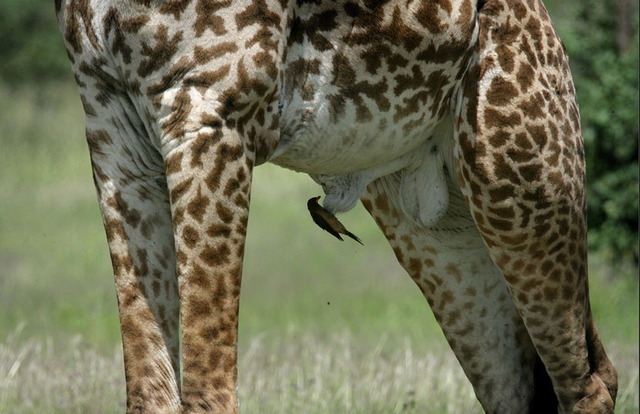
http://www.roflzoo.com/pics/072010/bird-on-a-giraffe.jpg
Birds are phallic-ly challenged and researchers want to know why
Jun 7, 2013 Geoffrey Mohan, Los Angeles Times
LOS ANGELES–Most birds lost their penises somewhere along the trail of evolution. Scientists want to know where they went.A biological program that triggers cell death is to blame, and it may offer clues about both evolution and the molecular biology behind birth defects, say researchers from the University of Florida, who published their work in Current Biology this week.
“One of the most puzzling events in evolution is the reduction and loss of the phallus in birds,” said Martin Cohn, A University of Florida biologist who studies the evolution of appendages.
“Evolution comes down to reproductive fitness,” he added. “So it’s remarkable that a group of animals would eliminate a structure that’s so important for reproduction.”
While it probably wasn’t any fun to be the first gallus born without a phallus, roosters and their undomesticated brothers have propagated quite successfully since then. Like about 97 percent of birds (roughly 10,000 species), male chickens use an opening called a cloaca for the requisite exchange of bodily fluids with the hen.
Birds from a lower position on the evolutionary tree, such as ostriches, emus and the like, have adequate apparatus for what scientists politely call “intromission,” the common way that internal fertilization takes place.
Anseriforms, or modern waterfowl, branched away but kept their protruberant phalluses, some of which are shaped like corkscrews.
But the galliform birds that perch on another branch of the evolutionary tree, such as chickens, quail and turkeys, lost their penises.
While research on animal penises gets a lot of chuckles and a fair share of derision about squandering public funds, scientists who study evolution care about the abandonment of major traits, such as bills, feathers, teeth, scales or tails. And genitalia are fast-growing organs and tend to be affected greatly by birth defects, such as hypospadias.
So the study of animal genitalia reveals something about evolutionary as well as molecular biology during a single lifespan. Understanding the switches that regulate rapid developments can lead to breakthroughs in the study of birth defects and cancer.
Researchers began with the genes known to trigger genital development in mice. They found that patterns of expression of these genes were similar in ducks and chickens, despite their differential endowment.
That led them to suspect that the genetic signal that makes cells proliferate probably was not the source of the difference. A signal inducing cell death during the embryonic stage of a chicken, however, appeared to be the cause.
They tested the patterns of cell generation and death in more “primitive” species, such as the emu. They also looked at the alligator, a nonavian that has been around a long time and also happens to be in abundance near Gainesville, Fla. It also is the UF mascot.
Their findings supported the idea that the genetic signaling that suppressed development of external genitalia was a unique development in galliforms. Finally, they blocked the expression of the cell-death gene in chicks, and were able to inhibit the cell death cycle.
And, no, they did not make chicks grow penises.
(c)2013 Los Angeles Times
Visit the Los Angeles Times at http://www.latimes.com
Distributed by MCT Information Services

http://drawception.com/pub/panels/2012/7-7/BOywkm8B1r-6.png
Read more at http://www.arcamax.com/technology/technews/s-1337862?fs#EjzhHoEGm6WD3COr.99
Filed under: birds, humor, Nae's Nest, nature, Reblogged articles, musing, photos etc, Renee Robinson, Spirituality/Reigion Tagged: evolution, Florida, Los Angelos, phallic, sex


June 8, 2013
Did Einstein believe in God?

http://www.kk.org/thetechnium//god-detail2.jpg
Jun 6, 2013 By Rabbi Marc Gellman, Tribune Media Services
Q: Among all the questions you receive about the conflict between science and religion, you seem to take the accomodationist route, insisting there is no conflict, and misquoting Albert Einstein in a way that makes him seem religious. How can you a) ignore direct conflicts between science and religion (age of the universe, first life on earth, etc.) and b) consistently distort Einstein’s pantheism and disbelief in a personal god? – N, via godsquadquestionA: I’m quite fond of quoting Einstein to make the points that one can be smart and be religious, and be a scientist and be religious. I usually choose the famous Einstein quote supposedly written in response to a letter from Gandhi that contained the query, “Dear Einstein: What do you do?” Einstein supposedly replied, “Dear Gandhi: I trace the lines that flow from God.”
I’ve also quoted Einstein’s supposed comment on the need for a Creator God in the universe: “How could so great a symphony as the universe have no conductor?” Or my absolute favorite possible-Einstein quote” “There are only two ways to live your life. One is as though nothing is a miracle. The other is as though everything is a miracle.”
I love these comments, but I try to be an honest and honorable thinker, so I also usually add that I haven’t been able to totally confirm the accuracy of these famous Einstein quotes.
Recently, a letter Einstein wrote a year before his death to philosopher Eric Gutkind was auctioned off in England that casts a shadow, as does your probing question, over my enthusiastic but possibly misguided attempts to make Einstein a proof text for a universe created and sustained by God. In that letter, he wrote:
“The word God is for me nothing more than the expression and product of human weaknesses, the Bible a collection of honorable but still primitive legends which are nevertheless pretty childish.” The letter proves that Einstein was not conventionally religious, but it doesn’t prove he was an atheist. In fact, Einstein was angered by assertions that he was an atheist. He said, “In view of such harmony in the cosmos, which I, with my limited human mind, am able to recognize, there are yet people who say there is no God. But what really makes me angry is that they quote me for the support of such views.”
In a 1940 essay on Science and Religion in the journal Nature, Einstein wrote: “Conflicts between science and religion have all sprung from fatal errors. Even though the realms of religion and science in themselves are clearly marked off from each other, there are strong reciprocal relationships and dependencies … science without religion is lame, religion without science is blind … a legitimate conflict between science and religion cannot exist.”
Following Einstein, Stephen Jay Gould, the late paleontologist, philosopher and evolutionary biologist, in a 1997 essay, called the domains of science and religion Non-Overlapping Magesteria (NOMA). Each has its own domain of human thought and problems only arise when the natural boundaries of each discipline are breached–when science tries to refute religion or when religion tries to refute science.
There are many ways to the truth, just like there are many ways up a mountain. I think Gould was less religious than Einstein, although Einstein was certainly not conventionally religious.
The religious ideas I’ve taken from Einstein (and similarly Spinoza) into my own faith are first and foremost the religious idea of awe. From Psalm 19′s powerful spiritual insight — that “The Heavens declare the glory of God.” — to Einstein’s idea of cosmic harmony, there is the foundational belief (and it is a belief, not a fact) that where there is order, there must be an Orderer.
This spiritual tenet is the foundation of all religious beliefs, but it is not the end of all religious beliefs. After the belief in the order of the universe, there is a belief in the moral order of the universe–Martin Luther King’s belief that the universe “arcs toward freedom.” It is the heroic and hopeful belief that despite the evidence of evil, goodness has an edge and has a stronger claim on our common future.
Einstein, Spinoza, Gould and you, dear reader, believe in the God of the Philosophers as opposed to the God of the Bible. I believe that both are in truth the one true God who made heaven and earth and who made us “but little lower than the angels.”
As for our Einstein debate, John Brooke, emeritus professor of science and religion at Oxford University, said of Einstein: “He was rather quirky about religion.”
I could not have said it better…or shorter!
(For more, you might want to read Max Jammer’s 1999 book, “Einstein and Religion: Physics and Theology”)
(Send QUESTIONS ONLY to The God Squad via email at godsquadquestion@aol.com.)
(c) 2013 THE GOD SQUAD DISTRIBUTED BY TRIBUNE MEDIA SERVICES, INC.
Read more at http://www.arcamax.com/religionandspirituality/godsquad/s-1336197#DCTbv0qIH1jhumQX.99
Filed under: Art, inspiration, Nae's Nest, nature, Renee Robinson, Spirituality/Reigion Tagged: Albert Einstein, auction, Gandhi, symphony, universe


Faith-healing case poses thorny legal issues

Holding hands, Catherine, left, and Herbert Schaible leave the Criminal Justice Center after a probation hearing May 6, 2013, in Philadelphia. The very religious couple, who were convicted of involuntary manslaughter in the 2009 death of their 2-year-old son because they denied him medical care, were in court because their 8-month-old son Brandon died recently under similar circumstances. (Clem Murray/Philadelphia Inquirer/MCT) Read more at
Faith-healing case poses thorny legal issues
Jun 7, 2013 Joseph A. Slobodzian, The Philadelphia Inquirer
PHILADELPHIA — Herbert and Catherine Schaible’s faith in the laws of God put them on a collision course with the laws of man when their 8-month-old son, Brandon, fell ill in April.As members of First Century Gospel Church, a Philadelphia Christian congregation that shuns medical care as an affront to God, they turned to prayer when Brandon became ill with what proved to be a fatal case of bacterial pneumonia.Prayer was what they turned to in January 2009 when their 2-year-old son, Kent, also died of bacterial pneumonia, a death that led to involuntary-manslaughter convictions, 10 years’ probation and a court order to seek medical care when their seven other children got sick.
For the Schaibles’ attorneys, prayer will have nothing to do with defending what legal experts say is one of the thorniest of murder cases.
“These are really difficult and sad cases,” said Steve Crampton, general counsel for Liberty Counsel, an Orlando, Fla.-based legal organization that focuses on religious issues.
Crampton said the Schaibles’ case “lies at the intersection of society’s right to protect the life of the child and the parents’ right to both the free exercise of their children’s religion and (control over) the upbringing of their children.”
The Schaibles are being held without bail pending a June 12 preliminary hearing. The couple’s seven children, ranging in age from about 8 to 17, were placed in foster care after Brandon’s April 18 death.
Bobby Hoof, the lawyer for Herbert Schaible, 44, declined comment. Mythri Jayaraman, attorney for Catherine Schaible, 43, could not be reached for comment. Both lawyers defended the Schaibles in the 2010 trial.
For the Schaibles and others like them, however, there is no protection when faith and law collide.
“For parents, there is no religious exemption, no absolute license that lets you do what you want in the name of religion,” Crampton said.
Donald A. Bosch knows the problems of defending a case like the Schaibles’. The Knoxville, Tenn., lawyer spent a decade representing self-proclaimed faith healer Ariel Ben Sherman, who was charged with neglect in the 2002 death of a 15-year-old girl with bone cancer.
Sherman, pastor of New Life Tabernacle in Lenoir City, Tenn., had counseled congregant Jacqueline Crank that her daughter Jessica could be cured by prayer — not medicine.
As Jessica’s condition worsened and authorities were called, Sherman and the Cranks went into hiding. By the time they were found a month later, Jessica had a basketball-size tumor on her shoulder and was near death.
Sherman and Jacqueline Crank were charged with neglect in Jessica’s death and, after a protracted journey through Tennessee courts, were found guilty and sentenced to a year’s probation for the misdemeanor conviction.
Bosch said that defending Sherman posed an unusual legal question. Jessica Crank’s father had died, but the girl and her mother lived in Sherman’s house and referred to him as her “spiritual father.”
“The issue was, what duty does someone without parental obligations to a minor child have to seek and obtain medical care?” Bosch said.
“I tried to turn the issue on its head,” Bosch said. “What criminal responsibility would (Sherman) have had if he had come in, scooped that child up, and taken her to the hospital?”
Bosch said that laws dealing with faith or prayer healing vary among the states: “Generally, the law says that there’s a duty to provide reasonable care, but that doesn’t mean you have to throw faith out the window. There’s a fine line for parents to navigate between faith and reasonable medical care.”
Jacqueline Crank is appealing her conviction in the Tennessee courts. Crank’s attorney, Gregory P. Isaacs, could not be reached for comment.
Sherman’s appeal is over, and he is now beyond the law’s reach: the 78-year-old faith healer died Nov. 28 in a South Carolina hospital where he was being treated for small-cell cancer.
The Schaibles’ biggest legal problem may be that they have been here before.
They were arrested and tried for involuntary manslaughter in the 2009 death of their son Kent. They sat in court and heard medical experts testify that had Kent been taken to a hospital, or just administered antibiotics, he likely would have survived. They heard the verdict and the judge impose 10 years’ probation and order that they get their remaining children to a doctor when they got sick.
Then, on April 18, 8-month-old Brandon died in their Rhawnhurst home, of bacterial pneumonia, without medical attention as his devout parents prayed over him.
The legal repercussions were predictable. The Schaibles were cited for violating probation. Their children were put in foster care. They were charged not with manslaughter but third-degree murder, which in Pennsylvania carries a 20- to 40-year prison term.
And Philadelphia Common Pleas Court Judge Benjamin Lerner ordered them held without bail, citing the risk that they might flee or be harbored by fellow believers.
In their favor, some experts say, is the almost universal description of them as loving, caring parents.
Temple University law professor David Kairys, a veteran criminal and civil rights lawyer, said he thought third-degree murder might still be a stretch for prosecutors.
“I don’t see how you can prove intent to kill,” Kairys said, referring to one of the components of the third-degree charge. Still, Kairys acknowledged, a jury could find them guilty of the charge under a theory of a “reckless disregard” of the consequences of their acts.
In the Schaibles’ first trial, their lawyers argued that religion was not the issue; the parents simply did not know how sick their child was.
This time around, Kairys said, religion may have to be an issue if only to show the couple’s mind-set.
“When the jurors get this case, you want a strong feeling among enough jurors that this just isn’t a crime,” Kairys added. “It’s horrible, but they didn’t intentionally kill.”
(c)2013 The Philadelphia Inquirer
Visit The Philadelphia Inquirer at http://www.philly.com
Distributed by MCT Information Services
Read more at http://www.arcamax.com/religionandspirituality/religiousnews/s-1337923?fs#FedyDjdBXMfsztVi.99
Filed under: Death, Nae's Nest, photography, Reblogged articles, musing, photos etc, Renee Robinson, Spirituality/Reigion Tagged: faith healing, First Centruy Gospel Church, Herbert and Catherine Schaible, parents accused of manslaughter of children, Philadelphia, religion shuns medical care


June 5, 2013
Article: Did Humans Really Eat Neanderthals? Charles Choi, LiveScience Contributor

http://www.sciencebuzz.org/sites/default/files/images/neanderthal%20eating.jpg
Written by: Charles Choi, LiveScience Contributor
No clear evidence suggests modern humans ate Neanderthals, much less that they did so enough to drive Neanderthals to extinction, despite recent claims from scientists in Spain.
Neanderthals were once the closest living relatives of modern humans, ranging across a vast area from Europe to western Asia and the Middle East. Their lineage went extinct about the same time modern humans expanded across the world, leading to speculation that modern humans wiped them out.
Scientists Bienvenido Martínez-Navarro and Policarp Hortolà at the Catalan Institute of Human Paleoecology and Social Evolution in Tarragona, Spain, noted the migration of modern humans across the globe may have played a role in the extinction of more than 178 of the world’s largest mammal species or megafauna, such as woolly mammoths.Homo sapiens can essentially be considered “a worldwide pest species,” they write in the May 8 issue of the journal Quaternary International. “No other species has ever developed such a killing potential.”
No evidence Humans today also hunt and eat chimpanzees, gorillas and orangutans, humans’ closest remaining living relatives, the researchers noted. As such, they suggest ancient modern humans may have killed and even devoured Neanderthals to extinction to get rid of competition. There is also fossil evidence that Neanderthals at times cannibalized other Neanderthals and ancient modern humans sometimes ate other ancient modern humans, they added.
However, there is no clear evidence that ancient modern humans ever ate Neanderthals, they noted. For instance, scientists have not discovered Neanderthal bones with cut marks on them from ancient modern human stone tools.
There is even very little evidence there was any violence between ancient modern humans and Neanderthals, “and the two or three possible examples there are are controversial and can be interpreted different ways,” paleoanthropologist Chris Stringer at the Natural History Museum in London, who did not take part in this study, told LiveScience. “I would not say this has been one of the mainstream arguments for why Neanderthals died out.”
For instance, in Shanidar Cave in Iraq, “there’s a rib wound that’s suggested to be from a spear that came from above, and spear-throwing appears to be an advance linked with modern humans,” Stringer said. “The problem is, we don’t know if there were any modern humans in the vicinity at the time, so that could’ve been produced by another Neanderthal, perhaps one standing over and thrusting downward against a victim who is on the ground.”
Human-Neanderthal contact?
Moreover, there is growing doubt there was ever much overlap between ancient modern humans and Neanderthals. For instance, recent findings suggest Neanderthals in Europe died out thousands of years earlier than before thought, perhaps never crossing paths with modern humans there.
“Even if Neanderthals and modern humans overlapped in terms of territory, they may not have contacted each other that much,” Stringer said. “When modern humans came out of Africa, they did so in quite small groups, and they were spread out.”
Recent genetic evidence suggests there was some interbreeding between ancient modern humans and Neanderthals, confirming there was at least some contact. “However, while such interactions could’ve been violent encounters, they could also have been peaceful as well,” Stringer said. “We don’t know for sure.” [Fight, Fight, Fight: The History of Human Aggression]
When ancient modern humans encountered Neanderthals, “it may have been near the end of their time,” Stringer said. “They were rather thin on the ground by then — the level of genetic diversity we see in Neanderthals suggests their population size from Spain to Siberia was at most 20,000 people, which by modern standards would make them an endangered species, really.”
“In my view of the Neanderthal disappearance, we don’t need to invoke violent causes for their demise,” Stringer said. “There are already two main factors they had to contend with.”
The first factor is very rapid climate change.
“Most of the north Atlantic was switching from bitterly cold to nearly as warm as the present day every few thousand years, sometimes in less than a decade, and so Neanderthals had to deal with an extremely unstable climate in western Europe before modern humans arrived there,” Stringer said.
Second, Neanderthals had to compete for resources with modern humans.
“Modern humans were hunting the same animals and wanting to live in the best real estate. You don’t have to kill off other species intentionally — just take over their environments, take away their food, and they die without lethal warfare.”
There might have been some violent encounters between ancient modern human and Neanderthal groups, or within those groups — “that’s human nature, and has happened throughout history,” Stringer added. “But the evidence is pretty thin that violence was a major mechanism for their disappearance.”
Find out more about this article and others at: http://www.livescience.com/37130-did-humans-eat-neanderthals.html?cmpid=527235
Filed under: Art, Nae's Nest, nature, photography, Reblogged articles, musing, photos etc, Renee Robinson, wildlife Tagged: ancient modern man, cannibalism, LiveScience.com, Neanderthals, Paleoecology, social Evolution


New Evidence of Symbolic Thought in Neanderthals
 Reblogged from The Cultural Niche:

It is a good week for defenders of the Neanderthals—a species long maligned for having fallen short of human thought, and as a consequence, having lost the competition between our species. While I don't necessarily assert that Neanderthals did have similar cognitive abilities to their Homo sapiens kin, the arguments against that possibility have always struck me as shallow. For decades, anthropologists have argued that the gap between the rich array of human artifacts to the sparser array of those of the Neanderthals—specifically those artifacts which have no discernible utility that are traditionally interpreted as symbolic—has shown that the Neanderthals did not have the propensity for symbolic thought, language, or complex cumulative culture.
I came across this while researching for another article. It caught my attention, as did the entire blog. I thought I'd pass the article (and blog) along. I encourage you to read and follow too! Happy Reading.
Lover’s Suicide

https://fbcdn-sphotos-a-a.akamaihd.net
Snuffing out the eternal flame
Allowing fear to guide
No confidence in yourself
Preferring to run and hide
Wax trails forming
Tears burned in time
The light will burn out
Never again will it shine
It is not an easy path
Twin flames are rare
The flame will go out
If not accepted with care
Never to touch
Only to burn
Souls ripped apart
Hearts that yearn
True happiness rejected
Foolishly denied
Punishing yourself
Lover’s suicide
Always a connection
Forever friends
A light still shines
Hands extend
Fingertips touch
Hearts shutter in pain
We share a soul
But destroyed the flame
Renee Robinson
Filed under: Art, by Renee Robinson, Cheating/breaking up poetry, My Poetry, Nae's Nest, Spirituality/Reigion, Surrealism Tagged: breaking up, candlewax, eternal flame, soulmates, spirituality, twin flame 

Forbidden

http://www.writerscafe.org/uploads/stories
The story that cannot be told
Forbidden and must not unfold
A curtain that never goes up
In a play that never happened
A real love playing make-believe
Trying to pretend never conceived
How does one turn off the heart
Condemned to living apart
Pretending we do not grieve
Fake happiness achieved
Acting skills finely hued
Color of deceit is in tune
Star part is my role
Award winning play
Never to be told
My soul
You shall never hold
Our story never
To unfold
Renee Robinson
Filed under: Art, by Renee Robinson, Cheating/breaking up poetry, My Poetry, Nae's Nest, photography Tagged: breaking up, condemned, forbidden love, romance, twin flame


Go Away

http://m5.paperblog.com/i/52/527450/dear-clark-i-cant-be-with-my-twin-flame-part–L-5rgPzr.jpeg
Go Away
I want to sit in your lap
To feel your arms around me
Keeping me here
Safe and within reach
I do not wish
To open that door
What lays behind it
I care no more
I do not want to go
I tie myself down
Wrapped around you
Refusing to go
My feet planted
Rooted to the ground
I will not go
I will not be moved around
Go away
I am not ready
Death, knock on another door
I refuse to go
Forever More
Renee Robinson
Filed under: Art, birds, by Renee Robinson,