
Renee Robinson's Blog, page 26
June 17, 2013
Beautiful Pets and Their Dilemmas

Dog survives four days trapped under boat
Jun 17, 2013
FAIRBANKS, Alaska (UPI) — An Alaska man whose boat overturned while he was out with two friends and a dog said the canine survived under the vessel for four days.
Jeremy McDonald, 34, said the boat overturned May 26 while he was out with his friends, brothers John and Billy Minerva, ages 35 and 25, and John Minerva’s girlfriend’s 30-pound Labrador retriever and terrier mix, Cutie, were out on the Chena River, the Fairbanks News-Miner reported Thursday.
McDonald and the Minerva brothers were able to make it to shore, but they were unable to find Cutie despite hours of searching.
McDonald said he was able to reach the damaged boat May 30 and Cutie revealed herself, alive and still wearing her canine flotation device, when a retrieval crew righted the vessel.
“I was pretty sure we were going to go there and find a dead dog,” McDonald said. It was pretty much a miracle.
John Minerva said he and his girlfriend, Grace Sommer, were overjoyed to have the dog back. He said she is recovering from her ordeal on the river.
“She was sore for a couple of days, but other than that she was fine,” Minerva said.
Copyright 2013 by United Press International
Read more at http://www.arcamax.com/pets/catsanddogs/s-1342754#2ziglket8UCVqYdI.99
Named ‘Deucy’ Is Doing Well
A rare, two-faced kitten was born in Amity, Oregon this week. Stephanie Durkee, the owner of both the female kitten and its mother, took the two-faced cat to a vet, who say she’s in good health.
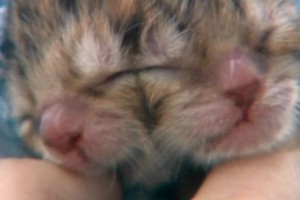
The animal, which meows loudly from both mouths, has just one body and set of organs. Owner Stephanie Durkee says she thought her children had made a mistake when they told her a cat with two heads had been born.
Durkee told Portland’s KGW-TV the kitten—named “Deucy”—has been rejected by her mother, so she’s been feeding her warmed kitten formula from a syringe.
“The kids … came in and said, ‘Mom there’s a kitty with two heads,’” Durkee told Portland’s NBC affiliate. “And I said, ‘I think you guys are just tired, you’re crazy, that doesn’t happen.’”
Durkee, who plans to keep Deucy, says the kitten was born at “6:11 a.m. on 6/11 under the ‘Gemini’ astrological sign.” Durkee said she “can’t help but wonder at the ‘double’ coincidences surrounding Deucy’s birth.”
Two-faced cats—known as Janus cats, for the two-faced Roman god who also gave us the word“January”—are unusual but not unprecedented.
Two-faced Janus kitten dies in Oregon
Jun 17, 2013
AMITY, Ore. (UPI) — An unusual two-faced kitten died Thursday two days after its birth in Amity, Ore., in spite of its owner’s regular feedings with an eyedropper.
Stephanie Durkee told KGW-TV the kitten’s mother had rejected the newborn, refusing to feed it. Durkee, who named the kitten Deucy, said its health deteriorated quickly.
The kitten, who had two healthy littermates with normal faces, suffered from a disorder known as diprosopus. Cats with the disorder are also known as Janus Cats after the two-faced Roman god Janus, who also gave his name to the month of January.
Durkee’s veterinarian told The (Portland) Oregonian most kittens born with two faces die soon after birth, although he has heard of a few surviving to be adults. One lived to be 12 years old.
Copyright 2013 by United Press International
Read more at http://www.arcamax.com/pets/catsanddogs/s-1342753#7hZeLuFufMjCcuQJ.99
[image error]
http://cutestcatpics.presscdn.com/wp-content/uploads/main/2013_03/Pampered-Cat-in-Spa.jpg
Pet Vet: Should Alfred’s wings be clipped?
Jun 12, 2013 Jeff Kahler, D.V.M., The Modesto Bee
It is common practice for people to have their bird’s wings clipped in order to prevent it from flying. Jerry wonders if that is the right thing for Alfred, his palm cockatoo.
Jerry’s major fear is that Alfred might fly out an open door into the wild blue yonder, never to be seen again.
Disabling a bird’s ability to fly can make training it a more rewarding experience, as the bird is no longer able to escape by taking flight. Birds that cannot fly are less likely to reach areas that may pose some sort of danger. Ceiling fans come to mind, along with hot cooking surfaces. But I prefer to allow my birds to fly.
Flight is an important exercise for aerobic fitness and for the development and maintenance of good muscle tone. Flight can allow a bird to avoid danger or flee from it — think four-legged pets. Obviously, this would not be a factor for all bird households. Birds can be taught to avoid things in the house while flying.
Of course, every situation is unique. Birds that are not handled and that don’t spend much, if any time, out of the cage may need to be clipped. If they were allowed to escape their enclosures, they would fly in an unfamiliar environment while experiencing some degree of panic. This is precisely why I believe it is very important to make your bird a part of your life. Play and interact with it and it will not fear flying in the house. It’s best to start doing so when birds are young, but still can be accomplished with older birds, albeit with more effort.
As for Alfred, I suspect he can be allowed to fly. From Jerry’s description, Alfred is very bonded to Jerry. I imagine he is very secure and should do quite well flying through Jerry’s house. Palm cockatoos are large birds and can knock things over with nothing more than the air movement created by their wings during flight. Jerry’s main concern that Alfred might fly out an open door and disappear would always be a potential concern of mine. I cannot advise testing that theory, but I will tell you that birds well-bonded to humans do not generally fly away, never to return.
I can attest to this from personal experience. One of my birds, Tuki, was outdoors with me on my shoulder while I was working in the yard. She was suddenly spooked by the rotating blades of my windmill and flew off into a Cypress tree, 25 feet off the ground. She was obviously scared and would not leave the tree. I climbed the tree to rescue her, and she came right to me.
I advise discussing the clipping of wings with an avian veterinarian and with other bird owners. If a decision is made to clip your bird’s feathers, make sure it is done properly. Inappropriately clipped feathers can cause problems such as bleeding from the feather shafts and poking of the body wall with the cut feather ends. This can lead to plucking behavior.
Not cutting the proper amount or proper types of feathers is another concern. This may allow the bird to fly or, worse, cause it to fall and potentially be injured.

http://static.desktopnexus.com/thumbnails/425802-bigthumbnail.jpg
=======
Jeff Kahler is a veterinarian in Modesto, Calif. Questions can be submitted to Your Pet in care of LifeStyles, The Modesto Bee, P.O. Box 5256, Modesto CA 95352.
(c)2013 The Modesto Bee (Modesto, Calif.)
Visit The Modesto Bee (Modesto, Calif.) at http://www.modbee.com
Distributed by MCT Information Services
Read more at http://www.arcamax.com/pets/catsanddogs/s-1340547#9PyKTAHBfffZDTZG.99

https://www.google.com swww.johnlund.com
Filed under: Awards, birds, by Renee Robinson, domestic animals, humor, Nae's Nest, nature, News Article, photography Tagged: cats, clipped wings, dogs, drowning dog, parrots, pet birds








June 16, 2013
Contributer, by Nicole Ciacchella
Contributor, by Nicole Ciacchella, is a well-thought, post-apostolic story. In some ways, I am reminded of George Orwell 1984 with “Big Brother” being the “Creators” in this not extremely far-fetched story. It does show how minds can subtly be controlled with the power of suggestion, repetition, education (or censorship) and even reward.
In this story a young lady named Dara matures a great deal over a period of just a few months as she competes for a cherished position as Assistant to Head of Engineering. Dara is a trusting soul who has faith in mankind until competing for this job began. Soon she finds herself mistrusting and questioning nearly all she is in contact with. Her world inside the “dome” begins to turn upside-down with the realization that the very company who provides everything necessary for the survival of all within can so easily toss you away as if all of your contribution meant nothing.
Personally,I enjoy stories such as these as I find them thought provoking and good reminders of our not so distant past history and how dangerous this type of mindset can be. Contributor is a good thought provoking read which I recommend.
Renee Robinson, Author of Shadows of The Heart
http://naesnest.wix.com/phoenixwriter

Filed under: by Renee Robinson, inspiration, Nae's Nest Tagged: 1984 classic, george orwell, Nicole Ciacchella, post-apocalyptic, Shadows of The Heart







Review Swap
Hello to all of you. Like many of you, I am in need of book reviews. I have 6 poetry books, with a couple of novels to be released soon. I need reviews for all of my poetry books.
I would like to offer a review swap to any of you who may also be in need of reviews, or otherwise interested in my proposal.
I will, of course, send you free copies of whichever books you would like to review.
If anyone is interested, please email. Good luck.
http://naesnest.wix.com/phoenixwriter
Keep an eye out for my soon to be released books below. Be the one of the first to read! Anyone who is reading this that would like to read and review one of my books, please let me know. I will get a complimentary copy to you. xxoxx Nae
Filed under: Art, by Renee Robinson,






June 15, 2013
What is Astrology?

http://behance.vo.llnwd.net/profiles
What is Astrology?
So, what is astrology exactly? Everybody’s heard of it. Just take a look in any popular newspaper or magazine and you will certainly find some sort of “horoscope” within its pages. For serious people, it is almost considered indecent to have any interest in astrology. That kind of stuff is for non-educated and superstitious people who are ready to believe in just about anything.
Sounds familiar, doesn’t it? This sort of opinion is very common in our pragmatic times. But how it could be then that the greatest minds of the past, whose findings, ideas, and illuminations make the foundations of contemporary science, were actually devoted astrologers? They used astrology in their research and many of them have written the whole books on astrology. It would be impossible to list them all because before the 17th century astrology was an inseparable part of higher education. However, here is a sampling of a few:
The Prominent Astrologers of the Past
Ptolemy (2nd century AD) was one of the founders of both astronomy and astrology. Ptolemy is honored by astronomers for many different things, but he is also the author of Tetrabiblos, the first comprehensive astrology manual.
Al Biruni (10th – 11th centuries) created a number of works devoted to medicine, geography, physics, and astronomy, but he is also the author of the “Book of Instruction in the Elements of the Art of Astrology”, which is basically a thorough astrological tutorial.
Paracelsus (15th – 16th centuries) was a legendary healer who considered astrology an important part of his art. He wrote that a doctor who doesn’t know astrology is a “pseudo-medic” and that the remedy is found in the sky.
Tycho Brahe (16th century) was hailed as “the King of astronomers”, while simultaneously working as an astrologer and an alchemist. Brahe was able to reach the highest precision in astronomical measurements, but also spent time writing astrological almanacs for the King of Denmark, as well as interpreting the natal charts of his children.
Johannes Kepler (16th – 17th centuries) was a great astronomer whose laws are now used to calculate the orbits of spaceships. In his first astrological almanac, Kepler predicted an exceptionally cold winter and an invasion of Turks into Austria. When everything happened exactly as he predicted, he became known as a prophet. He criticized the vulgar astrology, similar to the kind we can read now in newspapers and magazines, but added new elements to the theory of true astrology.
Karl Gustav Jung (19th – 20th centuries) was a famous psychologist and psychiatrist who seriously studied astrology and used it in his work. One of his astrological experiments became widely known.
Not a bad collection of minds, right? Who would dare to say that these people were incompetent and superstitious? So, perhaps there is something more to this astrology business over and above the ubiquitous magazine “horoscopes”.
Astrology as an Applied Philosophy
That which is below is like that which is above that which is above is like that which is below to do the miracles of one only thing.
Emerald Tablet by Hermes Trismegistus (Isaac Newton’s translation)
The words quoted above came to us from an unimaginable antiquity containing the source, the essence, and the aim of astrology all at the same time. The abbreviated version is used more frequently: As above, so below. One way to understand this is to realize that it is referring to the unity and mutual reflection between the macrocosm, the universe, on one side, and the microcosm on the other side. Microcosm here can be interpreted in a number of different ways: it can refer to a person with his or her unique life; a state, a society, or a factory; basically any integral system of our world — they are all different projections of the same macrocosm.
Such a global worldview is good for philosophy that describes all things in general and doesn’t delve into the nitty-gritty of everyday life. This is where astrology is unique: it projects philosophical concepts onto our lives, daily chores, health issues, relationships, onto the processes going on in human society, onto weather, earthquakes, floods, and so much more. The areas of application for astrology are numerous.
Astrologers of the past considered astrology to be an art, but it also has many mathematical and technical elements that do not fit our contemporary understanding of art. Many contemporary astrologers strive to prove that astrology is a science — and it was indeed one of the three Great Sciences of antiquity — however, astrology will never conform to the Procrustean bed of the contemporary view of what a science entails.
In my understanding, astrology can be defined in a most comprehensible way as an applied philosophy. Astrology offers a special, cosmic perspective of the events happening in our lives. It gives the events an orderliness, and because of this, it can help us to find a solution for a predicament, or — since astrology provides an understanding of the moving forces behind events — to make a prognosis.
Traditional astrology has a number of branches, of which the main ones are discussed in the next section.
The Main Branches of Astrology
Traditional Astrology has three main branches:
Natal Astrology deals with human life on the level of individuals and its main tool is a person’s birth chart (aka, natal chart, or the horoscope of birth). These refer to a map of the sky drawn for the moment of a person’s birth as viewed from the birthplace. This branch also contains synastry, or the astrology of relationships, as well as astrological healing.
Mundane Astrology studies the life of large communities of people such as cities, countries, and nations, as well as the world as a whole. In this branch, we are often unable to establish the moment of birth of such an entity. After all, when exactly is a city born? Therefore, some special varieties of astrological charts are used. This branch also contains political astrology, astro meteorology, financial astrology, and astrology of business, as well as the smaller branches that study various cataclysms such as earthquakes, floods, volcanic eruptions, etc.
Judicial Astrology was almost forgotten by the 20th century and only relatively recently was it reborn. This is a mysterious branch, which is as far from science as it can be, and is very close to the ancient magic. The best-known disciplines included in judicial astrology are hoary astrology, where a chart is cast for the moment when a question was asked, and elective astrology, which teaches how to select the best possible moment for various humane initiatives.
The Horoscope, aka the Natal Chart
All these branches and disciplines share a common tool,the Horoscope. A horoscope is a schematic picture, or map, of the sky at a specific moment of time as viewed from a specific location on the Earth. Some examples include: horoscopes of birth, which are calculated for the moment of people’s births and for their birth places; horoscopes of important events; or horoscopes of the equinoxes (vernal or autumnal) calculated for specific locations.
This is exactly where “what is above” joins with “what is below”: the map that depicts the state of the universe is used to understand a human being, or some other microcosm.
The word horoscope was used, and used properly, for many centuries, if not thousands of years. Nowadays, however, it is so often and widely misused by applying it to just any kind of astrological and pseudo-astrological writing that Western astrologers rarely use it. Instead, the word chart is used: a natal chart, a chart of a nation, a chart of a Vernal Equinox and so on. I will be using both terms interchangeably so that readers can begin to have a clear understanding of where the word “horoscope” truly belongs.
Author & Source unknown
Filed under: Art, Nae's Nest, nature, Reblogged articles, musing, photos etc, Spirituality/Reigion, Surrealism Tagged: astrology, astronomy, horoscope, Isaac Newton, philosophy


Grains of Life

The hourglass, the shape of a woman, woman gives birth, another grain added
To the hourglass
Stars sparkle in the sky, the galaxy, the planets-sun-moon all evolving, all glowing,
Life sparkles in the sky
LIFE
I am a grain of sand
Among all of you
Grains of life
In the hourglass of time
One grain full, an entire lifetime
Life will shine
It will sparkle
One day that grain drops through the hourglass
Life on earth is over
It is drawn through the hourglass and into the sky
It sparkles
Another star is falling, it is snuffed out
It is pulled down into the hourglass to evolve again
A new life, on earth
It sparkles
The cycle of life, no real beginnings, no real endings
Infinity Recycled
Life doesn’t end, it evolves, it changes, it circles
It Sparkles

http://designquickpoint.files.wordpress.com
Filed under: Art, birds, by Renee Robinson, Death, inspiration, My Poetry, Nae's Nest, nature, photography, Spirituality/Reigion, Surrealism Tagged: earth, evolution, father time, hourglass, infinity, recycle


A Whisper in The Wind

http://bp2.blogger.com/girl-fantasy-wallpapers.jpg
I am only a breath away
A whisper in the wind
I am a part of your soul
I am your twin
Beauty is all around
We see it everyday
Your sight has grown blind
To beauty seen, day by day
Hearts grow cold
When vision grows blind
Life taken for granted
Another tick in time
Loss of vision
A heart of stone
Cultivate life without passion
No room for love
A cold heart in black fashion
No room for joy
But
I am only a breath away
A whisper in the wind
I am a part of your soul
I am your twin
Call out my name
Open your eyes
Reach through the mirror
Reset your time
We make our happiness
We make our sorrow
Eyes must be kept open
Seeing beauty everyday
Matters of the heart
Can be washed away
Your soul can be saved
I carry it with me
I watch over and protect
You are the same as me
A whisper in the wind
Only a breath away
Filed under: Art, inspiration, love poems/songs, My Poetry, Nae's Nest, nature, Spirituality/Reigion Tagged: a breath away, a tick in time, black fashion, guardian angels, whisper


June 14, 2013
Cute and Colorful Frog Images
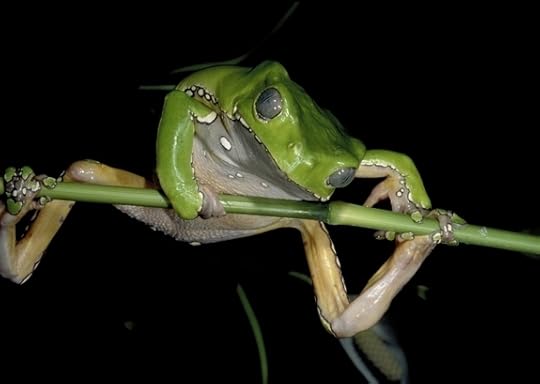
Giant Monkey FrogCredit: © Dave Northcott, Clyde Peeling’s ReptilandGiant monkey frogs are found in the Peruvian and Brazilian Amazon. Males call from high above the ground and descend to branches just above ponds to mate. The call is a loud “cluck” followed by several short, lower-pitched notes.
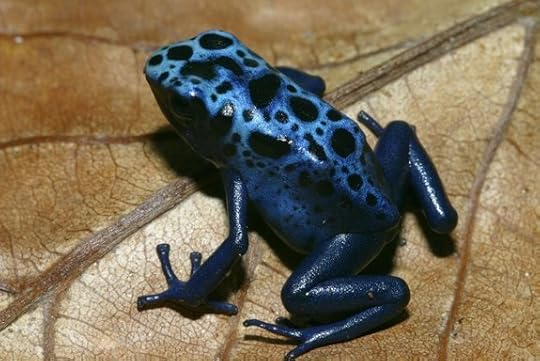
Blue Dart Poison FrogCredit: © T. Grant/AMNHBlue dart poison frogs grow to approximately one inch in length. They are active during the day and can be found hiding among boulders and debris near streams; however, they lack toe webbing and are poor swimmers, so they are rarely found in the water.


Tomato FrogCredit: © Bill Love, Clyde Peeling’s ReptilandTomato frogs are native to the lowlands of Madagascar. Brightly colored frogs are popular with pet owners and collectors. While many frogs are bred in captivity, over-collection of wild frogs is still a major problem. Frogs that live on islands or in small populations are most at risk. Tomato frogs have been given priority protection by international law.
American BullfrogCredit: © Joe McDonald, Clyde Peeling’s ReptilandMore than a century ago, American bullfrogs were introduced into the western United States in the hope that they could be farmed for food. Although the farming efforts failed, the bullfrog adapted to man-made ponds and waterways and is now a threat to native species of fish, snakes, birds, and other frogs—some of them endangered.
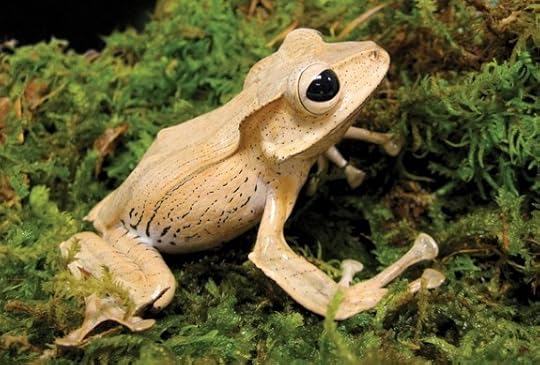
Borneo Eared FrogCredit: © Joe McDonald, Clyde Peeling’s ReptilandBorneo eared frogs are indigenous to Borneo,Sumatra, and other Indonesian islands. Females lay eggs in foam nests attached to branches overhanging the water. They create the nests by beating a frothy secretion into foam with their hind legs
Tanya Lewis, LiveScience Staff Writer
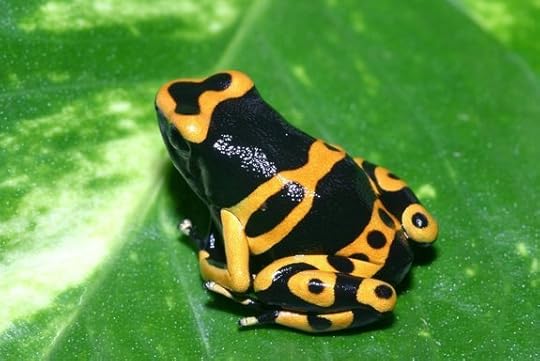
Bumblebee Dart Poison FrogCredit: © T. Grant/AMNHA new exhibit featuring live frogs from all over the world is opening at the American Museum of Natural History in New York Saturday (May 17) and runs through January 5, 2014. The exhibition, entitled “Frogs: A Chorus of Colors,” contains more than 150 live frogs from about 25 species. Above: Bumblebee dart poison frogs are also known as yellow-banded poison frogs. Their bright colors serve as warning labels forpredators, distinguishing them as a poisonous meal.
Some of nature’s most fascinating fathers may be at risk of extinction.
Male Darwin’s frogs swallow their offspring in the tadpole stage, incubate their young in their vocal sacs, and eventually spit out fully developed froglets. Along with seahorses, the frogs are thought to be the only known living vertebrates in which dads take on baby-carrying duties with special sacs that make them look pregnant.
But new research shows that these unique creatures may be vanishing as their habitats in Chile’s temperate forests are destroyed
Charles Darwin first discovered the frogs while traveling in Chile in 1834. Scientists who later studied the mouth-brooding animals found that there are actually two species, naming one Rhinoderma darwinii (Darwin’s frog) and the other Rhinoderma rufum (Chile Darwin’s frog).
From 2008 to 2012, a team of researchers led by zoologist Claudio Soto-Azat surveyed 223 sites in the frogs’ historical range, from the coastal city of Valparaíso south to an area just beyond Chiloé Island. R. rufum has not been seen in the wild since 1980, and despite the recent extensive search effort across every recorded location of the species, no individuals were seen or heard during the four-year survey, the researchers said. R. darwinii, meanwhile, was found in 36 sites, but only in fragmented and small populations, each with likely less than 100 individuals.
The findings suggest Darwin’s frogs have disappeared from, or at least rapidly declined in, many locations where they were recently abundant, the researchers wrote in a paper published online June 12 in the journal PLOS ONE. Habitat loss and fragmentation may be the culprits.
Changing forests
Native forests are being rapidly destroyed in Chile to make way for pine and eucalypt plantations, which supply the wood and paper industry. These landscape changes can have drastic effects on air temperature, wind speed, soil erosion and humidity, researchers say. And Darwin’s frogs don’t seem to be adapting; the survey showed that the remaining populations were clinging to their shrinking native forests.
The researchers recommended that Darwin’s frogs be listed as endangered by theInternational Union for Conservation of Nature (IUCN). The species is currently listed as vulnerable. Chile Darwin’s frogs, meanwhile, should get a “possibly extinct” tag, the researchers said.
Other factors could be contributing to the decline of Darwin’s frog. Their populations have taken a hit from volcanic eruptions in the southern Andes, the researchers say. What’s more the African clawed frog was introduced to Chile in the 1970s. That species has been associated with the deadly fungal infection chytridiomycosis, which has wiped out amphibian species across the globe. It’s not clear if Darwin’s frogs have been affected by the fungus in the wild, but the researchers say it’s worth investigating.
Extinct Aussie cousins
 Gastric brooding frogs come in two species: Rheobatrachus vitellinus and R. silus (pictured above and last seen in 1985). These frogs had a unique mode of reproduction: The female swallowed fertilized eggs, turned its stomach into a uterus and gave birth to froglets through the mouth. Timber harvesting and the chytrid fungus are the main suspects behind their extinction.
CREDIT: Mike Taylor/Conservation International
View full size image
Darwin’s frogs once had a close analog in eastern Australia, known as gastric brooding frogs. Female gastric brooding frogs swallowed their fertilized eggs, transformed their stomach into a uterus and gave birth to their sons and daughters through the mouth. There were only two known species and both went extinct by the mid-1980s, likely due to timber harvesting and the chytrid fungus.
“Their phenomenal reproductive strategy disappeared over twenty years ago with the extinction of both species and may never evolve again,” the authors of the new study wrote.
While that amazing ability may never evolve again, one group of scientists thinks it could be resurrected.
Earlier this year, scientists from the University of New South Wales announced that they had created early-stage embryos of gastric brooding frogs that were already forming hundreds of cells. The team said they used cloning methods to implant the DNA-storing nuclei of preserved gastric brooding frog cells in the eggs of Australian marsh frog eggs.
Amphibians are on the decline worldwide. Besides being at risk of deadly fungal infections, frogs, salamanders and their relatives are more vulnerable to environmental changesbecause they have permeable skin and a complex water-and-land life cycle. In a recent report on the sharp decline of the creatures in the United States, researchers found that amphibians have been disappearing from their habits at a rate of 3.7 percent each year.
Follow Megan Gannon on Twitter and Google+. Follow us @livescience , Facebook & Google+ . Original article on LiveScience.com .
Filed under: amphibians, Death, Nae's Nest, nature, News Article, photography, Renee Robinson, wildlife Tagged: american bullfrog, Darwin, endangered animals, extinction, frog daddy, poison dart frog


Find Your Way

http://www.poetrybyjohnpegg.co.
There is a hand
Always ready to reach out
To help you along
You must have no doubt
When times are trying
Find yourself overwhelmed
Gaze through portal
Look upon the other-side
A river so clean and cool awaits
It heals all pain away
It smooths all signs of age
Brings back yesterdays
To sleep on a cloud, like so often in my dreams
Can you imagine that?
It is exactly what it seems
Soft and billowy
With views of every dimension
Each one with its own beauty
Just follow the light for guidance
You will find your way
Filed under: Art, by Renee Robinson,

June 13, 2013
Making Babies After Death

Bahar Gholipour, LiveScience Staff Writer
Is it ethical to use a dead man’s sperm to father a child? Experts are calling for a consensus on policies surrounding this question, which currently vary widely across the country.
It has been possible for a few decades to obtain a man’s sperm after his death and use it to fertilize an egg. Today, requests for postmortem sperm retrieval (PMSR) are growing, yet the United States has no guidelines governing the retrieval of sperm from deceased men, said Dr. Larry Lipshultz, a urologist at Baylor College of Medicine in Texas.
In the absence of government regulations, medical institutions should come up with their own rules so they can handle the time-sensitive and ethically questionable procedures, Lipshultz argued in an editorial published June 5 in the journal Fertility and Sterilit
Requests for PMSR can come from the wife or parents of a young man who suddenly died in an accident before having a chance to leave a child, and requests can also come from living, terminally ill men who wish to preserve sperm to be used after death.
But the institutions trying to draft a protocol for these situations face a number of ethical concerns. For example, has the deceased consented to have his sperm used for reproduction after he’s gone? Could just anybody request to obtain his sperm? Is it in the best interest of the child to be brought into the world without having a father?
What everyone seems to agree on is that the man’s wishes should be clear. “The core principle is not to reproduce anyone without their permission,” said Arthur Caplan,head of the division of medical ethics at NYU Langone Medical Center in New York. (He was not involved in the editorial published in Fertility and Sterility).
Some institutions follow this principle strictly, and require written, informed consent from the deceased before they will retrieve sperm cells. However, many of the requests come in cases in which a man died unexpectedly, without ever having thought about giving explicit consent.
In the absence of written consent, some institutions may still honor the request if there is evidence that sperm retrieval may have been the wish of the deceased. For example, if a couple had been trying to conceive or had talked about it with friends and family, it can imply consent, Lipshultz told LiveScience.
Lipshultz and his colleagues recently published a study suggesting that, despite common assumptions, most men would agree to reproduce after death. The study found that 85 percent of men visiting a sperm bank provided consent for postmortem sperm use. Men in relationships, and those who were already fathers, were more likely to consent to postmortem use, according to the findings.
Another issue that must be considered in PMSR requests is the motivation of the requesting party. Experts say the grieving family members may not be able to make rational decisions under the circumstances. This has led the experts to recommend a mandatory waiting time of a few months to one year before using the retrieved sperm for conception, Lipshultz said.
Caplan noted that there are also ethical concerns that come with denying a request for PMSR. For example, “it would be limiting family wishes to continue their lineage, and the concern that outsiders should not determine who can reproduce,” he said.
PMSR is currently illegal in France, Germany, Sweden and other countries, even with written consent from the deceased. In the United Kingdom, it can be done if there is written consent, and in Israel, the sperm can be retrieved, but then a judge has to decide whether it can be used.
In the United States, some requests for sperm retrieval have been approved under the rules that govern organ donation. The Universal Anatomical Gift Act of 2006 allowed next of kin to consent to the retrieval of organs and tissues unless there is evidence that the deceased would not have consented. In 2006, a judge ruled that the anatomical gift, including the gift of sperm, can be retrieved at the consent of the donor’s parents, as long as the donor did not explicitly refuse to donate.
In a new analysis of nine American institutions that do have guidelines for PMSR, researchers at Stanford University identified elements of a working protocol that other institutions could use to devise their own guidelines. These elements aim to standardize issues such as what constitutes evidence of consent, and who is eligible to make the request. The article will be published in an upcoming issue of the journal Fertility and Sterility.
In the Stanford study, 60 percent of institutions that the researchers contacted said they did not have a PMSR protocol. Lipshultz said this shows that, nationally, institutions that may be called on to retrieve sperm from deceased men may be vulnerable to liability.
Researchers say that regardless of the details of any protocol, the ultimate goal is to establish policies that respect the wishes of the deceased and that are in the best interest of the family and the future child.
Email Bahar Gholipour or follow her @alterwired . Follow LiveScience @livescience, Facebook &Google+. Original article on LiveScience.com.
Filed under: Art, birds, Death, Nae's Nest, nature, Spirituality/Reigion Tagged: ethical, fatherhood after death, Is it ethical to use a dead man's sperm to father a child?, LiveScience.com, sperm donor, stork


June 12, 2013
It’s Official: B&N Has Ended Support for Nook PC, Mac Apps June 11th, 2013 by Nate Hoffelder
A little over a month ago Barnes & Noble quietly removed any mention of their Nook for PC and Nook for Mac apps, and today they confirmed to me that the apps are no longer being supported.
When my competition reported several days agothat B&N had quietly removed any mention of the Nook for PC, Mac apps from the B&N website, I was one of many that were puzzled by this inexplicable move. This story has already gotten some coverage in the blogosphere, but I held off in the hopes that this was an error of some kind. Unfortunately that is not the case.
It seemed to make little sense for B&N to remove the apps without providing a true replacement. But as unlikely as it might sound, that is exactly what has happened.
Earlier today I received an email from B&N which confirms that both apps have been retired:
We are no longer supporting NOOK for PC for Windows 2000/XP/Vista. To enjoy the NOOK content on your PC please use the NOOK for Windows 8 App or NOOK for Web. http://www.barnesandnoble.com/u/nook-for-web/379003594/
B&N sent me the same statement concerning the Nook for Mac app, but I don’t see a need to repeat it here.
TBH it should really come as no surprise. B&N stopped updating the PC app in November 2011 and the Mac app in March 2012 (according to the Wayback Machine at Archive.org).
That is over a year ago, meaning that the Mac app was already deadlined due to a lack of support for OSX 10.8 Mountain Lion. Also, there were no signs that either app supported all the content currently sold in the Nook Store. This now includes fixed layout ebooks (graphic novels, cookbooks, and other rich content), interactive children’s books, and more. Basically the apps had already been abandoned long before they were removed from the B&N website.
But even with the knowledge that B&N had given up on the apps long ago, IMO this move is still a poor choice. Readers might be able to use Nook for Web but they won’t be able to access all of their content. I just checked my Nook account and the majority of the ebooks I got from B&N are not compatible with Nook for Web. Of the first 120 titles listed in my account, a mere 32 could be read online.
Thrty-Two
I am lucky that I have alternate Nook apps and a Nook HD-, otherwise I would might lost access to something like 75% of the Nook ebooks I own (assuming I were dependent on the Windows app). Or at least it could cost me access to my purchased ebooks, and that brings me to B&N’s other example of mismanagement.
You see, B&N goofed a second time in that they forgot to recommend their other reading app for OSX and Windows. It’s called NookStudy, and it was launched in Summer 2010. NookStudy is more of a textbook app that a general purpose reading app, but it still reads all my Nook content and it is still available for OSX and Windows. At the very least it deserved a mention.
Update: A reader has told me that B&N has retired the support forums for NookStudy. That could be a sign that B&N is planning to get rid of that program as well. (Thanks, Tim!)
All in all, the manner in which B&N retired the Nook for PC and Nook for Mac app suggests that B&N doesn’t care much about ebooks any more. They’re not investing in the apps, they didn’t make any effort to make sure the content is compatible with the replacement, and they didn’t think to offer their other reading app for Windows and OSX.
At this point I am really hoping that the Microsoft buyout rumor is true, because B&N is cutting their losses. It looks to me like they are giving up, so I really really really hope that a white knight appears to rescue the Nook platform before B&N shuts it down completely.
Filed under: Nae's Nest, Reblogged articles, musing, photos etc, Renee Robinson Tagged: Barnes & Noble, ereaders, nook, self-publishing, Windows 8





![[image error]](http://cutestcatpics.presscdn.com/wp-content/uploads/main/2013_03/Pampered-Cat-in-Spa.jpg)
