
Brian Fies's Blog, page 54
May 27, 2015
The Last "Last Mechanical Monster"
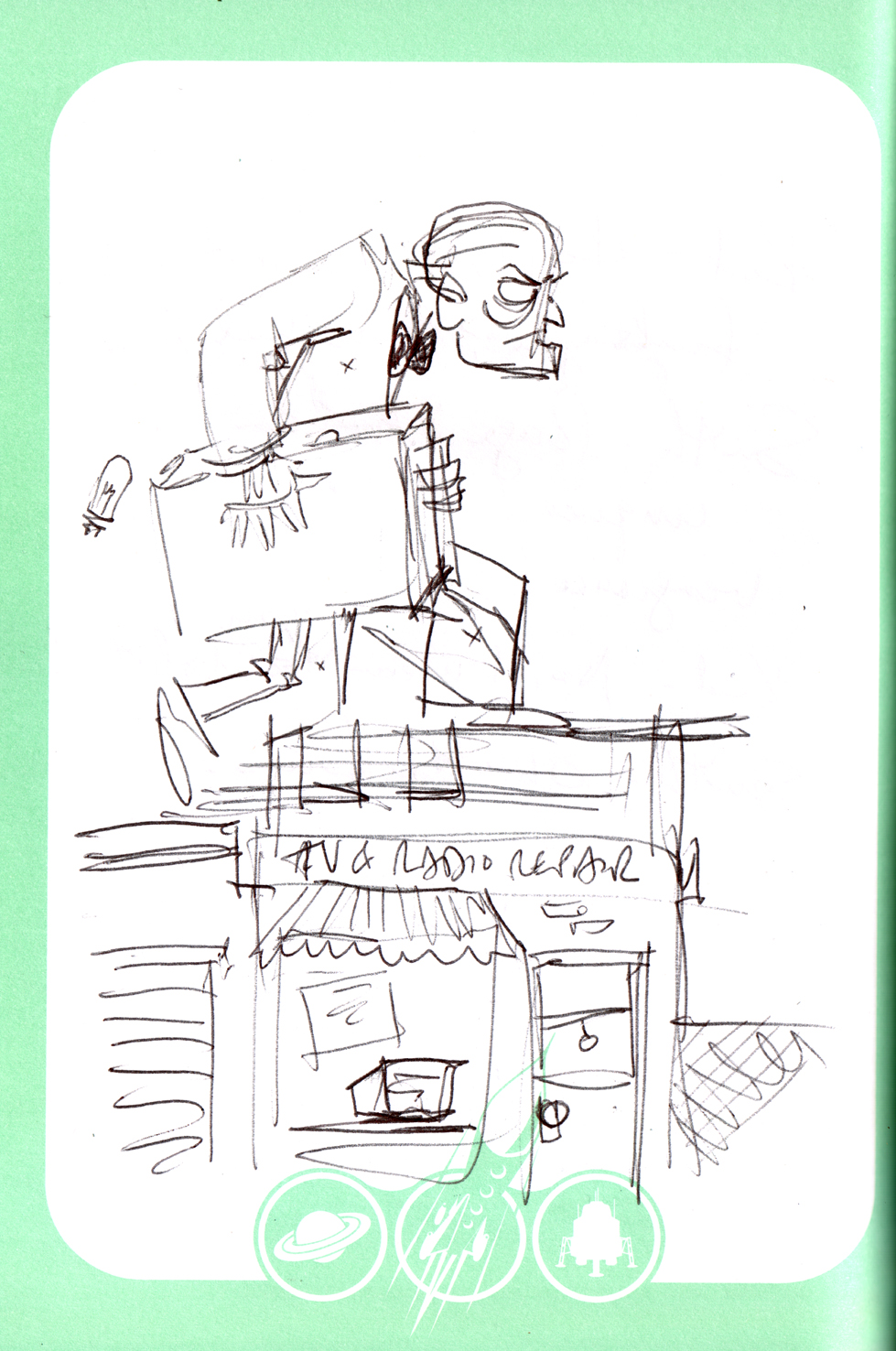 An early sketch of the Inventor toting his box of old vacuum tubes to Lillian's repair shop.
I kept a notebook by my bed to capture ideas that came as I woke up. This was one.
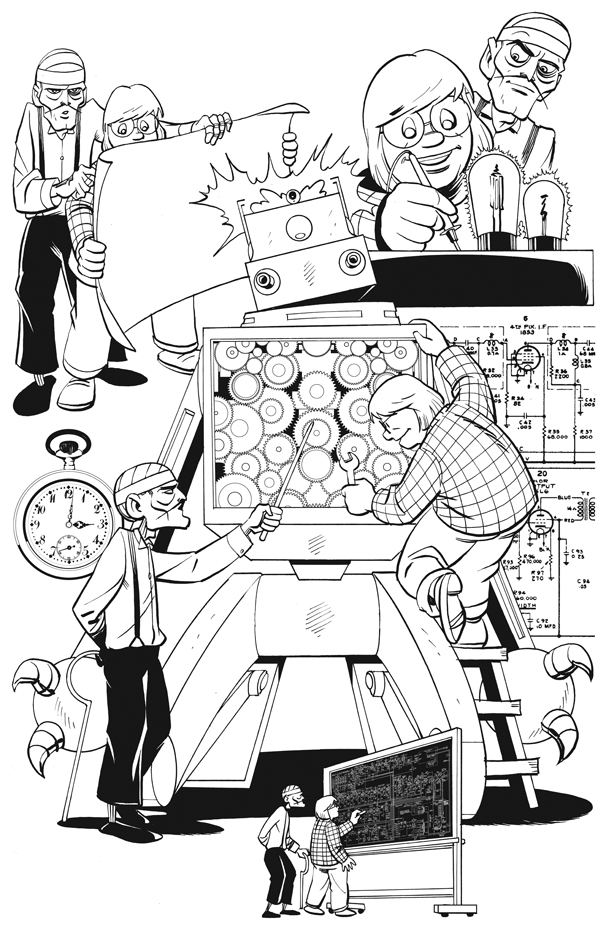
Yesterday I posted the final page of my Last Mechanical Monster webcomic. I published two per week since November 2013 and am proud to say that in 170 pages I never missed a deadline.
However, I confess that the four-month backlog I began with evaporated to about two weeks' lead time at one point, until I fought back to being about a month ahead by the end. If I had advice for potential webcomic creators that'd be near the top: don't even start posting until you've got a big cushion built up, then don't let it slip away. One of the points of doing a webcomic is practicing professionalism. Pros hit deadlines.
I won't repeat what I wrote over at my webcomic's "Coda," which you can go read if you're interested. I will say that it's been an interesting, gratifying experience. The Last Mechanical Monster developed a nice little fan base that grew over time, as I'd hoped. A few noteworthy mentions on other sites brought surges of curious readers for a couple of days, some of whom seemed to stick around. Nothing spun the ol' visitor counter faster than a mention on Metafilter following the announcement of our Eisner Award nomination in April. Not even close. At times like that you really get a visceral, almost scary feel for the power of the Internet when roused from its slumber to focus its gaze on you.
 It's like this.
The Last Mechanical Monster was a story I wanted to tell, struggled a few years figuring out how to tell (you may recall my tale about drawing 110 pages of it before deciding I didn't like that version and starting over from scratch), and then sat down and did it. Sitting down and doing it is where a lot of creative people get hung up, but there's no short cut or substitute. Ideas and good intentions are useless if you don't execute. One day you've got to turn a blank sheet of paper into Page 1. That's very hard to do!
It's been great. Meanwhile, I'm knee-deep in a new project I've never discussed publicly, but which my editor and I think would make a terrific book. More on that when appropriate. I've got one or two other potential projects lined up behind that one. There's also a possibility that The Last Mechanical Monster will be published in full color, but no contracts have been signed so that's all I can say about that. Too many ideas, not enough time.
Thanks to my Last Mechanical Monster readers. Thanks to two different panels of Eisner Award judges who thought it worth nominating for Best Digital Comic two years in a row. Thanks to the folks who reviewed, mentioned, or linked to my comic, it made a big difference. From my perspective the whole project couldn't have gone better, and I appreciate it.


May 25, 2015
A Fair Plate
Readers of Whatever Happen to the World of Tomorrow may recall that I began the book with the 1939 New York World's Fair, which (I argued) first presented a common vision of a technologically sophisticated future to millions of people. So Karen and I were shopping at an antiques store today when she asked, "What year was your fair?"
"1939," I replied.
"Oh . . . this has the pyramid and the sphere on it, but it says 1940."
"Hold on."
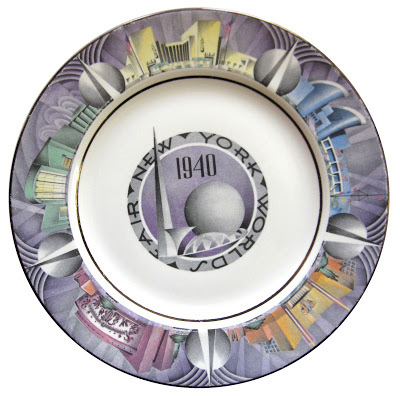
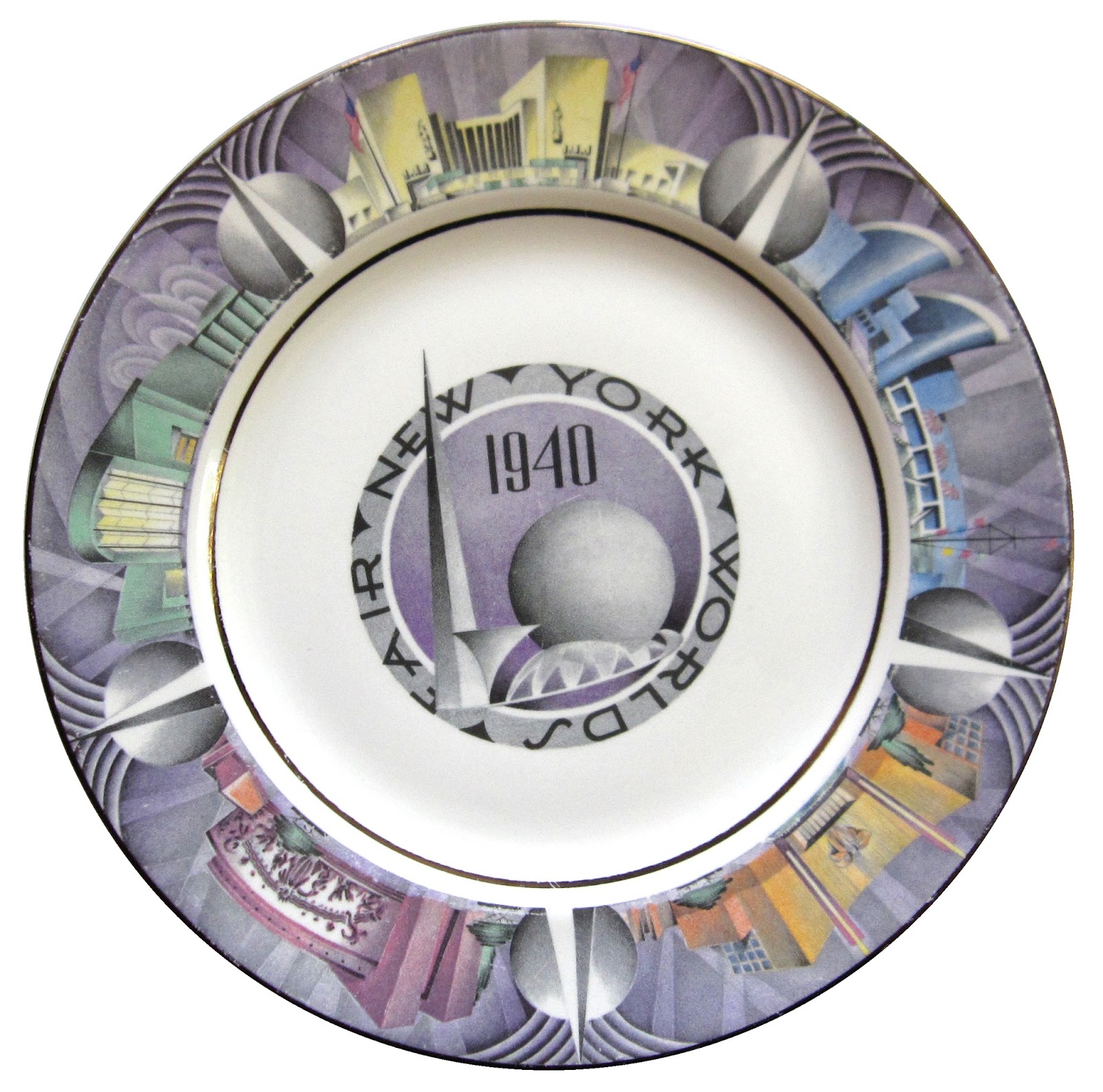
She'd found this beautiful plate from the fair highlighting the event's signature Trylon (tall pyramid) and Perisphere (sphere), and five of its great show buildings. Though the fair began in 1939 it ran until 1940. The plate's back has a sticker saying it was made to commemorate the 150th anniversary of George Washington's inauguration, which was one of the Fair's big themes.
Look at those colors! That Art Deco styling! It's a gem.
eBay tells me I got a really good deal on it. It'll go on my wall and always remind me of two things I love: my graphic novel, and my sharp-eyed wife.
"1939," I replied.
"Oh . . . this has the pyramid and the sphere on it, but it says 1940."
"Hold on."
She'd found this beautiful plate from the fair highlighting the event's signature Trylon (tall pyramid) and Perisphere (sphere), and five of its great show buildings. Though the fair began in 1939 it ran until 1940. The plate's back has a sticker saying it was made to commemorate the 150th anniversary of George Washington's inauguration, which was one of the Fair's big themes.
Look at those colors! That Art Deco styling! It's a gem.
eBay tells me I got a really good deal on it. It'll go on my wall and always remind me of two things I love: my graphic novel, and my sharp-eyed wife.
May 13, 2015
Mom's Cancer Notes: Page 5
I'm annotating individual pages from my book Mom's Cancer as they're posted on GoComics.com. These are my notes on Page 5 (May 14).
From a storytelling point of view, the game board metaphor does a couple of things.
It compresses time and delivers a lot of exposition. If I'd wanted to, I could have expanded any one of these "game squares" into a page or more of comic, but because a lot of the activity didn't directly involve Mom I wanted to get through it quickly.
It also stresses the role that random chance played in the quality of treatment Mom received. She ended up with very good care but could very easily not have. Remember, the osteopath at upper left was a quack . . . I mean, a giant duck. If Mom made any missteps at all, it was relying too much and too long on an incompetent primary care physician who (in my opinion) didn't know the first thing about cancer. I don't know if it made any difference.
This element of chance comes up again in the story. I thought it was a strong enough theme or motif that when it came time to design end papers for the print version of Mom's Cancer, I drew a token and a die (double meaning intended) pattern. Life is a crapshoot.
 The end paper pattern for the Mom's Cancer book, inspired by Page 5.
Starting today, Mom's Cancer will appear on GoComics.com twice a week instead of once. A week between pages was just too long, I thought (and some readers agreed with me). I'll see if twice per week helps the pacing. I could post a new page every day, but would be done with the entire story in a few months! Happily, GoComics seems to be up for any way I want to do it, so we'll give it a try. Let me know what you think.
From a storytelling point of view, the game board metaphor does a couple of things.
It compresses time and delivers a lot of exposition. If I'd wanted to, I could have expanded any one of these "game squares" into a page or more of comic, but because a lot of the activity didn't directly involve Mom I wanted to get through it quickly.
It also stresses the role that random chance played in the quality of treatment Mom received. She ended up with very good care but could very easily not have. Remember, the osteopath at upper left was a quack . . . I mean, a giant duck. If Mom made any missteps at all, it was relying too much and too long on an incompetent primary care physician who (in my opinion) didn't know the first thing about cancer. I don't know if it made any difference.
This element of chance comes up again in the story. I thought it was a strong enough theme or motif that when it came time to design end papers for the print version of Mom's Cancer, I drew a token and a die (double meaning intended) pattern. Life is a crapshoot.
 The end paper pattern for the Mom's Cancer book, inspired by Page 5.
Starting today, Mom's Cancer will appear on GoComics.com twice a week instead of once. A week between pages was just too long, I thought (and some readers agreed with me). I'll see if twice per week helps the pacing. I could post a new page every day, but would be done with the entire story in a few months! Happily, GoComics seems to be up for any way I want to do it, so we'll give it a try. Let me know what you think.
May 10, 2015
Mom's Cancer Notes: Page 4
I'm annotating individual pages from my book Mom's Cancer as they are posted on GoComics.com. These are my notes on Page 4.
Now I have to tell you about the Duck.
My original conceit for Mom's Cancer was that my family would look like people but everyone else would be depicted as animals or objects that somehow symbolized their personalities, as in Alice in Wonderland or Animal Farm. I first drew Mom's osteopath as a duck because she was . . . a quack. (Necessary disclaimer: I'm not insulting osteopathy in general; I'm sure there are some good osteopaths doing good work. Mom's was not one of them.)
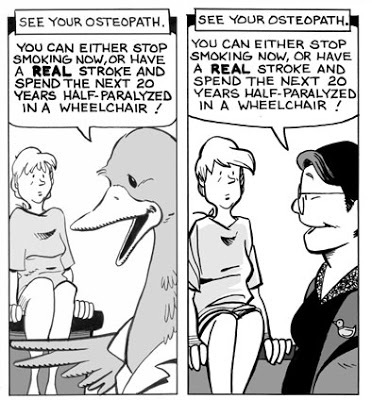 Original on the left, published version on the right.
This was also one of the early pages where I had to
redraw Mom, as I described in my notes on Page 1.
The problem was that there weren't many other characters in the story, and my high-concept symbolism didn't seem appropriate for the next one. Or the next. After a while, the osteopath was the only non-human character in the whole thing, and people reading it for the first time online began to ask, "Uh, what's up with the giant duck?"
Later, when we began thinking about editing for print, I hinted online that I might change her into a human. Fans of the Duck who'd understood my intent in the first place erupted in outrage (i.e., politely voiced mild disagreement). I think I made the right decision, but I gave Mom's duck--er, doc--a little lapel pin as a nod of respect to her history and her champions.
Now I have to tell you about the Duck.
My original conceit for Mom's Cancer was that my family would look like people but everyone else would be depicted as animals or objects that somehow symbolized their personalities, as in Alice in Wonderland or Animal Farm. I first drew Mom's osteopath as a duck because she was . . . a quack. (Necessary disclaimer: I'm not insulting osteopathy in general; I'm sure there are some good osteopaths doing good work. Mom's was not one of them.)
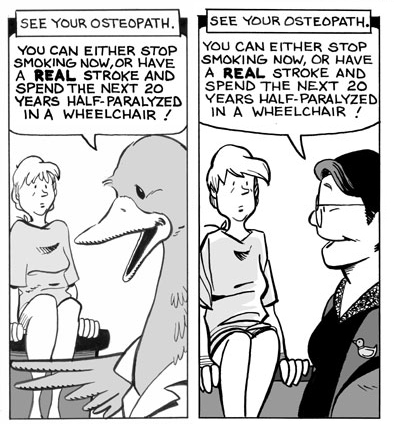 Original on the left, published version on the right.
This was also one of the early pages where I had to
redraw Mom, as I described in my notes on Page 1.
The problem was that there weren't many other characters in the story, and my high-concept symbolism didn't seem appropriate for the next one. Or the next. After a while, the osteopath was the only non-human character in the whole thing, and people reading it for the first time online began to ask, "Uh, what's up with the giant duck?"
Later, when we began thinking about editing for print, I hinted online that I might change her into a human. Fans of the Duck who'd understood my intent in the first place erupted in outrage (i.e., politely voiced mild disagreement). I think I made the right decision, but I gave Mom's duck--er, doc--a little lapel pin as a nod of respect to her history and her champions.
May 3, 2015
Mom's Cancer Notes: Page 3
I'm annotating individual pages from my book Mom's Cancer as they are posted on GoComics.com. These are my notes on Page 3.
There's a convention that comics characters wear the same clothes all the time--Charlie Brown's striped shirt, Clark Kent's blue suit. The "pro" of this convention is that it keeps the characters recognizable: once the reader gets used to seeing the characters dressed in a particular way, they don't have to stop and figure out who they are when they show up later. A uniform helps identify them. The "con" is that it's unrealistic. Cartoonists beginning a long project need to think about which way they want to go. In Mom's Cancer the characters wear the same clothes most of the time; when they change clothes late in the story, it helps signal the reader that time has passed.
I admit I didn't put a lot of thought into my own pants and polo shirt ensemble when I began Mom's Cancer. I don't even wear polo shirts that often! However, I dressed Mom in a striped long-sleeve shirt because I knew the stripes would be graphically interesting and draw the eye to her, the story's protagonist. I wanted Mom to be the center of attention whenever she appeared.
Similarly, I gave Kid Sis a sweater with a big floppy collar to emphasize the slenderness of her neck. In cartooning shorthand, skinny necks = youth, and thick necks = age. Nurse Sis and I are older than Kid Sis, so we have thicker necks and rounder curves (and Mom, even older, has hardly any neck at all!).
 Me: thick neck, round chin, high hairline, and a wrinkle or bag under one eye.
That all helps make me look older than....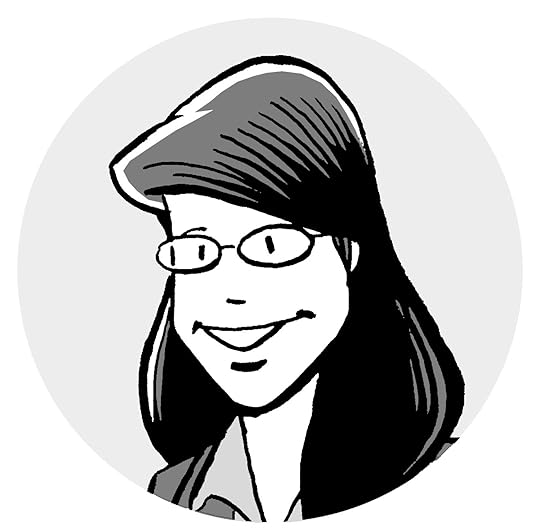 Kid Sis, who has a thin neck, sharp chin, perky nose, unlined face, and alert eyes.
These are some of the things I think about when designing characters.
By the way, my college friend Tina recently told me that she remembers me sitting slouched exactly as I've drawn myself in today's page of Mom's Cancer (Page 3). So I got that right.
There's a convention that comics characters wear the same clothes all the time--Charlie Brown's striped shirt, Clark Kent's blue suit. The "pro" of this convention is that it keeps the characters recognizable: once the reader gets used to seeing the characters dressed in a particular way, they don't have to stop and figure out who they are when they show up later. A uniform helps identify them. The "con" is that it's unrealistic. Cartoonists beginning a long project need to think about which way they want to go. In Mom's Cancer the characters wear the same clothes most of the time; when they change clothes late in the story, it helps signal the reader that time has passed.
I admit I didn't put a lot of thought into my own pants and polo shirt ensemble when I began Mom's Cancer. I don't even wear polo shirts that often! However, I dressed Mom in a striped long-sleeve shirt because I knew the stripes would be graphically interesting and draw the eye to her, the story's protagonist. I wanted Mom to be the center of attention whenever she appeared.
Similarly, I gave Kid Sis a sweater with a big floppy collar to emphasize the slenderness of her neck. In cartooning shorthand, skinny necks = youth, and thick necks = age. Nurse Sis and I are older than Kid Sis, so we have thicker necks and rounder curves (and Mom, even older, has hardly any neck at all!).
Me: thick neck, round chin, high hairline, and a wrinkle or bag under one eye. That all helps make me look older than....
Kid Sis, who has a thin neck, sharp chin, perky nose, unlined face, and alert eyes.These are some of the things I think about when designing characters.
By the way, my college friend Tina recently told me that she remembers me sitting slouched exactly as I've drawn myself in today's page of Mom's Cancer (Page 3). So I got that right.
April 26, 2015
Mom's Cancer Notes: Page 2
I'm annotating individual pages from my book Mom's Cancer as they are posted on GoComics.com. These are my notes on Page 2.
In answer to a question already posted on the GoComics.com page, Nurse Sis is my sister, and she's a registered nurse. You'll get to know the characters pretty well.
I think this page is a fair representation of the conversation Nurse Sis and I had that night. It was about this one-sided. I didn't quite know what to make of Mom's episode or how seriously to take it. We didn't realize it was just the start.
I was watching TV when my sister called, though I didn't remember exactly what. When it came time to portray it the comic, I wanted to draw myself watching some program I'd actually watch that would also say something about the "Brian" character.
I settled on the "Powerpuff Girls," which a clever cartoon series my daughters and I enjoyed together, and wouldn't have been out of character for me to enjoy by myself, either. I chose that particular image because I own it--that is to say, I bought the transparent layered cels the animators drew and painted to make that particular scene. They're framed and hanging on my wall.
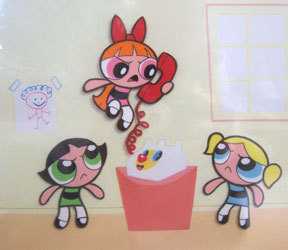
I'll let you conclude what that says about me.
By the way, owning the animation cels doesn't convey any particular right to reproduce them. The Powerpuff Girls are copyrighted and I respect other people's intellectual property as I'd hope they'd respect mine. But Fair Use allows the use of copyrighted material in transformative works of art (Warhol, Lichtenstein, etc.) and I was pretty sure that reproducing one frame of a cartoon in tiny black and white to reveal something about a character in a graphic novel about cancer was transformative enough to pass.
Just wanted you to know I gave that some thought . . .
In answer to a question already posted on the GoComics.com page, Nurse Sis is my sister, and she's a registered nurse. You'll get to know the characters pretty well.
I think this page is a fair representation of the conversation Nurse Sis and I had that night. It was about this one-sided. I didn't quite know what to make of Mom's episode or how seriously to take it. We didn't realize it was just the start.
I was watching TV when my sister called, though I didn't remember exactly what. When it came time to portray it the comic, I wanted to draw myself watching some program I'd actually watch that would also say something about the "Brian" character.
I settled on the "Powerpuff Girls," which a clever cartoon series my daughters and I enjoyed together, and wouldn't have been out of character for me to enjoy by myself, either. I chose that particular image because I own it--that is to say, I bought the transparent layered cels the animators drew and painted to make that particular scene. They're framed and hanging on my wall.
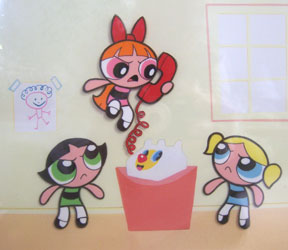
I'll let you conclude what that says about me.
By the way, owning the animation cels doesn't convey any particular right to reproduce them. The Powerpuff Girls are copyrighted and I respect other people's intellectual property as I'd hope they'd respect mine. But Fair Use allows the use of copyrighted material in transformative works of art (Warhol, Lichtenstein, etc.) and I was pretty sure that reproducing one frame of a cartoon in tiny black and white to reveal something about a character in a graphic novel about cancer was transformative enough to pass.
Just wanted you to know I gave that some thought . . .
April 22, 2015
"Last Mechanical Monster" an Eisner Nominee!
For the second year, "The Last Mechanical Monster" has been nominated for an Eisner Award for Best Webcomic!
 Woot!
Woot!
For those unfamiliar, the Eisners are sort of the Oscars or Emmys of comics. A panel of industry experts nominates comics in several categories, which are then voted on by comics professionals. Handsome trophies with spinny globes are awarded during a banquet at Comic-Con International in San Diego in July.
This honor is unexpected. Each year's Eisner judging panel comprises completely different people, and I had no reason to hope that this year's panel would feel the same about my work as last year's did. Especially since the world of webcomics is so large and diverse. To be picked out of that enormous field of talent by people who know and love comics means a lot.
As always, I'll hold any thoughts on the competition or my odds of winning until the voting period expires. That just seems sporting.
Meanwhile, all my thanks to the Eisner judges and any new readers they've brought my way. If you're a reader I hope you enjoy the story, and if you're eligible to vote in the Eisner Awards I'd appreciate your consideration.
 Woot!
Woot!For those unfamiliar, the Eisners are sort of the Oscars or Emmys of comics. A panel of industry experts nominates comics in several categories, which are then voted on by comics professionals. Handsome trophies with spinny globes are awarded during a banquet at Comic-Con International in San Diego in July.
This honor is unexpected. Each year's Eisner judging panel comprises completely different people, and I had no reason to hope that this year's panel would feel the same about my work as last year's did. Especially since the world of webcomics is so large and diverse. To be picked out of that enormous field of talent by people who know and love comics means a lot.
As always, I'll hold any thoughts on the competition or my odds of winning until the voting period expires. That just seems sporting.
Meanwhile, all my thanks to the Eisner judges and any new readers they've brought my way. If you're a reader I hope you enjoy the story, and if you're eligible to vote in the Eisner Awards I'd appreciate your consideration.
April 19, 2015
Mom's Cancer Notes: Page 1
As I celebrated in my previous post, the first page of Mom's Cancer was posted to GoComics.com today (actually tomorrow, but I got a jump on it from the Pacific Time Zone). Let me introduce it to new readers:
Mom's Cancer is a true story about my mother's diagnosis and treatment for metastatic lung cancer, and how that affected our family. I first serialized it as a webcomic, posting a few pages at a time online. At first I posted anonymously; my family didn't even know. After a few months the comic went viral, I told my family, and they took the news pretty well. Fortunately, Mom loved it. If she hadn't, I would've killed the whole thing. The webcomic went on to win the first Eisner Award for Best Digital Comic and be acquired for print by Abrams Books. It's gotten some very gratifying recognition, brought me many new opportunities and good friends, and is remarkably still in print. Now, about a decade after I created it, Mom's Cancer returns to the Web.
Annotated!
When Universal's John Glynn and I first talked about putting Mom's Cancer online, one of his ideas was to annotate the story with sketches, drafts, and my reflections on its creation. Terrific! But given how the GoComics.com site is set up, it'd be difficult to add such material without interrupting the flow of the story.
So I'll try to do that here. My plan is to add a comment to each week's comic linking readers to these posts (although I don't expect to have something to say about every page). Anyone interested in the behind-the-scenes process stuff can find it here, those uninterested won't be bothered. We'll see how that works.
I briefly considered setting up a separate blog for the purpose, but already have more balls online than I can juggle. These posts will all be labeled "Mom's Cancer Notes" in the right-column index so that, as they accumulate, they'll be easy to corral with a click.
Page 1
The story begins with Mom and Kid Sis watching a bad movie. I always felt a little guilty naming the culprit (the 2002 "Time Machine" film) but that's what it was and it truly was a bad movie.
This page establishes one of Mom's Cancer's conceits from the start: the story's mostly black and white, but anything that is extraordinary, fantastic, subjective or unreal--in this case the little blue spots floating around Mom's head--appears in color.
It took about a year and a half to complete Mom's Cancer. In that time, the way I drew the characters drifted and evolved, Mom most of all. That's pretty common in comic strips: Snoopy and Garfield changed a lot over the years. In Mom's case, the change was so noticeable that when it came time to turn my webcomic into a book, I had to go back and redraw her to match how she'd look later:
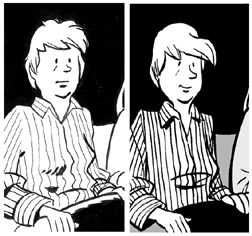 Original Mom at left, redrawn Mom at right.
Thank you for reading Mom's Cancer. Please feel free to leave any questions or comments here or at GoComics.com and I'll respond as best I can.
Mom's Cancer is a true story about my mother's diagnosis and treatment for metastatic lung cancer, and how that affected our family. I first serialized it as a webcomic, posting a few pages at a time online. At first I posted anonymously; my family didn't even know. After a few months the comic went viral, I told my family, and they took the news pretty well. Fortunately, Mom loved it. If she hadn't, I would've killed the whole thing. The webcomic went on to win the first Eisner Award for Best Digital Comic and be acquired for print by Abrams Books. It's gotten some very gratifying recognition, brought me many new opportunities and good friends, and is remarkably still in print. Now, about a decade after I created it, Mom's Cancer returns to the Web.
Annotated!
When Universal's John Glynn and I first talked about putting Mom's Cancer online, one of his ideas was to annotate the story with sketches, drafts, and my reflections on its creation. Terrific! But given how the GoComics.com site is set up, it'd be difficult to add such material without interrupting the flow of the story.
So I'll try to do that here. My plan is to add a comment to each week's comic linking readers to these posts (although I don't expect to have something to say about every page). Anyone interested in the behind-the-scenes process stuff can find it here, those uninterested won't be bothered. We'll see how that works.
I briefly considered setting up a separate blog for the purpose, but already have more balls online than I can juggle. These posts will all be labeled "Mom's Cancer Notes" in the right-column index so that, as they accumulate, they'll be easy to corral with a click.
Page 1
The story begins with Mom and Kid Sis watching a bad movie. I always felt a little guilty naming the culprit (the 2002 "Time Machine" film) but that's what it was and it truly was a bad movie.
This page establishes one of Mom's Cancer's conceits from the start: the story's mostly black and white, but anything that is extraordinary, fantastic, subjective or unreal--in this case the little blue spots floating around Mom's head--appears in color.
It took about a year and a half to complete Mom's Cancer. In that time, the way I drew the characters drifted and evolved, Mom most of all. That's pretty common in comic strips: Snoopy and Garfield changed a lot over the years. In Mom's case, the change was so noticeable that when it came time to turn my webcomic into a book, I had to go back and redraw her to match how she'd look later:
 Original Mom at left, redrawn Mom at right.
Thank you for reading Mom's Cancer. Please feel free to leave any questions or comments here or at GoComics.com and I'll respond as best I can.
April 13, 2015
Mom's Cancer on GoComics.com!
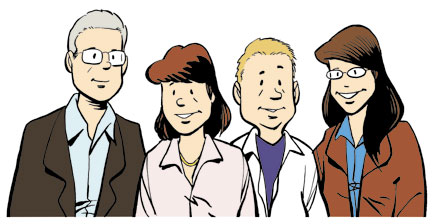
I've been waiting a long time to announce this....
Beginning next Monday, April 20, Mom's Cancer returns to the Internet on Universal Uclick's GoComics.com. Free.
I'll parse that sentence: Universal is one of the largest press syndicates in the world, providing comics and columnists for newspapers worldwide. They're the syndicate of Garfield, Dilbert, Calvin & Hobbes, Dear Abby, and my secret crush Miss Manners. Universal Uclick is their online arm, and GoComics.com is the bit of that arm (ulna?) that provides their comic strips online. Folks can set up an account to read all their favorite comics for free. They get a million visits per day.
That doesn't mean that a million people are going to read Mom's Cancer. Readers have to choose it from a list and add it to their subscriptions. I hope some will. We'll see. Even a few new readers I never would've had otherwise would be better than a poke in the eye with a sharp stick.
This means a lot to me.
Mom's Cancer started as a free webcomic, on a primitive site I hosted myself. When I signed my book contract with Abrams, they quite reasonably asked me to take it down so my free version wouldn't compete with something they were going to ask people to pay for. I was happy to do that.
Time passed. Except for a few perennial sellers, the life of a book has an ebb and flow. If you're lucky, there's a small flurry of reviews and events when the book comes out (if you're not lucky, it's just another raindrop in the lake that nobody notices). It stays on the bookstore shelves a while, then it's pulled from the shelves to make room for new books.
(This was something about the book business I was shocked to learn: say a bookstore orders X copies of your book and sells them all. You, Joe Author, think "Great, now they'll order more copies!" But Bev Bookseller thinks "Great, now I have space to put all these new books!" Unless you're To Kill a Mockingbird, bookstores really don't want you hanging around.)
As Mom's Cancer slid into the tail end of that curve, I occasionally broached to Abrams the idea of putting it back online. One of the paradoxical discoveries of the new webcomic era is that readers actually will pay money for a collection of work they can read online for nothing, and I thought that might help boost sales for the print Mom's Cancer. But mostly, as the book became harder to find or order in stores, I wanted the story to stay available to people who might benefit from it.
Well, that broaching never went far until Universal's President and Editorial Director John Glynn contacted me out of the blue many months ago asking if I were interested in adding Mom's Cancer to GoComics.com. Why, yes indeed, I was. Acutely! I talked to Abrams, Abrams and Universal talked to each other, lawyers got involved, somewhere deep in space a hydrogen nebula condensed into a star, and at last Mom's Cancer debuts on GoComics.com next week.
I think of this as Mom's Cancer's return home.
We'll post a page a week, so it'll take about two years to publish the whole book. We're trying to figure out ways to add notes, annotations, sketches, etc. without interrupting the flow of the story. I have some behind-the-scenes material, plus several years of perspective, that I think some readers will appreciate.
Thanks to John Glynn and Shena Wolf at Universal, and Charlie Kochman and Lindy Humphreys at Abrams. This part's going to sound sappy but it's sincere: all I want is for people who need the story to find it, and they made it happen.
March 26, 2015
Research vs. Writing
I liked this thought-provoking essay, "Mistaking Researching for Writing," by comic book writer Ron Marz. I'd recommend it for anyone working on a creative project and wondering whether they're doing so much research they'll never get around to writing, or so little research their writing will sound false and lack conviction.
Some money quotes:
"How much research is enough? After two decades of writing fiction, I've come to believe the answer is 'Enough to fool the audience into thinking you did a lot more research.'"
And:
"No one wants a book report. They want a story."
And:
"Depending too heavily upon research can be the death of imagination, or at least the submersion of it. One of the gifts of writing fiction is making it up. Revel in it."
You all know a writer who's spent months or years building a fictional world--drawing maps, diagramming family trees, classifying exotic flora and fauna--but never quite getting around to setting a story there. Maybe that writer is you. Research can become a bottomless pit if you let it.
It's an issue I've faced on all my projects to different extents.
On Mom's Cancer, most of the story was taken from my family's real lives. However, I also took a lot of notes as events happened, and researched a lot about cancers, treatments, prognoses, etc. (which of course I was doing anyway).
On Whatever Happened to the World of Tomorrow, I researched my butt off. The book covers four decades of Space Age history that I was determined to get right. For each decade I pulled together facts, figures, reference images, and original source material totaling about 3000 pages worth for a 208-page book.
Always uppermost in my mind was the fact that (as Marz said) "nobody wants a book report." If I drew a lamp post in 1939 or a fallout shelter in 1955, you can be certain I had references for it. But I tried to never rub the reader's nose in it. Instead, I hoped the cumulative effect of a thousand unconscious correct details would lend the whole book some credibility and verisimilitude. A few folks have told me that's what they like about it.
I learned to resist the urge to include material just because I'd done a lot of research on it. Yeah, it took me three days to dig up that nugget, but if it doesn't contribute to the story it has to go.
I'm working on some new projects now that also demand pretty deep research, both historical and scientific. Again, my goal is to fold all of that in so it helps the story without drawing attention to itself. I badly want to get it right. I also want to get it done.
Sometimes I think that's where Melville went wrong with Moby-Dick. Dedicating three chapters to how sailors tie knots is just showing off. More seriously and recently, I've read a couple of epically long graphic novels that I think could have profitably been cut in half if their authors had been less interested in telling us all they'd learned and more interested in their stories.
In my experience, writing and research go together. Often, you don't realize what you need to know until you begin to write. In turn, research sometimes suggests directions you could take your story you may never have considered.
In the course of writing Whatever Happened to the World of Tomorrow, it amazed me how often I needed some bit of information only to have it miraculously appear days later. Like, I'm writing about the most obscure incident or factoid imaginable, and BOOM the New York Times or NASA prints an article about it. I didn't even have to hunt for it; it found me! The same thing is happening on my new projects. The universe provides. It's almost eerie.
Do your research. Do your world building. Keep it in mind as you craft your story, but don't let it become the story. And if you story gets to a point that requires contradicting your research, and you think you can get away with it, err on the side of telling a good story. That doesn't mean you can say the first Moon landing happened in 1944 (unless you're doing a sci-fi Moon Nazi tale, then go for it!), but if you always thought your Realm of the Dragons was in the North and it suddenly makes more sense for your hero to find it in the South, make the change. It's not supposed to be a straitjacket.
"One of the gifts of writing fiction is making it up. Revel in it."
Some money quotes:
"How much research is enough? After two decades of writing fiction, I've come to believe the answer is 'Enough to fool the audience into thinking you did a lot more research.'"
And:
"No one wants a book report. They want a story."
And:
"Depending too heavily upon research can be the death of imagination, or at least the submersion of it. One of the gifts of writing fiction is making it up. Revel in it."
You all know a writer who's spent months or years building a fictional world--drawing maps, diagramming family trees, classifying exotic flora and fauna--but never quite getting around to setting a story there. Maybe that writer is you. Research can become a bottomless pit if you let it.
It's an issue I've faced on all my projects to different extents.
On Mom's Cancer, most of the story was taken from my family's real lives. However, I also took a lot of notes as events happened, and researched a lot about cancers, treatments, prognoses, etc. (which of course I was doing anyway).
On Whatever Happened to the World of Tomorrow, I researched my butt off. The book covers four decades of Space Age history that I was determined to get right. For each decade I pulled together facts, figures, reference images, and original source material totaling about 3000 pages worth for a 208-page book.
Always uppermost in my mind was the fact that (as Marz said) "nobody wants a book report." If I drew a lamp post in 1939 or a fallout shelter in 1955, you can be certain I had references for it. But I tried to never rub the reader's nose in it. Instead, I hoped the cumulative effect of a thousand unconscious correct details would lend the whole book some credibility and verisimilitude. A few folks have told me that's what they like about it.
I learned to resist the urge to include material just because I'd done a lot of research on it. Yeah, it took me three days to dig up that nugget, but if it doesn't contribute to the story it has to go.
I'm working on some new projects now that also demand pretty deep research, both historical and scientific. Again, my goal is to fold all of that in so it helps the story without drawing attention to itself. I badly want to get it right. I also want to get it done.
Sometimes I think that's where Melville went wrong with Moby-Dick. Dedicating three chapters to how sailors tie knots is just showing off. More seriously and recently, I've read a couple of epically long graphic novels that I think could have profitably been cut in half if their authors had been less interested in telling us all they'd learned and more interested in their stories.
In my experience, writing and research go together. Often, you don't realize what you need to know until you begin to write. In turn, research sometimes suggests directions you could take your story you may never have considered.
In the course of writing Whatever Happened to the World of Tomorrow, it amazed me how often I needed some bit of information only to have it miraculously appear days later. Like, I'm writing about the most obscure incident or factoid imaginable, and BOOM the New York Times or NASA prints an article about it. I didn't even have to hunt for it; it found me! The same thing is happening on my new projects. The universe provides. It's almost eerie.
Do your research. Do your world building. Keep it in mind as you craft your story, but don't let it become the story. And if you story gets to a point that requires contradicting your research, and you think you can get away with it, err on the side of telling a good story. That doesn't mean you can say the first Moon landing happened in 1944 (unless you're doing a sci-fi Moon Nazi tale, then go for it!), but if you always thought your Realm of the Dragons was in the North and it suddenly makes more sense for your hero to find it in the South, make the change. It's not supposed to be a straitjacket.
"One of the gifts of writing fiction is making it up. Revel in it."
Brian Fies's Blog

- Brian Fies's profile
- 64 followers
Brian Fies isn't a Goodreads Author
(yet),
but they
do have a blog,
so here are some recent posts imported from
their feed.

