
Brian Fies's Blog, page 52
February 19, 2016
World's Fair Greetings!
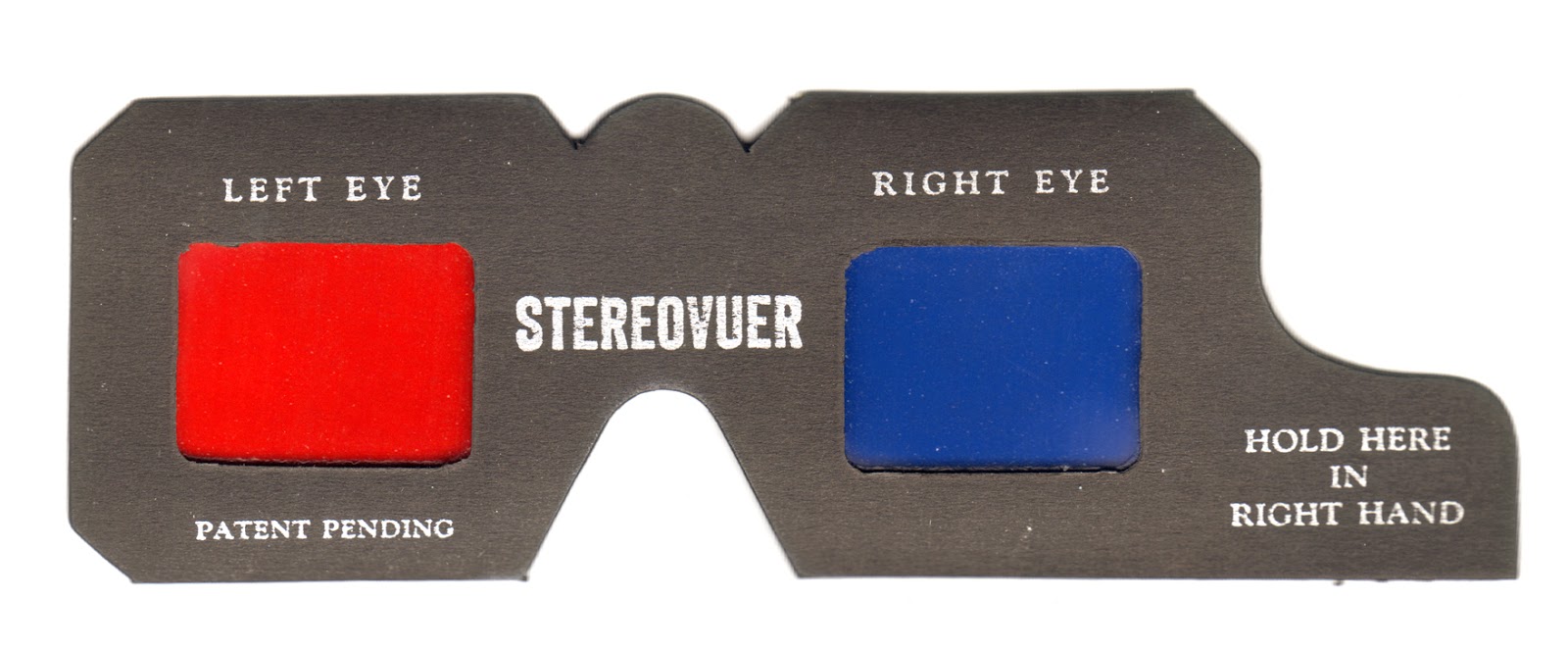
Friends and long-time readers know of my love for both the 1939 New York World's Fair, which I featured in my book Whatever Happened to the World of Tomorrow, and old-fashioned red-blue 3-D images (called "anaglyphs"). Here, now, in this very post, those worlds collide.
I like visiting antiques shops in other parts of the country. Our local shops are fine, but different places have their own regional flavors. I also think the vintage pickings aren't as good here in California as they are elsewhere because we're a state of emigrants who left all their old stuff behind when they moved out here.
So while in Ann Arbor, Michigan a couple of days ago (see my previous post!) I browsed a shop and discovered a treasure: a pack of 3-D "Stereovue" souvenir cards from the Fair. Each card is the size of a small postcard, in a cardboard pack meant to be mailed home. Here's the front cover:
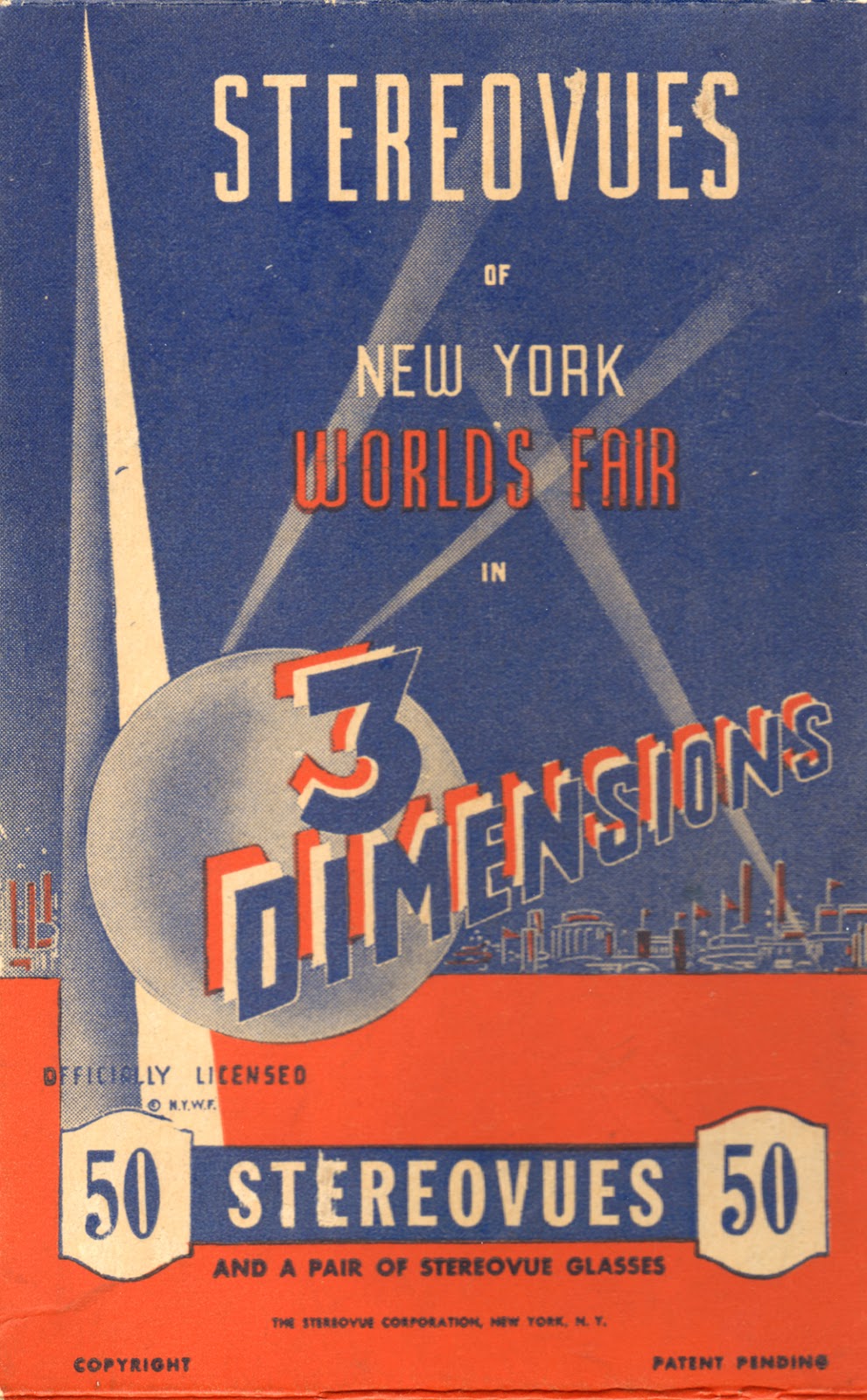
And here are several of the cards. I'm posting them large so you can look at them with your own red-blue glasses (everybody should have a pair!). Clicking on the images should make them much larger.
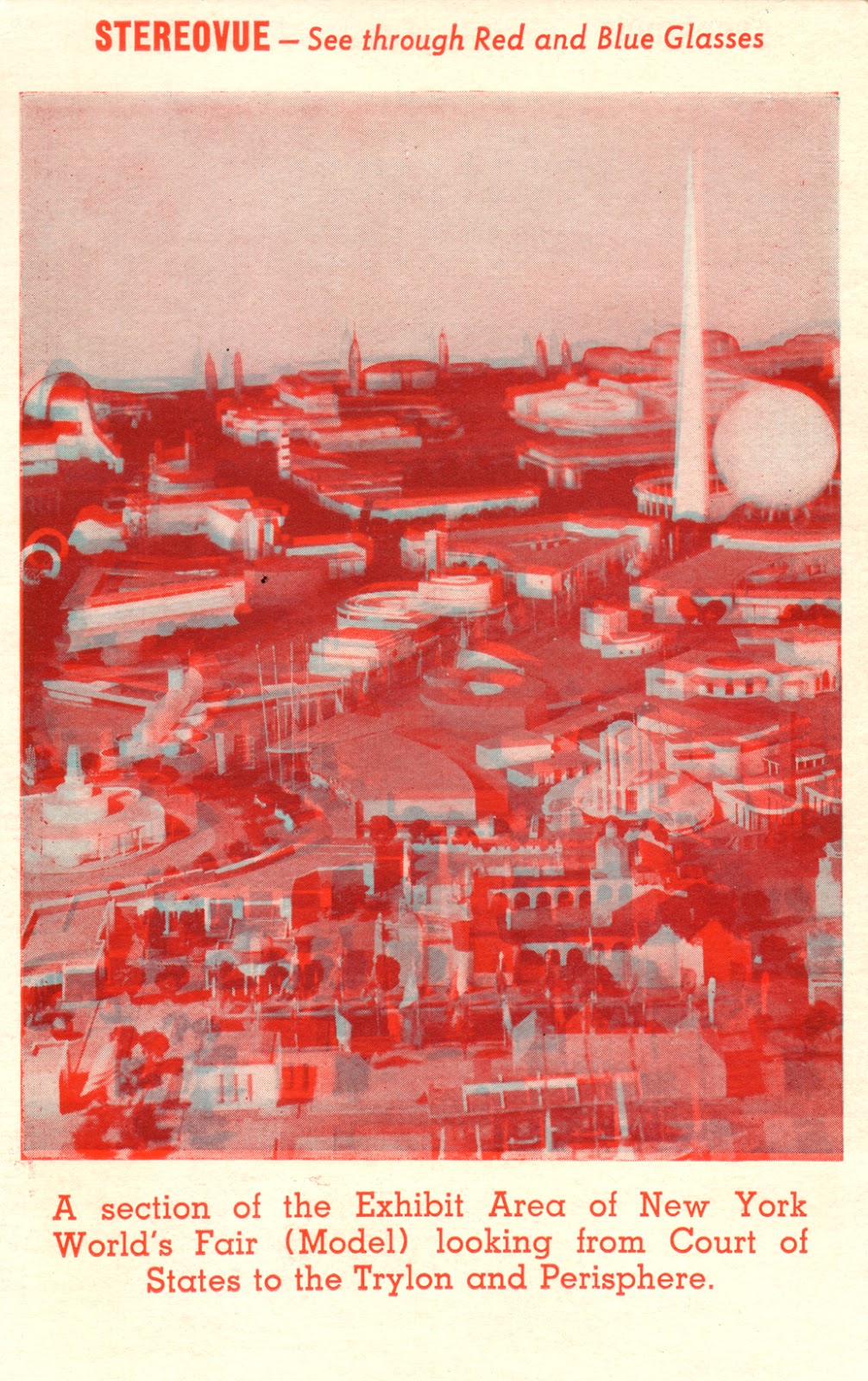
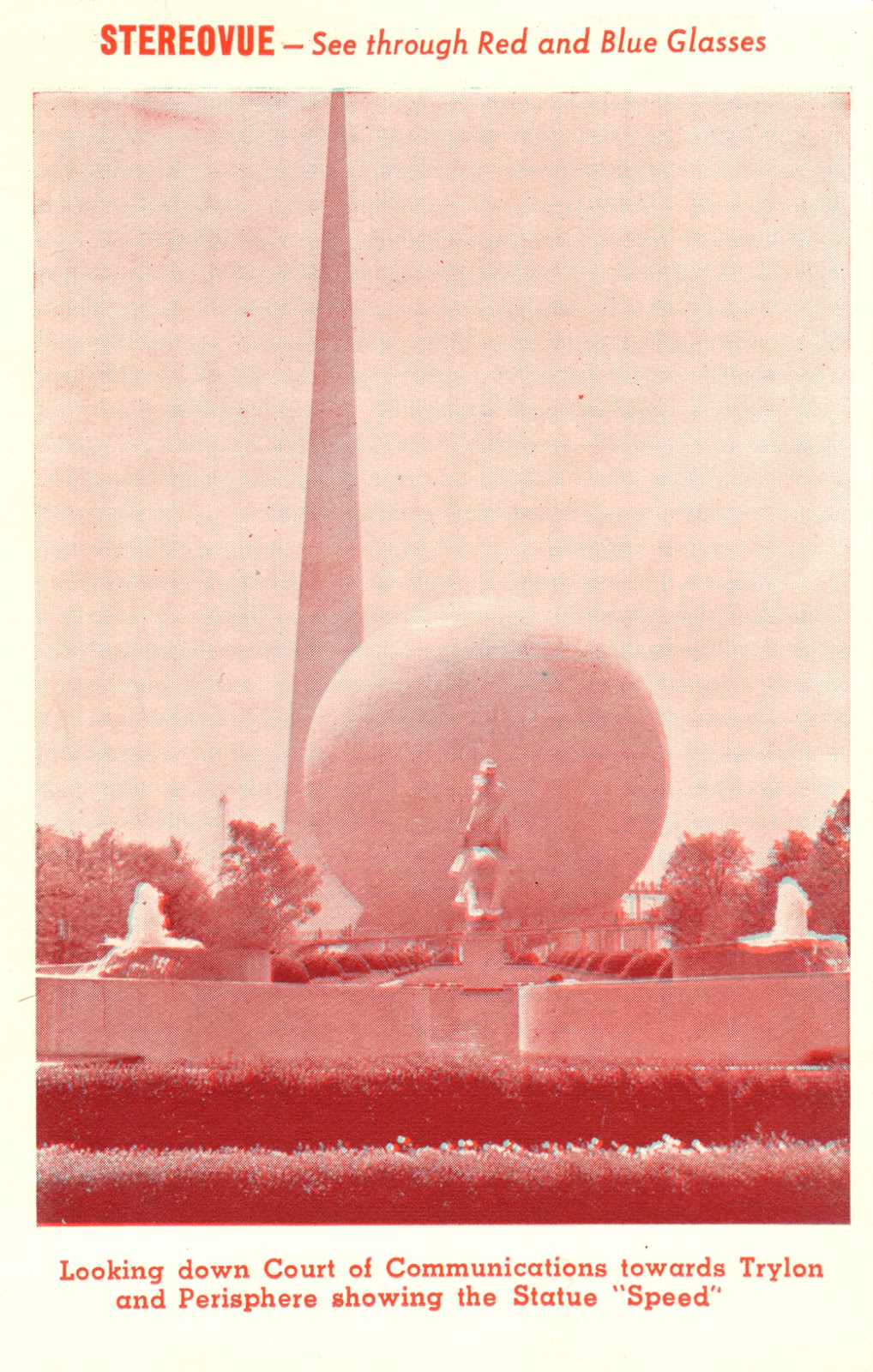

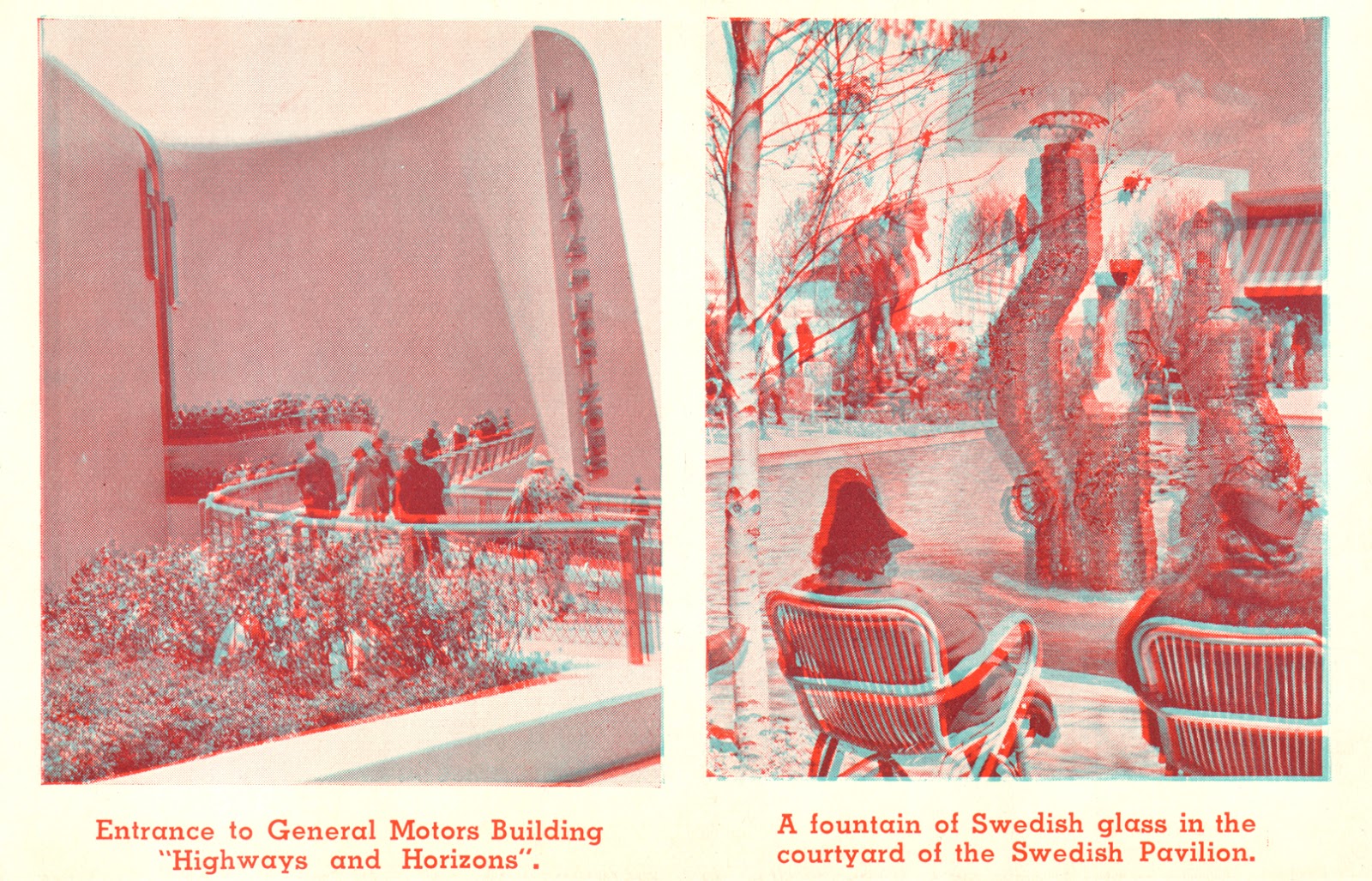
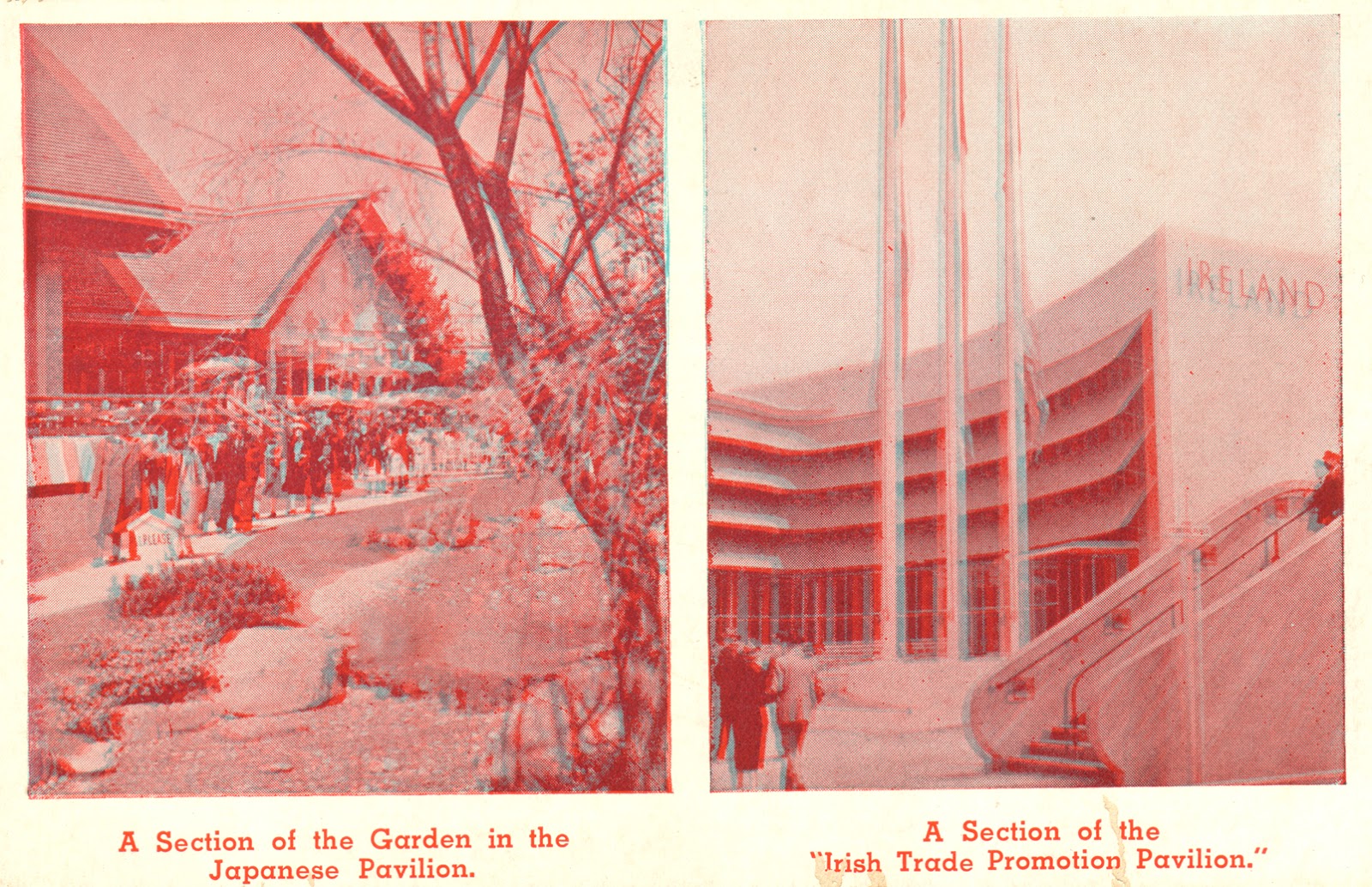

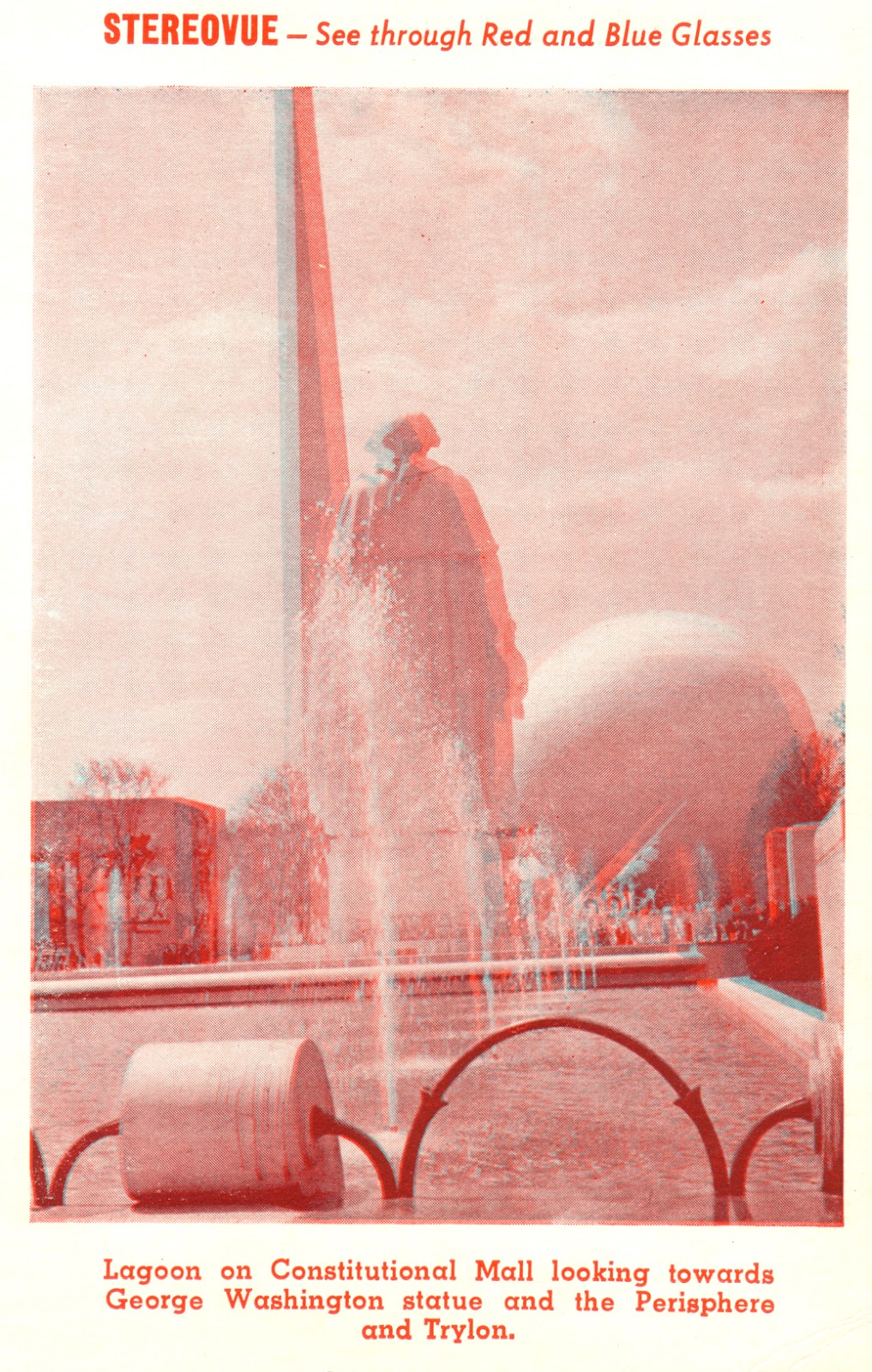
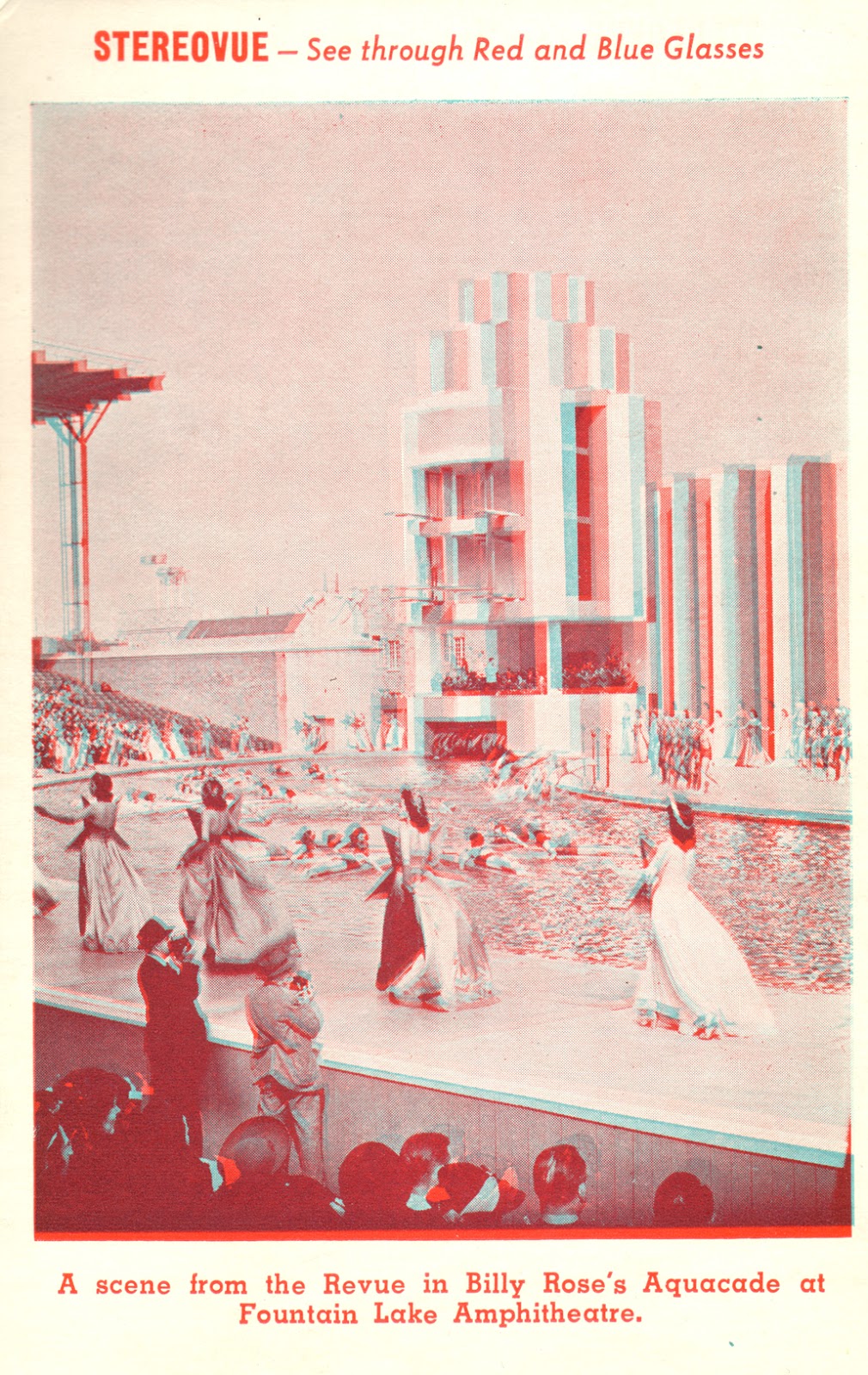
In all my research on the 1939 World's Fair, I hadn't seen these 3-D cards before. In fact, I was surprised to see the red-blue anaglyph technology at all--I thought it hadn't been invented until the 1950s. A good 2011 book by Craig Yoe and Joe Kubert, Amazing 3-D Comics, described Kubert developing it for comic books beginning in 1952. Kubert wrote that he'd seen publications using red-blue 3-D pictures serving in Germany in 1950-51. Obviously it had been around at least a decade before then. I wonder if the Fair was one of its earliest uses?
These are beautiful little gems in near-mint condition from 77 years ago. The cards don't look like they were ever touched, and I can't believe the plastic lenses of the enclosed viewer survived without cracking, What a tremendous find! If anybody wants to see more, let me know and I'll fire up the scanner.


February 18, 2016
Go (Quick Web Search) Wolverines!
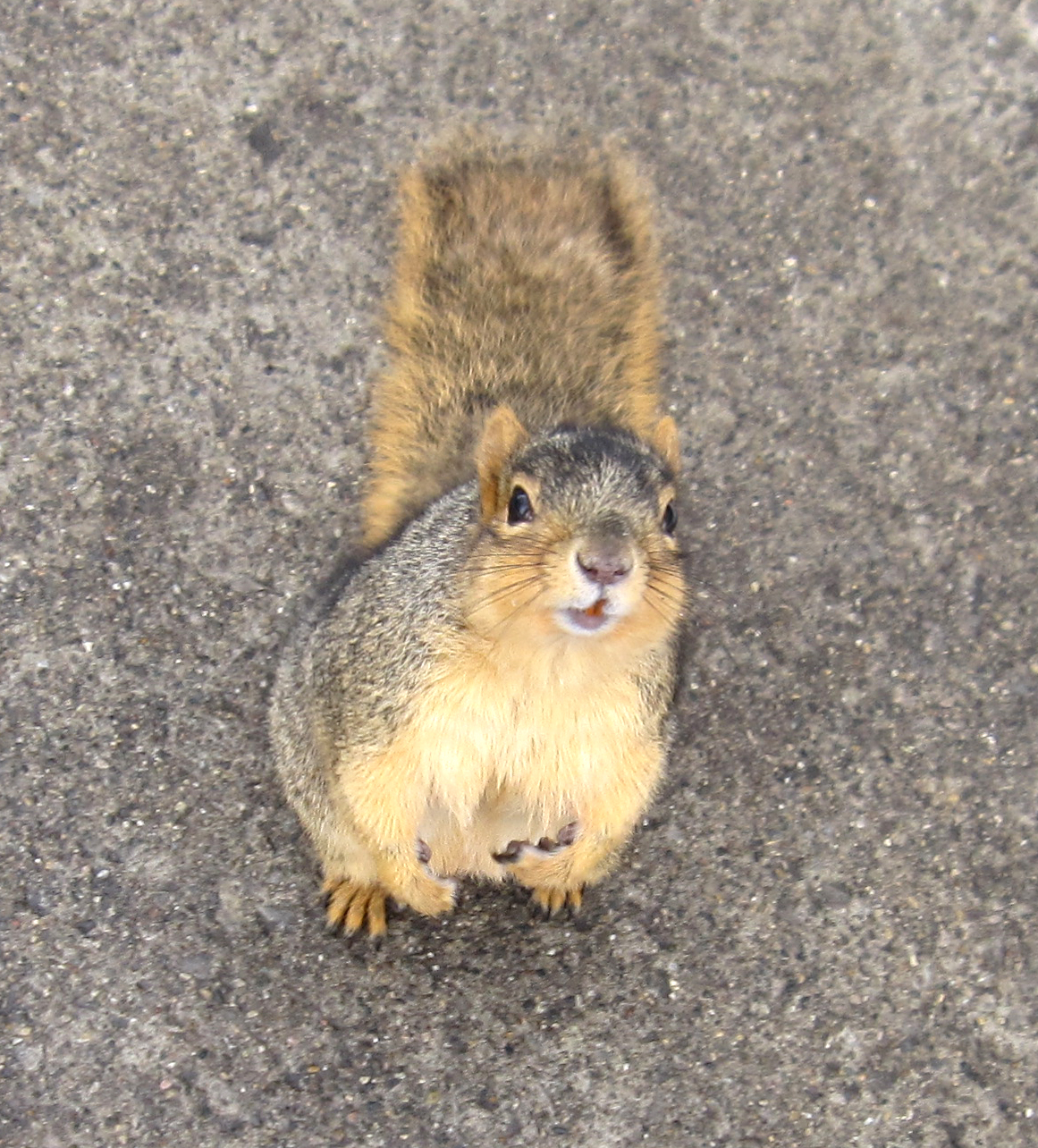 Not a Wolverine.
Honestly, I was about 96% sure that University of Michigan students are Wolverines, but since I haven't cared about college sports since I was in college, I thought I'd better double-check.
I got home late last night from an exhilarating and exhausting trip to the University of Michigan, where I gave three different talks in two days. I think everything went very well. Unless my hosts were lying, so did they. I've never been to Ann Arbor and found that it lived up to its reputation as the quintessential Midwestern college town. I had some time to do my favorite thing in new places: wander aimlessly. Even better, I got to do it through light snow flurries, which is an exotic treat for me (not so much for others who don't live in coastal California, I know).
I did not make it to Zingerman's Deli, which a couple of people told me I must. Now I have a reason to go back.
Several months ago, professor Alex Stern asked if I'd be interested in talking about Mom's Cancer with her class on Health, Biology and Society. Indeed I was, and since I was flying two-thirds of the way across the country I encouraged her to find as much work for me to do while there as she could. I was subsequently booked to speak at the Ann Arbor District Library the evening after the class, and talk with honors students at a luncheon the next day.
Three different audiences with three different talks, and not really one I could pull off the shelf (I do have a couple of standard stump speeches but they didn't fit the bill). I'm not afraid of public speaking but I was a little nervous taking three untested talks for their first spins around the track the day of the big race.
I think it worked out.
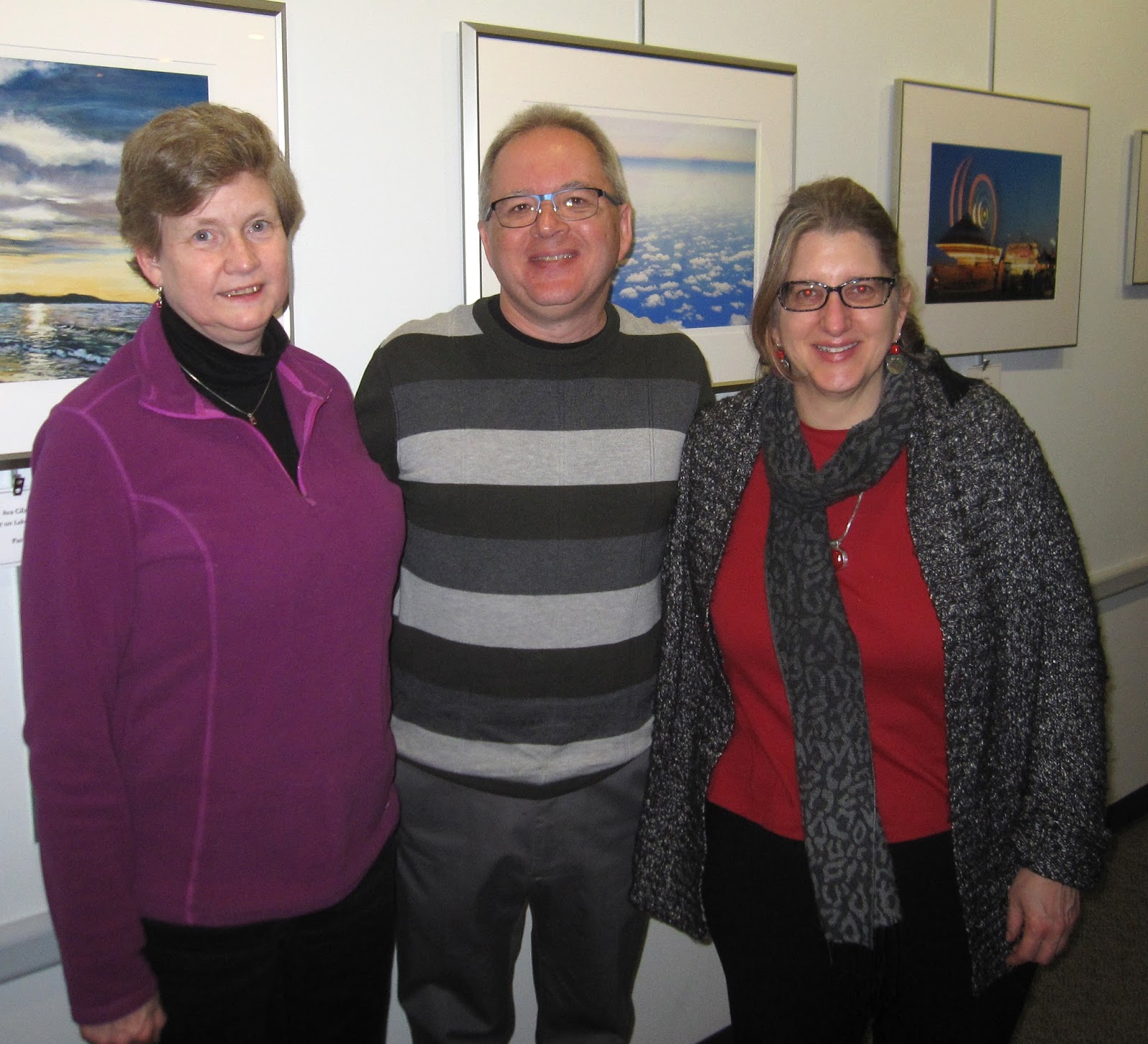 My hosts and instructors of the Health, Biology and Society course, Laura Olsen and Alex Stern. The class is a fascinating interdisciplinary thing pulling together material and students from science and humanities to focus on the socio-economics of cancer. By the time I got there, all the students had read Mom's Cancer and were frighteningly well prepared.
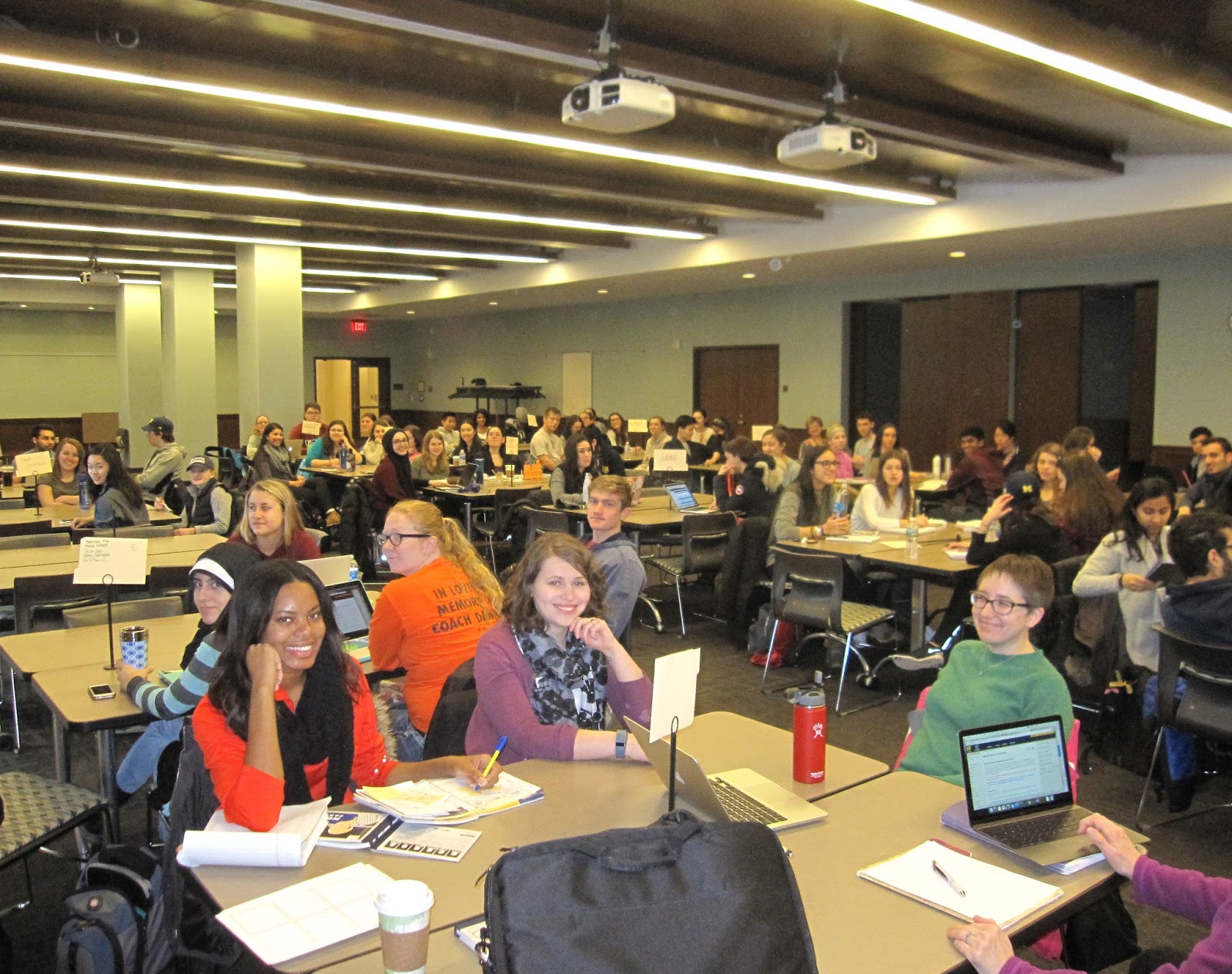 About 80 students take the class. Big group! Before I shot this photo I said, "Anybody who doesn't want to be on Facebook look away," so students whose faces you can't see obviously have something to hide. After the class I signed a lot of books and had some great one-on-one conversations. The future is in good hands.
Alex said the students are used to collaborating on worksheets and projects in their table groups (which they've all wittily named), so I suggested we could do jam comics, in which everyone draws the first panel of a comic and then passes it on for someone to draw the next, and so on. It's a great improvisational storytelling exercise whose success depends on the participants' willingness to play along and have fun. These guys were terrific.
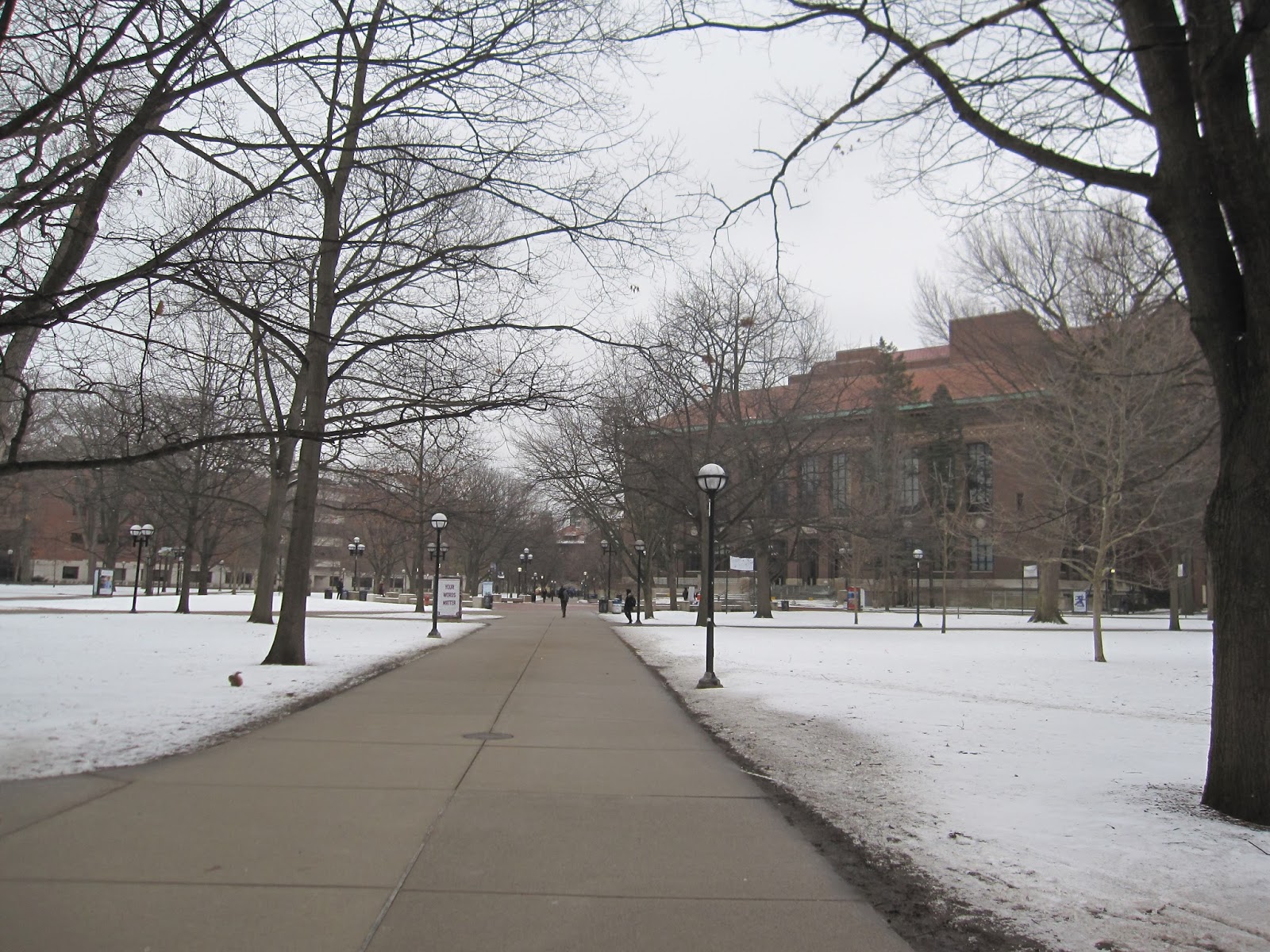 Weather was crisp but not unbearably cold, with an inch of dry icy show on the ground and occasional flakes drifting through the sky. The campus is home to roving gangs of squirrels that are fluffier, fatter and browner than those I'm used to, and nearly tame thanks to food handouts from big-hearted students. The squirrel at the top of this post was literally begging at my feet.
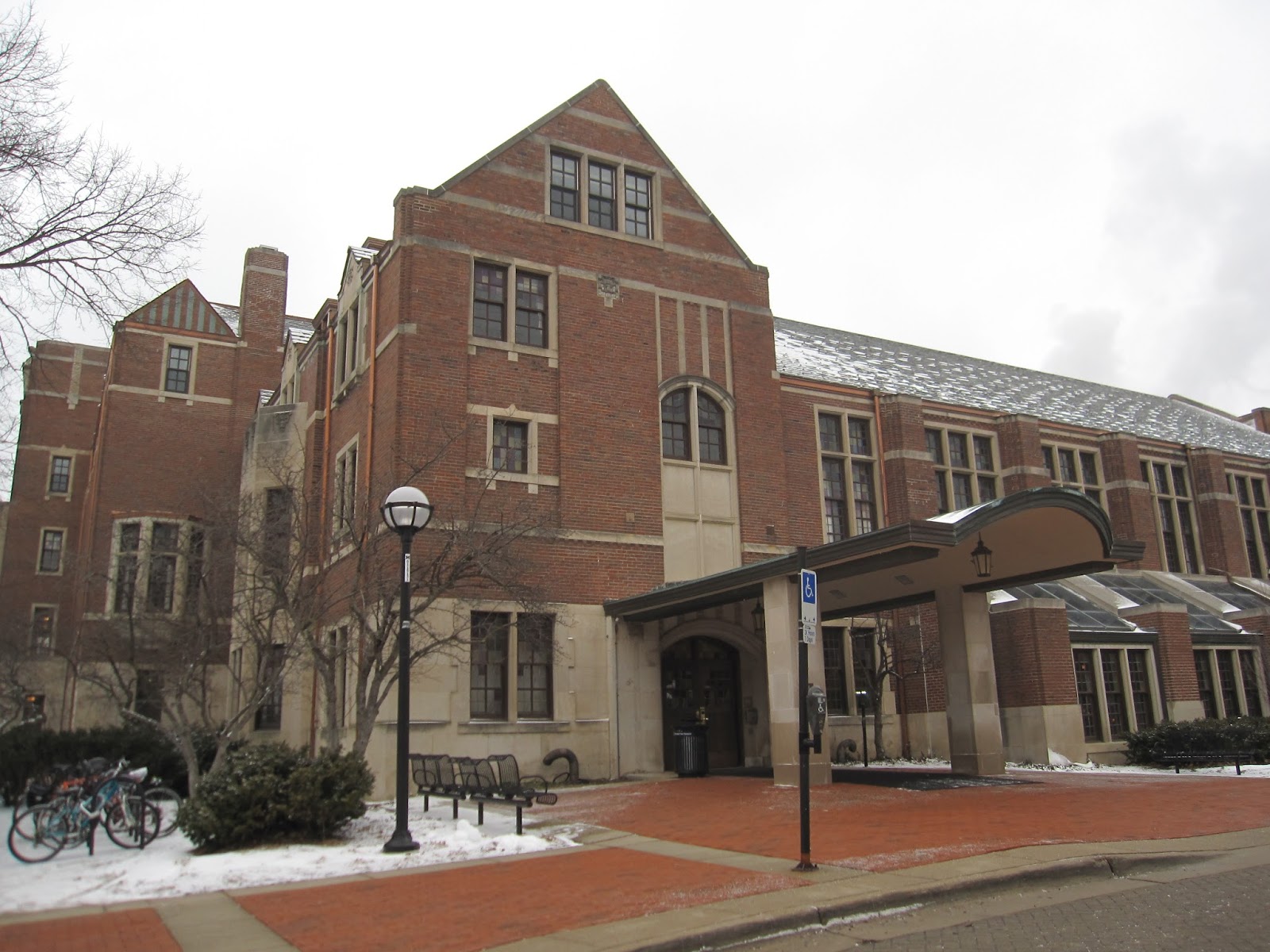 They put me up at the Michigan League, which looks like a typical student activity center (cafe, study areas, meeting rooms) except it has a hotel hidden on its fourth floor. Weird but nice. I remarked to someone that one of my favorite things to see while traveling is bricks. We don't have brick buildings in northern California. Ours all fell down in 1906.
 Wandering Ann Arbor. Look at all the bricks!
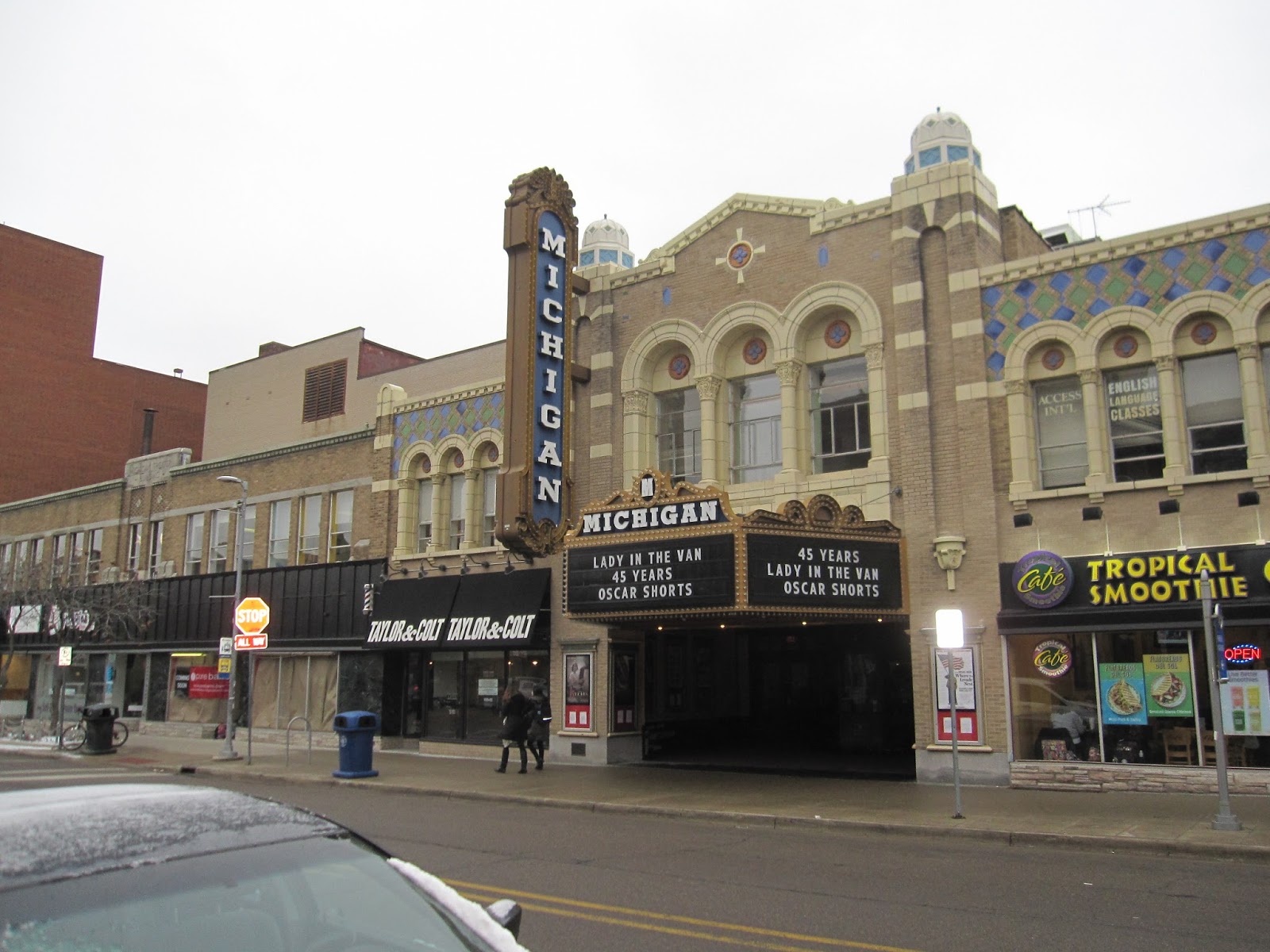 If your college town doesn't have an old movie theater converted to showing obscure arthouse films and Oscar shorts, you're going to the wrong college.
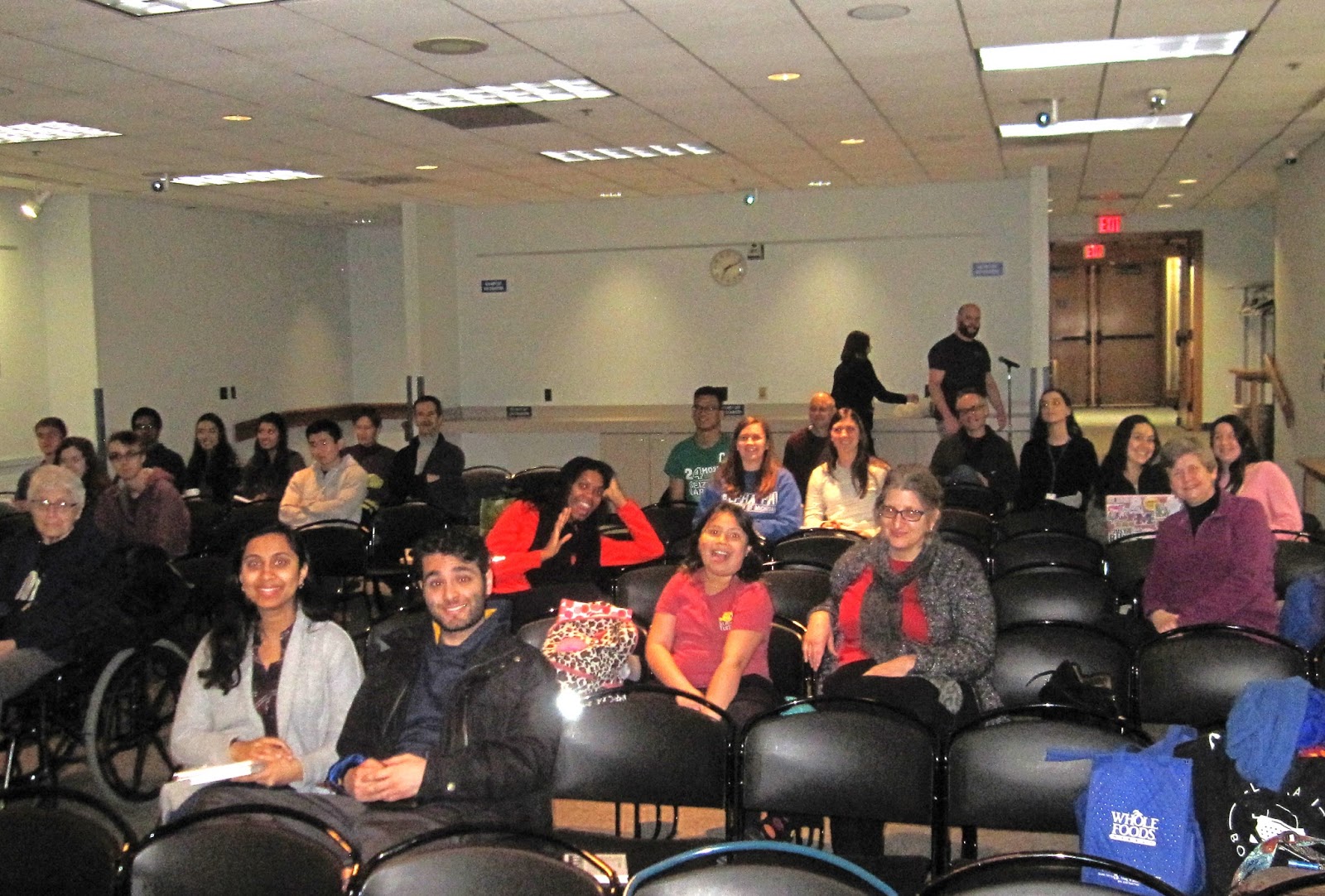 Some of the people who dropped by the Ann Arbor District Library that evening. The girl at center in the salmon-colored shirt next to Alex Stern is her daughter Sofia, who is a budding graphic novelist, likes plain cheese pizza, and is my new best friend, not least because knowing me puts her only one degree of separation away from her hero Raina Telgemeier.
 Jim Ottaviani is the writer of science-themed nonfiction comics. His subjects have included physicists Niels Bohr and Richard Feynman, Quantum Theory, the Moon Race, Jane Goodall, and Alan Turing. Jim and I are Facebook friends but had never met, and I didn't even know he lived in Ann Arbor until he told me he'd try to make my talk. And he did!
In addition to Jim, two other creators whose work I know and appreciate showed up completely out of the blue. Jerzy Drozd teaches comics, makes webcomics and podcasts, and with Ernie Colon illustrated a graphic adaptation of the Warren Commission Report (published by Abrams ComicArts!). His wife Anne Drozd, in addition to being his collaborator on several projects, is also on the library staff and introduced my talk.
I expected Jim to show and was excited enough about that, but to get Anne and Jerzy at the same time was like Christmas morning.
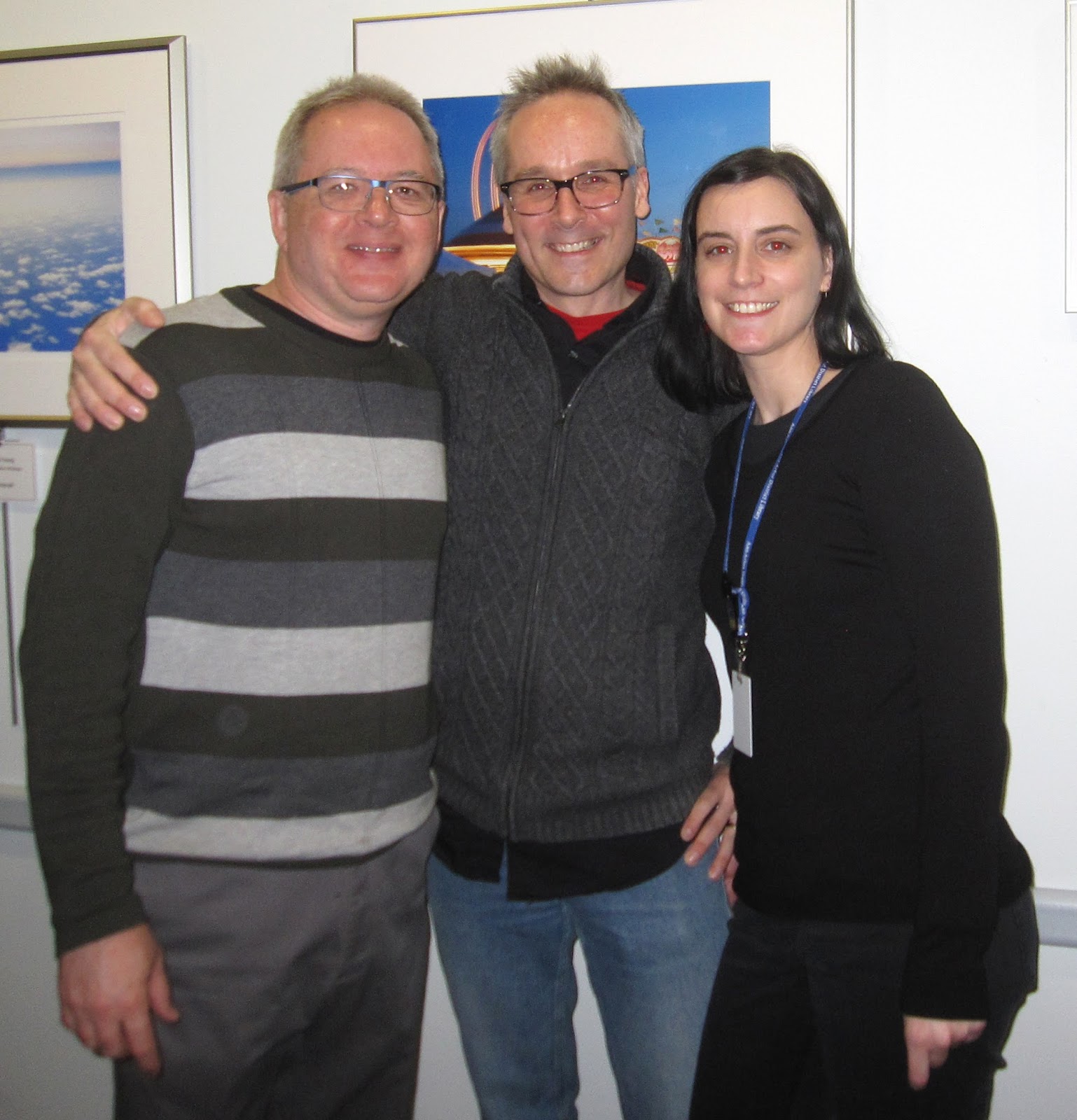 With Jerzy and Anne.
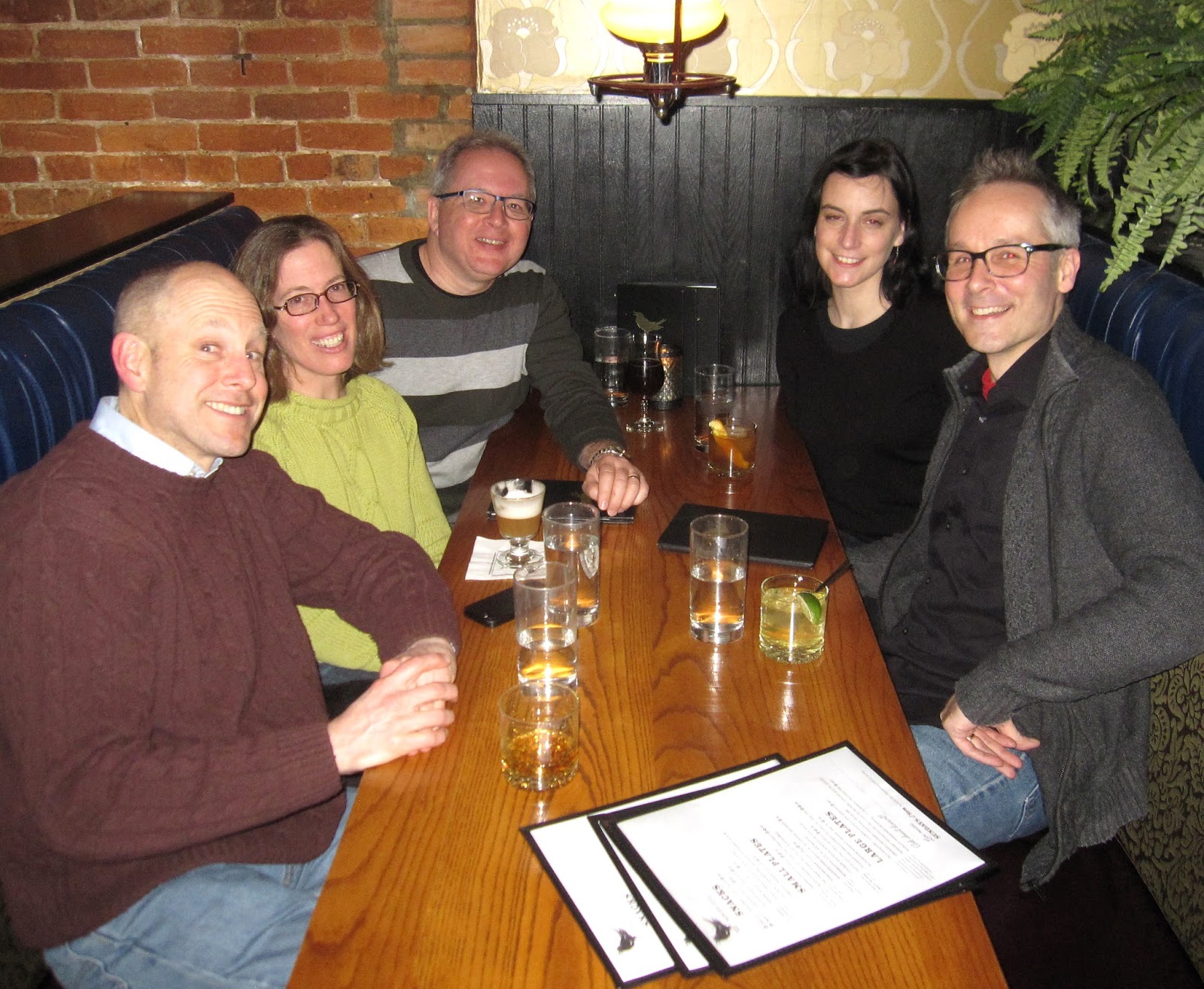 Enjoying adult beverages after the library talk with Jim, Jim's wife Kat, Anne and Jerzy. It turns out we've all worked with my pal and editor Charlie Kochman at Abrams, and so traded much intelligence and strategy.
 Heh heh heh.
Wednesday morning I had some wander time before lunch with about 15 or 20 honors students. This was a less formal setting and I aimed to say more than I usually would about the history of comics as an artistic and literary medium (the Art of the People!) still working to gain respect. Hope I made a good case. I had an especially nice pre-lunch conversation with philosopher and honors program advisor Henry Dyson.
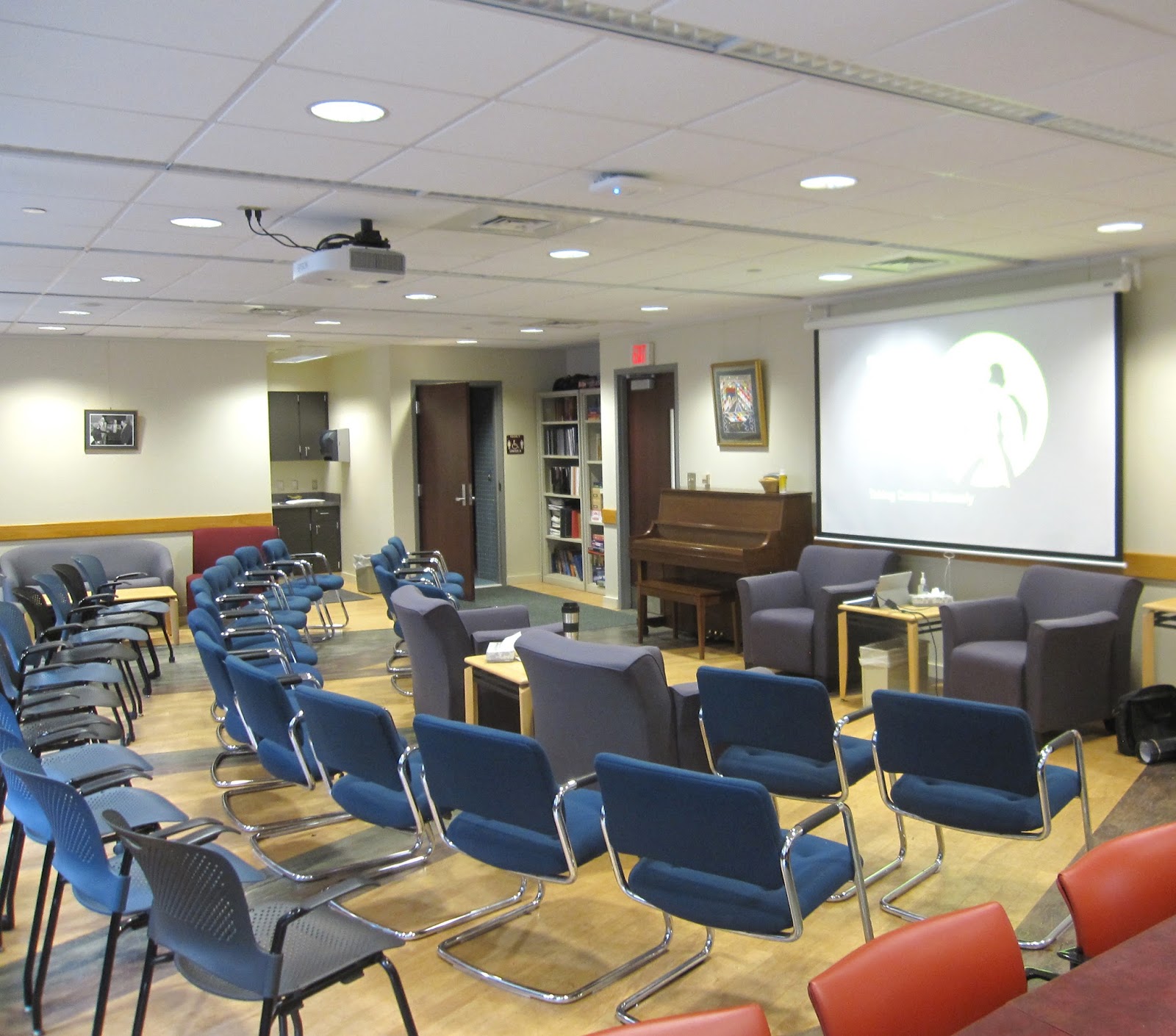 The luncheon set-up. I sat in a comfy chair up front while students grabbed a plate of food (good stuff!) and ate while we talked.
After lunch I went downstairs to a car waiting at the door to whisk me to the airport, where after about seven hours on two planes (separated by a rice bowl dinner at LAX) and another hour and a half dodging fender-benders on a rainy drive home, I oozed into bed dreaming of snow-blown bricks and hungry squirrels.
This trip was a nice career highlight for me. Thanks to Alex and Laura for making it happen (and for teaching my book!); Jim, Kat, Jerzy and Anne for talking shop; Sofia for drawing me a picture; and the students for being good people and good sports. Great school and town! Someday I'll be back for Zingerman's.
January 30, 2016
LumaCon 2
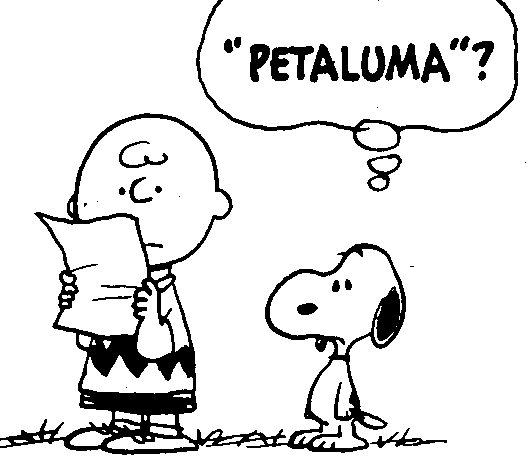 That cartoon always works.
LumaCon 2--the second annual comics convention put on by local librarians for kids and families in the town of Petaluma, Calif.--is over, although I'm sure there are still librarians folding up tables and sweeping up napkins as I type. The con aims to get students and fans in the same room with comics pros, often sitting side by side. I think they fulfill their mission spectacularly.
Last year's LumaCon was popular enough that they moved to a bigger site for this year's, with actual separate rooms for activities and panels. The fear was that scaling up would ruin the charm. They needn't have worried. Any con that has a bake sale, a costume parade, and a Lego room is doing everything right in my book.
As an invited guest I sold some books at a table and took part in a panel on "Comics as Literature." They gave me a gift basket. Nobody's ever given me a gift basket to come to their con before.
My gift basket included cuff links. I'm still trying to figure that out. But they're cool!
LumaCon was also free! I told organizer Nathan Libecap I thought that was insane, and he explained that they couldn't charge admission because library blah-blah school district blargy-blargh. There's some good reason. It's still insane.
The bulk of the floor space was occupied by Artists' Alley. The building lobby hosted bookstores, comic book sellers, and toy vendors. Culinary arts students served teriyaki and sushi. Side rooms hosted Magic card tournaments, craft tables, Legos, and quiet spaces for students and pros to talk. There were plenty of costumed folks, though I didn't think to take any good photos of them. Late in the day, organizers announced that 2400 people had attended. That felt like a good number.
For me, selling books is secondary to seeing my local cartooning friends and meeting new people interested in comics. One story that sums up my LumaCon experience: a father and grandfather brought their autistic boy, I'd guess about 14, to show people his drawings. At the previous LumaCon they'd bought him a book on "How to Draw Dragonball Z," and for the past year he'd meticulously mimicked those manga lessons, but also done some original work in his own style. We all talked for several minutes--the boy not so much talking as shoving one drawing after another at me from a manila folder. I gently critiqued and encouraged. Afterward, Dad took me aside and explained that they had feared his son would never talk, until they figured out that comics unlocked his mind. The boy could say that Superman's cape is red. Reading and drawing comics changed his life.
By the way, my wife Karen and daughters Robin and Laura came and were a big help manning my table, but I'm forbidden to show photographic proof. I also wish I'd had more time to talk to several personal friends who dropped by to say "Hi," but it was great to see them. Thanks especially to our friend Marion, who sent us some of her own photos.
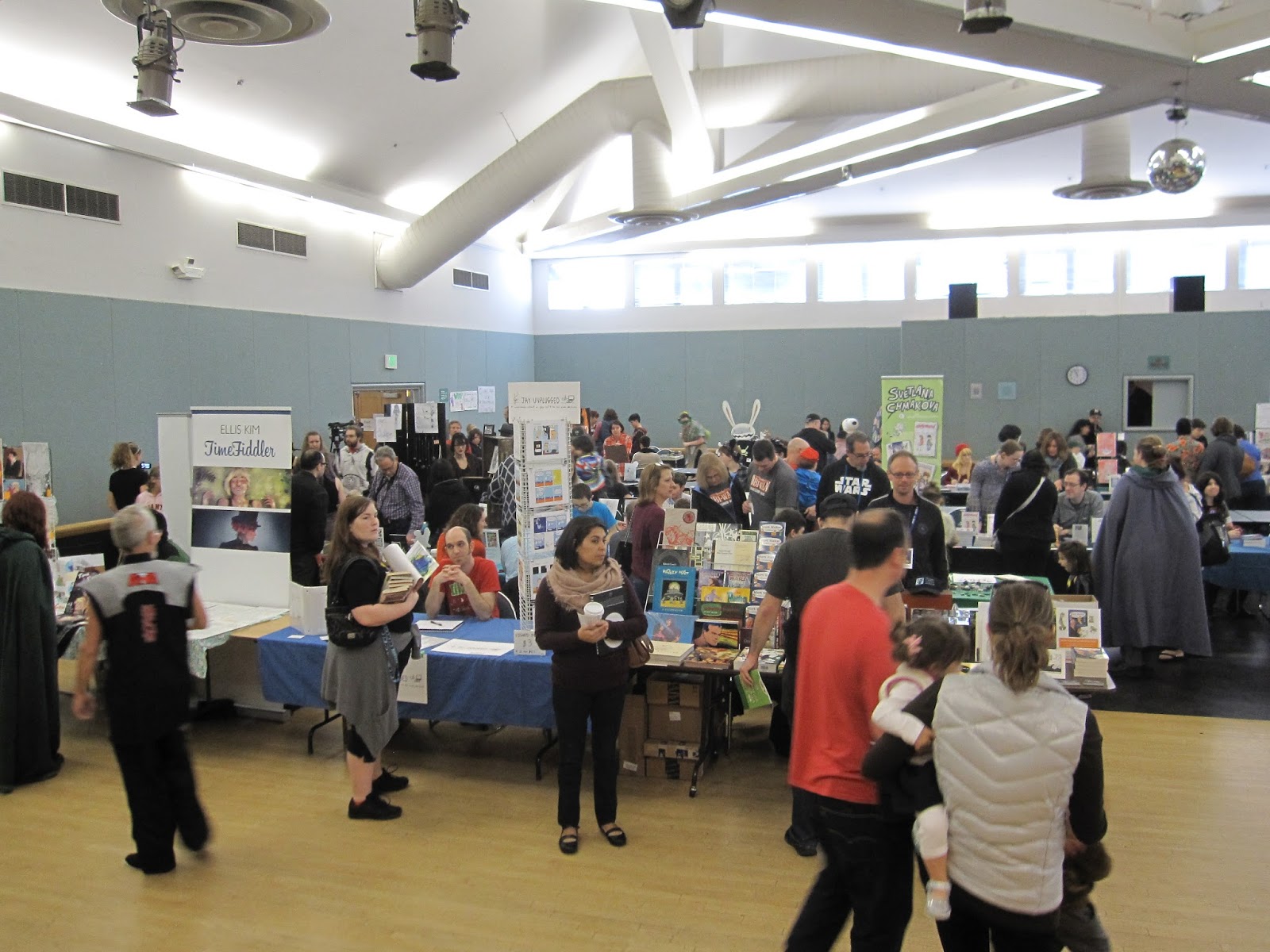
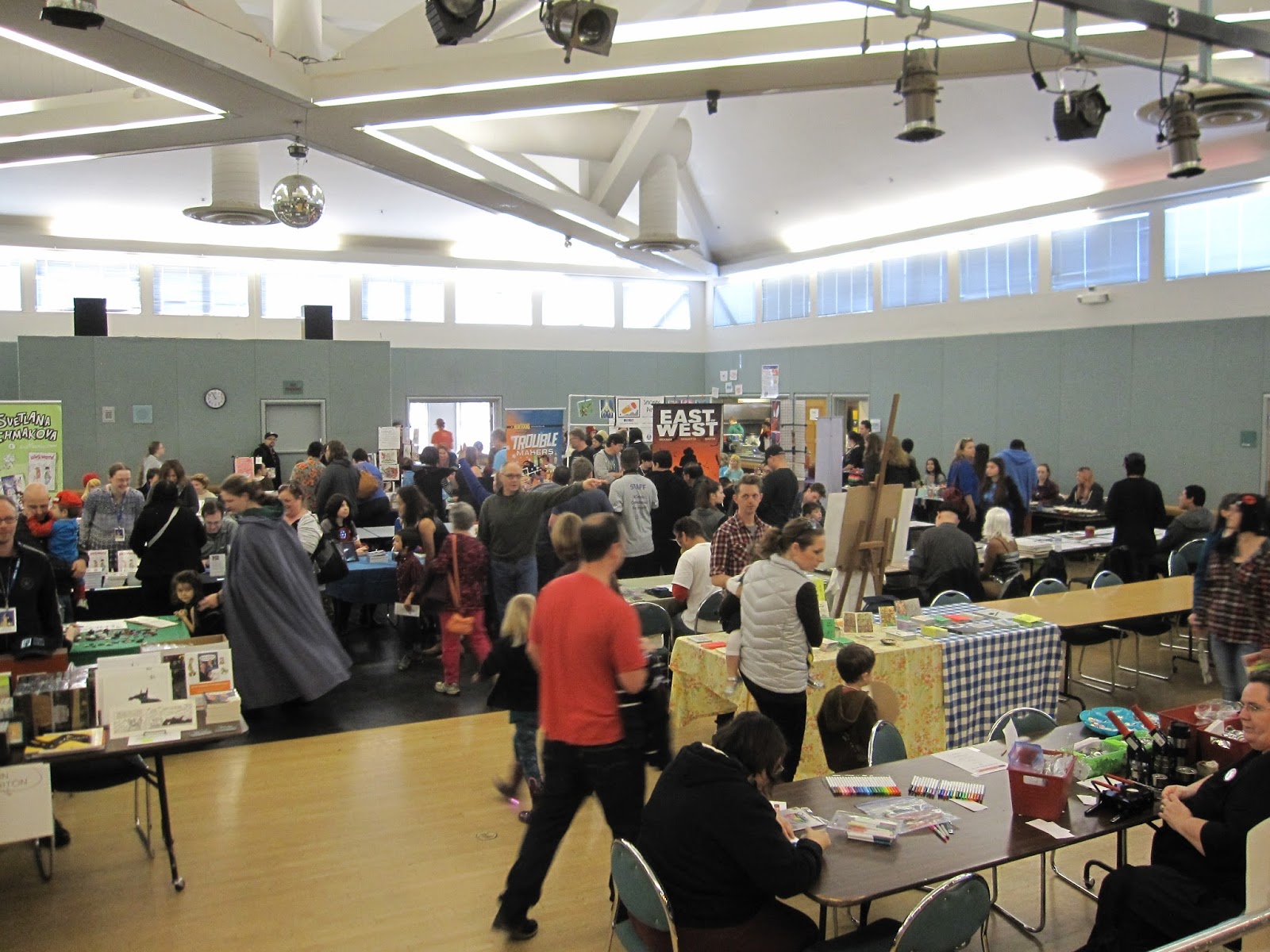 The south and north sides of Artists' Alley. I was smack in the middle. Cafe and bake sale are to the right rear of the bottom photo. In the foreground right is a little drawing/coloring table.
 I met syndicated cartoonist Brian Crane, creator of the comic strip "Pickles." He and his wife drove from Reno through the Sierra Nevadas just for LumaCon, and had to leave for home early to not end up like the Donner Party.
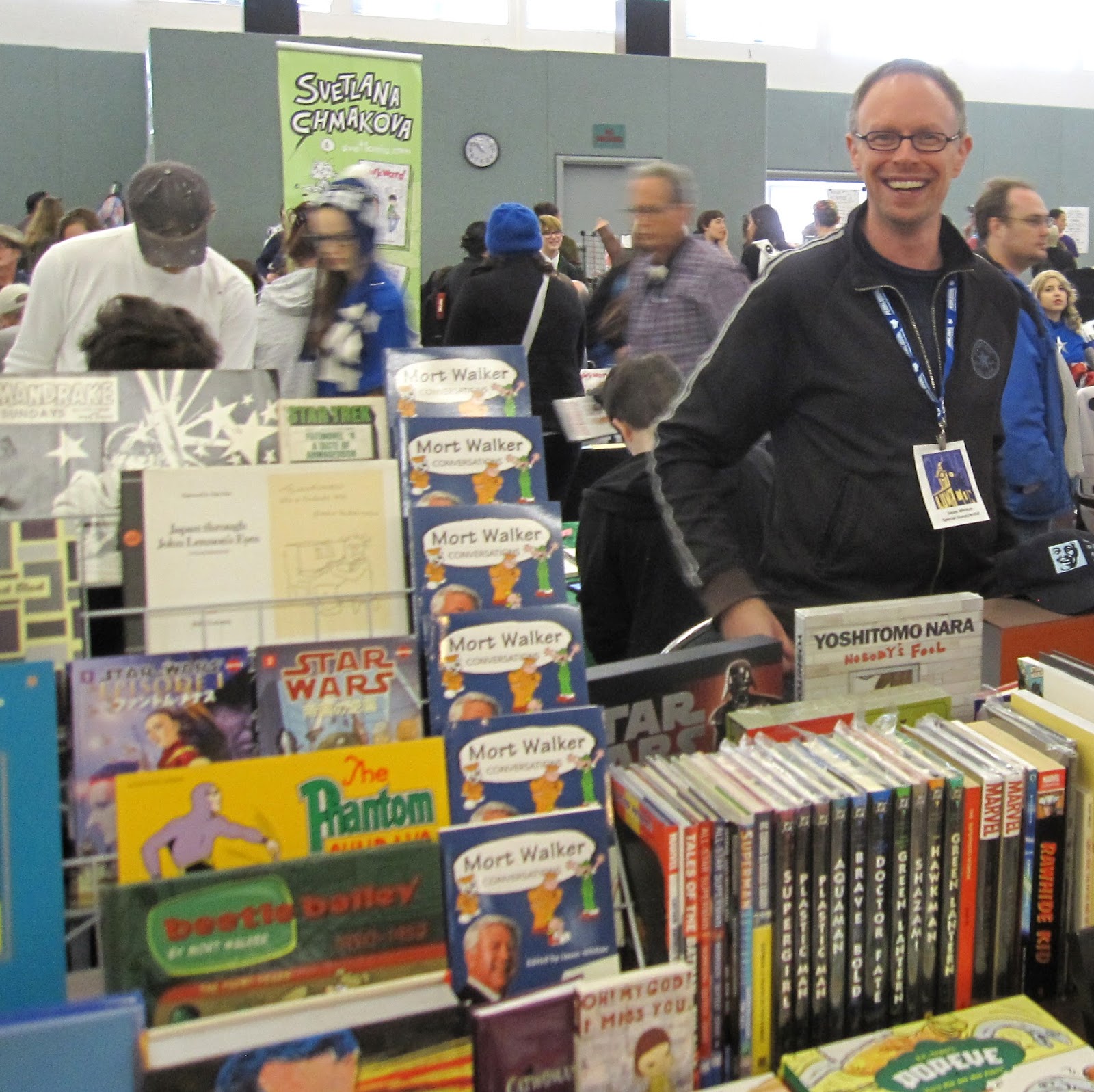 Writer, editor, teacher, and my pal Jason Whiton always stocks the most interesting table.
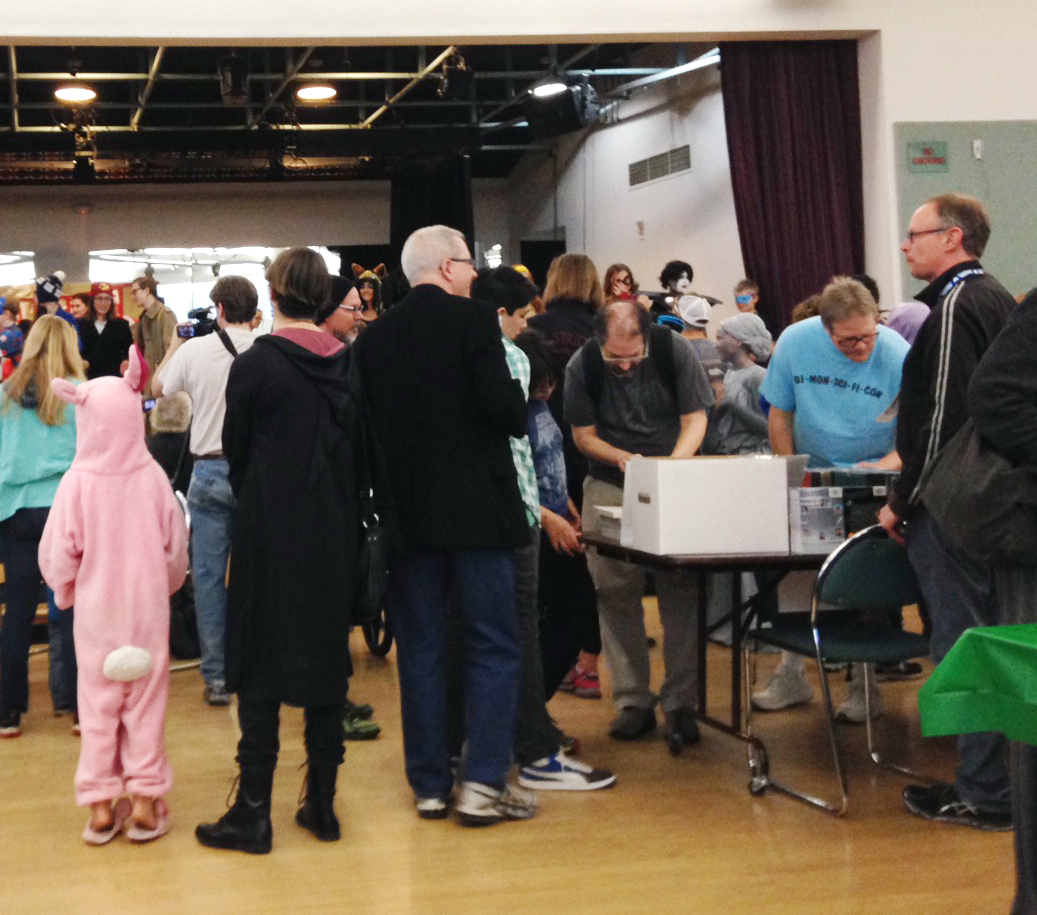 I'm in the center of this photo, so absorbed talking with Jason on the right that I totally missed I was being stalked by Little Ralphie from "A Christmas Story." Truly, a pink nightmare.
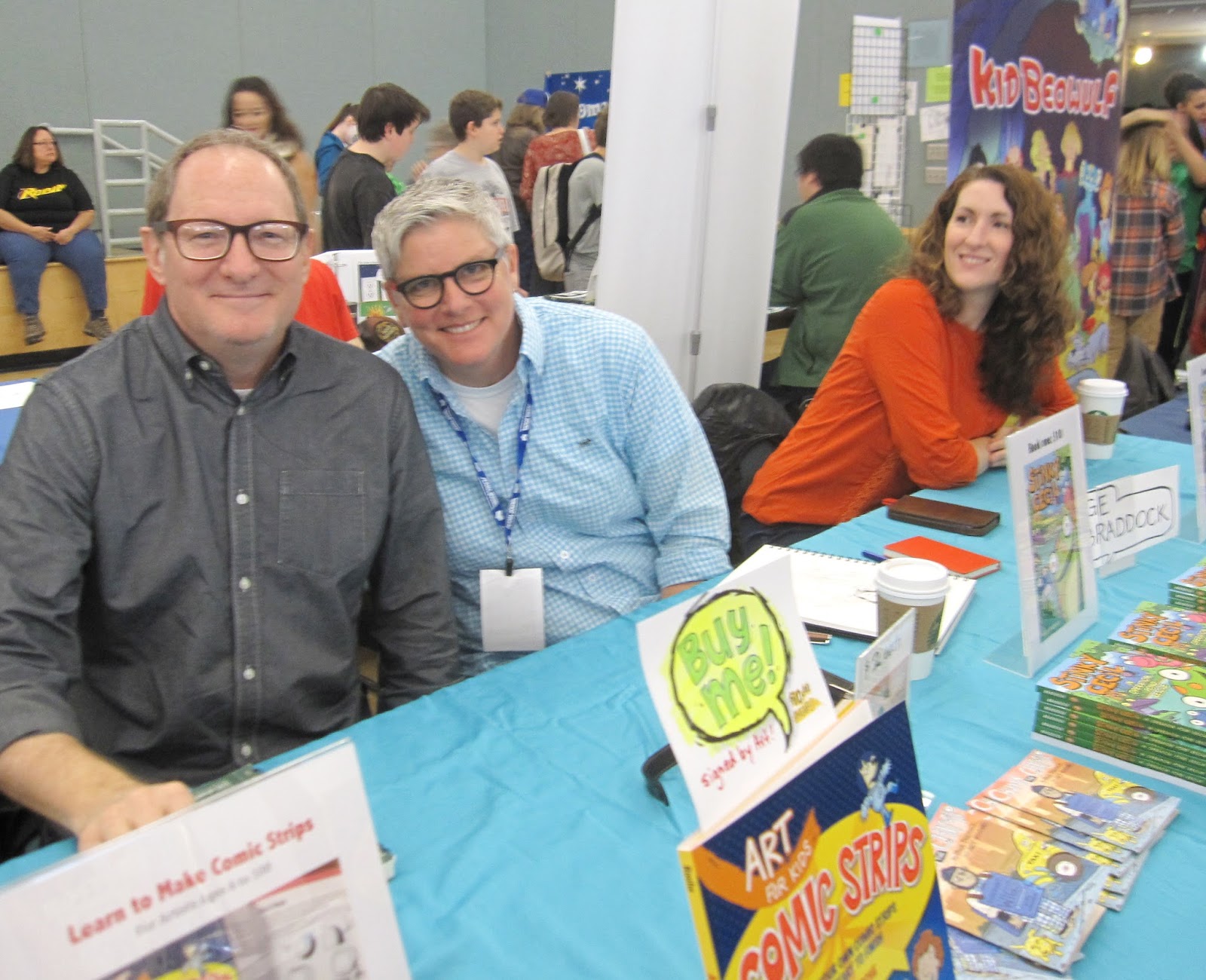 Schulz Studio pals Art Roche and Paige Braddock ("Jane's World," "Stinky Cecil") with Paige's wife Evelyn, who thought she had successfully leaned out of the shot.
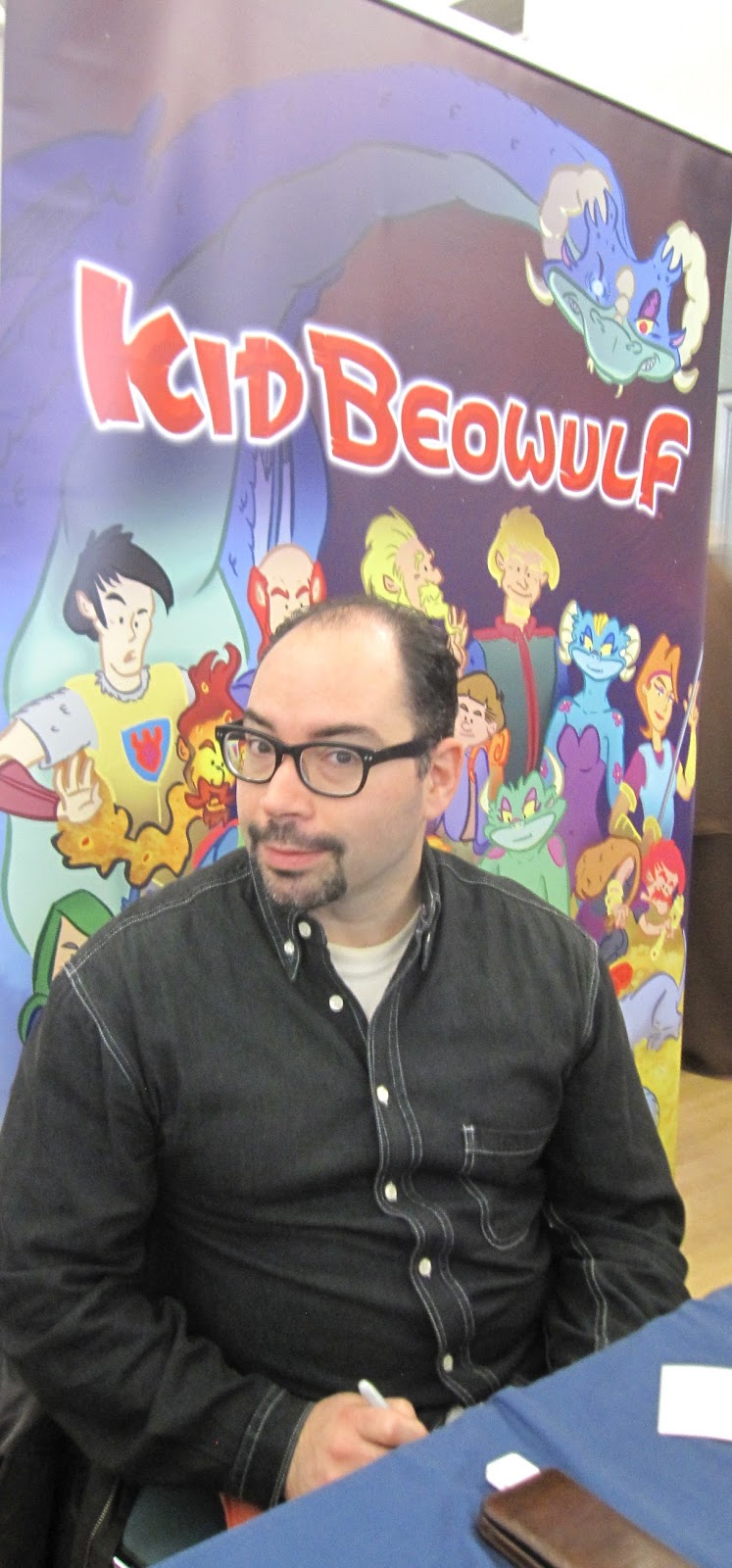 Another Schulz Studio pal, Lex Fajardo, flogged his great multi-volume "Kid Beowulf" series.
Lex and I also did a panel together at midday.
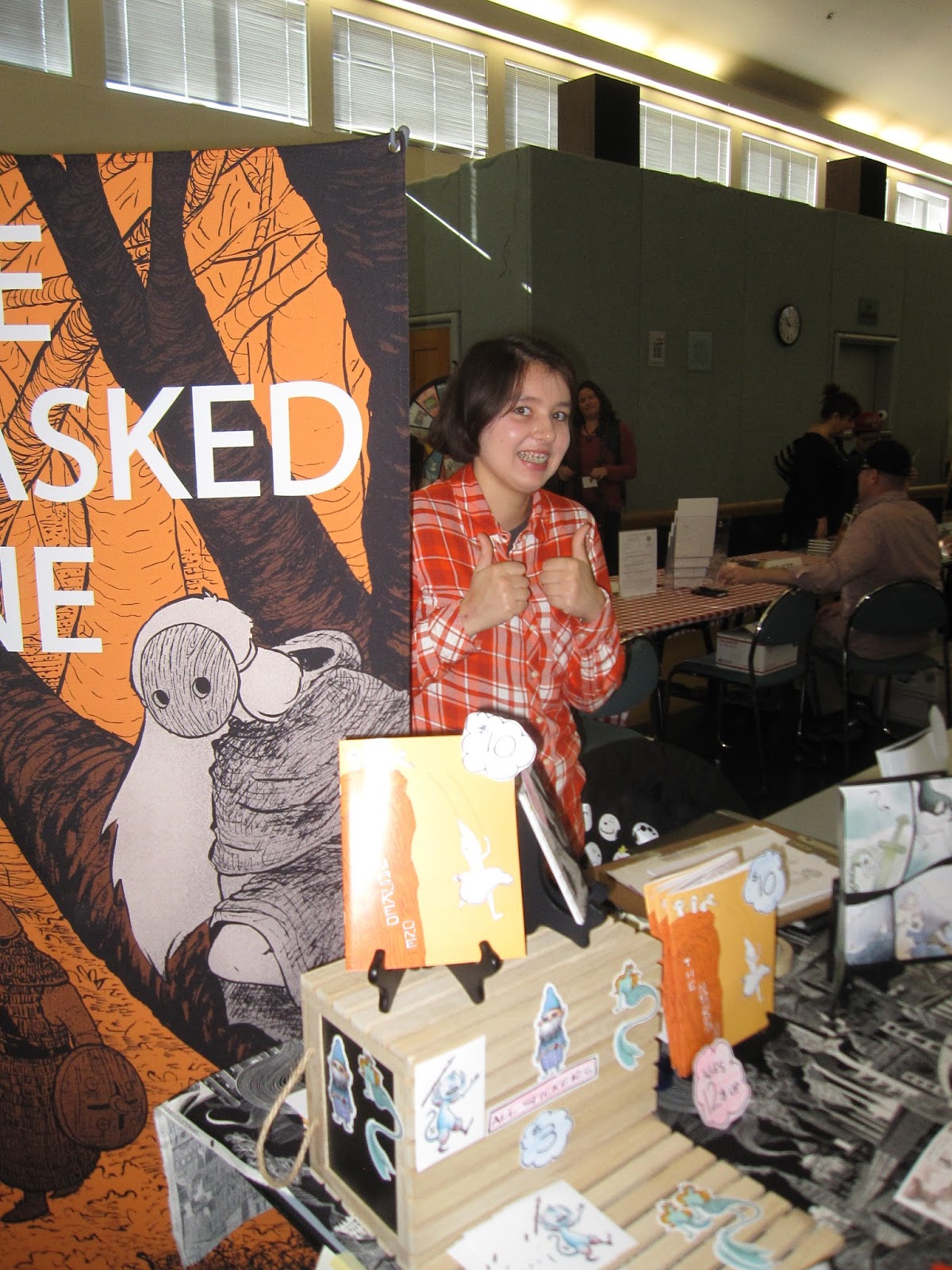 This is a talented young artist I first met when she was a little girl. She works under the pen name Sam Coaass but to me she's Erin. If drive and determination are worth anything, she'll do very well.
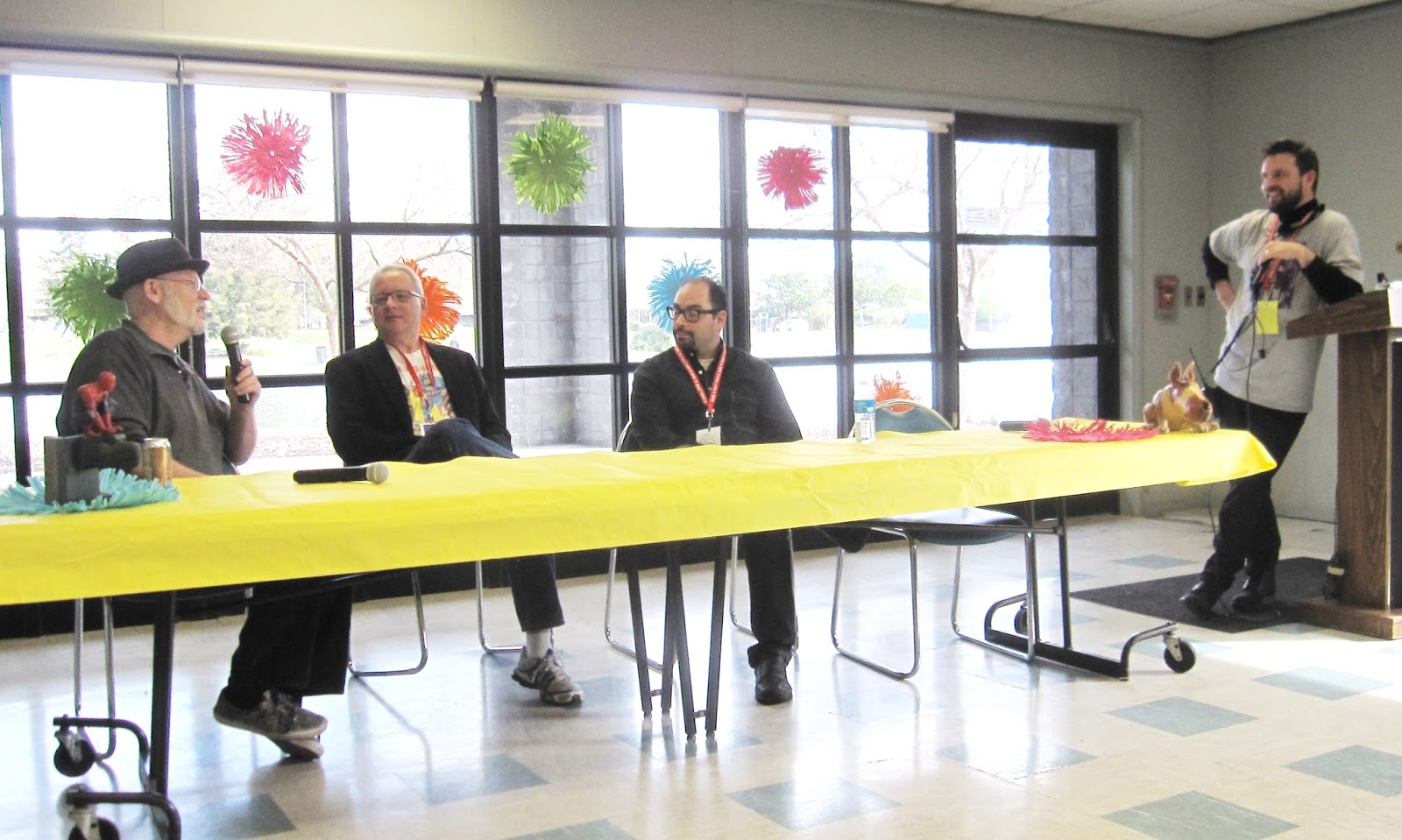 Cartoonist Tom Beland ("True Story Swear to God," Marvel), me, Lex, and moderator Nathan Libecap doing our panel on "Comics as Literature." I think it went well.
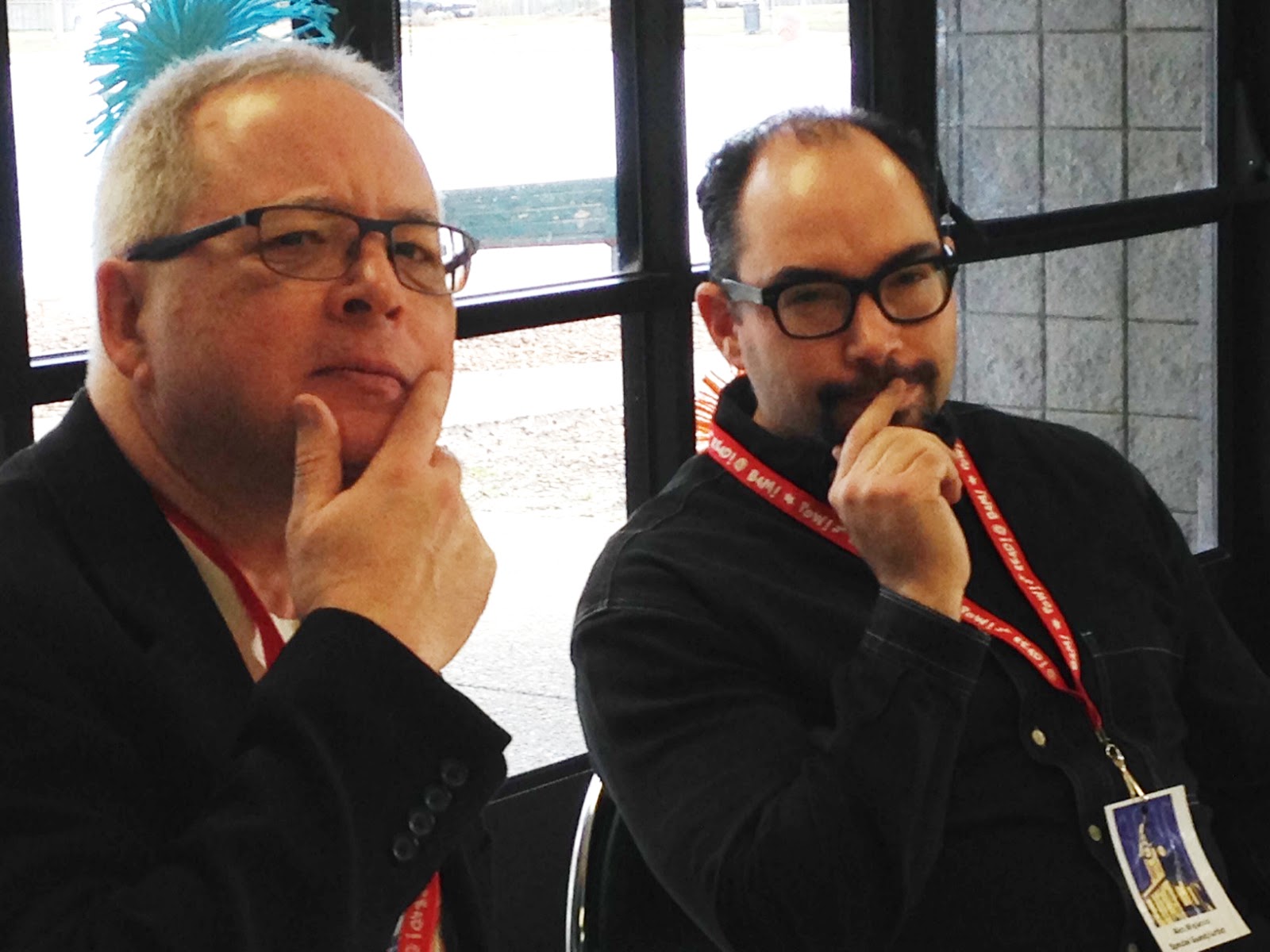 These are the expressions Karen got when she told us to "look thoughtful." Lex is better at thinking deep thoughts than I am.
I don't mean to oversell it. After all, LumaCon is just a little comics convention, but I find it uniquely fun and satisfying. It's small, intimate, charming, low-key. The opportunity to mix with people who are just there because they love comics is rarer than you'd think. The people organizing it are motivated solely by their love of the medium and their students (they'd better be, because they're evidently forbidden to make a dime on it). They treat their guests right (cuff links!).
I told a couple of them that, like Linus's pumpkin patch, LumaCon is the most sincere comics convention I know. Still is.
January 26, 2016
LumaCon and More Upcoming
As the song goes, "I've been one poor correspondent." I'm busy working on secret-for-the-time-being projects that might turn into books. I find that Facebook is a good home for little bits of news or comment that I once would have blogged about (which is no good to anyone who isn't my Facebook friend, I know). Also, I kind of feel that after 10 years of blogging I've said a lot of what I've got to say.
Still, the Fies Files haven't been abandoned, and I can imagine business will pick up here in a few weeks or months when I can talk about the projects I can't talk about.
Just wanted to mention now that I'll be at this Saturday's "LumaCon" comics convention in Petaluma, Calif. I'll be holding down a table diffidently selling my books, and also taking part in a panel at 1 p.m. The con is Saturday, 10 a.m. to 4 p.m., click that link for details.
I went to the first-ever LumaCon last year and had a terrific time. One of my best convention experiences ever, no kidding. It's organized by librarians with the purpose of bringing kids together with creators, and I found the whole thing low-key, small-town, and very sincere. Here's a blog post I wrote about it. This year's is in a larger facility. It's also free! I don't know how they do that. Seems to me they oughtta at least charge a couple bucks a head just so people'd appreciate the effort that goes into it.
In mid-February I've been invited to the University of Michigan in Ann Arbor. I'll be talking to a class on Health & Society that's reading Mom's Cancer, then speaking at the Ann Arbor District Library that evening. I'm in town one day only: Tuesday, February 16. More details on that later.
If there's anywhere more fun than Michigan in February, I can't imagine it.
Otherwise, all is well. Hope the same is true for you.
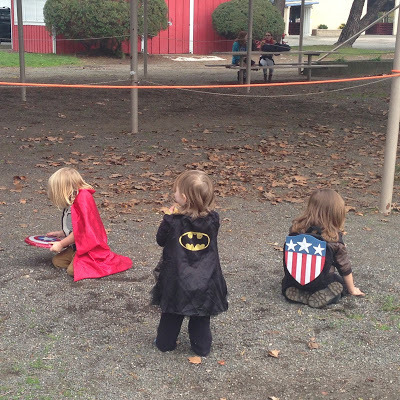 My favorite photo from last year's LumaCon, which captured the feel of the event for me.
Still, the Fies Files haven't been abandoned, and I can imagine business will pick up here in a few weeks or months when I can talk about the projects I can't talk about.
Just wanted to mention now that I'll be at this Saturday's "LumaCon" comics convention in Petaluma, Calif. I'll be holding down a table diffidently selling my books, and also taking part in a panel at 1 p.m. The con is Saturday, 10 a.m. to 4 p.m., click that link for details.
I went to the first-ever LumaCon last year and had a terrific time. One of my best convention experiences ever, no kidding. It's organized by librarians with the purpose of bringing kids together with creators, and I found the whole thing low-key, small-town, and very sincere. Here's a blog post I wrote about it. This year's is in a larger facility. It's also free! I don't know how they do that. Seems to me they oughtta at least charge a couple bucks a head just so people'd appreciate the effort that goes into it.
In mid-February I've been invited to the University of Michigan in Ann Arbor. I'll be talking to a class on Health & Society that's reading Mom's Cancer, then speaking at the Ann Arbor District Library that evening. I'm in town one day only: Tuesday, February 16. More details on that later.
If there's anywhere more fun than Michigan in February, I can't imagine it.
Otherwise, all is well. Hope the same is true for you.
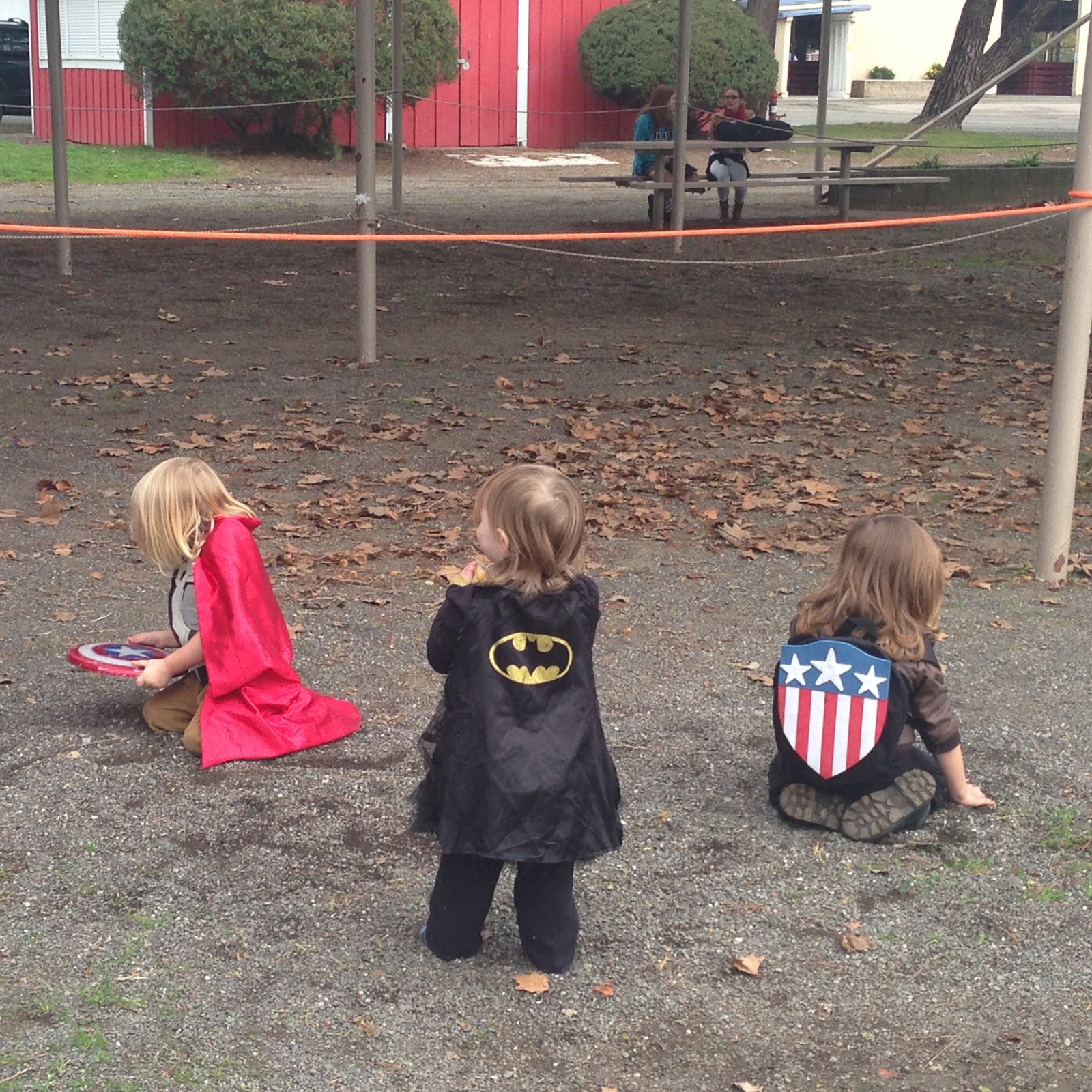 My favorite photo from last year's LumaCon, which captured the feel of the event for me.
December 24, 2015
Nora's Freezin' On The Trolley
Here's a morsel of whimsy that's become a Christmas tradition around these parts. Sing along; you know the tune (I'm not sure about all the scat singing in the middle, but it's the best version I found). All my best wishes to y'all.
Deck us all with Boston Charlie,
Walla Walla, Wash., an' Kalamazoo!
Nora's freezin' on the trolley,
Swaller dollar cauliflower alley-garoo!
Don't we know archaic barrel,
Lullaby Lilla boy, Louisville Lou?
Trolley Molly don't love Harold,
Boola boola Pensacoola hullabaloo!
Bark us all bow-wows of folly,
Polly wolly cracker n' too-da-loo!
Hunky Dory's pop is lolly
gaggin' on the wagon,
Willy, folly go through!
Donkey Bonny brays a carol,
Antelope Cantaloup, 'lope with you!
Chollie's collie barks at Barrow,
Harum scarum five alarum bung-a-loo! --Walt Kelly
Deck us all with Boston Charlie,
Walla Walla, Wash., an' Kalamazoo!
Nora's freezin' on the trolley,
Swaller dollar cauliflower alley-garoo!
Don't we know archaic barrel,
Lullaby Lilla boy, Louisville Lou?
Trolley Molly don't love Harold,
Boola boola Pensacoola hullabaloo!
Bark us all bow-wows of folly,
Polly wolly cracker n' too-da-loo!
Hunky Dory's pop is lolly
gaggin' on the wagon,
Willy, folly go through!
Donkey Bonny brays a carol,
Antelope Cantaloup, 'lope with you!
Chollie's collie barks at Barrow,
Harum scarum five alarum bung-a-loo! --Walt Kelly
December 16, 2015
Book Mapping
"The dirty secret of comics is that a lot of it involves copy fitting."--Justin Green
Book maps are on my mind these days. They're production tools that publishers, and some authors, use when plotting out how a book will go together. Maybe you could adapt the idea to your own projects.
As with all my process posts, this is only one way to make the sausage. It's not the only or best way; it's just mine.
You'd think the graphic novelist's responsibility would be writing the words, drawing the pictures, and telling the best story they could. But in fact, the form shapes the content (only in print; online, none of these rules apply, which is one of the liberating things about it). Other things the graphic novelist needs to consider:
--Chapters should begin on right (odd-numbered) pages and end on left (even-numbered) pages, which means all chapters have an even number of pages.
--Two-page spreads need to span an even- and odd-numbered pair of pages.
--The number of pages in a book should ideally be divisible by 16, or at least 8, because those are the number of pages in a signature or half-signature (a "signature" being a bundle of sheets of paper used in the book-binding process). Mom's Cancer is 128 pages (16 x 8); Whatever Happened to the World of Tomorrow is 208 pages (16 x 13). The page count of any book you've ever read is some multiple of 4 because that's how they're made.
Mom's Cancer was a publishing production challenge because I created it as a webcomic with no regard for any of this stuff. Different pages are in black-and-white (b&w) or color depending on whether I thought it was right for the story. However, for print, it would have been really nice if the b&w and color portions had broken down neatly into signatures or half-signatures--for example, if the first 8 pages were color, the next 16 were b&w, the following 16 were color, etc. Being able to print a signature in b&w instead of full color drops its printing costs by about three-fourths. That's why, in a lot of books, you'll see a bunch of color illustrations all gathered together in the middle while the rest of the book is b&w. Those color pages are their own signature printed separately from the others. Spreading them throughout the book would have cost a lot more money.
Editor Charlie and I wrestled with recoloring or reorganizing Mom's Cancer to make the signatures work out. We couldn't; my use of color was too scattered and integral to the storytelling. Charlie finally made the tough, expensive call to print the whole book in full color even though most of it was b&w! He could have insisted that Mom's Cancer be entirely b&w and I probably would have agreed, but he was a mensch who did the right thing and that's one of the reasons I love him.
World of Tomorrow was a different challenge. If you've read it, you'll recall that I created fake "old comic books" inserted into the book to show the comics my character Buddy read in different decades. They were printed on different paper stock (the cheapest pulp we could find) than the rest of the book. Three of the inserts were 8 pages and one was 16 pages, and now you know why.
In addition to being half or full signatures themselves, they had to fall between other signatures. That meant that, for example, the first fake comic book had to follow Page 32 (16 x 2). No matter what else was happening in the story, the action had to break on Page 32.
That's hard to keep track of. You'd almost need some sort of . . . map.
Here's what my book map looked like. In addition to tallying signatures and page counts, I also used it to manage my work flow.
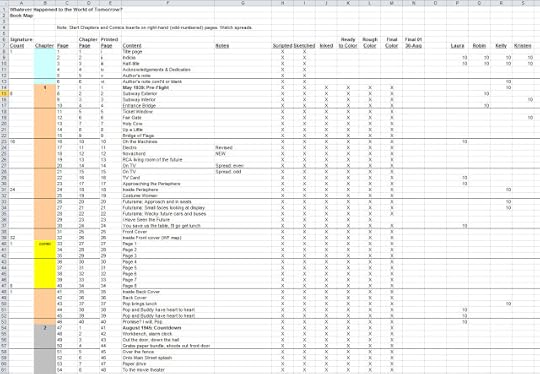 My book map in an Excel spreadsheet. The left column is the signature count, where I kept track of how many pages were in each half- or full-signature. The colored bars indicate chapters: blue is the front matter, orange/tan is Chapter 1, yellow is the first fake comic book insert (note that it follows Page 32, after which I restarted my signature count), followed by the remainder of Chapter 1 then the beginning of Chapter 2 in gray. Other columns provided a brief description to remind me what's on the page and check boxes to track my progress on each page. The final four columns tell me which pages I assigned to my Photoshop coloring assistants.
At the same time, unknown to me, Editor Charlie had made his own book map. It's laid out differently to give him information he needs, and it's interesting to compare and contrast.
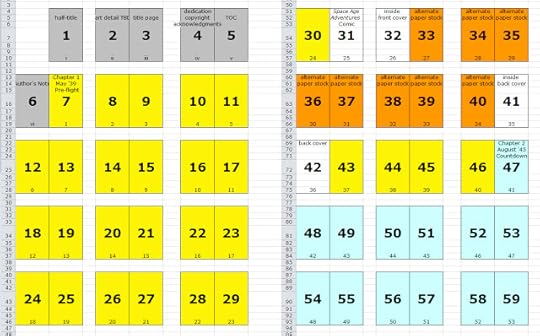 Charlie's book map, also in Excel. The gray pages are front matter, followed by Chapter 1 in yellow, the comic book insert in orange, and Chapter 2 in blue. Again, notice that the orange insert falls after Page 32. One nice feature of Charlie's map is it clearly shows Chapters 1 and 2 beginning on right-hand pages (pp. 7 and 47). Charlie also called out the front and back covers of the fake comic book (pp. 31, 32, 41, 42) but, in fact, they were printed on the same paper as the signatures before and after the inserts so no special attention was required.
I think book maps are particularly important for graphic novelists because each page is a discrete unit that has to fit with all the others. In a regular text novel, a writer or editor can add or subtract words, paragraphs or even chapters without doing much damage; in a graphic novel, adding or deleting one page tips over a chain of dominoes that clatters through the entire book.
Book maps are on my mind because I'm making a new one for a new book I'm not talking about until contracts are signed. If all goes as planned, it'll be full color throughout (so that won't be a problem) and will also have a few "special features" that'll need to go between signatures. With a first draft almost done, it's time to see how it fits into the mold while it's still flexible enough to reshape.
. . .
Cartoonist Justin Green delivered the quip at the top of this post during his lecture at the 2015 Comics & Medicine Conference in Riverside, Calif. I think I was the only person in the audience who guffawed because I found it very funny and true. Sometimes all you're trying to do is make the words fit.
Readers think writers and artists draw their words and images from the deepest wells of artistic self-expression. Well . . . ideally. But, at least in comics, more often than you'd think, I replace one word with another just because I'm out of space and it's shorter. I'll add or delete panels so the next chapter begins on an odd-numbered page. I'll tear up a story and reorganize it to put a signature break where I need it.
There's a nuts-and-bolts craftsmanship to publishing that I imagine some creators find frustrating but I really enjoy. It's like haiku: do whatever you want as long as it fits the structure. I like the constraints, especially the part where if you handle them right the reader never realizes they were there.
Book maps are on my mind these days. They're production tools that publishers, and some authors, use when plotting out how a book will go together. Maybe you could adapt the idea to your own projects.
As with all my process posts, this is only one way to make the sausage. It's not the only or best way; it's just mine.
You'd think the graphic novelist's responsibility would be writing the words, drawing the pictures, and telling the best story they could. But in fact, the form shapes the content (only in print; online, none of these rules apply, which is one of the liberating things about it). Other things the graphic novelist needs to consider:
--Chapters should begin on right (odd-numbered) pages and end on left (even-numbered) pages, which means all chapters have an even number of pages.
--Two-page spreads need to span an even- and odd-numbered pair of pages.
--The number of pages in a book should ideally be divisible by 16, or at least 8, because those are the number of pages in a signature or half-signature (a "signature" being a bundle of sheets of paper used in the book-binding process). Mom's Cancer is 128 pages (16 x 8); Whatever Happened to the World of Tomorrow is 208 pages (16 x 13). The page count of any book you've ever read is some multiple of 4 because that's how they're made.
Mom's Cancer was a publishing production challenge because I created it as a webcomic with no regard for any of this stuff. Different pages are in black-and-white (b&w) or color depending on whether I thought it was right for the story. However, for print, it would have been really nice if the b&w and color portions had broken down neatly into signatures or half-signatures--for example, if the first 8 pages were color, the next 16 were b&w, the following 16 were color, etc. Being able to print a signature in b&w instead of full color drops its printing costs by about three-fourths. That's why, in a lot of books, you'll see a bunch of color illustrations all gathered together in the middle while the rest of the book is b&w. Those color pages are their own signature printed separately from the others. Spreading them throughout the book would have cost a lot more money.
Editor Charlie and I wrestled with recoloring or reorganizing Mom's Cancer to make the signatures work out. We couldn't; my use of color was too scattered and integral to the storytelling. Charlie finally made the tough, expensive call to print the whole book in full color even though most of it was b&w! He could have insisted that Mom's Cancer be entirely b&w and I probably would have agreed, but he was a mensch who did the right thing and that's one of the reasons I love him.
World of Tomorrow was a different challenge. If you've read it, you'll recall that I created fake "old comic books" inserted into the book to show the comics my character Buddy read in different decades. They were printed on different paper stock (the cheapest pulp we could find) than the rest of the book. Three of the inserts were 8 pages and one was 16 pages, and now you know why.
In addition to being half or full signatures themselves, they had to fall between other signatures. That meant that, for example, the first fake comic book had to follow Page 32 (16 x 2). No matter what else was happening in the story, the action had to break on Page 32.
That's hard to keep track of. You'd almost need some sort of . . . map.
Here's what my book map looked like. In addition to tallying signatures and page counts, I also used it to manage my work flow.
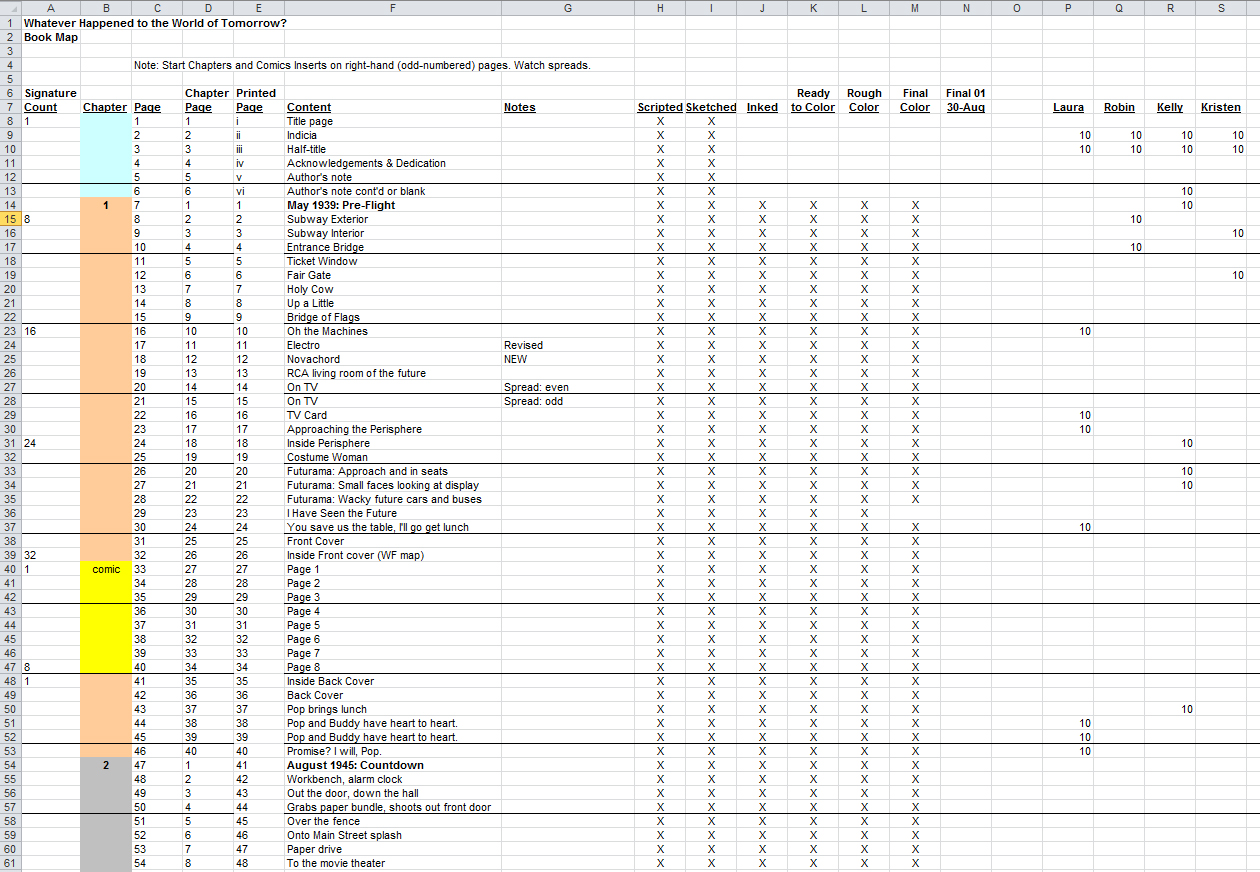 My book map in an Excel spreadsheet. The left column is the signature count, where I kept track of how many pages were in each half- or full-signature. The colored bars indicate chapters: blue is the front matter, orange/tan is Chapter 1, yellow is the first fake comic book insert (note that it follows Page 32, after which I restarted my signature count), followed by the remainder of Chapter 1 then the beginning of Chapter 2 in gray. Other columns provided a brief description to remind me what's on the page and check boxes to track my progress on each page. The final four columns tell me which pages I assigned to my Photoshop coloring assistants.
At the same time, unknown to me, Editor Charlie had made his own book map. It's laid out differently to give him information he needs, and it's interesting to compare and contrast.
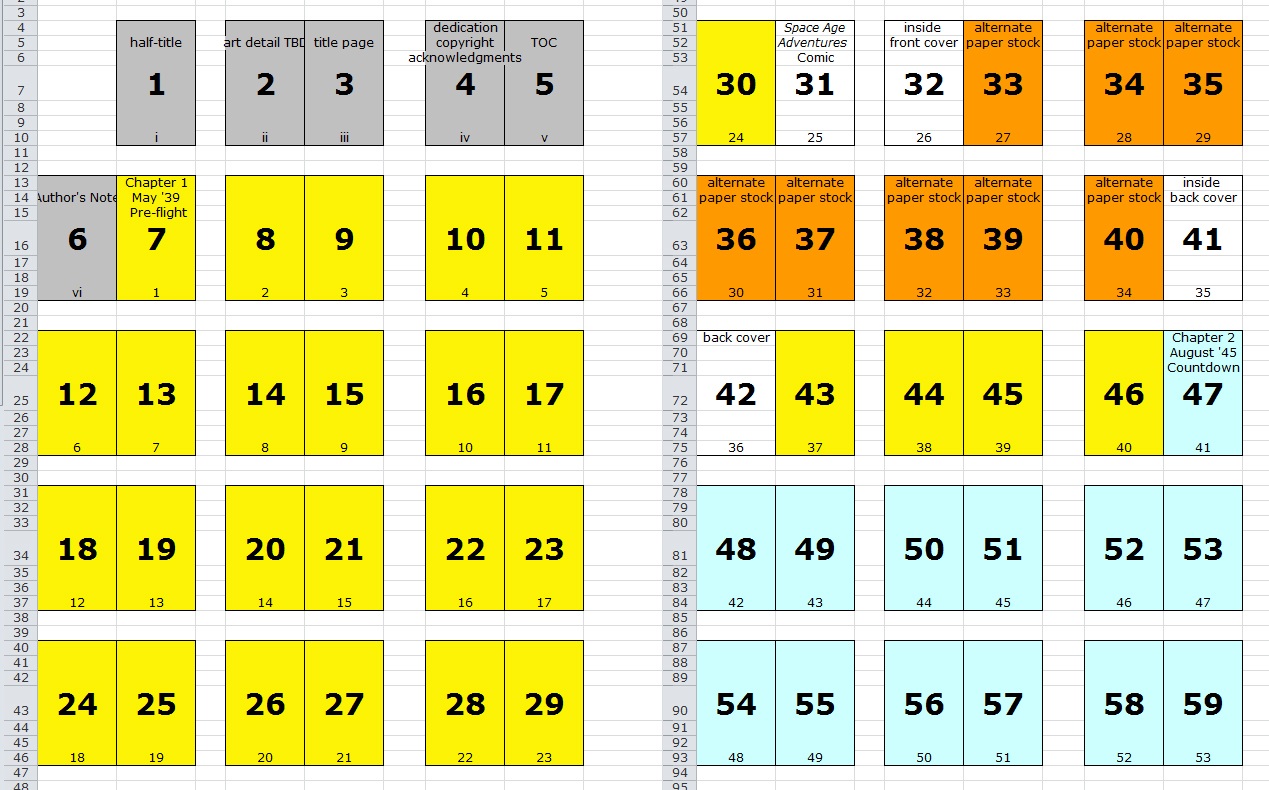 Charlie's book map, also in Excel. The gray pages are front matter, followed by Chapter 1 in yellow, the comic book insert in orange, and Chapter 2 in blue. Again, notice that the orange insert falls after Page 32. One nice feature of Charlie's map is it clearly shows Chapters 1 and 2 beginning on right-hand pages (pp. 7 and 47). Charlie also called out the front and back covers of the fake comic book (pp. 31, 32, 41, 42) but, in fact, they were printed on the same paper as the signatures before and after the inserts so no special attention was required.
 I think book maps are particularly important for graphic novelists because each page is a discrete unit that has to fit with all the others. In a regular text novel, a writer or editor can add or subtract words, paragraphs or even chapters without doing much damage; in a graphic novel, adding or deleting one page tips over a chain of dominoes that clatters through the entire book.
Book maps are on my mind because I'm making a new one for a new book I'm not talking about until contracts are signed. If all goes as planned, it'll be full color throughout (so that won't be a problem) and will also have a few "special features" that'll need to go between signatures. With a first draft almost done, it's time to see how it fits into the mold while it's still flexible enough to reshape.
. . .
Cartoonist Justin Green delivered the quip at the top of this post during his lecture at the 2015 Comics & Medicine Conference in Riverside, Calif. I think I was the only person in the audience who guffawed because I found it very funny and true. Sometimes all you're trying to do is make the words fit.
Readers think writers and artists draw their words and images from the deepest wells of artistic self-expression. Well . . . ideally. But, at least in comics, more often than you'd think, I replace one word with another just because I'm out of space and it's shorter. I'll add or delete panels so the next chapter begins on an odd-numbered page. I'll tear up a story and reorganize it to put a signature break where I need it.
There's a nuts-and-bolts craftsmanship to publishing that I imagine some creators find frustrating but I really enjoy. It's like haiku: do whatever you want as long as it fits the structure. I like the constraints, especially the part where if you handle them right the reader never realizes they were there.
November 13, 2015
Steely-Eyed Missile Men
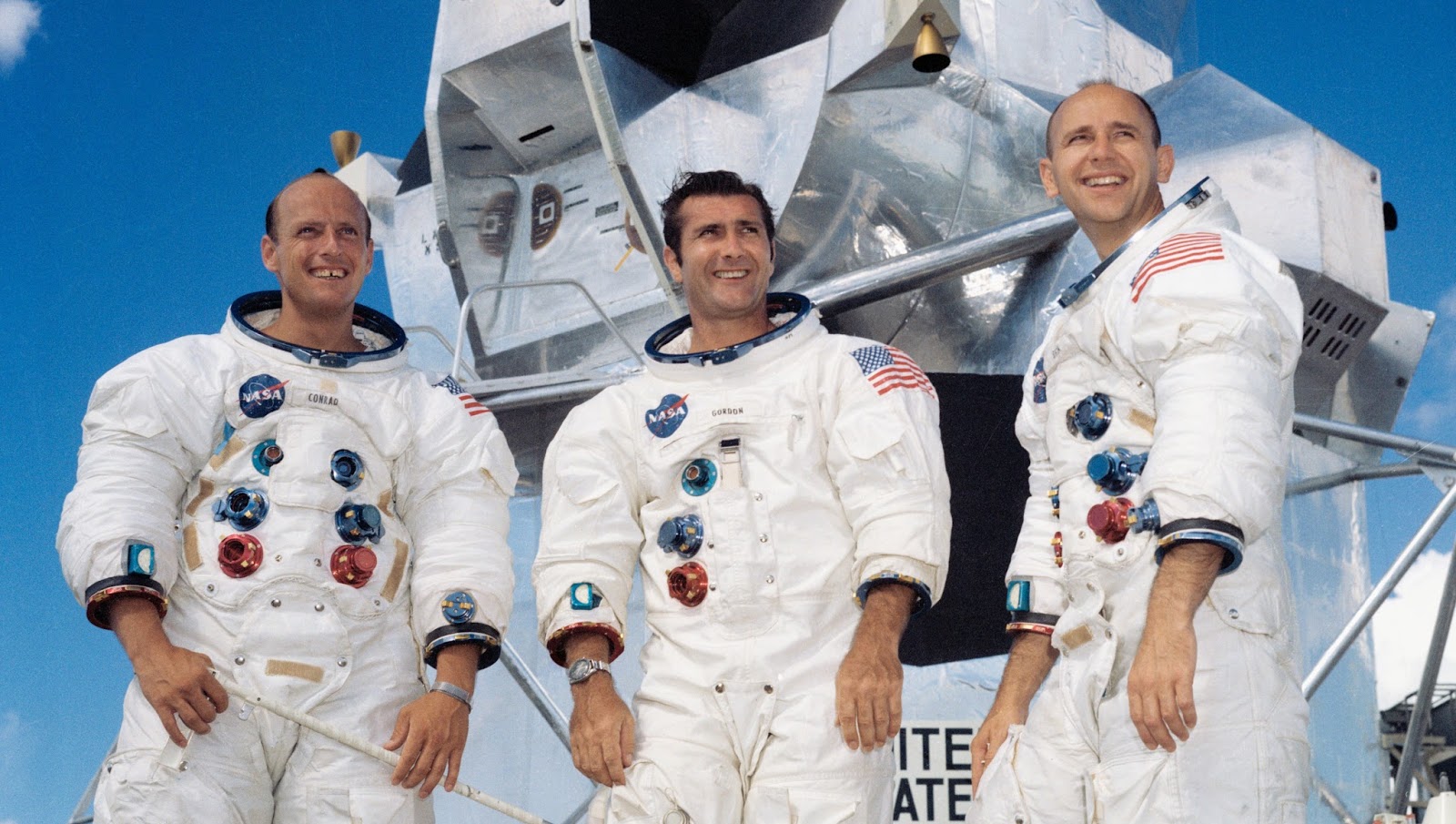 Pete Conrad, Dick Gordon and Alan Bean, the crew of Apollo 12
Tomorrow, November 14, is "SCE to AUX Day," one of the obscurer high holidays on the Space Age geek calendar. It's a reminder of how close the nation once came to disaster, and how one quick-witted person saved the day.
On November 14, 1969, Apollo 12 blasted off for the Moon in cloudy, crummy weather. Half a minute after liftoff it was struck by a bolt of lightning that fried every control in the command module and followed the ship's exhaust trail all the way to ground. This four-minute video tells the story. Short version: if not for the deep knowledge and calm decision-making of flight controller John Aaron, who remembered seeing a similar situation during a training simulation and told the astronauts to flip one switch--"Try SCE (Signal Conditioning Electronics) to AUX (Auxiliary)"--the mission would have been aborted, the rocket destroyed, and the astronauts possibly killed. No one else, including the astronauts, had the faintest idea what "SCE to AUX" meant, but they flipped the switch and their instruments came back on. Apollo 12 was saved.
Aaron's cool action under extreme pressure earned him the supreme NASA compliment of "steely-eyed missile man," a phrase I was delighted to hear used in "The Martian" movie.
The more dramatic perils of Apollo 13 are better-known, and rightly so, but this situation was just as dire. "SCE to AUX" is a reminder of just how dangerous those missions were, how thin the margins for error, and what a huge difference it made having the right smart people in the right place at the right time--and then trusting them when they told you to try something that wasn't in the manual.
Both Apollos 12 and 13 could have easily ended tragically. Apollo astronauts have since admitted they figured their chances of completing a successful mission and returning in one piece were 50-50. The fact that six missions landed on the Moon and returned their crews home is an astonishing success against great odds and a testament to tremendous courage (you'll recall that the astronauts of Apollo 13 didn't land on the Moon but successfully limped back to Earth, which has to count as a triumph, too).
A couple of years ago I had a chance to meet Apollo 12 Command Module Pilot Dick Gordon. Before the event, I asked the biggest space geek I know, my pal Jim O'Kane (whose Bureau of Astonishing Explanations has a library of wonderful short videos on a wealth of space topics and trivia, check it out), what he'd ask Gordon if he had the chance.
Ever since Apollo 12's liftoff, there's been a question/controversy about the presence of President Richard Nixon at the launch. Some think that the liftoff went ahead despite bad weather because Nixon had come to watch it, and nobody had the guts to scrub the launch and send the president home empty-handed. That was my question: did Gordon think Nixon's presence put any pressure on NASA to launch when maybe they shouldn't have?
Gordon shut me down before I had the question half out of my mouth.
"No," he said sharply. "Nobody at NASA would have done that. That wasn't the way we operated in those days."
Gordon seemed a little insulted. Nice job, Jim, you made me piss off an Apollo astronaut. I was also pretty sure that, at the age of 84, Gordon could have still kicked my ass if he'd wanted to.
Still, he was nice enough to autograph a Command Module model I'd brought for the occasion, and we had a nice conversation over a pizza afterward, so I think I was forgiven.
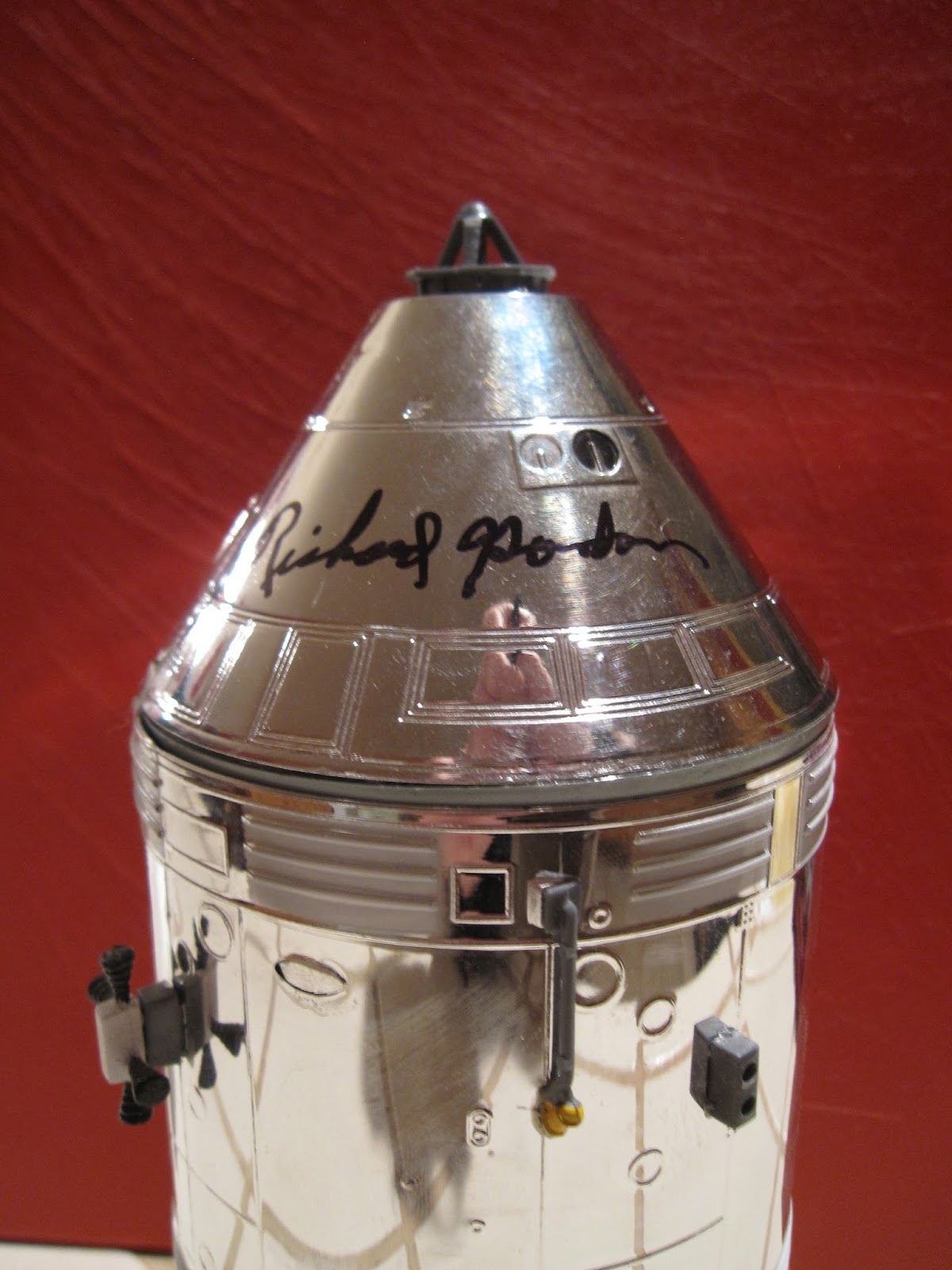
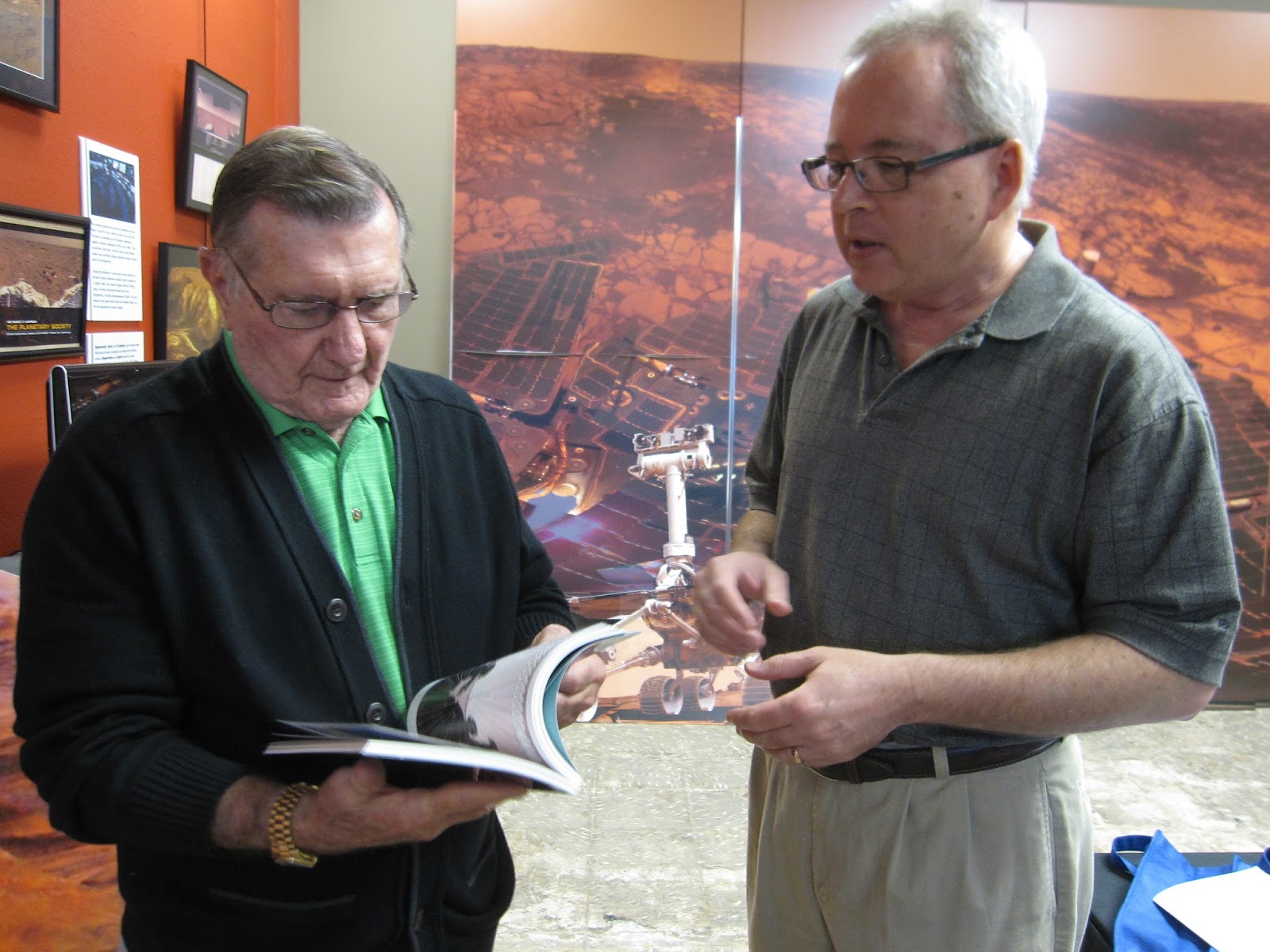 I also gave him a copy of Whatever Happened to the World of Tomorrow.
When he asked "What's it about?" I answered, "Well, you're in it."
The further the Wild West frontier days of spaceflight fade into history, the more astonishing their accomplishments become. The hardware of the era looks more and more primitive. It's all chicken wire and rudimentary computers slower and stupider than those in a modern baby's toy. I can't help but recall Princess Leia's first impression of the Millennium Falcon: "You came in that thing? You're braver than I thought." After all, the Apollo 12 mission is closer in time to Lindbergh's flight in 1927 than it is to us.
"SCE to AUX" shows that it's not hardware and software that make the difference between great success and failure. Not entirely, anyway. The most vital, indispensable resource is people, such as John Aaron, who are so well-prepared that they know what to do when something they haven't prepared for inevitably happens. We can update the equipment all we want but we'll always need steely-eyed missile men.
October 25, 2015
Peanuts at 65
In 1962, John F. Kennedy invited a group of Nobel Prize winners to dinner and joked, "This is the most extraordinary collection of talent that has ever been gathered together at the White House, with the possible exception of when Thomas Jefferson dined alone."
I thought of that Saturday while sitting with a couple of dozen cartoonists helping the Charles M. Schulz Museum pay tribute to the 65th anniversary of "Peanuts." There was an extraordinary amount of talent in the building, which all together might have added up to a bit less than one Charles Schulz. The only problem with my paraphrase is that Schulz never set foot in his museum, which was built after he died. But he worked at the studio next door, and ate lunch and skated at the ice arena across the street, so I say close enough.
I started my day at the museum earlier than most, leading a three-hour workshop for Girl Scouts earning their Comic Artist merit badges. I've done a few of these before and they're always fun. We make jam comics and I talk about the history and conventions of the art form. To earn their badges the girls have to complete a four-panel comic strip applying all they've learned. My wife Karen, who has 20 years' experience in Scouts, is my faithful girl wrangler. She took most of the photos.
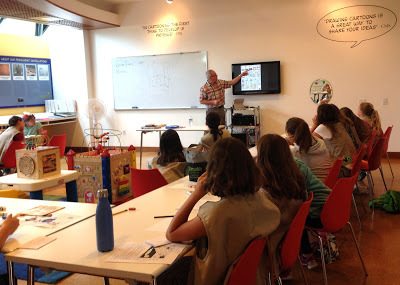 Me during the "blah blah" lecture part, which I try to keep short. We had 24 Scouts in this workshop.
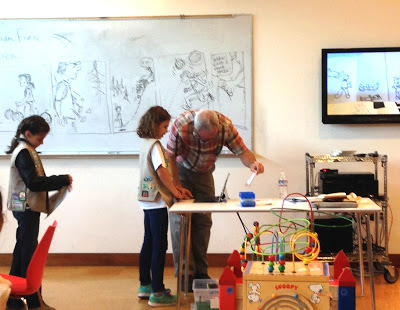 After the participants make their comics, I ask for volunteers to share theirs with the group using the camera in my laptop to show them on the monitor.
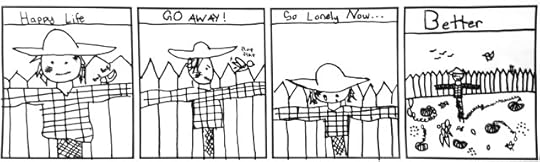 I liked this strip about a scarecrow who does its job too well. It's like a little poem.
The workshop went from 10 to 1, so I missed the Sketch-A-Thon's kick-off event: a panel discussion in the museum's theater about Peanuts' legacy that began at 1 (by the time I got cleaned up and downstairs, the theater was full). I heard it went well. Instead, I set up for the Sketch-A-Thon itself, which went from 2 to 4. My daughter Robin surprised me with a visit (Laura had to work and couldn't make it) and turned out to be a big help managing my table.
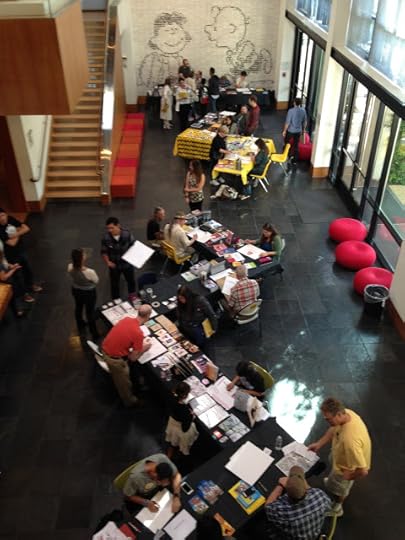 The museum's Great Hall. Cartoonists were seated at these zig-zag tables (it just occurred to me they may have been trying to mimic Charlie Brown's shirt stripe). I'm dead center in the red plaid shirt. My friend Gabby Gamboa is watercoloring to my right. Directly in front of me (with the hat and pony tail) is the great "Astro City" artist Brent Anderson.
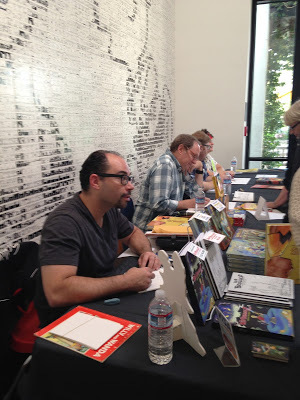 Lex Fajardo ("Kid Beowulf" and Schulz studio), Art Roche (Schulz studio), Eisner winner Shannon Watters ("Lumberjanes") and others held down the back wall.
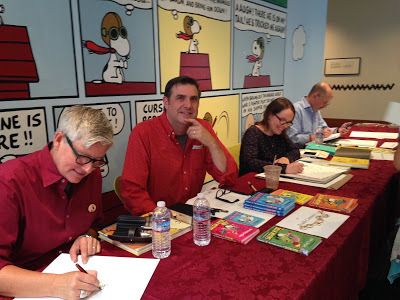 Paige Braddock (Schulz studio and "Jane's World"), Frank Cammuso ("Salem Hyde"), Raina Telgemeier (half the bestseller list), and Terry Moore ("Strangers in Paradise," "Echo") were seated near the front so they could all sign the 65th Anniversary Tribute book they contributed to.
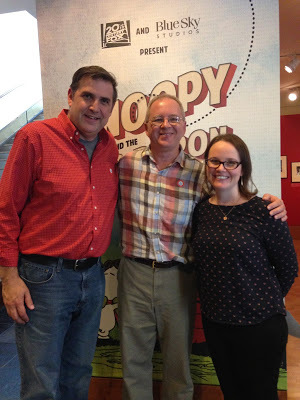 Frank and Raina kindly indulged me for this photo, which I really wanted to take because a decade ago we were all seated at the same table for the 2005 Eisner Awards (where "Mom's Cancer" won). This was a meaningful reunion for me.
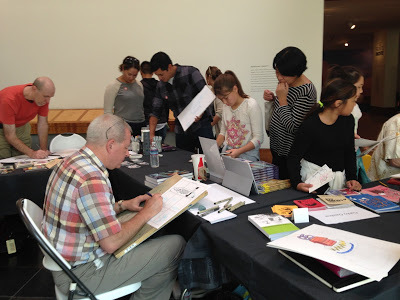 What made this a "Sketch-A-Thon" is that, in addition to talking to folks and selling our books and whatnot, everyone was supposed to draw some sort of tribute to "Peanuts." Here I am working on mine. Brian Kolm from Atomic Bear Press is in the red shirt behind me.
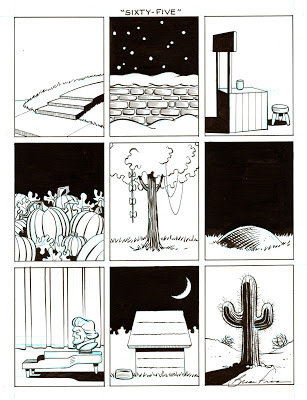 My tribute sketch. I actually had to bring it home to finish it, which gave me a chance to scan it, too. (The steps at upper left are from the very first "Peanuts" strip on Oct. 2, 1950.) If it feels a little melancholy, that's OK. So was "Peanuts."
After the Sketch-A-Thon we all walked over to the studio, where the Schulz folks had generously hired a fine food truck to feed us.
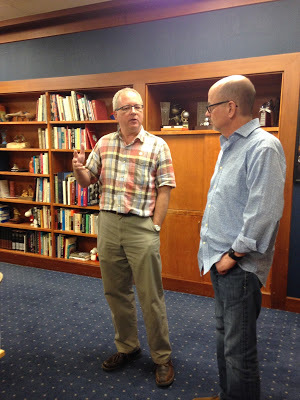 With Terry Moore in Schulz's studio. Notice the smattering of Eisner and other awards on the shelf behind us. These must be the ones that didn't fit into the museum, stuffed as it is with Emmy Awards and all.
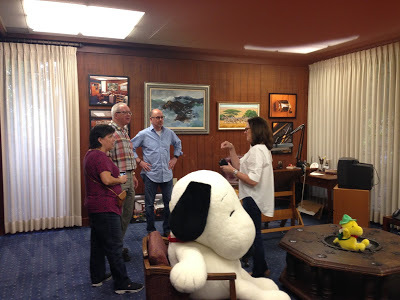 Another angle on the studio: Karen and I talking with Terry Moore and his wife Robyn. Photo by (my) Robin.
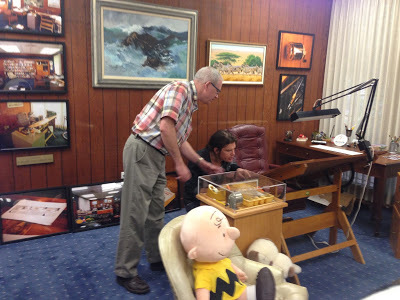 Scrutinizing Schulz's drawing board with comic book artist Paul Pope. I was pointing out that if you look at just the right angle, you can see Schulz's handwriting from his pen nib pressing through the paper into the wood. Photo by Robin.
I've been in Mr. Schulz's studio with other cartoonists a couple of times, and many of them do the exact same thing I did the first time. They eye the board and the chair. Then they look around. They really want to sit down at the board but they're afraid to. Somebody says, "Sure, go ahead!" so they reluctantly sit. Then a little electric shiver seems to go through them, as if they feel Schulz's aura emanating from the wood. If there's magic in the world, that's it.
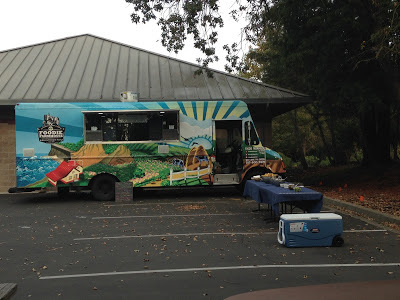 Dinner is almost served.
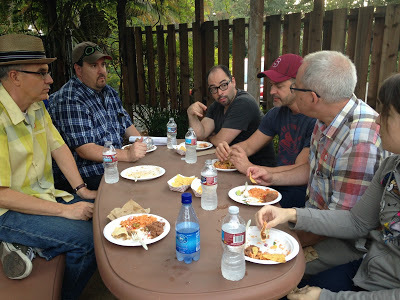 Tacos with Jonathan Lemon, Lucas Turnbloom, Lex Fajardo, Stephan Pastis (who didn't do the Sketch-A-Thon but just sort of shows up for free food), me and my daughter Robin.
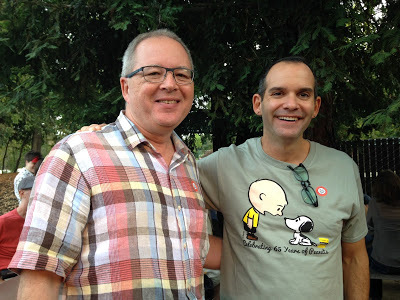 I met Judd Winick! I told him about graphic medicine and our international conferences, at which his "Pedro and Me" is frequently cited as an important early AIDS story. He seemed intrigued.
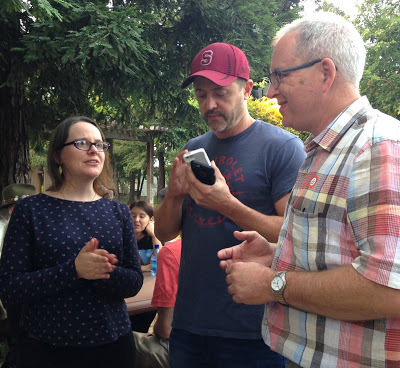 Talking about large-format scanners with Raina and Pastis.
 Lucas Turnbloom, who's illustrating a new book series called "Dream Jumper" for Scholastic, written by "Heroes" actor Greg Grunberg.
This was a long, very nice day for me. I reconnected with some friends who don't normally come out this way, made a couple of new ones, sold a few books, taught 24 Girl Scouts how to make comics, and ate a pretty darn good taco combo plate. I need to mention cartoonist Shaenon Garrity and Cartoon Art Museum curator Andrew Farago, who did me the honor of asking me to draw a picture in a book they're compiling for their newish son, Robin. I didn't get any good photos but it was terrific to see them.
I'm already looking forward to Peanuts' 70th.
I thought of that Saturday while sitting with a couple of dozen cartoonists helping the Charles M. Schulz Museum pay tribute to the 65th anniversary of "Peanuts." There was an extraordinary amount of talent in the building, which all together might have added up to a bit less than one Charles Schulz. The only problem with my paraphrase is that Schulz never set foot in his museum, which was built after he died. But he worked at the studio next door, and ate lunch and skated at the ice arena across the street, so I say close enough.
I started my day at the museum earlier than most, leading a three-hour workshop for Girl Scouts earning their Comic Artist merit badges. I've done a few of these before and they're always fun. We make jam comics and I talk about the history and conventions of the art form. To earn their badges the girls have to complete a four-panel comic strip applying all they've learned. My wife Karen, who has 20 years' experience in Scouts, is my faithful girl wrangler. She took most of the photos.
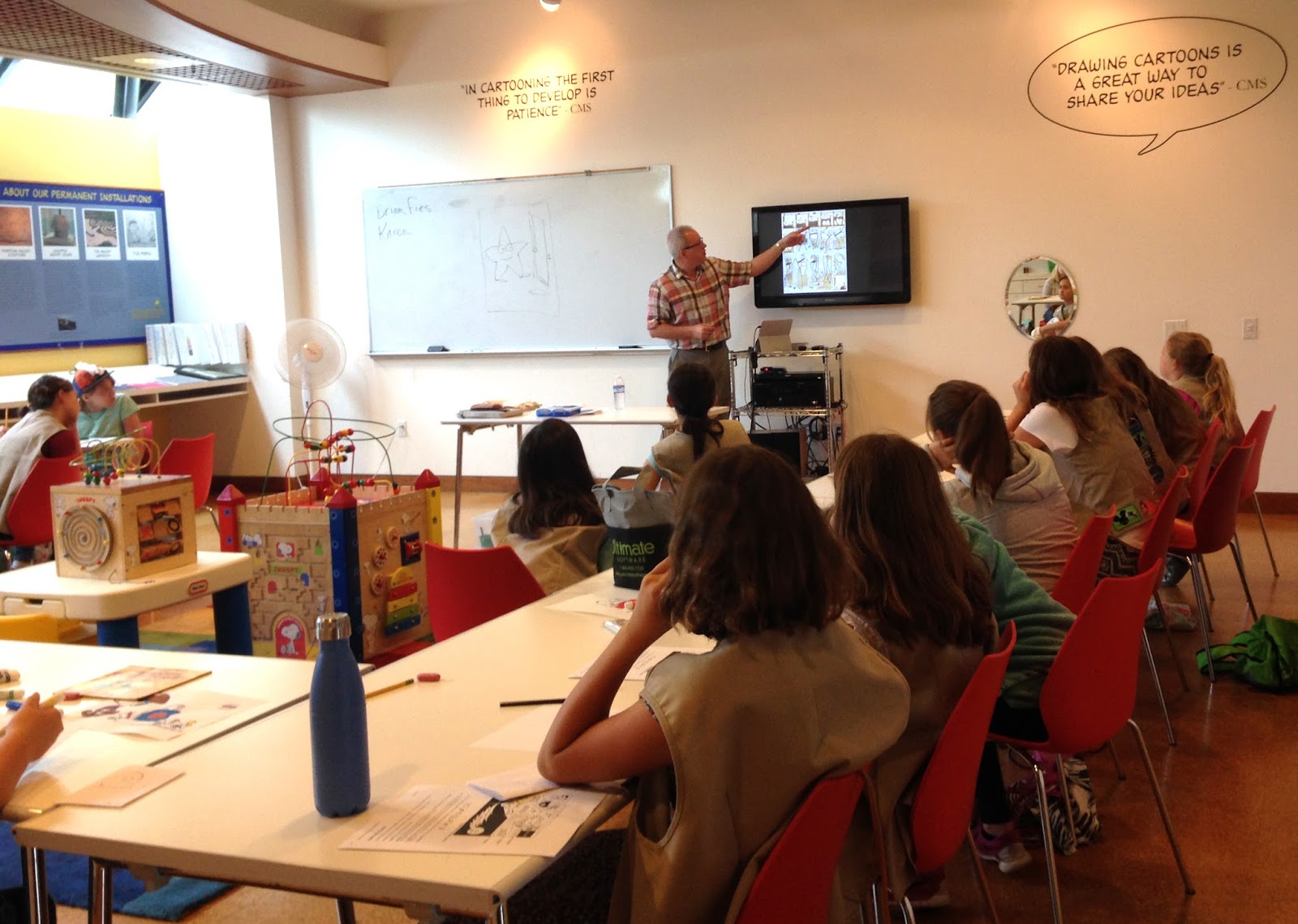 Me during the "blah blah" lecture part, which I try to keep short. We had 24 Scouts in this workshop.
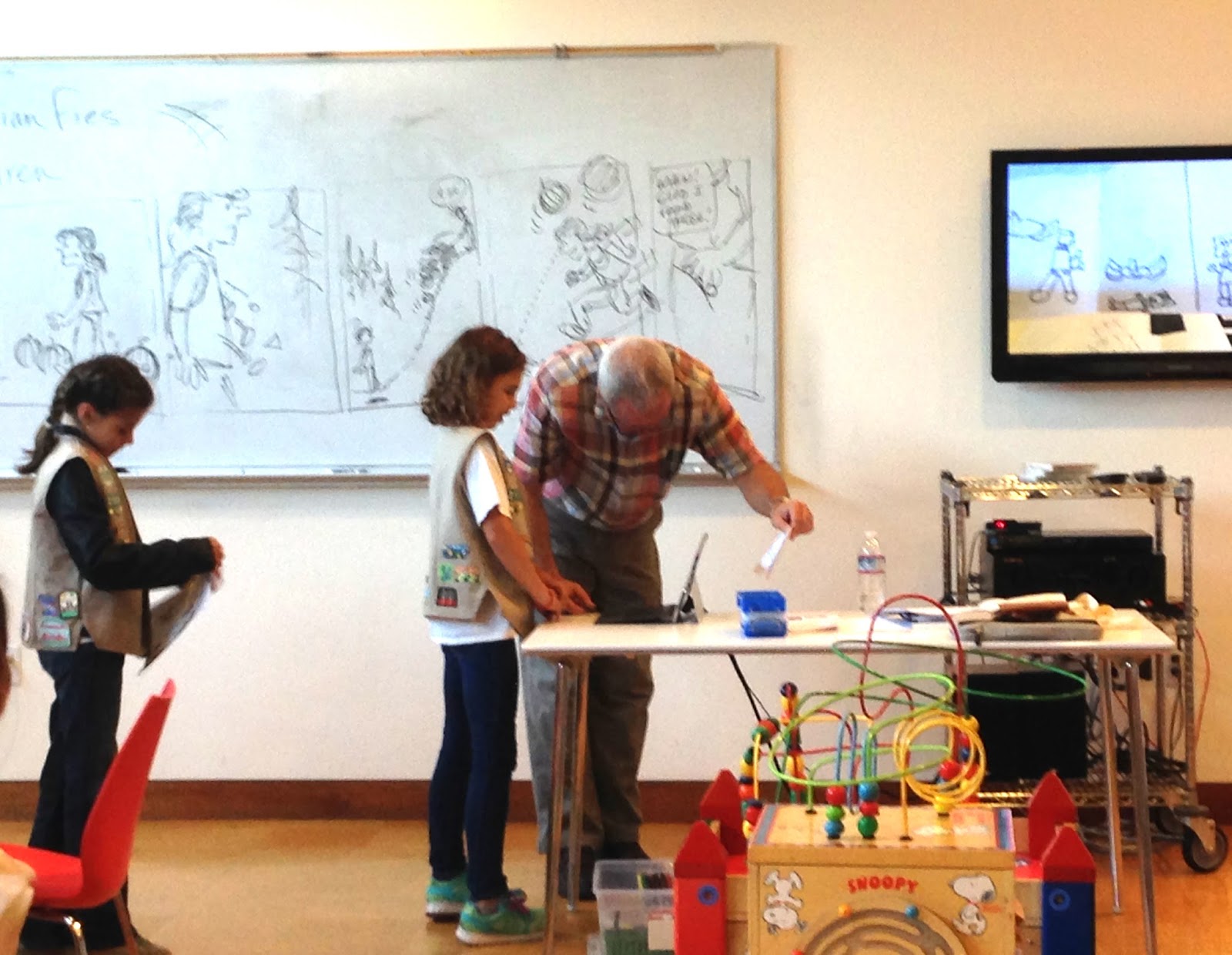 After the participants make their comics, I ask for volunteers to share theirs with the group using the camera in my laptop to show them on the monitor.
 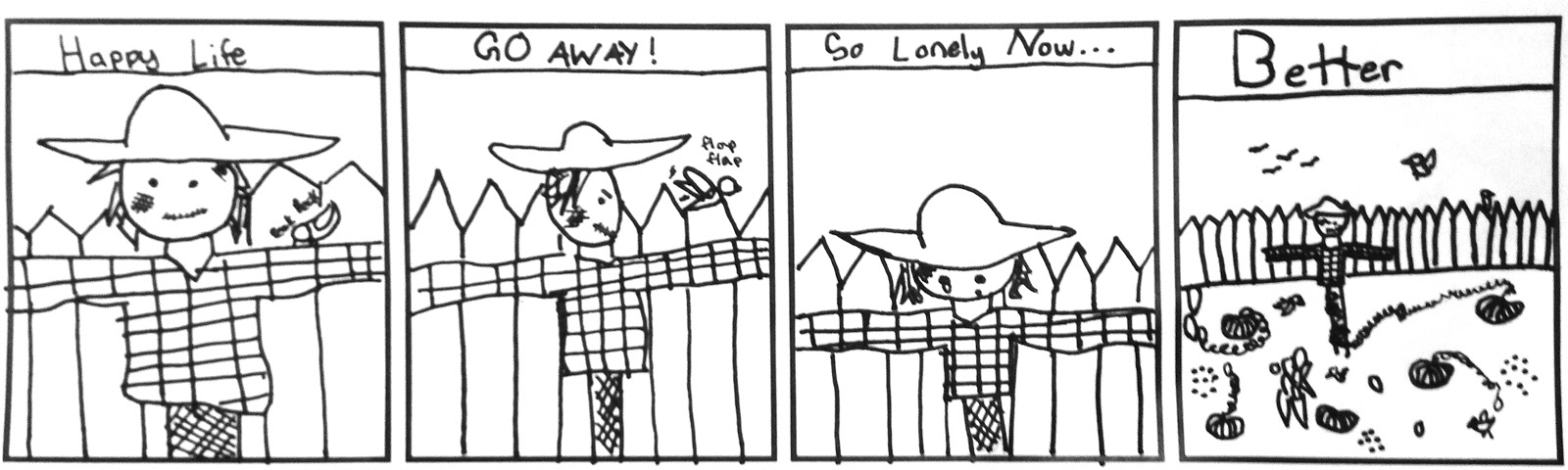 I liked this strip about a scarecrow who does its job too well. It's like a little poem.
The workshop went from 10 to 1, so I missed the Sketch-A-Thon's kick-off event: a panel discussion in the museum's theater about Peanuts' legacy that began at 1 (by the time I got cleaned up and downstairs, the theater was full). I heard it went well. Instead, I set up for the Sketch-A-Thon itself, which went from 2 to 4. My daughter Robin surprised me with a visit (Laura had to work and couldn't make it) and turned out to be a big help managing my table.
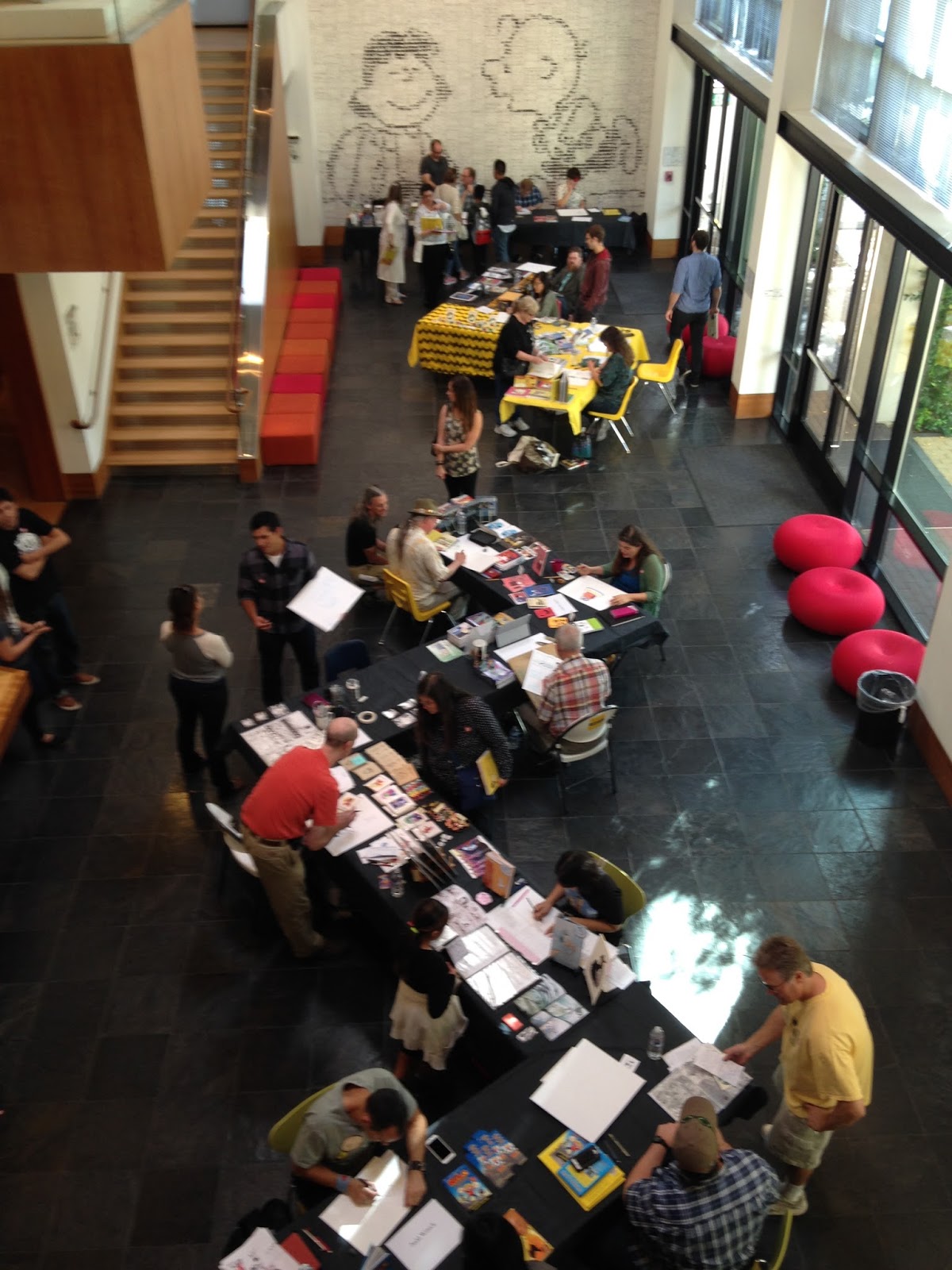 The museum's Great Hall. Cartoonists were seated at these zig-zag tables (it just occurred to me they may have been trying to mimic Charlie Brown's shirt stripe). I'm dead center in the red plaid shirt. My friend Gabby Gamboa is watercoloring to my right. Directly in front of me (with the hat and pony tail) is the great "Astro City" artist Brent Anderson.
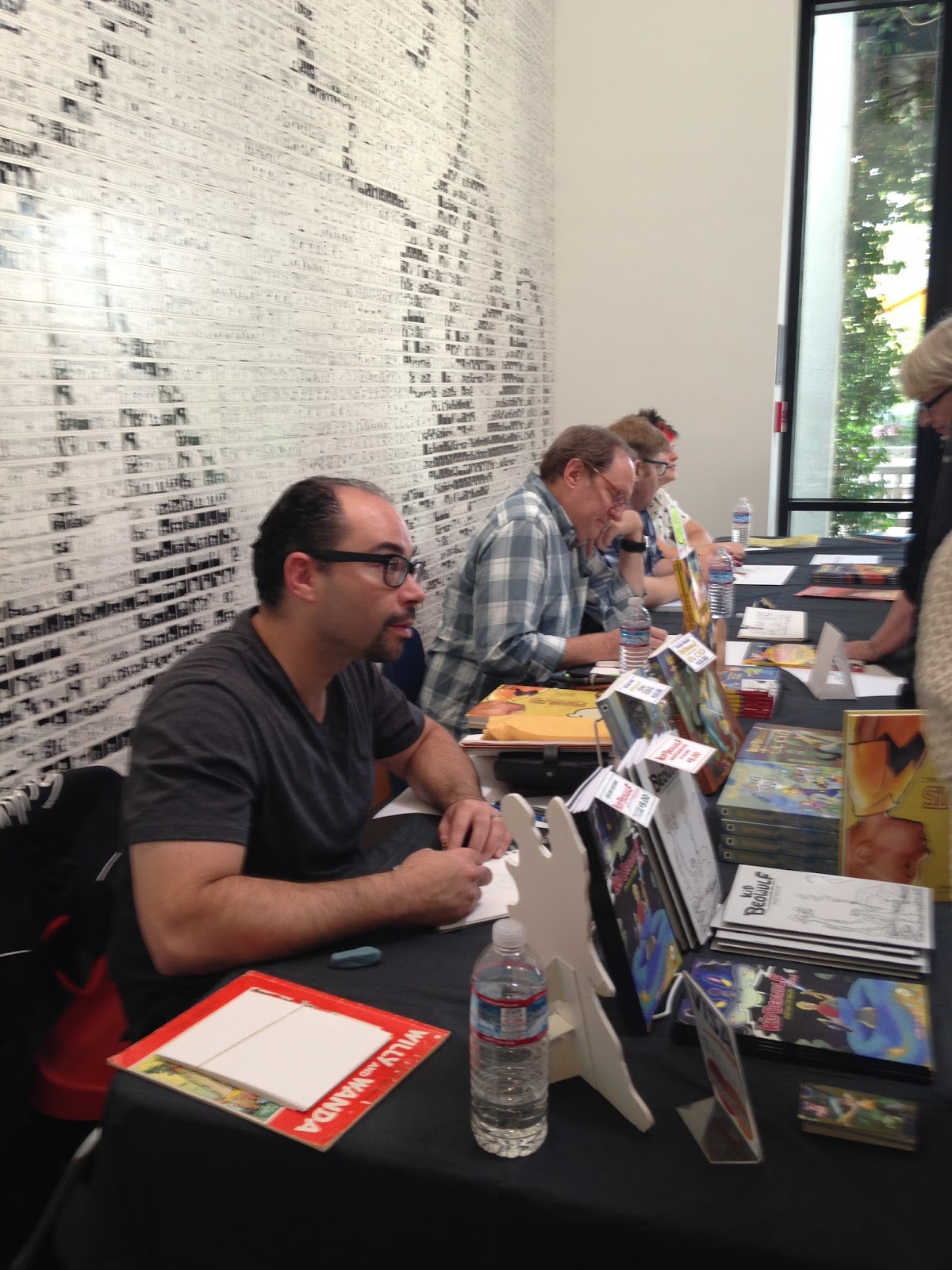 Lex Fajardo ("Kid Beowulf" and Schulz studio), Art Roche (Schulz studio), Eisner winner Shannon Watters ("Lumberjanes") and others held down the back wall.
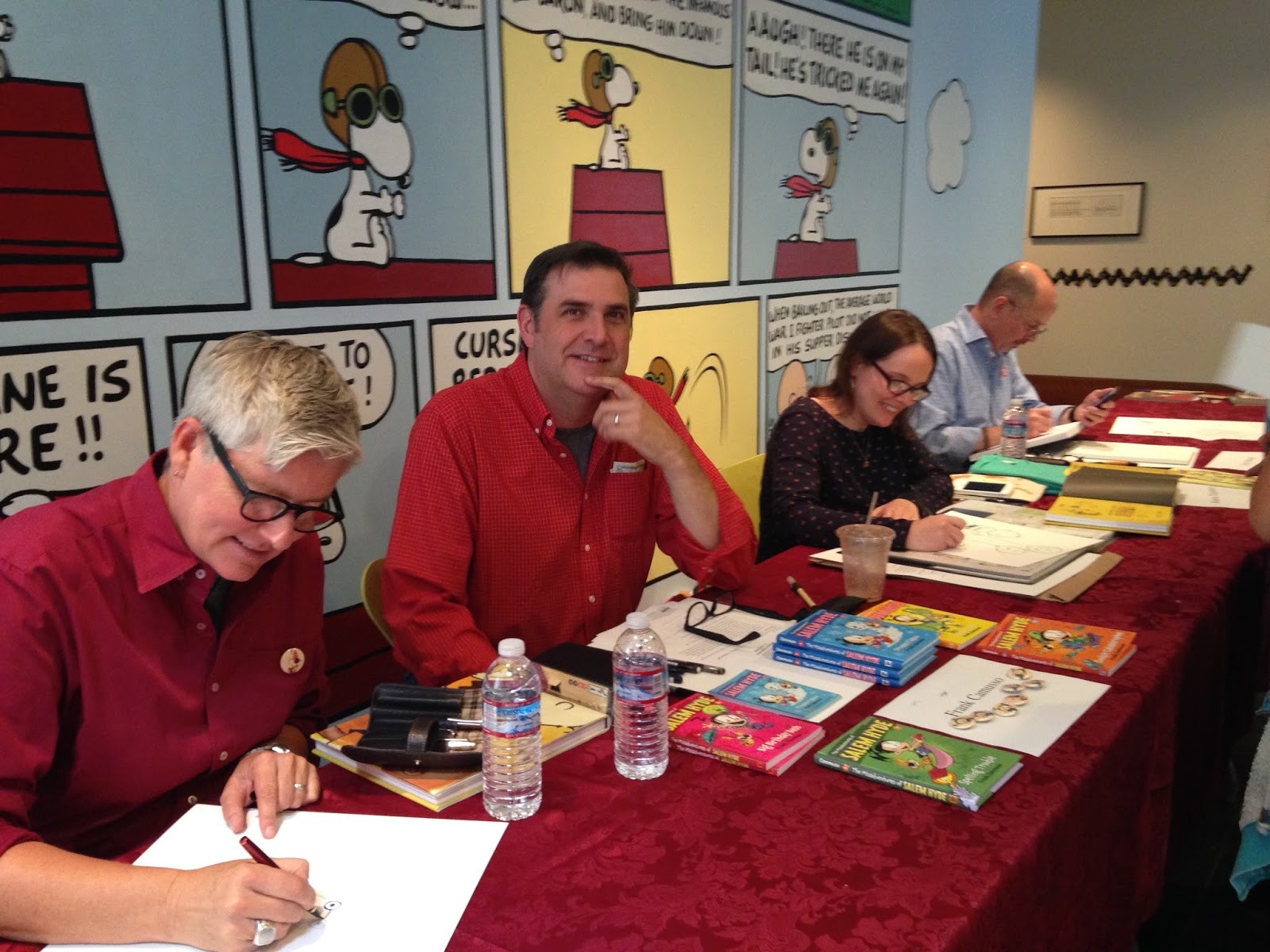 Paige Braddock (Schulz studio and "Jane's World"), Frank Cammuso ("Salem Hyde"), Raina Telgemeier (half the bestseller list), and Terry Moore ("Strangers in Paradise," "Echo") were seated near the front so they could all sign the 65th Anniversary Tribute book they contributed to.
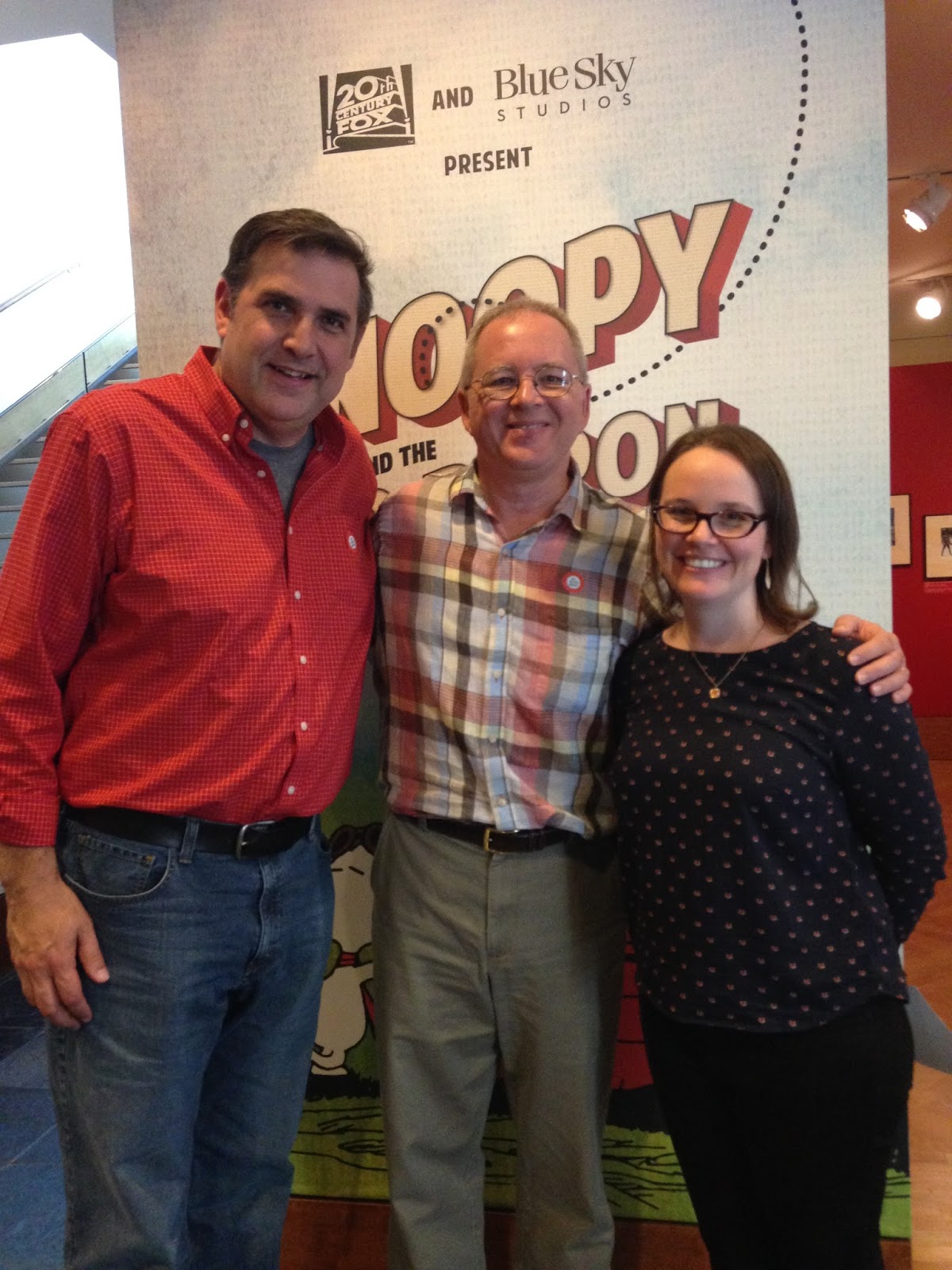 Frank and Raina kindly indulged me for this photo, which I really wanted to take because a decade ago we were all seated at the same table for the 2005 Eisner Awards (where "Mom's Cancer" won). This was a meaningful reunion for me.
 What made this a "Sketch-A-Thon" is that, in addition to talking to folks and selling our books and whatnot, everyone was supposed to draw some sort of tribute to "Peanuts." Here I am working on mine. Brian Kolm from Atomic Bear Press is in the red shirt behind me.
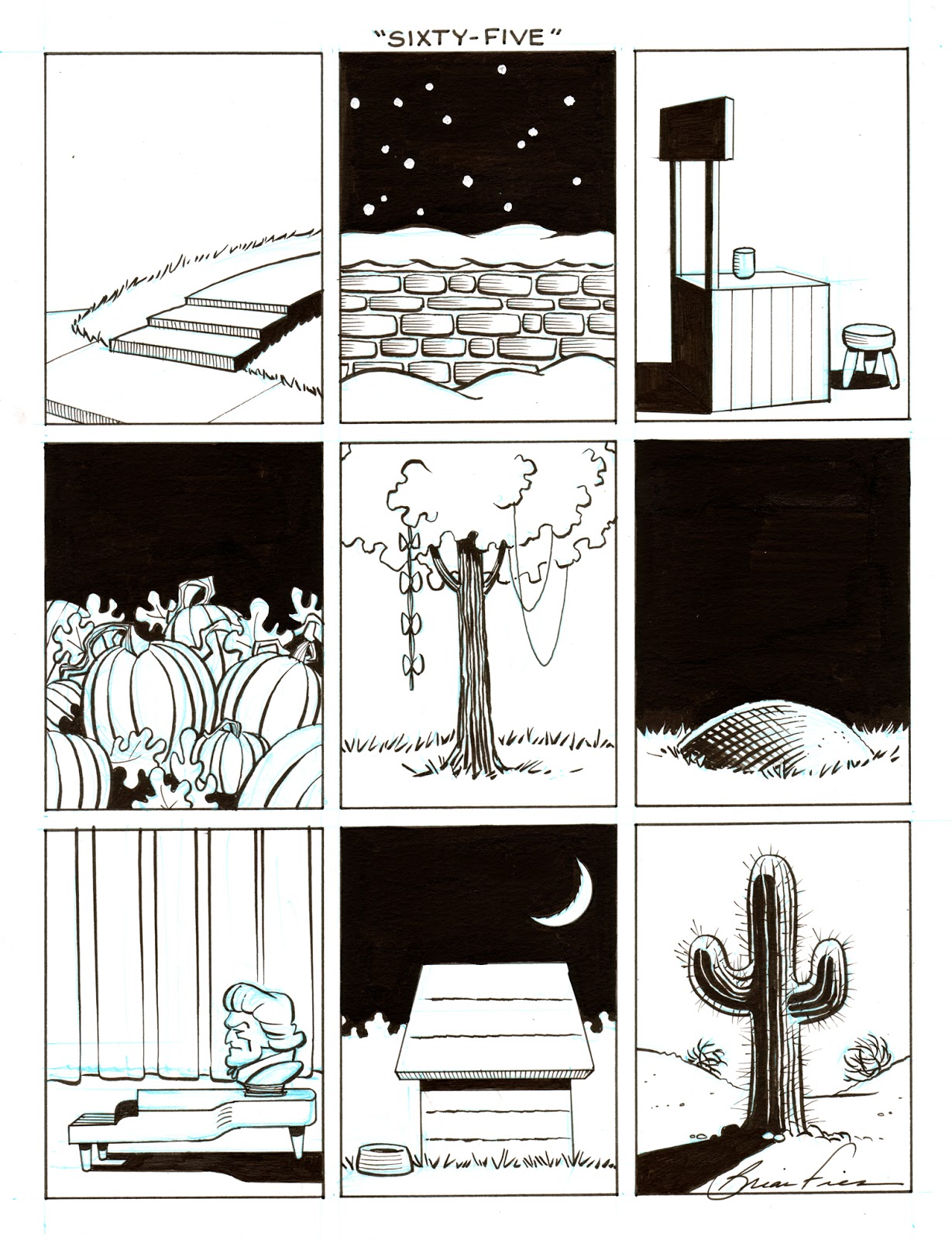 My tribute sketch. I actually had to bring it home to finish it, which gave me a chance to scan it, too. (The steps at upper left are from the very first "Peanuts" strip on Oct. 2, 1950.) If it feels a little melancholy, that's OK. So was "Peanuts."
After the Sketch-A-Thon we all walked over to the studio, where the Schulz folks had generously hired a fine food truck to feed us.
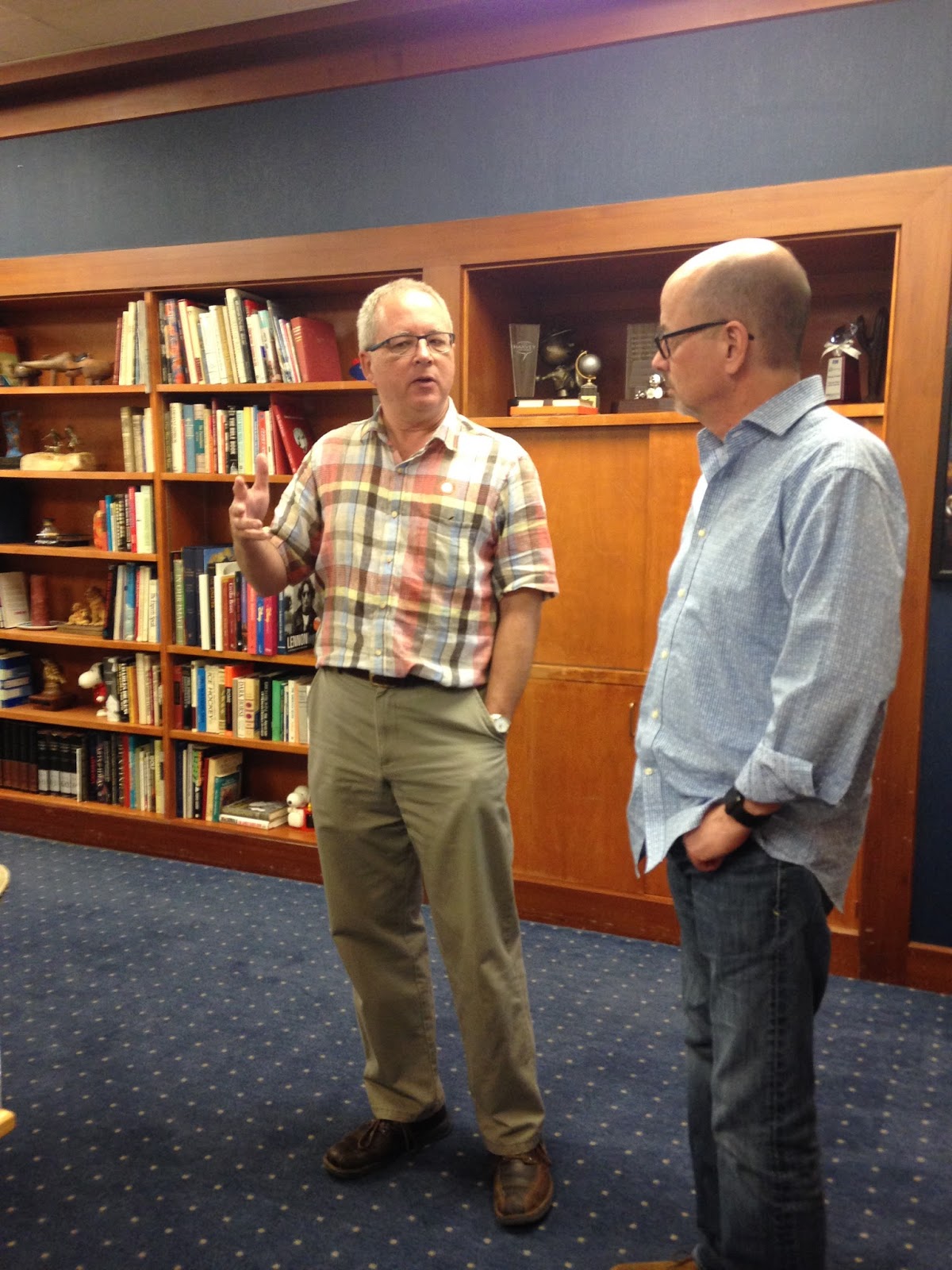 With Terry Moore in Schulz's studio. Notice the smattering of Eisner and other awards on the shelf behind us. These must be the ones that didn't fit into the museum, stuffed as it is with Emmy Awards and all.
 Another angle on the studio: Karen and I talking with Terry Moore and his wife Robyn. Photo by (my) Robin.
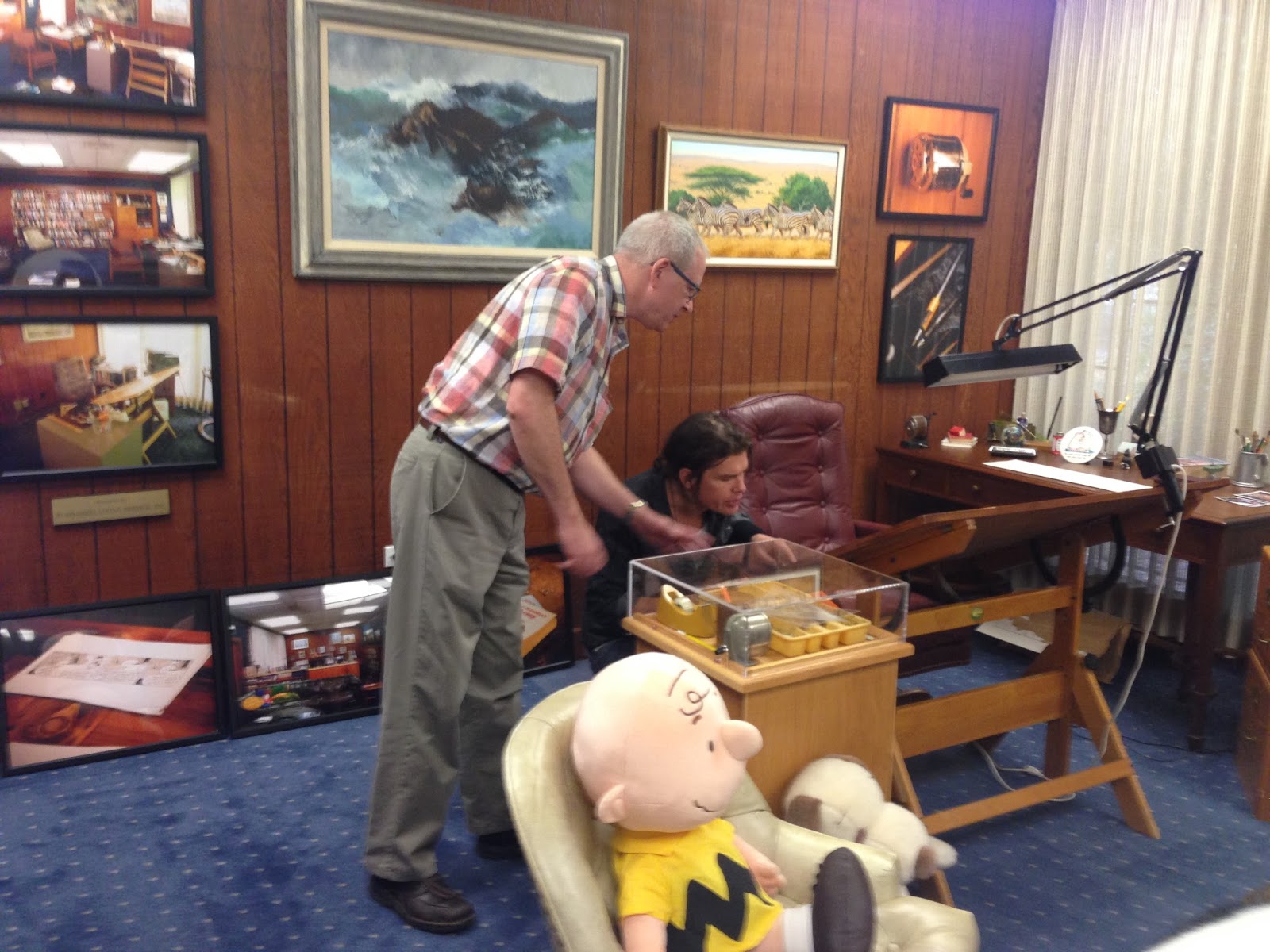 Scrutinizing Schulz's drawing board with comic book artist Paul Pope. I was pointing out that if you look at just the right angle, you can see Schulz's handwriting from his pen nib pressing through the paper into the wood. Photo by Robin.
I've been in Mr. Schulz's studio with other cartoonists a couple of times, and many of them do the exact same thing I did the first time. They eye the board and the chair. Then they look around. They really want to sit down at the board but they're afraid to. Somebody says, "Sure, go ahead!" so they reluctantly sit. Then a little electric shiver seems to go through them, as if they feel Schulz's aura emanating from the wood. If there's magic in the world, that's it.
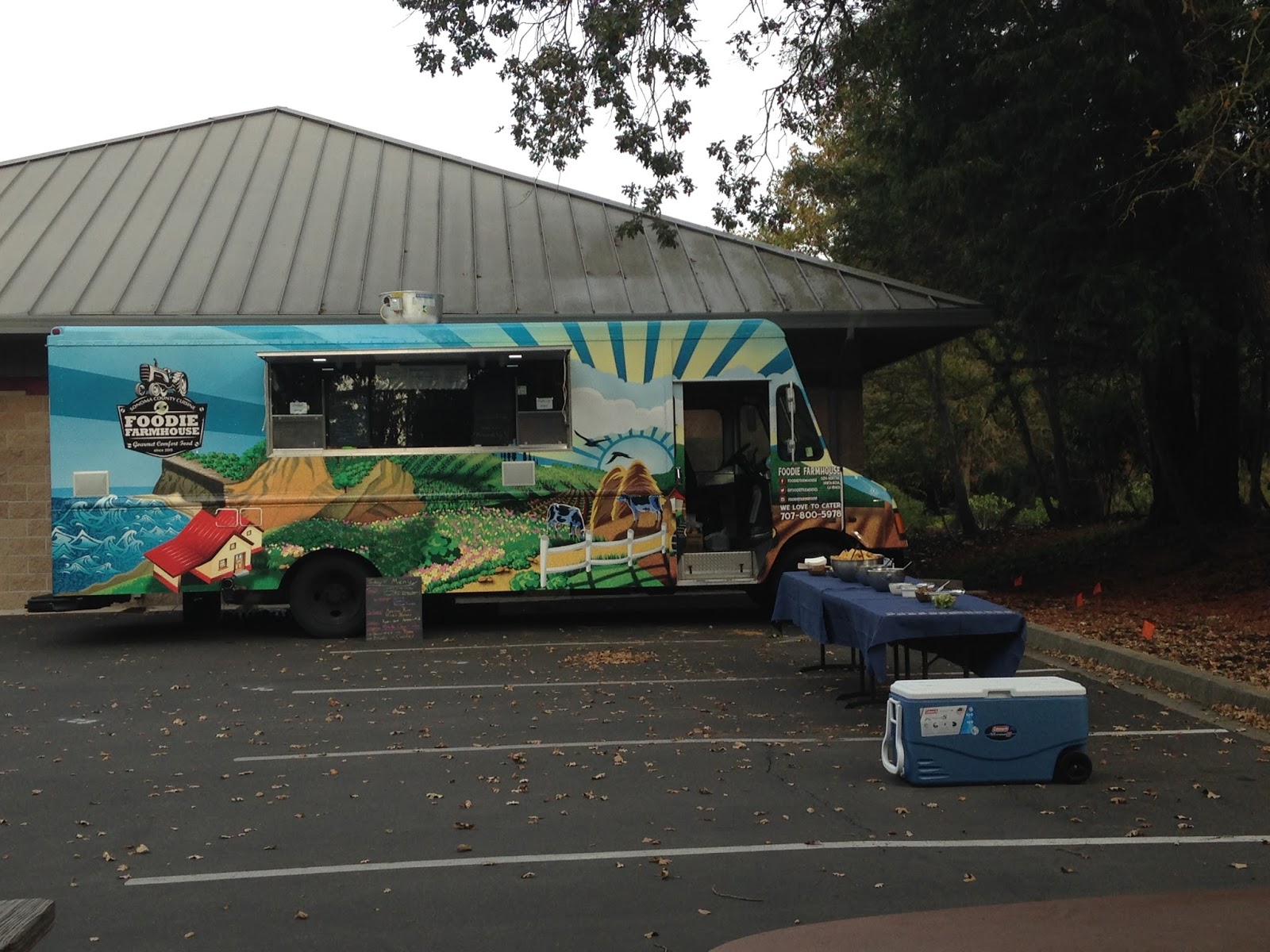 Dinner is almost served.
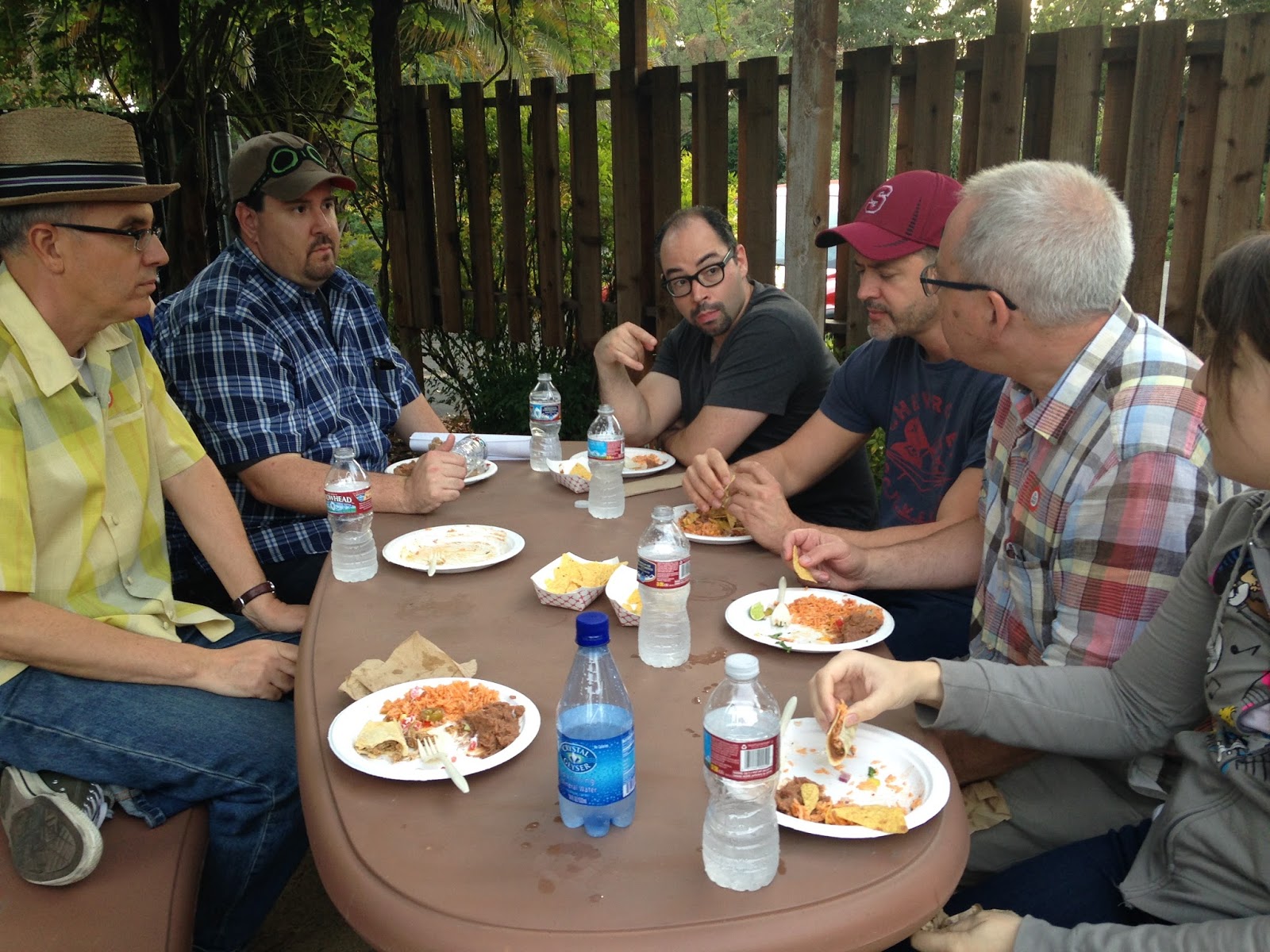 Tacos with Jonathan Lemon, Lucas Turnbloom, Lex Fajardo, Stephan Pastis (who didn't do the Sketch-A-Thon but just sort of shows up for free food), me and my daughter Robin.
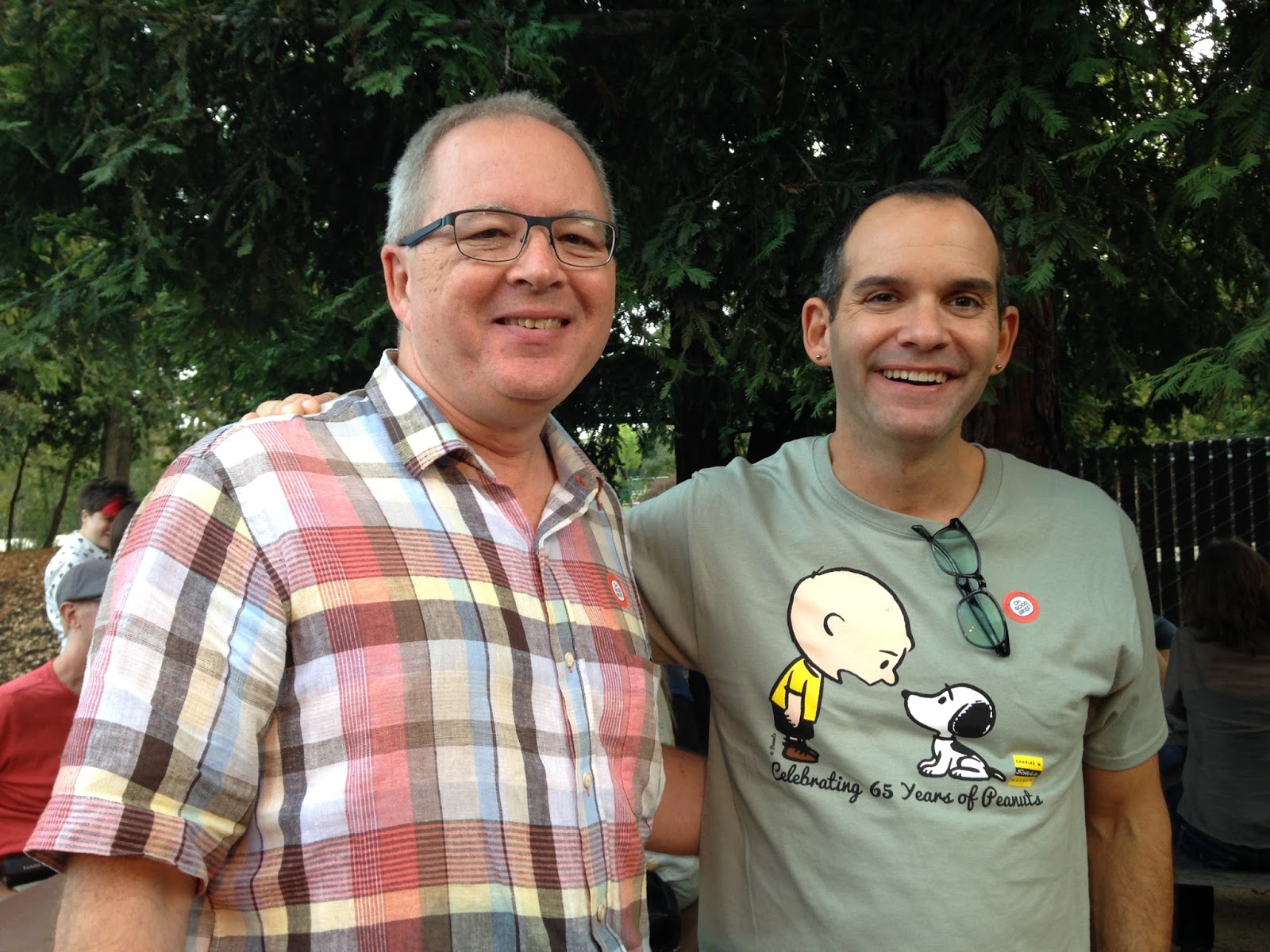 I met Judd Winick! I told him about graphic medicine and our international conferences, at which his "Pedro and Me" is frequently cited as an important early AIDS story. He seemed intrigued.
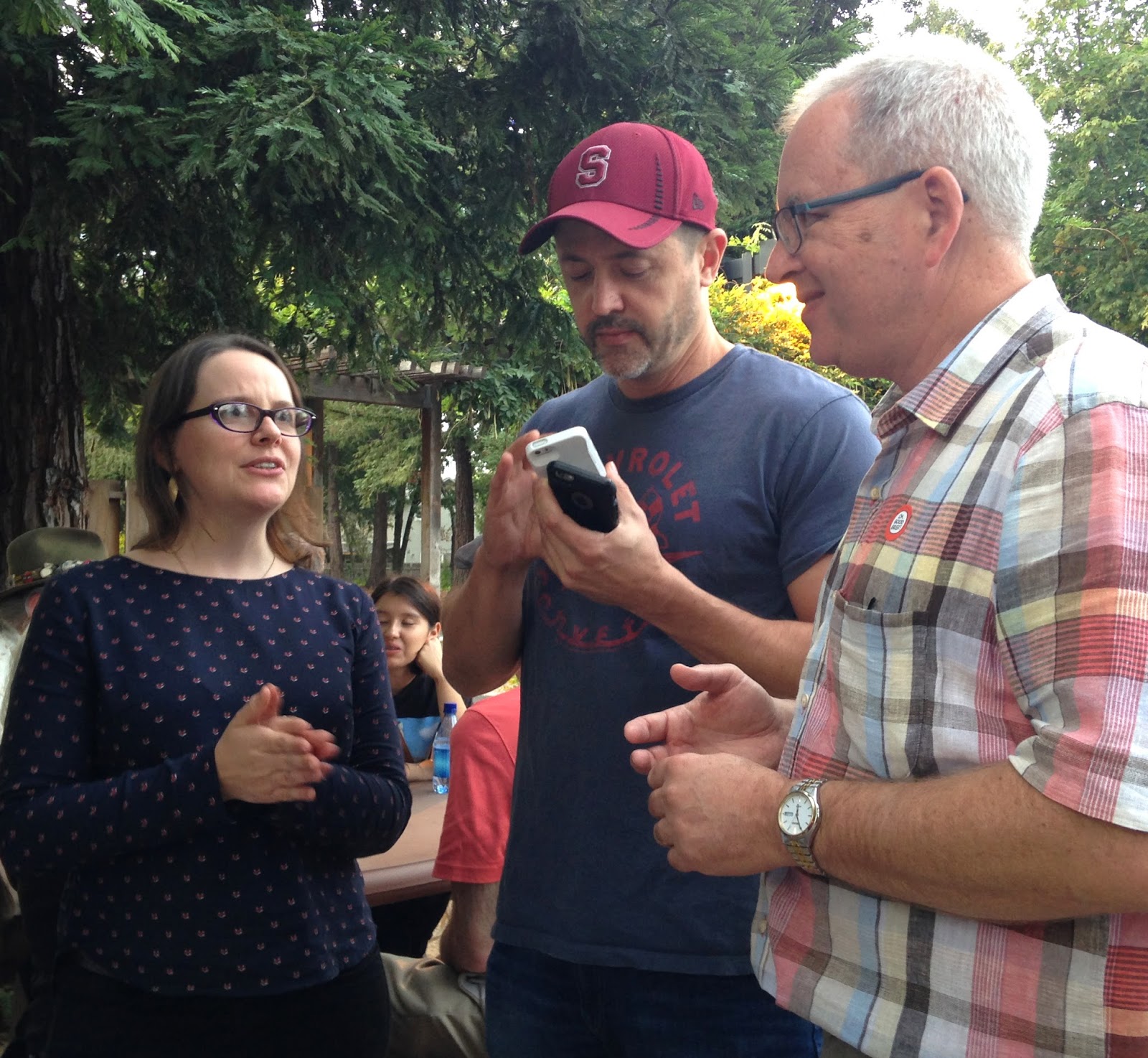 Talking about large-format scanners with Raina and Pastis.
 Lucas Turnbloom, who's illustrating a new book series called "Dream Jumper" for Scholastic, written by "Heroes" actor Greg Grunberg.
This was a long, very nice day for me. I reconnected with some friends who don't normally come out this way, made a couple of new ones, sold a few books, taught 24 Girl Scouts how to make comics, and ate a pretty darn good taco combo plate. I need to mention cartoonist Shaenon Garrity and Cartoon Art Museum curator Andrew Farago, who did me the honor of asking me to draw a picture in a book they're compiling for their newish son, Robin. I didn't get any good photos but it was terrific to see them.
I'm already looking forward to Peanuts' 70th.
October 5, 2015
Great Minds
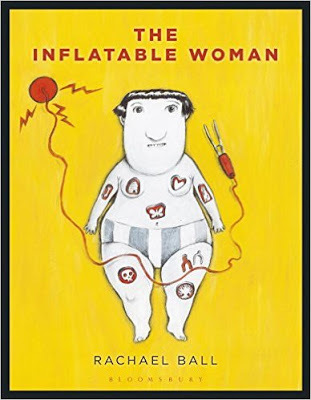
An Internet friend brought to my attention a new graphic novel being published in the U.K. titled The Inflatable Woman, in which cartoonist Rachael Ball writes about cancer. It sounds like it's a work of fiction based on Ball's own experience with breast cancer. The cover looks like this:
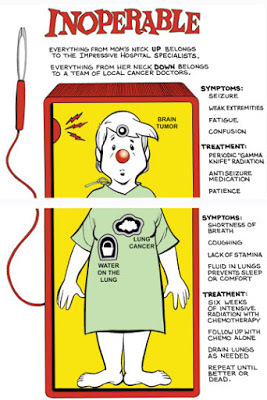
My friend thought I'd be interested because in Mom's Cancer, my graphic novel about my mother's experience with lung cancer, I drew two pages that looked like this:
So there you go.
For the record, and to put my friend's mind at ease, I've got no problem with that.
I don't know Ball and don't know if she read Mom's Cancer. I doubt it. I think she probably stumbled onto the same "Operation" metaphor I did. It's a good one! The identical red and gold color palette is easily explained: those are the colors of the game.
One thing I've learned over a long time of trying to be a creative person is that ideas--even ideas that seem strange and unique--are surprisingly common. It's what you do with those ideas that distinguishes them.
For example, I had opportunities to pitch story ideas to the producers of "Star Trek: The Next Generation" (then later "Deep Space Nine" and "Voyager"). I never sold them anything so the experience was a failure, but I learned a lot. I once got two sentences into a pitch when the story editor stopped me and said, "We started filming that last week." I was flabbergasted: I thought my idea was dazzlingly original. I was flabbergasted again when the episode aired and I saw that he was right. It was my story, including the parts I hadn't had a chance to tell him. If he hadn't stopped me, I'd have been absolutely certain that "Star Trek" had stolen it.
I think there are a lot of creative people nursing grudges against other creators or companies they're certain ripped them off but probably didn't. I know a few of them.
Even if Ball did read Mom's Cancer years ago and consciously or subconsciously filed away the "Operation" metaphor, so what? It's one image among hundreds in both of our books. Her use of it does me no harm. Besides, you can't copyright an idea, only the specific expression of it, and hers is totally different.
Ball doesn't need my blessing but she has it anyway. I'd like to meet her someday because I think we'd have a lot to talk about. I like the look of her cartooning style and wish her all the best with her book.
My friend thought I'd be interested because in Mom's Cancer, my graphic novel about my mother's experience with lung cancer, I drew two pages that looked like this:
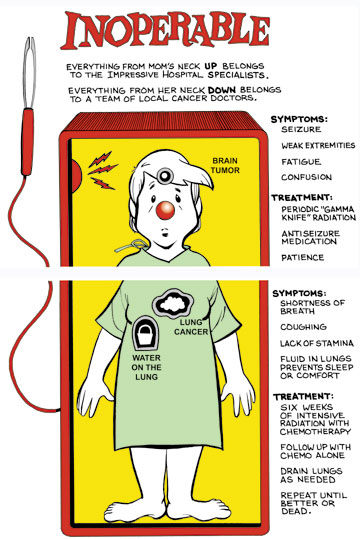
So there you go.
For the record, and to put my friend's mind at ease, I've got no problem with that.
I don't know Ball and don't know if she read Mom's Cancer. I doubt it. I think she probably stumbled onto the same "Operation" metaphor I did. It's a good one! The identical red and gold color palette is easily explained: those are the colors of the game.
One thing I've learned over a long time of trying to be a creative person is that ideas--even ideas that seem strange and unique--are surprisingly common. It's what you do with those ideas that distinguishes them.
For example, I had opportunities to pitch story ideas to the producers of "Star Trek: The Next Generation" (then later "Deep Space Nine" and "Voyager"). I never sold them anything so the experience was a failure, but I learned a lot. I once got two sentences into a pitch when the story editor stopped me and said, "We started filming that last week." I was flabbergasted: I thought my idea was dazzlingly original. I was flabbergasted again when the episode aired and I saw that he was right. It was my story, including the parts I hadn't had a chance to tell him. If he hadn't stopped me, I'd have been absolutely certain that "Star Trek" had stolen it.
I think there are a lot of creative people nursing grudges against other creators or companies they're certain ripped them off but probably didn't. I know a few of them.
Even if Ball did read Mom's Cancer years ago and consciously or subconsciously filed away the "Operation" metaphor, so what? It's one image among hundreds in both of our books. Her use of it does me no harm. Besides, you can't copyright an idea, only the specific expression of it, and hers is totally different.
Ball doesn't need my blessing but she has it anyway. I'd like to meet her someday because I think we'd have a lot to talk about. I like the look of her cartooning style and wish her all the best with her book.
September 16, 2015
Has It Really Been Ten Years? No, Really?!
I just realized 20 seconds ago that I've been blogging for a little over 10 years. I began my previous blog, the "Mom's Cancer Blog," on July 26, 2005 after returning from my first San Diego Comic-Con. That's 1072 posts, not counting this.
A decade ago, in September 2005, I was writing about reviewing printer's proofs, doing spot drawings, and designing endpapers for the book version of Mom's Cancer. That's also the month I received my "Gertie the Dinosaur" animation cel by Winsor McCay, which was my first (and to date only) splurge purchase with my new "cartooning money." Gertie passed her 100th birthday in my care.
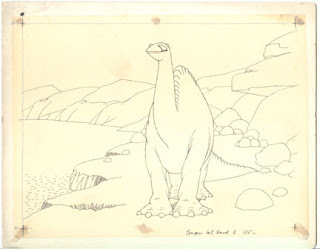 Still my pride and joy.
What I didn't blog about was the fact that Mom was miserably ill in Los Angeles and, unknown to us then, living the last of her days. The end was quick--up to a couple of days before, we were planning to take her home from the hospital. She died on October 1.
Ten years is a lot of "blah blah blah" under the bridge. I was a more diligent correspondent then. I used to think I had interesting things to say and some obligation to say them. I felt a responsibility to not somehow disappoint my mostly imaginary readers. Over the decade I've lightened up considerably--some combination of feeling like I've pretty much gotten everything off my chest, having Facebook to express some of the lighter thoughts I once would have turned into posts, and realizing nobody cares. I take the whole thing, and I think myself, less seriously than I used to.
I do like leaving a record, however ephemeral the Web turns out to be. Someone reading my archives would know me much better than people who've been real-life friends for 30 or 40 years. I like having a soapbox, even if I don't feel compelled to step up on it as often. It's there when I need it.
Some old posts still get a lot of hits, particularly those related to the technical side of making comics and publishing books. In general, my "process" posts do well long term. A few folks still look up my tutorial on Photoshopping the four-color dot effect I used in Whatever Happened to the World of Tomorrow every day.
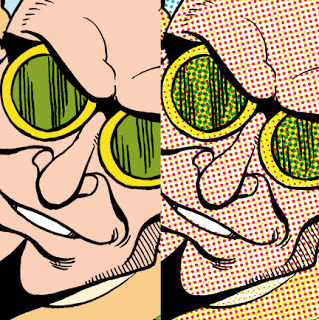 This kinda thing.
Posts that I work very hard on and expect to cause a big ruckus get nothing, while tossed-off brain farts bring down the roof. Weird posts get hits. A couple of years ago, I wrote about a set of encyclopedias we had when I was a child that had a big influence on me. Every so often, somebody Googles "Richard's Topical Encyclopedia," finds that post, and writes to tell me how much they loved it too. Google also leads migraine sufferers to my post on that topic.
Posts that drew the most comments include that darned encyclopedia article, a quippy piece on writing style and grammar, reflections on a recent birthday, two "ask me anything" Q&As (#1 and #2), and of course my announcement that Mom had passed.
My favorite pieces to write are probably my "on-the-scene" reports. I like sharing something interesting I've seen or done with (ideally) some insight and wit. Brings out the old journalist in me. People who can't get to comics conventions or graphic medicine conferences seem to enjoy my posts on those. Two of my very favorite posts were about time I spent in the orbit of Diary of a Wimpy Kid author Jeff Kinney, Two Hours in WimpyWorld and its sequel, Nine Hours in WimpyWorld, because being on a bestselling book tour is something most people never experience and I think I captured their strangeness pretty well.
My blogging ebbs and flows. With luck, I'll have some new projects to write about soon, with all new "how to" process posts and on-the-scene reports to come. If you've read some of my posts, thanks for that; if you've read all of them, may God have mercy on your soul.
A decade ago, in September 2005, I was writing about reviewing printer's proofs, doing spot drawings, and designing endpapers for the book version of Mom's Cancer. That's also the month I received my "Gertie the Dinosaur" animation cel by Winsor McCay, which was my first (and to date only) splurge purchase with my new "cartooning money." Gertie passed her 100th birthday in my care.
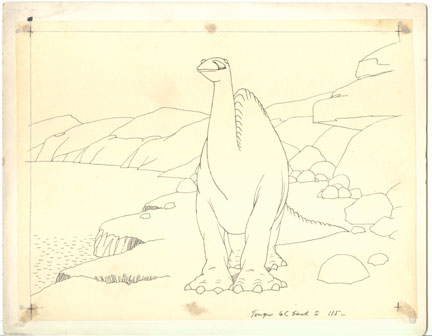 Still my pride and joy.
What I didn't blog about was the fact that Mom was miserably ill in Los Angeles and, unknown to us then, living the last of her days. The end was quick--up to a couple of days before, we were planning to take her home from the hospital. She died on October 1.
Ten years is a lot of "blah blah blah" under the bridge. I was a more diligent correspondent then. I used to think I had interesting things to say and some obligation to say them. I felt a responsibility to not somehow disappoint my mostly imaginary readers. Over the decade I've lightened up considerably--some combination of feeling like I've pretty much gotten everything off my chest, having Facebook to express some of the lighter thoughts I once would have turned into posts, and realizing nobody cares. I take the whole thing, and I think myself, less seriously than I used to.
I do like leaving a record, however ephemeral the Web turns out to be. Someone reading my archives would know me much better than people who've been real-life friends for 30 or 40 years. I like having a soapbox, even if I don't feel compelled to step up on it as often. It's there when I need it.
Some old posts still get a lot of hits, particularly those related to the technical side of making comics and publishing books. In general, my "process" posts do well long term. A few folks still look up my tutorial on Photoshopping the four-color dot effect I used in Whatever Happened to the World of Tomorrow every day.
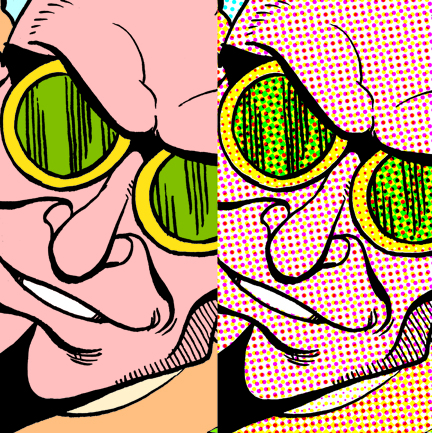 This kinda thing.
Posts that I work very hard on and expect to cause a big ruckus get nothing, while tossed-off brain farts bring down the roof. Weird posts get hits. A couple of years ago, I wrote about a set of encyclopedias we had when I was a child that had a big influence on me. Every so often, somebody Googles "Richard's Topical Encyclopedia," finds that post, and writes to tell me how much they loved it too. Google also leads migraine sufferers to my post on that topic.
Posts that drew the most comments include that darned encyclopedia article, a quippy piece on writing style and grammar, reflections on a recent birthday, two "ask me anything" Q&As (#1 and #2), and of course my announcement that Mom had passed.
My favorite pieces to write are probably my "on-the-scene" reports. I like sharing something interesting I've seen or done with (ideally) some insight and wit. Brings out the old journalist in me. People who can't get to comics conventions or graphic medicine conferences seem to enjoy my posts on those. Two of my very favorite posts were about time I spent in the orbit of Diary of a Wimpy Kid author Jeff Kinney, Two Hours in WimpyWorld and its sequel, Nine Hours in WimpyWorld, because being on a bestselling book tour is something most people never experience and I think I captured their strangeness pretty well.
My blogging ebbs and flows. With luck, I'll have some new projects to write about soon, with all new "how to" process posts and on-the-scene reports to come. If you've read some of my posts, thanks for that; if you've read all of them, may God have mercy on your soul.
Brian Fies's Blog

- Brian Fies's profile
- 64 followers
Brian Fies isn't a Goodreads Author
(yet),
but they
do have a blog,
so here are some recent posts imported from
their feed.

