
Brian Fies's Blog, page 50
April 3, 2017
Untravelogue
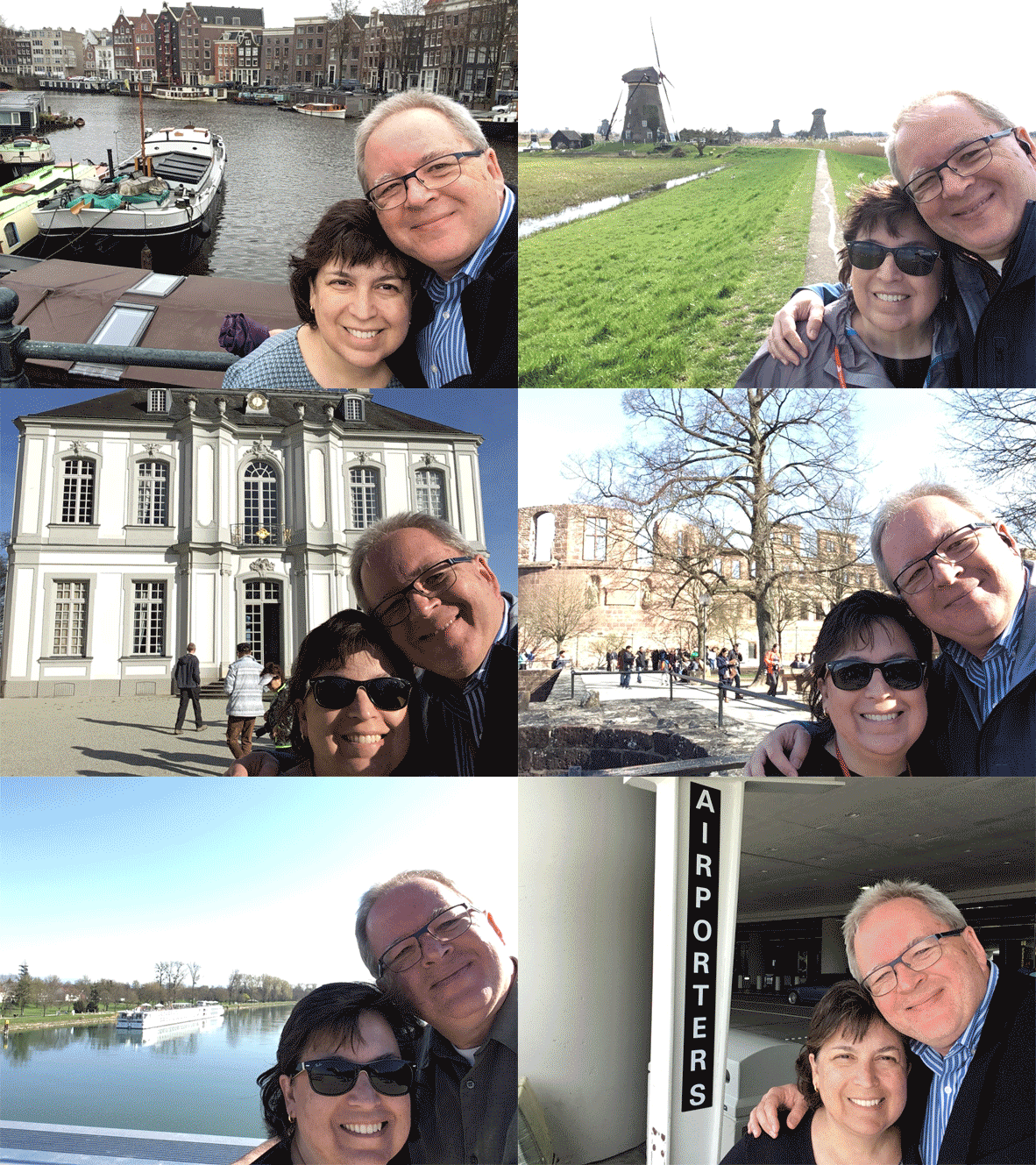
Karen and I just returned from ten days in Europe, including an eight-day Viking Cruise up the Rhine River, and I'm not going to tell you all about it.
It's hard to report on your international travels without being obnoxious. Bragging is kind of built in. Not everyone can do it (or wants to), and we're grateful we have the resources to take a trip like that. I also know that spending one day somewhere doesn't make me an expert on it, so I'm not inclined to deliver a travel lecture.
Still, I noticed what I noticed. A few observations:
Our voyage began in Amsterdam. We arrived a couple of days early to enjoy the city on our own, then cruised upstream with stops in Cologne, Heidelberg, Strasbourg, and various German and French landmarks as we made our way south. It rained our first day in Amsterdam; after that, the weather couldn't have been better.
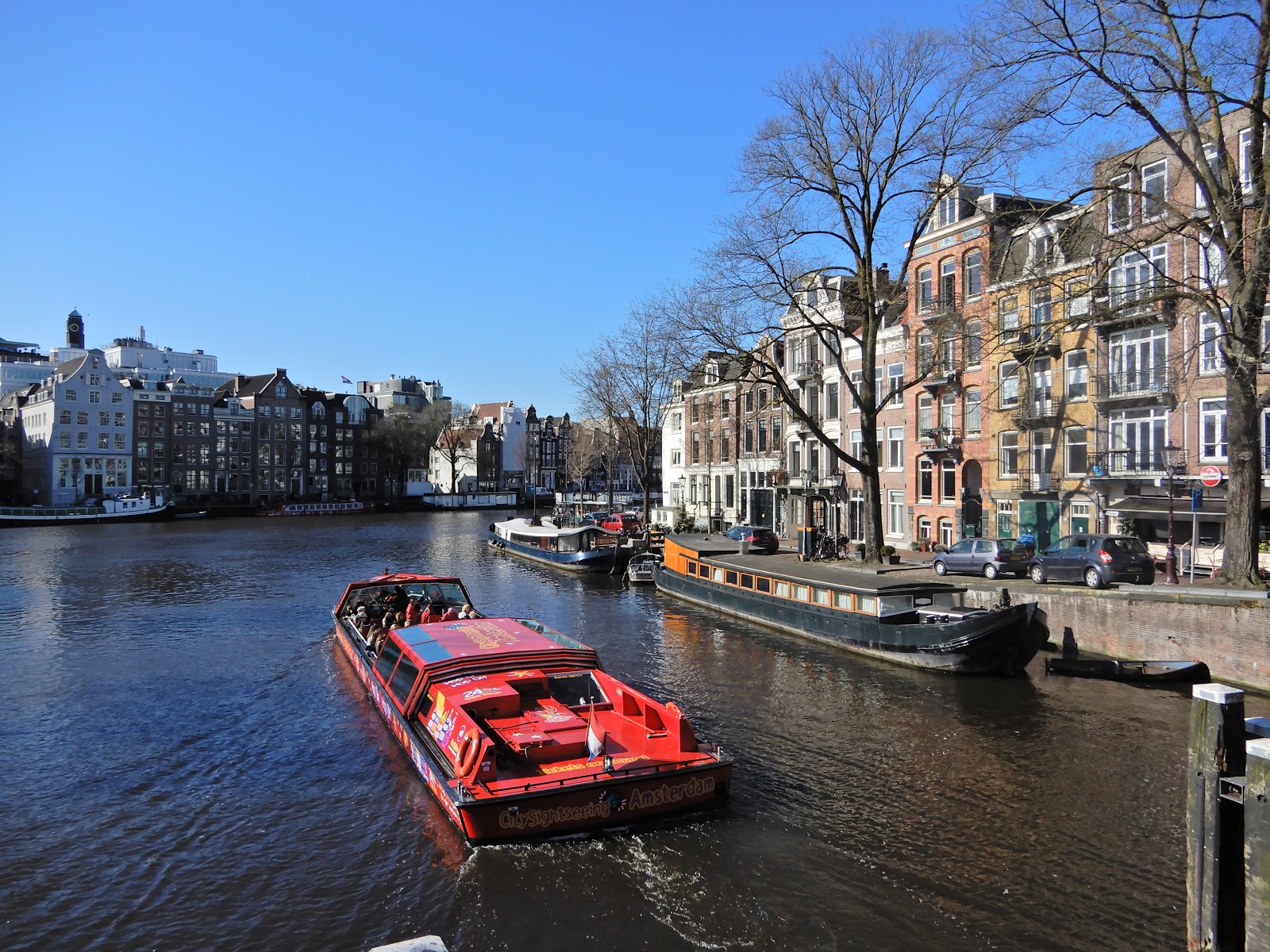 Just another perfect day in Amsterdam.
I liked Viking and its river "longship" (sized just right to fit through the Rhine's network of locks) very much. That said, it wouldn't be for everyone. The entire ship consisted of cabins, restaurant, lounge and sundeck. That's it. If your ideal cruise experience includes a casino, Broadway-style entertainment and water slides, you'd be disappointed and bored. I found the scale just right. On the other hand, if your ideal tour experience leans more toward do-it-yourself backpacks and hostels, Viking would be too structured and touristy. We basically looked at it as a mobile hotel so we didn't have to schlep our stuff around.
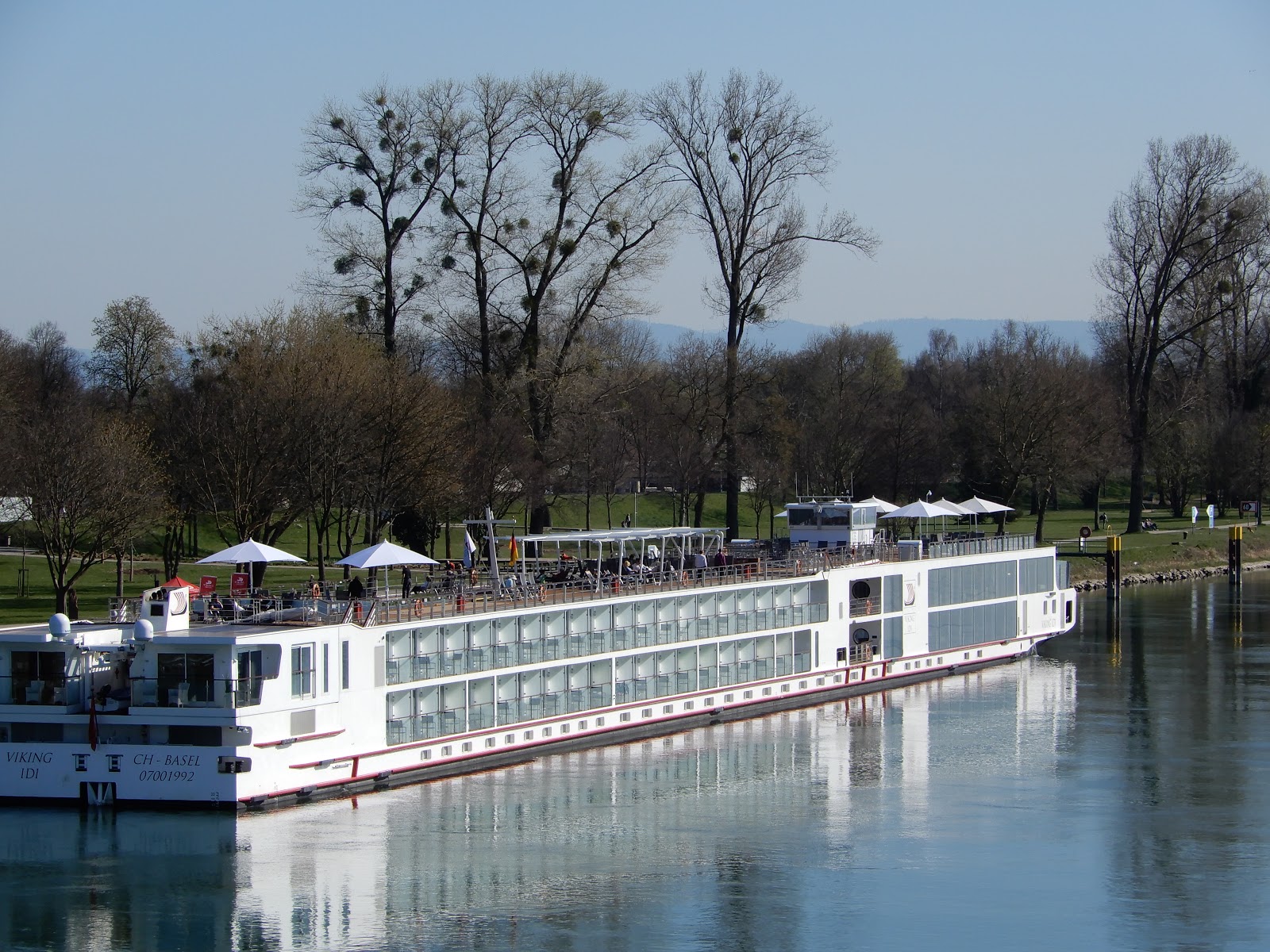 Our ship, the "Idi," docked on the bank of the Rhine.
The smartest advertising campaign of the decade was Viking sponsoring "Downton Abbey" on PBS.
Around the towns, Karen and I noticed a distinct lack of accommodation for the disabled--treacherous stairs, steps, thresholds, curbs and cobblestones that would never fly in the States. On the other hand, governments appear to trust adults to behave like adults and not do stupid things to hurt themselves. People seem to respond in kind.
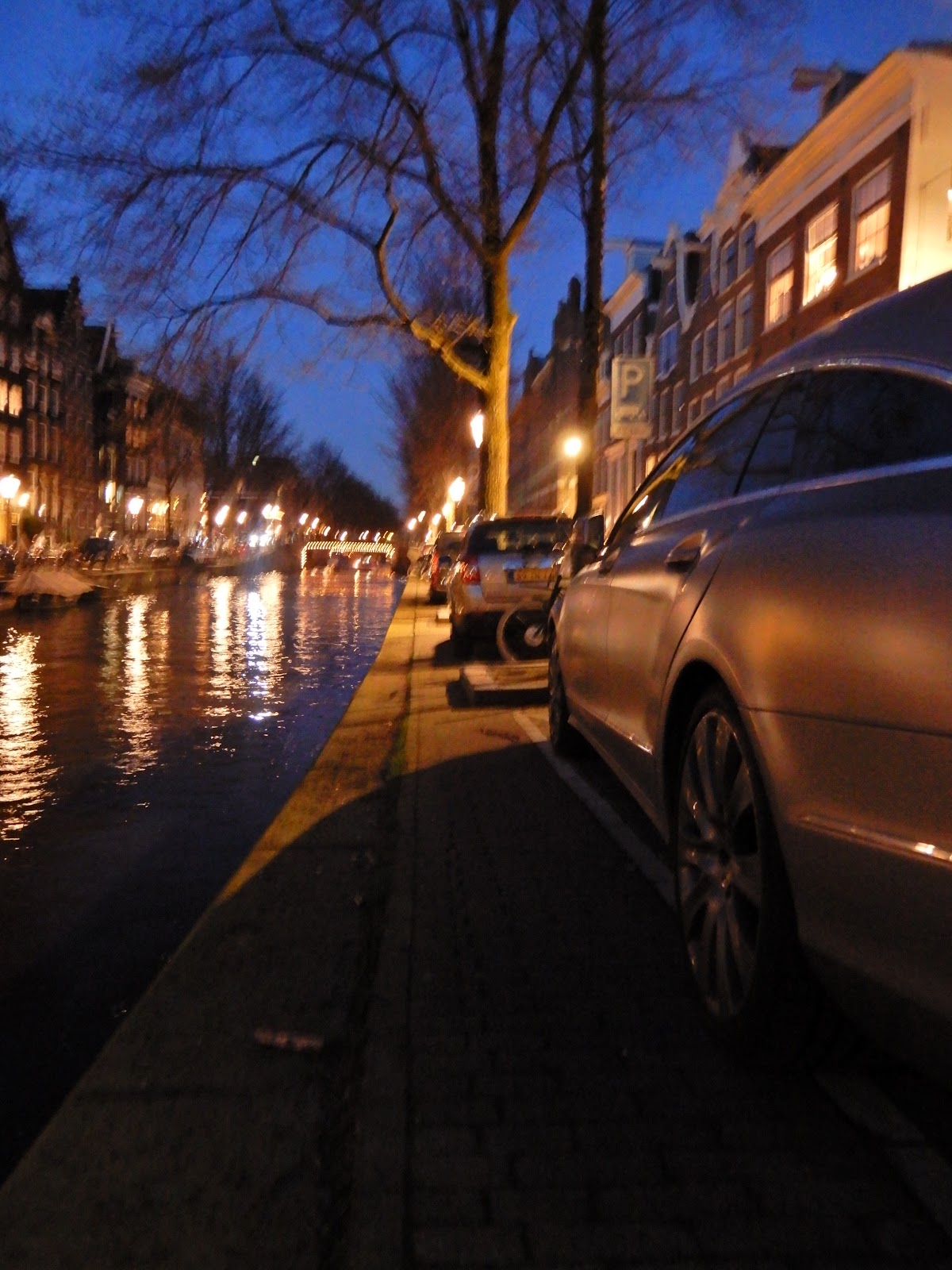 On the left, an Amsterdam canal. On the right, a row of parked cars. There's no rail or curb between them. In the United States they'd be fishing a hundred cars a day out of the water.
I could have taken a thousand photos of nothing but cockeyed 500-year-old brick buildings leaning precariously into the street.
We walked past, but did not stand in a long line to tour, Anne Frank's house. I was very moved. It's hard to describe, but one of the great benefits I get out of travel is remapping my mental geography. Like, the first time I visited Manhattan, I knew about the Empire State Building and the New York Public Library and Central Park and all the other famous landmarks, but didn't know how they fit together until I walked them. Same with Anne Frank. Until I visited, I couldn't imagine Nazis dragging a girl out of this house overlooking this lovely canal down this street I was walking on. Stunning.
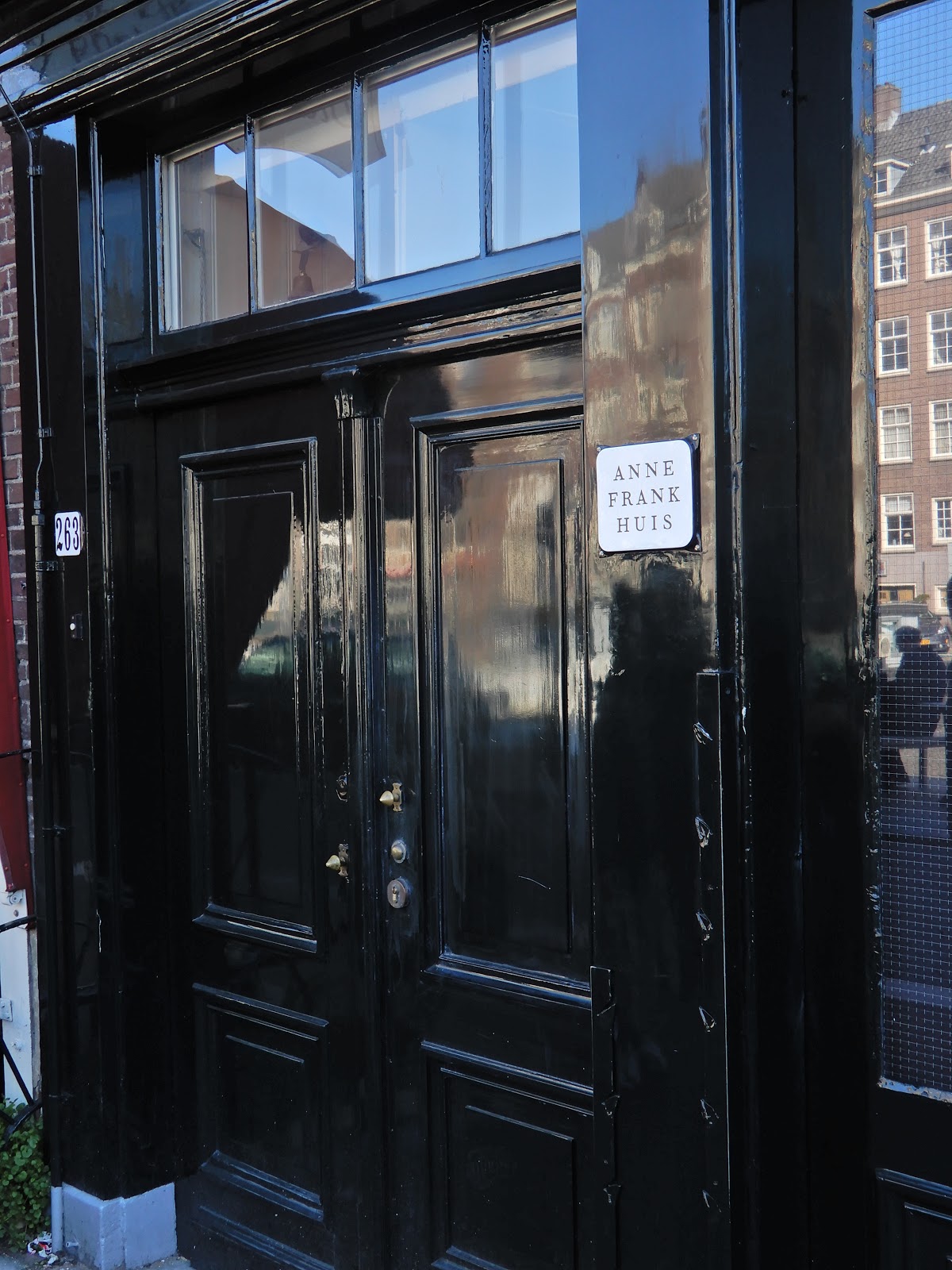
For a people who appear to subsist on pickled herring, brown gravy, cheese and cigarettes, Amsterdamers look remarkably fit.
There are a lot of very tall women in the Netherlands.
After decades living in a dry land of low-flow plumbing, it's wonderful to be in a country whose very existence is defined by having too much water. Amsterdam gave me the best shower I've had in years, with enough pressure to generate a kilowatt of electricity if I'd blasted it through a generator.
We saw many "coffee houses" that served more pot than coffee and a bit of Amsterdam's legal red-light district. Neither were intrusive. The working ladies in the windows just looked sad; also, all the women we saw were black, which raised many red flags about who's exploiting whom for what. There was nothing sexy about it.
Amsterdam's Rijksmuseum is truly one of the world's great museums, and our time spent with Rembrandt, Vermeer and Van Gogh was transcendent. Still, there comes a point where you feel like once you've seen 400 paintings of rosy-cheeked local politicians dressed in black satin suits with frilly lace collars, you've seen then all.
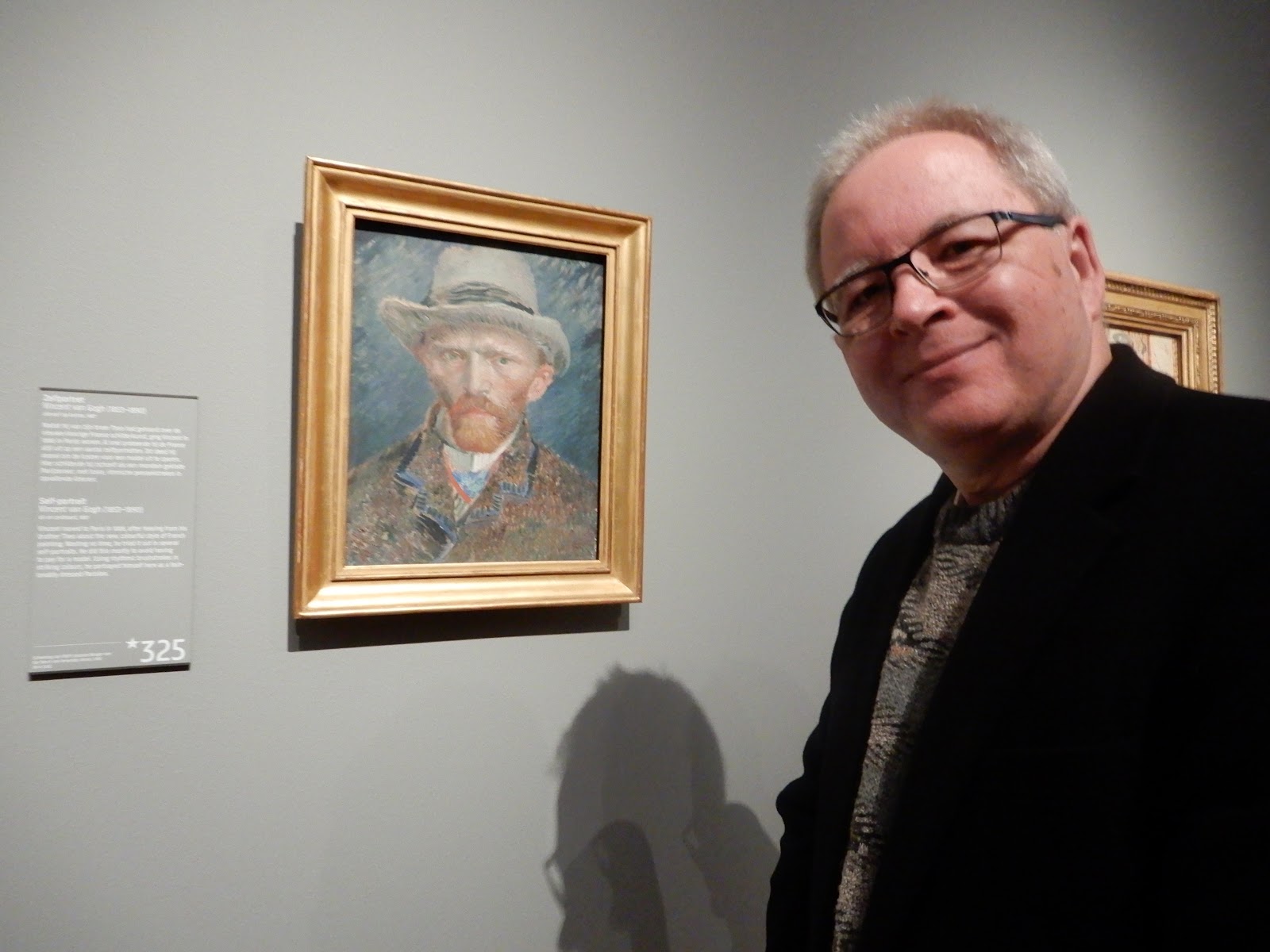 Me and this guy.
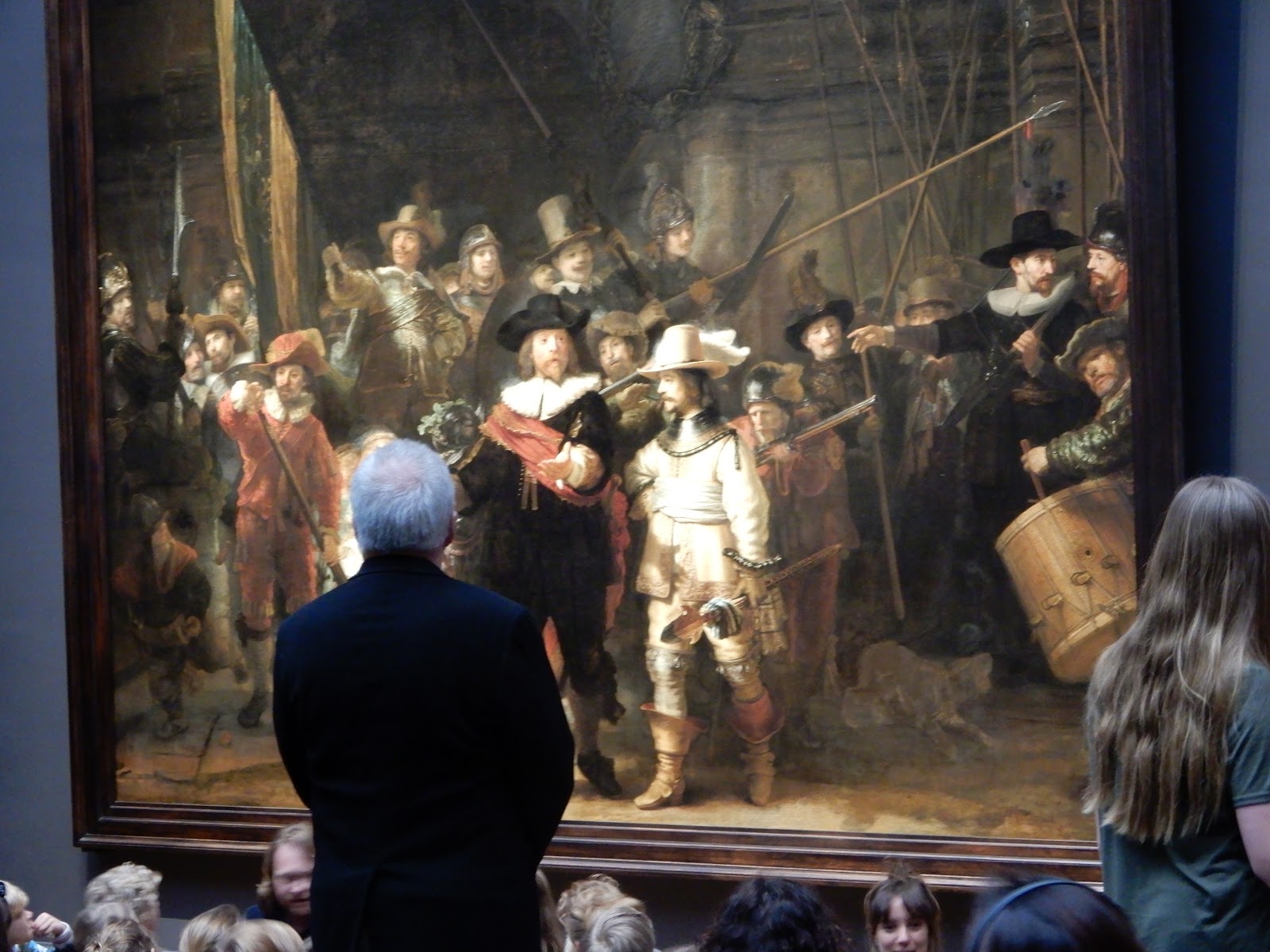 Also those guys.
The delicious cheese called Gouda is apparently pronounced "gow-da," not "goo-da." I've been doing it wrong. But if you can't trust a teenage girl earning minimum wage at the Cheese Museum, who can you?
Hot chocolate = tall mug of steamed milk + a little bowl of chocolate chips you melt into the hot milk. It works!
I think it's a universal law: wherever you go in the world--highest peak or deepest jungle, makes no difference--you'll run into someone from home. When Karen and I travel, we tell people we're from California. If they want more, we say San Francisco. It's close enough and everyone's heard of it. We got to talking with another couple on the cruise and drilled down to discover we live about six miles from each other. It's a small big world.
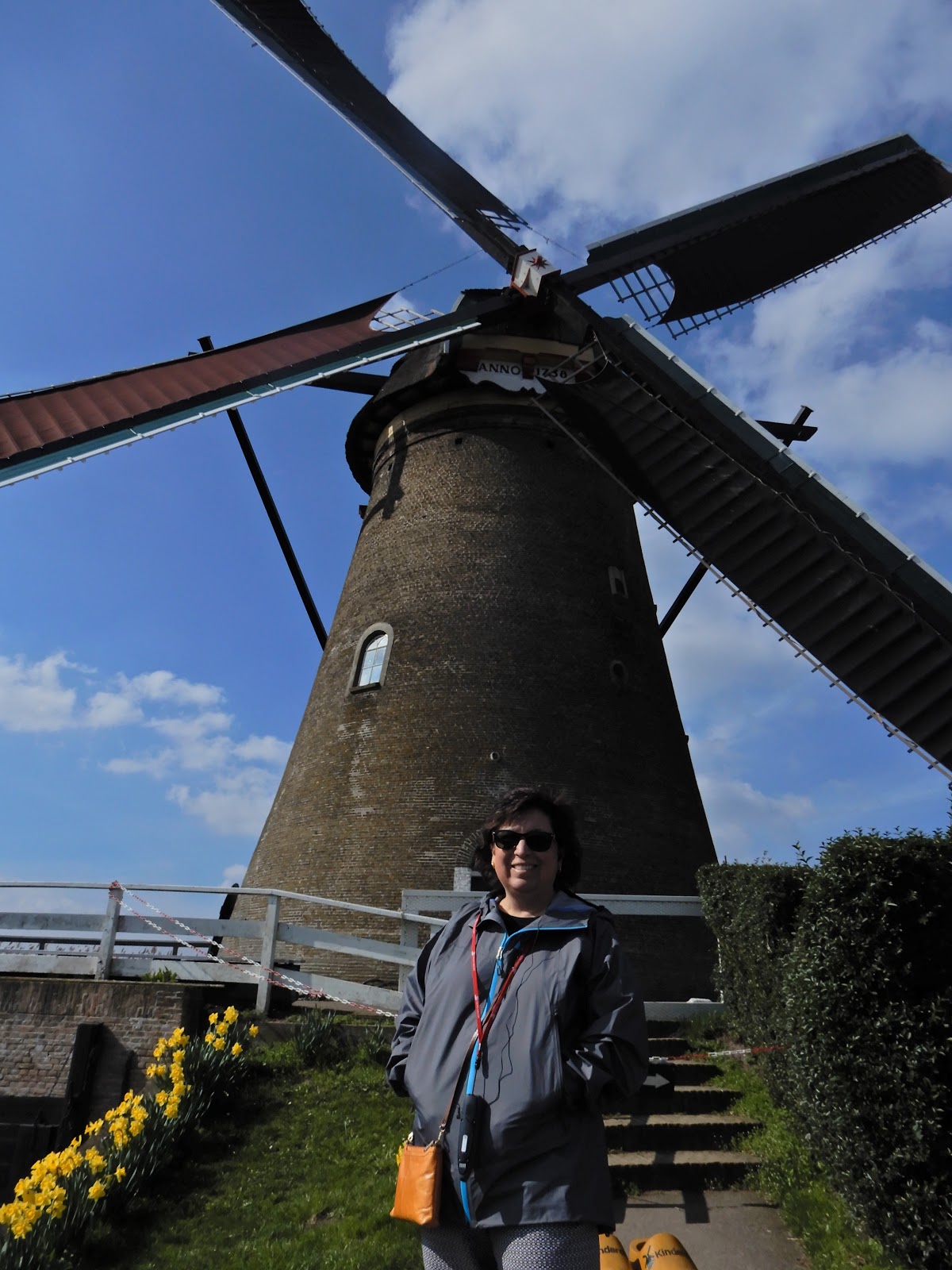 There aren't many old, authentic windmills left anymore, but the Dutch cherish those that remain at Kinderdijk.
The floor of a building you walk into from the street is numbered "0." The floor above that is "1," and so on. There's a certain number-line logic to it, but the number of times I ended up on the wrong floor due to this convention was non-zero.
The exchange rate was good: 1.08 dollars per euro. Nothing seemed too expensive.
Most popular street food: french fries in a paper cone topped with one of various sauces, most of them mayonnaise-based. We put satay sauce on ours. Pretty good!
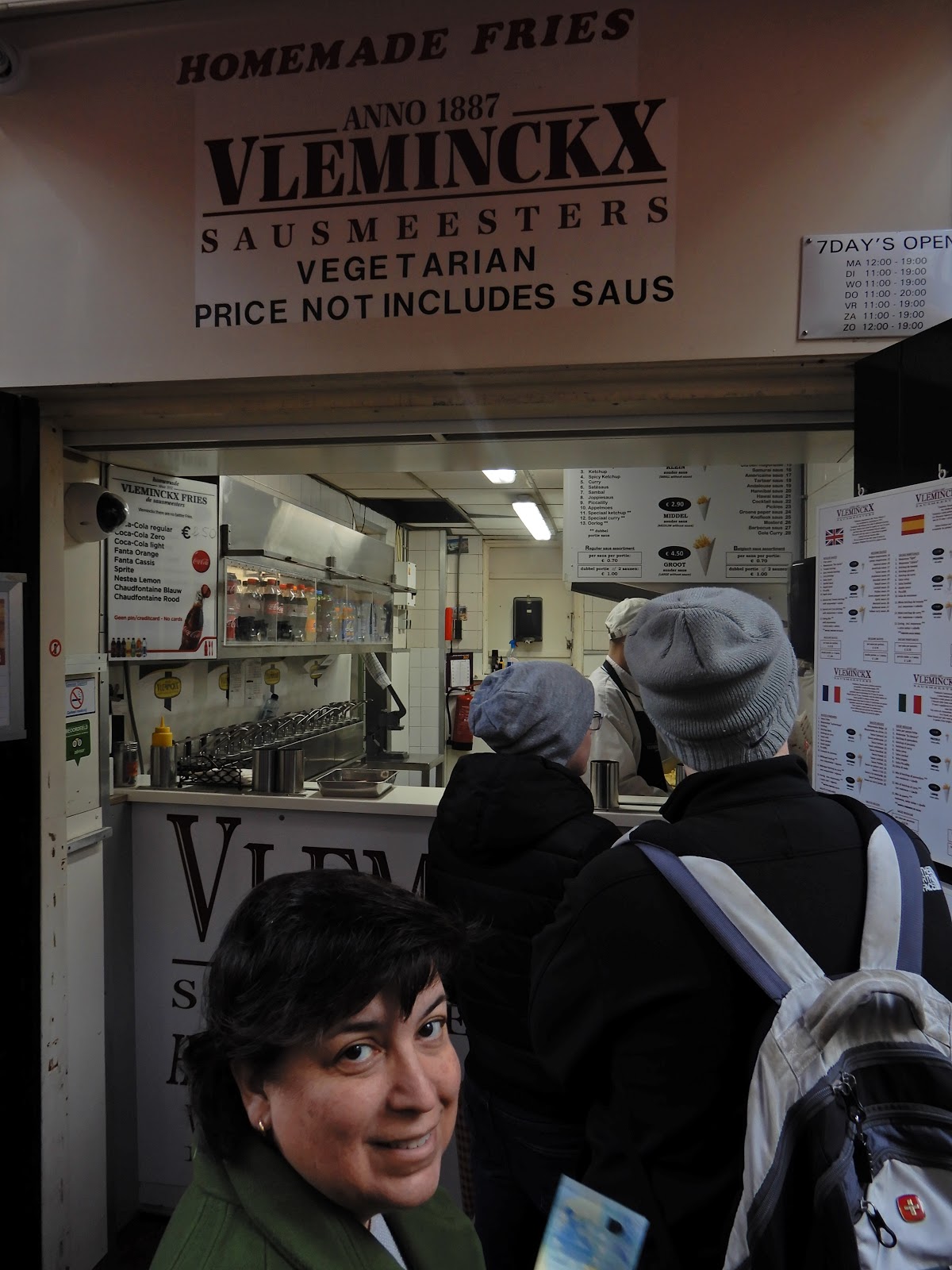 Queued up for fries. The chart at right lists the 20 or 30 sauces you can put on them.
I was delighted to exercise my two years of high school German on shopkeepers even when it wasn't necessary. Karen is skeptical, but I remembered more than I expected to and believe I could actually survive in Germany if necessary. "Ein Bier, bitte." I'm good.
That said, English is the lingua franca that worked everywhere.
Nearly everyone we encountered in the Netherlands was fully bilingual. What surprised me was how often English was their first go-to greeting rather than their follow-up, even to their fellow Dutch. I've been in parts of the United States (ahem Miami) where that's not true. Germans tended to try German first, then switch to English. The French knew English but didn't give a damn.
German villages on the Rhine look like model train layouts.
 Toot toot.
More than one guide made a big deal of the pre-Reformation Catholic Church's corruption and greed without acknowledging that their jobs depended on giving tours of the architecture and art it produced. Not that they're wrong, but there's an irony there.
St. Peter's Cathedral in Cologne was breathtaking. Its twin spires rise up from the horizon miles away, and as impressive as it is in the 21st century, imagine how much moreso it must have been in the Middle Ages. Begun in 1248 and only completed in 1880, it's a Gothic wonder. Probably the single most spectacular, awesome thing I saw on the trip.


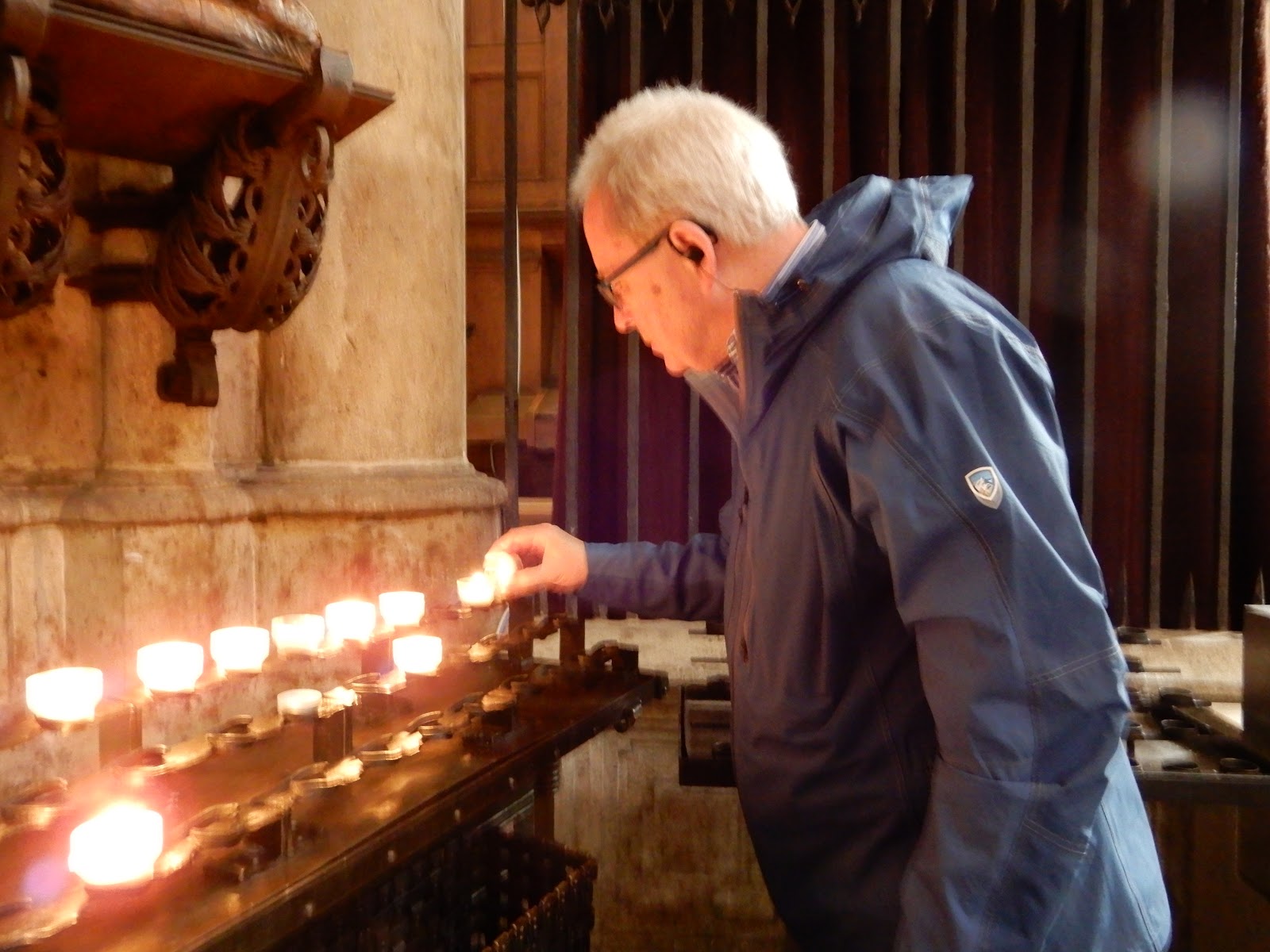 We lit a couple of candles to remember those to whom it would have meant a lot, including my Mom.

This may lose me some friends, but I wasn't impressed with German beer. I was really looking forward to sampling beers made under the country's centuries-old Reinheitsgebot purity laws, and asking for "something local and good" usually turns up some gems for me. Maybe I went to the wrong places, got the wrong stuff, or have had my palate ruined by hoppy West Coast brews, but to me it all seemed pale and bland, like people accuse American beers of being. Further research may be required.
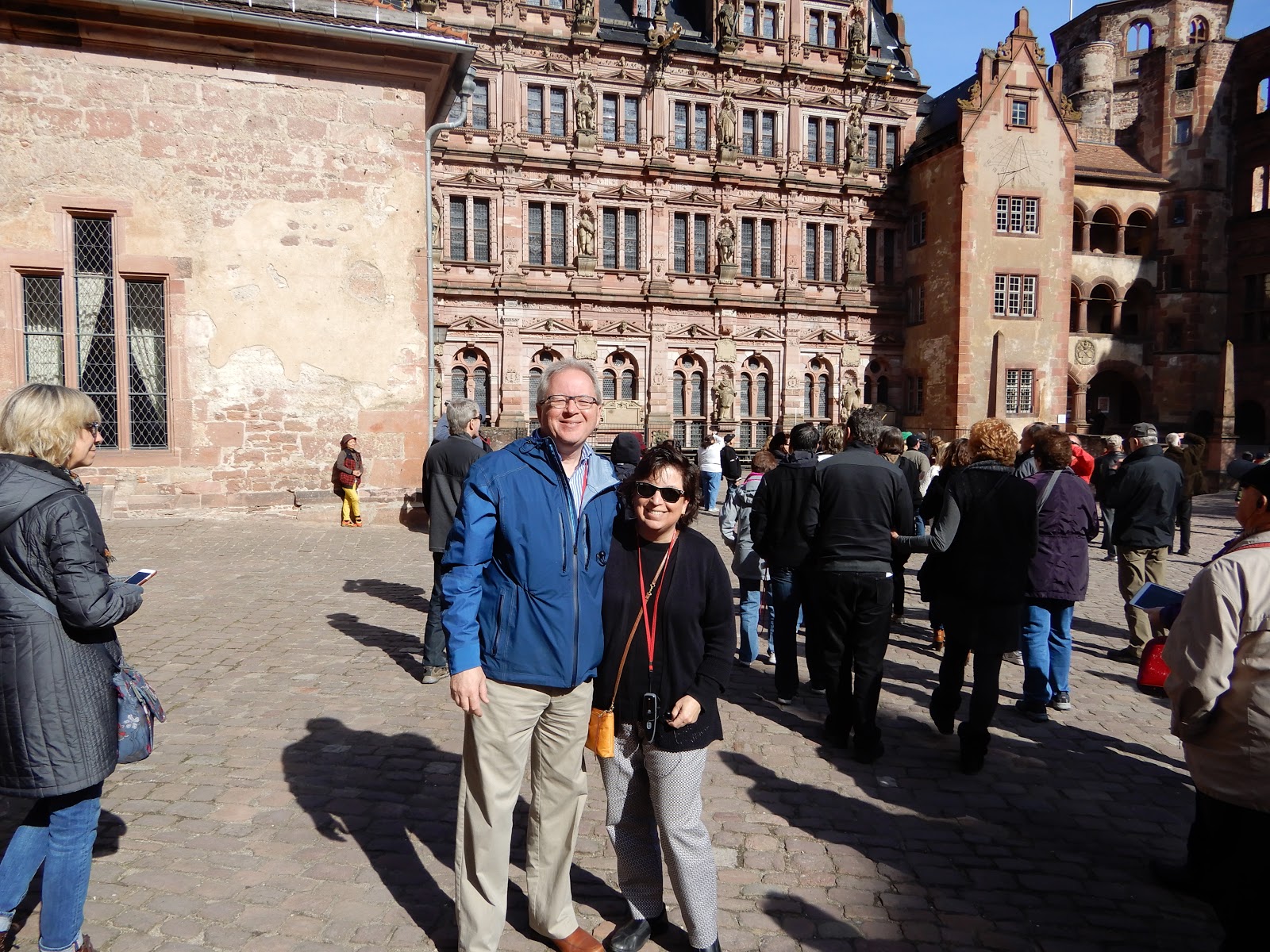
In A Tramp Abroad, Mark Twain called Heidelberg Castle a perfect wreck, writing that "a ruin must be rightly situated to be effective. This one could not have been better placed. It stands upon a commanding elevation, it is buried in green woods . . . and one looks down through shining leaves into profound chasms and abysses where twilight reins."
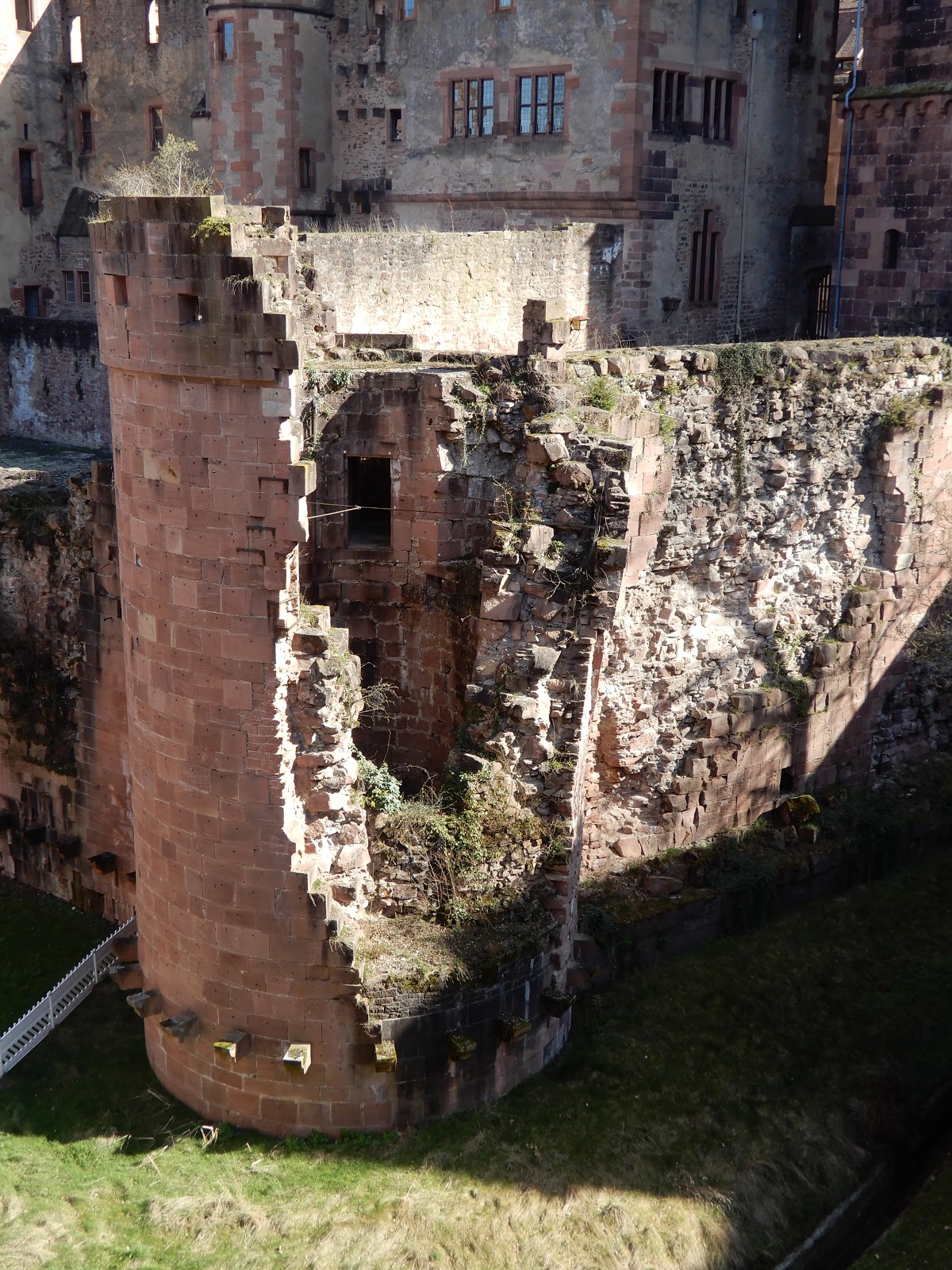 "One of these old towers is split down the middle, and one half has tumbled aside . . . The standing half exposes its arched and cavernous rooms to you, like open, toothless mouths." Mark Twain, 1880.
There's a lot of commercial river traffic on the Rhine. About half the barges have a single car on deck beside their cargo--I imagine so the owner can drive around once he gets to where he's going.
In my very limited experience, the best traveling companions are elderly Scots with endless reservoirs of great stories who can dance and drink you under the table.
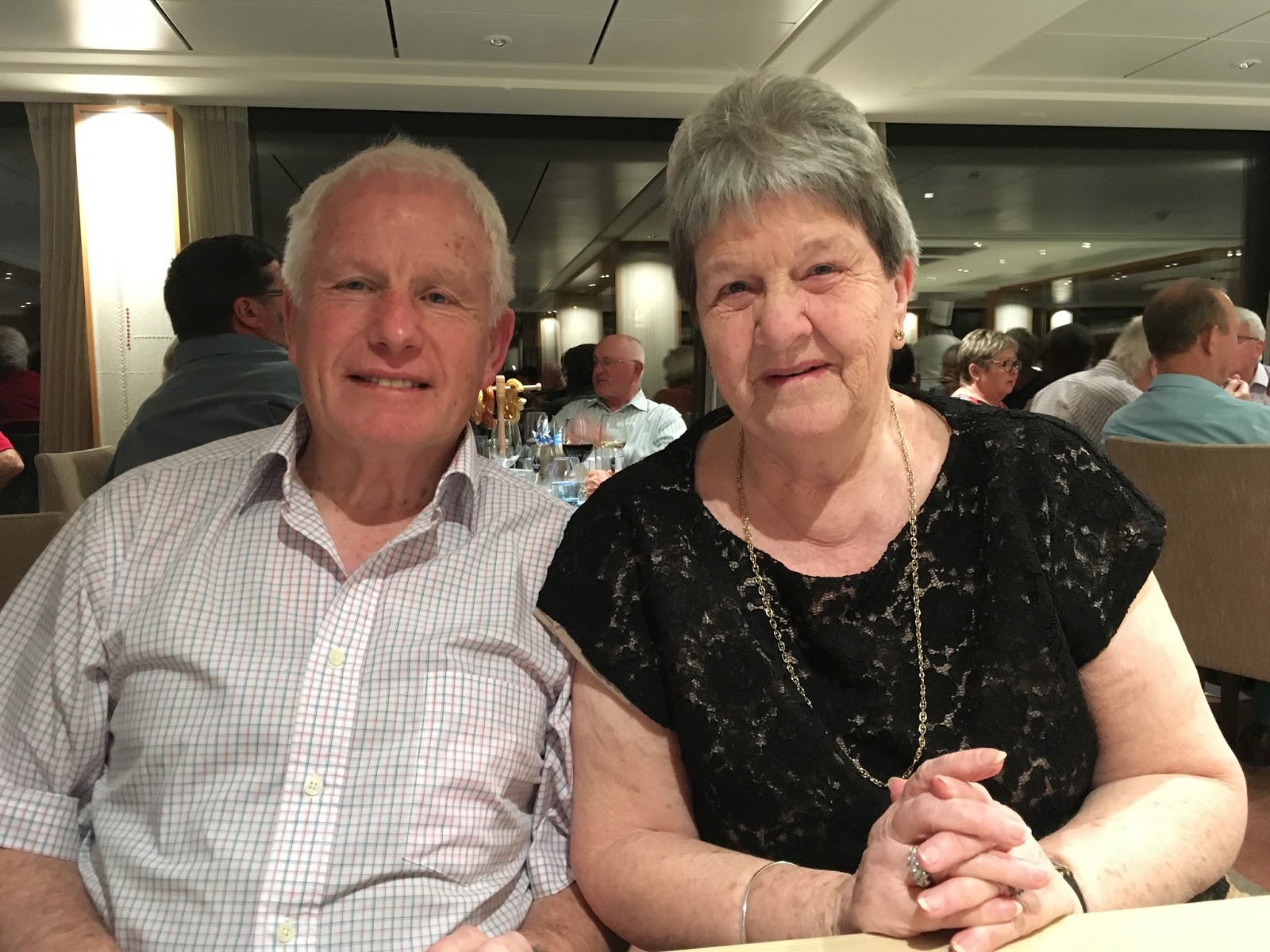 For example, our friends Wilson and Iris. Wilson will kick your ass while Iris rolls her eyes at him.
Man, did we bomb the hell out of Germany during World War II. I'm not saying they didn't have it coming, but the history of every town we visited was told in two chapters: Before the War, and After the War.
For the village of Rüdesheim, that page turned on Saturday, November 25, 1944. Every significant building in town had a little plaque that read (in German) something like "Built 1362. Destroyed 25 November 1944. Rebuilt 1956."
I felt some cognitive dissonance while listening to a guide describe how bullets gouged holes into a cathedral facade during World War II when those holes were directly above a woman begging for coins.
You haven't really heard the songs "Margaritaville" or "Sweet Caroline" until you've heard them in the original German.
Karen showed previously untapped musical talent.
Troupes of little streamer-twirling girls dancing in village spring festivals know "Let It Go" as well as little girls anywhere else.
When the sun comes out, Germans flock to the river by the thousands to sit and talk and play. Docked one afternoon, we saw a mob of people a quarter mile down the bank and walked over to see what was going on. Turned out it was called "Sunday."
In France, posted hours of operation seem to be more casual suggestions than reliable business commitments.
How one nation can support 837 patisseries per square block is beyond me, but all seem to survive. If France's incidence of celiac disease is lower than average, I suspect it's because all the delicious breads and pastries killed off anyone carrying the gluten-intolerance gene centuries ago.
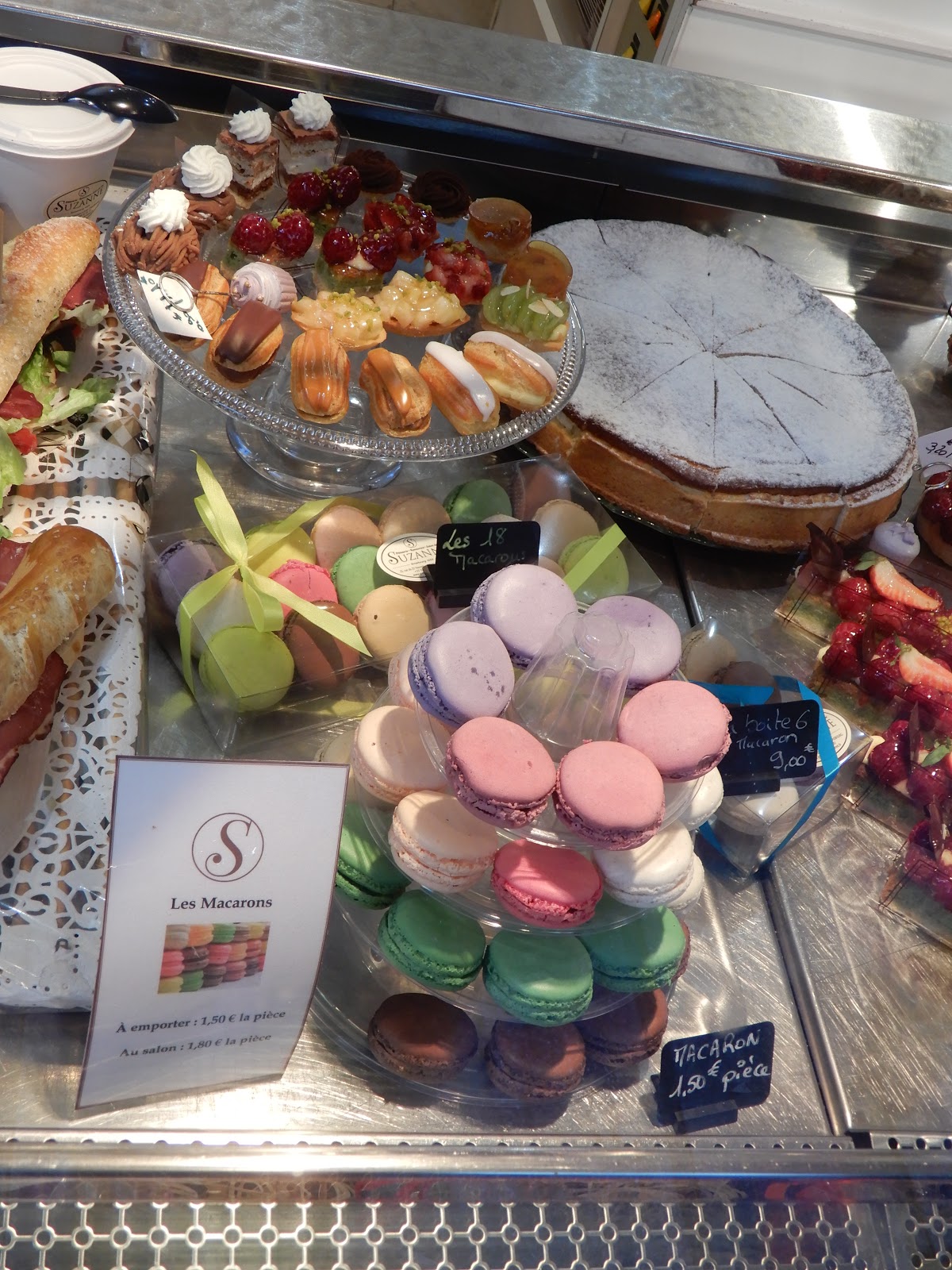 However, macarons are gluten-free.
Karen and I discovered that we were unable to walk through a French town without singing the "Little town, it's a quiet village" song from "Beauty and the Beast," especially when there actually was a baker with his tray like always, the same old bread and rolls to sell. "Bonjour!" "Bonjour!" "Bonjour bonjour bonjour!"
Similarly, it turns out it's impossible for me to be on a ship passing through a lock without humming the music from this scene in my head, and sometimes aloud:
Nerd.
European cooks should probably not attempt to make fried chicken and waffles, a quintessentially American (and, more, a rural black American) dish. Our ship chef's version came off like someone trying to kiss a girl after only reading about it in books. It had no soul.
My great-grandmother came from Alsace-Lorraine. I didn't know her, she died when I was a baby, but I was touched to see the landscape where one-eighth of my DNA came from, and easily imagined her walking the ancient streets of Strasbourg or Colmar.
Speaking of Strasbourg:
Sat down on a patio in Strasbourg and ordered a tarte flambée with gruyere, onions and lardons, not really sure what to expect. Based on my zero understanding of French and the list of ingredients, I thought maybe something like a little quiche. Imagine my surprise and delight when a flatbread pizza showed up. Even better, it was one of the best I've ever had.

Random photos of things I found interesting:
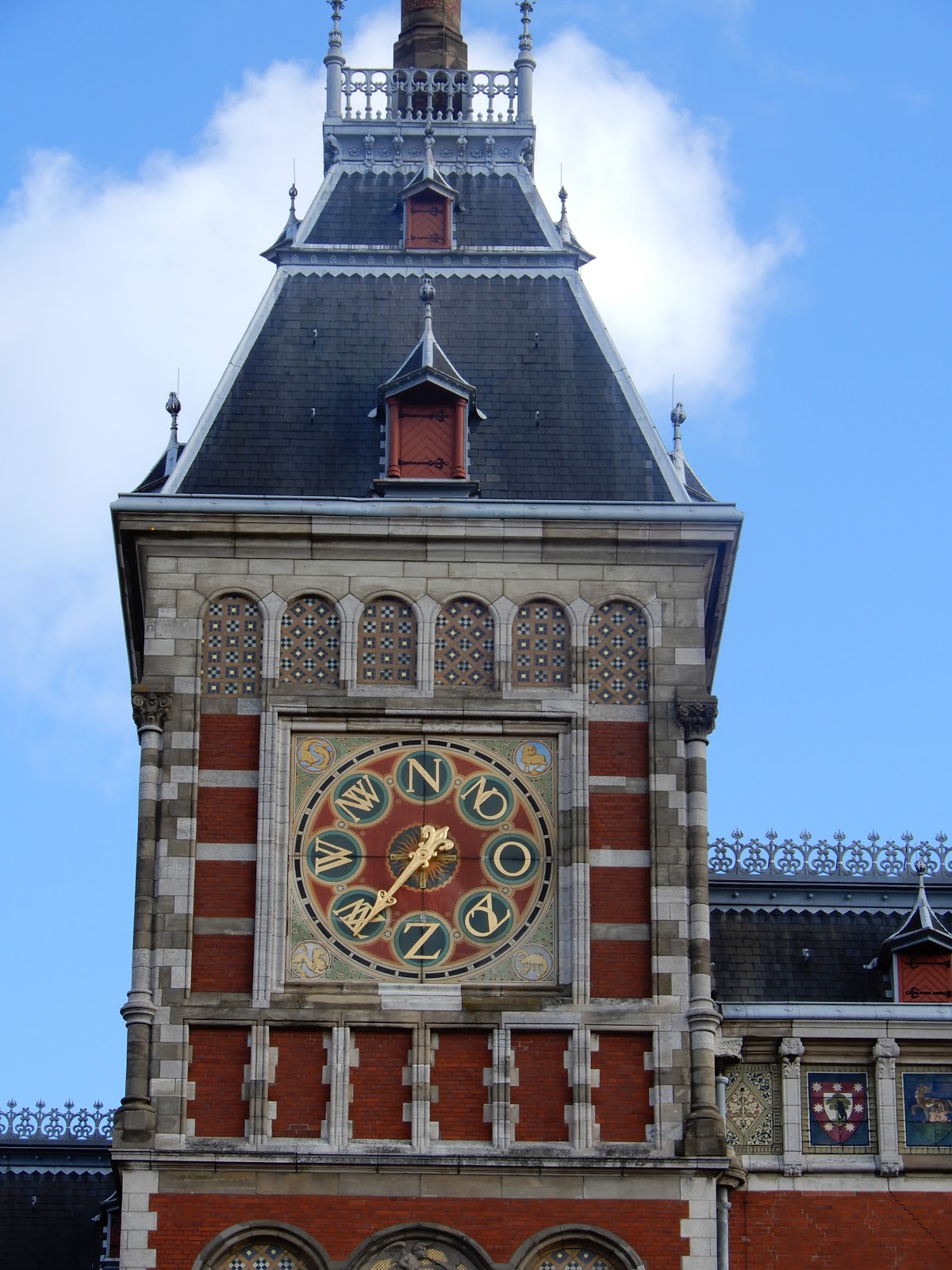 Beautiful dial indicating wind direction at Amsterdam's central train station. I like that one of its points reads "Oz" (because in Dutch east is "oosten" and south is "zuiden").
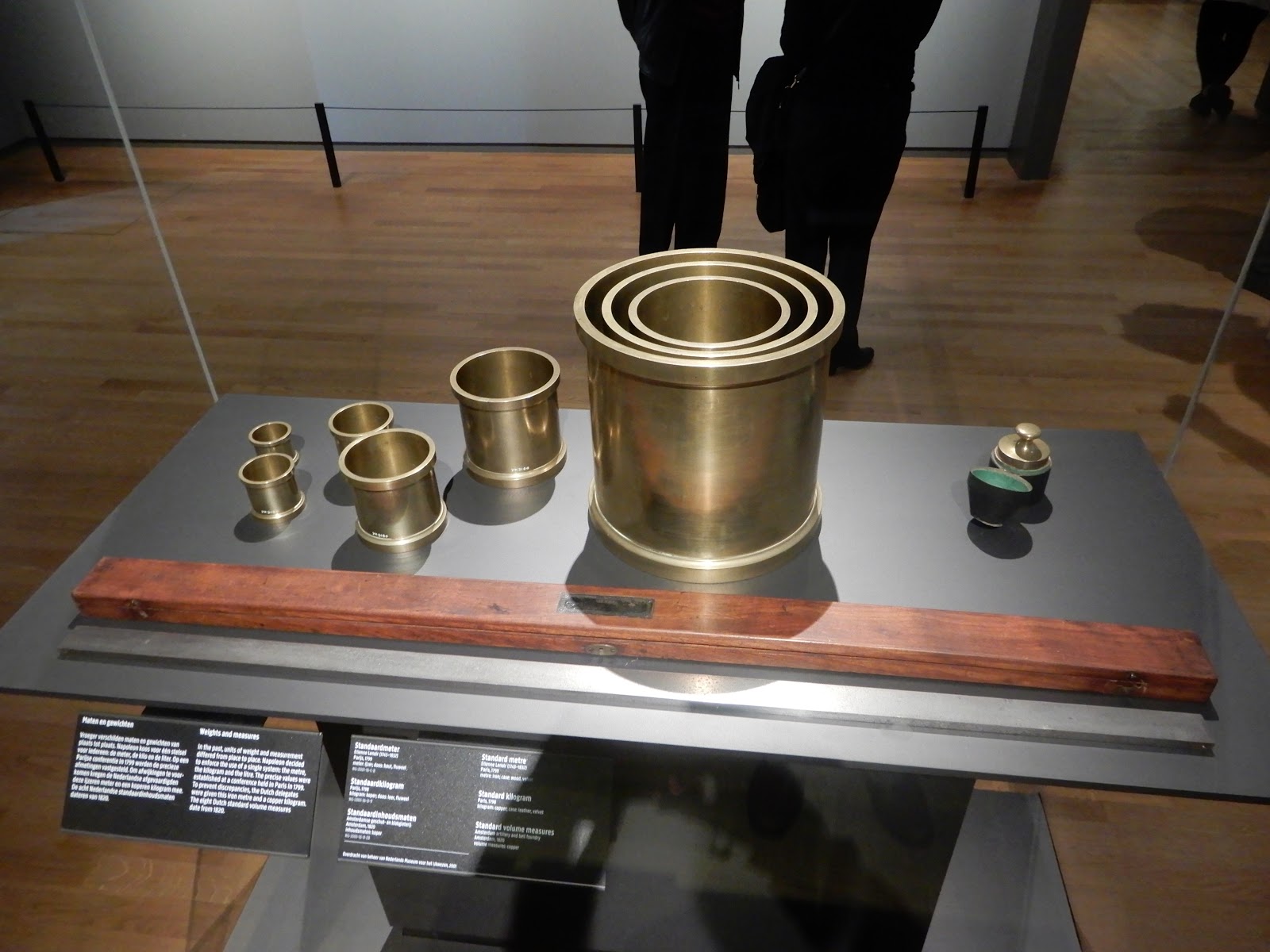 Official metric weights and measurement standards from 1820, at the Rijksmuseum.
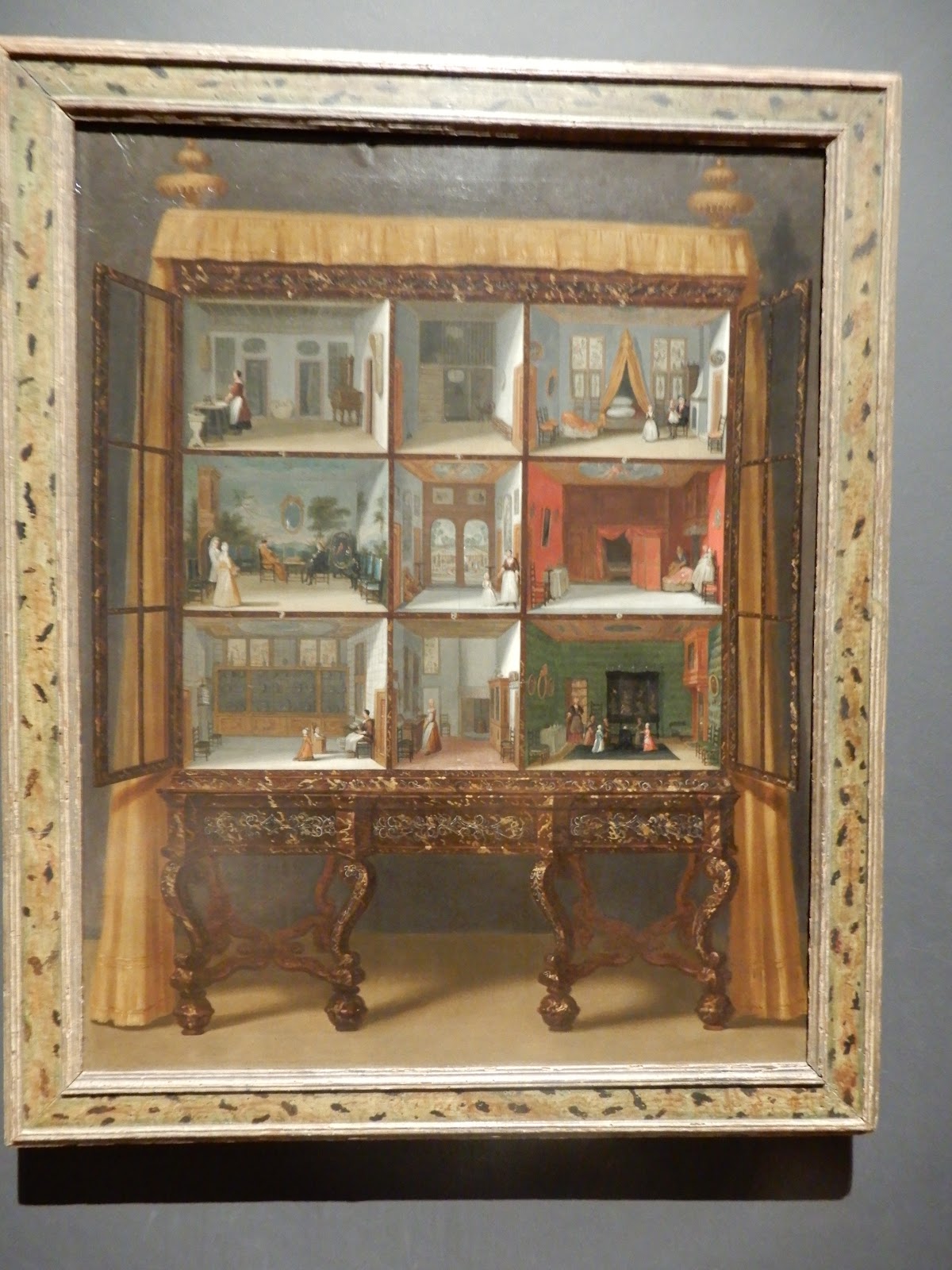
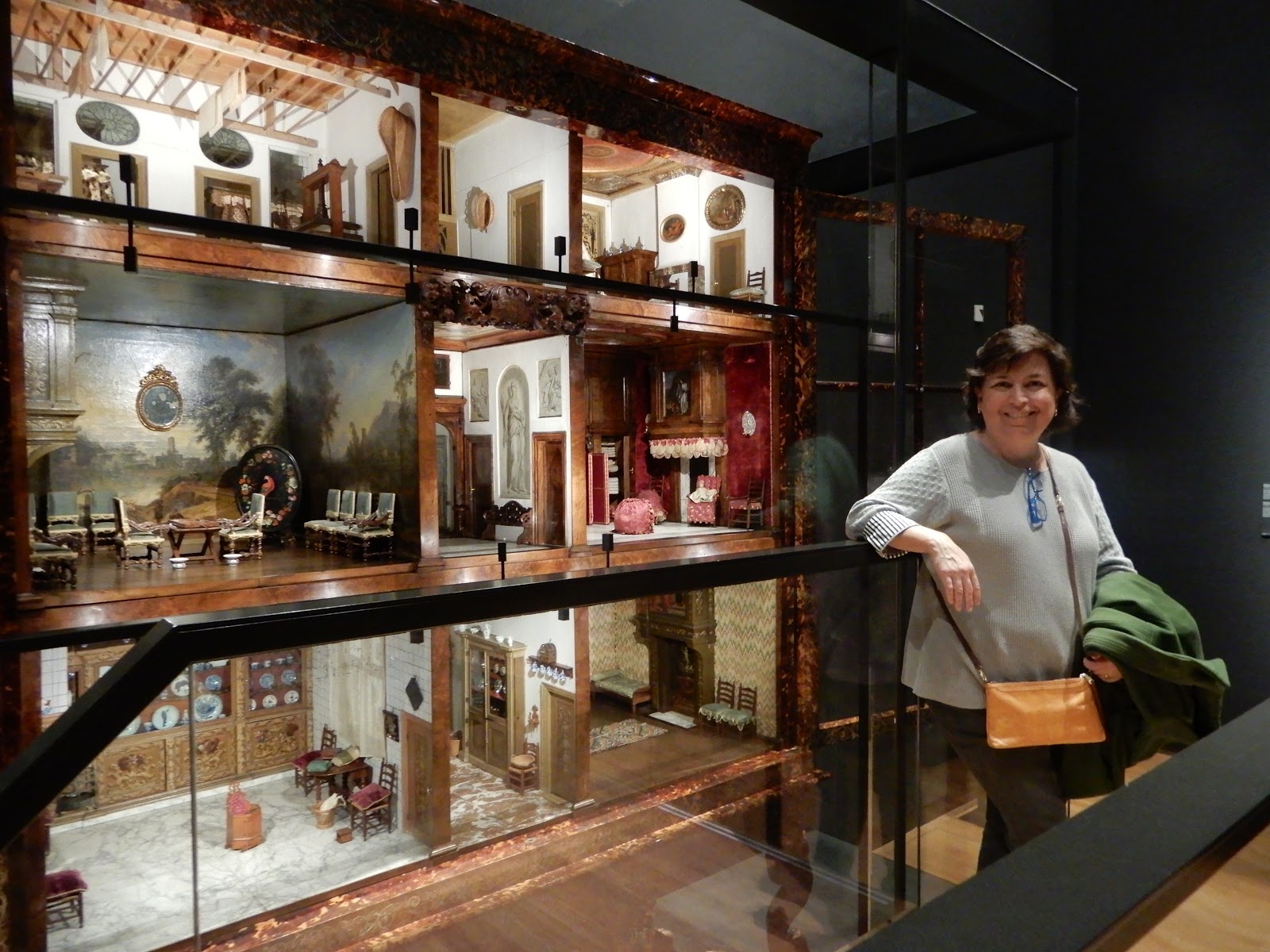 A very rich girl's giant dollhouse, followed below by a painting of that very same dollhouse done in 1710, at the Rijksmuseum.
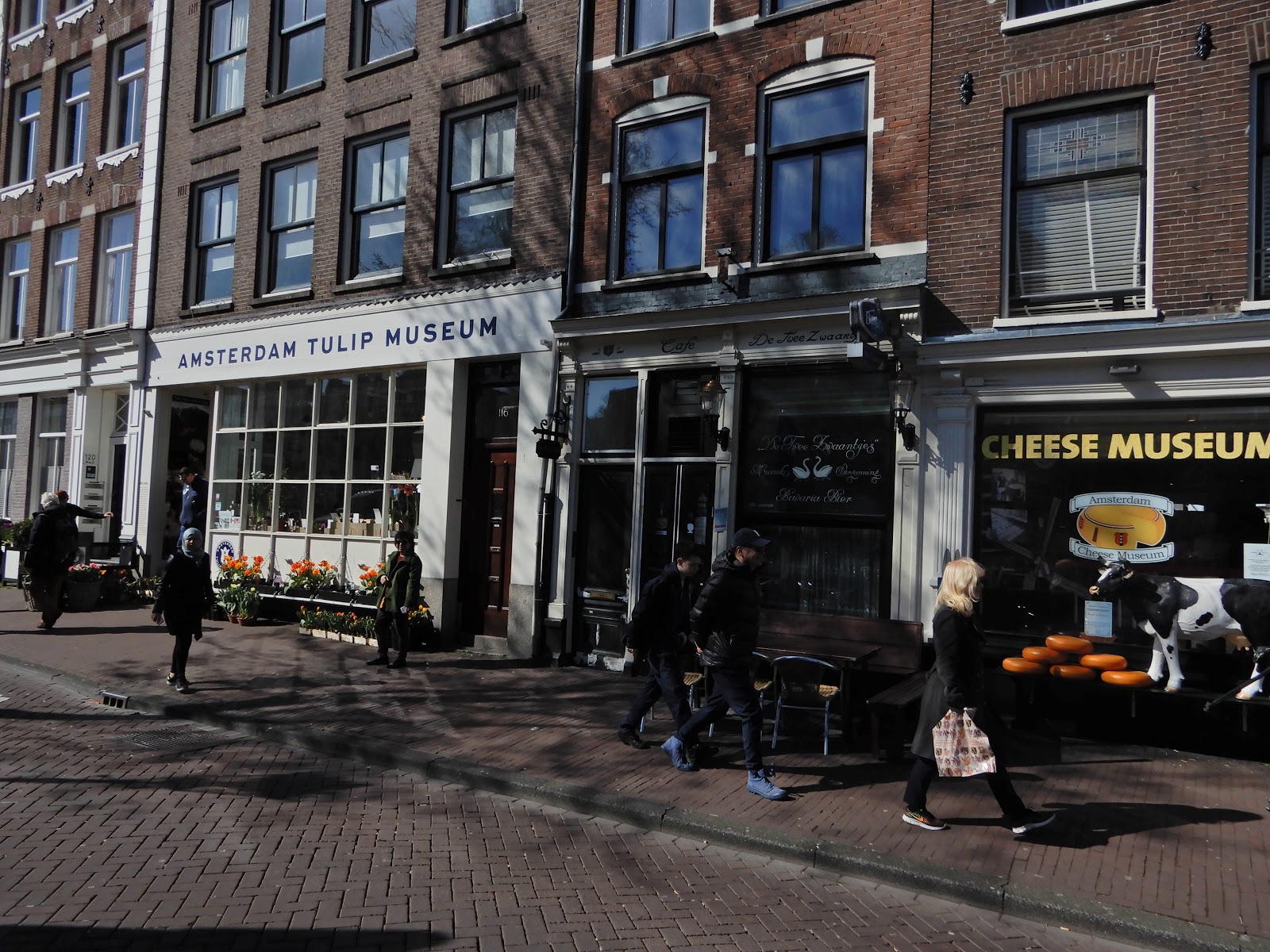 The Tulip Museum next to the Cheese Museum, Amsterdam.
 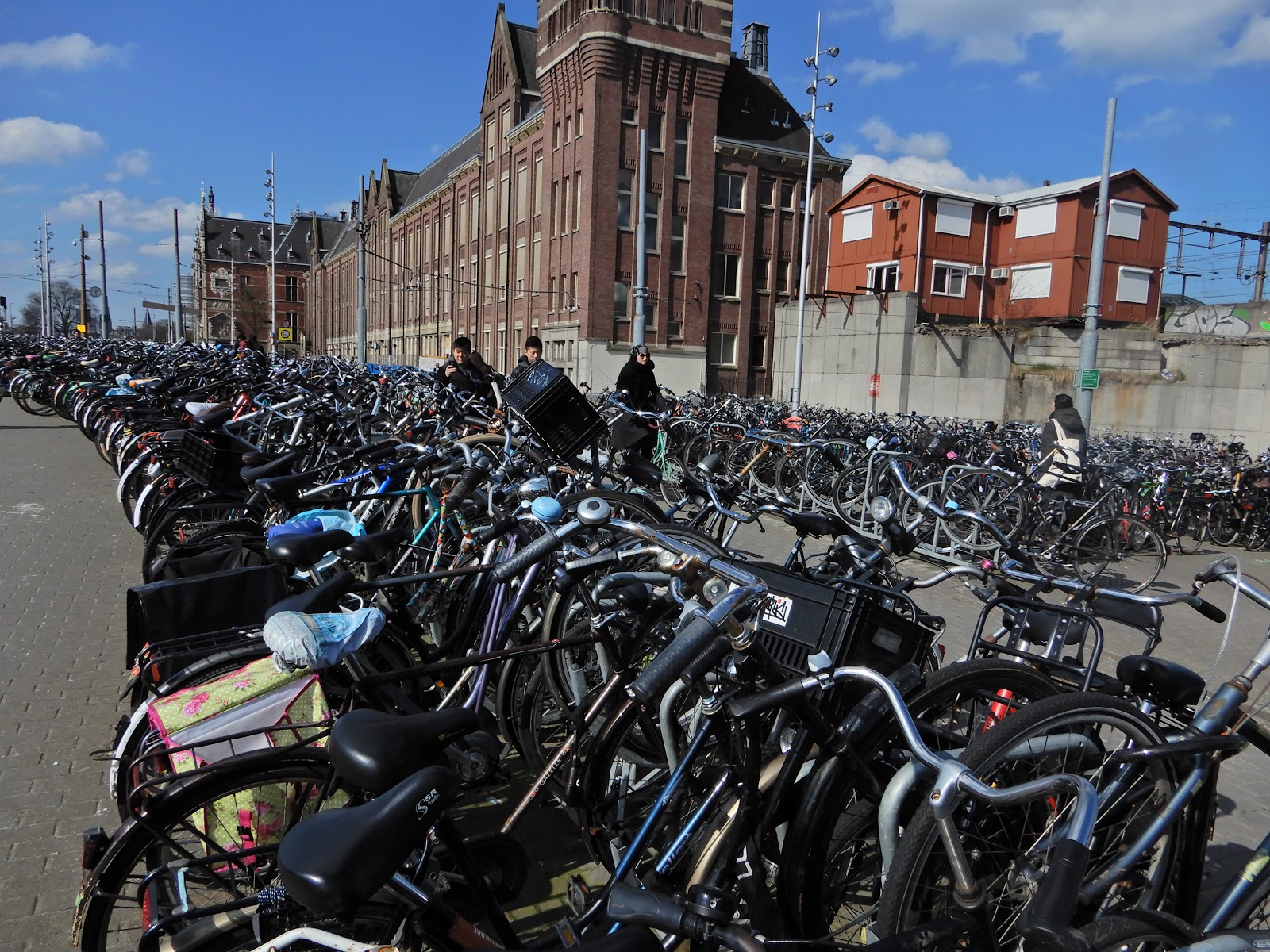 Amsterdam is a cyclist's town. Didn't see very many nice bikes, mostly old, heavy clunkers that people left unlocked. Don't get in their way, they'll run you down.
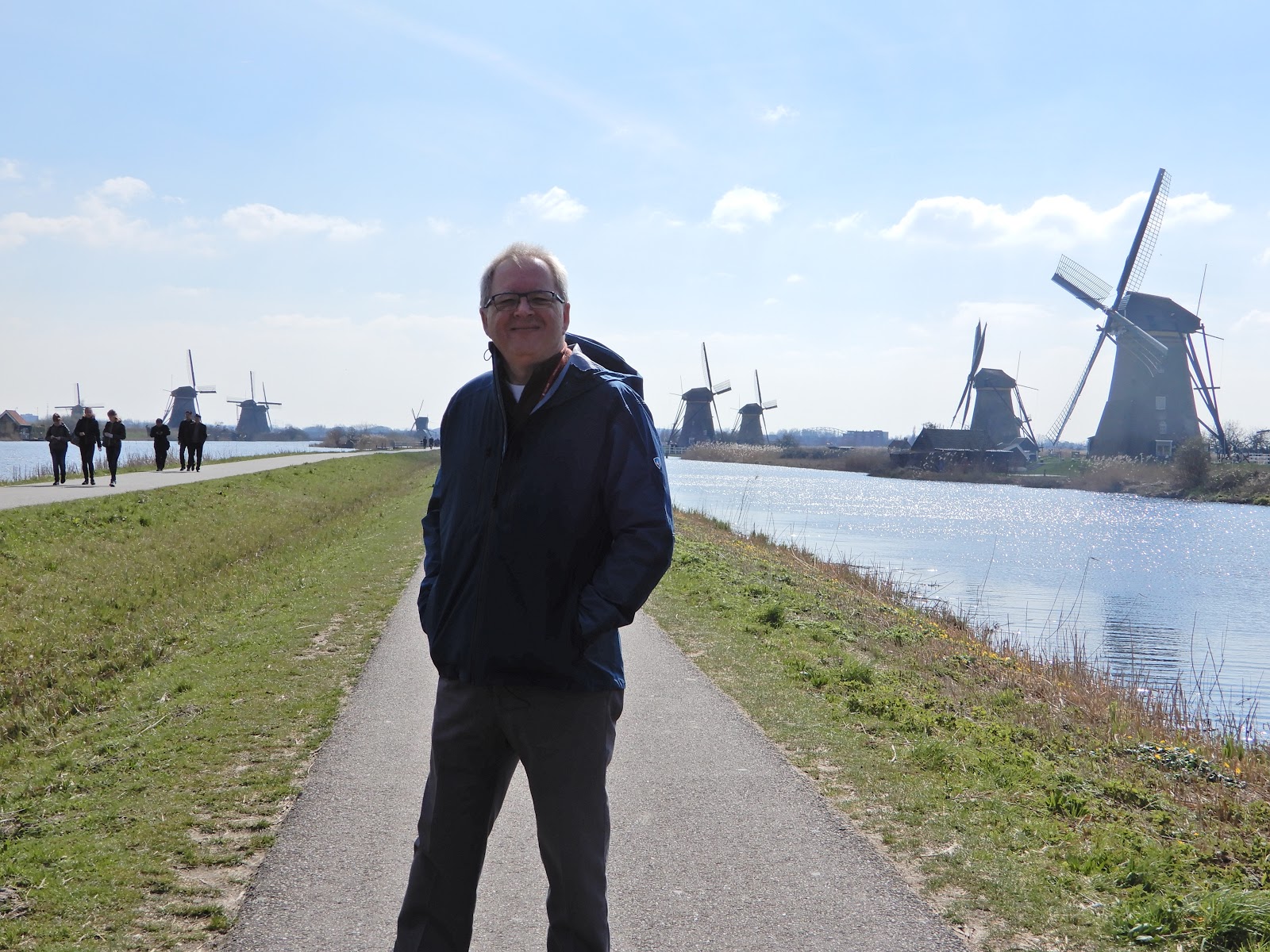 At Kinderdijk.
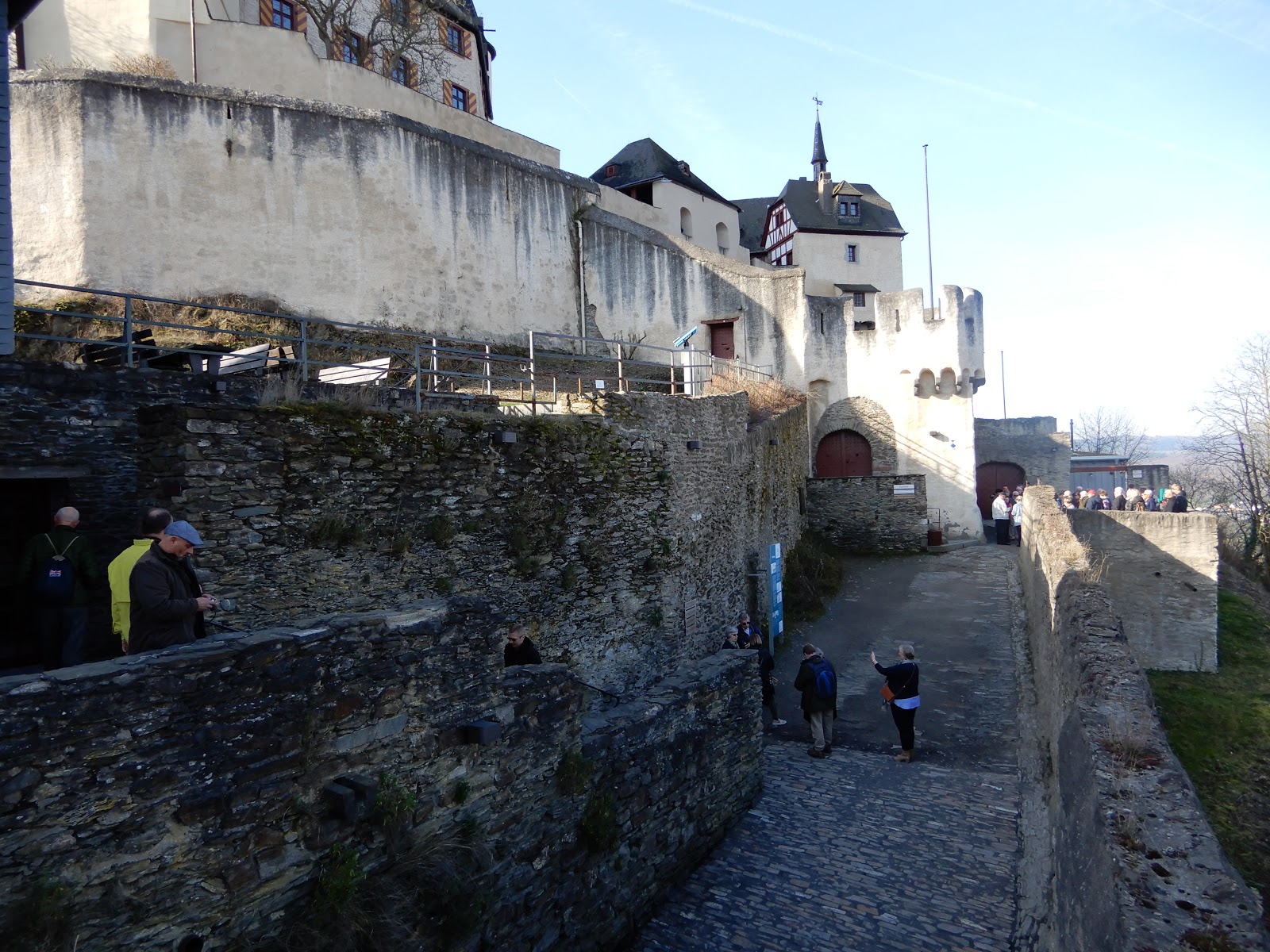 Marksburg Castle . . .
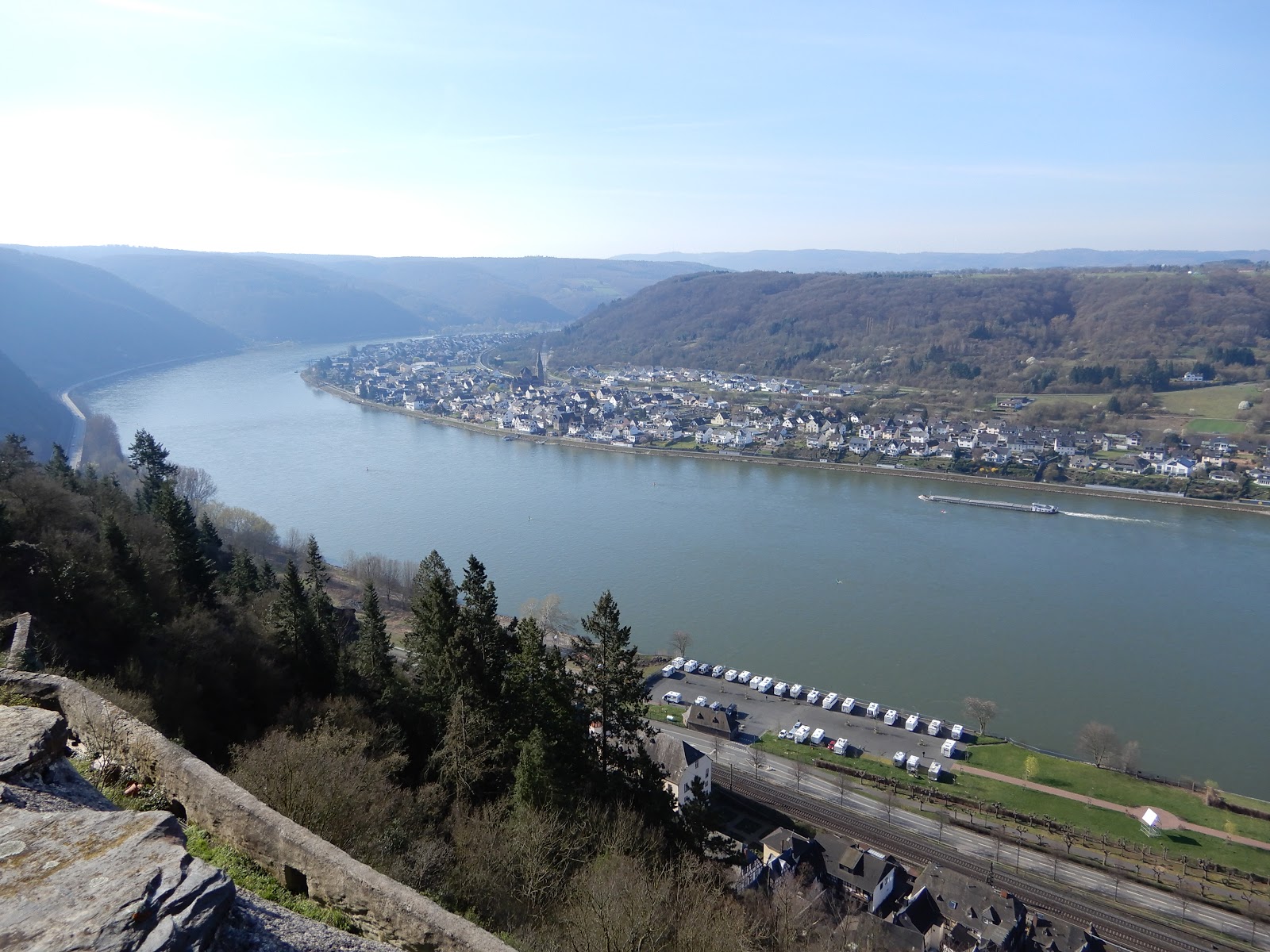 . . . and the Rhine from Marksburg Castle, whose cannons could hit the far bank.
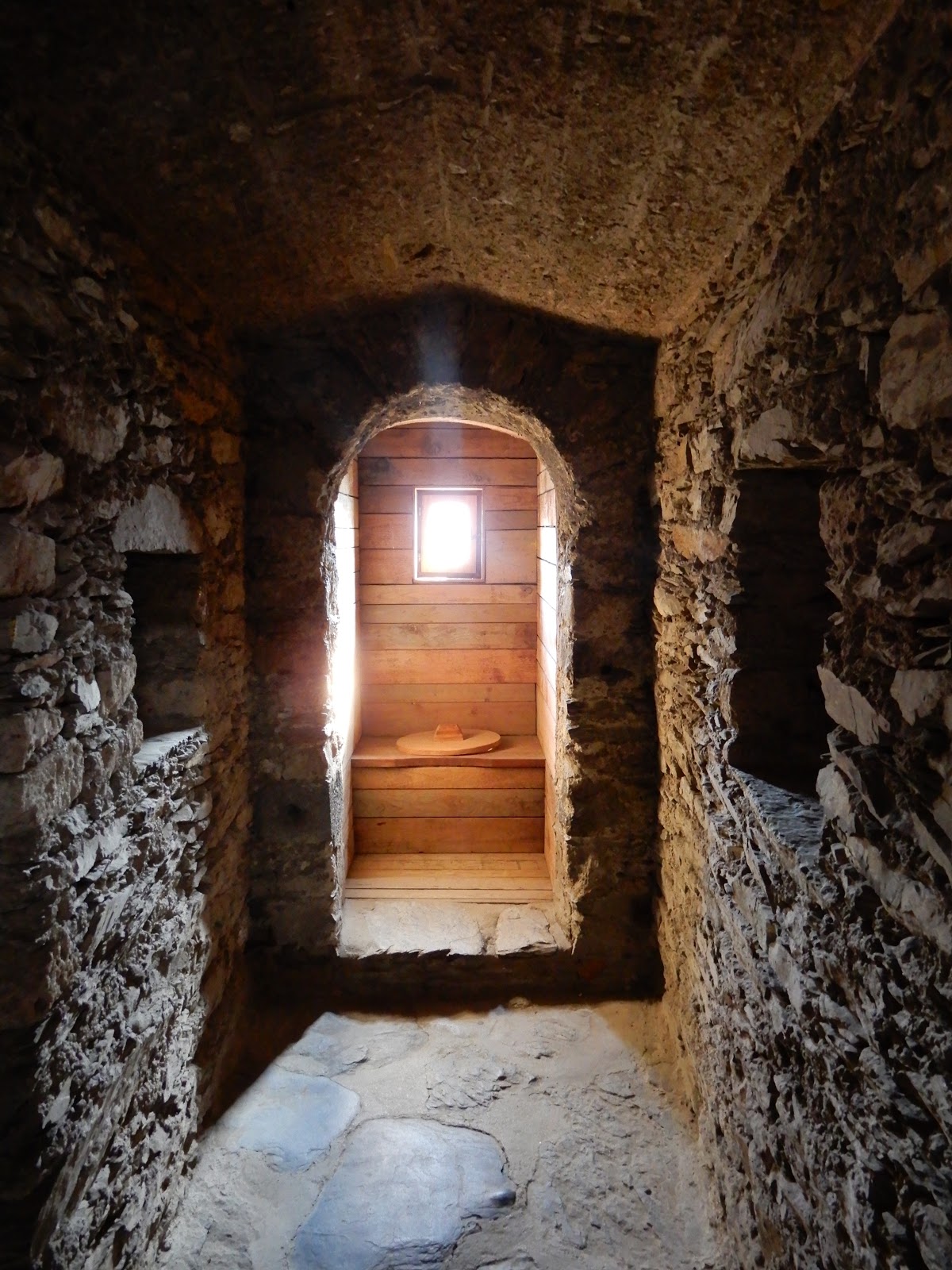 Medieval toilet at Marksburg Castle. The business end naturally opens onto a pathway below.
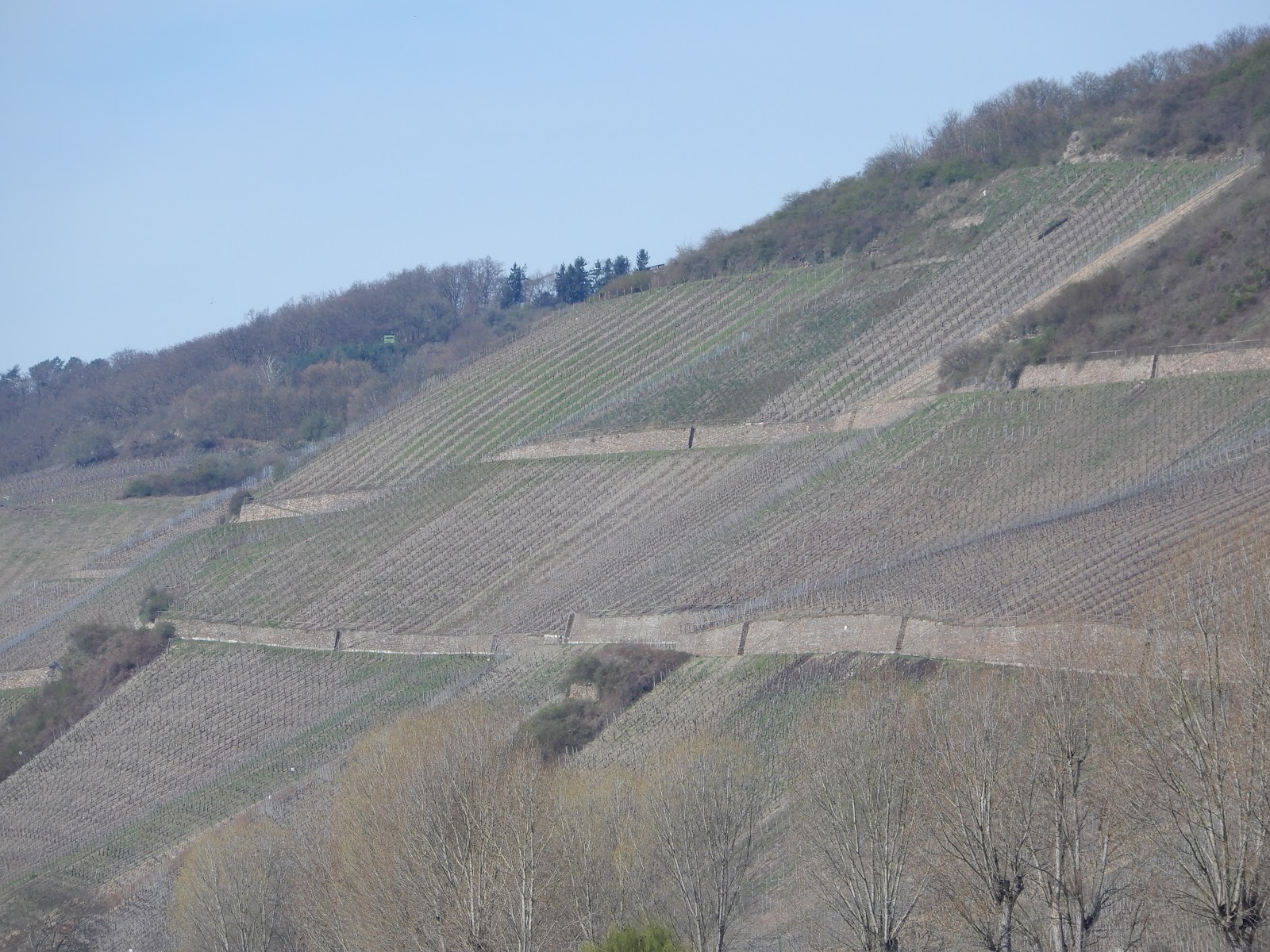 Coming from California's Wine Country, we were interested to see that vineyards along the Rhine are planted in rows that run up and down the hillsides, perpendicular to the way it's done back home. Don't know why.
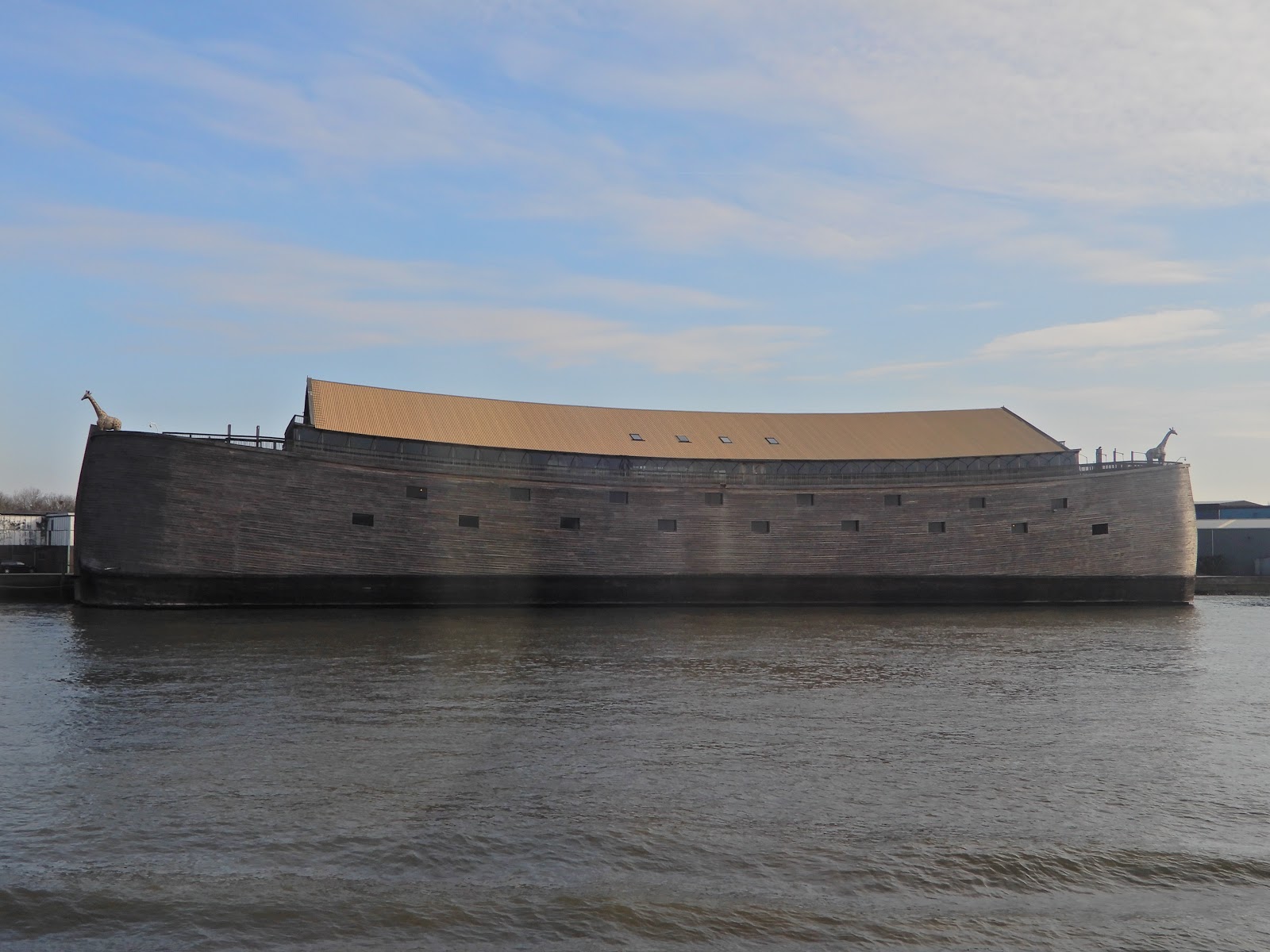 Noah's ark, near Rotterdam. I have no idea.
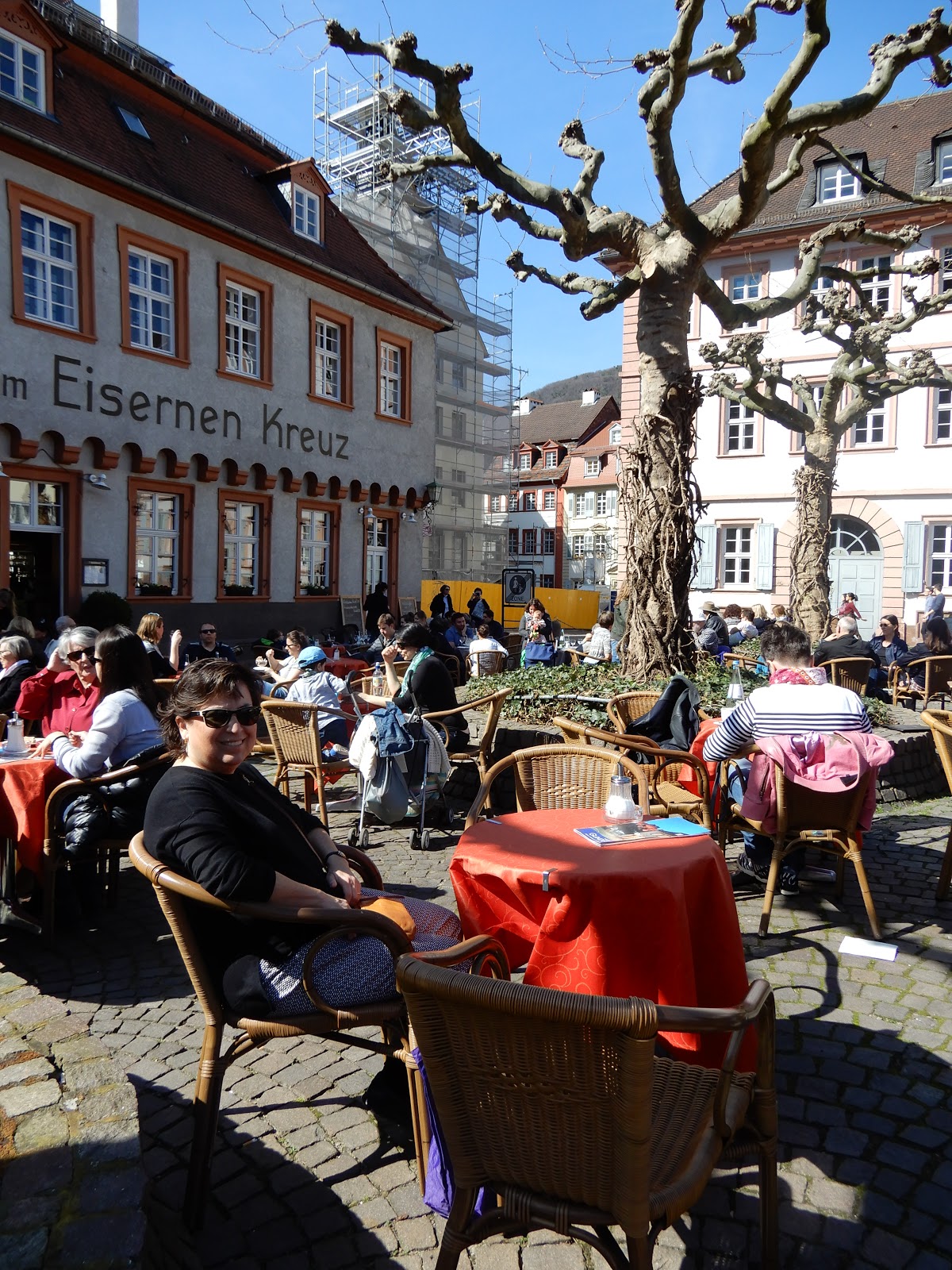 We could get used to this lifestyle. Heidelberg.
 Cool museum in Speyer, Germany, dedicated to transportation technologies, especially aircraft . . .
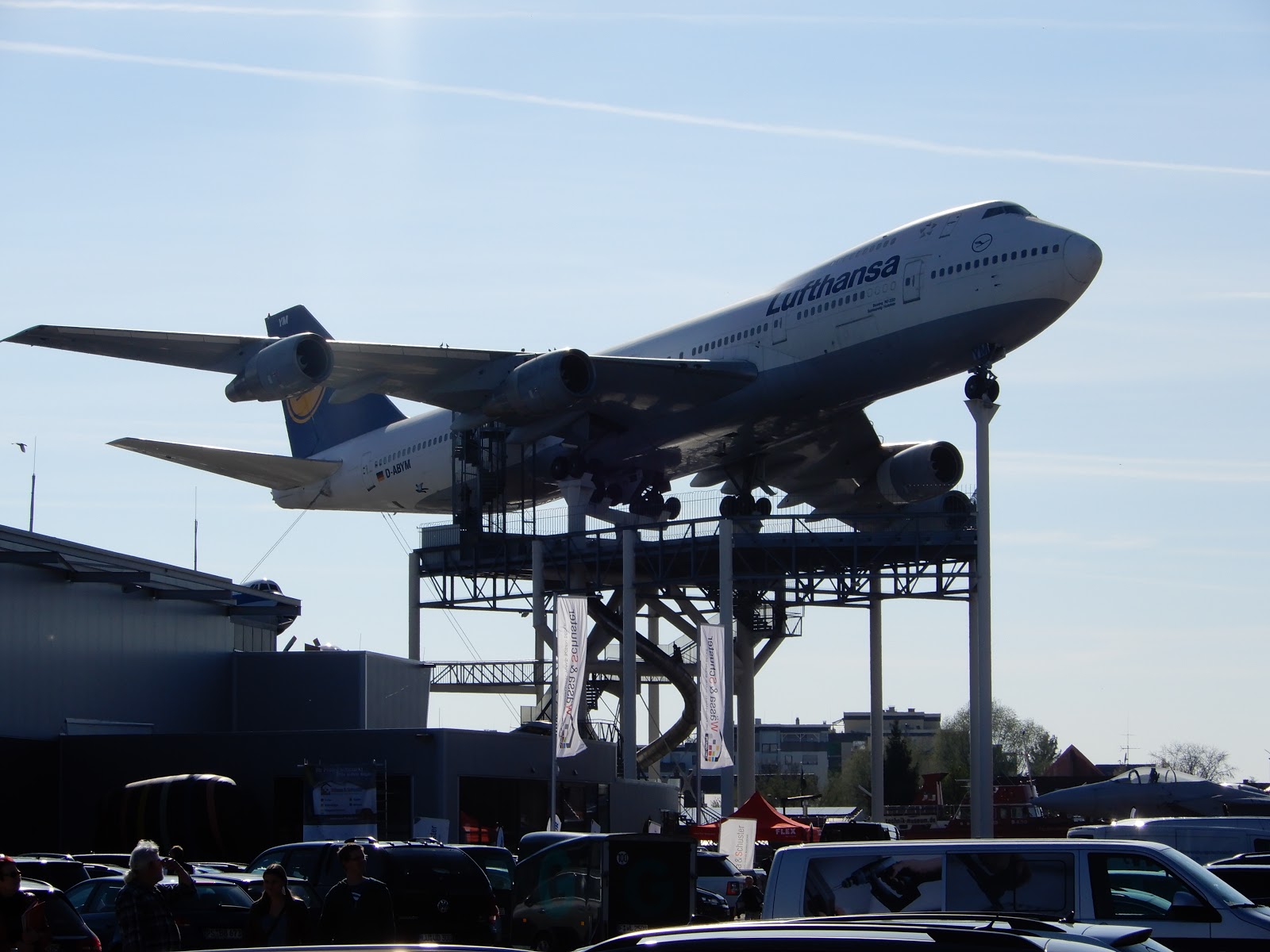 Including an actual 747, mounted on pillars, that visitors can walk through.
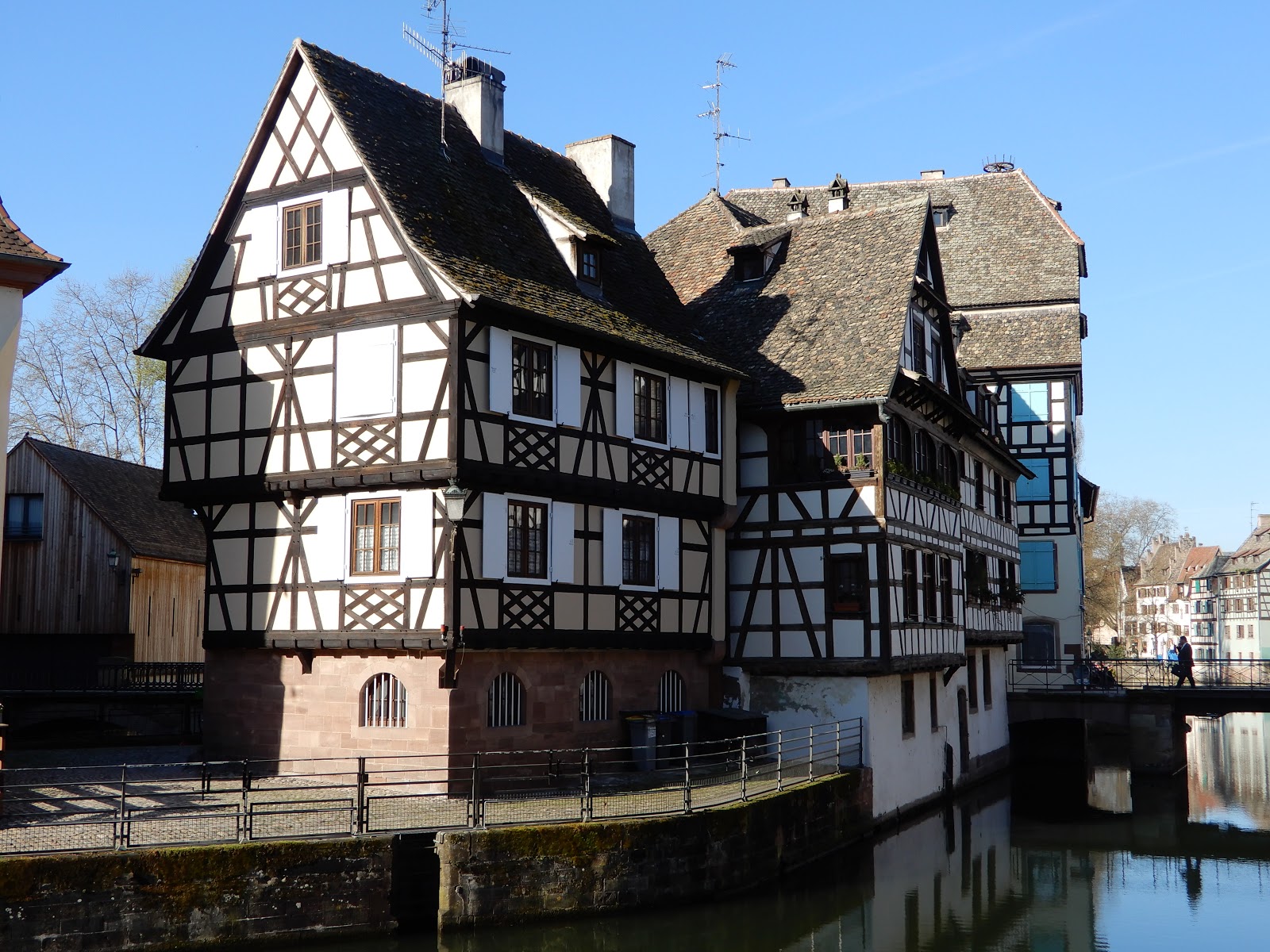 Half-timber construction from the 15th century in old Strasbourg.
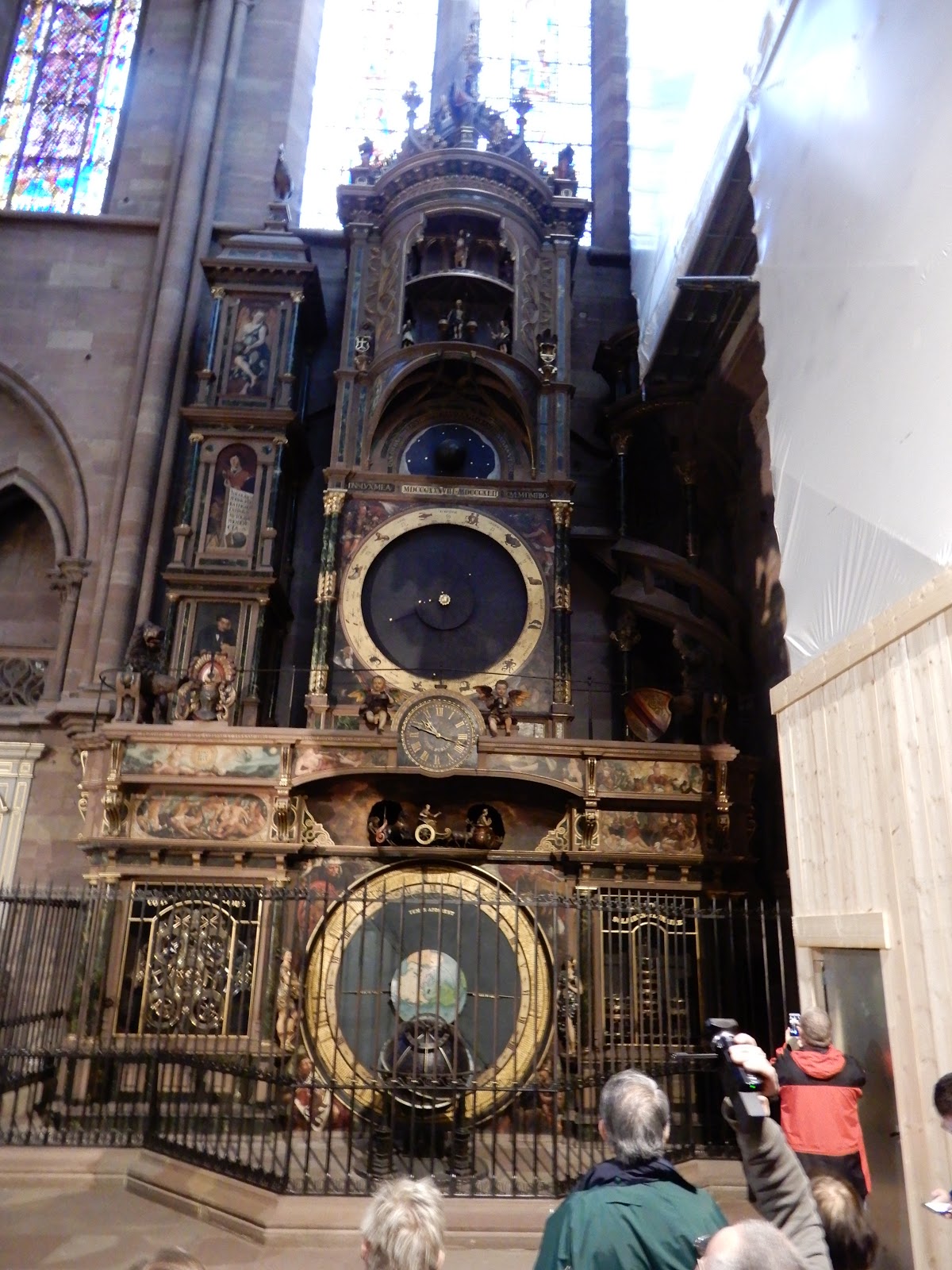 A terrific astronomical clock in Strasbourg Cathedral that marks time, Moon phase, and positions of the planets.
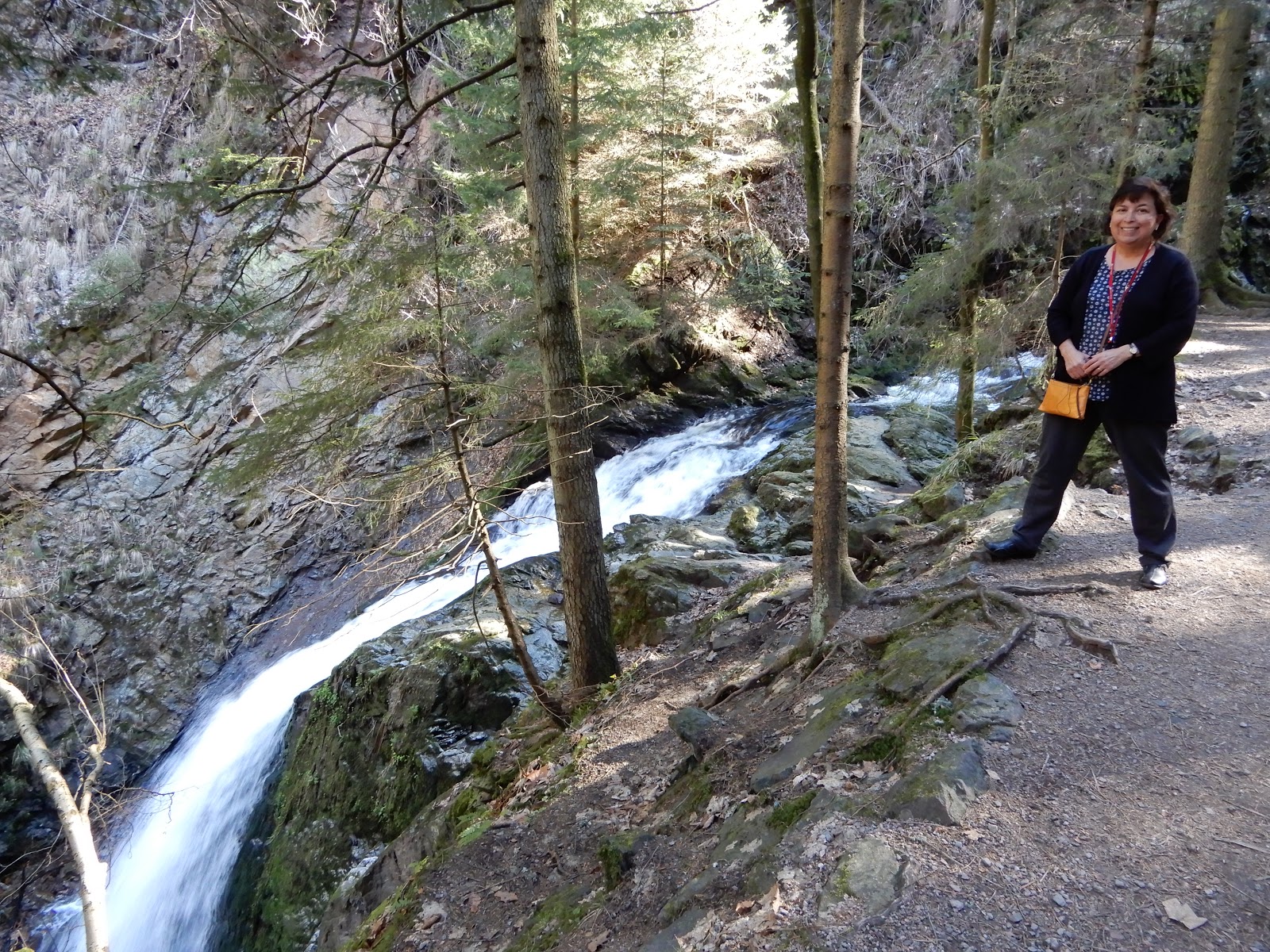 In the Black Forest, not as foreboding as you might think.
 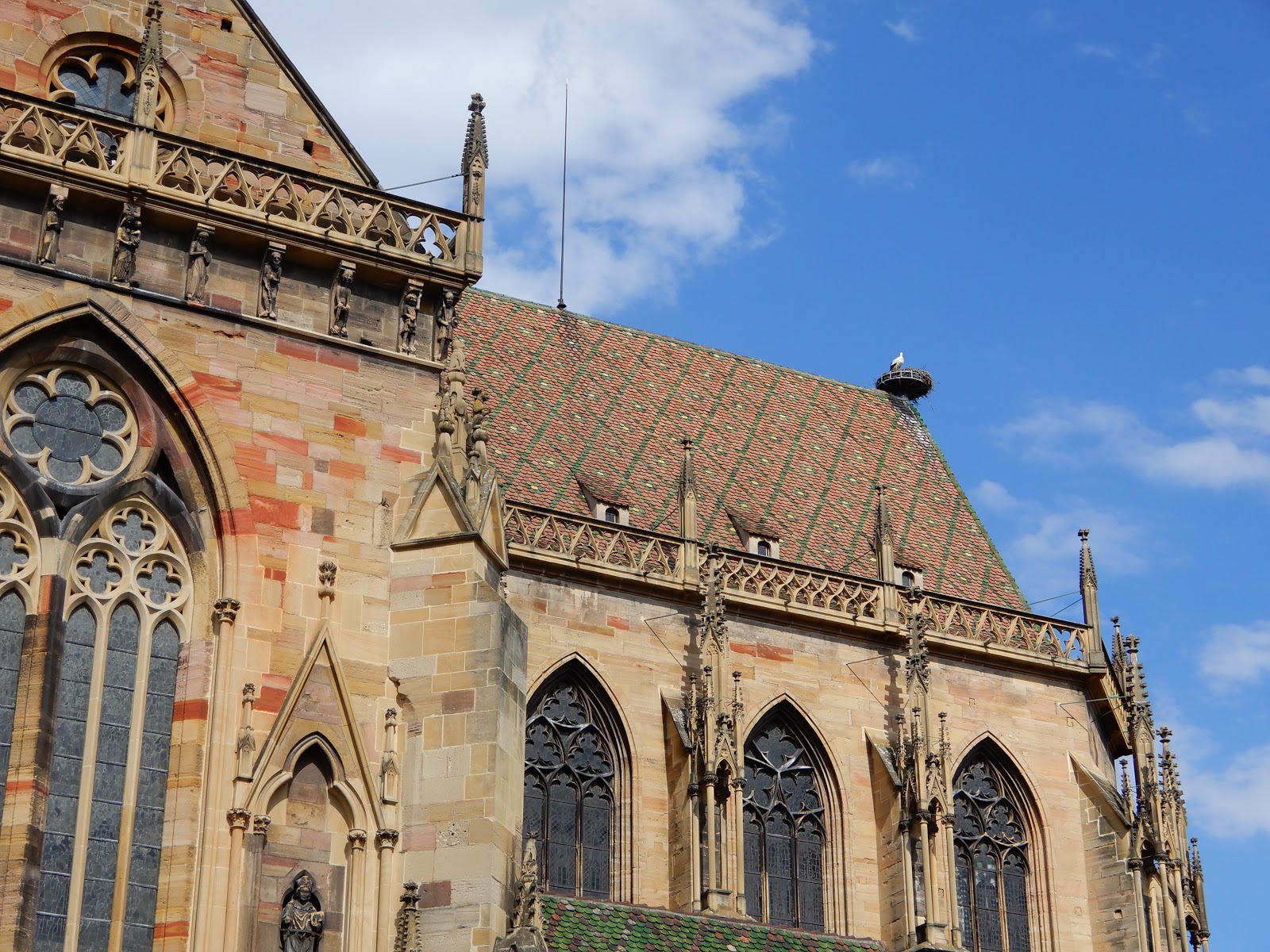 Storks nesting (at upper right) atop a cathedral in Colmar. We saw many stork nests bringing their hosts lots of good luck and fertility.
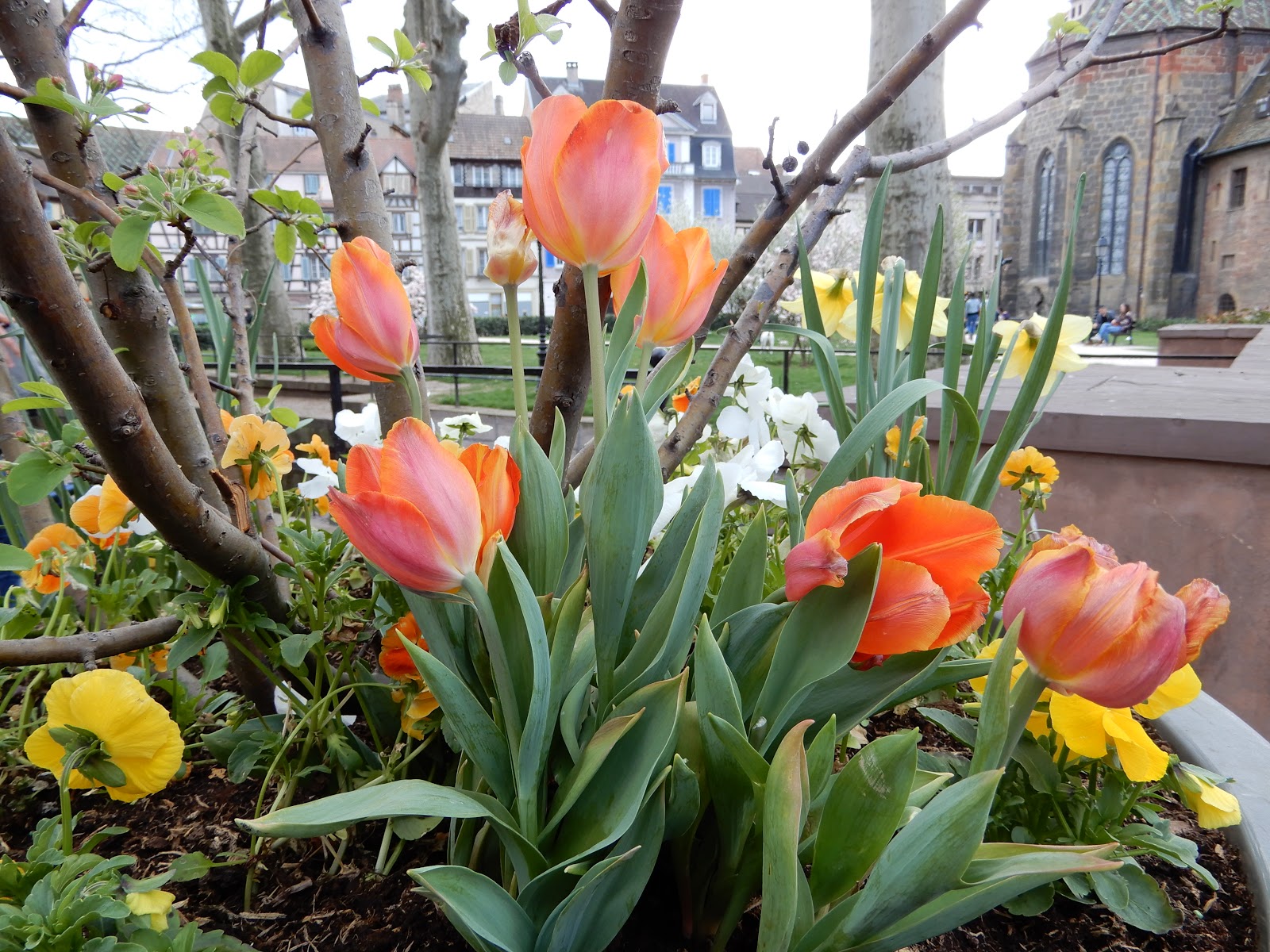 We were a few weeks early for prime tulip season but still caught them here and there.
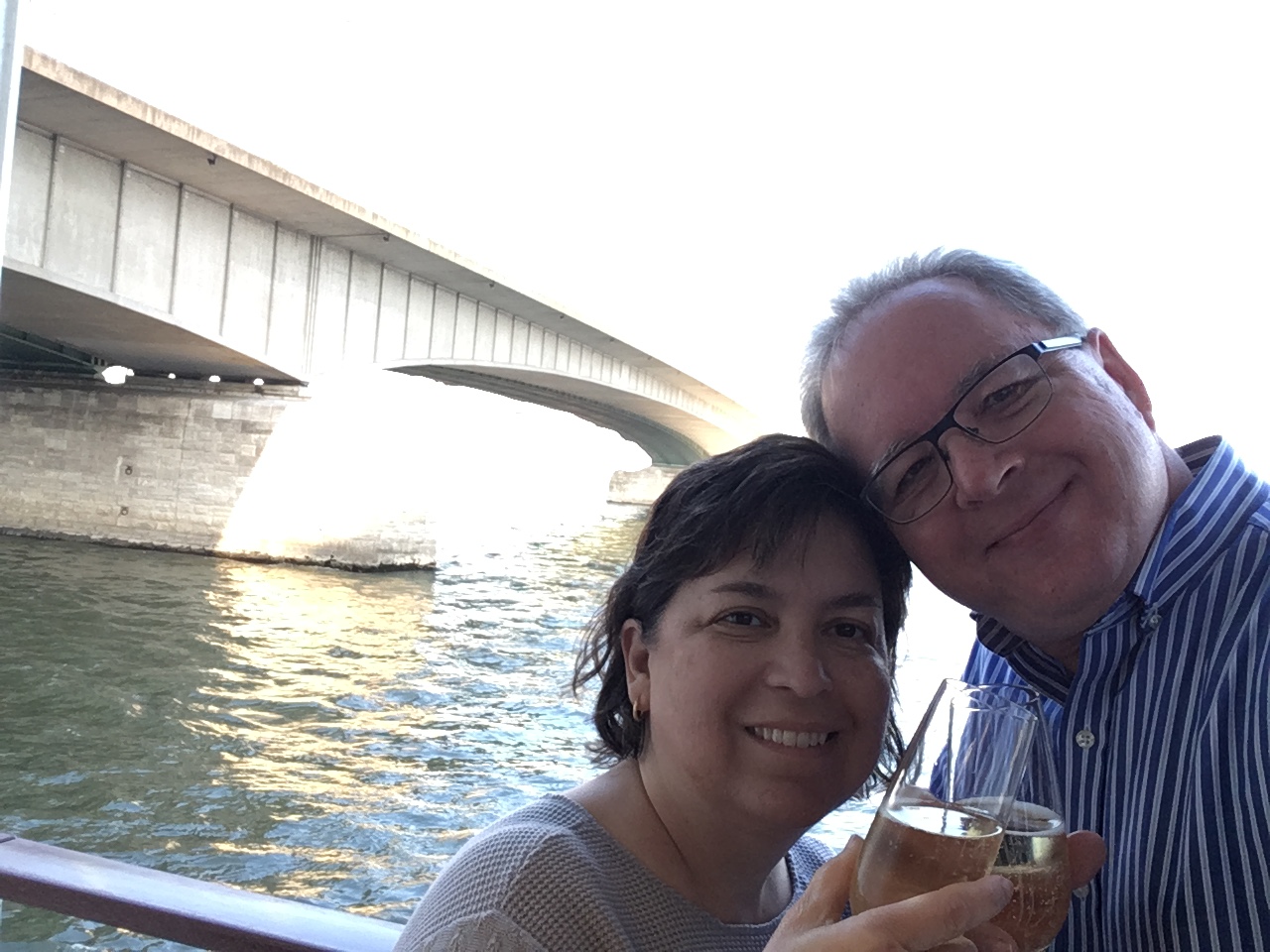 And somewhere in there, we celebrated our anniversary, too.
We managed to cram a lot of action into a week and half, and came home pretty tired but refreshed, the way you're supposed to be.
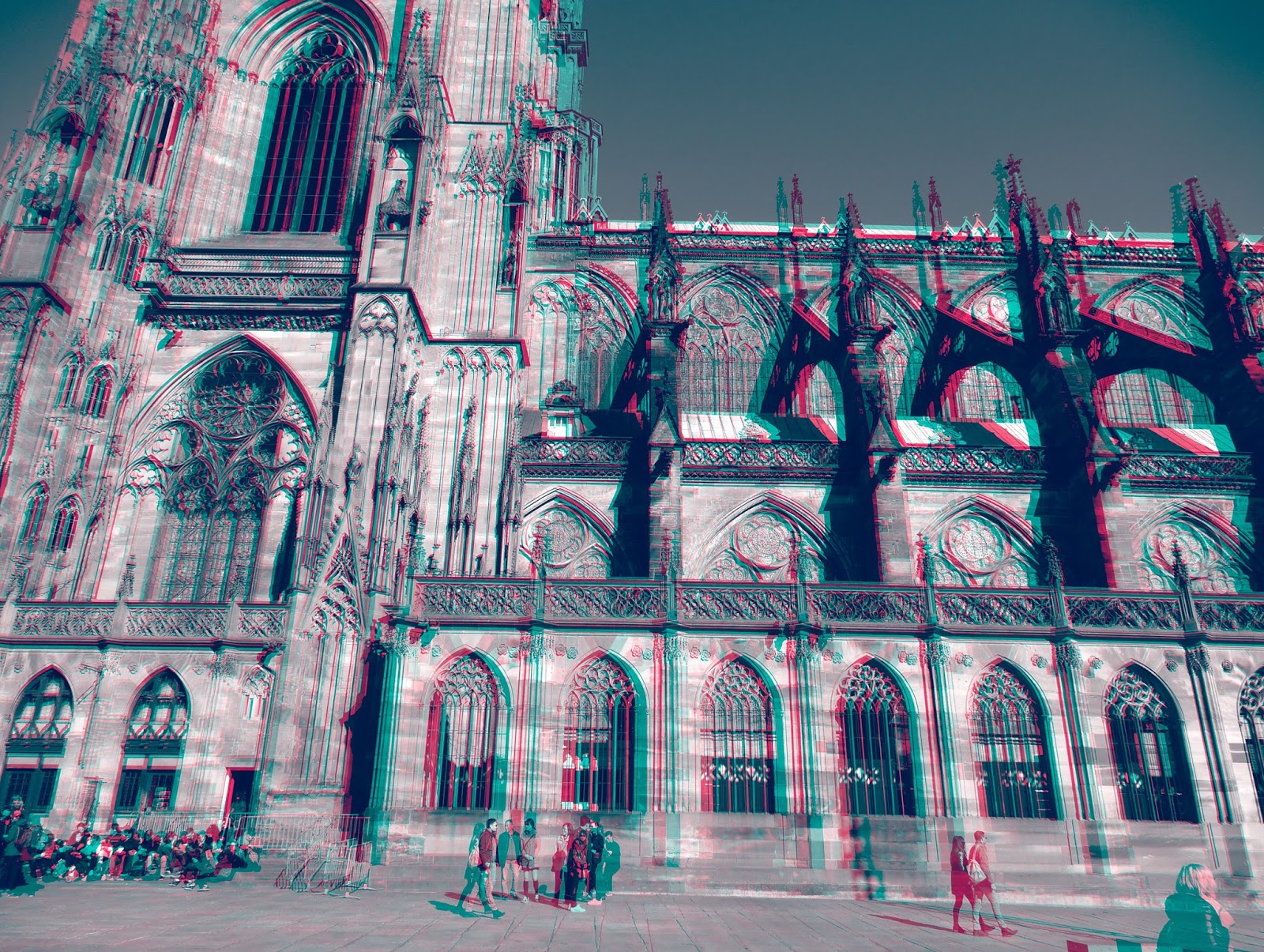
Finally, pull out your red-blue 3-D glasses and enjoy this mind-blowing view of the soaring towers and flying buttresses of Strasbourg Cathedral. You're welcome.


February 21, 2017
A Curious Book of Curious Facts

Karen is a much better shopper than I am. I skim, she digs. The downside is that I can be done with an entire store while she's still circling the first display case. The upside is that she often finds treasures I miss--such as this book I overlooked and she caught at an antiques store a couple of weeks ago. She said, "You're buying this book," and she was right.
Published in 1903, Curious Facts Relating to Almost Everything Under the Sun is an odd duck. It's a collection of brief news items, old wive's tales, "believe it or not" oddities, lists, poems, proverbs and advice organized in absolutely no order at all. It's like a Guinness Book of World Records crossed with an Old Farmer's Almanac minus the weather forecasts.
It's kept me entertained for days. Some selections:
The Flapping of a Fly's Wing
The slow flapping of a butterfly's wing produces no sound, but when the movements are rapid a noise is produced, which often increases in shrillness with the number of vibrations. Thus the housefly, which produces the sound F, vibrates its wings 21,120 times a minute, or 335 times in a second; and the bee, which makes a sound of an A, as many as 26,400 times, or 440 times in a second. On the contrary, a tired bee hums on E, and therefore, according to theory, vibrates its wings only 330 times in a second . . .
Odd Marriage Records
Married at Bridgewater, Dec. 16, 1788, Capt. Thomas Baxter, of Quincy, aged 66, to Miss Whitman, of the former place, aged 57, after a long and tedious courtship of forty-eight years, which they both sustained with uncommon fortitude.
To Be Avoided
Don't use obsolete words.
Don't use technical terms.
Don't use slang expressions.
Don't write a feeble sentence.
Don't write a clumsy sentence.
Don't say commence for begin.
Don't write an obscure sentence.
Don't say vituperation for abuse.
Don't say initiate for commence.
Don't use foreign words or phrases.
Don't take an impracticable position.
Don't say "Bard of Florence" for Dante.
Don't tempt one to question your veracity.
Wonderful Echoes
Every one is familiar with the phenomenon of echoes. In a cave in the Pantheon, the guide, by striking the flap of his coat, makes a noise equal to a twelve-pound cannon's report . . . In the cave of Smellin, near Viborg, in Finland, a cat or a dog thrown in will make a screaming echo lasting some minutes . . .
Brain Impressions
It is computed by scientists that, since one-third of a second suffices to produce an "impression," in 100 years a man must have collected in his brain 9,467,280,000 copies of impressions; or, if we take off one-third of the time for sleep, 6,311,520,000. This would give 3,155,760,000 separate waking impressions to the man who lives to the age of 50 years. Allowing a weight of four pounds to the brain, and deducting one-fourth for blood and vessels and another fourth for external integument, it is further computed that each grain of brain substance must contain 205,542 traces or impressions.
Advice to a Young Man
Never whip your brain. All high pressure is dangerous. Study to think as quietly and easily as you breathe. Never force yourself to learn what you have no talent for. Knowledge without love will remain a lifeless manufacture, not a living growth. Be content to be ignorant of many things that you may know one thing well, and that the thing which God especially endowed you to know. It requires fire to fuse the materials of thinking, no less than to melt the iron in the foundry . . .
A Perfect Woman Nobly Planned
A perfectly formed woman will stand at the average height of 5 feet 3 inches to 5 feet 7 inches [sorry, Karen]. She will weigh from 125 to 140 pounds. A plumb line dropped from a point marked by the tip of her nose will fall at a point one inch in front of her great toe. Her shoulders and her hips will strike a straight line drawn up and down. Her waist will taper gradually to a size on a line drawn from the outer third of the collar bone to the hips . . . [Continued like that for five more paragraphs.]
A Boy Should Learn
To let cigarettes alone.
To be kind to all animals.
To be manly and courageous.
To ride, row, shoot, and swim.
To build a fence scientifically.
To fill the wood box every night.
To be gentle to his little sisters.
To shut doors without slamming.
To sew on a button and darn a stocking.
To do errands promptly and cheerfully.
To shut the door in winter to keep the cold out.
To shut doors in summer to keep the flies out.
To wash dishes and make his bed when necessary.
To have a dog if possible and make a companion of him.
To get ready to go away without the united efforts of mother and sister.
The Rewards of Editing
Sir--Apropos of the presently raging controversy between editors and publishers, some interest may be felt in the following list of honoraria paid to different editors of the various editions of Shakespeare, Milton, Ben Jonson, Beaumont and Fletcher:--
For editing Shakespeare, Dr. Johnson (1st edition) was paid £375 ($1,575).
For editing Shakespeare, Dr. Johnson (2nd edition) was paid £100 ($500).
For editing Ben Jonson, the Rev. Mr. Whalley was paid £210 ($1,050).
[And so on for a page.]
Some Things We Don't Know
We may come down from out pedestal for a little--there are still two or three things we don't know. We do not know, for instance, how many of our kind there are on this globe. It is, after all, but a very small portion of the world that we know anything about, and the beaten path is but a trail on a mountain. The interior of Newfoundland is a terra incognita; there are islands in the Pacific of which we know nothing more than that they exist; China and Thibet (sic) are largely closed volumes, and about many other portions of this world there is as much guess work as there was in the days of Marco Polo.
We cannot tell why of two exactly similar bulbs put into precisely similar soil one should bloom out as a tulip and the other come out as an onion. We do not know how the flowers receive their color or perfume, nor why it is that while we can catch the shadow in the camera we cannot also imprison the color.
There are many things, too, for which we have not been able to frame laws. We cannot agree as to the cause of earthquakes, the origin of volcanic fires, or the birth-throes of the whirlwind. We do not even know our own origin, and the thinking world is divided between evolution and creation. We do not even know the normal color of man, whether we are bleached from the dark original, or whether the dark races are sun-burnt editions of the early whites. Was the flood local or universal? Did Atlantis exist? Were there giants in those days? These are a few of the many questions that might be asked and remain unanswered.
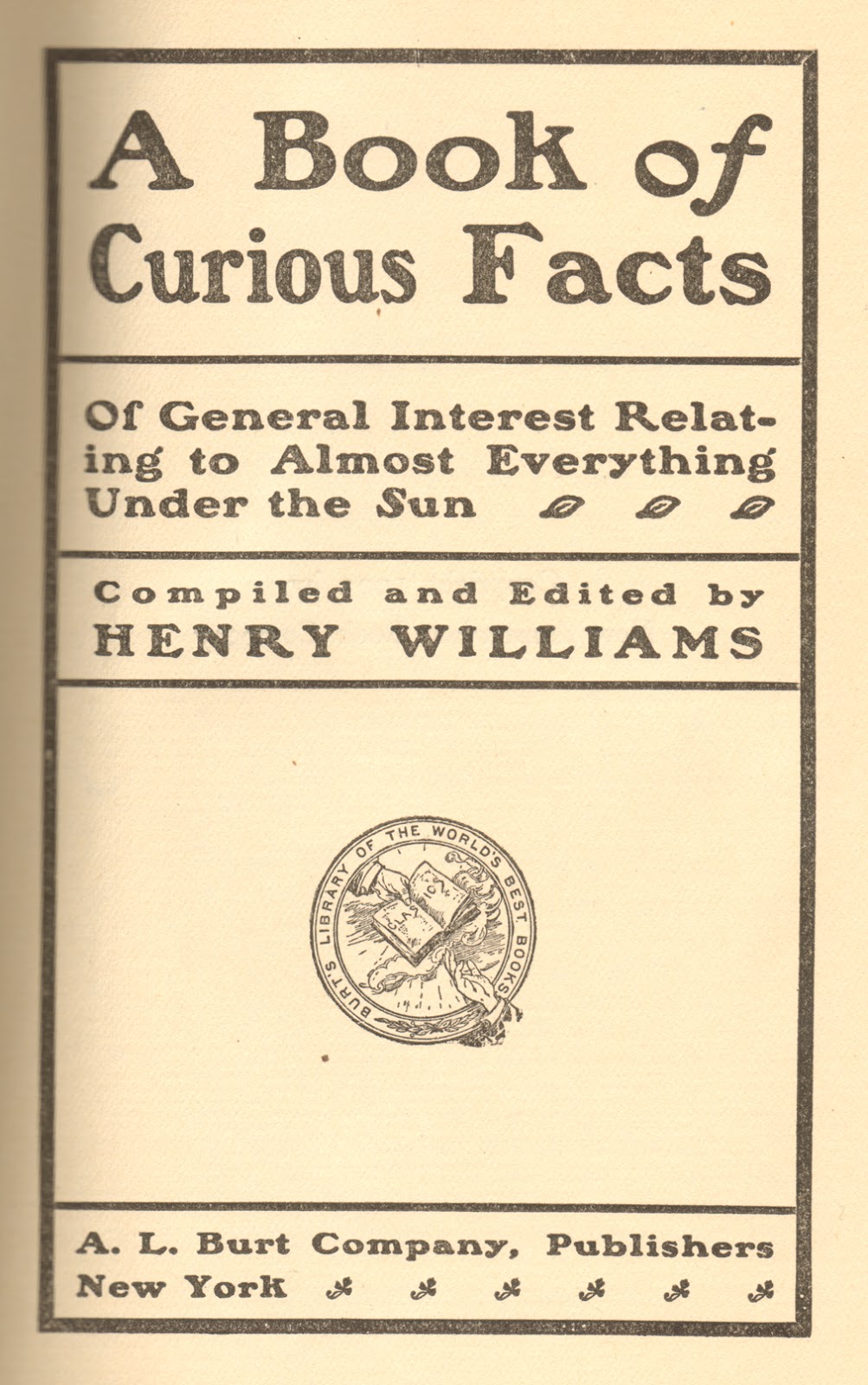
Back in 2017 now . . . I've found a couple mentions of this book online but no real details. The publisher, A.L. Burt, sold reference books, cookbooks, and children's books between 1883 and 1937.
I find the whole thing pretty charming and occasionally appalling in its casual 19th century racism, sexism, and other -isms that wouldn't have occurred to anyone in 1903. As always, I can't help wondering what its writers would think if they knew someone in the 21st century would be reading their work. It seems like a very pleasant sort of immortality. I'm happy to pass it along, and look forward to working "the bard of Florence" into my writing as the earliest opportunity.
January 29, 2017
LumaCon 3, Supervillains 0
The joke in that title never gets old. To me.
Local librarians threw the third annual LumaCon in the city of Petaluma, Calif. last Saturday. If LumaCon had a mission statement, it'd include bringing students interested in writing, art, and comics together with amateur and professional cartoonists to talk shop. It's small (attendance about 2500), free, low-key, down-home, and about as charming as could be. I even sold a few books. It's my absolute favorite comics convention.
The people who organize LumaCon do it for the love of kids and comics. They treat their guests better than any convention I know of: a gift basket, a guests' lounge generously stocked with snacks, and trusted sitters who are happy to watch your table while you meander or take a break. That last is a practical, generous service that other cons could emulate.
I love talking with kids who want to make comics. This year I noticed more shy ones than in the past. They'd come up to the table, silent, with a parent who talked about how much their son or daughter loved to draw pictures and make up stories. A nice way to open them up a bit was to show some of my original drawings and then show them how those drawings look as published in one of my books. I remember being young and not knowing, for example, that most comic art is drawn larger than it appears in print. I tried to demystify the process a bit. Making comics is work, but it's not magic. A few kids really seemed to get that. Some maybe went home excited to try it themselves.
As I understand it, that's the point of LumaCon, which distinguishes it from all other cons I've attended.
My daughters came and hung out with me for most of the day, but I'm forbidden to post photographic proof. However, I did try to get around and take some photos.
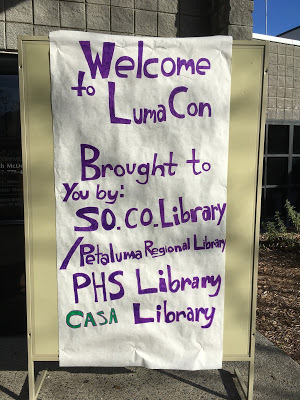 LumaCon is held in a local community center. This is how you know you've found the right place.
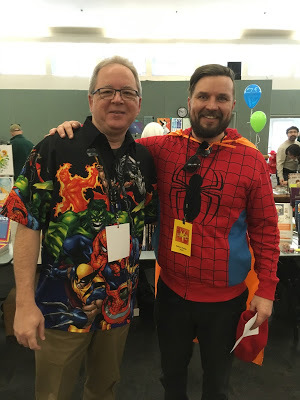 High school librarian Nathan Libecap, one of the head organizers, infused with as much energy and passion as if he'd been bitten by a radioactive spider. I don't get a lot of opportunities to wear that shirt.
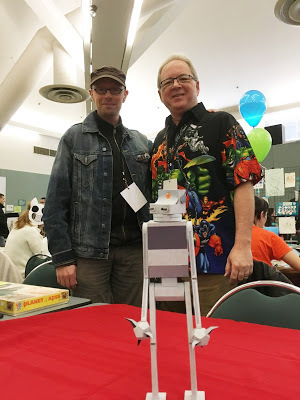 I was seated next to my friend Jason Whiton, who hosts SpyVibe and has a terrific interest in, and knowledge of, mid-century mod pop culture: The Prisoner, The Man from UNCLE, Dr. Who, cartoonist Mort Walker, and more. He's also a teacher. We talked all day. The Robot is a papercraft doll I engineered for my "Last Mechanical Monster" webcomic, intended as a sort of thank you prize for readers who made it to the end. I handed out little cards with a URL to the plans for anyone who wanted to try building it themselves. Give it a shot if you want.
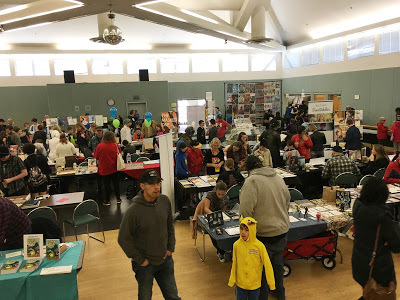
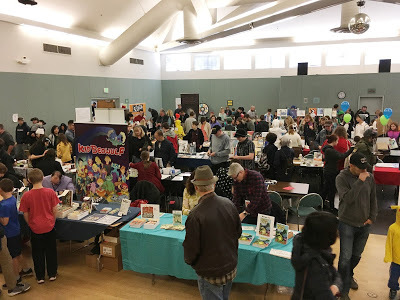 Two angles on the main Artists' Room, above and below, taken from a stage. Pals Lex Fajardo and Paige Braddock are in the foreground of the photo above.
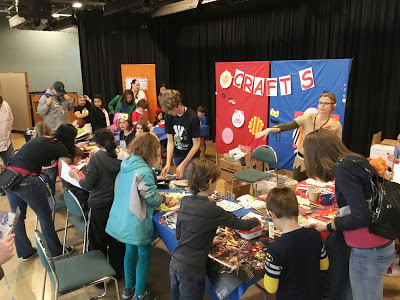 Turned around to get a picture of the Arts & Crafts action on that stage. Good creative energy. All day I saw kids running around with cardboard Captain America-style shields they'd made.
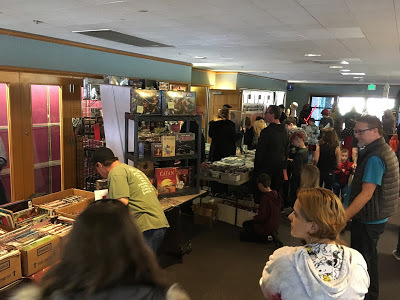 Vendors and booksellers crowded the entrance lobby.
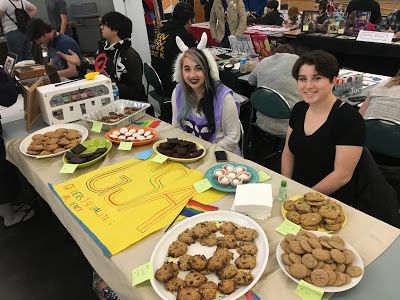 The bake sale. How can you not love a convention that has a bake sale?
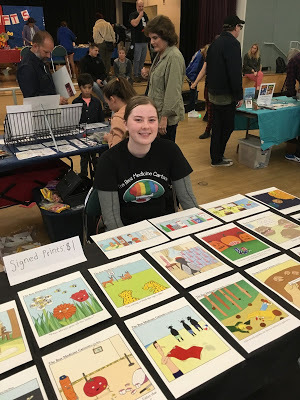 One of the highlights of my day was sitting across from, and getting to talk with, Izzy Ehnes. She does single-panel cartoons with a smart and dark POV. Fair or not, the best comparable I can think of is "The Far Side." Two years ago Izzy attended the first LumaCon, where her work was spotted by cartoonists Stephan Pastis and Nick Galifianakis. Stephan recommended her to Universal-UClick editor John Glynn, which is how her comic The Best Medicine ended up with a worldwide audience on GoComics.com. See? It's just that easy.
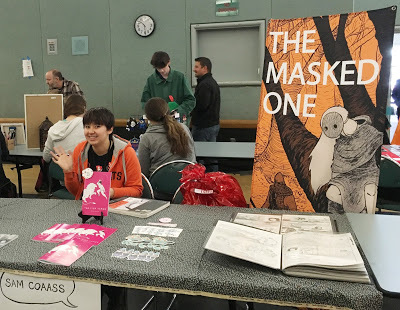 I checked in with another talented young woman, my friend Erin, who cartoons under the name Sam Coaass. Erin and her mother showed up at every local comics-related event since she was in middle school, and now she's in community college as determined as ever. It's impossible to predict success but she has all the tools to achieve it.
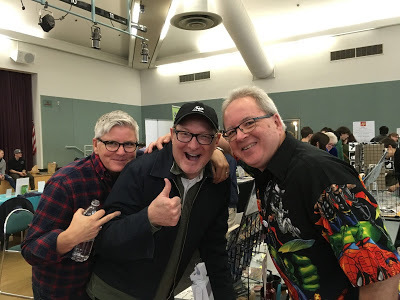 Paige Braddock and Art Roche from the Schulz Studio. Paige does a children's series called "Stinky Cecil" as well as decidedly non-children's work like "Jane's World" and "The Martian Confederacy." Art has a new book coming out soon titled "The Knights of Boo'Gar"; I've seen early drafts and think it could do well with fifth graders who like puns about boogers. Which is all of them.
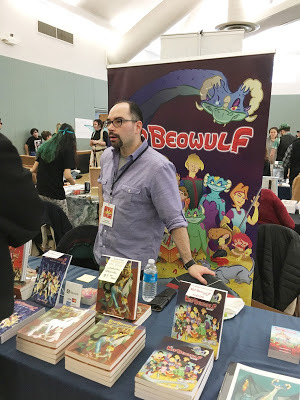 Lex Fajardo had kids and parents surrounding his "Kid Beowulf" booth all day. Long self-published, Kid B. is now being put out by publisher Andrews-McMeel, which has the potential to reach a much larger audience than Lex could on his own. Lex is very thoughtful about comics and works hard. I hope he's got a hit on his hands.
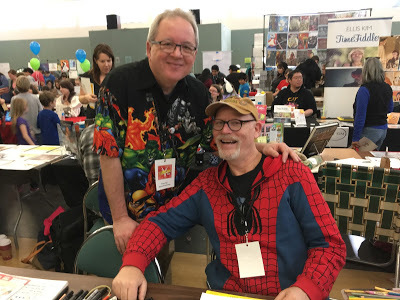 Said hello to Terrific Tom Beland (now I feel like Stan Lee handing out nicknames to the Marvel Bullpen in 1965). Tom has freelanced for Marvel Comics, Image and IDW, did a great book titled "True Story Swear to God," and recently published "Chicacabra." He's got a smooth, elegant, clean inking style I really admire and envy. Beautiful artwork and perceptive writing.
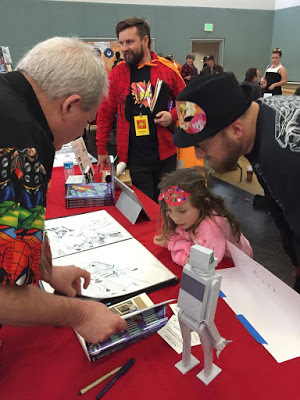 Jason Whiton took this picture of me doing what I described at the start, showing a girl and her father my original drawings and explaining how they got turned into a book. A really sweet kid. That's librarian Nathan Libecap behind. The con staff did a smart thing in that they all wore orange capes, so if you had a problem or needed someone to watch your table for a few minutes, you could just grab an orange cape for help.
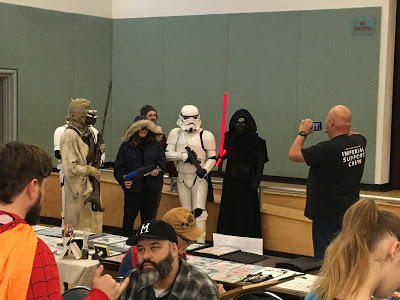 LumaCon had some of the usual costume ("cosplay") fol-de-rol, most of it charmingly homespun. These Star Wars guys were semi-pros who looked very sharp . . .
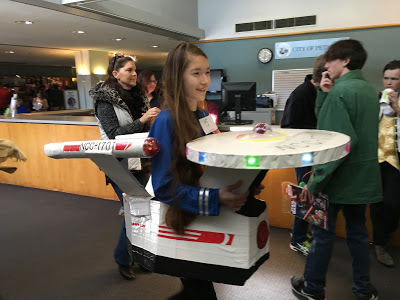 . . . but my favorite of the day was the cardboard starship Enterprise. Terrific.
All in all, LumaCon is about as sincere as Linus's pumpkin patch and as easy to love. I'll keep going as long as they'll have me.
Local librarians threw the third annual LumaCon in the city of Petaluma, Calif. last Saturday. If LumaCon had a mission statement, it'd include bringing students interested in writing, art, and comics together with amateur and professional cartoonists to talk shop. It's small (attendance about 2500), free, low-key, down-home, and about as charming as could be. I even sold a few books. It's my absolute favorite comics convention.
The people who organize LumaCon do it for the love of kids and comics. They treat their guests better than any convention I know of: a gift basket, a guests' lounge generously stocked with snacks, and trusted sitters who are happy to watch your table while you meander or take a break. That last is a practical, generous service that other cons could emulate.
I love talking with kids who want to make comics. This year I noticed more shy ones than in the past. They'd come up to the table, silent, with a parent who talked about how much their son or daughter loved to draw pictures and make up stories. A nice way to open them up a bit was to show some of my original drawings and then show them how those drawings look as published in one of my books. I remember being young and not knowing, for example, that most comic art is drawn larger than it appears in print. I tried to demystify the process a bit. Making comics is work, but it's not magic. A few kids really seemed to get that. Some maybe went home excited to try it themselves.
As I understand it, that's the point of LumaCon, which distinguishes it from all other cons I've attended.
My daughters came and hung out with me for most of the day, but I'm forbidden to post photographic proof. However, I did try to get around and take some photos.
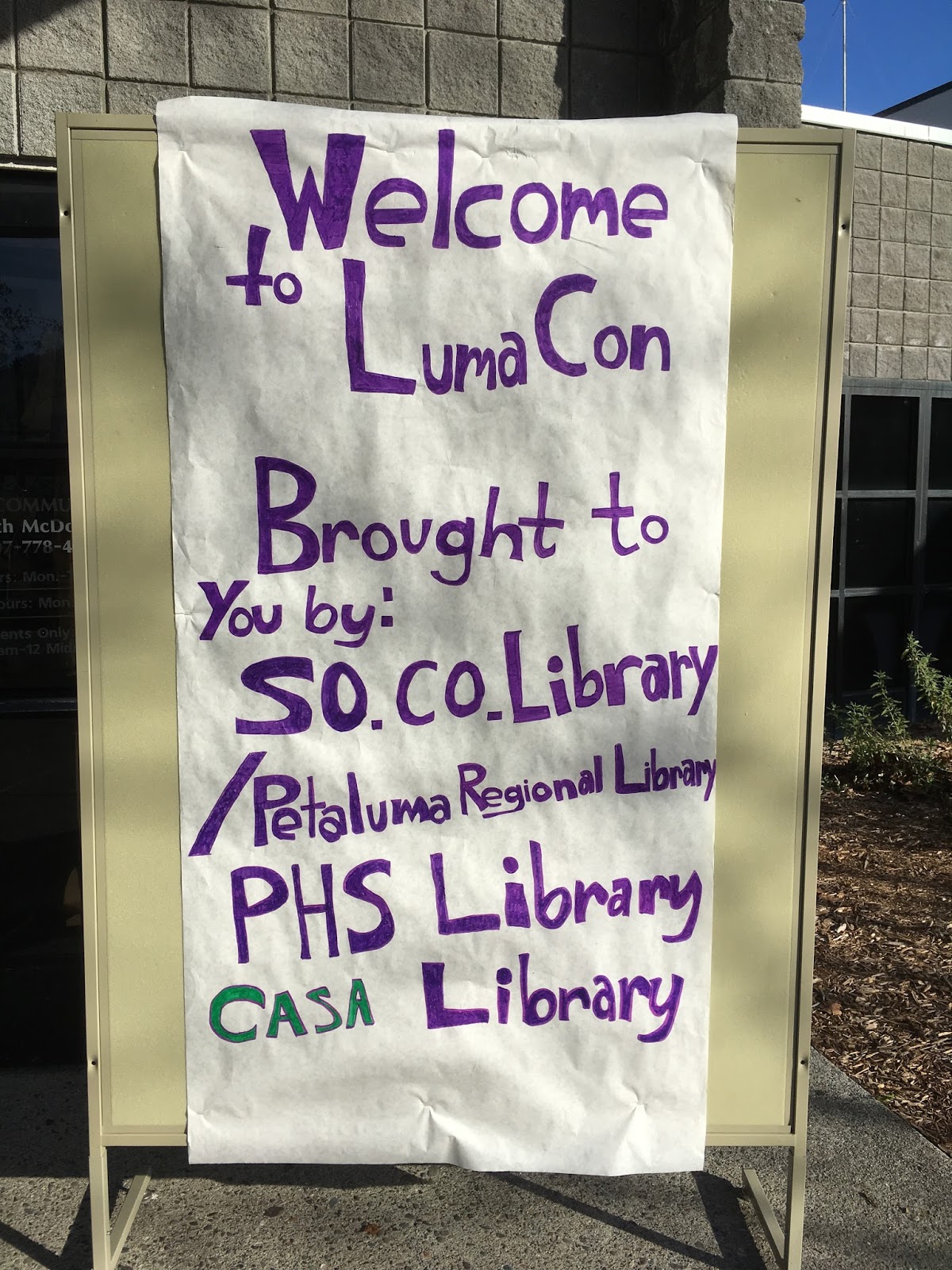 LumaCon is held in a local community center. This is how you know you've found the right place.
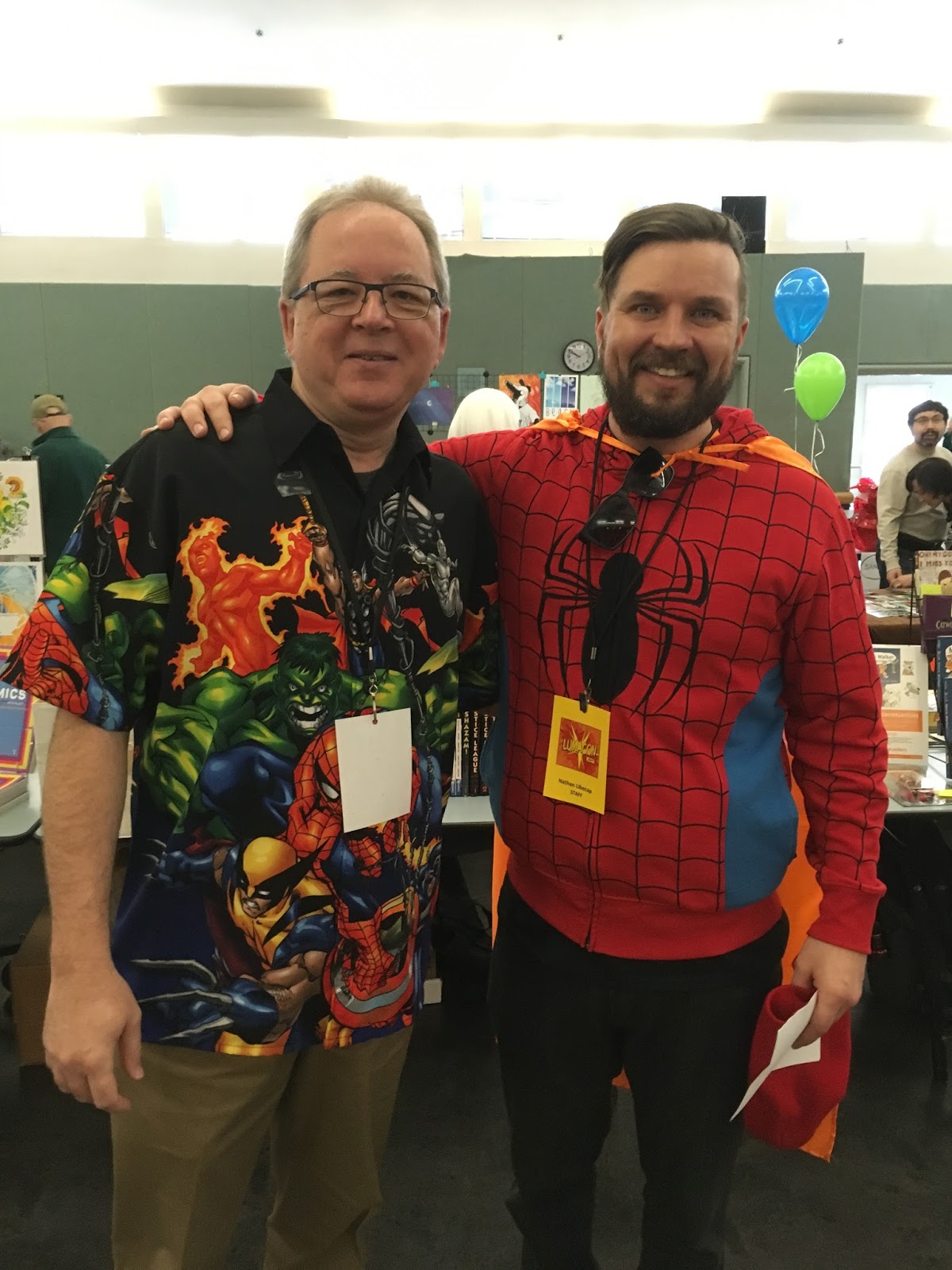 High school librarian Nathan Libecap, one of the head organizers, infused with as much energy and passion as if he'd been bitten by a radioactive spider. I don't get a lot of opportunities to wear that shirt.
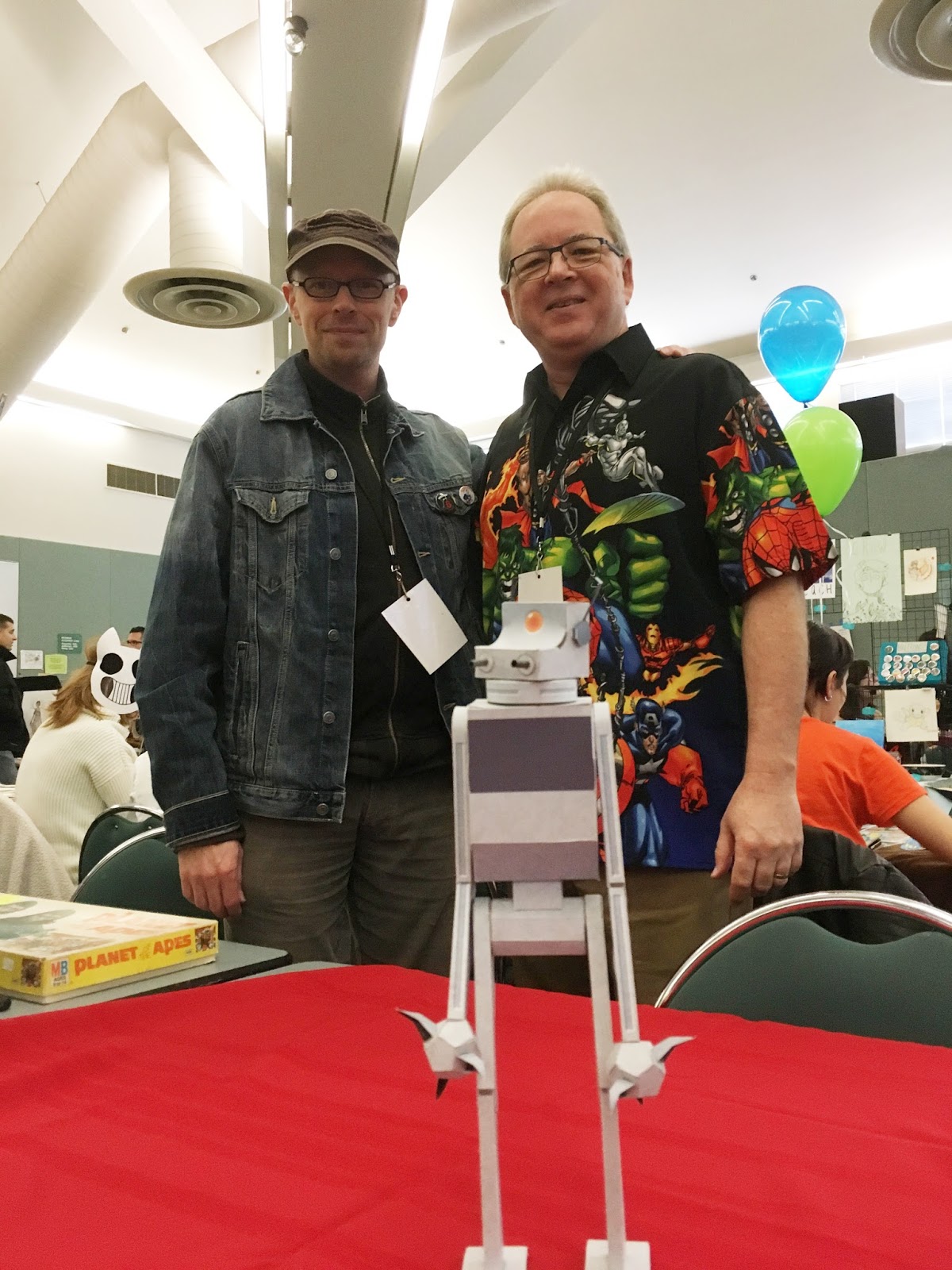 I was seated next to my friend Jason Whiton, who hosts SpyVibe and has a terrific interest in, and knowledge of, mid-century mod pop culture: The Prisoner, The Man from UNCLE, Dr. Who, cartoonist Mort Walker, and more. He's also a teacher. We talked all day. The Robot is a papercraft doll I engineered for my "Last Mechanical Monster" webcomic, intended as a sort of thank you prize for readers who made it to the end. I handed out little cards with a URL to the plans for anyone who wanted to try building it themselves. Give it a shot if you want.
 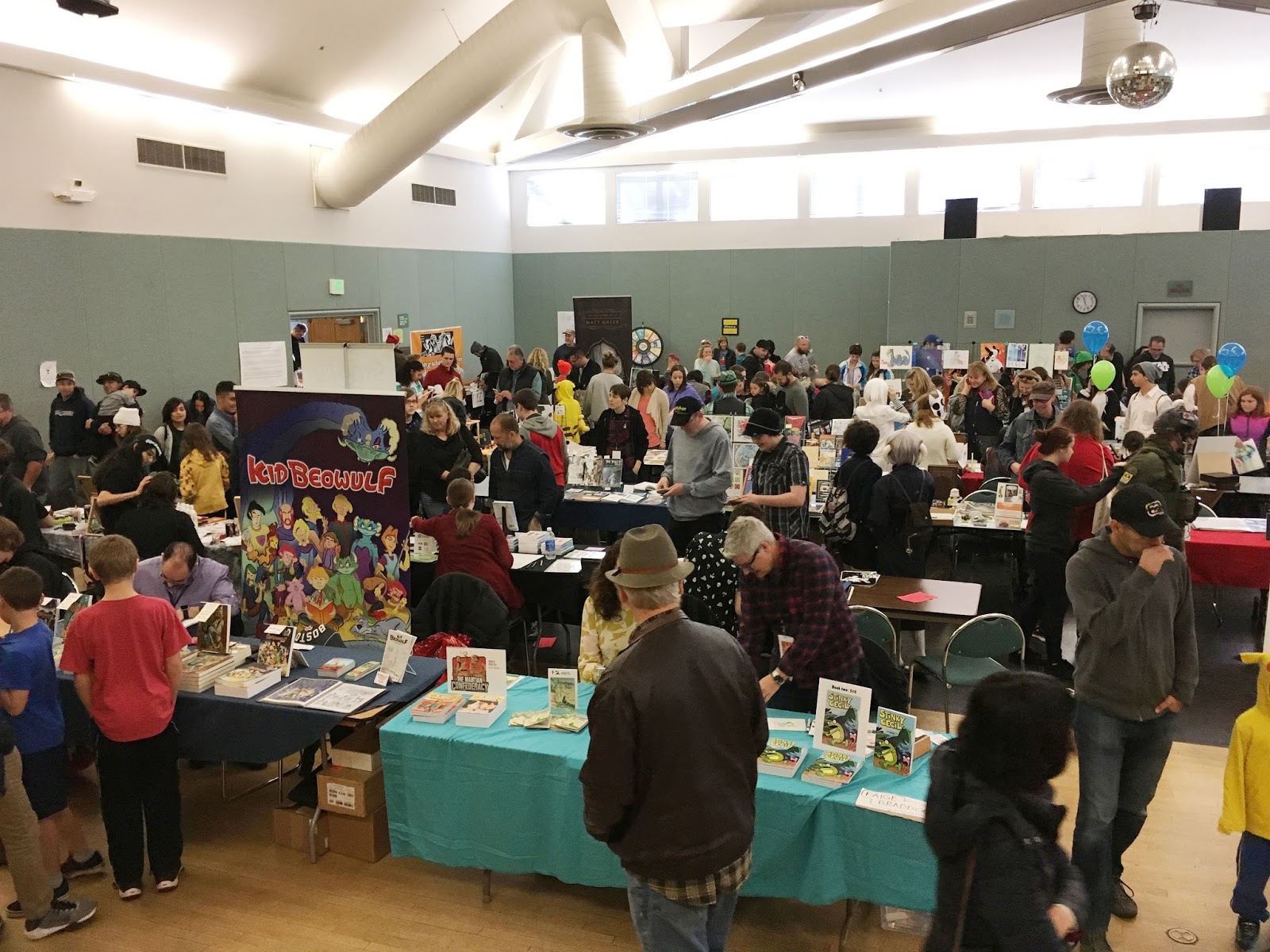 Two angles on the main Artists' Room, above and below, taken from a stage. Pals Lex Fajardo and Paige Braddock are in the foreground of the photo above.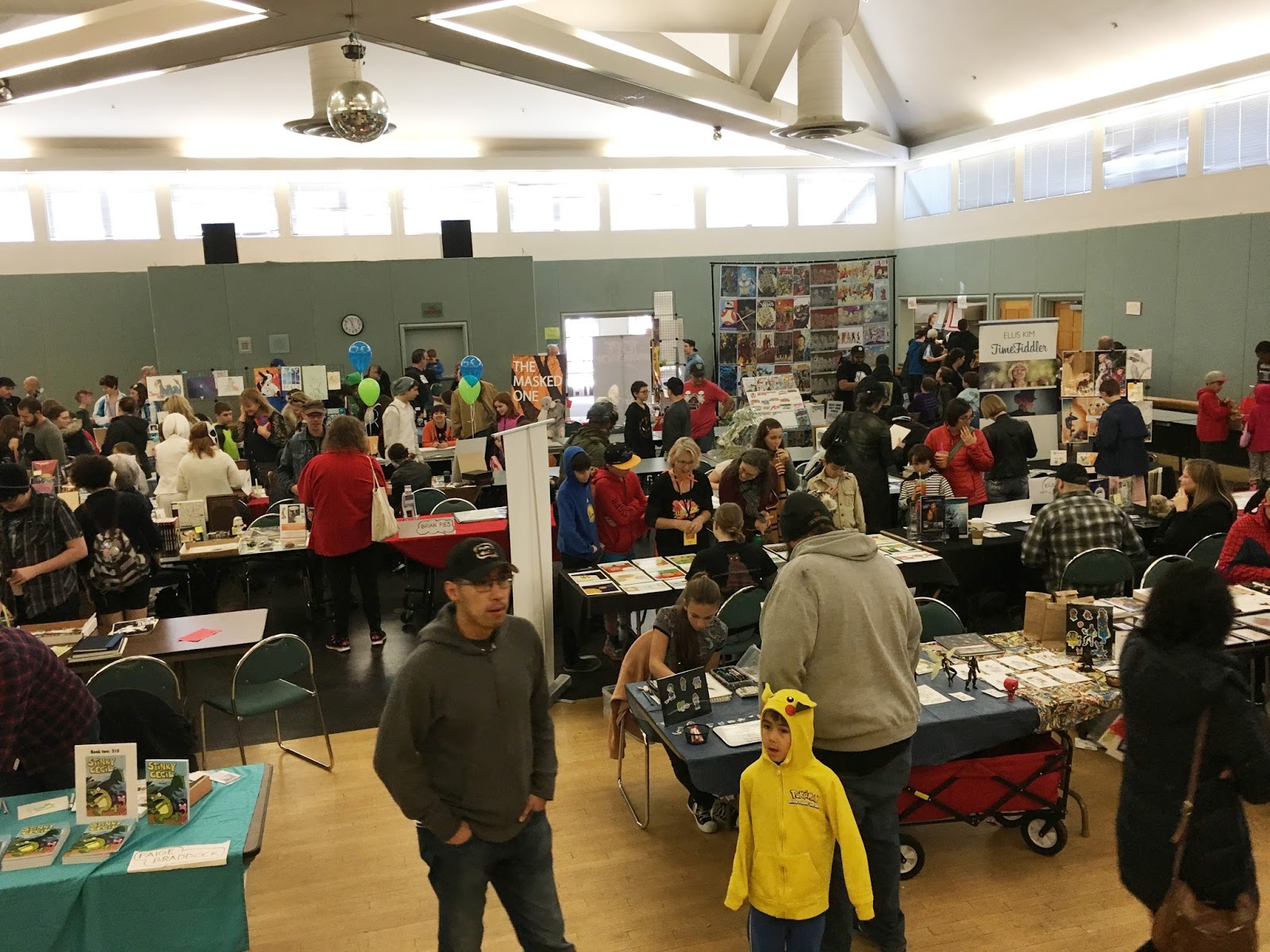
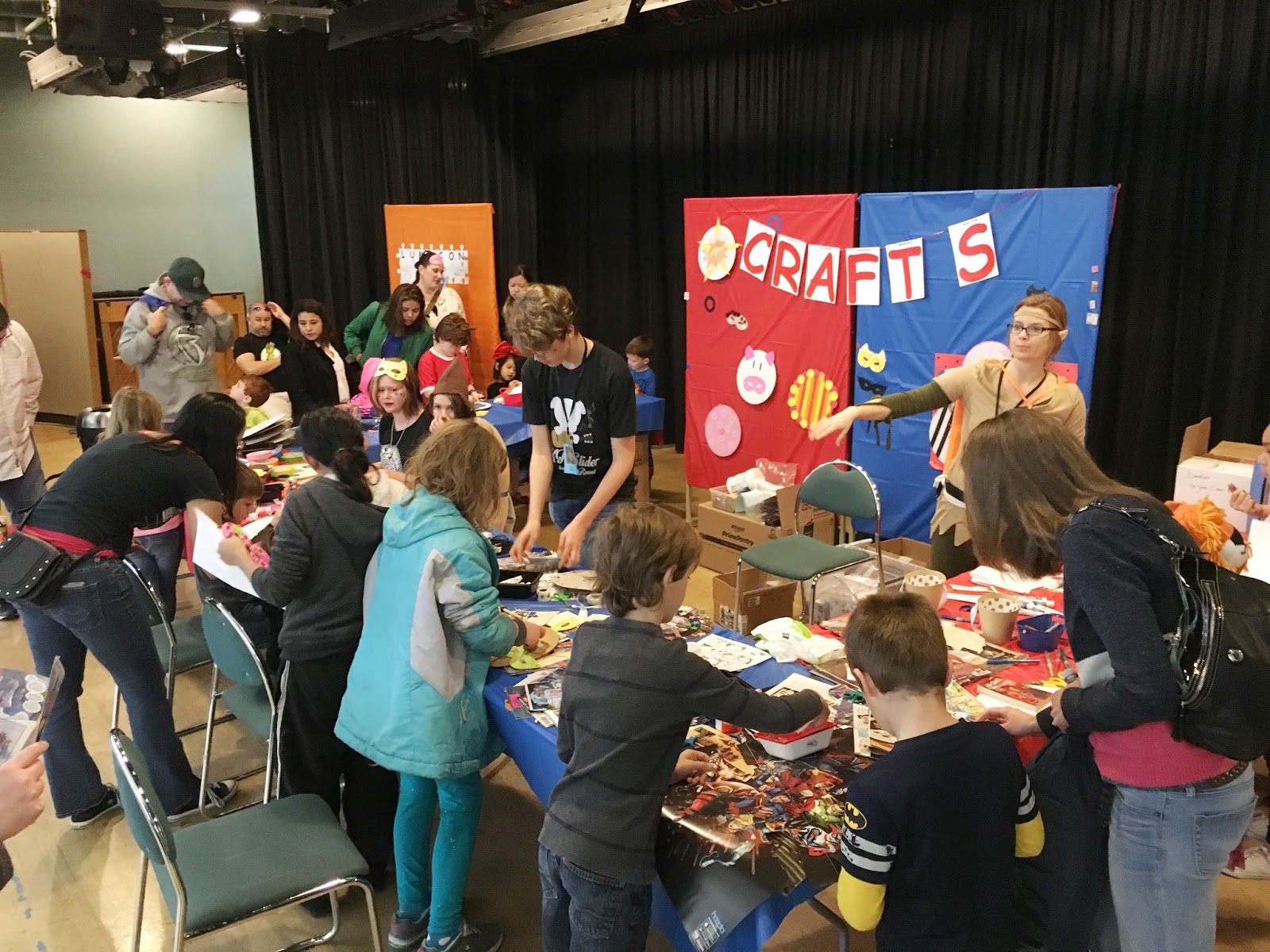 Turned around to get a picture of the Arts & Crafts action on that stage. Good creative energy. All day I saw kids running around with cardboard Captain America-style shields they'd made.
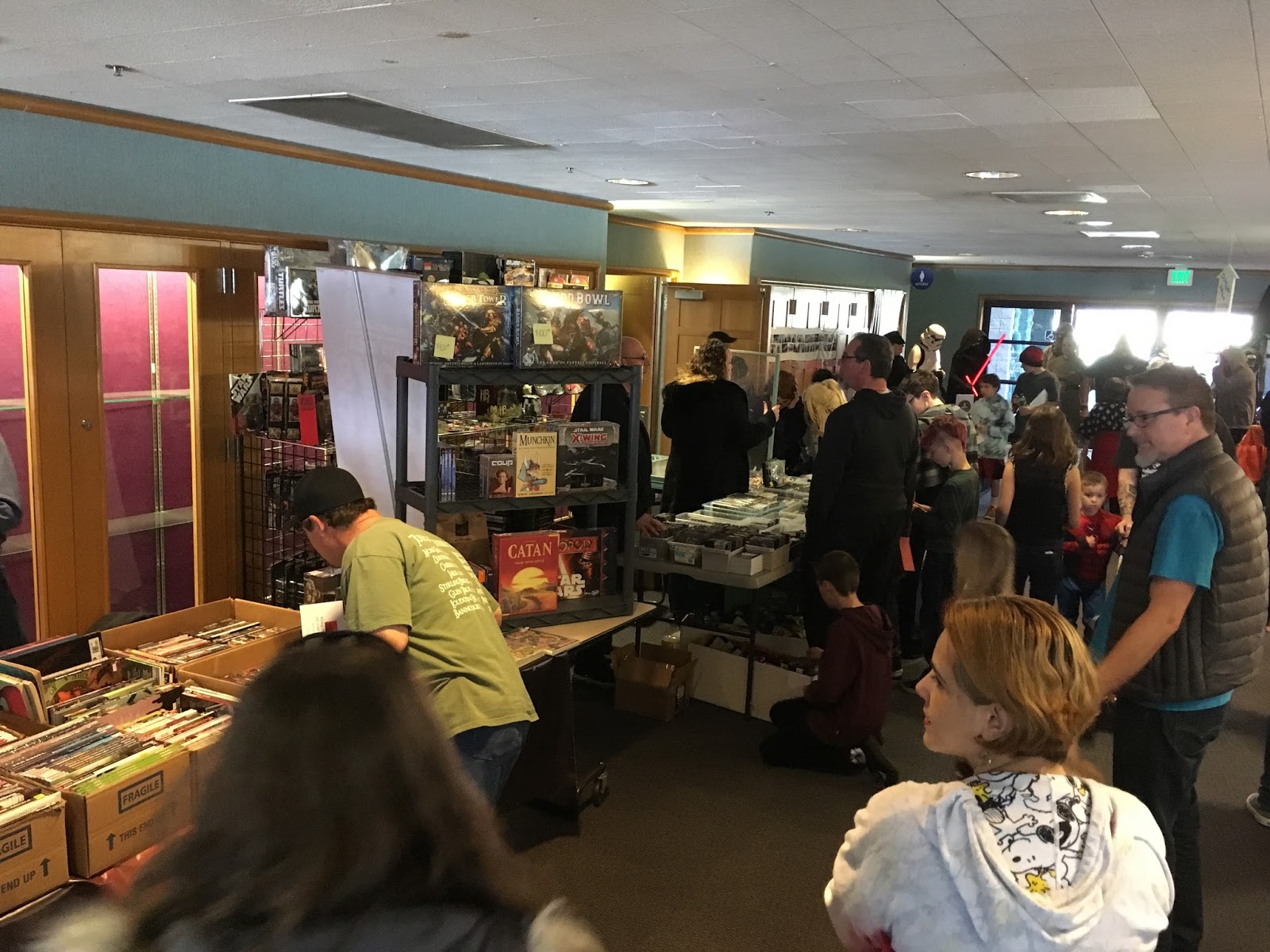 Vendors and booksellers crowded the entrance lobby.
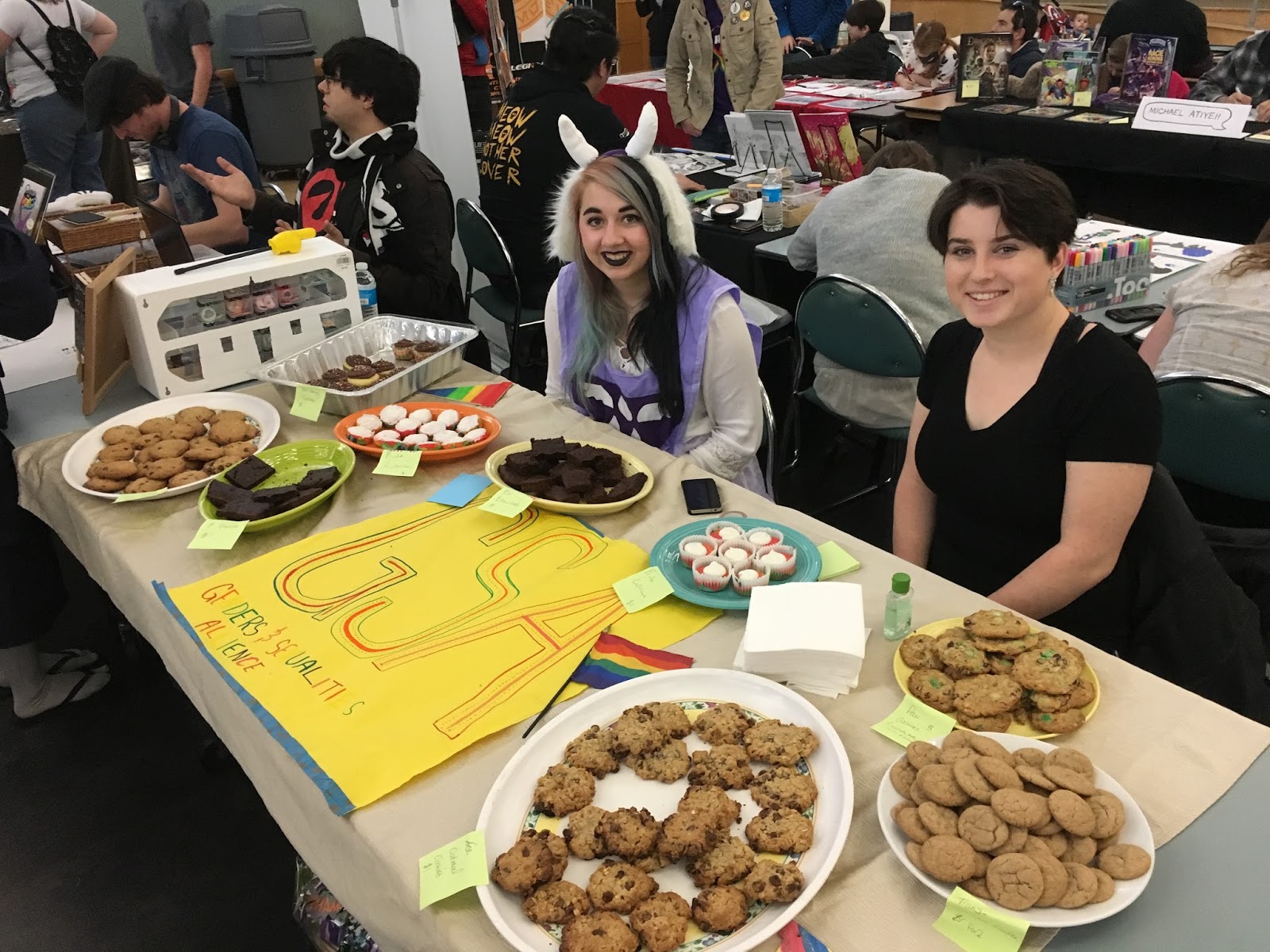 The bake sale. How can you not love a convention that has a bake sale?
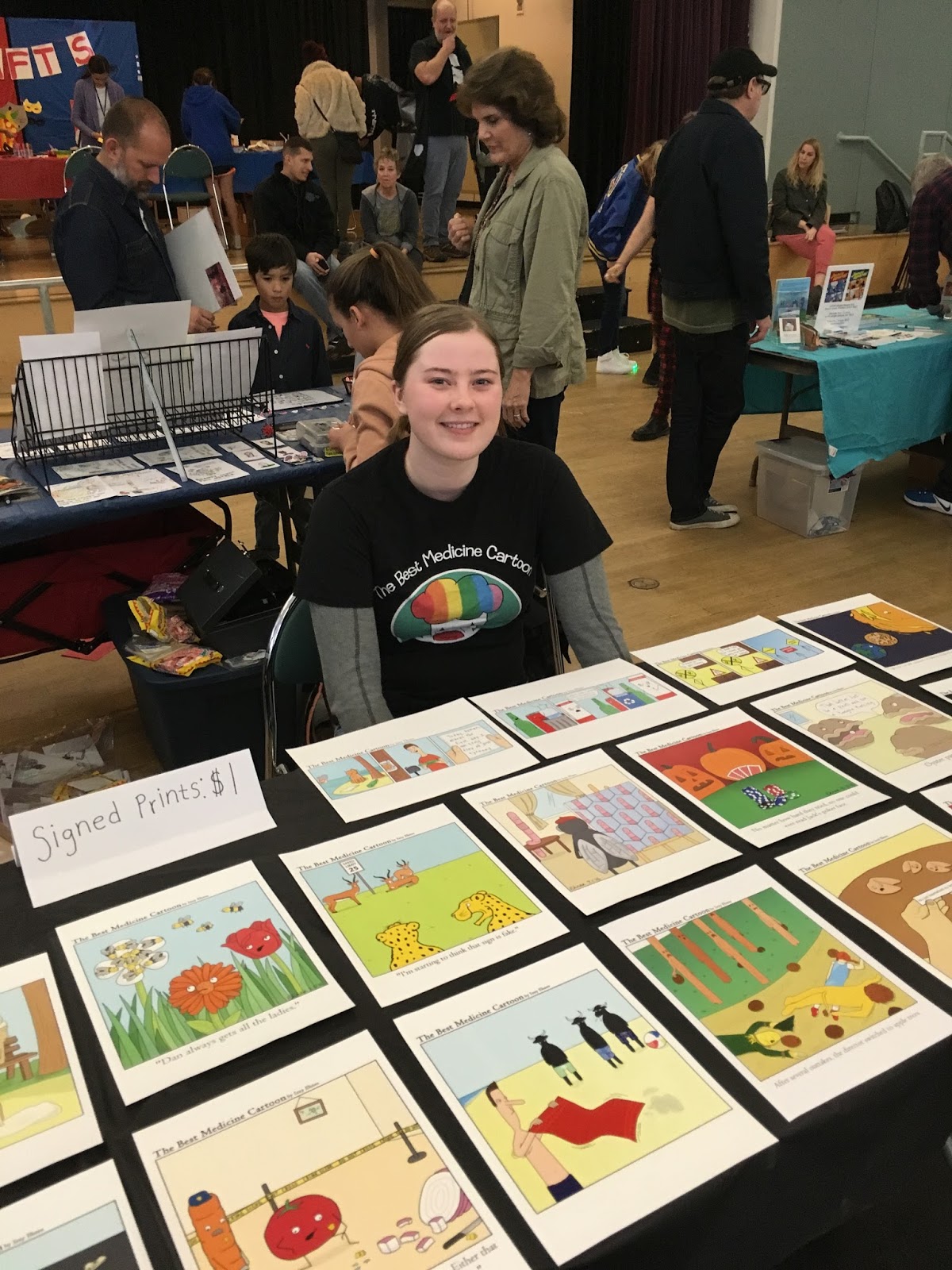 One of the highlights of my day was sitting across from, and getting to talk with, Izzy Ehnes. She does single-panel cartoons with a smart and dark POV. Fair or not, the best comparable I can think of is "The Far Side." Two years ago Izzy attended the first LumaCon, where her work was spotted by cartoonists Stephan Pastis and Nick Galifianakis. Stephan recommended her to Universal-UClick editor John Glynn, which is how her comic The Best Medicine ended up with a worldwide audience on GoComics.com. See? It's just that easy.
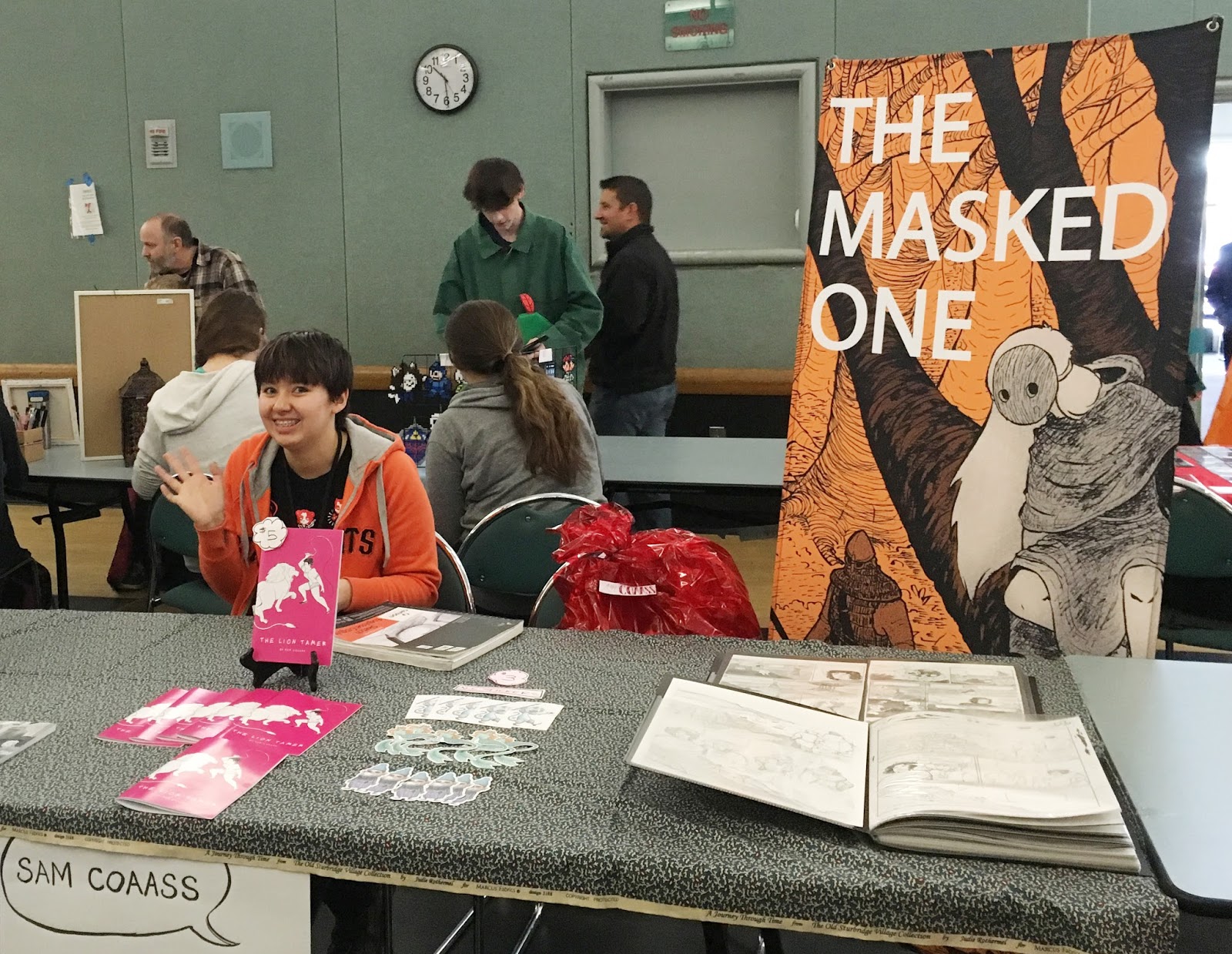 I checked in with another talented young woman, my friend Erin, who cartoons under the name Sam Coaass. Erin and her mother showed up at every local comics-related event since she was in middle school, and now she's in community college as determined as ever. It's impossible to predict success but she has all the tools to achieve it.
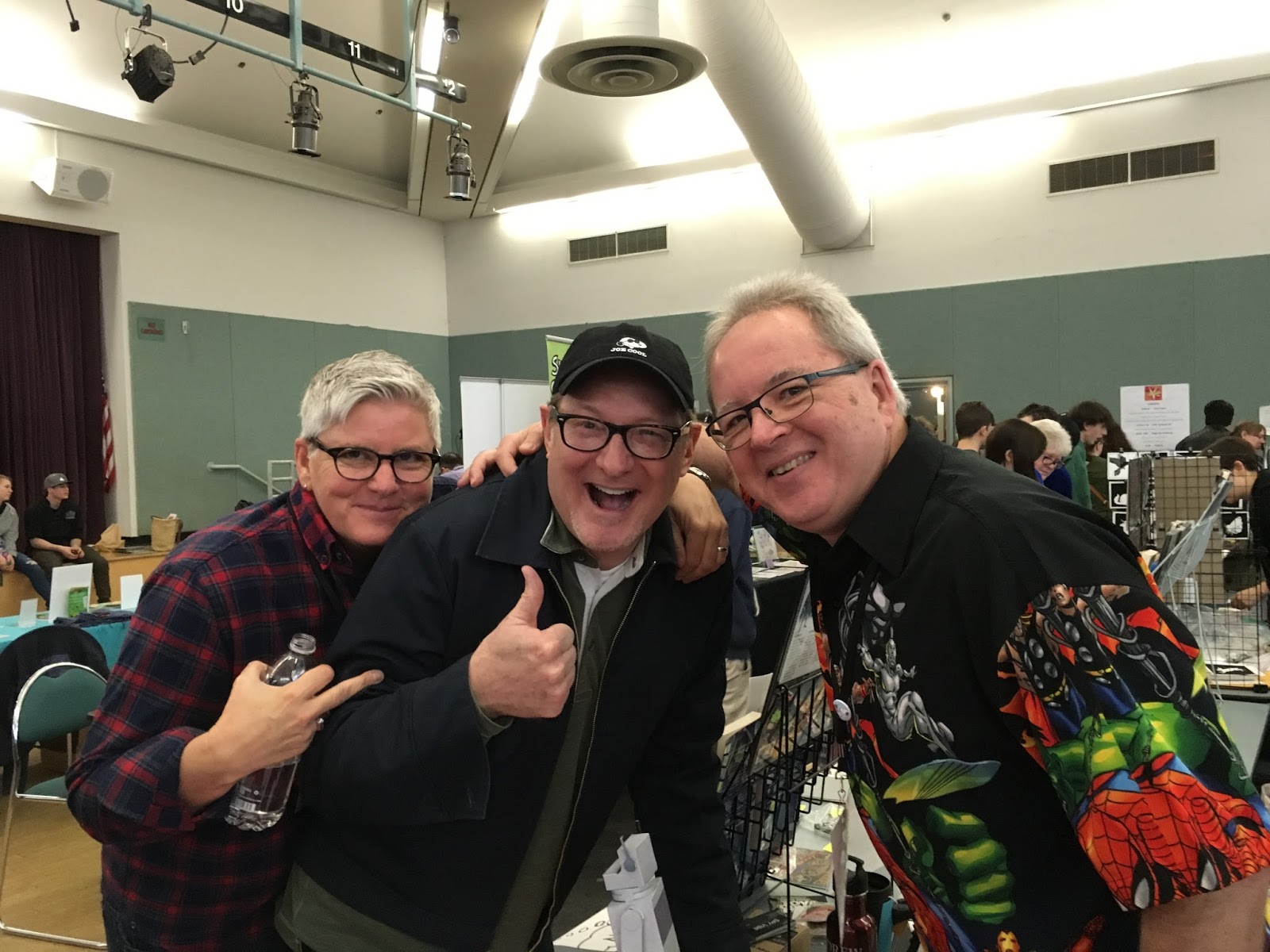 Paige Braddock and Art Roche from the Schulz Studio. Paige does a children's series called "Stinky Cecil" as well as decidedly non-children's work like "Jane's World" and "The Martian Confederacy." Art has a new book coming out soon titled "The Knights of Boo'Gar"; I've seen early drafts and think it could do well with fifth graders who like puns about boogers. Which is all of them.
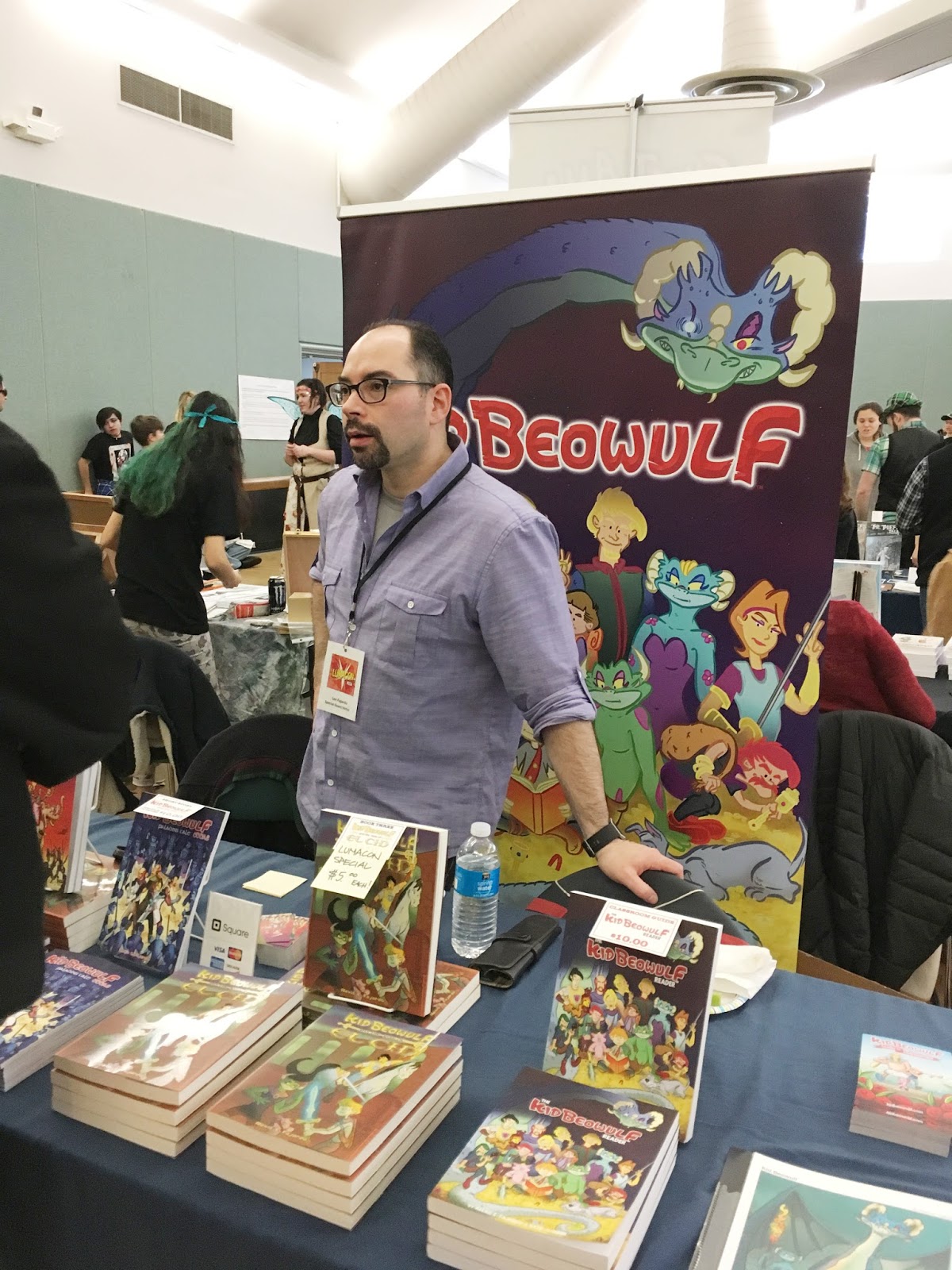 Lex Fajardo had kids and parents surrounding his "Kid Beowulf" booth all day. Long self-published, Kid B. is now being put out by publisher Andrews-McMeel, which has the potential to reach a much larger audience than Lex could on his own. Lex is very thoughtful about comics and works hard. I hope he's got a hit on his hands.
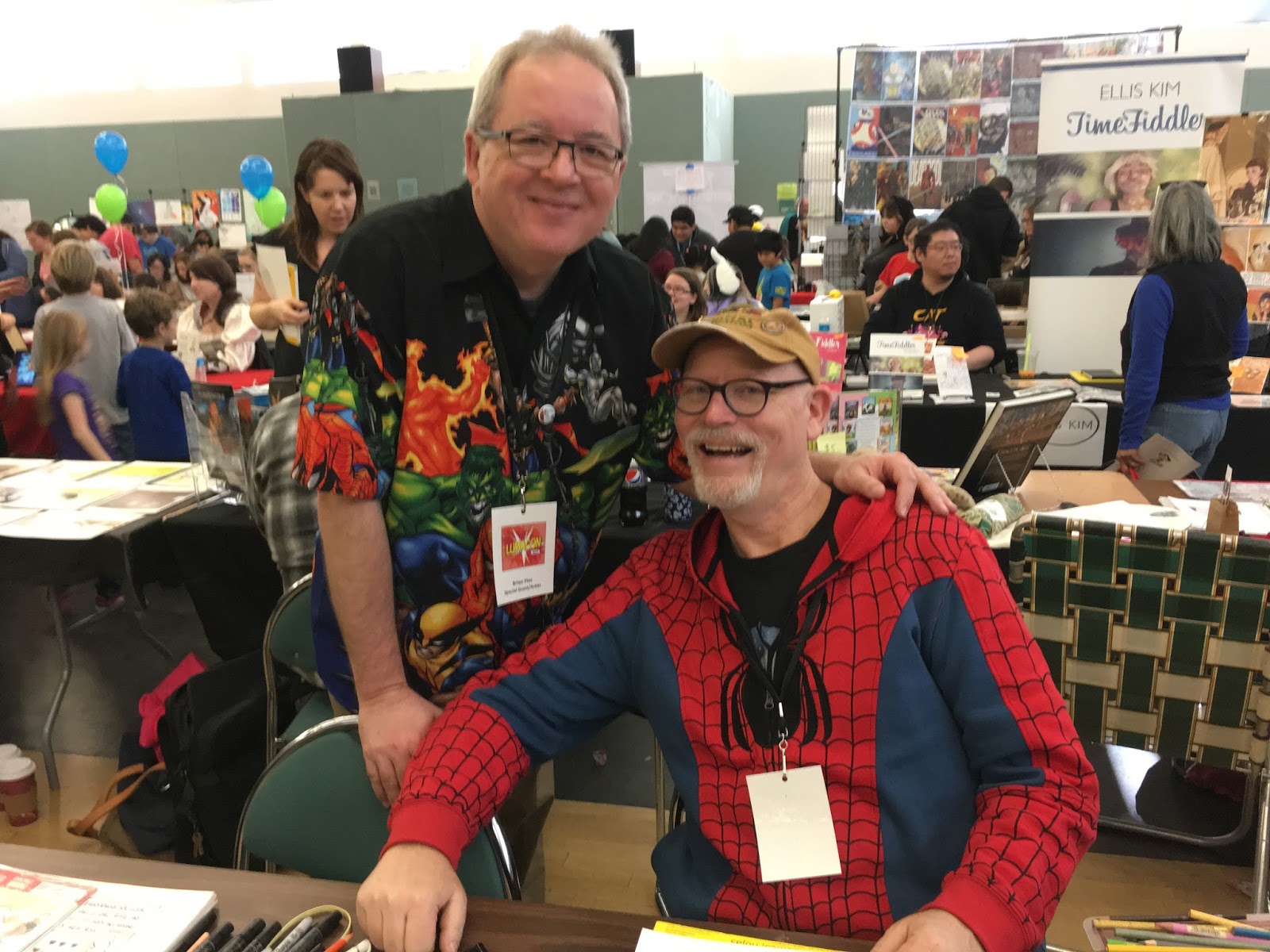 Said hello to Terrific Tom Beland (now I feel like Stan Lee handing out nicknames to the Marvel Bullpen in 1965). Tom has freelanced for Marvel Comics, Image and IDW, did a great book titled "True Story Swear to God," and recently published "Chicacabra." He's got a smooth, elegant, clean inking style I really admire and envy. Beautiful artwork and perceptive writing.
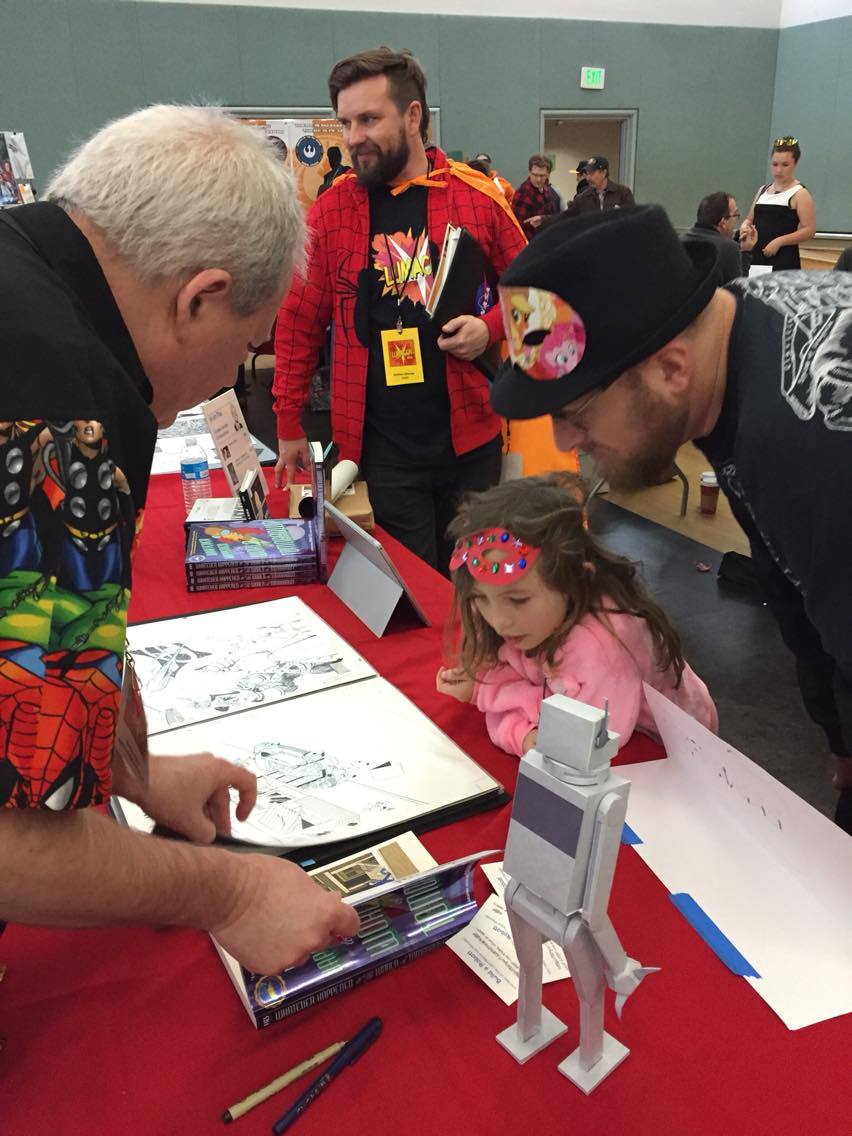 Jason Whiton took this picture of me doing what I described at the start, showing a girl and her father my original drawings and explaining how they got turned into a book. A really sweet kid. That's librarian Nathan Libecap behind. The con staff did a smart thing in that they all wore orange capes, so if you had a problem or needed someone to watch your table for a few minutes, you could just grab an orange cape for help.
 LumaCon had some of the usual costume ("cosplay") fol-de-rol, most of it charmingly homespun. These Star Wars guys were semi-pros who looked very sharp . . .
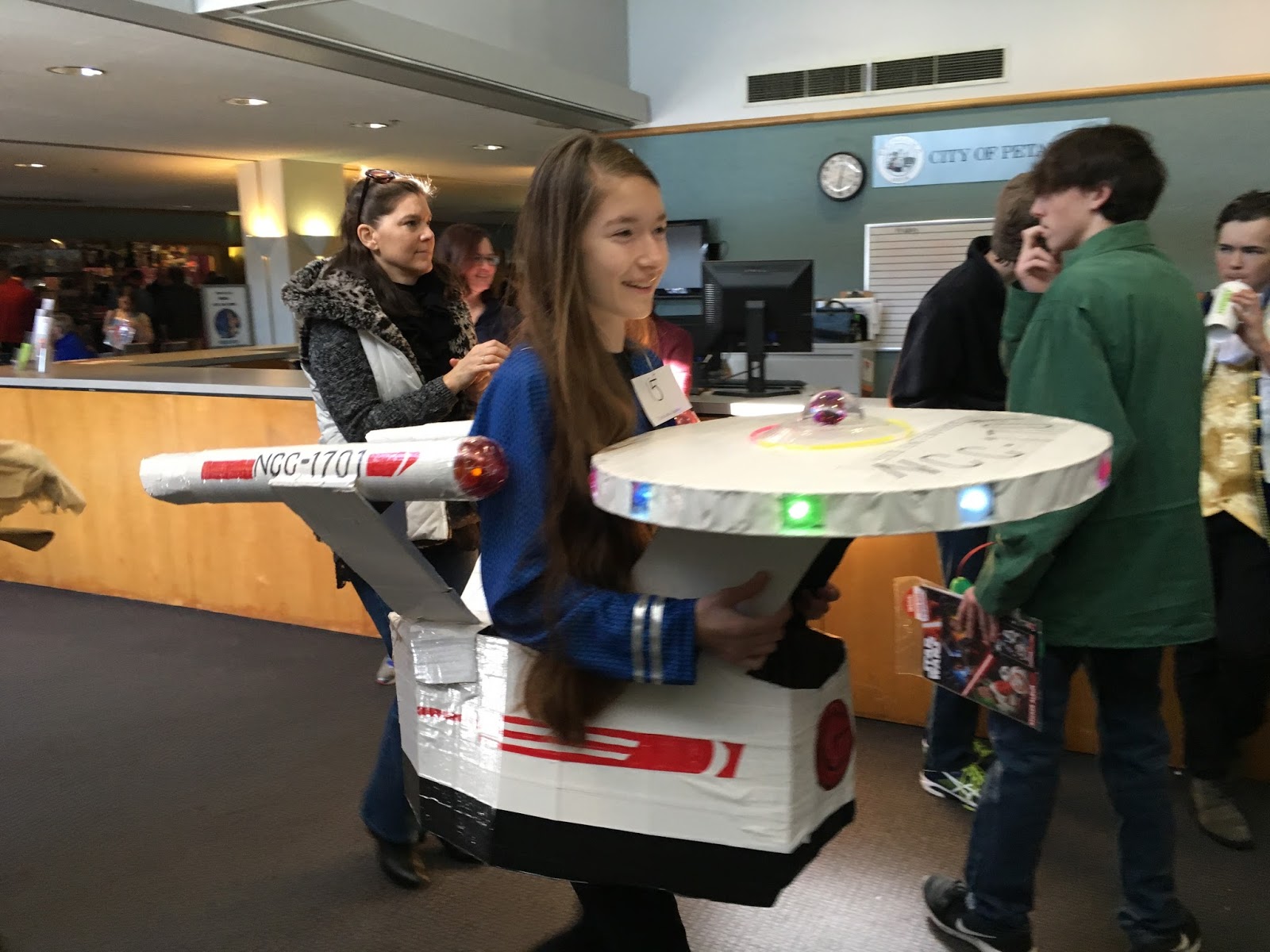 . . . but my favorite of the day was the cardboard starship Enterprise. Terrific.
All in all, LumaCon is about as sincere as Linus's pumpkin patch and as easy to love. I'll keep going as long as they'll have me.
January 15, 2017
How I Made a Picture
I haven't done a "how to" post in a long time, but a few days ago I made a drawing that I was uncharacteristically happy with, and thought it'd be a good example of how I sometimes combine real ink-on-paper art with digital (Photoshop) manipulation to get the result I want.
As always, this isn't the right way or the only way, it's just one way I solved a particular problem. Your mileage may vary.
I think it helps to have some sort of Philosophy of Art, even if you don't call it that--some sense of how you like to do things. A Platonic Ideal. For example, my ideal comic would be one that's entirely hand drawn, hand lettered, and even hand colored right on the page. A comic like that has integrity.
Now, I don't ever do that. For production and printing purposes, I letter and color in Photoshop. But I know some people who do, such as the great Carol Tyler. What you see in her books is exactly what she puts on the paper. I admire and envy that authenticity, and consider everything I do that isn't that a compromise that comes with a cost.
Your goal guides your process. I think Art should be as organic and analog as possible. Other artists have different philosophies. Many don't hesitate to do as much digital work as they can, up to 100 percent. I won't argue. It can look terrific. Whatever works. As the great cartoonist Wally Wood said:
Never draw what you can swipe.Never swipe what you can trace.Never trace what you can cut out and paste.And never do any of that if you can hire somebody to do it for you.
One reason I'm happy with this drawing, which is for a future project I won't talk about that's set to follow another project I won't talk about, is that it took me several tries to crack it. I couldn't figure out my composition and point of view. Here's what I came up with:
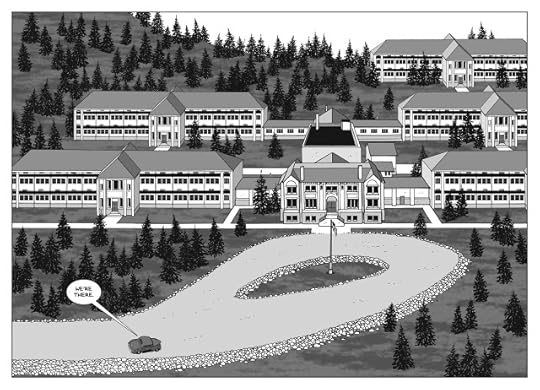
Based on photos of a real place, it's a black-and-white two-page spread that'll be printed with the left half on one page and the right half on the facing page. I'm happy with it because the left page draws your eye to the word balloon and car, the right page draws your eye to its destination--the steps and doors behind the flagpole--and together they make an asymmetrical but balanced (I think) composition.
I did not want to spend two weeks drawing that. So I cheated.
First I drew this. You can see some of my blue penciling under my black ink lines:

Yeah, I drew all those rocks by hand; I'm not completely lazy. I also drew this:

Those four rectangles at the top of the drawing became groups of three or four windows of various widths and heights simply by squashing or stretching them in Photoshop:

Copy and paste and paste and paste and paste and paste:
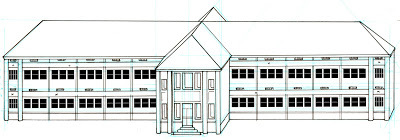
Copy and paste that whole thing five times and BOOM, instant sprawling compound.
I drew the car separately because I don't like to draw cars:
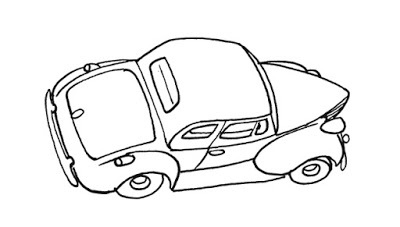
One thing I kept in mind when drawing the car, and throughout the entire assembly, was keeping line weight consistent for the final drawing. I drew the car with a thicker line and less detail than I otherwise might have because I knew it would end up very small, and it still had to look like it belonged in the rest of the picture.
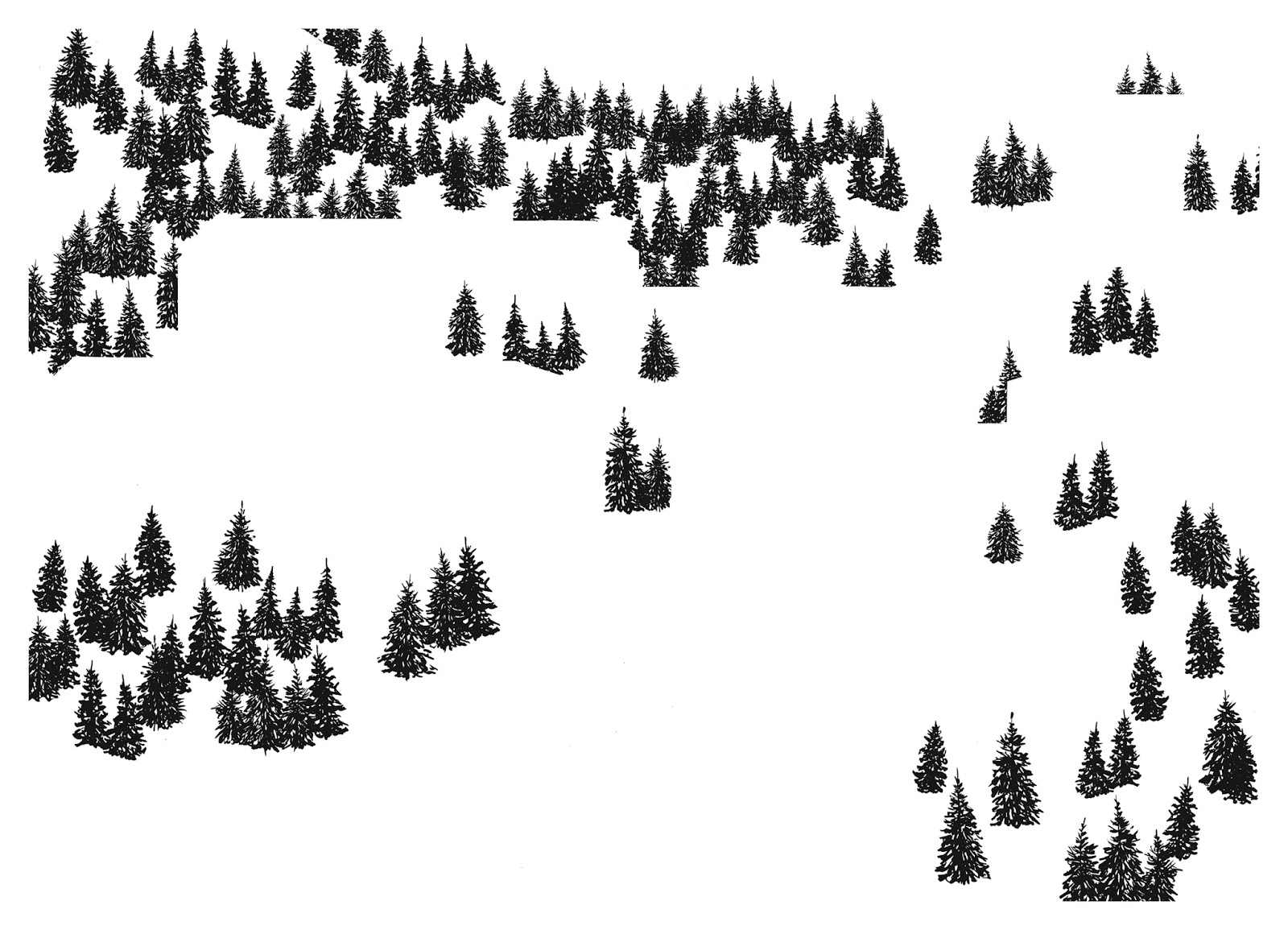
I didn't draw all the trees. I actually really love inking pine trees with a brush, but not that many. Instead, I drew 20 trees and clumps of trees, then manipulated them to look like more. Copy and paste those variations, trying not to put two duplicates next to each other, and you've got a forest.
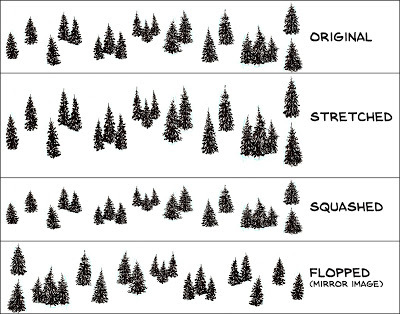 The top row are the only trees I actually drew. The rest I tweaked in Photoshop.
So here are the buildings and car pieced together, followed by the trees on a separate Photoshop layer (think of it as a transparency), which makes it a lot easier to color the ground "behind" them:

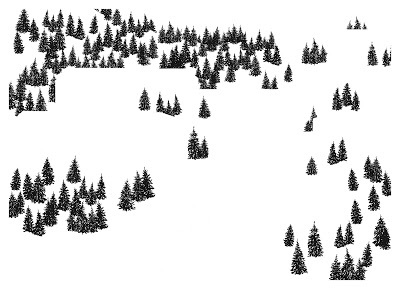
Put 'em all together, add some grays and words, and easy-peasy.
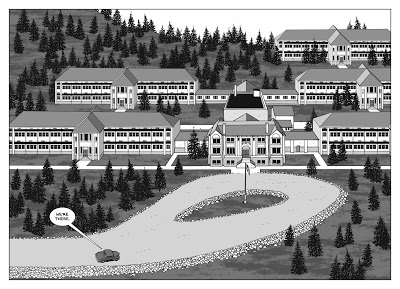
I don't expect to rely on so much digital tomfoolery for the rest of the project. I still aim to render as much by hand as possible. But because this two-page spread is an important establishing shot that shows the reader where they are and sets the stage for the entire story, I needed this level of detail and grand scale. After laying that foundation, I can relax a bit.
Maybe someone else could do a drawing like that completely freehand but I can't. So I did what works, with no apologies. It looks exactly like I wanted it to. That's the goal that guided my process.
As always, this isn't the right way or the only way, it's just one way I solved a particular problem. Your mileage may vary.
I think it helps to have some sort of Philosophy of Art, even if you don't call it that--some sense of how you like to do things. A Platonic Ideal. For example, my ideal comic would be one that's entirely hand drawn, hand lettered, and even hand colored right on the page. A comic like that has integrity.
Now, I don't ever do that. For production and printing purposes, I letter and color in Photoshop. But I know some people who do, such as the great Carol Tyler. What you see in her books is exactly what she puts on the paper. I admire and envy that authenticity, and consider everything I do that isn't that a compromise that comes with a cost.
Your goal guides your process. I think Art should be as organic and analog as possible. Other artists have different philosophies. Many don't hesitate to do as much digital work as they can, up to 100 percent. I won't argue. It can look terrific. Whatever works. As the great cartoonist Wally Wood said:
Never draw what you can swipe.Never swipe what you can trace.Never trace what you can cut out and paste.And never do any of that if you can hire somebody to do it for you.
One reason I'm happy with this drawing, which is for a future project I won't talk about that's set to follow another project I won't talk about, is that it took me several tries to crack it. I couldn't figure out my composition and point of view. Here's what I came up with:
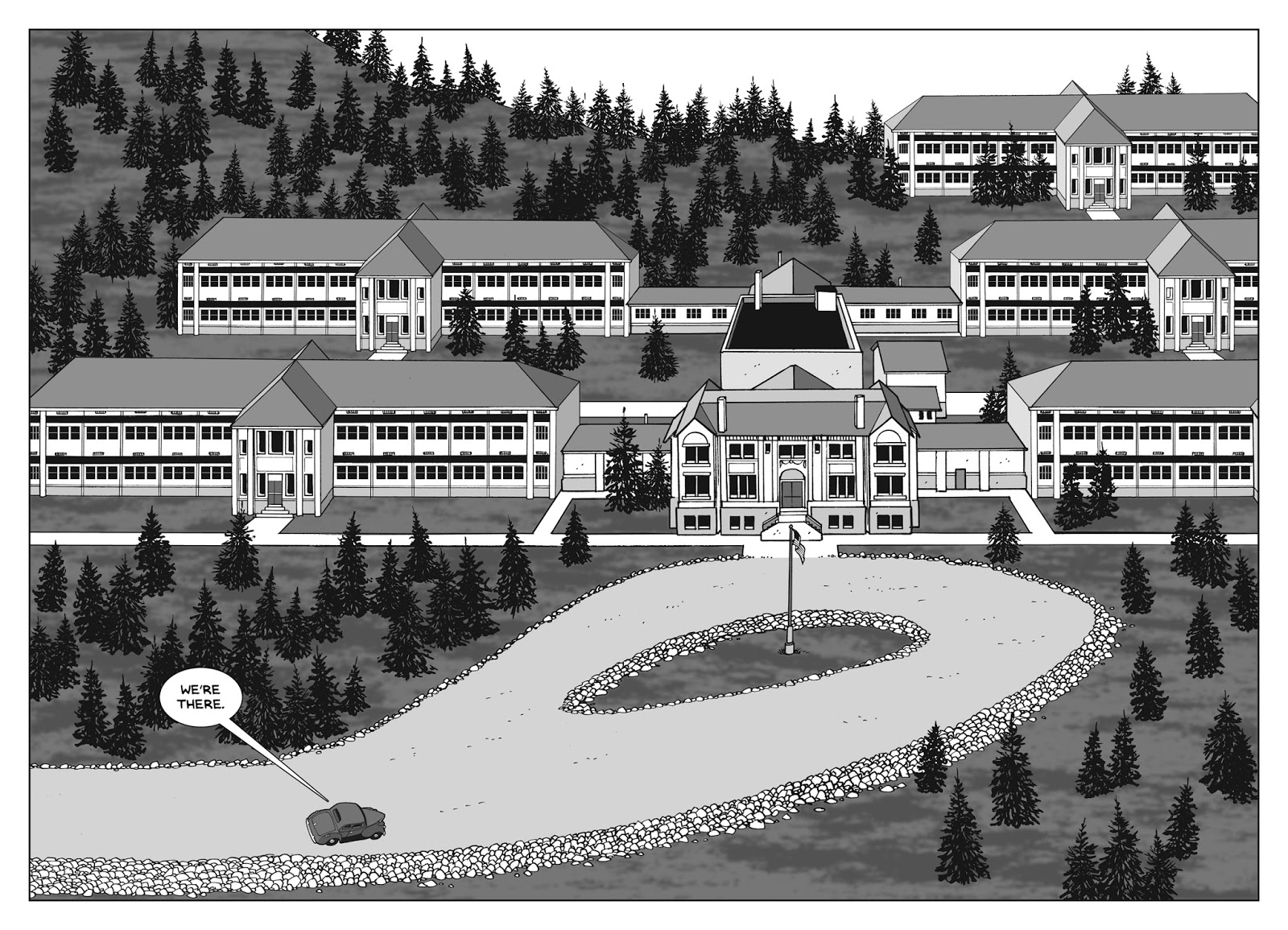
Based on photos of a real place, it's a black-and-white two-page spread that'll be printed with the left half on one page and the right half on the facing page. I'm happy with it because the left page draws your eye to the word balloon and car, the right page draws your eye to its destination--the steps and doors behind the flagpole--and together they make an asymmetrical but balanced (I think) composition.
I did not want to spend two weeks drawing that. So I cheated.
First I drew this. You can see some of my blue penciling under my black ink lines:
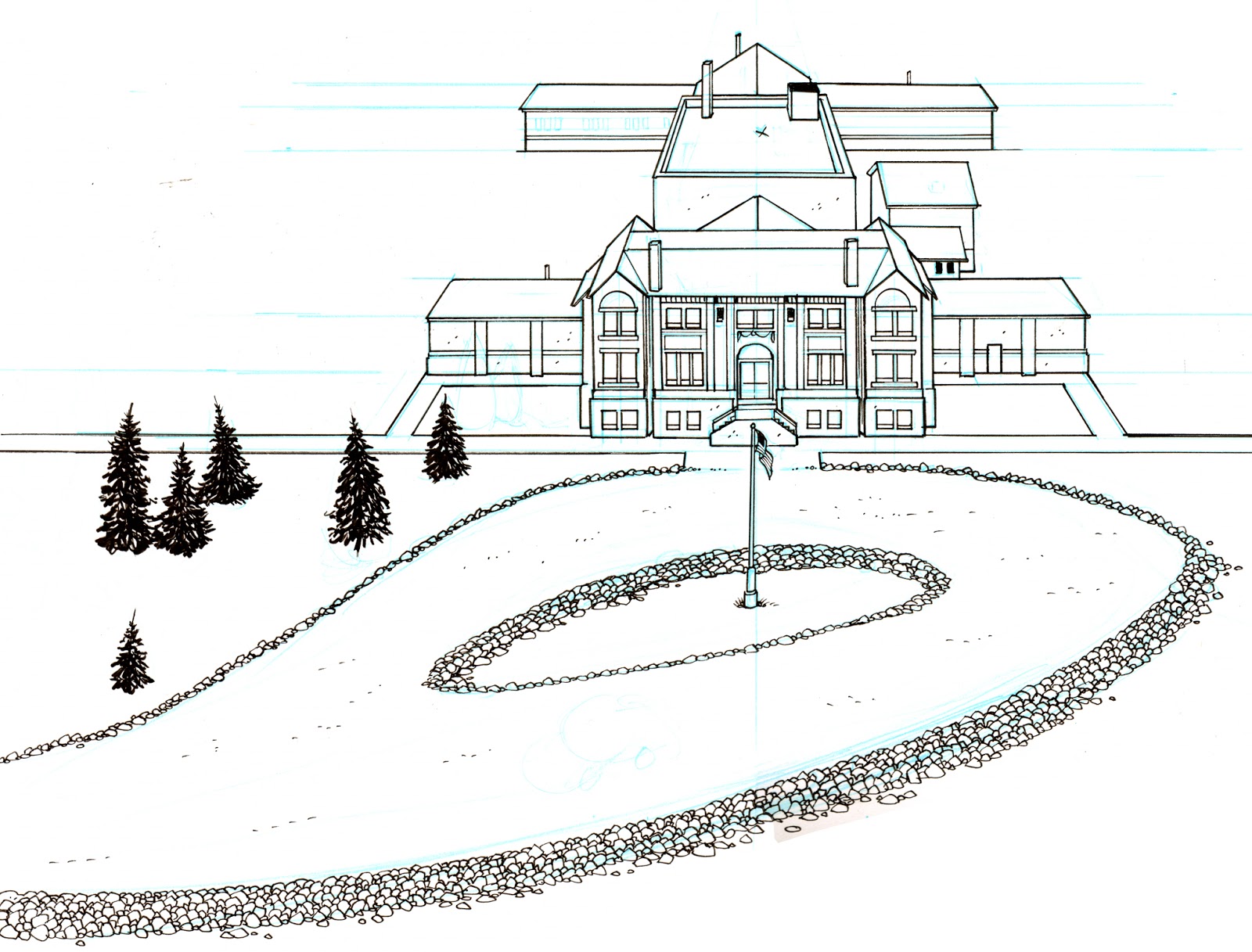
Yeah, I drew all those rocks by hand; I'm not completely lazy. I also drew this:

Those four rectangles at the top of the drawing became groups of three or four windows of various widths and heights simply by squashing or stretching them in Photoshop:

Copy and paste and paste and paste and paste and paste:

Copy and paste that whole thing five times and BOOM, instant sprawling compound.
I drew the car separately because I don't like to draw cars:

One thing I kept in mind when drawing the car, and throughout the entire assembly, was keeping line weight consistent for the final drawing. I drew the car with a thicker line and less detail than I otherwise might have because I knew it would end up very small, and it still had to look like it belonged in the rest of the picture.
I didn't draw all the trees. I actually really love inking pine trees with a brush, but not that many. Instead, I drew 20 trees and clumps of trees, then manipulated them to look like more. Copy and paste those variations, trying not to put two duplicates next to each other, and you've got a forest.
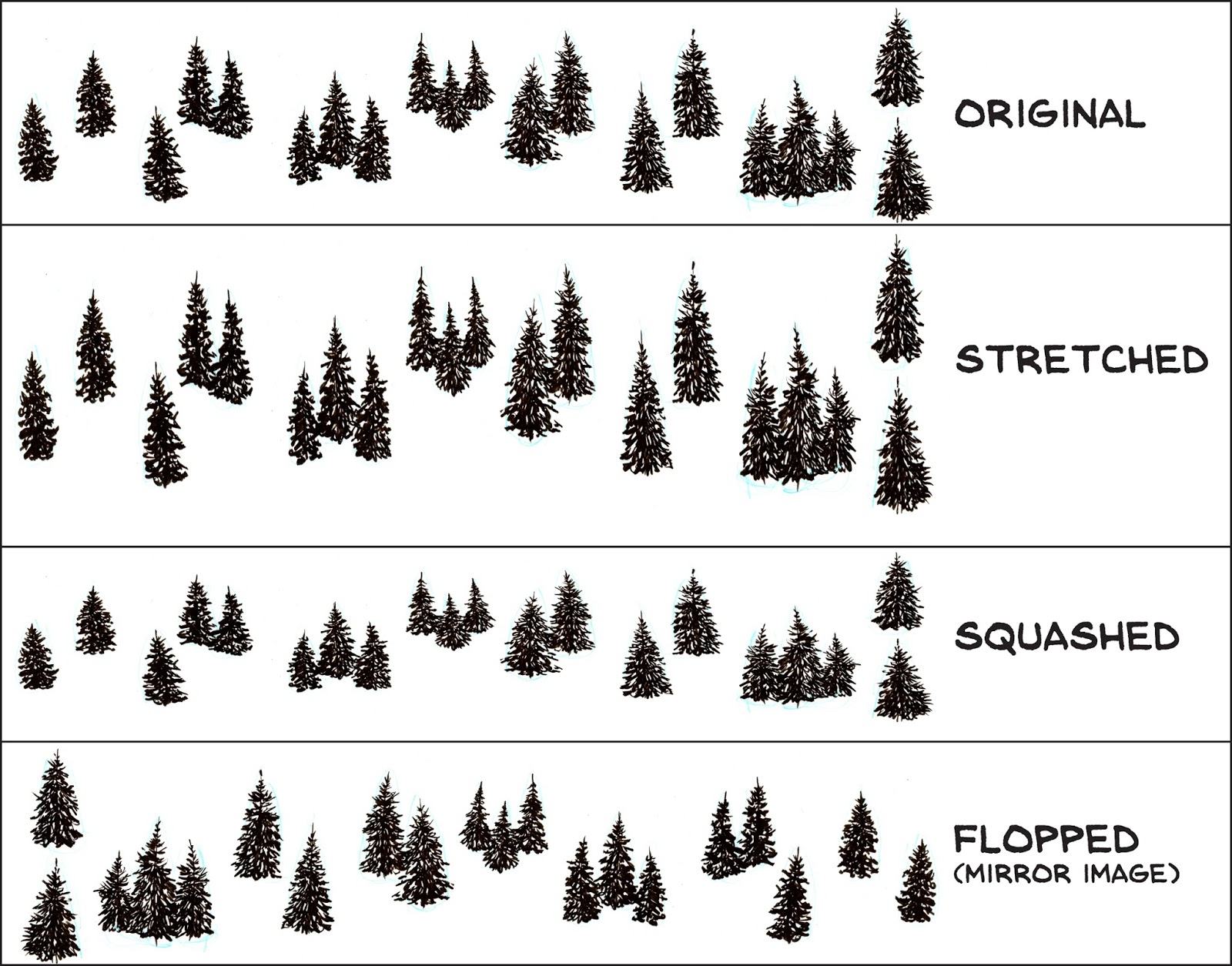 The top row are the only trees I actually drew. The rest I tweaked in Photoshop.
So here are the buildings and car pieced together, followed by the trees on a separate Photoshop layer (think of it as a transparency), which makes it a lot easier to color the ground "behind" them:

Put 'em all together, add some grays and words, and easy-peasy.
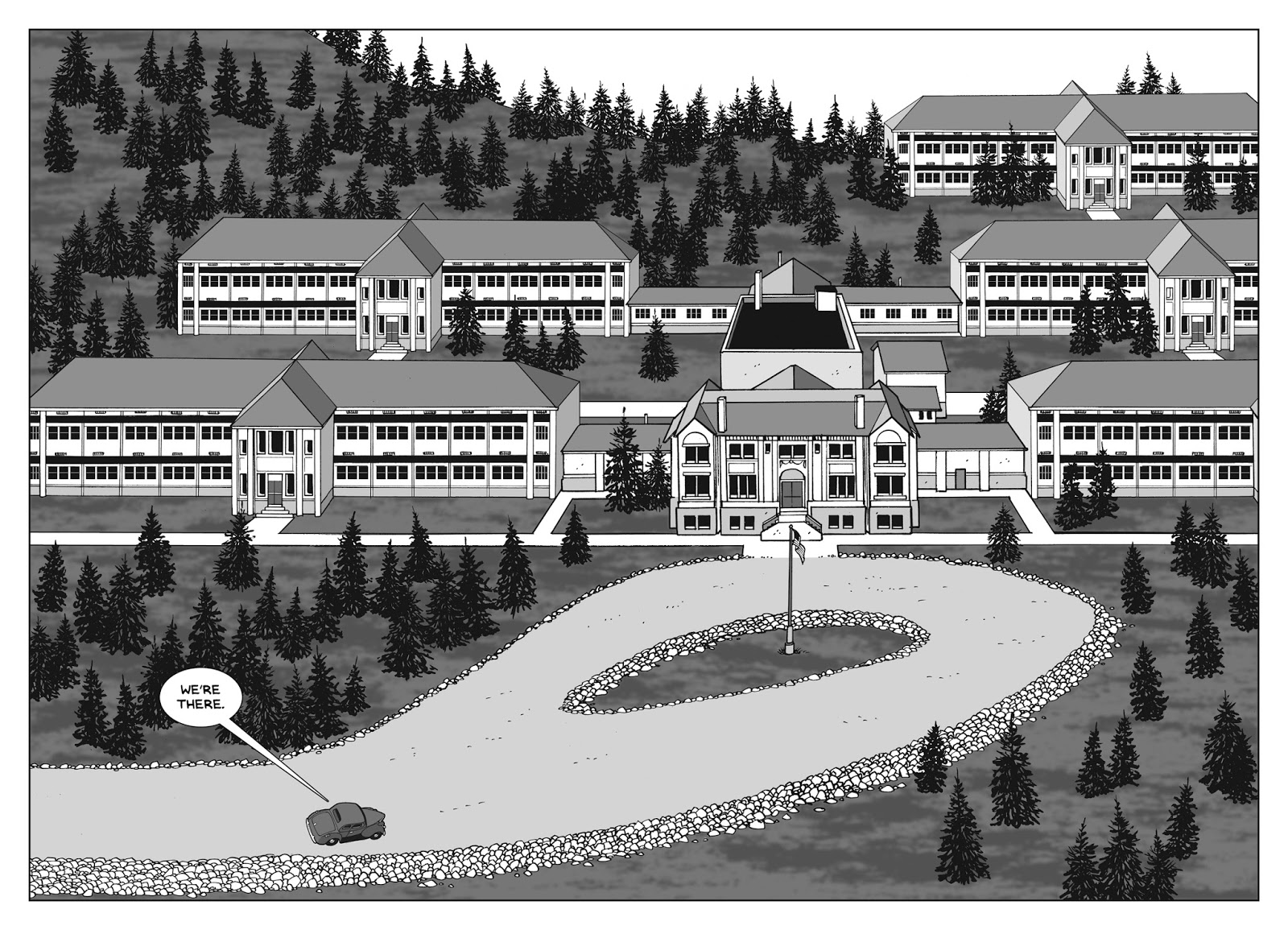
I don't expect to rely on so much digital tomfoolery for the rest of the project. I still aim to render as much by hand as possible. But because this two-page spread is an important establishing shot that shows the reader where they are and sets the stage for the entire story, I needed this level of detail and grand scale. After laying that foundation, I can relax a bit.
Maybe someone else could do a drawing like that completely freehand but I can't. So I did what works, with no apologies. It looks exactly like I wanted it to. That's the goal that guided my process.
December 30, 2016
Blue Highways
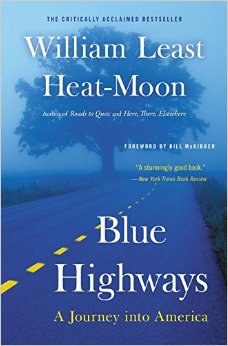
I'm reading Blue Highways, a gift from my friend Marion, in a way author William Least Heat-Moon never intended and probably couldn't have foreseen. Blue Highways is Heat-Moon's travelogue of his three-month loop through the backroads--the map's blue highways--of the United States in 1978. It was a bestseller at the time, and a book I always knew about and wanted to read but never quite got to. Now I have.
Blue Highways is partly an elegy to a then-vanishing America, where people lived as they had fifty years before. Heat-Moon didn't have to wander far off the interstate to find folks living in tarpaper shacks with no plumbing, drinking free spring water that bubbled up from half a mile underground and eating whatever they could catch from the local pond. The book has one foot in the then-now and another in the past.
Reading it today, nearly forty years after Heat-Moon's odyssey, piles another time shift on top. Now I can follow his route on Google Maps, and use Street View to tour the towns he traveled through. I can Google the businesses he patronized and the people he met. Some of them turn up. Heat-Moon didn't know how all the stories he told would turn out; now, I can look up the endings of at least a few.
Not surprisingly, most of Heat-Moon's America from fifty-years-before-1978 appears to be gone. A little more surprisingly, so does a lot of his America from 1978. It wasn't that long ago. I was there. Blue Highways did (unintended?) double duty, documenting both its past and its present before they both passed into its future--where I can ride along with Heat-Moon on a computer that's about the same size and weight as the paperback edition I'm reading.
It's a trip.
December 24, 2016
Pogo & His Pals
Golly, I haven't blogged in a couple of months. I may have run out of things to say, or been disabused of the conceit that anyone cares that I say them. My intentions are good. Maybe next year.
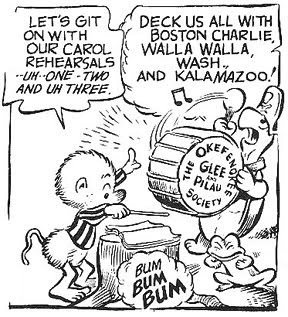
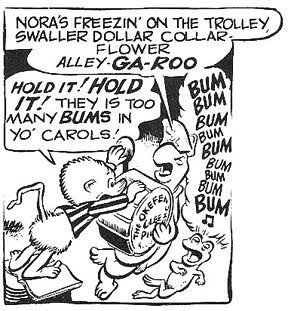
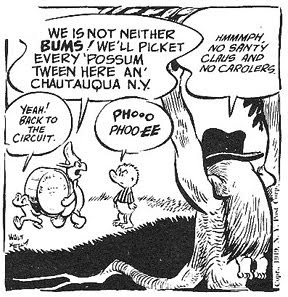
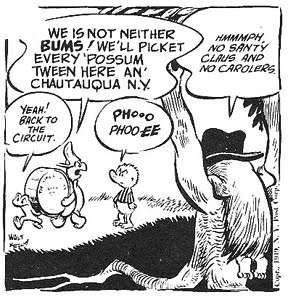
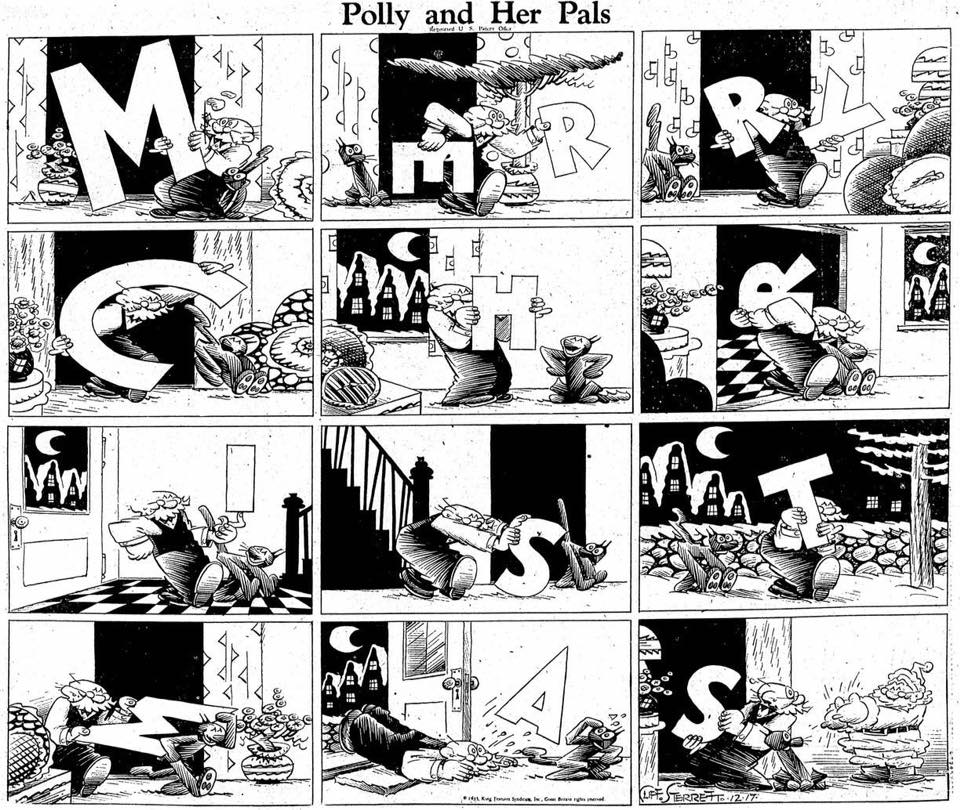
However, I can't let this year pass without posting a bit of whimsy that's been a tradition on my blog every Christmas Eve since way back in aught-five: "Pogo" cartoonist Walt Kelly's timeless carol, "Deck Us All With Boston Charlie." You know the tune. After that, for the first time ever, I've added a bonus cartoon by "Polly and Her Pals" cartoonist Cliff Sterrett, who in my opinion is the greatest underappreciated cartoonist you've never heard of from the first half of the 20th Century. I love Sterrett. This'll suggest why.
All my best for today, tomorrow, and the New Year. Thanks for reading.
Brian
Deck us all with Boston Charlie,
Walla Walla, Wash., an' Kalamazoo!
Nora's freezin' on the trolley,
Swaller dollar cauliflower alley-garoo!
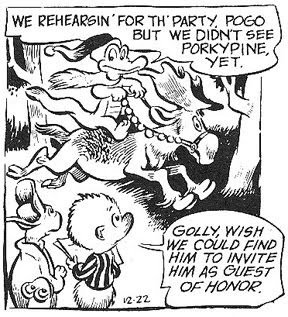
Don't we know archaic barrel,
Lullaby Lilla boy, Louisville Lou?Trolley Molly don't love Harold,Boola boola Pensacoola hullabaloo!
 Bark us all bow-wows of folly,
Polly wolly cracker n' too-da-loo!
Hunky Dory's pop is lolly
gaggin' on the wagon,
Willy, folly go through!
 Donkey Bonny brays a carol,
Antelope Cantaloup, 'lope with you!
Chollie's collie barks at Barrow,
Harum scarum five alarum bung-a-loo!
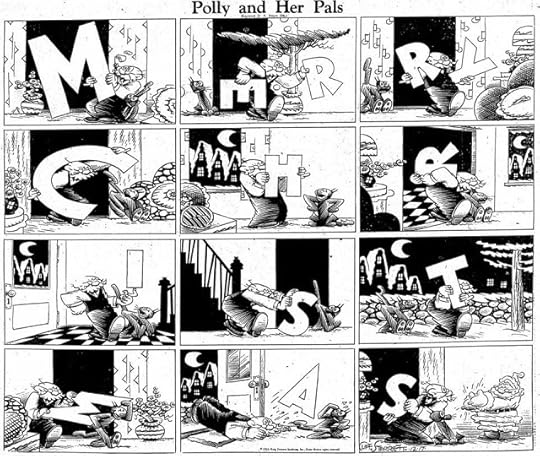
However, I can't let this year pass without posting a bit of whimsy that's been a tradition on my blog every Christmas Eve since way back in aught-five: "Pogo" cartoonist Walt Kelly's timeless carol, "Deck Us All With Boston Charlie." You know the tune. After that, for the first time ever, I've added a bonus cartoon by "Polly and Her Pals" cartoonist Cliff Sterrett, who in my opinion is the greatest underappreciated cartoonist you've never heard of from the first half of the 20th Century. I love Sterrett. This'll suggest why.
All my best for today, tomorrow, and the New Year. Thanks for reading.
Brian
Deck us all with Boston Charlie,
Walla Walla, Wash., an' Kalamazoo!
Nora's freezin' on the trolley,
Swaller dollar cauliflower alley-garoo!
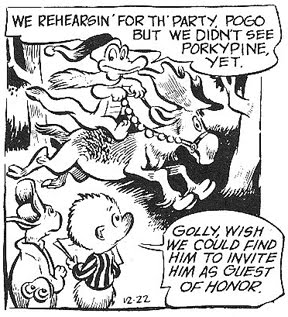
Don't we know archaic barrel,
Lullaby Lilla boy, Louisville Lou?Trolley Molly don't love Harold,Boola boola Pensacoola hullabaloo!
Bark us all bow-wows of folly,Polly wolly cracker n' too-da-loo!
Hunky Dory's pop is lolly
gaggin' on the wagon,
Willy, folly go through!
Donkey Bonny brays a carol,Antelope Cantaloup, 'lope with you!
Chollie's collie barks at Barrow,
Harum scarum five alarum bung-a-loo!
September 28, 2016
My Fellow Super-Americans



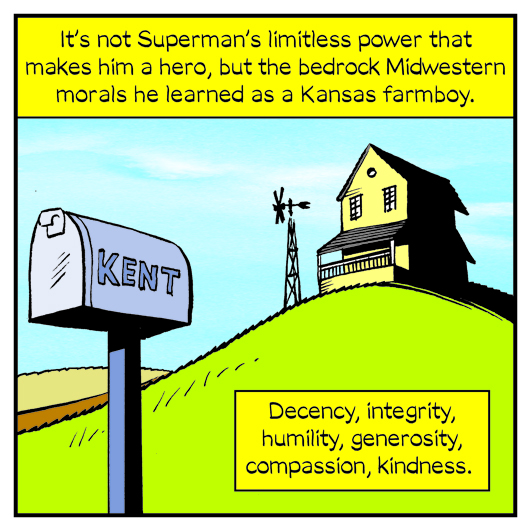
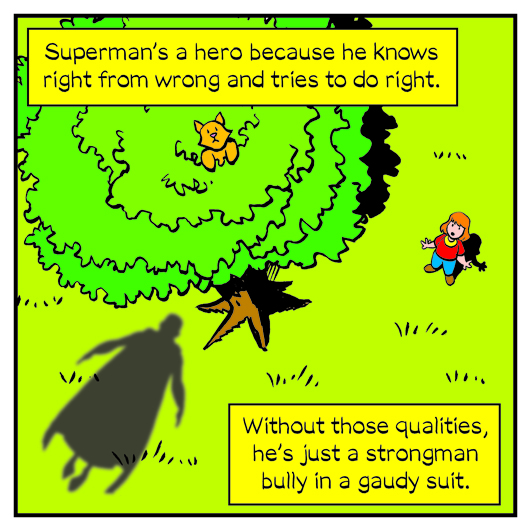
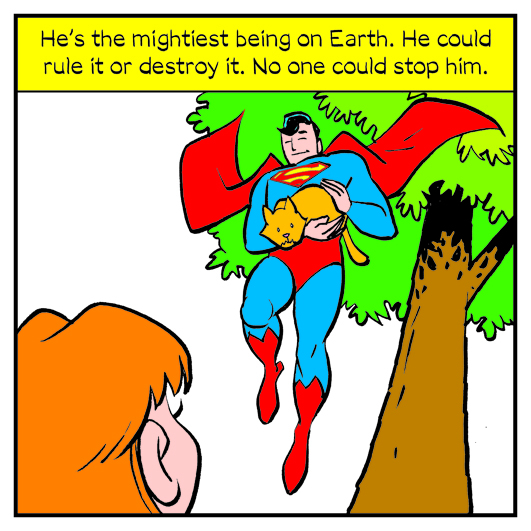
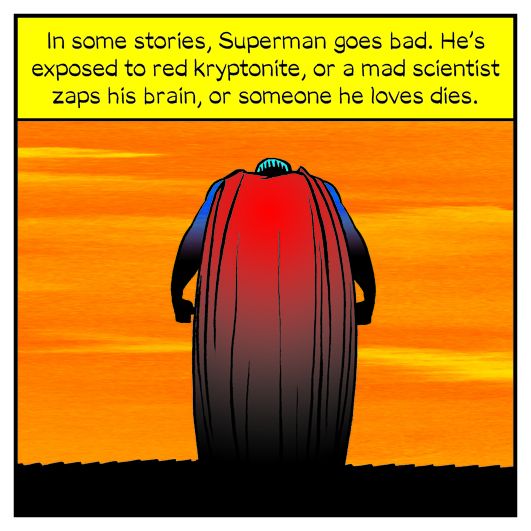
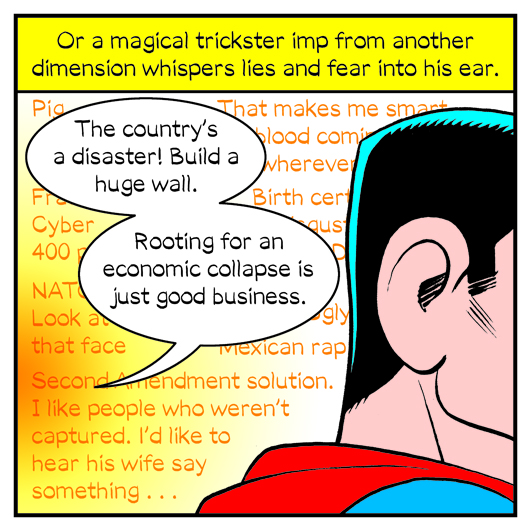
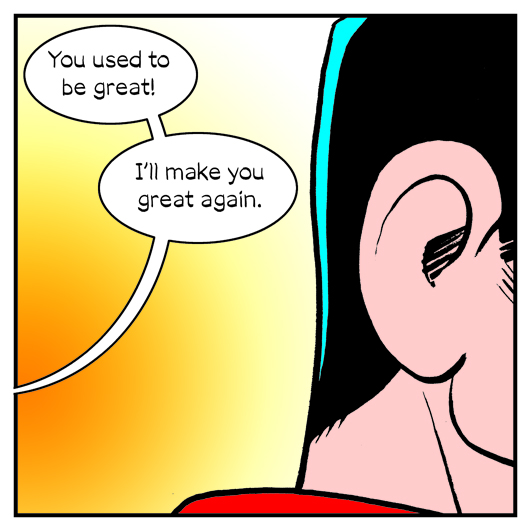
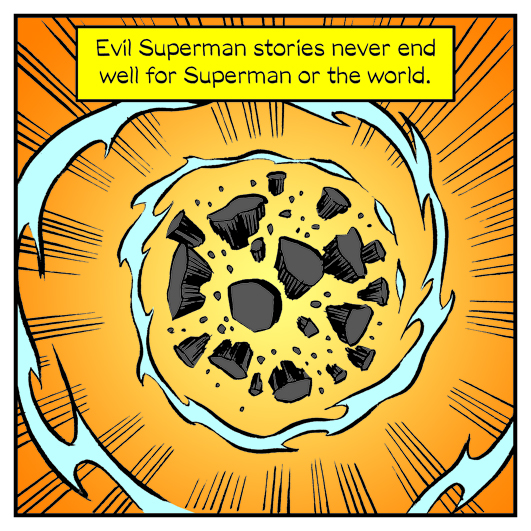
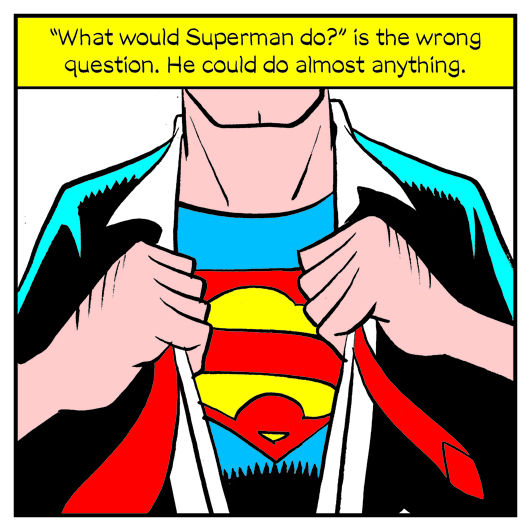
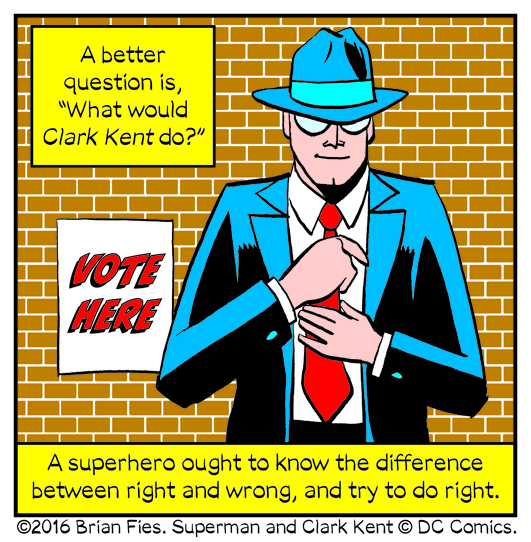
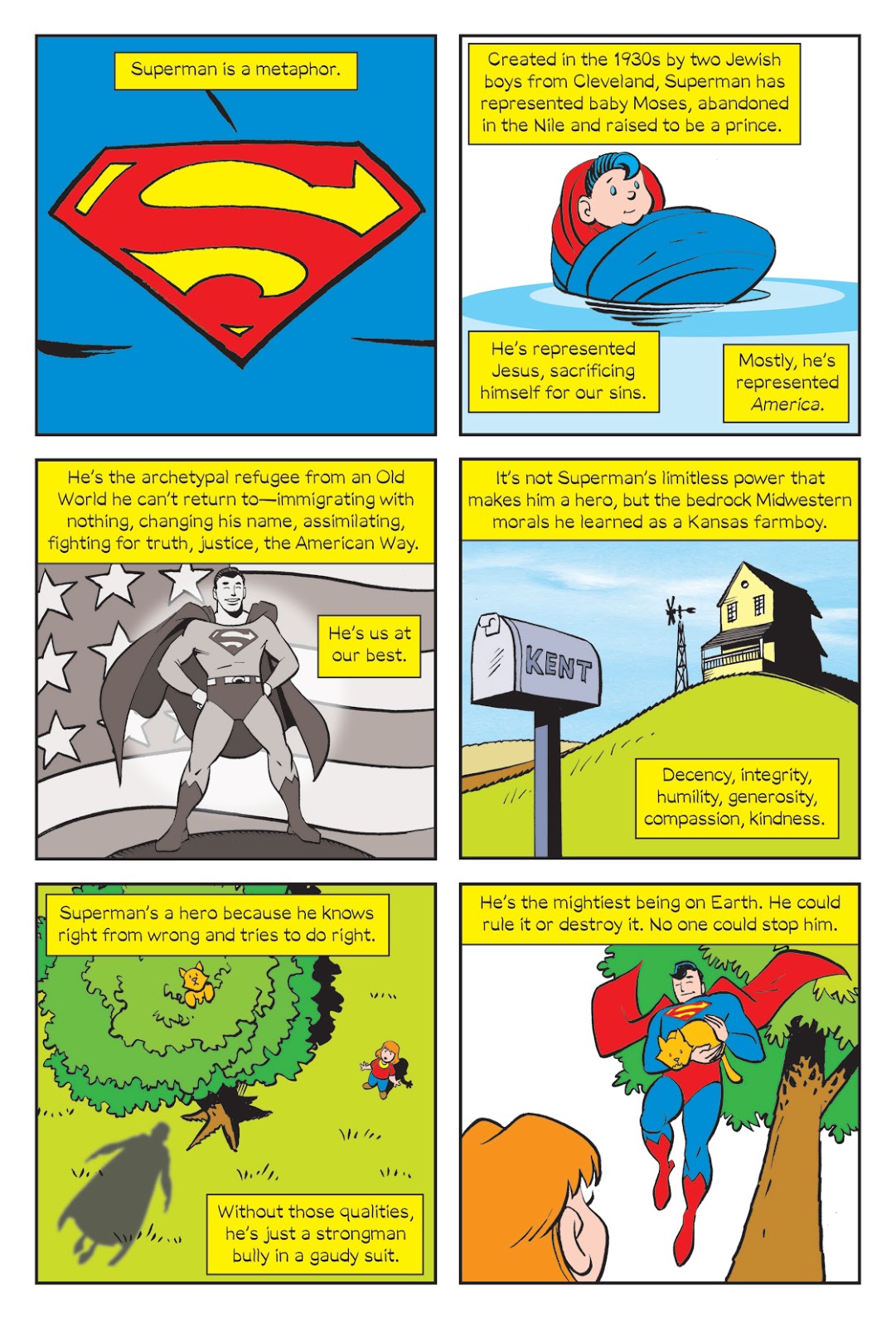
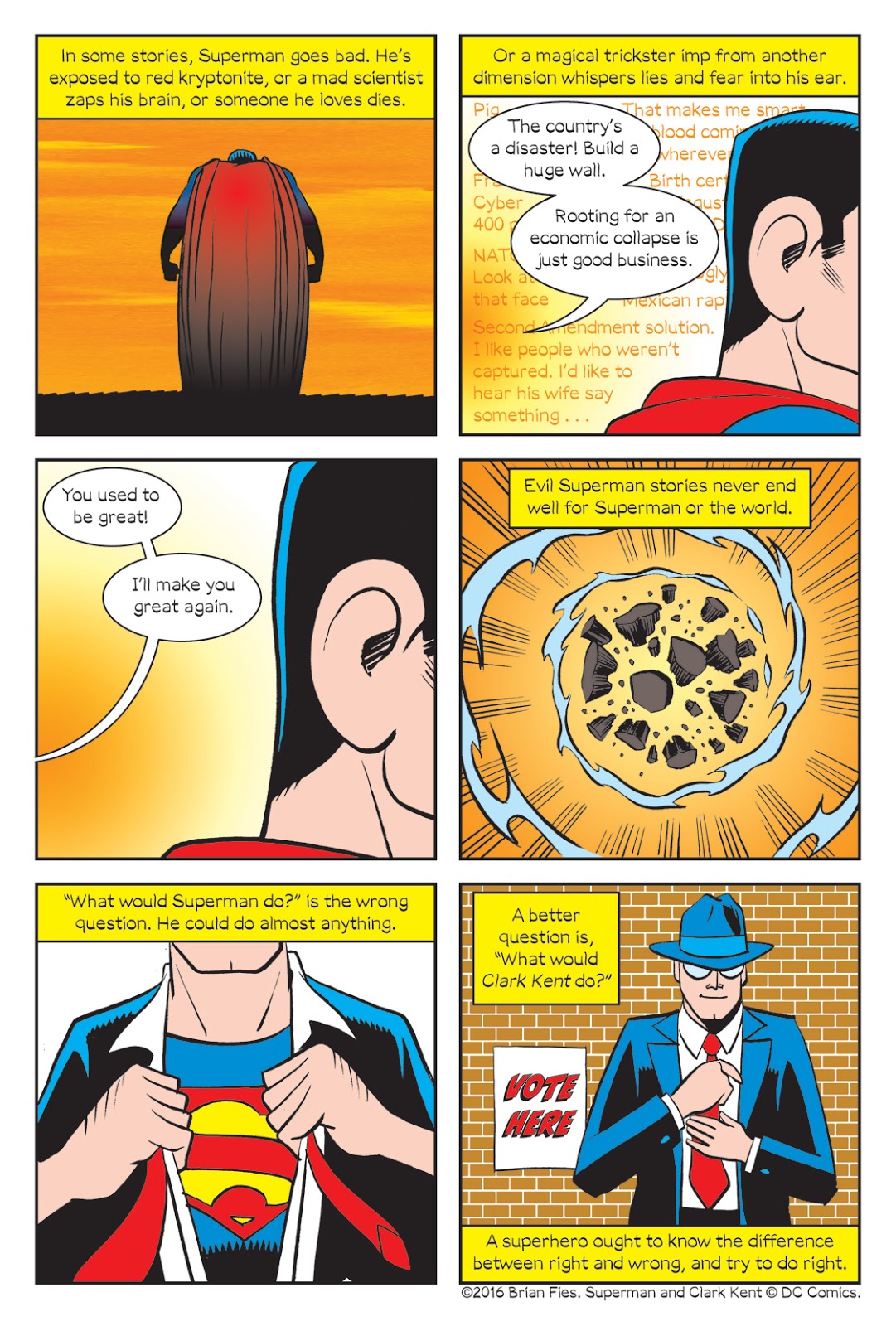
The "What Would Clark Kent Do?" filter works surprisingly well. Here's a partial list of things I'm pretty sure he wouldn't do:
Make fun of fat women.
Make fun of ugly women.
Make fun of menstruation.
Make fun of the disabled.
Insult POWs.
Insult the parents of dead soldiers.
Extort his allies ("Eh, nice country you got here, be a shame if somethin' happened to it.")
Go into business with General Zod.
Praise the way General Zod handles the press and dissidents.
Suggest that General Zod could maybe help him get rid of his enemies.
Lie; then when confronted with that lie, double down or deny.
Brag.
Bluster.
Bully.
When caught bullying, retort "Can't you take a joke?"
Blame his failures on everyone but himself.
Appeal to people's worst instincts instead of their best.
Really, the list is practically endless. I keep waiting for a modern-day Joseph Welch versus Joe McCarthy moment, but I'm not sure we have it in us anymore. Decency is too old-fashioned.
I don't expect to change anyone's mind, and I'm breaking my rule about not doing politics online. Might regret it; don't care. I had to stand up and be counted. Clark would.
Here's the above comic laid out in two pages, which I wasn't sure would be readable at blog size. Click to embiggen. Thanks for your indulgence.
September 6, 2016
The Grand Delusion
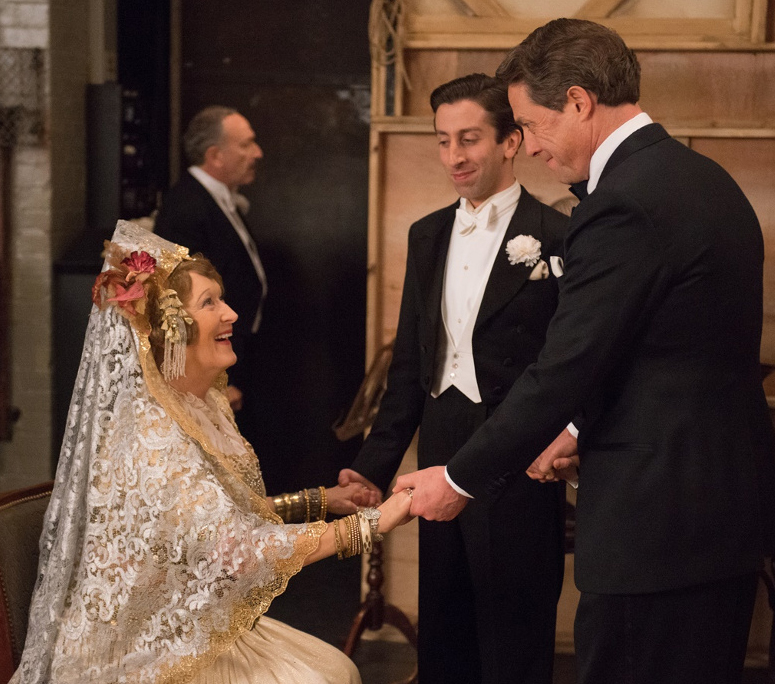
Over the weekend, Karen and I saw and really enjoyed "Florence Foster Jenkins." Based on an actual woman often called the World's Worst Singer, the film stars Meryl Streep, who may deserve an Oscar for her performance as Florence; Hugh Grant, who Hugh-Grants his way through a good performance as Florence's morally ambiguous husband (I think the film answers the question of whether he truly loves Florence but you may disagree); and Simon Helberg, "The Big Bang Theory's" Wolowitz, who gives a master class in reactive acting as Florence's horrified new accompanist.
Madame Florence was a wealthy woman in pre-War New York City whose patronage of the musical arts made her a pillar of high society. But merely supporting the arts wasn't enough for her. She wanted to sing, first at exclusive performances at the Verdi Club she founded to showcase her talents, then eventually at Carnegie Hall.
No one ever doubted Madame Florence's passion for music, just her ability to do it. She became a hit by being terrible, and according to the film and some profiles I've read, most people played along, complimenting and applauding as if she were terrific. Cole Porter and Enrico Caruso were fans. There's debate about how self-aware Florence was. Streep plays her as completely deluded and clueless until she gets an honest devastating review; some contemporaries said she was in on the joke.
I thought the movie was very good and, like all good movies, inspired a lot of deep thinking as I left the theater. For example, about Emperor Norton.
Norton the First, Pepper the Last
Joshua Norton arrived in San Francisco in 1849, and ten years later proclaimed himself "Norton I, Emperor of the United States and Protector of Mexico." He ordered the U.S. Army to disband Congress, and commanded that a suspension bridge be built between San Francisco and Oakland. He may have also imposed a $25 fine on anyone caught using the word "Frisco."
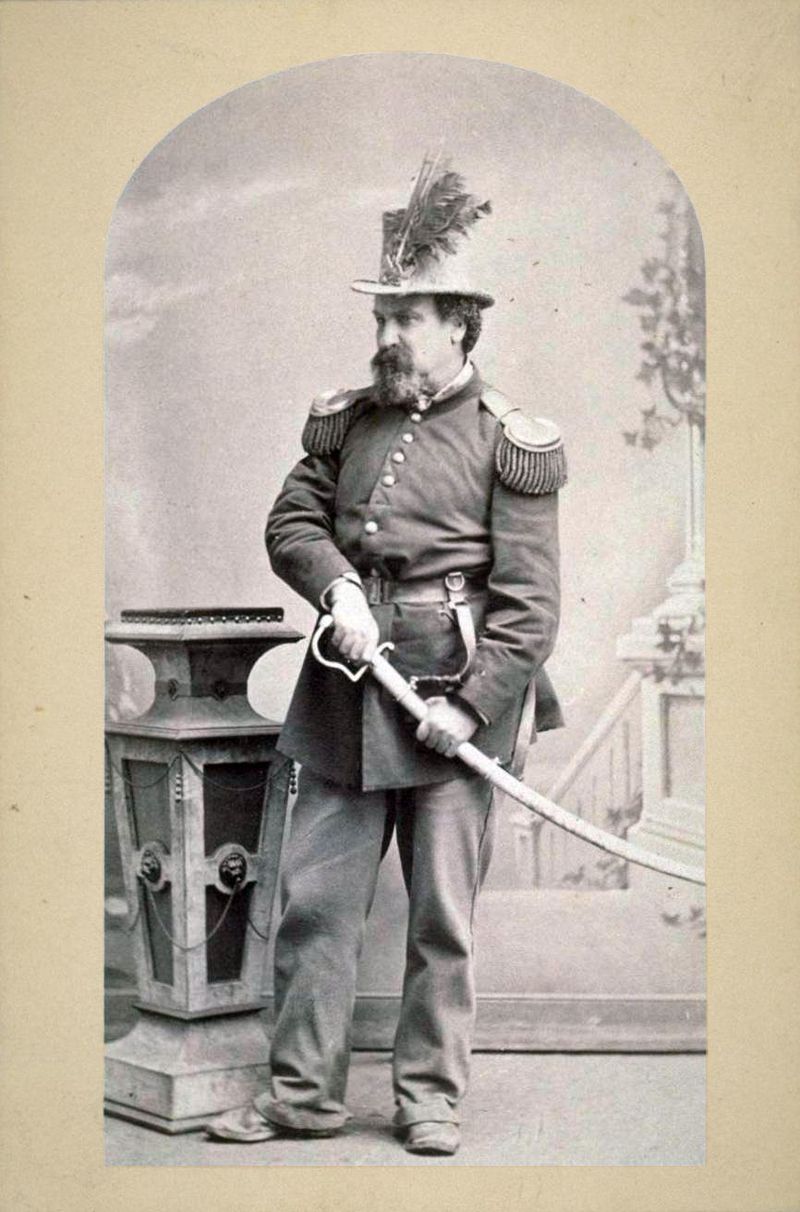 Norton IAnd the entire city of San Francisco played along.
Norton wore a flashy uniform given to him by Army officers at the Presidio. When that uniform wore out, the San Francisco Board of Supervisors requisitioned him a new one. Penniless, he issued his own currency, which was accepted by restaurants and merchants. Passersby bowed to him. Theaters left a balcony seat open for him. He once broke up an anti-Chinese-immigrant riot by standing between two mobs and reciting The Lord's Prayer.
Norton was arrested once, in 1867, by a cop who thought he was insane and ought to be committed. Citizens and newspapers rose up in outrage. The Daily Alta editorialized that the Emperor "has never shed blood, has robbed no one, and despoiled no country...which is a hell of a lot more than can be said for anyone else in the king line." The police chief released him with a formal apology, and afterward police officers saluted Norton whenever they passed him on the street.
Norton died in 1880, as beloved an Emperor as the United States and Mexico ever had. His suspension bridge between San Francisco and Oakland was eventually built in 1936. Although it's called the Bay Bridge, there is still today a popular campaign to rechristen it the Emperor Norton Bridge.
This train of thought, from Madame Florence to Emperor Norton, inevitably brought me around to Pepper.
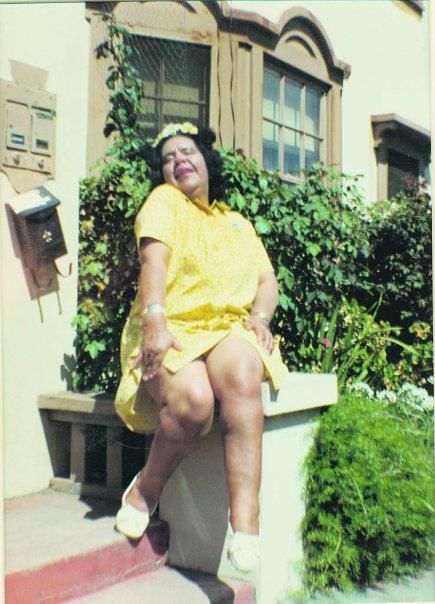 PepperUnless you grew up in my hometown you've never heard of Pepper, but you may have had a Pepper in your hometown. For 50 years Pepper Garcia Dardon was our local eccentric who fancied herself the town marshal, backed up by a tin badge the local cops gave her in the early 1960s. Her beat was downtown, where she directed traffic, collected 50-cent fines from jaywalkers, yodeled on supermarket microphones, and shoplifted penny candy to hand out to children. Pepper ran errands for merchants and sold fundraising tickets for the Kiwanis--no one dared decline. Sometimes, according to a 2005 profile by local historian Gaye LeBaron, Pepper ordered pizzas delivered to the police station to thank her boys in blue, but never bothered to pay for them.
I often saw Pepper around town but only had one direct run-in with her. I was probably 17 or 18, coming out of a store and heading to my car in the parking lot, when Pepper accosted me. "I need to go north. Which way are you going?" I was in fact headed north, but not wanting to provide a taxi that day, I stammered out, "Uh...south. Downtown." "That's exactly where I'm going too!" she said brightly. "Let's go!" Three miles later, I dropped her off downtown and turned around, completely outmaneuvered by the town marshal.
Pepper died in 1992, complaining that people weren't as friendly as they used to be. She was right. Do we have a Florence Foster Jenkins, Emperor Norton, or Pepper anymore? Could we? Should we?
There's some condescension in playing along, smirking knowingly behind their backs. Some might say we're not doing the deluded any favors by indulging them. But, as the Daily Alta argued, if they're not doing any harm then what's the harm? Who's to say a little collective compassionate fantasy isn't better than harsh reality? Would you tell Madame Florence she couldn't sing, tell Norton the First he wasn't emperor of anything, tell Pepper she had no authority to harass jaywalkers?
I wouldn't have the heart.
Here's Where I Stretch the Theme Too Far
Sometimes when striving writers and artists are being deep and honest, they ask each other how they're supposed to tell whether they're any good. How do you know if you're truly talented and ought to keep trying until you get one good break, or if you're a tone-deaf Florence Foster Jenkins? Winners never quit, but neither do a lot of folks who really should.
Sometimes they ask me what I think. It's a very tough question. I don't trust my own judgment enough to flat out tell anyone to quit and go home. I'm not in the spirit-crushing business. Besides, lots of people whose careers completely mystify me are doing a lot better than I am. What do I know?
I wouldn't have the heart.
I try to read the audience. Nine out of ten people who say "Don't be afraid to tell me what you really think" don't want to know what you really think. They just want to hear that they're great. Anything less than that and their defenses go up and their excuses come out. The other one out of ten is genuinely interested in feedback and trying to learn from it. I think of them as the pros, even if they've never sold anything (yet). It's not necessarily related to age or experience. I've seen 15-year-olds take constructive criticism better than 35-year-olds.
The best advice I've come up with (and I don't think it's great) is to look for external signs of progress. "External" means someone other than your mom or spouse or best friend telling you you're a genius. Someone like an editor. Notice I'm not saying "money," although getting paid is the only sure-fire unambiguous compliment. But if you're doing your best work and getting it in front of people who have the potential to someday pay for it, I have some faith that if you're any good they'll eventually notice. Maybe a note of encouragement along with the customary rejection, or a suggestion for something different you might try next time. Build on that.
Try not to be Florence Foster Jenkins.
August 15, 2016
Mark Twain Insult of the Day #15
From Volume 3 of the Autobiography of Mark Twain, today's subject: Lilian Aldrich, the wife of writer and Clemens acquaintance Thomas Bailey Aldrich.
"A strange and vanity-devoured, detestable woman! I do not believe I could ever learn to like her except on a raft at sea with no other provisions in sight."
"A strange and vanity-devoured, detestable woman! I do not believe I could ever learn to like her except on a raft at sea with no other provisions in sight."
July 28, 2016
Richard Thompson
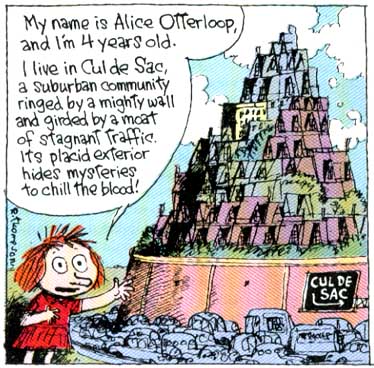
Cartoonist Richard Thompson died yesterday from Parkinson's disease at age 58. Michael Cavna wrote a good obit in the Washington Post, for which Richard did a lot of work. Richard was also the genius behind the comic strip Cul de Sac, which, when it retired in 2012 because Parkinson's had made it too difficult for Richard to draw, I called the best comic strip of the 21st Century. So far, it still is.
Unlike most people, I don't throw around the word "genius" lightly. To me it means something beyond "extremely smart and talented." More like "sprung full-blown from the brow of Zeus," doing things I don't even understand how any human could do. Richard did that.
The past couple of weeks I've been writing the Comic Strip of the Day blog while its founder, Mike Peterson, recovered from surgery. Mike came back yesterday, and for my final two posts on Monday and Tuesday I republished the testimonial I posted here when Cul de Sac closed up shop. I won't re-repost it again, but here's Part 1 and Part 2. Richard died on Wednesday.
The timing was coincidental but providential. I'd heard from people close to Richard that he was in very bad shape but didn't know he was near death. I reposted that piece partly because I wanted people to think good thoughts about him, and hoped he might see it and it would make him happy. Monday's Part 1 post got a Facebook "Like" in his name. He obviously didn't push the button but someone near him did, so I'm grateful for that.
I never met Richard but we exchanged some messages over the years. He was the same with me as he was with everyone: kind, funny, generous with his time and praise. I live 3000 miles away but always hoped I'd have a chance to take him up on the cup of coffee he promised, and I don't even drink coffee. I'm pretty heartsick and gutted by his loss.
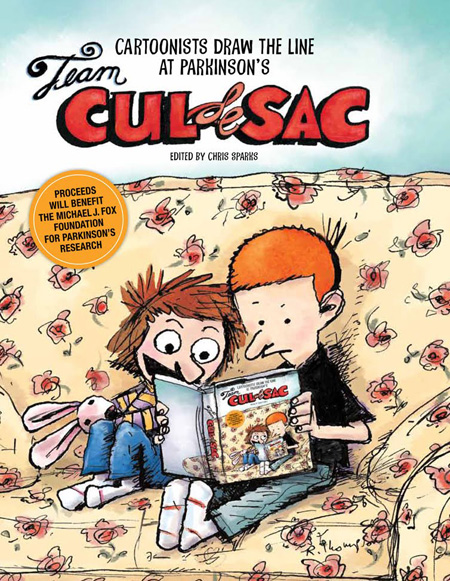 Chris Sparks started Team Cul de Sac to raise money for Parkinson's disease research in Richard's name. I contributed a drawing to a tribute book published a couple of years ago, and the group is still active at comics conventions and online, doing good work with the Michael J. Fox Foundation. Check them out.
I recommend two good books: The Complete Cul de Sac , which collects all of the strips in Cul de Sac's five-year run, and the Art of Richard Thompson, which, if you're an artist, will either inspire you to work harder or give up.
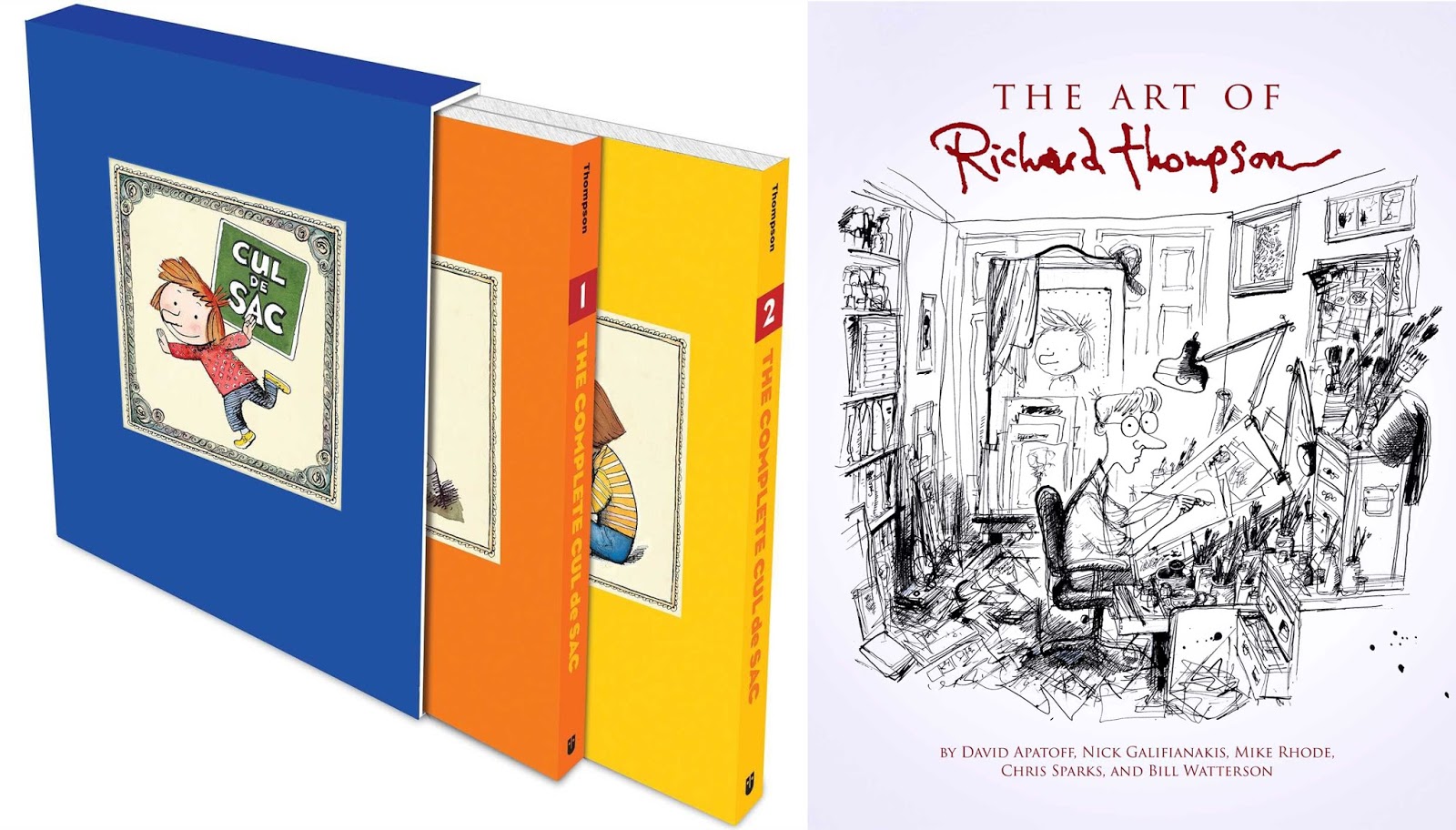
In addition, Picture This Press will soon release two books as part of its Richard Thompson Library: The Incompleat Art of Why Things Are, collecting Richard's illustrations for Joel Achenbach's column in the Washington Post, and Compleating Cul de Sac.
If you're curious what a genius looks like, watch this video. I'll miss having him in the world.
Brian Fies's Blog

- Brian Fies's profile
- 64 followers
Brian Fies isn't a Goodreads Author
(yet),
but they
do have a blog,
so here are some recent posts imported from
their feed.

