
Brian Fies's Blog, page 27
February 6, 2023
A Magic Lantern
 My magic lantern, with its orange-bordered glass slide in place. You just slide it sideways by hand to change the image.
I have a fascination with pre-electric home entertainment that people enjoyed before they could flip a switch. For example, I love old-timey spring-cranked phonographs and 3-D stereo viewers. With that in mind, last weekend's antique-store find was a charming old magic lantern--basically a flame-illuminated slide projector--plus 12 glass slides in their original box!
This magic lantern isn't marked so I don't know much about it. Some people's parlors had fancy ones, gleaming with fine wood cases and brass fittings, but I think mine is more on the cheap-children's-toy end of the scale. The slide box has no date clues. Magic lanterns have a long history, dating from the 1600s through the 1920s or so. Folks used to go to magic lantern shows in theaters. Just based on the style of the slides' artwork and some context clues--i.e., drawings of ships and bicycles but no autos or aircraft--I think I'm looking at late 19th or very early 20th century. Hard to tell.
 Ten of my twelve slides laid out on my lightbox. The slide second down on the right shows both a penny-farthing bicycle, invented around 1870, and a more modern "safety" bicycle, which supplanted penny-farthings in the late 1880s. So my best guess for the age of the slides--which I suspect but can't prove were bought with the lantern--is 1890 to 1900ish.
Light was provided by an oil- or alcohol-burning wick inside a lensed cone, which is nested inside a housing that holds the slides and a second lens. A chimney (still quite sooty inside) carried away heat and smoke. Not wanting to set my house on fire (again), I hung a small LED inside the chimney where the flame would have been, which works great! I just tried it out in a dark closet, and projected a nicely focused image maybe 6 feet. Farther = dimmer.
 The magic lantern disassembled. At right is a burner with its wick poking out. The middle tapered cylinder fits on top of that, with a fat round lens focusing the flame's light. Then the housing at left fits over the cylinder, with the second brass-lined lens sliding in and out to focus the image. Like I say: clever!
Part of what so grips me about these technologies is how clever they were, and how much fun they were, without electricity. I also like to imagine someone having the first phonograph or stereo viewer or magic lantern in the neighborhood. What a thrilling thunderclap it must have been to suddenly have recorded music, or 3D photos of exotic locales, or drawings glowing on the wall! What a world-expanding eye-opener!


January 30, 2023
Sittin' on the Dock of the Bay
 Going aboard the Gray Ghost, with San Francisco in the background. The Hornet is berthed in Alameda, where they (used to) keep the nuclear wessels.
Karen and I spent the day at the USS Hornet Museum, and a nippy but unusually crystal-clear day it was. San Francisco, across the Bay, looked close enough to touch.
 THERE'S the City across the Bay! She's a beauty.
As I might have mentioned once or a hundred times, my daughter Laura is the COO of the Hornet, a retired aircraft carrier that is now the coolest museum in the Bay Area. Karen visited today because the Hornet is looking into what kind of services it could provide in a disaster, and Karen is an expert in that. Personally, I can't think of a safer disaster shelter than an aircraft carrier--immune to earthquake, firestorm, tidal waves, whatever you've got, plus hundreds of bunks already installed--and it's my personal zombie-apocalypse destination.
I went today because years ago I built a "Gravity Box" for the Hornet's Apollo Mission exhibition. It has two handles visitors can pull to see what 24 pounds on Earth would feel like on the Moon. (I won't keep you in suspense: 4 pounds. Also, the Hornet has an Apollo exhibition because it's the ship that picked up Apollos 11 and 12 from the Pacific Ocean.) It was past time to refurbish the box, which has had a lot of love that, most notably, eroded away much of the trim that held the top of the box together. The first generation of trim was PVC, which didn't stand up well to thousands of legs and little bellies rubbing against it. Worse, when the PVC disintegrated, it left little finishing nails sticking out. The main goal of today's work, besides a general inspection and cleaning, was to replace the old trim with aluminum L-bracket that I expect to hold up better.
[Sidebar: designing stuff to hold up to thousands of uses, including some people abusing it in ways you can't imagine, is a real skill. I don't know how people at places like Disneyland do it. Respect.]
 Part of the Apollo Mission exhibition, with the Gravity Box at lower center.
 My Gravity Box pre-refurbishment. Notice especially how the bottom piece of trim has disappeared. The rest of the trim was no great shakes, either. There's also a fine powder of sawdust where the handles enter the box due to thousands of mighty piston strokes.
 And post-refurbishment, cleaner and more durable, I hope.
Karen's work took a couple of hours more than mine, which left me a lot of time to explore the ship and lounge in the sun on the flight deck. It wasn't crowded; at one point, I had the whole deck to myself. You should go visit and make it more crowded. If you're lucky, you'll get a day as beautiful as mine.
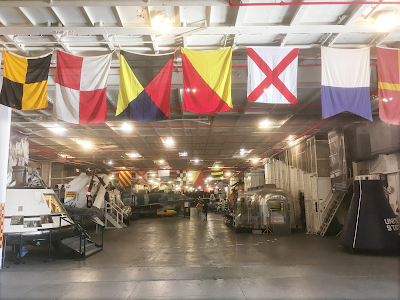 The hangar deck's got planes and helicopters and spaceships and Airstream trailers, oh my!
January 29, 2023
LumaCon 2023

My favorite event on the comics convention calendar did not disappoint! LumaCon 2023, the best free little con I know, put on by librarians in Petaluma, Calif., was a hoot. I'll dump some photos below, but short version: I had a good time with old friends, made a couple of new ones, talked to some very talented and driven kids about comics, and surprisingly sold more books than I think I have at any other con.
Seriously. I was telling Andrew Farago, curator of the Cartoon Art Museum, how surprised I was to see my books selling out, and he pointed out that people attend an event like, say, Comic-Con International in San Diego for a lot of reasons: movies, TV shows, video games, cosplay, the grand spectacle of it all. Whereas people go to a convention run by librarians largely because they like to read. I don't do well with a crowd that's there for Wolverine, but with people looking for something kind of interesting and different, I can do all right.
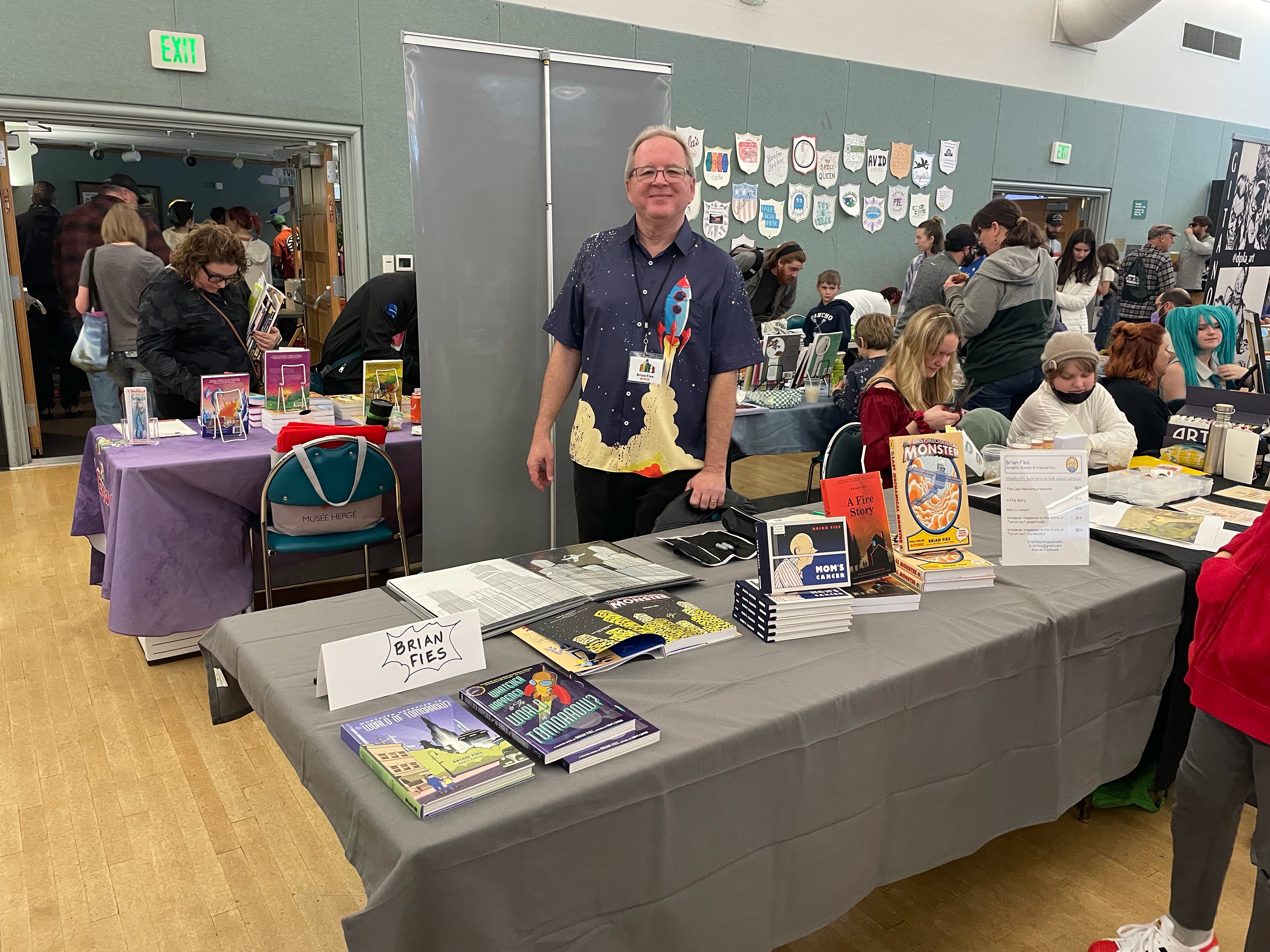 My spread. I had a couple of very creative and entrepreneurial kids sitting beside me and "Kid Beowulf" creator Lex Fajardo behind me. Surrounded by talent.
In addition to Andrew and his wife, cartoonist Shaenon Garrity, and their son Robin, other friends with tables included cartoonist Tom Beland, cartoonist/illustrator Emily C. Martin, and cartoonist Lex Fajardo, who sat right behind me. Everybody told me I had to meet Gio Benedetti, a cartoonist who also does workshops and puts together anthologies of teens' comics, so I did and he was great. Nathan Libecap, librarian at Casa Grande High School, and his team of colleagues and volunteers made all the pros feel very welcome and ran a smooth show. Other friends dropped by, including writer/teacher Jason Whiton, cartoonist Denis St. John, librarian/gallery wrangler Loretta Esparza, and friends Kathy Bottarini and Kristin Hendricks. Best of all, my daughters Laura and Robin helped staff my table for a couple of hours, which was wonderful because they're much better salespeople than I am.
Plus LumaCon still has its bake sale. If your comics convention doesn't have a bake sale, you're doing it wrong.
 The Bake Sale. Oh yeah.
In some press promoting LumaCon, Nathan had made the point that its focus is on young creators and the pros are pretty much invited as bait to lure people in (he put it nicer than that). I teased him a bit about that, and he reassured me that I would always be welcome but also told me something very interesting: since the first LumaCon in 2015, some of the artists who started out on the amateur kids' side of the room have begun to migrate over to the professional adult side. As they aged, at least a few of them kept their passion, grew their skills, and are now getting real pay and recognition for their creative work!
Holy Moley! How wonderful is that? I can only imagine how gratifying it must be for the LumaCon organizers to see the seeds they planted with their first mini-convention years ago begin to bloom like that. Nathan also confirmed that LumaCon has become a model that other cities, libraries and schools are looking to emulate, which I can confirm because I've been invited to one of them later this year.
 Nathan was easy to find because he was everywhere all at once.
Most years I can count on having an "Only at LumaCon" moment, and this is this year's:
One of the tables was selling work from Alchemia, a local program to "nuture the creative expression of individual with disabilities as a vehicle for personal growth and accomplishment," says their website. One of their artists, Justin, came by my table with his staff supporter Andy, and was absorbed by a couple pages of original artwork I'd brought because I like to talk to young artists about the process of turning drawings on paper into pages in a book. These particular pages were the two-page spread of skyscrapers on the title page of The Last Mechanical Monster, and Andy asked Justin if he'd like to talk to his art mentor about drawing something like that himself. I had an idea.
 Those pages.
I figured that if they went to Justin's art mentor, they wouldn't even know what to ask for. I also figured I couldn't teach Justin how to draw skyscrapers in two-point perspective in just a few minutes. But if I could sketch it out for Justin and Andy, and then if they took that sketch to Justin's art mentor, it might be something they could work on together and really master. So I took a piece of paper and drew a line down the middle of it, then put two dots on the line, then drew a bunch of lines radiating from those dots, then drew a box and drew some windows on it and said, "That's exactly how I made those drawings, and you can, too."
Justin leaned in real close, gave me a warm, firm, two-handed handshake, and said, "You're the best artist on Earth."
I didn't argue the point.
Here's some pictures.
 An overview of about half the Artists' Alley room, which was the heart of LumaCon. There were several vendors set up out in the lobby, and different activity rooms scattered around the Petaluma Community Center.
 The other side of the room, showing me with my daughter, Robin, so I deduce this photo is by my other daughter, Laura.
 Lex Fajardo
 Emily C. Martin
 One of my favorite art stylists, Tom Beland
 Alchemia, with Justin and Andy
 The Schulz Museum came, too!
 Separate rooms were dedicated to playing with Legos as well as just sitting and drawing. I love that.
 A stage in the Artists' Alley room was set up for crafts. This was very early in the day, they were swarmed later.
 Kids outside lopped off each other's limbs with deadly swords. I'm surprised it didn't make the news.
 I believe this brave young Jedi single-handedly captured an Empire outpost.
Like I said in my last post, LumaCon is just about the sincerest little con I know. They promise to keep having them, so if you're in the neighborhood next year I recommend it. Chances are good I'll be there, too.
January 27, 2023
LumaCon's A'Coming!
 Sign at the front door in 2019.
Here's a nice article in the local paper about where I'll be tomorrow: LumaCon, my favorite comics convention of them all! That's because, like Linus's pumpkin patch, it's the most sincere comic-con in the world. It's tiny, organized entirely by volunteer school librarians, and free. It exists purely for the love of comics.
Best of all, and a point I appreciate the article making clearly, it's about young creators and their work. The con makes an effort to mix up the kids and pros, and some of my best conversations about comics have been with those kids, whose work occasionally astounds and educates me. There's freedom in the work of someone who doesn't yet know all the rules that encourages a little rule-breaking of my own. Inspiration goes both ways.
 An overview of about half the Artists' Alley in 2018.
Two stories about why I love LumaCon:
Because it's free, people who wouldn't normally go to a comics convention drop by just to check it out. Invariably, a kid comes up to the table with a parent or grandparent in tow. While the kid and I talk comics, you see Mom or Dad or Grandma or Grandpa realize that, "Oh, comics are a real thing that adults actually DO!" Their whole attitude shifts from vague embarrassment to beaming pride. That never happens at bigger cons.
This is my favorite con story of all. A boy about 14 came to my table with his father and grandfather. The boy had autism, and I don't recall him speaking to me. But he had a book on "How to Draw Dragonball Z" and had gone through all the exercises, meticulously mimicking their manga style as well as doing some original drawings of his own, and wanted to show me his work. I gently critiqued his pile of loose pages and encouraged him to create more characters and stories of his own. He left happy. Later, his father circled back to thank me and explain that he feared his son would never talk, until one day he discovered comics. His very first words, at something like the age of 8 or 9, were "Superman's cape is red." For that family, comics became more than a fun pastime. They were the key to unlocking and engaging the boy's mind.
Again, that doesn't happen amid a crush of a hundred thousand people at San Diego Comic-Con. "Superman's cape is red." Damn.
In addition, I'm sure to reconnect with cartooning friends. I know Alexis Fajardo, Andrew Farago, Tom Beland, Thom Yeates, Donna Almendrala, the Schulz Museum, and Jason Whiton will be there, and I suspect others may turn up.
I've missed a few LumaCons, what with pandemics and other obligations, and am looking forward to getting back. If you're around Petaluma, Calif. Saturday between 10 and 4, come say Hello.
 My favorite LumaCon photo, 2015.
January 13, 2023
The Trump of Doom!

Friday the 13th actually falls on a Friday this month, which was a recurring gag in my favorite comic strip of all time (with apologies to my friends who work for "Peanuts"), "Pogo" by Walt Kelly. Sometimes Friday the 13th fell on a Tuesday or Wednesday, which was bad enough, but when it fell on a Friday HOO BOY you were in for some trouble!
Several years ago I indulged myself by adding this "Pogo" strip to my small collection of original comics art. When I saw its theme, I just couldn't pass it up. This was one of three pieces of art I saved from our fire in 2017; I didn't think to grab any of my own, but I grabbed my Walt Kelly.
(The actual strip isn't stacked 2 x 2, but it fits better on Blogger that way.)
I discovered "Pogo" by reading my Dad's paperback collections from the 1950s. As a pre-teen I didn't get all the topical and political references, but the characters and their world were terrific, Kelly's wordplay and playfulness with the comic strip format were astounding, and his artwork was just about as good as comics could be drawn. If I could ink like anyone, it'd be Kelly (or his contemporary, Gus Arriola).
If you want to know where I come from as a cartoonist, I'd say my DNA is at least a quarter Kelly.
Happy Friday the 13th (on a Friday!).
January 9, 2023
The Orange Chimera
 A slice of mutant orange on a light box.
Hey, kids, it's Mutant Monday!
While working at the food bank last Friday, Karen and I found an orange that was colored half orange, half yellow. I demanded an explanation from the Facebook hive mind, and we settled on two leading possibilities: a botched dye job, occurring when oranges are sometimes dyed a deeper color to make them more attractive for market; or a chimera, a rare mutation in which an organism (it happens in both plants and animals) contains two distinct genotypes--basically, two different critters mushed into one.

Today we cut it open and . . . it's a chimera! The color contrast goes all the way through to the core. It's a more subtle difference than the skin, but four segments are lighter orange and six segments are darker.


Unfortunately, if Professor Xavier calls asking if our orange can join the X-Men, we will have to decline on account of we ate it. In our final experiment, the two colors of flesh tasted the same.
As an indicator of how exciting my life is, this orange is the most fun I've had in quite a while.
January 8, 2023
The Intellectual Life #16

A Peek into the Intimate Intellectual Life of a Long-Married Couple, Part 16:
We had pancakes for breakfast this morning. Karen started to get a bit peckish around 1 p.m.
Karen: "Pancakes just aren't very filling."
Me: "What you you mean? They're delicious and hearty and full of magical fairy wings."
Karen: "Fairy wings aren't filling."
Me: "You have to eat about 3000 of them."
Karen: "Are they mostly protein or carbs?"
Me: "I suppose they're really meat, so . . ."
Karen: "Ugh."
Me: "But I always figured they were made of spun sugar."
Karen: "So pure carbs. No wonder I'm hungry."
This has been another peek into the intimate intellectual life of a long-married couple.
December 24, 2022
Donkey Bonny Brays a Carol

As long as I've been writing this blog, and the blog before this blog, which dates back to 2005, I've marked Christmas Eve by posting the best Christmas carol ever by one of the best cartoonists ever, Walt Kelly, the creator of "Pogo." It is my gift to you, or perhaps a curse, because now it's in your head.
All my best for the little fiddly tail end of this year and all of the next.

December 14, 2022
The Intellectual Life #15

A Peek into the Intimate Intellectual Life of a Long-Married Couple, Part 15:
Me: "I just found something interesting. For the past couple of days I've felt something scratching my leg. Turned out I had a nail sticking through the bottom of my jeans pocket."
Karen: "How could you not know you had a nail in your pocket?"
Me: "Only the head was in my pocket. The rest of it was poking out the bottom, scratching my leg."
Karen: "And you felt it for days and didn't investigate?"
Me: "I scratched the itch, it went away."
Karen: "I'm going to start experimenting by putting things in your pockets and seeing how long it takes you to notice them."
Me: "Like a live possum?"
Karen: "Like a dry bean."
Me: "Oh, I'd never notice that."
Karen: "You need to change your pants more often."
This has been another peek into the intimate intellectual life of a long-married couple.
December 8, 2022
The Occult
 Photo by Ethan Chappel, used with permission because asking is the right thing to do.
Last night the Moon glided between Earth and Mars, an event called an "occultation." Lunar occultations of planets are kind of rare but not really significant, except as a reminder of what my astronomer friend Sherwood called the "beautiful, graceful minuet they've been practicing for billions of years." I have thoughts.
My neighbor Mari took these photos before and after the occultation, with a regular camera. Mars is the speck at lower left (left) and upper right (right).
 Photos by Mari Haber
I was trying to explain the Moon's motion to Mari's husband Ron, and said something like, "The Moon actually moves from right to left (west to east), and it's going to pass Mars pretty fast." It occurred to me later how confusing that is, because the Moon obviously rises in the east and sets in the west (left to right in the Northern Hemisphere), just like the Sun and stars, so how can it also move from west to east?
It does both at the same time.
Because Earth spins once a day, everything rises in the east and sets in the west. But on a slower time scale, from day to day or week to week, the Moon and outer planets meander in the opposite direction, from west to east (the word "planet" means "wanderer")*.
The Moon's motion is actually incredibly complex. Since its orbit isn't a perfect circle, from our point of view the Moon gets slightly larger and smaller, and moves slightly faster and slower, over time. Its orbit is also tilted with respect to Earth, so from month to month it bobs north or south, similar to how the Sun moves higher or lower from season to season.
All these different motions--wheels within wheels within wheels--repeat in a 19-year rhythm called the Metonic cycle (or the slightly more accurate 76-year Callippic cycle). Whatever spot and phase the Moon is in today, it'll be in that exact same spot and phase 19 years from today. Ancient astronomers knew all about it. The Babylonians, Hebrews, Celts, and perhaps Polynesians all built calendars around it.
 The Metonic cycle depicted in a 9th century manuscript from St. Emmeram's Abbey in Bavaria.
Here I'm approaching something like my point: marvel at how smart they were! Ancient astronomers didn't have Newtonian physics or what we'd call modern scientific discipline, but they were careful and brilliant observers. A civilization that can watch, track, document, and mathematically express the motions of lights in the sky over decades is working at a very high level. It was somebody's job to do that, and probably one they passed down to generations of apprentices because some celestial cycles last longer than one astronomer's lifetime.
Never underestimate the intelligence of ancient peoples. They had the same physical brains, the same cleverness and insight and genius, that we do. They had their Newtons and Einsteins. Could you observe the Moon every day for 19 years and discover the Metonic cycle? I couldn't. But people did, thousands of years ago, in many cultures independently throughout the world.
The Metonic cycle is an example of why I hate any ideas of "ancient astronauts"--for example, that the Egyptian pyramids are too perfect and complex to have been built without the help of aliens. Baloney. We are very clever apes who excel at finding patterns. We use language, writing, and mathematics to describe the patterns to others, who can then build on them. What an insult to all those ancient geniuses to claim they were too stupid to do it without outside help.
Related: here's a page from a book-length science comic I was working on before my 2017 fire destroyed my research and documentation for it. We hadn't come up with a title yet, but the working title in my head was Don't Be A Dumbass. I think the project is dead, and some of it is already obsolete anyway, but don't be surprised to see bits and pieces of it float up in my stuff from time to time.

* Footnote: Yes, I know about retrograde motion. Go soak yer head.
Brian Fies's Blog

- Brian Fies's profile
- 64 followers

