
Brian Fies's Blog, page 31
April 22, 2022
Intellectual Life of a Long-Married Couple

For the past couple of years, over on Facebook, I've written a series of posts titled "A Peek into the Intimate Intellectual Life of a Long-Married Couple." No particular schedule, I post them when they happen, and my rule is that they're "99 percent real life." The conversations between Karen and I actually happened--usually on our morning dog walk--but I might buff 'em up a bit to make 'em sparkle.
In any event, I posted the 11th "Peek into the Intimate Intellectual Life of a Long-Married Couple" today, and wanted to consolidate them here before they slip away forever, as is Facebook's nature. Following are eleven peeks:
Peek 1 (Nov. 9, 2020)
 A peek into the intimate intellectual life of a long-married couple:
 Karen and I spent quite a bit of our dog walk this morning discussing whether Wishbone was a crime-solving dog, or a dog who narrated stories in which he just sometimes happened to solve crimes. We're pretty sure it's the latter, but when you're dealing with a talking dog it's hard to find solid ground upon which to base a well-reasoned argument.
This has been a peek into the intimate intellectual life of a long-married couple.
Peek 2 (Nov. 18, 2020)
 A peek into the intimate intellectual life of a long-married couple, Part Two:
Karen: What will short kids sit on at Thanksgiving now that nobody has a phone book anymore?
Me: A pillow?
Karen: A pillow is too smooshy.
Me: Two pillows?
Karen: *Looks at me like I'm an idiot and sighs.*
This has been a peek into the intimate intellectual life of a long-married couple.
Peek 3 (Nov. 20, 2020)
A peek into the intimate intellectual life of a long-married couple, Part Three:
(Karen and I are walking our dog Riley.)
Me: I read an article that said dogs poop in orientation with magnetic north.
Karen: They face north?
Me: North or south, more than east or west.
Karen: We have to do an experiment.
(Two minutes later, Riley poops.)
Karen: Is that north?
Me: Kinda northwest, I think. Hold on, my phone has a compass app.
Karen:
Me, swiping: I know it's here somewhere.
Karen: The neighbors are wondering what we're doing....
Me: Got it! Son of a gun.
Karen: What?
Me: She's about 4 degrees off of due north.
This has been a peek into the intimate intellectual life of a long-married couple.
Peek 4 (Dec. 7, 2020)

A peek into the intimate intellectual life of a long-married couple, Part Four:
Karen and I were comparing our lists of the many things we have to do this week, and I ended mine with "...My wife to murder, and Guilder to frame for it. I'm swamped."
She was only mildly amused.
This has been a peek into the intimate intellectual life of a long-married couple.
Peek 5 (Feb. 7, 2021)
 A peek into the intimate intellectual life of a long-married couple, Part Five:
(Walking the dog this morning, we hear a frog croak in an unusually deep voice.)
Karen: He's got a different accent than the local frogs.
Brian: I don't think he's from around here.
Karen: Just passing through.
Brian: He's a traveling frog.
(Brian hums about 16 bars of the song "Movin' Right Along" from the Muppet Movie, featuring Kermit the Frog and Fozzie Bear.)
Brian: Bear left.
Karen: Right, frog.
This has been a peek into the intimate intellectual life of a long-married couple.
Peek 6 (March 1, 2021)
A peek into the intimate intellectual life of a long-married couple, Part Six:
Karen: I've got the theme to "H.R. Huff 'n Puff" stuck in my head.
Brian: "Pufnstuf."

Karen: What did I say?
Brian: "Huff 'n Puff."
Karen: Like Harry Potter. Hufflepuff.
Brian: H.R. Hufflepuff.
Karen: Maybe that's where J.K. Rowling got the idea.
(Ten minutes later.)
Brian: H.R. Pufnstuf would have fit right in at Hogwarts.
This has been a peek into the intimate intellectual life of a long-married couple.
Peek 7 (May 26, 2021)
A peek into the intimate intellectual life of a long-married couple, Part Seven:
(Walking the dog, Karen pulls the leash sharply.)
Me: Jerk.
Karen: Who?
Me: You jerked the leash. The verb, not the noun.
Karen: That wasn't clear.
. . .
Karen: How about "Yank?"
Me: Same problem. It's a verb and a noun.
Karen: "Pull?"
Me: Yeah, but that doesn't capture the motion of a jerk.
. . .
Me: "Tug."
Karen: Noun.
Me: Dammit!
This has been a peek into the intimate intellectual life of a long-married couple.
Peek 8 (June 15, 2021)
A peek into the intimate intellectual life of a long-married couple, Part Eight:
(Watching a man mow the grass at our neighborhood park using a speedy standing mower that turns on a dime.)
Me: That must be the best job in the world.
Karen: That's your inner 10-year-old boy talking.
Me: Can you think of a better one?
Karen: Yes. But it might be fun to do once. Or twice.
(Three blocks away, we notice a single leaf of a plant oscillating wildly in an imperceptible breeze.)
Karen: It must be catching the air just right.
Me: But there's no wind.
Karen: It could be a ghost.
Me: Yes, that's logical.
Karen: A ghost whose job is to spin that leaf.
Me: That's a MUCH worse job than cutting grass with a cool riding lawnmower.
This has been a peek into the intimate intellectual life of a long-married couple.
Peek 9 (Sept. 3, 2021)
A peek into the intimate intellectual life of a long-married couple, Part Nine:
(Me, checking a mirror as we leave the house): How did I get so old?
Karen (gestures to herself, like "Me too").
Me: Yeah, but together we're almost twice as old.
Karen: Well, there's the dog . . .
Me: If we add her age, that's even worse!
Karen: But she does bring down our average.
Me: Yes! That's exactly the right way to look at it!
Karen: We could get a gerbil . . .
Me: . . . Or an aquarium, with like 20 goldfish! That'd drop our mean age WAY down!
(We walk away feeling pretty good about ourselves.)
This has been a peek into the intimate intellectual life of a long-married couple.
Peek 10 (Nov. 19, 2021)
A peek into the intimate intellectual life of a long-married couple, Part Ten:
Dealing with some family business, Karen has been meeting with a bank officer named Con. She just got home from a long and tiring appointment with him.
Me: Did he set up an Individual Retirement Account for you?
Karen (confused): No, that's not why we met.
Me: Because if he did open a particular type of IRA, you know what that would be?
Karen (eyes rolling): What?
Me: The Roth of Con.
She's seeing a divorce lawyer first thing Monday.
This has been a peek into the intimate intellectual life of a long-married couple.
Peek 11 (April 22, 2022)
A Peek into the Intimate Intellectual Life of a Long-Married Couple, Part Eleven:
Me: I got asked to contribute some Fire Story art to a new gallery exhibition in the fall.
Karen: A loan?
Me: No, it'll be with a lot of other people.
Karen: But they're not giving it back?
Me: Of course they'll give it back!
Karen: What?
Me: What?
Karen: I asked if it was a loan and you said "No."
Me: It's not alone, it's with other people.
Karen: A. Loan.
Me: Oh. That's different. Never mind.
True story. This has been a peek into the intimate intellectual life of a long-married couple.


April 11, 2022
Don Rubin
 Don. Photo by Peter Maresca.
My friend Don Rubin died last week, and it took me a few days to think of something fitting and good enough to say about him. Don built his reputation as a game designer and puzzle maker, creating brainteasers and graphic/textual/artistic entertainments of enormous complexity. He published many of them over the decades.
He was also in the comics business, working as an editor for publisher Peter Maresca, from whom I nicked this photo of Don because I couldn't find a good one of my own. Maresca is respected in comics circles for his oversized collections of meticulously curated and restored classic comic strips, and Don had a hand in producing those. He was driven to get it right, and could recall with great passion an instance or two when (apologies to Mr. Maresca) he thought Pete hadn't taken his guidance the way he should have. He loved and cared.
Don and I met not through our comics but through our wives, who worked together. Karen and Caroline compared notes--"Your husband makes comics? So does mine!"--and we hit it off. Don was a talker with East Coast energy and cadence. A natural storyteller. He had deeply penetrating insights into narrative and publishing, which made him someone whose word I respected and whose approval I sought.
Don was one of only a half dozen or so people who've seen my current comics project. It's a bit odd and ambitious, and Don immediately got what I was doing and why I was doing it. "If this then that and then you can do this but what about that?" He was excited. I wish he'd lived to see it done. If it's ever published, he'll have an acknowledgment.
I always thought that Don's great gift was seeing patterns that other people didn't. He found patterns in puzzles, stories, characters, graphics, current events. He looked at a series of panels from my new stuff and said "It's like music," which was in my head while I was drawing them but hadn't told anyone else. I once asked Don what inspired him to create a new type of puzzle. "Everything," he said. "Everything I do or see every day is raw material." His brain worked sideways from yours and mine, with wonderful results.
Don and Caroline lost their home in the same fire we did. We didn't live near each other, the fire was just that big. I think it took a lot of wind out of his sails (as it did ours). They rebuilt like we did; the last time I saw Don was about a month ago when we brought take-out to their house for dinner. It's up in the hills, with spectacular views toward the west, and Don--who was very sick then--talked about the beauty of the terrain despite its fire scars. I'm glad that at least he made it back home to see many more magnificent sunsets.
I'm heartsick for Caroline. For myself, I only wish I'd known Don longer and better, and had many more meals and talks together. He was the best.
March 21, 2022
From Fan to Pro
The talk I gave at CarrierCon pulled together bits of insights I've gleaned about what it takes to be a creative professional. How do you jump the chasm between fan and pro? What do pros know that fans don't?
I figured it'd be a good topic because conventions like that draw young people who write their own stories, do their own art, make their own songs and videos and plays, and have ambitions to make their creativity more than a hobby. It turns out that I have some thoughts, and I wanted to share them here as well.
I introduced myself not just as a graphic novelist with three published books and another on the way, but as someone who's done many different types of writing, from newspaper reporting to science writing, for more than 30 years. The version below began as a PowerPoint presentation, intended to be delivered in bite-sized bits, so it may read a little choppy. I hope it's useful.
First, everything I'm about to say is just my humble opinion (JMHO). Everybody's fan-turned-pro story is unique. Every pro I know made it in some different, weird way. This may not apply to you. Take and use what works for you and forget the rest.
All pros began as fans! I'll illustrate that truth with an embarrassing photo of me posing with a tempera painting of Doctor Strange that I did around age 13.
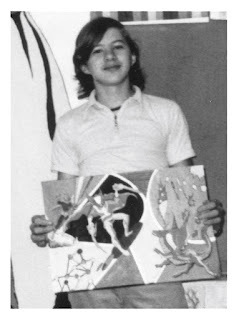
Pros know what you're going through because they've been you. They probably still are.
First Important Advice
DO THE WORK.
DO MORE WORK.
DO EVEN MORE WORK.
I can't tell you how many people call themselves writers but never write, or call themselves artists but never create art. Just doing anything at all already puts you way ahead of the posers.
Then the hard part: show it to strangers. Push it out into the world however you can. It needs to be seen by people other than your friends and mom--people who aren't obliged to love it. Online, publishers, zines. Pass it out on street corners.
Start small. Make content for a blog or Instagram account, an article for your school paper, a photo for a work newsletter, a drawing for a softball team.
Turn many small things into a big thing.
Turn many big things into a bigger thing.
Build a PORTFOLIO. This is how you show people what you can do. It'll have examples of your very best stuff. A portfolio should be a changing, living document that improves as your skills and work improve.
I love Mark Twain's advice for aspiring writers:
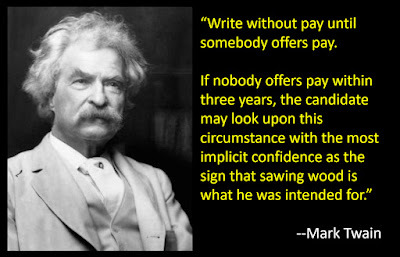
I think Twain's right, although that puts Mark and me at odds with those who say creative people should never work for free--that they should value their time and effort as much as any professional. "Work for exposure?" goes the meme. "People die from exposure!" I understand but disagree. You're not a pro yet, and volunteering may be necessary to start building a portfolio and get a foot in the door. The distinction I'd make: do gratis work if it serves YOU. Don't let yourself be exploited, but if you see it as part of a professional growth strategy, I say do what you've gotta do.
Others may disagree.
Learn How to Take Criticism
I'll now embarrass myself with another photo to make a point.
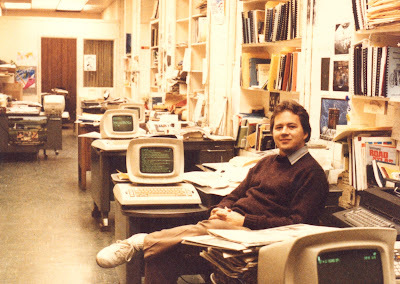
My first job out of college, I was a reporter for a small daily newspaper. You can tell how long ago that was by my brown hair and the green cathode ray tubes. That job gave me a thicker skin. I remember one day when an editor and I were slashing and reassembling a story I'd written, and I didn't get defensive about it. It wasn't personal, we were just working together to make my story better. I felt like a professional.
Here are some things NOT to say in the face of criticism:
"I meant to do that."
"You're not reading it right."
"It's not done yet."
"This isn't my best stuff."
I understand the impulse; I may have said some of those things myself. But if a reader doesn't understand you, that's your fault, not theirs. If it's not done or not your best stuff, why are you wasting their time with it? Stand behind your work! Say, "Yes, this is my best stuff!" It may not be what they like or need, but be proud of what you've done.
If someone is doing you the great favor of giving feedback on your work, SHUT UP AND LISTEN! Don't argue with them!
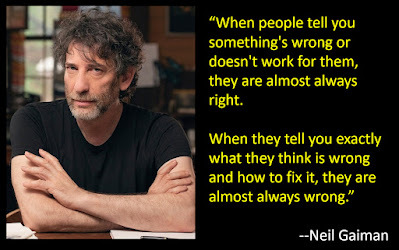
My experience matches Mr. Gaiman's. If one person identifies a problem, well, consider it, but maybe they just missed something. If two people identify the same problem, then you've got to fix it. The actual fix is up to you to figure out, not them.
It took me a while to realize why I consider my book editor, Charlie Kochman at Abrams, one of the best editors I've worked with. He'll find something that doesn't feel right or brings him up short or just doesn't work, but he always leaves the solution up to me. Then he either says "Yep, that does it" or "Nope, not there yet" and we move on. There are parts in all my books where I genuinely couldn't tell you which of us did what. Charlie makes me better without leaving fingerprints. It's a gift that good editors have.
Fanfic
I'm not a fan.
I want to differentiate between fan fiction and derivative works.
People create original work derived from the Bible, King Arthur, Shakespeare, Frankenstein, Dracula, Sherlock Holmes . . . for example, Dante's Inferno, Twain's Connecticut Yankee in King Arthur's Court, a thousand riffs on Romeo and Juliet such as West Side Story. Derivative works that build on legally available inspiration can be great pieces of art. I don't consider that fanfic.
Fanfic, by which I mean a story set in other creators' intellectual property, is fine for fun, friends, self-expression, and appreciation for stories and characters you love.
It's an OK way to get a feel for how storytelling and structure work.
BUT it's a poor shortcut past learning how to build worlds and develop characters yourself.
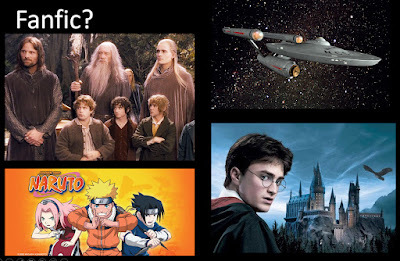
If you write Naruto fanfic, you don't have to explain how these characters, their relationships, and their abilities work. You just plug into a universe that already exists.
If you write Star Trek fanfic, you don't have to explain how a starship works. You say "Warp 5" and it goes. But what if you write a spaceship story that isn't Star Trek? Then you have to ask and answer some questions that have storytelling implications. Does your spaceship go faster than the speed of light? How? Maybe it doesn't, which means your spaceship has to operate within a solar system or maybe takes centuries to travel between stars. Or maybe your characters project their minds to other stars, or communicate via quantum telegraphs. Now instead of leaning on someone else's universe, you're building something new and entirely yours.
I only realized when I put these images of Lord of the Rings and Harry Potter together that both universes have wizards and elves. But Gandalf is different from Dumbledore, and Legolas is very different from Dobby. Your wizard-and-elf story in one universe will be different than in the other, but the point is that neither universe is yours. You're building on someone else's foundation as a framework for your story.
Instead, take those inspirations and create your worlds. Put your twist on them.
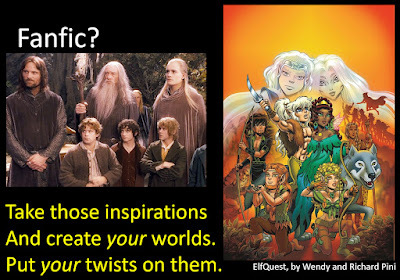
One of my favorite examples is ElfQuest by Wendy and Richard Pini, which for 40 years has been telling stories about a world of elves. These aren't Tolkien elves and they certainly aren't Rowling elves (which they predate by decades). The Pinis created completely new characters living in a rich, deeply detailed world with their own societies, cultures, languages, spirituality, and relationships with each other and nature. It's a tremendous body of work built up over many years and books.
The critical point is that it's theirs. The Pinis don't have to ask the Tolkien estate's or Rowling's permission to tell new stories. They don't have to send Tolkien or Rowling a check when they do. It's their world, their characters, their intellectual property to do with as they please.
A big problem with fanfic: with very, very few exceptions, you'll never be able to legally publish it.
(This is where someone points out that Fifty Shades of Grey began as Twilight fanfic. It's an exception that proves the rule, and also supports the point that E.L. James couldn't publish Fifty Shades until stripping out everything that smacked of Twilight.)
Fanfic is not (generally) the way to a professional career.
Instead, draw inspiration from LIFE: history, science, politics, travel. Your own lived experiences. Not other people's stories.
That will make your work stand out.
The cliche advice is "Write what you know!" I always amend that to add, "As long as what you know is interesting!" I think it's incumbent on writers, and creative people in general, to have broad curiosity. Take in everything you can about the world then filter it through yourself so that nobody could have written the same thing in the same way.
Ideas
Ideas are great, but are not as rare and special as you think.
I occasionally get an email that goes like: "I have a great idea for a book! You only need to do all the writing and drawing and find someone to publish it! I'll cut you in for half!"
The idea is the easy part. All that other work is the hard part.
I got an inkling of that when I had a chance to pitch stories to the producers of Star Trek: The Next Generation, Deep Space Nine, and Voyager. I pitched maybe 40 or 50 stories and never sold one, never got my name on screen, but I learned a lot. I can't tell you how many times I got two sentences into my most outlandish science-fictiony plotline when the producer raised his hand and said, "I've gotta stop you. We started filming that last week." And they were right! Six months later I'd see episodes that were so similar to my ideas I'd have been sure they'd ripped me off if they'd ever heard them in the first place.
Ideas are common. What matters is what you do with them . . . how you execute them.
Ways Pros Differ from Fans
1. They can take criticism from people they respect, or who are in a position to pay them.
The first point is important: bad criticism from an idiot can be very harmful, but good constructive criticism is gold if you're mature enough to accept it. The second point is also important: sometimes you've got to give the client what they want even if they're an idiot.
2. Pros treat it like a job. They don't wait around for inspiration to strike. Don't be precious about it, just put your butt in the seat and do it.
3. Pros know that being reliable, responsive, and a good collaborator is just as important--and maybe MORE important--than being talented.
When you're mystified how people you consider pretty mediocre keep getting jobs, the reason may be that they hit their deadlines, meet their commitments, and are easy to work with. Not being a jerk can get you a long way in whatever profession you're in.
4. Pros are not afraid of imperfection. They know their work won't be perfect but they do it anyway.
In my opinion, a lot of "writer's block" is fear of imperfection. As long as you don't start, the thing in your head is perfect. When you pull it out of your head and make it real, it won't be perfect anymore. I think it's very important for creative people to give themselves permission to be imperfect. To even suck once in a while. You can always improve it later, and nobody needs to see your failures but you. Start something, even if it stinks.
I was struck by that watching Peter Jackson's Beatles documentary, Get Back. It shows the Beatles putting together an entire album in a month. The Beatles didn't worry about perfection. Oh, they worked a song over and over until they got it good enough--and because they were the Beatles, "good enough" was better than pretty much anybody else--but then they recorded it and moved on.
Don't waste 20 years trying to make it perfect. You may know someone with a novel in the drawer or a song on their computer that they work and rework and rework for literally years. Those people will never achieve the perfect creation they seek. In fact, they're more likely to beat all the life out of it.
Do your best. Finish. Learn from it. Move on.
The Bravest Creative Acts I Know
1. Beginning a new piece of work knowing you have months or years to go.
When I start a new graphic novel, making the first ink mark at the top left of Page One, I heave a little sigh because I know I've taken the first step on a thousand-mile journey. It's daunting. My advice: break it into pieces. Authoring a 300-page book may seem impossible, but anybody can write eight pages. Or four. So do that. Then do it again. Then keep doing it. Manageable bite sizes. Or, as Anne Lamott wrote, bird by bird.
2. Showing your work to someone who might rip it apart. It's the best you can do but what if it's not good enough? You're wearing your heart on your sleeve, inviting a stranger to stomp on it. That's why it's brave.
3. Sending your work into the world beyond your control. Your work is your child, your heart. The world can be cruel and scary, and when your work is out there it can go in directions and end up in places you never anticipated--or worse, be completely ignored. You have to let it go.
Sometimes I hear about places my books have been and feel a little envious. They're out there having adventures I never will! Occasionally they send back a little postcard, which I appreciate.
4.
DO THE WORK.
DO MORE WORK.
DO EVEN MORE WORK.
Can't overstate the importance of that.
So You're Ready!
You have the discipline, you're producing work, you're getting good feedback from readers, online fans, TikTok or YouTube viewers, whomever.
NOW WHAT?
One option: Do it yourself.
Self-publish, eBooks, print on demand. You're responsible for distribution, marketing, accounting . . . all the business side. Not everybody's cup of tea. You do all the work but keep all the money.
Or: You may be able to submit directly to a publisher or outlet. List a dozen that put out work that's kind of like yours. Check their online submission guidelines. FOLLOW THEM.
Or: Depending on your medium, you may want or need an agent.
An agent represents you to publishers, studios, etc. for a percentage of the income they bring in for you.
An ethical agent will not charge you a fee up front! They don't make money until you make money! Don't fall for crooks!
How to find an agent? I don't know. I don't have one.
But I know people who've gotten agents via referrals from friends. There are trade and professional organizations you can look up. Author's acknowledgments. Or you can do your own Google research.
Agents specialize. Find the ones who represent your kind of work.
Check their online submission guidelines. FOLLOW THEM. (Sound familiar?)
Here's one thing not to do: Don't bug your favorite pros to help you. Honestly, there's very little they can do.
Even if I think your work is great, I don't know you. I don't know if you hit deadlines, play well with others, are a sane and functional human being.
I can only think of maybe three times I've contacted an editor to vouch for and try to open a door for a friend. The number of book deals that resulted in: zero.
YOUR WORK HAS TO SPEAK FOR ITSELF.
You won't believe me, but I promise: editors, publishers, producers are hungry for good, new content. They need you even more than you need them.
You Get an Offer
Holy Moley! Congratulations!
Don't sign a contract right away.
If you have an agent, they should watch your back. If you don't, hire an attorney.
You are expected to negotiate! They won't be offended or rescind their offer. If they do, you didn't want to work with them anyway.
Notice I said "work with" instead of "work for." They're not your boss and you're not their employee. You're eyeing each other to decide if you want to be business partners.
Unless . . . Understand "work for hire." That means the person or company you're working for keeps all the rights. If you're hired to write or draw Batman, it doesn't matter how good you are or how long you do it, you'll never own Batman, or get to write and draw your own Batman stories after you leave DC Comics. You're work for hire; they pay you to do a job and that's the end of it. That's fine as long as you know what you signed up for.
In general, keep all the rights you can.
What a lot of non-pros don't understand is that, at the moment you create something, you own all the rights to it. You hold the copyright, the North American publishing rights, the worldwide publishing rights, the digital rights, the TV and movie rights, the plush toy rights, the cereal box rights. They're all yours.
A contract is a tool for someone else to pay you for those rights. You have something they want. You can let them have whichever rights you want and keep whichever you want. There will be some they'll insist upon, and you'll have to decide if you're OK with that (you probably will be). Others they won't care so much about.
But unless you're doing work for hire, always--always always--retain the copyright to your creations.
I have friends who signed away their copyright, then had to watch as strangers elbowed them out and took over the characters they created. It's heartbreaking.
Trust me: A bad deal is worse than no deal at all. Walk away from a bad deal, even if it's the only deal on the table.
Don't let yourself be exploited!
Summing Up
1. Do the work. No excuses.
2. Put it out into the world any way you can.
3. Take criticism and rejection gracefully.
4. Act like a professional even if you aren't one yet. Build a good reputation. People remember.
Most Important
Be authentic and honest in your work. I believe very strongly that audiences crave authenticity. They want to feel like they're in a conversation with you, like they're getting a glimpse into your heart and mind.
An audience can detect bullshit. Don't peddle it to them.
Trying to strategize what's "hot" and what "the market wants" rarely works. By the time you figure it out, everyone's moved on to something else. Follow your own peculiar passions to create something that people didn't even know they needed.
Figure out what makes you unique and lean into that. Harness your "weird."
I feel this very strongly. Being weird can be a social handicap when you're young but an invaluable tool as you grow. If you've got a passion for collecting bottle caps, if you love bottle caps with all your heart and you know all there is to know about them, and if you can explain to me what's cool about bottle caps and why I should care about them, too, I'll be your fan for life (this is Malcolm Gladwell's career). I'd much rather read your bottle cap book than the thousandth Lord of the Rings pastiche about a gang of kooky characters bumbling through a magical quest.
Tell the stories only you can tell.
Stand on your little island and plant your flag. Especially in the Internet Age, people will find you.
Even More Important
As I said at the start, all of this is JMHO. Take and use what works for you and forget the rest.
Also, I'm always open to the possibility I'm wrong. Happy to reconsider. Let me know.
And good luck!
March 20, 2022
CarrierCon 2022
 I think my ride is here.
I had a tremendous time speaking and indulging in CarrierCon aboard the USS Hornet Sea, Air and Space Museum today, my first convention-type event in a long time. This was the second CarrierCon ever; the first was in 2019, with a lull for obvious reasons. I thought my talk on "From Fan to Pro" went well. I hope it's one I get to give again (and am thinking about writing up for my blog). What do pros do and know that fans don't? That's the idea.
My daughter Laura helped spearhead the event for the Hornet and, from what I saw, did a great job. Her sister Robin and many of their friends volunteered to help. I bought a book in Artists' Alley. It was neat to run into my friend Jim Sharkey, too.
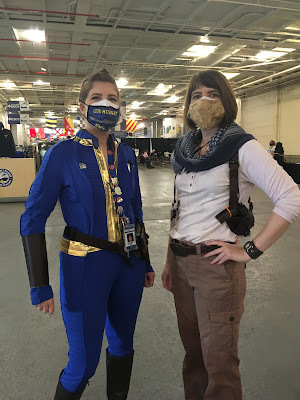 Laura (left) and Robin, camouflaged to fit in with the native fauna.
But what blew me away and made my day/week/year: my friends Richard and Wendy Pini, creators of the venerable fantasy series ElfQuest and two of the kindest people in comics, surprised me by driving up from Los Angeles just to see me and the Hornet. Richard's a fellow space geek who's been wanting to visit the ship for a long time; I think they saw their chance and figured, "Why not?" It was a whirlwind hit-and-run drive up and down the state that still astonishes me to think about--but not as astonished as I was to turn around and see them standing behind me.
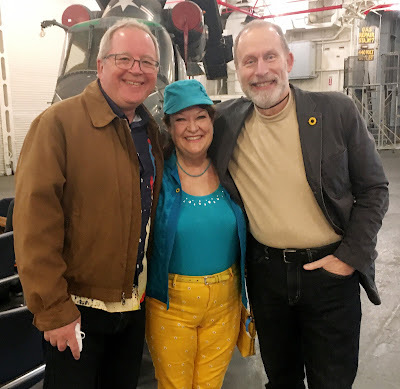 It's Wendy and Richard! This was about 20 seconds after I turned around and was still trying to understand what was happening. Note their sunflower lapel pins and Wendy's blue and yellow ensemble for Ukraine.
Two extra-cool things about their visit: they agreed with everything I said in my talk, which means a lot coming from people who've been successful pros for decades. And I used ElfQuest as an example (a good one!) in my presentation not knowing that they'd be there, which I think made them happy. It made me happy.
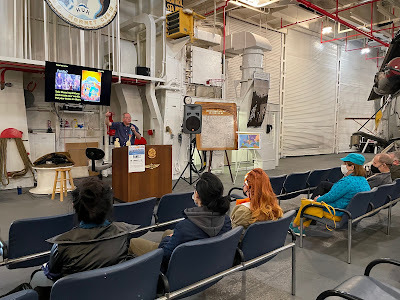 My talk. Here I'm showing my slide about ElfQuest with the creators of ElfQuest sitting in the second row. The coincidence did not go unremarked!
My audience started small but grew as I spoke. A few people came up afterward with good, smart questions that I love to get. All in all, an extraordinary day.
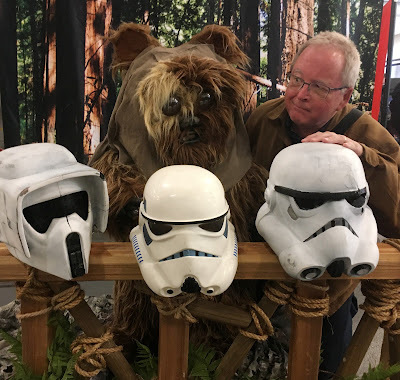 Hoping my Ewok friend doesn't want to add my head to his collection.
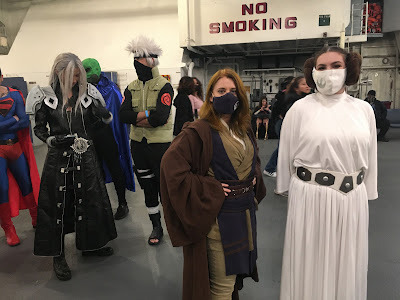 Heroes waiting in line for a sandwich and bag of chips.
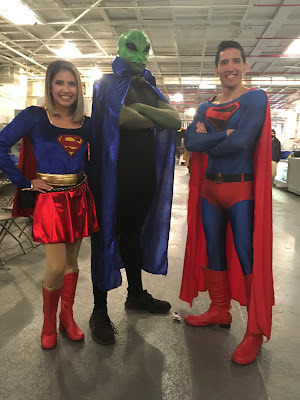 Super.
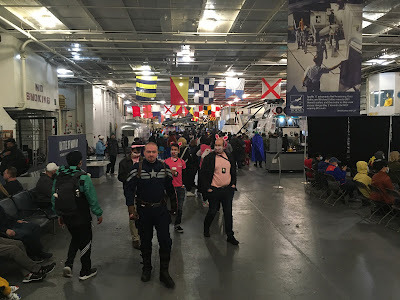 An overview shot of the Hangar Bay, trying to capture a sense of the size and hubbub.
December 28, 2021
Wayne Thiebaud
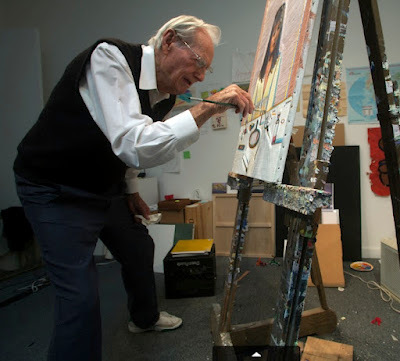
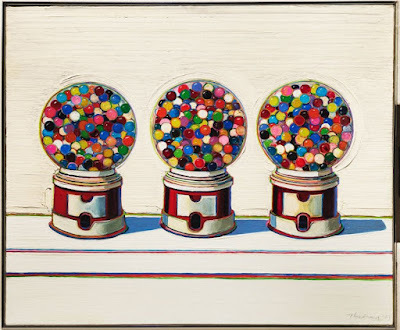
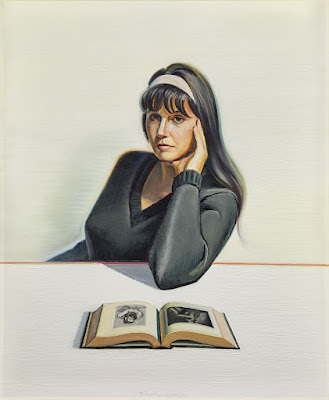
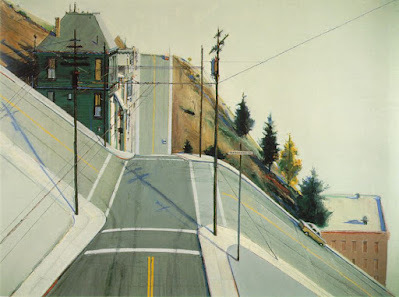
I emerge from the holiday to see that Wayne Thiebaud died at 101. I attended UC Davis between 1978-83, when Thiebaud was an active part of the art department and campus life. He, with artists like sculptor Robert Arneson, painter Roland Peterson and others, made Davis a respected center of the West Coast art scene.
I didn't take a class from Thiebaud--I don't think he taught undergrads--but I know I attended the opening of at least one of his exhibitions, since attendance was part of my studio art classes' grades (I got the impression they weren't sure anybody else would show up). I'm sure I exchanged a few words with him that I don't remember. My first-hand impression confirms his reputation: he was nice, and he loved teaching. He was certainly a highly regarded artist but not quite the Great Thiebaud he would become, and it wasn't unusual to see paintings that now sell for multi-millions hanging in the Memorial Union lobby or the halls of the art building.
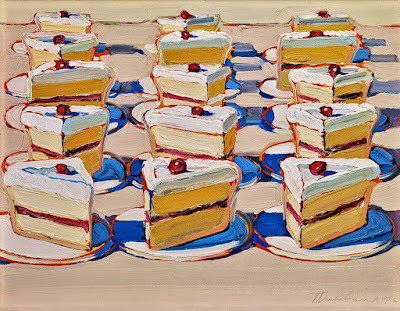
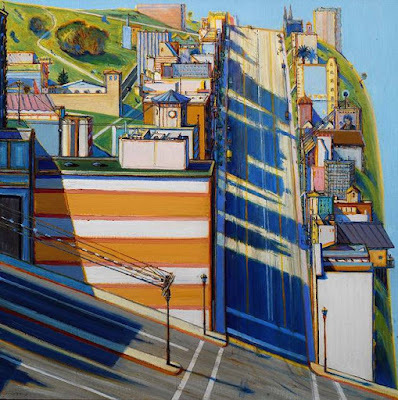
I can't say how many students realized they were in the presence of a great artist--probably not many--but those of us who were aware of it really appreciated it even at the time. To me, he always represented what a university was supposed to be: not just a place you went to take some classes and get a diploma, but a community where it was perfectly ordinary to see a world-class artist (or writer or physicist) pedaling a bicycle down the street, contributing to an educational and cultural environment I didn't really appreciate until I left it. Aside from a lifelong love of Thiebaud's art, that's my takeaway from his life.
December 24, 2021
Nora's Freezin' on the Trolley
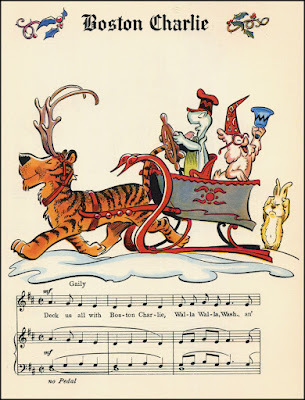
As long as I've been blogging, I've been marking Christmas Eve with a rousing round of revelry from the man who, depending on the day and my mood, I consider the first, second, or third best cartoonist who ever lived: Walt Kelly. From the great comic strip "Pogo," please accept this gift with my wishes for a good holiday and excellent 2022.
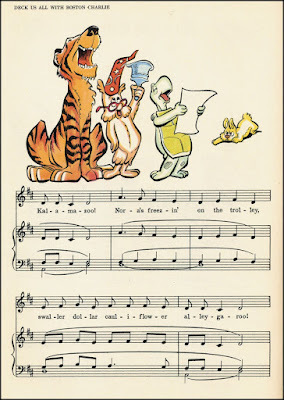
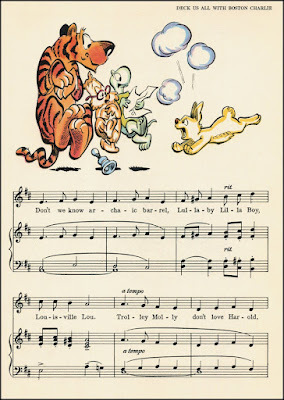
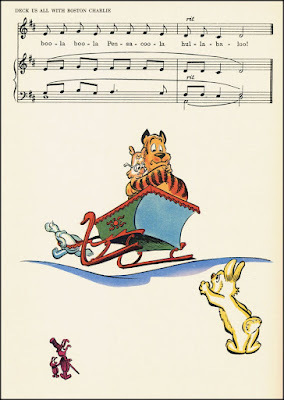
December 19, 2021
Holiday Tea on the USS Hornet
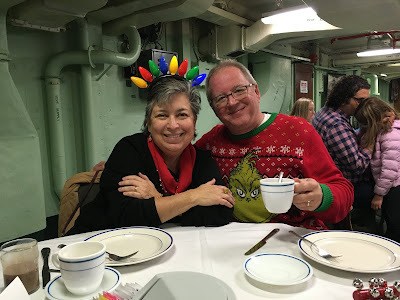 Festive!
Our daughter Laura is the XO (Executive Officer) of the USS Hornet Sea, Air and Space Museum in Alameda, Calif., and a few times a year puts on an Officers' Tea to raise money to support her museum's Collections and Exhibitions Dept., always with the help of her sister Robin and a couple of hardy volunteers. We attend whenever we can--today with Karen's sister Cathy and (most of) her family. This was the first tea since the pandemic began and there were no signs of rust in the operation. Maybe 30 to 35 vaccinated folks, all of whom seemed to have a great time, with a second seating that's happening as I type this.
Part of the fun is eating and drinking from the Hornet's historic collection of plates and cups and saucers. Laura studied old photos to set it up as much like it would have been in the 1940s or '50s as possible. They put on a first-class spread, and the ticket price includes admission to the museum. Great food PLUS a day aboard an aircraft carrier?! What a deal!
It's a ton of work, but for a small museum (not physically small--it's the size of a floating skyscraper!) every dollar counts. Having it a week before Christmas makes it extra festive and special. A very nice day.
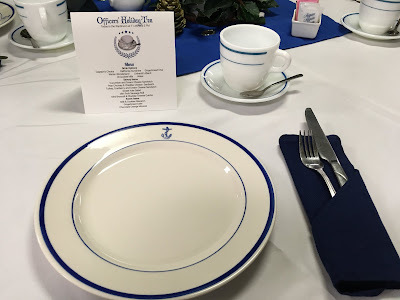 Historic!
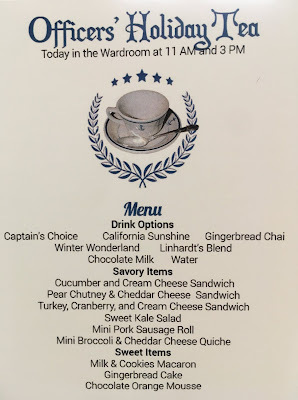 What a menu! Laura and Robin do all the cooking and baking themselves. They also blended the tea selections.
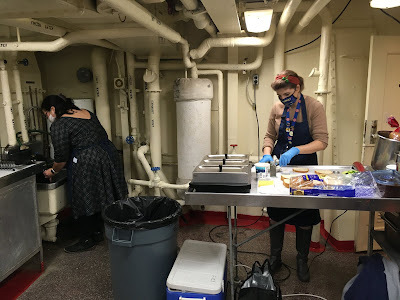 In the galley, Laura (right) and her friend Esme prepare sandwiches to follow the salad course.
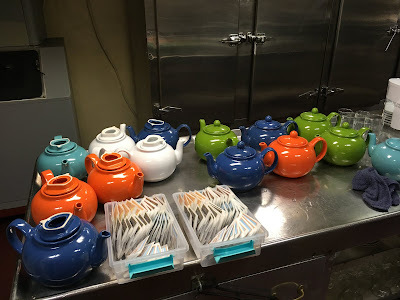 Teapots and teabags locked and loaded.
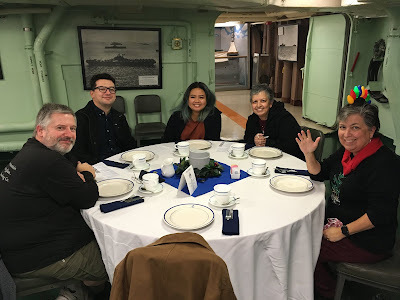 My brother-in-law Marc, nephew Brian, Brian's girlfriend Charlene, sister-in-law Cathy, and Karen.
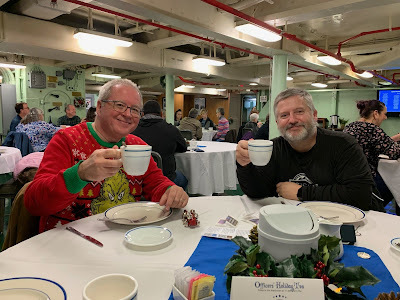 Marc and I toasting, with a nice view of the wardroom behind us. Low ceilings.
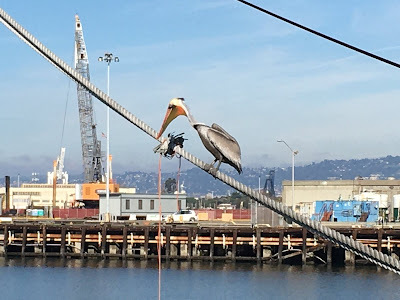 This pelican was feasting, just sitting on the Hornet's mooring lines and swooping down when a fish wandered beneath him. A fine sushi buffet.
 A good day on the Gray Ghost. Don't think I've ever had a bad one (unlike many of the sailors and Marines who once served aboard her).
December 1, 2021
Get Back

I've seen Peter Jackson’s Beatles documentary “Get Back” and have some thoughts.
I’m fascinated by the creative process. If you've ever dreamed of taking a time machine to watch Leonardo paint the Last Supper or Beethoven compose his Ninth Symphony, this is as close are you’re going to get. Like most viewers, I was thrilled to see the Beatles (especially McCartney) carve gems out of the improvisation and chaos that comprised a Beatles rehearsal. One morning, bored while waiting for John Lennon to show up, Paul turns random strumming into the recognizable beat and lyrics of “Get Back.” Chills up the spine. Something from nothing. A magic trick. A few days later, Paul sits down at the piano and plays “The Long and Winding Road” minus most of its lyrics. We know what Paul doesn’t: the words will come, and they’ll be great.
Some reviews have criticized the documentary as tedious and I understand why. There are long stretches where nothing really happens. For me those stretches feel like watching a rainstorm waiting for lightning to strike. The lads eat toast, drink beer, smoke a lot of cigarettes, read about themselves in the paper, and half-ass their performances. Paul pushes, John goofs (probably high), George sulks, and Ringo bless his heart shows up on time and does his job. Then, unexpectedly emerging from the churn: genius. "Get Back." "The Long and Winding Road." "Let It Be." "Something" ("in the way she moves, attracts me like a cauliflower..."). Joyful, inspired lightning.
What the reviewers miss is that the tedium is part of the genius. Goofing and noodling and doodling is the process. My very successful cartoonist pal Raina Telgemeier once wrote that she was starting work on a new book, which “very much resembles doing nothing,” and I’ve always remembered and loved that. You don’t get the brilliant lightning without the dull gray thunderclouds.
What I most love about witnessing these works in their fetal form is the reminder that they weren’t inevitable. The world has had Beatles songs so long that they seem like permanent monuments, but there was a time they didn’t exist, and they might have turned out very differently. The boys make them up as they go. In some parallel universe a butterfly flaps its wings and “Get Back” includes the lyrics “Sidi Abdul Rami was a Pakistani, but he didn’t live at home.” That sound disastrous, but do I only believe that because I’ve heard the canonical version a thousand times? I think it’s impossible to say. I like the one we got.
I wouldn’t presume to compare myself to the Beatles, but . . .
I have sometimes felt that, at the end of the day, I’d created something that didn’t exist that morning and which nobody could have done but me. That doesn’t mean it’s good, or that anybody’s going to like it or care, but it still feels like a tiny, satisfying contribution to civilization. It’s plus one point in my imaginary permanent record. In Jackson’s documentary, we witness the Beatles rack up several thousand points.
What most impressed me with the Beatles’ creative process was they knew when to say “good enough.” That’s a lesson a lot of creative people never learn. They think their work has to be perfect so they either never begin it or never finish it. I know writers who are afraid to write a word and others who pick at a completed manuscript for twenty years. Perfection--and its close cousin, fear of failure--are the enemy of both.
The Beatles didn’t aim for perfect. Oh, they worked hard on songs, polishing and refining them, but in relatively quick time they got them good enough to meet their (obviously high) standards, recorded them, then moved on. With few exceptions, they never went back and fiddled with them (one of those exceptions: in 2003, McCartney remastered the “Let It Be” album to remove Phil Spector’s orchestrations that he never approved). No second guessing; eyes forward, on to the next.
There’s a story, probably too good to be true, about the French Impressionist painter Pierre Bonnard, who was once arrested at the Louvre for bringing a brush and palette into the museum and retouching one of his paintings on the wall. When security grabbed him he cried, “But it is my painting! I have not finished it!” The guard replied, “It is in the Louvre, Monsieur Bonnard! It is finished!”
I wouldn’t presume to compare myself to the Beatles AGAIN, but . . .
Every few years, the Abrams warehouse runs out of copies of Mom’s Cancer and they print some more. And every time, Editor Charlie asks me if I want to take the opportunity to change anything. My answer is always “No.” That book came out 15 years ago (!) and I think I’ve learned a bit about storytelling in the meantime. If I redid Mom’s Cancer today I could write it better, draw it better, structure it better, and produce a new book superior in every detail to the original—and in the process completely ruin it. It is finished. It’s a record of who I was then, telling my family's story as well as I could at the time and under those conditions, and in that respect it’s perfect.
“Get Back” is a record of who the Beatles were in January 1969, making music as best they could at the time and under those conditions. In that respect, it’s perfect.
November 16, 2021
Boosted!
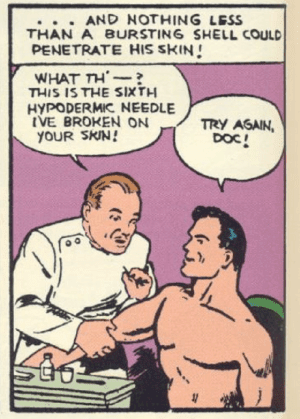
Karen and I got the Covid booster yesterday. Aside from my arm feeling like my college roommate punched me in the shoulder, which is something 20-year-old boys do for no good reason, I'm unscathed.
I planned to let it pass unremarked, but it seems worthwhile to take a public stand. I'll never understand how immunization got politicized. Vaccines work equally well on left- and right-wingers, and viruses don't care who you voted for.
I think I've curated my friends well enough that none of you will be surprised I try to guide my life by science and reason. I also know some of my friends are wary of the shot, for either themselves or their children, because they've had bad vaccine reactions in the past. I get my shots and wear my mask for you. You're welcome.
I even get my shots and wear my mask for stubborn people in fascist suicide cults. I'm not worried about catching Covid myself anymore, but I'm trying my damnedest to not kill you. That's how civilization is supposed to work. I wish you'd show the same consideration, but I can't control your actions. Just mine.
November 9, 2021
RIP Ms. Nicholas
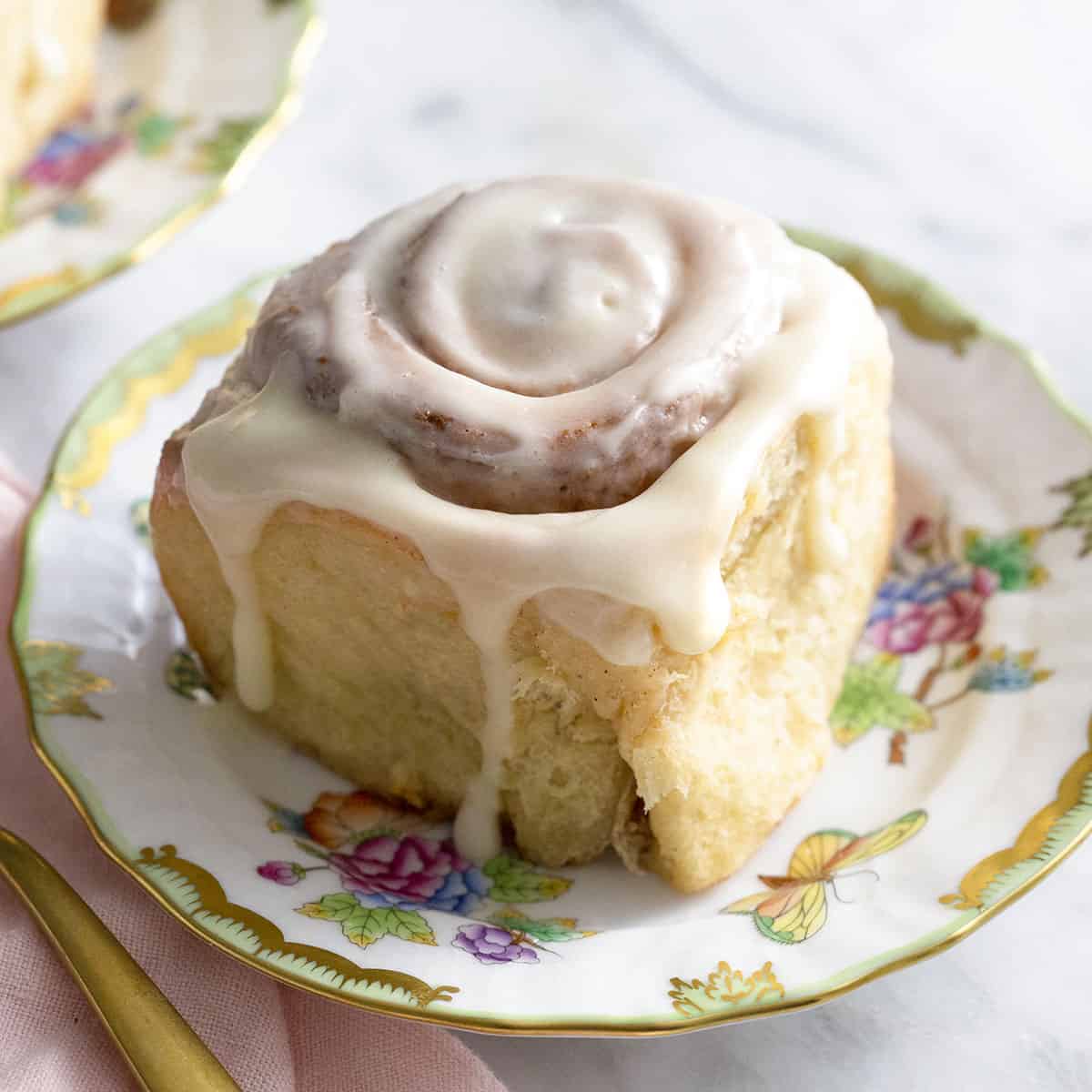
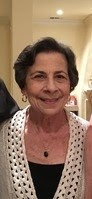
The late Helen Nicholas of Petaluma, Calif. taught Home Economics for decades. Her obit concludes: "In lieu of flowers, please bake and enjoy Mrs. Foody's Petaluma Junior High Cinnamon Rolls with your friends and family..." and then proceeds to print the entire recipe! Fantastic!
A good obit can be a treasure. "The Economist" magazine used to specialize in interesting, graceful obits of ordinary people who did extraordinary things (I still remember one about a watchmaker that made him sound like the Rembrandt of gears and springs). The fact that Ms. Nicholas's family marked her passing with a cinnamon roll recipe tells me more about her than another thousand words could have.
Mrs. Foody's Petaluma Junior High Cinnamon RollsPreheat oven to 425Bake time 10-15 minutes
Rolls2 C flour1 T baking powder1 t salt¼ C shortening¾ C milk1T melted butter
Cinnamon and sugar mixtureFrosting1 t melted butter1 C powdered sugar1 T water1 t vanilla
InstructionsStir flour, baking powder and salt together in a bowl. Cut shortening into the bowl and mix until crumbly. Stir in milk with a fork. Roll out dough, spread melted butter over the dough. Sprinkle cinnamon and sugar all over. Roll up and cut into 1 inch slices and place in a cupcake pan.Frosting: mix all ingredients together and drizzle over warm cinnamon rolls.
I have no idea if these rolls are actually good. If anybody tries the recipe, please report back!
Brian Fies's Blog

- Brian Fies's profile
- 64 followers

