
Brian Fies's Blog, page 26
April 10, 2023
Al Jaffee

Cartoonist Al Jaffee, best known for his decades of work on MAD Magazine, died today at the age of 102. That's a good long run but, somehow, not quite long enough.
I was a fan. Aside from sharing that quality with everyone who knew his work, I only have one Al Jaffee story and one small insight into why he was widely beloved.
At 2008's Comic-Con International in San Diego, I was scheduled to sign books at the Abrams booth right after Al. I showed up early. My memory is that surprisingly few people came to meet him. Fewer than a dozen. So he and I had about half an hour just to chat.
I don't remember many specifics of our conversation. I know I asked a lot of questions. But what I won't forget, and the small insight I have to offer, is that Al made me feel like a peer who deserved his full interest and attention. He was more than polite, genuinely curious about how the whole graphic novel thing worked because maybe he'd like to take a swing at it someday (while pushing 90!). He was great.
In my experience, the very best creators, the ones who have every right to stand atop Olympus and scowl down on mortals, share that generosity of spirit. Jerry Robinson, Gene Colan, Nick Meglin--all gone now--treated me like that. I doubt any of them had the faintest idea who I was or what I'd done, but there wasn't a hint they felt I didn't deserve to sit at their table. I was a cartoonist, so let's talk shop.
My big takeaway from meeting Al Jaffee: Be like Al. I do my best.
(Photo by Editor Charlie, who published both Al and me and introduced me to most of the Olympians I've met.)


April 1, 2023
Since Nobody Asked; Well, One Person Asked

Here's a question I get asked from time to time, and so try to answer from time to time.
A neighbor wants to write a book. Her grandchild has been diagnosed with a disease, and she'd like to write a book about dealing with it as a family. That sounds nice! She's already done some research on similar books, and asked me for advice on getting hers published. Here (with some revisions) is what I replied:
I love the idea for your book. Getting published is a hard thing! You're already ahead of my first piece of advice, which is to put together a list of publishers who have done similar books.
Step Two is to go online and see what those publishers' submission policies are. Many of them post them on their websites, and will tell you what they want to see in a book proposal. Give them exactly what they ask for.
You may find that many (or most or all) of them won't accept proposals without an agent. If that's the case, you may need to get an agent, and I don't have experience with that. I don't have one (graphic novels are one little niche of the publishing world where they aren't entirely necessary). But I know it involves sending your proposal to a lot of agents and hoping one wants to take it on, and my advice for that is similar: you want to find agents that represent books that are kind of like yours and look up their submission policies!
One of the things I really hate about publishing is how many gatekeepers stand in your way.
You may find it better and easier to self-publish. The advantage is that you have all the control and keep all the money. The disadvantage is that publishers know how to promote books, can get them into Barnes & Noble, and have warehouses to store them. You could also do print-on-demand, where books are only produced when they're ordered, so you don't need to have boxes of them in your garage. And of course there's digital, which needs no printing, paper, or storage at all!
There used to be a stigma against self-published books but these days they look as professional and are about as respected as any other, and there have been a lot of very successful self-published books. I don't know much about self-publishing and can't advise you how to get it done.
HERE'S WHAT I RECOMMEND:
Look up publishers' submission policies.
If you find some that will accept proposals without an agent, put together a proposal and send it to those.
If ALL of them require an agent, then decide if you want to try to find one, or look into self-publishing.
If the submission policies don't specify what should be in your book proposal, I suggest that it comprise a one-page cover letter, the first chapter or a big chunk of the book fully written, and an outline of the rest. Nobody cares about a great idea. You need to send them something complete to prove that you can write and give them a taste of your style. If it's a short book, go ahead and write the whole thing.
The cover letter should explain why the potential market for your book is HUGE! Say something like, "In the United States, X million children under the age of 5 are diagnosed with this disease every year. This book will be unique because . . ." The bottom line is that a publisher cares less what a book is about than how many copies they can sell, so approach them from that business perspective.
ALSO, look out for scams! You may find people who will offer to read your book, give you feedback, and promise you publication if you just pay them $1000. No legitimate publisher or agent will make you pay them to look at your book! Now if you go the self-publishing route, you'll of course have to pay something to set your book up to do that. You'd also be smart to hire an editor. I have no idea how much that costs.
You're trying to do a hard thing, but it sounds like it could be worth it to me! I think you have a good and important story to tell.
Good luck!
BACK TO ME in the present:
I'm always careful to explain that, although I've had four books published (and am working on more!), I'm looking at the publishing world through a tiny window. My experience is limited to one publisher and one type of book: graphic novels. However, I have a lot of writer friends, we talk shop, and I don't think I'm too off-base here.
The real bottom line is: If you want to write a book, then sit down and write it. Write it as good as you can, then start showing it to people. If you get that far, you'll be ahead of about 95 percent of everyone else who has a great idea for a book but never puts it to paper (or electrons). Every author I know has a different and unique story of how they "made it." You'll figure it out as you go.
March 30, 2023
National Pencil Day
Today is National Pencil Day. First thought: That's stupid. How important can a pencil be?
Second thought: I can actually think of a couple of pencils that are important to me.

The blue pencil is the one I use several hours each day to draw comics with. It's a mechanical pencil with "non-photo blue" lead. A quick note on making comics: traditionally, the art is drawn in pencil first, then gone over with black ink. When I scan my art for publication, the light blue lines get very faint and are easy to delete, so I don't need to erase them (in the old days, light blue was invisible in photocopies and photostats). This simple plastic pencil is probably my most essential tool.
The wooden pencil was made from a redwood tree that was in our yard before our 2017 fire. We know people who saved big sections of their downed trees to create beautiful tables and such, and we would have liked to do that, but at the time the logistics of cutting, moving, storing, slicing, drying, and crafting enormous pieces of wood were more than we could handle. We just needed the dead trees gone.
However, Karen saved some chunks of our trees, and a woodworking coworker of hers turned them into a beautiful little bowl and this pencil for me. Honestly, I don't use it a lot because its graphite lead is thick, but every time I do it reminds me of a tree I loved and the kindness and skill of someone who knew how to make it into a pencil.
Happy National Pencil Day!
March 22, 2023
Two Things
Two unrelated things I did/will do:
This morning I preached the gospel of Graphic Medicine to a group of about 70 physicians and faculty of New York-Presbyterian/Weill Cornell Medical Center. Dr. Rachel Kowalsky, who has more titles before and after her name than I can list, contacted her old friend, Editor Charlie, to ask if he knew anyone who could speak on the topic. Turns out, he did!
I was invited to Zoom in for 45 minutes during grand rounds, during which I gave a rousing overview of graphic medicine, with examples from "Mom's Cancer" and many others, as well as a quick comics-making workshop! It was a lot to cover in a short time, but the docs seemed very engaged and I think it went great.
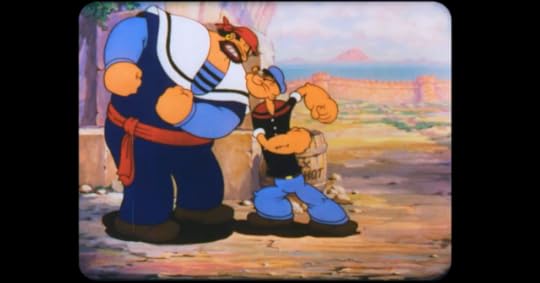
ALSO: On April 1, I'll be at the Schulz Museum talking about Popeye and Fleischer Brothers cartoons, on which I've become a bit of an expert what with making a graphic novel based on a Fleischer cartoon and all. I'm excited to be on a panel with film restorer Mauricio Alvarado, Max Fleischer's granddaughter Jane Fleischer Reid, and curator Benjamin Clark. How cool is that? (Answer: "Very.")
I'll be sure to mention that one again closer to the date!
March 17, 2023
I Had No Choice
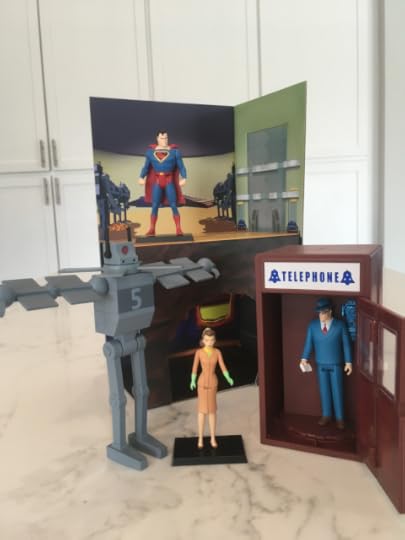
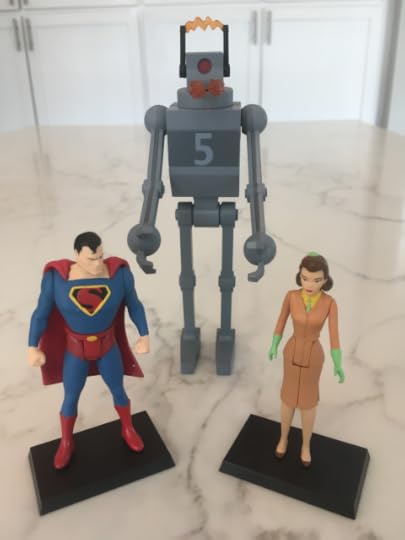
Nearly two years ago, I pre-ordered a toy playset from an outfit called Mezco Toyz. Price was no object because I really had no choice: the set was from the Fleischer Brothers' 1941 "Superman" cartoon "The Mechanical Monsters." If anybody in the world had to have those toys . . .
There's probably a name for Mezco's business model but I don't know it. At least for this playset, they advertised for pre-orders and then (I guess) made as many sets as the promised funds allowed. If they get more orders, they make more toys. In any case, my set arrived today and I couldn't be more delighted.
It's got Superman AND Clark Kent, plus a phone booth with a revolving platform so they can transform into each other (as the cognoscenti know, "The Mechanical Monsters" was the first time in history that Kent changed into Superman in a phone booth). Lois Lane with a little reporter's notebook. And the Robot! With detachable arms and propeller for flight or terrestrial modes, and optional flames for its flamethrowers!
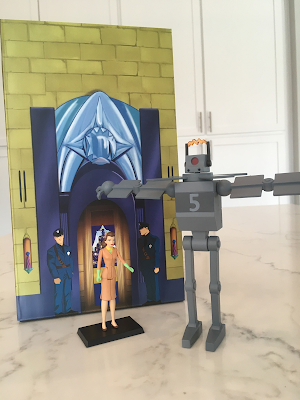
I could quibble with some of their proportions and design choices—I think the Robot in my Last Mechanical Monster book is maybe two feet taller—but chalk that up to "two different people looking at the same inconsistent source material and drawing different conclusions." They're great.
I don't expect anyone else to care, but I'm thrilled to have them.
March 15, 2023
Celebrating the Ides of March
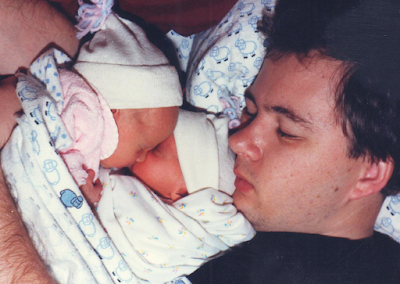
Historically, the Ides of March were a Roman religious holiday, a deadline for settling debts, and a bad day to be Julius Caesar. To me, today will always be the date I became a Dad, a few weeks earlier than expected but not a moment too soon for Karen. Happy Birthday, Chiquitas. You were exhausting but exhilarating.
March 13, 2023
Behind the Story: The Last Mechanical Monster
Through no fault of mine or Abrams's--in fact, despite quite a bit of time and effort on our parts--the deal just fell apart. Frustrating and disappointing. However, since I had all this extra stuff pulled together, I thought I'd share it here. Lemons, meet lemonade.
First DraftMy very earliest draft of The Last Mechanical Monster goes back to about 2009, right after Whatever Happened to the World of Tomorrow? I had always loved the Fleischer Superman cartoon, “The Mechanical Monsters,” and thought to create a sequel to it. Since the copyright to the cartoon expired in the 1960s, and I had no intention of using the characters of Superman or Lois Lane, I thought it was a story ripe to be continued. Whatever happened to the Inventor and his robots?
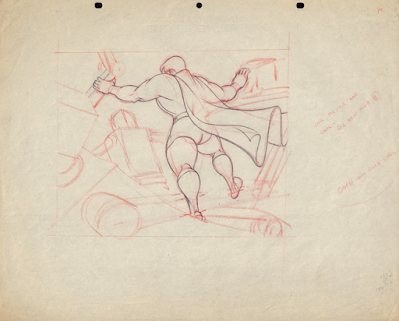
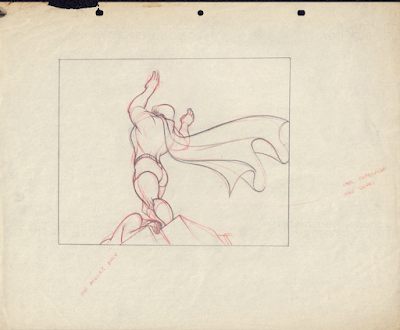 These are two preliminary animation drawings done by the Fleischer studios in 1941, in preparation for producing the “The Mechanical Monsters.” They show Superman fighting a group of loosely sketched robots in a scene that was never included in the final cartoon. I was lucky and grateful to acquire these pieces in a recent auction, and I am proud to hang them on my wall to inspire me.
My first draft of the story was very different from the published version. That draft featured a young journalist writing an article about the mechanical monsters. She had managed to find several robots that avoided destruction because they were absent from the inventor’s lair when Superman attacked. I made a list of every robot whose number appeared in the cartoon, and figured there were seven unaccounted for.
In my story, one was later used during atomic bomb testing in the 1950s. One was turned into a carnival ride. Another was lost at sea while working on an oil rig. And one was in the barn of a retired engineer named Lillian, who was almost killed by the robot when she was a child and was now trying to restore it. The journalist interviewed the Inventor in prison. When she revealed that at least one of his robots had survived, he escaped and made his way to Lillian’s barn, where the three characters worked to bring the robot back to life.
I wrote and made rough-draft drawings (“thumbnails”) for the entire story, and had drawn about 100 pages of it, when I decided I needed to start over. I realize that the story I was telling was not actually the story I wanted to tell! I wanted to see the old Inventor back in his cavern lair, wearing his old tuxedo. I wanted him, not the journalist, to drive the story. I also wanted the story to be more fun! So I turned over those 100 pages and began drawing a new story on their backs. That became a webcomic that became the first draft of the book.
These are some of the preliminary thumbnail drawings of the abandoned earliest draft.
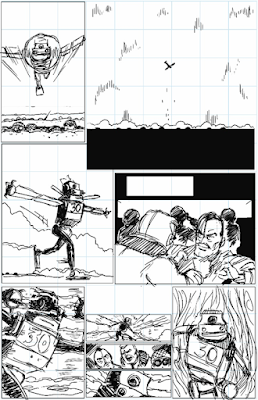
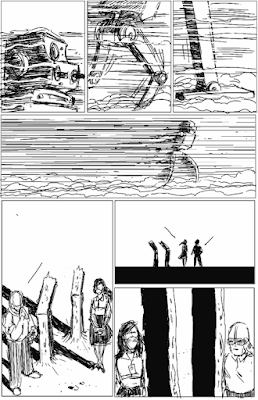 Robot #30 was used by the U.S. government during atomic bomb tests, leaving only the stubs of its legs fused to the desert floor. I would've worked in the poem "Ozymandias" somehow, because of course I would.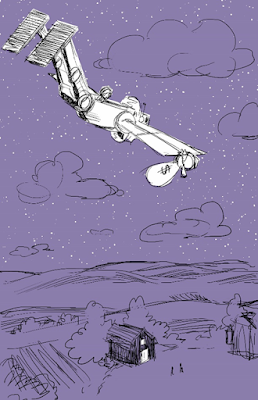
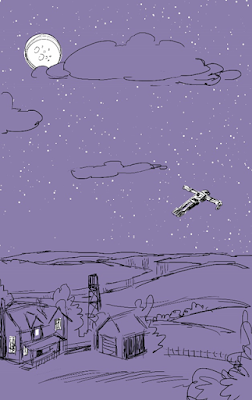 A two-page spread of the Robot doing training drills in the skies over Proto-Lillian's farmhouse.
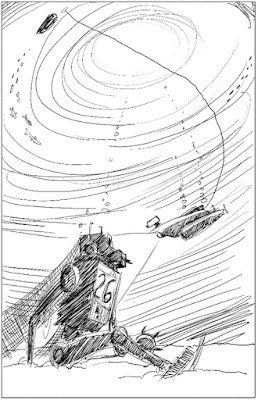 The earliest draft of the story ended with Lillian's robot heroically destroyed, but another found rusting at the bottom of the ocean. The LAST Last Mechanical Monster?
Finished First-Draft ArtWhen working on the first-draft thumbnails, I did more-finished versions of some pages to see how they might look when done. At this point I thought they might be published in grayscale—shades of black, white and gray—and so prepared some pages that looked like this. This is still from the first abandoned draft featuring the journalist character that I later dropped.
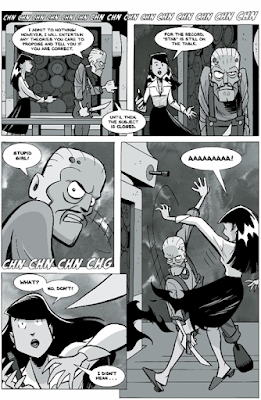
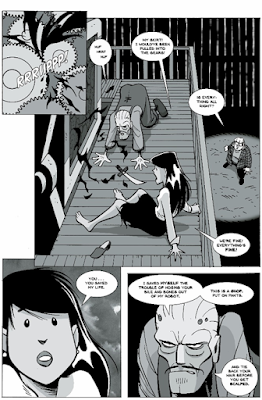
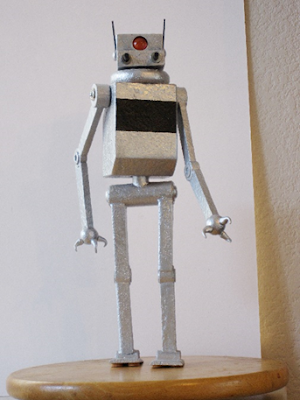
PreparationIn preparation for doing The Last Mechanical Monster, I made a wood model of the robot so I could draw its proportions consistently and correctly.
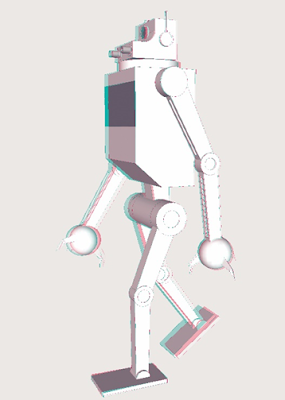
I also used a simple 3D rendering program (SketchUp) to make a digital model of the robot that I could pose and turn around in space. Here I used it to make an image of the robot that looks three dimensional when viewed through red-blue 3D glasses. I originally hoped to use a lot of 3D images in the story but later decided to tone it down to a couple of spots where it would have narrative impact.
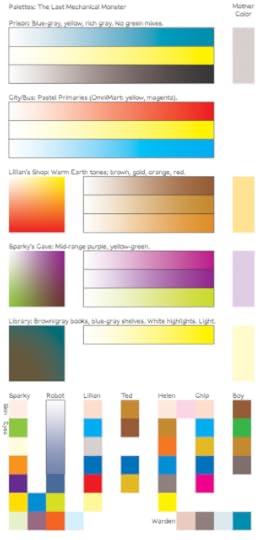
Also, as part of my drawing and coloring process, I made up detailed color palettes for each character and location in the story. Each has a distinct feel and personality that is partly expressed through color. I try to be very thoughtful about how I use color. It is a tool that can convey meaning or evoke emotions without a reader even realizing it. My challenge is understanding how to use that tool most effectively for the good of the story. I wrote quite a bit more about my approach to color in The Last Mechanical Monster in an earlier post.
 ProcessI make comics the old-fashioned way. Although many of my friends and colleagues have gone to digital art, I still take great joy in putting ink on paper. That’s the fun part for me. I don’t expect to ever stop. However, for The Last Mechanical Monster, I did letter and color the story using Photoshop and a typeface made from my own hand lettering.
 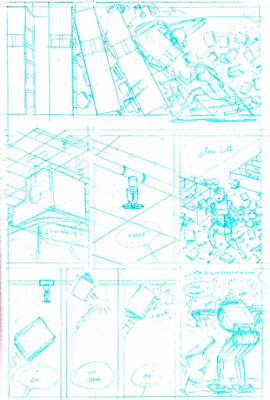 After I write and edit a script, and typically draw some very rough thumbnails, I pencil the artwork using light blue pencil on Bristol board paper. I use blue pencil because in the old days it did not photostat or photocopy, rendering it effectively invisible. It is still very easy to delete after scanning, which means I never have to erase the lines.
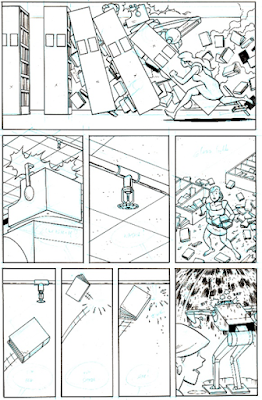 After penciling, I then go over the blue lines in black ink. I use a variety of brushes, nibs, pens, and brushpens. The small “X” marks are areas I plan to fill in with black.
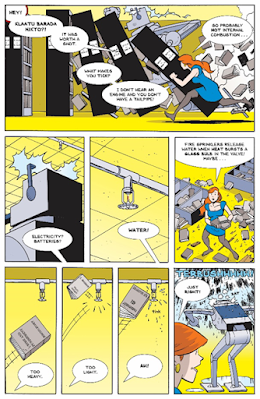 After that, I scan the art at a high resolution (at least 600 dpi), delete the blue pencil lines, and color and letter it.
Preparing art for press is technically complicated, but at this point the page is essentially ready to publish.
***********
Back to me in the present: Wouldn't that have been neat material to include with the book? I was looking forward to what might have been the definitive "artist's edition" of The Last Mechanical Monster (albeit it in a language I don't know).
Alas.
The Last Mechanical Monster taught me a couple of lessons that maybe others can learn from. First, the many months of work I did on the aborted first draft weren't wasted. I had to do that preliminary work, and draw those 100 pages, to get to the story that I really wanted to tell. It was kind of a sucky process that I wish would have yielded results sooner, but it worked.
So Lesson One: Don't fall for the Sunk Cost Fallacy: "Oh, I already put so much time and work into it, I can't start over." If you have a better idea, start over. I didn't regret it for a second.
Lesson Two: From initial idea to earliest draft to self-published webcomic to GoComics.com to published graphic novel took something like 14 years, constantly evolving as it went. I was doing other work at the same time (such as A Fire Story and another book idea that it turns out is never gonna happen), but The Last Mechanical Monster was always percolating on a back burner.
I think there's a fine line: don't waste your whole life banging your head on the brick wall of one fruitless idea, but if you think you've got a nugget of something good, grind and hone and polish and shine it for as long as it feels like you're making progress toward something better. There's a chance you'll end up with a pile of sand, but also a fair chance you'll produce a fine little gem.
March 5, 2023
On the Same Page in Claremont
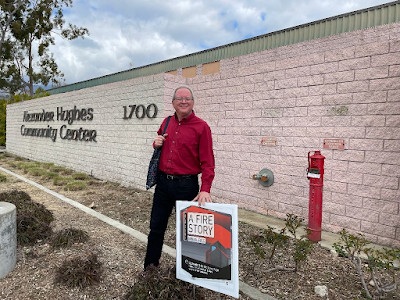 We arrived early, to find lawn signs ringing the community center! Yes, of course I took one (or three) home.
I'd say yesterday's talk and book signing capping off the Claremont (Calif.) Friends of the Library's "On the Same Page" program went great! The Friends chose "A Fire Story" as their community book of the year, and in the past several weeks hosted related events on fire safety and disaster preparedness. About 70 people came out on a lovely southern California Saturday to hear my story. Knowing that this was the first graphic novel many of them had read, I also made my best case for comics as a respectable literary medium. May have made a few converts.
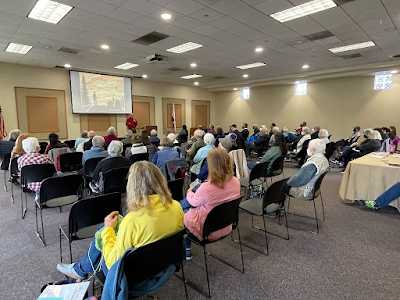 A good overview of the room and crowd as my talk got started.
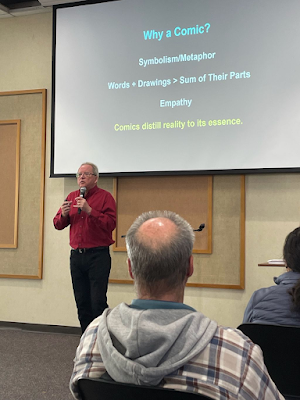 Explaining--maybe even evangelizing--about why on earth someone would tell the story of a firestorm in the form of a comic. I am passionate on the subject.
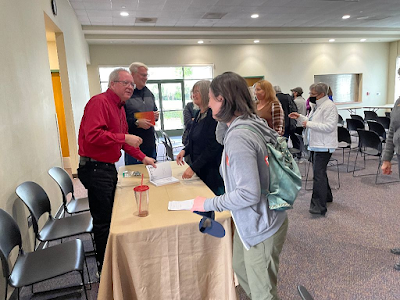 Signing books afterward. The library had distributed dozens of copies throughout the community in advance of my talk, so a lot of people brought theirs along to sign. The Friends also sold a few at the event.
My sisters Brenda and Lis live not too far from Claremont so they got to come, along with Lis's boyfriend Randy, which was very cool. It was also an opportunity to meet some Facebook friends in real life, including Susan Kullmann, who moved to Claremont after losing her home in the same fire I did, and comics writer and editor Barbara Randall Kesel, who I wish I'd had more time to talk shop with. Also got to know Chris Sayler and her husband Dave, who know my Dad! It was Chris who brought my book to the attention of the Claremont folks in the first place. All terrific.
The Friends of the Library seemed satisfied with my efforts and were as welcoming and kind as could be. Their hospitality extended to a wine bar after the event, which was a nice chance to wind down and get better acquainted. There are no better people on the planet than people who love books. Many thanks to them!
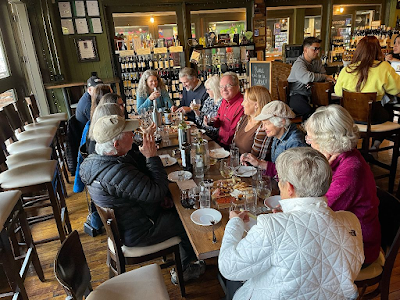 Later at the wine bar. A fine opportunity to relax and get to know people. A wonderful group of Friends.
February 23, 2023
Rocketeering
 My friends at the Cartoon Art Museum are holding an art auction this spring to celebrate the wonderful comic book (and Disney film but we're not talking about that) The Rocketeer and its creator, Dave Stevens. You may recall a similar auction featuring many cartoonists' tributes to Calvin & Hobbes last year. CAM is doing the auction in concert with an exhibition of Stevens's artwork this summer, and proceeds will go to both CAM and research on hairy-cell leukemia, from which Stevens died at the age of 52.
 And I get to contribute!
It occurred to me that this might make a good "process post" about how I make a comic, keeping in mind that this project is different from how I usually work. I'll point out how as I go.
The Rocketeer is an action-adventure story set in the Art Deco 1930s. Stevens mixed real-life people and places with his tales of barnstorming pilot Cliff Secord, who zips through the sky with a rocket on his back righting wrongs. Cliff is a young, dashing but reluctant hero, perfectly played in the movie by Billy Campbell. I joked about the 1991 Disney movie earlier; CAM told me that we had the Stevens family's blessing but not Disney's, so we could use material from the comics but not the film. Luckily, the film is such a close copy of the comics that almost everything in it showed up in the comics first.
My first thought was to draw something tall and skinny, so I could show the Rocketeer blasting into the sky. I did this VERY small thumbnail on a sticky note just to check the proportions and composition. That's the only preliminary sketch I did.
 It ain't much, but it did the job.
I drew on a piece of watercolor paper 1 foot wide and 3 feet tall. I don't have a drawing board that big, but I do have scrap pieces of wood left over from a bookshelf project, so I taped the paper onto that and began penciling, to be followed by inking over the pencil lines.
 Watercolor paper taped to a melamine board, with the border lightly penciled.
In most of my comics work, I pencil with light "non-photo" blue pencil that readily disappears when it's scanned. That way I don't have to erase and risk dulling or smearing the ink. But since this is meant to be a finished piece of art that someone might want to hang on a wall, I penciled with a regular ol' Number 2 that I would erase once I inked over it.
 Using reference to pencil the Bulldog Cafe, which was a real place in Los Angeles that Dave Stevens used in his Rocketeer comic book, as on the page at top left. I added palm trees because that says "L.A." to me.
The little man in the drawing is Cliff's mechanic buddy Peevy. The woman--well, that's a digression. In the comics, Stevens used the real-life pin-up model Bettie Page as the direct inspiration for Cliff's girlfriend, Betty, but that wasn't going to fly in a Disney film for more than one reason. In the movie her name is Jenny and she's played more demurely by Jennifer Connelly. My heroine isn't dressed like Betty or Jenny--I googled "1930s fashion" and picked a pretty dress--but she has Betty/Bettie's trademark bangs and jet-black hair.
After penciling the whole thing, I inked it using a brush and India ink, brush pens, and Micron pens, then gently erased my pencil lines with a soft kneaded eraser.
 Inked.
I don't like making comics on watercolor paper. In fact, I recently had a bad and time-wasting experience with it. It's just not the right medium for fine ink lines. The standard paper for cartooning is Bristol board, which is like a real nice cardstock. But I went with it on this project because I planned to watercolor the picture, and Bristol board is lousy for watercolors.
 Watercoloring in progress. At top is a sheet I made showing what many of my watercolors actually look like on paper, which is important to know! The black plastic tray is to contain the paint and water in case I knock over the cup. (For the same reason, I keep my bottle of India ink in a ceramic potted-plant saucer. You don't make that mistake twice!)
 After I finished watercoloring, I let it dry a bit and then scanned it so CAM could see what I was burdening them with. Since this is the scan that'll also advertise the eventual auction on eBay, I hardly fiddled with it at all, as I might with something meant for publication. What you see is what you'll get.
 Done! The area of the drawing is about 8 x 32 inches (20 x 81 cm). BTW, the airplane is also historically accurate, a whimsical design called a "Gee Bee" that Stevens loved and used in his comic.
And that's pretty much it! Start to finish, the whole thing might have taken me six or seven hours spread over two days, though some of that time was spent literally watching paint dry.
I'm gratified that I can do something unique to support a great museum and pay tribute to a comics creator who did terrific work and died far too young. There's also something satisfying in starting with a blank sheet of paper and in a few hours creating something that never existed before and nobody but me could have done in quite the same way. I always like that.
I'll be sure to shout out when the CAM auctions begin, and shout louder when mine goes on the block. Happy to answer any questions in the comments.
February 22, 2023
Powerhouse!
If you watched as many Warner Bros. cartoons growing up as I did, the song "Powerhouse" by Raymond Scott is embedded in your DNA and you never even knew it. Here's the original version by the artist; if you don't have the patience to sit through 3 minutes, forward to about 1:25 and wait for the "A-ha!" moment.
BTW, you may notice that the Raymond Scott Quintet has SIX musicians. The article explains that Mr. Scott feared the word "sextet" was so racy it'd distract listeners' minds from the music.
Here's a link to a great Cartoon Brew article about this remarkable composition and its decades of dedicated service to more entertainment than you can imagine, and below is a compilation of a few places you may have heard it. These Looney Tunes excerpts are just a small sampling. Composed in 1937, the tune is still being used in cartoons today!
Brian Fies's Blog

- Brian Fies's profile
- 64 followers

