Kelsey Timmerman's Blog, page 30
August 3, 2013
“Social Good” campaigns aren’t always good
This week I appeared on HuffPo Live alongside Dr. Mara Einstein, author of Compassion Inc, and Wendell Potter, a former health insurance executive who spoke out against the industry’s deception of the American public and author of Deadly Spin.
I talked about Starbucks C.A.F.E. Practices program that I witnessed (or in many cases did not witness) in Colombia while researching EATING. And I also talked about TOMS. My main point was that we are just served up a pill of “do gooding” and we swallow it whole without asking questions about who or how much such ideas benefit the people they are meant to serve.
Dr. Einstein shared a mind blowing example. McDonald’s had a campaign playing up the fact that a portion of all Happy Meal sales would go to the Ronald McDonald’s house.
And that portion was?
A penny.
A penny of a $4 Happy Meal went to helping sick kids. McDonald’s probably spent more on ink to print the Ronald McDonald’s house logo on the side of happy meals than they gave to their charity.
So before you buy, give, or buy and give at the same time ask yourself, “Where am I giving?” (I should write a book on that.)
Watch the segment here:


August 2, 2013
My Cover Story in the CS Monitor
The line between exploitation and opportunity in our global economy is blurry.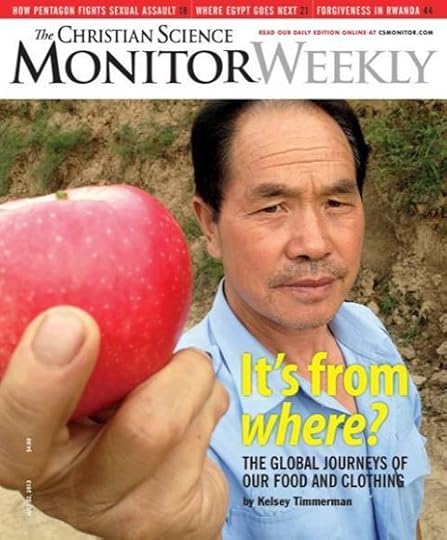
This blurred line is at the heart of my recent cover story in the CS Monitor. I feel that the feature is one of my most important works to date, bridging my travels and research from my first book WEARING and my latest book EATING.
I felt compelled to write the main story as I followed the tragedy of the recent collapsed factory in Bangladesh that killed 1,129 garment workers.
Here’s how Monitor Editor, John Yemma, introduced the feature:
“Kelsey’s reporting is not designed to steer you away from these items but to help you appreciate the human lives behind them.”
Read the main story, “Follow the Label: The Odyssey of our food and clothing”
The feature also included four sidebars, three of which were adapted from EATING and one from WEARING:
Starbucks farmers who never heard of Starbucks (Starbucks called me the day — a Sunday! — that this article came out. I had tried to reach them for over a year to comment. Still waiting to hear back from them.)
Feeding Chocolate lovers at little, or no wage
There is no such thing as a blue jean machine
American apple juice is a product of China
I talked about the feature with the Monitor’s Pat Murphy…
July 24, 2013
Powerful video of Congo refugees fleeing war zone
The soft face of the child ducks for cover as a tank fires and missiles launch. You can almost see the innocence leaving his eyes for good and fear taking its place. Awful.
But this is happening and this is always happening somewhere in the world.
Watch this five minute video and think of what it must be like to grab all that’s important and keep walking until the fear of death is far behind.
July 15, 2013
I’m a Finalist for an Indiana Authors Award!

The last writing award I won was in 4th grade. I wrote a story about a boy who stumbled upon a pair of flying shoes that he wore, flew into the heavens, and met Thor. It won honorable mention in the county writing competition.
My first two books have been well-received, and launched my career as a writer, but they’ve yet to win me any awards. Sure, if the publishing world had a superlative category, I would definitely have a good shot at, “Most likely to go anywhere, in search of anything.” But no actual awards, yet.
That’s why I’m thrilled to announce that I’m an Emerging Author Finalist for the 2013 Eugene & Marilyn Glick Indiana Authors Award, alongside Tricia Fields and Mike Mullin. On October 26th, I’ll attend the award dinner where Michael Martone will receive the National Author prize and James H. Madison will receive the Regional Author prize, and the winner of the Emerging Author prize will be announced.
Winners win actual cash! Wow! But the coolest part is that the Library Foundation of Indiana will grant each winners’ hometown library $2,500. And if you don’t know it, I kind of love libraries.
As they say, I’m honored to be nominated, and in such fine company, too. Truly.
I’m not sure if it’s customary to dedicate an award nomination, but this one goes out to Amilcar, Nari, Ai, Dewan, Zhu Chun, Arifa, Juan, Michael, Flor, Felipe, Mr. Feng, and all of the others around the world who have let me into their lives and shared their amazing stories.
I’m just the writer from Indiana, and I’m absolutely honored to share their stories and to be nominated for this award.
July 2, 2013
The State of the American Healthcare system: Paying Cash for Kids & Cancer
“Hi, my name is Kelsey Timmerman. How much does it cost to have a kid at your hospital? I’ll pay cash. ”
This is the state of the American medical system today. Patients are forced to approach the birth of a child like they would shopping for a used car. That’s exactly how it felt, and that’s exactly how an expecting mother described her similar experience shopping for hospitals recently to the New York Times:
“I feel like I’m in a used-car lot.”
Like the woman featured in the story, we had insurance, just not insurance that covered maternity expenses. Of course, we didn’t realize that we didn’t have maternity coverage until after my wife Annie was pregnant with our second child.
We had different insurance for the birth of our first child, but then the doctor that Annie worked for decided to not offer his employees health insurance and not a single penny at all toward any healthcare costs of any kind.
Yes, you read that right. She worked for a doctor who didn’t offer his employees health insurance. (If that hasn’t convinced you how mucked up the American medical system is, keep reading.)
My job as a writer comes with the benefit of being able to wear pajamas at 3 PM, but no medical or dental plans. So we have the pleasure of buying private health insurance.
To get prices from the first hospital we called was more painful than a minor surgery without anesthesia. Finally we learned that they don’t give any discounts for paying cash, and make no adjustments at all for individuals without maternity coverage. This meant that the hospital charges individuals more than they charge insurance companies because insurance companies negotiate adjustments on most of the expenses. To have baby #2 at this hospital was going to cost us at least $15,000.
The next hospital told us about a discount for paying in cash and a program that they had in place for those without maternity insurance. They gave us estimated expenses after the discounts, which were way cheaper than hospital #1. However, if Annie needed a C-section, things would still get pretty expensive. And, of course, Annie wanted to have an epidural and we learned that was going to run another $1,500 or so.
I imagined the conversations.
Annie in labor, me taking a break from live tweeting the events:
“Annie, are you REALLY sure that you need an epidural? Can’t you just push through the pain? For $1,500 we could get that new kitchen table you’ve been wanting.”
“Come on, Annie! Push! You don’t need a C-section more than you need that new car!”
Thankfully, we were able to save for the birth and the epidural for the delivery, she didn’t need a C-section, and Annie didn’t have to strangle me to death with an IV tube.
Our beautiful boy Griffin was born and he only cost us about $5,000. What a bargain!
Paying Cash for Cancer
Today, I found myself in a similar position: calling dermatologists trying to get good deals. I have a recurrence of a basal cell carcinoma – the best type of skin cancer to have, if there is such a thing.
I’ll be having a Mohs surgery on Friday, which entails a surgeon cutting on my head, that’s where my cancer is (on my right temple), and then the surgeon will examine the tissue under a microscope while I wait, bleeding out the hole in my head. If the surgeon doesn’t get it all, they’ll cut again. The more stages they do, the more the price goes up.
I shopped for prices, and it seems the place I’m scheduled to have the procedure done is competitive. The first stage costs about $1,000, every stage after that about $550, and then depending on how big the hole in my head is, patching me up could run anywhere between $1,500 and $2,500.
This means my surgery could cost between $2,500 to more than $5,000.
However, I do have insurance. Just insurance with a very high deductible, which means I’m pretty much on the hook for all the costs. Unless they do like 25 stages, removing my entire head, and thus we’d meet our very high deductible, and Annie would cash in on some life insurance.
Insurance will make adjustments, which I’m thankful that paying a $400 a month premium buys us something. I called the insurance company to ask what kind of adjustment to expect. They informed me they needed the tax ID number of the dermatologist and the medical codes for the procedure. I told them that I had an address and the actual name and cost of the procedure from the dermatoglogist. They told me that wasn’t enough. To which I said, “Thank you,” but wanted to say so much more.
Friday I’ll go under the knife to have an outpatient surgery to remove my skin cancer and have no idea how much the whole thing will cost me until a month or so later.
It’s possible that to have a nickel-sized spot of cancer cut from my head will cost us more than the birth of our second child. And I think that’s pretty screwed up.
I doubt I’ve got it in me to ask the surgeon to go without a local anesthetic, but maybe I will bring my own bandages and painkiller to cut down on costs.
What’s your absurd healthcare system story?
July 1, 2013
July Appearances: California for chocolate and wine, Indiana for writing friends and libraries
Summer is a time of rest, bike rides, backyard pools, and teaching my 4-year-old daughter to rider her bike without training wheels (on Father’s Day! I won Father’s day!). But I love summer events. They tend to be more intimate and laid back.
Here are my July Appearances
July 20 – Paso Robels, CA: Project Hope & Fairness Fundraiser at Pear Valley Vineyards. Wine and chocolate? Yes please! I traveled with Tom Neuhaus of Project Hope and Fairness in Ivory Coast while researching WHERE AM I EATING? Happy to help them raise money to improve the lives of cocoa farmers in West Africa.
July 22 – Columbus, IN: Batholomew County Library. Love visting libraries and happy they are having me back to talk about EATING after I spoke there about WEARING a few years back. Re-invite: the highest form of flattery!
July 25 – 27: Midwest Writers Workshop. This is my writing family. If you haven’t signed up yet, it’s too late. We sold out our 40th anniversary weeks ago. I’ll be emceeing, running a session, buttonholing (don’t ask), and anything else that Jama Kehoe Bigger asks me to do.
So my summer isn’t too busy, thankfully after last years EATING travels, but all of the above occur in one week. Should be a fun week!
Fair Trade USA giving away 6 copies of EATING
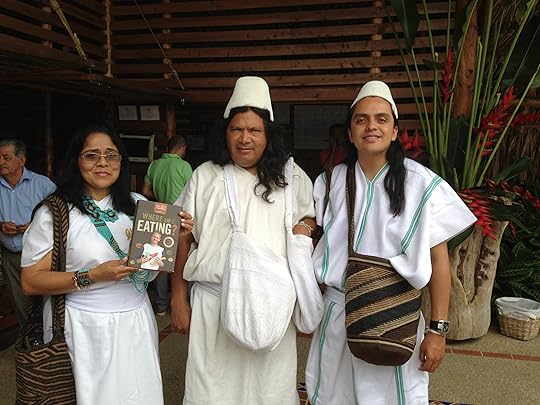
Shortly after I landed in Valledupar, Colombia, I was abducted by the indigenous Arhuaco.
Over the previous few week I had been in contact with them and must’ve asked, “Do I need a translator? My Spanish stinks,” ten times. They never answered. They never told me if they were going to pick me up at the airport. They never told me that I was going to be whisked away into the mountains down treacherous roads to the heart of their spiritual world. They never told me that I was about to have an amazing experience witnessing the most preserved indigenous culture I had ever seen.
Of course, I did use Google Translate for all of my emails, so maybe they thought my Spanish was better than it actually is.
Lucky for me, Katie Barrow of Fair Trade USA was on vacation with her boyfriend (now fiancee) Bobby Schneider. It says a lot about Katie’s passion for her job and also the passion that Fair Trade inspires that she would spend part of her vacation meeting Fair Trade farmers. Shortly after meeting Katie, Bobby, and our host Aurora, we crammed into an SUV and spent the next five hours bumping shoulders and knees as we navigated the mountainous roads of Colombia’s Sierra Nevada range.
If it weren’t for Katie, I couldn’t have written about the Arhuaco in WHERE AM I EATING? and connected with such an amazing group of people who have forever changed the way I eat.
Katie wrote a blog post introducing the contest Fair Trade is hosting. Read it and enter to win.
Katie, and the folks at Fair Trade, made sure that the Arhuaco got their very own copy of EATING. I’m thankful for the work they all do to bridge the gap between producers and consumers. Traveling with Katie and Bobby to meet the Arhuaco was one of the coolest travel experiences I’ve ever had.
June 12, 2013
“Injustice must be confronted”
One of the most talked about parts of WHERE AM I EATING? is when I freed a slave in Ivory Coast. This was the subject of an editorial in James Hallmark’s recent column in the Amarillo Globe-News titled Injustice must be confronted.
James writes:
“We have made helping easy in America, perhaps too easy. When a tornado strikes Oklahoma, we text “Red Cross” to 90999 and we have “helped.” We are asked to “like” a Facebook page and told doing so will help free little girls from sex trafficking. These small actions may indeed help and even be essential, but someone has to get their hands dirty to free slaves, liberate little girls from prostitution, or clean up a tornado’s damage.”
James says that my decision to hatch a plan to free Solo, the slave I met on a cocoa farm, “[was] more than risky; it [was] crazy.” He might be on to something. Overall, I think he gives me too much credit, not because I’m trying to be a humble fella here, but because, in hindsight, after what happened, I’m not sure I should have acted. That’s how complex social justice can be.
However, the main point of the article is that we often passively “save the world” through one-off donations and clicks on the computer. But so often we aren’t on the frontlines of seeing that change through.
James writes:
The concept of “sacrifice” has become too easy. We hire someone else to feed the hungry, text a donation to assist the victimized and stop tyranny with armies consisting of others’ children. “Sacrificing” is risk-free and those we help faceless.
There’s nothing wrong with these types of responses, but if you’ve never shaken the hand of someone you helped, or know the names of their family members, you’ve never given yourself over to a cause.
Please share. What injustices are you confronting?
June 11, 2013
Texas State Students produce “Where Am I Wearing?” documentaries
In 2012 Texas State freshmen read WEARING as part of their Common Experience — A Global Odyssey: Exploring Our Connections to the Changing World.
Dr. Salwa Khan with the School of Journalism & Mass Communication, had her students produce WEARING-themed segments. The segments explore if students think about where their clothes are made, how Texas State sources their athletic uniforms, feature University of Texas students who fought to get their university to sign on with the Worker Rights Consortium, and feature an interview with local clothing designer.
What I really enjoyed about each segment is that they took this global issue and talked about how it impacted their lives as locals.
Here are the the titles and credits for each segment:
Team 1
Topic: What is the difference between organic and non-organic clothing? What are the pros and cons in terms of the environment, health, and cost.
Title of segment: The Fabric of Our Lives
Producers: Katie Dudley, Sherry Klein, Emily Lyons
Team 2
Topic: An alternative to buying new is buying recycled clothing. This story focuses on an Austin woman who makes and sells clothing from recycled materials.
Title of segment: Material Girl
Producers: Jordan Mueller, Brandon Simmons, Ryan Stewart, Matt Wood
Team 3
Topic: Where are Texas State students wearing? Do they know that their clothes may come from sweatshops where workers are paid next to nothing?
Title of segment: Made in …
Poducers: Brittany Black, Kiana Fitzgerald, Stephanie Guzman
Team 4
Topic: Where do Texas State University athletic uniforms come from?
Title of segment: Where Are Bobcat Athletes Wearing?
Producers: Valene Bummara, Kristina Kenney, Ashley Vasquez, Kristie Vela
Team 5
Topic: A student group at the University of Texas at Austin successfully campaigned to change school policy on where university branded clothing is made. Can students at other schools do the same?
Title of segment: Students Against Sweatshops
Producers: Jacob Ehrnstein, Eva Fuentes, Femi Omoni, Joshua Twilligear
June 10, 2013
A reminder that whatever in the world you do, be awesome!
I spent the previous night in the guest room of a gold miner who employed 15-year-old workers. The bus that was supposed to take me all the way to Ghana, had ended at a flooded road in Burkina Faso. We then took a dugout canoe across the road to a brakeless taxi to a city without a hotel.
The next morning I had to take the taxi back to the flooded road, which I crossed again in a dugout canoe to a bus that would take me to Ghana. That bus dropped me off in Pa, Burkina Faso, where I waited for a bus to Hamile, Ghana, that may or not show up.
I waited hours.
The entire time I waited a man washed cars and motorbikes and bicycles at the side of the road. And he was awesome. At times, onlookers would applaud and laugh, but even when they weren’t, he was still awesome. He’d throw his water cup high into the air, spin, catch it, whip his sponge around his back as he twirled.
He reminded me that any job worth doing, is worth doing well. That even a job washing cars in the middle of nowhere in Burkina Faso for a few cents in the scorching hot sun can be done with a pep in your step and a smile, and be enjoyed that much more.
Wherever in the world you are, and whatever in the world you do, I hope that you try to enjoy your work as much as this guy.