Kelsey Timmerman's Blog, page 28
November 4, 2013
Why I do what I do
Just received this in an email: “your book really has inspired me to work in Human Rights, hopefully in the Department of Labor. I want to work in the Bureau of International Labor Affairs to make known the rights that workers deserve in the workplace.”
I hate when writers write that something is beyond words or indescribable, (you’re a writer dammit! Describe it!) but I seriously have no words for how emails like this make me feel. I suppose the immortal words of the Teenage Mutant Ninja Turtles come the closest:
Bodacious!
Radical!
Cowabunga, dude!
There are times when I’m on some death bus in some forgotten country, far from my family, homesick, dirty, tired, and sick that I ask myself, “Why the hell do you do this, Kelsey?”
This email, and all of the others I’ve received like it through the years, are why. Thanks to all of those who’ve shared how my work as impacted them. You give me a reason to push on.


November 1, 2013
The Problem with Reverse Trick-or-Treating
You probably haven’t hear of reverse trick-or-treating unless you are a hardcore engaged consumer. So let me show you how it works….
Little Jimmy dresses up like a zombie and goes door-to-door with his plastic pumpkin, just like any other little kid. But unlike any other kid Little Jimmy refuses to accept the chocolaty treats offered by his neighbors who went to the trouble of buying candy and handing it out to kids.
“No, thanks,” Little Jimmay says, “I have candy for YOU that wasn’t picked by a trafficked child laborer.”
At this point Little Jimmy hands over a piece of Fair Trade chocolate with a note outlining the child labor situation in West Africa.
This is a problem for two reasons:
1) Little Jimmy looks like a self-righteous little punk. This might be the first time his neighbors are learning about Fair Trade and it’s done in a way to make them feel guilty. It’s much better to inspire people to become responsible consumers by making them feel a part of the solution rather than part of the problem. If the note said something about giving farmers opportunity that would be great, but it won’t. It will say something about child slaves.
2) Child slavery isn’t the problem. There are a few thousands child slaves in West Africa, which is a few thousand too many for sure, but there are a few hundred thousand adult slaves. Most of the kids working in the cocoa fields are working for their parents, who are farmers who don’t earn enough money from their farms to send their kids to school on a regular basis if at all. Some cocoa communities don’t even have a school to which to send their kids.
Child slavery, adult slavery, and child laborers in the cocoa industry are all just symptoms of a larger problem: the cocoa farmers don’t earn enough money. This and farming in a sustainable way are the problems Fair Trade addresses.
If you want to spread the importance of Fair Trade:
1) Hand out fair trade chocolate with a note to trick-or-treaters talking about the opportunity fair trade provides farmers.
2) If you are going to have your kids hand out fair trade chocolate, first have them gratefully accept the candy offered from your neighbors. Don’t make your neighbors feel like slave supporting jackasses.
I’m a big supporter of Fair Trade, and if a Little Jimmy came to my door and gave me a lecture, I would not be happy. I feel like it’s the equivalent of an 8-year-old bible thumper telling you that you’re going to Hell. Nobody wants that.
Enjoy Halloween, make Fair Trade look good, and don’t be a jackass.
(I know this is a late post, but Halloween in Muncie got rained out yesterday. I’ll be hitting the streets tonight with SpongeBob–my 4-year-old daughter Harper–and a skeleton–my 2-year-old son Griffin.)
Where are your socks made?
I was contacted by a sock company that sells groovy socks. The socks were colorful and bold. They made a statement, and for every pair that they sold they gave money to a charity, which supports entrepreneurs.
Here’s what they wrote:
Kelsey, Love your mission. You are an inspiration. I have some rad socks for you. I’m the co-founder of XXX – a sustainable social enterprise that makes socks that (insert cause here).
So I picked out my favorite pair and sent them my address because, “hey! Free socks!” But I ended my response with a simple question that has gotten me in a lot of trouble…
“Where are they made?”
That was two months ago. I never received a response or socks. Maybe they could’ve just forgotten to reply or send me socks. Maybe the socks are made in a nursing home by grandmas who are paid $100,000/year and a lifelong supply of grandkid calendars. Maybe. But I doubt it.
I bet their socks are made in some factory in a developing nation that they really don’t know much about, by people they haven’t really thought about. I hope I’m wrong, but I’m probably not. (Note: I believe it is possible to source responsibly from such places. prAna and Patagonia are now offering Fair Trade clothes.)
Their are a lot of for-profit companies that use social causes to differentiate themselves in the marketplace. This particular sock company believes that its donations provide folks with opportunities. I wish they just made socks, and made socks in a way that gave people opportunities. I think we all need to do that thing that we do, that thing that makes us sing, that thing we’re passionate about to change the world.
If your thing is making socks, make them in a way that changes lives. When you do that, I’ll proudly wear them.
October 31, 2013
#BeFair: Dark chocolate or milk chocolate?
Since I’m eating Fair Trade chocolate today for lunch and nothing else, I have a question for you:
Dark chocolate or milk chocolate?
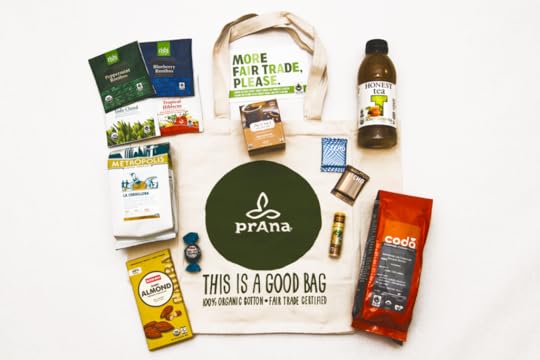
Leave your answer to be entered to win this bag of Fair Trade goods. After you leave a comment take the BeFair Survey.
Happy last day of Fair Trade month and Happy Halloween!
October 29, 2013
#BeFair: Fair Trade vs. Fairtrade
Did you know there were two fair trade organizations? Answer with a YES or NO in the comments and you’ll be entered to win a Fair Trade gift bag.
Huh? There are two fair trade certifications?
Yes, there are. As of 2011 Fair Trade USA, formerly known as Transfair, and Fairtrade International parted ways.
Who has a bigger and better impact? Fair Trade wonks can argue about this all day. From my view, their goal is the same: improve the lives of farmers. They both set minimum prices for farmers and pay social premiums back to farmers. These two points set them above all other certifications in my opinion.
The trick with any certification is that the stricter the environmental and social standards, the fewer farmers and laborers who benefit from the standards. Yet, if the standards are too watered down they’ll have less of an impact on the lives of the farmers.
Breaking down the Fair Trades
FAIR TRADE CERTIFIED (FAIR TRADE USA, FORMERLY TRANSFAIR USA)
The leading fair trade certifier in the United States, which works with more than 750 brands, retailers and importers. A people-focused certification that emphasizes empowering farmers and farm workers so that they can improve their lives and protect the planet. A Fair Trade premium goes back to the community and the cooperative decides how to spend it. Sets a minimum price for every crop to protect against any drops in the market. Fair Trade coffee must be 100% certified.
Popular brands that offer Fair Trade products:
Green Mountain Coffee Roasters, Archer Farms (at Target), Honest Tea, Newman’s Own, Numi Tea, Alter-Eco, Mama Ganeche.
More info at www.fairtradeusa.org
FAIRTRADE INTERNATIONAL USA (FAIRTRADE INTERNATIONAL OR FLO)
The U.S. branch of the Germany-based Fairtrade International, which opened in 2012 when Fair Trade USA made the decision to separate from Fairtrade International. This organization has many of its standards in common with Fair Trade USA, including the fair trade premium and minimum price, although the execution of those standards and those who execute them may vary. The main difference is that Fairtrade International only works with cooperatives when possible, such as those for coffee, cocoa, and sugar. They do certify tea and banana plantations, but not coffee.
Fair Trade USA believes that laborers on plantations and other small non-cooperative coffee farmer groups can benefit from the Fair Trade standards. Fairtrade International believes that working outside of traditional cooperative dilutes the effectiveness of fair trade.
Who’s on first? I just wrote all that and I’m still confused. In a Fair Trade nutshell: Fairtrade International focuses on the small farmers when possible and Fair Trade USA believes they can increase the reach of fair trade by working with co-ops, farmers groups, and plantations. For instance, under Fairtrade International’s standards, the coffee farmers I met in Narino could not be certified, but under Fair Trade USA they can.
Popular brands that offer products certified by Fairtrade International:
Ben and Jerry’s ice cream, Green & Black’s chocolate, Divine Chocolate, Wholesome Sweeteners.
More info at www.fairtrade.net
If you’re interested in learning about the impact or in some cases the lack of impact that certifications have on the lives of individual farmers, I break down the Fair Trades and other certs, including Rainforest Alliance, Utz, and Whole Trade in my latest book Where Am I Eating?
Did you know there were two fair trade organizations? Answer with a YES or NO in the comments and you’ll be entered to win a Fair Trade gift bag.
October 28, 2013
#BeFair: Is McDonald’s coffee more ethical than Starbucks?
Have you heard of the Fair Trade, C.A.F.E. Practices, Utz, or Rainforest Alliance certifications? Leave a comment listing the certs that you’ve heard of and you’ll be entered to win a Fair Trade gift bag.
In Where Am I Eating? I mention a major fast food chain that buys a lot of Fair Trade coffee, but couldn’t reveal what chain. Now I can.
It was McDonald’s! Surprised?
Here’s how the section should read now:
You already support fair trade more than you know. Two separate sources confirmed that McDonald’s buys 30 percent of their coffee certified Fair Trade. That’s 22 percent more than Starbucks. Yet here’s the problem: no one knows this or can talk about it publicly because the company is worried that they’ll get criticized for not sourcing the other 70 percent fair trade. Consumers need to be part of the solution and not the problem.
In 2012, Starbucks claimed to have ethically sourced 95% of their coffee. 92% was certified through their own certification program, C.A.F.E. Practices, and 3% through Fair Trade. I met farmers in Colombia who were counted in Starbucks C.A.F.E. Practices program, yet had never heard of Starbucks or received any type of assistance. Starbucks own C.A.F.E. Practices report on the region of Colombia I visited stated that 53% of farmers in the program reported the program did not benefit them in any way.
So does this make McDonald’s more ethical than Starbucks?
I have no idea.
McDonald’s reports that 25% (note: I heard 30% from two separate sources before pub of EATING) of their coffee is certified by Fair Trade USA, Rainforest Alliance, and UTZ. Not all certifications are created equal. Fair Trade is the only one of these three to set a minimum price for farmers and to pay a social premium. I have no idea what percentage is Fair Trade, but it sounds like Rainforest Alliance certifies the majority of their certified coffee.
Companies the size of Starbucks and McDonald’s can make a huge impact in the lives of coffee farmers by sourcing even a small percentage of their coffee ethically. As consumers we should encourage these companies to continue to do so. That said, we all need to educate ourselves about the differences between various certifications.
Have you heard of the Fair Trade, C.A.F.E. Practices, Utz, or Rainforest Alliance certifications? Leave a comment listing the certs that you’ve heard of and you’ll be entered to win a Fair Trade gift bag.
October 24, 2013
#BeFair: Ending Fair Trade Month with a bang!
October is Fair Trade Month. I know it’s sort of late to be noting this, given that there is only one week of the month left. Better late than never, I guess.
I want Fair Trade month to go out with a bang and will be writing a series of #BeFair posts, starting with the one you are reading right now. If you leave a comment on any of these posts, you’ll be entered to win a shiny environmentally-friendly, socially-conscious gift bag. The winner will be randomly selected on Halloween and will win this…
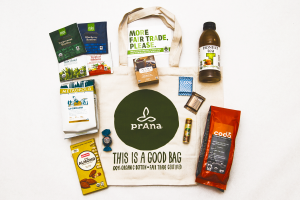
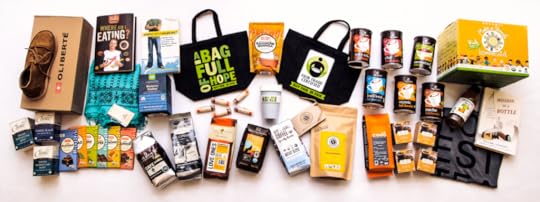
This gift bag is awesome, but pales in comparison to the absolutely gi-freaking-normous grand prize that Fair Trade USA is giving away (both of my books included) for taking their Fairness survey at befair.org.
What does Fair Trade do?
Establishes a minimum price guarantee for farmers to protect them against volatile global commodity markets.
Sets environmental and social standards to protect people and planet.
Pays farmers a social premium that farmers vote on how to spend. This could be on schools, roads, medical facility, or straight up dividing the money among all involved.
Fair Trade should be the way all trade is done
We live in a global economy that respects farmers less and less. Farmers are getting paid less and they are struggling to keep up with the changing climate. In Where Am I Eating I write about seeing Fair Trade in action, and how it’s one of the ways we can positively impact man and land.
Here’s an excerpt:
It’s amazing how often a discussion of food leads to a discussion of family. Annie and I used our family as an excuse to justify the way we’ve always eaten: we have two young kids and don’t have enough time so we need something quick. We need to save money so we can save for the kids’ college.
I’ve come to realize that we shouldn’t use our family as an excuse to justify eating poorly, but as a reason for eating healthier and more justly. How we eat impacts the futures of our children and the futures of farmers’ children around the world. That’s why we eat organic when possible. It’s good for us and it’s better for the farm workers. That’s why we’re trying to eat food that respects the land and people equally. I love my kids as much as Michael, a cocoa farmer who I met in Ivory Coast loves his, and because I know this, and because not eating chocolate is not an option, I need to find ways to support cocoa farmers like Michael with my purchases.
Fair Trade, in its various forms, is part of the answer.
“If we can get people to understand that something as simple as a banana or cup of coffee or a chocolate bar can change people’s lives,” Paul Rice, President of Fair Trade USA told me when I visited their headquarters in Oakland, “then we’re really onto something.”
After Paul told me that he rushed off to meet with some farmers. The office was filled with passionate employees who had traveled all over the earth, including Katie with whom I had traveled with in Colombia to meet the Arhuaco. The office buzzed with exciting ideas like allowing farm and factory workers to register complaints and rate their working environments through surveys on their cell phones. This would give workers a voice and allow brands that source from these farms and factories an on-the-ground look at the working conditions.
Fair trade shouldn’t need a special distinction from other types of trade, it should just be the way all trade happens: transparency of supply chains, environmental and social standards, and trading relationships in which all benefit. That’s all that Michael in the Ivory Coast, Felipe in Colombia, and Juan in Costa Rica are asking for. They don’t want any special treatment. They just want to work and support their families.
Ways to celebrate Fair Trade month
1) Buy something with this logo on it
2) Leave a comment on any of my BeFair posts for a chance to win a gift bag of goodies
3) Take the BeFair.org survey and be entered to win the gi-freaking-normous grandprize
October 10, 2013
Indiana Authors Award
“Dude, why do you live in Indiana?”
I’m repeatedly asked that question, and this week I answered it over at the Indiana Authors Award Blog.
I’m honored to be one of three finalists for this year’s Emerging Author Award. The banquet is sold out, but the award-winning and nominated authors will participate in a book signing and Q&A event at the Indianapolis Central Library on October 26.
Here are the details:
Meet the Authors
Central Library’s Clowes Auditorium
10:30 a.m. – 12 noon
Sit down with the winners and finalists of the 2013 Eugene & Marilyn Glick Indiana Authors Award as they discuss their writing and connections to Indiana. Book sales and signings will follow. Featured will be National Award winner Michael Martone, Regional Award winner James H. Madison, and Emerging Author finalists Tricia Fields, Mike Mullin and Kelsey Timmerman.
Indy Author Fair: Meet Indiana Authors!
Simon Reading Room and R.B. Annis West Reading Room
12 noon – 2 p.m.
Network with more than 40 up-and-coming Indiana authors who represent a variety of writing styles and genres. Book sales and signings will be included. For a list of participating authors, visit www.indianaauthorsaward.org.
If you live in the Indy area, I’d love to see you there. I believe I’m the only underwear journalist nominated this year, so it’s always awkward being around actual writers.
Shutdown threatening our already questionable food security
Marion Nestle author of SAFE FOOD: The Politics of Food Safety writes that the American food system is “breathtaking in its irrationality: 35 separate laws administered by 12 agencies housed in 6 cabinet-level departments.” She calls the fact that more of us aren’t dropping over with food borne illnesses “nothing less than miraculous, a tribute more to our immune systems, the benefits of cooking and food preservation, and plain good luck than to federal oversight.”
I wrote about this in Where Am I Eating?
In 2001, the United State’s Food and Drug Administration (F.D.A.) inspected less than 1 percent of imported foods. After the terrorist attacks on September 11th, 2001, they doubled the amount of imported food inspected. But still in 2004 Tommy Thompson, the then Secretary of Health under the Bush Administration, saw the weakness in our food system and said, “For the life of me, I cannot understand why the terrorists have not attacked our food supply because it is so easy to do.”
In 2012 the FDA inspected 2.3 percent of imported food. Put another way, the FDA inspects one pound of food for every one million that enters the United States.
A decade ago 6 million shipments of imported food arrived to our ports, and now in 2012, we’ll receive approximately 24 million shipments Over that same period of time, the number of FDA inspectors has only grown from 1,350 to 1,800. That’s a 400 percent increase in imports and only a 33 percent increase in inspectors.
That’s scary enough, right? Well, it’s worse now. Because of the government shutdown 45% of the FDA employees have been furloughed. The agency wouldn’t confirm what percent of imported food is currently being inspected, but just that it’s less than 2%.
Let’s hope the terrorist don’t read the New York Times.
October 8, 2013
Most awkward hotel check in ever
I had been in airport world for 12 hours and then had to drive two hours in a beat up rental car to a hotel in wine country in California. Back home I would’ve been in bed for a few hours already.
I was tired and in need of a shower.
I almost told the young woman behind the front desk, “Good morning,” when I pushed my way in through the front door. I hoped she would just throw me the key to my room and I could go and collapse on the bed.
Instead she was chipper.The kind of chipper that exhaustion doesn’t like. The kind that just reminds you of how tired you are. We went through the motions–the credit card for incidentals, the complimentary breakfast instructions–and then things got awkward.
“You are in room 19,” she said. “That’s one of my favorites.”
Awkward silence.