
Barbara Chepaitis's Blog: http://aliterarylunch.blogspot.com/2015/07/frying-mad.html, page 2
January 6, 2016
TARDIS ARE US
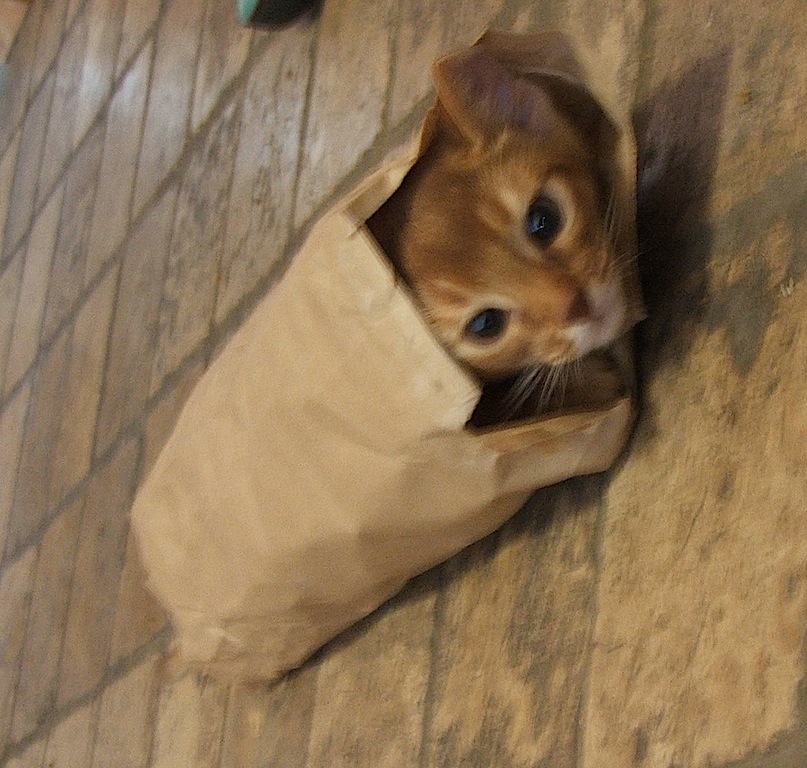 Kitty Seeks Tardis
Today is the Epiphany. For generic Catholics, it’s a celebration of the Three Wise Guys visiting baby Jesus. For Italian Catholics, it’s the day when La Befana, the Christmas Witch, brings her gifts. For Lithuanians, it’s a weird day of strange ritual, such as asking the devil for money, staring at the moon, and doing something called ‘horse dancing.’ That’s a human with a horse head costume, led around by a female ‘gypsy’ with her child, and various contests between the ‘horses’ of different villages, all ending with the ‘horse head’ being cut off. That’s my people, on both sides. Witches, horses, and very interesting ritual. Of course, the name of the holiday - Epiphany - has its own meaning outside of any religion. It is, according to Webster, a moment in which you suddenly see or understand something in a new or very clear way. So while I contemplate the various traditions of my people, I’ll confess that I had my own very contemporary epiphany this morning. It has to do with Dr. Who, a science fiction television series featuring a man known as ‘the Doctor,’ who is a Time Lord, traveling in time and space to save worlds and generally get into mischief. His enemies include Dahleks and Cybermen - basically human minds stuck inside machinery that dictates the need to kill, and assume ultimate power over others. You may already be catching on to the metaphor that created my epiphany. But please do read on. I started watching this series when my son was little, because it came on right after Mr. Rogers on PBS. My son would take his afternoon break and snack watching Mr. Rogers from his high chair, and then he would continue to amuse himself while I watched actor Tom Baker in the role of the Doctor. At the time the series was very low-tech, with sets made mostly of aluminum foil and string, but Tom Baker was such a mad man in the role, and had such great lines (like, “By all means interfere! Always do what you’re best at), I fell in love with the show, with the panache of the Doctor and his companions, and with the concept of being able to wander around space and time in what was, on the outside, a British police box, about the size of a phone booth. Oh, but on the inside. . . . That’s where the magic happened. For those who don’t know, the technical term for the box he traveled in is the TARDIS, which stands for Time And Relative Distance In Space. Because the exterior and the interior exist in different time dimensions, the outside is tiny and unassuming, but the inside is huge. I mean, HUGE. It has a library, a swimming pool, various bedrooms, an art gallery, and more. The Doctor says that it’s interior space is actually infinite, like time itself. And that’s where my epiphany came from. Just so you know, writers often wake up thinking weird things, and if their husband also happens to be a writer, they aren’t afraid to say them out loud. So this morning, I woke up saying to my husband, “I finally get it. The TARDIS is us.” “I have to get my car inspected this morning,” he mumbled in reply. “Really,” I continued. “We are the TARDIS.” “Need to be there at 8,” he muttered. “But it’s true,” I insisted. “Because we’re bigger on the inside than we are on the outside.” My husband opened his eyes, blinked them, and said, “What?” “Humans,” I explained. “We’ve got these lives that are all bound in by work and bills and time and fears and taking the garbage out and these bodies that don’t always do what we want.” “Yeah,” he agreed. “And?” “And on the inside, we’re totally bigger than any of that.” “Really, I have to be at the garage at 8,” he reminded me. I hitched up on an elbow and stared down his schedule. “Don’t you get it? Inside our minds we can go anywhere, anytime, and have any adventure we want. We can save worlds a thousand times over. We can create universes. We can be and do anything, all way the way to infinity. And in our hearts, we can love forever and ever. We’re bigger on the inside than we are on the outside.”
 Us On the Inside “You’re saying you can travel in time?” he asked, as he began to achieve as much consciousness as he’s capable of in the morning. “I do it all the time,” I told him. “So do you.” He considered. “You think maybe that’s peculiar to writers?” “Maybe,” I said. “Or maybe not. I’m guessing everyone has something bigger in their minds and hearts than they have in their every day routine.” “What about Donald Trump?” he asked. “Okay,” I said. “Maybe not him. He might be more like a Dahlek, smaller on the inside than the outside. And maybe that’s the ticket - to figure out who’s bigger inside and who’s smaller inside. Then vote accordingly.” He sighed. “I don’t think you’ll get either the democrats or the republicans to work that platform.” “It doesn’t matter,” I said. “So long as I know. We are the TARDIS.” He got up, and got ready to take his car into the garage and then go to work. I walked the dogs and gave them breakfast, made breakfast for him and for me. But all the while I was doing this, I was also traveling far beyond my daily routine. I was visiting the sun, and the infinite sky. I was talking with my imaginary friends, some of whom are Lithuanian and dealing with issues of immortality and the soul. My dogs, companions in my travels, smelled the essence of the world in ways I might yet be able to understand, once my mind linked with theirs. My husband, that great mystery of a man I married, might yet become comprehensible to me. My early attraction to Dr. Who and his world, combined with my particular heritage of magic and mystery, may explain why I now write novels like The Amber, where folks overcome their own insidious yearning for power over others and reach a sense of the bigness of life. Why I write characters like Jaguar Addams, who is truly bigger than the bureacracy she works in. Why I believed I could, against all odds, rescue an eagle from Afghanistan. No matter if the world sees me as small and inconsequential, perhaps as much of an unnecessary throwback as the British police box, on the inside I’m much bigger. On the inside, I occupy infinity, and am as expansive as all the possibilities of the universe. And those of you who are the same must recognize your own power. Then you must do the work of the Doctor, and save worlds, with panache.

My novel The Amber, which is about selling your soul to the devil and how love interferes with that decision, is available on Amazon in print and ebook format. My Jaguar Addams novels are available at Wildside Books , also in print and ebook.
And now, here’s a recipe for a rather expansive Lithuanian Honey Cake, which relies on time as one of its main ingredients, and will teach you the meaning of infinite yum.
 LITHUANIAN HONEY CAKEFOR THE CAKE
4 Tbsp (1/4 cup) honey
3/4 cup granulated sugar
2 Tbsp unsalted butter
3 large eggs, beaten with a fork
1 tsp baking soda
3 cups all-purpose flour (I used unbleached, organic)
FOR THE FROSTING
32 oz sour cream
2 cups powdered sugar
1 cup heavy whipping cream
OPTIONAL: 2 cups fresh blueberries, which you might want to include between 3 layers of the cake because you know the rules: PLAY WITH YOUR FOOD!
MAKING CAKE, IN TIME
Add 3/4 cup sugar, 1/4 cup honey and 2 Tbsp unsalted butter to a medium sauce pan and melt them together over medium/low heat, whisking gently until sugar is melted (5-7 mins). NO HIGH HEAT! This process requires times, which can’t be rushed unless you own a TARDIS.When the sugar is dissolved, remove from heat. Let it cool slightly, then slowly, thinking of time, add the beaten eggs in a slow steady stream while whisking vigorously and constantly, because a Time Lord or Lady must be constant in their vigilance of world and cake saving, or they’ll just scramble the eggs and the world. Continue until all the eggs are incorporated.Whisk in the baking soda until no lumps remain, then fold in your 3 cups flour, still going slowly because you don’t really have to worry about time, do you? Try for 1/2 cup at a time until the dough is a clay consistency and doesn’t stick to your hands. On a well-floured surface, roll out dough VERY THIN and cut into 9 inch circles, using a pan, a base from a springform mold, or a SONIC SCREWDRIVER to help you measure. You’ll want at least 8 CIRCLES, so work the thinness accordingly. Really thin isn’t bad, because time itself is thin and probably specious. If you need to, sprinkle the top with a little flour too to keep dough from sticking to your rolling pin. Keep the scraps for later, because the Universe doesn’t do waste. Transfer the dough to a large sheet of parchment paper and bake 2 at a time at 350˚F for 4-5 minutes or until golden. WATCH THEM CAREFULLY SO THEY DON’T BURN! They will be hard and un-cake-like, but don’t let that bother you. It’s how they’re supposed to be, and will expand on the inside with time. If they have little pockets of air, you can just crush them like a Dahlek. It’ll be fine. Transfer to a wire rack and let cool completely before stacking. Repeat with remaining layers.Bake the scraps until just done (once again, watch them so they don’t burn). Let them cool and CRUSH THEM LIKE THEY’RE CYBERMEN with a rolling pin, in a food processor or with your trusty Sonic Screwdriver, until you have fine crumbs.
THE FROSTING
1. Beat 1 cup heavy cream until fluffy and stiff peaks form (1-2 min on high speed). In a separate bowl, whisk together 32 oz sour cream with 2 cups powdered sugar. Fold the whipped cream into the sour cream. Refrigerate until ready to use.
2. Spread about 1/3 cup frosting on each cake layer. Don’t skimp. Time and Frosting are infinite, and besides the cake needs to absorb the cream to become soft. In two or three of the layers, add blueberries if you’re using this option. Or try strawberries or raspberries or some other odd flavor of your own choosing instead because you remember the rule: PLAY WITH YOUR FOOD! Press the cake layers down gently as you go to remove air gaps. Frost the top and sides with the remaining frosting.
3. Dust the top and sides with the cake crumbs, then refrigerate overnight. This cake needs TIME to soften, so be patient. As a Time Lord or Lady, you can afford to be.
4. REVEAL how sweet and wonderful your creations are the next day, or even the day after. Have some cake, then step into the TARDIS of your mind and go where you want to go, play how you want to play.


December 8, 2015
JUST SAYING - THE DONALD IS WRONG
 Chaco and Cricket: Yes, we can get along So today, the Donald made a statement saying all Muslims should be kept out of the United States. Let me just say, I disagree. Strongly. Because of my disagreement, today I called my good friend Anjum, to see if she's okay. She's a Muslim from Pakistan, and given the current rhetoric, I was worried about her. Just so you know, Anjum has worked with the FBI as a translator to help catch terrorists. She’s earned her master's degree here, responsibly held down a thriving business for 25 years, raised two beautiful children who work on Wall Street and in Academia, and I helped her write a book about Islamic history. She’s also a painter who has created many incredible, luscious, works of art about Islam. I’ll admit that when I first started working with her I was wary. I knew nothing about Islam, but had recently said to someone that I thought I needed to learn. In the territory of ‘careful what you wish for,’ Anjum came along as a literal godsend, paying me in a respectful way for my work, and learning from me as I learned from her. From me, Anjum learned about writing. From Anjum, I learned more about Islam than most folks in this country ever know. I learned that Mohammad married a businesswoman, and considered her his equal. I learned about his daughter Fatima, who was the light of the world to him. I learned about Ali, Mohammad's son-in-law and adopted heir, whose last words before he was murdered were that if anything happened to him, someone should care for his geese, because they were tame and vulnerable. From Anjum I learned all the beauty of Islam, which only served to remind me that each religion has its own beauty, its own worth to contribute to the world. As a pagan, I have something to teach which the world needs. As a Shia Muslim, Anjum had a great deal to teach me. Let me say this clearly and succinctly: Every religion, in its best form, adds to the blessings of the world. And right now, we can’t afford to ignore any blessings, because certain factions of the political world are trying their best to convince us that beauty and blessings don’t exist except within the tightest of possible parameters. That faction of the political world is wrong. Yes, there are twisted, disturbed factions of all religions that would make us hate, would lead to violence. That’s true in Islam, and it’s also true in Christianity. In fact, for many years we’ve ignored the ‘Christian Peril’ of violence that exists in the KKK and in other factions of that religion. It was Christianity that sent children on the Crusades, Christianity that killed millions of people as heretics, and in the name of Christianity today there are mass shootings, mass killings. (For something on that, see this: http://www.alternet.org/tea-party-and-right/10-worst-terror-attacks-extreme-christians-and-far-right-white-men) But that doesn’t mean Christ was wrong, or that all Christians are killers. Beauty, love, and all that’s good exists wherever there is love. There is love in the hearts of many Christians. And I learned about love from Anjum, a Muslim. I was raised Catholic, married a Rabbi’s son, then went back to my most pagan roots. To Anjum, none of that mattered at all. What mattered was that she recognized me as a loving and intelligent woman, passionate about the art of writing and telling the truth. What mattered to me was that I recognized her as the same. If we speak to each other as one human to another, we find the truth. That shouldn’t be difficult to understand. And when my sister was diagnosed with breast cancer, it was Anjum who prayed with me, Anjum who consoled me, Anjum who understood what it meant to love a sister, and fear losing her.
 Ziggy and Luna: We're good. How About you? I’m not sure why we characterize peril in religious terms rather than recognizing that maniacal killers grow from many roots, including politicians who would sort us according to our ethnicity, or our religious beliefs. Perhaps it’s our longing to belong to something, which we sometimes interpret as needing to make others not belong. More likely, it’s just fear, which we sometimes let outstrip our capacity for love. But Anjum taught me, through the story of her people and through her own particular strength, that our capacity for love is in fact much stronger than our fear. I want you all to remember that in the days ahead. Let your love be stronger than your fear. When in doubt, ask yourself always, what does love require? Then, do it. Do just that. I know it’s not easy, but it really is just that simple.
  My latest novel, THE AMBER, tracks my pagan roots to Lithuania, in a story about a man who sold his soul to the devil, and a young woman who has forgotten that she’s descended from an ancient bee goddess. Yeah. It’s fun. Find it at amazon.com
Now here’s a recipe I developed from all the fine, fine lunches Anjum fed me, and which the chef’s at the Master Chef auditions really liked:
LAMB KOFTA, WITH GOAT YOGURT SAUCE.
PATTIES1 pound ground lamb2 teaspoons GOOD cinnamon (or more, depending on your taste)5 curry leaves, chopped fine1/2 cup pine nuts, ground fine
 Food Teaches Love1/2 cup honey1 tsp salt1 tsp pepper1 tsp garlic powder
SAUCE:
1 cup goat milk yogurt1 cucumber, peeled, seeded and chopped rough1/2 tablespoon sumac1 teaspoon hyssop
Mix all the patty ingredients together in a bowl. Shape them into koftas - oblong patties about 5 inches long and 1 inch thick. Let them rest, because they need rest. They’re about to be cooked, after all.
MAKE THE SAUCEPuree all the sauce ingredients in a food processor or blender. Put it in a bowl in the refrigerator to rest, because WE ALL NEED A LITTLE REST FROM THE CRAZINESS OF THE WORLD, DON’T WE?
Cook the lamb patties:
Heat a large nonstick skillet on medium, and add the patties. Watch them carefully. Because of the honey in them, they burn easily.
After a few minutes, flip them over and cook for a few minutes more. Then, add water to the pan, turn the heat down, and let them cook for perhaps five more minutes.
This part is all about watching the patties, and getting them to the desired carmelization and doneness. Right now, what you want to do is sniff, and watch, and so on. Right now, what’s most important is that you know how to PLAY WITH YOUR FOOD!
When lamb patties are done, plate them, and pour some of the sauce on top.
You can eat them with rice, or in a piece of naan, or as is, as you choose. Enjoy, and may all the blessings of beauty and peace be yours.
July 29, 2015
Why Kill A Lion?
 Cricket does not approve of lion killing Of course, Cecil the Lion is on my mind this week. Also the nameless leopard, the illegal bear, and the many other animals Dr. Palmer killed for no reason except that he apparently likes to kill beautiful creatures. Then, of course, there's that sexual harassment suit he settled on, which I think is all part of the same issue.
While Dr. Palmer puts out statements saying he relied on his guides and thought he was legal in what he refers to as ‘the taking’ of Cecil (aka - the killing), lots of the conversation on Facebook is suggesting that he’s totally missed the point, and rightly so. Legal or illegal doesn’t really matter. What everyone wants to know is why he thinks it’s fun to kill such incredible, beautiful, and increasingly rare wild animals. What possible pleasure could come from that?
 Makes me weep I’m thinking of this photo of him, hoisting the carcass of a most beautiful leopard. Every time I see it, I want to weep. He had no need to kill that big cat. He had no cause to take its life. He has no reason for pride in having done so, because his killing put nothing good into the world. In fact, it only took away. So why does he grin with such immensely undeserved pride in such photos? Why does he puff up like a blowfish, as if he’s actually accomplished something? I have some theories. We all do. Before I say them, let’s keep a couple of things in mind. First, I’m not against hunting in general. My father was a hunter and a fisher. I grew up on deer meat, rabbit meat, turtle soup and trout, pheasant, and the occasional squirrel. For him and for us, hunting put food on the table. We used all the parts, even sending the skins to a tanning guy who made them into shoes and gloves, and we were aware that this was no game. When he took my brothers out hunting with him, he’d give them each one bullet. If they needed another one, they had to find him to get it. He triple locked his guns in a cabinet in the cellar, and God help any one of us he found near it without his permission. I also personally know at least one hunter who goes on Safari, both here and in other countries, responsibly. He hunts wild boar in Florida, and the meat is fed to the local puma population, which needs our support. He hunts in Africa, but only game that can be donated to villages as food. So it is possible to hunt with a sense of your larger place in the scheme of things. My Lithuanian ancestors knew this. They had a prayer which said, in part:
 That my hands may never become bloody from human blood. That the blood of animals, fish or birds may not soil my hands, if I might kill them satiated and not hungry. Those who today kill animals with delight will tomorrow drink human blood.
That I may not fell a single tree without holy need; that I may not step on a blooming field; that I may always plant trees.
This prayer recognizes that we’re predators, but also says we shouldn’t be predators who take life for personal fun. As a species, that’s the wrong direction to go. Clearly, Dr. Palmer doesn’t feel that way. And here’s my next point. He’s not the only one. He’s just become the poster boy for Idiots With Guns. A 2011 report by the International Fund for Animal Welfare says that between 1999 and 2008 Americans ‘lion trophies’ accounted for 64% of all African Lions killed for sport. And there are only about 30,000 lions left in the world. In the whole world. Then, of course, there’s the poaching of leopards for their skin, the decimation of jaguar habitat for drug lords . Let’s also keep in mind that in the middle ages, when the church decided to kill all the cats as familiars of the devil, they ran into the problem of too many rats carrying the plague. At what point, one wonders, will we get it clue that it’s not good to mess with cats, large or small? Never mind. Back to the question: Why does Dr. Palmer do that? What’s the pleasure in this particular kind of killing? How can anyone feel it as pleasure? Certainly they could make other choices as hunters, as humans. There’s two different ways I think of it. One of them is from my series of novels, the “fear” series featuring Jaguar Addams. She works in a prison system that believes all crime grows from fear, and her job is to use her telepathic gifts to make criminals face and overcome the fears that drove their crimes. She says of one man who is like Dr. Palmer, “He’s a petty fascist pig dog who substitutes a gun for the deficit of a tiny prick.” Yeah. It could be that, metaphorically speaking. And there may even be a gender component involved. After all, let’s admit that cats are associated with the human female. I know lots of people who always call cats ‘she’ even when they’re male. Perhaps those who are fearful, insecure about their personal power try to prove it to themselves by killing some large cat creature more powerful, more beautiful in life and spirit, than they could ever be. Or maybe gender doesn’t matter, since Cecil was a big boy. Maybe they just confuse killing with power, not understanding that killing is commonplace, petty, requires very limited intelligence, skill, or strength. And what you get at the end doesn’t enrich your life in any way. It just makes the rest of us poorer. I’m also thinking of a character in another novel, The Amber , where one of the main characters has sold his soul for the chance to control a woman. She is like that Leopard Dr. Palmer hoists against his bare chest. She’s beautiful, and powerful in life, with certain gifts, certain magic he can’t quite grasp how to find in himself. So instead he kills her, and for a short while feels that as control. But then it ends up costing him his soul, and as a soulless man he doesn’t feel, can’t taste his food, can’t even get drunk. He also realizes that the woman he killed and all her power still belongs only to herself, even in her death. Make no mistake: Even before all the furor about Cecil, Dr. Palmer sold his soul, craving a power and control he’ll never find through killing. Perhaps that’s why he, and others like him, seek incrementally greater, larger, prey. The hole in their souls is never filled, because what they seek can’t be found through death. True strength, true pride, never comes from destruction. It grows only from acts of creation and giving. Power comes not from putting ourselves above the power of others, but from recognizing the power we gain when we connect with the greater powers all around us, and help others to do the same. That’s a lesson we all need to learn again and again, in many ways. Certainly it’s a lesson Dr. Palmer and others like him need to learn. Now, we just have to figure out how to teach them. In my novels, many of the men learn such lessons from their interactions with goddess-like women such as Jaguar and Austeja. In this case, we can only hope that Cecil, a magnificent male, has made a sacrifice of his life to help some much weaker human men learn that killing did the opposite of confirming their self-worth. In fact, they’ll have to work a lot harder in order to be as important, as powerful, as strikingly gorgeous, and as well-loved, as he was.
You can learn more about Jaguar at Wildside Press . You can find The Amber at Amazon.com. Now, here’s some food for the soul, to help you in your work of making the world a better place.
SQUASH BLOSSOM GELATO Yes. Really. It’s a good way of keeping the zucchini population in balance, and tasty, too!
 INGREDIENTS
1 cup milk1/2 cup honey1 cup1/2 tsp salt3 egg yolks (Preferably duck eggs, but chicken eggs will do)1 cup heavy creamAbout 1/8 tsp grated fresh nutmeg1/2 cup pine nuts2 cups squash blossoms (from pumpkin, zucchini or other squash is fine)
Get a pan hot on the stove, medium high, and toss the pine nuts into it. Toast them until golden brown and WATCH THEM! Don’t let them burn and lose their souls. When they’re done, take them off the heat and coat them in honey. Put aside for now. They’ll reclaim themselves later.
Chop up the squash blossoms, using mostly the orange parts, though you can also pull out the stamens and pistils and include that in the mix.
Put the milk, sugar, and 1/2 cup of the squash blossoms in a saucepan, on medium high heat until the sugar dissolves. Add the nutmeg, and if you want, you can try a little cinnamon as well because you know the rule: PLAY WITH YOUR FOOD! Stir until milk just comes to a boil, then take the saucepan off the heat and stir a little more. Let it cool for about 15 minutes.
In a separate bowl, beat the egg yolks and remaining sugar until fluffy and happy. Pour a little of the milk mixture into this, and mix it well, tempering the mixture. Then slowly add this back into the milk mixture, stirring constantly.
Put it back on the stove, on medium heat, and stir, stir, stir, until the mixture begins to thicken. When it can coat the back of a spoon, take it off the heat. Put it in the fridge and let it get cool and rested for at least an hour. You can certainly leave it overnight, and do the rest in the morning.
When you’re ready, add the cream to the ‘custard’ and put it all in your favorite ice cream maker. While it’s churning and freezing, drop in the remainder of the squash blossoms.
Now you can either eat it, or put it in the freezer for later, to be enjoyed with even more honey and nutmeg and pine nuts drizzled on top if you like.
July 14, 2015
Frying Mad
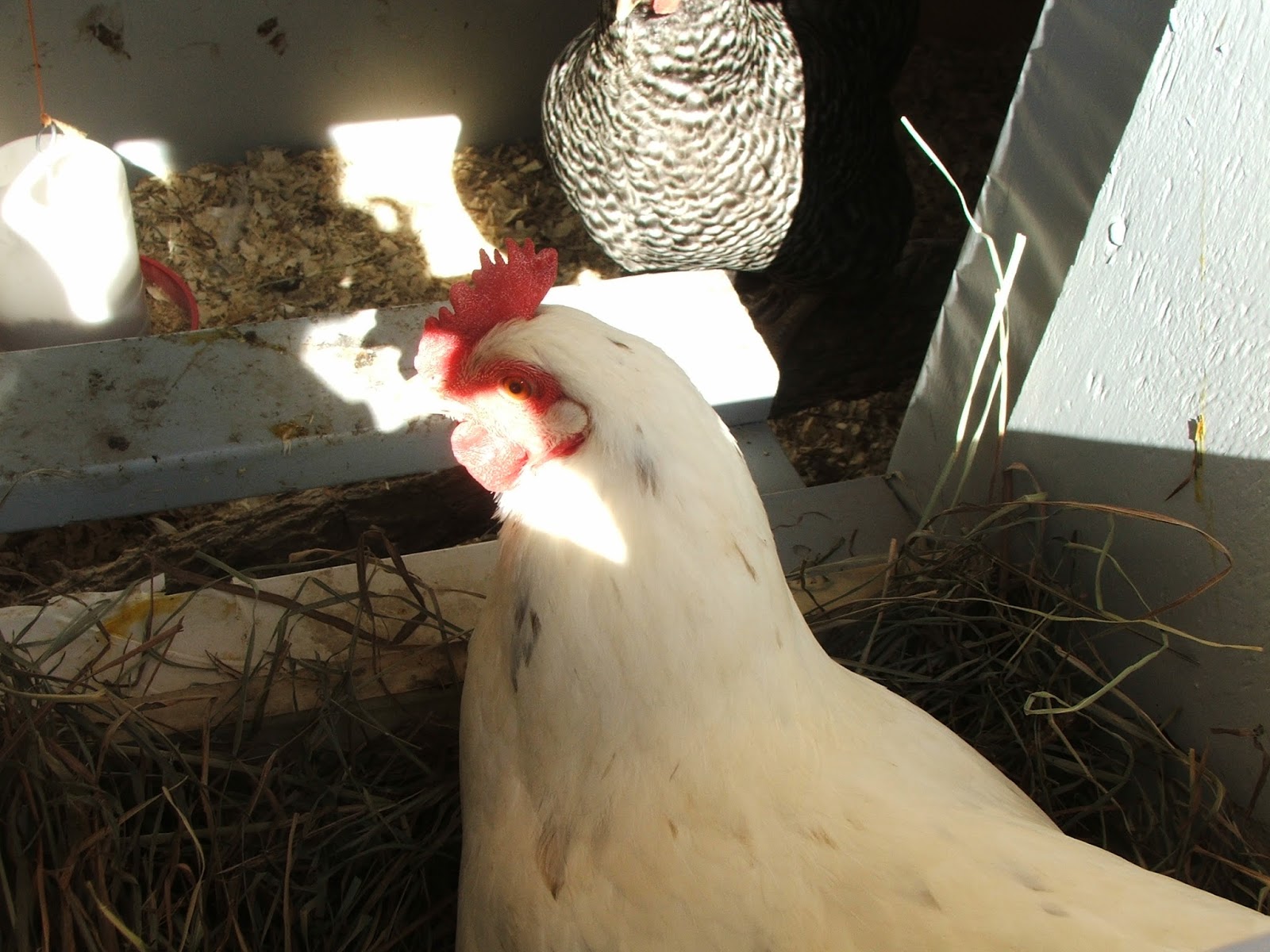 Chicken Frying Mad Today's release of the book, Go Set a Watchman, by Harper Lee, has me frying angry.
 There's plenty of evidence to suggest that the lawyer who arranged this release has lied more than once. Though this book is being touted as a sequel to To Kill a Mockingbird, a New York Times story indicates that it was submitted to publishers in 1957, and thus became the rough draft for the book we all know and love. As a rough draft it's interesting, a way to illustrate the process of moving from original thought to final book.
Unfortunately, that's not how it's being promoted. Instead, the publisher is pushing it as a sequel, as the 'real' story that modifies the iconic literary figure of Atticus Finch.
So here, I have to stop and say to the publishers and lawyers, okay, how low can you go for your greed? And here, I have to stop and say to the American public of readers, do you really crave a narrative that confirms your suspicion of evil more than one that offers you the possibility of good? Is that what the 21st century is all about? Lordie, I hope not.
But if you're uncertain, you should know there's been lots of finagling by the new lawyer who took over Ms. Lee's estate when her sister, Alice Lee, died. There's enough written evidence to suggest that these new lawyers lied on more than one occasion (see: http://wamc.org/post/mockingbird-next-door-marja-mills#stream/0 )
What's even more unfortunate is that most of the American public won't recognize the scam being perpetrated on them, because they haven't looked deeply enough into this to understand that it's not a sequel, but a rough draft.
Let me say that again: IT'S NOT A SEQUEL. IT'S A ROUGH DRAFT.
It was written before To Kill a Mockingbird, and then changed, as the author dug through her own thoughts and amended them to create the work she actually wanted published. That's something all writers do, and though readers may believe books are born fully formed, in fact we all work our way through a number of versions to get to the one we want. That's how writing works. That's how it's done. We start with an idea, and we work it through, with the help of readers and with a further digging into our own motives and ideas.
 To my mind, the way publishing and the legal authorities who have taken over Ms. Lee's estate after her sister's death are even worse than vultures, because vultures are here to clean up the aftermath of death. These folks exist only to feast off of still-living flesh, and that flesh is from one of our finest American authors and her imaginary friends. To my mind, it's as bad as, well, you know, killing a mockingbird.
Barbara Chepaitis is author of the book Saving Eagle Mitch: One Good Deed in a Wicked World, and she continues to protest the use of title and author for the profit of an industry that cares nothing about actual literature or story.
Of course, for this post, I had to include a recipe about frying something. Frying chicken seemed like the most appropriate food, and here it is. How I fry chicken.
FRYING MAD CHICKEN
2 chicken breasts, cut in half
2 chicken thighs
2 drumsticks
2 cups buttermilk
1 teaspoon salt
1 clover garlic, crushed
Get a big bowl and pour in your buttermilk, add the garlic and salt, and put all the chicken pieces in it. Mush them around so they're all covered and cosy. Let them sit overnight in the fridge.
NEXT MORNING:
While you're thinking about the morning after the trial in To Kill A Mockingbird, put together the following, and mix it up thoroughly:
2 cups self-rising flour
1-2 tablespoons tabasco sauce (to taste because you know the rule: PLAY WITH YOUR FOOD!
Pepper to taste
In a separate bowl, beat 3 eggs, and about a cup of the buttermilk from the marinade.
Put a BIG pot on the stove, and add oil to about the halfway mark. Turn the stove on medium high and let the oil heat to 350 degrees.
Dip the chicken pieces in the egg, and then in the flour mixture. Put them into the hot oil, and be careful not to add too much at once. You want the oil to stay at a consistent temperature. The dark meat will cook in about 14 minutes, the white meat in about 10 minutes. Keep turning it, checking it, moving it about, until it's done.
Then enjoy. And go read a good book. One that an author actually wrote rather than one a publishing company decided you should read.
June 21, 2015
Our Father’s Teachings, Our Children’s House
 Honeybees Need Our Help
It’s Father’s Day, and my father gave me a strange and wonderful heritage - the rich and somewhat mysterious traditions of Lithuania. Because of him, I spent much of my life explaining that I’m not Lutheran. I’m Lithuanian. That my name isn’t Greek. It’s Lithuanian. That it rhymes with most inflammatory diseases (bursitis, hepatitis, arthritis and so on). I also blame him, at least partially, for what I choose to write about. My father, like all fathers, wasn’t perfect. He made his errors, some serious, and there was much he didn’t teach me that he should have. But in one area he gave me a great gift: He loved the land, and taught me to do the same. He worked to conserve the wild lands in our county, and he believed in educating us about the need to steward the land well. Because of him I read Rachel Carson’s Silent Spring . Because of him I learned to pay attention to the creatures I shared the world with. As a writer, that translated into understanding that The Muse doesn’t always appear in human form. Therefore, years of unusual bird encounters nudged me to write the novel These Dreams , as well as the nonfiction book Saving Eagle Mitch . Building a house in an area where human and animal encounters are normal inspired the novel Something Unpredictable . And my latest book, The Amber , certainly wouldn’t have been born without my Lithuanian heritage of connection to bees. That’s right. I said bees. Here’s how that started. I was swarmed by bees. Not once, not twice, but three times, and it was painful and scary. I was complaining about it to a friend and he said, “Well, you’re Lithuanian.” “What’s that got to do with it?” I demanded. “Lithuanians have a bee mythology. A bee god and goddess. I think,” he mused, “your ancestors want you to write about them.” “Yeah,” I said. “Sure. I’ll do that.” I meant to, but other projects, paying projects mind you, intervened. In the meantime, my husband and I built a house out in the country, which took some time away from writing about my ancestors’ painful and nonpaying imperative. But as soon as we built the house, a swarm of honeybees gathered at one of our trees. Then, we had an invasion of wasps in the ceiling right above the pillow where I sleep. Finally, another swarm of honeybees decided to build their home inside the walls of our house. After they settled in, they crawled through the walls, until one day, I heard a strange buzzing near an electrical outlet in the office where I write. Being totally ignorant, I unscrewed the outlet cover to see what was going on, and was greeted by WINGS. Lots of BEE WINGS! I clamped the cover down, and took a breath. Honeybees were trying to get to me. Because my father taught me to pay attention to environmental issues, I was aware that honeybees were in trouble. Their population was being decimated by illness that seemed to be connected to a group of pesticides known as neonicotinoids . Thinking of my father, who made me read Silent Spring, thinking of all the good work honeybees do in the world, thinking how important it is that we pay attention to our imprint on the planet, I didn’t want to just kill them. On the other hand, I didn’t want to get stung a lot. After some thought I worked out a system of cardboard, tupperware containers, and duct tape that would allow me to capture and release the bees which were trying desperately to break through the ultimate human glass ceiling of my office. I spent four days fearfully manipulating my home-made rescue operation, until it seemed I’d gotten all I could. I remember the last bee lingering, and saying to it, “Go! Get the hell out of Dodge! Really.” It continued to linger, and so I said, “I promise. I’ll write the damn book. Just go!” When it was gone, I started research in earnest, and found all kinds of fascinating facts about my own heritage, many of which explained Why I am the Way I am. I did what writers do when the muse stings you. I fell in love with this world and its people, which were part of my DNA. The result was The Amber, which pays homage to the Lithuanian bee goddess Austeja, and explores what it means to be dragged back into your own soul, your own heritage, just when you thought you could leave it all behind. But you can’t. My father knew that. The reason we celebrate holidays like Father’s Day, and Mother’s Day, the reason we search out our ancestors, is because their story informs ours, and helps to shape our souls. The more we know about it, the better we can make conscious choices about what we’ll keep, what we’ll leave behind, and where we want the story to go next. Father’s Day isn’t just about what our fathers gave us. It’s also about what we want to do with it next. And that matters. A lot. So the honeybees would say. When I finished the first draft of my novel, I printed it out and stood on my front porch holding it, saying thank you, as I always do for the completion of a first draft.
 As I did, a swarm of honeybees flew down my country road, dipped briefly by me, and moved on. I thanked my father. I thanked the home of his people, Lietuva. And of course, I sent my thanks to the honeybees, hoping we’d do right by them at last.
 The Amber is now available in paperback and kindle format on Amazon. And here’s a yummy recipe for Honey Saffron Ice Cream. When you eat it, think about what you can do to help save the honeybees.
HONEY SAFFRON ICE CREAM
(You can double this recipe to make even more luscious goodness. And I HIGHLY recommend using duck eggs if you have access to them, because it does something intensely desirable to the end results. In cooking, as in environmental issues, small differences can have large effects.)1 cup whole milk3 tablespoons honey (Search out local honey, preferably raw. So good)1/2 cup sugar, divided1 teaspoon crushed saffron threads (Use more if you want because you know the rules: PLAY WITH YOUR FOOD!)3 egg yolks (Hint: QUACK QUACK)1 cups cream
 Can't make this without honeybeesPlace the milk, honey and ¼ cup of the sugar in a medium saucepan. Heat the mixture, stirring occasionally, until the honey and sugar dissolve and steam begins to rise from the milk. Remove the pan from heat.
 Stir in the saffron threads and cover, letting the mixture steep for 30 minutes.
While you’re waiting, say thank you to the honeybees, the cows, the sugarcane and the little crocuses who make the saffron. Saying thank you is good.
Beat the egg yolks and the remaining ¼ cup sugar in a medium bowl with a whisk until they become light yellow and thick. Sing a summer song that lasts about 3 minutes while you work.
Whisk ½ cup of the hot milk into the egg yolks, then very slowly and meditatively, stir this mixture back into the saucepan with the rest of the hot milk. This keeps the egg yolks from being terrified, and therefore scrambling themselves.
Cook over medium-low heat, stirring constantly with a wooden spoon, until the custard coats the back of the spoon and holds an outline if you draw your finger along it. Find another summer song to sing while you work. DO NOT LET THE MIXTURE BOIL!
Strain the custard through a sieve into a bowl. Stir in the cream. Refrigerate at least two hours, or until it has chilled to 40°. You can let this sit overnight, or hurry it along by putting your bowl into a bowl filled with ice, depending on your hurry. Freeze the custard in an ice cream maker, according to the manufacturer’s directions. Transfer to a plastic container and place in the freezer for 30 minutes before serving.
Serve, perhaps topped with some beautifully luscious raw honey or honey and honeycomb. As you raise your spoon, once again say THANK YOU to the honeybees.
March 1, 2015
http://aliterarylunch.blogspot.com/20...
1
Children of the Land
Okay, so it’s March 1st, and it’s snowing. Of course it is. And of course, like many others who live in the Great Northeast, we’ve had it with snow. And brutal, unforgiving cold. And more snow.
Where I live, it can feel even more overwhelming, because from the top of my hill to the bottom is a kind of built-in roller coaster, which is about impossible to drive safely until the plows go through more than once. Even then, with the drifts that blow across the open fields and onto the road, it’s dicey at best.
Plus, out here in the country, many of your neighbors walk on four feet, or use wings, or are rooted in the ground. In the absence of many of those neighbors, winter can feel lonely.
And here’s what I’ve noticed in particular this year: Just as years of teaching has made me extra sensitive to the unspoken signals of other humans, years of being connected to this land has made me sensitive to its particular language.
Children of the Land is the name of my new fantasy novel, and I think it’s true that the landscape we occupy shapes us in many ways. City dwellers find quiet more disturbing than traffic noise. Country folk are nervous when they can’t hear birds. I am a Child of the Land, no less than the characters in my book, and this extra special winter has made me extra specially aware of how deep that connection runs, after 10 years in this place. As if I am as blanketed as the ground I walk in in something cold, and difficult to maneuver.
Well, I suppose there’s something to be said for understanding that connection, because it’s an important one. I feel privileged to have it, because I think there’s lots of folks in the world whose circumstances don’t allow them to move beyond connection with the world of humans and their various technologies. Not that there’s anything at all wrong with human connection. Of course not. That’s crucial, too. But knowing that, in fact, my small life is inextricably intertwined with what happens on the planet, with the circumstances of the land, is also a big deal.
In this season of extremes, I am aware of that in my bones, and in my soul. I don’t just know “I’m part of the web of nature.” I feel the web around me and in me, every day.
I’ve always known that winter is a fine time for sleep and dreams. A fine time for introspection. But the light is coming back, and I miss the earth. Literally, I miss dirt. The smell of dirt. The feel of walking on earth instead of snow. I miss everything green and growing. I’m hungry for enough warmth in the air that I can take off my coat and feel it on my skin.
I’m guessing I’m not the only one who feels that way.
Take heart, Children of the Land. It is supposed to rain later this week, and I’m hoping that dream comes true. Meantime, do what you can to stay connected to the planet, because in spite of all our brain power, all our technology and advanced thinking, our bodies remain a part of the earth we live on.
Children of the Land is very much about love, and coming through winter to spring. You can find it as an ebook or paperback at amazon.com
And now, here’s something green to feed yourself with as you wait for the snow to melt.
ZINGY PEA SOUP
This is pea soup, vegan style. Dried peas remind us that it’s not yet the growing season here. Lemon reminds us that the sun is back. Smoked paprika is waaaarrrrm.
About a tablespoon of extra virgin olive oil
1 large onion, chopped
1 clove garlic (good for you!)
1/2 - 1 cup chopped kale (because how much you want is up to you, and you remember the rule: PLAY WITH YOUR FOOD!)
2 cups dried split peas
5-6 cups water, depending on the consistency you want
Dash of Tabasco, if you want
Teaspoon of chopped dill
About a tablespoon of grated FRESH turmeric (Also GOOD for you! But if you can’t find it, just leave it out. DON’T substitute ground turmeric. It’s not the same flavor)
Juice of 1/2 lemon
Some lemon zest
A pinch or two or three or four of smoked paprika (again, depending on taste and must I remind you of the rule?)
Put olive oil in big pot over medium heat
Add chopped onions, and SWEAT them. (Remember sweat? Seems like a long time ago, right?)
Add Turmeric, water, garlic, and kale. Toss in salt and pepper.
Let it simmer about 15 minutes, then either pour it into a blender and puree, or use a hand blender and puree it.
Add dried peas and lemon juice.
Let it simmer for about half an hour, or until peas are soft.
Now you can either blend it all, or blend half and keep half whole, depending on what you like for consistency (because you remember that rule about PLAY WITH YOUR FOOD, right?)
Children of the Land
Okay, so it’s March 1st, and it’s snowing. Of course it is. And of course, like many others who live in the Great Northeast, we’ve had it with snow. And brutal, unforgiving cold. And more snow.
Where I live, it can feel even more overwhelming, because from the top of my hill to the bottom is a kind of built-in roller coaster, which is about impossible to drive safely until the plows go through more than once. Even then, with the drifts that blow across the open fields and onto the road, it’s dicey at best.
Plus, out here in the country, many of your neighbors walk on four feet, or use wings, or are rooted in the ground. In the absence of many of those neighbors, winter can feel lonely.
And here’s what I’ve noticed in particular this year: Just as years of teaching has made me extra sensitive to the unspoken signals of other humans, years of being connected to this land has made me sensitive to its particular language.
Children of the Land is the name of my new fantasy novel, and I think it’s true that the landscape we occupy shapes us in many ways. City dwellers find quiet more disturbing than traffic noise. Country folk are nervous when they can’t hear birds. I am a Child of the Land, no less than the characters in my book, and this extra special winter has made me extra specially aware of how deep that connection runs, after 10 years in this place. As if I am as blanketed as the ground I walk in in something cold, and difficult to maneuver.
Well, I suppose there’s something to be said for understanding that connection, because it’s an important one. I feel privileged to have it, because I think there’s lots of folks in the world whose circumstances don’t allow them to move beyond connection with the world of humans and their various technologies. Not that there’s anything at all wrong with human connection. Of course not. That’s crucial, too. But knowing that, in fact, my small life is inextricably intertwined with what happens on the planet, with the circumstances of the land, is also a big deal.
In this season of extremes, I am aware of that in my bones, and in my soul. I don’t just know “I’m part of the web of nature.” I feel the web around me and in me, every day.
I’ve always known that winter is a fine time for sleep and dreams. A fine time for introspection. But the light is coming back, and I miss the earth. Literally, I miss dirt. The smell of dirt. The feel of walking on earth instead of snow. I miss everything green and growing. I’m hungry for enough warmth in the air that I can take off my coat and feel it on my skin.
I’m guessing I’m not the only one who feels that way.
Take heart, Children of the Land. It is supposed to rain later this week, and I’m hoping that dream comes true. Meantime, do what you can to stay connected to the planet, because in spite of all our brain power, all our technology and advanced thinking, our bodies remain a part of the earth we live on.
Children of the Land is very much about love, and coming through winter to spring. You can find it as an ebook or paperback at amazon.com
And now, here’s something green to feed yourself with as you wait for the snow to melt.
ZINGY PEA SOUP
This is pea soup, vegan style. Dried peas remind us that it’s not yet the growing season here. Lemon reminds us that the sun is back. Smoked paprika is waaaarrrrm.
About a tablespoon of extra virgin olive oil
1 large onion, chopped
1 clove garlic (good for you!)
1/2 - 1 cup chopped kale (because how much you want is up to you, and you remember the rule: PLAY WITH YOUR FOOD!)
2 cups dried split peas
5-6 cups water, depending on the consistency you want
Dash of Tabasco, if you want
Teaspoon of chopped dill
About a tablespoon of grated FRESH turmeric (Also GOOD for you! But if you can’t find it, just leave it out. DON’T substitute ground turmeric. It’s not the same flavor)
Juice of 1/2 lemon
Some lemon zest
A pinch or two or three or four of smoked paprika (again, depending on taste and must I remind you of the rule?)
Put olive oil in big pot over medium heat
Add chopped onions, and SWEAT them. (Remember sweat? Seems like a long time ago, right?)
Add Turmeric, water, garlic, and kale. Toss in salt and pepper.
Let it simmer about 15 minutes, then either pour it into a blender and puree, or use a hand blender and puree it.
Add dried peas and lemon juice.
Let it simmer for about half an hour, or until peas are soft.
Now you can either blend it all, or blend half and keep half whole, depending on what you like for consistency (because you remember that rule about PLAY WITH YOUR FOOD, right?)
Children of the Land

Okay, so it’s March 1st, and it’s snowing. Of course it is. And of course, like many others who live in the Great Northeast, we’ve had it with snow. And brutal, unforgiving cold. And more snow. Where I live, it can feel even more overwhelming, because from the top of my hill to the bottom is a kind of built-in roller coaster, which is about impossible to drive safely until the plows go through more than once. Even then, with the drifts that blow across the open fields and onto the road, it’s dicey at best. Plus, out here in the country, many of your neighbors walk on four feet, or use wings, or are rooted in the ground. In the absence of many of those neighbors, winter can feel lonely. And here’s what I’ve noticed in particular this year: Just as years of teaching has made me extra sensitive to the unspoken signals of other humans, years of being connected to this land has made me sensitive to its particular language. Children of the Land is the name of my new fantasy novel, and I think it’s true that the landscape we occupy shapes us in many ways. City dwellers find quiet more disturbing than traffic noise. Country folk are nervous when they can’t hear birds. I am a Child of the Land, no less than the characters in my book, and this extra special winter has made me extra specially aware of how deep that connection runs, after 10 years in this place. As if I am as blanketed as the ground I walk in in something cold, and difficult to maneuver. Well, I suppose there’s something to be said for understanding that connection, because it’s an important one. I feel privileged to have it, because I think there’s lots of folks in the world whose circumstances don’t allow them to move beyond connection with the world of humans and their various technologies. Not that there’s anything at all wrong with human connection. Of course not. That’s crucial, too. But knowing that, in fact, my small life is inextricably intertwined with what happens on the planet, with the circumstances of the land, is also a big deal. In this season of extremes, I am aware of that in my bones, and in my soul. I don’t just know “I’m part of the web of nature.” I feel the web around me and in me, every day. I’ve always known that winter is a fine time for sleep and dreams. A fine time for introspection. But the light is coming back, and I miss the earth. Literally, I miss dirt. The smell of dirt. The feel of walking on earth instead of snow. I miss everything green and growing. I’m hungry for enough warmth in the air that I can take off my coat and feel it on my skin. I’m guessing I’m not the only one who feels that way.
 Take heart, Children of the Land. It is supposed to rain later this week, and I’m hoping that dream comes true. Meantime, do what you can to stay connected to the planet, because in spite of all our brain power, all our technology and advanced thinking, our bodies remain a part of the earth we live on.
 Children of the Land is very much about love, and coming through winter to spring. You can find it as an ebook or paperback at amazon.com
And now, here’s something green to feed yourself with as you wait for the snow to melt.
ZINGY PEA SOUP
This is pea soup, vegan style. Dried peas remind us that it’s not yet the growing season here. Lemon reminds us that the sun is back. Smoked paprika is waaaarrrrm.

About a tablespoon of extra virgin olive oil1 large onion, chopped1 clove garlic (good for you!)1/2 - 1 cup chopped kale (because how much you want is up to you, and you remember the rule: PLAY WITH YOUR FOOD!)2 cups dried split peas5-6 cups water, depending on the consistency you wantDash of Tabasco, if you wantTeaspoon of chopped dillAbout a tablespoon of grated FRESH turmeric (Also GOOD for you! But if you can’t find it, just leave it out. DON’T substitute ground turmeric. It’s not the same flavor)Juice of 1/2 lemonSome lemon zestA pinch or two or three or four of smoked paprika (again, depending on taste and must I remind you of the rule?)
Put olive oil in big pot over medium heatAdd chopped onions, and SWEAT them. (Remember sweat? Seems like a long time ago, right?) Add Turmeric, water, garlic, and kale. Toss in salt and pepper.Let it simmer about 15 minutes, then either pour it into a blender and puree, or use a hand blender and puree it.Add dried peas and lemon juice. Let it simmer for about half an hour, or until peas are soft.
Now you can either blend it all, or blend half and keep half whole, depending on what you like for consistency (because you remember that rule about PLAY WITH YOUR FOOD, right?)
July 7, 2014
IN THE SWIM
 Luna loves summer
It’s no longer mud season here on the hill. Long past it, in fact, but with all the rain, you’d never know it. And as my dogs take their daily walks in the woods, they relish mud and water more than women at a day spa relish mud and sea weed and other strange body coverings.
When my husband gripes about the dogs being wet, how much mud they splatter when they shake it off, I sing him the Labrador Retriever song - to the tune of ‘when a man loves a woman.’ Sing it for yourself. With feeling.
When a man gets a labrador retriever, and he has a pond, He must fully expect that dog will often be wet. If a man wants a dry dog, He should have got a Papillon, which is what his wife suggested in the first place. Well, yeah. And if you ask me why he thinks it might someday be otherwise, I have no answer, except that it’s a sign of his eternal optimism. He should know better. Luna, in particular, is a true water dog. I knew this when she was six months old, and I brought her to my sister, Norma’s house, so we could walk her and my sister’s new sheltie puppy, Max, together. A doggie play date. And the first time she took a real swim. We started at her house, which is on the block we grew up on, just up the street from the pond where we took swimming lessons when we were young. Our big test at that time, the marker which said we could go swimming alone, was swimming from shore to the float in the middle of the pond without assistance. I can still remember the first time I did it, how aware I was of my brother standing on shore, his hands on his hips, watching to make sure I didn’t flounder. It seemed very far away, and I was scared I wouldn’t make it, but I did. And when I dragged myself up onto the float, I looked to shore to see him nodding approval. I was a swimmer. For Luna, it was all much easier. We walked our two dogs through the playground adjacent to the pond, took them around the trail and to the small beach. It was early May, and the pond wasn’t open yet, so there were no swimmers. Just a man standing at shore teaching his daughter how to fish for sunnies, a mother and her son building sand castles on shore. We took the dogs off leash, and tossed a frisbee around, which Max loved, and which distracted him from trying to keep the water from lapping the shore. Shelties are herding dogs, and in the absence of sheep, they’ll corral anything that might get out of bounds. But when I tossed the frisbee, since I’m pretty bad at throwing things, it went in the water, and Luna immediately went in after it. She stood there, hip deep, and paused. She shivered meaningfully, as if she’d just seen a Goddess. Then, the frisbee still in her mouth, she started paddling out toward the middle. “She’s swimming,” my sister said. “Shouldn’t you stop her?”
 Mud is GOOD! “Yeah,” I said. “How?” Clearly, there was no stopping her. This puppy was paddling with intent, her gaze focused, every gene in her body telling her she was made to do just this. Just this.She went out well over my head, and swam in large circles, hanging on to that frisbee. “Luna!” I called. She turned toward me, then kept swimming, and if a dog can look beatific, she was all that. Her eyes half open, she paddled with joy, water in her face, water all around her, water, water, everywhere. My sister’s sheltie lingered at the shore and barked, not sure Luna’s paddling was a good thing, but Luna had no doubt at all. As I watched, I understood I was witnessing a living being doing exactly what it was meant to do, exactly everything that brought her joy and dharmic fulfillment. She was being who she was meant to be, and it felt good to her. Really good. Since I have a lot of very active mirror neurons - those parts of the brain that allow us to feel what others around us are feeling - I got the lesson. This is what it looks like to be exactly who you’re meant to be. Witnessing her bliss reminded me of what it’s like to be a writer, or to choose any path that’s, um, unusual and authentic. It’s messy, and sometimes frightening, but if you’re lucky enough to find and follow that path, oh my. Will it feel good? Will it ever. She paddled for more than twenty minutes before I waded out toward her and called her fervently back to dry land. I heard her huff of breath - a doggie sigh - and she turned back to shore. Since that time, she’s ready to leap into water at a moment’s notice. Once or twice I’ve had the pleasure of swimming with her in country creeks. More often, I just watch as she tosses herself into water as if into the heart of a universe that loves her. Mud season, and labs combined with a pond, require a whole pile of towels as well as a mop that’s in constant use, but Luna’s expression is a daily cup of joy, and couldn’t we all use a little of that. Here’s hoping you find and relentlessly pursue the place you’re supposed to be.
 You can learn more about my fictional character, Big Cat woman Jaguar Addams, who knows exactly what she wants to do and does it, at wildside.com . Meantime, here’s a messy little recipe, just for summer fun.
 Life's a - you know.
Swimming Cherries and Frying OnionsReally. Cherries and onions. Something sweet and savory, good for many uses. We had a lot of cherries this week - it’s that time of year - and I wanted to play with them the way Luna swims. This recipe is for a very small experimental bowl - just about a cup - but you can expand it as you like. I know I will
13 Cherries, halved and pitted1 cippolini onion (small and sweet onion. So sweet)1 tbps. flourGOOD olive oilsalt and pepper to tasteSome prosecco, or other sweet white wine ( I actually used a peach moscato, and it was yum)
Put the halved cherries in a bowl with a cup or so of the wine and the salt and pepper and let them get all happy swimming in it for an hour, up to overnight. You’ll know by their smiles that it’s working.
Sip a little of the resultant juice, because it’s goooood.
Slice up a cippolini onion or another small onion, and dredge it in the flour.
Get the olive oil hot in a saute pan and throw in the onions, letting them get brown and crispy, but NOT BURNT! Because they don’t swim and can’t cool off.
Remove the onions, wipe the pan out and add a bit more olive oil. Get it HOT.Toss in the cherries, and move them around as they cook. Add the juices from the bowl and the onions, lower the heat and let it cook a little more, until the liquid goes away.
Use the cherries on chicken or duck, or in a salad. Or just eat them. They’re quite a taste treat.
March 11, 2014
VENGEANCE
 Luna's Tundra Really, what I’m talking about in this blog is climate change, and how humans refuse to recognize our interaction with the rest of the natural world. You’ll get that toward the end. For now, if you like, I’m just talking about cats and dogs, and the weather.
 We’ve changed the clocks to summertime, and that means it’s almost spring, right? RIGHT? Well, not really. In my part of the world, everyone is hunkering down for a snowstorm tomorrow, though right now it’s sunny and almost balmy, in strange contrast to the snow that’s still everywhere. EVERYWHERE. Not that I’m hankering for spring, and my garden and getting rid of my boots, and walking the dogs through meadows instead of over the continuing, infinite tundra. No. Of course not. Luna, of course, is perfectly content. She loves the snow. Labrador Retrievers were bred from Newfoundlands and Springers to create a dog who loved the water, was agile and active, and would do things like retrieve fishing nets from icy cold waters, and clear the ice from the edges of lakes and rivers. Luna, who apparently bred true, will attack ice on our pond with gusto, one of only two times where she’ll show anything like aggression. The other is if someone presents a threat to me. She’s a sweet natured dog, but don’t mess with her pack leader.
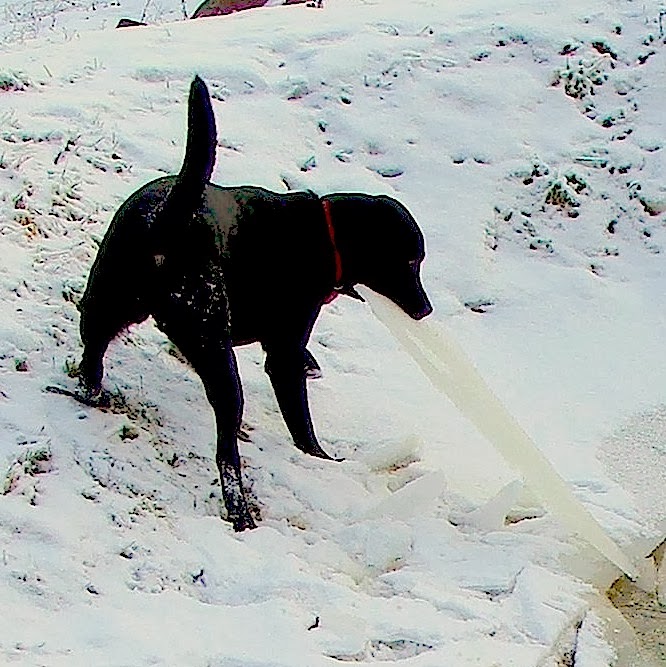 GOT the ice! If you have a healthy respect for the kind of damage a dog can do, you’re smart. At least a million dog bites are reported each year, and maybe a dozen people are killed by dogs. On the other hand, cats are not known to kill by attacking, which is one reason why cruel people and cowards often abuse them. My personal experience tells me that when cats act with aggression the motive is different from what you see in dogs, who attack either to guard territory or people, or from fearful aggression and a lack of training. All the cats I’ve known were aggressive in a more deliberate, pro-active way. Psychokitty, for instance, sized up everyone who came to my house, and if she thought they were no good, she’d stroll over to them and pee on their shoes. As it turned out, she was always right. Then, there was my black cat Chaos, a mighty hunter whom I once saw devour an entire squirrel except for the tail, which he brought to me as a gift. When he was part of my household, a friend made the mistake of giving me a parakeet as a birthday present. As soon as I brought the bird home in his cage, Chaos looked at me as if to say, “You’re kidding, right?” To his dismay, the bird stayed in a cage. He could walk up to it, brood about it all he wanted, but the bird itself was out of reach. He began to hunker down morosely in front of it. There it was, boxed lunch, and he couldn’t figure out how to open the box. As time passed, he would physically droop whenever he passed the cage. Sometimes I’d catch him pawing at the door, then shaking himself and walking away. Then, one day as I opened the cage to put food in, the bird suddenly flew out and began swooping around the room. Immediately Chaos was there, and before I could move a molecule, he leapt up, caught the bird mid-flight, pierced it once in the heart and dropped it. He looked at the lifeless body for a moment, gave a small kitty trill of triumph, and walked proudly away. Though I was truly upset about the bird, I couldn’t help but admire Chaos for his tenacity, and his aim. Cats do not forget. And they do let you know when they’re displeased. Photon did this once when I went away for a weekend, the first time I’d done that since I got him. He was the kind of cat who wanted everyone to stay within the boundaries he proscribed, and when I took Luna for walks he’d pace the windows and the doors, meowing frantically until we returned. I’ve learned since that cats who live in colonies take on different roles, some of them becoming nurse cats for those who are sick, some becoming the cats who prevent fights, and some securing the perimeters, making sure nobody goes beyond their territory. Photon was surely one of those. When I returned from the weekend, Steve greeted me at the door. “Look what your cat did,” he said, and gestured broadly. In front of me I saw all the stuffed animals that belonged to my son when he was a child, stretching in a perfect line from the kitchen, through the living room. I’d kept them in a basket, and he’d taken them all out one by one and lined them up, then beat each one thoroughly. Steve watched him do this. “What?” I asked Steve. “Photon’s been beating them all weekend,” he replied. “He's angry that you went away.”
 Don't Mess With Me I looked to the end of the line. There was my son’s stuffed Alf doll, a figure from a TV show about an alien who hated cats. Photon was trouncing it solidly. We watched for a while in silence. Then Photon grabbed Alf by the back of the neck and dragged it to his lair, totally ignoring me, making his opinion known. Do cats actively seek revenge? Some cat experts say they have the intelligence to plot and plan, and they also have a sense of fairness. But they also say cats only act badly when they’re trying to control a difficult situation. This, I think, is something we can all understand. When the world gets out of control, we also try to bring it back into frame. If cats act badly, they have reason to do so. And here is best incident possible to illustrate that. It happened in the suburban neighborhood where I lived when my son, Matthew, was ten years old. For a while we had a stray Tomcat hanging around, a handsome fellow with long black and white hair. He’d lay in my driveway, indolently rolling around the tarmac and purring. Of course, I fed him. He’d rub against my hand in grand manner, as if he was the Duke of Essex, willing to grant audience to his subjects. He never caused any trouble, and I enjoyed his grand style. One of my neighbors didn’t care for him so much. She worried that he’d bother her two cats, though he’d never gone near mine. But she was a worrying kind of woman, so she bought a trap, baited it with tuna, and caught him. Then she drove him 25 miles away and let him go. Two days later, he was back in my driveway, sunning himself, looking not at all the worse for wear. I fed him, petted him, asked him how he was doing. He purred at me that he was fine, deigned to rub against my hand and meow. After a while he rose, yawned, and strolled away. I wondered how my neighbor would react. The next day I learned her reaction wasn’t the problem. When he left my house, he went and sat under her back porch. As she stepped onto it after work, he attacked her, clawing her badly enough that she had to have eighteen stitches in her leg. Then, he went away again – this time for good. Had he come back all those miles just to let her know he was miffed? Greeted me amicably, then waited under her porch to maul her? If so, what does that teach us?
I’m thinking of a commercial that was popular when I was young, about margarine. In the commercial, Mother Nature was the main character, and she was angry that someone would make a substance to imitate butter, part of her arena. At the end of the commercial, she sent down lightning and said, “Don’t mess with mother nature.” Yeah. All that. As I mentioned before, when cats were indiscriminately killed in the middle ages to suit the new patriarchal religion, the result was an increase in rat popultion, which increased the plagues that killed millions of humans. In so many ways, we have to learn this lesson over and over again, both personally and politically, and cats, half domesticated, willing to live with us but not to serve us, are perhaps our best teachers. As debate rages in the Senate and Congress about climate change
, and those who survived Hurricanes Irene and Sandy shake their heads in wonder, dogs serve to remind us that we interact with nature on a daily basis, and cats remind us that nature is still bigger than we are, that Mother Nature doesn’t forget, and that she will respond when we act unfairly in any way.
Here’s to the dogs. Here’s to the cats. Our best teachers ever.
My novel, Something Unpredictable , is an environmental romantic comedy that has something to say about the choices we make and how they affect the planet. If you feel strongly about that, CALL your representative and let them know. They get paid to represent us, after all. And here's a simple recipe to keep you going while you do.
Avocado Sandwich
Really simple, and very satisfying. You can add slices of tomato or onion or both if you like, because you know the rule: PLAY WITH YOUR FOOD!
 Simple and Happy
1 avocado
1 clover garlic, mashed or grated
About two tablespoons of balsamic vinegar
A slice or two of your favorite cheese (I use cheddar or brie, depending on my mood)
2 slices of your favorite bread
Salt and pepper to taste
Mash the avocado with the garlic, add the vinegar and mash some more. Toast the bread. Slab some of avocado mis onto the bread, sprinkle salt and pepper on top, layer the cheese over this. If you're using the onion and tomato, put this on top. Smush the other slice of bread on top.
Now you can either put the open faced sandwich into a microwave and set it for a minute to let the cheese get melty, OR put some butter in a skillet, heat it up, and then put the sandwich into the skillet and let it get all melty that way, like a grilled cheese sandwich.
Either way, it will taste good, and remind you that nature gives many gifts, which we should appreciate, and return the favor.
March 9, 2014
SHINY: Part II
 I am Dog. Must Have Stick.
There are many shiny things in the world. Some of them are just distractions, the kind the Mohawk refer to in their prayer, ‘keep me from being distracted from the things that glitter on the side of the road.’ Other shiny things are true light, to be followed at any cost. Learning to distinguish between the two is a lifelong task, needing the wisdom and experience of intuition, which is developed by taking a lot of wrong turns, and a few right ones. Luna, as it turned out, was a true light for me, guiding me into a deeper understanding of myself, making me better at loving others, healing some long broken places. Animals of all kinds can do that for us, if we pay attention. If we’re not distracted by the things that glitter along the side of the road. So how did I know enough to push past my own limitations and keep her? Well, partly that’s the nature of my being. I’m a Sagittarius. We resent limitations to begin with. When they pop up, we try to stretch them. But mostly, it’s like I said at the start. It was all about love - both receiving and giving. My husband loved me enough to give her up for my sake. I loved him enough to get her back, for his. It’s really as simple as that. Very simple. Just not easy. Some sayings I’ve learned in the course of therapy come to mind: The only way out is through. And this - The truth will set you free. But first it will hurt like hell. Love almost always asks us to go beyond our own limitations - which, mind you, is not the same as relinquishing yourself. The first asks you to become more of who you are. The latter asks you to slice off a piece of your soul. The first is moving toward light. The latter is usually making a false promise of something that glitters along the side of the road.
 I am Dog. Must Love Mud. And one reason having an interaction with animals is good for us humans is because they don’t make false promises. They are pretty much what they appear to be, and we have to accept them that way. Luna is smart, attentive, high energy and very attached to her humans, but she’s not human, and I need to recognize that. Though she recognizes words, and picks up on mood and emotion better than many humans I know, she’ll always want to roll in poop, always need to be walked, always respond to the genetic code that makes it imperative for her leap into mud puddles, and retrieve sticks. My cats, too, will always be cats, and asking them to be dogs, or otters or anything other than cats, would do them a great disservice. I appreciate them because of their unique shine, just as I appreciate Luna because of hers, and my husband because of his. As humans, our interactions with other species is about that shine, which invites us to enter into the realm of another consciousness, and so expands our own. I think dogs are unique in human history because of the way they’re also willing to enter our consciousness, but that doesn’t make them more valuable than cats, or birds, or the salamanders I find along the paths in the woods I walk. Each species has its own thing to teach us, a different way of viewing what it means to be conscious. They teach us to see things we couldn’t see with our own eyes, as we are willing to view the world through theirs. Right now, I’m thinking of the hummingbird who tried to slam into the ceiling of a greenhouse. I was at a garden shop, looking for fuschia to feed my own local hummers, when I noticed a small female zipping about. I tracked her, and saw that she was zipping up toward the plastic ceiling, ramming into it over and over. Horrified, terrified that she’d kill herself, I got one of the people who worked there and showed her. “Please,” I begged. “Do something.” The woman, older than me and very calm, considered. “I could get a net,” she said laconically, “but then I might hurt her more trying to catch her.”
“But - but she’ll kill herself,” I protested, wringing my hands. “Here’s the thing,” the woman said. “I see them do this a lot, and what happens usually is that after a while, they get tired. When they get tired, they drop down. When they drop down, they see the door, and then they fly out.”
As it happens, at the time I was in a dead end relationship with a man who wasn’t willing to do anything much for me, while I felt compelled to make the thing work. Make it work. Make it work. I’m sure other women know what I mean.
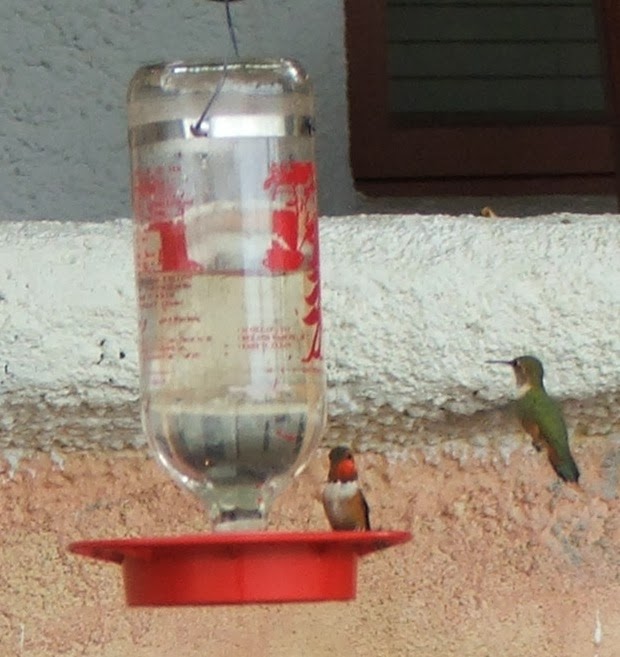 I am Hummer. Must Hummmm. But as I watched, the little hummer did drop down, and did see the door, and sure enough, zipped right through it. I sighed. The woman shrugged. “Like I said,” she commented, and wandered away. She understood the hummer not from the human perspective, but from the bird’s. Her willingness to do so probably saved the creature from being injured, and showed me what I needed to next in my human relationship. All this, from a creature that weighs between .071 and .212 ounces. Animals teach us, in ever so many ways, if we pay attention to what they are, rather than asking them to be us. And that, I think, is at the heart of what’s shiny, rather than what glitters along the side of the road.
 Luna, of course, had a great deal more to teach me about who she is, and with every part of it, I learned more about who I might be.
If you want to read more about birds, try my novel These Dreams. If you want to read more about how one young woman learns the difference between glitter and shine, try Something Unpredicatable . And here's another shiny recipe.
SHINY SMOOTHIE
This smoothie, a fine breakfast, will make you feel shiny because it's full of everything good. Of course, you might want to amend it, and sub out the maple syrup for honey, or peach yogurt for the peaches, and that's just fine because you know the rule: PLAY WITH YOUR FOOD!
 Must Also Contemplate Smoothie BREAKFAST SMOOTHIE1 cup soy, almond, or regular milk 1/3 cup blueberries (I use wild frozen)1 tbsp. ground flaxseed2-3 tbsps. maple syrup
2 teaspoons bee pollen, if you've got it.1/2 of a peach (frozen work, as does some peach yogurt, soy or regular)Put it all in a blender or food processor, pour it in a glass, and drink it up. Yum.


